

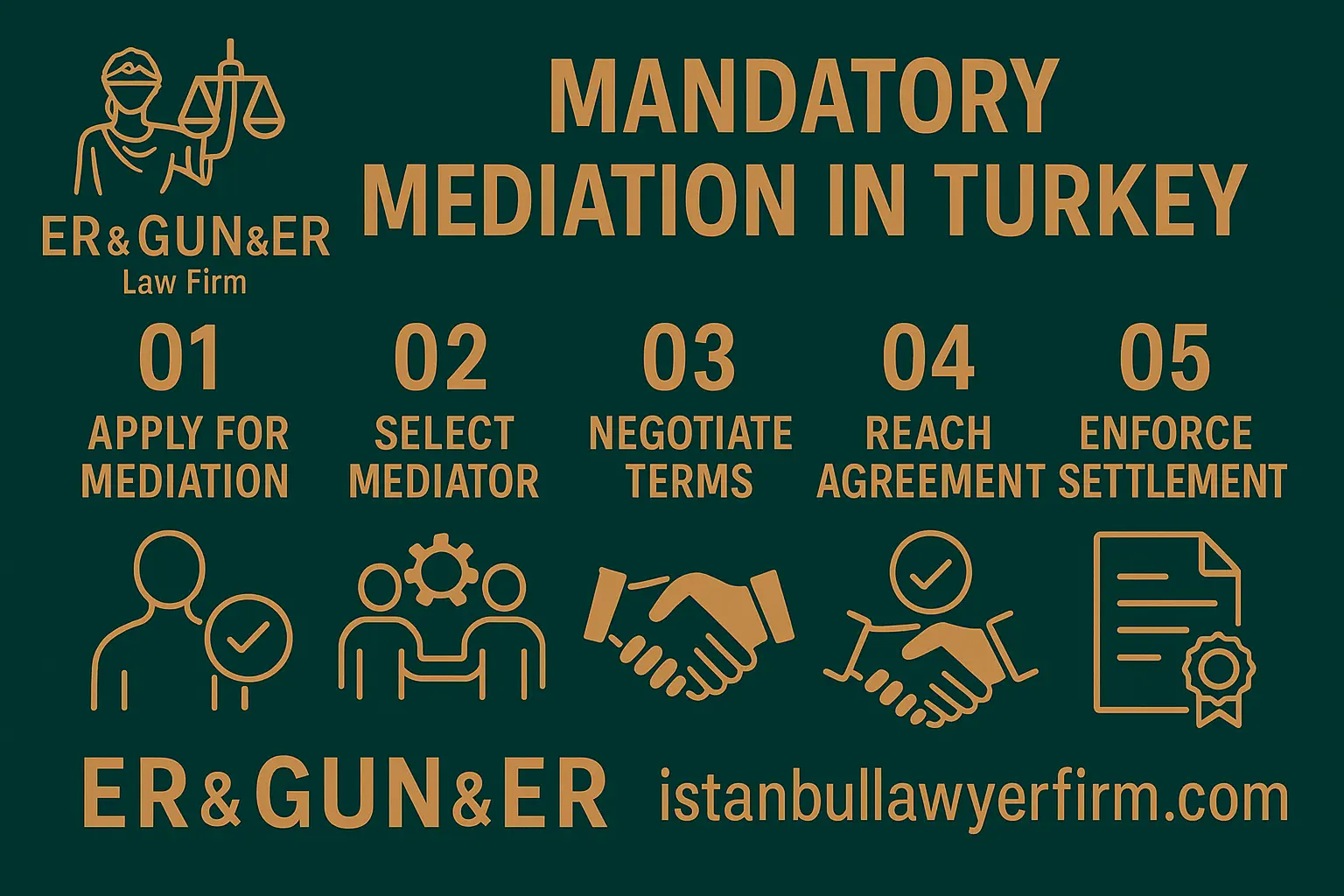
Mandatory mediation in Turkey operates within a progressively expanded statutory framework built on the Law No. 6325 on Mediation in Civil Disputes (Hukuk Uyuşmazlıklarında Arabuluculuk Kanunu) of 22 June 2012 (Official Gazette 28331) establishing the foundational mediation framework, with subsequent legislation adding mandatory mediation as pre-litigation condition (dava şartı) for specific dispute categories. Law No. 7036 on Labor Courts (İş Mahkemeleri Kanunu) of 25 October 2017 established mandatory mediation for individual labor disputes effective 1 January 2018 under Article 3 — covering termination claims, severance pay, notice pay, overtime, wages, annual leave compensation, reinstatement actions, and other individual employment claims. Law No. 7155 of 6 December 2018 added Article 5/A to Turkish Commercial Code No. 6102 establishing mandatory mediation for commercial disputes involving monetary claims effective 1 January 2019 — covering receivables, contract damages, commercial debt recovery, and other monetary claims between merchants. Law No. 7251 effective 28 July 2020 added Article 73/A to Consumer Protection Law No. 6502 establishing mandatory mediation for consumer disputes above consumer arbitration committee monetary threshold. Law No. 7445 of 5 April 2023 (Official Gazette 32165 — Seventh Judicial Package) added Article 316/A to Code of Civil Procedure No. 6100 (HMK) establishing mandatory mediation effective 1 September 2023 for tenancy disputes (rent, eviction, and other landlord-tenant matters), co-ownership dissolution (ortaklığın giderilmesi), and other categories. Mandatory mediation operates as a pre-litigation procedural condition (dava şartı) — failure to complete mandatory mediation before filing lawsuit results in dismissal on procedural grounds without merits review (usulden red). Settlement agreements reached through mediation acquire enforceability certificate status (ilam niteliğinde belge) following court-issued enforceability certificate (icra edilebilirlik şerhi) from Peace Civil Court (Sulh Hukuk Mahkemesi). The progressive expansion reflects Turkish Ministry of Justice policy of shifting resolvable disputes from congested civil courts to structured mediation — reducing court backlog substantially for covered categories based on Ministry statistics since initial 2018 labor mediation implementation. Settlement rates for mandatory mediation typically reach approximately 55-65% for labor disputes and 50-60% for commercial disputes with category-specific variation based on dispute nature and party circumstances. Mediator pool has grown from initial thousands at 2018 labor mediation launch to tens of thousands of registered mediators across specializations by 2025 reflecting profession expansion and specialization development. Practice may vary by authority and year, and mandatory mediation requires specific expertise in the category-framework applicable to each dispute type. A lawyer in Turkey coordinates the mediation strategy, documentation, session conduct, and post-mediation steps determining successful outcomes. For framework on labor court procedure that connects to employment mediation, readers can consult our labor court procedure guide.
Statutory framework and expansion of mandatory mediation
A Turkish Law Firm advising on mandatory mediation works from the Law No. 6325 foundational framework and subsequent legislation expanding mandatory coverage. Law No. 6325 established the initial Turkish mediation framework with mediator qualification requirements, procedural framework, confidentiality protection, and enforceability mechanisms. The initial regime treated mediation as voluntary alternative dispute resolution — parties could pursue mediation by agreement but not compulsion. Shift to mandatory mediation began with Law No. 7036 addressing chronic court backlog in labor courts — labor disputes typically constituted 30-40% of civil court caseload before mandatory mediation, with mandatory pre-litigation mediation designed to filter resolvable cases before court filing. Subsequent expansion through Law No. 7155 (commercial), Law No. 7251 (consumer), and Law No. 7445 (tenancy and other categories) extended mandatory mediation to progressively broader dispute categories. Each expansion applies to qualifying cases filed after the specific effective date — cases filed before mandatory mediation effective date proceeded under prior voluntary framework. Implementing Regulation on Mediation in Civil Disputes (Hukuk Uyuşmazlıklarında Arabuluculuk Kanunu Yönetmeliği) of 2 June 2018 (Official Gazette 30439) provides detailed procedural rules. Practice may vary by authority and year, and statutory framework understanding is foundational for category-specific mediation strategy.
Turkish lawyers who address the mandatory mediation as pre-litigation condition work through the procedural framework determining case progression. Dava şartı (procedural condition) under Turkish civil procedure framework means failure to complete mandatory mediation before filing lawsuit results in procedural dismissal — the court cannot reach merits until the procedural defect is cured. Curing procedural defect may be possible through subsequent mediation completion with refiling, though specific timing and limitation analysis applies. Pre-mediation consultation with legal counsel supports strategic positioning — determining whether the claim falls within mandatory mediation scope, analyzing potential settlement positions, preparing documentary support, and other preparatory work. Filing mediation application to the competent Mediation Bureau (Arabuluculuk Bürosu) at the relevant courthouse initiates the formal process — applications typically filed through UYAP (National Judiciary Informatics System) electronic platform since 2018 digitization. Mediator assignment through random selection from qualified mediator pool at the relevant jurisdiction supports neutrality and impartiality. Initial contact and session scheduling by the assigned mediator begins the substantive mediation process. Practice may vary by authority and year, and procedural discipline throughout the process prevents downstream complications.
An Istanbul Law Firm addressing jurisdiction and venue analysis works through the framework determining which Mediation Bureau handles disputes. Employment mediation jurisdiction typically at the workplace location or employee's residence Mediation Bureau — Law No. 7036 Article 3 specifies specific jurisdictional rules supporting employee convenience. Commercial mediation jurisdiction follows contract performance location, defendant's domicile, or other competent bureau — TTK Article 5/A framework coordinates with general commercial jurisdiction rules. Consumer mediation jurisdiction supports consumer convenience with consumer's residence bureau providing primary option. Tenancy mediation jurisdiction at property location Mediation Bureau for property-specific matters. Parties may agree to specific Mediation Bureau selection in circumstances. Special jurisdiction for specific subject matters (maritime, other specialized disputes) may apply where relevant framework establishes forum. Foreign party involvement does not typically affect Turkish Mediation Bureau jurisdiction for Turkey-situated disputes — foreign parties participate in Turkish mediation under Turkish procedural framework. Transfer between Mediation Bureaus may occur where initial filing was at incorrect bureau with specific procedural framework supporting efficient correction without substantial delay. Multi-district disputes where parties span multiple jurisdictions require analysis of primary filing location with other coordination. Online filing through UYAP permits remote submission eliminating physical travel for initial application regardless of Mediation Bureau location. Practice may vary by authority and year, and jurisdiction analysis affects practical considerations including party convenience and procedural elements.
Mandatory mediation in employment disputes
A lawyer in Turkey coordinating employment mediation works through the Law No. 7036 Article 3 framework as the dominant mandatory mediation category by volume. Scope covers individual labor disputes including termination compensation claims (severance pay — kıdem tazminatı, notice pay — ihbar tazminatı, bad faith compensation — kötüniyet tazminatı, other termination-related claims), wage and overtime claims, annual leave compensation, holiday pay, national holiday compensation, bonus and bonus-equivalent payments, reinstatement actions following termination, mobbing and workplace harassment claims with employment consequence, discrimination claims in employment context, and other individual labor matters. Scope excludes workplace accident (iş kazası) and occupational disease (meslek hastalığı) claims following 2020 legislative amendment — these physical injury and death claims from workplace incidents proceed directly to court without mandatory mediation. Social insurance institution (SGK) direct claims by worker follow specific administrative procedural framework rather than mandatory mediation. Collective labor disputes follow separate procedural framework under Collective Labor Law No. 6356. Practice may vary by authority and year, and employment mediation scope analysis requires verification against current legislative framework.
Turkish lawyers who address employment mediation strategic considerations work through the framework supporting client objectives. Employer perspective considerations include termination decision legal validity (valid just cause under Labor Law Article 25, valid termination under Article 18, other bases), potential exposure quantification (severance, notice, additional claims), reinstatement risk assessment particularly for covered workplace employees, reputation and morale considerations, and other employer interests. Employee perspective considerations include claim quantification across all potential heads, evaluation of reinstatement option versus compensation preference, other claim possibilities, and other employee interests. Settlement negotiation typically addresses comprehensive release for payment amount — protocol structure affects future claim possibilities and tax treatment. Payment structure alternatives include lump sum versus installment, allocation between claim categories (severance allocation versus specific non-compensatory allocation has different tax treatment), and other structural elements. For framework on termination of employment covering substantive framework underlying mediation discussions, readers can consult our termination of employment guide. Practice may vary by authority and year, and employment mediation benefits from integrated substantive labor law and procedural mediation expertise.
An English speaking lawyer in Turkey addressing employment mediation timeline and procedural elements works through the framework governing the process. Timeline under Law No. 7036 Article 3 provides 3-week standard mediation period from mediator appointment to final outcome, extendable by 1 additional week (total 4 weeks) with party consent. Time limit exceeding the statutory period automatically results in non-settlement outcome — mediator must issue final protocol (son tutanak) before period expiration. Session frequency typically one to three sessions depending on complexity and negotiation progress — complex cases with other negotiation challenges may require multiple sessions within the compressed timeline. Power of attorney framework permits lawyer attendance on behalf of clients — parties may attend personally or through authorized counsel with power of attorney language supporting settlement authority. Remote session accommodation through video conferencing developed during COVID-19 pandemic and continues under current framework — supports foreign employee and employer participation without travel. Interpreter requirements for non-Turkish-speaking parties must be arranged in advance — mediator may approve party-arranged interpreter or other arrangement supporting effective communication. Statistical data from Ministry of Justice indicates labor mediation settlement rates typically in 55-65% range with higher rates for smaller claims and routine termination disputes, lower rates for complex mobbing, discrimination, or high-value executive termination claims. Employee cost considerations for labor mediation are significantly lower than litigation — no mediator fees paid by employees in non-settlement outcomes under labor-favorable allocation framework. Employer costs typically include mediator fees and legal representation with substantially lower total cost than full labor court litigation which may extend 18-36 months. For framework on severance pay calculations relevant to mediation negotiations, readers can consult our severance pay guide. Practice may vary by authority and year, and employment mediation procedural discipline supports effective use of compressed statutory timeline.
Mandatory mediation in commercial disputes
A Turkish Law Firm coordinating commercial mediation works through the Turkish Commercial Code Article 5/A framework added by Law No. 7155 of 6 December 2018 (Official Gazette 30617) effective 1 January 2019. Scope covers commercial disputes where the subject matter is monetary payment (konusu bir miktar paranın ödenmesi olan alacak ve tazminat talepleri) — receivables from commercial relationships, contract damages, commercial debt recovery, other monetary commercial claims. Commercial matter definition follows TTK Article 4 framework covering transactions between merchants, relating to commercial enterprise, relating to commercial code-regulated matters, and other commercial characterizations. No monetary threshold applies — all monetary commercial claims regardless of amount trigger mandatory mediation. Scope excludes non-monetary commercial claims — specific performance, injunction, declaratory judgment, and other non-monetary relief proceed directly to court. Bankruptcy and enforcement proceedings follow separate frameworks not subject to commercial mandatory mediation. Specific other commercial categories including cheque proceedings, other specialized commercial matters may follow specialized frameworks. Practice may vary by authority and year, and commercial mediation scope analysis requires attention to claim characterization.
Turkish lawyers who address commercial mediation strategic considerations work through the framework supporting business-to-business dispute resolution. Business relationship preservation considerations often weigh significantly in commercial mediation — ongoing supplier-customer relationships, other commercial relationships continuing beyond disputes, reputation considerations affecting industry relationships, and other relational factors. Settlement structure alternatives include lump sum payment versus installment, partial payment with balance offset against future transactions, goods or services exchange, warranty or other non-cash consideration, and other creative structures. Payment security for settlement amounts including guarantees, escrow, other security mechanisms supports settlement enforcement. Confidentiality provisions particularly valuable for commercial matters — trade secrets, business strategy, other confidential business information often discussed during mediation. Post-settlement business relationship management including specific future transaction terms, dispute resolution for future issues, and other forward-looking elements. For framework on commercial litigation as alternative to mediated resolution, readers can consult our commercial litigation guide. Practice may vary by authority and year, and commercial mediation benefits from integrated commercial law and negotiation strategy.
An Istanbul Law Firm addressing commercial mediation timeline and complex transaction considerations works through the framework supporting sophisticated commercial matters. Timeline under TTK Article 5/A provides 6-week standard mediation period extendable to 8 weeks with party consent — longer than labor mediation reflecting typically greater complexity of commercial matters. Document-intensive nature of commercial mediation often requires extensive pre-session preparation — contract analysis, correspondence review, payment records, delivery records, other documentation. Expert involvement may be valuable for specific commercial matters requiring technical assessment — accountants for financial matters, engineers for construction or manufacturing disputes, other technical experts. Multi-party commercial disputes with three or more parties require procedural coordination — supply chain disputes with other multi-party dynamics may involve multiple Mediation Bureau applications with coordination. Cross-border commercial matters with foreign party involvement proceed under Turkish Mediation Bureau framework with other international dimensions. Document-intensive commercial mediations may benefit from pre-session document exchange permitting more focused session time — mediator may facilitate document organization and issue identification before formal session. Expert joint engagement where parties agree to joint accountant or other expert appointment supports factual issue resolution with economy of effort. Mediation of complex supply chain disputes typically requires phased approach addressing specific component disputes progressively rather than attempting comprehensive single-session resolution. Post-mediation commercial relationship continuation often benefits from transition protocols addressing future transaction terms, dispute resolution mechanisms for emerging issues, and other forward-looking framework elements. For framework on commercial dispute resolution spanning mediation, arbitration, and litigation alternatives, readers can consult our commercial dispute resolution guide. Practice may vary by authority and year, and commercial mediation requires sophisticated substantive and procedural preparation.
Mandatory mediation in consumer and tenancy disputes
A lawyer in Turkey coordinating consumer mediation works through the Consumer Protection Law No. 6502 Article 73/A framework added by Law No. 7251 effective 28 July 2020. Scope covers consumer disputes (tüketici uyuşmazlıkları) above the consumer arbitration committee (tüketici hakem heyeti) monetary threshold — consumer disputes below specific threshold proceed through administrative arbitration committee framework, while disputes above threshold require mandatory mediation before court filing. Threshold updates annually through revaluation rate with other periodic adjustments — current thresholds should be verified at claim filing date. Consumer definition under Article 3 covers natural persons acquiring goods or services for non-commercial or non-professional purposes from commercial or professional providers. Scope covers defective goods and services claims, misleading advertising claims, warranty breach claims, installment sale disputes, distance sale disputes, consumer credit disputes, and other consumer matters. Scope excludes non-consumer transactions and other categories falling outside consumer protection framework. Timeline and procedural framework similar to commercial mediation with modifications reflecting consumer context. Practice may vary by authority and year, and consumer mediation scope analysis requires current threshold verification.
Turkish lawyers who address consumer mediation strategic considerations work through the framework balancing consumer protection with efficient resolution. Consumer perspective considerations include claim quantification across direct damages and other recoverable amounts, enforcement considerations for settlement collection, other consumer interests. Business perspective considerations include reputation and customer retention balance, settlement precedent effects for other consumer claims, brand and commercial impact of specific resolution patterns, and other business interests. Class action mechanisms are limited under Turkish law — individual consumer claims proceed through individual mediation and litigation, though consumer protection associations have procedural roles in circumstances. Settlement structure for consumer matters typically addresses defect remediation (repair, replacement, refund, discount), damages compensation, and other relief. Consumer arbitration committee (tüketici hakem heyeti) interaction with mandatory mediation creates two-tier structure — disputes below arbitration committee threshold proceed through administrative arbitration committee as primary resolution mechanism, disputes above threshold require mandatory mediation before court filing. Threshold adjustment through annual revaluation requires current verification for applicability analysis. Bad faith conduct in consumer mediation may trigger additional liability under Consumer Protection Law sanctions framework with administrative fines and other consequences. For framework on consumer protection laws covering substantive consumer rights, readers can consult our consumer protection laws guide. Practice may vary by authority and year, and consumer mediation benefits from specialized consumer protection and mediation expertise.
An English speaking lawyer in Turkey addressing tenancy mediation works through the Code of Civil Procedure Article 316/A framework added by Law No. 7445 (Seventh Judicial Package) effective 1 September 2023. Scope covers tenancy (kira) disputes including rent collection claims, eviction actions (tahliye davası) covering various grounds including non-payment, breach of lease terms, personal use, and other grounds, rent adjustment disputes (kira tespiti), security deposit disputes, damage claims by landlord or tenant, and other landlord-tenant matters. Scope also covers co-ownership dissolution (ortaklığın giderilmesi) actions for joint property ownership division, partnership dissolution (ortaklık ilişkisinden kaynaklanan) disputes between business partners, and other categories. Enforcement through İcra İflas Kanunu (ilamsız icra) for specific rent collection scenarios interacts with mandatory mediation framework with other procedural considerations. Tenant-landlord relationship preservation often affects mediation strategy — continuing tenancy vs termination determines appropriate settlement structure. Pre-mediation notice requirements applicable to specific tenancy actions (particularly eviction for non-payment under Turkish Code of Obligations Articles 315-316 with specific warning requirements) must be satisfied before mediation initiation — procedural defects in substantive notice cannot be cured by mediation completion. Rent adjustment mediation addresses inflation-adjusted rent calculation with Turkish Statistical Institute indexes providing baseline reference. Security deposit disputes typically involve evidence preservation for property condition — move-in and move-out inspection documentation, photographic evidence, and repair estimates support settlement negotiation. Multi-unit landlord disputes with multiple tenants typically require individual mediation proceedings rather than consolidated approach. For framework on commercial lease termination as specialized tenancy mediation category, readers can consult our commercial lease termination guide. For framework on eviction procedure integration with mediation, readers can consult our eviction procedure guide. Practice may vary by authority and year, and tenancy mediation since September 2023 requires familiarity with the relatively new procedural framework.
Mediator qualification and procedural workflow
A Turkish Law Firm coordinating mediator selection and engagement works through the qualification and procedural framework established under Law No. 6325 and implementing regulations. Mediator qualification requirements include Turkish citizenship, legal capacity, specific professional experience (typically 5 years in law, judging, prosecution, or other legal profession), completion of 180-hour basic mediation training, 25-hour mediation internship, passing the Ministry of Justice mediation qualification examination, and other requirements. Specialized mediation certifications address specific categories — labor mediation specialization, commercial mediation specialization, consumer mediation specialization, and tenancy mediation specialization with specific additional training and certification. Mediator registration with the Ministry of Justice Mediation Department (Arabuluculuk Daire Başkanlığı) maintains professional standards and availability tracking. Mediator appointment through random selection from qualified mediator pool at the relevant Mediation Bureau supports neutrality — parties can in circumstances request specific mediator by mutual agreement though default is random assignment. Mediator impartiality and independence obligations apply throughout the process with specific disclosure requirements for potential conflicts. Practice may vary by authority and year, and mediator qualification discipline maintains process quality and outcome enforceability.
Turkish lawyers who address mediator fee framework work through the regulation governing mediation costs. Ministry of Justice Mediation Fee Tariff (Arabuluculuk Ücret Tarifesi) establishes mediator fees by case type and outcome. Non-settlement outcome fees: first 2 hours of mediator time paid by Ministry of Justice Judicial Support Fund, additional time allocated between parties per framework. Settlement outcome fees: typically allocated to parties proportional to settlement amount or by specific agreement. Labor mediation fees lower than commercial reflecting policy preference for employee access. Commercial mediation fees based on claim amount with graduated scale. Consumer mediation fees on framework balancing consumer protection with mediator compensation. Fee increase for complex multi-party matters, extended timeline, other complexity factors. Payment mechanics including advance payment, final adjustment at completion, other payment procedures. Practice may vary by authority and year, and fee framework understanding supports accurate cost expectation for mediation participants.
An Istanbul Law Firm addressing procedural workflow from application through completion works through the integrated framework managing specific process stages. Application submission through UYAP electronic filing or physical filing at Mediation Bureau — application content includes party identification, dispute description, claim amount where relevant, other required elements. Application review by Mediation Bureau verifies mandatory mediation applicability, jurisdictional competence, other procedural matters. Mediator assignment through random selection triggers mediator notification and initial contact obligation. Initial meeting and substantive sessions conducted by mediator at mediator's office, other location, or remote via video conference. Separate caucuses (ayrı oturum) where mediator meets each party individually during session support confidential negotiation discussions. Joint sessions (ortak oturum) where all parties meet together support direct communication. Final protocol preparation by mediator documents outcome — settlement agreement (anlaşma tutanağı) where parties agree, non-settlement protocol (anlaşmama tutanağı) where agreement cannot be reached, partial settlement documenting scope and other mixed outcomes. Timeline tracking throughout process ensures statutory period compliance — mediator maintains session dates, party attendance, substantive progress, and other procedural records supporting final protocol accuracy. Translation and interpretation costs for non-Turkish proceedings typically allocated between parties by mediator direction or settlement agreement. Travel costs for remote party attendance where physical session is required may affect mediation economics particularly for cross-border matters. Session format selection (physical versus remote versus hybrid) reflects party preferences, mediator availability, and practical considerations. Practice may vary by authority and year, and workflow discipline supports effective use of mediation procedural framework.
Session conduct and settlement architecture
A lawyer in Turkey coordinating mediation session conduct works through the framework supporting client interests during the negotiation process. Pre-session preparation includes substantive case analysis identifying claim and defense strengths, financial analysis quantifying potential outcomes, settlement position development with walk-away alternatives, documentary evidence organization, witness or expert coordination where relevant, and other preparation. Power of attorney framework for lawyer attendance on behalf of clients — clients may attend personally, send authorized representative with power of attorney for settlement authority, or attend jointly with lawyer. Opening statement preparation addresses dispute framing, party position, relevant supporting facts, and constructive tone supporting negotiation. Substantive negotiation typically progresses through position identification, interest exploration beyond stated positions, option generation for mutual gain, other negotiation techniques. Settlement authority management particularly for corporate parties requires clear decision-making protocol — who can agree to specific terms, escalation for approvals beyond authorized levels, other decision-making framework. Practice may vary by authority and year, and session conduct discipline determines whether mediation achieves settlement or requires court proceeding.
Turkish lawyers who address settlement agreement drafting work through the framework establishing enforceable post-mediation obligations. Settlement agreement structure typically addresses payment terms (amount, timing, method, other payment elements), specific action requirements (performance of specific obligations, other conduct requirements), release provisions covering claims and potentially broader scope, confidentiality provisions protecting mediation content and potentially settlement terms, dispute resolution for post-settlement disagreements, and other substantive provisions. Comprehensive release drafting affects ability to bring future claims — narrowly drafted releases preserve other claims while broadly drafted releases cover comprehensive dispute scope. Conditional settlement agreements where specific contingencies affect effectiveness require careful drafting. Multi-party settlements with allocation among parties require coordinated agreement structure. Currency and payment structure particularly for cross-border settlements addresses payment mechanics. Tax consequences of settlement structure affect net recovery — allocation between claim categories affects tax treatment, other tax considerations. Settlement form compliance requires written format with party signatures and mediator attestation — oral agreements are not recognized under mandatory mediation framework even where parties reach consensus. Mediator role in drafting settlement agreement is facilitative rather than representative — mediator may draft standard protocol but substantive terms reflect party agreement with legal representation recommended for complex terms. Comprehensive release versus narrow release drafting strategy depends on relationship continuation expectations, potential other claim risks, and client tolerance for residual risk. Practice may vary by authority and year, and agreement drafting discipline determines whether settlement achieves intended outcomes.
An Istanbul Law Firm addressing non-settlement scenarios and continuation to litigation works through the framework governing post-mediation proceedings. Non-settlement protocol (anlaşmama tutanağı) documents failure to reach agreement and completes mandatory mediation procedural condition. Timing for court filing after non-settlement is subject to limitations — statute of limitations tolling during mediation supports other filing, court filing within reasonable time following non-settlement protocol issuance. Information developed during mediation remains subject to confidentiality protection and cannot be used as evidence in subsequent litigation except in limited exceptions. Mediator cannot be compelled to testify regarding mediation content. Settlement position offered during mediation cannot be introduced as admission in subsequent litigation. Partial settlement allowing agreement on specific issues while preserving other issues for litigation provides middle-ground alternative — partial settlement protocol documents agreed scope and other unresolved issues. Re-mediation after initial non-settlement is not mandatory but may be pursued voluntarily if circumstances warrant. Practice may vary by authority and year, and non-settlement planning supports smooth transition to litigation where that path becomes necessary.
Confidentiality, enforceability, and agreement effects
A Turkish Law Firm coordinating confidentiality management works through the Law No. 6325 Article 4 framework protecting mediation content. Confidentiality obligation applies to all parties, mediator, and participants — covers all statements, documents, proposals, and other information shared during mediation process. Evidentiary protection prevents use of mediation content as evidence in subsequent litigation — specific statements, proposed settlement terms, admissions made during mediation cannot be introduced in court except in limited exceptions. Mediator testimonial immunity prevents compelled testimony about mediation content — even party subpoena cannot require mediator disclosure. Limited exceptions include criminal proceedings for crimes committed during mediation, other legal disclosures required by law, other narrow circumstances. Confidentiality extension through separate agreements for enhanced protection particularly for sensitive commercial or personal matters supports other confidentiality concerns. Breach of confidentiality may trigger other liability including damages claims with specific limitations. Practice may vary by authority and year, and confidentiality framework understanding supports effective participation in sensitive mediations.
Turkish lawyers who address settlement agreement enforceability work through the Law No. 6325 Article 18 framework and court enforceability procedures. Settlement agreement (anlaşma tutanağı) signed by parties and mediator constitutes binding agreement between parties with contract law enforcement through subsequent litigation if breached. Enforceability certificate (icra edilebilirlik şerhi) from Peace Civil Court (Sulh Hukuk Mahkemesi) upgrades settlement agreement to enforceable document status (ilam niteliğinde belge) permitting direct enforcement through Enforcement Office (İcra Müdürlüğü) without separate court proceeding. Certificate application to Peace Civil Court includes settlement agreement with supporting documentation. Court review verifies form compliance, parties' capacity, other formal elements without substantive merits review. Certificate effect supports direct enforcement action through İcra Müdürlüğü using standard enforcement procedures — asset attachment, bank account attachment, salary attachment, and other enforcement mechanisms. Time for enforcement action typically 10 years from certificate or other limitation based on claim type. Certificate is not required for voluntary performance — most settlement agreements are performed without court enforcement needed. Certificate application fee is modest (nominal court fee) compared to substantive litigation costs and supports efficient enforcement pathway. Territorial jurisdiction for enforceability certificate is Peace Civil Court at settlement signing location or party domicile with practical flexibility. Certificate refusal is extremely rare — court review is formalistic and settlement agreements meeting minimum requirements receive certificate routinely. Post-certificate enforcement through İcra Müdürlüğü follows standard enforcement procedures with creditor-favorable timeline typically 2-6 months from enforcement initiation to asset recovery depending on debtor cooperation. Foreign party enforcement against Turkish assets proceeds through same enforcement framework without additional procedural barriers. Practice may vary by authority and year, and enforceability certificate strategy depends on settlement payment structure and voluntary performance expectations.
An English speaking lawyer in Turkey addressing tax and other post-settlement considerations works through the framework managing settlement consequences beyond core substantive terms. Tax treatment of settlement payments varies by payment characterization — employment settlements have tax treatment with allocation affecting gross versus net amounts, commercial settlements affect deductibility and other corporate tax implications, consumer settlements have other tax considerations. Reporting obligations for settlement payments include withholding where applicable, information reporting, and other tax compliance. Settlement allocation between claim categories affects tax treatment — severance allocation versus specific wage allocation in employment has different tax treatment. Corporate settlement documentation affects financial statement treatment — provision and settlement accounting for other reporting effects. Regulatory implications for specific industries affect settlement structure — banking, insurance, other regulated industry settlements may require specific regulator notification or approval. Insurance coverage for claim categories may apply to settlement payments with specific coordination requirements. Practice may vary by authority and year, and post-settlement tax and compliance discipline protects expected settlement economics.
International mediation and Singapore Convention framework
A lawyer in Turkey coordinating international mediation aspects works through the framework applying to cross-border dispute resolution. Singapore Convention on Mediation (United Nations Convention on International Settlement Agreements Resulting from Mediation) of 2018 provides international enforcement framework for mediated settlement agreements — Turkey signed the Convention on 25 June 2019. Convention coverage addresses commercial international settlement agreements reached through mediation with specific exclusions for consumer, employment, and family matters. Enforcement framework provides that parties can invoke settlement agreement directly against non-complying party in courts of signatory states — parallel to New York Convention framework for arbitration awards but specifically for mediation settlements. UNCITRAL Model Law on International Commercial Mediation (2018) provides framework for harmonized domestic legislation — Turkey's Law No. 6325 preceded the Model Law but parallels many concepts. Turkish mediation settlements with international parties benefit from enforceability framework supporting cross-border recognition. Convention entry into force occurred on 12 September 2020 after sufficient ratifications were obtained — Turkey's ratification status should be verified through current Ministry of Foreign Affairs records for applicability analysis in particular cases. Ratifying states to date include Singapore, Fiji, Qatar, Saudi Arabia, Belarus, Ecuador, Honduras, Georgia, Jordan, Nigeria, Kazakhstan, Sri Lanka, and additional countries with ongoing ratification activity from commercial trading partners. Coverage distinction between Singapore Convention (international commercial mediation) and domestic mediation frameworks supports specialized analysis — domestic Turkish mediation under Law No. 6325 continues parallel to Singapore Convention framework for qualifying international matters. Commercial-only scope of Singapore Convention excludes employment, consumer, and family matters from international enforcement framework — these categories continue under domestic enforcement mechanisms of relevant jurisdictions. Practice may vary by authority and year, and international mediation framework continues developing with expanding Convention ratifications and other developments.
Turkish lawyers who address multi-jurisdictional mediation coordination work through the framework managing disputes spanning Turkish and foreign legal systems. Jurisdiction selection for mediation between Turkey and other countries may involve forum selection clauses in contracts, neutral third-country venue selection, other forum considerations. Language management for multi-jurisdictional mediation typically requires English working language with Turkish documentation where Turkish court enforcement may be sought. Applicable law selection affects both substantive dispute resolution and mediation procedural framework — other choice of law considerations. Foreign party participation mechanics include authorized representative attendance, remote participation via video conference, translated documentation, other accommodation. Enforcement across jurisdictions through Singapore Convention (where applicable), bilateral treaties, other international frameworks. Cross-border tax treatment coordination between Turkish tax framework and foreign party home country tax framework affects settlement structure. For framework on international arbitration which provides alternative for cross-border commercial disputes, readers can consult our international arbitration guide for foreign companies. Practice may vary by authority and year, and international mediation benefits from integrated Turkish and foreign legal expertise.
An Istanbul Law Firm addressing remote mediation and digital developments works through the framework supporting modern mediation practice. Remote mediation through video conferencing developed extensively during COVID-19 pandemic continues under current framework — legal basis under Law No. 6325 and implementing regulations supports remote sessions with party consent. Technical requirements include adequate video conferencing capability, document sharing capacity, secure communication for confidential discussions, other technical infrastructure. Party verification in remote settings addresses identity confirmation through other identification procedures. Document exchange through secure electronic platforms with other security considerations. Electronic signature on settlement agreements under Electronic Signature Law No. 5070 supports remote settlement execution. UYAP integration for application, mediator assignment, and other procedural elements facilitates digital workflow. Hybrid models combining physical and remote participation support complex multi-party mediations where specific parties attend physically and other parties participate remotely. Digital confidentiality protection requires attention to video conference security, document encryption, and other digital security measures. Electronic document exchange with encrypted channels supports confidentiality maintenance across remote sessions. Recording restrictions apply to remote mediation sessions — recording is generally not permitted without party consent and conflicts with confidentiality framework. Platform selection for remote mediation requires balance between accessibility for all parties and security features protecting sensitive discussion. Mediator technical proficiency with remote platforms supports smooth session conduct without technical interruption. Practice may vary by authority and year, and remote mediation frameworks continue developing with technology and procedural refinements.
Author: Mirkan Topcu is an attorney registered with the Istanbul Bar Association (Istanbul 1st Bar), Bar Registration No: 67874. His practice focuses on cross-border and high-stakes matters where evidence discipline, procedural accuracy, and risk control are decisive, with particular concentration on mandatory mediation representation across employment, commercial, consumer, and tenancy dispute categories in Turkey within the integrated statutory framework combining Law No. 6325 on Mediation in Civil Disputes (Hukuk Uyuşmazlıklarında Arabuluculuk Kanunu) of 22 June 2012 (Official Gazette 28331) with Implementing Regulation of 2 June 2018 (Official Gazette 30439), Law No. 7036 on Labor Courts (İş Mahkemeleri Kanunu) Article 3 establishing mandatory mediation for individual labor disputes effective 1 January 2018 covering severance, notice pay, wages, overtime, annual leave compensation, reinstatement, mobbing, and discrimination claims with workplace accident and occupational disease exclusion following 2020 amendment, 3-week timeline extendable to 4 weeks, Turkish Commercial Code Article 5/A added by Law No. 7155 of 6 December 2018 (Official Gazette 30617) establishing mandatory mediation for commercial monetary claims effective 1 January 2019 with no threshold covering receivables and contract damages between merchants, 6-week timeline extendable to 8 weeks, Consumer Protection Law No. 6502 Article 73/A added by Law No. 7251 effective 28 July 2020 establishing mandatory mediation for consumer disputes above consumer arbitration committee threshold with specific consumer protection framework, Code of Civil Procedure No. 6100 Article 316/A added by Law No. 7445 of 5 April 2023 (Official Gazette 32165 — Seventh Judicial Package) establishing mandatory mediation effective 1 September 2023 for tenancy disputes covering rent, eviction, security deposit, and specific landlord-tenant matters plus co-ownership dissolution (ortaklığın giderilmesi) and partnership dissolution actions, mediator qualification framework requiring 5-year professional experience, 180-hour training, 25-hour internship, and Ministry of Justice examination with specialized certifications for labor, commercial, consumer, and tenancy mediation, Arabuluculuk Daire Başkanlığı (Ministry of Justice Mediation Department) oversight, UYAP electronic filing integration, procedural dava şartı (pre-litigation condition) consequence with usulden red dismissal for non-compliance, confidentiality framework under Article 4 with evidentiary protection and mediator testimonial immunity, enforceability framework under Article 18 with Peace Civil Court (Sulh Hukuk Mahkemesi) enforceability certificate (icra edilebilirlik şerhi) upgrading settlement to enforceable document status (ilam niteliğinde belge), Ministry of Justice Mediation Fee Tariff, remote mediation accommodation post-COVID-19, Singapore Convention on Mediation (United Nations Convention on International Settlement Agreements Resulting from Mediation) 2018 which Turkey signed on 25 June 2019 providing international enforcement framework for commercial international settlement agreements, and UNCITRAL Model Law on International Commercial Mediation 2018.
He advises employers, employees, merchants, consumers, landlords, tenants, and other parties across mandatory mediation scenarios including pre-mediation case analysis and scope confirmation for applicability under specific statutory category, strategy development covering substantive claim and defense analysis with settlement position development, mediator selection review and challenge where conflict of interest or other concerns arise, session representation with client preparation, negotiation management, and other session elements, settlement agreement drafting with comprehensive release, payment structure, confidentiality provisions, and other substantive terms, enforceability certificate applications through Peace Civil Court where direct enforcement capability is needed, non-settlement litigation transition where mediation does not resolve dispute, confidentiality protection including mediator communications and other sensitive information, cross-border mediation coordination with international parties and foreign counsel, Singapore Convention enforcement strategy for international settlement agreements, remote and hybrid mediation coordination with foreign participants, tax treatment planning for settlement payments across employment, commercial, consumer, and other payment categories, and post-settlement compliance and enforcement support. His practice spans Commercial and Corporate Law, Commercial Contracts, Foreign Investment, Data Protection and Privacy, Intellectual Property, Arbitration and Dispute Resolution including mediation and arbitration, Enforcement and Insolvency including mediation settlement enforcement, Citizenship and Immigration, Real Estate including tenancy mediation, International Tax, International Trade, Foreigners Law, Sports Law, Health Law, and Criminal Law.
Education: Istanbul University Faculty of Law (2018); Galatasaray University, LL.M. (2022). LinkedIn: Profile. Istanbul Bar Association: Official website.
Frequently asked questions
- What disputes require mandatory mediation in Turkey? Individual labor disputes under Law No. 7036 Article 3 effective 1 January 2018, commercial monetary claims under TTK Article 5/A effective 1 January 2019, consumer disputes above arbitration committee threshold under Article 73/A effective 28 July 2020, and tenancy disputes, co-ownership dissolution, and partnership dissolution under HMK Article 316/A effective 1 September 2023 following Law No. 7445 (Seventh Judicial Package).
- What is the consequence of failing to complete mandatory mediation? Filing lawsuit without completing mandatory mediation where required results in procedural dismissal (usulden red) under the dava şartı (procedural condition) framework. Court cannot reach merits until procedural defect is cured. Re-filing after completing mediation is possible subject to limitation period considerations.
- How long does mandatory mediation take? Labor mediation 3 weeks extendable to 4 weeks under Law No. 7036 Article 3. Commercial mediation 6 weeks extendable to 8 weeks under TTK Article 5/A. Consumer and tenancy mediation follow similar frameworks with specific category-specific periods. Extension requires party consent.
- Who qualifies as a mediator in Turkey? Mediators must have Turkish citizenship, legal capacity, 5 years of professional experience (in law, judging, prosecution, or specific legal professions), completion of 180-hour basic training, 25-hour internship, and successful completion of Ministry of Justice mediation examination. Specialized certifications apply for labor, commercial, consumer, and tenancy mediation.
- Is mediation confidential? Yes. Law No. 6325 Article 4 establishes comprehensive confidentiality covering all statements, documents, and proposals during mediation. Content cannot be used as evidence in subsequent litigation. Mediator enjoys testimonial immunity. Limited exceptions apply for crimes committed during mediation and other narrow circumstances.
- How is a mediation settlement enforced? Settlement agreement (anlaşma tutanağı) signed by parties and mediator binds parties by contract. For direct enforcement capability, parties apply to Peace Civil Court (Sulh Hukuk Mahkemesi) for enforceability certificate (icra edilebilirlik şerhi) under Article 18. Certificate upgrades settlement to enforceable document status (ilam niteliğinde belge) permitting direct İcra Müdürlüğü enforcement.
- Can foreign parties participate in Turkish mediation? Yes. Foreign parties participate under Turkish Mediation Bureau framework with specific accommodations including interpreter services, remote participation via video conference, authorized representative attendance with power of attorney, and other supports. Turkish law governs procedural aspects while substantive framework depends on applicable law analysis.
- What happens if mediation does not reach settlement? Mediator issues non-settlement protocol (anlaşmama tutanağı) documenting failure to reach agreement. This completes mandatory mediation procedural condition, permitting subsequent lawsuit filing. Information from mediation remains subject to confidentiality protection with limited exceptions.
- Are workplace accident claims subject to mandatory mediation? No. Following 2020 amendment, workplace accident and occupational disease claims are excluded from mandatory mediation under Law No. 7036. These physical injury claims proceed directly to court. Other individual labor claims continue under mandatory mediation framework.
- Can a lawyer attend mediation on behalf of a client? Yes, with power of attorney. The power of attorney must include explicit authority for settlement agreement execution. Clients may also attend jointly with counsel or attend personally without counsel though professional representation is recommended.
- How are mediator fees determined? Under Ministry of Justice Mediation Fee Tariff. For non-settlement outcomes, first 2 hours are paid by Ministry of Justice Judicial Support Fund; additional time allocated between parties. For settlement outcomes, fees typically allocated between parties per settlement terms or statutory framework. Fees vary by case category with graduated scales for commercial matters.
- What is the Singapore Convention on Mediation? The United Nations Convention on International Settlement Agreements Resulting from Mediation (2018) provides international enforcement framework for commercial international mediation settlements. Turkey signed on 25 June 2019. Parallel to New York Convention for arbitration but specifically addressing mediation settlements in commercial international context.
- Can mediation be conducted remotely? Yes. Remote mediation via video conferencing developed extensively during COVID-19 pandemic and continues under current framework with party consent. Technical requirements include adequate video conferencing, secure document sharing, and other technical infrastructure. Foreign parties particularly benefit from remote participation without Turkey travel.
- How do mediation settlements affect tax treatment? Tax treatment varies by settlement characterization. Employment settlements have tax treatment with allocation affecting gross versus net amounts — severance allocation differs from wage allocation. Commercial settlements affect corporate tax deductibility. Professional tax advice is recommended for substantial settlements to optimize after-tax outcomes.
- How does ER&GUN&ER Law Firm structure mandatory mediation engagements? Engagements begin with scope analysis confirming mandatory mediation applicability and category-framework, proceed through substantive case analysis and settlement position development, mediator selection review, session representation with pre-session preparation and active negotiation, settlement agreement drafting with comprehensive protection or non-settlement protocol documentation, enforceability certificate application where direct enforcement is needed, and transition to litigation where mediation does not resolve dispute.