

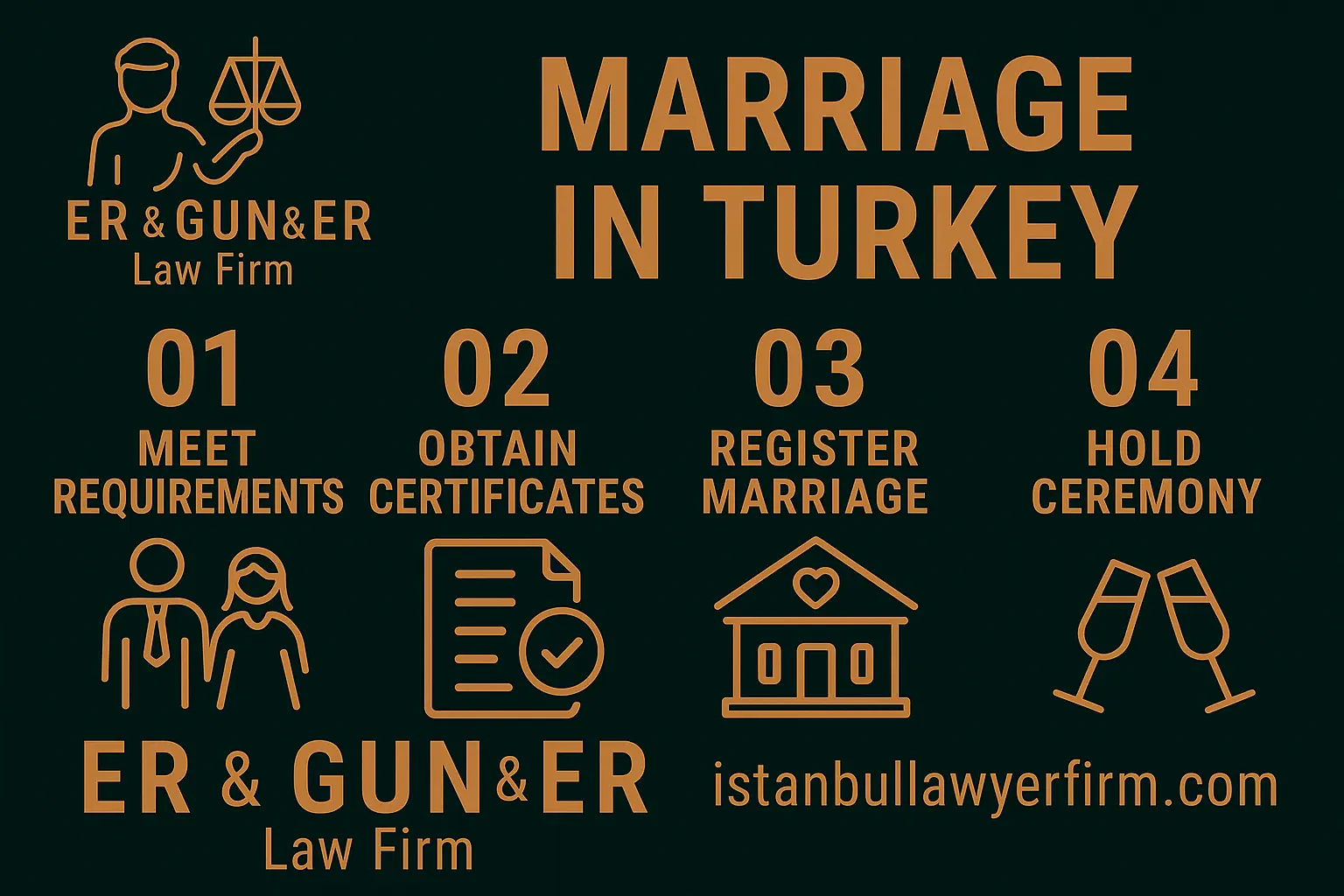
Marriage in Turkey involving foreign nationals operates within an integrated legal framework combining the Turkish Civil Code No. 4721 Articles 124-144 marriage provisions, MÖHUK (Private International Law and Procedural Law No. 5718) Articles 13-14 conflict-of-laws framework for marriage capacity and form, Marriage Regulation (Evlendirme Yönetmeliği) procedural framework issued under Civil Code authority, Public Health Law No. 1593 Article 123 pre-marital health examination requirement, Hague Apostille Convention (Turkey acceded 29 September 1985, Law No. 3028) for foreign document authentication, Turkish Citizenship Law No. 5901 Article 16 marriage-based citizenship framework, Foreigners and International Protection Law No. 6458 (YUKK) Articles 34-35 family residence permit framework, Population Services Law No. 5490 for marriage registration through MERNIS (Central Civil Registration System), and bilateral treaties affecting particular nationality combinations. Civil marriage through authorized Marriage Registry Office (Evlendirme Dairesi) is the only legally recognized marriage form in Turkey — religious ceremonies have no independent legal effect and may only follow (not substitute) the civil ceremony. Marriage capacity under Civil Code Article 124 requires minimum age of 17 years for both prospective spouses with judicial permission available from age 16 in exceptional circumstances under Article 124/2. Marriage impediments under Article 129 prohibit marriage between specified relatives (consanguinity, affinity), between adoptive relationships, between persons lacking mental capacity under framework, and between persons with pre-existing undissolved marriages. Pre-marital health examination requirement under Public Health Law Article 123 applies to all marriage applications with screening framework. Matrimonial property regime defaults to participation in acquired property (edinilmiş mallara katılma) under Civil Code Article 202, governing how property acquired during marriage is divided upon termination — alternative regimes (separation of property, community of property) may be selected through prenuptial agreement executed before marriage or through post-nuptial agreement under Civil Code framework. Marital surname framework under Article 187 permits various options including spouse's surname adoption, hyphenated surname use, or surname retention with Civil Code framework — historically women faced mandatory surname change though current law permits several options through procedural elements. Post-marriage immigration pathways for foreign spouses of Turkish citizens operate through YUKK Article 34 family residence permit framework with maximum 3-year initial permit duration and renewal options, while marriage-based citizenship under Citizenship Law Article 16 requires 3-year marriage duration plus additional substantive requirements. Practice may vary by authority and year, and marriage matters benefit from integrated legal coordination across Turkish counsel and home-country counsel particularly for cross-border recognition and other international elements. A lawyer in Turkey coordinates the documentation, procedural, capacity-related, and post-marriage legal elements determining marriage validity and subsequent legal status. For framework on marriage-based Turkish citizenship acquisition, readers can consult our marriage citizenship law guide.
Statutory framework for marriage in Turkey
A Turkish Law Firm advising on marriage matters works from the Turkish Civil Code No. 4721 Articles 124-144 as the foundational framework governing marriage formation in Turkey. Article 124 establishes marriage capacity with minimum age of 17 years for both prospective spouses as standard requirement — judicial permission (mahkeme izni) under Article 124/2 may permit marriage from age 16 in exceptional circumstances based on factual situations. Article 125 requires mental capacity — persons lacking capacity to distinguish (temyiz kudreti) cannot marry, and persons under other capacity limitations face restrictions. Article 126 addresses minor or restricted-capacity persons — marriage requires legal representative consent with procedural elements. Article 127 addresses consent requirement for parental situations. Articles 128-129 address marriage impediments categorizing absolute impediments (prohibiting marriage regardless of circumstances) and other restrictions — absolute impediments include consanguinity within prohibited degrees (lineal relatives, siblings, uncle/aunt with nephew/niece), affinity relationships within specific degrees, adoptive relationships under framework, and pre-existing undissolved marriage (bigamy prohibition). Practice may vary by authority and year, and capacity and impediment analysis is foundational for marriage validity.
Turkish lawyers who address waiting period requirements work through the framework limiting immediate remarriage. Article 132 waiting period (iddet müddeti) applies to women following termination of previous marriage — 300-day waiting period from previous marriage termination through divorce, annulment, or spouse's death before new marriage may be celebrated. Article 132/2 exceptions permit waiver — pregnancy from previous marriage must be resolved (birth or other resolution), medical evidence showing non-pregnancy may support judicial waiver under Article 132/2, and other circumstances may permit waiver. Judicial waiver procedure through application to family court or competent court provides the procedural mechanism for exception — court examines medical and factual evidence before ordering waiver. Men do not face equivalent waiting period — the rule is gender-asymmetric reflecting historical framework for paternity certainty. Practical application typically relies on medical certification for efficient waiver where pregnancy is not at issue. Practice may vary by authority and year, and waiting period analysis requires attention where previous marriage ended within 300 days of proposed new marriage.
An Istanbul Law Firm addressing the marriage ceremony framework works through Articles 134-144 governing the civil marriage process. Marriage application (evlenme müracaatı) under Article 134 requires both prospective spouses' appearance at Marriage Registry Office (Evlendirme Dairesi) with required documentation — application may be filed at Registry in either prospective spouse's place of residence. Marriage file (evlenme dosyası) under Article 136 contains specific documents including identity documents, birth certificates, health examination certificates, parental consent where required, and other elements. Article 137 provides objection period — persons with legal interest may object during period based on capacity, impediment, or other grounds. Marriage ceremony under Article 141 occurs before authorized marriage officer (evlendirme memuru) with 2 witnesses (tanık) meeting Article 142 requirements (majority age, capacity to distinguish) — officer reads marriage declaration, parties confirm consent, officer pronounces marriage formed. Marriage certificate (evlenme cüzdanı) issued under Article 143 evidences the marriage. Registry record under Article 144 — marriage registered with Population Registry (nüfus müdürlüğü) through MERNIS system under Population Services Law No. 5490. Practice may vary by authority and year, and ceremony scheduling typically requires 2-4 weeks from complete application depending on registry capacity.
Marriage capacity, impediments, and waiting periods
A lawyer in Turkey coordinating marriage capacity analysis works through the framework addressing whether prospective spouses meet legal requirements. Age-based capacity under Article 124 establishes standard 17-year minimum with 16-year minimum available through judicial permission — judicial permission requires factual showing of extraordinary circumstances warranting earlier marriage with specific evaluation of minor's best interests and factual situation. Mental capacity under Article 125 requires ayırt etme gücü (capacity to distinguish) — persons with specific mental conditions affecting decision-making capacity may face marriage restrictions. Guardianship or other capacity limitations require examination — restricted-capacity persons (kısıtlı) under guardianship face procedural requirements including guardian consent under framework. Previous marriage status verification through civil registry records or equivalent foreign evidence — bigamy prohibition is absolute under Turkish law, making verification of single status foundational. Specific other capacity issues including criminal disqualification in narrow circumstances or other restrictions may apply. Practice may vary by authority and year, and capacity verification for foreign applicants requires authenticated home country evidence.
Turkish lawyers who address impediment analysis work through the Article 129 framework prohibiting marriage between specified relationships. Consanguinity (kan hısımlığı) prohibits marriage between lineal relatives of any degree (parents, grandparents, children, grandchildren and further), between full or half siblings, between uncle/aunt and nephew/niece — these prohibitions are absolute. Affinity (sıhri hısımlık) prohibits marriage between specified relatives by previous marriage — between step-parent and step-child specifically, and other affinity relationships face restrictions though generally less extensive than consanguinity prohibitions. Adoptive relationship (evlatlık ilişkisi) creates marriage impediments between adoptive parents and adopted children, between adopted children and natural children of adoptive parents under framework — these prohibitions may continue even after adoption relationship termination under circumstances. Pre-existing marriage (mevcut evlilik) is absolute impediment — parties must be legally single at time of new marriage, meaning previous marriages must be terminated through death, divorce, or annulment with full legal effect before new marriage. Health-related impediments under framework have historically existed though current application requires analysis of relevant Public Health Law and Civil Code provisions. Practice may vary by authority and year, and impediment analysis for mixed-nationality couples may require consideration of both Turkish and home-country impediments.
An English speaking lawyer in Turkey addressing foreign applicant capacity verification works through the framework proving foreign applicants meet Turkish marriage requirements. Home country identity documents (passport) and birth certificate establish foundational identity — both require current validity and apostille or consular legalization authentication. Marriage capacity certificate (bekarlık belgesi / certificate of no impediment) from home country civil registry or competent authority confirms applicant's legal capacity to marry under home country law — this document is foundational for foreign applicants and must be current (typically within 6 months of marriage date). Previous marriage termination evidence where applicable includes divorce decree with apostille authentication for divorce situations, death certificate with apostille for widowed applicants, or other evidence — MÖHUK tenfiz (recognition) procedure may be required for foreign divorce decrees before Turkish Marriage Registry accepts them. For framework on foreign divorce recognition in Turkey, readers can consult our foreign divorce recognition guide. Mental capacity certification where required for circumstances. Name and identity consistency across documents requires attention — name variations across documents may require reconciliation through affidavit or other procedural steps. Practice may vary by authority and year, and foreign document preparation typically requires 4-12 weeks before marriage date.
MÖHUK conflict-of-laws framework for cross-border marriages
A Turkish Law Firm coordinating conflict-of-laws analysis works through the MÖHUK No. 5718 framework governing applicable law determination for marriages with foreign elements. Article 13 marriage capacity and substantive conditions applies each party's national law at time of marriage to their respective capacity and substantive requirements — each party must satisfy their own national law regarding age, capacity, impediments, and other substantive conditions. Practical consequence: foreign party must establish marriage capacity under their national law (typically through home country certificate of no impediment) while Turkish party must satisfy Turkish Civil Code capacity requirements — both must be simultaneously satisfied. Article 13/2 public policy (kamu düzeni) exception — Turkish public policy may prevent application of foreign law in circumstances where foreign law contradicts fundamental Turkish legal principles. Examples include specific foreign polygamy permissions (not recognized in Turkey), specific marriages under foreign law that violate Turkish public policy principles, and other policy-based restrictions. Nationality-specific considerations — dual nationals may require specific determination of effective nationality for marriage law purposes, stateless persons apply alternative connecting factors, and refugees face framework. Practice may vary by authority and year, and conflict-of-laws analysis is particularly important for marriages involving parties from jurisdictions with substantive marriage law differences.
Turkish lawyers who address marriage form under MÖHUK Article 14 work through the framework governing formal validity requirements. Article 14 applies form of place of celebration (lex loci celebrationis) — marriages celebrated in Turkey follow Turkish Civil Code form requirements (civil ceremony before Marriage Registry Office), marriages celebrated abroad follow the place of celebration's form requirements. Alternative form under national law of either party — Article 14/2 permits alternative form validity under either party's national law at time of marriage, providing flexibility for marriages celebrated in form not meeting place of celebration requirements but meeting national law requirements. Recognition of foreign marriages in Turkey — marriages validly celebrated abroad under applicable law receive recognition in Turkey upon registration with Turkish civil registry through nüfus müdürlüğü, typically requires apostille-authenticated foreign marriage certificate with sworn translation. Consular marriage framework — Turkish consulates abroad may celebrate marriages between Turkish citizens under consular jurisdiction, foreign consulates in Turkey may celebrate marriages between their nationals under reciprocity framework where conditions are met. For framework on general Turkish family law, readers can consult our family law guide. Practice may vary by authority and year, and form recognition analysis affects marriage validity and subsequent recognition across jurisdictions.
An Istanbul Law Firm addressing marriage-related cross-border considerations works through the framework coordinating Turkish marriage with foreign legal consequences. Home country recognition of Turkish marriage — Turkish marriage certificate with apostille authentication supports home country recognition under applicable bilateral frameworks or home country recognition rules. Home country civil registry notification — most jurisdictions require or permit Turkish marriage registration with home country civil registry for other legal purposes, procedure varies by home country. Immigration consequences of marriage — Turkish marriage to Turkish citizen may create foundation for family residence permit under YUKK Article 34 (discussed separately), marriage to other foreigner does not automatically create immigration benefits. Surname change coordination — Turkish law framework for marital surname changes under Civil Code Article 187 permits various options, coordination with home country surname rules may require steps. Inheritance implications — marriage affects inheritance rights under applicable inheritance law (lex rei sitae for Turkish real estate, national law for movable property under MÖHUK Article 20). Tax filing status implications where marriage affects tax obligations in either jurisdiction. Matrimonial property regime — Civil Code default regime (edinilmiş mallara katılma) applies for Turkish marriages unless alternative regime is selected through prenuptial agreement. For framework on divorce in Turkey for foreign nationals who may later need to address marital dissolution, readers can consult our divorce in Turkey guide for foreigners. Future-proofing marriage arrangements through prenuptial agreements addresses property division, spousal support, and other matters under Turkish law framework. Practice may vary by authority and year, and cross-border coordination benefits from integrated Turkish and home-country legal engagement.
Required documents and apostille authentication framework
A lawyer in Turkey coordinating documentation preparation works through the framework establishing what foreign applicants must provide. Valid passport with adequate remaining validity (typically at least 6 months beyond marriage date) serves as primary identity document — passport types and other identity documents may apply for specific nationalities. Birth certificate with complete parental information supports identity and lineage verification — authenticated through apostille under Hague Convention 1961 (Turkey acceded 29 September 1985, Law No. 3028) for member-state documents, consular legalization for non-Hague documents. Certificate of no impediment (bekarlık belgesi, certificate of no impediment to marriage) from home country civil registry or competent authority — foundational document confirming applicant's single status and legal capacity to marry, must be recent (typically within 6 months). Previous marriage documentation where applicable — divorce decree with apostille authentication for previously divorced applicants, death certificate with apostille for widowed applicants. Recognition of foreign divorce decrees through MÖHUK Article 50 tenfiz procedure may be required before Turkish Marriage Registry accepts the divorce as effective. Practice may vary by authority and year, and document preparation is typically the longest phase of marriage planning for foreign applicants.
Turkish lawyers who address authentication and translation requirements work through the framework establishing document admissibility. Hague Apostille Convention 1961 authentication applies for documents from Hague Convention member states — single-stamp authentication at issuing country's designated authority provides Turkey-recognized authentication. Apostille process varies by issuing country — typically Ministry of Foreign Affairs or other designated authority issues apostille with standardized form. Consular legalization applies for documents from non-Hague Convention countries — typically requires authentication by issuing country's foreign ministry then Turkish consulate — more time-consuming than apostille but provides equivalent recognition. Translation to Turkish through sworn translator (yeminli tercüman) is required for all foreign-language documents — sworn translators are registered with Turkish courts and produce legally-recognized translations. Notarization of translations provides additional verification — Turkish notaries (noter) may authenticate translator signatures and other procedural elements. Document copying and distribution — originals typically retained in marriage file, copies provided to applicants and other relevant parties. Timing coordination — most foreign documents have currency requirements (6-month validity typical) requiring marriage application within the currency window. Practice may vary by authority and year, and authentication timing depends on home country procedures and may range from days to several months.
An English speaking lawyer in Turkey addressing document preparation workflow works through the framework managing parallel procedural streams. Home country document request — initiated early in marriage planning, typically requires specific forms, fees, and processing time varying by jurisdiction and document type. Apostille acquisition — typically follows document issuance with procedural requirements — some jurisdictions permit combined procedures while others require sequential steps. Turkey-side preparation — sworn translation coordination (sworn translator selection, document transmission, translation delivery), notarization where needed for purposes, and other preparatory elements. Embassy or consular support for foreign applicants unable to obtain home country documents through standard channels — Turkish embassies and consulates abroad may provide specific documentation services, foreign embassies in Turkey may provide supporting services. Document review before submission — Marriage Registry staff review documents for completeness and authenticity, deficiencies require correction before acceptance. Rejected documents may require reissuance, re-authentication, or procedural steps. Currency tracking for documents with expiration dates — most documents must remain current through marriage date, requiring specific coordination where preparation spans weeks or months. Practice may vary by authority and year, and proactive timeline management prevents last-minute documentation crises.
Civil registry application and ceremony procedure
A Turkish Law Firm coordinating civil registry procedure works through the Marriage Regulation (Evlendirme Yönetmeliği) procedural framework implementing Civil Code marriage provisions. Initial application at Marriage Registry Office (Evlendirme Dairesi) — jurisdictional choice between prospective spouses' residences permits flexibility, metropolitan areas typically have multiple registries with varying appointment availability. Istanbul marriage registries particularly have varying practices — some registries specialize in foreign-involved marriages with staff experienced in international documentation, other registries may be less familiar with foreign applications. Application includes both prospective spouses appearing in person — limited power of attorney options exist for circumstances but generally personal appearance is required. Documentation submission creates marriage file (evlenme dosyası) for registry review — registry verifies documentation completeness, authenticity, and substantive eligibility. Objection period under Civil Code Article 137 following marriage announcement — persons with legal interest (specific family members, specific authorities) may object during period based on capacity, impediment, or other grounds. Pre-ceremony final verification by marriage officer immediately before ceremony. Practice may vary by authority and year, and registry selection and procedural management significantly affect timeline and outcome.
Turkish lawyers who address marriage ceremony conduct work through the framework governing the formal wedding ceremony. Marriage ceremony conducted by authorized Marriage Officer (evlendirme memuru) — typically registry office personnel, sometimes mayor or designated official, other authorized person in circumstances. Ceremony requirements include 2 witnesses (tanık) meeting Civil Code Article 142 requirements (majority age, capacity to distinguish, absence of specific disqualifications) — witnesses may be any qualified persons, typically friends or family members. Ceremony conduct — officer reads formal declaration, asks prospective spouses whether they consent to marriage, receives consent confirmation, pronounces marriage formed, obtains signatures. Translator requirement where one or both parties do not speak Turkish — sworn translator (yeminli tercüman) must be present to translate ceremony and confirm understanding. Ceremony location flexibility — standard location is Marriage Registry Office, other locations may be approved under circumstances including historical or ceremonial venues with Registry coordination. Post-ceremony immediate issuance of marriage certificate (evlenme cüzdanı) documenting the marriage — serves as official marriage record, often sufficient for most immediate post-marriage purposes. Marriage ceremony language accommodation — ceremony conducted in Turkish with sworn translator (yeminli tercüman) mandatory presence where either party does not speak Turkish sufficiently to understand ceremony proceedings, translator must be on Ministry of Justice sworn translator list and produces signed record of translation. Ceremony fees structure — modest statutory fee paid to Marriage Registry Office covering administrative processing, ceremony conduct, and certificate issuance, fees vary by municipality with specific rates typically published on municipal websites. Post-ceremony certificate legalization for foreign use — apostille authentication of Turkish marriage certificate at Turkish competent authority (typically governor's office - valilik in issuing province) supports foreign recognition, Ministry of Foreign Affairs authentication for non-Hague Convention countries. Practice may vary by authority and year, and ceremony logistics require planning particularly for non-standard elements.
An Istanbul Law Firm addressing consular marriage and alternative framework works through specific non-standard marriage mechanisms. Turkish consular marriage abroad — Turkish consulates abroad may celebrate marriages between Turkish citizens under consular jurisdiction with procedural framework. Foreign consular marriage in Turkey — foreign consulates in Turkey may celebrate marriages between their own nationals under reciprocity framework where conditions apply, consular marriage validity depends on both celebrating country law and Turkish recognition. Recognition in Turkey of marriages celebrated abroad — marriages validly celebrated abroad (under either lex loci celebrationis or national law of either party per MÖHUK Article 14) receive Turkish recognition upon registration with Turkish civil registry through nüfus müdürlüğü. Registration procedure for foreign-celebrated marriages requires apostille-authenticated foreign marriage certificate, sworn translation, passport copies, other required documentation — procedure typically takes 2-4 weeks to complete registration. Religious ceremony coordination — religious ceremonies following civil marriage are permitted and do not affect civil marriage validity, religious ceremonies preceding civil marriage carry criminal penalty under Civil Code framework for officiating religious figure. Practice may vary by authority and year, and non-standard marriage framework requires procedural attention to ensure validity.
Pre-marital health examination requirements
A lawyer in Turkey coordinating health examination compliance works through the Public Health Law No. 1593 Article 123 framework requiring medical screening before marriage. The statutory requirement applies to all marriage applications in Turkey regardless of applicants' nationality — both Turkish citizens and foreign nationals must complete examination before Marriage Registry will process application. Examination purpose is public health protection — screening for transmissible conditions that may affect prospective spouse or potential children, protecting marriage participants and public health generally. Examination conducted at state-authorized medical facility — typically public health centers (sağlık ocağı, aile sağlığı merkezi) or specific designated facilities. Private healthcare providers with authorization may also conduct examinations with appropriate certification. Examination content typically includes blood tests for transmissible conditions including communicable diseases under current screening framework, general physical examination for overall health status, and other screening elements based on current protocols. Examination report issued by conducting physician — becomes part of marriage file and must show applicants' fitness for marriage under applicable framework. Historical screening scope under Public Health Law framework has included tests for transmissible diseases including syphilis (frengi), tuberculosis, and other conditions with public health significance, though current screening protocols are determined by Ministry of Health regulations and evolve with medical understanding. Legal effect of positive screening findings — most positive results do not prevent marriage but may require disclosure to prospective spouse, treatment completion before marriage, or other resolution depending on specific condition and current medical and legal framework. Practice may vary by authority and year, and current screening protocols may differ from historical protocols as public health framework evolves.
Turkish lawyers who address examination procedure and documentation work through the framework managing the health examination process. Appointment scheduling at authorized facility — metropolitan areas typically have multiple options with varying wait times, appointment availability affects overall marriage timeline. Documentation required at examination includes identity documents, marriage application reference or other Marriage Registry coordination documentation. Examination timing relative to marriage application — examination results typically have currency requirement (usually several months) requiring coordination with marriage date. Results interpretation and documentation — positive findings for screened conditions may prevent or delay marriage pending treatment or other resolution, negative findings permit marriage approval on health grounds. Confidentiality protections for health information — medical privacy framework protects examination results from unauthorized disclosure beyond Marriage Registry necessary disclosure. Cost of examination — typically modest fee at public facilities, higher at private facilities, fee structure varies by location and examination scope. Insurance coverage for examination — examination costs typically not covered by standard health insurance given elective nature, some health plans may provide coverage depending on policy terms. Practice may vary by authority and year, and examination timeline typically adds 1-2 weeks to overall marriage preparation schedule.
An English speaking lawyer in Turkey addressing foreign applicant health examination considerations works through the framework accommodating cross-border elements. Language accommodation at examination facility — examination conducted in Turkish with translator needed for foreign applicants unable to communicate in Turkish, facility may provide translator services or applicants may bring qualified interpreter. Previous medical history disclosure — foreign applicants may need to provide home country medical history including screening tests from home country with authenticated documentation. Existing medical conditions that may affect marriage eligibility require specific analysis — most chronic conditions do not prevent marriage though transmissible conditions may require treatment or other resolution. Pregnancy-related examination for female applicants where applicable — pregnancy status may affect examination scope and may interact with Civil Code waiting period framework under Article 132 for previously married women. Foreign medical test result recognition — results from foreign medical facilities may be recognized with appropriate authentication and translation, though Turkish authorities may require confirming tests at Turkish facilities for conditions. Medical examination waivers — narrow waiver possibilities exist for specific medical circumstances through procedural framework. Practice may vary by authority and year, and foreign applicant health examination typically completes within 1 week with proper preparation.
Post-marriage residence permit framework
A Turkish Law Firm coordinating post-marriage immigration matters works through the Foreigners and International Protection Law No. 6458 (YUKK) Article 34 family residence permit framework. Family residence permit (aile ikamet izni) is available to foreign spouse of Turkish citizen as primary category — permit duration up to 3 years with renewal possibility upon qualifying circumstances. Application framework through provincial Directorate General of Migration Management (Göç İdaresi Genel Müdürlüğü İl Müdürlüğü) — applications filed online through e-residence system (https://e-ikamet.goc.gov.tr) with in-person appointment at provincial office. Application documentation includes valid passport with adequate remaining validity, Turkish marriage certificate, other family relationship documentation, proof of accommodation in Turkey (rental agreement, ownership, or host arrangement with supporting documents), proof of financial means sufficient for residence (framework with threshold requirements updated periodically), health insurance coverage for Turkey through other qualifying framework, biometric photo, fee payment, and other required documentation. Processing timeline typically 2-3 months for initial application with variations by province and individual circumstances. Interview requirement where authorities may require — interview typically addresses marriage authenticity, cohabitation, and other verification elements. Practice may vary by authority and year, and family residence permit framework supports foreign spouse's legal residence in Turkey.
Turkish lawyers who address fictitious marriage scrutiny work through the YUKK Article 35 framework addressing concerns about marriages of convenience. Fictitious marriage (muvazaalı evlilik / sahte evlilik) is marriage entered primarily to obtain immigration benefits without genuine marital intention or substance — Turkish law treats such marriages as ineffective for immigration purposes and may trigger additional consequences. Indicators of potential fictitious marriage that authorities may examine include significant age difference (though age difference alone is not determinative), short courtship period before marriage, language barriers preventing meaningful communication between spouses, separate residences or lack of shared household, payment arrangements between parties suggesting commercial rather than marital motivation, and other factors considered in totality. Interview process for marriage verification — both spouses may be questioned separately about relationship history, daily life, family knowledge, and other relationship-verifying elements, inconsistencies may trigger further scrutiny. Permit refusal under Article 35 where fictitious marriage is established — residence permit may be refused, revoked if previously granted, or not renewed. Criminal consequences possible for fictitious marriage participants under framework including Turkish Criminal Code provisions for fraud-related offenses. For framework on deportation protections through family ties, readers can consult our deportation ban guide. Practice may vary by authority and year, and genuine marriages receive routine approval while suspected fictitious marriages face significantly increased scrutiny.
An Istanbul Law Firm addressing residence permit renewal and transitions works through the framework managing longer-term foreign spouse residence. Renewal application before permit expiration — typically 60 days before expiration is recommended window, continued marriage and cohabitation documentation supports renewal. Renewal documentation includes updated marriage confirmation, continued accommodation and financial evidence, renewed health insurance, and other updated documentation. Changed circumstances during permit period — relocation within Turkey requires notification, marriage-related changes (separation, divorce proceedings) may affect permit status, employment changes may provide alternative permit basis. Divorce or marriage termination during permit period under YUKK Article 34/3 — permit may continue for period after marriage termination under circumstances particularly where Turkish children are involved, permit termination triggers alternative immigration status analysis. Long-term residence permit (uzun süreli ikamet izni) under Article 42 available after 8 years of uninterrupted legal residence in Turkey — family residence permit time counts toward this threshold, long-term permit provides enhanced residency rights approaching permanent resident status. For framework on family residence permit specifically, readers can consult our family residence permit guide. For broader framework on Turkish immigration law and alternative permit pathways, readers can consult our immigration law guide. Practice may vary by authority and year, and long-term immigration planning benefits from early analysis of various permit pathways.
Marriage-based citizenship under Law 5901
A lawyer in Turkey coordinating marriage-based citizenship acquisition works through the Turkish Citizenship Law No. 5901 Article 16 framework establishing the alternative citizenship acquisition pathway through marriage to Turkish citizen. Fundamental requirements under Article 16/1: (a) at least 3 years of marriage to Turkish citizen continuing at application time, (b) maintenance of family union (aile birliği), (c) absence of activities incompatible with marital union, (d) absence of national security or public order grounds preventing acquisition. The 3-year marriage duration is calculated from marriage date through application filing — marriage must remain valid and effective throughout this period. Family union requirement addresses actual cohabitation and genuine marital relationship — separations, divorce proceedings, or other relationship disruptions may affect satisfaction. Activities incompatible with marital union may include relationships with other partners, certain conduct inconsistent with marriage, and other situations suggesting marriage is not genuine ongoing relationship. National security and public order screening addresses applicant's background — criminal history, specific associations, or other concerning factors may trigger refusal. Practice may vary by authority and year, and marriage-based citizenship provides alternative pathway to Turkish citizenship outside investment-based or other acquisition routes.
Turkish lawyers who address application procedure work through the framework managing the citizenship application process. Application filing with Ministry of Interior General Directorate of Population and Citizenship Affairs (İçişleri Bakanlığı Nüfus ve Vatandaşlık İşleri Genel Müdürlüğü) through provincial Directorate or Directorate General of Civil Registration — online application system with subsequent in-person appointment and document submission. Application documentation includes passport and identity documents with other proof, marriage certificate and ongoing marriage confirmation, residence confirmation showing specific Turkish residence, financial information supporting genuine marriage and other elements, criminal record certificate from home country and other jurisdictions of significant residence with apostille authentication, other supporting documentation. Interview process where authorities examine marriage genuineness through questioning of both spouses separately — consistency in responses about relationship history, daily life, family knowledge, and other relationship-verifying elements supports application. Investigation period may include site visits, neighbor inquiries, and other verification elements. Ministry of Interior decision after review — approval grants citizenship, refusal may be appealed through administrative judicial review under framework. Timeline typically 1-2 years from application to decision with significant variation based on individual circumstances and current processing capacity. Practice may vary by authority and year, and preparation discipline significantly affects application outcome.
An English speaking lawyer in Turkey addressing post-citizenship matters and related considerations works through the framework managing Turkish citizenship effects and coordination. Turkish citizenship acquisition effects — Turkish national status provides full Turkish citizenship rights including voting, unrestricted residence, employment without work permit, property ownership without reciprocity restrictions, Turkish passport and consular protection, and other citizenship rights. Dual citizenship handling — Turkey permits dual citizenship generally, though home country rules may affect dual citizenship status based on acquisition of Turkish citizenship, specific country analysis required. Loss of Turkish citizenship through marriage-based route under Article 20 — where marriage is determined to have been fictitious or other grounds exist, Turkish citizenship may be revoked, with procedural framework. Children's citizenship status — children born during marriage to Turkish citizen parent typically acquire Turkish citizenship at birth under Article 7 jus sanguinis framework, citizenship through marriage-based acquisition may affect children's status under circumstances. Name change options upon citizenship acquisition — Turkish citizenship permits Turkish name adoption with procedural framework, original names retained in most jurisdictions. For framework on name change procedure after Turkish citizenship acquisition, readers can consult our name change guide. Post-citizenship documentation — Turkish identity card (nüfus cüzdanı or kimlik kartı), Turkish passport, tax number confirmation, and other Turkish-national documentation obtained following citizenship decision. For framework on dual citizenship law specifically, readers can consult our dual citizenship law guide. Practice may vary by authority and year, and post-citizenship transition requires specific administrative coordination.
Author: Mirkan Topcu is an attorney registered with the Istanbul Bar Association (Istanbul 1st Bar), Bar Registration No: 67874. His practice focuses on cross-border and high-stakes matters where evidence discipline, procedural accuracy, and risk control are decisive, with particular concentration on marriage procedures for foreign nationals in Turkey across the integrated legal framework combining Turkish Civil Code No. 4721 Articles 124-144 marriage provisions including Article 124 marriage capacity with minimum age 17 standard and 16 through judicial permission, Article 125 mental capacity (ayırt etme gücü), Articles 126-127 minor consent framework, Articles 128-129 marriage impediments including consanguinity, affinity, adoptive relationships, and pre-existing marriage prohibition, Article 132 300-day waiting period for women with pregnancy-related and judicial waiver alternatives, Articles 134-144 civil marriage procedure including application at Marriage Registry Office (Evlendirme Dairesi), marriage file (evlenme dosyası) under Article 136, objection period under Article 137, marriage ceremony under Article 141 with 2 witnesses meeting Article 142 requirements, marriage certificate (evlenme cüzdanı) under Article 143, and registry recording under Article 144 through MERNIS system, Marriage Regulation (Evlendirme Yönetmeliği) implementing Civil Code, MÖHUK No. 5718 Article 13 applying each party's national law for marriage capacity with public policy exception, Article 14 applying place-of-celebration law for marriage form with alternative national law validity, Public Health Law No. 1593 Article 123 pre-marital health examination requirement, Hague Apostille Convention 1961 (Turkey acceded 29 September 1985, Law No. 3028) for foreign document authentication with sworn translation requirement for Turkish use, Turkish Citizenship Law No. 5901 Article 16 marriage-based citizenship framework requiring 3-year marriage duration plus family union maintenance plus activities compatibility plus national security and public order clearance, Article 20 revocation for fictitious marriage, Article 7 jus sanguinis for children, Foreigners and International Protection Law No. 6458 (YUKK) Article 34 family residence permit up to 3-year duration for Turkish citizen spouses with renewal framework, Article 35 fictitious marriage grounds for permit refusal or revocation, Article 42 long-term residence permit after 8 years, Population Services Law No. 5490 for marriage registration through MERNIS (Central Civil Registration System) and specific identity documentation framework, consular marriage frameworks for Turkish consulates abroad serving Turkish citizens and foreign consulates in Turkey serving their nationals under reciprocity, matrimonial property regime under Civil Code Article 202 with default participation in acquired property (edinilmiş mallara katılma) and alternative regimes through prenuptial agreement, marital surname framework under Article 187, and bilateral treaties affecting particular nationality combinations.
He advises foreign nationals on integrated marriage strategy from initial eligibility assessment through post-marriage immigration and specific citizenship pathways, marriage capacity analysis under Turkish Civil Code and home-country national law coordination under MÖHUK, document preparation including apostille authentication and sworn translation for foreign documents, previous marriage termination evidence including MÖHUK tenfiz procedure for foreign divorce decree recognition, pre-marital health examination coordination under Public Health Law framework, Marriage Registry Office procedural management including application, ceremony, and registration, consular marriage options for specific nationality combinations or circumstances, post-marriage family residence permit application under YUKK Article 34 with financial means, accommodation, and other required documentation, fictitious marriage prevention and proper documentation supporting genuine marriage authenticity where authorities conduct scrutiny, marriage-based citizenship application under Citizenship Law Article 16 with 3-year duration, family union, and other Article 16 requirements, interview preparation for residence permit and citizenship applications, post-acquisition administrative matters including Turkish identity documentation, passport acquisition, and other post-citizenship steps, dual citizenship coordination with home country citizenship rules, and matrimonial property regime selection and prenuptial agreement drafting. His practice spans Commercial and Corporate Law, Commercial Contracts, Foreign Investment, Data Protection and Privacy, Intellectual Property, Arbitration and Dispute Resolution, Enforcement and Insolvency, Citizenship and Immigration including marriage-based citizenship and family residence permits, Real Estate including property implications of marriage, International Tax, International Trade, Foreigners Law, Sports Law, Health Law, and Criminal Law.
Education: Istanbul University Faculty of Law (2018); Galatasaray University, LL.M. (2022). LinkedIn: Profile. Istanbul Bar Association: Official website.
Frequently asked questions
- Can two foreigners marry in Turkey? Yes. Two foreign nationals may marry in Turkey under Civil Code framework provided both satisfy Turkish procedural requirements (documentation, health examination, registry application) and each satisfies their own national law capacity requirements under MÖHUK Article 13. Residence permit is not required for marriage itself.
- What is the minimum age for marriage in Turkey? Under Civil Code Article 124, standard minimum age is 17 years for both prospective spouses. Judicial permission under Article 124/2 may permit marriage from age 16 in exceptional circumstances based on factual evaluation.
- Are religious marriages legally recognized in Turkey? No. Only civil marriage through authorized Marriage Registry Office (Evlendirme Dairesi) is legally recognized. Religious ceremonies may follow civil marriage but cannot substitute it — religious ceremony before civil marriage actually triggers criminal liability for officiating religious figure under Civil Code framework.
- What documents do foreign nationals need to marry in Turkey? Core documents include valid passport, birth certificate with apostille, certificate of no impediment (bekarlık belgesi) from home country, previous marriage termination evidence where applicable (divorce decree or death certificate with apostille), health examination certificate, identity photographs, and sworn Turkish translations of all foreign-language documents.
- What is the certificate of no impediment? Certificate of no impediment (bekarlık belgesi, certificate of no impediment to marriage) is home country document confirming applicant's legal capacity to marry under home country law — issued by civil registry, courts, or other competent authority depending on jurisdiction, must be recent (typically within 6 months) with apostille authentication for Turkish use.
- Is there a waiting period for women after divorce? Yes. Civil Code Article 132 requires 300-day waiting period from previous marriage termination before women may remarry. Pregnancy resolution or medical evidence of non-pregnancy supports judicial waiver under Article 132/2 — typical waiver based on medical certification obtained through family court application.
- How long does the marriage process take for foreign nationals? Typical timeline 6-12 weeks from preparation start to marriage — document preparation abroad 4-8 weeks with apostille and translation, Turkey-side application and appointment 2-4 weeks, ceremony date scheduling additional 1-2 weeks in busier registries. Urgent cases may be expedited through procedural mechanisms.
- Can we marry on a tourist visa? Yes. Tourist visa permits marriage in Turkey subject to visa validity through marriage date. Post-marriage immigration status analysis required separately — marriage itself does not extend visa but marriage to Turkish citizen creates foundation for family residence permit application under YUKK Article 34.
- How do we obtain a residence permit after marrying a Turkish citizen? Family residence permit (aile ikamet izni) application under YUKK Article 34 through provincial Directorate General of Migration Management — requires valid passport, marriage certificate, accommodation proof, financial means evidence, health insurance, and other documentation. Typical processing 2-3 months with potential interview for marriage authenticity verification.
- What is the framework for Turkish citizenship through marriage? Turkish Citizenship Law Article 16 requires: (a) at least 3 years of valid ongoing marriage to Turkish citizen, (b) maintenance of family union, (c) absence of activities incompatible with marital union, (d) absence of national security or public order concerns. Application through Ministry of Interior with interview and investigation, typical timeline 1-2 years.
- How does MÖHUK affect marriages with foreign elements? MÖHUK Article 13 applies each party's national law for marriage capacity — foreign party must meet home-country capacity requirements while Turkish party meets Turkish requirements. Article 14 applies place-of-celebration law for marriage form with alternative validity under national law of either party. Turkish public policy may override foreign law in circumstances.
- Are foreign marriages recognized in Turkey? Yes. Foreign marriages validly celebrated under applicable law (lex loci celebrationis under MÖHUK Article 14 or alternative national law) receive Turkish recognition upon registration with nüfus müdürlüğü through apostille-authenticated foreign marriage certificate and sworn Turkish translation.
- What is fictitious marriage and what are the consequences? Fictitious marriage (muvazaalı evlilik / sahte evlilik) is marriage entered primarily for immigration or citizenship benefits without genuine marital intention. Under YUKK Article 35 and Citizenship Law Article 20, fictitious marriages support residence permit refusal/revocation and citizenship revocation, with potential criminal consequences under framework.
- Can same-sex couples marry in Turkey? No. Turkish law does not currently recognize same-sex marriage. Foreign same-sex marriages celebrated in jurisdictions permitting such marriages generally do not receive Turkish recognition under public policy framework. Alternative legal arrangements (cohabitation contracts, property structures, powers of attorney) may provide partial legal structure for same-sex partners in Turkey.
- How does ER&GUN&ER Law Firm structure marriage engagements for foreign nationals? Engagements begin with initial eligibility assessment under Turkish and home-country law through MÖHUK framework, proceed through document preparation and authentication including apostille and sworn translation coordination, pre-marital health examination scheduling, Marriage Registry application and ceremony procedural management, consular coordination where applicable, and post-marriage immigration and citizenship pathway analysis including family residence permit under YUKK Article 34 and potential marriage-based citizenship under Citizenship Law Article 16.