

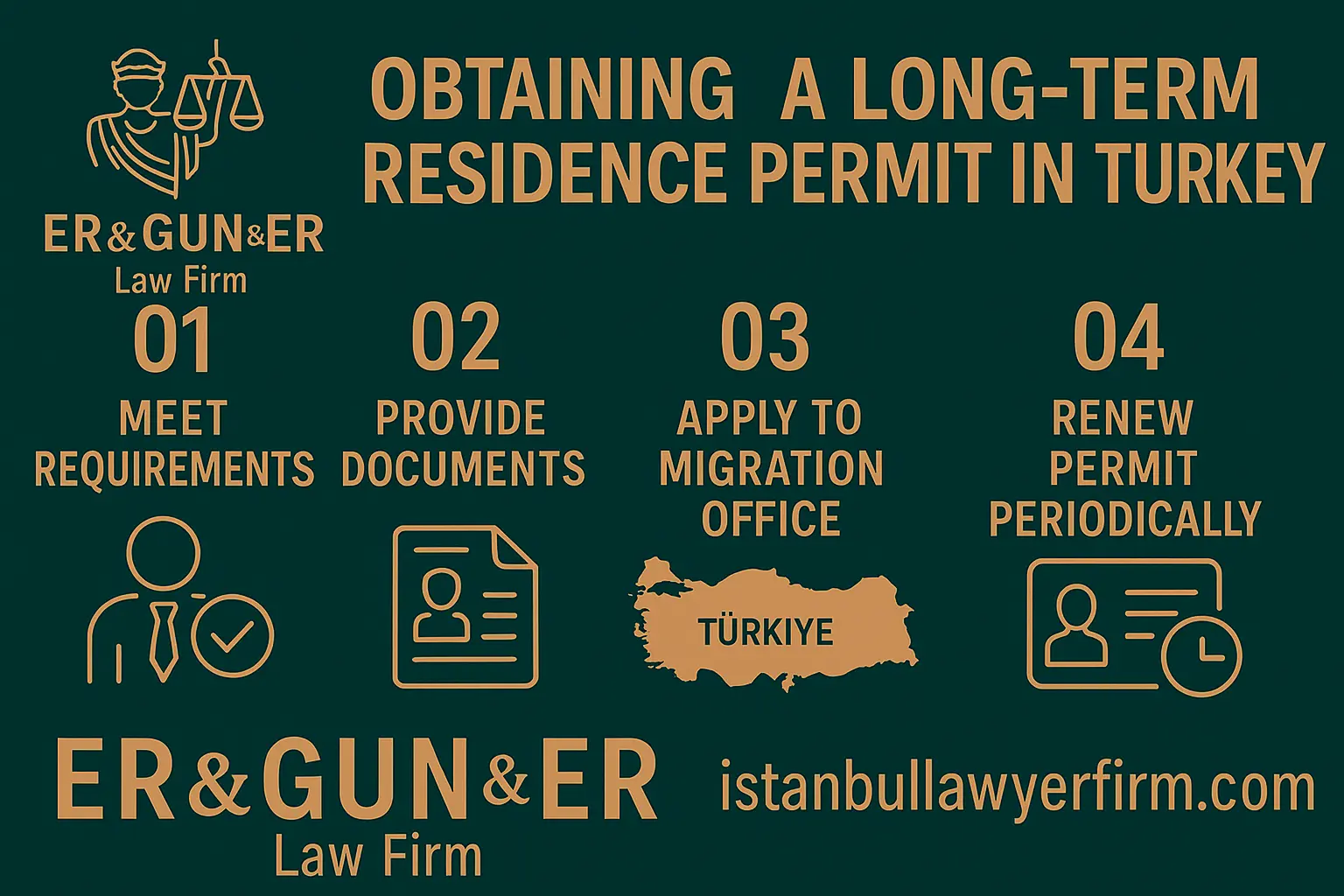
Long-term residence permit (uzun dönem ikamet izni) in Turkey operates within an integrated legal framework combining the Foreigners and International Protection Law No. 6458 (Yabancılar ve Uluslararası Koruma Kanunu, YUKK, 2013) Articles 42-45 long-term residence framework — Article 42 core eligibility requirements including minimum 8 years uninterrupted legal residence in Turkey, adequate and regular income (yeterli ve düzenli gelir) supporting self and dependents, valid health insurance meeting Turkish standards, and non-threat to public order or public security, Article 43 specific exempt categories (refugees, conditional refugees, and other protected categories) with modified or exempt application of standard requirements, Article 44 comprehensive rights framework providing near-equivalent treatment to Turkish citizens except voting rights, holding public office, mandatory military service, and other citizen-exclusive domains, Article 45 cancellation grounds including extended absence exceeding 1 year without justification, significant criminal convictions creating public order concerns, and other public order or security-based cancellation grounds. Implementing Regulation on Foreigners and International Protection (Yabancılar ve Uluslararası Koruma Kanununun Uygulanmasına İlişkin Yönetmelik, 17 March 2016, RG 29656, replacing 2013 Regulation RG 28980) operationalizes Law 6458 framework with procedural detail. Directorate General of Migration Management (Göç İdaresi Genel Müdürlüğü, GİGM, now under Ministry of Interior Presidency of Migration Management) administers immigration framework nationally. Provincial Migration Administration Directorates (İl Göç İdaresi Müdürlükleri) process applications at provincial level. Turkish Citizenship Law No. 5901 provides transition framework with Article 11 ordinary acquisition through 5-year residence, Article 12 exceptional acquisition pathways, Article 13 acquisition through marriage. Social Security Law No. 5510 universal health insurance (SGK) framework applies to long-term residents. Constitutional Articles 16 (foreigner rights framework) and 23 (settlement freedom) establish constitutional foundations. A lawyer in Turkey coordinates the statutory, documentary, procedural, and strategic elements determining long-term residence permit outcomes. For framework on residence permits generally including short-term permits and extensions, readers can consult our residence permit framework.
Statutory framework for long-term residence in Turkey
A Turkish Law Firm advising on long-term residence framework works from Foreigners and International Protection Law No. 6458 (YUKK) Articles 42-45 as the substantive legal foundation. Article 42 core eligibility requirements establish the foundational criteria for long-term residence permit: (a) minimum 8 years uninterrupted legal residence (kesintisiz en az sekiz yıl kanuni ikamet) in Turkey, (b) absence of public assistance receipt (sosyal yardım alınmamış olma) during residence period (with specific exceptions for disability-related assistance), (c) adequate and regular income (yeterli ve düzenli gelir kaynağı) supporting applicant and dependents, (d) valid and comprehensive health insurance (geçerli sağlık sigortası), (e) non-threat to public order or public security (kamu düzeni veya kamu güvenliği açısından tehdit oluşturmama). Uninterrupted residence calculation — continuous residence calculated with maximum 180 days total absence across all travel during qualifying 8-year period, absence exceeding 180 days may disqualify regardless of permit continuity. Residence permit continuity — legal residence requires valid residence permit throughout qualifying period, gaps in permit coverage create qualification challenges even if applicant remained in Turkey. Article 43 specific exempt categories provide modified application for refugees and conditional refugees (other protected categories) — residence period and other requirements may operate differently for these categories. Practice may vary by authority and year, and statutory framework establishes baseline qualification subject to procedural and documentary demonstration.
Turkish lawyers who address rights framework work through Article 44 rights provisions establishing substantial protection for long-term residence permit holders. Article 44/1 general rights framework — long-term residents benefit from rights equivalent to Turkish citizens with specific exclusions. Article 44/2 excluded rights framework: (a) political rights (voting, holding political office), (b) mandatory military service exemption (exception from Turkish military service obligation), (c) other citizen-exclusive domains. Equivalent rights inclusion: (a) work authorization without separate work permit requirement for most positions, (b) social security coverage through SGK framework, (c) education access including publicly-funded education, (d) healthcare access through SGK and other public healthcare frameworks, (e) property ownership (already available to most foreigners under other framework), (f) business establishment and commercial activity, (g) banking and financial services, (h) social assistance access where qualifying. Tax implications — long-term residence typically triggers Turkish tax residence based on 183-day rule under Income Tax Law No. 193, with worldwide income taxation framework applying. Work authorization framework — long-term residence permit provides automatic work authorization for most employment, with other limitations for other professions requiring specific licenses or citizenship. For framework on work permits interacting with residence status, readers can consult our work permit framework. Practice may vary by authority and year, and rights framework provides substantial benefit justifying long-term residence pursuit.
An Istanbul Law Firm addressing cancellation framework works through Article 45 cancellation grounds establishing conditions for permit revocation. Article 45/1 cancellation grounds include: (a) continuous absence from Turkey exceeding 1 year without justification (kabul edilebilir bir mazeret olmaksızın bir yıldan uzun süreli Türkiye dışında bulunma), (b) specific criminal convictions creating public order concerns, (c) false documentation or misrepresentation in application, (d) public order or national security violations, (e) other cancellation grounds. 1-year absence threshold interpretation — "justification" (mazeret) interpretation through GİGM and judicial precedent, medical treatment abroad, family emergencies, education abroad, employment assignment may constitute valid justification with documentation, general leisure or business travel typically not sufficient justification for extended absence. Criminal conviction framework — not all convictions trigger cancellation, specific criteria including sentence severity, offense category, time elapsed since conviction affect cancellation analysis. False documentation cancellation — cancellation for documentation fraud extends beyond application to subsequent discovery, creating ongoing vulnerability for improperly obtained permits. Public order and national security — broad framework with GİGM discretion, specific violations including terrorism-related activities create immediate cancellation grounds. Cancellation procedure — GİGM administrative decision with notification to permit holder, judicial review through administrative court system, interim injunction framework may support continued residence during judicial review. Reapplication framework — cancelled permit holders may reapply after other period, with previous cancellation typically creating substantial application challenges. Practice may vary by authority and year, and cancellation framework requires ongoing compliance attention throughout permit period.
Eligibility criteria and documentation requirements
A lawyer in Turkey coordinating eligibility assessment works through comprehensive framework analyzing 8-year residence qualification. Residence period calculation begins from first legal residence permit in Turkey — tourist visa entries, transit periods, and other non-permit stays typically do not count toward qualifying period. Different residence permit types count toward qualifying period including short-term (kısa dönem), family (aile), student (öğrenci), work (çalışma izni providing residence), humanitarian (insani), victim of human trafficking permits — each permit category contributes to 8-year calculation. Absence calculation methodology — total days absent during 8-year period, not consecutive absence only, typically calculated from Turkish entry/exit records (PASSAPORT system). Absence documentation — maintaining personal travel records with passport entry/exit stamps supports application, GİGM system provides official record but personal documentation supplements discrepancies. Permit gap analysis — continuous legal residence requires valid permit throughout, residence during permit application processing typically acceptable, expired permit followed by new permit may create gap requiring other resolution. Military service exemption for qualifying applicants — long-term residents are generally exempt from Turkish military service requirement under Article 44/2(b) though retain obligation under home country military service framework. Practice may vary by authority and year, and eligibility calculation requires comprehensive travel history analysis and permit continuity verification.
Turkish lawyers who address income and financial framework work through "adequate and regular income" (yeterli ve düzenli gelir kaynağı) requirement under Article 42(c) interpretation. Income threshold varies by location and family size — typically minimum monthly income equivalent to Turkish minimum wage (asgari ücret) per family member, currently TRY 22,104 monthly gross for 2025 with periodic adjustments, higher thresholds common for Istanbul and other major cities. Acceptable income sources include: (a) employment income from Turkish employer with social security registration, (b) pension income from home country or Turkish pension, (c) investment income with documentation, (d) business income from Turkish business activity, (e) rental income from Turkish or foreign property, (f) remittances from family with documentation, (g) other documented income sources. Income documentation requirements: (a) employment contract and payslips for employed applicants, (b) pension letter and bank records showing pension receipt, (c) bank statements typically covering 12-month period, (d) tax returns demonstrating Turkish tax compliance, (e) business registration and tax documentation for self-employed, (f) other source-appropriate documentation. Public assistance non-receipt — Article 42(b) requires absence of public assistance during qualifying period, specific exceptions for disability-related assistance and other qualifying circumstances. Practice may vary by authority and year, and income framework demonstration typically represents substantial application preparation effort.
An English speaking lawyer in Turkey addressing health insurance requirements works through Article 42(d) valid health insurance framework. Health insurance acceptable categories: (a) Social Security Institution (SGK, Sosyal Güvenlik Kurumu) coverage through employment or voluntary enrollment, (b) private health insurance meeting minimum coverage standards established by GİGM, (c) European Union health insurance for EU nationals with bilateral agreement coverage, (d) other approved insurance arrangements. SGK coverage through employment — salaried employees automatically benefit from SGK coverage, self-employed and other categories may enroll voluntarily with contribution payment. Voluntary SGK enrollment (isteğe bağlı sigorta) — foreign residents may enroll voluntarily with contribution based on other income bands, provides universal coverage equivalent to employed coverage. Private health insurance standards — minimum coverage requirements typically include inpatient care, outpatient care, medication, other essential coverage categories, policy must be valid in Turkey with Turkish insurer or Turkish branch of foreign insurer. Coverage continuity requirement — health insurance must remain valid throughout residence period, gaps in coverage create eligibility concerns and potentially affect qualifying period calculation. For framework on health insurance specifically for foreigners seeking residence, readers can consult our health insurance framework. Criminal record requirements — police clearance certificate (adli sicil belgesi) from Turkey and other countries where applicant resided for significant periods demonstrating absence of disqualifying criminal record, apostille authentication under Hague Convention 1961 for foreign clearance certificates. Practice may vary by authority and year, and documentation framework requires comprehensive advance preparation.
Application procedure and timeline
A Turkish Law Firm coordinating application procedure works through the e-ikamet online system and Provincial Migration Administration Directorate framework. Application initiation through e-ikamet.goc.gov.tr — online registration with personal details, contact information, and application type selection, document upload through online portal, appointment scheduling for in-person submission at Provincial Migration Administration. Appointment availability considerations — appointment waiting times vary by province and seasonal factors, Istanbul typically experiences longest waiting periods often 2-4 months, strategic timing of application initiation supports efficient processing. Required documentation for submission: (a) application form (başvuru formu) completed in full, (b) 4 passport-size biometric photographs meeting other specifications, (c) passport with remaining validity (minimum 60 days beyond intended residence period), (d) all previous residence permits covering qualifying 8-year period, (e) address registration document (yerleşim yeri belgesi) from Civil Registry Office, (f) income documentation as analyzed above, (g) health insurance documentation, (h) Turkish police clearance certificate (adli sicil kaydı), (i) foreign country police clearance certificates with apostille and sworn translation, (j) payment receipts for residence permit fee and card fee, (k) other documentation depending on application specifics. In-person appointment procedure — document review, biometric data collection (fingerprints, photograph), interview where other circumstances warrant, application registration with tracking number. Practice may vary by authority and year, and application procedure requires systematic documentation preparation and procedural discipline.
Turkish lawyers who address processing timeline work through the framework managing application review period. Processing timeline typically 30-90 days from complete application submission, with significant variation by province — Istanbul and other major cities typically longer processing than smaller provinces. GİGM review framework — Provincial Migration Administration initial review followed by GİGM headquarters review for long-term applications given substantive nature. Additional documentation requests — GİGM may request other documentation during review, prompt response supports timely processing, delayed response may trigger application rejection requiring reapplication. Interview requirement — some applications face interview requirement for other circumstances including: complex residence history, previous rejections, other documentation concerns. Interview preparation through experienced counsel supports favorable presentation — addressing potential concerns proactively, clarifying documentation complexity, demonstrating genuine integration and stability. Status tracking through e-ikamet portal — applicants may track application status online, but direct inquiry to Provincial Migration Administration may be necessary for complex matters. Processing extensions — processing may extend beyond 90 days for complex applications, status inquiry framework supports follow-up on extended processing. For framework on residence permit rejection appeals where application faces denial, readers can consult our residence permit rejection appeal framework. Practice may vary by authority and year, and processing timeline planning benefits from realistic expectations and proactive response capability.
An Istanbul Law Firm addressing post-approval procedures works through the framework completing long-term residence permit activation. Residence permit card (ikamet izin kartı) issuance — approved applicants receive residence permit card with unique foreigner identification number (yabancı kimlik numarası, YKN), card delivery through PTT (Turkish Post) to registered address. Card content includes: applicant identity, foreigner identification number, permit type (uzun dönem / long-term), issuance date, validity period (typically indefinite for long-term residents subject to Article 45 cancellation), photograph, biometric chip data. Address registration update — long-term residence triggers address registration obligation at Civil Registry Office if not already completed, MERNIS system integration provides central record. Tax identification number coordination — long-term residence interaction with Turkish tax system including tax identification number (vergi kimlik numarası), tax residence determination under Income Tax Law No. 193, potential worldwide income taxation framework application. Bank account update — notification to banks of residence status change supports banking relationship continuity, potential benefits including domestic banking rates and other services. SGK enrollment consideration — long-term residents may benefit from SGK enrollment for healthcare coverage, eligibility and contribution framework depending on employment status and other factors. Specific other administrative updates — driver's license validity verification (foreign licenses valid for 6 months upon arrival, Turkish license recommended thereafter), vehicle registration if applicable, other registration updates. Practice may vary by authority and year, and post-approval procedures optimize long-term residence benefits.
Rights, benefits, and ongoing obligations
A lawyer in Turkey coordinating rights framework analysis works through Article 44 comprehensive rights with strategic implementation guidance. Work authorization framework — long-term residence permit provides automatic work authorization for most employment without separate work permit requirement, substantial advantage over short-term residence requiring separate work permit under Work Permit Law No. 4817 and successor frameworks. Profession-specific restrictions — specific professions restricted to Turkish citizens including certain legal, medical, governmental positions, engineering in other sectors, teaching in state institutions, other citizen-restricted professions. Entrepreneurship and business framework — long-term residents may establish Turkish businesses, serve as directors, and conduct commercial activity with full equivalence to Turkish citizens except in other sector restrictions. Property ownership framework — already generally available to foreigners under Land Registry Law No. 2644 Article 35, long-term residence may facilitate larger acquisitions and other property-related transactions. Education access — long-term residents have equivalent educational access including publicly-funded education for dependents, state university access (typically through other admission procedures), professional education and licensing. Social security integration — SGK enrollment provides universal health coverage equivalent to Turkish citizens, pension contribution framework, unemployment insurance where applicable, other social security benefits. Banking relationship enhancement — long-term residence typically supports enhanced banking services including favorable mortgage terms, investment account access, other enhanced services. Practice may vary by authority and year, and rights framework provides substantial life quality enhancement compared to short-term residence status.
Turkish lawyers who address ongoing obligations work through the framework maintaining long-term residence compliance. Address registration maintenance (adres kayıt sistemi) — long-term residents must maintain current address registration with Civil Registry, address changes require formal notification within other timeframes, failure to maintain current registration creates other compliance concerns. Tax compliance framework — long-term residence typically triggers Turkish tax residence with worldwide income taxation obligation under Income Tax Law No. 193, tax return filing where applicable, tax identification number maintenance throughout residence period. Health insurance continuity — valid health insurance must be maintained throughout residence period, gaps in coverage may affect status and other residence-related matters. Absence monitoring — extended absences from Turkey approaching 1-year threshold require careful documentation supporting continued residence intent, 1-year absence without justification triggers Article 45 cancellation risk. Criminal conduct avoidance — criminal convictions during residence period create cancellation risk under Article 45, other conviction categories trigger other concerns. Public order compliance — general compliance with Turkish law and public order standards supports status maintenance, other violations create status concerns. Document updates — passport renewal coordination with residence permit, name changes (marriage, other changes) require residence permit updates, other document changes require GİGM notification. Practice may vary by authority and year, and ongoing obligation compliance supports continuous long-term residence status maintenance.
An English speaking lawyer in Turkey addressing strategic planning considerations works through the framework optimizing long-term residence for broader life planning. Tax planning coordination — Turkish worldwide income taxation triggered by residence requires coordination with home country tax framework, double taxation treaty (DTT) analysis for residents' home country support tax optimization, tax residence timing may affect substantial transactions. Inheritance planning framework — Turkish inheritance framework under Turkish Civil Code Articles 495-682 applies to Turkish real estate regardless of nationality under MÖHUK Article 20 lex rei sitae principle, long-term residence does not change inheritance framework but affects procedural aspects. Investment framework — long-term residents may benefit from specific investment frameworks including Turkish citizenship by investment through real estate (TRY-denominated USD 400,000 equivalent threshold) building on existing residence status. Family planning integration — long-term residence supports family member residence applications through family residence permit framework, spouse and children may ultimately qualify for independent long-term residence through their own qualifying periods. For framework on family residence permit coordination, readers can consult our family residence permit framework. Retirement planning — long-term residence provides stable retirement framework in Turkey with substantial cost-of-living advantages for many source countries, pension transfer coordination, healthcare planning. Business continuity — long-term residence supports stable business ownership and commercial activity without residence renewal concerns, workforce management benefits, supplier relationship stability. Practice may vary by authority and year, and strategic planning integration maximizes long-term residence benefits across multiple life dimensions.
Transition to Turkish citizenship framework
A Turkish Law Firm coordinating citizenship transition analysis works through the Turkish Citizenship Law No. 5901 framework providing pathways from long-term residence to Turkish citizenship. Article 11 ordinary acquisition (olağan yoldan kazanma) requirements: (a) adult capacity, (b) minimum 5 years uninterrupted legal residence in Turkey (substantially less than 8-year long-term residence requirement, meaning long-term residents typically satisfy residence requirement with margin), (c) intention to settle permanently in Turkey, (d) good moral conduct, (e) no contagious disease threatening public health, (f) adequate Turkish language ability for communication, (g) adequate income and profession supporting self and family, (h) no threat to national security or public order. Residence period calculation — 5-year Turkish Citizenship residence requirement differs from 8-year long-term residence requirement in calculation method and absence limitation, specific documentation verification supports citizenship application. Turkish language requirement — written and oral Turkish adequate for communication, assessment through interview, other language certification not required but may strengthen application. Settlement intention demonstration — Turkish employment, property ownership, family ties, community integration support settlement intention. Moral conduct assessment — absence of significant criminal record, civil conduct in Turkey, other integration indicators. Practice may vary by authority and year, and ordinary citizenship acquisition provides primary pathway for long-term residents seeking Turkish citizenship.
Turkish lawyers who address exceptional citizenship framework work through the Article 12 exceptional acquisition (istisnai yoldan kazanma) pathways providing specific alternatives to ordinary 5-year residence requirement. Article 12 exceptional categories: (a) persons providing significant services or expected to provide significant services to Turkey (scientists, cultural figures, other contributors), (b) persons fulfilling specific investment criteria (current framework requires USD 400,000 real estate investment with 3-year holding commitment, USD 500,000 investment capital, USD 500,000 government bonds, other qualifying investments), (c) persons establishing other Turkish connections with governmental determination. Investment-based citizenship framework — most common exceptional acquisition pathway for qualified investors, real estate route particularly common given straightforward qualification through property purchase. Real estate investment citizenship requirements: (a) property purchase at or above USD 400,000 equivalent (or current threshold) from licensed Turkish real estate, (b) 3-year holding commitment prohibiting sale during period, (c) Capital Markets Board licensed appraisal supporting valuation, (d) other procedural requirements. Long-term residence coordination with investment citizenship — existing long-term resident status may support or supplement investment citizenship application, other procedural advantages for existing residents. Documentation framework for exceptional acquisition — comprehensive investment documentation, criminal background, health assessment, other supporting materials. For framework on Turkish citizenship by investment specifically, readers can consult our citizenship by investment framework. Practice may vary by authority and year, and exceptional citizenship provides accelerated pathway for qualifying long-term residents.
An Istanbul Law Firm addressing citizenship application procedure works through the integrated procedural framework for citizenship application transitioning from long-term residence. Application submission through Provincial Population Directorate (İl Nüfus ve Vatandaşlık Müdürlüğü) or Turkish consulate abroad for overseas applicants — substantive application with comprehensive documentation. Documentation requirements: (a) Turkish birth certificate equivalent (foreign birth certificate with apostille and sworn translation), (b) parents' identification documentation, (c) marital status documentation including marriage certificate or divorce decree if applicable with authentication, (d) residence history documentation (e-ikamet records, police records, other supporting documents), (e) Turkish language ability documentation through other assessment, (f) income and employment documentation, (g) criminal record clearance (Turkish and foreign countries of residence with apostille), (h) health assessment from other authorized medical institution, (i) 2 passport photographs, (j) other supporting documentation. Interview framework — citizenship applications typically involve interview at Provincial Population Directorate assessing Turkish language ability, integration indicators, settlement intention, other qualitative factors. Processing timeline — ordinary citizenship typically 6-24 months depending on application specifics and Directorate workload, exceptional citizenship through investment typically 3-12 months given expedited procedural framework. Approval framework — approved applications result in Turkish citizenship grant with Turkish identity card (nüfus cüzdanı) issuance, passport eligibility, other citizenship benefits. Renunciation requirements — Turkish law permits dual citizenship without home country renunciation requirement, though home country may require Turkish citizenship disclosure or may prohibit dual citizenship under other frameworks. For framework on specific citizenship application considerations including potential refusal grounds, readers can consult our citizenship refusal framework. Practice may vary by authority and year, and citizenship application procedure benefits from comprehensive preparation and experienced counsel engagement.
Family members and dependent coordination
A lawyer in Turkey coordinating family residence framework works through the Foreigners and International Protection Law No. 6458 family residence permit (aile ikamet izni) framework supporting family unity during qualifying period and post-approval. Article 34 family residence permit eligibility — spouse, minor children, and adult dependent children of Turkish citizens, long-term residents, or other qualifying residence permit holders may obtain family residence permit. Spouse eligibility requirements: (a) valid marriage recognition under Turkish law or home country law with documentation, (b) genuine marriage (not fraudulent), (c) sponsor's valid residence status, (d) adequate housing and income supporting family. Minor child eligibility — typically under 18 years with relationship documentation (birth certificate, adoption decree, other family relationship evidence). Adult dependent children eligibility — over-18 children with specific dependency justification (education, disability, other dependency factors). Family residence permit duration — initially up to 3 years subject to renewal, permits renewable throughout sponsor's qualifying residence. Children born in Turkey to foreign residents — birth certificate registration at Civil Registry, residence permit application typically within other timeframe from birth, child typically eligible for independent residence qualifying period calculation from birth. Practice may vary by authority and year, and family residence framework supports family unity while establishing independent qualifying periods for family members.
Turkish lawyers who address family members' independent long-term residence applications work through the framework supporting family members' separate qualifying period accumulation. Spouse independent qualification — spouse maintaining independent legal residence for 8 years qualifies for independent long-term residence regardless of sponsor's status, divorce or spouse death does not reset qualifying period if independent residence maintained. Children independent qualification — children maintaining legal residence through family residence permit accumulate qualifying period, may apply for independent long-term residence upon reaching 18 and meeting other criteria. Age calculation for children — 8-year qualifying period calculated from birth (for children born in Turkey) or from legal residence commencement (for children arriving in Turkey), creating eligibility as early as age 8 for children born in Turkey. Dependent parent considerations — adult children sponsoring elderly parents face other framework, long-term residence for dependent parents requires other evidence of genuine dependency and relationship. Specific other family member scenarios — siblings, grandchildren, other relatives typically do not qualify for family residence permit absent other circumstances, alternative residence pathways including work permit, investment, other routes may apply. Documentation coordination — family member applications typically require sponsor's residence documentation, relationship documentation, other family-specific elements. For framework on dependent residency specifically, readers can consult our dependent residency framework. Practice may vary by authority and year, and family coordination requires integrated planning across multiple family members' residence statuses.
An English speaking lawyer in Turkey addressing cross-border family framework works through the framework managing international family situations affecting long-term residence. Foreign marriage recognition — foreign marriage certificates require apostille under Hague Convention 1961 (Turkey acceded 29 September 1985, Law No. 3028) for member-country documents, consular legalization for non-Hague countries, sworn Turkish translation for Turkish proceedings. Turkish marriage recognition abroad — Turkish marriage certificates require similar authentication for use in home country with apostille or consular legalization. Divorce framework — foreign divorce decrees require recognition through Turkish court proceedings (tenfiz) under MÖHUK Article 50 for effective application in Turkey, including implications for family residence permit continuity. Custody framework — international custody arrangements affect children's residence eligibility, custody decrees require authentication and potentially Turkish recognition proceedings. International child abduction framework — Hague Convention on International Child Abduction 1980 (Turkey member) addresses cross-border child custody disputes potentially affecting residence matters. Foreign birth certificate authentication — births abroad to foreign residents require birth certificate authentication for Turkish registration supporting child's residence framework. Specific other international family matters — adoption, guardianship, other family matters require integrated international legal coordination. Turkish consular services coordination — Turkish consulates abroad provide other services supporting cross-border family situations, though limitations exist for other matters requiring in-Turkey procedures. Practice may vary by authority and year, and cross-border family coordination requires integrated international legal planning.
Challenges, rejections, and strategic response
A Turkish Law Firm coordinating challenge assessment works through the framework identifying common rejection grounds and strategic response options. Common rejection grounds include: (a) insufficient uninterrupted residence documentation (gaps in permit coverage, excessive absence), (b) inadequate income documentation or income below threshold, (c) health insurance deficiencies (coverage gaps, inadequate coverage scope), (d) criminal record concerns, (e) public order or security concerns, (f) incomplete documentation, (g) inconsistent information across application documents, (h) other concerns from provincial discretion. Residence continuity challenges — gaps in permit coverage represent frequent rejection ground, other evidence supporting continuous residence intent (address registration, utility bills, employment records, banking records) may supplement permit documentation. Absence exceeding 180 days — clear disqualification absent other circumstances, careful advance planning prevents absence accumulation near threshold. Income threshold challenges — documented income below applicable threshold creates rejection risk, supplementary income sources (spouse income, rental income, other) may support application. Health insurance gap challenges — gaps even brief may create documentation concerns, continuous coverage documentation supports application. Practice may vary by authority and year, and proactive challenge assessment supports application optimization before submission.
Turkish lawyers who address rejection response framework work through the administrative and judicial response options available upon application rejection. Administrative appeal framework — rejection appeals within other timeframes (typically 60 days) to GİGM higher administrative levels, other supplementary documentation supports appeal, administrative appeal allows correction of documentation deficiencies without full reapplication. Administrative court judicial review — rejection decisions subject to judicial review in administrative court system, 60-day filing deadline from rejection notification, other procedural requirements. Judicial review scope — courts review administrative action for legal compliance, proportionality, and procedural regularity, substantive eligibility determination remains within GİGM discretion subject to other judicial oversight. Constitutional Court individual application — fundamental rights violations from rejection may support Constitutional Court individual application, particularly for cancellation cases affecting established residence. Administrative response effectiveness — successful challenge typically requires addressing rejection grounds specifically, supplementary documentation strategically, legal arguments framework, other case-specific elements. Reapplication versus appeal analysis — reapplication with addressed deficiencies sometimes preferable to lengthy appeal process depending on rejection specifics and supporting evidence availability. Timing considerations — rejection response must occur within procedural timeframes, other timeframe limitations affecting reapplication and appeal options. For framework on residence permit rejection specifically, readers can consult our residence permit rejection framework. Practice may vary by authority and year, and rejection response strategic assessment benefits from experienced counsel engagement.
An Istanbul Law Firm addressing cancellation defense framework works through the framework responding to Article 45 cancellation proceedings during residence period. Cancellation triggers and notification — GİGM initiates cancellation through notification to permit holder, other procedural requirements including opportunity to respond to cancellation grounds. Cancellation response strategy — immediate counsel engagement supports optimal response, factual response addressing cancellation grounds (justifying absence, explaining criminal conviction context, addressing public order concerns), legal arguments under Article 45 interpretation, procedural challenges where appropriate. Interim measures during cancellation proceedings — continued residence typically permitted during administrative response period, interim injunction framework under HMK Articles 389-399 may support continued residence during judicial review where cancellation creates immediate harm. Judicial review of cancellation — administrative court review of cancellation decisions, 60-day filing deadline, substantial evidence review supporting judicial reversal in appropriate cases. Constitutional Court individual application for cancellation — cancellation affecting established residence may implicate fundamental rights supporting Constitutional Court review where fundamental rights violation is established. Post-cancellation options — successful judicial reversal restores residence status, reapplication following cancellation faces substantial application challenges, other alternative residence pathways may be available through family relationships, work permits, investment, or other routes. Strategic considerations for cancellation prevention — early warning identification for risk factors (approaching 1-year absence, pending criminal proceedings, other), proactive counsel engagement for cancellation risk mitigation, documentation preparation for potential cancellation defense. Practice may vary by authority and year, and cancellation defense requires substantial preparation and experienced legal support.
Financial framework, tax residence, and social security integration
A Turkish Law Firm coordinating financial framework for long-term residents works through the integrated framework covering tax residence, social security, and banking considerations. Tax residence determination under Income Tax Law No. 193 — Article 3 establishes residence-based worldwide taxation framework, Article 4 defines tax residence primarily through 183-day rule within calendar year, long-term residents typically satisfy tax residence threshold automatically given indefinite stay status. Worldwide income taxation implications — Turkish tax residents taxed on worldwide income including foreign employment, pension, investment, rental income, with foreign tax credit framework under double taxation treaties (DTT). Turkish DTT network — Turkey has DTT with substantial number of countries including EU member states, UK, USA, Russia, Gulf states, and other major jurisdictions, specific treaty provisions affect specific income categories differently. Tax identification number (vergi kimlik numarası) coordination — long-term residents typically already hold tax identification number from earlier residence, maintenance throughout long-term period essential. Annual tax return obligation — tax residents with worldwide income above specific thresholds must file annual income tax return (gelir vergisi beyannamesi), electronic filing through Interactive Tax Office (İnteraktif Vergi Dairesi) supports efficient compliance. Wealth and inheritance tax implications — Turkish Inheritance and Transfer Tax Law No. 7338 applies to Turkish situs assets regardless of residence status, other considerations for long-term residents with Turkish assets. Practice may vary by authority and year, and tax framework requires ongoing attention supported by specialized tax counsel.
Turkish lawyers who address social security integration work through the Social Security Institution (SGK) framework under Social Security Law No. 5510 providing comprehensive coverage framework. SGK enrollment categories for long-term residents: (a) employed (4/a) enrollment automatic through Turkish employer, (b) self-employed (4/b) enrollment for independent professionals and business owners, (c) voluntary (isteğe bağlı sigorta) enrollment for foreign residents without employment relationship with contribution based on other income bands, (d) dependent coverage for family members of insured person. Employment SGK coverage — salaried employees automatically covered through employer registration, employee contribution deducted from salary, comprehensive coverage including healthcare, pension, disability, unemployment insurance. Voluntary SGK enrollment framework — foreign residents may enroll voluntarily through other procedures, contribution based on selected income band (ranging from minimum wage to multiple times minimum wage), provides equivalent coverage to employed enrollment. Retiree pension framework — long-term residents meeting pension eligibility through Turkish contributions may receive Turkish pension, foreign pensioners may coordinate home country pension with Turkish supplementary coverage. Healthcare coverage — SGK provides comprehensive healthcare through state hospitals and contracted private facilities, supplementary private health insurance provides other benefits. International social security coordination — Turkey has bilateral social security agreements with other countries enabling contribution coordination, pension portability, and other coordination benefits. Practice may vary by authority and year, and social security framework provides substantial healthcare and retirement benefits for long-term residents.
An English speaking lawyer in Turkey addressing banking and financial services coordination works through the framework optimizing long-term resident financial services access. Banking relationship development — long-term residence status typically supports enhanced banking services including favorable mortgage terms, investment account access, preferential foreign exchange services, other enhanced services. Mortgage and real estate financing — long-term residents typically qualify for residential mortgage products on terms comparable to Turkish citizens, other bank-specific criteria apply. Investment account framework — Turkish investment accounts including securities trading, mutual funds, other investment vehicles typically accessible to long-term residents with standard KYC documentation. Foreign currency account framework — Turkish banking permits foreign currency accounts including EUR, USD, GBP, and other currencies, foreign exchange transactions through Turkish banks typically favorable for residents versus non-residents. Credit card and consumer finance access — long-term residents typically access Turkish credit card products with credit scoring based on Turkish financial history, consumer loans available through standard banking channels. Remittance framework — international remittances subject to other banking regulations, anti-money laundering framework under Law No. 5549 requires documentation for significant transfers. Inheritance and estate planning coordination — long-term residence affects estate planning strategy, Turkish will (vasiyetname) and Civil Code inheritance framework considerations, cross-border estate planning coordination with home country framework. Retirement financial planning — long-term residents benefit from Turkish cost-of-living advantages for many source countries, pension transfer coordination, healthcare cost planning, other retirement-specific elements. Practice may vary by authority and year, and financial services framework optimization provides substantial quality-of-life enhancement for long-term residents.
Author: Mirkan Topcu is an attorney registered with the Istanbul Bar Association (Istanbul 1st Bar), Bar Registration No: 67874. His practice focuses on cross-border and high-stakes matters where evidence discipline, procedural accuracy, and risk control are decisive, with particular concentration on long-term residence permit (uzun dönem ikamet izni) matters in Turkey across the integrated legal framework combining Foreigners and International Protection Law No. 6458 (YUKK) Articles 42-45 long-term residence framework including Article 42 core eligibility requirements (minimum 8 years uninterrupted legal residence with maximum 180 days absence during qualifying period, absence of public assistance receipt, adequate and regular income supporting self and dependents, valid health insurance meeting Turkish standards, non-threat to public order or public security), Article 43 exempt categories for refugees and conditional refugees, Article 44 comprehensive rights framework providing near-equivalent treatment to Turkish citizens with specific exclusions (political rights, mandatory military service, specific citizen-restricted professions), Article 45 cancellation grounds including 1-year absence without justification, significant criminal convictions, false documentation, public order violations, Implementing Regulation on Foreigners and International Protection (17 March 2016, RG 29656) operationalizing Law 6458 with procedural detail, Directorate General of Migration Management (Göç İdaresi Genel Müdürlüğü, GİGM) administrative framework under Ministry of Interior Presidency of Migration Management, Provincial Migration Administration Directorates (İl Göç İdaresi Müdürlükleri) application processing at provincial level, e-ikamet online application system, Turkish Citizenship Law No. 5901 transition framework including Article 11 ordinary acquisition through 5-year residence with Turkish language requirement, settlement intention, good moral conduct, adequate income, Article 12 exceptional acquisition through significant services or investment (USD 400,000 real estate with 3-year holding, USD 500,000 investment capital, USD 500,000 government bonds), Article 13 acquisition through marriage with 3-year marriage and other conditions, Social Security Law No. 5510 universal health insurance (SGK) framework coordination, Income Tax Law No. 193 tax residence determination through 183-day rule and worldwide income taxation implications, Work Permit Law No. 4817 and successor frameworks coordination (long-term residence providing automatic work authorization for most employment), Land Registry Law No. 2644 Article 35 foreign property acquisition framework, Turkish Civil Code No. 4721 inheritance framework Articles 495-682 with MÖHUK Article 20 lex rei sitae principle, Constitutional Articles 16 foreigner rights framework and 23 settlement freedom establishing constitutional foundation, Hague Apostille Convention 1961 (Turkey acceded 29 September 1985, Law No. 3028) for foreign document authentication, Hague Convention on International Child Abduction 1980 for cross-border child matters, Family residence permit framework under Article 34 of Law 6458 with spouse, minor children, and adult dependent children eligibility, MÖHUK Article 50 tenfiz framework for foreign judgment recognition including foreign marriage and divorce decrees, Code of Civil Procedure No. 6100 Articles 389-399 interim injunction framework for urgent residence matters, administrative court judicial review framework for rejection and cancellation challenges, and Constitutional Court individual application framework for fundamental rights protection.
He advises clients on integrated long-term residence strategy from initial eligibility assessment through citizenship transition, eligibility analysis including 8-year residence calculation with permit continuity verification and absence analysis, income threshold analysis with supplementary income strategy where applicable, health insurance framework selection across SGK voluntary enrollment, private health insurance, and specific coverage alternatives, documentation preparation including Turkish and foreign police clearance coordination with apostille authentication, income documentation preparation across employment, pension, investment, rental income sources, health insurance documentation, biometric and identity documentation, application procedure management through e-ikamet online system and Provincial Migration Administration in-person appointment, processing timeline management with strategic response to additional documentation requests, interview preparation for complex residence histories, post-approval procedures including foreigner identification number activation, address registration update, tax identification coordination, banking relationship update, SGK enrollment, rights framework optimization including automatic work authorization utilization, property ownership planning, education access for dependents, business establishment, strategic planning coordination including tax residence implications with double taxation treaty analysis, inheritance planning with Turkish lex rei sitae principle, family reunification through family residence permit framework, cross-border family coordination with apostille and tenfiz frameworks, citizenship transition planning through ordinary acquisition under Article 11 of Law 5901 with Turkish language preparation and settlement documentation, exceptional acquisition through Article 12 investment or services framework including Turkish citizenship by investment coordination, rejection response through administrative appeal and judicial review, cancellation defense under Article 45 including factual and legal response coordination, interim measures through HMK framework, and strategic residence maintenance throughout permit period. His practice spans Commercial and Corporate Law, Commercial Contracts, Foreign Investment, Data Protection and Privacy, Intellectual Property, Arbitration and Dispute Resolution, Enforcement and Insolvency, Citizenship and Immigration including comprehensive residence permit matters, Real Estate, International Tax, International Trade, Foreigners Law, Sports Law, Health Law, and Criminal Law.
Education: Istanbul University Faculty of Law (2018); Galatasaray University, LL.M. (2022). LinkedIn: Profile. Istanbul Bar Association: Official website.
Frequently asked questions
- What is long-term residence permit in Turkey? Long-term residence permit (uzun dönem ikamet izni) under Article 42 of Law No. 6458 is indefinite residence status for foreigners meeting eligibility including minimum 8 years uninterrupted legal residence, adequate income, valid health insurance, non-threat to public order, and absence of public assistance receipt. Provides near-equivalent treatment to Turkish citizens under Article 44 with specific exclusions.
- How is 8-year residence calculated? Uninterrupted legal residence requires valid residence permit throughout qualifying period with maximum 180 days total absence from Turkey during entire 8-year period. Different residence permit types (short-term, family, student, work, humanitarian) contribute to qualifying period. Permit gaps create qualification challenges.
- What income threshold applies? Adequate and regular income typically requires minimum monthly income equivalent to Turkish minimum wage (asgari ücret) per family member. Istanbul and major cities may require higher thresholds. Acceptable income sources include employment, pension, investment, business, rental income with documentation.
- Is private health insurance acceptable? Yes, subject to minimum coverage standards established by GİGM. Alternatives include SGK enrollment through employment or voluntary enrollment, EU health insurance coordination under bilateral agreements. Coverage must be continuous throughout residence period.
- What rights do long-term residents enjoy? Article 44 provides near-equivalent treatment to Turkish citizens including automatic work authorization for most employment, social security coverage, education access, healthcare access, property ownership, business establishment, banking services. Excluded rights include voting, public office, mandatory military service, specific citizen-restricted professions.
- Does long-term residence support citizenship? Yes. Turkish Citizenship Law No. 5901 Article 11 ordinary acquisition requires only 5 years residence (less than 8-year long-term requirement), meaning long-term residents typically satisfy residence requirement. Additional citizenship requirements include Turkish language ability, settlement intention, good moral conduct, adequate income, no public order threat.
- Can the permit be cancelled? Yes, under Article 45. Cancellation grounds include continuous absence from Turkey exceeding 1 year without justification, significant criminal convictions, false documentation in application, public order or national security violations. Cancellation subject to administrative and judicial review.
- What does "adequate justification" mean for absence? Medical treatment abroad, family emergencies, education abroad, employment assignment typically constitute valid justification with documentation. General leisure or business travel typically insufficient. Documentation supporting justification essential for periods approaching 1-year threshold.
- Do family members qualify automatically? No. Family members require separate family residence permit under Article 34 during sponsor's residence period. Family members may qualify for independent long-term residence after their own 8-year qualifying period with independent eligibility documentation.
- What happens to children born in Turkey to long-term residents? Children require birth registration at Civil Registry and residence permit application. Turkish citizenship is not automatic based on birth location alone — jus sanguinis (parentage) governs citizenship. Children may accumulate qualifying residence from birth supporting future independent long-term residence.
- What documentation authentication is required for foreign documents? Hague Convention 1961 apostille authentication (Turkey acceded 29 September 1985, Law No. 3028) for member-country documents. Consular legalization for non-Hague countries. Sworn Turkish translation (yeminli tercüme) by registered Turkish sworn translator for all foreign-language documents.
- How long does application processing take? Typically 30-90 days from complete application submission, with variation by province. Istanbul and major cities typically longer. Complex applications may extend beyond 90 days. Processing includes Provincial Migration Administration review and GİGM headquarters review for long-term applications.
- What is the e-ikamet system? e-ikamet.goc.gov.tr is the online application system for residence permits in Turkey. Initial registration, document upload, and appointment scheduling occur online. In-person appointment at Provincial Migration Administration required for document verification and biometric data collection.
- Can long-term residents work without separate work permit? Yes, for most employment under Article 44 automatic work authorization. Exceptions exist for specific profession-restricted categories including certain legal, medical, governmental positions typically restricted to Turkish citizens. Confirmation for specific profession recommended before reliance.
- How does ER&GUN&ER Law Firm structure long-term residence engagements? Engagements begin with comprehensive eligibility assessment covering residence period, permit continuity, income, health insurance, criminal record, proceed through documentation preparation with apostille and sworn translation coordination, e-ikamet application and appointment scheduling, Provincial Migration Administration appearance support, post-approval procedures coordination, ongoing compliance monitoring, family member coordination, rejection or cancellation defense where needed, and citizenship transition planning when appropriate.