

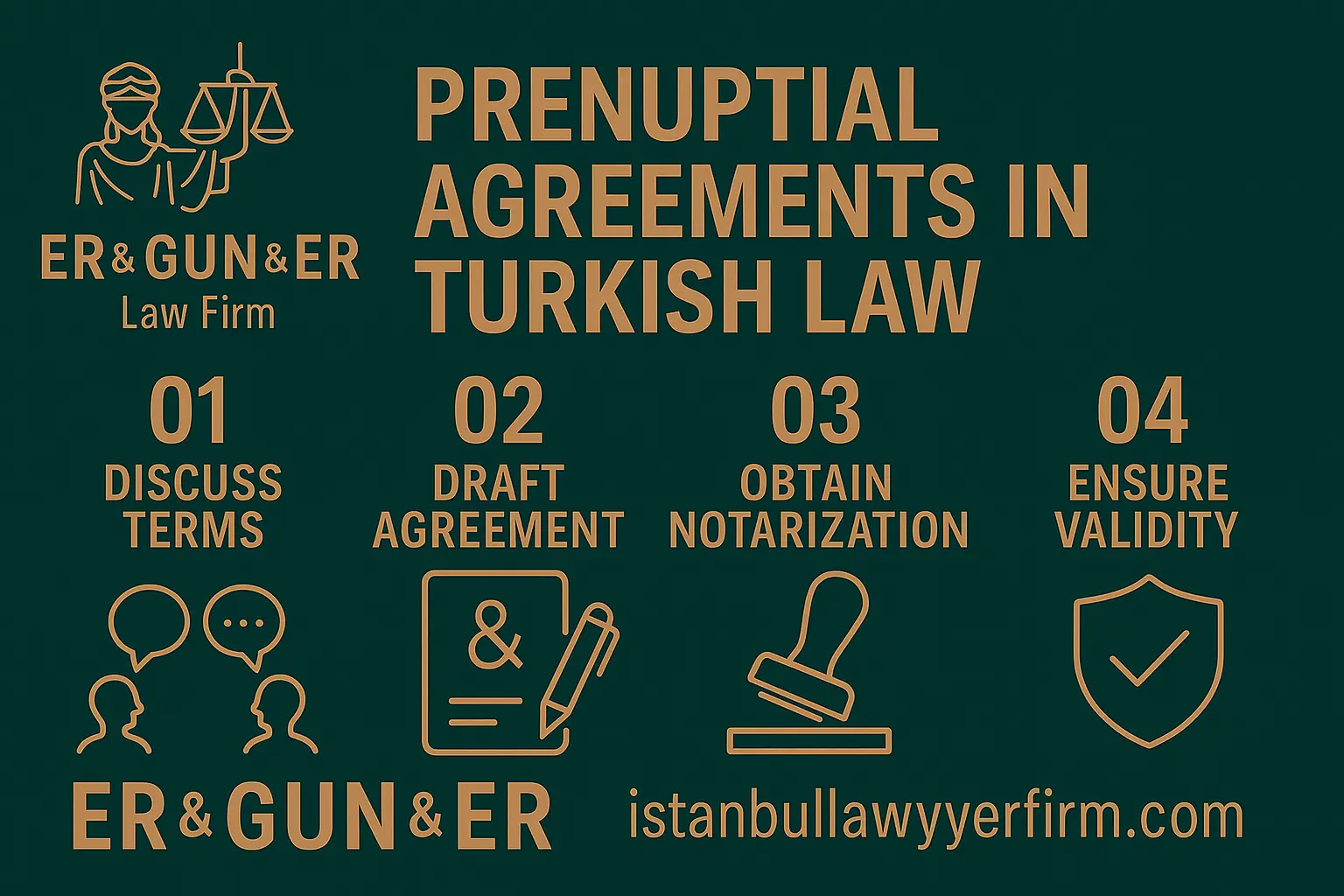
Prenuptial agreements in Turkey — known in the technical Turkish vocabulary as mal rejimi sözleşmesi (marital property regime contract) — are the principal instrument through which spouses define how their assets and liabilities will be characterized, managed and divided during marriage and at its dissolution by divorce or death. The framework that governs the document is set primarily by the Türk Medeni Kanunu (Law No. 4721, the Turkish Civil Code), which codifies the four available marital property regimes, the formal requirements for the prenuptial contract, the substantive rules on classification of assets, and the rules on dissolution and liquidation; supplemented by the Noterlik Kanunu (Law No. 1512), which sets the notarial form requirements; the Türk Borçlar Kanunu (Law No. 6098), which governs the contract's general validity (capacity, consent, lawful object); and the Hague Convention on the Law Applicable to Matrimonial Property Regimes and bilateral conventions where the parties involve a foreign element. Practice may vary by authority and year, and the discussion below describes how these layers operate in practice rather than promising particular outcomes for any specific marriage.
An English speaking lawyer in Turkey advising foreign nationals or Turkish-foreign couples on prenuptial agreements will explain that the Turkish framework operates differently from many common-law jurisdictions in two structurally important ways. First, the default Turkish marital property regime — edinilmiş mallara katılma (participation in acquired property) — automatically applies to all marriages in Turkey unless the spouses elect a different regime through a prenuptial or postnuptial contract; the absence of a contract is itself a substantive choice rather than an absence of legal regime. Second, Turkish prenuptial contracts must satisfy a specific notarial form to be valid; private (informal) prenuptial agreements that would be enforceable in some common-law jurisdictions are unenforceable under Turkish law. The body of this guide walks through the legal framework, the four regimes, the formal requirements, asset and business protection, inheritance integration, cross-border considerations, negotiation discipline, and the rules on amendment, revocation and regime change during marriage. For procedural orientation on adjacent family-law matters, our notes on divorce procedures in Turkey and property inheritance laws in Turkey can be read alongside this material.
1) Legal Framework: Prenuptial Agreements (Mal Rejimi Sözleşmesi) under the Türk Medeni Kanunu
A lawyer in Turkey who maps the prenuptial framework will start with the Türk Medeni Kanunu's structure on marital property. The Civil Code defines marriage as a legal status that produces specific economic consequences during the marriage and at its dissolution, with the marital property regime determining how the spouses' assets and liabilities are classified, managed and ultimately divided. The procedure ordinarily requires the spouses to recognize that they are in a regime — whether they have signed a contract or not — because the Civil Code's default regime applies automatically from the moment the marriage is registered and continues until the marriage ends or until the spouses elect a different regime through a notarial contract. The procedure also requires the spouses to understand that the chosen regime governs the relationship between them, not the relationship between either spouse and third-party creditors, which operates under separate rules of contract and tort liability. A creditor of one spouse can pursue that spouse's personally owned assets regardless of the marital property regime; what the regime determines is whether assets the spouse owns count as personal property (reachable by the spouse's personal creditors) or as community property (subject to additional rules on creditor reach depending on the regime's specific framework). The standard approach for spouses with significant individual creditor exposure — for example, a spouse running a business with personal guarantee exposure, or a spouse with material individual debt obligations — is to model the prenuptial choice against creditor risk as well as against dissolution risk, because the same regime that produces favorable dissolution outcomes may produce unfavorable creditor outcomes or vice versa. Practice may vary by authority and year, and the interaction between marital property regimes and creditor remedies has continued to develop through Yargıtay decisions on debtor-spouse asset reach. Practice may vary by authority and year.
An Istanbul Law Firm advising on the substantive choice between the regimes will explain that the Turkish framework offers four available regimes: edinilmiş mallara katılma (the default regime, participation in acquired property), mal ayrılığı (separation of property), paylaşmalı mal ayrılığı (separation of property with sharing on liquidation), and mal ortaklığı (community of property in defined forms including general community and limited community). Each regime produces different outcomes on the same factual pattern, and the choice between them depends on the spouses' asset structure, income expectations, business interests, inheritance prospects, and risk allocation preferences. The standard approach is to model the same hypothetical dissolution under each regime to show the spouses what each regime would produce on their actual asset profile, rather than to recommend a regime in the abstract; the modeling exercise typically clarifies the choice in a single working session and is the most useful negotiation tool the prenuptial process provides.
A Turkish Law Firm coordinating the contract's interaction with related legal frameworks will identify the points where the prenuptial reaches outside marital property law into adjacent fields. The contract's validity depends on the general contract framework of the Türk Borçlar Kanunu — the spouses must have legal capacity, must consent freely, and must contract on a lawful object — so that defects in capacity (for example, where one spouse is under guardianship) or in consent (for example, where one spouse signs under duress or under a fundamental mistake) can render the contract void or voidable independently of compliance with the marital property regime rules. The contract's interaction with inheritance law operates through the Civil Code's reserved-share (saklı pay) provisions, which protect the surviving spouse's and descendants' minimum inheritance rights against contractual derogations that would reduce them below the statutory floor. The discipline outlined in our note on property inheritance laws in Turkey covers the inheritance side of the equation in greater depth. The reserved-share framework operates as a structural limit on what the prenuptial can achieve in inheritance terms: spouses can adjust the marital property regime that determines what enters the deceased spouse's estate, but they cannot use the prenuptial to deprive descendants or the surviving spouse of their statutory minimum inheritance shares (saklı pay) in that residual estate. Where the parties wish to structure outcomes that would reduce reserved shares, the route is through the Civil Code's separate framework for inheritance contracts (miras sözleşmesi) executed in the inheritance-law form rather than through the prenuptial alone. The standard approach for spouses who want to combine prenuptial regime selection with inheritance customization is to execute parallel instruments — the prenuptial under the marital property regime framework, and a will or inheritance contract under the inheritance framework — rather than to attempt to consolidate both functions in a single document that would face validity challenges from either side. Practice may vary by authority and year.
2) The Four Marital Property Regimes under the Türk Medeni Kanunu
An English speaking lawyer in Turkey explaining the four regimes will start with the default — edinilmiş mallara katılma — because every marriage in Turkey enters this regime automatically unless the spouses elect a different one. Under this regime, each spouse retains full ownership of pre-marital assets (kişisel mal, personal property) and of certain assets acquired during marriage from defined personal sources (gifts, inheritance, indemnities for personal injury, replacement values of personal assets). Assets acquired during marriage from work income or asset returns become the spouse's personal property in ownership terms but are subject to a sharing claim (katılma alacağı) at dissolution: the other spouse becomes entitled to half the value of the acquired-property pool's net value, with the calculation performed at dissolution. The regime preserves ownership autonomy during marriage and produces a sharing outcome at dissolution that approximates community-of-property economics without the operational complexity of joint ownership during the marriage itself.
Turkish lawyers who advise spouses considering a contractual regime will outline the three alternatives. Mal ayrılığı (separation of property) preserves each spouse's full ownership autonomy throughout the marriage and produces no sharing claim at dissolution; each spouse retains pre-marital and during-marriage assets without contributing to a common pool, and dissolution operates as a simple confirmation of ownership rather than as a liquidation. Paylaşmalı mal ayrılığı (separation with sharing on liquidation) preserves the same ownership autonomy during marriage but produces a sharing mechanism at dissolution focused on assets that supported the family's living standards, with a more equity-focused calculation than the strict separation regime. Mal ortaklığı (community of property) creates a shared property pool that is owned jointly during marriage in defined forms — general community covering most assets, or limited community covering specific asset categories — with shared management and shared liability, and dissolution operates as a partition of the community pool. Each regime carries trade-offs that the spouses' specific circumstances illuminate.
An Istanbul Law Firm advising high-net-worth or business-owning spouses will note that the choice between regimes is materially different from a binary "yes-or-no on prenup" decision, because the default regime is itself a choice with substantive consequences. For spouses whose pre-marital assets are concentrated and whose during-marriage acquisitions will be modest, the default regime preserves pre-marital assets while producing an equitable sharing outcome on acquisitions; for spouses whose during-marriage entrepreneurial activity is expected to generate significant wealth that one spouse will largely build alone, mal ayrılığı or paylaşmalı mal ayrılığı may better reflect the parties' contributions; for spouses entering a fully economic-partnership marriage where shared management is the operational reality, mal ortaklığı captures the relationship's economic structure most accurately. Practice may vary by authority and year, and judicial interpretation of the regimes' boundary cases has continued to develop through accumulated decisions of the Yargıtay's family-law chambers. The illustrative scenarios that the modeling exercise typically considers include: a spouse who brings a substantial pre-marital property portfolio into the marriage and earns modest during-marriage income (where the default regime preserves the pre-marital portfolio entirely while sharing only the during-marriage acquisitions); a spouse who builds a successful business during marriage with the other spouse's domestic support (where the default regime produces a sharing claim on the business value built during marriage even though title is in the entrepreneur's name); a spouse who receives substantial inheritance during marriage (where the inheritance is classified as personal property under the default regime and does not enter the sharing pool, but its returns and reinvestments may be partially shared depending on classification); a spouse who is co-investor with the other spouse in joint commercial activities (where the default regime's sharing logic may not align with the parties' actual contributions and where mal ortaklığı or a tailored mal ayrılığı with sharing addenda may produce more accurate outcomes). The standard approach is to model each spouse's specific facts under each regime rather than to default to general advice that cannot capture the relevant variables.
3) Formal Requirements: Notarial Düzenleme Şeklinde and Onaylama Şeklinde Execution
A lawyer in Turkey explaining the formal requirements will distinguish two notarial routes that the Türk Medeni Kanunu recognizes for prenuptial contracts. The first is düzenleme şeklinde — the document drafted by the notary based on the spouses' declarations, read by the notary to the spouses, and executed before the notary as a notarial deed in the strict form. The second is onaylama şeklinde — the document drafted by the spouses (or by their counsel) in advance and presented to the notary for signature certification, with the notary's role limited to verifying the parties' identities and signature authenticity rather than drafting the substantive document. Both routes produce a valid mal rejimi sözleşmesi under the Civil Code's framework, and the choice between them depends on the document's complexity and the spouses' preference for notary involvement in drafting. The procedure ordinarily requires the choice of route to be made before the appointment, because the notary's preparation differs materially between the two.
Turkish lawyers who handle prenuptial execution at a Turkish notary will guide the spouses through the procedural steps required for a valid instrument. The procedure ordinarily requires the spouses to attend the notary office in person with valid identification (Türk kimlik kartı for Turkish citizens, passport for foreign nationals together with residence permit where applicable), to identify their chosen regime and the substantive terms (where the contract goes beyond regime selection to address asset categorization, business protection, inheritance coordination or other specific matters), and to sign the document in the notary's presence after the notary has verified identities and confirmed the spouses' understanding of the document's contents. Where one or both spouses do not speak Turkish at a level sufficient to follow the notary's reading of the document, the standard approach is to engage a sworn translator (yeminli tercüman) to attend the appointment, translate the document orally during execution, and sign the notary's register confirming the translation. Practice may vary by authority and year on translator availability for specific languages.
An Istanbul Law Firm coordinating the contract's interaction with the marriage registration will explain that the prenuptial can be executed before the marriage (gerçek anlamıyla evlenme öncesi mal rejimi sözleşmesi) or during the marriage (evlilik içinde yapılan mal rejimi sözleşmesi), with both routes recognized under the Civil Code's framework. Where the contract is executed before marriage, it takes effect from the moment the marriage is registered with the relevant evlendirme memuru (civil marriage registrar). Where the contract is executed during marriage, it takes effect from the date of execution and prospectively reorganizes the marital property regime; assets acquired before the regime change continue to be classified under the prior regime unless the contract expressly addresses retrospective reclassification subject to the Civil Code's limits on third-party rights. The contract's notarial execution is the operative point for validity; separate registration with the civil marriage registry is not required for the contract's validity between spouses, although the spouses may declare their regime choice at the marriage registration where they wish to align the public record with the contractual choice. Practice may vary by authority and year, and the Türk Medeni Kanunu's framework for declaring regime choice at marriage registration has continued to operate through evolving administrative practice at the evlendirme memuru offices across municipalities. Where the spouses execute a prenuptial after the marriage registration date — for example, where one of the spouses had not focused on the marital property question before the wedding and the spouses subsequently agreed to formalize their regime — the post-marriage execution operates as a postnuptial regime contract with effect from the date of execution, and the spouses' assets acquired between the marriage date and the contract date are governed by the default regime unless the contract expressly addresses retrospective reclassification within the limits the Civil Code permits. The standard approach is to recognize that the timing of execution affects what the contract can accomplish, and to align the execution with the spouses' substantive objectives rather than to assume that pre- and post-marriage contracts are interchangeable.
4) Asset Protection, Business Ownership and Intellectual Property Considerations
A Turkish Law Firm advising business-owning spouses will draft the prenuptial to coordinate the marital property regime with the spouse's corporate and operational structures. Where the business operates as a Turkish anonim şirket or limited şirket, the prenuptial should address the classification of the spouse's shareholding (whether as personal property under the chosen regime or as subject to sharing on dissolution), the treatment of dividends and other distributions during marriage, and the consequences of spousal involvement in management — for example, whether the non-owner spouse's contributions to the business produce sharing rights at dissolution. The standard approach is to align the prenuptial's classification of business assets with the company's articles of association and shareholders' agreement, so that a dissolution-driven valuation does not produce surprises against the company's internal economic arrangements among the founders or other shareholders.
Turkish lawyers who advise on cross-business prenuptial coordination will note that family-business succession planning interacts with the marital property regime through several channels. Where the spouse's business interests are part of a multi-generational family-business structure with a family constitution (aile anayasası), shareholder agreement provisions, or pre-existing succession arrangements, the prenuptial should reference and coordinate with those instruments rather than adopt regime classifications that would conflict with them. Where the spouse holds a minority shareholding in a family-controlled business, the family group may itself prefer a specific regime selection that protects the family-business equity from dissolution-driven external claims; the standard approach is to address these family-level considerations in advance of the prenuptial negotiation rather than to discover them after the contract is signed. The discipline outlined in our note on family business governance in Turkey covers adjacent corporate-side considerations.
An English speaking lawyer in Turkey advising on intellectual property considerations will note that intangible assets — copyrights, patents, trademarks, software, licensing agreements, royalty streams — present particular classification challenges under the marital property regimes because their value is often realized over time and depends on continuing exploitation by the holder. Where one spouse is a creator, inventor or licensor, the prenuptial should address the classification of the underlying IP rights (typically as personal property where created or acquired before marriage), the classification of royalty and license income generated during marriage (which may be subject to sharing under the default regime even where the underlying right is personal), and the operational mechanics of valuation at dissolution. The standard approach is to combine clear regime selection with specific IP-related clauses that identify the assets, define the valuation methodology, and specify the cooperation obligations during marriage that protect the IP's commercial value through the dissolution process. Valuation methodology is particularly important for IP-heavy prenuptials because IP assets often lack the market-comparable transactions that simpler asset valuations rely on; the prenuptial should specify whether valuation will use income-based methods (discounted royalty streams, comparable license rates), market-based methods (recent transactions in similar IP), or cost-based methods (replacement value of the development cost), and whether the valuation will be performed by an agreed expert, by parallel experts retained by each spouse, or by a court-appointed expert in dispute proceedings. Where the IP is part of an active commercial business — software products in market, copyrighted works generating ongoing royalties, trademarks supporting brand-driven sales — the valuation should also address business-continuity considerations that prevent dissolution-driven valuation disputes from disrupting the underlying commercial operation. Practice may vary by authority and year, and IP valuation has continued to develop as a distinct discipline within Turkish family-law practice.
5) Inheritance Coordination and Family Wealth Planning
A lawyer in Turkey advising on inheritance integration will explain that the prenuptial agreement's interaction with inheritance law operates within the boundaries set by the Türk Medeni Kanunu's reserved-share (saklı pay) provisions, which protect the surviving spouse's and descendants' minimum inheritance rights against contractual derogations that would reduce them below the statutory floor. The procedure ordinarily requires the prenuptial to be coordinated with — not used as a substitute for — a will (vasiyetname) or an inheritance contract (miras sözleşmesi) where the spouses wish to structure inheritance outcomes that go beyond the default rules of intestate succession. The marital property regime determines what assets enter the deceased spouse's estate and which assets the surviving spouse keeps as their own property; the inheritance rules then determine how the deceased spouse's estate is distributed among the surviving spouse, descendants and other heirs.
An Istanbul Law Firm advising on multi-generational wealth structures will note that the choice of marital property regime materially affects the size and composition of each spouse's estate at death, which in turn affects the inheritance-tax and succession-planning architecture. Where one spouse holds significant ancestral or family-pool wealth, the choice of regime affects whether that wealth remains entirely with the surviving spouse's family line at first death or whether it transitions partially to the deceased's spouse's line through the marital property liquidation; the family-wealth implications can be substantial and warrant explicit modeling at the prenuptial stage rather than discovery at first-death event. The standard approach is to model the prenuptial alongside the spouses' broader estate plan — wills, lifetime gifts, family-trust structures where applicable in foreign jurisdictions — rather than to treat the prenuptial as an isolated document. Where one spouse is a beneficiary of a foreign-jurisdiction family trust or other vehicle that does not have a direct Turkish-law equivalent, the prenuptial should address how Turkish marital property law will treat distributions from that vehicle during marriage and at dissolution, because Turkish law's classification of foreign-trust distributions is not always intuitive to spouses and counsel familiar with the originating foreign framework. The standard approach is to obtain a written legal opinion from the trust's home-jurisdiction counsel describing the trust's structure and distribution mechanics, to coordinate that opinion with Turkish counsel's analysis of how Turkish marital property law will characterize the resulting distributions, and to draft the prenuptial's classification clauses to reflect both legal frameworks rather than to leave the question to dissolution-stage interpretation. Practice may vary by authority and year on the treatment of foreign-trust distributions under Turkish marital property analysis.
A Turkish Law Firm advising on cross-border inheritance coordination will address the additional layer that arises when the spouses or their assets connect to multiple jurisdictions. Where the spouses are nationals of different countries, where they own assets in multiple jurisdictions, or where one spouse's family wealth is held in foreign structures, the prenuptial should be drafted in coordination with the spouses' home-country counsel and should anticipate the recognition issues that may arise on dissolution or death in any of the relevant jurisdictions. The applicable-law analysis under the Hague Convention on the Law Applicable to Matrimonial Property Regimes (where applicable) and under bilateral conventions where the spouses' countries have entered them governs which law a foreign court will apply on recognition. The discipline outlined in our note on property inheritance laws in Turkey covers the Turkish inheritance side; the parties' home-country counsel should provide the parallel analysis for their respective jurisdictions. Practice may vary by authority and year.
6) Foreign Nationals and Cross-Border Marriage Contracts
An English speaking lawyer in Turkey advising international couples — both spouses foreign, or one Turkish and one foreign — will explain that the cross-border layer adds three distinct considerations to the basic prenuptial analysis. First, the applicable-law analysis: which country's marital property law governs the spouses' regime, and what choice-of-law options the prenuptial can exercise. Second, the recognition analysis: whether a Turkish-executed prenuptial will be recognized in the spouses' home countries on later dissolution or death proceedings, and whether home-country-executed prenuptials will be recognized in Turkey. Third, the operational coordination: how the Turkish prenuptial integrates with the spouses' home-country pre- or post-nuptial arrangements where they have them. The standard approach is to address all three considerations explicitly in the contract rather than to assume that Turkish execution will produce uncomplicated international recognition.
Turkish lawyers who handle international prenuptials will draft choice-of-law clauses in coordination with the spouses' home-country counsel, because choice-of-law clauses are operative only within the scope that the relevant legal frameworks permit. Where the spouses choose Turkish law as the governing law of their marital property, the choice operates within Turkey unproblematically; foreign-court recognition of that choice depends on the foreign jurisdiction's conflict-of-laws rules. Where the spouses choose foreign law as the governing law, Turkish courts will apply the chosen foreign law to the extent the Türk Medeni Kanunu's framework on private international law permits, with public-policy reservations protecting Turkish reserved-share provisions and other matters where Turkish public policy applies. The standard approach is to document the choice-of-law analysis in a written memo prepared in coordination between Turkish and home-country counsel, so that the parties have a coherent record of why the choice was made and how it operates in each jurisdiction. The recognition analysis warrants particular attention for couples whose home jurisdiction operates under common-law principles where prenuptial agreements have historically been treated with judicial skepticism — England and Wales most prominently, where prenuptial agreements were not directly enforceable as a matter of contract under the older case law and have only been given material weight following more recent Supreme Court decisions on the conditions for enforcement. Where one spouse's home jurisdiction operates under such a framework, the recognition analysis must address whether the home-country court would treat the Turkish prenuptial as evidence of the spouses' intentions rather than as a directly binding contract, what additional disclosure or independent-advice requirements that court would impose for material weight, and what asymmetries between the Turkish and home-country approaches the spouses should anticipate. The standard approach is to over-document execution rather than to produce an instrument that satisfies Turkish minimums but falls short of the home-country jurisdiction's higher standards. Practice may vary by authority and year on cross-jurisdictional recognition standards.
An Istanbul Law Firm coordinating the documentary architecture for international couples will produce parallel or mirror documents where the spouses' jurisdictions both require local instruments. The standard approach is to execute a Turkish prenuptial in Turkish before a Turkish notary with sworn translation into the spouses' working language, and where the home country requires its own pre- or post-nuptial instrument, to execute a parallel home-country instrument with consistent substantive terms. Where the home country's framework recognizes foreign-executed prenuptials with apostille authentication, the standard approach is to authenticate the Turkish prenuptial with apostille for use in the home country rather than to execute parallel documents that may diverge over time. The choice between mirror and authenticated-original approaches depends on the spouses' specific home-country requirements and the long-term operational considerations of which jurisdiction is more likely to be the dissolution forum. Where the spouses execute mirror documents in two jurisdictions, the procedural risk is divergence over time as one document is amended without the other, producing inconsistent regimes that one party can exploit at dissolution; the standard approach is to include explicit cross-reference clauses in each document identifying the mirror in the other jurisdiction, and to commit to bilateral amendment whenever either document is changed. Where the spouses authenticate the Turkish original for foreign use, the procedural risk is that the foreign jurisdiction's later interpretation of the Turkish-law regime may diverge from the Turkish interpretation, particularly where the foreign jurisdiction's framework does not have a directly analogous regime; the standard approach is to include in the Turkish prenuptial an interpretive memorandum that explains the regime's operation in terms a foreign court can understand, with the memorandum executed in the spouses' working language and authenticated alongside the prenuptial itself. Practice may vary by authority and year on home-country recognition requirements.
7) Negotiation, Timing, Disclosure and Capacity Considerations
A lawyer in Turkey advising on the negotiation process will treat timing as a substantive factor rather than a logistical one. The standard approach is to start the prenuptial discussion at least four to six weeks before the planned marriage date — earlier where the asset profile is complex or where cross-border coordination is required — because last-minute prenuptial execution carries multiple risks: insufficient time for both parties to review and consult independent counsel, heightened vulnerability to claims of duress or undue influence at later challenge, and procedural friction at the notary office that may push execution past the marriage date. The procedure ordinarily requires the contract to be executed before the marriage where the spouses want pre-marital effect, and execution after the marriage produces a postnuptial regime change rather than a prenuptial agreement strictly construed.
Turkish lawyers who handle the negotiation phase will design the disclosure architecture as the foundation of the contract's substantive integrity. The standard approach is to require both spouses to provide written financial disclosure — current assets and liabilities with supporting documentation, current income sources, anticipated significant changes, prior obligations from earlier marriages or partnerships — and to attach the disclosure as an annex to the contract that becomes part of the executed document. Mutual disclosure protects against later challenges based on misrepresentation or concealment of material facts, and in Turkish practice the disclosure annex is one of the key documentary defenses against later attack on the contract's validity. The disclosure should be prepared in advance of the negotiation so that both parties understand each other's financial picture before they negotiate the substantive terms; surprise revelations during negotiation tend to produce contracts that one party later regrets and challenges. The disclosure architecture itself should follow a consistent structure that both spouses can readily understand: real estate holdings with current market estimates and supporting valuations, business interests with shareholder records and most-recent financial statements, financial accounts with statements covering the prior twelve months, investment positions with current account statements, prior obligations including any maintenance or support obligations from prior marriages, anticipated significant changes including expected inheritance receipts where the spouse has reasonable visibility into the timing and substance, and contingent liabilities including personal guarantees and other off-balance-sheet exposures. Each category should be supported by documentary evidence rather than by self-prepared schedules, because the documentary trail is what defends the disclosure against later challenges that the spouse misrepresented or omitted material information. Where one spouse's financial picture is unusually complex — multiple business interests across jurisdictions, family-pool assets the spouse partially controls, contingent positions with uncertain valuations — the disclosure should include a written narrative explaining the structure rather than relying on the spouse's counterparty to interpret raw documents. The narrative should also identify which assets fall outside the spouse's actual control even where formal title or beneficial interest is allocated to that spouse, because the difference between formal ownership and effective control is often material to dissolution-stage valuation discussions. The standard approach is to refresh the disclosure shortly before notarial execution rather than to rely on a static snapshot prepared weeks earlier.
An Istanbul Law Firm advising on capacity and consent will note that Turkish courts evaluate prenuptial validity on the same general contract criteria the Türk Borçlar Kanunu applies to all contracts: legal capacity, free consent, lawful object, formal compliance. Capacity questions arise where one spouse is under guardianship, suffers from a condition affecting decision-making capacity, or is at the boundary age of majority; consent questions arise where one spouse alleges duress, undue influence, fraud, or fundamental mistake. The standard approach is to ensure that both spouses have independent legal advice before signing — even where the parties' relationship is amicable and the contract is balanced — because independent advice is the most reliable protection against later challenges based on inadequate consent or undisclosed information. The discipline outlined in our note on divorce procedures in Turkey illustrates the dispute environment in which prenuptial validity questions typically arise. The boundary cases that produce the most prenuptial validity challenges in Turkish practice include: prenuptials signed within days of the wedding where the challenged spouse alleges they had insufficient time to seek independent advice; prenuptials signed in a foreign language by a spouse who later alleges they did not fully understand the Turkish-language operative version; prenuptials with unilateral disclosure where only one spouse provided detailed financial information; prenuptials signed during a period when one spouse was in a vulnerable emotional state due to family or health circumstances; and prenuptials with substantively unbalanced terms (one spouse retains essentially all assets and the other waives substantial rights) where the imbalance itself supports an inference of inadequate consent. The standard approach is to address each of these risk factors at execution time — independent counsel for each side, sworn translation with bilingual review, mutual disclosure with sufficient lead time, and substantive balance that the parties can both rationally explain — rather than to leave the contract exposed to challenges grounded in execution-stage deficiencies. Practice may vary by authority and year on the courts' receptivity to capacity and consent challenges.
8) Amendment, Revocation, Regime Change and Dissolution Coordination
A Turkish Law Firm advising on post-execution flexibility will explain that prenuptial agreements in Turkey are not immutable instruments. The Türk Medeni Kanunu's framework permits the spouses to amend, revoke or replace their marital property regime by mutual consent at any point during the marriage, subject to the same notarial form requirements that apply to the original prenuptial. The procedure ordinarily requires the spouses to execute the amendment or revocation document before a Turkish notary, with the document taking effect from the date of execution and operating prospectively unless the document expressly addresses retrospective reclassification within the limits the Civil Code permits. Where one spouse refuses to consent to a regime change that the other spouse considers necessary, the unilateral spouse cannot effect the change through unilateral action and must rely on the underlying regime's standard rules until the other spouse agrees or the marriage dissolves.
An English speaking lawyer in Turkey supporting regime changes will identify the typical triggers for amendment in foreign-buyer or international-couple files. The triggers include the birth of children (which often prompts spouses to revisit asset categorization to reflect estate-planning preferences), significant changes in business structure (mergers, acquisitions, sales of substantial business interests), inheritance receipts that reshape the spouses' relative wealth positions, relocation between jurisdictions that changes the operative legal environment, and the disposition of major assets that the original prenuptial addressed. The standard approach is to schedule periodic prenuptial reviews — every three to five years for active high-net-worth families, more frequently for spouses whose asset structures are evolving rapidly — rather than to wait for crisis-driven amendment that may produce defensive rather than considered outcomes.
Turkish lawyers who handle dissolution coordination will explain that the prenuptial's operative effect crystallizes at dissolution, when the spouses (or their estates, in the case of dissolution by death) implement the regime's liquidation rules. For divorce proceedings before the Aile Mahkemesi (Family Court), the prenuptial governs the property aspects of the dissolution while the divorce-specific issues (custody, alimony, divorce grounds) operate under the divorce framework's separate rules. For dissolution by death, the prenuptial determines the marital property liquidation that precedes the inheritance distribution, with the surviving spouse first taking their share under the marital property regime and the deceased spouse's residual estate then passing under the inheritance framework's rules. Disputes over the prenuptial's interpretation or validity typically proceed before the competent civil court — typically the Aile Mahkemesi for matters tied to ongoing divorce, the Asliye Hukuk Mahkemesi for stand-alone disputes — with the dispute file built on the prenuptial document, the disclosure annexes, the notarial execution record, and any subsequent amendments or correspondence relevant to the parties' understanding of the contract. Practice may vary by authority and year. The interaction between the prenuptial and the divorce-specific issues deserves separate attention because the divorce framework's rules on alimony (yoksulluk nafakası and tedbir nafakası), child support (iştirak nafakası) and custody operate independently of the marital property regime; the prenuptial cannot determine these matters because Turkish law treats them as protective rules that reflect public policy considerations beyond the spouses' bilateral agreement. Where the prenuptial includes clauses purporting to waive alimony in advance, those clauses are typically not enforceable as written — the alimony question is decided at divorce based on the parties' actual circumstances at that time — and counsel should explain this limit at the prenuptial drafting stage rather than allow the parties to believe they have contracted out of alimony exposure. The dissolution coordination layer is one of the most frequent sources of post-execution disappointment in Turkish prenuptial practice, and clear communication at drafting time prevents subsequent recriminations.
9) Frequently Asked Questions for Couples and International Investors
- What is a prenuptial agreement under Turkish law? A prenuptial agreement (mal rejimi sözleşmesi) is a notarial contract through which spouses select among the four marital property regimes the Türk Medeni Kanunu recognizes — edinilmiş mallara katılma, mal ayrılığı, paylaşmalı mal ayrılığı, mal ortaklığı — and define how their assets and liabilities will be classified, managed and divided during marriage and at dissolution by divorce or death.
- Are prenuptial agreements legal and recognized in Turkey? Yes. The Türk Medeni Kanunu expressly authorizes prenuptial contracts and sets the framework for their formal and substantive validity. Properly executed prenuptials are recognized by Turkish courts and treated as binding on the spouses subject to the Civil Code's protective provisions on reserved-share inheritance rights and capacity-and-consent requirements.
- Can foreign nationals execute a prenuptial agreement in Turkey? Yes. Foreign nationals can execute Turkish prenuptial agreements before a Turkish notary, with sworn translation where the spouses do not speak Turkish at the level required to follow the notary's reading. Cross-border coordination with the spouses' home-country counsel is recommended to address recognition and applicable-law issues.
- What is the default marital property regime in Turkey if no prenuptial is signed? The default regime is edinilmiş mallara katılma (participation in acquired property), under which each spouse retains personal ownership of pre-marital assets and certain personal-source assets acquired during marriage, with a sharing claim at dissolution on the net value of the acquired-property pool. This regime applies automatically unless the spouses elect a different one.
- What are the four available marital property regimes? Edinilmiş mallara katılma (default, participation in acquired property), mal ayrılığı (separation of property), paylaşmalı mal ayrılığı (separation with sharing on liquidation), and mal ortaklığı (community of property in general or limited form). Each produces different outcomes on the same factual pattern.
- Is notarial execution mandatory? Yes. Prenuptial agreements must be executed before a Turkish notary in either düzenleme şeklinde (drafted by the notary) or onaylama şeklinde (signature certification by the notary on a document drafted in advance). Private prenuptials without notarial execution are not valid under Turkish law.
- Can a prenuptial be modified or revoked after marriage? Yes. Spouses can amend, revoke or replace their marital property regime by mutual consent at any point during marriage, subject to the same notarial form requirements that apply to the original prenuptial. Unilateral amendment is not possible.
- Does a prenuptial override Turkish inheritance law? No. The prenuptial operates within the boundaries set by the Türk Medeni Kanunu's reserved-share (saklı pay) provisions, which protect the surviving spouse's and descendants' minimum inheritance rights. Inheritance planning beyond the default rules typically requires separate instruments — wills or inheritance contracts — coordinated with the prenuptial.
- How are business assets handled in a Turkish prenuptial? Business assets are addressed through regime selection combined with specific contractual clauses on classification of shareholdings, treatment of dividends and distributions, valuation methodology at dissolution, and coordination with the company's articles of association and shareholders' agreement. The standard approach is to model dissolution outcomes under each regime against the spouse's actual business profile.
- How are intellectual property rights treated? IP rights present specific classification challenges because their value is often realized over time. The prenuptial typically classifies the underlying rights (often as personal property where created or acquired before marriage) and addresses the treatment of royalty and license income separately, together with valuation methodology at dissolution.
- How does the prenuptial work for international couples? International couples address three layers — applicable-law analysis (which country's marital property law governs), recognition analysis (whether the prenuptial will be recognized in the spouses' home countries), and operational coordination (how the Turkish prenuptial integrates with home-country instruments). The standard approach is to coordinate with home-country counsel before execution.
- When should the prenuptial be executed? The standard approach is to start the discussion at least four to six weeks before the planned marriage date and to execute the prenuptial well before the wedding, allowing time for independent legal advice, financial disclosure, and considered negotiation. Last-minute execution increases the risk of later challenges based on duress or inadequate consent.
- What disclosure is required during negotiation? The standard approach requires both spouses to provide written financial disclosure covering current assets and liabilities, income sources, anticipated significant changes, and prior obligations. The disclosure is attached as an annex to the contract and serves as a documentary defense against later challenges based on misrepresentation or concealment.
- What happens to the prenuptial at divorce or death? At divorce, the prenuptial governs the property aspects of dissolution before the Aile Mahkemesi while the divorce-specific issues (custody, alimony, grounds) operate under separate rules. At death, the prenuptial determines the marital property liquidation that precedes the inheritance distribution, with the surviving spouse taking their marital property share before the deceased spouse's residual estate passes under inheritance rules.
- Does ER&GUN&ER Law Firm advise on Turkish prenuptial agreements for both Turkish and international couples? Yes. ER&GUN&ER Law Firm is an Istanbul-based law firm advising Turkish citizens, foreign nationals and Turkish-foreign couples on the complete prenuptial lifecycle, including marital property regime selection under the Türk Medeni Kanunu, formal notarial execution, asset and business protection coordination, inheritance integration, cross-border applicable-law and recognition analysis, negotiation and disclosure architecture, and amendment, revocation and regime-change documentation during marriage — with English-language client communication and bilingual documentation throughout each engagement. Files in this area are typically led personally by the managing partner rather than delegated.
Author: Mirkan Topcu is an attorney registered with the Istanbul Bar Association (Istanbul 1st Bar), Bar Registration No: 67874. His practice focuses on cross-border and high-stakes matters where evidence discipline, procedural accuracy, and risk control are decisive.
He advises Turkish citizens, foreign nationals and Turkish-foreign couples on Turkish prenuptial and postnuptial agreements (mal rejimi sözleşmesi) under the Türk Medeni Kanunu, including marital property regime selection across the four available regimes, notarial execution under the Noterlik Kanunu, asset and business ownership coordination, intellectual property considerations, inheritance and family-wealth integration with reserved-share protections, cross-border applicable-law and recognition analysis for international couples, negotiation timing and financial disclosure architecture, capacity and consent considerations, and amendment, revocation and regime change during marriage; together with adjacent matters where the prenuptial intersects with divorce proceedings before the Aile Mahkemesi and with inheritance proceedings before the Sulh Hukuk Mahkemesi.
Education: Istanbul University Faculty of Law (2018); Galatasaray University, LL.M. (2022). LinkedIn: Profile. Istanbul Bar Association: Official website.