

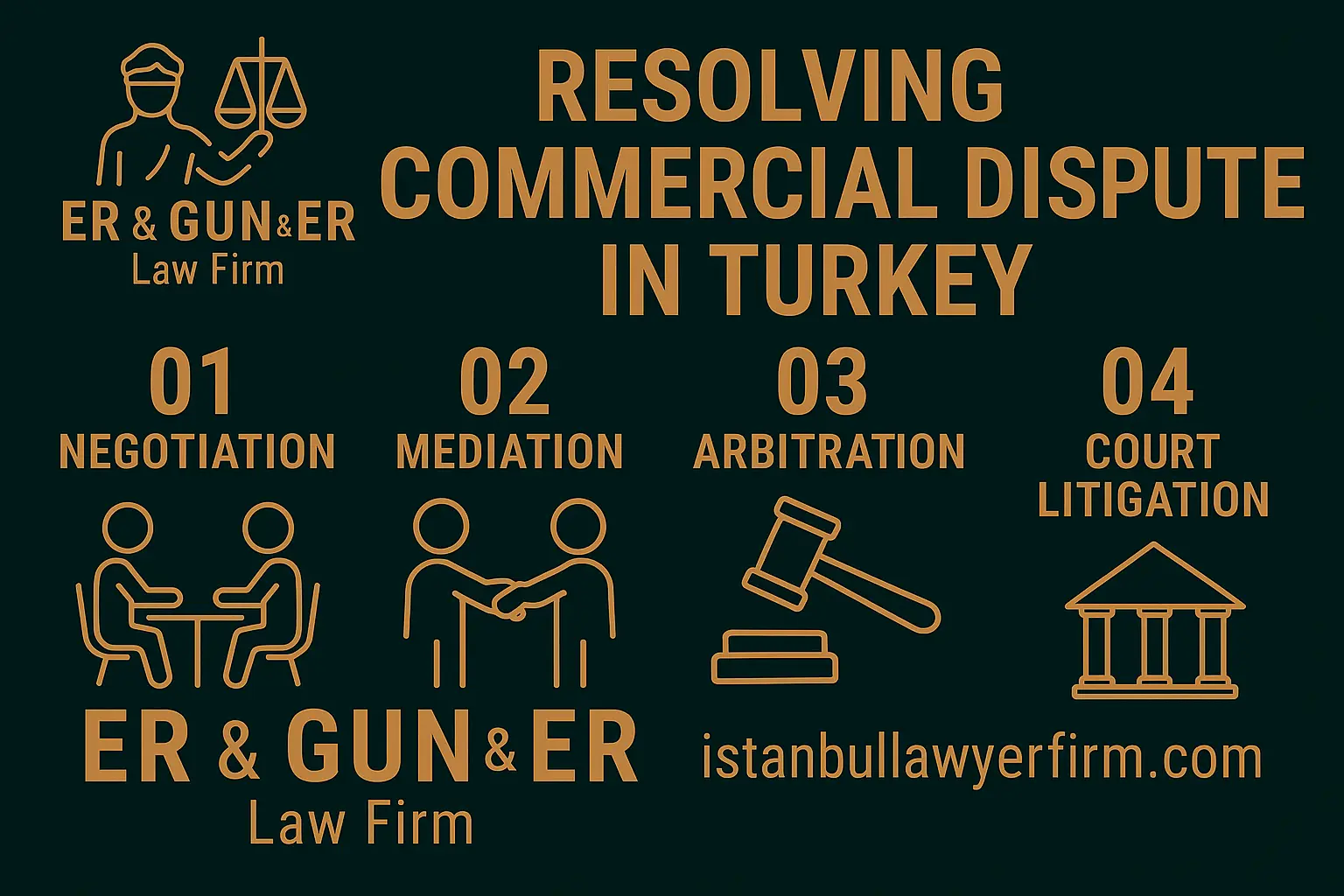
Resolving commercial disputes in Turkey operates within a structured procedural framework that combines specialized commercial-court litigation, mandatory pre-litigation mediation, domestic and international arbitration mechanisms, comprehensive interim measures, structured cross-border recognition pathways, and integrated enforcement coordination producing the comprehensive dispute-resolution discipline that experienced practitioners support across the full lifecycle. The framework that governs the relevant questions is set primarily by the 6100 sayılı Hukuk Muhakemeleri Kanunu (HMK / Code of Civil Procedure) covering m.1 vd. (genel hükümler / general provisions), m.4-5 (sulh hukuk mahkemesi görev), m.219-224 (belge ibrazı / document production), m.266-287 (bilirkişi / expert witness), m.341 vd. (istinaf / intermediate appeal effective 20 July 2016), m.361 vd. (temyiz / cassation), m.389-403 (ihtiyati tedbir / precautionary injunction), m.400 (delil tespiti / preservation of evidence), and m.407-444 (tahkim / domestic arbitration); the 6102 sayılı Türk Ticaret Kanunu (TTK / Turkish Commercial Code) including m.4 (ticari iş / commercial transaction), m.5 (Asliye Ticaret Mahkemesi / Commercial Court of First Instance jurisdiction), and m.5/A (dava şartı arabuluculuk / mandatory pre-litigation mediation framework for commercial disputes effective 1 January 2019); the 6325 sayılı Hukuk Uyuşmazlıklarında Arabuluculuk Kanunu (Law on Mediation in Civil Disputes) establishing the substantive mediation framework; the 4686 sayılı Milletlerarası Tahkim Kanunu (MTK / International Arbitration Law) governing international arbitration matters; the ISTAC (Istanbul Tahkim Merkezi / Istanbul Arbitration Centre) framework under Law No. 6570 effective 1 October 2014; the 2004 sayılı İcra ve İflas Kanunu (İİK / Enforcement and Bankruptcy Code) including m.257-268 (ihtiyati haciz / precautionary attachment) and the broader enforcement framework through İcra Müdürlüğü (Enforcement Office) and İcra Mahkemesi (Enforcement Court); the 5718 sayılı Milletlerarası Özel Hukuk ve Usul Hukuku Hakkında Kanun (MÖHUK / Code on International Private and Procedural Law) m.50-63 covering tanıma (recognition) and tenfiz (enforcement) of foreign judgments and arbitral awards including m.54 establishing structured tenfiz conditions (kesinleşmiş karar / finalized decision, karşılıklılık / reciprocity, kamu düzeni / public order), and m.62 governing tenfiz reddine itiraz (appeal against refusal of enforcement); the New York Convention on the Recognition and Enforcement of Foreign Arbitral Awards 1958 with Turkey's accession effective 25 September 1991 with reciprocity reservation; and the 6216 sayılı Anayasa Mahkemesinin Kuruluşu ve Yargılama Usulleri Hakkında Kanun m.45-49 governing AYM bireysel başvuru where applicable. Practice may vary by authority and year.
An English speaking lawyer in Turkey advising on commercial dispute resolution will explain that effective dispute positioning requires structured coordination across forum-selection analysis (litigation versus arbitration), mandatory mediation compliance, interim measures planning, substantive evidence discipline, integrated enforcement positioning, and broader strategic considerations supporting both immediate dispute outcomes and longer-horizon commercial relationships. The body of this guide walks through the HMK Law No. 6100 litigation framework with TTK m.5 Asliye Ticaret Mahkemesi jurisdiction; the mandatory mediation framework under Law No. 6325 and TTK m.5/A with dava şartı analysis effective 1 January 2019; the arbitration framework with HMK m.407-444 domestic arbitration and MTK Law No. 4686 international arbitration with ISTAC coordination; the interim measures framework with HMK m.389-403 ihtiyati tedbir and İİK m.257-268 ihtiyati haciz; the document production framework under HMK m.219-224; the foreign judgment and award recognition framework under MÖHUK m.50-63 and New York Convention 1958; the setting-aside challenges framework under MTK m.15 and HMK m.439 with appellate hierarchy; and the cost recovery, strategic forum selection, and drafting discipline. For procedural orientation on adjacent topics, our notes on foreign court judgment enforcement in Turkey, contract disputes in Turkey, and arbitration in Turkey can be read alongside this material.
1) HMK Law No. 6100 Litigation Framework and Asliye Ticaret Mahkemesi Jurisdiction under TTK m.5
A lawyer in Turkey advising on the litigation framework will explain that Turkish commercial litigation operates through structured procedural mechanics under the 6100 sayılı Hukuk Muhakemeleri Kanunu (HMK) with substantive commercial-jurisdiction allocation under the 6102 sayılı Türk Ticaret Kanunu (TTK) producing specialized commercial-court positioning for ticari uyuşmazlıklar (commercial disputes). The procedure ordinarily considers the substantive jurisdictional framework where TTK m.4 establishes the substantive scope of ticari iş (commercial transaction) and TTK m.5 establishes Asliye Ticaret Mahkemesi (Commercial Court of First Instance) as the specialized forum for commercial disputes — the substantive commercial-jurisdiction analysis covers disputes between merchants (tacir), disputes arising from commercial activities, and broader categories enumerated in the substantive framework; the procedural framework under HMK covering filing (dava açma) under HMK m.118-119, dava dilekçesi (statement of claim) preparation, cevap dilekçesi (statement of defense) framework under HMK m.126, ön inceleme (preliminary examination) under HMK m.137-142, tahkikat (substantive examination) under HMK m.143 vd., and karar (judgment) framework; the timeline framework where commercial litigation timelines depend on the substantive dispute complexity, court docket conditions, and broader procedural mechanics — practitioners do not promise specific timelines because substantial variation exists across courts and matters; and the appellate framework covering Bölge Adliye Mahkemesi (regional court of appeals) istinaf review under HMK m.341 vd. effective 20 July 2016 and Yargıtay (Court of Cassation) temyiz review under HMK m.361 vd. supporting comprehensive multi-tier judicial review.
An Istanbul Law Firm advising on the substantive evidence framework will note that Turkish commercial litigation operates through structured evidence-evaluation mechanics with specific procedural mechanics affecting both substantive presentation and broader procedural positioning. The procedure ordinarily considers the substantive evidence (delil) framework under HMK m.187 vd. covering written evidence (yazılı delil) supporting documentary commercial transactions, witness evidence (tanık) where applicable under HMK m.240-265, expert witness (bilirkişi) framework under HMK m.266-287 supporting structured technical evaluation of complex commercial matters, and broader evidence-discipline supporting comprehensive substantive presentation; the document production framework under HMK m.219-224 covering belge ibrazı (document production) procedures with structured procedural mechanics for both party-driven and court-ordered disclosure — Turkish litigation document production framework is more limited than common-law discovery, requiring structured pre-litigation evidence preservation supporting comprehensive case preparation; the bilirkişi framework where complex commercial disputes typically involve structured expert appointment supporting technical evaluation of accounting, valuation, construction, intellectual property, and other technical questions; the delil tespiti (preservation of evidence) framework under HMK m.400 supporting pre-litigation evidence preservation where structured documentary or physical evidence faces risk of loss or destruction; and the strategic-presentation framework where structured evidence positioning supports both immediate dispute prospects and broader procedural integrity.
A Turkish Law Firm advising on the strategic litigation framework will note that effective Turkish commercial litigation requires structured strategic positioning across multiple parallel categories supporting comprehensive dispute outcomes. The procedure ordinarily considers the substantive forum-selection framework where contractual venue clauses (yetki sözleşmesi) under HMK m.17-18 affect substantive jurisdiction with specific procedural mechanics — practitioners review pre-existing contractual yetki provisions before filing; the choice-of-law framework where MÖHUK substantive provisions affect cross-border commercial disputes with structured private international law analysis; the corporate-veil framework where shareholder disputes under TTK provisions face structured procedural mechanics distinct from broader commercial disputes; the joint-venture framework where JV disputes face structured contractual analysis combined with substantive commercial-court framework; the trade-and-industry-specific framework where energy disputes (involving Energy Market Regulatory Authority / EMRA), banking disputes (involving Banking Regulation and Supervision Agency / BDDK), construction disputes (often involving FIDIC clauses), and industry-specific scenarios produce structured sectoral considerations; and the broader strategic integration where litigation positioning operates within the comprehensive Turkish commercial-dispute framework rather than as isolated procedural events. The discipline outlined in our note on contract disputes in Turkey covers the broader contractual dispute framework. Practice may vary by authority and year.
2) Mandatory Mediation under Law No. 6325 and TTK m.5/A — Dava Şartı Arabuluculuk Effective 1 January 2019
An English speaking lawyer in Turkey advising on the mandatory mediation framework will explain that Turkish commercial dispute resolution operates within a structured pre-litigation mediation framework with specific procedural mechanics affecting substantive litigation eligibility. The procedure ordinarily considers the substantive 6325 sayılı Hukuk Uyuşmazlıklarında Arabuluculuk Kanunu (Law on Mediation in Civil Disputes) framework establishing the foundational Turkish mediation regulatory framework with implementing regulations and arabuluculuk daire başkanlığı (mediation directorate general) coordination; the substantive TTK m.5/A framework establishing dava şartı (precondition / procedural prerequisite) arabuluculuk for commercial disputes effective 1 January 2019 — applicants pursuing commercial litigation under TTK m.5 must first complete structured mediation through registered arabulucu (mediator) before filing the substantive dava (lawsuit) at Asliye Ticaret Mahkemesi; the substantive scope where the dava şartı framework covers commercial disputes involving monetary claims and certain enumerated categories with specific exclusions; the timeline framework where mediation typically operates within structured timeframes (initial meeting within specific period, completion within additional period subject to extension) with the practitioner discipline of monitoring current procedural deadlines; the failure framework where unsuccessful mediation produces son tutanak (final report) supporting subsequent litigation filing — the son tutanak operates as procedural prerequisite enabling court filing; and the substantive consequence framework where filing litigation without completing mandatory mediation produces structured procedural complications including potential rejection on procedural grounds.
A Turkish Law Firm advising on the broader mandatory mediation framework will note that the dava şartı (precondition) framework operates across multiple substantive Turkish dispute categories with specific procedural mechanics affecting strategic dispute positioning. The procedure ordinarily considers the substantive commercial dispute framework under TTK m.5/A (effective 1 January 2019) covering ticari uyuşmazlıklar; the substantive labor dispute framework under the 7036 sayılı İş Mahkemeleri Kanunu m.3 (effective 1 January 2018) establishing dava şartı arabuluculuk for labor disputes; the substantive consumer dispute framework under the 6502 sayılı Tüketicinin Korunması Hakkında Kanun establishing structured pre-litigation consumer mediation framework; the substantive rental dispute framework under Law No. 6325 effective 1 September 2023 establishing dava şartı arabuluculuk for rental disputes; the broader integration framework where multiple parallel dava şartı categories support integrated procedural positioning across the Turkish dispute resolution framework; and the strategic-coordination framework where structured mediation completion across applicable dispute categories supports both immediate procedural compliance and broader strategic positioning.
Turkish lawyers who advise on mediation strategic positioning will note that effective mediation operates beyond procedural compliance, supporting genuine commercial-relationship preservation and dispute resolution efficiency. The procedure ordinarily considers the substantive mediator-selection framework where parties may select arabulucu through structured procedural mechanics with specific qualification requirements under Law No. 6325; the substantive negotiation framework where structured pre-mediation analysis supports comprehensive dispute positioning, settlement-range analysis, and broader strategic preparation; the document-preparation framework where structured documentary support including contractual baseline, communication history, financial impact analysis, and broader supporting materials supports effective mediation engagement; the confidentiality framework under Law No. 6325 establishing structured confidentiality protection for mediation communications and the broader settlement-discussion framework; the settlement-agreement (anlaşma belgesi) framework where successful mediation produces enforceable settlement agreements with specific procedural mechanics under HMK; the multilingual-coordination framework where international parties benefit from structured bilingual mediation positioning supporting comprehensive dispute communication; and the broader strategic integration where mediation operates as substantive dispute resolution mechanism rather than as procedural box-checking exercise. Practice may vary by authority and year.
3) Domestic Arbitration under HMK m.407-444 and International Arbitration under MTK Law No. 4686 with ISTAC Coordination
An Istanbul Law Firm advising on the arbitration framework will note that Turkish arbitration operates through two parallel substantive frameworks producing structured procedural mechanics depending on the international or domestic character of the underlying dispute. The procedure ordinarily considers the substantive domestic arbitration framework under HMK m.407-444 covering disputes lacking the substantive international element with specific procedural mechanics including arbitration agreement requirements (m.412), arbitrator selection (m.416-419), procedural framework (m.421-426), award framework (m.430-435), and setting-aside challenges (m.439); the substantive international arbitration framework under the 4686 sayılı Milletlerarası Tahkim Kanunu (MTK) covering arbitrations with international element including disputes where parties have different nationalities or principal places of business in different countries — MTK substantive provisions establish parallel framework distinct from the HMK domestic provisions; the substantive scope distinction where the international or domestic categorization determines the applicable substantive framework with specific procedural mechanics; the seat-selection framework where parties may select Istanbul, Ankara, or other Turkish cities as arbitration seat producing specific procedural implications under the applicable framework; the institutional framework where arbitration administered through institutional rules (ISTAC, ICC, LCIA, others) operates within the broader substantive arbitration framework; and the strategic integration framework where structured forum-selection analysis supports comprehensive arbitration positioning.
A lawyer in Turkey advising on ISTAC coordination will explain that the Istanbul Arbitration Centre operates as Turkey's primary domestic arbitration institution with structured procedural framework supporting both domestic and international arbitration. The procedure ordinarily considers the substantive ISTAC framework under the 6570 sayılı İstanbul Tahkim Merkezi Kanunu (Istanbul Arbitration Centre Law) effective 1 October 2014 establishing the institutional framework with structured procedural rules and administrative coordination; the substantive ISTAC arbitration rules framework establishing specific procedural mechanics including arbitrator-selection procedures, fast-track arbitration framework (typically supporting accelerated proceedings for lower-value disputes), emergency arbitrator procedures, and broader procedural framework; the institutional-fee framework where ISTAC fee schedules establish structured cost framework with both administrative fees and arbitrator fees; the comparison framework where ISTAC operates alongside major international arbitration institutions (ICC International Court of Arbitration, LCIA London Court of International Arbitration, SCC Arbitration Institute, others) with each institution producing specific procedural mechanics affecting strategic forum-selection; the seat-and-institution-selection framework where contractual arbitration clauses specify both seat (lex arbitri) and institution (procedural rules) supporting comprehensive procedural framework; and the broader strategic positioning framework where ISTAC selection supports specific advantages including Turkish-language proceedings (where applicable), Istanbul-based practical convenience, integration with Turkish commercial-law framework, and structured cost framework.
Turkish lawyers who advise on the broader arbitration strategic framework will note that effective arbitration positioning requires structured analysis across multiple parallel categories supporting comprehensive dispute prospects. The procedure ordinarily considers the substantive arbitration-clause drafting framework where structured contractual provisions covering arbitration agreement validity (under both Turkish law and applicable foreign law where relevant), seat selection, institutional rules selection, language selection, number of arbitrators (typically one or three), substantive law selection, and broader procedural framework; the emergency arbitration framework where some institutional rules support emergency arbitrator procedures producing interim measures before tribunal constitution; the third-party-funding framework where structured analysis supports funding arrangements for high-value disputes; the multi-party arbitration framework where complex commercial disputes involving multiple parties face structured procedural mechanics; the multi-contract arbitration framework where related contracts with potentially distinct dispute resolution provisions face structured consolidation analysis; the witness-evidence and expert-witness framework where structured documentary and testimony evidence supports comprehensive substantive presentation; and the broader strategic integration where arbitration operates within the comprehensive Turkish dispute resolution framework rather than as isolated procedural choice. The discipline outlined in our note on arbitration in Turkey covers the broader arbitration framework. Practice may vary by authority and year.
4) Interim Measures: HMK m.389-403 İhtiyati Tedbir and İİK m.257-268 İhtiyati Haciz Framework
An English speaking lawyer in Turkey advising on interim measures will explain that Turkish dispute resolution provides structured interim measures across two distinct substantive frameworks with specific procedural mechanics affecting both substantive dispute outcomes and broader strategic positioning. The procedure ordinarily considers the substantive ihtiyati tedbir (precautionary injunction) framework under HMK m.389-403 supporting structured interim relief preventing changes in the substantive dispute scope — distinct from ihtiyati haciz which targets monetary claims through asset attachment; the substantive eligibility framework under HMK m.389 requiring (i) açıkça hukuka aykırılık (apparent illegality) of the underlying conduct or threatened consequences and (ii) telafisi güç veya imkansız zarar (irreparable harm) likely to result during pending proceedings; the substantive scope framework where ihtiyati tedbir supports preserving the substantive dispute status, preventing destruction or modification of substantive evidence or property, halting potentially harmful activities, and broader interim protection — with the practitioner discipline of distinguishing ihtiyati tedbir from ihtar (warning notice under TBK m.117 vd.) which serves a different substantive function entirely; the procedural framework where ihtiyati tedbir applications proceed through structured procedural mechanics under HMK with documentary support of urgency and harm; the security (teminat) framework where applicants typically must provide structured security supporting the broader procedural integrity; and the integration framework where ihtiyati tedbir operates alongside the broader litigation or arbitration framework supporting integrated dispute resolution.
A Turkish Law Firm advising on the ihtiyati haciz framework will note that the precautionary attachment framework under İİK operates as a distinct substantive mechanism targeting monetary claims with specific procedural mechanics. The procedure ordinarily considers the substantive ihtiyati haciz framework under İİK m.257-268 (İcra ve İflas Kanunu) supporting precautionary attachment of debtor assets where structured grounds support the broader monetary-claim protection — note that the correct legal term is "ihtiyati haciz" (precautionary attachment), not "ihtarî haciz" which is not a recognized Turkish legal concept; the substantive eligibility framework under İİK m.257 requiring structured documentary support including (i) the existence of a monetary debt due, (ii) credible evidence of the debt, and (iii) circumstances supporting the likelihood that the debtor may dissipate or transfer assets to avoid eventual enforcement — the framework reflects creditor-protection considerations balanced against debtor procedural rights; the substantive scope framework where ihtiyati haciz supports attachment of debtor bank accounts, real property, vehicles, securities, and other movable and immovable assets through structured procedural mechanics; the procedural framework where ihtiyati haciz applications proceed before the substantive court with jurisdiction over the underlying claim with structured documentary support; the security framework where applicants typically must provide structured security supporting potential damage compensation; the post-attachment framework where ihtiyati haciz must be followed by substantive litigation filing within specific procedural deadlines (under İİK m.264) supporting the broader procedural integrity; and the appellate framework where ihtiyati haciz decisions face structured appellate review.
A lawyer in Turkey advising on the integrated interim measures framework will note that effective interim positioning typically requires structured integration of both ihtiyati tedbir and ihtiyati haciz frameworks supporting comprehensive dispute protection. The procedure ordinarily considers the substantive framework-selection analysis where the underlying dispute character (monetary versus non-monetary, contractual versus property-related, urgent versus non-urgent) determines the appropriate framework selection; the integrated-application framework where some disputes support both ihtiyati tedbir (preserving substantive status) and ihtiyati haciz (securing monetary recovery) producing structured parallel applications; the cross-border framework where international disputes may produce parallel interim measures applications across multiple jurisdictions supporting comprehensive asset preservation; the arbitration-coordination framework where arbitration proceedings under HMK m.407-444 or MTK Law No. 4686 may produce structured coordination between tribunal interim measures and Turkish-court interim measures supporting integrated protection; the emergency arbitrator framework where institutional arbitration rules supporting emergency arbitrator procedures may produce structured interim relief before full tribunal constitution; the delil tespiti (preservation of evidence) framework under HMK m.400 supporting parallel pre-litigation evidence preservation where applicable; and the broader strategic integration where structured interim measures positioning supports both immediate dispute protection and broader longer-horizon enforcement positioning. Practice may vary by authority and year.
5) Document Production under HMK m.219-224 and Cross-Border Evidence Coordination
An Istanbul Law Firm advising on document production will note that Turkish commercial litigation operates through a structured document production framework with substantively narrower scope compared to common-law discovery, requiring disciplined evidence preservation and presentation. The procedure ordinarily considers the substantive HMK m.219-224 belge ibrazı (document production) framework establishing the structured Turkish documentary disclosure mechanism with specific procedural mechanics — the framework operates through party-driven and court-ordered production with substantively narrower scope than common-law discovery; the substantive party-document framework where parties bear the substantive burden of producing documents supporting their own claims with structured documentary discipline; the substantive court-ordered framework under HMK m.222 where the court may order document production from opposing parties or third parties with specific procedural mechanics; the substantive third-party document framework where structured procedural mechanisms support third-party document production through court orders supporting integrated evidence-collection; the privilege framework where attorney-client privilege (avukat-müvekkil ilişkisinin gizliliği) and other recognized privilege categories support structured documentary protection; the documentary-format framework where Turkish documents (originals, certified copies) and foreign documents (with structured apostille and yeminli tercüman translation) require specific procedural mechanics; the electronic-document framework where digital documents face structured authenticity-verification framework with specific procedural mechanics; and the strategic-positioning framework where structured pre-litigation documentary discipline supports comprehensive subsequent procedural positioning.
A Turkish Law Firm advising on cross-border evidence coordination will note that international commercial disputes typically involve cross-border evidence coordination with structured procedural mechanics affecting both substantive presentation and broader procedural positioning. The procedure ordinarily considers the substantive Hague Evidence Convention 1970 framework supporting structured evidence coordination across Convention member states with specific letter rogatory procedures; the substantive bilateral judicial assistance framework where Turkey's bilateral judicial assistance treaties with various countries support structured cross-border evidence coordination; the apostille framework under the 1961 La Haye Konvansiyonu (Hague Apostille Convention) where foreign documents from Convention member states require apostille certification supporting documentary authenticity; the translation framework where all foreign-language documents require yeminli tercüman (sworn translator) translation with notary certification supporting Turkish-court acceptance; the witness-coordination framework where cross-border witnesses face structured procedural mechanics including potential video-conference testimony, written statements, and broader procedural alternatives; the expert-witness framework where international expert witnesses face structured documentary discipline supporting Turkish-court acceptance; and the broader strategic integration where cross-border evidence coordination operates as integrated procedural framework rather than as isolated translation exercises.
Turkish lawyers who advise on arbitration document production will note that arbitration proceedings typically support structured document production protocols with specific procedural mechanics potentially distinct from court litigation. The procedure ordinarily considers the substantive arbitration-rules framework where institutional arbitration rules (ISTAC, ICC, LCIA, others) typically establish structured document production frameworks with specific procedural mechanics — these frameworks may be broader than HMK litigation or narrower depending on tribunal discretion and party agreement; the IBA Rules on the Taking of Evidence framework where international arbitration practice frequently adopts the IBA Rules supporting structured cross-border evidence coordination; the request-to-produce framework where structured requests support targeted document production with specific procedural mechanics; the privilege framework where structured arbitration-specific privilege analysis supports comprehensive documentary protection; the redaction framework where confidential information may face structured redaction supporting both production compliance and confidentiality protection; the metadata-disclosure framework where electronic document production may include structured metadata analysis supporting comprehensive documentary integrity; and the broader strategic integration where arbitration document production operates within the comprehensive arbitration procedural framework supporting both immediate dispute prospects and broader integrated dispute resolution positioning. Practice may vary by authority and year.
6) Foreign Judgment and Award Recognition under MÖHUK Law No. 5718 m.50-63 and New York Convention 1958
An English speaking lawyer in Turkey advising on foreign judgment recognition will explain that Turkish private international law provides structured frameworks for foreign judgment and arbitral award recognition with specific procedural mechanics depending on the underlying foreign decision character. The procedure ordinarily considers the substantive MÖHUK Law No. 5718 m.50-63 framework governing tanıma (recognition) and tenfiz (enforcement) of foreign judgments and arbitral awards with structured procedural mechanics; the substantive MÖHUK m.54 tenfiz şartları (enforcement conditions) framework requiring (i) kesinleşmiş karar (finalized decision — the foreign judgment must be final and binding under the issuing jurisdiction's law), (ii) karşılıklılık (reciprocity — typically established through bilateral treaty, statutory provision, or de facto reciprocity), and (iii) kamu düzeni (Turkish public order — the foreign decision must not violate fundamental Turkish public policy principles) — these three conditions operate as substantive prerequisites with structured procedural review; the substantive scope framework covering foreign court judgments (yabancı mahkeme kararları) and foreign arbitral awards (yabancı hakem kararları) with specific procedural mechanics; the procedural framework through Asliye Hukuk Mahkemesi (general civil court of first instance) or specialized commercial courts depending on the underlying matter character; the documentary discipline framework requiring foreign judgment original or certified copy, apostille certification under 1961 La Haye Konvansiyonu, yeminli tercüman translation, and structured supporting documentation; and the appellate framework where MÖHUK m.62 governs tenfiz reddine itiraz (appeal against refusal of enforcement) supporting structured appellate review.
A Turkish Law Firm advising on the New York Convention framework will note that international arbitral award recognition operates through the structured 1958 Convention framework with specific procedural mechanics affecting cross-border arbitration enforcement. The procedure ordinarily considers the substantive New York Convention on the Recognition and Enforcement of Foreign Arbitral Awards 1958 framework with Turkey's accession effective 25 September 1991 with reciprocity reservation establishing the foundational international arbitration enforcement framework; the substantive scope where the Convention covers arbitral awards (rather than court judgments) with specific procedural mechanics; the substantive Article V grounds for refusal of recognition framework covering specific procedural and substantive grounds including (i) invalidity of arbitration agreement, (ii) inadequate notice or inability to present case, (iii) award exceeding submission scope, (iv) tribunal-composition or procedural irregularity, (v) award not yet binding or set aside, (vi) non-arbitrability under enforcement jurisdiction law, and (vii) public policy violation; the procedural framework under MÖHUK supporting Turkish-court recognition with structured documentary discipline; the integration with the broader Turkish arbitration framework where recognized international awards face structured İcra Müdürlüğü enforcement coordination; the comparison with the broader MÖHUK m.50-63 framework where the New York Convention typically operates as the more specific applicable framework for international arbitral awards while MÖHUK provides the general substantive framework; and the broader strategic integration where international arbitration produces structured cross-border enforcement positioning supporting comprehensive commercial dispute resolution.
A lawyer in Turkey advising on the integrated enforcement framework will note that successful recognition produces structured İcra Müdürlüğü (Enforcement Office) and İcra Mahkemesi (Enforcement Court) coordination supporting tangible asset recovery. The procedure ordinarily considers the substantive İİK enforcement framework under the 2004 sayılı İcra ve İflas Kanunu supporting recognized foreign judgment and arbitral award enforcement through structured procedural mechanics; the substantive İcra Müdürlüğü (Enforcement Office) framework administering the practical enforcement mechanics including asset identification, attachment, and broader enforcement coordination; the substantive İcra Mahkemesi (Enforcement Court) framework supporting structured judicial review of enforcement disputes including itiraz (objection) proceedings; the asset-tracing framework where structured pre-enforcement asset identification supports comprehensive recovery prospects; the bank-account-freezing framework where coordinated bank-attachment supports immediate monetary recovery; the real-property-enforcement framework where Tapu Müdürlüğü (Land Registry) coordination supports immovable property enforcement; the cross-border parallel-enforcement framework where multi-jurisdictional enforcement positioning supports comprehensive recovery prospects; the AYM bireysel başvuru framework under the 6216 sayılı Anayasa Mahkemesinin Kuruluşu ve Yargılama Usulleri Hakkında Kanun m.45-49 where ordinary remedies are exhausted and fundamental rights are involved; and the broader strategic integration where recognition positioning operates within the comprehensive commercial dispute enforcement framework. The discipline outlined in our note on foreign court judgment enforcement in Turkey covers the broader recognition framework. Practice may vary by authority and year.
7) Setting-Aside Challenges under MTK m.15 and HMK m.439 with Bölge Adliye Mahkemesi İstinaf and Yargıtay Temyiz Framework
An Istanbul Law Firm advising on setting-aside challenges will note that Turkish arbitration framework provides structured setting-aside procedural mechanics with specific substantive grounds depending on the international or domestic character of the underlying arbitration. The procedure ordinarily considers the substantive MTK m.15 setting-aside framework for international arbitration under the 4686 sayılı Milletlerarası Tahkim Kanunu establishing the iptal davası (setting-aside action) procedural framework with specific substantive grounds covering (i) invalidity of arbitration agreement, (ii) procedural irregularities affecting fundamental rights, (iii) tribunal-composition issues, (iv) award scope exceeding submission, (v) public policy violations, and (vi) non-arbitrability — the framework operates with specific filing-period discipline (typically 30 days from notification) before the competent court; the substantive HMK m.439 setting-aside framework for domestic arbitration establishing parallel framework for domestic arbitration setting-aside proceedings with specific substantive grounds and procedural mechanics; the substantive scope distinction where the international or domestic categorization determines the applicable setting-aside framework producing structured procedural mechanics; the procedural framework supporting structured documentary preparation, evidence presentation, and broader procedural mechanics; the suspensive-effect framework where setting-aside proceedings may produce interim implications affecting parallel enforcement positioning; and the broader strategic integration where setting-aside positioning operates within the comprehensive arbitration framework supporting integrated post-award procedural mechanics.
A Turkish Law Firm advising on the appellate hierarchy will note that adverse first-instance decisions across both litigation and setting-aside proceedings face structured appellate review through the broader Turkish judicial appellate framework. The procedure ordinarily considers the substantive Bölge Adliye Mahkemesi (regional court of appeals) istinaf framework under HMK m.341 vd. effective 20 July 2016 establishing the intermediate appellate level supporting comprehensive judicial review with structured procedural mechanics including specific filing-period discipline; the substantive Yargıtay (Court of Cassation) temyiz framework under HMK m.361 vd. supporting cassation-level review where exceptional cases meet specific procedural and substantive thresholds; the substantive scope framework where each appellate level supports specific review scope (istinaf typically supporting both factual and legal review; temyiz typically supporting cassation-level legal review only); the documentary-discipline framework where each appellate level requires structured preservation of the prior procedural record alongside specific appellate-level supplementary materials; the timing-coordination framework where structured appellate-timing discipline supports continuous procedural positioning; the AYM bireysel başvuru framework under the 6216 sayılı Anayasa Mahkemesinin Kuruluşu ve Yargılama Usulleri Hakkında Kanun m.45-49 where ordinary remedies are exhausted and fundamental rights (notably fair trial under Anayasa m.36 and ECHR Article 6) are involved with 30-day filing period; and the AİHM (European Court of Human Rights) framework where domestic remedies are exhausted and Convention violations are alleged with 4-month filing period under Protocol 15.
Turkish lawyers who advise on the broader post-award strategic positioning will note that effective post-award positioning requires structured analysis across multiple parallel categories supporting comprehensive dispute resolution outcomes. The procedure ordinarily considers the substantive parallel-track framework where setting-aside proceedings (challenging the award) and recognition-and-enforcement proceedings (enforcing the award) may proceed in parallel across different jurisdictions producing structured procedural coordination; the suspensive-effect analysis framework where setting-aside applications may produce interim suspensive effect affecting enforcement positioning depending on jurisdiction-specific procedural mechanics; the asset-preservation framework where ihtiyati haciz under İİK m.257-268 may support asset attachment during pending post-award proceedings; the cross-border coordination framework where international arbitration produces structured multi-jurisdictional post-award positioning across enforcement jurisdictions and seat jurisdiction; the strategic-integration framework where post-award positioning operates within the comprehensive arbitration framework rather than as isolated post-procedural events; the documentary-archive framework where structured preservation of arbitration record, award, supporting materials, and procedural correspondence supports comprehensive subsequent procedural positioning; and the broader integration framework where post-award discipline operates as integrated component of comprehensive arbitration strategy rather than as separate procedural matter. Practice may vary by authority and year.
8) Cost Recovery, Strategic Forum Selection and Drafting Discipline
An English speaking lawyer in Turkey advising on cost recovery will explain that Turkish dispute resolution operates through structured cost-recovery frameworks with specific procedural mechanics affecting both immediate financial outcomes and broader strategic positioning. The procedure ordinarily considers the substantive litigation cost-recovery framework where Turkish courts typically allocate court fees (harç) and partial attorney fees (vekalet ücreti) according to structured AAÜT (Avukatlık Asgari Ücret Tarifesi / Minimum Attorney Fee Schedule) framework — the framework allocates cost recovery according to the underlying judgment outcome with specific procedural mechanics; the substantive AAÜT framework where annual structured tariff schedules establish minimum recoverable attorney fees with court discretion supporting case-specific adjustments; the substantive court fee framework where court fees (harç) under the 492 sayılı Harçlar Kanunu are typically allocated to the losing party according to the underlying judgment outcome; the substantive arbitration cost-recovery framework where institutional rules (ISTAC, ICC, LCIA) establish structured cost-allocation frameworks with tribunal discretion supporting case-specific adjustments — arbitration cost recovery typically operates more flexibly than litigation through tribunal discretion; the contractual-coordination framework where arbitration agreements and broader commercial contracts may establish specific cost-allocation provisions affecting recovery framework; the enforcement-coordination framework where successful cost recovery requires structured enforcement positioning through İcra Müdürlüğü; and the broader strategic integration where cost-recovery positioning supports both immediate financial outcomes and broader integrated dispute resolution strategy.
A Turkish Law Firm advising on strategic forum selection will note that effective forum selection requires structured analysis across multiple parallel factors supporting comprehensive dispute resolution prospects. The procedure ordinarily considers the substantive enforceability framework where international arbitration under New York Convention 1958 typically produces broader cross-border enforceability than Turkish litigation judgments under MÖHUK m.50-63 — affecting forum selection for cross-border commercial relationships; the substantive confidentiality framework where arbitration typically supports structured confidentiality protection compared to public Turkish litigation — affecting forum selection where confidentiality is strategically important; the substantive specialized-tribunal framework where arbitration supports party-selected arbitrators with specific subject-matter expertise compared to general commercial-court framework — affecting forum selection where technical expertise is critical; the substantive procedural-flexibility framework where arbitration supports party-customized procedural framework compared to relatively rigid HMK procedures — affecting forum selection where procedural customization is valuable; the substantive cost-and-timeline framework where forum-specific cost and timeline characteristics affect strategic positioning; the substantive enforcement-jurisdiction framework where the location of debtor assets affects optimal forum selection supporting comprehensive recovery prospects; and the broader strategic integration where forum selection operates within the comprehensive commercial relationship framework rather than as isolated procedural choice.
A lawyer in Turkey advising on drafting discipline will note that effective dispute resolution begins at contract drafting through structured dispute resolution provisions with specific procedural mechanics affecting subsequent dispute resolution prospects. The procedure ordinarily considers the substantive arbitration-clause drafting framework where comprehensive arbitration clauses cover seat selection, institutional rules selection, language selection, number of arbitrators, substantive law selection, scope of arbitrable matters, emergency arbitrator framework, document production framework, and broader procedural framework — drafting precision affects subsequent procedural mechanics significantly; the substantive choice-of-law framework where structured choice-of-law clauses (under MÖHUK private international law framework) affect substantive analysis with specific procedural mechanics; the substantive yetki sözleşmesi (jurisdiction agreement) framework under HMK m.17-18 where contractual venue clauses affect Turkish litigation jurisdiction with specific procedural mechanics; the substantive multi-tier dispute resolution framework where structured contractual provisions may establish negotiation, mediation, then final adjudication sequence with specific procedural mechanics; the substantive carve-out framework where some contractual provisions establish specific carve-outs (intellectual property, urgent injunctive relief, regulatory matters) from arbitration framework supporting integrated dispute resolution; the bilingual-drafting framework where international transactions benefit from structured bilingual drafting with specific provisions addressing potential translation discrepancies; and the broader strategic integration where dispute resolution drafting operates within the comprehensive commercial-relationship framework supporting both immediate transaction objectives and broader longer-horizon dispute resolution prospects. Practice may vary by authority and year.
9) Frequently Asked Questions for Commercial Dispute Parties
- What is the difference between litigation and arbitration? Litigation operates through Turkish courts under the 6100 sayılı Hukuk Muhakemeleri Kanunu (HMK) with Asliye Ticaret Mahkemesi (Commercial Court of First Instance) jurisdiction for commercial disputes under TTK m.5. Arbitration operates through party-appointed arbitrators under HMK m.407-444 (domestic arbitration) or the 4686 sayılı Milletlerarası Tahkim Kanunu (MTK) (international arbitration) with optional institutional administration through ISTAC, ICC, LCIA, or others.
- Is mandatory mediation required for commercial disputes? Yes. Under TTK m.5/A effective 1 January 2019, dava şartı (precondition) arabuluculuk applies to commercial disputes — applicants must complete structured mediation through registered arabulucu before filing the substantive dava at Asliye Ticaret Mahkemesi. The framework operates under the 6325 sayılı Hukuk Uyuşmazlıklarında Arabuluculuk Kanunu. Failure to complete mandatory mediation produces structured procedural complications including potential rejection on procedural grounds.
- What is ISTAC? ISTAC (Istanbul Tahkim Merkezi / Istanbul Arbitration Centre) is Turkey's primary domestic arbitration institution operating under the 6570 sayılı İstanbul Tahkim Merkezi Kanunu effective 1 October 2014. ISTAC provides structured arbitration rules covering arbitrator-selection, fast-track arbitration, emergency arbitrator procedures, and broader procedural framework. ISTAC operates alongside major international arbitration institutions including the ICC International Court of Arbitration, LCIA London Court of International Arbitration, and SCC Arbitration Institute.
- What interim measures are available? Two distinct frameworks operate: (i) ihtiyati tedbir (precautionary injunction) under HMK m.389-403 supporting interim relief for non-monetary disputes requiring (i) açıkça hukuka aykırılık and (ii) telafisi güç veya imkansız zarar; and (ii) ihtiyati haciz (precautionary attachment) under İİK m.257-268 supporting interim asset attachment for monetary claims. Note that the correct legal terms are "ihtiyati tedbir" and "ihtiyati haciz" — not "ihtar" or "ihtarî haciz" which are different concepts.
- How are foreign judgments enforced? Under MÖHUK Law No. 5718 m.50-63, foreign judgments face structured tanıma (recognition) and tenfiz (enforcement) framework. MÖHUK m.54 establishes three tenfiz şartları (enforcement conditions): (i) kesinleşmiş karar (finalized decision), (ii) karşılıklılık (reciprocity — typically through bilateral treaty, statutory provision, or de facto reciprocity), and (iii) kamu düzeni (Turkish public order). MÖHUK m.62 governs tenfiz reddine itiraz (appeal against refusal of enforcement).
- How are foreign arbitral awards enforced? Under the New York Convention on the Recognition and Enforcement of Foreign Arbitral Awards 1958 with Turkey's accession effective 25 September 1991 with reciprocity reservation, foreign arbitral awards face structured recognition and enforcement framework. Convention Article V establishes specific grounds for refusal including invalidity of arbitration agreement, inadequate notice, award exceeding submission scope, tribunal-composition irregularity, non-binding or set-aside awards, non-arbitrability, and public policy violation.
- What is the appellate framework? Adverse first-instance decisions face structured appellate review through Bölge Adliye Mahkemesi (regional court of appeals) under istinaf framework under HMK m.341 vd. effective 20 July 2016 and Yargıtay (Court of Cassation) under temyiz framework under HMK m.361 vd. AYM bireysel başvuru under the 6216 sayılı Anayasa Mahkemesinin Kuruluşu ve Yargılama Usulleri Hakkında Kanun m.45-49 may apply where ordinary remedies are exhausted and fundamental rights are involved with 30-day filing period.
- How are arbitration awards challenged? Setting-aside challenges proceed through MTK m.15 (international arbitration) or HMK m.439 (domestic arbitration) with specific substantive grounds including invalidity of arbitration agreement, procedural irregularities, tribunal-composition issues, award scope exceeding submission, public policy violations, and non-arbitrability. The framework operates with specific filing-period discipline before the competent court.
- What about document production? Document production operates under HMK m.219-224 (belge ibrazı) with substantively narrower scope than common-law discovery. The framework operates through party-driven and court-ordered production. HMK m.222 governs court-ordered production from opposing parties or third parties. Privilege framework covers attorney-client privilege (avukat-müvekkil ilişkisinin gizliliği) and other recognized privilege categories. HMK m.400 supports delil tespiti (preservation of evidence) for pre-litigation evidence preservation.
- How does cost recovery work in litigation? Turkish courts allocate court fees (harç) under the 492 sayılı Harçlar Kanunu and partial attorney fees (vekalet ücreti) according to the AAÜT (Avukatlık Asgari Ücret Tarifesi / Minimum Attorney Fee Schedule) framework. Allocation typically follows the underlying judgment outcome with structured procedural mechanics.
- How does cost recovery work in arbitration? Institutional arbitration rules (ISTAC, ICC, LCIA) establish structured cost-allocation frameworks with tribunal discretion supporting case-specific adjustments. Arbitration cost recovery typically operates more flexibly than litigation through tribunal discretion. Contractual provisions in arbitration agreements may establish specific cost-allocation provisions.
- What is delil tespiti? Delil tespiti (preservation of evidence) under HMK m.400 supports pre-litigation evidence preservation where structured documentary or physical evidence faces risk of loss or destruction. The framework supports comprehensive evidence positioning before formal litigation filing.
- What about document apostille? Foreign-source documents typically require apostille certification under the 1961 La Haye Konvansiyonu (Hague Convention on Apostille) from the issuing jurisdiction's competent authority for documents from Convention member states, with consular legalization through structured embassy procedures applicable for documents from non-Convention jurisdictions. All foreign-language documents require Turkish translation through registered yeminli tercüman with subsequent notary certification.
- How does enforcement work? Enforcement operates through İcra Müdürlüğü (Enforcement Office) and İcra Mahkemesi (Enforcement Court) under the 2004 sayılı İcra ve İflas Kanunu (İİK). Asset-tracing, bank-account-freezing, real-property-enforcement (through Tapu Müdürlüğü coordination), and broader enforcement mechanics support tangible recovery prospects.
- Does ER&GUN&ER Law Firm advise on commercial dispute resolution? Yes. ER&GUN&ER Law Firm is an Istanbul-based law firm advising foreign companies, Turkish companies, family offices, foreign legal counsel, and multinational dispute participants on Turkish commercial dispute resolution matters, including litigation under the 6100 sayılı Hukuk Muhakemeleri Kanunu (HMK) with Asliye Ticaret Mahkemesi jurisdiction under the 6102 sayılı Türk Ticaret Kanunu (TTK) m.5; mandatory mediation under the 6325 sayılı Hukuk Uyuşmazlıklarında Arabuluculuk Kanunu and TTK m.5/A dava şartı arabuluculuk effective 1 January 2019; domestic arbitration under HMK m.407-444; international arbitration under the 4686 sayılı Milletlerarası Tahkim Kanunu (MTK) with ISTAC (Istanbul Tahkim Merkezi) coordination under Law No. 6570 effective 1 October 2014, ICC, LCIA, and other institutional framework; interim measures including ihtiyati tedbir under HMK m.389-403 and ihtiyati haciz under İİK m.257-268; document production under HMK m.219-224 with cross-border evidence coordination including Hague Evidence Convention 1970 and 1961 La Haye Konvansiyonu apostille; foreign judgment recognition under MÖHUK Law No. 5718 m.50-63 with structured tenfiz şartları analysis (kesinleşmiş karar, karşılıklılık, kamu düzeni); foreign arbitral award recognition under New York Convention 1958 with Turkey's 25 September 1991 accession and reciprocity reservation framework; setting-aside challenges under MTK m.15 (international) and HMK m.439 (domestic); appellate framework through Bölge Adliye Mahkemesi (istinaf) under HMK m.341 vd. (effective 20 July 2016) and Yargıtay (temyiz) under HMK m.361 vd.; AYM bireysel başvuru under the 6216 sayılı Anayasa Mahkemesinin Kuruluşu ve Yargılama Usulleri Hakkında Kanun m.45-49; AİHM application under the European Convention on Human Rights with 4-month filing period under Protocol 15; enforcement coordination through İcra Müdürlüğü and İcra Mahkemesi under the 2004 sayılı İcra ve İflas Kanunu; cost recovery analysis including AAÜT and Harçlar Kanunu (492 sayılı) framework; strategic forum selection and drafting discipline including arbitration clause drafting, choice-of-law analysis under MÖHUK, yetki sözleşmesi under HMK m.17-18, and multi-tier dispute resolution framework; and broader strategic positioning — with English-language client communication and bilingual documentation throughout each engagement. Files in this area are typically led personally by the managing partner rather than delegated.
Author: Mirkan Topcu is an attorney registered with the Istanbul Bar Association (Istanbul 1st Bar), Bar Registration No: 67874. His practice focuses on cross-border and high-stakes matters where evidence discipline, procedural accuracy, and risk control are decisive.
He advises foreign companies, Turkish companies, family offices, foreign legal counsel, and multinational corporate-dispute participants on Turkish commercial dispute resolution matters under the 6100 sayılı Hukuk Muhakemeleri Kanunu (HMK / Code of Civil Procedure) covering m.4-5 (görev), m.17-18 (yetki sözleşmesi), m.118-119 (dava açma), m.137-142 (ön inceleme), m.143 vd. (tahkikat), m.187 vd. (delil), m.219-224 (belge ibrazı / document production), m.222 (court-ordered production), m.240-265 (tanık), m.266-287 (bilirkişi / expert witness), m.341 vd. (istinaf / intermediate appeal effective 20 July 2016), m.361 vd. (temyiz / cassation), m.389-403 (ihtiyati tedbir / precautionary injunction), m.400 (delil tespiti / preservation of evidence), m.407-444 (tahkim / domestic arbitration), and m.439 (domestic arbitration setting-aside); the 6102 sayılı Türk Ticaret Kanunu (TTK / Turkish Commercial Code) including m.4 (ticari iş), m.5 (Asliye Ticaret Mahkemesi jurisdiction), and m.5/A (dava şartı arabuluculuk for commercial disputes effective 1 January 2019); the 6325 sayılı Hukuk Uyuşmazlıklarında Arabuluculuk Kanunu (Law on Mediation in Civil Disputes) establishing the foundational mediation framework with arabuluculuk daire başkanlığı coordination; the 7036 sayılı İş Mahkemeleri Kanunu m.3 (effective 1 January 2018) for labor disputes dava şartı arabuluculuk; the 6502 sayılı Tüketicinin Korunması Hakkında Kanun for consumer disputes; the 4686 sayılı Milletlerarası Tahkim Kanunu (MTK / International Arbitration Law) including m.15 (setting-aside for international arbitration); the 6570 sayılı İstanbul Tahkim Merkezi Kanunu (Istanbul Arbitration Centre Law) effective 1 October 2014 establishing ISTAC institutional framework; the 2004 sayılı İcra ve İflas Kanunu (İİK / Enforcement and Bankruptcy Code) including m.257-268 (ihtiyati haciz / precautionary attachment), m.264 (post-attachment litigation filing deadline), and the broader İcra Müdürlüğü (Enforcement Office) and İcra Mahkemesi (Enforcement Court) framework; the 5718 sayılı Milletlerarası Özel Hukuk ve Usul Hukuku Hakkında Kanun (MÖHUK / Code on International Private and Procedural Law) m.50-63 covering tanıma (recognition) and tenfiz (enforcement) including m.54 (tenfiz şartları: kesinleşmiş karar, karşılıklılık, kamu düzeni) and m.62 (tenfiz reddine itiraz); the New York Convention on the Recognition and Enforcement of Foreign Arbitral Awards 1958 with Turkey's accession effective 25 September 1991 with reciprocity reservation including Article V refusal grounds; the Hague Evidence Convention 1970 supporting cross-border evidence coordination; the 1961 La Haye Konvansiyonu (Hague Convention on Apostille) governing apostille recognition with Turkey's accession effective 1985; the 6216 sayılı Anayasa Mahkemesinin Kuruluşu ve Yargılama Usulleri Hakkında Kanun m.45-49 governing AYM bireysel başvuru with 30-day filing period; the European Convention on Human Rights and AİHM framework with 4-month filing period under Protocol 15 covering Article 6 (right to fair trial); the Anayasa m.36 establishing fair-trial fundamental right; the 492 sayılı Harçlar Kanunu (Fees Law) governing court fee framework; and the AAÜT (Avukatlık Asgari Ücret Tarifesi / Minimum Attorney Fee Schedule) governing structured attorney fee allocation. His advisory work covers structured commercial litigation positioning before Asliye Ticaret Mahkemesi with comprehensive HMK procedural framework coordination; mandatory mediation completion under Law No. 6325 and TTK m.5/A for commercial disputes (effective 1 January 2019); domestic arbitration coordination under HMK m.407-444; international arbitration coordination under MTK Law No. 4686 with ISTAC, ICC, LCIA, SCC, and other institutional framework; interim measures coordination including HMK m.389-403 ihtiyati tedbir and İİK m.257-268 ihtiyati haciz with structured documentary discipline; document production under HMK m.219-224 with cross-border evidence coordination through Hague Evidence Convention 1970 and 1961 La Haye Konvansiyonu apostille; foreign judgment recognition under MÖHUK m.50-63 with comprehensive tenfiz şartları analysis; foreign arbitral award recognition under New York Convention 1958; setting-aside challenges under MTK m.15 and HMK m.439; appellate framework coordination through Bölge Adliye Mahkemesi istinaf, Yargıtay temyiz, AYM bireysel başvuru, and AİHM application; enforcement coordination through İcra Müdürlüğü and İcra Mahkemesi; cost recovery analysis with AAÜT and Harçlar Kanunu framework integration; strategic forum selection and drafting discipline including comprehensive arbitration clause drafting, choice-of-law analysis under MÖHUK, yetki sözleşmesi under HMK m.17-18, multi-tier dispute resolution framework, and bilingual transaction drafting; and broader strategic dispute resolution positioning across both substantive and procedural frameworks supporting comprehensive commercial dispute outcomes.
Education: Istanbul University Faculty of Law (2018); Galatasaray University, LL.M. (2022). LinkedIn: Profile. Istanbul Bar Association: Official website.