

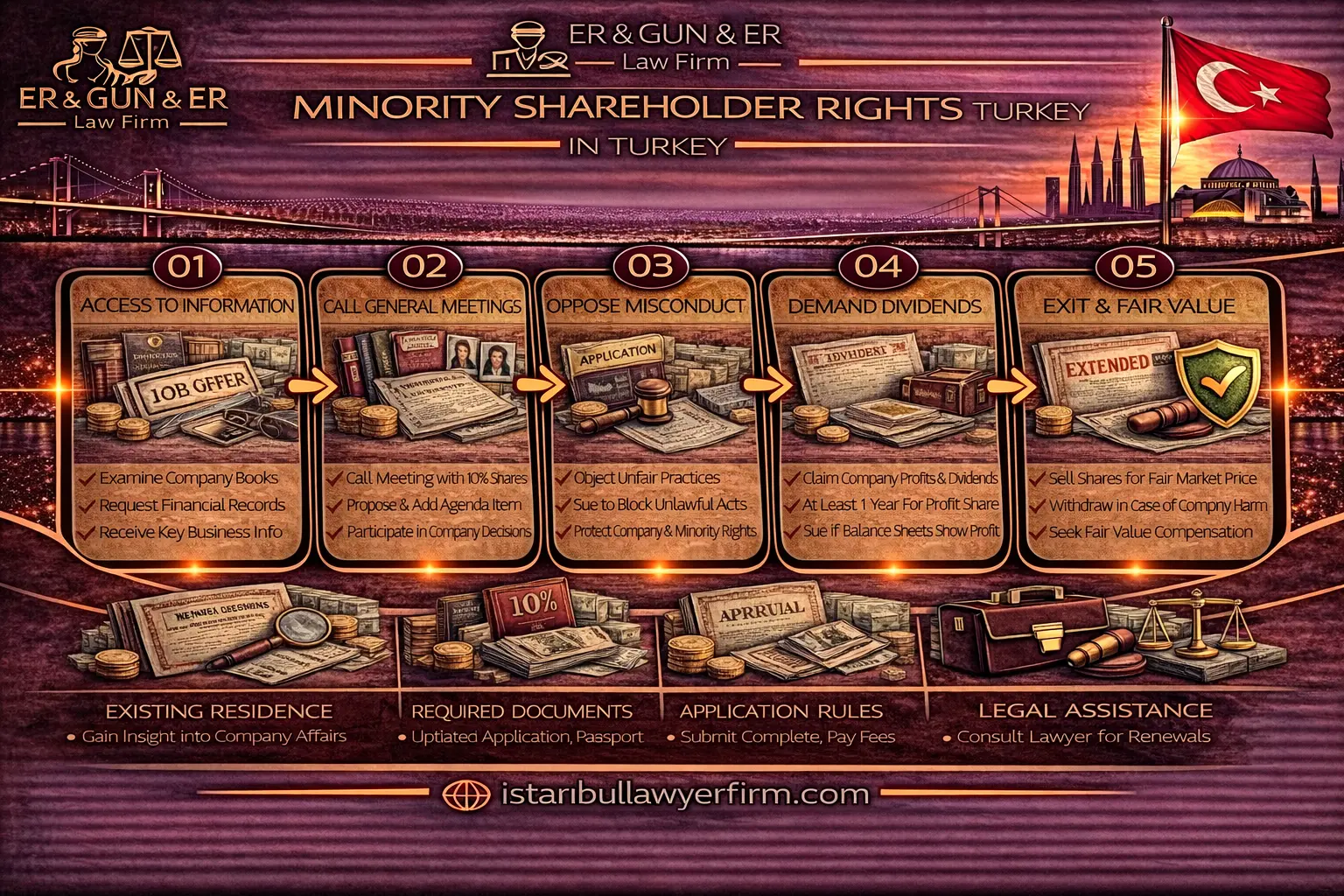
Minority shareholder rights in Turkish anonim şirket (joint stock company / JSC) operate within a structured procedural framework that combines specific statutory thresholds, comprehensive information and inspection rights, structured general assembly participation mechanisms, special audit pathways, resolution-challenge frameworks, director liability frameworks, and integrated procedural protection producing the comprehensive minority-protection discipline that experienced practitioners support across the full corporate-governance lifecycle. The framework that governs the relevant questions is set primarily by the 6102 sayılı Türk Ticaret Kanunu (TTK / Turkish Commercial Code) covering m.329 vd. (anonim şirket / joint stock company general framework), m.330 vd. (genel kurul / general assembly framework), m.380 (şirketin kendi paylarını iktisabı / own share acquisition), m.411 (azınlık tarafından genel kurul toplantıya çağrılması / minority calling of general assembly — establishing 10% statutory threshold for closed JSCs and 5% threshold for halka açık ortaklıklar / public companies), m.412 (gündem ekletme talebi / agenda addition request — same threshold framework), m.413 (genel kurul kararı tasdik talebi / general assembly resolution confirmation), m.437 (bilgi alma ve inceleme hakkı / individual information and inspection rights), m.438-440 (özel denetim / special audit including m.438 application framework, m.439 court appointment of denetçi, and m.440 audit scope and report), m.445-451 (genel kurul kararı iptal davası / general assembly resolution annulment action with structured procedural mechanics), m.447-448 (butlan / nullity of resolutions covering fundamentally invalid resolutions distinct from procedurally defective annulable resolutions), m.479 (oyda imtiyaz sınırları / voting privilege limitations), m.514-526 (finansal tablolar / financial statements), m.553-560 (yönetici sorumluluğu / director liability framework including m.555 şirket adına dava / company-account action and m.558 ibranın kapsamı / discharge scope), and m.5 (Asliye Ticaret Mahkemesi / Commercial Court of First Instance jurisdiction); the 6362 sayılı Sermaye Piyasası Kanunu (SerPK / Capital Markets Law) including m.27 (pay sahibinin ortaklıktan çıkarılması hakkı / squeeze-out right with 98% threshold for halka açık ortaklıklar) and m.28 (satma hakkı / sell-out right supporting minority exit); the 6100 sayılı Hukuk Muhakemeleri Kanunu (HMK) including m.389-403 (ihtiyati tedbir / precautionary injunction) and m.400 (delil tespiti / preservation of evidence); the 6325 sayılı Hukuk Uyuşmazlıklarında Arabuluculuk Kanunu and TTK m.5/A establishing dava şartı arabuluculuk effective 1 January 2019 for commercial disputes; the 4686 sayılı Milletlerarası Tahkim Kanunu (MTK) supporting international arbitration for cross-border investor disputes; and the 5718 sayılı Milletlerarası Özel Hukuk ve Usul Hukuku Hakkında Kanun (MÖHUK) governing private international law for cross-border minority scenarios. Practice may vary by authority and year.
An English speaking lawyer in Turkey advising on minority shareholder positioning will explain that effective minority protection requires structured coordination across standing verification (share ledger and depository confirmations), substantive remedy selection (information versus participation versus resolution-challenge versus liability), comprehensive evidence preservation, integrated negotiation positioning, and broader strategic considerations supporting both immediate dispute outcomes and longer-horizon governance reform. The body of this guide walks through the substantive minority framework under TTK with thresholds and standing analysis; the information rights under TTK m.437 and inspection rights with documentary discipline; the general assembly participation framework with agenda requests under TTK m.411-412; the özel denetim (special audit) framework under TTK m.438-440 and broader board accountability tools; the resolution-challenge framework with annulment under TTK m.445-451 and nullity under TTK m.447-448; the director liability framework under TTK m.553-560 and related party transaction risks; the dividend rights, share transfer restrictions, and squeeze-out framework under SerPK m.27-28; and the interim measures under HMK m.389-403, evidence preservation, and public company differences. For procedural orientation on adjacent topics, our notes on LLC versus joint stock company comparison in Turkey, corporate governance legal compliance in Turkey, and share purchase agreements in Turkey can be read alongside this material.
1) Defining Minority under TTK Law No. 6102: Standing, Thresholds (m.411 10% / 5%), and Strategic Framework
A lawyer in Turkey advising on minority status will explain that "minority" under Turkish corporate law operates as both a substantive legal category and a practical influence concept, with structured statutory thresholds determining specific right activations. The procedure ordinarily considers the substantive TTK m.411 framework establishing the foundational azınlık (minority) threshold for genel kurul toplantıya çağrılması (calling of general assembly) — 10% of paid-in capital for closed joint stock companies (kapalı anonim ortaklık) and 5% for halka açık ortaklık (public companies) producing the structured procedural prerequisite for minority calling actions; the substantive TTK m.412 framework establishing the same threshold for gündem ekletme talebi (agenda addition request) — supporting structured minority-driven agenda framing where the company control group otherwise determines meeting topics; the substantive TTK m.413 framework establishing the same threshold for genel kurul kararı tasdik talebi (general assembly resolution confirmation request); the substantive standing-verification framework where minority threshold proof requires structured pay defteri (share ledger) extracts, depository confirmations through MKK (Merkezi Kayıt Kuruluşu / Central Registry Agency) for halka açık ortaklıklar, beneficial-ownership chain documentation where shares are held through nominees or holding vehicles, and broader documentary discipline supporting the substantive standing positioning; and the broader integration framework where threshold satisfaction operates as procedural prerequisite rather than as standalone substantive right. For the full procedural framework, see our pillar guide on company formation in Turkey.
An Istanbul Law Firm advising on standing-verification discipline will note that effective minority positioning begins with structured standing documentation supporting both immediate procedural mechanics and broader subsequent procedural integrity. The procedure ordinarily considers the substantive pay defteri framework where structured share ledger extracts demonstrate share ownership with specific procedural mechanics — closed JSCs maintain pay defteri internally with structured access requirements; the substantive depository framework where halka açık ortaklıklar shares are typically dematerialized through MKK with structured depository confirmations supporting cross-system standing verification; the substantive nominee-shareholding framework where beneficial owners operating through nominee structures require structured documentation including nominee agreement, instruction authority, and beneficial-ownership chain — courts evaluate standing through the comprehensive ownership chain rather than only through ledger entries; the substantive share-class framework where multi-class share structures require analysis of whether the relevant class carries voting rights triggering minority remedies; the substantive pledge-and-encumbrance framework where pledged shares (rehinli paylar) may face structured restrictions affecting voting and information rights; the substantive coordinated-shareholding framework where multiple minority shareholders may aggregate holdings to satisfy threshold requirements with structured procedural mechanics; and the broader strategic-coordination framework where standing documentation operates as foundational evidence supporting all subsequent procedural mechanics.
A Turkish Law Firm advising on the broader strategic minority framework will note that effective minority positioning requires structured analysis across multiple parallel dimensions supporting comprehensive subsequent procedural mechanics. The procedure ordinarily considers the substantive shareholders agreement framework where pre-existing shareholders agreements may establish bespoke minority protections (board observer rights, veto rights, information covenants, exit mechanisms) supplementing the statutory baseline; the substantive articles of association framework where the company's anasözleşme may establish either expanded or modified minority protections compared to the TTK statutory baseline — review of current articles is foundational; the substantive corporate-form framework where joint stock company analysis differs substantially from limited liability company (limited şirket / LLC) analysis with specific implications for governance levers and remedies; the substantive public-company framework where halka açık ortaklık status produces additional SerPK Law No. 6362 requirements including disclosure obligations, public-platform reporting, and SerPK m.27-28 squeeze-out and sell-out frameworks; the substantive forum-selection framework where shareholders agreement arbitration clauses, MTK Law No. 4686 international arbitration framework, and Asliye Ticaret Mahkemesi jurisdiction under TTK m.5 produce structured forum-strategy considerations; the substantive timing-coordination framework where minority remedies operate within specific procedural deadlines requiring structured calendar coordination; and the broader integration framework where minority positioning operates within the comprehensive Turkish corporate-governance framework rather than as isolated procedural mechanism. The discipline outlined in our note on LLC versus joint stock company comparison in Turkey covers the broader corporate-form framework. Practice may vary by authority and year.
2) Information Rights under TTK m.437 and Inspection Rights with Documentary Discipline
An English speaking lawyer in Turkey advising on information rights will explain that the substantive TTK m.437 bilgi alma ve inceleme hakkı (information and inspection rights) framework operates as the foundational individual minority right with specific procedural mechanics affecting both substantive disclosure outcomes and broader procedural positioning. The procedure ordinarily considers the substantive TTK m.437 framework establishing both bilgi alma hakkı (information right) and inceleme hakkı (inspection right) for joint stock company shareholders with structured procedural mechanics; the substantive bilgi alma framework where shareholders may pose questions during the genel kurul toplantısı (general assembly meeting) regarding company affairs with the board obligated to respond — questions may also be raised through structured pre-meeting written requests with specific procedural mechanics; the substantive inceleme framework where shareholders may inspect specific company books and records with structured procedural mechanics — inceleme operates as more limited than common-law discovery, requiring connection to legitimate shareholder concerns and structured documentary specification; the substantive corporate-purpose framework where information requests benefit from explicit corporate-purpose framing supporting structured request defensibility — requests framed as governance-protection or investment-monitoring perform better than requests framed as personal grievance; the substantive request-format framework where structured written requests with specific document categories, time periods, and corporate-purpose statements support both immediate compliance and broader procedural positioning; and the substantive denial framework where company refusals to provide information may produce structured procedural responses including escalation to özel denetim under TTK m.438-440 and broader judicial remedies.
A Turkish Law Firm advising on confidentiality coordination will note that effective information requests typically require structured engagement with company confidentiality concerns with specific procedural mechanics supporting both shareholder rights and legitimate company interests. The procedure ordinarily considers the substantive ticari sır (trade secret) framework where TTK m.437 expressly limits information rights where disclosure would harm company trade secrets — the framework requires structured analysis of whether requested information genuinely qualifies as trade secret rather than serving as blanket refusal mechanism; the substantive controlled-review framework where shareholders may propose structured controlled inspection arrangements (on-site review, redaction protocols, confidentiality undertakings) supporting both information access and confidentiality protection — controlled-review proposals operate as more defensible compared to unrestricted-copying demands; the substantive selective-disclosure framework where selective information disclosure to one shareholder while withholding from others may produce structured equality-violation concerns supporting broader procedural responses; the substantive public-company framework where halka açık ortaklık status under SerPK Law No. 6362 produces structured public-disclosure obligations affecting information-rights coordination — selective disclosure may violate SerPK insider information framework; the substantive electronic-record framework where digitally maintained records produce structured authenticity-and-integrity discipline including system logs, access controls, and audit trails; and the broader strategic-coordination framework where information rights operate within the comprehensive minority-protection toolbox supporting integrated subsequent procedural mechanics.
Turkish lawyers who advise on documentary preservation discipline will note that effective information-rights enforcement requires structured documentary preservation supporting both immediate procedural mechanics and broader litigation-readiness positioning. The procedure ordinarily considers the substantive request-history framework where structured preservation of every information request, response, and refusal produces comprehensive evidentiary chain supporting subsequent procedural escalation; the substantive delivery-proof framework where structured delivery proof through tebligat (formal service through Notarlık Kanunu m.71/A noter notice or PTT Kayıtlı Posta) supports authenticity and timing documentation; the substantive electronic-evidence framework where electronic communications (email, web platform notifications) require structured preservation with timestamp documentation supporting authenticity verification; the substantive gap-analysis framework where systematic comparison of provided documents against requested documents produces structured documentation of partial compliance and selective withholding patterns; the substantive certified-copy framework where formal certified copies (onaylı suret) of key documents support cross-procedural use across negotiation, special audit, and litigation contexts; the substantive minute-correction framework where general assembly minute discrepancies may be corrected through structured post-meeting correction letters with delivery proof preservation; and the broader strategic integration framework where documentary preservation operates as foundational discipline supporting all subsequent procedural mechanics rather than as late litigation accessory. The discipline outlined in our note on corporate governance legal compliance in Turkey covers the broader corporate governance framework. Practice may vary by authority and year.
3) General Assembly Participation, Agenda Requests under TTK m.411-412, and Procedural Discipline
An Istanbul Law Firm advising on general assembly participation will note that the genel kurul (general assembly) operates as the structured forum where shareholders exercise voting rights and where multiple statutory minority remedies are activated through specific procedural mechanics. The procedure ordinarily considers the substantive call-notice framework where shareholders receive structured pre-meeting notification including agenda, supporting documents, and proposed resolutions — preservation of call notices supports both immediate participation positioning and broader procedural-integrity documentation; the substantive attendance framework where in-person attendance, vekaletname-based proxy attendance, or e-Genel Kurul (electronic general assembly) attendance under TTK provisions produce different documentary mechanics with structured preservation requirements; the substantive proxy framework where vekaletname preparation requires specific procedural mechanics including signature authentication and submission timing — improperly prepared proxies face structured rejection risks; the substantive agenda-binding framework where general assembly typically may not validly resolve on items outside the published agenda except where unanimous attendance and consent support gündem dışı (non-agenda) items; the substantive question-objection framework where shareholders may pose questions and raise objections during the meeting with structured procedural mechanics affecting subsequent annulment-action prospects — objections must be specifically recorded in minutes to preserve standing for subsequent challenges under TTK m.445-451; and the broader strategic-coordination framework where structured pre-meeting preparation supports comprehensive subsequent procedural mechanics.
A lawyer in Turkey advising on agenda requests will note that the substantive TTK m.411-412 framework supports structured minority-driven agenda framing with specific procedural mechanics affecting both agenda content and broader corporate-governance dynamics. The procedure ordinarily considers the substantive m.411 framework where minority shareholders meeting threshold requirements (10% closed JSC / 5% public company) may demand the board call a general assembly meeting through structured written request — the demand triggers specific procedural mechanics with deadline-driven board response obligations; the substantive m.412 framework where the same threshold supports gündem ekletme talebi (agenda addition request) for an already-scheduled meeting — this framework supports minority-driven agenda framing without requiring fresh meeting calling; the substantive corporate-purpose framework where m.411 and m.412 requests benefit from explicit corporate-purpose framing supporting structured defensibility against company refusal; the substantive draft-resolution framework where structured proposed-resolution wording supports specific agenda framing and prevents broad-discussion dilution; the substantive supporting-documentation framework where attached supporting documents (transaction proposals, term sheets, governance concern memos) strengthen request defensibility; the substantive delivery-proof framework where formal tebligat produces structured timing documentation supporting both immediate procedural mechanics and subsequent escalation prospects; and the substantive court-coordination framework where company refusals to honor m.411 and m.412 requests may produce structured judicial coordination through Asliye Ticaret Mahkemesi.
Turkish lawyers who advise on procedural discipline will note that effective general assembly participation requires structured procedural coordination across multiple parallel categories supporting comprehensive procedural-integrity positioning. The procedure ordinarily considers the substantive minute-preservation framework where structured preservation of meeting minutes (through both immediate copy acquisition and structured post-meeting correction protocols) supports comprehensive procedural-record documentation; the substantive objection-recording framework where structured specific objections recorded in minutes preserve standing for subsequent annulment challenges under TTK m.445-451 — vague or ambient dissatisfaction does not preserve standing; the substantive question-recording framework where structured agenda-linked questions create stronger procedural records compared to vague broad questions; the substantive coordinator framework where minority coordination through one designated spokesperson supports consistent narrative and avoids fragmented messaging; the substantive bilingual-coordination framework where international minority coordination benefits from structured bilingual positioning supporting consistent terminology across translations; the substantive resolution-text-preservation framework where structured preservation of exact resolution wording supports subsequent procedural challenges including annulment and nullity actions; the substantive vote-result-preservation framework where structured documentation of voting mechanics, attendance, and tabulation supports comprehensive procedural verification; and the broader strategic integration framework where general assembly participation operates as integrated component of comprehensive minority-protection strategy rather than as isolated procedural event. Practice may vary by authority and year.
4) Special Audit (Özel Denetim) under TTK m.438-440 and Board Accountability Tools
An English speaking lawyer in Turkey advising on özel denetim will explain that the substantive TTK m.438-440 special audit framework operates as one of the most powerful Turkish minority remedies supporting structured investigation of specific transactions or governance concerns where ordinary information rights prove inadequate. The procedure ordinarily considers the substantive TTK m.438 framework establishing the application mechanism where minority shareholders meeting threshold requirements may pursue özel denetim through structured procedural mechanics — the substantive framework requires (i) prior request through general assembly, (ii) general assembly refusal or inadequate response, and (iii) subsequent court application; the substantive TTK m.439 framework establishing court appointment of denetçi (auditor) where general assembly refuses or inadequately responds to özel denetim demand — Asliye Ticaret Mahkemesi conducts structured procedural review with specific substantive criteria; the substantive TTK m.440 framework establishing audit scope and reporting mechanics where the appointed denetçi conducts comprehensive investigation with specific procedural mechanics — the audit produces structured report supporting both immediate disclosure and broader subsequent procedural mechanics including potential director liability framework under TTK m.553-560; and the broader strategic integration framework where özel denetim operates as structured fact-finding mechanism preceding more contentious procedural mechanics.
An Istanbul Law Firm advising on özel denetim positioning will note that effective özel denetim positioning requires structured strategic preparation supporting both immediate audit prospects and broader subsequent procedural mechanics. The procedure ordinarily considers the substantive concrete-suspicion framework where özel denetim petitions require connection to specific suspected irregularity rather than general dissatisfaction — abstract concerns face structured procedural rejection; the substantive transaction-identification framework where structured petitions identify specific transactions, date ranges, and document categories supporting both administrability and substantive focus; the substantive prior-request-exhaustion framework where the m.438 procedural prerequisite requires prior general assembly request with refusal or inadequate response — preservation of the exhaustion record supports subsequent court application; the substantive scope-definition framework where structured audit scope balances administrability (preventing rejection as overly broad) with substantive coverage (preventing superficial compliance); the substantive confidentiality-coordination framework where structured protective measures (limited auditor access, redaction protocols, confidentiality undertakings) support both audit effectiveness and legitimate company interests; the substantive coordinator framework where minority coordination through one designated petition supports consistent narrative compared to fragmented competing applications; and the broader strategic-coordination framework where özel denetim operates within the comprehensive minority-protection strategy supporting integrated subsequent procedural mechanics.
A Turkish Law Firm advising on board accountability tools will note that effective board accountability operates through structured coordination across multiple parallel categories supporting comprehensive corporate-governance verification. The procedure ordinarily considers the substantive board-meeting-record framework where board minutes (yönetim kurulu karar defteri) operate as foundational corporate-governance documentation with structured procedural mechanics — minority shareholders typically lack direct access but may obtain access through özel denetim and broader procedural mechanisms; the substantive committee framework where structured committees (audit committee, related party transactions committee where applicable) produce integrated governance documentation; the substantive ibra (discharge) framework under TTK m.558 where general assembly discharge of directors faces structured scope analysis — discharge typically covers disclosed transactions while concealed transactions remain subject to liability framework under TTK m.553-560; the substantive related-party-disclosure framework where structured disclosure of director conflicts under TTK provisions produces governance documentation supporting subsequent verification; the substantive committee-charter framework where structured committee charter analysis supports verification of substantive governance integrity; the substantive independence framework where independent director declarations face structured verification through criteria analysis and conflict disclosure records; and the broader strategic integration where board accountability operates within the comprehensive corporate-governance framework. The discipline outlined in our note on corporate governance legal compliance in Turkey covers the broader corporate governance framework. Practice may vary by authority and year.
5) Resolution Challenges: Annulment under TTK m.445-451 and Nullity under TTK m.447-448
An Istanbul Law Firm advising on resolution challenges will note that Turkish corporate law provides two distinct substantive frameworks for challenging general assembly resolutions with specific procedural mechanics affecting both immediate substantive outcomes and broader corporate-governance dynamics. The procedure ordinarily considers the substantive TTK m.445-451 annulment framework (genel kurul kararı iptal davası) supporting structured challenges to procedurally defective or substantively unlawful resolutions with specific procedural mechanics; the substantive m.445 grounds framework covering (i) kanuna aykırılık (unlawfulness — violation of statute or articles), (ii) dürüstlük kuralına aykırılık (violation of good faith principle), and (iii) genel kurulun yetkisini aşma (exceeding general assembly authority); the substantive m.446 standing framework where annulment-action standing typically requires shareholders who attended the meeting with recorded objections, shareholders unlawfully excluded from meeting, and broader recognized claimant categories with specific procedural mechanics; the substantive 3-month filing period under TTK m.445/3 measured from resolution date — strict procedural deadline with structured implications for dispute timing; the substantive procedural framework before Asliye Ticaret Mahkemesi with structured documentary discipline including meeting minutes, attendance records, agenda, supporting documents, and broader procedural materials; and the broader strategic integration where annulment actions support both immediate resolution-neutralization and broader corporate-governance reform.
A lawyer in Turkey advising on the butlan (nullity) framework will note that the substantive TTK m.447-448 framework operates as a distinct procedural mechanism targeting fundamentally invalid resolutions with specific procedural mechanics differing from the broader annulment framework. The procedure ordinarily considers the substantive TTK m.447 framework establishing specific nullity grounds covering (i) violation of pay sahibinin vazgeçilmez hakları (inalienable shareholder rights), (ii) anonim şirketin temel yapısına aykırılık (violation of fundamental joint stock company structure), and (iii) sermayenin korunması ilkesi ihlali (violation of capital protection principle); the substantive TTK m.448 framework establishing the nullity-action procedural mechanics with specific differences from the m.445-451 annulment framework — nullity actions typically face less restrictive procedural deadlines compared to annulment actions, reflecting the more serious substantive concerns; the substantive butlan-versus-iptal characterization framework where the boundary between annulment (curable defects) and nullity (fundamental invalidity) operates fact-sensitively with specific implications for procedural strategy; the substantive court-discretion framework where Asliye Ticaret Mahkemesi conducts structured analysis distinguishing between annulable and null resolutions; the substantive procedural framework supporting structured documentary preparation, evidence presentation, and broader procedural mechanics; and the broader strategic-coordination framework where structured early framing analysis supports correct procedural pathway selection avoiding both procedural-failure scenarios.
Turkish lawyers who advise on resolution-challenge strategic positioning will note that effective resolution challenges require structured strategic preparation across multiple parallel categories supporting comprehensive procedural-integrity positioning. The procedure ordinarily considers the substantive evidence-preservation framework where structured preservation of meeting minutes, attendance records, agenda, supporting documents, and broader procedural materials supports comprehensive subsequent procedural mechanics; the substantive procedural-defect-versus-substantive-defect framework where annulment claims may target either procedural defects (improper call, agenda manipulation, denial of information needed for informed voting, voting-mechanism problems) or substantive defects (resolutions exceeding general assembly authority, resolutions violating shareholder equality, resolutions violating mandatory law) — clear defect characterization supports structured procedural strategy; the substantive interim-measures framework under HMK m.389-403 supporting structured ihtiyati tedbir applications preventing immediate resolution implementation pending action review — the framework requires structured documentary support of urgency and irreparable harm; the substantive coordination framework where minority coordination across multiple potential plaintiffs supports consistent procedural narrative compared to fragmented competing actions; the substantive timing-coordination framework where the 3-month TTK m.445/3 filing period operates as critical procedural deadline; and the broader strategic integration framework where resolution challenges operate within the comprehensive minority-protection strategy supporting integrated subsequent procedural mechanics. Practice may vary by authority and year.
6) Director Liability under TTK m.553-560 and Related Party Transaction Risks
An English speaking lawyer in Turkey advising on director liability will explain that the substantive TTK m.553-560 framework establishes the comprehensive Turkish director liability framework with specific procedural mechanics affecting both individual director accountability and broader corporate-governance dynamics. The procedure ordinarily considers the substantive TTK m.553 framework establishing the foundational director liability principle where yönetim kurulu üyeleri (board members), kurucular (founders), and certain related actors are liable for damages caused through breach of statute, articles, or fiduciary duties — the framework operates through structured culpability analysis (kusur) with specific procedural mechanics; the substantive TTK m.555 şirket adına dava framework where shareholders may file derivative-style actions on company account with specific procedural mechanics — the framework requires (i) prior request to the board, (ii) inadequate board response, and (iii) shareholder action filing with structured documentary discipline; the substantive TTK m.558 framework establishing the ibra (discharge) scope analysis where general assembly discharge typically covers disclosed transactions while concealed transactions remain subject to liability framework — discharge framework analysis is foundational for liability case framing; the substantive 2-year (kıdem 2 yıl) and 5-year (zamanaşımı) limitation framework under TTK m.560 with specific procedural mechanics affecting filing timeline; and the substantive Asliye Ticaret Mahkemesi jurisdiction framework supporting comprehensive procedural mechanics.
A Turkish Law Firm advising on related party transaction risks will note that related party (ilişkili taraf) transactions operate as the most common minority-value-extraction channel with structured implications for both immediate substantive concerns and broader corporate-governance dynamics. The procedure ordinarily considers the substantive related-party-mapping framework where structured identification of related parties (shareholders, directors, affiliates, key suppliers operating through controlling shareholder networks) supports comprehensive transaction analysis — Türkiye Ticaret Sicili Gazetesi extracts and structured corporate registry analysis support objective mapping; the substantive transaction-identification framework where recurring transaction categories (management fees, royalty payments, service invoices, intercompany loans, asset transfers) support structured pattern analysis — recurring patterns provide stronger evidence than isolated transactions; the substantive approval-history framework where structured analysis of board and general assembly approvals (authorization scope, conflict disclosure, supporting documentation) supports substantive governance integrity verification; the substantive valuation-comparison framework where structured market-comparable analysis supports objective fairness assessment — uncomparable pricing produces stronger value-extraction evidence; the substantive özel denetim coordination framework where TTK m.438-440 special audit operates as effective fact-finding mechanism for related party transaction investigation supporting subsequent director liability framework; and the broader strategic integration framework where related party transaction analysis operates within the comprehensive minority-protection strategy.
A lawyer in Turkey advising on the integrated liability strategic framework will note that effective director liability positioning requires structured coordination across multiple parallel categories supporting comprehensive corporate-governance enforcement. The procedure ordinarily considers the substantive evidence-preservation framework where structured preservation of board approvals, contracts, payment trails, valuation materials, and broader procedural documentation supports comprehensive subsequent procedural mechanics; the substantive damages-calculation framework where structured damages calculation through audited statements, bank movements, and transaction documents (rather than speculative numerical claims) supports comprehensive substantive presentation; the substantive multiple-director framework where coordinated multi-director liability analysis addresses contribution and allocation issues with specific procedural mechanics; the substantive D&O insurance framework where director-and-officer insurance coverage analysis supports recovery prospects with specific procedural mechanics; the substantive procedural-coordination framework where parallel annulment actions, özel denetim proceedings, and director liability proceedings benefit from structured coordination supporting consistent narrative and integrated procedural mechanics; the substantive interim-measures framework under HMK m.389-403 supporting structured asset-preservation measures during pending liability proceedings; the substantive cross-border framework where international-component liability scenarios produce structured MÖHUK Law No. 5718 and MTK Law No. 4686 coordination with specific procedural mechanics; and the broader strategic integration where director liability operates within the comprehensive corporate-governance enforcement framework rather than as isolated procedural mechanism. Practice may vary by authority and year.
7) Dividend Rights, Share Transfer Restrictions, and Squeeze-Out under SerPK m.27 (Public Companies)
An Istanbul Law Firm advising on dividend rights will note that minority dividend positioning operates through structured general assembly mechanics with specific procedural mechanics affecting both immediate distribution outcomes and broader corporate-governance dynamics. The procedure ordinarily considers the substantive financial-statement-approval framework where structured financial statements under TTK m.514-526 support general assembly profit-allocation decisions with specific procedural mechanics; the substantive equality-of-treatment framework under TTK general principles where structured shareholder-equality analysis supports challenges to selective dividend mechanisms (selective buybacks, side contracts, asymmetric distributions); the substantive retention-justification framework where company retention claims benefit from structured analysis including investment plan documentation, cash forecast evidence, debt covenant verification, and yedek akçe (reserve) calculation methodology; the substantive disguised-distribution framework where structured analysis of related party payments operating as alternative distribution mechanisms supports broader corporate-governance enforcement; the substantive resolution-challenge framework where defective profit-allocation resolutions may face structured TTK m.445-451 annulment challenges with specific procedural mechanics; the substantive disclosure-coordination framework where halka açık ortaklıklar face additional SerPK Law No. 6362 disclosure obligations affecting dividend positioning; and the broader strategic integration framework where dividend positioning operates within the comprehensive minority-protection strategy.
A lawyer in Turkey advising on share transfer restrictions will note that structured share-transfer analysis operates within the comprehensive minority-exit framework with specific procedural mechanics affecting both immediate transferability and broader strategic positioning. The procedure ordinarily considers the substantive articles-restriction framework where TTK and the company's anasözleşme may establish structured transfer restrictions including approval requirements, pre-emption rights (öncelik hakkı), drag-along provisions, and tag-along provisions with specific procedural mechanics; the substantive shareholders-agreement framework where bespoke transfer restrictions through shareholders agreements supplement or modify the statutory baseline with specific procedural mechanics; the substantive lockup (kilit dönem) framework where structured lockup analysis examines duration, release conditions, and enforcement mechanics with specific implications for exit timing; the substantive registered-share framework where named (nama yazılı) share approval requirements produce specific procedural mechanics distinct from bearer (hamile yazılı) share regime; the substantive pre-emption framework where structured pre-emption mechanics including notice requirements, exercise periods, and pricing methodology support comprehensive exit-coordination; the substantive forced-buyback framework where company-initiated buyback proposals face structured TTK m.380 analysis (şirketin kendi paylarını iktisabı) with specific approval and limit requirements; and the substantive evidentiary-preservation framework where structured documentation of transfer requests, refusals, and supporting materials supports comprehensive subsequent procedural mechanics.
A Turkish Law Firm advising on the squeeze-out and sell-out framework will note that the SerPK Law No. 6362 m.27-28 framework establishes the structured Turkish public-company squeeze-out and sell-out framework with specific procedural mechanics affecting both controlling and minority shareholder positioning. The procedure ordinarily considers the substantive SerPK m.27 squeeze-out (pay sahibinin ortaklıktan çıkarılması) framework where controlling shareholders meeting 98% threshold in halka açık ortaklıklar may compulsorily acquire remaining minority shares with structured procedural mechanics — the framework operates through specific Sermaye Piyasası Kurulu (SPK / Capital Markets Board) coordination with structured pricing and procedural requirements; the substantive SerPK m.28 sell-out (satma hakkı) framework establishing the corresponding minority right to compel acquisition where threshold conditions support exit positioning — the framework operates as structured procedural counterpart to the m.27 squeeze-out framework; the substantive valuation framework where SPK-coordinated valuation methodology supports fair-pricing analysis with specific procedural mechanics; the substantive procedural-deadline framework where structured procedural deadlines apply to both squeeze-out implementation and sell-out exercise; the substantive judicial-review framework where adverse SPK or company decisions face structured judicial review through Idare Mahkemesi or Asliye Ticaret Mahkemesi depending on the underlying matter character; the substantive private-company framework where SerPK m.27-28 framework applies specifically to halka açık ortaklıklar — closed JSC squeeze-out scenarios operate through different mechanisms including potential resolution-challenge and structural analysis; and the broader strategic integration where squeeze-out and sell-out coordination operates within the comprehensive public-company minority-protection framework. The discipline outlined in our note on share purchase agreements in Turkey covers the broader transaction framework. Practice may vary by authority and year.
8) Interim Measures under HMK m.389-403, Evidence Preservation, and Public Company Differences
An English speaking lawyer in Turkey advising on interim measures will explain that the substantive HMK m.389-403 ihtiyati tedbir (precautionary injunction) framework supports structured interim protection during pending corporate disputes with specific procedural mechanics affecting both immediate procedural protection and broader subsequent procedural mechanics. The procedure ordinarily considers the substantive HMK m.389 framework establishing the substantive eligibility criteria requiring (i) açıkça hukuka aykırılık (apparent illegality) of the underlying conduct or threatened consequences and (ii) telafisi güç veya imkansız zarar (irreparable harm) likely to result from execution during pending review; the substantive HMK m.400 delil tespiti (preservation of evidence) framework supporting pre-litigation evidence preservation where structured documentary or physical evidence faces risk of loss or destruction — the framework operates as alternative or complementary mechanism to ihtiyati tedbir; the substantive corporate-context framework where structured ihtiyati tedbir applications in minority disputes typically target preventing implementation of harmful resolutions, freezing related party asset transfers, preserving company records, and broader corporate-governance protection; the substantive teminat (security) framework where applicants typically must provide structured security supporting potential damage compensation; the substantive timing-coordination framework where ihtiyati tedbir applications can be filed concurrently with substantive actions or as separate procedural motions during proceedings; and the broader strategic integration where interim measures operate within the comprehensive minority-protection strategy supporting integrated subsequent procedural mechanics.
A Turkish Law Firm advising on evidence preservation will note that structured evidence preservation operates as foundational discipline supporting all subsequent procedural mechanics with specific procedural mechanics affecting both immediate substantive positioning and broader procedural-integrity outcomes. The procedure ordinarily considers the substantive request-history framework where structured preservation of every information request, response, refusal, and delivery proof produces comprehensive evidentiary chain supporting subsequent procedural escalation; the substantive corporate-record framework where structured preservation of share ledger snapshots, trade registry filings, board papers, and broader corporate documentation supports comprehensive procedural-record documentation; the substantive electronic-evidence framework where electronic communications, portal notifications, and digital records require structured preservation with timestamp documentation supporting authenticity verification; the substantive pre-action framework where structured pre-action evidence preservation supports both negotiation positioning and litigation-readiness — broad threats may trigger document sanitization, supporting structured controlled-communication discipline; the substantive controlled-data-room framework where minority coordinator may maintain structured controlled data room supporting consistent evidence access and reducing leakage risk; the substantive bilingual-coordination framework where international minority scenarios benefit from structured bilingual preservation with consistent terminology; and the broader strategic integration framework where evidence preservation operates as foundational discipline rather than as late litigation accessory.
A lawyer in Turkey advising on public company differences will note that halka açık ortaklık (publicly traded company) status produces structured additional procedural mechanics under SerPK Law No. 6362 supplementing the broader TTK minority-protection framework with specific implications for strategic positioning. The procedure ordinarily considers the substantive public-disclosure framework under SerPK supporting structured disclosure obligations affecting both company communications and minority information rights — selective disclosure to one shareholder may violate insider information framework supporting structured public-disclosure positioning; the substantive Sermaye Piyasası Kurulu (SPK / Capital Markets Board) coordination framework where structured regulator-facing engagement supplements the broader corporate-procedural framework; the substantive material-event-disclosure framework where structured public disclosures (material event statements, financial reporting cycles, governance disclosures) produce documentary record supporting subsequent procedural mechanics; the substantive market-abuse framework under SerPK where structured market-integrity considerations affect minority strategic positioning — minorities should avoid public accusations without structured documentary support; the substantive enhanced-related-party-governance framework where halka açık ortaklıklar typically face enhanced related-party-transaction governance expectations supporting stronger minority leverage where documented; the substantive squeeze-out and sell-out framework under SerPK m.27-28 supporting structured exit positioning specific to public companies; the substantive AYM bireysel başvuru framework under the 6216 sayılı Anayasa Mahkemesinin Kuruluşu ve Yargılama Usulleri Hakkında Kanun m.45-49 where applicable; and the broader strategic integration where public company minority positioning operates within the integrated SerPK + TTK + HMK + SPK regulatory framework. Practice may vary by authority and year.
9) Frequently Asked Questions for Minority Shareholders
- What law governs minority shareholder rights in Turkey? The 6102 sayılı Türk Ticaret Kanunu (TTK / Turkish Commercial Code) operates as the foundational framework for joint stock companies (anonim şirket) with comprehensive minority-protection provisions. The 6362 sayılı Sermaye Piyasası Kanunu (SerPK / Capital Markets Law) supplements the framework for halka açık ortaklıklar (publicly traded companies). Asliye Ticaret Mahkemesi (Commercial Court of First Instance) under TTK m.5 has jurisdiction over substantive disputes.
- What are the minority thresholds? Under TTK m.411 (calling general assembly), m.412 (agenda addition), and m.413 (resolution confirmation), minority thresholds operate as 10% of paid-in capital for closed joint stock companies (kapalı anonim ortaklık) and 5% for halka açık ortaklıklar (public companies). Standing verification requires structured pay defteri (share ledger) extracts and depository confirmations through MKK (Merkezi Kayıt Kuruluşu) for public companies.
- What information rights exist? Under TTK m.437, shareholders have both bilgi alma hakkı (information right) and inceleme hakkı (inspection right). Information requests benefit from structured corporate-purpose framing, narrow document specification, and formal delivery-proof preservation. The framework recognizes ticari sır (trade secret) limitations supporting structured controlled-review proposals rather than blanket refusals.
- What is özel denetim? Özel denetim (special audit) under TTK m.438-440 is the structured Turkish minority-driven audit mechanism. The framework requires (i) prior request through general assembly under m.438, (ii) general assembly refusal or inadequate response, and (iii) court application before Asliye Ticaret Mahkemesi under m.439. Court-appointed denetçi conducts structured investigation with reporting under m.440.
- How can I challenge a general assembly resolution? Two distinct frameworks operate: (i) annulment (iptal) under TTK m.445-451 for procedurally defective or substantively unlawful resolutions with 3-month filing period under m.445/3; and (ii) nullity (butlan) under TTK m.447-448 for fundamentally invalid resolutions including violation of inalienable shareholder rights, fundamental joint stock company structure, or capital protection principle. Standing under m.446 typically requires meeting attendance with recorded objections or unlawful exclusion.
- What is the agenda request right? Under TTK m.411 (calling general assembly) and m.412 (agenda addition for already-scheduled meetings), minority shareholders meeting threshold requirements (10% closed JSC / 5% public company) may demand specific procedural mechanics. Requests benefit from explicit corporate-purpose framing, draft-resolution wording, supporting documentation, and formal tebligat delivery-proof preservation.
- What is the director liability framework? Under TTK m.553-560, directors face liability for damages caused through breach of statute, articles, or fiduciary duties. TTK m.555 supports şirket adına dava (company-account / derivative-style action) with structured procedural mechanics. TTK m.558 establishes ibra (discharge) scope analysis where discharge typically covers disclosed transactions while concealed transactions remain subject to liability framework.
- What about related party transactions? Related party (ilişkili taraf) transactions operate as the most common minority-value-extraction channel. The framework requires structured related-party-mapping through Türkiye Ticaret Sicili Gazetesi extracts, transaction-identification through recurring pattern analysis, approval-history verification including conflict disclosure, valuation-comparison through market-comparable analysis, and özel denetim coordination under TTK m.438-440 for fact-finding support.
- What are interim measures available? Under HMK m.389-403, ihtiyati tedbir (precautionary injunction) supports structured interim protection requiring (i) açıkça hukuka aykırılık (apparent illegality) and (ii) telafisi güç veya imkansız zarar (irreparable harm). HMK m.400 delil tespiti supports pre-litigation evidence preservation. Applicants typically provide teminat (security) supporting potential damage compensation.
- What is the squeeze-out framework for public companies? Under SerPK Law No. 6362 m.27, controlling shareholders meeting 98% threshold in halka açık ortaklıklar may compulsorily acquire remaining minority shares (pay sahibinin ortaklıktan çıkarılması). The framework operates through Sermaye Piyasası Kurulu (SPK) coordination with structured pricing and procedural requirements.
- What is the sell-out right? Under SerPK Law No. 6362 m.28, the satma hakkı (sell-out right) supports structured minority right to compel acquisition where threshold conditions in halka açık ortaklıklar support exit positioning. The framework operates as procedural counterpart to the m.27 squeeze-out framework with SPK-coordinated valuation methodology.
- What about share transfer restrictions? TTK and the company's anasözleşme may establish structured transfer restrictions including approval requirements, pre-emption rights (öncelik hakkı), drag-along provisions, and tag-along provisions. Shareholders agreements supplement or modify the statutory baseline. Named share (nama yazılı) approval requirements differ from bearer share (hamile yazılı) regime. TTK m.380 governs şirketin kendi paylarını iktisabı (own share acquisition) with specific approval and limit requirements.
- What is mandatory mediation for minority disputes? Under TTK m.5/A effective 1 January 2019, dava şartı (precondition) arabuluculuk applies to commercial disputes including minority shareholder disputes — applicants must complete structured mediation through registered arabulucu before filing the substantive dava at Asliye Ticaret Mahkemesi. The framework operates under the 6325 sayılı Hukuk Uyuşmazlıklarında Arabuluculuk Kanunu.
- What is the appellate framework? Adverse Asliye Ticaret Mahkemesi decisions face structured appellate review through Bölge Adliye Mahkemesi (regional court of appeals) under istinaf framework under HMK m.341 vd. effective 20 July 2016 and Yargıtay (Court of Cassation) under temyiz framework under HMK m.361 vd. AYM bireysel başvuru under the 6216 sayılı Anayasa Mahkemesinin Kuruluşu ve Yargılama Usulleri Hakkında Kanun m.45-49 may apply where ordinary remedies are exhausted.
- Does ER&GUN&ER Law Firm advise on minority shareholder matters? Yes. ER&GUN&ER Law Firm is an Istanbul-based law firm advising foreign minority shareholders, family offices, foreign legal counsel, foreign institutional investors, and multinational portfolio participants on Turkish minority shareholder matters in joint stock companies (anonim şirket), including standing verification through pay defteri and MKK depository confirmations; threshold analysis under TTK Law No. 6102 m.411 (10% closed JSC / 5% public company genel kurul çağrı), m.412 (gündem ekletme), and m.413 (resolution confirmation); information and inspection rights under TTK m.437 with structured corporate-purpose framing and ticari sır coordination; özel denetim (special audit) under TTK m.438-440 with comprehensive m.438 application, m.439 court appointment, and m.440 audit-scope coordination; general assembly participation including agenda requests, vekaletname-based proxy mechanics, e-Genel Kurul electronic attendance, and structured objection-recording for subsequent annulment standing; resolution-challenge framework including iptal davası under TTK m.445-451 (with 3-month filing period under m.445/3) and butlan analysis under m.447-448; director liability framework under TTK m.553-560 including m.555 şirket adına dava (derivative-style action) and m.558 ibranın kapsamı (discharge scope) analysis; related party transaction risk analysis with Türkiye Ticaret Sicili Gazetesi extract coordination; dividend rights coordination under TTK m.514-526 financial-statement framework; share transfer restriction analysis including pre-emption (öncelik hakkı), drag-along, tag-along, and TTK m.380 own-share acquisition framework; squeeze-out coordination under SerPK Law No. 6362 m.27 (98% threshold for halka açık ortaklıklar) and sell-out under m.28 with Sermaye Piyasası Kurulu (SPK) coordination; interim measures coordination under HMK m.389-403 ihtiyati tedbir and m.400 delil tespiti; mandatory mediation coordination under Law No. 6325 and TTK m.5/A; appellate framework through Bölge Adliye Mahkemesi (istinaf), Yargıtay (temyiz), and AYM bireysel başvuru under Law No. 6216 m.45-49; international arbitration coordination under MTK Law No. 4686 for cross-border investor disputes; evidence preservation discipline including pay defteri snapshots, trade registry filings, and board-paper preservation; and broader strategic positioning across both substantive and procedural frameworks supporting comprehensive minority-protection outcomes — with English-language client communication and bilingual documentation throughout each engagement. Files in this area are typically led personally by the managing partner rather than delegated.
Author: Mirkan Topcu is an attorney registered with the Istanbul Bar Association (Istanbul 1st Bar), Bar Registration No: 67874. His practice focuses on cross-border and high-stakes matters where evidence discipline, procedural accuracy, and risk control are decisive.
He advises foreign minority shareholders, family offices, foreign legal counsel, foreign institutional investors, and multinational portfolio participants on Turkish minority shareholder matters in joint stock companies (anonim şirket / JSC) under the 6102 sayılı Türk Ticaret Kanunu (TTK / Turkish Commercial Code) covering m.5 (Asliye Ticaret Mahkemesi jurisdiction), m.5/A (dava şartı arabuluculuk effective 1 January 2019), m.329 vd. (anonim şirket general framework), m.330 vd. (genel kurul / general assembly framework), m.380 (şirketin kendi paylarını iktisabı / own share acquisition with specific approval and limit requirements), m.411 (azınlık tarafından genel kurul toplantıya çağrılması — 10% threshold for closed JSCs and 5% for halka açık ortaklıklar), m.412 (gündem ekletme talebi / agenda addition request — same threshold framework), m.413 (genel kurul kararı tasdik talebi), m.437 (bilgi alma ve inceleme hakkı / individual information and inspection rights with ticari sır limitations), m.438-440 (özel denetim / special audit including m.438 prior-request prerequisite, m.439 court appointment of denetçi, and m.440 audit scope and report), m.445-451 (genel kurul kararı iptal davası / general assembly resolution annulment action with m.445 grounds covering kanuna aykırılık, dürüstlük kuralına aykırılık, and yetki aşımı; m.446 standing framework; and 3-month filing period under m.445/3), m.447-448 (butlan / nullity covering violation of vazgeçilmez haklar, anonim şirket temel yapısı, and sermayenin korunması ilkesi), m.479 (oyda imtiyaz sınırları / voting privilege limitations), m.514-526 (finansal tablolar / financial statements), and m.553-560 (yönetici sorumluluğu / director liability framework including m.553 foundational liability principle, m.555 şirket adına dava / company-account action, m.558 ibranın kapsamı / discharge scope, and m.560 limitation framework); the 6362 sayılı Sermaye Piyasası Kanunu (SerPK / Capital Markets Law) including m.27 (pay sahibinin ortaklıktan çıkarılması hakkı / squeeze-out — 98% threshold for halka açık ortaklıklar) and m.28 (satma hakkı / sell-out right) with Sermaye Piyasası Kurulu (SPK / Capital Markets Board) coordination; the 6100 sayılı Hukuk Muhakemeleri Kanunu (HMK) including m.341 vd. (istinaf effective 20 July 2016), m.361 vd. (temyiz), m.389-403 (ihtiyati tedbir / precautionary injunction with açıkça hukuka aykırılık and telafisi güç veya imkansız zarar criteria), and m.400 (delil tespiti / preservation of evidence); the 6325 sayılı Hukuk Uyuşmazlıklarında Arabuluculuk Kanunu and TTK m.5/A establishing dava şartı arabuluculuk for commercial disputes effective 1 January 2019; the 4686 sayılı Milletlerarası Tahkim Kanunu (MTK) supporting international arbitration for cross-border investor disputes; the 5718 sayılı Milletlerarası Özel Hukuk ve Usul Hukuku Hakkında Kanun (MÖHUK) governing private international law for cross-border minority scenarios; the 6216 sayılı Anayasa Mahkemesinin Kuruluşu ve Yargılama Usulleri Hakkında Kanun m.45-49 governing AYM bireysel başvuru with 30-day filing period; and the Türkiye Ticaret Sicili Gazetesi framework supporting structured registry-based evidence coordination. His advisory work covers structured standing verification through pay defteri (share ledger) extracts, MKK (Merkezi Kayıt Kuruluşu) depository confirmations for halka açık ortaklıklar, beneficial-ownership chain documentation for nominee structures, and share-class analysis; threshold analysis under TTK m.411-412-413 with structured corporate-purpose framing and supporting documentation discipline; information rights coordination under TTK m.437 with structured controlled-review proposals and ticari sır limitations analysis; özel denetim coordination under TTK m.438-440 with structured prior-request exhaustion documentation, transaction-identification, scope-definition, and confidentiality-coordination supporting subsequent fact-finding mechanisms; general assembly participation including structured pre-meeting preparation, vekaletname-based proxy mechanics, e-Genel Kurul electronic attendance, agenda-linked questioning, structured objection-recording supporting subsequent annulment standing, and minute-correction protocols; resolution-challenge framework including iptal davası under TTK m.445-451 with structured documentary discipline and 3-month filing period coordination, and butlan analysis under m.447-448 with structured fundamental-invalidity analysis; director liability framework under TTK m.553-560 including m.555 şirket adına dava with prior-request exhaustion, breach-and-causation framework, m.558 ibranın kapsamı (discharge scope) analysis, and m.560 limitation framework coordination; related party transaction risk analysis with structured related-party mapping through Türkiye Ticaret Sicili Gazetesi extracts, transaction-identification through recurring pattern analysis, valuation-comparison through market-comparable analysis, and integrated özel denetim coordination; dividend rights coordination including financial-statement-approval framework, equality-of-treatment analysis, retention-justification verification, and disguised-distribution analysis through related party transaction overlap; share transfer restriction analysis including articles-restriction framework, shareholders-agreement framework, lockup analysis, registered-versus-bearer share regime distinction, pre-emption mechanics, drag-along and tag-along provisions, and TTK m.380 own-share acquisition framework; squeeze-out coordination under SerPK m.27 (98% halka açık ortaklık threshold) and sell-out under m.28 with SPK coordination, valuation methodology analysis, and structured procedural-deadline coordination; interim measures coordination under HMK m.389-403 and m.400 with structured documentary discipline supporting urgency and irreparable-harm framework; mandatory mediation coordination under Law No. 6325 and TTK m.5/A; appellate framework coordination through Bölge Adliye Mahkemesi istinaf, Yargıtay temyiz, and AYM bireysel başvuru; international arbitration coordination under MTK Law No. 4686 for cross-border investor disputes including ICC, LCIA, ISTAC, and other institutional framework; evidence preservation discipline including pay defteri snapshots, trade registry filings, board papers, electronic communications, and broader procedural materials supporting comprehensive subsequent procedural mechanics; and broader strategic positioning across both substantive and procedural frameworks supporting comprehensive minority-protection outcomes.
Education: Istanbul University Faculty of Law (2018); Galatasaray University, LL.M. (2022). LinkedIn: Profile. Istanbul Bar Association: Official website.