

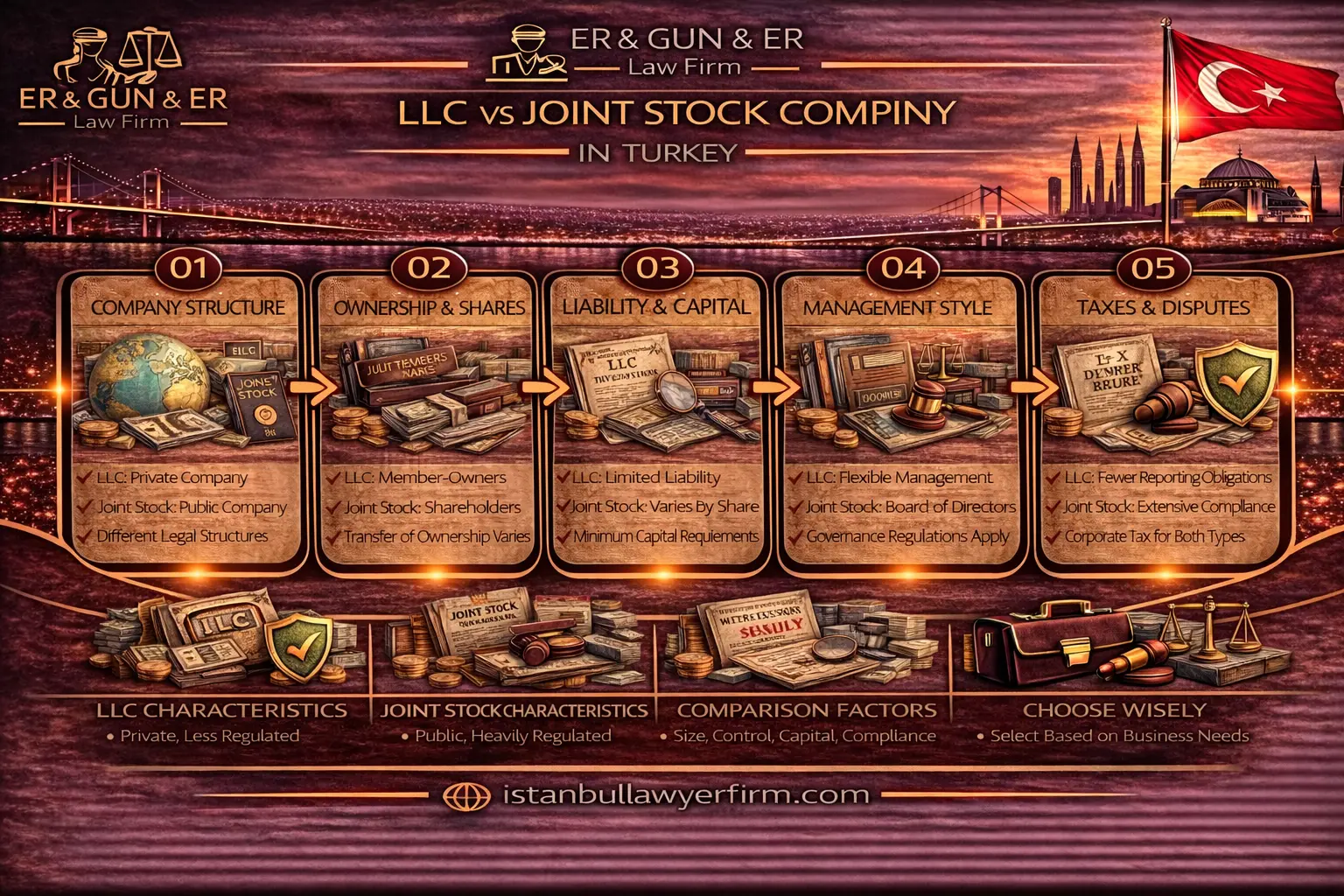
Choosing between a limited liability company (Limited Şirket — Ltd. Şti.) and a joint stock company (Anonim Şirket — A.Ş.) is one of the earliest legal decisions a founder makes in Turkey under Turkish Commercial Code No. 6102 (TTK). The choice controls liability boundaries, signature authority architecture, investor entry and exit mechanics, share transfer procedures, and corporate governance obligations. Current minimum capital thresholds under Presidential Decree No. 7887 of 25 November 2023 (Official Gazette No. 32380) and effective 1 January 2024 are TRY 250,000 for A.Ş. (TTK Article 332) and TRY 50,000 for Ltd. Şti. (TTK Article 580), with non-public A.Ş. operating under registered capital system (kayıtlı sermaye sistemi) requiring minimum TRY 500,000 initial capital. TTK Provisional Article 15 added by Law No. 7511 of 29 May 2024 (Official Gazette No. 32560) provides that existing companies with capital below these thresholds must increase to the minimum by 31 December 2026 or face dissolution by operation of law (infisah), with the Ministry of Trade holding authority to extend the deadline up to two additional one-year periods. A.Ş. operations continue the deposit requirement under TTK Article 344 (25% of cash capital deposited before registration with remaining 75% payable within 24 months), while Ltd. Şti. capital deposit has been relaxed by Law No. 7511 amendments — though the 75% payment within 24 months applies to both forms. Governance differs fundamentally: Ltd. Şti. operates through managers (müdürler) under TTK Articles 623-633 while A.Ş. operates through a board of directors under TTK Articles 359-371, producing different decision-making architectures, delegation frameworks, and documentation patterns. Share transfer mechanics differ materially: Ltd. Şti. quota transfer under TTK Article 595 requires written contract, notarization, and general assembly approval (unless articles provide otherwise), while A.Ş. share transfer under TTK Articles 489-496 operates through endorsement and delivery for registered shares (nama yazılı) with greater flexibility. Practice may vary by authority and year, and entity choice benefits from forward-looking analysis matching business objectives, financing expectations, and exit strategy rather than default selection. A lawyer in Turkey can help translate commercial goals into enforceable Turkish corporate structure. For framework on overall company forms in Turkey, readers can consult our types of companies guide.
Statutory framework and entity choice architecture
A Turkish Law Firm addressing entity choice works from the Turkish Commercial Code No. 6102 framework that governs commercial entities in Turkey. TTK entered into force on 1 July 2012 replacing the prior TTK No. 6762 of 1957 and establishing the modern corporate law framework. The principal commercial company forms include joint stock company (Anonim Şirket) under TTK Articles 329-572, limited liability company (Limited Şirket) under TTK Articles 573-644, general partnership (Kollektif Şirket) under TTK Articles 211-303, limited partnership (Komandit Şirket) under TTK Articles 304-328, and cooperative (Kooperatif) under separate legislation. For most foreign-invested and commercially-oriented Turkish operations, the choice narrows to A.Ş. or Ltd. Şti. because partnership forms create unlimited liability for at least some partners while A.Ş. and Ltd. Şti. provide limited liability structures with separate legal personality. Both A.Ş. and Ltd. Şti. acquire legal personality upon Trade Registry registration (Ticaret Sicili tescili), creating a separate legal entity distinct from shareholders that can own property, contract in its own name, sue and be sued, and continue operations independent of shareholder changes. Practice may vary by authority and year, and entity choice benefits from matching specific business architecture to the form's statutory features. For the full procedural framework, see our pillar guide on the broader procedure for establishing a company in Turkey.
Turkish lawyers who address the capital threshold analysis work within the updated framework established by Presidential Decree No. 7887 of 25 November 2023. The Decree increased minimum capital requirements effective 1 January 2024 for newly established companies — A.Ş. minimum capital increased from TRY 50,000 to TRY 250,000 under TTK Article 332, registered capital system (halka açık olmayan kayıtlı sermaye sistemi) initial capital increased from TRY 100,000 to TRY 500,000, and Ltd. Şti. minimum capital increased from TRY 10,000 to TRY 50,000 under TTK Article 580. The Presidential authority to adjust these thresholds derives from TTK Article 332 for A.Ş. (no upper limit on Presidential authority) and TTK Article 580 for Ltd. Şti. (capped at ten times the statutory floor). Law No. 7511 of 29 May 2024 added TTK Provisional Article 15 providing transition framework for existing companies — companies with capital below the new thresholds have until 31 December 2026 to increase capital to comply, with Ministry of Trade authority to extend by up to two additional one-year periods. Companies that fail to adapt by the deadline face dissolution by operation of law (infisah), triggering mandatory liquidation procedures under TTK Articles 529-548 for A.Ş. or TTK Articles 636-644 for Ltd. Şti. General assembly decisions to increase capital to threshold levels operate without quorum requirements and without privileged share voting objections under the Provisional Article framework. Practice may vary by authority and year, and existing company adaptation planning should start well before the 31 December 2026 deadline because capital increase procedures require documentation preparation, shareholder approval, and Trade Registry registration that takes time to complete properly.
An Istanbul Law Firm coordinating entity selection analysis for foreign investors works through the strategic framework connecting business objectives to structural features. Business model factors include operational complexity (simple holding entities may suit Ltd. Şti. with compact governance while operating companies with multiple business lines may benefit from A.Ş. structure), anticipated scale (small closely-held operations work well as Ltd. Şti. while scaling operations preparing for external investment typically benefit from A.Ş.), sector regulation (regulated sectors may require or strongly prefer A.Ş. format — banking under Law No. 5411, insurance, capital markets under Law No. 6362, and several other categories), and employee equity plans (A.Ş. shares accommodate employee share plans more readily than Ltd. Şti. quotas). Financing factors include anticipated investor rounds (institutional investors typically prefer A.Ş. for familiar governance and transferability), debt financing (both forms access bank lending but share pledge mechanics differ), and equity instruments (A.Ş. supports preferred share classes, convertible instruments, and other equity features more readily). Exit strategy factors include acquirer preferences (strategic acquirers often prefer A.Ş. target for share purchase mechanics; financial acquirers may accept either), and IPO pathway (only A.Ş. can list on Borsa İstanbul). For framework on broader business establishment decision architecture, readers can consult our business establishment guide for foreigners. Practice may vary by authority and year, and the entity choice sets the foundation for subsequent corporate evolution.
Shareholder liability, guarantees, and corporate veil scenarios
A lawyer in Turkey addressing shareholder liability works through the limited liability framework that operates in both A.Ş. and Ltd. Şti. with important exceptions. The general rule under TTK Article 329 for A.Ş. and TTK Article 573 for Ltd. Şti. is that shareholders' liability is limited to their capital commitment — shareholders are not personally liable for company debts beyond their unpaid capital contributions, and the company as separate legal person bears its own obligations. Corporate veil (şirket perdesi) protection means that ordinary commercial creditors pursue the company's assets first, not shareholder personal assets. However, several specific exceptions may create shareholder-level exposure. Personal guarantees (kefalet) given by shareholders to banks, landlords, major suppliers, or specific other creditors operate as separate contractual commitments under TBK Articles 581-603 — these guarantees bypass corporate limited liability by creating direct shareholder obligation. Guarantees are contractual choices rather than automatic consequences of entity form, and founders should negotiate guarantee scope and duration carefully. Personal guarantees by spouses under TBK Article 584 require written spousal consent, providing some protection but not eliminating exposure. Practice may vary by authority and year, and guarantee analysis is a transactional negotiation dimension rather than a fixed legal rule.
Turkish lawyers who address public debt exception to limited liability work through Law No. 6183 on the Collection Procedure of Public Receivables Article 35 framework. Under Law 6183 Article 35, Ltd. Şti. shareholders are liable for the company's public debts (tax debts, SGK premiums, other public receivables) proportional to their capital participation where the debt cannot be collected from the company. This creates shareholder-level exposure for public debts that does not apply to A.Ş. shareholders by default. However, for A.Ş., board members face similar exposure under TTK Article 553 for breach of statutory duties and specific personal liability under Law 6183 Article 35 and Tax Procedure Law No. 213 Article 10 for company tax debts when company assets are insufficient. The practical implication is that Ltd. Şti. structure creates specific ordinary-shareholder exposure for public debts that A.Ş. avoids at the pure shareholder level — though A.Ş. directors face comparable exposure. This distinction matters for founders considering their personal role: Ltd. Şti. shareholders who are not active in management still face public debt exposure, while A.Ş. passive shareholders (without director role) generally do not. Management involvement in either form creates its own liability exposure for the management role regardless of shareholder status. Practice may vary by authority and year, and structural choices should reflect the actual management and shareholder roles anticipated.
An English speaking lawyer in Turkey coordinating corporate veil analysis works through the framework that determines when limited liability protection may be pierced. Turkish courts generally respect corporate separateness but may pierce the corporate veil (perdeyi kaldırma) in exceptional circumstances including deliberate undercapitalization designed to defeat creditors, commingling of shareholder and company assets that makes meaningful separation impossible, use of the company as mere instrumentality of the shareholder without genuine corporate operation, and specific abuse scenarios where the corporate form is weaponized against creditors in bad faith. The doctrine is applied narrowly — ordinary undercapitalization, reasonable related-party transactions with proper documentation, and other standard commercial arrangements do not trigger veil piercing. Contractual warranty and indemnity exposure in transaction documents creates separate shareholder liability through representations and warranties, indemnities for specific risks, and other contractual promises — these create personal exposure regardless of corporate veil protection because they arise from contract rather than from corporate operation. Tort liability for personal wrongdoing by a shareholder (not merely wrongdoing by the company) creates direct shareholder exposure under TBK Article 49 framework. Proper documentation discipline including separate corporate and personal accounts, board resolutions for material transactions, minute discipline, related-party transaction documentation, and consistent record-keeping supports corporate veil protection. Practice may vary by authority and year, and veil piercing analysis is fact-intensive with outcomes depending on specific corporate discipline rather than entity-form generalizations.
Capital, contributions, and source documentation
A Turkish Law Firm addressing capital architecture works through the distinct frameworks for A.Ş. and Ltd. Şti. capitalization. A.Ş. capital under TTK Article 332 requires minimum TRY 250,000 total capital with TTK Article 344 deposit requirement mandating at least 25% of cash capital deposited at a Turkish bank before Trade Registry registration, with the bank providing a deposit confirmation letter (blokaj mektubu) required for registration. The remaining 75% of subscribed cash capital must be paid within 24 months of Trade Registry registration under Article 344. Ltd. Şti. capital under TTK Article 580 requires minimum TRY 50,000 with Law No. 7511 of 29 May 2024 amendments eliminating the pre-registration cash capital deposit requirement — Ltd. Şti. can now register without blokaj, with the 75% cash capital payment due within 24 months. Registered capital system (kayıtlı sermaye sistemi) under TTK Articles 332(3) and 351 operates only for A.Ş. with minimum initial capital of TRY 500,000 and authorized capital ceiling up to which the board may increase capital without general assembly approval — supporting flexible capital increases for growing companies. In-kind contributions under TTK Article 342 for A.Ş. and TTK Article 581 for Ltd. Şti. require independent expert valuation (bilirkişi raporu) by a court-appointed expert confirming the contributed asset's value before registration — property title transfer, other asset transfers, and valuation documentation become integral to the incorporation file.
Turkish lawyers who address capital adequacy beyond statutory minimums work through the framework that matches capital structure to operational and strategic needs. Statutory minimums represent compliance floors rather than business plans — operational capital needs typically substantially exceed statutory minimums based on business model, working capital requirements, investment needs, and other factors. Capital adequacy supports credible banking relationships (banks assess capital structure during KYC under MASAK Law No. 5549 and credit evaluation), landlord acceptance (commercial landlords prefer adequately capitalized tenants), customer confidence (particularly for large commercial contracts), and investor readiness (investors examine capital structure during due diligence for valuation and governance context). Undercapitalization drives reliance on personal guarantees that undermine limited liability benefits — structuring adequate capital at formation reduces pressure to provide personal guarantees to obtain supplier credit, bank facilities, or specific other operational commitments. Capital increase procedures under TTK Articles 456-472 for A.Ş. and Articles 590-591 for Ltd. Şti. enable subsequent capital adjustments with pre-emption rights (rüçhan hakkı) under Article 461 for A.Ş. and Article 591 for Ltd. Şti. protecting existing shareholders' proportional ownership. Capital reduction procedures under TTK Articles 473-475 for A.Ş. and Article 592 for Ltd. Şti. enable downsizing capital when operational needs change. For framework on company formation procedural sequencing, readers can consult our company formation guide. Practice may vary by authority and year, and capital planning benefits from integrated analysis of statutory compliance, operational needs, and future flexibility.
A lawyer in Turkey coordinating contribution documentation for foreign investors works through the framework supporting both corporate filing and banking KYC requirements. Cash contributions from foreign parent or shareholder sources require SWIFT transfer documentation showing the origin country, sending entity, purpose narrative consistent with capital contribution rather than commercial transaction, and other transfer details that support anti-money laundering review under MASAK Law No. 5549 framework. Turkish bank receipt of the transfer with corresponding account credit establishes the capital deposit for A.Ş. registration purposes. In-kind contributions require title transfer documentation (deeds for real estate under Property Registry Law No. 2644, asset transfer agreements, registration requirements for specific asset types), independent expert valuation report under TTK Articles 342 and 581, and reflection in articles of association describing the in-kind contribution with valuation basis. Intellectual property contributions require clear assignment documentation, patent or trademark registration transfer where applicable, and valuation support — IP valuation may involve specialized methodology and documentation. Shareholder loans (ortak borcu) represent separate contractual advances rather than capital contributions and should be documented through written loan agreements with specific terms (amount, currency, interest rate or interest-free status, repayment terms, specific covenants) to preserve clear characterization. Commingling capital contributions with shareholder loans creates documentation confusion that affects both tax treatment and corporate governance clarity. Practice may vary by authority and year, and contribution documentation creates the evidentiary foundation for subsequent corporate operation and investor relations.
Governance, management, and representation
A Turkish Law Firm coordinating governance architecture for A.Ş. works through the board of directors framework under TTK Articles 359-371. The board (yönetim kurulu) may consist of one or more directors who need not be shareholders, with a minimum of one director for basic A.Ş. (though regulated sectors require minimum three directors and additional requirements). Directors are appointed by the general assembly for terms up to three years under Article 362, with the board electing its chairman (başkan) and vice chairman (başkan vekili) from among its members. Law No. 7511 of 29 May 2024 amended Article 366 providing that the board may elect chairman and vice-chairman for the full term rather than requiring annual election — providing operational stability. Board meetings require quorum of majority of members under Article 390, with decisions by simple majority of members present (higher majorities for specific reserved matters under the articles). The board manages and represents the company under Article 365 with power to delegate specific functions to executive directors, committees, and executives through documented delegation (TTK Article 367). Representation authority under Article 370 operates jointly or individually as specified in the articles and signature circular (imza sirküleri), with delegation documentation required for individual director representation. Practice may vary by authority and year, and A.Ş. governance requires ongoing board meeting discipline with resolutions documenting major decisions because corporate records serve as evidence in subsequent transactions and disputes.
Turkish lawyers who address Ltd. Şti. governance work through the managers (müdürler) framework under TTK Articles 623-633. Ltd. Şti. is managed by one or more managers who may be shareholders or third parties, appointed in the articles of association or by general assembly resolution. The articles can specify either joint or several (müteselsil) representation — joint representation requires multiple manager signatures for company commitments while several representation permits individual signatures. TTK Article 629 establishes that managers collectively are the management body with specific powers enumerated in the articles and TTK framework. Manager decisions typically require majority where multiple managers exist, though the articles can specify different voting thresholds. The general assembly (genel kurul) as the ultimate shareholder forum under TTK Articles 616-622 has mandatory authority over articles amendments, specific capital actions, major transactions exceeding certain thresholds, appointment and removal of managers, and other reserved matters. Compared to A.Ş. board-driven structure, Ltd. Şti. manager-driven structure can be more compact for closely-held businesses where shareholders coordinate management directly. However, the manager structure provides less institutional governance for companies planning external investment because investors typically prefer board oversight architecture. For framework on corporate governance compliance specifically, readers can consult our corporate governance compliance guide. Practice may vary by authority and year, and governance architecture choice affects ongoing operational patterns and investor readiness.
An English speaking lawyer in Turkey addressing representation and signature authority works through the framework supporting third-party reliance on corporate commitments. Signature circular (imza sirküleri) issued by a notary based on Trade Registry extract and board or manager resolution establishes who may sign on behalf of the company and under what authority terms (individual, joint, limited to transaction categories, specific monetary thresholds). The circular operates as authoritative third-party evidence — banks, counterparties, and other parties rely on the circular when assessing whether a signatory binds the company. Outdated signature circulars where authority has changed but the circular has not been updated create friction because third parties may refuse to accept signatures not reflected in current circular documentation. Powers of attorney (vekaletname) delegate specific signature authority for defined purposes or time periods under TBK Articles 502-514 framework. POAs require notarization for most commercial purposes and may require apostille for international use (Turkey acceded to Hague Convention on 29 September 1985 through Law No. 3028). Limited POAs covering transactions provide operational flexibility while preserving authority discipline; general POAs create broader authority but correspondingly broader exposure. The Trade Registry Gazette (Ticaret Sicili Gazetesi) publishes corporate appointments, authority changes, and other matters creating public notice of corporate authority — third parties are deemed to have notice of published information. Practice may vary by authority and year, and representation discipline creates the operational foundation enabling daily business while protecting against unauthorized commitments.
Share transfers, quota transfers, and encumbrances
A lawyer in Turkey addressing A.Ş. share transfer works within the TTK Articles 489-496 framework for share transfer mechanics. Shares may be registered (nama yazılı — registered in the name of shareholders) or bearer (hamiline yazılı — transferable by delivery), with different transfer mechanics for each category. Registered shares transfer through endorsement (ciro) on the share certificate or register entry plus delivery of the certificate, with the transfer binding the company only after recording in the share ledger (pay defteri) under TTK Article 499. Transfer restrictions may be included in articles of association under TTK Article 491 including consent requirements from board or general assembly, pre-emption rights for existing shareholders, other restrictions — these restrictions must be reflected in share certificates and ledger entries to bind third parties. Bearer shares transfer by simple delivery of the certificate with anonymity at the company level, though Trade Registry notification of bearer share owners became mandatory under Law No. 7262 of 27 December 2020 amendments to TTK Article 415 framework for anti-money-laundering purposes. Share ledger under TTK Article 499 must record all share transfers with shareholder name, share number, transfer date, and other details — the ledger is the authoritative corporate record of ownership. For framework on share purchase agreements documenting share transfers, readers can consult our share purchase agreements guide. Practice may vary by authority and year, and A.Ş. share transfer discipline preserves the chain of title essential for subsequent transactions.
Turkish lawyers who address Ltd. Şti. quota transfer work within the TTK Article 595 framework requiring more formal procedures than A.Ş. share transfer. Quota transfer (esas sermaye payı devri) requires written contract executed before a notary (noter önünde yapılması), general assembly approval by simple majority representing at least one-half of the total capital unless the articles provide otherwise, and recording in the share ledger. The notarial execution requirement under Article 595 creates procedural formality absent from most A.Ş. share transfers and affects transaction timing — parties must schedule notary appointments, prepare documentation, and coordinate execution. General assembly approval requirement can be modified by articles of association — articles can eliminate the approval requirement (open quota transfer), can increase the approval threshold (stricter control), or can add specific other conditions (shareholder consent, pre-emption rights). Ltd. Şti. articles typically address whether transfers are free or restricted because the default TTK approval requirement can impede liquidity. Pre-emption rights under TTK Article 595 provide existing shareholders with first right to acquire transferred quotas unless the articles waive this right. Transfer to third parties (non-shareholder purchasers) typically faces more substantive review than transfers among existing shareholders. Practice may vary by authority and year, and Ltd. Şti. quota transfer mechanics require advance planning because procedural formality and approval requirements affect transaction timing and certainty.
An Istanbul Law Firm addressing share and quota encumbrances works through the framework supporting security arrangements and other equity transactions. Share pledges (pay üzerinde rehin) on A.Ş. shares operate under TTK Article 491 for registered shares and general pledge law for bearer shares, typically requiring physical share certificate delivery to the pledgee for possessory pledge or registration for non-possessory pledge. Pledge enforcement through sale in the event of secured obligation default follows Enforcement and Bankruptcy Law No. 2004 procedures adapted to equity instruments. Ltd. Şti. quota pledges operate under TTK Article 600 requiring written contract, notarial formality, and registration in the share ledger with possible general assembly approval requirements depending on articles. Usufruct rights (intifa hakkı) on shares or quotas separate economic benefits (dividends, liquidation proceeds) from voting rights, enabling specific equity arrangements for estate planning, family structures, and other purposes. Share option arrangements for employees or specific third parties require careful structuring including option grant documentation, exercise procedures, and other mechanisms — A.Ş. employee share option plans (ESOP) are more common than Ltd. Şti. equivalents because A.Ş. share mechanics accommodate option grants more readily. Convertible instruments (convertible bonds under TTK Articles 504-507, convertible notes as contractual arrangements) enable future equity conversion with procedural framework. Practice may vary by authority and year, and equity arrangements benefit from integrated legal, tax, and commercial analysis.
Investor entry, shareholder agreements, and exit planning
A Turkish Law Firm coordinating investor entry planning works through the framework supporting external investment in either form. Due diligence preparation including corporate records review, contractual relationships review, intellectual property review, employment review, tax and regulatory review, and other due diligence dimensions enables smooth investor evaluation. Data room organization with systematic document categorization supports efficient due diligence and investor confidence. Shareholder agreement (pay sahipleri sözleşmesi / SHA) operates as contractual supplement to articles of association, addressing matters that may not appear in articles (detailed board composition for A.Ş. including director designation rights, reserved matters requiring investor consent, information and reporting rights, specific exit rights including drag-along and tag-along, other investor protections). SHA enforceability in Turkish courts operates through standard contract law principles — provisions must not contradict mandatory corporate law provisions, and the SHA binds parties but does not bind non-parties or the company directly unless the company is a party. Article amendments to reflect SHA provisions where appropriate ensure consistency between contractual arrangements and corporate record. For framework on foreign investor company law, readers can consult our foreign investor company law guide. Practice may vary by authority and year, and investor entry architecture shapes subsequent operational and exit flexibility.
Turkish lawyers who address investor protections work through the framework that translates commercial terms into enforceable corporate structure. Reserved matters (ağırlıklı kararlar) requiring investor consent for specific decisions — major transactions above defined thresholds, capital increases or decreases, articles amendments, business combination decisions, other enumerated matters — can be implemented through articles-level supermajority voting, SHA-level contractual consent requirements, or combination. Veto rights for investor categories operating similarly through articles or SHA provide minority protection against majority abuse. Information rights including periodic financial reporting, access to books and records (TTK Article 437 right of inspection for A.Ş. shareholders, TTK Article 614 right of information for Ltd. Şti. shareholders expanded by contract), and other information elements enable investor monitoring. Preferred share classes under TTK Article 478 for A.Ş. can provide economic preferences (preferential dividends, liquidation preferences) and governance preferences (voting multipliers, director designation rights) — Ltd. Şti. does not directly accommodate preferred share classes because quota structure differs, though contractual preferences operate through SHA. Anti-dilution protections in subsequent financing rounds preserve investor economic position through weighted-average or full-ratchet mechanisms. Practice may vary by authority and year, and investor protection architecture requires coordinated drafting across articles, SHA, and other documents to operate effectively.
An English speaking lawyer in Turkey addressing exit planning works through the framework enabling orderly investor exit when strategic objectives or circumstances trigger liquidity events. Drag-along rights (beraber satma hakkı) enable a majority shareholder to compel minority participation in a sale to third party, supporting clean exit for the investor group as a whole. Tag-along rights (birlikte satma hakkı) enable a minority shareholder to participate proportionally in majority sale, protecting minority exit opportunity. Put options granting investors the right to sell shares back to the company or other shareholders at predetermined terms provide guaranteed exit under specific trigger conditions. Call options granting founders the right to buy back investor shares operate as inverse of put structures. Right of first refusal (ROFR) and right of first offer (ROFO) affecting future share sales with structural differences in timing and price determination provide specific control over share movement. Public offering (halka arz) pathway for qualifying A.Ş. through Borsa İstanbul listing process involves specific regulatory approvals under Capital Markets Law No. 6362 and extensive preparation — this pathway is only available to A.Ş. and requires significant corporate transformation. For framework on M&A scenarios including exit structures, readers can consult our M&A legal process guide. Practice may vary by authority and year, and exit planning should be built into initial investment documentation rather than retrofit under subsequent transaction pressure.
Tax posture, employment, and banking considerations
A lawyer in Turkey addressing tax architecture works through the framework applying to both A.Ş. and Ltd. Şti. under Corporate Tax Law No. 5520 with some structural differences in practical application. Corporate income tax under Corporate Tax Law No. 5520 applies at 25% standard rate (25% effective 1 January 2024 under Law No. 7456 and Presidential Decree amendments) on annual corporate income for both forms. Specific rate reductions for specific activities, specific sector-specific rates, and other variations may apply. Dividend withholding under Income Tax Law No. 193 Article 94 and Corporate Tax Law at 15% rate (effective 22 December 2023 under Presidential Decree No. 7887) applies to distributions to non-resident shareholders, with reductions available under applicable double taxation treaties reducing to 5-10% depending on treaty and ownership threshold. Intragroup dividend exemption under Corporate Tax Law Article 5/1-a provides exemption from dividend taxation for qualifying distributions between Turkish resident entities, supporting tax-efficient holding structures. VAT under Law No. 3065 applies to both forms at 20% standard rate (effective 10 July 2023) on taxable supplies and imports with specific exemptions and reduced rates (10%, 1%) for specific categories. Transfer pricing under Article 13 applies arm's-length principle to related party transactions with documentation requirements scaling to company size. Practice may vary by authority and year, and tax architecture decisions affect both operational efficiency and investor returns.
Turkish lawyers who address employment architecture work through Labor Law No. 4857, SGK Law No. 5510, and other employment frameworks applying consistently across A.Ş. and Ltd. Şti. — entity form does not fundamentally change employment law application. Employment contracts, working time (45-hour weekly limit), overtime (1.5x rate, 270 annual cap), rest periods, annual leave (14-20-26 days by service), termination procedures (notice periods under Article 17, severance under Labor Law No. 1475 Article 14), and other employment elements apply identically. Social security (SGK) registration, monthly declarations, and contributions at approximately 37.5% combined rate on specific wage base apply identically. Work permits under Law No. 6735 for foreign employees operate identically. Employment differences between forms are primarily internal — signature authority for employment contracts (board resolution and delegated signature for A.Ş.; manager signature for Ltd. Şti.), employment dispute defense through corporate authority documentation (board minutes for A.Ş.; manager decisions for Ltd. Şti.), and other operational employment elements reflect the governance architecture difference. Practice may vary by authority and year, and employment compliance architecture operates similarly across entity forms with operational differences flowing from governance rather than employment law.
An Istanbul Law Firm addressing banking and KYC considerations works through the framework applying to both forms with specific differences affecting account opening and ongoing banking relationship. Banking KYC under MASAK Law No. 5549 applies identically to both forms requiring ultimate beneficial owner (UBO) identification, source of funds documentation, business purpose verification, and other KYC elements. Banks typically request articles of association, Trade Registry extract, signature circular, board/manager resolution authorizing banking relationship, director/manager identification, UBO declaration tracing ownership to individuals (through intermediate entities where the shareholder is a legal person), and other documentation. The governance documentation differs between forms — A.Ş. provides board resolutions with delegation authority reflected in signature circular; Ltd. Şti. provides manager decisions reflected in signature circular. Banks may perceive board-governed A.Ş. as preferable for complex banking relationships because board resolutions can provide more granular authority architecture, though Ltd. Şti. with well-documented manager authority functions effectively. Central Registry for Corporate Identification Number (MERSİS) registration provides unified corporate identification across Turkish government systems. For framework on company bank account opening specifically, readers can consult our company bank account guide. For framework on corporate tax specifically affecting foreign companies, readers can consult our corporate tax for foreign companies guide. Practice may vary by authority and year, and banking considerations should inform entity selection when specific banking relationships are central to business operations.
Disputes, conversion, and M&A routes
A Turkish Law Firm addressing corporate disputes works through the framework applicable to both A.Ş. and Ltd. Şti. with procedural variations. Shareholder disputes typically proceed through Commercial Courts of First Instance (Asliye Ticaret Mahkemesi) under Code of Civil Procedure No. 6100 framework, with three-judge panel for disputes exceeding TRY 500,000 under recent legislation affecting substantial commercial matters. Common dispute categories include shareholder challenges to general assembly or board resolutions (general assembly resolution annulment action — genel kurul kararı iptal davası — under TTK Article 445 for A.Ş.; Ltd. Şti. equivalent under Article 617), squeeze-out disputes under TTK Article 208 where 90% majority seeks forced buyout of minority, appraisal rights disputes where minorities dispute valuation, minority shareholder protection claims including derivative actions against directors (şirket adına dava açma hakkı), information request disputes, specific performance of shareholder agreement obligations, and other disputes. Arbitration clauses in articles of association or shareholder agreements enable alternative dispute resolution under International Arbitration Law No. 4686 or domestic arbitration procedures. Practice may vary by authority and year, and dispute prevention through clear documentation substantially reduces litigation frequency and cost.
Turkish lawyers who address conversion between entity forms work through the framework enabling restructuring between A.Ş. and Ltd. Şti. under TTK Articles 180-194. Type conversion (tür değiştirme) enables an existing company to change form while preserving legal personality, corporate relationships, and operational continuity — the converting entity retains its legal identity with the converted form. Conversion from Ltd. Şti. to A.Ş. is common when companies scale toward external investment and institutional governance requirements, requiring general assembly decision with 2/3 supermajority of capital (or higher threshold if articles specify), conversion plan (tür değiştirme planı) and conversion report (tür değiştirme raporu), audited financial statements supporting conversion valuation, Trade Registry registration of conversion, and other procedural elements. Conversion from A.Ş. to Ltd. Şti. is less common but available for companies downsizing or simplifying governance, with similar procedural framework adapted to the reverse direction. Capital adequacy at conversion requires the converted form to meet applicable minimum capital (A.Ş. TRY 250,000, Ltd. Şti. TRY 50,000). Pre-existing creditors retain rights against the converted entity because conversion preserves legal personality. Shareholders who dissent from conversion may exercise appraisal rights in specific circumstances. Practice may vary by authority and year, and conversion planning typically takes three to six months from decision through Trade Registry completion.
An English speaking lawyer in Turkey addressing M&A routes works through the framework supporting transactions involving either entity form. Share purchase transactions (share deal) involve shareholders selling their A.Ş. shares or Ltd. Şti. quotas to buyers, with the target company continuing with its legal identity intact and all contracts, licenses, employees, assets, and liabilities continuing through the share transaction. Share deals preserve operational continuity but transfer all historical liabilities to the buyer — comprehensive due diligence, representations and warranties, and indemnities protect buyers from undisclosed liabilities. Asset purchase transactions (asset deal) involve the target company selling assets and liabilities to the buyer while the original entity and any retained assets/liabilities remain with selling shareholders — asset deals enable liability ring-fencing but require contractual continuity planning for customer contracts, supplier relationships, employment continuity under Labor Law Article 6 automatic transfer framework, and other operational elements. Merger transactions (birleşme) under TTK Articles 136-158 combine two or more entities with statutory succession — merging entity transfers all assets and liabilities to surviving entity with universal succession principle. Demerger (bölünme) under TTK Articles 159-179 divides one entity into multiple successor entities. Cross-border transactions involving foreign parties create additional layers including authentication, translation, cross-border regulatory considerations, and other elements. Practice may vary by authority and year, and M&A route selection benefits from integrated analysis of tax, regulatory, operational, and commercial considerations.
Author: Mirkan Topcu is an attorney registered with the Istanbul Bar Association (Istanbul 1st Bar), Bar Registration No: 67874. His practice focuses on cross-border and high-stakes matters where evidence discipline, procedural accuracy, and risk control are decisive, with particular concentration on LLC versus joint stock company entity selection and structural comparison in Turkey including Turkish Commercial Code No. 6102 framework effective 1 July 2012 with TTK Articles 329-572 for Anonim Şirket (A.Ş.) and TTK Articles 573-644 for Limited Şirket (Ltd. Şti.), current minimum capital thresholds under Presidential Decree No. 7887 of 25 November 2023 effective 1 January 2024 establishing TRY 250,000 for A.Ş. and TRY 50,000 for Ltd. Şti. with registered capital system initial capital of TRY 500,000, TTK Provisional Article 15 added by Law No. 7511 of 29 May 2024 requiring existing companies to adapt capital by 31 December 2026 or face dissolution by operation of law with Ministry of Trade extension authority up to two additional one-year periods, TTK Article 344 deposit requirement continuing for A.Ş. with 25% cash capital deposited before registration and Law 7511 amendments relaxing Ltd. Şti. deposit requirements, shareholder liability framework with limited liability under TTK Articles 329 and 573 subject to Law No. 6183 Article 35 public debt exception particularly affecting Ltd. Şti. shareholders and TTK Article 553 director liability affecting A.Ş., capital and contribution mechanics including in-kind contributions under TTK Articles 342 and 581 with independent expert valuation requirements, governance differences between board of directors under TTK Articles 359-371 for A.Ş. and managers under TTK Articles 623-633 for Ltd. Şti. with Law No. 7511 amendments to Article 366 permitting multi-year chairman election, representation and signature authority including signature circular (imza sirküleri) and powers of attorney with Hague Apostille Convention framework, share transfer under TTK Articles 489-499 for A.Ş. with registered (nama) and bearer (hamiline) share distinctions and quota transfer under TTK Article 595 for Ltd. Şti. with notarial execution and general assembly approval requirements, share ledger discipline under Article 499, share pledges and encumbrances, investor entry through shareholder agreements with pre-emption rights under Articles 461 and 591, reserved matters and investor protections, exit mechanisms including drag-along and tag-along, tax treatment under Corporate Tax Law No. 5520 with 25% rate, dividend withholding at 15% under Presidential Decree No. 7887 effective 22 December 2023 with DTT reductions, VAT under Law No. 3065 at 20% standard rate, transfer pricing under Article 13, employment under Labor Law No. 4857 with SGK compliance under Law No. 5510, banking KYC under MASAK Law No. 5549, disputes through Commercial Courts and arbitration, entity conversion under TTK Articles 180-194, and M&A routes across share deals, asset deals, mergers under Articles 136-158 and demergers under Articles 159-179.
He advises foreign and domestic founders on entity selection strategic analysis matching business objectives to A.Ş. or Ltd. Şti. features, incorporation documentation and Trade Registry filings, capital planning including cash and in-kind contribution architecture with source documentation for banking KYC, governance architecture design with articles drafting and shareholder agreement coordination, ongoing governance operation including board and general assembly meeting procedures, share and quota transfer execution with share ledger updates and Trade Registry coordination, investor entry including due diligence support, shareholder agreement drafting, and capital increase implementation, exit planning including drag-along and tag-along enforcement, put and call option execution, and other exit mechanics, tax planning including dividend optimization and DTT benefit claims, employment architecture coordinated with governance, banking relationship establishment and ongoing management, dispute resolution through courts and arbitration, entity conversion between A.Ş. and Ltd. Şti. forms, and M&A transactions across share deals, asset deals, mergers, and demergers. His practice spans Commercial and Corporate Law, Commercial Contracts, Foreign Investment, Data Protection and Privacy, Intellectual Property, Arbitration and Dispute Resolution, Enforcement and Insolvency, Citizenship and Immigration, Real Estate, International Tax, International Trade, Foreigners Law, Sports Law, Health Law, and Criminal Law.
Education: Istanbul University Faculty of Law (2018); Galatasaray University, LL.M. (2022). LinkedIn: Profile. Istanbul Bar Association: Official website.
Frequently asked questions
- What is the minimum capital for A.Ş. versus Ltd. Şti.? Under Presidential Decree No. 7887 of 25 November 2023 effective 1 January 2024, A.Ş. minimum capital is TRY 250,000 under TTK Article 332 and Ltd. Şti. minimum capital is TRY 50,000 under TTK Article 580. Non-public A.Ş. operating under registered capital system requires TRY 500,000 initial capital.
- Must existing companies with lower capital adapt? Yes. TTK Provisional Article 15 added by Law No. 7511 of 29 May 2024 requires existing companies to increase capital to the minimum by 31 December 2026 or face dissolution by operation of law. The Ministry of Trade may extend by up to two additional one-year periods.
- Does A.Ş. require capital deposit before registration? Yes. TTK Article 344 requires 25% of cash capital deposited at a Turkish bank before Trade Registry registration with the bank's deposit letter (blokaj mektubu) required for registration. The remaining 75% is due within 24 months of registration.
- Does Ltd. Şti. require pre-registration capital deposit? No. Law No. 7511 of 29 May 2024 amendments eliminated the pre-registration deposit requirement for Ltd. Şti. The 75% cash capital payment within 24 months requirement applies to both forms.
- How does shareholder liability differ? Both forms provide limited liability to capital commitment under TTK Articles 329 and 573. Law No. 6183 Article 35 creates direct shareholder liability for Ltd. Şti. public debts proportional to capital participation, which does not apply to A.Ş. shareholders. A.Ş. directors face similar exposure under TTK Article 553 and other provisions.
- What is the governance difference? A.Ş. operates through board of directors under TTK Articles 359-371 supporting board-driven management with delegation to executives. Ltd. Şti. operates through managers (müdürler) under TTK Articles 623-633 with more compact governance suitable for closely-held businesses.
- How does share transfer differ? A.Ş. share transfer under TTK Articles 489-496 uses endorsement and delivery for registered shares with flexibility to restrict in articles. Ltd. Şti. quota transfer under TTK Article 595 requires written notarized contract and general assembly approval (unless articles provide otherwise), creating more formal transfer mechanics.
- Which form suits external investment? A.Ş. is typically preferred for external investment because board governance, share transferability, preferred share classes under TTK Article 478, and other features align with institutional investor expectations. Ltd. Şti. can accept investment but structural limitations affect flexibility.
- What are pre-emption rights? Under TTK Article 461 for A.Ş. and Article 591 for Ltd. Şti., existing shareholders have proportional rights to subscribe to new shares or quotas in capital increases, protecting against dilution. Pre-emption can be waived by qualified majority in specific circumstances.
- What tax rates apply to both forms? Corporate income tax under Law No. 5520 at 25% (effective 1 January 2024). Dividend withholding at 15% under Presidential Decree No. 7887 effective 22 December 2023, reducible under applicable double taxation treaties. VAT at 20% standard rate under Law No. 3065. Transfer pricing applies to related party transactions under Article 13.
- Can companies convert between A.Ş. and Ltd. Şti.? Yes, under TTK Articles 180-194 type conversion framework. Conversion preserves legal personality and operational continuity while changing form. Conversion from Ltd. Şti. to A.Ş. is common during scaling; reverse conversion is less common but available.
- What is a shareholder agreement? A contractual supplement to articles of association addressing detailed matters including reserved matters, information rights, exit mechanics (drag-along, tag-along), minority protections, and other investor-relevant provisions. The SHA binds parties through contract law but must not conflict with mandatory corporate law provisions.
- How are disputes resolved? Through Commercial Courts of First Instance under Code of Civil Procedure No. 6100 with three-judge panel for disputes exceeding TRY 500,000, or through arbitration under International Arbitration Law No. 4686 where an arbitration clause exists. General assembly resolution annulment actions under TTK Article 445 follow specialized procedures.
- What are the M&A transaction structures? Share deals transferring ownership with target continuing intact. Asset deals transferring assets and liabilities with seller retaining the original entity. Mergers under TTK Articles 136-158 with universal succession. Demergers under TTK Articles 159-179 dividing one entity into multiple successors. Structure selection depends on tax, regulatory, and operational considerations.
- How does ER&GUN&ER Law Firm structure entity selection engagements? Engagements begin with strategic analysis matching business objectives to entity features, proceed through incorporation documentation and Trade Registry coordination, integrate banking KYC preparation, articles and shareholder agreement drafting, ongoing governance support, share/quota transfer execution, investor entry and exit planning, conversion planning when needed, and M&A transaction support.