

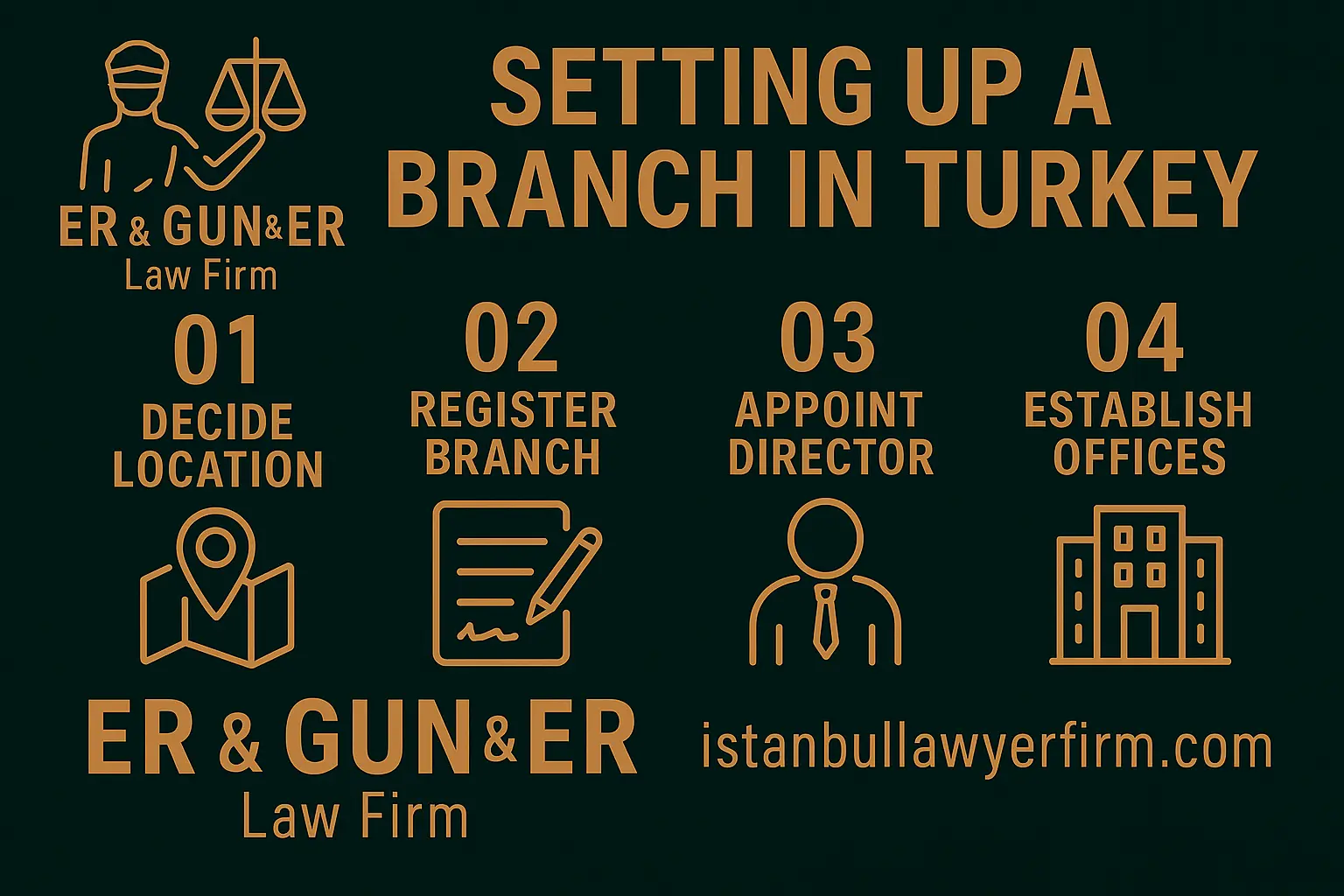
Establishing a branch (şube) in Turkey by a foreign parent company operates within a structured procedural framework that combines specific corporate-law foundations, comprehensive registration mechanics, structured tax framework coordination, integrated employment positioning, sector-specific licensing requirements, and broader strategic positioning producing comprehensive market-entry discipline that experienced practitioners support across the full branch lifecycle. The framework that governs the relevant questions is set primarily by the 6102 sayılı Türk Ticaret Kanunu (TTK / Turkish Commercial Code) covering m.40 (ticari işletme tescili / commercial enterprise registration), m.41 (ticari unvan / commercial title — establishing the mandatory "şube" suffix designation for branch operations), m.42 (tescil zorunluluğu / registration requirement), m.42-44 (tescil ve ilan / registration and publication), m.5 (Asliye Ticaret Mahkemesi / Commercial Court of First Instance jurisdiction), m.5/A (dava şartı arabuluculuk / mandatory mediation effective 1 January 2019), and m.351-356 (yabancı şirketlerin merkezi Türkiye'de bulunmayanların şubeleri / branches of foreign companies whose head offices are not located in Turkey — establishing the foundational Turkish-law framework specifically governing foreign-parent branch operations); the 4875 sayılı Doğrudan Yabancı Yatırımlar Kanunu (DYY / Foreign Direct Investment Law) effective 17 June 2003 establishing the foundational yabancı yatırımcı eşit muamele (foreign investor equal treatment) principle under m.3 supporting structured non-discriminatory framework; the T.C. Ticaret Bakanlığı (Ministry of Trade) İç Ticaret Genel Müdürlüğü Şirketler Dairesi Başkanlığı (General Directorate of Domestic Trade — Companies Department) operating as foundational authorization authority; the MERSİS (Merkezi Sicil Kayıt Sistemi / Central Registry Information System) electronic registration platform supporting integrated registration mechanics; the Türkiye Ticaret Sicili Gazetesi (Turkish Trade Registry Gazette) supporting publication requirements; the 5174 sayılı Türkiye Odalar ve Borsalar Birliği ile Odalar ve Borsalar Kanunu governing TOBB (Türkiye Odalar ve Borsalar Birliği / Union of Chambers and Commodity Exchanges) and Ticaret Odası (Chamber of Commerce) framework; the 5520 sayılı Kurumlar Vergisi Kanunu (KVK) m.3/2 (dar mükellef kurum / limited tax liability — the substantive Turkish-tax classification framework specifically governing foreign-parent branches) and m.30 (cross-border withholding); the 3065 sayılı KDV Kanunu (Katma Değer Vergisi / Value Added Tax); the 488 sayılı Damga Vergisi Kanunu; the 213 sayılı Vergi Usul Kanunu (VUK); the 4857 sayılı İş Kanunu (Labor Law); the 6735 sayılı Uluslararası İşgücü Kanunu effective 28 July 2016 governing yabancı çalışma izni (foreign work permits — critical for non-Turkish branch managers); the 5510 sayılı SSGSS Kanunu (SGK); the 6331 sayılı İş Sağlığı ve Güvenliği Kanunu (İSG); the 6698 sayılı KVKK effective 7 April 2016 (personal data protection); the 6563 sayılı E-Ticaret Kanunu effective 1 May 2015 (ETBİS); the 5411 sayılı Bankacılık Kanunu (BDDK); the 3568 sayılı SMMM ve YMM Kanunu (yeminli mali müşavir / sworn-in financial accountant); the 6325 sayılı Arabuluculuk Kanunu; the 4686 sayılı MTK; the 6570 sayılı İstanbul Tahkim Merkezi Kanunu effective 1 October 2014 establishing ISTAC; and the New York Convention 1958 with Turkey accession effective 25 September 1991 with reciprocity reservation. Practice may vary by authority and year.
An English speaking lawyer in Turkey advising on branch establishment will explain that effective Turkish branch positioning requires structured coordination across substantive framework analysis (şube versus subsidiary distinction), comprehensive Ticaret Bakanlığı authorization mechanics, integrated MERSİS registration and Türkiye Ticaret Sicili Gazetesi publication coordination, structured tax framework positioning (notably KVK m.3/2 dar mükellef kurum analysis), comprehensive employment coordination including yabancı çalışma izni mechanics, sector-specific licensing positioning, and broader strategic considerations supporting both immediate establishment outcomes and longer-horizon operational positioning. The body of this guide walks through the substantive branch framework under TTK m.351-356 with DYY coordination; the registration procedure with Ticaret Bakanlığı authorization, MERSİS, and Türkiye Ticaret Sicili Gazetesi publication; the tax framework under KVK m.3/2 dar mükellef kurum with KDV, withholding, and damga vergisi positioning; the employment framework with İş Kanunu, SGK, and yabancı çalışma izni coordination; the sector-specific licensing framework with BDDK, ETBİS, KVKK, and broader regulatory positioning; the corporate governance, internal controls, and TFRS/VUK accounting framework; the dispute resolution framework with TTK m.5/A mandatory mediation, MTK, ISTAC, and NY Convention coordination; and the annual compliance, YMM-certified financial statements, and branch closure framework. For procedural orientation on adjacent topics, our notes on foreign investor company law in Turkey, LLC versus joint stock company comparison in Turkey, and foreign court judgment enforcement in Turkey can be read alongside this material.
1) Branch Framework under TTK Law No. 6102 m.351-356 (Yabancı Şirket Şubeleri), DYY Law No. 4875, and Şube versus Subsidiary Distinction
A lawyer in Turkey advising on the substantive branch framework will explain that Turkish şube (branch) operates as an extension of the foreign parent company rather than as separate legal entity, with specific procedural mechanics affecting both immediate establishment positioning and broader operational structure. The procedure ordinarily considers the substantive TTK m.351-356 framework establishing the foundational Turkish-law framework specifically governing branches of foreign companies whose head offices are located outside Turkey — the framework operates as the substantive primary mevzuat (legislation) regulating foreign-parent branch operations with comprehensive procedural mechanics; the substantive şube non-entity character framework where Turkish branches operate as legal extensions of the foreign parent rather than as separate legal entities — the substantive framework produces specific implications for liability allocation (the foreign parent retains full legal and financial responsibility), contracting authority (the parent company authority operates through branch with structured procedural mechanics), and broader operational positioning; the substantive subsidiary alternative framework where foreign companies may alternatively establish a Turkish anonim şirket (A.Ş. / joint stock company) or limited şirket (Ltd. Şti. / limited liability company) subsidiary — the subsidiary framework produces separate legal entity status with structured liability segregation, separate corporate governance, and distinct tax positioning; the substantive TTK m.40-44 general registration framework governing structured commercial enterprise tescil (registration) with specific procedural mechanics; the substantive TTK m.41 framework establishing the mandatory "şube" suffix designation in the Turkish branch ticari unvan (commercial title) — the suffix operates as foundational identification framework supporting market-participant clarity; and the broader integration framework where şube operations integrate within the comprehensive Turkish corporate-regulatory framework. For the full procedural framework, see our pillar guide on establishing a company in Turkey as a wholly owned subsidiary.
An Istanbul Law Firm advising on the DYY (Doğrudan Yabancı Yatırımlar Kanunu / Foreign Direct Investment Law) framework will note that the 4875 sayılı DYY Kanunu effective 17 June 2003 establishes the foundational Turkish foreign-investment regulatory framework with specific implications for branch establishment positioning. The procedure ordinarily considers the substantive DYY m.3 yabancı yatırımcı eşit muamele (foreign investor equal treatment) framework establishing the structured non-discriminatory principle where foreign investors operate under substantively identical framework to Turkish investors — the framework supports both establishment freedom and ongoing operational positioning; the substantive freedom-of-investment framework where foreign investors may freely establish Turkish presence (subsidiary, branch, liaison office, joint venture) subject only to specific sector-restriction frameworks (notably banking, insurance, broadcasting, real estate in restricted zones, and broader sector-specific frameworks); the substantive structured no-prior-approval framework where general FDI transactions typically operate without prior approval requirements — the framework substantially streamlined the prior 6224 sayılı eski DYY Kanunu (former DYY Law) framework which required structured prior approval; the substantive notification framework where structured ex-post notification supports comprehensive regulatory awareness without obstructing investment positioning; the substantive DYY Uygulama Yönetmeliği (Implementing Regulation) framework providing detailed implementation procedural mechanics; the substantive sector-restriction framework where structured sectoral analysis (notably banking under 5411 sayılı Bankacılık Kanunu, insurance under specific framework, broadcasting under RTÜK framework) supports comprehensive regulatory positioning; and the broader integration framework where DYY framework operates within the comprehensive Turkish foreign-investment regulatory architecture.
A Turkish Law Firm advising on the strategic branch-versus-subsidiary framework will note that effective Turkish market-entry positioning requires structured analysis across multiple parallel dimensions producing optimal entity selection for specific transaction circumstances. The procedure ordinarily considers the substantive liability framework where şube produces full parent company liability exposure (parent retains substantive liability for branch operations) compared to subsidiary which produces structured liability segregation (subsidiary operates as separate legal entity with limited parent liability — though piercing-the-corporate-veil scenarios may produce structured exception frameworks); the substantive tax framework where şube typically operates under KVK m.3/2 dar mükellef kurum framework while subsidiary operates as tam mükellef kurum (resident corporation) — the framework distinction produces structurally different tax positioning with specific implications for cross-border profit repatriation; the substantive operational-flexibility framework where şube operates within parent company authorization scope while subsidiary operates with independent decision-making authority — the framework distinction affects operational responsiveness; the substantive capital-requirement framework where şube has no minimum capital requirements while subsidiary requires minimum capital under TTK (50,000 TL for A.Ş., 10,000 TL for Ltd. Şti. — subject to periodic adjustments); the substantive corporate-governance framework where şube operates without separate genel kurul (general assembly) or yönetim kurulu (board) while subsidiary operates with full corporate-governance structure; the substantive exit framework where branch closure operates through structured deregistration while subsidiary closure operates through liquidation procedures with broader procedural complexity; and the broader strategic-coordination framework where entity selection operates within the comprehensive market-entry strategic framework. The discipline outlined in our note on foreign investor company law in Turkey covers the broader entity-selection framework. Practice may vary by authority and year.
2) Registration Procedure: Ticaret Bakanlığı Authorization, MERSİS, Türkiye Ticaret Sicili, and Türkiye Ticaret Sicili Gazetesi Publication
An English speaking lawyer in Turkey advising on branch registration will explain that Turkish şube establishment operates through structured multi-stage procedural mechanics with specific coordination requirements affecting both immediate establishment timing and broader operational readiness. The procedure ordinarily considers the substantive T.C. Ticaret Bakanlığı (Ministry of Trade) authorization framework through the İç Ticaret Genel Müdürlüğü Şirketler Dairesi Başkanlığı (General Directorate of Domestic Trade — Companies Department) — structured application establishing branch authorization with specific documentary requirements; the substantive documentary discipline framework requiring structured (i) parent company corporate documents (incorporation certificate / good standing certificate, articles of association / equivalent, registry extract — typically dating within 6 months), (ii) parent company board resolution authorizing branch establishment with specific scope, name, address, capital allocation, and branch manager appointment, (iii) apostille certification under the 1961 La Haye Konvansiyonu (Hague Convention on Apostille) for foreign documents — Turkey acceded effective 1985, (iv) yeminli tercüman (sworn translator) translation into Turkish, and (v) noter (notary) certification of structured Turkish-side documents; the substantive branch manager appointment framework where structured branch manager appointment requires comprehensive documentation including branch manager identification, residence documentation, and authority specification; the substantive activity scope framework where branch activity scope must align with parent company corporate purposes — structured scope definition supports comprehensive regulatory positioning; and the substantive Ticaret Bakanlığı approval timeline where structured authorization typically operates within multiple weeks depending on documentary completeness.
An Istanbul Law Firm advising on MERSİS and Trade Registry coordination will note that MERSİS (Merkezi Sicil Kayıt Sistemi / Central Registry Information System) operates as the foundational electronic registration platform supporting integrated branch registration mechanics. The procedure ordinarily considers the substantive MERSİS framework as the structured online platform supporting comprehensive Turkish corporate registration including branch registration with specific procedural mechanics — typical practice involves coordinated MERSİS application supporting subsequent Trade Registry processing; the substantive Türkiye Ticaret Sicili (Trade Registry) framework where structured local Trade Registry filing in the intended branch operating city (typically Istanbul, Ankara, İzmir, or other major commercial centers) supports comprehensive establishment; the substantive NACE (Nomenclature of Economic Activities) code framework where structured activity classification supports tax registration, statistical reporting, and broader regulatory coordination; the substantive address registration framework where structured branch address documentation through lease agreement (kira sözleşmesi) supports both registration completion and broader operational positioning; the substantive vergi numarası (tax number) framework where structured tax registration through Vergi Dairesi (Tax Office) supports comprehensive fiscal positioning; the substantive imza sirküleri (signature circular) framework where structured noter-certified signature circular supports branch operations; the substantive şirket kaşesi (company seal) framework supporting transactional documentation; and the substantive Ticaret Odası (Chamber of Commerce) registration framework under the 5174 sayılı Türkiye Odalar ve Borsalar Birliği Kanunu where structured Chamber of Commerce membership supports operational positioning.
Turkish lawyers who advise on the publication and post-registration framework will note that effective branch registration completion requires structured publication and post-registration coordination supporting comprehensive operational readiness. The procedure ordinarily considers the substantive Türkiye Ticaret Sicili Gazetesi (Turkish Trade Registry Gazette) publication framework under TTK provisions supporting structured public notification of branch establishment with specific procedural mechanics — publication serves both regulatory compliance and broader market-participant disclosure functions; the substantive e-Tebligat (electronic notification) framework under the 7201 sayılı Tebligat Kanunu with UETS (Ulusal Elektronik Tebligat Sistemi / National Electronic Notification System) providing mandatory electronic notification capability for corporate entities with structured procedural mechanics; the substantive 5070 sayılı Elektronik İmza Kanunu framework governing NES (nitelikli elektronik sertifika / qualified electronic certificate) acquisition supporting digital signature capability for branch manager and broader corporate operations; the substantive corporate bank account framework where structured Turkish bank account opening supports comprehensive operational positioning — typically requires comprehensive documentation including registration certificate, signature circular, branch manager identification, and broader documentary materials; the substantive SGK (Sosyal Güvenlik Kurumu / Social Security Institution) registration framework where structured SGK iş yeri (workplace) registration supports employment positioning; the substantive lease agreement (kira sözleşmesi) framework under TBK m.299 vd. where structured commercial lease coordination supports operational positioning; the substantive financial books opening framework under VUK with structured noter-certified financial book opening; and the broader integration framework where post-registration coordination supports comprehensive Turkish operational readiness. Practice may vary by authority and year.
3) Tax Framework: KVK Law No. 5520 m.3/2 Dar Mükellef Kurum, m.30 Withholding, KDV Kanunu Law No. 3065, and Damga Vergisi Law No. 488
An Istanbul Law Firm advising on Turkish branch tax positioning will note that Turkish foreign-parent şube operates under the structured KVK m.3/2 dar mükellef kurum (limited tax liability) framework with specific procedural mechanics. The procedure ordinarily considers the substantive 5520 sayılı Kurumlar Vergisi Kanunu (KVK / Corporate Tax Law) establishing the foundational Turkish corporate tax framework; the substantive KVK m.3/2 dar mükellef kurum framework specifically governing foreign-parent branches as limited-tax-liability corporations — the framework subjects branches to Turkish corporate tax only on Turkish-source income (Türkiye'de iş yeri veya daimi temsilci aracılığıyla elde edilen kazançlar / income earned through workplace or permanent representative in Turkey); the substantive corporate tax rate framework where dar mükellef kurum operates under standard Turkish corporate tax rate (currently 25% subject to periodic adjustments) on Turkish-source income; the substantive KVK m.30 cross-border withholding framework establishing structured withholding obligations on cross-border payments to non-resident corporations including dividends, interest, royalties, and broader payment categories — typical rates 10-15% subject to applicable çifte vergilendirme önleme anlaşması (DTAA / Double Taxation Avoidance Agreement) reduction; the substantive DTAA framework where Turkey's network of 90+ jurisdictional DTAAs supports structured treaty-based tax coordination — branch profit repatriation typically benefits from DTAA-coordinated reduced rates; and the substantive transfer pricing framework under KVK m.13 governing related-party transactions between branch and parent or affiliates with structured arm's-length analysis requirements.
A lawyer in Turkey advising on KDV (Value Added Tax) coordination will note that the 3065 sayılı KDV Kanunu (Katma Değer Vergisi / VAT Law) operates as foundational Turkish indirect tax framework with specific implications for branch operational positioning. The procedure ordinarily considers the substantive KDV registration framework where structured branch KDV registration through Vergi Dairesi (Tax Office) supports comprehensive operational positioning — typically required for branches engaged in taxable transactions in Turkey; the substantive standard KDV rate framework where the standard rate currently operates at 20% with structured reduced rates (10%, 1%) for specific goods and services categories — rates subject to periodic adjustments; the substantive monthly KDV declaration framework where structured monthly KDV beyannamesi (declaration) requires comprehensive transaction reporting with specific procedural mechanics — typical filing deadline within structured monthly cycle; the substantive cross-border services framework where structured tersine ödenen KDV (reverse-charge VAT) mechanics apply to certain cross-border services with specific procedural requirements; the substantive input KDV recovery framework where structured input KDV documentation through fatura (invoice) discipline supports recovery positioning; the substantive e-fatura framework where structured electronic invoicing supports comprehensive compliance positioning — mandatory for branches meeting specific thresholds; the substantive bilingual invoice framework where structured Turkish-language invoicing operates as primary compliance framework with English-language supplementation supporting cross-border operations; and the substantive KDV inspection framework where structured Vergi Dairesi inspection coordination supports both immediate compliance and broader subsequent procedural mechanics.
A Turkish Law Firm advising on Damga Vergisi and broader tax coordination will note that effective branch tax positioning requires structured coordination across multiple parallel categories supporting comprehensive compliance discipline. The procedure ordinarily considers the substantive 488 sayılı Damga Vergisi Kanunu framework establishing structured stamp duty obligations with standard 0.948% (binde 9.48) rate applicable to documents specifying monetary amounts and signed in Turkey, subject to annual ceilings — branch operational documents (lease agreements, employment contracts, supplier agreements) typically trigger damga vergisi with structured calculation mechanics; the substantive 213 sayılı VUK (Vergi Usul Kanunu / Tax Procedure Law) framework governing comprehensive Turkish tax procedural mechanics including documentary discipline, accounting requirements, and broader compliance framework; the substantive 193 sayılı GVK (Gelir Vergisi Kanunu / Personal Income Tax Law) framework affecting employee withholding under m.94; the substantive social security framework under the 5510 sayılı SSGSS Kanunu governing SGK premium calculations affecting both employer and employee positioning; the substantive YMM (yeminli mali müşavir / sworn-in financial accountant) framework under the 3568 sayılı SMMM ve YMM Kanunu where structured YMM-certified annual financial statements support comprehensive compliance — typically required for branches meeting specific thresholds; the substantive electronic-filing framework where structured e-Beyanname (electronic declaration), e-Fatura, e-Defter, and broader electronic compliance mechanisms support integrated operational positioning; the substantive transfer pricing documentation framework where structured transfer pricing reports support compliance positioning under KVK m.13; and the substantive tax-audit-readiness framework where structured documentation discipline supports comprehensive subsequent procedural mechanics including potential audit responses, penalty mitigation, and voluntary disclosure positioning. The discipline outlined in our note on foreign investor company law in Turkey covers the broader investor-tax framework. Practice may vary by authority and year.
4) Employment under İş Kanunu Law No. 4857, SGK under SSGSS Law No. 5510, and Yabancı Çalışma İzni under Uluslararası İşgücü Kanunu Law No. 6735
An English speaking lawyer in Turkey advising on branch employment positioning will explain that Turkish branch employment operates through structured procedural mechanics across multiple parallel categories with specific implications for both immediate workforce positioning and broader operational compliance. The procedure ordinarily considers the substantive 4857 sayılı İş Kanunu (Labor Law) establishing the foundational Turkish employment framework with comprehensive coverage including m.14 (kıdem tazminatı / severance compensation), m.17 (ihbar süreleri / notice periods), m.18-21 (fesih sebepleri / termination grounds with iş güvencesi / job security framework for workplaces with 30+ employees), m.29 (toplu işten çıkarma / collective dismissal), m.32 (ücret / wage protections), m.55 (yıllık ücretli izin / annual paid leave), and broader employment regulatory framework; the substantive standard probation framework under m.15 where structured deneme süresi (probation period) operates up to 2 months extendable to 4 months by collective bargaining agreement; the substantive working hours framework under m.63 where standard çalışma süresi operates at 45 hours per week with structured overtime framework under m.41 (fazla çalışma); the substantive bilingual contract framework where Turkish-language contracts operate as authoritative version with structured English-language translation supporting non-Turkish employee understanding; the substantive 6356 sayılı Sendikalar ve Toplu İş Sözleşmesi Kanunu framework governing trade-union and collective bargaining where applicable; the substantive disciplinary framework where structured disciplinary procedural mechanics support both employer authority and employee protection; and the substantive workplace policy framework where structured internal regulations support comprehensive operational positioning.
An Istanbul Law Firm advising on SGK coordination will note that the 5510 sayılı Sosyal Sigortalar ve Genel Sağlık Sigortası Kanunu (SGK / Social Security Law) establishes comprehensive Turkish social security framework with specific procedural mechanics affecting branch employment positioning. The procedure ordinarily considers the substantive SGK iş yeri (workplace) registration framework where structured branch registration as SGK iş yeri supports comprehensive employment compliance — registration must be completed before employee onboarding with specific procedural mechanics; the substantive 30-day employee enrollment framework under SGK requirements where new employees must be enrolled within 30 days of start date — typical practice involves enrollment immediately upon hire to avoid administrative friction; the substantive monthly SGK premium declaration framework where structured aylık prim ve hizmet belgesi (monthly premium and service document) requires comprehensive employer and employee premium reporting; the substantive employer premium framework where structured employer SGK contributions typically operate at approximately 20.5-22.5% of gross wages with structured composition across long-term insurance, short-term insurance, general health insurance, and unemployment insurance; the substantive employee premium framework where structured employee SGK contributions typically operate at approximately 14-15% of gross wages with similar composition; the substantive maternity, sick leave, and military service framework where structured procedural mechanics support comprehensive employee protection; the substantive İŞKUR (Türkiye İş Kurumu / Turkish Employment Agency) coordination framework supporting employment market positioning; the substantive Ücret Garanti Fonu (Wage Guarantee Fund) framework under İş Kanunu m.33 supporting unpaid wage protection in employer insolvency scenarios; and the substantive SGK audit framework where structured SGK inspection coordination supports both immediate compliance and broader subsequent procedural integrity.
A lawyer in Turkey advising on yabancı çalışma izni (foreign work permit) coordination will note that the 6735 sayılı Uluslararası İşgücü Kanunu effective 28 July 2016 establishes the comprehensive Turkish foreign workforce framework with specific procedural mechanics affecting non-Turkish branch staff including potentially the branch manager. The procedure ordinarily considers the substantive 6735 sayılı Kanun framework as the substantive primary mevzuat governing foreign work permits — the framework substantially modernized prior 4817 sayılı Yabancıların Çalışma İzinleri Kanunu replaced through the 2016 reform; the substantive Çalışma ve Sosyal Güvenlik Bakanlığı (Ministry of Labor and Social Security) coordination framework operating as foundational regulatory authority; the substantive çalışma izni başvurusu (work permit application) framework where structured application typically operates through (i) employer-sponsored application from Turkish employer (the branch operating as Turkish employer for this purpose) supporting structured cross-border employee deployment, with comprehensive supporting documentation including (a) işveren talebi (employer request), (b) yabancı çalışan kimlik ve eğitim belgeleri (foreign employee identification and education documents), (c) noter-certified iş sözleşmesi (employment contract), (d) parent company financial statements, and (e) broader documentary materials; the substantive 2-stage processing framework where domestic-application path (yurt içi başvuru) and consulate-application path (yurt dışı başvuru) operate under different procedural mechanics; the substantive structured approval timeline where typical processing operates within 30-60 days depending on documentary completeness; the substantive Türkiye'de Çalışma İzni Muafiyeti (Work Permit Exemption) framework for specific categories including diplomatic personnel, scientific researchers, and broader exempt categories; the substantive renewal framework where structured çalışma izni uzatması (work permit extension) supports continued employment with specific procedural mechanics; the substantive penalty framework where unauthorized foreign employment produces structured administrative penalties affecting both employer and employee positioning; and the substantive ikamet izni (residence permit) coordination framework under the 6458 sayılı Yabancılar ve Uluslararası Koruma Kanunu (YUKK) where structured residence-and-work coordination supports comprehensive expatriate positioning. Practice may vary by authority and year.
5) Sector-Specific Licensing: BDDK Law No. 5411, ETBİS Law No. 6563, KVKK Law No. 6698, and Sectoral Authorities
An Istanbul Law Firm advising on sector-specific licensing will note that effective Turkish branch positioning across regulated industries requires structured coordination with sector-specific authorities supporting comprehensive operational compliance. The procedure ordinarily considers the substantive 5411 sayılı Bankacılık Kanunu (Banking Law) governing structured banking-sector branch operations through BDDK (Bankacılık Düzenleme ve Denetleme Kurumu / Banking Regulation and Supervision Agency) with specific procedural mechanics — banking branches face structured prior-authorization framework, capital adequacy requirements, and ongoing prudential supervision; the substantive TMSF (Tasarruf Mevduatı Sigorta Fonu / Savings Deposit Insurance Fund) coordination framework supporting deposit insurance and bank resolution positioning; the substantive 6362 sayılı SerPK (Sermaye Piyasası Kanunu / Capital Markets Law) governing capital-markets sector operations through SPK (Sermaye Piyasası Kurulu / Capital Markets Board) coordination — investment services, asset management, and broader capital-markets activities require structured SPK authorization; the substantive insurance regulatory framework through the SEDDK (Sigortacılık ve Özel Emeklilik Düzenleme ve Denetleme Kurumu / Insurance and Private Pension Regulation and Supervision Agency) supporting insurance-sector branch operations; the substantive TİTCK (Türkiye İlaç ve Tıbbi Cihaz Kurumu / Turkish Medicines and Medical Devices Agency) coordination framework supporting pharmaceutical and medical device branch operations; the substantive RTÜK (Radyo ve Televizyon Üst Kurulu / Radio and Television Supreme Council) framework governing broadcasting-sector activities; the substantive EPDK (Enerji Piyasası Düzenleme Kurumu / Energy Market Regulatory Authority) framework governing energy-sector operations; and the substantive sector-coordination framework where structured authority engagement supports comprehensive regulatory compliance.
A Turkish Law Firm advising on ETBİS (Elektronik Ticaret Bilgi Sistemi) coordination will note that the 6563 sayılı Elektronik Ticaretin Düzenlenmesi Hakkında Kanun (E-Ticaret Kanunu) effective 1 May 2015 establishes the foundational Turkish e-commerce regulatory framework with specific procedural mechanics affecting branches engaged in e-commerce activities. The procedure ordinarily considers the substantive 6563 sayılı Kanun framework as the substantive primary mevzuat governing Turkish e-commerce with comprehensive coverage including consumer protection, contract formation, electronic communications, and broader e-commerce regulatory framework; the substantive ETBİS (Elektronik Ticaret Bilgi Sistemi / Electronic Commerce Information System) framework operating as comprehensive Turkish e-commerce registry under T.C. Ticaret Bakanlığı coordination — branches engaged in e-commerce typically face structured ETBİS registration requirements with specific procedural mechanics; the substantive consumer protection framework where structured 6502 sayılı Tüketicinin Korunması Hakkında Kanun (Consumer Protection Law) coverage supports comprehensive Turkish consumer-relation positioning; the substantive electronic communications framework where structured ticari elektronik ileti (commercial electronic message) requirements under İYS (İleti Yönetim Sistemi / Message Management System) coordination support compliance positioning — opt-in framework with structured procedural mechanics; the substantive cookie and tracking framework where structured KVKK coordination supports comprehensive personal data protection positioning; the substantive complaint and dispute resolution framework where structured procedural mechanics support comprehensive consumer-relation positioning; and the broader integration framework where e-commerce coordination operates within the comprehensive Turkish digital-economy regulatory architecture.
A lawyer in Turkey advising on KVKK (Kişisel Verilerin Korunması Kanunu / Personal Data Protection Law) coordination will note that the 6698 sayılı KVKK effective 7 April 2016 establishes the comprehensive Turkish personal data protection framework with specific procedural mechanics affecting branch operations across all sectors processing personal data. The procedure ordinarily considers the substantive 6698 sayılı KVKK framework as the substantive primary mevzuat governing Turkish personal data protection with comprehensive coverage including data processing principles, individual rights, data controller obligations, and enforcement framework; the substantive VERBİS (Veri Sorumluları Sicil Bilgi Sistemi / Data Controllers Registry Information System) framework where structured data controller registration supports comprehensive compliance positioning — branches typically require structured VERBİS registration with specific procedural mechanics depending on threshold criteria; the substantive KVKK Kurulu (Data Protection Authority) coordination framework operating as foundational regulatory authority; the substantive cross-border transfer framework where structured m.9 yurtdışına aktarım mechanics support cross-border personal data transfer positioning — typically requires explicit consent or specific procedural prerequisites; the substantive aydınlatma metni (informational notice) framework supporting structured data subject communication; the substantive açık rıza (explicit consent) framework supporting structured consent mechanics where applicable; the substantive personal data inventory framework where structured kişisel veri envanteri supports comprehensive compliance positioning; the substantive employee personal data framework where employment-context personal data processing produces specific procedural mechanics; the substantive customer personal data framework where customer-relation data produces specific procedural mechanics; and the broader strategic-coordination framework where KVKK compliance operates as foundational compliance discipline rather than as documentary afterthought. Practice may vary by authority and year.
6) Corporate Governance, İş Sağlığı Güvenliği under Law No. 6331, and TFRS/VUK Accounting Framework
An English speaking lawyer in Turkey advising on branch corporate governance will explain that effective Turkish branch operations require structured internal governance coordination supporting both immediate operational integrity and broader compliance positioning. The procedure ordinarily considers the substantive parent-policy alignment framework where Turkish branch internal policies typically require structured adaptation aligning parent-company global frameworks with Turkish-law mandatory provisions — the framework supports both global consistency and local compliance; the substantive bilingual policy framework where structured Turkish-and-English policy documentation supports both Turkish-employee accessibility and global head-office understanding; the substantive financial delegation framework where structured signature authority and approval threshold mechanics support comprehensive financial-control positioning; the substantive internal-control framework where structured internal control mechanisms support both fraud prevention and operational integrity; the substantive board-reporting framework where structured periodic reporting from Turkish branch to foreign parent board supports comprehensive corporate-governance positioning; the substantive anti-corruption framework where structured compliance with Turkish anti-corruption requirements (notably TCK m.252-256 covering rüşvet / bribery, görevi kötüye kullanma / abuse of office) and applicable foreign frameworks (FCPA, UK Bribery Act, OECD Anti-Bribery Convention) supports integrated compliance positioning; the substantive supplier and vendor management framework where structured Turkish-language contracts with embedded compliance provisions support comprehensive supply-chain positioning; and the broader strategic-coordination framework where corporate governance operates as integrated component of comprehensive operational excellence.
An Istanbul Law Firm advising on İSG (İş Sağlığı ve Güvenliği / Occupational Health and Safety) compliance will note that the 6331 sayılı İş Sağlığı ve Güvenliği Kanunu (İSG Kanunu) effective 30 December 2012 establishes comprehensive Turkish workplace safety framework with specific procedural mechanics affecting branch operational positioning. The procedure ordinarily considers the substantive 6331 sayılı Kanun framework establishing comprehensive workplace safety obligations including risk assessment (risk değerlendirmesi), employee safety training, structured workplace inspection mechanisms, and broader safety regulatory framework; the substantive iş sağlığı güvenliği uzmanı (workplace safety expert) framework where structured certified safety expert (A, B, C kategorisi) coordination supports comprehensive compliance — workplace risk classification (az tehlikeli, tehlikeli, çok tehlikeli) determines specific expert qualification requirements; the substantive iş yeri hekimi (workplace physician) framework where structured medical professional coordination supports comprehensive employee health monitoring; the substantive risk değerlendirmesi (risk assessment) framework where structured periodic assessment supports comprehensive workplace safety positioning; the substantive çalışan eğitimi (employee training) framework where structured periodic safety training supports compliance positioning; the substantive İSG-Kâtip framework where structured electronic compliance reporting supports comprehensive procedural mechanics; the substantive accident-and-incident reporting framework where structured iş kazası (workplace accident) and meslek hastalığı (occupational disease) reporting supports compliance positioning; the substantive penalty framework where İSG non-compliance produces structured administrative penalties supporting compliance discipline; and the broader strategic integration framework where İSG compliance operates within the comprehensive Turkish employment-and-safety regulatory architecture.
A Turkish Law Firm advising on TFRS/VUK accounting framework will note that effective Turkish branch accounting positioning requires structured coordination across multiple parallel accounting and reporting frameworks supporting comprehensive compliance discipline. The procedure ordinarily considers the substantive Türkiye Muhasebe Standartları (TMS / Turkish Accounting Standards) and Türkiye Finansal Raporlama Standartları (TFRS / Turkish Financial Reporting Standards) framework under the Kamu Gözetimi Muhasebe ve Denetim Standartları Kurumu (KGK / Public Oversight Accounting and Auditing Standards Board) coordination supporting structured Turkish accounting framework — structured alignment with IFRS supports cross-border financial reporting integration; the substantive 213 sayılı VUK (Vergi Usul Kanunu / Tax Procedure Law) framework governing comprehensive Turkish tax-accounting framework with structured documentary discipline including yevmiye defteri (journal), büyük defter (general ledger), envanter defteri (inventory book), and broader accounting books with specific procedural mechanics; the substantive noter-certified accounting books framework where structured noter (notary) certification supports comprehensive procedural integrity — typically certified annually before fiscal year commencement; the substantive e-Defter framework where structured electronic ledger maintenance supports comprehensive electronic compliance for branches meeting threshold criteria; the substantive YMM (yeminli mali müşavir / sworn-in financial accountant) coordination framework under the 3568 sayılı SMMM ve YMM Kanunu where structured YMM-certified annual financial statements support comprehensive compliance — typically required for branches meeting specific revenue or asset thresholds; the substantive transfer pricing documentation framework supporting structured cross-border tax compliance; the substantive Türkiye Ticaret Sicili Gazetesi annual financial statement publication framework where structured public disclosure supports comprehensive corporate-record positioning; and the broader strategic integration where accounting framework operates within the comprehensive Turkish corporate-regulatory architecture. Practice may vary by authority and year.
7) Dispute Resolution: TTK m.5/A Mandatory Mediation, MTK Law No. 4686, ISTAC under Law No. 6570, NY Convention 1958, and Asliye Ticaret Mahkemesi
An Istanbul Law Firm advising on branch dispute resolution will note that Turkish branch operations may produce disputes across multiple parallel categories with structured dispute resolution framework supporting comprehensive resolution positioning. The procedure ordinarily considers the substantive TTK m.5 framework establishing Asliye Ticaret Mahkemesi (Commercial Court of First Instance) jurisdiction over commercial disputes including branch-related commercial matters with structured procedural mechanics; the substantive TTK m.5/A framework establishing dava şartı arabuluculuk (mandatory mediation as precondition to litigation) effective 1 January 2019 for commercial disputes — applicants must complete structured mediation through registered arabulucu (mediator) before filing the substantive dava (lawsuit) at Asliye Ticaret Mahkemesi; the substantive 6325 sayılı Hukuk Uyuşmazlıklarında Arabuluculuk Kanunu (Mediation Law) establishing comprehensive Turkish mediation framework with specific procedural mechanics; the substantive employment-dispute mediation framework where workforce-related disputes (notably wrongful dismissal claims) similarly face structured mandatory mediation prerequisite under İş Kanunu provisions; the substantive contractual dispute framework where structured commercial dispute resolution supports comprehensive procedural mechanics including supplier disputes, customer disputes, and broader commercial-relation disputes; the substantive interim-measures framework under HMK m.389-403 ihtiyati tedbir supporting structured pre-judgment protection; the substantive ihtiyati haciz (precautionary attachment) framework under İİK m.257-268 supporting monetary-claim asset preservation; and the broader strategic-coordination framework where dispute resolution operates within the comprehensive Turkish litigation framework.
A lawyer in Turkey advising on international arbitration will note that effective cross-border branch dispute resolution typically operates through structured international arbitration framework supporting both procedural efficiency and comprehensive cross-border enforceability. The procedure ordinarily considers the substantive MTK Law No. 4686 (Milletlerarası Tahkim Kanunu / International Arbitration Law) establishing the foundational Turkish international arbitration framework with comprehensive coverage including arbitration agreement requirements, tribunal appointment, procedural mechanics, and award enforceability; the substantive 6570 sayılı İstanbul Tahkim Merkezi Kanunu (ISTAC Law) effective 1 October 2014 establishing ISTAC (Istanbul Arbitration Centre) as structured Turkish-jurisdiction arbitration institution supporting both Turkish and international arbitration with comprehensive procedural framework; the substantive ICC, LCIA, SIAC alternative framework where major international arbitration institutions support cross-border branch dispute resolution with structured procedural mechanics; the substantive New York Convention 1958 framework with Turkey accession effective 25 September 1991 with reciprocity reservation establishing the foundational cross-border arbitral award enforcement framework; the substantive arbitration-clause-drafting framework where structured drafting supports specific tribunal selection, procedural rules selection, language selection, seat selection, and substantive arbitration mechanics; the substantive emergency-arbitrator framework where structured emergency arbitrator procedures support time-sensitive interim relief; the substantive expedited-proceedings framework where structured expedited mechanisms support efficient dispute resolution for smaller-value disputes; the substantive cost-control framework where structured arbitration cost provisions support efficient dispute resolution; and the broader strategic integration where international arbitration operates within the comprehensive cross-border venture-finance dispute framework.
Turkish lawyers who advise on cross-border judgment enforcement will note that effective cross-border dispute resolution requires structured coordination across MÖHUK and broader recognition frameworks supporting comprehensive enforceability positioning. The procedure ordinarily considers the substantive 5718 sayılı Milletlerarası Özel Hukuk ve Usul Hukuku Hakkında Kanun (MÖHUK / Private International Law) m.50-63 framework governing tanıma (recognition) and tenfiz (enforcement) of foreign judgments — operates as foundational framework for foreign court judgment enforcement in Turkey; the substantive MÖHUK m.54 tenfiz şartları (enforcement conditions) framework requiring (i) kesinleşmiş karar (finalized decision under issuing jurisdiction's law), (ii) karşılıklılık (reciprocity), and (iii) kamu düzeni (Turkish public order); the substantive bilateral judicial assistance treaty framework where Turkey's bilateral treaties may support specific cross-border coordination beyond MÖHUK general framework; the substantive NY Convention 1958 framework providing more streamlined cross-border enforcement compared to MÖHUK general framework — typical practice favors arbitration clauses leveraging NY Convention positioning; the substantive Bölge Adliye Mahkemesi istinaf and Yargıtay temyiz appellate framework under HMK m.341 vd. and m.361 vd.; the substantive AYM bireysel başvuru framework under 6216 sayılı Kanun m.45-49 where applicable; and the broader strategic integration where dispute resolution operates within the comprehensive Turkish litigation and arbitration framework. The discipline outlined in our note on foreign court judgment enforcement in Turkey covers the broader recognition framework. Practice may vary by authority and year.
8) Annual Compliance, Audited Financial Statements (YMM Law No. 3568), and Branch Closure under TTK Framework
An English speaking lawyer in Turkey advising on annual compliance will explain that Turkish branch ongoing compliance operates through structured periodic reporting and filing framework with specific procedural mechanics affecting comprehensive operational integrity. The procedure ordinarily considers the substantive annual corporate filing framework where structured Türkiye Ticaret Sicili and broader regulatory filings support comprehensive compliance positioning — typical practice involves structured annual filing calendar coordination; the substantive monthly KDV reconciliation framework where structured monthly KDV beyannamesi (declaration) under the 3065 sayılı KDV Kanunu supports comprehensive indirect tax compliance; the substantive quarterly muhtasar beyanname (withholding declaration) framework supporting comprehensive withholding tax compliance under GVK and KVK; the substantive annual kurumlar vergisi beyannamesi (corporate tax declaration) framework under KVK m.3/2 dar mükellef kurum coordination; the substantive monthly SGK premium declaration framework under the 5510 sayılı SSGSS Kanunu supporting comprehensive social security compliance; the substantive annual Chamber of Commerce membership renewal framework under the 5174 sayılı TOBB Kanunu; the substantive periodic İSG compliance reporting framework under the 6331 sayılı İSG Kanunu; the substantive periodic KVKK VERBİS update framework under the 6698 sayılı KVKK; the substantive YMM (yeminli mali müşavir) coordination framework under the 3568 sayılı SMMM ve YMM Kanunu where structured YMM-certified annual financial statements support comprehensive compliance for branches meeting threshold criteria; and the substantive Türkiye Ticaret Sicili Gazetesi annual financial statement publication framework supporting comprehensive public-disclosure positioning.
An Istanbul Law Firm advising on YMM-certified financial statements will note that YMM (yeminli mali müşavir / sworn-in financial accountant) coordination operates as foundational compliance discipline with specific implications for branch annual reporting positioning. The procedure ordinarily considers the substantive 3568 sayılı SMMM ve YMM Kanunu (Independent Accountants and Sworn-in Financial Accountants Law) establishing the comprehensive Turkish accounting professional regulatory framework with specific procedural mechanics governing both SMMM (Serbest Muhasebeci Mali Müşavir / independent accountant) and YMM categories; the substantive YMM eligibility framework where YMM credential requires SMMM credential plus 10-year experience plus specific examination — YMM operates as enhanced credential supporting structured tax certification authority; the substantive YMM tasdik (certification) framework where structured YMM certification of annual financial statements supports comprehensive Turkish tax compliance — certification produces structured legal effects affecting subsequent tax positioning; the substantive YMM tax inspection framework where YMM-certified statements typically face structured exemption from certain inspection categories supporting administrative efficiency; the substantive threshold framework where YMM certification requirements depend on company size, sector, and broader threshold criteria — branches meeting thresholds face mandatory YMM coordination; the substantive YMM-prepared transfer pricing documentation framework where structured YMM coordination supports comprehensive transfer pricing compliance under KVK m.13; the substantive penalty framework where YMM non-compliance produces structured implications supporting compliance discipline; and the broader strategic-coordination framework where YMM coordination operates as foundational compliance discipline.
A Turkish Law Firm advising on branch closure will note that branch deregistration operates through structured procedural mechanics requiring comprehensive coordination across multiple parallel categories supporting clean exit positioning. The procedure ordinarily considers the substantive parent company decision framework where structured parent-company board resolution authorizing branch closure operates as foundational documentary requirement with specific procedural mechanics including signing authority, scope definition, and closure mechanics; the substantive Ticaret Bakanlığı notification framework where structured Ministry of Trade notification supports comprehensive regulatory positioning; the substantive Türkiye Ticaret Sicili kapanış tescili (closure registration) framework under TTK m.40-44 where structured Trade Registry deregistration supports comprehensive corporate-record closure; the substantive Türkiye Ticaret Sicili Gazetesi closure publication framework where structured public notification supports comprehensive market-participant disclosure; the substantive Vergi Dairesi closure framework where structured tax registration termination requires (i) final tax declarations, (ii) tax inspection coordination where applicable, (iii) tax certificate issuance, and (iv) broader procedural mechanics; the substantive SGK iş yeri kapanış (workplace closure) framework where structured SGK deregistration requires (i) final premium declarations, (ii) employee termination coordination with kıdem tazminatı (severance) and ihbar tazminatı (notice compensation) calculation, (iii) employment certificate issuance, and (iv) broader procedural mechanics; the substantive lease termination framework under TBK governing structured kira sözleşmesi termination; the substantive bank account closure framework supporting comprehensive financial-record termination; the substantive corporate seal return and signature circular cancellation framework supporting comprehensive procedural integrity; and the substantive evidence preservation framework where structured documentation preservation (typically 10-year period under VUK) supports subsequent procedural mechanics including potential audit responses. The discipline outlined in our note on company liquidation in Turkey covers the broader exit framework. Practice may vary by authority and year.
9) Frequently Asked Questions for Foreign Companies
- Can a foreign company open a branch in Turkey? Yes. Under TTK Law No. 6102 m.351-356 (yabancı şirketlerin merkezi Türkiye'de bulunmayanların şubeleri / branches of foreign companies whose head offices are not located in Turkey) and DYY Law No. 4875 (Doğrudan Yabancı Yatırımlar Kanunu effective 17 June 2003), foreign companies may freely establish Turkish branches subject to Ticaret Bakanlığı authorization and Trade Registry filing.
- Is a branch a separate legal entity? No. The Turkish şube (branch) operates as legal extension of the foreign parent company rather than as separate legal entity. The parent company retains full legal and financial responsibility for branch operations under TTK m.351-356 framework. Subsidiary alternative (anonim şirket / A.Ş. or limited şirket / Ltd. Şti.) produces separate legal entity status with structured liability segregation.
- What is the registration procedure? Branch establishment operates through structured multi-stage procedure: (i) Ticaret Bakanlığı (Ministry of Trade) authorization through İç Ticaret Genel Müdürlüğü Şirketler Dairesi Başkanlığı, (ii) MERSİS (Merkezi Sicil Kayıt Sistemi) electronic registration, (iii) Türkiye Ticaret Sicili (Trade Registry) filing in operating city, (iv) Türkiye Ticaret Sicili Gazetesi publication, (v) Vergi Dairesi tax registration, (vi) SGK iş yeri registration, and (vii) Ticaret Odası (Chamber of Commerce) membership under Law No. 5174.
- How is the branch taxed? Under KVK Law No. 5520 m.3/2, the Turkish branch operates as dar mükellef kurum (limited tax liability) subject to corporate tax on Turkish-source income only (currently 25% rate subject to periodic adjustments). KVK m.30 governs cross-border withholding (typically 10-15%) subject to applicable çifte vergilendirme önleme anlaşması (DTAA) reduction. KDV Law No. 3065 governs VAT (standard 20% rate). Damga Vergisi Law No. 488 (binde 9.48 / 0.948% standard rate) applies to documents specifying amounts.
- Is minimum capital required? No. The Turkish şube has no minimum capital requirement (unlike A.Ş. requiring 50,000 TL or Ltd. Şti. requiring 10,000 TL — subject to periodic adjustments). Operational funds should be transferred from parent as required for ongoing operations.
- Do I need a resident branch manager? Yes. A resident branch manager (şube müdürü) must be appointed and registered. Under the 6735 sayılı Uluslararası İşgücü Kanunu effective 28 July 2016, foreign branch managers require structured çalışma izni (work permit) from Çalışma ve Sosyal Güvenlik Bakanlığı with comprehensive supporting documentation. Under the 6458 sayılı YUKK (Yabancılar ve Uluslararası Koruma Kanunu), foreign managers also require ikamet izni (residence permit).
- What about employment regulations? Branch operations face structured Turkish employment regulation including (i) 4857 sayılı İş Kanunu (Labor Law) covering employment contracts, working hours (standard 45/week under m.63), severance (kıdem tazminatı under m.14), notice periods (ihbar süreleri under m.17), and termination grounds (m.18-21 with iş güvencesi for 30+ employee workplaces); (ii) 5510 sayılı SSGSS Kanunu governing SGK with 30-day enrollment requirement and monthly premium declarations; (iii) 6331 sayılı İş Sağlığı ve Güvenliği Kanunu (İSG) governing workplace safety; and (iv) 6356 sayılı Sendikalar Kanunu for union and collective bargaining where applicable.
- What about KVKK personal data protection? Under the 6698 sayılı KVKK effective 7 April 2016, branches processing personal data (employee data, customer data, supplier data) face comprehensive Turkish data protection compliance including (i) VERBİS (Veri Sorumluları Sicili) registration where threshold criteria apply, (ii) aydınlatma metni (informational notice) for data subjects, (iii) açık rıza (explicit consent) where applicable, (iv) cross-border transfer compliance under m.9, and (v) KVKK Kurulu coordination.
- What about e-commerce operations? Under the 6563 sayılı E-Ticaret Kanunu effective 1 May 2015, branches engaged in e-commerce face structured ETBİS (Elektronik Ticaret Bilgi Sistemi) registration through Ticaret Bakanlığı, ticari elektronik ileti compliance through İYS (İleti Yönetim Sistemi), 6502 sayılı Tüketicinin Korunması Hakkında Kanun consumer protection requirements, and KVKK coordination for personal data processing.
- What about sector-specific licensing? Specific industries require structured additional authorization including: 5411 sayılı Bankacılık Kanunu (BDDK / Banking Regulation and Supervision Agency) for banking; 6362 sayılı SerPK (SPK / Capital Markets Board) for capital markets; SEDDK for insurance; TİTCK (Türkiye İlaç ve Tıbbi Cihaz Kurumu) for pharmaceuticals and medical devices; RTÜK for broadcasting; EPDK for energy.
- Is mandatory mediation required for disputes? Yes. Under TTK m.5/A effective 1 January 2019, dava şartı (precondition) arabuluculuk applies to commercial disputes. Applicants must complete structured mediation through registered arabulucu under the 6325 sayılı Hukuk Uyuşmazlıklarında Arabuluculuk Kanunu before filing the substantive dava at Asliye Ticaret Mahkemesi. Employment disputes similarly face mandatory mediation prerequisite under İş Kanunu provisions.
- What about international arbitration? Under MTK Law No. 4686 (Milletlerarası Tahkim Kanunu), international arbitration framework supports cross-border branch dispute resolution. ISTAC (Istanbul Arbitration Centre) under 6570 sayılı Kanun effective 1 October 2014 provides structured Turkish-jurisdiction institution. Major international institutions (ICC, LCIA, SIAC) support cross-border arbitration. The New York Convention 1958 with Turkey accession effective 25 September 1991 (with reciprocity reservation) supports cross-border award enforcement.
- What is the YMM requirement? Under the 3568 sayılı SMMM ve YMM Kanunu, YMM (yeminli mali müşavir / sworn-in financial accountant) certification of annual financial statements supports comprehensive Turkish tax compliance. YMM credential requires SMMM credential plus 10-year experience plus specific examination. YMM-certified statements typically face structured exemption from certain inspection categories supporting administrative efficiency. Branches meeting specific thresholds face mandatory YMM coordination.
- How is branch closure handled? Branch closure operates through structured procedural mechanics: (i) parent company board resolution authorizing closure, (ii) Ticaret Bakanlığı notification, (iii) Türkiye Ticaret Sicili kapanış tescili under TTK m.40-44, (iv) Türkiye Ticaret Sicili Gazetesi publication, (v) Vergi Dairesi closure with final tax declarations, (vi) SGK iş yeri kapanış with employee termination including kıdem tazminatı and ihbar tazminatı, (vii) lease termination, (viii) bank account closure, and (ix) 10-year documentation preservation under VUK.
- Does ER&GUN&ER Law Firm advise on branch establishment matters? Yes. ER&GUN&ER Law Firm is an Istanbul-based law firm advising foreign parent companies, multinational corporations, foreign legal counsel, and international investment participants on Turkish branch establishment matters, including substantive analysis under TTK Law No. 6102 m.351-356 (yabancı şirketlerin merkezi Türkiye'de bulunmayanların şubeleri), m.40-44 (tescil ve ilan), m.41 (ticari unvan with mandatory "şube" suffix), m.5 (Asliye Ticaret Mahkemesi jurisdiction), and m.5/A (dava şartı arabuluculuk effective 1 January 2019); DYY Law No. 4875 coordination including m.3 yabancı yatırımcı eşit muamele framework and DYY Uygulama Yönetmeliği procedural mechanics; Ticaret Bakanlığı authorization through İç Ticaret Genel Müdürlüğü Şirketler Dairesi Başkanlığı; MERSİS electronic registration coordination; Türkiye Ticaret Sicili filing and Türkiye Ticaret Sicili Gazetesi publication; Ticaret Odası coordination under Law No. 5174; tax framework coordination including KVK Law No. 5520 m.3/2 dar mükellef kurum positioning, m.30 cross-border withholding (typically 10-15%) with DTAA coordination, m.13 transfer pricing analysis, KDV Kanunu Law No. 3065 (standard 20% rate), Damga Vergisi Kanunu Law No. 488 (binde 9.48 / 0.948%), and VUK Law No. 213; employment framework coordination including İş Kanunu Law No. 4857 (m.14 kıdem tazminatı, m.17 ihbar süreleri, m.18-21 fesih sebepleri with iş güvencesi, m.32 ücret, m.55 yıllık ücretli izin, m.63 working hours), Uluslararası İşgücü Kanunu Law No. 6735 effective 28 July 2016 (yabancı çalışma izni for foreign branch managers and staff with Çalışma ve Sosyal Güvenlik Bakanlığı coordination), SSGSS Law No. 5510 (SGK with 30-day enrollment, monthly premium declarations), İSG Kanunu Law No. 6331 (workplace safety with iş sağlığı güvenliği uzmanı, iş yeri hekimi, risk değerlendirmesi), 6356 sayılı Sendikalar Kanunu where applicable, YUKK Law No. 6458 ikamet izni coordination, and Ücret Garanti Fonu under İş Kanunu m.33; sector-specific licensing including BDDK Bankacılık Kanunu Law No. 5411, SerPK Law No. 6362 (SPK capital markets), SEDDK insurance, TİTCK pharmaceuticals, RTÜK broadcasting, and EPDK energy; KVKK Law No. 6698 personal data protection (effective 7 April 2016) with VERBİS registration, aydınlatma metni, açık rıza, m.9 cross-border transfer, and KVKK Kurulu coordination; E-Ticaret Kanunu Law No. 6563 (effective 1 May 2015) with ETBİS registration, ticari elektronik ileti through İYS, and 6502 sayılı Tüketicinin Korunması Hakkında Kanun coordination; 5070 sayılı Elektronik İmza Kanunu (NES / nitelikli elektronik sertifika) and 7201 sayılı Tebligat Kanunu with UETS (Ulusal Elektronik Tebligat Sistemi) coordination; corporate governance positioning including parent-policy alignment, bilingual policy adaptation, financial delegation matrices, internal controls, anti-corruption compliance (TCK m.252-256 plus FCPA/UK Bribery Act/OECD Anti-Bribery Convention), and supplier and vendor management; TFRS/VUK accounting framework with KGK coordination, e-Defter, e-Fatura, noter-certified accounting books, and YMM certification under 3568 sayılı SMMM ve YMM Kanunu; dispute resolution coordination including TTK m.5/A mandatory mediation under 6325 sayılı Arabuluculuk Kanunu, MTK Law No. 4686 international arbitration, ISTAC under 6570 sayılı Kanun effective 1 October 2014, ICC/LCIA/SIAC institutional coordination, NY Convention 1958 (Turkey accession 25 September 1991 with reciprocity reservation), and MÖHUK Law No. 5718 m.50-63 with m.54 tenfiz şartları; appellate framework through Bölge Adliye Mahkemesi (istinaf), Yargıtay (temyiz), and AYM bireysel başvuru under Law No. 6216 m.45-49; annual compliance coordination including monthly KDV declarations, muhtasar beyanname, annual kurumlar vergisi beyannamesi, SGK premium declarations, Chamber of Commerce renewal, İSG compliance, KVKK VERBİS updates, and YMM-certified annual financial statements; branch closure coordination including parent board resolutions, Türkiye Ticaret Sicili kapanış tescili, Vergi Dairesi closure, SGK iş yeri kapanış, lease termination, and 10-year VUK documentation preservation; and broader strategic positioning supporting comprehensive Turkish branch lifecycle outcomes — with English-language client communication and bilingual documentation throughout each engagement. Files in this area are typically led personally by the managing partner rather than delegated.
Author: Mirkan Topcu is an attorney registered with the Istanbul Bar Association (Istanbul 1st Bar), Bar Registration No: 67874. His practice focuses on cross-border and high-stakes matters where evidence discipline, procedural accuracy, and risk control are decisive.
He advises foreign parent companies, multinational corporations, foreign legal counsel, family offices, and international investment participants on Turkish branch establishment matters under the 6102 sayılı Türk Ticaret Kanunu (TTK) including m.5 (Asliye Ticaret Mahkemesi jurisdiction), m.5/A (dava şartı arabuluculuk effective 1 January 2019), m.40-44 (tescil ve ilan), m.41 (ticari unvan with mandatory "şube" suffix), and m.351-356 (yabancı şirketlerin merkezi Türkiye'de bulunmayanların şubeleri — foundational Turkish-law framework specifically governing foreign-parent branches); the 4875 sayılı Doğrudan Yabancı Yatırımlar Kanunu (DYY) effective 17 June 2003 with m.3 yabancı yatırımcı eşit muamele framework; the T.C. Ticaret Bakanlığı authorization framework with MERSİS electronic registration and Türkiye Ticaret Sicili Gazetesi publication coordination under the 5174 sayılı TOBB Kanunu; the 5520 sayılı Kurumlar Vergisi Kanunu (KVK) including m.3/2 (dar mükellef kurum — substantive Turkish-tax classification specifically governing foreign-parent branches), m.13 (transfer pricing), and m.30 (cross-border withholding 10-15% subject to DTAA reduction); the 3065 sayılı KDV Kanunu (standard 20% rate), 488 sayılı Damga Vergisi Kanunu (binde 9.48 / 0.948%), 213 sayılı VUK, and 193 sayılı GVK; the 4857 sayılı İş Kanunu including m.14 kıdem tazminatı, m.17 ihbar süreleri, m.18-21 fesih sebepleri with iş güvencesi, m.32 ücret, m.33 Ücret Garanti Fonu, m.55 yıllık ücretli izin, and m.63 çalışma süresi (45/week); the 6735 sayılı Uluslararası İşgücü Kanunu effective 28 July 2016 governing yabancı çalışma izni with Çalışma ve Sosyal Güvenlik Bakanlığı coordination; the 5510 sayılı SSGSS Kanunu (SGK with 30-day enrollment); the 6331 sayılı İş Sağlığı ve Güvenliği Kanunu effective 30 December 2012; the 6356 sayılı Sendikalar Kanunu; the 6458 sayılı YUKK governing ikamet izni; the 6698 sayılı KVKK effective 7 April 2016 with VERBİS, aydınlatma metni, açık rıza, and m.9 yurtdışına aktarım framework; the 6563 sayılı E-Ticaret Kanunu effective 1 May 2015 with ETBİS and İYS coordination; the 6502 sayılı Tüketicinin Korunması Hakkında Kanun; the 5070 sayılı Elektronik İmza Kanunu (NES); the 7201 sayılı Tebligat Kanunu with UETS; the 5411 sayılı Bankacılık Kanunu (BDDK), 6362 sayılı SerPK (SPK), and broader sector-specific frameworks (SEDDK, TİTCK, RTÜK, EPDK); the 3568 sayılı SMMM ve YMM Kanunu with KGK coordination supporting TFRS/TMS framework; the 6325 sayılı Arabuluculuk Kanunu; the 4686 sayılı MTK and 6570 sayılı İstanbul Tahkim Merkezi Kanunu effective 1 October 2014 (ISTAC); the New York Convention 1958 with Turkey accession effective 25 September 1991 with reciprocity reservation; the 5718 sayılı MÖHUK m.50-63 with m.54 tenfiz şartları; the 6100 sayılı HMK including m.341 vd. (istinaf), m.361 vd. (temyiz), and m.389-403 (ihtiyati tedbir); the 2004 sayılı İİK m.257-268 (ihtiyati haciz); the 6216 sayılı Kanun m.45-49 (AYM bireysel başvuru); the 1961 La Haye Konvansiyonu apostille framework; and çifte vergilendirme önleme anlaşmaları (DTAA — Turkey's network of 90+ jurisdictions). His advisory work covers comprehensive branch establishment coordination across TTK m.351-356 substantive analysis with şube versus subsidiary distinction, DYY framework coordination, Ticaret Bakanlığı authorization with comprehensive documentary preparation including apostille certification and yeminli tercüman translations, MERSİS registration with NACE coordination, Türkiye Ticaret Sicili Gazetesi publication, integrated tax framework positioning under KVK m.3/2 dar mükellef kurum analysis with m.30 cross-border withholding optimization through DTAA coordination, KDV compliance, and Damga Vergisi optimization, comprehensive employment coordination including yabancı çalışma izni under Uluslararası İşgücü Kanunu and ikamet izni under YUKK, İSG compliance with workplace safety expert and physician coordination, sector-specific licensing across BDDK, SPK, SEDDK, TİTCK, RTÜK, and EPDK regulators, KVKK and ETBİS digital-economy compliance, corporate governance positioning including parent-policy alignment and anti-corruption framework, TFRS/VUK accounting with YMM-certified annual financial statements, dispute resolution including TTK m.5/A mandatory mediation, MTK and ISTAC international arbitration, NY Convention enforcement, MÖHUK recognition framework, and AYM bireysel başvuru where applicable, annual compliance coordination, and structured branch closure with comprehensive Vergi Dairesi and SGK deregistration through 10-year VUK documentation preservation framework.
Education: Istanbul University Faculty of Law (2018); Galatasaray University, LL.M. (2022). LinkedIn: Profile. Istanbul Bar Association: Official website.