

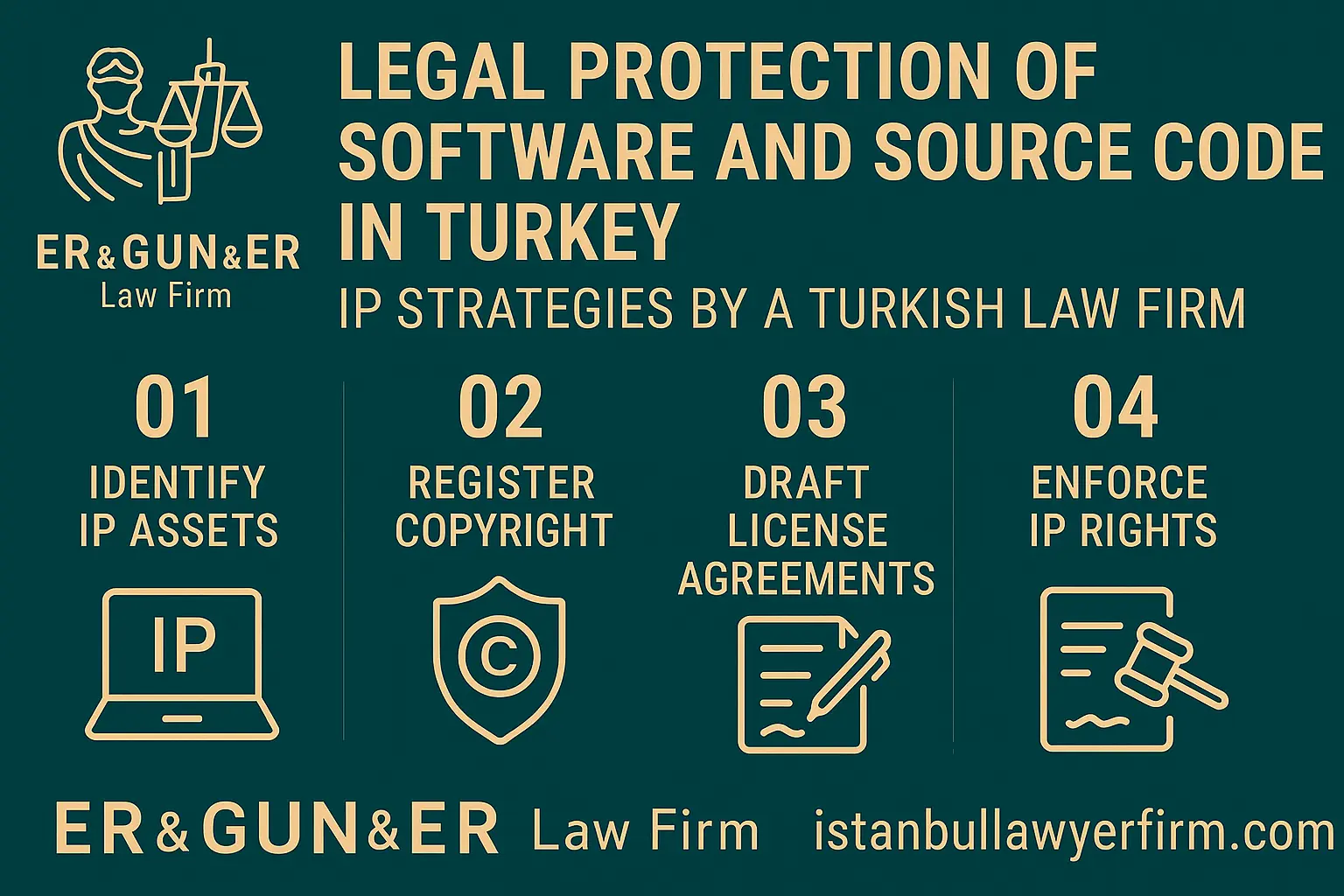
Software protection in Turkey rests on three statutory pillars that work together rather than separately. The first pillar is copyright under the Law on Intellectual and Artistic Works (Law No. 5846, "FSEK"), which expressly classifies computer programs as a category of literary work eligible for automatic copyright protection from the moment of creation. The second pillar is patent under the Industrial Property Code (Law No. 6769, "SMK"), which excludes computer programs as such from patentability but admits computer-implemented inventions where the claimed subject matter produces a technical effect beyond the normal interaction between program and computer. The third pillar is trade secret protection, which in Turkey is not consolidated in a single statute but distributed across the Turkish Commercial Code (Law No. 6102) Article 55(1)(b) on unfair competition, the Penal Code (Law No. 5237) Articles 239 (disclosure of commercial secrets) and 244 (unauthorized access to information systems), the Labour Law (Law No. 4857) Article 396 on employee non-compete, and contractual confidentiality undertakings.
The interaction of the three pillars determines what protection a particular software asset actually receives. Source code itself is automatically protected by copyright as a literary work. Software architecture, algorithms, and underlying inventive concepts may be protected by patent if they meet the technical-effect threshold under SMK. Confidential implementation details, business logic, and the source code itself (where kept secret) can be protected as trade secrets in parallel with the copyright protection. Licensing, source-code escrow, employee assignment of inventions, and contractual confidentiality complete the architecture. ER&GUN&ER Law Firm advises software developers, technology companies, startups, and foreign investors on the design and enforcement of integrated IP architectures across all three pillars, including registration with the General Directorate of Copyright (Telif Hakları Genel Müdürlüğü) of the Ministry of Culture and Tourism, patent applications before the Turkish Patent and Trademark Office (TÜRKPATENT), trade secret protection design, licensing under FSEK Articles 48-52, and infringement litigation before the specialised IP courts.
The Legal Framework: FSEK and the Code as Literary Work
The Law on Intellectual and Artistic Works (Law No. 5846, the "FSEK") is the primary copyright statute in Türkiye, originally enacted on 5 December 1951 and substantially amended over the decades to align with international and EU developments. Article 2 of FSEK lists the categories of works protected as "scientific and literary works" (ilim ve edebiyat eserleri), with paragraph 1 including "computer programs expressed in any form, including their preparatory design materials" alongside conventional literary works. The classification of computer programs as literary works mirrors the international consensus established by the WIPO Copyright Treaty (WCT) of 1996 (to which Turkey acceded through the Resmi Gazete publication of 18 March 2008) and the TRIPS Agreement Article 10(1) under the WTO framework.
Copyright protection under FSEK arises automatically upon creation, without any registration formality. The author of a computer program (the natural person or persons who create it) becomes the holder of both the moral rights (manevi haklar) and the economic rights (mali haklar) under FSEK Articles 14-25 and 21-25 respectively. Moral rights include the right to be identified as author, the right to integrity of the work, and the right to decide on disclosure; these rights are personal to the author and cannot be assigned (though they can be exercised by the author's heirs after death). Economic rights include the right of reproduction, the right of distribution, the right of communication to the public, and the right of adaptation; these rights are assignable and licensable in whole or in part.
The duration of copyright protection under FSEK Article 27 runs for the life of the author plus 70 years after the year of the author's death. For works created by legal entities (where authorship is attributed to the entity under specific conditions) or for anonymous and pseudonymous works, the protection runs for 70 years from the date of first lawful publication. The duration regime aligns with the EU Copyright Term Directive and the Berne Convention as revised. Practice may vary by authority and year on specific calculation rules where multiple authors or successive works are involved; the Court of Cassation has refined the analysis multiple times in software-specific contexts.
Optional Copyright Registration with the Ministry of Culture and Tourism
Although copyright protection arises automatically without registration, FSEK and the implementing regulations provide an optional registration system administered by the General Directorate of Copyright of the Ministry of Culture and Tourism. The registration is governed by the Regulation on Voluntary Registration of Intellectual Works and Voluntary Registration of Computer Programs and Database Producers' Rights, with the procedural framework allowing the author or right-holder to deposit the work and obtain an official registration certificate.
For software, the registration deposit typically includes a representative sample of the source code (often the first and last 25 pages of each module, the structure overview, and the documentation), the author/owner identification, declarations as to originality and authorship, and the technical documentation supporting the registration claim. The deposit is held by the General Directorate and serves as evidence of the existence of the work at the registration date and of the registration applicant's claim to authorship or ownership. Registration is not constitutive of copyright (the copyright exists without it) but is highly probative in subsequent infringement litigation.
The strategic value of registration is most apparent in disputes where the question is whether the plaintiff actually owns the work or actually created it on the date claimed. A registered deposit at the General Directorate, with the timestamp and the documentary trail, is materially more difficult for an opposing party to challenge than a developer's internal records alone. For commercial software with significant licensing or enforcement value, we routinely recommend voluntary registration as the standard prophylactic measure. Practice may vary by authority and year on specific deposit requirements; the General Directorate has refined the documentary checklist multiple times since the regulation was issued.
Patentability of Software: SMK Article 82(2)(c) and Computer-Implemented Inventions
The Industrial Property Code (Law No. 6769, "SMK") effective 10 January 2017 governs the patent regime in Türkiye. Article 82(2)(c) of SMK expressly excludes "computer programs" (bilgisayar programları) from patentable subject matter "as such" (bunlarla ilgili olduğu ölçüde). The exclusion mirrors Article 52(2)(c) of the European Patent Convention (EPC) and follows the approach of the European Patent Office (EPO) in distinguishing between computer programs as such (excluded) and computer-implemented inventions (potentially patentable where they produce a technical effect beyond the normal interaction between program and computer).
The practical consequence is that pure software innovations — improvements to algorithms in the abstract, business methods implemented in code, or user interface enhancements without technical dimension — are excluded from patentability. Software innovations that produce a technical effect — improved cryptographic processing efficiency, improved control of an industrial process through software, improved hardware-software interaction at the technical level — are potentially patentable as computer-implemented inventions, with the patent claims drafted to capture the technical contribution rather than the program code itself. The Turkish Patent and Trademark Office (TÜRKPATENT) follows the EPO's analytical framework for computer-implemented inventions, which the Court of Cassation and the IP courts have generally accepted.
Patent protection, where available, provides a much stronger exclusivity than copyright: it covers the underlying technical contribution rather than the specific code expression, and it can prevent independent reinvention by third parties (which copyright cannot). The patent application process follows the standard SMK procedure: filing, formal examination, publication after 18 months, substantive examination, and grant if the patentability requirements (novelty, inventive step, industrial applicability) are met. The patent term is 20 years from the filing date, subject to annual maintenance fees. For international protection, the Patent Cooperation Treaty (PCT) and the European Patent Convention provide the standard routes, with national-phase entries in the desired jurisdictions. Practice may vary by authority and year on specific TÜRKPATENT examination practice for computer-implemented inventions; the case law has continued to develop alongside the EPO's evolving approach.
Trade Secret Protection Without a Standalone Statute
Türkiye does not have a standalone trade secrets statute equivalent to the EU Trade Secrets Directive 2016/943 or the US Defend Trade Secrets Act. Trade secret protection in Turkish law is distributed across multiple statutes that, together, provide a functional framework. The Turkish Commercial Code (Law No. 6102) Article 55(1)(b) treats unauthorized acquisition, use, or disclosure of commercial secrets as an act of unfair competition giving rise to civil remedies including injunction, damages, and (where the conduct is malicious) corrective publication of the judgment. The Penal Code (Law No. 5237) Article 239 criminalises the disclosure of commercial secrets entrusted to a person by reason of duty, profession, or service, with imprisonment of one to three years and judicial fine. Penal Code Article 244 criminalises unauthorized access to information systems, with imprisonment up to one year, and Article 244/2 criminalises the destruction or alteration of data within information systems, with imprisonment of six months to three years.
The contractual layer is essential. Non-disclosure agreements (NDAs) with employees, contractors, vendors, and business partners create the documentary basis for trade secret protection that the statutory framework presupposes. Employee confidentiality undertakings under Labour Law (Law No. 4857) Article 396, post-employment non-compete agreements under Code of Obligations (Law No. 6098) Articles 444-447, and customer/supplier NDAs under general contract law (Code of Obligations Article 26) create the boundaries that trigger statutory protection when crossed. Without contractual undertakings, the trade secret claim becomes substantially harder to prove because the recipient can argue absence of confidentiality obligation.
Operational measures complete the architecture. Trade secret protection under both the unfair competition framework and the criminal framework typically requires the right-holder to demonstrate that reasonable measures were taken to maintain secrecy: access controls within the organization, document classification systems, technical security measures, employee training on confidentiality obligations, exit interviews documenting the return or destruction of confidential materials, and audit trails showing who accessed what when. Source code repositories with access logs, encrypted storage of design documents, version-control systems with audit capability, and segregated development environments for sensitive projects are the technical correlates of the legal architecture. Practice may vary by authority and year on the specific reasonableness standard the courts apply; the Court of Cassation has progressively raised the bar on what counts as adequate protective measures.
Software Licensing Under FSEK Articles 48-52
FSEK Articles 48-52 govern the assignment and licensing of economic rights in copyrighted works, including computer programs. Article 48 distinguishes between assignment (devir) of the underlying economic right itself and licensing (ruhsat) of the right to exercise it for defined purposes, with both requiring written form to be valid. Article 52 specifically requires that the contract identify the works covered, the rights covered, the geographic and temporal scope, and the financial terms; ambiguity in any of these elements is resolved in favour of the right-holder under the standard interpretive principle.
The exclusive licence (tam ruhsat) versus non-exclusive licence (basit ruhsat) distinction under Article 48 has direct commercial consequences. An exclusive licence enables the licensee to exclude even the licensor from exercising the licensed rights within the licensed scope, and entitles the licensee to bring infringement actions against third parties in their own name. A non-exclusive licence allows the licensor to license the same rights to multiple licensees and does not give the licensee standing to sue infringers without the licensor's involvement. The choice between exclusive and non-exclusive licensing reflects the underlying commercial structure: SaaS distribution typically uses non-exclusive licensing at scale, while strategic technology partnerships and OEM arrangements often involve exclusive licensing within defined fields.
Software licensing in international transactions typically follows English-law or Turkish-law master agreements with the licensor's standard terms, customised for the specific licensee. The standard provisions include the licence grant scope (number of users, geography, term), permitted and prohibited uses, source code access (typically excluded for proprietary software), maintenance and support obligations, audit rights for compliance verification, warranties and disclaimers, limitation of liability, indemnity for IP infringement claims by third parties, termination rights and consequences, and dispute resolution. We design licence architectures with the specific business model in mind — perpetual versus subscription, on-premise versus SaaS, single-tenant versus multi-tenant — because each model has different IP exposure profiles and different optimal contract structures.
Open-Source License Enforcement in Turkish Practice
Open-source software licences (GPL, MIT, Apache, BSD, MPL, and the broader catalogue of OSI-approved licences) are private contracts under Turkish law, enforceable through the standard contract enforcement framework subject to the form requirements of FSEK Articles 48-52 for economic right transfers. The international developer community's debate on whether open-source licences are "bare licences" (revocable at will) or "contracts" (binding bilateral undertakings) has been resolved in most major jurisdictions in favour of the contract analysis, including in Turkish doctrine.
The practical compliance issues for users of open-source software in Turkish commercial products are: identifying the open-source components incorporated into the product, understanding the licence terms applicable to each component (particularly the copyleft obligations of GPL-family licences that can require source code disclosure for derivative works), maintaining the licence notice and attribution requirements that virtually all OSS licences require, and avoiding licence violations through unintended distribution. Software composition analysis tools have become standard in development pipelines for identifying OSS components and their licences; a compliance breach typically arises not from deliberate violation but from inadequate inventory of what the product actually contains.
Enforcement actions for open-source licence violations have been brought in Turkey, although the case law remains thin compared to Germany and the United States where the bulk of OSS enforcement litigation has developed. The German Federal Court of Justice (BGH) decisions in the Welte/Skype line of cases recognised GPL as an enforceable contract creating obligations that breach triggers; Turkish courts have generally followed the same analytical approach in the limited cases that have reached judgment. Practice may vary by authority and year on specific OSS enforcement contours; the EU's evolving copyright case law on technological protection measures and on derivative work boundaries informs the Turkish analysis.
Source Code Escrow and Technology Transfer
Source code escrow is the contractual arrangement by which a software vendor deposits the source code of a licensed product with a neutral third-party escrow agent, with release to the licensee triggered by defined events (typically vendor bankruptcy, vendor failure to maintain the product, or vendor breach of support obligations). The escrow agreement is a tripartite contract among the vendor, the licensee, and the escrow agent under standard Turkish contract law (Code of Obligations Articles 26 onwards), with the escrow agent's specialised role typically covered by the agent's standard terms and the agent's professional liability framework.
Source code escrow is the standard risk mitigation for licensees of mission-critical proprietary software where the vendor is a smaller entity and the licensee's business depends on continued operation of the software. The negotiation typically focuses on the trigger events (vendor bankruptcy is uncontroversial; "material breach" requires careful definition), the deposit cycle (typically each major release plus periodic updates), the verification procedures (whether the deposited code actually compiles and runs as the production code), and the release procedures (notice, cure periods, evidence requirements). We design escrow arrangements that produce a release that the licensee can actually use rather than a release of code that proves untestable when the trigger event occurs.
Technology transfer agreements — broader arrangements covering not only software licence but also know-how transfer, training, technical assistance, and ongoing support — are commonly used in cross-border contexts where a Turkish company licenses software and underlying technology from a foreign vendor. The Turkish-side considerations include foreign exchange compliance under Decree No. 32 on the Protection of the Value of Turkish Currency, withholding tax on royalty payments under bilateral tax treaties, transfer pricing alignment where the parties are related, and TÜRKPATENT registration of patent and trademark licences under SMK to perfect the licence as against third parties. Practice may vary by authority and year on specific registration and reporting requirements; the regime has been updated multiple times since the SMK came into force.
Specialized IP Courts: FSHHM Jurisdiction and Procedure
Turkish Civil Code of Procedure and the IP-specific procedural rules establish specialised intellectual and industrial property rights courts (Fikrî ve Sınai Haklar Hukuk Mahkemeleri, "FSHHM") in Istanbul, Ankara, and İzmir, with jurisdiction over civil disputes arising under FSEK and SMK. Where the FSHHM does not exist for the locality, the relevant general civil court of first instance is designated to hear IP matters. The specialised courts have judges with experience in copyright, patent, trademark, design, and trade secret disputes, which produces materially better outcomes than general civil courts for technical IP cases.
The procedural framework follows the Code of Civil Procedure (Law No. 6100) with the general principles of pleadings, evidence, expert reports, and judgment. IP cases routinely involve expert witnesses (bilirkişi) appointed by the court to assess technical questions: software code comparison for substantial similarity, patent claim construction and infringement analysis, trade secret reasonableness assessment. The expert reports often determine the case outcome, which makes the choice of expert and the scope of expert questions central to the litigation strategy.
Specialized IP criminal courts (Fikrî ve Sınai Haklar Ceza Mahkemeleri) operate in parallel for criminal IP matters: copyright infringement under FSEK Article 71, trademark infringement under SMK Article 30, patent infringement under SMK Article 30, and trade secret crimes under TCK Articles 239 and 244. The criminal track is procedurally separate from the civil track but the underlying factual record often overlaps; coordinated strategy across both tracks is essential where both routes are pursued. Practice may vary by authority and year on specific procedural emphasis; the IP courts have continued to refine their procedural approach as the case load and the technical complexity of IP cases have increased.
Civil Remedies for Infringement Under FSEK Articles 66-68
FSEK Articles 66 through 68 establish the civil remedies available to copyright holders for infringement. Article 66 provides the action for cessation of infringement (tecavüzün ref'i ve men'i): the right-holder can obtain a court order requiring the infringer to stop the infringing conduct and prevent its recurrence, with the order enforceable through the standard execution mechanisms of the Enforcement and Bankruptcy Law (Law No. 2004). Provisional measures under HMK Articles 389-399 are available for urgent cases where the infringement is causing ongoing harm and the substantive litigation timeline would leave the harm unredressed.
Article 67 provides remedies for infringement of moral rights, including the right to demand correction of the violation, identification of the author, and (where appropriate) publication of the judgment to undo the reputational harm. Moral rights remedies are personal to the author and cannot be exercised by the economic rights holder unless the author has joined the litigation or has authorised the action.
Article 68 is the most important provision for commercial enforcement: it allows the copyright holder to claim damages for the unauthorized use of the work, calculated as up to three times the licence fee that the infringer would have paid for a comparable lawful licence. The three-times multiplier is a statutory enhanced-damages framework that produces materially larger awards than ordinary contract damages would, which is why FSEK litigation is often economically meaningful even for relatively minor infringements. The right-holder has the option to claim either three-times the licence fee or actual damages and lost profits under general tort principles, choosing whichever produces the larger recovery. Practice may vary by authority and year on the specific application of the three-times multiplier; the Court of Cassation has issued multiple decisions refining the analytical framework for calculating the comparable licence fee.
Criminal Liability Under FSEK Article 71 and TCK Article 244
FSEK Article 71 establishes criminal liability for copyright infringement, with imprisonment of one to five years and judicial fine for the unauthorized reproduction, distribution, performance, communication to the public, or processing of a copyrighted work. The provision applies to all categories of works including computer programs. Aggravated forms — commercial-scale infringement, infringement involving organised crime, and infringement causing serious damage — attract enhanced sentences. The criminal action is initiated through complaint by the right-holder; it is not pursued by the prosecutor on the prosecutor's own initiative for the standard (non-aggravated) offence.
The Penal Code (Law No. 5237) Articles 243-246 criminalise computer-related offences that frequently overlap with software IP violations. Article 243 criminalises unauthorized access to information systems (one year imprisonment, with aggravations for systems containing personal data or for benefit-driven access). Article 244/1 criminalises the destruction or alteration of data in information systems (six months to three years). Article 244/2 criminalises the unauthorised use, transmission, copying, or destruction of programs or data (six months to three years). These provisions complement the FSEK criminal framework and are routinely invoked in cases involving software theft, code copying, or unauthorized access to development systems.
Trade secret crimes under TCK Article 239 (disclosure of commercial secrets) impose imprisonment of one to three years and judicial fine for disclosure of secrets entrusted by reason of duty, profession, or service. The provision applies to employees who disclose employer trade secrets, contractors who disclose client trade secrets, and others in equivalent positions of trust. The combined civil-criminal architecture provides a stronger deterrent than civil remedies alone, which is why we routinely pursue parallel civil and criminal tracks in serious software IP cases. Practice may vary by authority and year on specific prosecutorial priorities; the Cybercrime Department of the Turkish National Police has expanded its capacity for software IP investigations since 2018.
International Framework: Berne, TRIPS, WCT and Cross-Border Enforcement
Türkiye's software IP regime operates within an international framework that ensures Turkish-created works receive protection abroad and foreign-created works receive protection in Türkiye. The Berne Convention for the Protection of Literary and Artistic Works, to which Türkiye has been party since 1952, provides the foundational principle of national treatment: works of authors who are nationals of any contracting state, or works first published in any contracting state, receive in each other contracting state the same protection that the contracting state grants to its own nationals. The minimum standards of protection set by Berne (life plus 50 years for most categories, with extensions in many member states including the Turkish life-plus-70 regime) provide the floor.
The TRIPS Agreement (Trade-Related Aspects of Intellectual Property Rights) under the WTO framework, to which Türkiye is party as a WTO member, provides the modern multilateral framework that incorporates Berne and adds enforcement obligations. TRIPS Article 10(1) confirms that computer programs are protected as literary works under Berne, providing the international foundation for the FSEK Article 2 classification. TRIPS Articles 41-50 set the standards for civil enforcement procedures (interim measures, damages, injunctions) and Articles 51-60 set the standards for border measures against counterfeit goods.
The WIPO Copyright Treaty (WCT) of 1996, to which Türkiye acceded effective 18 March 2008, modernised the international framework for the digital environment, including specific provisions on technological protection measures and rights management information. The interaction with the EU acquis (the Software Directive 2009/24/EC, the InfoSoc Directive 2001/29/EC, the Enforcement Directive 2004/48/EC, the Trade Secrets Directive 2016/943) influences Turkish practice through the EU-Türkiye Customs Union and the broader process of legislative approximation, although Türkiye's transposition of EU directives is selective rather than comprehensive. For cross-border enforcement, the New York Convention 1958 (acceded by Turkey through Law No. 3731 effective 25 September 1991) governs recognition and enforcement of arbitral awards in IP licensing disputes, and the Hague Conventions on service of process and taking of evidence support international litigation procedures.
Strategic IP Architecture for Software Companies
The integrated strategic IP architecture for a software company operating in Türkiye combines the three statutory pillars with the contractual layer and the operational layer to produce defensible protection across the full lifecycle of the software asset. At the foundation, the copyright protection arises automatically and is reinforced by voluntary registration with the General Directorate of Copyright for high-value products. Patent protection is assessed for genuinely technical innovations and pursued through TÜRKPATENT applications where the patentability threshold is met. Trade secret protection is implemented through the contractual and operational measures discussed above, with explicit recognition that trade secret enforceability depends on the right-holder's affirmative protection efforts.
Employment and contractor architecture matters as much as the statutory pillars. Employee invention assignment under the IP-specific provisions of SMK Articles 113-122 (governing inventions made by employees in the course of employment) and the contractual IP assignment provisions in standard employment agreements produce the chain of title from individual developers to the company. Contractor IP assignment in service agreements with external developers ensures that work-for-hire output flows cleanly to the company. Without these contractual undertakings, the company can find itself in the awkward position of using software whose copyright belongs to former employees or external contractors, with all the licensing and enforcement complications that follow.
Licensing architecture supports both inbound (consuming third-party software, including open-source) and outbound (distributing the company's own software) flows. Software composition analysis and licence compliance for inbound consumption prevents the unintended GPL contamination scenario; standardised outbound licensing terms support consistent commercial deployment. Source code escrow for mission-critical inbound dependencies and for outbound licences to mission-critical customers manages the bilateral risk of vendor or customer failure. Audit rights, IP indemnification, and technological protection measures complete the contractual framework. The architecture is designed once at the strategic level and refreshed periodically as the company's product portfolio, geographic reach, and customer profile evolve. Practice may vary by authority and year on specific implementation details; the Turkish IP regime continues to develop alongside international and EU developments.
Frequently Asked Questions
- What law governs software copyright in Türkiye? The Law on Intellectual and Artistic Works (Law No. 5846, FSEK) of 5 December 1951, with computer programs classified as literary works under Article 2, paragraph 1.
- Is copyright registration required for software? No. Copyright arises automatically upon creation. Voluntary registration with the General Directorate of Copyright (Telif Hakları Genel Müdürlüğü) of the Ministry of Culture and Tourism provides documentary evidence and strengthens enforcement.
- How long does copyright protection last? Under FSEK Article 27, the life of the author plus 70 years after the year of death. For works of legal entities and anonymous/pseudonymous works, 70 years from first lawful publication.
- Can software be patented in Türkiye? Computer programs as such are excluded from patentability under SMK Article 82(2)(c). Computer-implemented inventions producing a technical effect beyond normal program-computer interaction are potentially patentable, following the EPO analytical framework.
- What are the moral and economic rights under FSEK? Moral rights (Articles 14-19) are personal and non-assignable: identification as author, integrity, disclosure decision. Economic rights (Articles 21-25) are assignable and licensable: reproduction, distribution, communication, adaptation.
- Does Türkiye have a trade secrets statute? No standalone statute. Protection is distributed across TTK Article 55(1)(b) (unfair competition), TCK Articles 239 (commercial secret disclosure), 244 (data system access/destruction), Labour Law Article 396 (employee confidentiality), and contractual NDAs.
- How are licence agreements regulated? FSEK Articles 48-52 govern assignment and licensing of economic rights, requiring written form and specific identification of works, rights, scope, and financial terms. Exclusive (tam ruhsat) and non-exclusive (basit ruhsat) distinctions are recognised.
- Are open-source licences enforceable in Türkiye? Yes, as private contracts subject to FSEK form requirements. Turkish doctrine has generally followed the international consensus treating OSS licences as enforceable contracts creating obligations that breach triggers.
- Where are IP disputes heard? Specialised intellectual and industrial property rights courts (Fikrî ve Sınai Haklar Hukuk Mahkemeleri) operate in Istanbul, Ankara, and İzmir, with jurisdiction over civil IP disputes. Specialised criminal IP courts handle the criminal track in parallel.
- What civil remedies are available for copyright infringement? Cessation of infringement (FSEK Article 66), moral rights remedies (Article 67), and damages calculated as up to three times the licence fee that would have been paid for a lawful licence (Article 68), or actual damages and lost profits at the right-holder's election.
- Is copyright infringement a crime? Yes, under FSEK Article 71 with imprisonment of one to five years and judicial fine. The action requires complaint by the right-holder for the standard offence; aggravated forms attract enhanced sentences.
- What about cyber crimes related to software? Penal Code Articles 243 (unauthorized access to information systems), 244/1 (data destruction/alteration), and 244/2 (unauthorized use of programs or data) complement the FSEK framework with general computer-crime liability.
- Are foreign software works protected in Türkiye? Yes, under the Berne Convention (Türkiye party since 1952), TRIPS Agreement (WTO membership), and WIPO Copyright Treaty (acceded 18 March 2008). National treatment principle ensures equivalent protection.
- Who owns software developed by employees? Under SMK Articles 113-122 (governing employee inventions) and standard employment-contract IP assignment clauses, the employer typically owns the software developed by employees in the course of employment, subject to the specific contractual provisions.
- Where does ER&GUN&ER Law Firm support software IP matters? Copyright registration with the General Directorate of Copyright; computer-implemented invention patent applications before TÜRKPATENT; trade secret protection design (contractual + operational); FSEK-compliant licensing including open-source compliance and source-code escrow; and infringement litigation before the specialised IP courts (civil and criminal tracks) under FSEK Articles 66-68 and 71, TCK Articles 239 and 244, and SMK enforcement provisions.
Author: Mirkan Topcu is an attorney registered with the Istanbul Bar Association (Istanbul 1st Bar), Bar Registration No: 67874. His practice focuses on cross-border and high-stakes matters where evidence discipline, procedural accuracy, and risk control are decisive.
He advises software developers, technology companies, startups, founders, and foreign investors across Software Copyright under FSEK, Computer-Implemented Invention Patents under SMK, Trade Secret Protection, Software Licensing including Open-Source Compliance, Source Code Escrow, IP Litigation before the specialised Fikrî ve Sınai Haklar Hukuk Mahkemeleri, and cross-border IP enforcement under TRIPS and the New York Convention.
Education: Istanbul University Faculty of Law (2018); Galatasaray University, LL.M. (2022). LinkedIn: Profile. Istanbul Bar Association: Official website.