

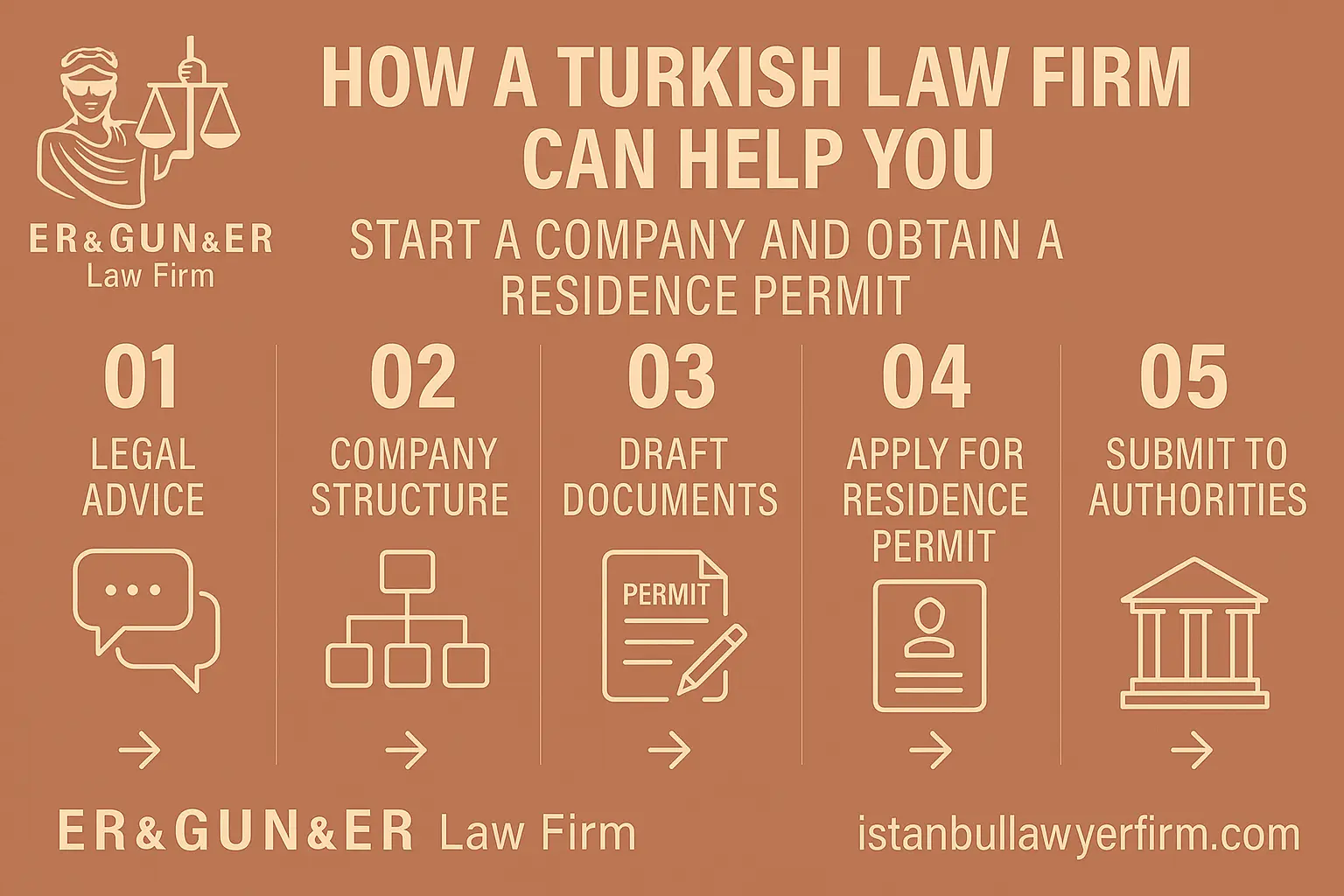
For a foreign founder establishing a presence in Türkiye, two parallel legal tracks must be coordinated: the corporate formation track under the Turkish Commercial Code (Law No. 6102, the "TTK") and the immigration track under the Foreigners and International Protection Law (Law No. 6458, "YUKK") as amended, with the Presidency of Migration Management (Göç İdaresi Başkanlığı, "GİB") as the competent authority since the 24 October 2021 reorganisation that converted the former Directorate General of Migration Management (DGMM) into a presidency-level institution under the Ministry of Interior. The two tracks intersect: a foreigner who establishes a company in Türkiye becomes eligible for a short-term residence permit under YUKK Article 31, and the residence permit application file relies on the corporate documentation produced by the formation track.
The corporate formation track has been materially reshaped by the November 2023 amendment to the TTK minimum capital provisions through Presidential Decree, with the minimum capital for joint-stock companies (anonim şirket, "A.Ş.") raised to TL 250,000 (TL 500,000 for those adopting the registered capital system) and the minimum capital for limited liability companies (limited şirket, "Ltd. Şti.") raised to TL 50,000, all effective from 1 January 2024. The immigration track has continued to develop alongside YUKK amendments and the implementing regulations issued by the Presidency of Migration Management, with sectoral nuances applying to specific applicant categories. ER&GUN&ER Law Firm advises foreign founders on the integrated execution of both tracks: corporate form selection, articles of association drafting, MERSİS submission and Trade Registry filing, tax registration, bank account opening, residence permit application, work permit interaction with the Ministry of Labour and Social Security, family member residence permits, and the longer-term pathway to citizenship by investment under the Turkish Citizenship Law (Law No. 5901) Article 12 where applicable.
The Two Tracks: Company Formation Under TTK and Residence Under YUKK
The corporate formation track in Türkiye begins with the choice of legal form (A.Ş. or Ltd. Şti., or in limited cases a branch or liaison office), proceeds through the drafting of the articles of association (esas sözleşme or ana sözleşme), the submission of the formation file through the Central Registry System (Merkezi Sicil Kayıt Sistemi, "MERSİS") of the Ministry of Trade, the notarisation of the founding documents and the founders' signatures, the filing with the local Trade Registry Directorate (Ticaret Sicil Müdürlüğü), and culminates in the publication of the formation in the Trade Registry Gazette (Ticaret Sicil Gazetesi). The whole sequence ordinarily takes seven to fifteen business days for a standard formation, with timing shaped by the Trade Registry workload, the completeness of the founder identification and capital documentation, and any sector-specific authorisations required for the company's stated activities. For the full procedural framework, see our pillar guide on the complete company formation procedure in Turkey.
The immigration track for a foreign founder begins with entry to Türkiye on a visa or visa-exempt status that allows the application for a residence permit, the assembly of the documentation required by GİB for the chosen residence permit category, the online application through the e-ikamet system, the submission of the documentation pack, the biometric appointment at the local provincial directorate of migration management (İl Göç İdaresi Müdürlüğü), the GİB review of the application, and the issuance of the residence permit card. For the foreign founder, the standard route is the short-term residence permit under YUKK Article 31, with the corporate documentation (Trade Registry extract, articles of association, signatory circular) anchoring the application.
The interaction between the two tracks is sequential rather than simultaneous: the company must be formed first, because the residence permit application file relies on the Trade Registry extract and other corporate documents that exist only after formation. The visa-free stay or visa allowance must be sufficient to cover both the formation period and the residence permit processing period, which is why we typically structure formations at the start of the foreign founder's stay rather than near the end. Practice may vary by authority and year on processing timelines; the GİB and the Trade Registry have continued to refine their processes as the volume of foreign-founder formations has increased.
Choosing the Corporate Form: A.Ş. vs Ltd. Şti. Under TTK
The two principal corporate forms available to foreign founders in Türkiye are the joint-stock company (A.Ş.) under TTK Articles 329-563 and the limited liability company (Ltd. Şti.) under TTK Articles 573-644. Both forms accommodate 100% foreign shareholding without nationality restrictions, both provide the standard limited liability protection for shareholders (subject to TTK piercing-the-veil principles in case of fraud or undercapitalisation), and both are widely used by foreign investors. The choice between them depends on the projected scale, the governance preferences of the founders, the planned exit or capital-raising trajectory, and the tax and regulatory profile of the planned activities.
The Ltd. Şti. is the standard choice for smaller-scale operations and closely-held structures. Minimum capital under TTK Article 580 is TL 50,000 (raised from TL 10,000 by the Presidential Decree effective 1 January 2024), with at least 25% paid up at formation and the balance within 24 months. Governance is simpler than the A.Ş.: the partners (ortaklar) take key decisions through partner resolutions, and the company is managed by one or more managers (müdür) appointed in the articles or by partner resolution. Share transfers require a written and notarised transfer agreement and partner approval (TTK Article 595), which produces a more closed-corporation profile than the A.Ş.
The A.Ş. is the standard choice for larger-scale operations, growth-oriented ventures with capital-raising plans, and structures requiring board governance. Minimum capital under TTK Article 332 is TL 250,000 for the standard system or TL 500,000 for the registered capital system (kayıtlı sermaye sistemi), with at least 25% paid up at formation. Governance is structured around a board of directors (yönetim kurulu) with one or more members under TTK Article 359, a general assembly (genel kurul) of shareholders, and (for companies meeting size thresholds) statutory auditing requirements. Share transfers in non-public A.Ş. companies are generally free unless restricted in the articles, which produces a more open profile suitable for capital-raising. Practice may vary by authority and year on specific governance requirements; the TTK has continued to develop alongside the broader corporate governance framework.
The Company Formation Procedure: MERSİS, Notary, and Trade Registry
The procedural sequence for company formation in Türkiye centres on three institutional touchpoints. First, the formation file is initiated through the Central Registry System (MERSİS) operated by the General Directorate of Domestic Trade of the Ministry of Trade, where the company name is reserved and verified for uniqueness, the articles of association are uploaded in the prescribed electronic format, and the founder identification information is registered. MERSİS produces the formation reference number that links the file across institutions.
Second, the founders attend a notary (Noter) to sign the articles of association and the formation declaration. For foreign founders not physically present in Türkiye, the formation can be executed through a notarised power of attorney (vekaletname) issued from abroad and apostilled (or legalised through consular channels for non-Hague Apostille countries), with the Turkish translation prepared by a sworn translator and notarised. The notarial step also produces the signatory circular (imza sirküleri) that authenticates the signatures of the persons authorised to bind the company.
Third, the formation file is submitted to the local Trade Registry Directorate (Ticaret Sicil Müdürlüğü) of the Chamber of Commerce in the city of the company's registered seat, together with the formation declaration, the articles of association, the bank certificate evidencing the deposit of at least 25% of the capital (under TTK Articles 344 and 585), the chamber registration documents, and the supporting identification papers. The Trade Registry reviews the file, registers the company, and arranges publication in the Trade Registry Gazette (Ticaret Sicil Gazetesi). The company acquires legal personality at the moment of Trade Registry registration under TTK Article 354 (A.Ş.) and Article 588 (Ltd. Şti.). Practice may vary by authority and year on specific Trade Registry documentary requirements; the documentary checklist has been refined multiple times as MERSİS integration has advanced.
Tax Registration and the Yabancı Kimlik Numarası
Tax registration with the local Tax Office (Vergi Dairesi) of the Revenue Administration (Gelir İdaresi Başkanlığı) follows immediately after Trade Registry registration. The Tax Office issues the corporate tax number (vergi numarası), registers the company for corporate tax under the Corporate Tax Law (Law No. 5520) at the post-2024 standard rate of 25%, registers the company for value added tax (VAT) under the VAT Law (Law No. 3065) where the company's activities involve taxable supplies, and assigns the company to the appropriate tax declaration cycle under the Tax Procedure Law (Law No. 213). For foreign founders without a Turkish residency status, the Tax Office issues a potential tax number (potansiyel vergi numarası) that allows the founder to act in tax-related matters before residency is established.
For the foreign founder personally, the Yabancı Kimlik Numarası (YKN, foreigner identity number) becomes critical for all subsequent transactions. The YKN is a 99-prefixed eleven-digit identifier that the GİB issues to foreigners holding a residence permit, and it functions as the foreigner's equivalent of the Turkish citizen identification number (T.C. Kimlik Numarası) for all administrative interactions: bank account opening, tax filings, social security registration, real estate registration at the Land Registry (Tapu Müdürlüğü), and contract execution before notaries. Until the residence permit is issued and the YKN assigned, the foreigner operates with the potential tax number for tax-related matters and the passport number for identification.
Social security registration with the Social Security Institution (Sosyal Güvenlik Kurumu, "SGK") follows the appointment of any employees and, for the founder personally, follows the determination of whether the founder will work for the company in a capacity that triggers SGK obligations. Foreign founders who serve as company managers or directors and who reside in Türkiye are typically required to register under the SGK 4/b regime (formerly Bağ-Kur) covering self-employed and independent workers under the Social Security Law (Law No. 5510) Article 4(1)(b). The interaction between SGK status and residence permit eligibility is sequential: residence permit first, then SGK registration. Practice may vary by authority and year on specific SGK assessment standards; the SGK has continued to refine its approach to foreign founder SGK status over time.
Bank Account Opening for the Newly Formed Company
Opening a corporate bank account is the operational gateway for the newly formed company, but it has become increasingly demanding due to bank compliance frameworks under the Banking Law (Law No. 5411), MASAK regulations on AML/CFT under Law No. 5549, and individual bank risk policies. The standard documentation pack includes the Trade Registry extract (sicil tasdiknamesi), the Trade Registry Gazette publication, the articles of association, the signatory circular, the tax registration certificate, the company stamp, identification of the authorised signatories (with apostilled and translated passports for non-Turkish signatories), proof of address for both the company and the signatories, and the bank's own KYC questionnaire.
For foreign-owned companies, the bank's compliance review typically focuses on the source of funds for the share capital, the beneficial ownership structure (with UBO declarations under MASAK's beneficial ownership transparency framework), the planned business activities and their risk profile, the projected transaction patterns and counterparty profiles, and the founder's home country exposure including sanctions screening. Banks vary materially in their internal risk appetite for foreign-founded companies; some banks have streamlined onboarding for specific countries or sectors while others apply enhanced due diligence as the default. The choice of bank therefore matters strategically and is rarely a commodity decision.
Where the foreign founder cannot be physically present in Türkiye for the bank account opening, the apostilled and translated power of attorney route allows a Turkish-based representative to handle the account opening, although many banks require the foreign founder to attend in person at least for the initial signature capture and KYC interview. Remote-only account opening for foreign founders is possible but limited to specific bank programmes and customer profiles. Practice may vary by authority and year on specific bank requirements; the regulatory environment has tightened progressively under MASAK guidance and BDDK supervision.
The Residence Permit Track Under YUKK Article 31
The Foreigners and International Protection Law (Law No. 6458, YUKK) Article 31 provides the legal basis for short-term residence permits (kısa dönem ikamet izni) covering a range of foreigner profiles. The relevant subparagraphs for a foreign founder include subparagraph (h) — foreigners who will establish commercial connection or business in Türkiye — and subparagraph (j) — foreigners attending Turkish language courses or specified educational programmes — depending on the founder's specific situation. The short-term residence permit under Article 31 is granted for up to two years initially and can be renewed under Article 33 subject to the continuing existence of the qualifying ground.
The standard documentation pack for the YUKK Article 31(h) application based on company founder status includes the Trade Registry extract showing the foreigner as shareholder/manager, the articles of association, the signatory circular, the company's tax registration certificate, evidence of company activity (bank statements, contracts, invoices, office lease), the foreigner's passport with valid visa or visa-exempt entry, biometric photographs, valid private health insurance covering the residence permit period, proof of accommodation in Türkiye (typically a residential lease in the foreigner's name notarised by the local authority — ikametgah beyannamesi or muhtarlık belgesi), and the application form generated through the e-ikamet online system.
The application is submitted online through the e-ikamet system (www.goc.gov.tr/e-ikamet), with the biometric appointment scheduled at the local İl Göç İdaresi Müdürlüğü (Provincial Directorate of Migration Management). The applicant attends the biometric appointment with the documentary pack, biometric data is captured (photograph, fingerprints, signature), and the application enters the GİB review process. Processing times vary by province and case complexity; the GİB has worked to standardise timelines but actual experience varies. The residence permit card is issued on approval and delivered to the address designated by the applicant. Practice may vary by authority and year on specific documentary requirements; the GİB has refined the documentary checklist multiple times since the YUKK came into force.
Independent Work Permit Under Law 6735
The Foreigners' Work Permit Law (Law No. 6735 of 28 July 2016, the International Workforce Law / Uluslararası İşgücü Kanunu) governs the work permit framework for foreign nationals in Türkiye, administered by the Ministry of Labour and Social Security (Çalışma ve Sosyal Güvenlik Bakanlığı). The standard work permit for an employed foreigner is sponsored by the Turkish employer and tied to that specific employment relationship under Articles 7-12 of Law 6735. For a foreign founder who works for the company they own, two principal options exist: the sponsored work permit issued by the founder's own company as employer, or the independent work permit (bağımsız çalışma izni) under Article 10 of Law 6735.
The independent work permit is designed for foreigners who will work in Türkiye on their own account rather than as employees of a Turkish employer. The application requires evidence that the applicant will engage in productive activity that contributes to the Turkish economy, has the financial capacity to support that activity, and meets the specific criteria set out in the Law 6735 implementing regulations. For a foreign founder, the independent work permit is often the more appropriate route than the sponsored work permit, because it captures the founder-as-owner relationship more accurately than the artificial founder-employee construct.
The interaction between the residence permit under YUKK and the work permit under Law 6735 is governed by the simplification rule that, as a general matter, a work permit issued under Law 6735 also serves as a residence permit for the duration of the work permit's validity, which avoids the need for a separate residence permit. For foreign founders who hold a residence permit first and add a work permit later, the work permit application will reference the existing residence permit. The strategic choice between starting with a residence permit (with no work authorisation) and starting with a work permit (which includes residence authorisation) depends on the founder's specific operational needs and the timing of business launch. Practice may vary by authority and year on specific work permit assessment criteria; the Ministry of Labour and Social Security has issued multiple updates to the implementing regulations since Law 6735 came into force.
Family Members and Dependent Residence Permits
Family members of the foreign founder can obtain residence permits in Türkiye under the family residence permit (aile ikamet izni) framework of YUKK Articles 34-37. The eligible family members are the spouse and dependent minor children, with the foreign founder serving as the sponsor (destekleyici). The family residence permit is granted for periods of up to three years initially, with renewal subject to the continuing existence of the family relationship and the sponsor's residence status.
The application requirements for the family residence permit include evidence of the family relationship (marriage certificate for the spouse, birth certificates for children, all apostilled and translated where issued abroad), the sponsor's valid residence permit and YKN, evidence of the sponsor's financial means to support the family members (typically a minimum monthly income threshold set by GİB), evidence of accommodation suitable for the family, valid private health insurance for each family member, and the standard application documents (passports, biometric photographs, application forms generated through e-ikamet).
The standard sequencing is for the foreign founder to obtain the founder's own residence permit first, then submit the family residence permit applications for the spouse and children once the founder has YKN status. The family residence permit holders can attend Turkish public schools (children) and access certain services, but the family residence permit does not automatically include work authorisation; family members who wish to work in Türkiye must obtain their own work permit under Law 6735, with the eligibility analysis depending on the specific employment offered and the regulatory framework for the relevant profession. Practice may vary by authority and year on specific income thresholds; the GİB has updated the financial means thresholds multiple times in line with inflation and policy adjustments.
Corporate Tax, VAT, and SGK Compliance
Operational compliance for the newly formed company spans corporate tax, VAT, payroll tax, SGK contributions, withholding tax, and the documentation and reporting obligations under the Tax Procedure Law (Law No. 213). Corporate tax under Law No. 5520 applies at the post-2024 standard rate of 25%, with quarterly provisional payments (geçici vergi) and the annual return filed by 30 April of the year following the fiscal year. VAT under Law No. 3065 applies to taxable supplies at standard, reduced, or zero rates depending on the supply category, with monthly returns filed by the 28th day of the following month under the standard regime.
Payroll tax (gelir vergisi stopajı) and SGK contributions apply to all employees including the foreign founder where the founder is registered as an employee. The standard payroll cycle includes the Income Tax Law (Law No. 193) withholding on employment income at the progressive rates, the SGK employer and employee contributions under Law No. 5510 at the standard rates (with adjustments for sector and employment type), and the SGK reporting through the SGK e-Bildirge system. Stamp duty (damga vergisi) applies to certain contracts and documents under the Stamp Tax Law (Law No. 488).
For the company that engages with foreign clients or suppliers, additional compliance layers apply: withholding tax on payments to foreign service providers (with treaty relief under bilateral double taxation treaties where applicable), VAT reverse charge on imported services, transfer pricing documentation under Corporate Tax Law Article 13, and customs duty/VAT on imported goods under the Customs Law (Law No. 4458). Practice may vary by authority and year on specific tax administration interpretations; the Revenue Administration has issued numerous communiqués and rulings over the years that refine the application of the framework provisions.
Renewals, Address Changes, and Continuing Compliance
Residence permit renewals under YUKK Article 33 must be initiated within 60 days before the current permit's expiry through the e-ikamet system, with the same documentary pack as the initial application updated for the renewal period. The renewal must demonstrate the continuing existence of the qualifying ground (continuing company shareholder/manager status, continuing business activity, continuing financial means, continuing health insurance coverage). Late renewal applications can be made but are subject to administrative fines and, in extended cases, to risk of refusal and consequential overstay penalties.
Address changes must be reported to the GİB within twenty business days under YUKK Article 99, through the e-ikamet system or in person at the local provincial directorate. The address registered with GİB is the address used for official communication including residence permit card delivery; failure to update the address can result in missed correspondence and procedural complications. Address changes also need to be coordinated with other registries — the Address Registration System (Adres Kayıt Sistemi) of the Civil Registration Directorate, the Tax Office for the company's registered address, the Trade Registry for company address changes, and SGK for employee address changes.
Corporate compliance under the TTK includes annual general assembly meetings (TTK Articles 409 and 617 for A.Ş. and Ltd. Şti. respectively), annual financial statements approval, board/manager appointment renewals at the end of term, capital changes registered with the Trade Registry, and articles of association amendments registered with the Trade Registry. Failure to maintain corporate compliance can produce knock-on effects on the founder's residence permit, because GİB renewal review can question whether the underlying company continues to meet the qualifying ground for the residence permit. Practice may vary by authority and year on specific renewal review intensity; the GİB has progressively raised the threshold for evidence of genuine business activity in renewal applications.
Pathway to Citizenship by Investment
The Turkish Citizenship Law (Law No. 5901) Article 12, paragraph (b) and the implementing Regulation on the Implementation of the Turkish Citizenship Law provide the framework for acquisition of Turkish citizenship through investment. The investment thresholds, last comprehensively updated by the Presidential Decree of May 2022 raising the real estate threshold to USD 400,000, include real estate investment of USD 400,000 with a three-year retention commitment registered on the title deed annotation, fixed capital investment of USD 500,000, government bond purchase of USD 500,000 with a three-year holding commitment, deposit in a Turkish bank of USD 500,000 with a three-year holding commitment, employment of at least 50 Turkish citizens evidenced by SGK records, and certain other investment categories specified in the Regulation.
For the foreign founder pathway, the most relevant categories are typically the fixed capital investment route (USD 500,000 invested in the Turkish company) and the employment route (50 Turkish citizens employed). The fixed capital investment route requires certification by the Ministry of Industry and Technology that the capital investment meets the threshold and qualifying conditions, supported by evidence of the actual investment (capital injection bank statements, equipment acquisition records, business plan execution evidence). The employment route requires SGK records demonstrating the employment of at least 50 Turkish citizens, with the employment maintained for the qualifying period.
The citizenship application process is administered by the General Directorate of Civil Registration and Citizenship Affairs (Nüfus ve Vatandaşlık İşleri Genel Müdürlüğü) under the Ministry of Interior, with the application supported by the certified investment evidence, the applicant's passport and personal documents, the residence permit (where applicable), criminal record clearances from the home country and from Türkiye, and the standard procedural fees. The processing involves multiple inter-ministry consultations and can take several months to over a year depending on case complexity. Acquired citizenship is by Cumhurbaşkanı Kararı (Presidential Decree) and produces a full Turkish citizen status with the associated rights and obligations. Practice may vary by authority and year on specific documentary review standards; the citizenship review process has been refined multiple times since the original Article 12 framework was adopted.
Strategic Sequencing for Foreign Founders
The optimal sequencing for a foreign founder establishing in Türkiye starts with pre-arrival planning: home country corporate documents (where the founder is a corporate shareholder rather than an individual) need to be apostilled or legalised through consular channels, individual founder documents (passport, criminal record clearance, marital status documents if family members will follow) need to be prepared, and the Turkish counsel relationship needs to be established with a power of attorney that allows formation work to begin before the founder arrives. The Turkish counsel can reserve the company name through MERSİS, prepare draft articles of association in line with the founder's specifications, and identify the local Trade Registry that will handle the formation.
On arrival in Türkiye, the founder attends the notary for the founding documents, the bank for the capital deposit (with the bank certificate produced by the bank for the formation file), the Trade Registry submission, and the Tax Office for tax registration. With the company formed and registered, the residence permit application is initiated through the e-ikamet system, the documentary pack is assembled, and the biometric appointment is scheduled. In parallel, the corporate bank account is opened (separately from the capital deposit account, which serves the formation), the company commences operational activities including any office lease, and the founder's personal arrangements (residential lease with notarised ikametgah beyannamesi, private health insurance, YKN issuance upon residence permit approval) are completed.
Once the residence permit is issued and YKN assigned, the founder's full administrative capacity in Türkiye is established. Family members can be brought in under the family residence permit framework. SGK registration as a 4/b self-employed under Law No. 5510 follows for the founder personally. Operational compliance — corporate tax, VAT, SGK, payroll tax, withholding tax — proceeds in the standard cycle. Renewal cycles for the residence permit (every two years initially under YUKK Article 31) are calendared and prepared in advance. Where the longer-term plan includes Turkish citizenship under Law 5901 Article 12, the qualifying investment evidence is built progressively over the residency period. Practice may vary by authority and year on specific sequencing optimisation; the integrated execution benefits substantially from coordinated counsel from the formation stage through the citizenship stage.
Frequently Asked Questions
- What law governs company formation in Türkiye? The Turkish Commercial Code (Law No. 6102, TTK), with A.Ş. provisions in Articles 329-563 and Ltd. Şti. provisions in Articles 573-644, supplemented by Trade Registry Regulation and Ministry of Trade implementing rules.
- What is the minimum capital for a Turkish company? Effective 1 January 2024 (per the November 2023 Presidential Decree): A.Ş. minimum TL 250,000 (TL 500,000 for the registered capital system); Ltd. Şti. minimum TL 50,000. At least 25% must be paid up at formation.
- Can foreigners own 100% of a Turkish company? Yes, in nearly all sectors. Specific sectoral restrictions apply only in defence, broadcasting, aviation, maritime cabotage, and certain regulated industries.
- What is MERSİS? The Central Registry System (Merkezi Sicil Kayıt Sistemi) operated by the Ministry of Trade, the electronic backbone for company name reservation, articles of association registration, and Trade Registry integration.
- What is YKN? Yabancı Kimlik Numarası — the foreigner identity number issued by GİB to foreigners holding a residence permit. It functions as the foreigner's equivalent of the T.C. Kimlik Numarası for all administrative interactions.
- Which law governs residence permits? The Foreigners and International Protection Law (Law No. 6458, YUKK) of 4 April 2013, administered by the Presidency of Migration Management (Göç İdaresi Başkanlığı, GİB) since the 24 October 2021 reorganisation.
- What is YUKK Article 31? The provision establishing short-term residence permits (kısa dönem ikamet izni) for various foreigner categories, including subparagraph (h) for those establishing commercial connection or business in Türkiye.
- How long is the initial residence permit? Up to two years for short-term permits under YUKK Article 31, renewable under Article 33 subject to continuing qualifying conditions.
- What law governs work permits? The International Workforce Law (Law No. 6735 of 28 July 2016), administered by the Ministry of Labour and Social Security.
- What is an independent work permit? The bağımsız çalışma izni under Law No. 6735 Article 10, designed for foreigners working on their own account rather than as employees, suitable for foreign founders.
- Can family members obtain residence permits? Yes. Spouses and dependent minor children can apply for family residence permits (aile ikamet izni) under YUKK Articles 34-37, with the foreign founder serving as sponsor.
- What is the corporate tax rate? 25% standard rate under the Corporate Tax Law (Law No. 5520) effective from 2024, with quarterly provisional payments and annual return filing by 30 April.
- How does company formation lead to Turkish citizenship? Under Law No. 5901 Article 12 paragraph (b), with thresholds raised by the May 2022 Presidential Decree: USD 500,000 fixed capital investment, employment of 50 Turkish citizens, USD 400,000 real estate, and other categories specified in the Regulation.
- How long does the company formation take? Ordinarily 7-15 business days for a standard formation, depending on Trade Registry workload, founder documentation completeness, and any sector-specific authorisations.
- Where does ER&GUN&ER Law Firm support foreign founders? Corporate form selection (A.Ş./Ltd. Şti.) under the TTK; articles of association drafting and MERSİS submission; Trade Registry filing and Tax Office registration; corporate bank account opening; YUKK Article 31 residence permit application and renewal; Law 6735 work permit and independent work permit; YUKK family residence permits; SGK registration; and the longer-term Law 5901 Article 12 citizenship-by-investment pathway.
Author: Mirkan Topcu is an attorney registered with the Istanbul Bar Association (Istanbul 1st Bar), Bar Registration No: 67874. His practice focuses on cross-border and high-stakes matters where evidence discipline, procedural accuracy, and risk control are decisive.
He advises foreign founders, entrepreneurs, investors, and their families across TTK Company Formation (A.Ş. and Ltd. Şti.), MERSİS and Trade Registry Filings, Tax Office Registration, Corporate Bank Account Opening, YUKK Article 31 Short-term Residence Permits, Law 6735 Work Permits and Independent Work Permits, Family Residence Permits, SGK Registration, and the Law 5901 Article 12 Citizenship-by-Investment pathway.
Education: Istanbul University Faculty of Law (2018); Galatasaray University, LL.M. (2022). LinkedIn: Profile. Istanbul Bar Association: Official website.