

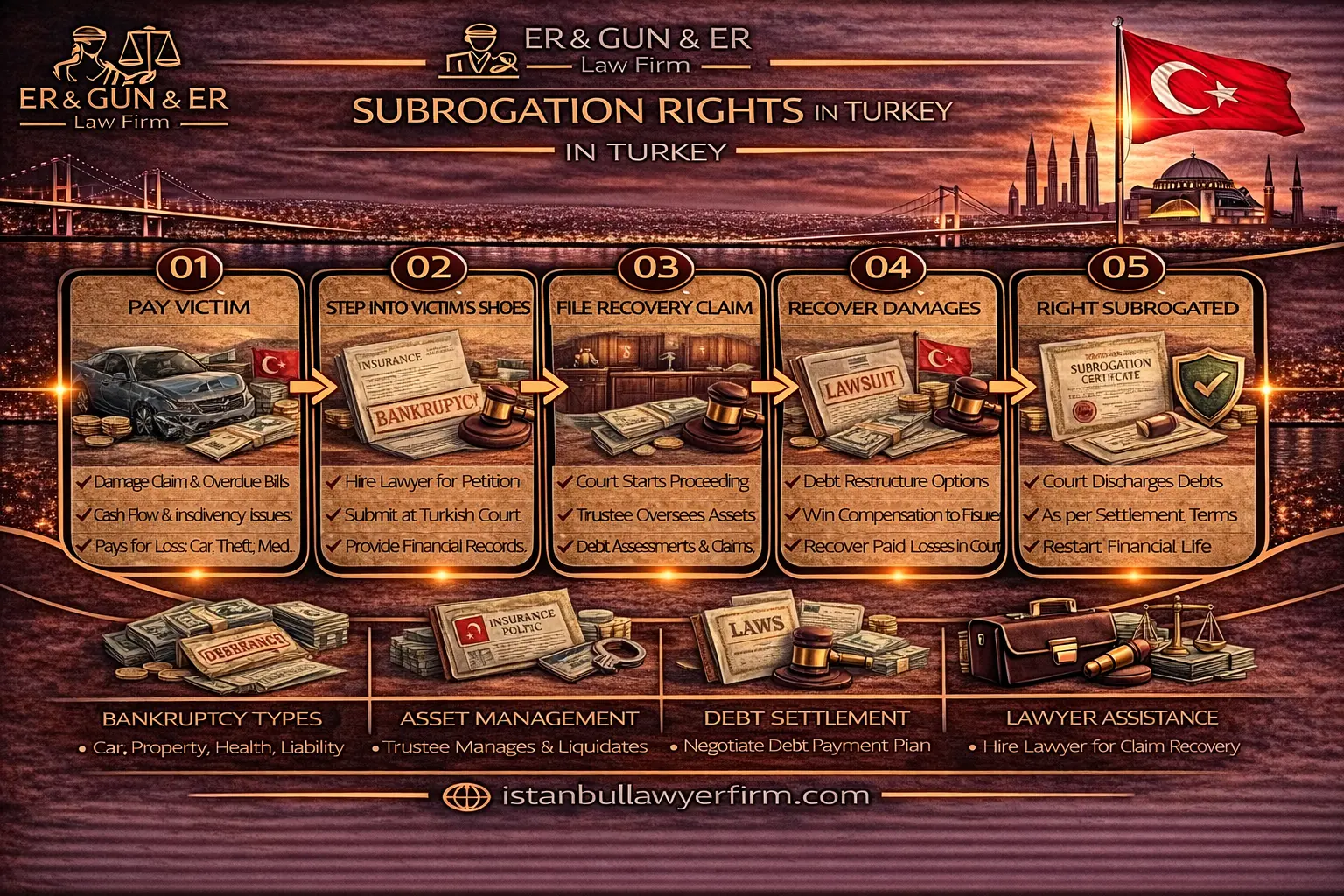
Subrogation (halefiyet) is the legal mechanism by which a party that has indemnified a loss steps into the injured party's rights against the person who caused the loss. In Turkish law, the principal statutory basis for insurance subrogation is the Turkish Commercial Code (Law No. 6102, the "TTK") Article 1472, which provides that the insurer who has paid the insurance indemnity legally takes the place of the insured, and the insured's right of action against persons responsible for the realised damage passes to the insurer to the extent of the indemnity paid. The underlying liability against the wrongdoer is governed by the Turkish Code of Obligations (Law No. 6098, the "TBK") — the tort framework under Articles 49-76 (with the prescription rule in Article 72) and the contractual liability framework under Articles 112-126 (with general prescription under Articles 146-147). Procedural matters fall within the Code of Civil Procedure (Law No. 6100, the "HMK"), enforcement under the Execution and Bankruptcy Law (Law No. 2004, the "İİK"), and cross-border issues under the International Private and Procedural Law (Law No. 5718, the "MÖHUK").
Subrogation differs from assignment because it typically arises by operation of law upon payment, rather than by a voluntary transfer agreement between creditor and assignee. Insurers, guarantors, and contractual indemnifiers use recourse to prevent double recovery and to keep the ultimate loss on the party responsible. A subrogation file is judged by its evidence trail, particularly the proof of payment, the scope of the insured's original claim, and the policy terms that may expand or restrict recovery. The same claim can rest on tort principles under TBK Articles 49-76, contract principles under TBK Articles 112-126, or special insurance provisions under TTK Articles 1401-1520, so the legal basis must be matched to the facts. ER&GUN&ER Law Firm advises insurers, reinsurers, corporate insureds, and counterparties on subrogation file design, pre-action discipline, technical evidence preservation, litigation before commercial and civil courts under HMK, enforcement under İİK, and cross-border recognition under MÖHUK Articles 50-63 and the New York Convention 1958 (Law No. 3731). Practice may vary by authority and year — check current guidance.
What Subrogation Means
Subrogation under TTK Article 1472 means the indemnifying party acquires the right to pursue the responsible party to the extent of what it paid. The insured's original cause of action is not recreated but is exercised by the payer in the insured's place. In insurance, the payer is typically the insurer, but similar logic appears in suretyship under TBK Articles 581-603 and contractual indemnity. The subrogated party cannot obtain a better right than the insured had against the tortfeasor or contract debtor. If the insured's claim would fail due to lack of fault, lack of causation, or a valid release, the subrogated claim is affected in the same way. This step-into-the-shoes feature is central to Turkish practice because courts test the underlying liability before discussing recovery mechanics. Subrogation also prevents the insured from being paid twice for the same loss, once by the insurer and once by the liable party. When the insurer pays only part of the loss, the insured may retain the remainder of the claim, which creates coordination issues. A clear approach is to document the allocation and to avoid releases that unintentionally waive the subrogated portion. Practice may vary by authority and year — check current guidance.
In Turkish disputes, subrogation is often described as a statutory consequence of indemnity under TTK Article 1472, but its practical reach is still shaped by the policy and by the underlying claim. Insurers usually start by confirming that the loss falls within cover and that payment was made under the policy, not as an ex gratia gesture. That distinction matters because voluntary payments may not produce a clean subrogation pathway under Article 1472, which requires payment of the insurance indemnity (sigorta tazminatı) rather than payments outside the policy framework. The file should also confirm whether the insured signed a discharge, a settlement, or a waiver that could narrow the claim against the wrongdoer. Another recurring issue is partial payment, where the insured retains a portion of the loss and remains a potential co-claimant. If the insurer sues alone in a partial scenario, the defendant may argue that the plaintiff lacks standing for the uninsured portion. A disciplined approach is to coordinate the insured and the insurer so each component of loss is claimed once and allocated transparently. In practice, defendants often request the policy, adjuster reports, and payment proof to test whether the insurer is truly subrogated. Many recourse teams therefore build an index of core exhibits before they send any demand, because the first reply is usually an evidence challenge.
Insurers and indemnifiers pursue recourse because indemnity is intended to shift risk temporarily, not to let the wrongdoer escape. A successful recourse action can reduce loss ratios and, in commercial settings, can also deter repeat negligence in supply chains. In Türkiye, recourse often arises from property damage, cargo losses, construction incidents, product defects, and professional errors, with each loss type carrying different evidence sources. The subrogated claimant must translate those sources into admissible court exhibits that establish breach, fault, and causation under the relevant TBK or TTK framework. A practical early step is to identify whether a liability insurer exists for the defendant, because that changes settlement dynamics. If a liability insurer is engaged, recourse discussions often revolve around technical causation issues and apportionment of responsibility. Where the insured settled directly with the wrongdoer, the insurer must review the settlement wording to see whether subrogation rights were preserved. If they were not preserved, the insurer may face a defence that the underlying claim was extinguished by release. For that reason, insurers commonly issue early notices reminding insureds not to waive claims without consent. Subrogation success often depends on early technical capture of facts, because later reconstruction can be contested and incomplete.
Subrogation Versus Assignment
Assignment (alacağın temliki) under TBK Articles 183-194 is a voluntary transfer of a claim from the original creditor to another person by agreement. Subrogation under TTK Article 1472 is typically a legal consequence of paying a debt or indemnifying a loss, and it operates to the extent of that payment. In an assignment, the debtor may raise defences based on the original relationship under TBK Article 188, but the transfer itself is based on the parties' contract. In subrogation, the transfer is anchored in law and in the principle that the payer should be able to pursue the party ultimately responsible. Assignments often require clear documentation of intent to transfer and, depending on the claim, notice to the debtor for practical enforcement under TBK Article 186. Subrogation usually requires proof of payment and proof that the payer paid under a legal or contractual obligation to indemnify. Another difference is timing, because an assignment can be signed before any payment, while subrogation generally arises after payment is made under TTK Article 1472. This timing matters in litigation because standing is tested at the time of filing under HMK Article 114. Practice may vary by authority and year — check current guidance.
In practice, insurers sometimes obtain additional documents that look like assignments, such as rights transfer declarations or powers of attorney. These documents can be useful for evidentiary clarity, but they can also create confusion if they imply that the claim was assigned rather than subrogated. Courts will typically look at the substance, meaning whether the payer is exercising the insured's right by operation of law after indemnity. If the document purports to transfer rights exceeding the paid amount, defendants may argue that the claimant is overreaching beyond the TTK Article 1472 scope. A clean approach is to draft supporting documents that confirm cooperation and disclosure, without labelling the relationship as an assignment unless it truly is. Another operational issue is notice, because an assignee often notifies the debtor under TBK Article 186 to prevent payment to the wrong person. In subrogation, notice is still useful, because early notice can prevent the insured from releasing the wrongdoer before the insurer asserts recourse. Insurers also need to manage confidentiality, because sharing full policies and underwriting materials may not be necessary to prove standing. Instead, standing is usually proved through the relevant policy parts, loss adjustment correspondence, and payment proof. Defendants may argue that an assignment is invalid or unproven, hoping to delay the case through formal objections under HMK procedural rules. To reduce that risk, the claimant should plead subrogation as the primary basis and use any additional documents as supportive cooperation evidence.
Subrogation and assignment can coexist in a single loss file, but the roles must be separated clearly. An insurer may be subrogated by law for the indemnity paid, while the insured may assign any uninsured portion under TBK Articles 183-194 to the insurer for unified pursuit. If that is done, the pleadings should distinguish which amounts are claimed by subrogation under TTK Article 1472 and which by assignment under TBK Articles 183-194, to avoid double counting. This distinction matters because the defendant may raise different defences or procedural objections depending on the legal basis invoked. For example, set-off arguments under TBK Articles 139-145 can differ if the defendant has a counterclaim against the insured that does not exist against an assignee. In insolvency scenarios under İİK, the characterisation of the claim can affect how it is filed and prioritised in the debtor's estate. Where multiple insurers seek recovery for the same event in co-insurance and reinsurance arrangements, internal allocation agreements ensure that the defendant sees one coherent demand rather than conflicting letters. Where the insured negotiates with the wrongdoer, the insurer should ensure that settlement drafts address the subrogated portion explicitly. The practical cure is to include a carve-out or to require insurer consent before any release is executed.
Legal Basis in Turkey
The principal statutory foundation for insurance subrogation in Türkiye is TTK Article 1472, which states that the insurer who has paid the insurance indemnity legally takes the place of the insured, and the insured's right of action against persons responsible for the realised damage passes to the insurer to the extent of the indemnity paid. The provision applies to indemnity insurance broadly within the TTK insurance Book (Articles 1401-1520) and is reinforced by TTK Article 1409 on the formation of the insurance contract and TTK Article 1448 on the insured's duty to mitigate. The underlying claim against the wrongdoer is grounded in tort principles under TBK Articles 49-76 (general tort liability under Article 49, presumptions of fault, employer/principal liability under Article 66, animal owner liability under Article 67, building owner liability under Article 69) or in contractual liability under TBK Articles 112-126 (debtor's liability for non-performance, defective performance, and delay).
Where the wrongdoer breached a contract with the insured, the recourse claim mirrors the insured's contractual rights, including warranty and indemnity clauses. Where the wrongdoer caused damage without a contract, the claim is typically framed under TBK Article 49 as the general unlawful act provision. The subrogated claimant must therefore plead not only the payment and policy, but also the elements of the underlying liability — protected interest, damaging event, fault (or strict liability where applicable), and causation. If the claim relies on product-related liability, the file often turns on technical standards and Product Safety Law (Law No. 7223, effective 12 March 2021) compliance records. If the claim relies on construction defects, the file turns on project documents and expert assessment under TBK Article 474 (contractor's liability). If the claim relies on logistics losses, the file turns on delivery records, survey reports, and TTK transport provisions under Articles 850-930.
Time bars are a critical risk in recourse files because a strong liability case can still fail if brought too late under prescription rules. For tort claims, TBK Article 72 sets a 2-year period from the date the injured party learns of the damage and of the wrongdoer's identity, with an absolute 10-year period from the act causing the damage. Where the act also constitutes a crime carrying a longer criminal prescription period, the longer period applies under TBK Article 72 paragraph 2. For contractual claims, the general 10-year period under TBK Article 146 applies, with the 5-year exceptions under TBK Article 147 for specific categories (rent, interest, periodic obligations, attorney/architect/medical professional fees, contractor work obligations under contracts of work for delivery, employment-related claims). Practice may vary by authority and year — check current guidance. A recourse team should open the time-bar analysis at the moment the loss is reported, not after payment is made, because the underlying prescription continues to run regardless of internal claim handling timelines. Where the act is also criminal, longer periods may apply under TBK Article 72(2). Where statutory interruption events occur under TBK Articles 153-155 (acknowledgment, lawsuit, attachment), document them as part of the chronology.
Insurance Subrogation Basics
Insurance subrogation under TTK Article 1472 is most commonly encountered in property and liability contexts where the insurer pays for damage and then seeks recovery from a third party. The insurer's standing is demonstrated through the policy, the loss adjustment record, and the payment evidence. The insurer must show that the insured had a legally valid claim against the third party, because subrogation under Article 1472 transfers existing rights and does not create new ones. If the insured's claim would be barred by contractual limitation of liability under TBK Article 115 (with exceptions for gross fault), the insurer must address that limitation. If the insured's claim would be reduced by contributory fault under TBK Article 52, the insurer must address that apportionment and cannot simply claim full recovery. Subrogation under Article 1472 is also influenced by the nature of the insurance product, because Article 1472 applies to indemnity insurance (zarar sigortaları) and not all insurance categories operate as indemnity. A careful file therefore identifies the insurance product type, the insuring clause, and the exact payment reason recorded in the adjustment file. Practice may vary by authority and year — check current guidance.
Policy wording can expand or restrict recourse, and the file must start with the exact clauses that govern recovery and cooperation. Waiver of subrogation clauses are particularly important in commercial relationships under TBK contractual freedom (Article 26), because they can shift risk allocation between contracting parties. If a waiver exists, the insurer must analyse whether it was permitted under the policy and whether it binds the insurer under Turkish practice. Defendants often rely on waivers, indemnity clauses, and limitation of liability provisions in upstream contracts to resist recourse. The insurer's file must therefore include the relevant commercial contract chain and not rely solely on the insurance policy documents. Another common clause is the insured's duty not to prejudice the insurer's rights, which is relevant when the insured negotiates directly with the wrongdoer. If the insured signs a broad release, the insurer may face an argument that the underlying claim was extinguished, even if payment was later made. To manage this risk, insurers often issue early reservation letters that instruct the insured to preserve rights and evidence under TTK Articles 1446-1448 (insured's duties).
A practical insurance recourse workflow begins with capturing the incident facts while physical evidence and witness memories are still intact. The insurer should request the insured's incident reports, maintenance logs, and contractual documents at the same time it requests invoices and repair estimates. These materials allow the insurer to assess whether there is a viable third-party target before the payment is finalised. If a third-party target exists, the insurer should send an early preservation notice to the target and to any relevant service providers. Once payment is made, the insurer should compile a payment proof bundle that includes bank transfers, accounting entries, and the settlement agreement with the insured. The bundle should also include the insured's acknowledgment of receipt and the breakdown of what the payment covers. The next step is to assemble the liability narrative and identify the legal basis, whether contract breach under TBK Articles 112-126, tort under TBK Articles 49-76, or product liability under Law 7223. Where the narrative relies on technical failure, early technical expert review helps shape the questions for later court experts under HMK Articles 266-287 (expert witness rules).
Contractual Recourse Claims
Contractual recourse starts with the insured's contract chain and the risk allocation that contract created. The recourse file must show that the defendant owed a contractual duty to the insured under the relevant TBK provisions and breached it. The most common sources are supply contracts (TBK Articles 207-281 — sale), service contracts (TBK Articles 393-447 — employment-related work and TBK Articles 502-514 — independent professional services), carriage terms (TTK Articles 850-930 — carriage of goods), and maintenance agreements (TBK Articles 470-486 — work contracts). The subrogated claimant must obtain the signed contract, the applicable general terms, and any later change orders. Missing pages and unsigned appendices often become defence points, so the contract pack should be reconstructed carefully. Contractual liability arguments must also be matched to TBK Articles 112-126, the general framework for debtor's liability for non-performance, with TBK Article 117 on debtor's default, TBK Article 118 on consequences of default, TBK Article 112 on damages for non-performance, and TBK Article 123 on rescission rights.
The claimant should explain which contractual clause was violated and how the breach created the loss that was indemnified. This framing is especially important because defendants often argue the loss is outside the contractual risk the defendant accepted. Warranty limitations under TBK Articles 219-231 (sale warranty) or Articles 474-478 (work contract warranty), exclusion clauses, and notice clauses under TBK Article 223 should be analysed before a demand is sent. If the contract includes an indemnity clause tied to third-party claims, the claimant should clarify whether the loss fits the indemnity trigger. The claimant should also verify whether the insured agreed to any waiver of recourse or waiver of claims under TBK Article 115's gross fault exception, because such clauses can restrict recovery. Practice may vary by authority and year — check current guidance.
Contractual recourse also requires choosing the correct forum and procedural lane for the underlying relationship. Some contracts contain jurisdiction clauses under HMK Article 17 (commercial parties may agree on jurisdiction), dispute resolution clauses, or arbitration clauses under HMK Articles 407-444 (domestic arbitration) or the International Arbitration Law (Law No. 4686) for international arbitration. If the contract points to a specific court, the claimant should preserve the clause and explain why it applies to the subrogated claimant. If the contract requires pre-litigation negotiation or mediation under Mediation Law (Law No. 6325) Article 18/A (mandatory mediation for commercial disputes since 1 January 2019), the claimant should document whether and how those steps were attempted. Many insurer recovery files fail not because liability is weak, but because the forum or mandatory mediation argument was handled too late. A disciplined litigation strategy begins with a clean pleading map that distinguishes the insured's contractual right from the insurer's standing by payment under TTK Article 1472.
Tort-Based Recourse Claims
Tort-based recourse is used when the liable party is not in contract with the insured or when the contract does not fully capture the wrong. The underlying liability is framed under TBK Articles 49-76, the general tort framework. TBK Article 49 establishes the fundamental rule: a person who causes damage to another by a fault-based unlawful act is required to compensate the damage. TBK Article 50 addresses the burden of proof. TBK Articles 51-55 cover compensation calculation and reduction grounds. TBK Articles 65-71 cover special liability rules (employer liability under Article 66, animal owner liability under Article 67, building owner liability under Article 69, dangerous activity strict liability under Article 71). The case typically turns on fault, damage, causation, and the absence of a legal justification. Defendants often attack the causal chain rather than the fact of payment, so a subrogation lawsuit needs a clean factual narrative supported by technical and documentary evidence. Practice may vary by authority and year — check current guidance.
Tort recourse frequently arises from product failures (TBK Article 49 plus Product Safety Law No. 7223 framework), construction defects (TBK Articles 474-478 if a contractor is involved, plus general tort Article 49 against third parties), transport incidents (TTK Articles 850-930 plus tort principles), and professional negligence (TBK Articles 502-514 work contracts plus general tort). In product-related matters, technical standards and market compliance records often determine whether a defect existed and whether the defect caused the loss. The claimant must also prove that the insured would have had a viable claim, meaning defences such as misuse, intervening causes, and warnings must be considered. Evidence is often built from survey reports, lab results, and independent expert opinions obtained immediately after the incident. If evidence is collected late, defendants may argue contamination, alteration, or loss of chain of custody. Courts often appoint experts under HMK Articles 266-287, but court experts rely on what remains available, so early private evidence capture can be decisive for framing.
Joint tortfeasor scenarios are common in recourse, especially where multiple contractors worked on the same risk. TBK Article 61 governs joint and several liability of multiple wrongdoers (müteselsil sorumluluk): if multiple persons together caused damage, each is jointly and severally liable to the injured party for the full damage. The injured party can claim full damages from any of them; internal recourse between wrongdoers is governed by TBK Article 62. The claimant should identify each actor's duty and the factual basis linking that actor to the damaging event. The claimant should also anticipate that defendants will shift blame to absent parties, so the file should be built to support joinder under HMK Article 57 or separate actions as appropriate. Where the insured had a contractual relationship with one actor but not another, the file may need both contract and tort theories in parallel. The claimant should also manage settlement discussions carefully, because settling with one tortfeasor under TBK Article 166 can affect contribution claims against others depending on the settlement language.
Proof of Payment and Loss
Proof of payment is the standing spine of subrogation under TTK Article 1472 because it shows that the insurer actually indemnified the insured. The file should include the payment instruction, bank transfer evidence, and the insured's receipt acknowledgment in a consistent exhibit set. It should also include the settlement agreement or discharge that explains what the payment covered. If multiple payments were made, each payment should be mapped to a specific head of loss so the defendant cannot argue overreach. Recovery is typically tested against what was actually paid, not against a later estimate, so accounting clarity matters. Evidence for the subrogation claim should therefore include accounting ledger extracts or payment confirmations that align with the bank record. If the insurer paid in a foreign currency, the file should preserve the payment date and amount records in a way that can be verified — this becomes important under TBK Article 99 currency rules and Decree No. 32 on foreign exchange. Defendants often challenge the payment as voluntary or ex gratia, so the file should show it was made under policy cover and claim handling process. Practice may vary by authority and year — check current guidance.
Loss proof is not limited to invoices, because courts and experts test whether the loss flowed from the event and whether the claimed items are necessary and reasonable under TBK Articles 50-55 (damage assessment). The file should include pre-loss condition evidence, incident evidence, and repair or replacement evidence in a chronological chain. If a technical expert assessed cause, preserve the expert's mandate and the underlying data so the report is not attacked as speculative. If the insured took emergency steps, document those steps with timestamps, because timing is often used to test causation under TBK Article 51's adequate causation test. If the defendant claims the insured worsened the loss, mitigation documentation under TTK Article 1448 (insured's duty to mitigate) is the first defence. Defendants also raise time-bar arguments, so timeline completeness matters even at the loss-proof stage. The record should show each key date — incident date, discovery date, and payment date — even if the legal analysis will be completed later.
Payment and loss proof must also be presented in a way that survives procedural objections under HMK and does not overwhelm the court with unstructured documents. A practical method is to create an index that labels each exhibit and states what it proves in one sentence, complying with HMK Article 121's requirement for evidence to be specifically pleaded. The index should separate policy proof, payment proof, incident proof, and quantification proof to keep the narrative clean. If documents are produced by third-party adjusters, preserve engagement letters and report scope so the defendant cannot claim the report is advocacy rather than assessment. If documents are produced by repair vendors, preserve the vendor's identity and scope so invoices are not attacked as unrelated. If photographs are used, store original files with timestamps where possible and include a simple chain-of-custody note. Courts often appoint experts, and experts rely heavily on organised exhibits to form an opinion, so disorganisation can become a hidden cost.
Evidence Preservation Strategy
Evidence preservation begins on the incident day, not on the litigation day, because key physical and digital evidence can disappear quickly. The first step is to secure the scene records, including photographs, video, and third-party reports, while they still exist. The next step is to preserve the damaged item where feasible, or to document why preservation is not feasible and what substitutes exist. If the loss involves machinery or electronics, preserve logs, maintenance records, and error codes because they can explain causation. A subrogation team should send preservation requests to counterparties early to prevent destruction of CCTV footage or digital logs. Where evidence preservation through court order is needed, HMK Articles 400-405 provide for evidence preservation procedure (delil tespiti) — a separate proceeding before the trial begins to fix evidence that may otherwise be lost. The file should also identify which documents are held by the insured and which by third parties so requests are targeted. Practice may vary by authority and year — check current guidance.
Preservation is also about preventing spoliation narratives, because defendants often argue that missing evidence should be interpreted against the claimant under HMK Article 220's general duty to produce documents. A disciplined file therefore logs who collected each item, when it was collected, and where it was stored. It also logs when the damaged item was inspected, by whom, and under what conditions. If a joint inspection is offered, document the offer and the response, because refusal may later undermine the defendant's arguments. If evidence must be moved, document the move and preserve photographs before and after relocation. If digital evidence is involved, preserve original metadata and avoid editing images or files that could change timestamps. If the insured's internal investigation produced drafts, keep the final version and preserve drafts separately to avoid accidental disclosure of inconsistent language. Counsel should also consider attorney-client privilege under Attorneys Act (Law No. 1136) Article 36 boundaries, especially where corporate reports include legal analysis.
Preservation must also align with negotiation posture, because early correspondence can shape what evidence counterparties preserve or destroy. A pre-action notice should be drafted with an awareness that it may trigger defensive behaviour. It should request preservation of specific evidence categories and identify the time window relevant to the event. It should also avoid making speculative accusations that could later be disproved by evidence. If the claimant needs access to premises or items, request access in writing and log any refusal. If access is granted, document the inspection conditions and preserve photographs of what was inspected. Where access is refused, HMK Article 400 evidence preservation procedure can compel inspection. If the file involves multiple defendants, send separate preservation requests so each custodian of evidence is clearly notified. The insured's cooperation is crucial under TTK Article 1446 (information duty), so cooperation duties should be recorded and confirmed.
Identifying Liable Parties
The first practical task in any recourse file is identifying the correct defendant, because a misidentified party can defeat recovery regardless of the merits. In an insurer recovery action, that identification must align with the insured's underlying right, which may point to a contractor, a manufacturer, a carrier, or a service provider. Start by separating the immediate actor from the legally responsible entity, because the person on site is often not the contracting party. Check who owned or controlled the risk at the time of loss, because control often explains which duty was owed. Then check whether the insured had privity of contract under Turkish contract privity rules, because contractual duties depend on the contract chain. If no contract exists, map the factual actor to the legal person that can be sued, such as the company that employed the technician under TBK Article 66 (employer liability for damage caused by employees in the course of employment). Practice may vary by authority and year — check current guidance.
Liable-party identification must also reflect the legal theory, because the defendant for a contract claim may differ from the defendant for a tort claim. If the insured's right depends on a service agreement, the proper defendant is usually the party that undertook performance. If the insured's right depends on a supply contract, the proper defendant may be the seller even when the technical defect originated at the manufacturer (with the manufacturer potentially liable in parallel under product liability). In practice, defendants frequently argue that they were only an intermediary, so the file must show the duty link rather than relying on labels. Where subcontractors exist, obtain the main contract and the subcontract so you can prove the allocation of duties and the right of recourse between tiers under TBK Article 471 (contractor's liability for subcontractors). Where the wrongdoer is a foreign entity, confirm whether it has a branch, assets, or an appointed agent in Türkiye that can be served effectively under HMK Article 16 service rules and the Hague Service Convention.
Once you have a candidate list of defendants, convert it into a service-ready identification pack. That pack should include the legal name, registered address from the Trade Registry (Ticaret Sicili), tax number where known, and authorised representative information when available. If the defendant is a corporate group, include documentation showing which entity signed the relevant contract and which entity received payment from the insured. If the defendant is an individual professional, include licensing data and workplace address details that can be verified. If multiple entities share similar names, preserve registry extracts to avoid mis-service and later nullity arguments. In many subrogation lawsuits, the first defence is that the wrong party was sued, so identification packs are not optional. Where the defendant uses multiple addresses, document where notices were sent previously and which address produced responses. If a defendant has a liability insurer, identify the insurer and policy contact, but keep the primary demand against the liable party unless strategy dictates otherwise. Where collectability is uncertain, begin documenting assets and business activity early so you can choose realistic enforcement tools later under İİK.
Causation and Fault Analysis
Causation under TBK Article 51 (the adequate causation test) is the bridge between the incident and the loss, and it is usually the main battleground in recourse disputes. The standard requires both factual causation (but-for) and adequate causation (the act must be the kind of act that, in the ordinary course of events, would produce the relevant kind of damage). Courts and experts distinguish what happened from what is legally attributable to the defendant. Start with a factual timeline that lists the event sequence in minutes and hours where possible, because technical failures often unfold quickly. Then identify the alleged wrongful act or omission and explain how it changed the risk level in a measurable way. If multiple conditions existed at the site, separate background conditions from the triggering act to avoid an overbroad narrative. If the defendant argues that another party intervened, test that claim by identifying what intervening act occurred and whether it was foreseeable under the adequate causation test. Practice may vary by authority and year — check current guidance.
Causation proof in Türkiye is usually expert-heavy under HMK Articles 266-287, so pleadings should be written to guide the expert questions. If the court appoints an expert committee (bilirkişi heyeti), the committee will rely on the file exhibits, so missing source documents can become fatal. For that reason, evidence for the subrogation claim should include the raw data that supports each conclusion, not only summaries. Examples of raw data include machine logs, laboratory readings, maintenance schedules, and original survey measurements. Where the damaged item is still available, document inspection conditions and preserve chain of custody notes so later objections are minimised. Where the item was repaired, preserve removed parts and vendor confirmations so the defendant cannot claim the defect was never shown. If CCTV exists, preserve the original file and metadata, because edited clips are easy to attack. If the insured's internal emails contain tentative hypotheses, contextualise them with final expert conclusions and avoid letting drafts define the record.
Fault allocation often becomes a percentage debate under TBK Articles 51-52 (judicial discretion in determining damages and reduction for contributory fault), especially where the insured's conduct is alleged to have contributed to the loss. In subrogation under TTK Article 1472, the insurer cannot ignore contributory fault because it steps into the insured's position and inherits the same reductions. The file should therefore include safety instructions, compliance records, and training proofs that show the insured acted reasonably. If the insured deviated from instructions, record why the deviation occurred and whether the deviation was truly causal. If the defendant provided defective instructions, preserve the instruction documents and change logs to show which version was in force. Fault can also be strict or presumed in certain contexts under TBK Articles 65-71 (special liability cases) — animal owner under Article 67, building owner under Article 69, dangerous activity operator under Article 71. Where the case is framed under such strict liability provisions, fault language should not replace the strict liability standard. If the case involves Product Safety Law (Law No. 7223), strict liability principles apply with limited defences.
Quantifying Recoverable Amounts
Quantification in recourse under TBK Articles 50-55 is not a single number, but a structured set of heads of loss that must be linked to the incident. TBK Article 50 establishes that the burden of proving damage rests on the injured party, with judicial discretion under Article 50/2 where exact proof is not possible. TBK Articles 51-55 govern damage calculation, contributory fault reduction, lost profit recovery, and other refinements. Start by separating what the insurer paid from what the insured may still claim as an uninsured portion. The recovery is limited to what was actually indemnified and provably connected to the defendant's liability under TTK Article 1472. If the insurer paid multiple invoices, map each invoice to a damage item and to the causal chain so the court can see necessity. If salvage was recovered, document the salvage proceeds and net the claim transparently to avoid allegations of double recovery. Practice may vary by authority and year — check current guidance.
Disputes over quantum often focus on whether the claimed repairs were the most reasonable method of remediation under the TBK Article 51 adequacy test. Defendants may argue that the insured upgraded equipment rather than restoring it (the new-for-old issue, governed under deduction-for-betterment principles in Turkish damage law), and courts may scrutinise that through experts. To manage this, preserve multiple quotations and procurement correspondence that show why the chosen repair path was reasonable. If the insured used internal labour, document timesheets and internal cost allocation policies so the number is not speculative. If the insured used external contractors, document contractor scopes, acceptance certificates, and payment receipts to prove the work was performed. In recourse claims, defendants often attack adjuster methodology, so preserve the adjuster's data sources and assumptions. If lost profits are sought under TBK Article 49 paragraph 2 (compensation for damages includes both actual loss and lost profit), provide accounting evidence that supports the calculation method.
Quantification also requires alignment between the paid amount and the legal measure of damages against the defendant. If the defendant's liability is limited to foreseeable loss under contract (TBK Article 117 on contractual damage scope), consequential items must be justified carefully. If the defendant's liability is tort-based, the file should still show that each head of loss is a direct consequence of the unlawful act under TBK Article 49. Where multiple defendants exist, allocate amounts by causation segments under TBK Articles 61-62 (joint and several liability and internal recourse between wrongdoers) so apportionment can be argued without confusion. Where the insured retained a deductible, clarify whether the insurer is claiming only its paid portion or coordinating the deductible portion with the insured. Defendants may raise set-off under TBK Articles 139-145 based on alleged counterclaims against the insured, so the claimant should anticipate that defence. If interest is claimed, connect the request to the payment chronology under TBK Articles 117-120 (default interest) and the Default Interest and Statutory Interest Law (Law No. 3095).
Pre-Action Notices and Talks
Pre-action practice in recourse files is about creating a clean record of demand and preserving settlement options. A pre-action notice should identify the event, the insured, the payment, and the legal basis in a factual tone. The letter should attach the minimum standing proofs, such as payment confirmation and a short loss summary, without flooding the recipient. It should also request preservation of specific evidence categories, such as logs, CCTV, and maintenance records, by reference to the relevant dates. If the claim is contractual, the notice should cite the contract and the breached obligation in plain terms. If the claim is tort-based, the notice should describe the negligent act or omission in concrete conduct terms. The notice can also serve as a default notice under TBK Article 117 to trigger debtor's default interest where applicable. Practice may vary by authority and year — check current guidance.
Negotiation should be run as a structured exchange of documents rather than as an argument about blame. The claimant should be ready to provide a core bundle that proves payment, proves the insured's underlying right, and outlines causation. The recipient should be asked to identify its alternative causation theory in writing so the dispute narrows to testable points. If technical inspection is needed, propose a joint inspection protocol and log any refusal, because refusal can later affect credibility. Where asset dissipation risk exists, counsel may evaluate interim measures under İİK Articles 257-268 (precautionary attachment, ihtiyati haciz) or HMK Articles 389-399 (interim injunction, ihtiyati tedbir), but those measures require careful proof and timing discipline. Interim measures should not be threatened casually, because an empty threat reduces credibility and can harden the counterparty's stance. Negotiation records should be preserved in the evidence pack, including emails, meeting notes, and exchanged documents. These records matter because later the parties may dispute what was admitted or offered during talks.
Settlement documentation should be drafted with subrogation mechanics in mind, because a broad release can extinguish rights unintentionally under TBK Article 132 (release / ibra). The release should identify whose claims are being released, which loss event is covered, and what portion of the loss is being satisfied. If the insured has a remaining uninsured loss, the release should either carve it out or include the insured as a signatory with a clear allocation. If multiple defendants exist, consider whether to settle with one party while preserving claims against others under TBK Article 166 (effect of release of one joint debtor on others), and draft the language accordingly. Do not assume that a generic settlement template will preserve recourse rights, because templates are often drafted for single-claimant disputes. If mandatory commercial mediation under Law 6325 Article 18/A applies (commercial monetary claims since 1 January 2019), treat the mediation as a document-driven negotiation and keep a clear record of what was exchanged.
Litigation Route and Venue
A subrogation claim becomes litigation when voluntary payment is refused or the liability basis is contested. Mandatory mediation under Law 6325 Article 18/A applies to commercial monetary claims as a precondition to filing suit, so the first step for commercial recourse claims is to complete the mediation process and obtain the final mediation minutes (mediation outcome certificate). The first procedural choice after mediation is how to characterise the underlying right, because venue and proof can differ between contract and tort. If the insured's right is contractual, the claim is usually framed as breach and damages with the insurer acting as subrogated claimant under TTK Article 1472. If the right is tort-based, the pleading focuses on TBK Article 49 elements (unlawful act, fault, damage, causation) and then ties payment to standing. Commercial courts (Asliye Ticaret Mahkemesi) often see insurer recourse files under TTK Article 4 (commercial dispute classification), but court competence must be tested against the parties' status and the nature of the dispute. Practice may vary by authority and year — check current guidance.
Once venue is selected, the statement of claim under HMK Article 119 should tell one coherent story from incident to loss to payment to recourse. The court will test standing first, so attach clear payment records and the parts of the policy that establish the indemnity basis under TTK Article 1472. Then the court will test the insured's underlying right, so attach the contract chain or tort evidence that would have supported the insured. Recourse files often require experts under HMK Articles 266-287, and expert review is more efficient when the pleadings ask precise questions tied to exhibits. Where you rely on technical causation, include the raw data and inspection records that the expert can verify. Where you rely on contractual breach, include performance records such as acceptance notes, service tickets, and notice letters. If the defendant raises contributory fault, include the insured's compliance records and mitigation steps so allocation under TBK Article 52 is grounded in facts. Courts generally expect authenticated documents and readable scans, so poor image quality can become an unnecessary dispute. Where documents are bilingual, use consistent translations under HMK Article 223 (foreign-language documents must be translated) and keep the source and translation together.
Litigation planning should also consider whether evidence must be secured through court-assisted measures before it disappears. HMK Articles 400-405 evidence preservation (delil tespiti) provides for an expedited proceeding to preserve evidence at risk. If the damaged item is at risk of disposal, request preservation access early and document any refusal in writing. If the defendant controls digital logs or CCTV, request preservation and capture the time window precisely. Interim asset measures may be considered under İİK Articles 257-268 (precautionary attachment) when there is a credible risk of dissipation, but they require focused evidence and proportionality. Do not rely on assumptions about speed, because court scheduling and expert appointment timing are not uniform. A prudent strategy is to advance the main case on a complete record rather than waiting for informal concessions. If the defendant proposes arbitration or a jurisdiction objection under HMK, respond with the contract chain and the legal theory that supports your chosen forum. If the claim involves multiple policies and co-insurers, align internal authority to sue and present one claimant voice to the court.
Enforcement and Collection
Winning a case is not the end of recovery, because collection depends on enforcement mechanics under the Execution and Bankruptcy Law (Law No. 2004, the "İİK"). Enforcement is handled through execution offices (İcra Müdürlüğü) rather than through the trial court. The claimant should plan enforcement while litigating, because asset dissipation can occur long before a final judgment is obtained. If a judgment becomes enforceable, the next step is to initiate proceedings under İİK Article 32 (enforcement based on judgment, ilamlı icra) or general enforcement procedures under İİK Articles 42-72. Defendants may object under İİK Articles 62-69, and the claimant must be ready to respond with the judgment, interest requests under Law No. 3095, and clear debtor identification. Execution success depends on finding attachable assets, which can include bank accounts, receivables, movable assets, and real estate interests. Asset location and ownership records should be checked carefully through Turkish Trade Registry, MERSİS, and TAKBİS (Land Registry) records. Practice may vary by authority and year — check current guidance.
Collection planning starts before judgment, because a debtor's payment capacity and willingness shape the best route. A recourse claimant should assess whether a negotiated repayment, a structured settlement, or immediate execution is the most realistic outcome. Negotiation is stronger when it is backed by a clear evidence pack, because counterparties respond to documents rather than accusations. If the debtor requests time, document the proposal and require a written acknowledgment of the debt under TBK Article 154 (interruption of prescription by acknowledgment) to reduce later disputes. If the debtor requests discounts, require them to identify which head of loss they contest and which head they accept. Where multiple claims exist, allocate payments under TBK Article 101 (allocation of payments to multiple debts) to specific heads so the remaining balance is clear and provable. If a payment plan is agreed, include default consequences and evidence rules so future enforcement is not reset to zero.
Enforcement risk increases when the debtor is insolvent or close to insolvency under İİK bankruptcy framework (Articles 154-251). In those scenarios, the recovery plan should include an insolvency pathway analysis rather than relying only on execution attachments. If the debtor enters bankruptcy under İİK or commercial reorganisation (concordat) under İİK Articles 285-309, claims often must be filed and proven within the insolvency framework with strict deadlines. The claimant should preserve the judgment, the payment proofs, and the underlying invoices because insolvency administrators (iflas idaresi) test claims against documents. Priority issues under İİK Article 206, set-off under İİK Article 200, and distribution issues under İİK Article 232 can arise, so a recovery plan must be realistic about what portion may be collectible. If the claimant has a security interest or a reservation of title argument, preserve the contract chain and delivery evidence early. If the debtor has foreign assets, consider whether parallel proceedings or recognition issues under MÖHUK will affect practical collection.
Cross-Border Recourse Issues
Cross-border elements appear when the insured, the defendant, the policy, or the evidence sits outside Türkiye. These files require early mapping of jurisdiction, applicable law under MÖHUK (Law No. 5718), and service routes under the Hague Service Convention or bilateral treaties, because each choice affects timing and proof. Start by identifying where the damaging event occurred and where the key evidence is located. Then identify whether the underlying liability is contractual or tort-based, because choice-of-law analysis under MÖHUK Articles 24 (contracts), 34 (tort), and 39 (insurance contracts) can differ by legal basis. If the contract has a governing law clause, preserve the signed clause and check how Turkish courts treat it for recourse standing under MÖHUK Article 24. If the defendant is foreign, plan service carefully under the Hague Service Convention (to which Türkiye is party) or bilateral treaties, and preserve proof of service. Practice may vary by authority and year — check current guidance.
Cross-border recovery can also involve using a foreign judgment or arbitral award as the enforcement foundation in Türkiye. Where a foreign decision exists, recognition and enforcement are governed by MÖHUK Articles 50-59 (foreign court judgments) or Article 60-63 in conjunction with the New York Convention 1958 (to which Türkiye is party through Law No. 3731 effective 25 September 1991, for foreign arbitral awards). The recognition and enforcement procedure is initiated at the Court of First Instance of Civil Affairs (Asliye Hukuk Mahkemesi) of the location of the assets or the debtor. The grounds for refusing recognition under MÖHUK Article 54 are limited: lack of reciprocity (for non-treaty foreign judgments), non-finality, public policy violation, lack of proper service, or jurisdiction taken in violation of exclusive Turkish jurisdiction. For arbitral awards under the New York Convention, the grounds are the Article V grounds: incapacity, invalid arbitration agreement, lack of proper notice, award beyond submission, irregular tribunal composition, non-binding or set aside award, non-arbitrability, or public policy violation. If a Turkish case is already pending, the interaction between the Turkish case and the foreign decision must be managed carefully under MÖHUK and HMK lis pendens rules to avoid inconsistent outcomes.
Cross-border recourse files also raise operational issues around data, confidentiality, and document transfer under the Personal Data Protection Law (Law No. 6698, "KVKK"). Insurers often hold sensitive underwriting and claims notes that are not needed for proof, and those materials should be filtered carefully. A good practice is to disclose only what supports standing, causation, and quantum, and to keep internal deliberations protected. If the insured is part of a multinational group, internal emails may be spread across jurisdictions, so collection and preservation must be coordinated, with attention to KVKK cross-border data transfer rules under Articles 9 and the post-2024 amendments to the cross-border transfer regime. Currency issues can arise when the indemnity was paid in one currency but the recovery is pursued in another, so the file should preserve bank records and dates under TBK Article 99 (currency obligations). If experts are abroad, plan how their reports will be presented and authenticated under HMK Article 31 in a Turkish court file. If witnesses are abroad, plan how testimony will be obtained — through letters rogatory under the Hague Evidence Convention or written statements as supporting material.
Practical Roadmap
A practical roadmap starts at first notice of loss, because the earliest decisions shape later recoverability. Open a recourse file as soon as the claim is notified and assign an owner for evidence collection and timeline control. Request the insured's contract chain, incident reports, photographs, and maintenance records before the scene changes. Send preservation requests to counterparties early to secure logs, CCTV, and inspection access. Build a defendant map with legal names from Trade Registry, registry data, and role descriptions so misidentification is avoided. Create a chronology that includes incident date, discovery date, claim reporting, adjustment steps, and payment events. Run a time-bar analysis from the underlying claim type — TBK Article 72 (tort: 2 years from discovery, 10 years absolute) or TBK Articles 146-147 (contract: 10 years general, 5 years for specific categories) — and update the memorandum when new facts appear. Document the payment basis clearly under TTK Article 1472 standing requirements and preserve bank proofs, ledger extracts, and the insured's receipt acknowledgment. Quantify the claim through an indexed bundle of invoices, quotations, and mitigation records under TBK Articles 50-55 framework. Practice may vary by authority and year — check current guidance.
Roadmaps fail when governance is unclear, so define who approves settlement, who signs pleadings, and who holds originals. If multiple insurers or reinsurers are involved, define internal authority to sue and create one outward-facing claimant voice. If the insured has its own uninsured interest, agree in writing how that portion will be pursued and how releases will be drafted with attention to TBK Article 132 (release) consequences. Create a translation protocol with a token sheet for names and dates so bilingual evidence does not drift across versions. Define a cost protocol so expert work, court fees, and enforcement costs are tracked against expected recovery without exaggeration. Define an enforcement protocol early under İİK, because collection depends on debtor assets and procedural readiness, not only on winning liability. Run periodic internal audits of open recourse files to ensure key exhibits, such as payment proof and causation evidence, are complete. If a case becomes contentious, freeze the evidence set and create supplements rather than replacing documents silently. Agree on a single narrative and a single exhibit numbering system so the case does not fragment into inconsistent drafts. If interim measures may be needed under İİK Articles 257-268 or HMK Articles 389-399, pre-collect the proofs that support urgency and asset risk so the request is credible.
A practical roadmap ends with closing disciplines that preserve future rights and reduce repeat losses. After recovery, document the settlement or judgment terms and store the execution receipts in the master archive. If the loss arose from a supplier or contractor, feed the findings into procurement and contract templates to reduce recurrence. If the loss arose from product issues, update quality controls and preserve the technical root-cause report for future disputes. If contribution or indemnity claims between defendants remain under TBK Article 62, track them separately so the main recovery is not diluted. If enforcement yielded partial recovery, record why collection stopped and what assets were unavailable so future forecasting is realistic. If the debtor entered insolvency under İİK, record the claim registration steps and the distribution status in a separate insolvency tab. Maintain a portfolio log that tracks recoveries, write-offs, and reasons for failure without blaming individuals. Use the log to identify patterns, such as recurring evidentiary gaps or recurring waiver clauses, and correct them through training. Practice may vary by authority and year — check current guidance.
Frequently Asked Questions
- What is the legal basis for insurance subrogation in Türkiye? The Turkish Commercial Code (Law No. 6102) Article 1472, which provides that the insurer who has paid the insurance indemnity legally takes the insured's place, and the insured's rights against persons responsible for the realised damage pass to the insurer to the extent of the indemnity paid.
- How does subrogation differ from assignment? Subrogation under TTK Article 1472 arises by operation of law upon indemnity payment. Assignment under TBK Articles 183-194 is a voluntary contractual transfer. Subrogation is limited to the paid amount; assignment can transfer broader rights if the contract so provides.
- What law governs the underlying tort claim? The Turkish Code of Obligations (Law No. 6098) Articles 49-76 — Article 49 general tort, Article 51 adequate causation, Article 52 contributory fault reduction, Articles 65-71 special liability cases, Article 72 prescription.
- What is the prescription period for tort claims? Under TBK Article 72: 2 years from the date the injured party learns of the damage and the wrongdoer's identity, with an absolute 10-year period from the act causing the damage. Where the act is also a crime carrying a longer criminal prescription, the longer period applies.
- What is the prescription for contractual claims? The general 10-year period under TBK Article 146, with 5-year exceptions under TBK Article 147 for specific categories (rent, periodic obligations, professional fees, contractor work obligations, employment-related claims).
- Is mandatory mediation required for commercial recourse claims? Yes. Mediation Law (Law No. 6325) Article 18/A requires mediation as a precondition to filing commercial monetary claims since 1 January 2019. The mediation outcome certificate must be attached to the lawsuit.
- Where are subrogation claims litigated? Commercial cases involving merchants typically before the Asliye Ticaret Mahkemesi (Commercial Court of First Instance) under TTK Article 4. Civil claims involving non-merchants before the Asliye Hukuk Mahkemesi (Civil Court of First Instance). Jurisdiction is governed by HMK Articles 6-19.
- What is joint and several liability for multiple wrongdoers? Under TBK Article 61, multiple persons who together caused damage are jointly and severally liable to the injured party for the full damage. Internal recourse between wrongdoers is governed by TBK Article 62.
- How are foreign judgments enforced? Under MÖHUK (Law No. 5718) Articles 50-59, with grounds for refusal in Article 54 (lack of reciprocity, non-finality, public policy violation, improper service, exclusive Turkish jurisdiction violation).
- How are foreign arbitral awards enforced? Under MÖHUK Articles 60-63 in conjunction with the New York Convention 1958 (Türkiye party through Law No. 3731 effective 25 September 1991), with grounds for refusal in Convention Article V.
- What about evidence preservation before litigation? HMK Articles 400-405 provide for evidence preservation procedure (delil tespiti) — a separate proceeding to preserve evidence at risk of loss before the main case begins.
- Can the insurer obtain interim attachment? Yes, under İİK Articles 257-268 (precautionary attachment, ihtiyati haciz) where the debt is liquid and the debtor's conduct creates risk to enforceability, or under HMK Articles 389-399 (interim injunction, ihtiyati tedbir) where a right is at risk.
- How is enforcement initiated after judgment? Through execution offices (İcra Müdürlüğü) under İİK Article 32 (judgment-based enforcement, ilamlı icra), with debtor's objections handled under İİK Articles 62-69.
- What if the debtor becomes insolvent? Claims must be registered within the insolvency proceedings under İİK Articles 154-251, with priority determined under İİK Article 206 and distribution under İİK Article 232. Concordat (commercial reorganisation) under İİK Articles 285-309 may also apply.
- Where does ER&GUN&ER Law Firm support subrogation matters? Pre-action evidence design and preservation under HMK Articles 400-405; pre-action notice and mandatory mediation under Law 6325 Article 18/A; subrogation lawsuits under TTK Article 1472 with TBK Articles 49-76 (tort) or TBK Articles 112-126 (contract) framework; HMK procedural compliance; interim measures under İİK and HMK; enforcement under İİK; and cross-border recognition under MÖHUK Articles 50-63 and the New York Convention.
Author: Mirkan Topcu is an attorney registered with the Istanbul Bar Association (Istanbul 1st Bar), Bar Registration No: 67874. His practice focuses on cross-border and high-stakes matters where evidence discipline, procedural accuracy, and risk control are decisive.
He advises insurers, reinsurers, corporate insureds, and counterparties across Pre-action Evidence Strategy under HMK Articles 400-405, Subrogation Lawsuits under TTK Article 1472 with TBK Articles 49-76 and 112-126 frameworks, Mandatory Commercial Mediation under Law 6325, HMK Civil Procedure, Interim Measures under İİK and HMK, Enforcement under İİK, and Cross-border Recognition under MÖHUK Articles 50-63 and the New York Convention 1958.
Education: Istanbul University Faculty of Law (2018); Galatasaray University, LL.M. (2022). LinkedIn: Profile. Istanbul Bar Association: Official website.