

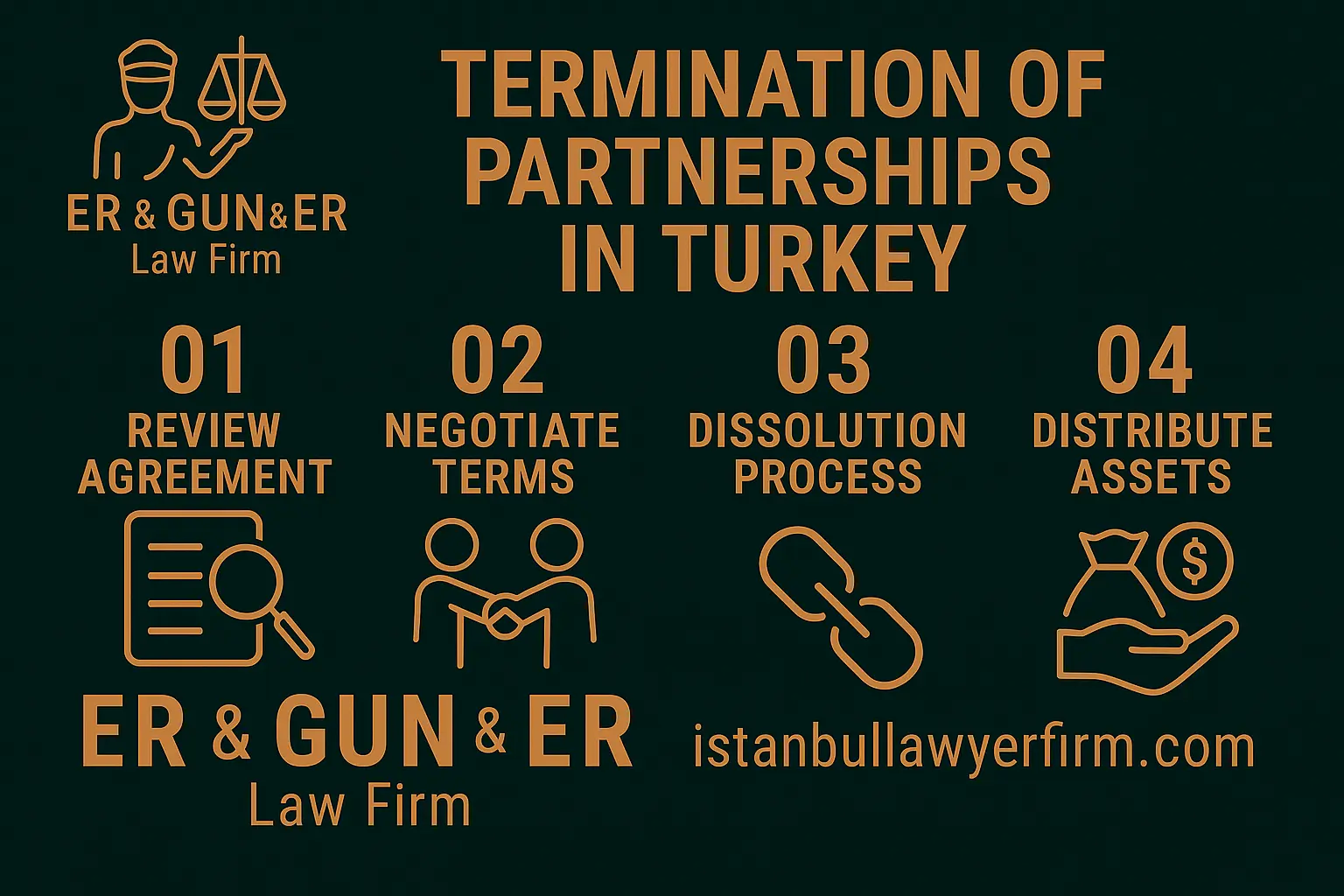
Termination of business associations in Türkiye operates through distinct legal frameworks depending on the entity type. Turkish law distinguishes sharply between non-corporate partnerships (adi ortaklık) governed by the Turkish Code of Obligations (Law No. 6098, the "TBK") of 11 January 2011 Articles 620-645; and commercial companies (ticaret şirketleri) governed by the Turkish Commercial Code (Law No. 6102, the "TTK") of 13 January 2011, which entered into force on 1 July 2012. Within commercial companies, further distinctions apply between personal companies (şahıs şirketleri) — collective partnerships (kollektif şirket, TTK Articles 211-303) and limited partnerships (komandit şirket, TTK Articles 304-328) — and capital companies (sermaye şirketleri) — joint stock companies (anonim şirket, "A.Ş.", TTK Articles 329-562) and limited liability companies (limited şirket, "Ltd. Şti.", TTK Articles 573-644).
The substantive distinction matters because termination, withdrawal, expulsion, and dissolution rules differ fundamentally across these forms. In adi ortaklık (TBK 620-645), partners hold direct ownership without separate legal personality and dissolution operates through TBK 639-645 framework. In capital companies (A.Ş. and Ltd. Şti.), the company has separate legal personality, shareholders cannot generally "withdraw" but may transfer shares under TTK Article 490 (A.Ş.) or TTK Articles 595-596 (Ltd. Şti.), and dissolution proceeds through formal liquidation under TTK Articles 532-548 (A.Ş.) or TTK Articles 642-643 (Ltd. Şti.). Just-cause termination by minority shareholders is available under TTK Article 531 for A.Ş. (with 10% threshold for non-public companies, 5% for public) and TTK Article 636(3) for Ltd. Şti. Just-cause withdrawal by individual Ltd. Şti. partners operates under TTK Article 638(2), and just-cause expulsion under TTK Article 640. Mandatory mediation under HUAK Article 18/A applies to commercial monetary claims (including partnership-related compensation) but not to dissolution actions themselves. ER&GUN&ER Law Firm advises Turkish and foreign partners and shareholders on the integrated termination, withdrawal, expulsion, dissolution, liquidation, tax closure, and registry deregistration framework. Practice may vary by authority and year — check current guidance.
Partnership and Company Forms in Turkish Law
The starting point for any termination analysis is correct identification of the entity form, because the applicable rules differ substantially. Adi ortaklık under TBK 620-645 is a contractual relationship without separate legal personality — partners hold property, debts, and rights jointly under partnership-specific rules with personal liability for partnership obligations. Adi ortaklık is commonly used for short-term joint ventures, professional collaborations not requiring corporate form, real estate development partnerships, and similar arrangements where the parties prefer flexibility over corporate complexity. Termination of adi ortaklık follows TBK 639-645 with specific dissolution causes and liquidation procedures.
Personal companies (şahıs şirketleri) under TTK have separate legal personality but partners bear personal liability for company obligations to varying degrees. Kollektif şirket (collective partnership) under TTK 211-303 imposes unlimited joint personal liability on all partners. Komandit şirket (limited partnership) under TTK 304-328 has commandite (limited liability, capital contribution only) and komanditer (unlimited personal liability, management) partner categories. These forms are increasingly rare in modern Turkish practice as capital companies (A.Ş. and Ltd. Şti.) provide superior liability protection. Termination of personal companies follows TTK provisions specific to each form, with similar dissolution-and-liquidation pattern as capital companies but with heightened attention to partner personal liability for debts arising during the company's existence. Practice may vary by authority and year — check current guidance.
Capital companies (sermaye şirketleri) — A.Ş. under TTK 329-562 and Ltd. Şti. under TTK 573-644 — are the dominant Turkish business forms. They have separate legal personality, with shareholder liability limited to the unpaid capital contribution. The minimum capital under amendments to TTK by Cabinet Decree No. 7887 of November 2023 (effective 1 January 2024) increased to TRY 250,000 for A.Ş. (or TRY 500,000 for registered capital companies under TTK Article 332) and TRY 50,000 for Ltd. Şti., with 25% paid up at incorporation. The fundamental distinction for termination purposes: shareholders cannot "withdraw" from an A.Ş. — they must transfer their shares under TTK Article 490 (free transferability principle, subject to articles of association restrictions). Ltd. Şti. shareholders can transfer shares under TTK Articles 595-596 (with default consent requirements modifiable in articles), and have additional rights to seek just-cause withdrawal under TTK Article 638(2) or to be expelled by company action under TTK Article 640. Misunderstanding these distinctions is a common source of failed exit attempts.
Adi Ortaklık Dissolution Under TBK Articles 639-645
Adi ortaklık dissolution operates under TBK Article 639, which lists termination causes including: completion of the partnership purpose or impossibility of its achievement; expiration of the agreed term; mutual agreement of all partners; partner death (unless otherwise agreed for partnership continuation among survivors); partner bankruptcy or judicial restriction; expulsion of a partner with judicial decision based on just cause; and any other cause specified in the partnership agreement. The dissolution can be voluntary (mutual agreement, term expiration) or involuntary (death, bankruptcy, just-cause expulsion). The partnership agreement may modify default rules within TBK 620-645 framework, providing flexibility for the parties' specific arrangements.
Just-cause dissolution by individual partners under TBK Article 639 includes situations where: partnership purposes cannot be achieved due to one partner's conduct; significant breach of partnership obligations by a partner; bankruptcy threatens the partnership's viability; or other circumstances make continued partnership unreasonable. The just-cause analysis is fact-intensive, with Turkish courts examining the partnership history, partner conduct, business circumstances, and specific reasons asserted. Where just cause is established, the partnership terminates from the date of the dissolving event or court decision, with subsequent liquidation following TBK 640-645 framework. Practice may vary by authority and year — check current guidance.
Liquidation of adi ortaklık under TBK 640-645 proceeds through: appointment of a liquidator (tasfiye memuru) — typically the partners themselves act as liquidators by default unless they appoint a third party or seek court appointment under TBK 643; collection of partnership assets including outstanding receivables; settlement of partnership debts to creditors; reimbursement of partners' contributions to the extent of remaining assets; and distribution of any surplus among partners according to their participation shares (or as the partnership agreement specifies). Where partnership debts exceed assets, partners bear personal liability for the deficit in proportion to their loss-sharing arrangements. The liquidation period varies based on the partnership's complexity, with simple partnerships closing within months and complex ones requiring longer wind-down. Tax obligations from the dissolution period — including final income tax declarations for the partners' share of partnership income — must be coordinated with the Revenue Administration through the partners' personal tax filings.
A.Ş. Termination Under TTK Article 529
A.Ş. termination grounds are exhaustively listed in TTK Article 529: (a) expiration of the period specified in the articles of association; (b) achievement or definitive impossibility of the company's purpose; (c) any cause specified in the articles of association; (d) general assembly decision under TTK Article 421(3) requiring qualified majority (resolutions on dissolution require affirmative votes representing at least 75% of the capital, or higher if articles specify); (e) declaration of bankruptcy by competent court; (f) court decision in the cases provided by law (including TTK 530 and 531); and (g) other cases specified in law. Each ground operates with distinct procedural and substantive requirements.
General assembly dissolution under TTK Article 529(d) requires properly noticed general assembly meeting, the qualified majority quorum and voting under TTK Article 421(3), notarial certification of the resolution, and registration with the Trade Registry (Ticaret Sicil Müdürlüğü) under TTK Article 30. The dissolution resolution becomes effective upon registration and triggers entry into liquidation status under TTK Article 533. The articles of association may modify default majority requirements upward (but not downward) for dissolution, providing greater minority protection in companies with concentrated ownership. Special procedural rules apply for public companies under Capital Markets Law (Law No. 6362, "SPK") with Capital Markets Board (Sermaye Piyasası Kurulu, "SPK") notification and disclosure requirements. Practice may vary by authority and year — check current guidance.
Court-ordered dissolution under TTK Article 530 applies in specific statutory situations including: company operating without proper management bodies for extended periods; failure to maintain minimum statutory requirements; serious violations of mandatory provisions; and other cases where statutory bases exist. The lawsuit is filed before the Commercial Court of First Instance (Asliye Ticaret Mahkemesi) by qualifying parties (which may include shareholders, creditors, public prosecutor, or competent authorities depending on the specific ground). The court analyses the substantive grounds and may order: dissolution; allowing the company time to remedy the deficiency; or other appropriate remedies short of dissolution where less drastic measures suffice. Court-ordered dissolution carries the same liquidation consequences as voluntary dissolution but operates through judicial supervision rather than general assembly initiative.
Just-Cause Termination Under TTK Article 531
TTK Article 531 provides a critical minority shareholder protection right: just-cause dissolution action by minority shareholders representing at least 10% of capital in non-public A.Ş. (or 5% in public A.Ş.). The action seeks judicial dissolution of the company based on just cause (haklı sebep) where the company's affairs have reached a state making continued operation unreasonable for the minority. Just causes recognized by Turkish jurisprudence include: persistent oppression of minority shareholders by majority; misappropriation of company assets by majority or directors; long-term failure to distribute dividends despite profitability; deadlock in company governance preventing operations; serious breach of articles of association; and other circumstances making continuation unreasonable from the minority's perspective.
The TTK 531 action is filed before the Commercial Court of First Instance with substantive evidentiary support for the just-cause grounds. The court has broad discretion under TTK Article 531(2) to order alternative remedies short of dissolution: ordering the majority to purchase the minority's shares at a court-determined fair value (çıkma payı); ordering specific corrective actions in company governance; ordering distribution of accumulated profits; or other appropriate measures. The buyout remedy under TTK 531(2) has become particularly significant in practice — courts increasingly favour minority buyout over outright dissolution where the underlying company business remains viable, providing minority exit at fair value while preserving company operations. Practice may vary by authority and year — check current guidance.
Strategic considerations for TTK 531 actions include several factors. The minority threshold (10%/5%) must be satisfied at filing and maintained throughout the proceedings. The just-cause grounds must be substantively documented through company records, shareholder correspondence, financial statements, board meeting minutes, and witness testimony where available. The valuation methodology for buyout remedy becomes critical — court-appointed expert valuations (bilirkişi raporu) typically determine the share price, with substantial dispute potential over discounted cash flow assumptions, market multiples, asset values, and minority discount applications. The litigation timeline is substantial (often two to four years through trial and appeals), making interim relief (ihtiyati tedbir) under HMK Articles 389-399 important to prevent dissipation of company assets during the proceeding. ER&GUN&ER Law Firm advises minority shareholders pursuing TTK 531 protection and majority shareholders defending against such actions, with strategic positioning across the substantive and procedural dimensions.
Limited Şirket Termination Under TTK Article 636
Ltd. Şti. termination operates under TTK Article 636 with structurally similar but textually distinct framework from A.Ş. Article 529. The grounds include: (1) expiration of the period in the articles; (2) achievement or impossibility of the company's purpose; (3) other causes in the articles; (4) general assembly decision under TTK Article 621(1)(h) requiring qualified majority (typically at least two-thirds of the represented capital, modifiable in articles within statutory limits); (5) bankruptcy declaration by competent court; (6) court decision based on just cause (haklı sebeple fesih davası) under TTK Article 636(3); and (7) other statutory cases. The general assembly dissolution requires the TTK 621 qualified majority and notarial certification, similar to the A.Ş. process.
Just-cause dissolution under TTK Article 636(3) for Ltd. Şti. mirrors the A.Ş. Article 531 framework but with different threshold structure: any partner can file just-cause dissolution action without minimum capital threshold (unlike A.Ş.'s 10%/5% thresholds). The court has parallel discretion under TTK 636(3) to order alternative remedies including ordering other partners to purchase the petitioning partner's shares at court-determined value or other appropriate measures short of dissolution. The lower threshold for Ltd. Şti. just-cause actions reflects the closer-knit nature of typical Ltd. Şti. arrangements where individual partner exit options are particularly important. Practice may vary by authority and year — check current guidance.
Comparison between A.Ş. and Ltd. Şti. termination architecture reveals strategic considerations for entity choice and termination planning. A.Ş. provides stronger minority protections through TTK 531's 10%/5% threshold but no individual partner termination right, suiting larger companies with diversified ownership. Ltd. Şti. provides individual partner termination right under TTK 636(3) but no minimum threshold protection, suiting smaller companies with limited partners where individual exit options are essential. The general assembly qualified majority requirements (75% for A.Ş., two-thirds for Ltd. Şti.) reflect intentional differences in deadlock prevention vs. flexibility balance. For closely held businesses contemplating future exit scenarios, the choice between A.Ş. and Ltd. Şti. should consider the projected exit pathways and minority/individual protection needs alongside other factors (capital flexibility, tax treatment, governance complexity).
Partner Withdrawal and Expulsion in Limited Şirket
Ltd. Şti. provides distinctive partner exit and removal mechanisms under TTK 638-640 not available in A.Ş. form. Just-cause withdrawal (haklı sebeple çıkma) under TTK Article 638(2) allows individual partners to file action seeking judicial determination of their right to withdraw from the company with corresponding share buyout. The just causes recognized include: persistent disagreement preventing effective participation; breach of articles or partnership obligations by other partners; loss of trust in management; significant changes in company circumstances rendering continued participation unreasonable; and other case-specific factors. The court analyses the asserted just cause and, if established, orders the company (or remaining partners) to purchase the withdrawing partner's shares at court-determined fair value, with the partner's exit becoming effective upon payment.
Just-cause expulsion (haklı sebeple çıkarma) under TTK Article 640 allows the company to file action seeking judicial removal of a partner whose continued membership has become unreasonable. The just causes for expulsion include: substantive breach of partnership obligations; conduct damaging to company interests; persistent obstruction of company governance; misappropriation or misuse of company resources; criminal conduct affecting business reputation; and other partner-attributable factors making continued membership unreasonable. The expulsion lawsuit requires substantive evidentiary documentation of the partner's conduct and corresponding harm to company interests. Where the court grants expulsion, the company purchases the expelled partner's shares at fair value with payment becoming effective separately. Practice may vary by authority and year — check current guidance.
Articles of association may modify default TTK 638-640 frameworks within statutory limits — for example, specifying additional just causes, modifying valuation methodologies for buyout, providing for installment payment terms, or establishing arbitration mechanisms for disputes. Such modifications must be carefully drafted to remain within enforceable statutory bounds. The valuation methodology for share buyout under TTK 638 and 640 typically involves court-appointed expert evaluation considering company financial statements, asset values, going-concern value, and other relevant factors. Discounts for minority position or lack of marketability are sometimes applied but are subject to court discretion and case-specific factors. Coordination between the TTK 638/640 actions and any related dispute resolution proceedings (mediation, arbitration, parallel commercial litigation) requires strategic planning to avoid procedural complications. Strategic withdrawal and expulsion planning, including pre-action documentation and negotiation positioning, often substantially affects outcomes — making early legal counsel valuable rather than waiting for disputes to escalate.
Share Transfer in A.Ş. and Limited Şirket
A.Ş. share transfer operates under TTK Article 490's free transferability principle: shares are freely transferable unless the articles of association impose restrictions. Common restrictions in articles include: pre-emption rights for existing shareholders; board approval requirements for share transfers; right of first refusal mechanisms; and tag-along/drag-along provisions. Bearer shares (hamiline yazılı paylar) transfer through delivery of share certificates with notification under specific TTK Article 489 framework (introduced by Law No. 7262 of 2020 to enhance bearer share oversight). Registered shares (nama yazılı paylar) transfer through written assignment with company registration in the share book under TTK Article 499.
Ltd. Şti. share transfer operates under TTK Articles 595-596 with different default rules: share transfers require general assembly approval by qualified majority (typically two-thirds of the represented capital under TTK 621) unless articles provide otherwise, the transfer must be in writing notarised before a Turkish notary, and transfer becomes effective upon registration in the company's partner book. Articles may liberalise these requirements (eliminating general assembly approval, modifying notarial requirements) within statutory limits, but cannot eliminate the basic written-and-registered requirements. The notarial requirement is particularly important — share transfers without proper notarisation are legally invalid regardless of party intentions. Practice may vary by authority and year — check current guidance.
Share transfer documentation typically includes: written share purchase agreement specifying parties, shares transferred, price, payment terms, representations and warranties, indemnification provisions, and closing conditions; notarial deed of transfer for Ltd. Şti. (or notarial deed of authorisation for transfer); board resolution approving the transfer where applicable; general assembly resolution approving the transfer where applicable; updated share book entries; and Trade Registry filings where the transfer affects registered information. Tax implications include: capital gains tax under GVK Articles 80-82 for individual sellers (with five-year exemption for certain residential conditions); corporate tax under KVK for corporate sellers (with potential KVK Article 5(1)(e) exemption for two-year holding); stamp tax under Stamp Tax Law (Law No. 488) on transfer instruments; and potential transfer pricing analysis under KVK Article 13 for related-party transfers. Cross-border share transfers involving foreign sellers or buyers require additional analysis under Foreign Exchange Legislation, FATCA/CRS reporting, and applicable double tax treaties. ER&GUN&ER Law Firm structures share transfer transactions with integrated corporate, tax, and regulatory analysis.
Liquidation Procedure Under TTK Articles 532-548
A.Ş. liquidation following dissolution operates under TTK Articles 532-548 framework. The dissolved company enters liquidation status (tasfiye hâlinde) under TTK Article 533, retaining legal personality solely for liquidation purposes with company name suffixed "in liquidation" (tasfiye hâlinde) under TTK Article 535. Liquidator(s) (tasfiye memuru) are appointed by the dissolving general assembly under TTK Article 536, defaulting to the existing board members if no separate appointment is made. The liquidator's authority under TTK Article 537 includes: representing the company in liquidation; collecting receivables; selling assets; settling debts; and conducting other liquidation activities. Liquidator duties include preparing the liquidation entry balance sheet (tasfiye giriş bilançosu) under TTK Article 540 and periodic reporting to shareholders.
Creditor protection in liquidation is paramount. TTK Article 541 requires the liquidator to issue three public announcements at one-week intervals through the Türkiye Trade Registry Gazette (Türkiye Ticaret Sicili Gazetesi, "TTSG") notifying creditors to file their claims. The mandatory notification period prevents premature distribution of assets to shareholders before creditor satisfaction. Known creditors must be individually notified by the liquidator. Creditor claims are paid from liquidation assets in the order specified by Bankruptcy and Enforcement Law (Law No. 2004) priority rules, with secured creditors and statutory priority claims (employee wages, taxes) paid first, followed by unsecured creditors. Where liquidation assets are insufficient to satisfy creditors, the company enters bankruptcy under TTK Article 376 framework with substantive director liability implications. Practice may vary by authority and year — check current guidance.
Distribution of remaining assets to shareholders under TTK Article 543 occurs only after: completion of asset realisation; satisfaction of all creditor claims; payment of liquidation costs and liquidator fees; and expiration of the statutory waiting period (typically six months from the third creditor announcement to permit late-filing creditors). Distribution is proportional to shareholders' paid-in capital unless articles specify otherwise. The final liquidation balance sheet (son tasfiye bilançosu) under TTK Article 544 documents the closing financial position. Cancellation from the Trade Registry under TTK Article 546 marks the company's final extinction. The cancellation requires liquidator application supported by: final balance sheet; tax clearance certificate (vergi ilişiksiz belgesi) from the Tax Office; SGK clearance certificate from Social Security Institution; and other clearances from licensing authorities where applicable. Total liquidation timeline varies substantially based on company size, asset complexity, debt structure, and dispute potential, with simple liquidations completing within months and complex ones extending over years.
Tax and Regulatory Closure Under KVK Article 17
Liquidation period taxation operates under Corporate Tax Law (Law No. 5520, "KVK") Article 17 with specific framework distinguishing the liquidation period from regular operations. Each year of liquidation constitutes a separate tax period (tasfiye dönemi) with separate corporate tax calculation, declaration, and payment under KVK Article 17(1). The liquidation entry date establishes the close of the regular operating period and opening of the first liquidation period. Liquidation period income includes regular operating income (where activities continue), gains from asset realisations, recovered receivables, and other income items. Deductions include liquidation expenses, debt settlement losses, and other operating costs.
Final liquidation period closing triggers final corporate tax computation under KVK Article 17(4) with treatment of distributable assets to shareholders. Where distribution exceeds shareholders' contributed capital, the excess is treated as dividend distribution subject to withholding tax under GVK Article 94 framework (typically 10% for resident individual shareholders, varying for non-resident shareholders based on applicable double tax treaty). The treatment requires careful planning where significant retained earnings or asset appreciation has accumulated, with timing and structuring of distributions affecting overall tax burden. Practice may vary by authority and year — check current guidance.
Regulatory closure obligations span multiple authorities. Tax Office closure requires final corporate tax return for the closing liquidation period, VAT cancellation, and final tax clearance certificate issuance. SGK closure requires final employee separation processing under Labor Law (Law No. 4857) Articles 17-32 framework with severance and notice payments under specific calculations, final SGK premium reconciliation, and SGK clearance certificate issuance. Trade Registry deregistration under TTK Article 546 requires the cancellation application supported by all clearances. Industry-specific licensing authorities (banking, securities, telecommunications, healthcare, etc.) require separate closure procedures under their regulatory frameworks. The integrated closure timeline can extend substantially beyond the operational liquidation period, with directors and liquidators bearing personal responsibility for procedural completion under TTK director liability framework. Personal liability exposure for directors and liquidators in failed or improperly completed liquidations under TTK Articles 553-562 makes proper closure documentation essential beyond mere asset distribution.
Mandatory Mediation Under HUAK Article 18/A
Mandatory mediation as procedural prerequisite (dava şartı arabuluculuk) applies to specific dispute categories rather than dissolution actions broadly. Under Mediation in Civil Disputes Law (Law No. 6325, "HUAK") Article 18/A as amended by Law No. 7155 of 6 December 2018 effective 1 January 2019, mandatory mediation applies to commercial monetary claims (ticari nitelikli alacak ve tazminat davaları). This means: partnership-related compensation claims (such as TTK 531 buyout valuation disputes, TTK 638/640 share value disputes after court-ordered withdrawal/expulsion, and similar monetary claims) typically require mandatory mediation completion before court filing. However, pure dissolution actions (such as TTK 530, TTK 531 dissolution requests, TTK 636(3) Ltd. Şti. dissolution actions) and corporate governance actions are not subject to mandatory mediation under current framework.
The distinction between dissolution actions (not subject to mediation) and monetary claims (subject to mediation) creates strategic complexity. A TTK 531 lawsuit seeking dissolution as the primary remedy with alternative buyout request raises mixed-action analysis — whether the entirety must complete mediation, only the monetary portion, or neither, depends on case-specific procedural framing and court interpretation. Recent case law has tended toward requiring mediation for the monetary aspects while allowing dissolution actions to proceed without it. Strategic petition drafting can sometimes structure actions to optimise procedural pathways. Where mediation is required, the procedure operates through licensed mediators under Ministry of Justice oversight with typical 3-week completion timeline (extendable for complex cases). Successful mediation produces enforceable settlement; unsuccessful mediation enables litigation with the mediation final report as procedural prerequisite documentation. Practice may vary by authority and year — check current guidance.
Beyond mandatory mediation, voluntary mediation and other ADR mechanisms remain available for partnership disputes. Arbitration clauses in articles of association or shareholder agreements direct disputes to arbitration rather than court litigation, with the Istanbul Arbitration Centre (İstanbul Tahkim Merkezi, "İTM" or "ISTAC") established under Law No. 6570 of 21 November 2014 providing institutional arbitration administration. International arbitration through the International Chamber of Commerce (ICC), Singapore International Arbitration Centre (SIAC), or other institutions is also commonly chosen for cross-border partnership arrangements. Arbitration awards are enforceable in Türkiye through the New York Convention 1958 (Türkiye party since 1992) and the International Arbitration Law (Law No. 4686). Strategic dispute resolution clause drafting at partnership formation often substantially affects later termination dispute outcomes and costs.
Foreign Partner and Cross-Border Considerations
Foreign partners and shareholders enjoy national treatment under Foreign Direct Investment Law (Law No. 4875, "DYY Kanunu") of 5 June 2003 Article 3. Foreign-owned A.Ş. and Ltd. Şti. operate under the same TTK termination framework as domestic-owned companies, with foreign shareholders having the same TTK 490 share transfer rights, TTK 531 just-cause dissolution rights (subject to threshold), and TTK 636(3)/638(2)/640 Ltd. Şti. partner rights as Turkish shareholders. The cross-border dimension affects practical execution rather than substantive rights — particularly regarding documentation, currency transfers, tax treatment, and home-country recognition of Turkish proceedings.
Power of attorney (vekaletname) under TBK Articles 502-514 enables Turkish counsel to handle the entire termination process on the foreign partner's behalf. The vekaletname must be: executed before a Turkish notary if the partner is in Türkiye, or before a Turkish consulate abroad, or before a foreign notary with apostille legalisation under the Hague Apostille Convention 1961 (Türkiye party since 1985 through Law No. 6303); translated into Turkish under HMK Article 223 by sworn translators registered with Turkish notaries; and specific in scope (authorising general assembly attendance, share transfer execution, mediation participation, litigation representation, and other relevant actions). Cross-border share transfer documentation typically requires apostille legalisation of foreign-executed documents and Turkish translation for Turkish-side filings. Practice may vary by authority and year — check current guidance.
Repatriation of partnership distribution proceeds operates through Turkish banking channels under Foreign Exchange Legislation framework. Outgoing transfers exceeding specified thresholds require source-of-funds documentation supporting the distribution as legitimate partnership exit (rather than disguised income or other tax-relevant transactions). Coordination between Turkish counsel managing the termination process and home-country counsel managing tax reporting, regulatory compliance, and beneficial ownership reporting in the foreign jurisdiction is essential. Specific double tax treaty analysis applies for capital gains taxation on share transfers — many Turkish DTTs allocate share gain taxation rights to the seller's residence country (with exceptions for substantial real estate holdings under specific DTT provisions). The integrated cross-border termination strategy requires planning across Turkish corporate, Turkish tax, foreign tax, and foreign corporate dimensions to achieve optimal outcomes. ER&GUN&ER Law Firm coordinates Turkish-side termination with foreign counsel for international partners and shareholders managing Turkish exit within global structures.
Frequently Asked Questions
- What law governs partnership termination in Türkiye? Adi ortaklık (non-corporate partnerships) under Turkish Code of Obligations (Law No. 6098) Articles 620-645. Commercial companies under Turkish Commercial Code (Law No. 6102): A.Ş. (Articles 329-562), Ltd. Şti. (Articles 573-644), kollektif (211-303), komandit (304-328).
- What is the difference between partnership and company termination? Adi ortaklık has no separate legal personality; partners hold property and debts directly with personal liability. A.Ş. and Ltd. Şti. have separate legal personality with shareholder liability limited to capital contribution. Termination procedures differ accordingly.
- How does A.Ş. terminate? Under TTK Article 529: term expiration; purpose achievement/impossibility; articles-specified causes; general assembly decision (75% capital majority under TTK 421(3)); bankruptcy; court decision (TTK 530, 531); other statutory cases.
- What is just-cause dissolution under TTK 531? Minority shareholders representing 10% (non-public) or 5% (public) of A.Ş. capital can file dissolution action. Court has discretion to order alternative remedies including buyout of minority's shares at fair value (çıkma payı), as preferred remedy preserving company viability.
- How does Ltd. Şti. terminate? Under TTK Article 636: term expiration; purpose achievement/impossibility; articles-specified causes; general assembly decision (typically two-thirds capital under TTK 621); bankruptcy; just-cause dissolution under TTK 636(3) — available to any partner without minimum threshold.
- Can a partner withdraw from Ltd. Şti.? Yes, through just-cause withdrawal action under TTK Article 638(2). Court analyses asserted just causes; if established, orders company or remaining partners to purchase the withdrawing partner's shares at court-determined fair value.
- Can a partner be expelled from Ltd. Şti.? Yes, through just-cause expulsion action under TTK Article 640. Company files action; if just cause established, court orders share purchase at fair value, removing the partner.
- Can shareholders withdraw from A.Ş.? No. A.Ş. shareholders cannot "withdraw" — they must transfer shares under TTK Article 490 (free transferability principle, subject to articles restrictions). Only TTK 531 minority dissolution action provides involuntary exit mechanism.
- How does liquidation work? A.Ş. liquidation under TTK Articles 532-548: liquidator appointment, three creditor announcements via TTSG (one-week intervals), creditor claim period, asset realisation, debt settlement, distribution to shareholders, final balance sheet, Trade Registry cancellation.
- What about taxes during liquidation? Each liquidation year is separate tax period under KVK Article 17 with separate corporate tax. Final period distribution above contributed capital is treated as dividend with withholding tax under GVK Article 94. Tax clearance certificate required for Trade Registry cancellation.
- Is mediation mandatory? Under HUAK Article 18/A (added by Law 7155 of 6.12.2018, effective 1.1.2019), mandatory mediation applies to commercial monetary claims including partnership-related compensation. Pure dissolution actions are typically not subject to mandatory mediation.
- Is arbitration available? Yes, where shareholder agreements or articles include arbitration clauses. ISTAC (İstanbul Tahkim Merkezi) under Law No. 6570 of 2014, ICC, and other institutional arbitration are commonly chosen. Awards enforceable through New York Convention 1958 (Türkiye party since 1992) and Law No. 4686.
- How do foreign partners exit? Same substantive rights as Turkish partners under DYY Kanunu (Law No. 4875) Article 3 national treatment. Practical execution through Turkish counsel under power of attorney (vekaletname) with apostille legalisation under Hague Convention 1961 (Law No. 6303) and sworn translation under HMK Article 223.
- Are there personal liability risks? For A.Ş. and Ltd. Şti. shareholders, liability is generally limited to unpaid capital. However, personal guarantees, director liability under TTK Articles 553-562 (capital companies), or partnership liability for adi ortaklık, kollektif, komandit (for komanditer partners) can create personal exposure.
- Where does ER&GUN&ER Law Firm support partnership termination matters? Adi ortaklık dissolution under TBK 639-645; A.Ş. termination under TTK 529 and 531; Ltd. Şti. termination under TTK 636 and 636(3); partner withdrawal under TTK 638(2); partner expulsion under TTK 640; share transfer under TTK 490 and 595-596; liquidation procedure under TTK 532-548; KVK Article 17 liquidation taxation; mandatory mediation under HUAK 18/A; ISTAC and ICC arbitration; and cross-border foreign partner representation under DYY Kanunu and Hague Convention 1961.
Author: Mirkan Topcu is an attorney registered with the Istanbul Bar Association (Istanbul 1st Bar), Bar Registration No: 67874. His practice focuses on cross-border and high-stakes matters where evidence discipline, procedural accuracy, and risk control are decisive.
He advises Turkish and foreign partners, shareholders, family-owned enterprises, joint venture parties, and corporate boards across Adi Ortaklık Dissolution under TBK Articles 639-645, A.Ş. Termination under TTK Articles 529-548, TTK Article 531 Minority Just-Cause Dissolution, Limited Şirket Termination under TTK Articles 636-644, Partner Withdrawal under TTK Article 638(2) and Expulsion under TTK Article 640, Share Transfer under TTK Articles 490 and 595-596, Liquidation Procedure and Trade Registry Deregistration, KVK Article 17 Liquidation Period Taxation, Mandatory Mediation under HUAK Article 18/A, ISTAC and ICC Arbitration, Vekaletname-Based Foreign Partner Representation under TBK Articles 502-514, and Hague Apostille Convention 1961 documentation under Law No. 6303.
Education: Istanbul University Faculty of Law (2018); Galatasaray University, LL.M. (2022). LinkedIn: Profile. Istanbul Bar Association: Official website.