

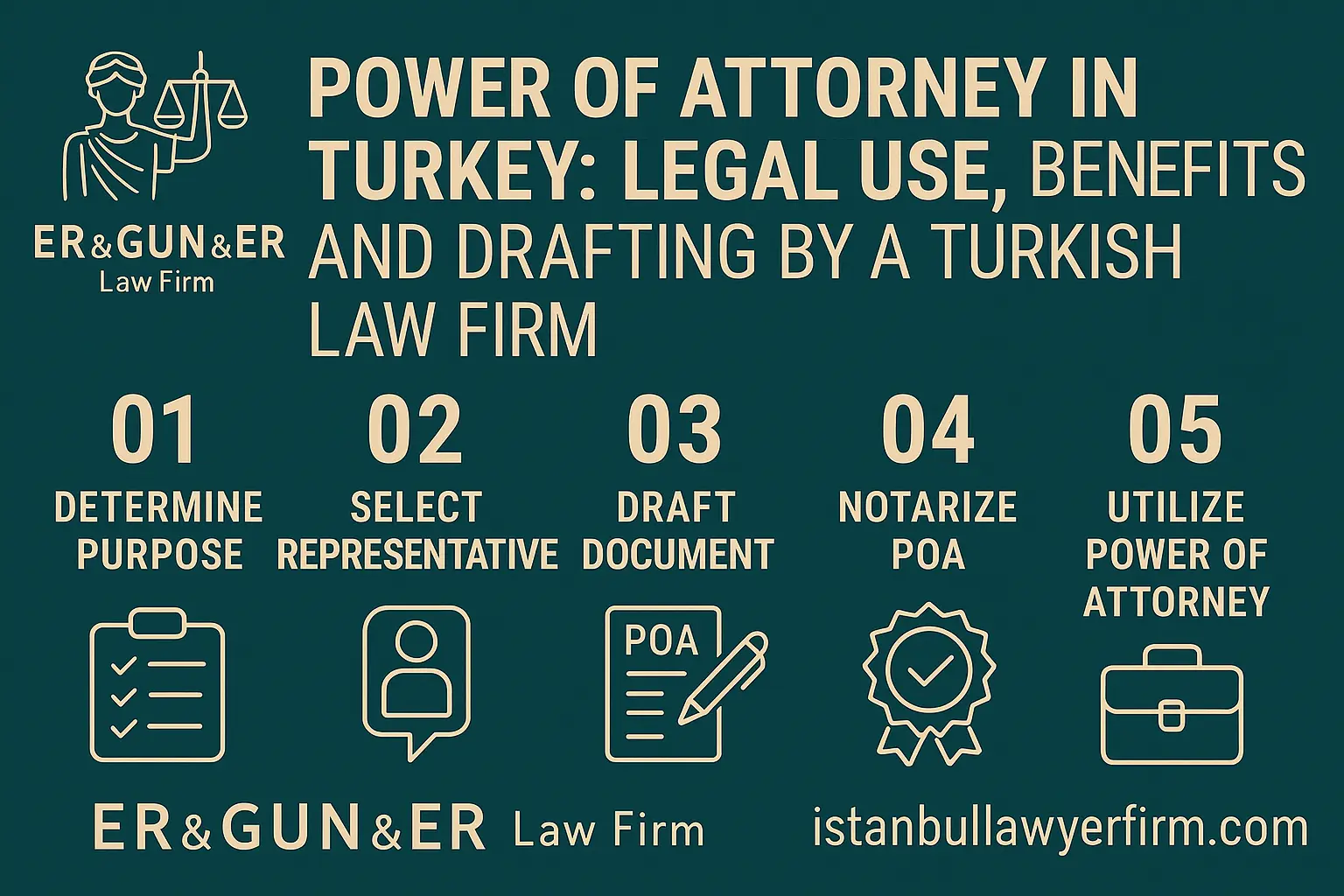
Power of attorney (vekaletname) in Türkiye operates through the integrated framework of the Turkish Code of Obligations (Law No. 6098, the "TBK") of 11 January 2011 Articles 502-514 governing the underlying mandate contract (vekalet sözleşmesi); the Notary Law (Law No. 1512) of 18 January 1972 establishing the formal requirements for notarial powers of attorney; the Civil Procedure Code (Law No. 6100, the "HMK") of 12 January 2011 Articles 71-83 governing court representation by attorneys; and the Attorneyship Law (Law No. 1136) of 19 March 1969 regulating attorney representation specifically. International recognition operates through the Hague Apostille Convention 1961 (Türkiye party since 1985 through Law No. 6303) for member states, and consular legalisation for non-member states. Sworn translation under HMK Article 223 is required for foreign-language powers of attorney used in Türkiye.
The fundamental distinction matters: the underlying mandate contract under TBK 502-514 establishes the obligations between principal (müvekkil) and attorney-in-fact (vekil); the notarial vekaletname document under Notary Law 1512 is the formal evidentiary instrument granting third parties confidence in the attorney's authority. TBK Article 504 specifies powers requiring express authorisation in the vekaletname (special powers — including litigation settlement, real property disposition, suretyship, gifts, withdrawal from claims, arbitration agreements, and similar significant powers). Court representation requires additional special powers under HMK Article 74 for specific procedural acts (settlement, withdrawal, acceptance of claims, judge recusal, oath administration, arbitration agreement, moral damages waiver, withdrawal from rights closely tied to person, interim relief). The vekaletname terminates under TBK Articles 512-513 through expiration, revocation by either party, principal's or attorney's death, bankruptcy, or loss of capacity. ER&GUN&ER Law Firm prepares vekaletnameler covering real estate, corporate, litigation, tax, banking, and personal matters with attention to TBK 504 / HMK 74 special authorisation requirements, international apostille / consular legalisation pathways, and sworn translation compliance. Practice may vary by authority and year — check current guidance.
Mandate Framework Under TBK Articles 502-514
The mandate contract (vekalet sözleşmesi) under TBK Article 502 is the underlying legal relationship between the principal (müvekkil) granting authority and the attorney-in-fact (vekil) accepting it. The mandate creates fiduciary obligations including: TBK Article 504 — performance of the mandated work in accordance with principal's interests; TBK Article 505 — compliance with the principal's instructions, with limited exception for situations requiring departure where principal's prior consent could not be obtained; TBK Article 506 — personal performance, with delegation permitted only where authorised, customary, or required by circumstances; TBK Article 507 — duty of care and loyalty, requiring the attorney to act with the diligence appropriate to the work and to avoid conflicts of interest; and TBK Article 508 — duty to account for receipts and expenditures.
TBK Article 504 establishes the critical distinction between general authority (genel yetki) and special authority (özel yetki) within the mandate framework. Acts requiring express special authority in the vekaletname include: settlement of disputes; signing arbitration agreements; assigning or compromising claims; making gifts; suretyship; consenting to interim measures; withdrawing from inheritance; acquiring or disposing of real property; subjecting the principal's rights to encumbrance; and similar acts of significant consequence. The general authority alone — even broadly worded — does not authorise these acts. Drafting precision is therefore essential: a vekaletname intended to enable real estate sale must explicitly authorise the sale; one intended for litigation settlement must explicitly grant settlement authority. Practice may vary by authority and year — check current guidance.
TBK Articles 512-514 govern termination of the mandate. TBK Article 512 lists automatic termination causes: death, bankruptcy, or loss of capacity of either party (with limited exceptions where the mandate's nature requires continuation). TBK Article 513 permits unilateral termination by either party at any time, subject to liability for damages caused by termination at an inopportune time without justified cause. TBK Article 514 establishes that termination has effect from the moment the other party learns of it, with acts done in good faith before knowledge remaining valid. Revocation by the principal must be communicated to the attorney and to relevant third parties (banks, registries, courts, government offices) to be fully effective in those contexts. The revocation should typically follow the same formal pathway as the original grant — notarial revocation for notarial vekaletname, with copies served on relevant parties through documented means.
Notarial Form Under Notary Law 1512
Notarial form requirements for vekaletname documents operate under Notary Law (Law No. 1512) of 18 January 1972 with detailed implementing regulations. The Notary Law distinguishes two principal notarial document forms relevant to vekaletnameler: drafting-form documents (düzenleme şeklinde noter senetleri) under Notary Law Article 89 where the notary actively drafts the document with parties' instructions; and authentication-form documents (onaylama şeklinde noter senetleri) under Notary Law Article 90 where the parties present a pre-prepared document and the notary authenticates the signatures. Vekaletnameler are typically prepared in drafting form for substantive transactions, providing additional procedural certainty.
The drafting-form vekaletname under Notary Law Article 89 requires: parties' physical attendance at the notary office (or notary's attendance at parties' location for justified circumstances); identity verification through official identification documents (Turkish ID for citizens, passport for foreigners with Turkish presence, residence permit for residents); statement of the principal's intent and authorisation scope; preparation of the document by the notary or notary-supervised staff in compliance with statutory format; signing by the principal in the notary's presence; and notarial seal and signature certification. The notary maintains the original in the notary's records (asıl), with certified copies (suret) issued to the parties for use. The vekaletname may be issued in Turkish (standard) or in bilingual format with Turkish as the primary version. Practice may vary by authority and year — check current guidance.
For foreign principals not present in Türkiye, Turkish consulates abroad function as Turkish notaries under the Consular Service Law (Law No. 6004) framework, enabling vekaletname execution at Turkish consulates worldwide for use in Türkiye. The consular vekaletname has the same legal effect as a Turkish notarial vekaletname, eliminating the need for apostille or further legalisation. Alternatively, a vekaletname can be executed before a foreign notary, subsequently apostilled or consular-legalised (depending on the country's Hague Convention status), translated by a sworn Turkish translator under HMK Article 223 framework, and authenticated by a Turkish notary for use. The choice between these pathways depends on practical access to Turkish consular services, urgency, and document complexity. Costs and timing differ — Turkish consular execution is typically faster and simpler but limited to Turkish consular locations; foreign notarial execution with apostille is more flexible geographically but requires additional legalisation and translation steps. ER&GUN&ER Law Firm coordinates the optimal vekaletname execution pathway based on the principal's location, urgency, and document complexity.
Court Representation Under HMK Articles 71-83
Court representation by attorneys operates under HMK Articles 71-83 with specific procedural requirements distinct from the general TBK 502-514 mandate framework. HMK Article 71 establishes that parties may litigate personally or through attorneys, with attorney representation being optional in most civil proceedings (mandatory representation applies in specific contexts including before the Court of Cassation in commercial matters above thresholds and certain specialised proceedings). The Attorneyship Law (Law No. 1136) Article 35 specifies the principle that only attorneys registered with the Bar may represent parties professionally in court — non-attorney representatives operate under specific exceptions for limited contexts.
HMK Article 74 establishes the critical framework of special authorisations (özel yetki) required in litigation vekaletnameler. The general authority to litigate does NOT include power to: settle the dispute (sulh olmak); withdraw from the lawsuit (davadan feragat); accept the opposing party's claim (davayı kabul); request judge recusal (hakim reddi); offer or accept oath (yemin teklifi/kabulü); enter arbitration agreement (tahkim sözleşmesi); waive moral damages (manevi tazminat hakkından feragat); withdraw from rights closely tied to person (kişiye sıkı sıkıya bağlı haklar); request interim relief without urgency justification (ihtiyati tedbir); compromise enforcement (icra takibinde sulh); or undertake similar significant procedural acts. Each special authority must be expressly stated in the vekaletname for the attorney to exercise the corresponding act. Drafting omissions can prevent attorneys from taking necessary actions during proceedings, with potential adverse consequences. Practice may vary by authority and year — check current guidance.
HMK Article 76 specifies vekaletname format for court use: must be notarial (or certified equivalent for foreign-issued vekaletnameler); must identify the principal and attorney; must specify the matters covered (general litigation authority, specific cases, or specific proceedings); must include the special authorities expressly granted; and must comply with current notarial form requirements. HMK Article 77 requires the attorney to file the vekaletname (or certified copy) with the court at the first opportunity — typically with the petition or first hearing attendance. HMK Article 81 governs vekaletname termination during litigation: revocation by the principal must be communicated to the court; the attorney's resignation under HMK Article 82 must follow specified procedures including notification to the principal and the court. Litigation continuity during attorney transitions requires careful procedural management to avoid prejudicing the principal's substantive position. The Attorneyship Law (Law No. 1136) Articles 56-71 govern attorney fee arrangements (vekalet ücreti) including statutory minimum fees, contingency fee restrictions, and fee disputes — typically supplementing the litigation vekaletname with separate written fee agreement.
Real Estate Powers of Attorney
Real estate transactions in Türkiye require specific vekaletname provisions due to the substantive significance and Land Registry (Tapu Müdürlüğü) procedural requirements. Under TBK Article 504, real property acquisition or disposition (purchase, sale, mortgage, encumbrance) requires express special authority in the vekaletname — generic property management authority does not authorise sale or other dispositive acts. The vekaletname for real estate sale must specify: the parties; the specific authority to sell or transfer real property; the property identification (typically by district, street, building, parcel/section, with detailed cadastral references for definitive identification); price authorisation (specific minimum price, formula for price determination, or unrestricted authority); payment terms acceptance authority; and signing authority for sale deed at the Land Registry.
The Land Registry Law (Law No. 2644) and Land Registry Regulation (Tapu Sicil Tüzüğü) Articles 13-14 establish the Land Registry's authority to verify vekaletname adequacy before processing transactions. Land Registry officials examine: the vekaletname's notarial form and currency; the specific authority for the proposed transaction (sale, purchase, mortgage, etc.); the property identification matching the vekaletname's authority scope; price authorisation where applicable; and any restrictions or conditions specified. Vekaletnameler with insufficient specificity (general "all property matters" without specific transaction authority) or scope mismatches (vekaletname for one property used for another) result in transaction refusal, requiring vekaletname amendment or new execution. Practice may vary by authority and year — check current guidance.
For foreign real estate buyers and sellers, the vekaletname coordination with the broader transaction is critical. The buyer's vekaletname typically authorises: property purchase from the specified seller; payment from specified accounts within authorised price ranges; signing the sale deed (satış senedi) at the Land Registry; receiving the title deed (tapu) in the buyer's name; and related ancillary acts (utility transfers, tax notifications, residency permit linkage where applicable under Law No. 6458 framework). The seller's vekaletname authorises corresponding acts on the seller's side. Title check before transaction completion (tapu kayıtlarının incelenmesi) under Land Registry Law Article 7 confidentiality framework is conducted by the attorney with specific authorisation. Foreign currency payment for property purchase under specific exchange regulations requires coordination with banking provisions in the vekaletname. The integrated real estate vekaletname approach — with proper specific authorities, banking authorisations, registry transaction authorities, and ancillary act authorities — enables foreign buyers and sellers to complete transactions efficiently without requiring physical presence in Türkiye throughout the multi-step process.
Corporate Powers of Attorney
Corporate vekaletnameler enable shareholders, directors, and authorised representatives to act in company-related matters. The framework distinguishes vekaletnameler granted by the company (acting through its authorised representatives under Articles of Association and TTK signature authority framework) from vekaletnameler granted by individual shareholders or directors. Company-issued vekaletnameler require coordination with the company's signature authority documentation: signature circular (imza sirküleri) under Notary Law and TTK Article 372 establishing who can bind the company; board resolution (yönetim kurulu kararı) authorising the specific matter where required by Articles or substantive significance; and the resulting vekaletname properly executed by authorised signatories.
Shareholder vekaletnameler for general assembly attendance and voting under TTK Article 425 enable shareholders to be represented at general assemblies without personal attendance. The shareholder vekaletname must identify: the shareholder and represented shares; the attorney; the specific general assembly (date, agenda items); the voting authority (full discretion, specified positions on each agenda item, or restricted authority); and signature authority for general assembly minutes. Public company shareholder vekaletnameler face additional requirements under Capital Markets Law (Law No. 6362) and SPK regulations including specific format requirements and disclosure rules. Practice may vary by authority and year — check current guidance.
Director and management vekaletnameler enable specific authorised persons to act for the company in particular contexts: bank account operations with specified transaction limits and signature authority levels; tax office representation for filings, payments, and dispute proceedings before Vergi Dairesi; SGK representation for employment and social security matters; Trade Registry representation for filings and amendments; and similar specific delegations. Banking vekaletnameler typically interact with bank-specific signature authority requirements, KYC documentation under MASAK Law 5549 framework, and specific transaction limits structured in coordination with bank policy. The corporate vekaletname structure should reflect both internal corporate governance requirements and external counterparty requirements — ensuring that the vekaletname's authority is sufficient for the intended use without being excessively broad in ways that create internal control concerns. ER&GUN&ER Law Firm structures corporate vekaletnameler with attention to TTK signature authority, internal governance, banking and tax interaction, and specific transaction requirements.
Hague Apostille Convention 1961 and Consular Legalisation
International recognition of foreign-issued vekaletnameler in Türkiye operates through two principal pathways depending on the country of origin. The Hague Apostille Convention of 5 October 1961 (the "Apostille Convention") simplifies legalisation among member states by replacing the traditional consular legalisation chain with a single apostille certificate issued by the country of origin's designated authority. Türkiye became a party to the Apostille Convention through Law No. 6303 of 8 May 1985, with the Convention entering into force for Türkiye on 29 September 1985. Apostilled documents from member states are accepted in Türkiye without further consular legalisation, requiring only sworn translation under HMK Article 223 framework.
The Apostille Convention has expanded substantially in recent years. Notable recent additions include the United Arab Emirates (party since 2021, effective 7 May 2022), Canada (party since 2024 with effective date in 2024-2025), and Qatar (party since 2024). For Apostille Convention member states, the apostille is issued by the country's designated competent authority — typically the Ministry of Foreign Affairs, the Ministry of Justice, or specifically designated apostille issuance offices. The apostille certificate format is standardised (10 numbered fields specifying issuing country, signatory, capacity, seal authority, place, date, issuing authority, certificate number, signatory name, and seal). The apostille certifies the genuineness of the signature, capacity of the signatory, and identity of the seal — but does NOT certify the document's content correctness, leaving substantive accuracy a separate question. Practice may vary by authority and year — check current guidance.
For non-Apostille Convention countries, traditional consular legalisation chain applies: notarisation in the country of origin; authentication by the country of origin's Ministry of Foreign Affairs (or competent authority); and legalisation by the Turkish consulate or embassy in that country. The chain establishes successive authentication of signatures and authorities, with the Turkish consular legalisation being the final step recognised by Turkish authorities. The process is more time-consuming and involves additional fees, with practical timelines varying by country. Once the document is properly apostilled or consular-legalised, it requires sworn translation into Turkish under HMK Article 223 by translators registered with Turkish notaries. The translation must be certified by the translating notary, with the certified translation accompanying the original (apostilled or legalised) document for Turkish use. The vekaletname is then ready for use at Turkish authorities (Land Registry, courts, Tax Office, banks, etc.). ER&GUN&ER Law Firm coordinates the international vekaletname pathway from foreign execution through apostille/legalisation, sworn translation, and Turkish authority use, providing integrated support for foreign principals managing Turkish matters remotely.
Tax, Banking, and Government Agency Vekaletnameler
Tax-related vekaletnameler enable representation before the Revenue Administration (Gelir İdaresi Başkanlığı) and local Tax Offices (Vergi Daireleri) for specific tax matters. Authority can include: filing tax returns (corporate income tax, personal income tax, VAT, withholding tax declarations); receiving tax notifications and decisions; signing reconciliation agreements under VUK Articles 24-25; representing the taxpayer in tax dispute proceedings before Tax Courts under İYUK framework; signing instalment plan applications under AATUHK Article 48; and submitting administrative remedies including pişmanlık ve ıslah filings under VUK Article 371, düzeltme requests under VUK Articles 116-126, and cezada indirim requests under VUK Article 376. The tax vekaletname must specify the authority scope clearly to enable Tax Office acceptance.
Banking vekaletnameler enable account operations and banking transactions on behalf of account holders. Bank-specific requirements typically include: bank's standard vekaletname forms or specific authority language; signature authority levels (single signature, joint signatures, transaction value thresholds); KYC compliance documentation under MASAK Law (Law No. 5549) framework; and specific account or transaction identifiers. Common authorities include: opening and closing accounts; deposit and withdrawal authority within specified limits; wire transfer authority (domestic, international with specific country/counterparty restrictions where appropriate); signing loan and guarantee documentation; managing investment accounts; and credit/debit card management. Banking vekaletnameler face heightened scrutiny due to fraud risk and regulatory requirements, with banks often requiring fresh vekaletnameler within specified currency periods (commonly six months to one year for non-recurring authorities). Practice may vary by authority and year — check current guidance.
Government agency vekaletnameler enable representation before specific authorities for particular matters. Common categories include: Trade Registry (Ticaret Sicil Müdürlüğü) for company filings, amendments, and certificates; Population Registry (İl Nüfus Müdürlüğü) for civil status documents and address registration under Law No. 5490 Article 50; Land Registry for real estate transactions and title certificates; SGK (Sosyal Güvenlik Kurumu) for employment registrations, premium payments, and benefits; Migration Administration (Göç İdaresi Başkanlığı) for residence permits under Law No. 6458 framework; Customs (Gümrük İdaresi) for import/export declarations and customs proceedings; and Municipalities for licensing, zoning, and local matters. Each agency may have specific vekaletname format expectations and authority scope requirements based on the agency's procedural rules. Pre-clearance with the relevant agency before vekaletname execution can identify specific format requirements and avoid subsequent rejection issues.
Personal Affairs, Healthcare, and Family Matters
Personal vekaletnameler address individual rather than commercial matters: civil status proceedings (marriage, divorce — though personal-status matters have specific in-person requirements that limit vekaletname use); inheritance acceptance, rejection, and partition proceedings under TMK framework; family matters where personal participation is not legally required; healthcare consent and medical record access; and routine personal administration (utility bills, document renewals, mail collection). Personal vekaletnameler often serve elderly principals, expatriates, or principals with limited mobility seeking trusted representation for routine matters.
Healthcare-related representation operates through both vekaletname mechanisms and specific healthcare law frameworks. The Patient Rights Regulation (Hasta Hakları Yönetmeliği, Resmi Gazete 1.8.1998/23420) Article 24 establishes the patient's legal representative concept for medical decisions where the patient cannot consent personally. For competent adults seeking advance representation arrangements, vekaletname under TBK 502-514 can authorise an attorney to make medical decisions, access medical records, and consent to treatment within specified scope. Limitations exist for life-or-death decisions and certain personal-rights matters where Turkish law restricts delegation. Healthcare vekaletnameler should coordinate with specific hospital and treatment facility requirements, as healthcare institutions may have specific format expectations. Practice may vary by authority and year — check current guidance.
Capacity and guardianship considerations under Civil Code (Law No. 4721, the "TMK") Articles 405-419 affect vekaletname planning for elderly or incapacitated principals. A vekaletname requires the principal's capacity at execution time. Where capacity has been or may be lost, guardianship (vesayet) under TMK Articles 396-419 or curatorship (kayyımlık) under TMK Article 408 may be necessary as alternatives or supplements. Pre-incapacity vekaletname planning — where competent principals proactively grant vekaletnameler before potential capacity issues arise — provides important alternative to formal guardianship proceedings. The vekaletname continues in effect under TBK Article 512 framework subject to the specific termination causes (which include loss of capacity but with practical implementation complexity). Coordination between vekaletname planning and broader family law and estate planning provides integrated framework for elderly principals and their families. Criminal liability under Penal Code (Law No. 5237, the "TCK") Article 155 (abuse of trust — embezzlement-like offense) and TCK Articles 204-207 (forgery offenses) addresses vekaletname misuse, with serious penalties for attorneys exceeding their authority or for parties forging vekaletname documents.
Drafting Best Practices and Risk Management
Effective vekaletname drafting balances completeness (providing the attorney sufficient authority to accomplish the intended purpose) with precision (avoiding excessive scope that creates risk). Best practices include several elements developed through practice. First, scope specification: vekaletnameler should specify the matter scope (real estate purchase of property at specified location; banking operations at specified institution; litigation of specified case; etc.) rather than relying on overly broad general authority that may be rejected by counterparties or create misuse risk. Second, special authority enumeration: TBK 504 special powers and HMK 74 court-specific special powers must be expressly granted where intended — generic clauses rarely suffice for these specific authorities.
Third, limitation and protection clauses: vekaletnameler can specify monetary limits (maximum transaction values), time limits (validity periods), counterparty restrictions (specified institutions or persons), reporting requirements (periodic accountings to principal), and similar protective provisions. These clauses operate as both internal control measures and external evidence of authority scope. Fourth, identification precision: clear identification of principal, attorney, and any specifically referenced third parties or properties prevents confusion and supports recognition by counterparties. Fifth, currency planning: vekaletnameler should be reviewed periodically for currency, with renewal or revocation as circumstances change. Practice may vary by authority and year — check current guidance.
Risk management considerations beyond drafting include: attorney selection (only granting vekaletnameler to trustworthy individuals or institutions with appropriate accountability mechanisms); communication maintenance (regular communication between principal and attorney to monitor activities); document security (maintaining secure copies of executed vekaletnameler, with originals at notary archives accessible if needed); revocation planning (clear understanding of revocation procedures and triggering events); and substantive review for material transactions (separate counsel review for major transactions even where the vekaletname authorises the attorney to proceed). Where vekaletname misuse occurs, civil remedies under TBK 511 (attorney liability for damages caused by breach of duties) and criminal remedies under TCK 155 framework provide accountability mechanisms. Pre-emptive structural protection through careful vekaletname design is generally preferable to reactive remedies after misuse. ER&GUN&ER Law Firm advises principals on vekaletname structure, draft language, attorney selection, and ongoing risk management — and represents principals in vekaletname-related disputes including misuse claims and revocation enforcement.
Frequently Asked Questions
- What law governs vekaletname in Türkiye? The Turkish Code of Obligations (Law No. 6098) Articles 502-514 (mandate framework); Notary Law (Law No. 1512) (notarial form); Civil Procedure Code (Law No. 6100) Articles 71-83 (court representation); and Attorneyship Law (Law No. 1136) (attorney representation specifically).
- What is the difference between general and special authority? Under TBK Article 504, certain significant acts require express special authority in the vekaletname: real property disposition, settlement of disputes, arbitration agreements, gifts, suretyship, withdrawal from claims, and similar acts. General authority alone does not authorise these acts.
- What special powers are needed for litigation? Under HMK Article 74: settlement (sulh), withdrawal from lawsuit, acceptance of opposing party's claim, judge recusal, oath administration, arbitration agreement, moral damages waiver, withdrawal from rights closely tied to person, interim relief request, and similar significant procedural acts. Each must be expressly granted.
- What form must vekaletname take? Notarial form under Notary Law 1512 — typically drafting form (Article 89) where notary actively prepares the document. Authentication form (Article 90) is permitted but less common for substantive vekaletnameler. Foreign-executed vekaletnameler require apostille or consular legalisation plus sworn translation.
- How is vekaletname terminated? Under TBK Articles 512-514: automatic termination on death, bankruptcy, or capacity loss of either party; unilateral termination by either party at any time under TBK Article 513 (with damage liability for inopportune timing); revocation effective when communicated to attorney and relevant third parties.
- How are foreign-executed vekaletnameler used in Türkiye? Through Turkish consulate execution (consular vekaletname under Law No. 6004 framework — most efficient), or through foreign notarisation followed by Hague Apostille Convention 1961 (Türkiye party since 1985, Law No. 6303) certification or non-Hague consular legalisation, followed by sworn translation under HMK Article 223.
- Which countries are now Hague Apostille Convention members? Coverage continues to expand. Notable recent additions include UAE (effective 7 May 2022), Canada (effective 2024-2025), and Qatar (effective 2024). The full current member list should be verified at the time of vekaletname execution.
- What is required for real estate vekaletnameler? Express special authority under TBK Article 504 for real property disposition; specific property identification (district, parcel, cadastral references); price authorisation; and Land Registry Law (Law No. 2644) procedural compliance. Land Registry officials examine vekaletname adequacy under Land Registry Regulation Articles 13-14.
- What about banking vekaletnameler? Bank-specific format requirements typically apply, often with periodic currency requirements (six months to one year). Authority should specify accounts, transaction types, monetary limits, and signatory levels. KYC compliance under MASAK Law (Law No. 5549) framework applies.
- How can corporations issue vekaletnameler? Through authorised signatories under signature circular (imza sirküleri) and TTK Article 372 framework. Board resolution may be required for substantive matters. The vekaletname should reflect both internal corporate governance authority and external counterparty requirements.
- How does shareholder representation at general assemblies work? Under TTK Article 425, shareholders may be represented at general assemblies through vekaletname identifying: shareholder and shares; attorney; specific general assembly (date, agenda); voting authority (discretion or specified positions); and signature authority for minutes. Public companies face additional SPK requirements.
- What healthcare representation is permitted? Under Patient Rights Regulation Article 24 framework, legal representatives can make medical decisions where the patient cannot consent personally. For competent adults, vekaletname under TBK 502-514 can authorise medical decisions and record access, with specific limitations for life-or-death decisions and personal-rights matters.
- What about capacity and guardianship? Vekaletname requires capacity at execution. For incapacity scenarios, guardianship (vesayet) under TMK Articles 396-419 or curatorship (kayyımlık) under TMK Article 408 may apply. Pre-incapacity vekaletname planning provides alternative to formal guardianship for competent principals.
- What are misuse remedies? Civil remedies under TBK Article 511 for attorney liability for damages from breach of mandate duties. Criminal remedies under TCK Article 155 (abuse of trust) and TCK Articles 204-207 (forgery offenses). Pre-emptive structural protection through careful vekaletname design is generally preferable.
- Where does ER&GUN&ER Law Firm support vekaletname matters? Drafting under TBK 502-514 with attention to special authorities under TBK 504; notarial execution coordination under Notary Law 1512; court-use vekaletnameler with HMK 74 special authorities; real estate vekaletnameler with Land Registry Law and Tapu Sicil Tüzüğü compliance; corporate, banking, tax, and governmental agency vekaletnameler; international vekaletname coordination through Hague Apostille Convention 1961 (Law No. 6303) or non-Hague consular legalisation; sworn translation under HMK Article 223; and vekaletname-related dispute representation including misuse claims and revocation enforcement.
Author: Mirkan Topcu is an attorney registered with the Istanbul Bar Association (Istanbul 1st Bar), Bar Registration No: 67874. His practice focuses on cross-border and high-stakes matters where evidence discipline, procedural accuracy, and risk control are decisive.
He advises Turkish and foreign principals, corporate clients, real estate investors, family offices, and litigation parties across Vekaletname Drafting under TBK Articles 502-514, Special Authorities under TBK Article 504 and HMK Article 74, Notarial Form under Notary Law 1512, Court Representation under HMK Articles 71-83 and Attorneyship Law (Law No. 1136), Real Estate Vekaletnameler under Land Registry Law (Law No. 2644) and Tapu Sicil Tüzüğü, Corporate Vekaletnameler under TTK and Capital Markets Law (Law No. 6362), Banking Vekaletnameler under MASAK Law (Law No. 5549), Tax Vekaletnameler under VUK and AATUHK, International Vekaletname Coordination under Hague Apostille Convention 1961 (Law No. 6303), Non-Hague Consular Legalisation, Sworn Translation under HMK Article 223, Healthcare Vekaletnameler under Patient Rights Regulation, Capacity and Guardianship under TMK Articles 396-419, and Misuse Liability under TBK Article 511 and TCK Articles 155 and 204-207.
Education: Istanbul University Faculty of Law (2018); Galatasaray University, LL.M. (2022). LinkedIn: Profile. Istanbul Bar Association: Official website.