
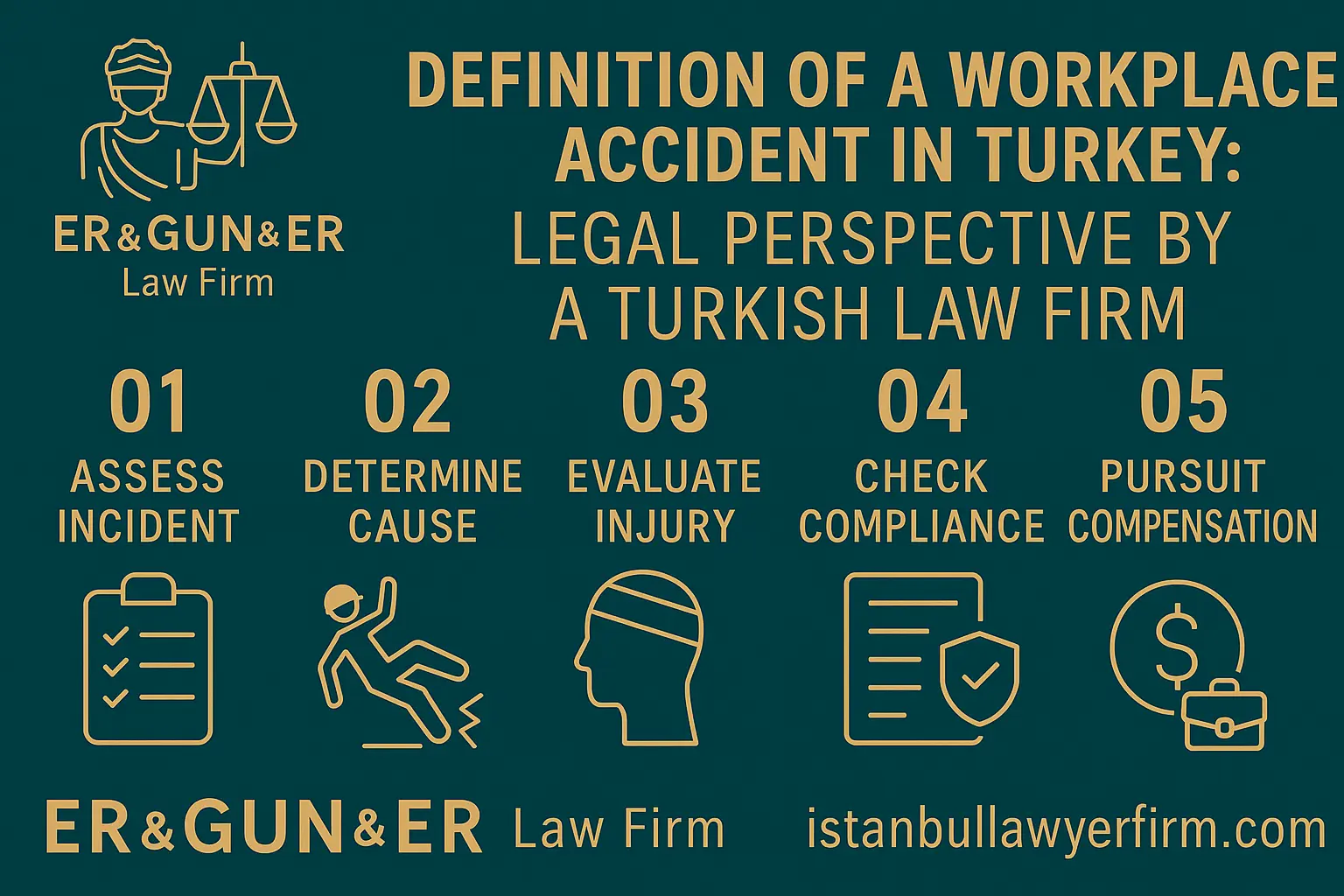
Workplace accident (iş kazası) law in Türkiye operates through an integrated framework spanning social security, occupational health and safety, labour, civil obligations, criminal law, and procedural rules. The principal statutes are: the Social Security and General Health Insurance Law (Law No. 5510, the "SGK Kanunu") of 31 May 2006 Article 13 establishing the substantive workplace accident definition; the Occupational Health and Safety Law (Law No. 6331, the "İSG Kanunu") of 20 June 2012 (Resmi Gazete 30.6.2012/28339) governing employer health and safety obligations; the Labour Law (Law No. 4857, the "İş Kanunu") of 22 May 2003 Article 77 reinforcing employer protection duties; the Turkish Code of Obligations (Law No. 6098, the "TBK") Article 417 establishing the employment-contract protection duty and Articles 49-76 governing tort liability; the Penal Code (Law No. 5237, the "TCK") Articles 85 and 89 governing criminal liability for negligent killing and negligent injury; and the Labour Courts Law (Law No. 7036, the "İMK") of 12 October 2017 establishing specialised labour court jurisdiction.
Mandatory mediation under İMK Article 3 (effective 1 January 2018) applies to compensation claims arising from workplace accidents — a procedural prerequisite that must be completed before filing in the Labour Court. The Social Security Institution (Sosyal Güvenlik Kurumu, "SGK") administers the social insurance dimension, with workplace accident benefits including temporary incapacity benefit under SGK Article 16, permanent disability income under SGK Article 18, death income under SGK Article 19, and funeral assistance under SGK Article 20. Crucially, where employer fault contributes to the accident, SGK Article 21 establishes the SGK's recourse right (rücu hakkı) against the employer to recover benefits paid — making employer fault analysis central to financial exposure beyond the SGK statutory benefits. The Ministry of Labour and Social Security (Çalışma ve Sosyal Güvenlik Bakanlığı) and its labour inspectorate (İş Müfettişliği) oversee OSH compliance with administrative enforcement under Law 6331 Article 26. ER&GUN&ER Law Firm advises injured workers, families of deceased workers, and employers on the integrated framework. Practice may vary by authority and year — check current guidance.
Workplace Accident Definition Under SGK Law Article 13
The substantive definition of workplace accident in Turkish law is established in SGK Law (Law No. 5510) Article 13 with five distinct categories. SGK Article 13(a) covers accidents occurring while the insured worker is at the workplace (sigortalının işyerinde bulunduğu sırada) — the classic on-site accident category covering injuries during work tasks, in workplace common areas, in employer-provided dining or rest facilities, and in similar workplace contexts. The "workplace" definition extends beyond the principal premises to include attached areas, employer-controlled adjacent zones, and temporary work locations under specific conditions.
SGK Article 13(b) covers accidents occurring due to work being performed by the employer — including work performed off-site at customer locations, project sites, or other locations directed by the employer. SGK Article 13(c) covers accidents during travel for work assignments away from the workplace, even where the worker is not directly performing work duties at the moment of the accident — a category significantly expanding workplace accident coverage to business travel time. SGK Article 13(d) covers nursing-mother accidents during legally protected breastfeeding time periods. SGK Article 13(e) covers commuting accidents (servis kazaları) where the accident occurs during travel between home and workplace using employer-provided transportation — a category with specific scope limited to employer-provided transport rather than worker's independent commuting choices. Practice may vary by authority and year — check current guidance.
The boundary cases of Article 13 categories generate substantial Yargıtay jurisprudence. Workplace accidents during temporary task interruptions (smoking breaks, short personal errands during work hours) generally remain within Article 13(a) scope unless the worker has substantially deviated from work-related activity. Travel accidents under Article 13(c) require analysis of whether the travel was work-related (qualifying) versus personal (non-qualifying). Commuting accidents under Article 13(e) require employer-provided transport — accidents during private commuting (worker's own car, public transit not employer-arranged) generally fall outside workplace accident scope despite occurring during the worker's transit to work. Occupational diseases (meslek hastalıkları) under SGK Articles 14-15 operate as a parallel framework distinct from workplace accidents — gradual exposure conditions (chemical poisoning, hearing loss, respiratory diseases, repetitive strain injuries) typically qualify as occupational diseases rather than workplace accidents, with separate procedural and benefit framework. The substantive classification of an event under Article 13 versus Articles 14-15 affects medical evaluation, benefit calculations, and evidentiary requirements.
Notification Obligations Under SGK Article 13/2 and Law 6331
Notification of workplace accidents to SGK must be made within three business days following the accident under SGK Article 13/2 framework. The notification operates through the e-SGK electronic system with specific accident report content including: worker identification and SGK registration; accident date, time, and location; circumstances of the accident; injuries sustained; medical treatment commenced; emergency response actions; and witness identification where applicable. The three-business-day clock runs from the employer's awareness of the accident, with practical implications for accidents discovered later or with delayed reporting through the worker's normal channels.
The notification deadline is jurisdictional with specific consequences for missed notifications. Under SGK Article 21, where the employer fails to make timely notification, SGK retains the right to recover from the employer the medical and benefit costs that SGK incurs — converting the employer's reporting failure into direct financial exposure. Additionally, late notification triggers administrative fine exposure under Law 6331 Article 26 framework (with substantial fines for severe violations or repeat occurrences) and may complicate the worker's statutory benefit access. Strategic best practice involves immediate notification at the lower threshold of suspicion rather than delaying for full investigation — the notification can subsequently be supplemented or corrected as facts develop, but the procedural prerequisite is met. Practice may vary by authority and year — check current guidance.
OSH-side notification under Law 6331 Article 14 imposes parallel reporting obligations to the Ministry of Labour and Social Security where workplace accidents occur. The OSH notification operates through specific reporting channels including: workplace accident records (iş kazası kayıt defteri) maintained at the workplace; investigation reports (kaza inceleme raporu) prepared for serious accidents identifying root causes and corrective measures; and authority notifications for serious injuries and fatalities triggering labour inspectorate (İş Müfettişliği) involvement. Serious accidents trigger labour inspectorate site visits, formal investigation, and potential administrative enforcement. The investigation findings feed into both administrative enforcement and any subsequent civil/criminal proceedings, making cooperation with proper documentation essential. Strategic management of the notification and investigation phases substantially affects subsequent enforcement and litigation outcomes.
Employer OSH Duties Under Law 6331
The Occupational Health and Safety Law (Law No. 6331) of 20 June 2012 establishes comprehensive employer obligations applicable to all workplaces. Law 6331 Article 4 establishes the general employer obligation: the employer must take all measures necessary to ensure occupational health and safety of workers, including prevention of work-related risks, provision of training and information, maintenance of organisational and material framework, and adaptation to changing circumstances. Law 6331 Article 5 specifies the principles of risk prevention: avoiding risks; evaluating unavoidable risks; addressing risks at source; adapting work to the worker; substituting dangerous with non-dangerous or less dangerous; planning collective preventive measures with priority over individual; providing appropriate instructions; and developing comprehensive prevention policy.
Law 6331 Article 10 mandates risk assessment (risk değerlendirmesi) — systematic identification, analysis, and evaluation of workplace hazards with documented assessment results updated periodically and after material workplace changes. The risk assessment must address physical hazards, chemical hazards, biological hazards, ergonomic factors, psychosocial factors, and similar risk categories. Law 6331 Article 14 requires comprehensive accident and occupational disease recording and reporting with the Ministry-prescribed forms and timelines. Law 6331 Article 16 requires worker information about workplace risks, preventive measures, and emergency procedures. Law 6331 Article 17 requires worker training including general OSH training, job-specific training, and refresher training at specified intervals. Workplace OSH professionals (iş güvenliği uzmanı) and workplace physicians (işyeri hekimi) under Law 6331 frameworks staff the employer's OSH organisation with class-specific qualifications and minimum service hours based on workplace hazard class. Practice may vary by authority and year — check current guidance.
Law 6331 Article 26 establishes the administrative penalty framework for employer non-compliance with OSH obligations. Penalties (indexed annually) apply for: failure to conduct risk assessment; failure to appoint OSH professionals or workplace physician; failure to provide required training; failure to provide personal protective equipment; failure to make required notifications; and various other specified violations. Penalties for repeat violations and serious violations are substantially higher, with severe non-compliance potentially triggering business operations suspension under Article 25 for imminent danger situations. Beyond administrative penalties, OSH compliance status directly affects civil and criminal liability when workplace accidents occur — establishing the employer's regulatory baseline and the extent of any deviation. Strategic OSH compliance is therefore both regulatory necessity and litigation risk management, with proper documentation of compliance measures essential for both purposes.
Civil Liability Under TBK Articles 49-76 and 417
Civil liability for workplace accidents operates through two parallel doctrinal pathways: contract-based liability under TBK Article 417 (employment contract protection duty) and tort-based liability under TBK Articles 49-76 (general tort framework). The dual pathway provides plaintiffs strategic flexibility and creates layered liability for employers with breaches of multiple legal duties. TBK Article 417 establishes the employer's protection duty (işçiyi koruma borcu) — within the employment relationship, the employer must protect the worker's personality, ensure morally appropriate workplace order, take all necessary measures for occupational health and safety, and provide a workplace meeting health requirements. Article 417 violations establish contract-based liability for damages without requiring further fault analysis (the employer's protection duty is treated as substantive contractual obligation).
TBK tort framework provides parallel and supplementary liability bases. TBK Article 49 establishes general tort liability requiring fault, unlawful conduct, damage, and causation. TBK Article 66 establishes employer liability (adam çalıştıranın sorumluluğu) — employers are liable for damages caused by employees in the performance of their work, with the employer's defence requiring proof of having selected, instructed, and supervised the employee with appropriate care (typically a difficult defence in workplace accident contexts). TBK Article 71 establishes strict liability for dangerous activities (tehlike sorumluluğu) — operators of dangerous undertakings bear liability for damages caused by the activity regardless of fault, applicable to inherently hazardous workplace operations such as mining, construction, chemical processing, and similar high-risk industries. Practice may vary by authority and year — check current guidance.
Damage calculation in workplace accident civil claims under TBK Articles 51-56 includes multiple categories. TBK Article 53 covers death cases including funeral expenses, medical and treatment costs incurred before death, loss of support to dependents, and similar elements. TBK Article 54 covers bodily injury cases including medical and treatment costs (past and future), lost income (past and future earning capacity loss), and increased life-cost expenses. TBK Article 55 covers moral damages (manevi tazminat) for the personal suffering of the injured worker. TBK Article 56 covers moral damages for close relatives in death cases. The earning capacity loss calculation involves actuarial analysis considering age, occupation, income level, life expectancy, and disability percentage from medical evaluation. Court-appointed experts (bilirkişi) typically conduct these calculations under HMK Articles 266-287 framework, with substantial dispute potential over methodology and assumptions. The civil judgment can amount to multiples of the SGK statutory benefits, particularly where employer fault is significant and the worker's loss is substantial.
Criminal Liability Under TCK Articles 85 and 89
Criminal liability for workplace fatalities and serious injuries operates principally under Penal Code (Law No. 5237) Articles 85 (negligent killing — taksirle öldürme) and 89 (negligent injury — taksirle yaralama). TCK Article 85(1) establishes negligent killing with imprisonment from 2 to 6 years. TCK Article 85(2) increases the penalty range to 2 to 15 years where the negligent act causes death of more than one person, or causes death of one or more persons together with injury of one or more persons — a frequent application in workplace accident contexts where multiple workers are affected by single events such as scaffold collapses, mine accidents, or fire incidents.
TCK Article 89 covers negligent injury cases. The base penalty under Article 89(1) is imprisonment from 3 months to 1 year or judicial fine; aggravated forms under Article 89(2)-(5) increase penalties based on injury severity (life-threatening conditions, permanent loss of senses or organs, permanent disability, miscarriage in pregnant victims, fracture or dislocation, severe deterioration of mental capacity). Multiple-victim aggravation applies under Article 89(4). TCK Article 22(3) addresses conscious negligence (bilinçli taksir) — where the perpetrator foresaw the result but did not desire it — increasing the penalty by one-third. Conscious negligence frequently applies in workplace accident contexts where employers were aware of specific hazards (prior accidents at the same location, identified risk assessment items, worker complaints about safety conditions) but failed to implement preventive measures. Practice may vary by authority and year — check current guidance.
Criminal liability attaches to specific persons within the employer organisation rather than to the legal entity as such. The Public Prosecutor's investigation typically identifies: the employer (company representative such as managing director or board chairman); workplace OSH professional (iş güvenliği uzmanı); workplace physician (işyeri hekimi); supervising managers with operational authority over the affected work area; and other personnel with specific safety responsibilities. The criminal proceedings follow CMK (Code of Criminal Procedure) framework with investigation by the Public Prosecutor's Office, indictment for serious cases, and trial before the Ağır Ceza Mahkemesi (Heavy Criminal Court) for fatality cases or Asliye Ceza Mahkemesi for non-fatal cases. Statute of limitations under TCK Article 66/1(d) is 8 years for negligent killing, with the period running from the date of accident. Successful defence strategies focus on causation analysis (whether the alleged employer conduct actually caused the accident), foreseeability analysis (whether the risk was reasonably foreseeable), preventive measures evidence (documented OSH compliance, training records, equipment maintenance, risk assessment updates), and similar factors. Mitigation through compensation paid, safety improvements implemented, and remorse demonstrated can affect sentencing within statutory ranges.
SGK Rücu Right Under Article 21
SGK Article 21 establishes the social security institution's recourse right (rücu hakkı) against employers whose fault contributed to workplace accidents. The recourse right operates as follows: SGK pays statutory benefits to the injured worker or family in accordance with the SGK framework regardless of fault analysis; subsequently, SGK conducts fault investigation including obtaining the labour inspectorate report, expert evaluations, and other evidence; where the investigation finds employer fault contributed to the accident, SGK files a recourse lawsuit (rücu davası) against the employer seeking recovery of benefits paid (and projected to be paid) attributable to the employer's fault percentage.
The recourse calculation can be substantial. The SGK benefits include lifetime income payments to permanently disabled workers and dependents of deceased workers, with present-value calculations producing aggregate amounts that can exceed millions of Turkish lira for serious cases. The employer's fault percentage allocates the recovery — 100% employer fault produces recovery of the full present value of benefits; partial fault (e.g., 60% employer / 40% worker contributory negligence) reduces the recovery proportionally. The recourse lawsuit proceeds before the Labour Court (İş Mahkemesi) under İMK framework with mandatory mediation prerequisite under İMK Article 3. The fault analysis often turns on labour inspectorate findings, expert reports on causation and OSH compliance, and witness testimony. Practice may vary by authority and year — check current guidance.
Strategic implications of SGK Article 21 recourse are substantial. Employers face dual financial exposure for workplace accidents: civil compensation to injured workers/families (TBK 417 and 49-71 framework, often net of SGK benefits paid to avoid double recovery); plus SGK Article 21 recourse for SGK benefits paid (representing the SGK's separate financial recovery). The combined exposure can be significantly larger than either pathway alone. OSH insurance products (separate from SGK statutory coverage) provide some protection but typically with coverage limits and exclusions. Self-insured employers and employers with limited OSH insurance face direct exposure for the full liability. The SGK Article 21 risk significantly motivates employer compliance investment beyond what direct civil liability alone would justify, with substantial OSH spending often economically rational on a risk-adjusted basis. Defence against SGK Article 21 claims involves the same fault analysis as civil compensation — establishing OSH compliance documentation, demonstrating worker contributory factors, and identifying alternative causation hypotheses.
Mandatory Mediation and Labour Court Procedure
Mandatory mediation as procedural prerequisite (dava şartı arabuluculuk) for labour disputes operates under Labour Courts Law (Law No. 7036) Article 3, effective 1 January 2018. The framework applies to compensation claims arising from workplace accidents and occupational diseases — both worker claims against employers and SGK Article 21 recourse claims. The procedure operates through licensed labour-specialised mediators registered with the Mediation Department; mediation must be completed within statutory periods (3 weeks with 1-week extension); successful mediation produces enforceable settlement; unsuccessful mediation enables court filing with the final report attached as procedural prerequisite documentation. Filing in Labour Court without prior mediation completion triggers procedural dismissal under HMK Article 115.
Labour Court (İş Mahkemesi) jurisdiction under Law 7036 covers individual labour disputes including workplace accident compensation, employment termination disputes, wage and benefit claims, and similar individual employer-worker matters. The Labour Court process operates with specific procedural elements adapted for labour matters: simplified procedure provisions, accelerated timelines compared to general civil cases, witness testimony emphasis, and expert reliance for technical matters. Court-appointed experts conducting damage calculations include: medical experts (tıbbi bilirkişi) for injury evaluation and disability percentage determination; actuarial experts (aktüer) for present-value loss calculations; and OSH experts for fault analysis. The expert reports significantly influence outcomes, with party expert critiques (tarafların uzman görüşleri) and counter-expert requests common where initial reports are unfavourable. Practice may vary by authority and year — check current guidance.
Appeals from Labour Court judgments proceed through Bölge Adliye Mahkemesi (istinaf) and Yargıtay (temyiz) frameworks under HMK procedural rules, with specific monetary thresholds determining appeal availability. Yargıtay's specialised 10th and 21st Civil Chambers handle most workplace accident appeals, with substantial jurisprudence developed over decades on causation, fault allocation, damage calculation, and procedural matters. The total Labour Court litigation timeline through trial and appeals typically extends substantially, with case-specific factors (case complexity, expert availability, court workload, settlement potential during proceedings) significantly affecting timing. Interim relief mechanisms under HMK Articles 389-399 provide options for asset preservation, evidence preservation, and other protective measures during litigation. Settlement negotiations frequently occur throughout the process, with structured settlements involving lump-sum components, periodic payments, and SGK coordination becoming common in serious cases.
SGK Statutory Benefits Framework
SGK statutory benefits for workplace accidents operate under specific articles of Law 5510. Temporary incapacity benefit (geçici iş göremezlik ödeneği) under SGK Article 16 provides daily benefit during the medical recovery period — typically calculated at a percentage of the worker's earnings base used for SGK premium contributions, with payment continuing through medical recovery up to the maximum periods specified. The benefit replaces lost wages during inability to work due to the workplace accident injury.
Permanent disability income (sürekli iş göremezlik geliri) under SGK Article 18 provides ongoing monthly income for workers whose workplace accident causes permanent disability. The benefit calculation involves the disability percentage (determined through Health Board medical evaluation), the worker's earnings base, and the statutory benefit formula. Disability percentages of 10% or higher qualify for permanent disability income; lower percentages may qualify for one-time lump sum benefits. The benefit continues throughout the disabled worker's life with periodic reviews of medical condition and disability percentage. Practice may vary by authority and year — check current guidance.
Death income (ölüm geliri) under SGK Article 19 provides ongoing benefits to qualifying dependents of workers killed in workplace accidents — surviving spouse, children meeting age and dependency criteria, and dependent parents under specific conditions. The benefit calculation uses the deceased worker's earnings base with specific allocation percentages among qualifying beneficiaries. Funeral assistance (cenaze yardımı) under SGK Article 20 provides one-time payment for funeral expenses. The aggregate SGK benefit value for a fatal workplace accident with dependents can amount to substantial present-value figures, particularly for younger workers with multiple dependent family members. Strategic SGK benefit access requires proper accident classification under SGK Article 13, timely notifications, complete medical documentation through Health Board procedures, and potentially appeals where initial SGK determinations underestimate disability percentages or other benefit-determining factors. ER&GUN&ER Law Firm advises injured workers and families on SGK benefit access, appeal processes for unfavourable determinations, and integration with civil compensation claims to ensure comprehensive recovery without inadvertent waiver of rights through procedural missteps.
Foreign Worker and International Considerations
Foreign workers in Türkiye are entitled to the same workplace accident protections as Turkish workers under Foreign Direct Investment Law (Law No. 4875) Article 3 national treatment principle and SGK Law framework that applies to all workers in Türkiye regardless of nationality. SGK registration is required for all workers including foreign workers with valid work permits under International Labour Force Law (Law No. 6735) framework. Foreign workers' SGK benefits operate identically to Turkish workers' benefits, with the SGK Article 13 workplace accident definition, Article 16-20 benefit framework, and Article 21 recourse mechanics applying uniformly.
Cross-border considerations affecting foreign workers include several practical elements. Bilateral social security agreements (sosyal güvenlik sözleşmeleri) — Türkiye has bilateral agreements with over 30 countries — provide framework for benefit transfer, totalisation of qualifying periods, and avoidance of dual SGK contributions. Worker repatriation following serious accidents requires coordination between Turkish medical care and home-country medical care, with SGK benefits potentially continuing payment to workers residing abroad subject to specific provisions. Dependents living abroad may qualify for death income payments through banking channels, with verification procedures conducted through Turkish consulates. Practice may vary by authority and year — check current guidance.
Multinational employers operating Turkish workplaces face integrated compliance challenges spanning Turkish OSH requirements, home-country reporting obligations, and global insurance arrangements. Group OSH policies must adapt to Turkish Law 6331 specific requirements (workplace OSH professional appointments, workplace physician requirements based on hazard class and worker count, mandatory training programmes, risk assessment documentation). Global insurance arrangements may need supplementation with Turkish-specific OSH coverage to address SGK Article 21 recourse exposure not always covered by international policies. Crisis management for serious workplace accidents involves coordination across Turkish authorities (SGK, labour inspectorate, Public Prosecutor for criminal aspects), worker/family communications, internal stakeholders, and home-country corporate communications. ER&GUN&ER Law Firm coordinates Turkish-side workplace accident response with foreign counsel for international employers managing Turkish operations within global frameworks, with attention to medical records confidentiality under KVKK Article 6 special category personal data protections, cross-border information transfer under amended KVKK Article 9 framework (Law No. 7499 of 2 March 2024), and integrated incident management.
Frequently Asked Questions
- What law defines workplace accidents in Türkiye? Social Security Law (Law No. 5510) Article 13 establishes the substantive definition with five categories: at workplace; due to employer's work performed off-site; during work assignments away from workplace; nursing-mother breaks; commuting via employer-provided transport.
- What are employer OSH duties? Under Occupational Health and Safety Law (Law No. 6331) of 20 June 2012: general duty under Article 4, risk prevention principles under Article 5, risk assessment under Article 10, accident recording and reporting under Article 14, worker information under Article 16, and worker training under Article 17.
- What is the notification deadline? Three business days following the accident under SGK Article 13/2 framework, through e-SGK electronic system. Late notification triggers SGK's recovery right under Article 21 for medical and benefit costs, plus administrative fines under Law 6331 Article 26.
- What is criminal liability? Under Penal Code (Law No. 5237) Article 85 for negligent killing (2-6 years; 2-15 years for multiple deaths); Article 89 for negligent injury (3 months-1 year base, increased for severe injuries); Article 22(3) conscious negligence aggravation by one-third where employer foresaw the result.
- What is civil liability? Dual pathway: contract-based under TBK Article 417 employer protection duty; tort-based under TBK Articles 49-71 including general tort (Article 49), employer liability (Article 66), and strict liability for dangerous activities (Article 71). Damages under Articles 51-56 cover medical costs, lost earnings, and moral damages.
- What is SGK rücu right? Under SGK Article 21, where employer fault contributed to the accident, SGK files recourse lawsuit against employer to recover benefits paid (and projected to be paid) attributable to employer fault percentage. Can amount to substantial sums for permanent disability and death cases.
- Is mediation mandatory? Yes. Under Labour Courts Law (Law No. 7036) Article 3 effective 1 January 2018, mandatory mediation as procedural prerequisite applies to compensation claims arising from workplace accidents. Filing in Labour Court without mediation triggers procedural dismissal under HMK Article 115.
- What court has jurisdiction? Labour Court (İş Mahkemesi) under Law 7036 framework for compensation claims. Appeals through Bölge Adliye Mahkemesi (istinaf) and Yargıtay's specialised 10th and 21st Civil Chambers (temyiz). Criminal proceedings before Ağır Ceza Mahkemesi (fatality) or Asliye Ceza Mahkemesi (injury).
- What SGK benefits apply? Temporary incapacity benefit under Article 16; permanent disability income under Article 18 (for disability percentage 10%+); death income under Article 19 for qualifying dependents; funeral assistance under Article 20. Aggregate value for serious cases can amount to substantial present-value figures.
- What about commuting accidents? Commuting accidents qualify under SGK Article 13(e) only where the accident occurs during travel using employer-provided transportation (servis). Worker's independent commuting (private car, public transport not arranged by employer) generally falls outside workplace accident scope.
- What about occupational diseases? Operate under SGK Articles 14-15 as parallel framework distinct from workplace accidents. Gradual exposure conditions (chemical poisoning, hearing loss, respiratory diseases, repetitive strain injuries) typically classify as occupational diseases. Separate procedural and benefit framework applies.
- Are foreign workers protected? Yes. Foreign workers with valid work permits under International Labour Force Law (Law No. 6735) framework receive identical SGK protection as Turkish workers under DYY Kanunu Article 3 national treatment. Bilateral social security agreements with over 30 countries provide framework for cross-border coordination.
- What is the statute of limitations? Civil compensation under TBK general framework. Criminal limitations: 8 years for negligent killing under TCK Article 66/1(d). SGK recourse claims under specific timelines. Various procedural deadlines for SGK appeals and Labour Court actions.
- What about medical records confidentiality? Medical records are special category personal data under KVKK Article 6 with explicit consent or specific lawful basis required for processing. Cross-border transfer requires KVKK Article 9 compliance (amended by Law No. 7499 of 2 March 2024). Hospital and SGK record sharing operates under specific health data sharing frameworks.
- Where does ER&GUN&ER Law Firm support workplace accident matters? SGK Article 13 accident classification analysis; SGK notification compliance under Article 13/2 and Law 6331 Article 14; OSH compliance review under Law 6331 Articles 4-17; SGK statutory benefit access under Articles 16-20 with appeals; civil compensation litigation under TBK Article 417 and Articles 49-71 framework; SGK rücu defence under Article 21; criminal defence under TCK Articles 85, 89, and 22(3); mandatory mediation under İMK Article 3; Labour Court litigation under Law 7036; appeals through Bölge Adliye Mahkemesi and Yargıtay 10th/21st Civil Chambers; foreign worker representation under bilateral social security agreements; and integrated employer compliance and crisis management.
Author: Mirkan Topcu is an attorney registered with the Istanbul Bar Association (Istanbul 1st Bar), Bar Registration No: 67874. His practice focuses on cross-border and high-stakes matters where evidence discipline, procedural accuracy, and risk control are decisive.
He advises injured workers, families of deceased workers, Turkish and foreign employers, and multinational operations across SGK Article 13 Workplace Accident Classification, Notification Compliance under SGK Article 13/2 and Law 6331 Article 14, OSH Compliance under Law 6331 Articles 4-17 and 26, SGK Statutory Benefits under Articles 16-20, Civil Compensation Litigation under TBK Article 417 and Articles 49-71, SGK Rücu Defence under Article 21, Criminal Defence under TCK Articles 85, 89, and 22(3), Mandatory Mediation under İMK Article 3, Labour Court Litigation under Law 7036, Appeals through Bölge Adliye Mahkemesi and Yargıtay's specialised 10th and 21st Civil Chambers, Bilateral Social Security Agreements for Foreign Workers, and Integrated Employer Crisis Management.
Education: Istanbul University Faculty of Law (2018); Galatasaray University, LL.M. (2022). LinkedIn: Profile. Istanbul Bar Association: Official website.