

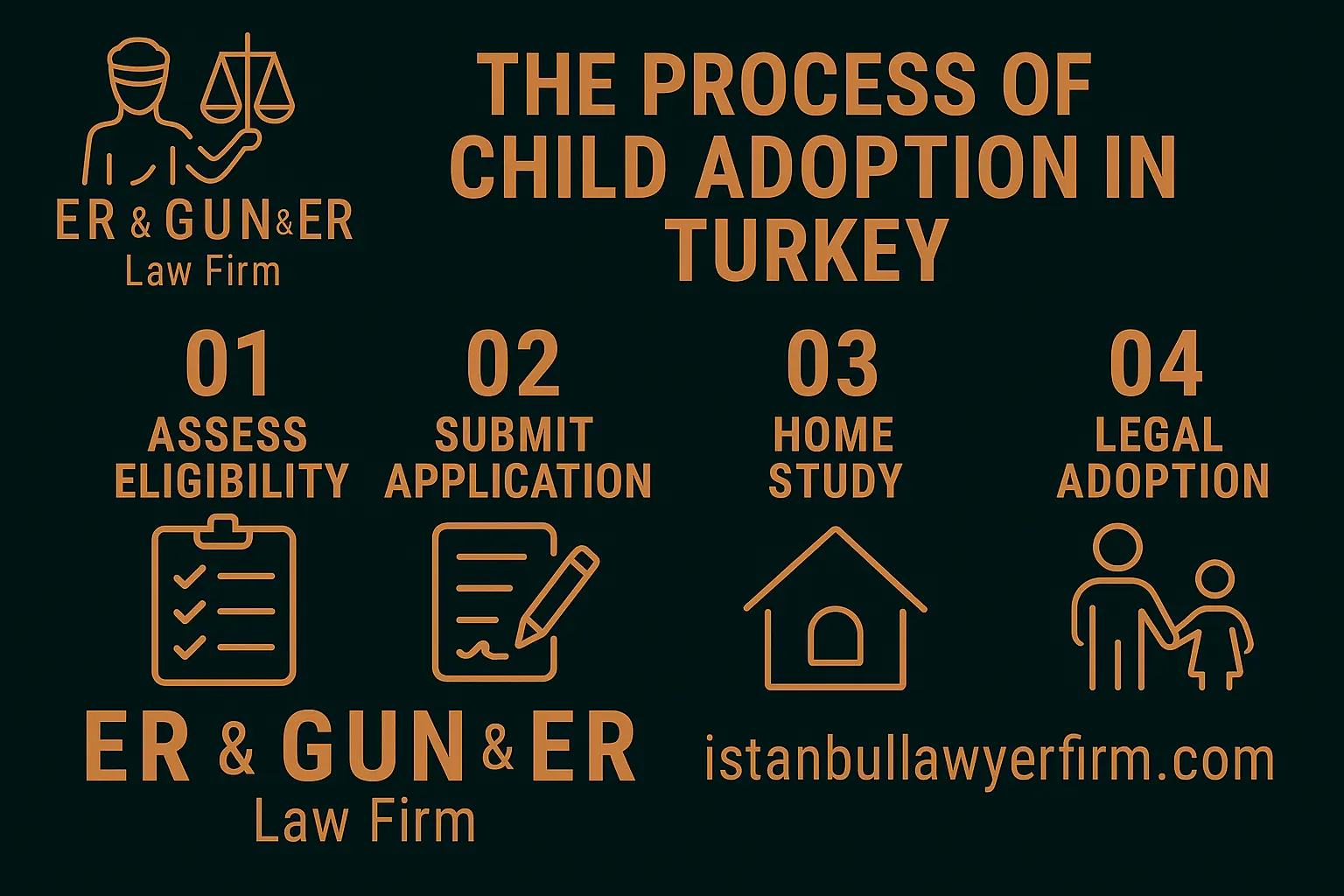
Child adoption (evlat edinme) in Türkiye operates through an integrated framework of substantive civil law, procedural rules, child protection legislation, and international conventions. The principal legal sources are: the Civil Code (Law No. 4721, the "TMK") of 22 November 2001, Articles 305-320 governing adoption substance and procedure; the Children Protection Law (Law No. 5395, the "Çocuk Koruma Kanunu") of 3 July 2005 (Resmi Gazete 15.7.2005/25876) governing state-care children and child protection framework; the Family Courts Law (Law No. 4787) of 9 January 2003 establishing specialised Family Court jurisdiction; the Citizenship Law (Law No. 5901) Article 17 governing citizenship effects of adoption; the International Private and Procedural Law (Law No. 5718, the "MÖHUK") Article 18 governing cross-border adoption choice of law; the Foreigners and International Protection Law (Law No. 6458, the "YUKK") for foreign adopter residence requirements; the Hague Convention on Protection of Children and Co-operation in Respect of Intercountry Adoption 1993 (Türkiye party since 2004); the Hague Apostille Convention 1961 (Türkiye party through Law No. 6303 of 8 May 1985); and HMK Article 223 governing sworn translation of foreign documents.
Family Court (Aile Mahkemesi) under Family Courts Law (Law No. 4787) holds principal jurisdiction for adoption proceedings, with proceedings characterised as inquisitorial process focused on the child's interest rather than adversarial litigation between competing parties. The Ministry of Family and Social Services (Aile ve Sosyal Hizmetler Bakanlığı) and its Directorate General of Children's Services (Çocuk Hizmetleri Genel Müdürlüğü) hold administrative authority over state-care children, foster care arrangements, and intercountry adoption coordination. Provincial Directorates (İl Müdürlüğü) operate at local level conducting home studies (sosyal inceleme), psychological assessments, and adoption suitability evaluations. The integrated framework prioritises the child's interest (çocuğun yararı) as the governing standard under TMK Article 305(2). Mandatory mediation under HUAK Articles 18/A and 18/B does not apply to adoption proceedings, which involve fundamental status determinations rather than monetary or property disputes. ER&GUN&ER Law Firm advises Turkish and foreign individuals and families through the integrated framework. Practice may vary by authority and year — check current guidance.
TMK 305-320 Substantive Adoption Framework
The Turkish Civil Code (Law No. 4721) Book Two governs adoption through Articles 305-320 with comprehensive substantive and procedural framework. TMK Article 305 establishes the foundational principles for adopting minors. The article requires that the adoption serves the child's interest (çocuğun yararı) — the governing standard throughout adoption analysis. The interest standard requires the court to evaluate not just the adopters' fitness but the substantive benefit to the specific child considering all circumstances including emotional bonding, stability, family integration, and similar factors. The article also requires that adoption not impair the interests of the adopters' other children where applicable.
TMK Article 306 governs joint adoption by spouses (eşlerin birlikte evlat edinmesi) with specific qualifying conditions. The spouses must be either: married for at least 5 years; or one of them must have completed 30 years of age. The "or" structure means either condition satisfies the threshold — both are not required. A specific exception applies for adoption of one spouse's existing descendant (typically stepchild adoption), where the requirement is reduced to 2 years of marriage or 30 years of age. The framework supports both newer marriages with mature individuals and longer marriages of younger adopters. Joint adoption establishes parental relationship with both spouses simultaneously, distinguishing this pathway from sequential individual adoption. Practice may vary by authority and year — check current guidance.
TMK Article 307 governs single-person adoption (tek başına evlat edinme) requiring the adopter to have completed 30 years of age. Single persons (whether unmarried, divorced, or widowed) and married persons whose spouse is unable or unwilling to participate (with specific exceptions) can pursue single-person adoption. The framework establishes parental relationship with only the single adopter — without creating any legal relationship with the adopter's spouse if applicable. TMK Article 308 establishes the minimum 18-year age gap between adopter and adoptee, ensuring developmentally appropriate parent-child relationship. The age gap requirement is strict — exceptions are not generally available even where biological-equivalent relationships might support shorter gaps (such as adoption between very close relatives). The age gap calculation runs from the adopter's birth date to the adoptee's birth date as of the adoption decision date.
Consent, Care Period, and Procedural Requirements
TMK Article 309 governs the minor's consent (küçüğün rızası). Where the child has capacity of discernment (ayırt etme gücü — typically interpreted as approximately 12+ years subject to individual assessment), the child's consent to adoption is required and must be expressed before the court directly. The consent requirement protects the child's autonomy in significant family status decisions. For children below capacity of discernment, the consent requirement does not apply, but the court still evaluates the child's interest considering all available evidence including any expressed preferences appropriate to the child's developmental level.
TMK Article 310 governs biological parents' consent (ana ve babanın rızası) as the general rule for adoption — parents must consent in writing before the court. TMK Article 311 establishes specific exceptions where parental consent is not required: parent is deceased or whereabouts unknown; parent permanently lacks capacity of discernment; or parent has substantially failed in parental duties despite the child's needs. The exceptions are interpreted strictly with substantive evidence required for the substantial failure ground — typical applications involve documented neglect, abandonment, abuse, or chronic absence from the child's life. TMK Article 312 specifies the form and timing of consent — consent must be express, specific to adoption (not generic), and provided after the child reaches 6 weeks of age (preventing pressured early consent shortly after birth). Practice may vary by authority and year — check current guidance.
TMK Article 313 establishes the one-year care and education requirement (bir yıl bakıp eğitme şartı) — the prospective adopters must have cared for and educated the child for at least one year before the adoption can be finalised. This pre-adoption care period serves multiple functions: enabling the child to bond with the prospective adopters; providing observation period for child welfare authorities and the court; identifying any incompatibilities before formal adoption; and supporting reasoned decision-making by all parties. The care period typically operates through formal foster care arrangement coordinated with the Provincial Directorate of Family and Social Services, with periodic supervision and assessment. Note that this one-year care requirement is substantively different from any residence requirement that may apply to foreign adopters — the two "one-year" periods address different concerns and operate through different legal mechanisms. Successful completion of the care period supports the adoption petition to the Family Court for final adoption order.
Family Court Procedure Under Articles 317-320
Adoption procedure operates through the Family Court (Aile Mahkemesi) under Family Courts Law (Law No. 4787) jurisdiction with TMK Articles 317-320 governing specific procedural requirements. The procedure begins with petition (dava dilekçesi) filed at the Family Court of the prospective adopters' domicile, naming the child to be adopted, the adoption pathway (joint, single-person, stepchild), and supporting facts. The petition must include comprehensive documentation: identity documents for adopters and child; marital status documentation where applicable; family registry records (vukuatlı nüfus kayıt örneği); proof of the one-year care period; income and asset documentation supporting financial capacity; medical records confirming health for parenting; criminal record clearances; and similar supporting documentation.
Court proceedings under TMK Article 317 require the court to evaluate adoption suitability through multiple inputs. Social investigation report (sosyal inceleme raporu) by Provincial Directorate of Family and Social Services social workers provides comprehensive home study assessment including living environment, family dynamics, financial stability, emotional readiness, and integration prospects. Psychological assessments evaluate adopters' parenting capacity and child's bonding patterns. Medical assessments confirm physical health for parenting. The court hears the prospective adopters, the child (where appropriate to age), the biological parents (where applicable), and any other relevant parties. The Public Prosecutor (savcı) participates in adoption proceedings under inquisitorial framework, providing independent input on the child's interest. Practice may vary by authority and year — check current guidance.
The court issues the adoption order (evlat edinme kararı) only after satisfaction that all substantive requirements are met and the adoption serves the child's interest. The decision becomes final upon expiration of appeal period (typically 2 weeks) without challenge, or upon completion of any appeal proceedings affirming the adoption. Once final, the adoption is registered with the Civil Registry (Nüfus Müdürlüğü) updating the central population system (MERNİS) with the child's new family relationship, surname, and parental authority. The Civil Registry issues new identity documents reflecting the adopted status. Foreign-side documentation, embassy notifications, and similar additional administrative steps follow based on case-specific factors. Adoption can be terminated in extraordinary circumstances under TMK Article 315 — specific grounds include: lack of required consents; absence of qualifying conditions retrospectively discovered; or significant breach of adoption purposes. Termination proceedings require strong substantive justification given the strong policy preference for adoption stability protecting the child.
Effects of Adoption Under TMK Article 314
TMK Article 314 governs the legal effects of adoption establishing a comprehensive transformation of the legal relationship between adopter, adoptee, and biological family. The adopter and adoptee acquire a parent-child legal relationship (soybağı) with all associated rights and obligations equivalent to biological parent-child relationships. The adopted child acquires inheritance rights from the adopter equivalent to biological children's rights — adopted children inherit alongside biological children of the adopter under TMK Articles 495-501 framework, with TMK Article 506 forced heirship protection extending to adopted children.
Surname effects under TMK Article 314 establish that minor adopted children take the adopter's surname. For joint adoption by spouses, the child takes the family name. For single-person adoption, the child takes the single adopter's surname. The surname change is automatic with adoption and reflected in Civil Registry records and identity documents. Adult adoption (TMK Article 316) operates with somewhat different surname rules acknowledging the adult's existing identity. Parental authority (velayet) under TMK Articles 335-351 transfers from biological parents to the adopter(s) — the adopter holds full parental authority including custody, education decisions, medical consent, religious instruction, and general parental decision-making. Where stepchild adoption preserves the relationship with one biological parent (the adopter's spouse), parental authority is shared between the biological parent and the adopting stepparent. Practice may vary by authority and year — check current guidance.
Relationship with biological family generally terminates with adoption — the adopted child is no longer legally connected to biological parents, biological siblings, or the broader biological family for inheritance, support obligations, and similar legal purposes. The exceptions involve stepchild adoption where the relationship with the adopter's spouse (the child's biological parent) is preserved. The substantive transformation distinguishes Turkish adoption from foster care, guardianship, or similar partial-relationship arrangements that preserve biological family connections. Legal duties of biological parents including child support obligations end with adoption finalisation. Practical relationships including ongoing contact may continue based on the adopted family's choices but are not legally compelled by Turkish framework. The clean-break model supports adoptive family integration while creating significant emotional and identity considerations for adopted persons accessing biological family information later — Turkish framework provides limited but specific access to biological family information through judicial procedures upon adopted person's request after reaching majority.
Cross-Border Adoption Under MÖHUK 18 and Hague Convention
Cross-border adoption involving Turkish elements operates under integrated international framework. MÖHUK Article 18 establishes choice-of-law rules for adoption with specific application based on adopters' nationality, residence, and relationship to the child. The substantive rules generally apply the adopters' national law to adoption requirements while preserving Turkish public policy and the child's interest as overriding considerations. Procedurally, Turkish-side adoption proceedings before Turkish Family Court remain available for Turkish-resident adopters or for adoption of children located in Türkiye, regardless of the adopters' or child's nationality.
Türkiye is party to the Hague Convention on Protection of Children and Co-operation in Respect of Intercountry Adoption 1993 (in force for Türkiye since 2004), establishing comprehensive international framework for cross-border adoption between member states. The Convention's principal mechanisms include: cooperation between Central Authorities of sending and receiving states; required determinations by both states regarding the child's adoptability and the prospective adopters' suitability; integrated documentation and approval processes preventing inappropriate cross-border placements; recognition framework ensuring adoption decisions are recognised in both states; and post-adoption monitoring frameworks. The Convention significantly streamlines international adoptions between member states while imposing rigorous protections against improper practices including child trafficking and inadequate child welfare assessment. Practice may vary by authority and year — check current guidance.
Practical cross-border adoption implementation involves several integrated elements. Foreign adopters seeking to adopt Turkish children typically operate through accredited adoption agencies coordinating with Turkish Central Authority (Ministry of Family and Social Services for Hague Convention purposes) and the receiving country's Central Authority. Turkish-resident adopters seeking to adopt foreign children operate through analogous coordination from Turkish receiving-state perspective. Documentation requires comprehensive translation under HMK Article 223 sworn translation framework, and legalisation through Hague Apostille 1961 (Türkiye party through Law No. 6303 since 1985) for documents from member states or consular legalisation for non-member states. Recent expansions of the Apostille Convention include UAE (effective 7 May 2022), Canada (2024), and Qatar (2024) — substantially simplifying cross-border documentation from these countries. Foreign adopter residence in Türkiye involves coordination with Foreigners and International Protection Law (Law No. 6458) framework with specific residence permit categories supporting adoption-related stays. Post-adoption residence and citizenship for the adopted child involve coordination with destination country immigration framework and Turkish citizenship considerations. The integrated cross-border framework requires careful coordination between Turkish counsel and foreign counsel with established expertise in both jurisdictions.
Citizenship Effects Under Law 5901 Article 17
Citizenship effects of adoption operate under Citizenship Law (Law No. 5901) framework with specific Article 17 governing adoption-based citizenship. Where a Turkish citizen adopts a foreign minor child, the child can acquire Turkish citizenship through adoption-based pathway under Law 5901 Article 17. The acquisition operates upon the adoption decision becoming final, with subsequent administrative registration with the Directorate General of Population and Citizenship Affairs (Nüfus ve Vatandaşlık İşleri Genel Müdürlüğü). Specific procedural requirements include: documentation of adoption finality; child's identity verification; absence of national security or public order concerns; and similar administrative requirements supporting the citizenship registration.
Where foreign adopters adopt a Turkish citizen child, the child generally retains Turkish citizenship — the adoption does not automatically result in citizenship loss. Specific circumstances may support citizenship loss under Law 5901 Articles 28-32 framework if the adopted child acquires foreign citizenship and specific procedural requirements are met, but the default outcome preserves Turkish citizenship alongside any acquired foreign citizenship resulting in dual nationality. Dual nationality is generally permitted under Turkish framework with specific rights and obligations including military service obligation considerations for male dual nationals reaching applicable age. Practice may vary by authority and year — check current guidance.
Practical citizenship management for adopted children involves several elements. Documentation including new identity card, passport, and family registry records reflects the post-adoption status. Where dual nationality applies, both nationality documents must be obtained and maintained through respective issuing authorities. Travel documentation for cross-border movements requires coordination between Turkish and foreign authority frameworks. Education and social services access through Turkish institutions operates based on Turkish citizenship and family status. Future citizenship implications for the adopted child including military service, voting rights, employment access, and similar nationality-based rights operate under the citizenship status established at adoption. Strategic planning for international families considers all these dimensions in the adoption decision-making and post-adoption management. ER&GUN&ER Law Firm coordinates citizenship analysis with broader adoption process providing integrated representation across substantive adoption law, procedural Family Court representation, citizenship registration with Directorate General of Population and Citizenship Affairs, and international coordination with foreign counsel.
Special Cases: Stepchild, Relative, and State-Care Adoptions
Stepchild adoption (üvey çocuğun evlat edinilmesi) operates under TMK Article 306 modified framework — the existing spouse's biological parent role is preserved while the adopting stepparent acquires parental authority alongside the biological parent. The reduced qualifying conditions (2 years of marriage instead of 5, or 30 years of age) recognise the existing family integration. Consent of the non-custodial biological parent is required under TMK Article 310 unless qualifying exceptions under Article 311 apply (parent deceased, unknown, lacking capacity, or substantially failing parental duties). Stepchild adoption is among the most common adoption forms in Turkish practice, formalising existing family relationships into legal recognition.
Relative adoption (akraba evlat edinmesi) — adoption by family members other than spouses — operates under general TMK 305-320 framework with the same substantive requirements applying. Common scenarios include grandparents adopting grandchildren following biological parents' death or incapacity, aunts and uncles adopting nieces and nephews in similar circumstances, and similar family-based adoptions preserving children within the broader family rather than placing them with unrelated adopters. The court evaluation gives substantial weight to existing family bonds while still applying the child's interest standard rigorously. Documentation requirements typically include comprehensive family relationship evidence and explanation of the circumstances necessitating relative adoption rather than biological parent care. Practice may vary by authority and year — check current guidance.
State-care children (devlet korumasındaki çocuklar) adoption operates under integrated framework with Children Protection Law (Law No. 5395) providing the substantive framework for state-care arrangements and TMK adoption framework providing the procedural pathway for adoption finalisation. Children in state institutions, foster care arrangements, or under formal child protection orders can be adopted following specific Ministry of Family and Social Services procedures including adopter registration, suitability assessment, child matching, foster care transition, and adoption finalisation through the Family Court. The Provincial Directorate maintains adopter registries (evlat edinme bekleyen aile) with prospective adopters waiting for suitable child matches. Same-sex couple joint adoption is not currently available under Turkish framework as Turkish law does not recognise same-sex marriage and consequently does not provide for joint adoption by same-sex partners — single-person adoption under TMK Article 307 remains theoretically available regardless of sexual orientation, though practical considerations including home study evaluations may involve case-specific dynamics. Adult adoption (erginlerin evlat edinilmesi) under TMK Article 316 enables adoption of persons 18 years and older with specific substantive requirements including continuing care relationship and absence of competing biological parent objection in specific circumstances.
Frequently Asked Questions
- What law governs adoption in Türkiye? Turkish Civil Code (Law No. 4721) Articles 305-320; Children Protection Law (Law No. 5395, 3.7.2005); Family Courts Law (Law No. 4787); Citizenship Law (Law No. 5901) Article 17 for citizenship effects; MÖHUK (Law No. 5718) Article 18 for cross-border choice of law; Hague Adoption Convention 1993 (Türkiye party since 2004).
- What are the basic eligibility requirements? TMK Article 306 for spousal joint adoption — 5 years married OR 30 years of age (one condition). TMK Article 307 for single-person adoption — 30 years of age. TMK Article 308 — minimum 18-year age gap between adopter and child. TMK Article 305 — child's interest as governing standard.
- What is the one-year care requirement? Under TMK Article 313, prospective adopters must have cared for and educated the child for at least one year before the adoption can be finalised. This pre-adoption care period typically operates through formal foster care arrangement coordinated with Provincial Directorate of Family and Social Services.
- Is consent required? Under TMK Article 309, child with capacity of discernment (typically 12+ years) must consent. Under TMK Article 310, biological parents' consent is generally required, with TMK Article 311 exceptions (parent deceased, unknown, lacking capacity, or substantially failing parental duties).
- What about stepchild adoption? Reduced qualifying conditions under TMK Article 306 — 2 years of marriage or 30 years of age. Existing biological parent (the adopter's spouse) role preserved. Non-custodial biological parent consent generally required unless TMK Article 311 exceptions apply.
- Which court has jurisdiction? Family Court (Aile Mahkemesi) under Family Courts Law (Law No. 4787) of 9.1.2003. Inquisitorial procedure focused on child's interest. Public Prosecutor (savcı) participates providing independent input. Mandatory mediation under HUAK Articles 18/A and 18/B does NOT apply to adoption proceedings.
- What documentation is needed? Identity documents for adopters and child; marital status documentation; family registry records (vukuatlı nüfus kayıt örneği); proof of one-year care period; income and asset documentation; medical records; criminal record clearances; social investigation report (sosyal inceleme raporu); psychological assessments. For foreign documents: Hague Apostille 1961 (Türkiye party through Law No. 6303) plus sworn translation under HMK Article 223.
- What are the effects of adoption? Under TMK Article 314: parent-child legal relationship (soybağı) with all associated rights; inheritance rights equivalent to biological children under TMK Articles 495-501 with TMK Article 506 forced heirship; surname change to adopter's surname for minors; parental authority (velayet) transfer under TMK Articles 335-351; termination of legal relationship with biological family (except stepchild adoption preserving biological parent relationship).
- Can foreigners adopt in Türkiye? Yes. Through Hague Convention 1993 framework where applicable (between member states), or through general TMK 305-320 framework. Coordination through Ministry of Family and Social Services as Turkish Central Authority for Hague purposes. Foreign adopter residence under YUKK (Law No. 6458) framework with specific residence permit categories.
- What citizenship effects apply? Under Law 5901 Article 17: Turkish citizen adopting foreign minor — child can acquire Turkish citizenship through adoption-based pathway upon decision finality. Foreign adopter adopting Turkish child — child generally retains Turkish citizenship with possible dual nationality based on receiving country framework.
- Is same-sex adoption available? Joint adoption by same-sex couples is not available under Turkish framework as Turkish law does not recognise same-sex marriage. Single-person adoption under TMK Article 307 remains theoretically available regardless of sexual orientation, though practical considerations apply.
- Is adult adoption possible? Yes, under TMK Article 316 (erginlerin evlat edinilmesi) for persons 18 years and older with specific substantive requirements including continuing care relationship and consent considerations.
- Can adoption be terminated? Yes, in extraordinary circumstances under TMK Article 315: lack of required consents; absence of qualifying conditions retrospectively discovered; significant breach of adoption purposes. Termination requires strong substantive justification given adoption stability policy.
- How does cross-border adoption work? Under MÖHUK Article 18 choice-of-law framework and Hague Convention 1993 cooperation framework. Central Authority coordination between sending and receiving states. Comprehensive documentation through accredited agencies. Recognition of foreign adoption decisions through MÖHUK Articles 50-59 tenfiz procedures where required.
- Where does ER&GUN&ER Law Firm support adoption matters? Adoption eligibility analysis under TMK Articles 305-308; Family Court representation under Law 4787 with petition preparation, social investigation report coordination, hearing representation, and final decision registration; one-year care period structuring under TMK Article 313 with Provincial Directorate coordination; consent procedures under TMK Articles 309-311; cross-border adoption under MÖHUK Article 18 with Hague Convention 1993 coordination; foreign documentation with Hague Apostille 1961 and HMK Article 223 sworn translation; foreign adopter residence under YUKK Law 6458; citizenship effects under Law 5901 Article 17 with Directorate General of Population and Citizenship Affairs registration; stepchild and relative adoption with reduced TMK 306 conditions; state-care children adoption under Law 5395 framework; adult adoption under TMK Article 316; adoption termination under TMK Article 315; and integrated multi-jurisdiction representation with foreign counsel coordination.
Author: Mirkan Topcu is an attorney registered with the Istanbul Bar Association (Istanbul 1st Bar), Bar Registration No: 67874. His practice focuses on cross-border and high-stakes matters where evidence discipline, procedural accuracy, and risk control are decisive.
He advises Turkish and foreign individuals and families across Adoption Eligibility Analysis under TMK Articles 305-308, Family Court Representation under Family Courts Law (Law No. 4787) of 9.1.2003 with Petition Preparation under TMK Articles 317-320, One-Year Care Period Structuring under TMK Article 313, Consent Procedures under TMK Articles 309-311, Adoption Effects under TMK Article 314 with Inheritance under TMK Articles 495-501, Forced Heirship under TMK Article 506, and Surname Change Coordination, Cross-border Adoption under MÖHUK (Law No. 5718) Article 18 with Hague Convention on Protection of Children and Co-operation in Respect of Intercountry Adoption 1993 Coordination, Foreign Documentation under Hague Apostille Convention 1961 (Türkiye party through Law No. 6303 since 1985) with Sworn Translation under HMK Article 223, Foreign Adopter Residence under YUKK (Law No. 6458), Citizenship Effects under Citizenship Law (Law No. 5901) Article 17 with Directorate General of Population and Citizenship Affairs Registration, Stepchild and Relative Adoption under TMK Article 306 Reduced Conditions, State-Care Children Adoption under Children Protection Law (Law No. 5395) of 3.7.2005, Adult Adoption under TMK Article 316, Adoption Termination under TMK Article 315, MÖHUK Articles 50-59 Foreign Judgment Recognition, and Integrated Multi-jurisdiction Representation.
Education: Istanbul University Faculty of Law (2018); Galatasaray University, LL.M. (2022). LinkedIn: Profile. Istanbul Bar Association: Official website.