

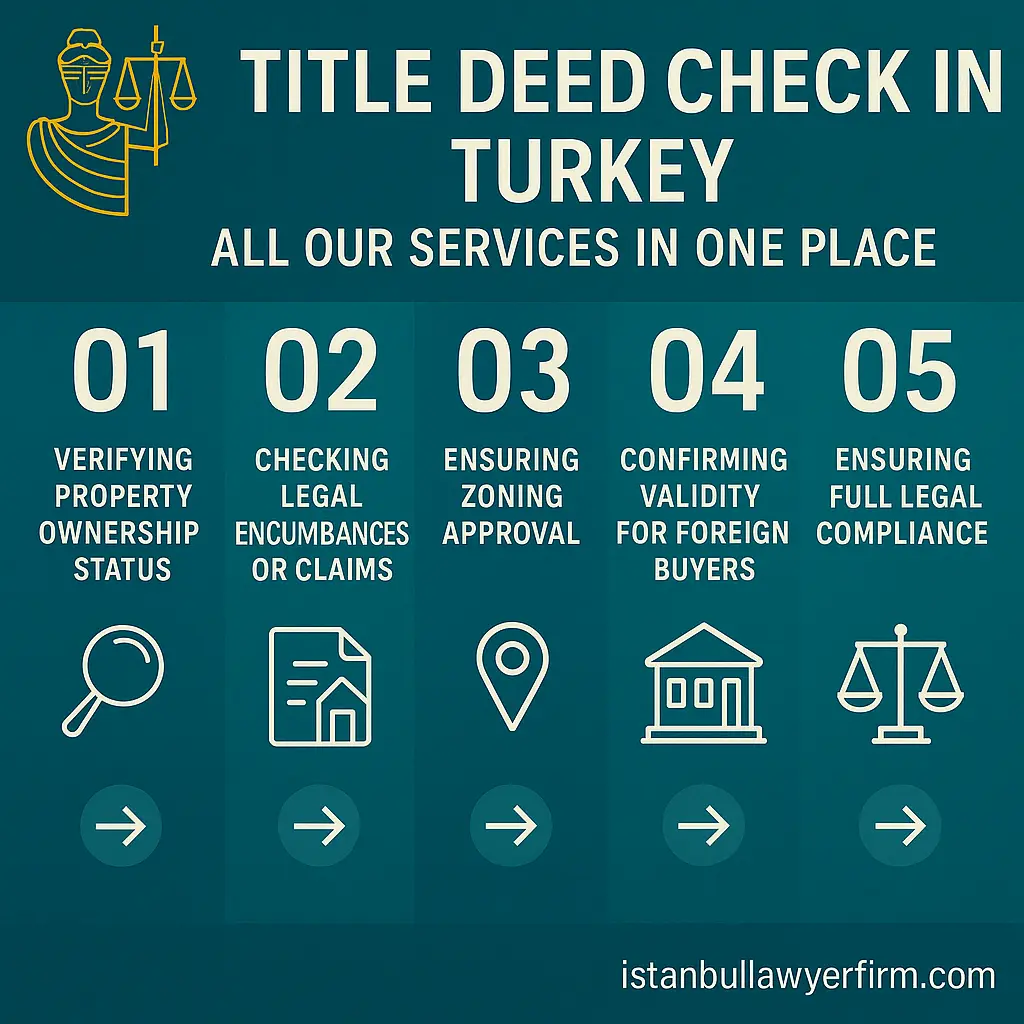
Title deed (tapu) verification in Türkiye operates through an integrated framework spanning property registration, zoning, condominium law, foreign acquisition rules, and procedural systems. The principal legal sources are: the Land Registry Law (Law No. 2644, the "Tapu Kanunu") of 22 December 1934 (Resmi Gazete 29.12.1934/2892) including Article 7 registry reliability principle, Article 26 official deed requirement, Article 35 foreign acquisition framework, and Article 36 foreign legal entity rules; the Civil Code (Law No. 4721, the "TMK") Articles 683-723 governing property rights, Articles 704-723 governing immovable property, Articles 997-1027 governing the land registry system, Article 1023 establishing registry good-faith reliance, and Article 1024 governing title cancellation and registration actions; the Zoning Law (Law No. 3194, the "İmar Kanunu") of 9 May 1985 with Article 20 (building permit), Article 30 (occupancy permit), and Article 32 (unlicensed buildings); the Condominium Law (Law No. 634, the "Kat Mülkiyeti Kanunu") governing apartment ownership; the Land Registry Regulation (Tapu Sicil Tüzüğü) of 17 August 2013 (Resmi Gazete 28738) providing comprehensive procedural framework; Cumhurbaşkanlığı Kararı No. 6302 of 18 June 2022 governing foreign acquisition country eligibility; and Citizenship Law (Law No. 5901) Article 12/A with Cumhurbaşkanlığı Kararı No. 5042 of 13 June 2022 establishing the USD 400,000 investment threshold for citizenship-by-investment.
The Turkish land registry operates through TAKBİS (Tapu ve Kadastro Bilgi Sistemi — Land Registry and Cadastre Information System) centralised electronic system maintained by Tapu ve Kadastro Genel Müdürlüğü (General Directorate of Land Registry and Cadastre). Web-Tapu provides public-facing access to specific registry information through e-Devlet integration with extended functionality for authorised users including attorneys with appropriate authorisations. Specialised concerns affecting specific properties include: military restricted zones under Law No. 2565 (Askeri Yasak Bölgeler ve Güvenlik Bölgeleri Kanunu); cultural heritage and conservation sites under Law No. 2863 (Kültür ve Tabiat Varlıklarını Koruma Kanunu); disaster risk areas under Law No. 6306 (Afet Riski Altındaki Alanların Dönüştürülmesi Hakkında Kanun); agricultural land restrictions under Law No. 5403 (Toprak Koruma ve Arazi Kullanımı Kanunu); and expropriation risk under Law No. 2942 (Kamulaştırma Kanunu). Comprehensive title deed verification requires integrated review across all these frameworks. ER&GUN&ER Law Firm advises foreign and Turkish buyers, sellers, and investors on integrated title verification.
Tapu Kanunu and TMK Property Framework
The Land Registry Law (Law No. 2644) and Civil Code (Law No. 4721) together establish the substantive Turkish property law framework. TMK Article 705 establishes that immovable property ownership transfer requires registration in the land registry — meaning title to Turkish real estate transfers only through formal Tapu Müdürlüğü registration, not through private sale agreements alone. TMK Article 706 requires the official deed (resmi senet) prepared at the Tapu Müdürlüğü as the constituent transfer instrument. Tapu Kanunu Article 26 reinforces the official deed requirement specifying procedural form. Private sale agreements between parties without official deed registration generally do not transfer title under Turkish law, though they may create contractual obligations enforceable through specific performance actions under TMK and TBK frameworks. The land registry framework evolves with periodic Tapu Müdürlüğü and TKGM guidance; confirm the current practice for any specific transaction.
The registry good-faith principle under TMK Article 1023 and Tapu Kanunu Article 7 protects bona fide purchasers relying on registry information against challenges from prior unregistered claims. The principle supports market efficiency and transaction security by enabling buyers to rely on registry status without exhaustive historical investigation — though specific exceptions apply for actual knowledge of conflicting claims, fraudulent registration, and similar circumstances. The Tapu Kanunu and TMK framework establishes the substantive basis for due diligence focus on registry status: a clean current registry typically supports valid acquisition through standard registration process, while problematic registry status (encumbrances, restrictions, conflicting claims) requires specific resolution before or during acquisition.
Title cancellation and registration action (tapu iptali ve tescili davası) under TMK Article 1024 provides the substantive remedy for incorrect or fraudulent registry entries. The action operates before the Asliye Hukuk Mahkemesi (Civil Court of First Instance) under HMK general civil procedure framework. Successful action results in court-ordered registry correction with retroactive effect. Common grounds include: fraudulent transfer through forged documents; transfer by non-owner; erroneous registry entries; failure of formal requirements in original transaction; and similar circumstances supporting registry correction. Mandatory mediation under HUAK Article 18/B (added by Law No. 7445 of 28 March 2023, effective 1 September 2023) applies to immovable property disputes including TMK 1024 actions involving certain dispute types — meaning attempted mediation is procedural prerequisite for court filing in qualifying cases. Strategic title verification before purchase reduces TMK 1024 dispute risk through identification of registry concerns enabling pre-purchase resolution rather than post-purchase litigation. The integrated framework supports robust protection for buyers conducting proper due diligence while requiring active verification rather than passive reliance.
Reading the Tapu: Components and Significance
The Turkish title deed (tapu senedi) contains specific information enabling property identification and ownership verification. The principal fields include: il (province), ilçe (district), mahalle (neighbourhood), and köy (village where applicable) establishing geographic location; ada numarası (block number) and parsel numarası (parcel number) providing cadastral identification; bağımsız bölüm numarası (independent section number) for condominium units identifying the specific apartment; arsa payı (land share) showing the unit's proportional share in common areas; nitelik (property nature) classifying the property type; cins (kind) providing additional classification; and yüzölçümü (area) showing property size.
Ownership information includes malik (owner) showing the registered owner's identity, hisse (share) showing ownership share for fractional ownership situations, edinme sebebi (acquisition cause) showing how the current owner acquired title (purchase, inheritance, etc.), and edinme tarihi (acquisition date). Encumbrance and restriction information appears in the beyanlar (declarations) and şerhler (annotations) sections covering: ipotek (mortgage); haciz (judicial seizure); ihtiyati tedbir (preliminary injunction); ihtiyati haciz (preliminary attachment); irtifak hakkı (servitude/easement); intifa hakkı (usufruct); satış vaadi (promise to sell); kira şerhi (lease annotation); and similar encumbrances affecting property rights.
Property classification analysis is critical for understanding usage rights and restrictions. The principal classifications include: arsa (vacant land within municipal boundaries); tarla (agricultural field outside municipal boundaries with significant use restrictions under Law No. 5403); bağ-bahçe (vineyard-garden); mesken (residential building); işyeri (commercial property); kat mülkiyeti (condominium ownership under Kat Mülkiyeti Kanunu Article 1); kat irtifakı (condominium servitude — pre-completion stage under Article 12); and arsa payı (land share without condominium status). The distinction between kat mülkiyeti (full condominium ownership for completed buildings with occupancy permit) and kat irtifakı (preliminary stage prior to building completion) is fundamental for buyers — kat mülkiyeti provides the highest level of ownership security with full legal independence of the unit, while kat irtifakı creates dependency on building completion and successful conversion to kat mülkiyeti. Buyers should generally prefer kat mülkiyeti or carefully analyse kat irtifakı situations before commitment.
İmar Kanunu Zoning and Building Compliance
The Zoning Law (Law No. 3194, "İmar Kanunu") of 9 May 1985 establishes the comprehensive Turkish zoning framework with substantial application to property due diligence. İmar Kanunu Article 20 governs the building permit (yapı ruhsatı) requirement — construction requires prior building permit issued by the relevant municipality based on approved zoning plan and architectural project. Construction without permit (kaçak yapı — unlicensed building) violates Article 32 with administrative consequences including demolition orders, monetary penalties, and integrated regulatory exposure.
The occupancy permit (yapı kullanma izin belgesi or iskan belgesi) under Article 30 represents the critical post-completion certification that the building meets project specifications and is suitable for use. The occupancy permit is prerequisite for: utility connections (electricity, water, natural gas) under integrated regulatory framework; conversion of kat irtifakı to kat mülkiyeti; legal commercial operation for commercial properties; and full property functionality. Buildings lacking occupancy permits face substantial limitations and risks despite physical existence — buyers should specifically verify occupancy permit status alongside title deed verification. Recent legal frameworks have addressed historical occupancy permit issues through amnesty programmes (imar barışı) — most recently through Law No. 7143 of 18 May 2018 enabling registration of qualifying unlicensed buildings, with subsequent extensions and modifications. Properties registered through amnesty programmes carry specific characteristics worth understanding before purchase.
Zoning verification involves multiple coordinated steps. Municipal zoning plan (imar planı) review identifies the property's permitted uses, building density (KAKS — building coefficient), height limits, setback requirements, and similar zoning parameters. Cadastral plan (kadastro planı) review confirms physical boundaries match registry information. Site visit and physical verification confirms the actual structure matches registry and project documentation. Coordination with municipal officials including imar müdürlüğü (zoning directorate), fen işleri müdürlüğü (technical services directorate), and ruhsat müdürlüğü (permit directorate) provides authoritative verification. Specific concerns include: buildings exceeding zoning permitted parameters (potentially subject to demolition); construction violating setback requirements; properties in zones designated for future urban renewal under Law No. 6306; properties affected by expropriation plans under Law No. 2942; and similar regulatory concerns. Strategic zoning verification before purchase enables informed decisions and price negotiation reflecting actual property status. ER&GUN&ER Law Firm coordinates zoning verification with broader title due diligence through municipal engagement and integrated regulatory analysis.
Condominium Law (Kat Mülkiyeti) Under Law 634
The Condominium Law (Law No. 634, "Kat Mülkiyeti Kanunu") governs apartment ownership representing the most common Turkish residential property structure for multi-unit buildings. Kat Mülkiyeti Kanunu Article 1 defines kat mülkiyeti as ownership of an independent section (bağımsız bölüm) within a building suitable for separate use, with shared ownership of common areas (ortak yerler) under Article 4. The framework enables individual unit ownership combined with shared infrastructure, common area, and building governance.
Establishment of kat mülkiyeti under Article 10 requires several integrated elements: completed building with occupancy permit under İmar Kanunu Article 30; approved project and floor plans (proje ve plan); building management plan (yönetim planı) governing common area management and dispute resolution; and formal registration through Tapu Müdürlüğü based on integrated documentation. Pre-completion buildings operate under kat irtifakı (Article 12) — preliminary condominium servitude that converts to full kat mülkiyeti upon building completion and registration. The conversion from kat irtifakı to kat mülkiyeti is critical milestone — buyers acquiring kat irtifakı should understand the conversion timing, conditions, and risks if conversion fails or delays.
Building management under Kat Mülkiyeti Kanunu Article 35 onwards operates through the management plan framework with general assembly (kat malikleri kurulu) decision-making, manager (yönetici) execution, and integrated framework for: common expenses allocation; building maintenance; common area use; building rules and restrictions; and dispute resolution. The management plan registers in the land registry annotation section and binds successive owners — meaning new buyers inherit the existing management framework regardless of their views on its terms. Common expense liability under Article 20 attaches to unit ownership with specific procedures for collection including ipotek registration for unpaid expenses. Common area regulation under Article 18 establishes the framework for use rights and restrictions. Disputes between unit owners typically operate through Sulh Hukuk Mahkemesi jurisdiction under HMK Article 4 framework with specific Kat Mülkiyeti Kanunu procedural rules. Strategic condominium due diligence includes reviewing the existing management plan, recent general assembly decisions, common expense status, and any pending disputes affecting the building. Foreign buyers should specifically understand condominium framework as the default residential property structure differs substantially from individual house ownership in many other jurisdictions.
Foreign Acquisition Under Article 35 and CK 6302
Foreign acquisition of Turkish real estate operates under Tapu Kanunu Article 35 framework as substantially modified by reciprocity and Cabinet/Presidential Decree mechanisms. The historical reciprocity (mütekabiliyet) requirement was substantially modified through legislative reforms enabling broader foreign acquisition. Currently, foreign nationals from countries permitted under Cumhurbaşkanlığı Kararı No. 6302 of 18 June 2022 framework can acquire Turkish real estate subject to specific conditions and limitations.
Substantive limitations under Article 35 framework include: total foreign acquisition not exceeding 10% of provincial district private property; individual foreign acquisition not exceeding 30 hectares total in Türkiye (with exceptional increase to 60 hectares with Presidential authorisation); restriction on military restricted zones requiring specific permits; restrictions in security zones; and integrated security clearance procedures through provincial authorities and military commands where applicable. Tapu Kanunu Article 36 governs foreign legal entities' acquisition with separate framework typically requiring: investment law (Law No. 4875) registration where applicable; specific corporate purpose connection to acquired property; and integrated regulatory compliance. Foreign companies generally cannot acquire real estate as passive investments without operational connection to the property.
Procedural framework for foreign acquisition involves several integrated steps. Pre-acquisition verification typically includes: country eligibility confirmation under CK 6302 framework; security clearance through military and security authorities for properties in or near restricted zones (typically administered through Tapu Müdürlüğü); aggregate acquisition tracking against provincial 10% and personal 30-hectare limits; and integrated regulatory compliance. Acquisition execution operates through the standard Tapu Müdürlüğü registration with specific foreign-acquisition documentation including: passport and identity verification; tax registration through Turkish Revenue Administration; valuation report from SPK-licensed appraiser meeting specific requirements (particularly important for citizenship-by-investment qualifying purchases); banking documentation evidencing payment through Turkish banking system; and integrated legal representation typically through power of attorney (vekaletname) under TBK Articles 502-514 for foreign buyers unable to attend in person. Citizenship-by-investment under Citizenship Law (Law No. 5901) Article 12/A as implemented through Cumhurbaşkanlığı Kararı No. 5042 of 13 June 2022 requires USD 400,000 minimum investment with three-year hold restriction registered as title deed annotation. The valuation must be conducted by SPK (Capital Markets Board) licensed appraisers using prescribed methodology — qualification of the appraisal is critical for citizenship application success.
Special Risk Areas: Military, Disaster, Conservation, Agricultural
Special risk areas affect title due diligence beyond general framework with specific implications for property acquisition and use. Military restricted zones (askeri yasak bölge) under Law No. 2565 (Askeri Yasak Bölgeler ve Güvenlik Bölgeleri Kanunu) restrict ownership, use, and transfer in specific zones around military installations. Properties in or near military zones require specific security clearances for foreign acquisition under Tapu Kanunu Article 35 framework. Verification through military command consultation is typically required and represents standard procedure for affected properties. Failure to obtain proper clearance can result in transaction invalidation and integrated security consequences.
Cultural heritage and conservation sites (sit alanı) under Law No. 2863 (Kültür ve Tabiat Varlıklarını Koruma Kanunu) impose substantial restrictions on properties within designated zones. The classification system includes archaeological, urban, natural, and integrated conservation site categories with corresponding restriction levels. Conservation site properties typically face: restriction on construction and modification requiring prior conservation board approval; specific architectural and material requirements for permitted modifications; restrictions on land use changes; integrated reporting and inspection obligations; and similar substantial limitations affecting property utility and value. Investment analysis for conservation site properties requires careful evaluation of restriction implications against use objectives. Disaster risk areas under Law No. 6306 (Afet Riski Altındaki Alanların Dönüştürülmesi Hakkında Kanun) of 16 May 2012 designate specific areas subject to urban renewal and structural transformation programmes. Properties in disaster risk areas face specific procedures for reconstruction, redevelopment, and integrated transformation with implications for current use and future development.
Agricultural land restrictions under Law No. 5403 (Toprak Koruma ve Arazi Kullanımı Kanunu) impose substantial limitations on agricultural property division and conversion. The framework restricts subdivision below specified minimum sizes affecting partition and inheritance treatment of agricultural land. Conversion from agricultural to non-agricultural use requires specific authorisation under integrated regulatory framework. Buyers acquiring agricultural land should specifically understand these restrictions affecting development and use flexibility. Coastal area properties under Law No. 3621 (Kıyı Kanunu) of 4 April 1990 face specific restrictions on shoreline buffer zones with prohibition on certain construction and use. Forest area properties under Law No. 6831 (Orman Kanunu) face complete restriction on private ownership of forest land with specific procedures for de-forestation and acquisition. National parks and protected natural areas under Law No. 2873 (Milli Parklar Kanunu) face complete or substantial restrictions on private acquisition. Expropriation risk under Law No. 2942 (Kamulaştırma Kanunu) affects properties subject to public-purpose acquisition with specific compensation and procedural framework. Strategic title due diligence includes systematic verification across all special risk frameworks through coordination with relevant authorities and integrated review of property-specific factors. ER&GUN&ER Law Firm coordinates comprehensive special risk area verification with broader title due diligence through multi-authority engagement.
TAKBİS, Web-Tapu, and Electronic Verification
The Turkish land registry operates through TAKBİS (Tapu ve Kadastro Bilgi Sistemi — Land Registry and Cadastre Information System) centralised electronic platform maintained by Tapu ve Kadastro Genel Müdürlüğü. TAKBİS integrates land registry records, cadastral information, and integrated property data across all Turkish provinces enabling consolidated access to property information. Authorised users including Tapu Müdürlüğü officials, government agencies with statutory authority, and specifically authorised attorneys access TAKBİS for comprehensive property information.
Web-Tapu (web-tapu.gov.tr) provides public-facing electronic access to specific property information through e-Devlet integration. Property owners access their own property records through e-Devlet authentication. Authorised attorneys can access client properties through power of attorney documentation. Web-Tapu provides: current registry status with ownership and encumbrance information; transaction history showing prior registrations; specific information about restrictions and annotations; and integrated property characteristics. Web-Tapu also supports transactional functionality including online application for various Tapu Müdürlüğü services. The integration between TAKBİS comprehensive data and Web-Tapu user-facing access provides modern Turkish title verification infrastructure substantially superior to historical paper-based verification.
Electronic verification advantages include: real-time current registry status (subject to update timing); reduced reliance on potentially outdated paper documents; integrated cross-referencing across registry information; documentation through electronic outputs supporting due diligence files; and remote access enabling cross-border due diligence without physical presence. Practical due diligence integration typically combines electronic verification through Web-Tapu and TAKBİS authorised access with: physical site visit for actual property condition; municipal engagement for zoning and permit verification; sworn appraiser engagement for valuation; and integrated legal review for risk assessment. Foreign buyer due diligence frequently operates through Turkish counsel under power of attorney with electronic verification supporting comprehensive analysis without buyer's physical presence. Documentation through Web-Tapu screenshots, official extracts, and integrated reports provides evidentiary basis for due diligence files supporting potential dispute resolution and ongoing property management. Strategic electronic verification implementation includes: regular monitoring during transaction negotiation and closing periods to detect any changes; integration with banking transaction documentation; coordination with valuation reports and timing; and comprehensive documentation supporting both transaction execution and post-closing dispute resolution.
Citizenship-by-Investment Title Requirements
Citizenship-by-investment under Citizenship Law (Law No. 5901) Article 12/A and implementing Cumhurbaşkanlığı Kararı No. 5042 of 13 June 2022 establishes specific real estate investment requirements with substantial title due diligence implications. The principal requirements include: minimum USD 400,000 investment in qualifying real estate (increased from prior USD 250,000 threshold through 2022 amendment); investment must be in real property rather than other asset categories; three-year minimum hold period registered as title deed annotation; specific procedural requirements for investment documentation and citizenship application; and integrated compliance with broader citizenship framework.
Title deed requirements for citizenship investment include several specific elements requiring rigorous verification. The title deed must register in the foreign investor's name (or qualifying spouse for joint investments) — preliminary contracts or rights without title transfer do not qualify. The property must be free from encumbrances affecting full ownership at the time of acquisition — existing mortgages, judicial seizures, conservation restrictions, or similar limitations may disqualify the investment depending on specific circumstances. The valuation through SPK-licensed appraiser must meet methodology requirements with the appraised value supporting the USD 400,000 threshold based on Central Bank exchange rate at acquisition date. Bank transfer documentation must evidence the investment payment through Turkish banking system with specific format requirements. The three-year hold annotation under Cumhurbaşkanlığı Kararı No. 5042 framework registers in the title deed beyanlar section preventing transfer during the qualifying period.
Common citizenship investment title issues affecting application success include: undervaluation through appraisal not meeting methodology requirements; inflated valuation creating later regulatory challenges; mismatched information between title deed, valuation report, and bank transfer documentation; encumbrances on the property affecting investment qualifying status; agricultural or restricted-use classification affecting investment qualification; military zone or other restricted area complications affecting acquisition itself; building completion and occupancy permit issues affecting valuation reliability; and integrated procedural errors in title transfer or hold annotation registration. Strategic citizenship investment due diligence operates through pre-acquisition comprehensive verification including: property suitability for citizenship investment; valuation methodology and appraiser qualification; encumbrance status and resolution requirements; building compliance and occupancy status; military and special-zone clearances where applicable; and integrated compliance with broader citizenship requirements including bank transfer documentation, family member coordination, and procedural execution. Post-acquisition support includes hold-period compliance monitoring, citizenship application coordination with Migration Administration and Directorate General of Population and Citizenship Affairs, and integrated representation through citizenship completion. ER&GUN&ER Law Firm provides comprehensive citizenship-by-investment legal representation with title verification, transaction execution, hold-period compliance, and integrated citizenship application coordination. Specific procedures and document requirements vary by registry directorate and over time; verify the current position with qualified Turkish counsel before any acquisition decision.
Frequently Asked Questions
- What law governs title deeds in Türkiye? Land Registry Law (Law No. 2644, "Tapu Kanunu") of 22.12.1934; Civil Code (Law No. 4721) Articles 683-1027; Land Registry Regulation (Tapu Sicil Tüzüğü, RG 17.8.2013/28738). Title transfer requires registration under TMK Article 705 and official deed under TMK Article 706.
- What is Tapu Kanunu Article 35? Foreign acquisition framework — currently operating through Cumhurbaşkanlığı Kararı No. 6302 of 18.6.2022 country eligibility framework. Limitations: 10% of provincial district private property; 30 hectares per individual (60 with Presidential authorisation); military zone restrictions; specific procedural requirements.
- What is the difference between kat mülkiyeti and kat irtifakı? Kat mülkiyeti (Kat Mülkiyeti Kanunu Article 1) — full condominium ownership for completed buildings with occupancy permit. Kat irtifakı (Article 12) — preliminary stage prior to building completion. Kat mülkiyeti provides highest ownership security; kat irtifakı creates dependency on building completion.
- What is the registry good-faith principle? Under TMK Article 1023 and Tapu Kanunu Article 7: bona fide purchasers relying on registry information are protected against challenges from prior unregistered claims. Specific exceptions for actual knowledge, fraud, and similar circumstances.
- What zoning verification is needed? İmar Kanunu (Law 3194) compliance: Article 20 building permit (yapı ruhsatı); Article 30 occupancy permit (iskan/yapı kullanma izin belgesi); Article 32 unlicensed building consequences. Municipal zoning plan review for permitted use, density, height, setback requirements.
- What special risk areas exist? Military zones (Law 2565); cultural heritage sites (Law 2863); disaster risk areas (Law 6306); agricultural land restrictions (Law 5403); coastal areas (Law 3621); forest areas (Law 6831); national parks (Law 2873); expropriation risk (Law 2942).
- What is TAKBİS? Tapu ve Kadastro Bilgi Sistemi — Land Registry and Cadastre Information System — centralised electronic platform integrating land registry and cadastral data across all Turkish provinces, maintained by Tapu ve Kadastro Genel Müdürlüğü.
- What is Web-Tapu? Public-facing electronic access (web-tapu.gov.tr) through e-Devlet integration. Property owners access own records; authorised attorneys access client properties through POA. Provides current status, transaction history, restrictions/annotations, and transactional functionality.
- What is the citizenship-by-investment threshold? Under Citizenship Law (Law No. 5901) Article 12/A and Cumhurbaşkanlığı Kararı No. 5042 of 13.6.2022: USD 400,000 minimum investment in qualifying real estate, with three-year hold restriction registered as title deed annotation.
- What are encumbrances on a Turkish title? Beyanlar and şerhler section: ipotek (mortgage); haciz (judicial seizure); ihtiyati tedbir (preliminary injunction); irtifak hakkı (servitude); intifa hakkı (usufruct); satış vaadi (promise to sell); kira şerhi (lease annotation). Each affects property rights differently.
- What is the foreign acquisition reciprocity? Historical mütekabiliyet (reciprocity) requirement under Tapu Kanunu Article 35 substantially modified through Cumhurbaşkanlığı Kararı No. 6302 of 18.6.2022 country eligibility framework. Eligible countries' nationals can acquire subject to other Article 35 limitations.
- What is title cancellation action? Tapu iptali ve tescili davası under TMK Article 1024 — action before Asliye Hukuk Mahkemesi for incorrect or fraudulent registry entries. HUAK Article 18/B (Law 7445 of 28.3.2023, effective 1.9.2023) mandatory mediation applies to qualifying immovable property disputes.
- How does foreign buyer representation work? Through Turkish counsel under power of attorney (vekaletname) under TBK Articles 502-514. POA executed at Turkish consulate abroad or with Hague Apostille 1961 (Türkiye party through Law No. 6303 since 1985, recent expansions UAE 2022, Canada 2024, Qatar 2024) for foreign-executed POAs. Sworn translation under HMK Article 223.
- What about valuation for citizenship? SPK (Capital Markets Board) licensed appraisers using prescribed methodology under Capital Markets Law (Law No. 6362) framework. Appraised value must support USD 400,000 threshold based on Turkish Central Bank exchange rate at acquisition date. Methodology compliance critical for citizenship application success.
- Where does ER&GUN&ER Law Firm support title due diligence? Comprehensive verification under Tapu Kanunu (Law 2644), TMK (Law 4721) Articles 683-1027, İmar Kanunu (Law 3194), Kat Mülkiyeti Kanunu (Law 634); foreign acquisition under Article 35 with CK 6302 country framework; special risk area verification across military zones (Law 2565), conservation (Law 2863), disaster risk (Law 6306), agricultural (Law 5403), coastal (Law 3621), forest (Law 6831), national parks (Law 2873), and expropriation (Law 2942) frameworks; TAKBİS and Web-Tapu electronic verification with POA-based access; municipal zoning coordination with İmar Müdürlüğü, Fen İşleri Müdürlüğü, Ruhsat Müdürlüğü; SPK-licensed appraiser coordination for citizenship investment; citizenship-by-investment under Law 5901 Article 12/A and CK 5042 with USD 400,000 threshold and three-year hold annotation; transaction execution at Tapu Müdürlüğü; Hague Apostille 1961 and HMK Article 223 sworn translation for cross-border documentation; title cancellation action under TMK Article 1024; HUAK Article 18/B mandatory mediation; and Asliye Hukuk Mahkemesi and Yargıtay 1st and 8th Civil Chambers appellate representation.
Author: Mirkan Topcu is an attorney registered with the Istanbul Bar Association (Istanbul 1st Bar), Bar Registration No: 67874. His practice focuses on cross-border and high-stakes matters where evidence discipline, procedural accuracy, and risk control are decisive.
He advises Turkish and foreign buyers, sellers, investors, family offices, and developers across Title Deed Verification under Tapu Kanunu (Law No. 2644) of 22.12.1934 and TMK (Law No. 4721) Articles 683-1027, Foreign Acquisition under Tapu Kanunu Article 35 with Cumhurbaşkanlığı Kararı No. 6302 of 18.6.2022 Country Eligibility Framework, Zoning Compliance under İmar Kanunu (Law No. 3194) Articles 20 (building permit), 30 (occupancy permit), and 32 (unlicensed buildings), Condominium Framework under Kat Mülkiyeti Kanunu (Law No. 634) with Article 1 kat mülkiyeti and Article 12 kat irtifakı, Special Risk Area Verification across Military Zones (Law No. 2565), Cultural Heritage Sites (Law No. 2863), Disaster Risk Areas (Law No. 6306), Agricultural Land (Law No. 5403), Coastal Areas (Law No. 3621), Forest Areas (Law No. 6831), National Parks (Law No. 2873), and Expropriation Risk (Law No. 2942), TAKBİS and Web-Tapu Electronic Verification with Power of Attorney Access, Citizenship-by-Investment under Citizenship Law (Law No. 5901) Article 12/A and Cumhurbaşkanlığı Kararı No. 5042 of 13.6.2022 with USD 400,000 Threshold and Three-Year Hold Annotation, SPK-Licensed Appraiser Coordination under Capital Markets Law (Law No. 6362), Title Cancellation Action under TMK Article 1024, HUAK Article 18/B Mandatory Mediation under Law No. 7445 of 28.3.2023, Hague Apostille Convention 1961 (Türkiye party through Law No. 6303 since 1985) Documentation with HMK Article 223 Sworn Translation, Asliye Hukuk Mahkemesi Litigation, and Yargıtay 1st and 8th Civil Chambers Appellate Representation.
Education: Istanbul University Faculty of Law (2018); Galatasaray University, LL.M. (2022). LinkedIn: Profile. Istanbul Bar Association: Official website.