

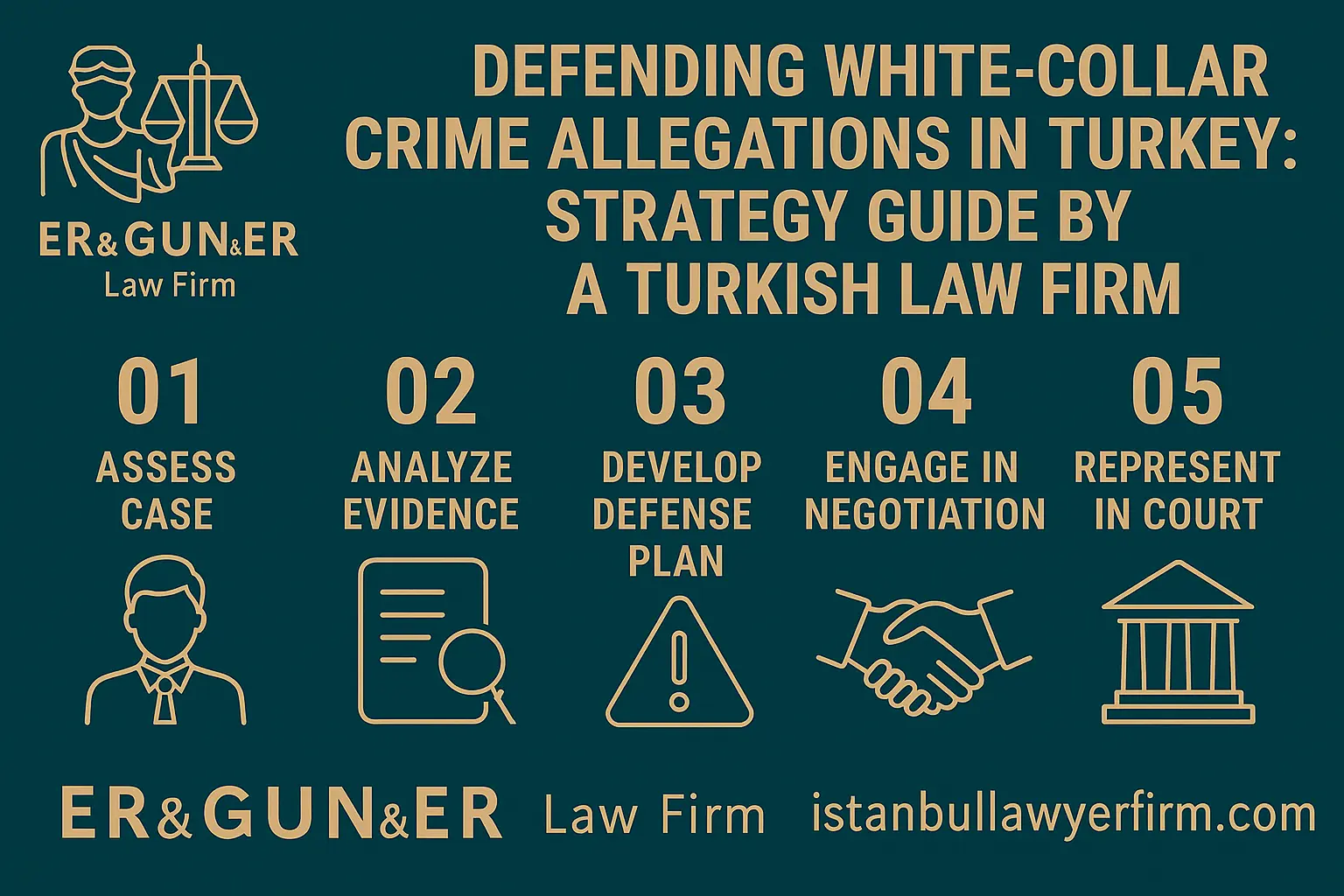
White-collar criminal allegations in Türkiye encompass a substantively distinct category of offences operating against a specific procedural framework and judicial architecture. Foreign executives operating Turkish subsidiaries, multinational enterprises facing Turkish-jurisdiction enforcement, expatriate managers caught in cross-border investigations, family-office principals with Turkish-situated assets, and Turkish enterprises navigating allegations from regulators, business counterparties, or former employees each engage the same statutory framework with substantively different fact patterns. The framework's complexity rewards engagement with counsel familiar with both the substantive offence elements under 5237 sayılı Türk Ceza Kanunu and the procedural protections under 5271 sayılı Ceza Muhakemesi Kanunu, particularly because the early stages of investigation produce decisions that bind the later trial posture in ways difficult to reverse.
The substantive framework operates against 5237 sayılı Türk Ceza Kanunu (TCK) of 26 September 2004 (Resmi Gazete 12 October 2004 No. 25611) Article 1 establishing the principle of legality (kanunilik), Articles 21-22 establishing the kast (intent) and taksir (negligence) framework that performs the function comparable to mens rea analysis in common-law systems, Articles 66-67 establishing dava zamanaşımı (statute of limitations on prosecution) and ceza zamanaşımı (statute of limitations on enforcement), Article 155 güveni kötüye kullanma (breach of trust), Article 156 hizmet nedeniyle güveni kötüye kullanma (aggravated breach of trust by service relationship), Articles 157-159 dolandırıcılık (fraud) including the nitelikli dolandırıcılık aggravators in Article 158 and etkin pişmanlık (effective remorse) provisions in Article 159, Article 161 hileli iflas (fraudulent bankruptcy), Article 162 taksirli iflas (negligent bankruptcy), Articles 204-208 belgede sahtecilik (forgery of public and private documents), Article 235 ihaleye fesat karıştırma (procurement fraud), Articles 247-249 zimmet (embezzlement by public servant), Article 250 irtikap (extortion by public servant), Articles 252-254 rüşvet (bribery — both giving and receiving with etkin pişmanlık), and Article 282 suçtan kaynaklanan malvarlığı değerlerini aklama (money laundering); 5271 sayılı Ceza Muhakemesi Kanunu (CMK) of 4 December 2004 (Resmi Gazete 17 December 2004 No. 25673) governing the procedural framework; 5549 sayılı Suç Gelirlerinin Aklanmasının Önlenmesi Hakkında Kanun establishing the Mali Suçları Araştırma Kurulu (MASAK) anti-money-laundering framework; 6362 sayılı Sermaye Piyasası Kanunu Articles 106-107 governing piyasa dolandırıcılığı (market manipulation) and içeriden öğrenenlerin ticareti (insider trading); 5411 sayılı Bankacılık Kanunu governing banking offences; 6415 sayılı Terörizmin Finansmanının Önlenmesi Hakkında Kanun for terrorism-financing matters; the Avrupa İnsan Hakları Sözleşmesi (AİHS) Article 6 fair-trial framework as a binding international instrument; and the Anayasa Mahkemesi bireysel başvuru pathway under Article 148 of the Constitution as the post-domestic-exhaustion remedy that may also produce Avrupa İnsan Hakları Mahkemesi (AİHM) review.
Institutional architecture for white-collar prosecution operates through the Cumhuriyet Başsavcılığı (Public Prosecutor's Office) leading the soruşturma evresi (investigation phase), the Sulh Ceza Hâkimliği (Criminal Magistrate) issuing search warrants under CMK Article 116 and detention orders under Articles 100-104, the Asliye Ceza Mahkemesi handling lower-level white-collar offences, the Ağır Ceza Mahkemesi handling the serious offences carrying ten years or more imprisonment including aggravated dolandırıcılık and large-scale zimmet, the Bölge Adliye Mahkemesi conducting istinaf review of first-instance judgments, Yargıtay operating across specialised ceza daireleri including the 5. Ceza Dairesi handling forgery and fraud appeals and the 12. Ceza Dairesi handling zimmet and rüşvet appeals, the Mali Suçları Araştırma Kurulu (MASAK) coordinating anti-money-laundering operations under 5549 sayılı Kanun, sectoral regulators including BDDK and SPK handling sector-specific offences, and the Anayasa Mahkemesi bireysel başvuru framework as the constitutional post-conviction remedy. Türkiye is a contracting party to the Avrupa İnsan Hakları Sözleşmesi (AİHS) and recognises the binding jurisdiction of the AİHM, producing the supranational layer where Article 6 fair-trial standards reach beyond the domestic framework.
5237 TCK and 5271 CMK White-Collar Defence Framework
White-collar criminal practice in Türkiye divides into two integrated workstreams: the substantive analysis of whether the alleged conduct satisfies the offence elements under 5237 TCK, and the procedural analysis of whether the investigation and prosecution have observed the protections under 5271 CMK. Both workstreams operate concurrently throughout the proceeding, but their relative weight shifts across the phases. Soruşturma evresi (investigation phase) emphasises procedural-protection arguments because the substantive evidence is still being collected by the Cumhuriyet Başsavcılığı. Kovuşturma evresi (prosecution phase) following indictment shifts substantial weight to the substantive offence-element analysis as the trial court evaluates whether the prosecutor has proven each element beyond reasonable doubt under TCK 5237 Article 23 framework.
The kast (intent) requirement under TCK Articles 21-22 functions as the central gating element for nearly all white-collar offences. The framework distinguishes between kast (specific intent), olası kast (advertent recklessness), basit taksir (ordinary negligence), and bilinçli taksir (advertent negligence). Most white-collar offences require kast — for dolandırıcılık under Article 157, the perpetrator must have intended to deceive the victim and obtain unjust gain; for zimmet under Article 247, the public servant must have intended to appropriate the entrusted property. Conduct that produces harm without the requisite kast typically falls outside the offence definition or migrates into the lower-penalty taksir category where applicable. Defence strategy frequently centres on disproving kast — demonstrating that the conduct, while perhaps producing harm or breaching civil obligations, did not occur with the specific criminal intent the offence requires. Yargıtay case law on kast analysis examines the totality of conduct including the perpetrator's role, prior conduct, contemporaneous communications, and reactions upon discovery, rather than relying on isolated indicators.
Note that Turkish criminal procedure operates without juries; the Asliye Ceza Mahkemesi sits with a single judge while the Ağır Ceza Mahkemesi sits with a three-judge panel. Foreign clients accustomed to common-law systems should not expect jury instructions or jury-selection procedures because these procedural elements do not exist in Turkish criminal trials. Decisions rest with the professional judges, who evaluate evidence under reasoned-judgment principles and produce written gerekçeli karar (reasoned judgment) supporting the verdict and sentence determination. A Turkish Law Firm advising a foreign-client defendant addresses this structural difference at engagement intake to align expectations and defence strategy with the actual procedural framework.
TCK m.155-160 Güveni Kötüye Kullanma and Dolandırıcılık
Güveni kötüye kullanma (breach of trust) under TCK Article 155 addresses the perpetrator's misappropriation of property held under a trust relationship for the purpose of obtaining benefit for themselves or another. The offence elements are the existence of a trust relationship under which property was entrusted, the perpetrator's contrary use or appropriation, and the kast to derive benefit. The basic offence carries six months to two years imprisonment plus adli para cezası (judicial fine). Article 156 produces aggravation where the trust relationship arose from service, employment, profession, or specified other contexts, increasing the penalty range. The aggravated form often applies in employee-employer or principal-agent contexts where the trust relationship exists by virtue of the working arrangement.
Dolandırıcılık (fraud) under TCK Article 157 punishes the perpetrator's deception of another by hileli (deceptive) conduct producing victim disposition of property to the perpetrator's or third party's benefit, with the elements of hileli davranış (deceptive conduct), aldatma (induction of mistaken belief), tasarruf (victim disposition), and unjust benefit. The basic offence carries one to five years imprisonment plus adli para cezası. Article 158 produces nitelikli dolandırıcılık (aggravated fraud) where specified aggravators apply — fraud through religious belief abuse, against state institutions, against banks or credit institutions, through information processing systems (electronic fraud), against vulnerable persons, in commerce or business, through legal proceedings, or where the deception involved official document forgery — substantially increasing the penalty range to three to ten years imprisonment with the higher range available for combinations of aggravators. The Yargıtay 5. Ceza Dairesi handles dolandırıcılık appeals and has produced consolidated case law on aggravator characterisation, kast proof, and victim-disposition causation analysis.
Article 159 etkin pişmanlık (effective remorse) provides a substantial penalty reduction where the perpetrator restores the misappropriated property or compensates the victim before prosecution commences, between prosecution commencement and prosecution conclusion, or after conviction. The reduction scales depending on the timing — pre-prosecution restoration produces the most favourable treatment with potential reduction of up to two-thirds of the imposed sentence; post-conviction restoration produces reduced but still substantial mitigation. The provision creates a procedural pathway that defence counsel evaluates against the case's evidentiary posture: where prosecution evidence is strong and conviction is likely, early restoration through etkin pişmanlık may produce more favourable outcomes than contested defence; where prosecution evidence is weak, contested defence may produce acquittal without the implicit admission that restoration carries. An Istanbul Law Firm advising on white-collar defence performs this strategic calculation early in the proceeding rather than discovering the choice point under trial pressure.
Common defence patterns in dolandırıcılık prosecutions cluster around several lines. Civil-versus-criminal characterisation defence argues that the dispute, while perhaps producing financial harm, reflects a contractual or commercial disagreement rather than the deceptive conduct that the criminal framework requires; this defence frequently succeeds where the parties had a genuine commercial relationship and the alleged hile is more accurately characterised as commercial breach. Authorisation defence demonstrates that the disputed conduct occurred within valid corporate authorisation through board resolution, shareholder approval, or contractual mandate, removing the kast required for criminal characterisation. Mistake-of-fact defence under TCK Article 30 addresses circumstances where the perpetrator operated under genuine factual error that excludes the offence elements. The aggravator analysis under Article 158 supplies a separate defence vector where the prosecution charges the aggravated form but the evidence supports only the basic offence; successful reduction to the basic form materially affects the sentence range and HAGB eligibility under CMK Article 231 (which applies to convictions of two years or less imprisonment).
TCK m.247-254 Zimmet, İrtikap, Rüşvet
Zimmet (embezzlement) under TCK Article 247 addresses the public servant's appropriation of property entrusted by virtue of public office for personal benefit or another's benefit. The offence applies specifically to kamu görevlisi (public servant) as defined in TCK Article 6, including ministry personnel, municipal employees, state-owned enterprise officials, court personnel, and analogous public-function performers. The basic offence carries five to twelve years imprisonment plus adli para cezası. Article 248 produces nitelikli zimmet (aggravated embezzlement) where the perpetrator concealed the appropriation through deceptive means, with substantially increased penalties. Article 249 governs the related case where the appropriated value is small (az değer), producing reduced penalties calibrated to the lower-harm context. The kamu görevlisi requirement is the key gating element — appropriation of entrusted property by a private-sector employee falls under güveni kötüye kullanma analysis under Articles 155-156 rather than zimmet, with substantially different penalty exposure.
İrtikap (extortion by public servant) under TCK Article 250 addresses the public servant's improper extraction of benefit from a person whose interests fall within the servant's official capacity. The offence has three forms: cebren irtikap involving threats, ikna sureti irtikap involving deceptive persuasion, and hatadan yararlanma involving exploitation of mistake. Penalty ranges vary by form, with the cebren variant carrying the heaviest exposure of five to ten years imprisonment. The offence's distinctive feature is the asymmetric power relationship arising from official capacity — the same conduct between private parties might constitute simple fraud or extortion under different provisions, but the official-capacity element triggers the specific irtikap framework with its enhanced penalties reflecting the public-trust violation.
Rüşvet (bribery) under TCK Articles 252-254 addresses the corrupt exchange between a public servant performing official duties and a person seeking favourable treatment. Article 252 punishes both rüşvet alma (receiving) by the servant and rüşvet verme (giving) by the briber, with parallel penalties of four to twelve years imprisonment for both sides under the basic framework, increased for aggravators including involvement of judges, prosecutors, or specified other public functionaries. Article 253 addresses derivative offences including rüşvet anlaşması üzerine yarar sağlama. Article 254 establishes etkin pişmanlık producing penalty reduction or in specified circumstances penalty exemption where the briber reports the matter to authorities before discovery. The Yargıtay 12. Ceza Dairesi handles zimmet and rüşvet appeals and has produced extensive case law on definitions, official-capacity boundaries, and proof standards. A Turkish Law Firm advising in corruption matters maps the evidentiary architecture against these specific offence elements rather than treating the analysis as generic corruption defence.
Cross-border bribery exposure adds a layer of complexity for multinational defendants. Türkiye is a party to the OECD Anti-Bribery Convention and the United Nations Convention against Corruption (UNCAC), with TCK Article 252 incorporating both domestic and foreign-public-servant bribery within its scope. A Turkish-based subsidiary's payment to a foreign public official may produce TCK Article 252 prosecution in Türkiye in addition to home-jurisdiction enforcement under FCPA, UK Bribery Act, or analogous regimes. Parallel investigations across jurisdictions require coordinated defence strategy addressing the substantive offence elements under each framework, the procedural protections in each forum, the information-sharing dynamics between authorities, and the strategic timing of any cooperation or self-disclosure. The differences between the frameworks matter — TCK Article 252 requires specific kast and limited corporate liability under TCK Article 20, while FCPA and Bribery Act impose substantially broader corporate liability frameworks. Defence counsel coordinating multi-jurisdictional response calibrates the strategy to the specific framework engagement rather than treating the matter as procedurally homogeneous.
TCK m.282 + 5549 MASAK Money Laundering Framework
Suçtan kaynaklanan malvarlığı değerlerini aklama (laundering of proceeds of crime) under TCK Article 282 punishes the conversion, transfer, concealment, or use of property derived from any predicate offence carrying six months or more imprisonment, with knowledge of the property's criminal origin. The basic offence carries three to seven years imprisonment plus adli para cezası up to twenty thousand günden full days under the day-fine system. The predicate offence list is broad, capturing essentially all material crimes including the Article 155-282 white-collar framework, drug offences, organised crime, corruption, fraud, and human trafficking. The kast requirement extends to knowledge of the criminal origin — the perpetrator must have known or had circumstances from which they should have known that the property derived from criminal activity. Wilful blindness analysis under Yargıtay practice produces de facto knowledge in circumstances where the perpetrator deliberately avoided inquiry that ordinary diligence would have prompted.
5549 sayılı Suç Gelirlerinin Aklanmasının Önlenmesi Hakkında Kanun establishes the broader anti-money-laundering framework operating in parallel with the TCK Article 282 substantive offence. The Mali Suçları Araştırma Kurulu (MASAK) under the Hazine ve Maliye Bakanlığı serves as the financial intelligence unit receiving suspicious-transaction reports from yükümlü kişiler ve kuruluşlar (obligated persons and institutions), conducting financial-crime analysis, and coordinating with the Cumhuriyet Başsavcılığı for prosecutions. The obligated reporters include banks, insurance companies, financial leasing firms, factoring companies, securities brokers, real estate brokers, jewellers, notaries, attorneys (in specified contexts), accountants, and other categories defined in supplementary regulations. Failure to report suspicious transactions or to maintain identification records produces administrative penalties and may produce criminal liability where the failure reflects intent to facilitate the underlying laundering.
Defence strategy in TCK Article 282 prosecutions operates across several dimensions. The predicate-offence requirement creates a defence vector where the alleged predicate has not been established or is itself contested; absence of provable predicate undermines the laundering charge regardless of the defendant's specific conduct. The knowledge requirement creates the second vector — defendants who received funds without circumstances supporting knowledge of criminal origin escape Article 282 even if the funds in fact derived from crime. The asset-tracing analysis creates the third vector where forensic accounting demonstrates that the alleged laundered funds did not in fact transit through the defendant or originated from legitimate sources. An English speaking lawyer in Turkey coordinating MASAK-related defence integrates the financial-forensic workstream with the substantive legal defence, ensuring that the documentary record supports each defence vector with admissible evidence rather than aspirational arguments.
TCK m.204-208 Belgede Sahtecilik Forgery Offences
Belgede sahtecilik (document forgery) offences under TCK Articles 204-208 address the production, alteration, or use of false documents in contexts where document authenticity matters legally. Article 204 covers resmi belgede sahtecilik (forgery of public documents) carrying two to five years imprisonment for the basic offence, with the aggravated form involving public servant perpetrators or specific document categories carrying three to eight years. Article 205 addresses the use of forged public documents. Article 206 covers resmi belge düzenlenmesinde yalan beyan (false declaration in the issuance of public documents) by the person providing false information for the document. Article 207 covers özel belgede sahtecilik (forgery of private documents) carrying one to three years imprisonment. Article 208 addresses the use of forged private documents.
The public-document versus private-document distinction operates as a key categorisation point with substantial penalty implications. Public documents include those issued by public authorities in their official capacity (court orders, administrative decisions, registry extracts, notarial deeds, official certificates) and certain documents to which the law attaches public-document status (cheques, bills of exchange in certain contexts, specified commercial paper). Private documents include contracts, invoices, internal corporate documents, and analogous instruments lacking public-authority issuance. Forgery analysis examines whether the alleged false document falls into the public or private category, the manner of falsification (fabrication, alteration, substitution), the perpetrator's role and kast, and the use of the false document in subsequent transactions. The use of a forged document by someone other than the forger typically engages Articles 205 or 208 rather than the underlying forgery provision.
Belgede sahtecilik prosecutions frequently combine with substantive offences such as dolandırıcılık (where the false document was the deceptive means producing victim disposition) or vergi kaçakçılığı (where the false document was used in tax evasion). The combined charges produce concurrent or consecutive sentencing analysis under the içtima provisions of TCK Articles 42-43, with the prosecutor and court determining whether the conduct constitutes a single offence with absorption analysis or multiple offences with concurrent penalty imposition. Defence strategy in these combined cases requires evaluation of each offence separately on its own elements rather than treating the combination as a single charge — successful defence on one offence may not affect the others, and procedural outcomes (including HAGB eligibility) operate offence by offence.
Document-authenticity analysis in belgede sahtecilik cases relies heavily on bilirkişi expert reports addressing handwriting, signature comparison, paper analysis, ink dating, and digital-document forensics for electronic instruments. The Adli Tıp Kurumu (Council of Forensic Medicine) operates specialised document-examination units producing court-ordered analyses, with private bilirkişi engagement also available for defence-side parallel work. Defence counsel evaluating a forgery prosecution examines the methodology of the prosecution's bilirkişi report — whether the comparison samples were sufficient, whether the analytical techniques were appropriate, whether alternative explanations for the identified anomalies were considered. Many forgery prosecutions reduce to a methodology contest between competing expert reports, with the trial court weighing the analytical depth and conclusions of each. A Turkish Law Firm coordinating forgery defence engages defence-side document examiners early to support the prosecution-bilirkişi cross-examination and to produce alternative analyses where the original prosecution report contains methodological gaps.
CMK Soruşturma Phase: Search, Seizure, and Interception Protections
The soruşturma evresi (investigation phase) under 5271 CMK begins with the Cumhuriyet Başsavcılığı's receipt of a complaint, suspicious-transaction report from MASAK, or other triggering information and continues through the iddianame submission. During this phase, the prosecutor coordinates with judicial colluk (judicial police), forensic experts, and where applicable sectoral regulators to develop the evidentiary foundation. The procedural protections under CMK Articles 116-156 constrain what investigation steps may be taken and under what authorisations, producing the framework through which defence counsel monitors investigation legality and prepares challenges to procedurally defective evidence.
Arama (search) under CMK Articles 116-119 requires judicial authorisation through hâkim kararı issued by the Sulh Ceza Hâkimliği. The decision must specify the place to be searched, the items sought, and the grounds supporting reasonable suspicion. In acil durumlarda (urgent circumstances) the Cumhuriyet savcısı may order search without prior judicial decision, with subsequent judicial confirmation required within twenty-four hours. Searches conducted without proper authorisation, or exceeding the scope of the authorisation, produce evidence that defence counsel may challenge for exclusion under the framework. Elkoyma (seizure) under Articles 123-130 operates with parallel judicial control — items may be seized only with judicial decision, supplemented by emergency-seizure power for the prosecutor with subsequent confirmation. Seized items must be inventoried in writing with the involved parties' signatures, producing the documentary trail that supports both the prosecution's chain of custody and defence challenges to handling integrity.
İletişimin dinlenmesi ve kayda alınması (telecommunications interception) under CMK Articles 135-138 operates under particularly strict criteria reflecting the privacy-rights significance. The provision applies only to specified offence categories enumerated in the article including aggravated white-collar offences, and only where strong suspicion (kuvvetli suç şüphesi) exists and no other evidentiary route is available. The hâkim kararı must come from the Ağır Ceza Mahkemesi sitting collectively, with the strict criteria preserving against interception based on speculative or insufficient grounds. Improperly authorised interception produces evidence that the framework excludes from prosecution use under CMK Article 217. Defence counsel reviewing the prosecution file examines the interception authorisations carefully because procedural defects in this area frequently produce the strongest exclusion arguments and substantially weaken prosecution evidence built on intercepted communications.
Dawn-raid and on-site investigation scenarios produce specific procedural pressure points where defence engagement at the moment of intervention substantially affects the later case posture. Where the Cumhuriyet savcısı orders search and seizure at a corporate office, the on-site team typically arrives early in the working day with judicial authorisation. The defendant company should ensure that the executing team presents and is willing to record the specific hâkim kararı identifying the place, items, and grounds for the operation; that the search remains within the spatial and substantive scope of the authorisation; that the inventory of seized items is comprehensive, accurate, and witnessed; and that the company's müdafii is given access to monitor the operation. Operational details that defence counsel monitors include preservation of attorney-client privileged materials under CMK Article 154 and Avukatlık Kanunu m.34, separation of personal devices from corporate devices, and proper handling of electronic evidence with hash-value documentation supporting later authentication. Foreign companies operating Turkish subsidiaries should establish dawn-raid response protocols at the policy stage, identifying counsel-of-record contact procedures, document-handling rules, and chain-of-command for executive decisions during the operation.
Müdafii Right Under CMK m.149-156
The right to defence counsel under CMK Articles 149-156 forms the procedural backbone of white-collar defence engagement. Article 149 establishes the suspect's and defendant's right to be assisted by müdafii (defence counsel) at every stage of the proceeding. Article 150 imposes mandatory counsel for proceedings involving offences carrying five years or more imprisonment as the maximum penalty, for proceedings against minors, for proceedings against persons unable to defend themselves due to impairment, and for specified other categories — the suspect's or defendant's election to proceed without counsel does not waive the requirement in mandatory cases, and the proceeding without appointed counsel produces procedural invalidity. The Avukatlık Kanunu and TBB framework supply the standards for müdafii admission and conduct in this capacity, with the baro maintaining a CMK rotation list for appointed-counsel cases.
Article 156 establishes the inviolable confidentiality of müdafii communications with the suspect or defendant. Conversations between counsel and client may not be recorded, listened to, or otherwise monitored. Documents and communications between counsel and client are not subject to seizure absent specific narrow exceptions. The protection extends to in-custody communications, where the suspect or defendant has an unconditional right to consult counsel privately. Violations of Article 156 by investigative authorities produce both evidentiary consequences (exclusion of the improperly obtained communications) and disciplinary consequences for the responsible officials. Foreign clients accustomed to weaker confidentiality frameworks in some jurisdictions benefit from the relatively strong Turkish Article 156 protection.
The susma hakkı (right to silence) under CMK Article 147 supplements the counsel framework. The suspect must be informed at the outset of ifade alma (statement-taking) of the right not to make a statement and the right to consult counsel before responding. The right operates throughout the proceeding — the suspect may refuse to answer specific questions, terminate the statement-taking, or decline to respond at any later point. Adverse inference from silence is impermissible in Turkish criminal practice; the prosecution must prove the offence elements through affirmative evidence rather than relying on the suspect's silence as substantive support. Defence counsel's first communication with a client at investigation onset typically addresses the silence-right framework alongside the substantive case analysis, because early-stage statements made without counsel often produce the most consequential evidentiary problems for the eventual defence.
CMK m.170 İddianame and m.231 HAGB Architecture
The investigation phase concludes either with kovuşturmaya yer olmadığına dair karar (decision of non-prosecution, when the prosecutor finds insufficient grounds) or with iddianamenin düzenlenmesi (preparation of indictment) under CMK Article 170. The iddianame is the formal charging document submitted to the trial court, identifying the defendant, the alleged offences with statute citations, the supporting evidence summary, the witnesses, and the requested sanctions. Article 174 permits the trial court to return the indictment for revision (iddianamenin iadesi) where it finds defects in form or content, requiring the prosecutor to address the identified deficiencies before the trial proceeds. The court's iddianame iadesi power supplies an early procedural filter that produces refinement of weak prosecutions before full trial proceedings.
Hükmün açıklanmasının geri bırakılması (HAGB) under CMK Article 231 provides the principal alternative-resolution mechanism in white-collar defence. Where the trial concludes with conviction-and-sentence determination of two years or less imprisonment, the court may decide to defer pronouncement of the judgment and place the defendant under five-year denetim süresi (probationary period) subject to specified conditions including no commission of further offences during the period. Successful completion of the denetim süresi produces erasure of the deferred judgment as if it had not occurred — no criminal record consequence, no enforcement of the suspended sentence, no public-record stigmatisation. Eligibility requirements include the defendant's prior absence of conviction, the assessment that future offending is unlikely, and (where applicable) compensation of victim damages. The HAGB pathway is procedurally distinct from the etkin pişmanlık framework under TCK Article 159 — etkin pişmanlık reduces the substantive sentence; HAGB defers and ultimately erases the entire judgment subject to compliance.
The uzlaşma (mediation in criminal matters) framework under CMK Articles 253-255 operates for specified offence categories where the offence affects primarily individual victims rather than public interest. Many güveni kötüye kullanma cases under Article 156 fall within the uzlaşma scope; some belgede sahtecilik categories may qualify; substantive corruption offences typically do not. Where uzlaşma applies, the parties may reach settlement through the uzlaştırmacı (mediator) producing victim compensation in exchange for prosecution termination. The uzlaşma outcome eliminates both the prosecution and any criminal record consequence, distinguishing it from HAGB which produces deferred judgment subject to denetim. Defence counsel evaluating early-stage strategy assesses HAGB eligibility, uzlaşma availability, etkin pişmanlık possibility, and contested-defence prospects across the case profile to identify the optimal pathway given the evidence and the client's risk tolerance.
Trial Defence Strategy in Asliye Ceza and Ağır Ceza Mahkemesi
Trial-phase defence operates within the framework established at the soruşturma phase, with the substantive offence-element analysis taking dominant weight. The Asliye Ceza Mahkemesi handles offences with maximum sentences below ten years, including basic dolandırıcılık, basic güveni kötüye kullanma, basic belgede sahtecilik, and analogous categories. The Ağır Ceza Mahkemesi handles serious offences carrying ten years or more maximum, including aggravated dolandırıcılık under TCK Article 158, aggravated zimmet, the more serious rüşvet variants, and Article 282 aklama charges. The trial-court level affects procedural rhythm, witness-handling capacity, evidence-evaluation thoroughness, and judgment-time expectations, with Ağır Ceza proceedings typically running longer and with more procedural depth than Asliye Ceza proceedings.
Substantive defence themes in white-collar trials cluster around several lines. Kast-disproof defence challenges whether the prosecution has established the specific intent the offence requires — common in dolandırıcılık and güveni kötüye kullanma cases where the underlying conduct may have occurred but the accompanying intent is disputed. Authority-of-action defence demonstrates that the conduct occurred under valid corporate authorisation, regulatory compliance framework, or contractual arrangement that removes it from criminal characterisation. Predicate-offence-defect defence in Article 282 aklama cases attacks the prosecution's establishment of the underlying criminal source. Procedural-evidence-exclusion defence builds on CMK violations during the soruşturma phase to remove improperly obtained evidence from trial use. Witness-credibility defence addresses prosecution-witness consistency, motivation, and reliability through cross-examination and contradictory-document presentation. Each defence theme requires distinct preparatory work — kast-disproof requires deep documentary analysis of the defendant's communications and decisions; predicate-defect requires forensic-accounting capability; procedural-exclusion requires meticulous CMK procedural compliance review.
Bilirkişi (court-appointed expert) reports under CMK Article 62 carry substantial evidentiary weight in white-collar trials and warrant focused defence engagement. Forensic accountants, banking specialists, IT forensic experts, and analogous specialists prepare bilirkişi reports addressing transaction analysis, document authenticity, electronic-evidence integrity, and comparable technical questions. Defence counsel may challenge the bilirkişi appointment under Article 67 grounds, may submit counter-evidence and expert reports, may request additional bilirkişi where the original report is incomplete or contradicted, and may cross-examine the bilirkişi at trial. A Turkish Law Firm coordinating white-collar defence engages defence-side forensic experts early in the proceeding rather than waiting for the prosecution-supporting bilirkişi report and reacting under time pressure. The defence-side forensic work produces parallel analysis that supports cross-examination of the prosecution bilirkişi and frequently identifies analytical gaps or methodological errors that strengthen the substantive defence.
Pre-trial detention (tutuklama) and judicial control measures (adli kontrol) under CMK Articles 100-104 produce significant pressure on white-collar defendants particularly during the soruşturma phase. Tutuklama requires kuvvetli suç şüphesi (strong suspicion) plus a tutuklama nedeni — risk of flight, evidence destruction, or witness pressure. The Sulh Ceza Hâkimliği decides on detention with periodic review at maximum thirty-day intervals. Adli kontrol under Article 109 provides alternative measures including travel ban, periodic reporting to authorities, residence restriction, and electronic monitoring, addressing investigation-period control without custodial detention. Defence counsel objecting to tutuklama at the initial hearing or seeking conversion to adli kontrol structures the argument around concrete evidence rebutting the kaçma şüphesi or other tutuklama nedeni — established residence, family ties, employment, surrendered passport, prior cooperation. Successful tutuklama defence preserves the defendant's freedom and substantially improves capacity to coordinate the substantive defence.
İstinaf, Temyiz, AYM Bireysel Başvuru, and Adli Sicil Framework
Post-judgment appeal pathways under the Turkish criminal procedure framework follow a specific sequence. İstinaf (regional court of appeal review) before the Bölge Adliye Mahkemesi operates as the de novo appellate review with capacity to re-evaluate both legal and factual questions. The two-week filing window from gerekçeli karar (reasoned judgment) notification triggers the istinaf procedure under CMK Articles 272-285. The istinaf court may affirm the first-instance judgment, reverse and remand, reverse and produce a new judgment, or modify specific elements while preserving others. The istinaf phase frequently produces meaningful recalibration of first-instance judgments, particularly on sentence severity, kast analysis, and procedural-error consequences.
Temyiz (cassation review) before Yargıtay operates as the legal-question review focused on application of law and procedural compliance rather than factual re-evaluation. CMK Articles 286-307 govern the temyiz framework. Yargıtay's specialised ceza daireleri (criminal chambers) handle specific offence categories — the 5. Ceza Dairesi for fraud and forgery offences, the 12. Ceza Dairesi for zimmet and rüşvet offences, with other chambers handling other categories. The chambers produce both individual-case decisions and consolidated case-law interpreting offence elements, procedural rules, and sentence-analysis approaches. Defence counsel preparing temyiz submissions structures the brief around legal-question identification rather than factual re-argument, recognising that Yargıtay's review jurisdiction focuses on whether the istinaf decision correctly applied the substantive and procedural law.
Anayasa Mahkemesi bireysel başvuru under Constitution Article 148/3 supplies the post-cassation domestic remedy where the proceedings allegedly violated fundamental rights protected by the Constitution and the AİHS. The bireysel başvuru must come within thirty days of exhaustion of domestic remedies through the temyiz decision, must identify the specific rights violations, and must demonstrate the substantial and direct nature of the harm. Common bireysel başvuru bases in white-collar matters include fair-trial framework violations under AİHS Article 6 (insufficient time for defence preparation, denial of evidence access, breach of müdafii confidentiality, kararın gerekçelendirilmemesi or insufficient reasoning), property-rights violations under Constitution Article 35 (improper seizure or asset blocking without due process), and personal-liberty violations under Article 19. Successful bireysel başvuru may produce annulment of the underlying conviction, reopening of proceedings, or compensation determination. Where the bireysel başvuru fails or where the violation persists, the AİHM under AİHS Article 34 provides the supranational remedy producing binding judgments that Türkiye undertakes to implement under Article 46. A Turkish Law Firm advising on long-horizon white-collar defence considers the full appellate pathway including the constitutional and supranational layers as part of the strategic framework rather than concentrating exclusively on first-instance defence.
Adli sicil kaydı (criminal record) consequences under 5352 sayılı Adli Sicil Kanunu shape the post-conviction landscape for white-collar defendants. The adli sicil maintained by the Adalet Bakanlığı records convictions producing imprisonment or specified other sanctions. Records affect employment in regulated sectors, professional licensing in fields requiring clean records, immigration consequences, and analogous downstream effects. HAGB outcomes under CMK Article 231 do not produce adli sicil entries because the judgment was not pronounced — among the most consequential reasons for pursuing HAGB where eligibility supports it. Adli sicil arşiv kaydı silme under 5352 sayılı Kanun Articles 12-13 operates after specified periods following sentence completion, producing as-if-never-occurred status for most subsequent purposes. Memnu hakların iadesi under TCK Article 53 framework addresses ancillary rights that conviction extinguishes including voting in certain contexts, holding public office, exercising guardianship, and certain commercial activity rights, with restoration available after specified periods following sentence completion supported by rehabilitation documentation.
Frequently Asked Questions
- What is the principal statutory framework for white-collar criminal defence in Türkiye? 5237 sayılı Türk Ceza Kanunu (TCK) of 26 September 2004 supplies the substantive offences including Articles 155-160 (güveni kötüye kullanma and dolandırıcılık), Articles 204-208 (belgede sahtecilik), Articles 247-249 (zimmet), Article 250 (irtikap), Articles 252-254 (rüşvet), and Article 282 (aklama). 5271 sayılı Ceza Muhakemesi Kanunu (CMK) of 4 December 2004 supplies the procedural framework. 5549 sayılı Suç Gelirlerinin Aklanmasının Önlenmesi Hakkında Kanun supplies the MASAK anti-money-laundering framework.
- What is the kast (intent) requirement? TCK Articles 21-22 establish the framework distinguishing kast (specific intent), olası kast (advertent recklessness), basit taksir (ordinary negligence), and bilinçli taksir (advertent negligence). Most white-collar offences require kast — for dolandırıcılık the perpetrator must have intended to deceive and obtain unjust gain; for zimmet the public servant must have intended to appropriate. Conduct without the requisite kast typically falls outside the offence definition. Defence strategy frequently centres on disproving kast.
- Are there juries in Turkish criminal trials? No. Asliye Ceza Mahkemesi sits with a single judge; Ağır Ceza Mahkemesi sits with a three-judge panel. There are no juries, no jury instructions, and no jury-selection procedures. Decisions rest with professional judges who evaluate evidence under reasoned-judgment principles and produce written gerekçeli karar.
- What is the difference between dolandırıcılık and güveni kötüye kullanma? Dolandırıcılık (TCK Article 157) requires hileli conduct producing victim disposition through deceptive means, with elements of deception, mistaken belief induction, victim disposition, and unjust benefit. Güveni kötüye kullanma (TCK Article 155) requires existence of a trust relationship under which property was entrusted, contrary use or appropriation, and intent to derive benefit. The trust relationship is the gating element distinguishing the offences.
- What is etkin pişmanlık? TCK Article 159 etkin pişmanlık (effective remorse) provides substantial penalty reduction where the perpetrator restores misappropriated property or compensates the victim. Pre-prosecution restoration produces the most favourable treatment with potential reduction of up to two-thirds of the sentence. Post-conviction restoration produces reduced but still substantial mitigation. Article 254 provides parallel etkin pişmanlık framework for rüşvet.
- What is HAGB? Hükmün açıklanmasının geri bırakılması under CMK Article 231 defers pronouncement of judgment where the conviction-and-sentence determination is two years or less imprisonment. The defendant enters five-year denetim süresi subject to specified conditions. Successful completion produces erasure of the deferred judgment as if it had not occurred, with no criminal record consequence. HAGB requires the defendant's prior absence of conviction and assessment that future offending is unlikely.
- What protections apply during search and seizure? CMK Articles 116-119 require judicial authorisation for arama through hâkim kararı issued by Sulh Ceza Hâkimliği, specifying place, items, and grounds. Acil durum permits prosecutor-ordered search with subsequent judicial confirmation within twenty-four hours. Articles 123-130 govern elkoyma with parallel judicial control. Articles 135-138 govern iletişimin dinlenmesi requiring strong suspicion, lack of alternative evidence, and Ağır Ceza Mahkemesi collective decision.
- What müdafii rights apply? CMK Articles 149-156 establish the right to defence counsel at every stage. Article 150 imposes mandatory counsel for offences carrying five years or more imprisonment. Article 156 establishes inviolable confidentiality of müdafii communications. Article 147 establishes the susma hakkı (right to silence) with no adverse-inference framework — the prosecution must prove offence elements through affirmative evidence rather than relying on silence.
- What is the MASAK framework? 5549 sayılı Suç Gelirlerinin Aklanmasının Önlenmesi Hakkında Kanun establishes the Mali Suçları Araştırma Kurulu (MASAK) under the Hazine ve Maliye Bakanlığı as the financial intelligence unit. Obligated reporters including banks, insurance, financial firms, real estate brokers, jewellers, notaries, attorneys (specified contexts), and accountants submit suspicious-transaction reports. MASAK conducts financial-crime analysis and coordinates with the Cumhuriyet Başsavcılığı for prosecutions.
- What is the difference between zimmet and güveni kötüye kullanma? Zimmet under TCK Articles 247-249 applies specifically to kamu görevlisi (public servant) appropriation of property entrusted by virtue of public office, with substantially heavier penalties (five to twelve years for basic offence). Güveni kötüye kullanma under Articles 155-156 applies to private-sector trust relationships. The kamu görevlisi requirement under TCK Article 6 definition is the key gating element; private-sector employee misconduct falls under Articles 155-156 not zimmet.
- What courts handle white-collar prosecutions? Asliye Ceza Mahkemesi handles offences with maximum sentences below ten years (basic dolandırıcılık, güveni kötüye kullanma, belgede sahtecilik). Ağır Ceza Mahkemesi handles serious offences carrying ten years or more maximum (aggravated dolandırıcılık under Article 158, aggravated zimmet, serious rüşvet variants, Article 282 aklama). Bölge Adliye Mahkemesi conducts istinaf review. Yargıtay 5. Ceza Dairesi handles fraud/forgery appeals; 12. Ceza Dairesi handles zimmet/rüşvet appeals.
- What is the appeal pathway? İstinaf before Bölge Adliye Mahkemesi within two weeks of gerekçeli karar notification under CMK Articles 272-285 produces de novo review of legal and factual questions. Temyiz before Yargyaay specialised ceza daireleri under Articles 286-307 produces legal-question review. Anayasa Mahkemesi bireysel başvuru under Constitution Article 148/3 within thirty days of domestic remedy exhaustion addresses fundamental rights violations. AİHM under AİHS Article 34 provides supranational remedy.
- What happens to criminal records after conviction? 5352 sayılı Adli Sicil Kanunu governs the adli sicil framework. Records affect employment in regulated sectors, professional licensing, immigration, and analogous areas. Articles 12-13 permit adli sicil arşiv kaydı silme after specified periods following sentence completion, producing as-if-never-occurred status for most purposes. HAGB outcomes do not produce adli sicil entries because the judgment was not pronounced — among the most consequential reasons for pursuing HAGB where eligibility supports it.
- What is the role of bilirkişi in white-collar trials? Bilirkişi (court-appointed experts) under CMK Article 62 prepare reports addressing transaction analysis, document authenticity, electronic-evidence integrity, and analogous technical questions. Defence may challenge bilirkişi appointment under Article 67 grounds, submit counter-evidence and expert reports, request additional bilirkişi where the original is incomplete, and cross-examine at trial. Defence-side forensic engagement produces parallel analysis supporting cross-examination and frequently identifying analytical gaps in prosecution bilirkişi reports.
- Where does ER&GUN&ER Law Firm support white-collar defence? Engagement covers soruşturma evresi defence including dawn-raid attendance under CMK Articles 116-130 framework with arama and elkoyma scope monitoring, ifade alma assistance under Articles 147-148 with susma hakkı and müdafii confidentiality preservation, kovuşturma evresi defence including iddianame analysis and iddianame iadesi motions under Article 174, substantive offence-element defence across TCK Articles 155-282 spectrum, etkin pişmanlık and HAGB strategic evaluation, bilirkişi engagement coordination including defence-side forensic accounting, MASAK-related defence under 5549 sayılı Kanun framework, post-judgment appeals across istinaf, temyiz, and Anayasa Mahkemesi bireysel başvuru pathways, and adli sicil arşiv kaydı silme together with memnu hakların iadesi post-conviction services.
Author: Mirkan Topcu is an attorney registered with the Istanbul Bar Association (Istanbul 1st Bar), Bar Registration No: 67874. His practice at this Turkish Law Firm focuses on cross-border and high-stakes matters where evidence discipline, procedural accuracy, and risk control are decisive.
His engagement profile in white-collar criminal matters addresses foreign executives operating Turkish subsidiaries facing investigation by Cumhuriyet Başsavcılığı, multinational enterprises navigating Turkish-jurisdiction enforcement and parallel home-jurisdiction regulatory matters, expatriate managers caught in cross-border financial-crime investigations, family-office principals with Turkish-situated assets subject to MASAK or seizure proceedings, and Turkish enterprises responding to allegations from regulators or business counterparties, operating against 5237 sayılı Türk Ceza Kanunu (TCK) of 26 September 2004 (Resmi Gazete 12 October 2004 No. 25611) substantive framework including Article 1 kanunilik, Articles 21-22 kast ve taksir, Articles 66-67 zamanaşımı, Article 53 memnu haklar framework, Articles 155-156 güveni kötüye kullanma, Articles 157-159 dolandırıcılık including nitelikli aggravators in Article 158 and etkin pişmanlık in Article 159, Article 161 hileli iflas, Article 162 taksirli iflas, Articles 204-208 belgede sahtecilik (resmi ve özel belge), Article 235 ihaleye fesat karıştırma, Articles 247-249 zimmet, Article 250 irtikap, Articles 252-254 rüşvet, and Article 282 suçtan kaynaklanan malvarlığı değerlerini aklama; 5271 sayılı Ceza Muhakemesi Kanunu (CMK) of 4 December 2004 (Resmi Gazete 17 December 2004 No. 25673) procedural framework including Articles 116-119 arama, Articles 123-130 elkoyma, Articles 135-138 iletişimin dinlenmesi, Articles 147-148 ifade alma with susma hakkı, Articles 149-156 müdafii framework with Article 150 mandatory-counsel threshold and Article 156 inviolable confidentiality, Articles 100-104 tutuklama framework, Article 170 iddianame, Article 174 iddianamenin iadesi, Article 231 hükmün açıklanmasının geri bırakılması (HAGB), Articles 253-255 uzlaşma, Articles 272-285 istinaf, Articles 286-307 temyiz, Articles 308-310 olağanüstü kanun yolları; 5549 sayılı Suç Gelirlerinin Aklanmasının Önlenmesi Hakkında Kanun establishing the Mali Suçları Araştırma Kurulu (MASAK) framework; 6415 sayılı Terörizmin Finansmanının Önlenmesi Hakkında Kanun where applicable; 6362 sayılı Sermaye Piyasası Kanunu Articles 106-115 piyasa dolandırıcılığı ve içeriden öğrenenlerin ticareti where capital-markets dimensions arise; 5411 sayılı Bankacılık Kanunu banking offences; 5352 sayılı Adli Sicil Kanunu governing adli sicil and arşiv kaydı silme; 1136 sayılı Avukatlık Kanunu m.34 lifetime sır saklama and m.156 inviolable müdafii-defendant confidentiality; the Avrupa İnsan Hakları Sözleşmesi (AİHS) Article 6 fair-trial framework; the Anayasa Mahkemesi bireysel başvuru framework under Constitution Article 148/3; institutional coordination across the Cumhuriyet Başsavcılığı (Public Prosecutor), the Sulh Ceza Hâkimliği (Criminal Magistrate), the Asliye Ceza Mahkemesi, the Ağır Ceza Mahkemesi, the Bölge Adliye Mahkemesi for istinaf review, Yargıtay specialised ceza daireleri including 5. Ceza Dairesi (fraud and forgery) and 12. Ceza Dairesi (zimmet and rüşvet), the Anayasa Mahkemesi, the Avrupa İnsan Hakları Mahkemesi (AİHM), the Mali Suçları Araştırma Kurulu (MASAK), and sectoral regulators including BDDK, SPK, and Vergi Dairesi where applicable; coordination with foreign jurisdiction counsel, sworn translators (yeminli tercüman), Turkish notaries (noter), forensic accountants, banking specialists, IT forensic experts, public-relations advisers (where reputational management warrants), and analogous professional service providers as the engagement profile requires.
Education: Istanbul University Faculty of Law (2018); Galatasaray University, LL.M. (2022). LinkedIn: Profile. Istanbul Bar Association: Official website.