

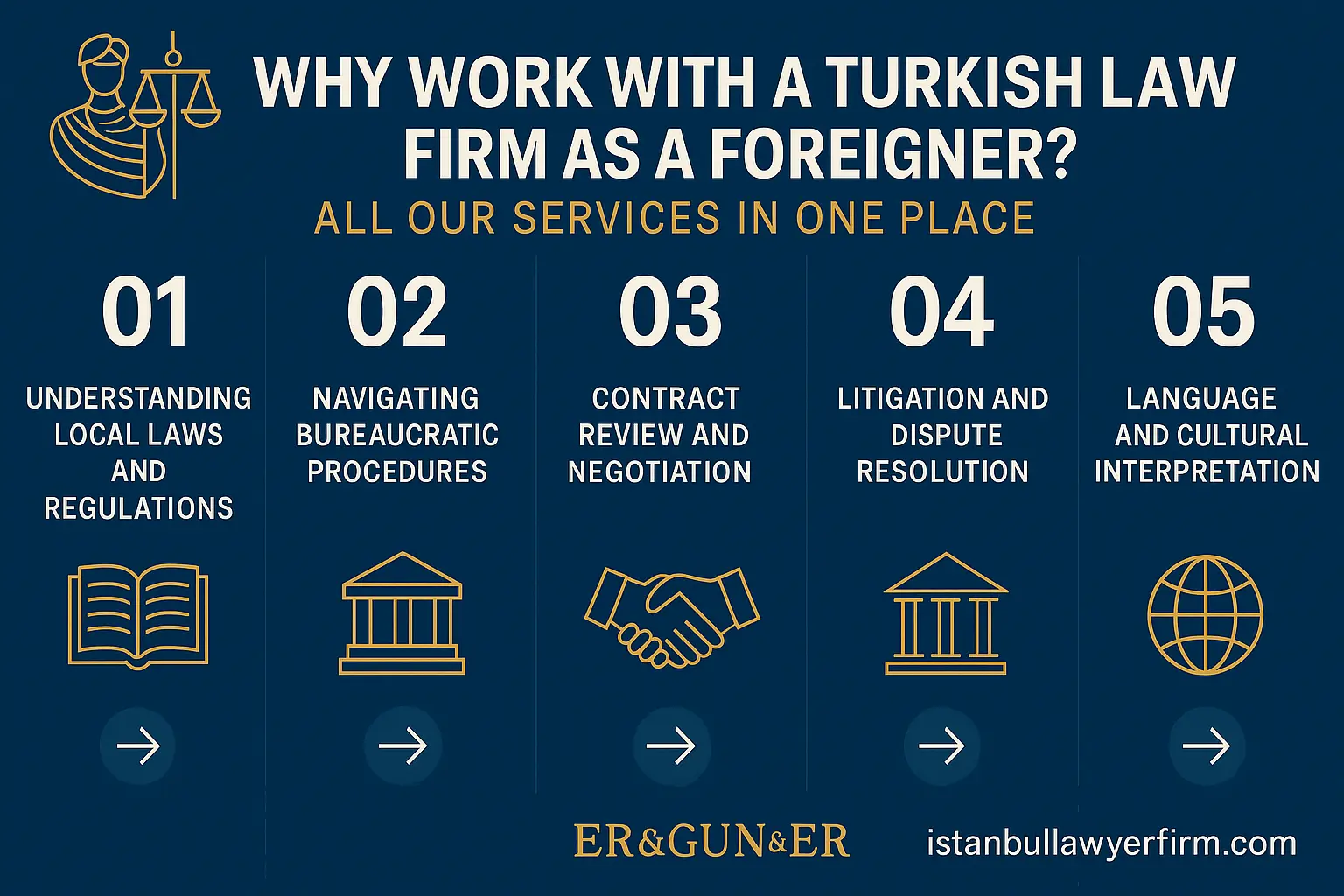
For a foreign client engaging a Turkish law firm, the question is rarely whether to use local counsel — the structure of the Turkish legal system makes that conclusion straightforward. The harder question is how the engagement actually works: how the lawyer is appointed and authorised to act, what a Turkish power of attorney needs to contain, how documents are authenticated for use across borders, how confidentiality is protected under Turkish law, how the relationship is coordinated with home-jurisdiction counsel, how communication and reporting are sequenced across time zones, how fees are structured under the Turkish Bar Association's tariff regime, and how a long-term retainer relationship typically takes shape after the first matter closes. This guide walks through the operational mechanics of working with a Turkish law firm as a foreign client. It is not a marketing piece. It is a step-by-step explanation of the practical realities that determine whether the engagement runs smoothly or produces friction — written in plain English from the foreign client's perspective, with the relevant Turkish legal terminology identified at first mention.
1. Licensed Lawyer Versus Unlicensed Consultant: The Operational Difference
A Turkish Law Firm engaging a foreign client begins with a structural distinction that does not always exist in the same form in common-law jurisdictions: in Türkiye, only a person registered with a Bar Association and authorised to practise law under the Law on Lawyers (Avukatlık Kanunu, Law No. 1136) can represent a client before the courts, file petitions, sign court correspondence, and exercise the procedural rights that the Code of Civil Procedure and the Code of Criminal Procedure reserve to attorneys. The market also contains intermediaries who describe themselves as "consultants", "advisors", or "legal agents" — accountants, fixers, immigration consultants, real-estate agents — but who are not Bar-registered and cannot lawfully represent the foreign client before any judicial or administrative authority that requires attorney representation. A foreign client who engages a non-attorney intermediary for a matter that requires attorney representation faces filings that are rejected at the counter, signature blocks that have no legal effect, and proceedings that have to be re-started later under proper representation, often after irreversible time has been lost.
An Istanbul Law Firm engagement is therefore preceded by a verification step that foreign clients sometimes overlook: confirmation that the lawyer is registered with the relevant Bar Association, holds a current Bar Association card, and is authorised to act in the geographical and subject-matter scope of the engagement. The Istanbul Bar Association maintains a public roster of its members; the same exists for each provincial Bar Association across Türkiye. Verification is straightforward — the lawyer's Bar registration number and certificate are checkable through the Bar's records — and is the first item on a properly conducted foreign-client onboarding checklist. Counsel acting outside Bar registration, or acting in a subject-matter area that requires specialised authorisation the counsel does not hold, exposes the client to the consequences of unlawful representation rather than mitigating them.
A lawyer in Turkey acting for a foreign client also operates under the disciplinary architecture of the Bar. The Law on Lawyers establishes a graduated set of disciplinary sanctions — warning, censure, monetary penalty, suspension from practice, removal from the profession — administered by the Bar's disciplinary boards with appeal to the Union of Turkish Bar Associations and ultimately to the administrative courts. The disciplinary architecture is not relevant on a day-to-day basis on a routine mandate, but it is relevant in two contexts that foreign clients sometimes underestimate: first, when something goes wrong on a file and the client needs a recourse mechanism (the disciplinary route exists in parallel with the courts); and second, when the client is comparing licensed counsel against unlicensed alternatives (the unlicensed alternative has no disciplinary architecture above it, which is precisely why it is cheaper and precisely why the cost surfaces later). The disciplinary regime also produces a behavioural discipline within the practising profession: an attorney's reputation within the Bar is operationally significant, and conduct that would attract disciplinary attention is conduct most experienced attorneys actively avoid. The reputational layer reinforces the formal sanctions and is itself part of the reason the licensed-attorney channel produces materially different outcomes for foreign clients than unlicensed alternatives.
2. Bar Registration, Court Privileges and UYAP Access
An Istanbul Law Firm working on the procedural side of a foreign-client mandate operates inside the National Judiciary Informatics System (Ulusal Yargı Ağı Bilişim Sistemi, abbreviated UYAP), the electronic case-management system that runs the entirety of the Turkish judiciary. Bar-registered attorneys access UYAP through credentialed accounts that allow them to file pleadings electronically, monitor case dockets, receive hearing notifications, download judgments, file appeals, track enforcement proceedings, and exchange procedural correspondence with the court secretariat. UYAP access is restricted to attorneys, parties, and authorised public officials; a non-attorney intermediary cannot access UYAP on the client's behalf, which means a non-attorney engagement is structurally incapable of supporting a court-track matter even on the documentary side.
A Turkish Law Firm running litigation for a foreign client uses UYAP across the entire procedural arc. A new filing is submitted electronically with the supporting documents uploaded as PDFs; the system stamps the filing with a date-and-time receipt that establishes the procedural moment for limitation-period purposes; the court secretariat reviews the filing and either accepts it or returns it for correction; once accepted, the case docket appears in UYAP with a unique file number; subsequent pleadings, expert reports, and procedural decisions all enter the same docket; hearing dates and procedural notifications are pushed to the attorney's UYAP account; judgments are uploaded as soon as they are issued; appellate filings are submitted through the same system. A foreign client whose matter is being administered through UYAP receives an attorney-prepared progress summary at each stage, but the underlying record is the UYAP file itself, which an attorney can produce on request as a complete reconstructable history of the procedural events.
Turkish lawyers who handle administrative-track matters use the same architecture across the parallel administrative justice system. The Council of State (Danıştay) and the regional administrative courts and tax courts all operate through UYAP, with the same e-filing, e-notification, and e-tracking mechanics. Customs disputes, tax disputes, public-procurement disputes, and immigration administrative challenges are filed and tracked through this layer. The integration also extends to the enforcement layer: enforcement files at the Enforcement Offices (İcra Daireleri) under the Enforcement and Bankruptcy Law (Law No. 2004) are administered through a separate but linked electronic system, and counsel coordinates the substantive litigation track and the enforcement track as parts of a single matter. None of this electronic infrastructure is accessible to a non-attorney, and none of it can be replicated by a foreign client running the matter remotely without local-counsel infrastructure. The UYAP architecture also produces a procedural transparency that benefits foreign clients who want visibility into the underlying record. Every pleading filed in the matter, every order issued by the court, every notification sent by the secretariat is recorded with a date-and-time stamp on the docket; counsel can produce the complete docket history on request, and the foreign client sees not only the firm's interpretive summary but the underlying procedural events that the summary describes. This level of procedural transparency is one of the structural advantages of the Turkish electronic-judiciary model over older paper-based systems, and is a meaningful operational point of comfort for foreign clients accustomed to opaque procedural files in jurisdictions where electronic court systems are less developed. The Turkish judiciary's investment in UYAP over the past two decades has materially compressed the procedural friction that used to dominate cross-border legal work in Türkiye.
3. The Power of Attorney (Vekaletname): Scope-Design and Consular Execution
A lawyer in Turkey beginning a foreign-client engagement spends a significant proportion of the first-contact phase on the design of the power of attorney (vekaletname) — the legal instrument that authorises the Turkish attorney to act on the foreign client's behalf in dealings with courts, registries, banks, government authorities, and counterparties. The vekaletname is not a single template; it is a custom-drafted document whose scope must be matched to the matter at hand. A vekaletname for a real estate purchase must explicitly authorise the attorney to appear at the Land Registry, sign the deed, accept the title in the principal's name, and pay the title registry fees. A vekaletname for a residence permit application must explicitly authorise the attorney to file before the Migration Directorate, attend appointments, accept correspondence, and respond to information requests. A vekaletname for litigation must explicitly authorise the attorney to file pleadings, accept service, conclude settlements within agreed financial limits, attend hearings, file appeals, and where authorised receive payments on the principal's behalf.
An English speaking lawyer in Turkey advising on the vekaletname execution mechanics covers the two execution paths a foreign client can take. The first is execution at a Turkish notary (noter) during a visit to Türkiye, which is the simplest path where the principal can travel: the notary verifies identity, reads out the document, the principal signs, the notary affixes the official seal, and the document is operative immediately. The second is execution at a Turkish consulate abroad, used when the principal cannot travel to Türkiye: the principal makes an appointment at the relevant consulate, attends in person, presents identification, and signs the document before the consular officer who exercises notarial authority on the Turkish state's behalf. Consular execution is procedurally rigid — the consulate maintains its own appointment calendar, accepts documents in formats the consular officer is willing to certify, and may refuse to certify documents whose drafting deviates from the standards the consulate accepts. Counsel drafts the vekaletname to consular-acceptable specifications and routes the principal through the consular appointment system.
A Turkish Law Firm that handles a high volume of foreign-client work maintains a vekaletname-template library calibrated for the matters that recur. Real estate purchase, real estate sale, residence permit application, work permit application, citizenship-by-investment, company incorporation, share transfer, banking instruction, litigation initiation, litigation defence, inheritance file, divorce proceeding, recognition of foreign judgment — each has its own template with the matter-specific authorisations the relevant Turkish authority will look for at the registry counter or court desk. A vekaletname missing one of those authorisations is rejected at submission, and the rejection produces a delay measured in weeks while a replacement document is executed at the consulate, couriered, sworn-translated, and re-notarised. The cost of a properly drafted vekaletname at the front end is trivial compared to the cost of a defective vekaletname rejected at the registry. A second category of friction arises from over-broad vekaletname drafting: a document that authorises the attorney to do too much can produce concerns from the client side about the scope of the attorney's authority, and from the registry side about whether the document actually authorises the specific transaction in front of the registry officer. The drafting discipline aims for matter-specific precision: each clause is tied to a concrete operational requirement, surplus authority is omitted, and the document is dated and scoped in time where the matter does not require an open-ended mandate. Where a foreign client engages the same firm across multiple matters over time, separate vekaletnames are typically issued for each major matter category, allowing the principal to terminate or limit any single mandate without disturbing the others. This separation also simplifies the eventual cancellation (azil) process at the conclusion of each matter.
4. Document Authentication: Apostille, Sworn Translation, Notarisation
An Istanbul Law Firm running a cross-border document chain for a foreign client coordinates four distinct authentication layers. The first is the apostille, established by the 1961 Hague Convention Abolishing the Requirement of Legalisation for Foreign Public Documents, which Türkiye has been a contracting state to since 1985. An apostille is issued by the competent authority in the document's country of origin and certifies that the document is genuine in its country of issue; an apostilled document is recognised in Türkiye without further consular legalisation. The second is consular legalisation, used for documents originating from countries that are not parties to the Hague Convention; the document is legalised at the issuing country's foreign ministry and then at the Turkish consulate or embassy in that country. The third is the sworn translation (yeminli tercüme), discussed below. The fourth is Turkish notarisation, where the document is presented to a Turkish notary for the certification that Turkish authorities require for filing.
A Turkish Law Firm advising on the sworn-translation step works through a system that does not have a precise equivalent in most common-law jurisdictions. A sworn translator (yeminli tercüman) is a translator who has taken an oath before a notary and is authorised to certify translations whose certification Turkish courts, registries, and government authorities will accept. The translator stamps and signs the translation, attaches it to the original, and the package is then notarised. Translations from non-sworn translators — even highly competent translators — are typically rejected at the registry counter regardless of accuracy. The same applies to translations done abroad: a translation done by a translator in the document's country of origin is normally not accepted in Türkiye unless re-done by a Turkish-court-registered sworn translator. The recurring cost mistake foreign clients make is paying for a high-quality translation in the home country that then has to be redone in Türkiye when it fails the sworn-translator requirement. The sworn-translator system also produces a documentary discipline that survives long after the matter closes: every page of the translation carries the translator's stamp, the translator's identifying information, and the date of the translation, which means that a translation produced for a closing in 2025 can be re-verified five or ten years later if the underlying document is challenged. Counsel maintains the source documents, the translations, and the notarisation certificates as a complete linked file, because partial files are routinely the cause of delays in subsequent re-filings.
Turkish lawyers who handle high document volumes maintain working relationships with sworn translators in the principal language pairs (English, Russian, Arabic, German, French, Persian, Mandarin) and route translation work to translators whose certifications the relevant registry has accepted in the past. They also coordinate the chain-of-custody discipline that prevents documents from being lost or compromised between authentication steps. A typical foreign-client document pipeline reads: principal in home country procures the document → home-country apostille → secure courier to Türkiye → sworn translation in Türkiye → Turkish notary → registry submission. The pipeline takes days when properly organised and weeks when it is not, and the difference is mostly about whether a single party (typically the Turkish lawyer) is owning the chain end-to-end.
5. The Confidentiality Framework Under Turkish Law
An English speaking lawyer in Turkey explaining confidentiality to a foreign client builds the framework around three statutory layers. The first is the attorney's confidentiality obligation under Article 34 of the Law on Lawyers (Avukatlık Kanunu, Law No. 1136), which imposes a lifetime duty to preserve client confidences extending well beyond the termination of the engagement and breach of which is a disciplinary offence. The duty covers the existence of the engagement, the substance of the advice, and the documents exchanged in the course of the work. The second is the protection of attorney-client communications during the criminal process under Article 136 of the Code of Criminal Procedure (Law No. 5271), which prohibits interception or seizure of communications between the suspect and defence counsel during the period of representation. The third is the data-protection regime under the Personal Data Protection Law (Law No. 6698), which subjects the processing of client personal data by the law firm to lawful-basis, purpose-limitation, and security obligations.
A Turkish Law Firm handling cross-border data flows for a foreign client also has to coordinate the personal-data layer with home-jurisdiction privacy regimes. The General Data Protection Regulation in the European Union, the United Kingdom Data Protection Act, the California Consumer Privacy Act, and other home-jurisdiction privacy laws may apply alongside the Turkish framework where the client is a European Union resident, a United Kingdom resident, or a California consumer. Cross-border transfer of client personal data from Türkiye to a home-jurisdiction location is regulated under the Personal Data Protection Law's transfer provisions, which were substantially revised by Law No. 7499 in 2024 to align more closely with European Union transfer mechanics. The compliance architecture for a cross-border engagement therefore includes the engagement letter's data-handling clauses, the firm's internal information-security controls, and where applicable a data-transfer agreement satisfying both Turkish and home-jurisdiction requirements.
A lawyer in Turkey advising on confidentiality in litigation also has to handle the practical mechanics of asserting privilege in the Turkish procedural context. Turkish civil and criminal procedure does not contain a general discovery process of the Anglo-American type, which means the routine common-law privilege battles over deposition and document production largely do not arise in the Turkish forum. Where confidentiality issues do arise — typically when a prosecutor or a counterparty seeks access to attorney-held documents — the protective architecture flows from Article 34 of the Law on Lawyers and the criminal-procedure provisions cited above. Counsel structures the file accordingly: external-counsel engagement letters that document the legal-services character of the work, separation of legal-analysis memoranda from factual-investigation material, and attorney-client correspondence handled through channels that preserve the protective characterisation. Foreign clients also benefit from a related operational discipline: the firm holds physical and electronic files in segregated systems by client and by matter, with access restricted to the engagement team and audit logs maintained against the firm's data-protection programme. The information-security infrastructure is the practical backbone underneath the statutory confidentiality framework, and is one of the markers a foreign client can use to evaluate whether a prospective firm operates at the standard their home-jurisdiction internal policies require.
6. Coordinating with Home-Jurisdiction Counsel
A Turkish Law Firm working on a multi-jurisdictional matter operates inside a counsel network that the foreign client has typically already assembled. The foreign client may have a long-standing general counsel relationship in the home jurisdiction, a transactional firm handling a parallel deal, a litigation firm handling a related foreign proceeding, or a tax adviser running the cross-border tax structure. The Turkish counsel's role is to integrate into that network rather than to replace any part of it: providing the Turkey-specific advice, handling the Turkey-side filings and registrations, attending Turkish hearings, coordinating Turkish documentation, and serving as the operational interface between the Turkish authorities and the foreign client's existing legal infrastructure. Foreign clients who initially treat Turkish counsel as a substitute for home-jurisdiction counsel quickly discover that the relationship works better when both layers are explicitly preserved.
An Istanbul Law Firm coordinating with home-jurisdiction counsel typically establishes a working protocol at the outset of the engagement that covers four practical points. First, the language of working communication: most cross-border matters run in English, with Turkish-language deliverables produced for filing purposes and English-language summaries produced for the home-jurisdiction layer. Second, the privilege architecture: communications between Turkish counsel and home-jurisdiction counsel are typically structured to preserve privilege under both regimes, which often means home-jurisdiction counsel formally retains Turkish counsel as part of the home-jurisdiction privileged engagement. Third, the document-flow protocol: who circulates drafts, who holds the master copy, what the version-control discipline looks like, where the deal-room is hosted. Fourth, the decision-making escalation: who has authority to make which decisions on the client's behalf, particularly in time-sensitive moments where the home-jurisdiction principal cannot be reached on Türkiye time. The coordination layer is most useful when the protocols are agreed in writing at the outset rather than negotiated on the fly when an issue first arises, because the cost of an inconsistent decision made under time pressure is materially higher than the cost of agreeing the decision-making framework when the file is calm. On larger transactions, the protocol is typically captured in a brief coordination memorandum circulated to the deal team at kick-off.
A lawyer in Turkey working with home-jurisdiction counsel also handles the conflicts-of-law analysis that inevitably arises in cross-border matters. The Code on Private International Law and Procedural Law (Law No. 5718) governs the conflict-of-law rules for civil and commercial matters with a foreign element: which substantive law applies to the contract, which forum has jurisdiction over the dispute, how foreign judgments are recognised in Türkiye, how arbitration awards are enforced. Counsel runs the Turkey-side conflicts analysis and reconciles it with the home-jurisdiction analysis run by the foreign counsel, identifying the points where the two systems diverge and structuring the relevant documents (governing-law clauses, jurisdiction clauses, dispute-resolution clauses, asset-located-where clauses) to produce a coherent overall outcome. The conflicts-coordination layer is one of the highest-value contributions a Turkish counsel makes on a cross-border matter, because it prevents structural inconsistencies that would otherwise surface only when a dispute arises.
7. Communication Protocols, Reporting and Time-Zone Management
An English speaking lawyer in Turkey working with a foreign client also handles the operational layer of communication that does not require legal expertise but does require discipline. The standard practice on a foreign-client engagement covers four operational pillars. First, the channel architecture: which communications go by email, which by secure-document portal, which by signed letter, and which by telephone or videoconference, with the choice driven by the sensitivity and the procedural requirements of each communication type. Second, the cadence: a routine engagement is typically administered through scheduled status updates (weekly during active phases, monthly during dormant phases) supplemented by ad-hoc communication on developments. Third, the reporting format: most foreign clients prefer a structured status report that opens with a one-paragraph summary, followed by a status grid of open items, followed by the action items requiring client input. Fourth, the time-zone discipline: communications are timed to land at the home-jurisdiction client's morning rather than at the end of their evening, even where this means Turkish counsel works at the end of their own day.
A Turkish Law Firm with a substantial foreign-client practice maintains an internal infrastructure that supports cross-border communication discipline at scale. Document-management systems with version control. Client-portal access for status visibility. Calendar systems that surface filing deadlines early enough to permit document collection from the foreign client across the time-zone gap. A staffing model that includes English-fluent associates and paralegals so that the lead partner is not the bottleneck on every routine communication. Where the matter is high-velocity — citizenship file with a moving deadline, transaction with a closing schedule, litigation with appellate windows — counsel runs daily standups with the home-jurisdiction client to keep the velocity sustainable. The internal infrastructure is the part of the engagement the foreign client typically sees only as outputs (timely deliverables, clear reports, anticipated questions); the inputs that produce those outputs are the part counsel runs without surfacing.
Turkish lawyers who advise foreign clients across multiple time zones also calibrate the response-time expectation realistically. Most routine communications are answered within the same working day in Türkiye time, which lands the next morning for European Union and United Kingdom clients, that evening for United States East Coast clients, and that night for United States West Coast clients. Urgent matters — a hearing the next morning, a closing later that day, a deportation notice received in real time — are handled through escalation channels with shorter response windows. The reciprocal expectation is that the foreign client communicates instructions, documents, and signoffs in the time window that allows counsel to act on them; a closing scheduled for Wednesday morning Türkiye time cannot be supported by client signoff received Wednesday afternoon home-time.
8. Conflict-of-Interest Management and Engagement Letters
A Turkish Law Firm onboarding a new foreign client runs a conflicts check before the engagement is accepted. The Law on Lawyers and the professional rules issued by the Union of Turkish Bar Associations prohibit a lawyer from acting against a client in a matter substantially related to a prior representation, and from acting for opposing parties in the same matter. The conflicts check covers existing client relationships, prior engagements that may overlap with the proposed matter, and personal or financial relationships of the partners and associates that could compromise the independence of the engagement. For cross-border clients, the check also covers home-jurisdiction conflicts that may flow through to the Turkey side: a Turkish firm that is part of a home-jurisdiction-led conflicts perimeter (because home-jurisdiction counsel has cleared conflicts for the parent) operates differently from a Turkish firm running its own independent perimeter.
An Istanbul Law Firm that has cleared conflicts then issues an engagement letter (vekalet sözleşmesi or hizmet sözleşmesi) that documents the scope, the parties, the fee structure, and the operational protocols. Article 163 of the Law on Lawyers requires that the fee agreement between attorney and client be in writing, and the standard practice on foreign-client engagements is a written engagement letter that records the scope of work in detail, the fee structure (fixed fee, hourly, retainer, contingency, or hybrid), the disbursement pass-through arrangement, the expected timeline, the confidentiality and conflict-of-interest provisions, the personal-data-handling provisions where applicable, and the dispute-resolution clause for disputes between attorney and client. Turkish bar rules cap contingency fees at twenty-five per cent of the recovered amount under Article 164/IV, which is a structural difference from common-law markets where higher contingency arrangements are sometimes available.
A lawyer in Turkey reviewing engagement-letter mechanics with a foreign client also covers the termination and withdrawal architecture. The client retains the right to terminate the engagement at any time; the attorney can withdraw on grounds set out in the Law on Lawyers and the Bar's professional rules, with notice and a reasonable transition window. On termination, the file is handed over to the client or to incoming counsel against settlement of fees due, with the attorney's lien on file documents asserted only to the extent recognised by the professional rules. The handover discipline matters in cross-border matters because a poorly handled transition can produce gaps in litigation timing, registry filings, or deadline tracking that surface weeks later. Counsel works to ensure that transitions, when they occur, run cleanly enough not to compromise the client's underlying matter. The handover package on a properly run termination typically includes the complete UYAP docket extract for any active litigation, the originals or certified copies of the executed vekaletnames in force, the signed engagement letter and any subsequent amendments, the open-items list with associated deadlines, the contact details for any third-party counterparties or authorities active on the file, and a brief written status memorandum summarising the position at the date of transfer. The receiving lawyer is then in a position to take the matter forward without losing operational continuity.
9. Fee Structures, Bar Tariff and Disbursement Pass-Through
An Istanbul Law Firm explaining fees to a foreign client begins with the framework set by the Turkish Bar Association's annual minimum-fee tariff (Avukatlık Asgari Ücret Tarifesi). The tariff, published annually by the Union of Turkish Bar Associations under Article 168 of the Law on Lawyers, sets the floor below which an attorney cannot charge for specified categories of work. The tariff is binding as a minimum in formal litigation and other Bar-regulated work; firms can charge above the tariff and routinely do for sophisticated commercial work, but cannot charge below. The tariff also sets the recoverable attorneys' fees in successful litigation, which means that a winning litigant typically recovers the tariff-level fee from the losing party regardless of the actual fee paid to counsel, with any excess paid by counsel's own client. Foreign clients comparing Turkish counsel pricing against home-jurisdiction comparators should factor in this tariff-based structure rather than reading the headline fee figure in isolation.
A Turkish Law Firm structuring fees on a foreign-client mandate uses one of four standard models depending on the nature of the work. The first is fixed-fee for defined-scope mandates: company incorporation, residence permit application, citizenship-by-investment file, real estate due diligence and closing. Fixed fees are the dominant structure for foreign-client transactional work because they produce budget certainty, and the scope is precise enough at the front end that the firm can price the work reliably. The second is hourly for advisory and litigation work where the volume and trajectory cannot be reliably forecast. The third is retainer for ongoing engagements covering general advisory, regulatory monitoring, and routine corporate-secretarial support. The fourth is contingency for specified recovery work, capped at twenty-five per cent under Article 164/IV. Hybrid arrangements combining elements — for example, a fixed fee plus a success premium tied to a defined outcome — are also used where the structure of the matter supports it. The choice of fee model affects more than just the billing arithmetic: a fixed-fee structure typically incentivises the firm to keep scope tight and matter-progression efficient, while an hourly structure permits flexibility on emerging issues but requires more attentive scope management on the client side. Most experienced foreign-client engagements settle on a fixed-fee structure for the discrete deliverables and an hourly or retainer structure for the underlying advisory work, with the engagement letter recording the boundary between the two.
Turkish lawyers who handle foreign-client work also operate a transparent disbursement pass-through layer that is sometimes opaque in lower-quality engagements. The official-fee and disbursement layer covers notary fees, apostille fees, sworn-translation fees, registry fees, courier costs, expert-witness fees in litigation, court-deposit fees, bailiff fees, and other third-party costs that are paid through the firm's client account or directly by the client. The standard practice on a transparent foreign-client engagement is that disbursements are billed at cost with supporting receipts, separate from professional fees, with the engagement letter setting out which categories of disbursement are passed through and which are absorbed by the firm under the fee. The transparency of the disbursement layer is itself one of the markers a foreign client can use to gauge the quality of the engagement: a firm that breaks out disbursements clearly is the same firm that will produce a disciplined matter file two years later.
10. Retainer Mandates and Long-Term Relationships
A Turkish Law Firm engaging a foreign client on a retainer mandate moves the relationship from project-based to ongoing. A typical retainer covers general legal advisory across the practice areas the client routinely encounters in Türkiye — corporate, employment, tax, real estate, commercial contracts, regulatory — at a monthly or quarterly fee that bundles a specified volume of work. Above the bundled volume, additional work bills at the agreed hourly or project rate. Retainer mandates suit foreign clients with sustained operational presence in Türkiye: a foreign-headquartered group running a Turkish subsidiary, an investor with a portfolio of Turkish properties, a high-net-worth individual with Turkish-resident family members and ongoing personal-affairs administration, or an international firm with active Turkish business relationships requiring routine legal support.
An Istanbul Law Firm administering a retainer mandate over multiple years builds institutional memory that becomes one of the relationship's structural advantages. The firm holds a complete record of the corporate filings, the contracts in force, the regulatory positions taken, the litigation history, the tax positions, and the personnel changes. New matters arrive against this stored context rather than starting from zero each time, which materially compresses the work required to handle them. A new contract reviewed against an existing standard form takes a fraction of the time of a contract reviewed in isolation; a regulatory question that touches a previously analysed issue draws on the prior memorandum; a litigation development that follows a known counterparty pattern is handled by counsel who has handled the same counterparty before. The institutional-memory dimension is rarely the reason a client engages a firm at the outset, but it is one of the most reliable reasons clients stay with the same firm across multiple years and multiple matters.
A lawyer in Turkey running a long-term foreign-client relationship also operates as the institutional liaison between the foreign principal and the Turkish authorities. The same counsel that handled the original company incorporation handles the share-transfer ten years later. The same counsel that registered the original residence permit handles the citizenship application five years later. The same counsel that closed the original real estate purchase handles the inheritance file when the property passes to the next generation. The continuity is operationally efficient — the counsel knows the file, the registries know the counsel — and is a meaningful part of why long-running foreign-client relationships in Türkiye tend to consolidate around a single law firm rather than fragmenting across multiple providers. The relationship is rarely the cheapest option in the short term, but it is consistently the most cost-effective option over the multi-year horizon that most foreign clients in Türkiye eventually run. The succession-planning dimension also matters for clients with second-generation involvement in their Türkiye affairs: a long-running firm can introduce the principal's adult children to the file ahead of any actual transition, brief them on the standing arrangements, and ensure that the documentary continuity survives the generational change without disruption.
Frequently Asked Questions
- Why does it matter whether my Turkish representative is a Bar-registered lawyer? Only Bar-registered attorneys can represent clients before Turkish courts, file pleadings, and access the National Judiciary Informatics System (UYAP). A non-attorney intermediary cannot lawfully act in any matter that requires attorney representation, and proceedings filed without proper representation can be rejected at the procedural level.
- How do I verify that a Turkish lawyer is properly Bar-registered? The Bar Association of the city where the lawyer practises maintains a public roster of its members. The lawyer's registration number and professional certificate are checkable through the Bar's records. Proper verification is the first step on a sound foreign-client engagement.
- What is a vekaletname and why do I need one? A vekaletname is a Turkish power of attorney that authorises a Turkish lawyer or other agent to act on the foreign principal's behalf with courts, registries, banks, and government authorities. Its scope must explicitly list the powers granted; a missing clause produces a rejected filing.
- Where can I execute a vekaletname if I cannot travel to Türkiye? A vekaletname can be executed at a Turkish consulate or embassy abroad. The principal attends in person, presents identification, and signs before the consular officer who exercises notarial authority for these purposes. Counsel drafts the document to consular-acceptable specifications.
- What is the difference between a sworn translation and a regular translation? A sworn translation (yeminli tercüme) is produced by a translator who has taken an oath before a notary and is registered with the Turkish courts. Translations from non-sworn translators are typically rejected at registries and courts regardless of accuracy. The sworn-translation requirement applies to most documents filed with Turkish authorities.
- What happens to confidentiality if I terminate the engagement? The attorney's confidentiality obligation under Article 34 of the Law on Lawyers is a lifetime duty that survives termination of the engagement. The duty covers the existence of the engagement, the substance of the advice, and the documents exchanged.
- Can I work with my home-jurisdiction lawyer alongside Turkish counsel? Yes, and most cross-border matters benefit from this structure. Turkish counsel handles the Turkey-side advice and filings; home-jurisdiction counsel maintains the broader relationship and handles the home-jurisdiction layer. The two sides coordinate through agreed protocols on language, privilege, document flow, and decision-making escalation.
- How does cross-border privilege work? Communications between Turkish counsel and home-jurisdiction counsel are typically structured to preserve privilege under both regimes, which often means home-jurisdiction counsel formally retains Turkish counsel as part of the home-jurisdiction privileged engagement. Counsel structures the engagement letter and document-flow protocols accordingly.
- How are fees structured? Turkish lawyers use four standard fee structures: fixed-fee for defined-scope work, hourly for advisory and litigation, retainer for ongoing engagements, and contingency capped at twenty-five per cent for specified recovery work. The Turkish Bar Association's annual minimum-fee tariff sets the floor below which fees cannot be charged for specified categories.
- What is a retainer mandate and when does it make sense? A retainer mandate covers general legal advisory across the practice areas the client routinely encounters at a monthly or quarterly fee that bundles a specified volume of work. It suits clients with sustained operational presence in Türkiye: foreign-headquartered groups, real estate portfolio holders, high-net-worth individuals with ongoing family-affairs administration, and international firms with active Turkish business relationships.
- How do communication and reporting typically work across time zones? Most foreign-client engagements run on scheduled status updates (weekly during active phases, monthly during dormant phases) supplemented by ad-hoc communication on developments. Communications are typically timed to land at the foreign client's morning. Urgent matters are handled through escalation channels with shorter response windows.
- How long does it take to set up the engagement? A standard onboarding — conflicts check, engagement letter, vekaletname draft and execution, document-collection plan, fee arrangement — takes one to two weeks where the client can act efficiently on their side. Consular vekaletname execution can extend the timeline by two to four weeks depending on consular appointment availability.
- Can a Turkish lawyer represent me in arbitration as well as in court? Yes. Turkish lawyers are admitted to act in both court litigation and in arbitration proceedings seated in Türkiye or abroad. International arbitration with a Türkiye nexus runs under the International Arbitration Law (Law No. 4686) for arbitrations seated in Türkiye, and under the New York Convention for the recognition and enforcement of foreign arbitral awards in Türkiye.
- What happens if I want to switch Turkish lawyers mid-matter? The client retains the right to terminate the engagement at any time. The outgoing lawyer hands over the file against settlement of fees due. The incoming lawyer files a new vekaletname and updates the relevant registries and case files. Counsel works to ensure transitions run cleanly enough not to compromise the underlying matter.
- What does the engagement letter need to contain? The engagement letter records the scope of work, the parties, the fee structure, the disbursement pass-through arrangement, the expected timeline, confidentiality and conflict-of-interest provisions, personal-data-handling provisions where applicable, and the dispute-resolution clause. Article 163 of the Law on Lawyers requires that the fee agreement be in writing.
About the Author
Av. Mirkan Günay Topcu is the managing partner of ER&GUN&ER Law Firm (Istanbul) and is registered with the Istanbul Bar Association under No. 67874. The firm advises foreign nationals, foreign-incorporated entities, and multinational legal teams on the operational mechanics of working with Turkish counsel — from the first-contact engagement through long-term retainer relationships — across the corporate, immigration, real estate, tax, employment, family, and dispute-resolution practice areas.
The author works principally in English with home-jurisdiction counsel and directly with foreign principals, and his day-to-day work covers the engagement-letter and conflicts-check layer, vekaletname design and consular-execution coordination, the apostille and sworn-translation chain, UYAP-track court representation, regulatory filings, and the cross-border counsel coordination that runs above all of these.
Profile: LinkedIn. Foreign clients evaluating Turkish counsel may also wish to read the companion guides on selecting a Turkish law firm under the Law on Lawyers and the Turkish Bar Association advertising rules and the practice-area survey of foreign-client work in Türkiye.
Contact ER&GUN&ER Law Firm