

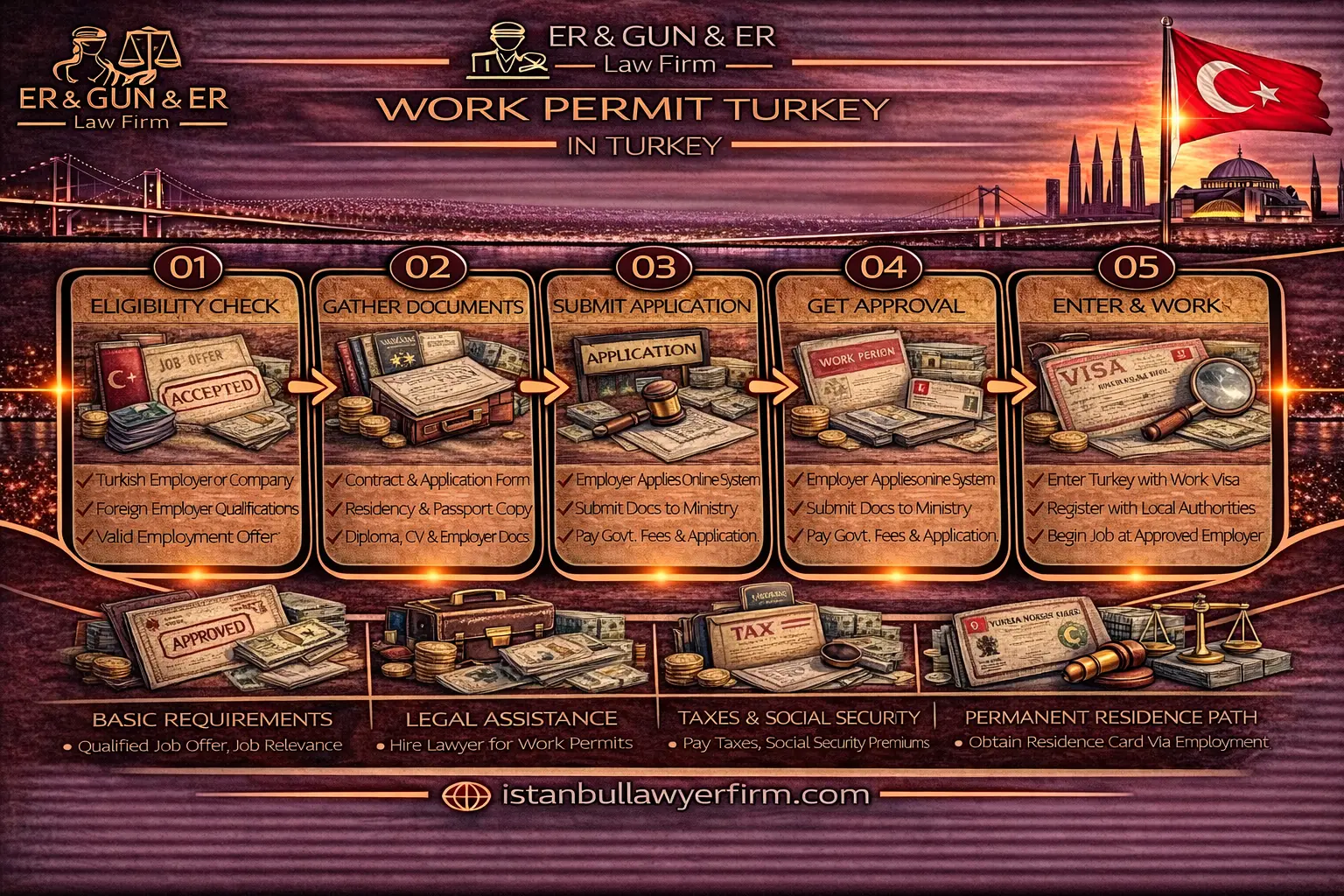
A Turkish work permit (çalışma izni) is the legal instrument that authorises a foreign national to work in Turkey under the International Labour Force Law (Uluslararası İşgücü Kanunu, Law No. 6735). This guide addresses the work permit not at the application stage — that subject is covered in the companion work permit application guide for foreigners in Turkey — but at the compliance lifecycle stage that follows. The work permit is a sustained legal status rather than a one-time approval, and the period between approval and either renewal or termination is governed by an integrated set of obligations covering social security registration, payroll discipline, scope adherence, workplace consistency, change-notification requirements, and audit readiness. The compliance dimension matters because non-compliance during the work-permit period produces consequences that range from administrative fines under Articles 21 to 23 of Law 6735 to permit cancellation under Article 15, with downstream effects on the worker's residence status and on the employer's eligibility to sponsor future foreign workers. This guide walks through the compliance lifecycle for foreign workers and Turkish employers in 2026, with the relevant Turkish legal terminology identified at first mention.
1. The Work Permit Lifecycle: Beyond the Initial Application
A Turkish Law Firm advising on the work-permit lifecycle works with a framework that extends well beyond the application phase. The lifecycle has six analytically distinct stages. The application stage produces the initial permit decision through the e-Permit (e-İzin) electronic portal of the Directorate General of International Labour (Uluslararası İşgücü Genel Müdürlüğü, abbreviated DGIL). The onboarding stage converts the approved permit into operational employment through SGK registration, payroll setup, and workplace integration. The active-employment stage runs through the permit period with continuing compliance obligations. The change-management stage addresses material modifications to the underlying employment relationship — title changes, workplace changes, employer-side restructurings, worker-side passport renewals and address updates. The renewal stage re-validates the compliance position before the next permit cycle begins. The termination stage closes the permit cleanly through resignation, dismissal, or expiry without renewal.
An Istanbul Law Firm advising a foreign worker or a Turkish employer on the operational consequences of the lifecycle framework explains an important point. Each stage's compliance obligations are tested at the next stage's gateway: the permit decision is granted assuming compliance with the application-stage representations; the renewal decision is granted assuming compliance through the active-employment and change-management stages; the post-renewal permit is granted assuming the compliance program continues into the next cycle. Lifecycle thinking accordingly replaces transactional thinking — a work permit is not an isolated approval that the parties can forget about until the next renewal, but a continuous compliance state that the parties must maintain through the documentary and operational discipline appropriate to each stage. The compliance failure modes that emerge across the lifecycle are predictable enough that prudent employers and workers anticipate them through structural controls. The most common failure mode is documentary lag, where the underlying employment circumstances evolve faster than the work-permit registration tracking. The second most common failure mode is scope creep, where the worker's actual responsibilities gradually expand beyond the registered position without the corresponding change-notification step. The third most common failure mode is registration inconsistency, where the SGK record, the payroll record, the work-permit record, and the residence-permit record drift apart over time as different teams maintain different files without cross-referencing them. The fourth most common failure mode is termination handling, where the employment ends in a way that produces avoidable residence-status complications because the conversion architecture was not addressed during the active employment period. Each of these failure modes is addressable through specific compliance disciplines that this guide develops in the corresponding sections.
A lawyer in Turkey advising on the dispute-prevention dimension of lifecycle compliance covers the interface between the work permit and the related legal frameworks. The Labour Law (İş Kanunu, Law No. 4857) governs the substantive employment relationship and applies to foreign workers on the same basis as Turkish workers. The Social Security Law (Sosyal Sigortalar ve Genel Sağlık Sigortası Kanunu, Law No. 5510) governs the SGK registration, premium-payment, and benefits framework. The Foreigners and International Protection Law (Yabancılar ve Uluslararası Koruma Kanunu, Law No. 6458) governs the residence-permit interface, including the conversion architecture that becomes operative at termination. The Occupational Health and Safety Law (Law No. 6331) governs the workplace-safety framework that applies to all workers regardless of nationality. The compliance lifecycle accordingly runs across multiple statutes, and the operational discipline that supports the compliance position must address each statute's documentary and procedural requirements rather than treating the work-permit framework in isolation.
2. Activity Classification: When a Work Permit Is Required
An English speaking lawyer in Turkey advising a foreign client on the threshold classification question — whether a particular activity in Turkey requires a work permit — works with the broad scope of Article 6 of Law 6735. The starting position is that any work-like activity performed in Turkey by a foreign national requires a work permit. The categorical scope captures the obvious cases (employment under a Turkish-law contract with a Turkish employer for work performed in Turkey) and extends to the less obvious cases that produce the most classification disputes: project-based work for a foreign company on a Turkish-located worksite, ongoing managerial activity by a foreign shareholder of a Turkish company, on-site service delivery by a foreign consultant who attends Turkish premises repeatedly, and remote work performed from a Turkish address even if the engaging entity is foreign.
A Turkish Law Firm advising a foreign professional on the classification framework also covers the limited statutory exceptions at Article 13 of Law 6735 and the implementing regulation. Short-term scientific, cultural, sporting, or artistic activities of limited duration may be exempt from the work-permit requirement, but the exemption categories are narrowly defined and the durations are short. Diplomatic and consular personnel are governed by separate frameworks under international law. Certain academic visiting positions for limited periods may qualify under specific Ministry of National Education or Council of Higher Education frameworks. The exemption analysis is fact-specific: the activity must fall squarely within a recognised exemption category, the duration must be within the prescribed limit, and the documentary record must support the classification. An exemption that is asserted without documentary support is treated by inspectors as an undocumented work activity and triggers the unauthorised-employment sanctions framework under Article 23.
Turkish lawyers who handle the practical classification question for foreign founders and senior executives address a recurring pattern that produces compliance risk if mishandled. A foreign national who holds shares in a Turkish company without operational engagement does not need a work permit for the shareholding itself — share ownership is not a work activity. A foreign national who serves on the board of a Turkish company in a non-executive capacity attending periodic board meetings does not necessarily need a work permit if the activity is genuinely limited to board meetings and the documentary record supports the limitation. A foreign national who acts as an executive director, manages day-to-day operations, signs commercial contracts on behalf of the company, supervises Turkish staff, or otherwise performs operational work activity needs a work permit regardless of the shareholding relationship. The line between non-executive board membership and operational engagement is fact-specific, and founders who plan to be substantively engaged in their Turkish companies typically obtain work permits through the shareholder-director category at the company-formation stage rather than relying on a thinner classification position that may not survive an inspection.
3. The Four Permit Categories Under Law 6735: Brief Reference
An Istanbul Law Firm orienting a client on the category framework provides a brief reference rather than a substantive treatment, because the substantive treatment is in the companion work permit application guide. The four categories under Law 6735 are the dependent work permit (süreli çalışma izni) for employer-sponsored employment under Articles 7 to 10, issued for an initial period of up to one year and extendable through the renewal track described in section 8 of this guide. The independent work permit (bağımsız çalışma izni) under Article 10 is issued to foreign nationals working on their own account, typically as freelance professionals or sole-practitioner business operators, with eligibility tied to economic-contribution criteria established by the implementing regulation.
A Turkish Law Firm continuing the brief reference covers the indefinite work permit (süresiz çalışma izni) under Article 10/3 of Law 6735, which becomes available after a foreign worker has held lawful work permits for an aggregate of eight years. The indefinite permit removes the position, employer, and workplace constraints that apply to dependent permits and authorises work in any profession with any employer. The eligibility-counting period is calculated on the basis of cumulative lawful work-permit time, with periods between permits and periods of unauthorised work not counting toward the eight-year threshold. The Turquoise Card (Turkuvaz Kart) under Article 11 is the highest-tier category, available to foreign nationals whose qualifications, investments, or contributions meet the elevated criteria established by the implementing regulation. The Turquoise Card produces work and residence rights equivalent to those of Turkish citizens in most economic respects after the initial three-year probationary period.
A lawyer in Turkey advising on the practical implications of category selection for the compliance lifecycle covers an important compliance-side observation. The category determines the scope of the compliance obligations that follow approval. A dependent-permit holder is bound to the specific employer, position, and workplace identified in the permit; any change to these elements requires a new application or, in some cases, a workplace-update or position-update notification through the e-Permit portal. An independent-permit holder operates without the employer-side compliance infrastructure but takes on direct responsibility for the SGK registration, tax filings, and operational compliance that the employer would otherwise handle. An indefinite-permit holder operates without the position, employer, or workplace constraints and accordingly without the change-notification obligations that apply to dependent permits. A Turquoise Card holder operates under a regime that more closely resembles Turkish-citizen employment, with the work permit's compliance dimension substantially reduced after the probationary period closes.
4. Employer Compliance Program: Ongoing Duties Beyond Approval
A Turkish Law Firm advising a Turkish employer on the post-approval compliance program works with the framework at Articles 12 to 15 of Law 6735 and the corresponding employer-duty provisions in the implementing regulation. The employer's compliance program addresses six recurring obligations. The first is the SGK registration of the foreign worker within statutory windows after the worker begins employment, with the SGK premium calculations on the worker's full declared compensation. The second is the maintenance of the salary at or above the threshold the implementing regulation establishes for the worker's profession category, with adjustments when the underlying minimum wage is revised. The third is the payment of the salary through the formal banking system rather than in cash, with the corresponding bank statements available for audit support.
An Istanbul Law Firm advising on the remaining employer obligations covers the fourth obligation: the maintenance of the workplace-level five-to-one Turkish-worker ratio that supports the foreign-worker employment, verified against the SGK premium service list (aylık prim ve hizmet belgesi) at workplace inspections and at renewal applications. The fifth obligation is the documentation of the worker's actual employment activity in a way that matches the position description registered in the permit — the worker's actual job duties, reporting line, workplace, and operational context must be consistent with the permit records, with material divergence creating cancellation exposure. The sixth obligation is the change-notification framework under Article 12 of Law 6735: material changes to the employment relationship — workplace transfer, position change, salary adjustment outside the threshold-tracking range, employer-side corporate restructuring affecting the legal entity employing the worker — must be notified through the e-Permit portal within the statutory windows the implementing regulation establishes.
Turkish lawyers who handle the operational implementation of an employer compliance program for a corporate client with multiple foreign workers typically build the program around a structured documentary architecture. The architecture has three layers. The corporate layer maintains the employer-eligibility evidence — trade registry records, financial statements, signature circular, SGK workplace registration — in a state that can support a workplace inspection or a renewal application without preparation lag. The position layer maintains the substantive employment evidence for each foreign worker — the contract, the position description, the salary records, the SGK premium service list demonstrating the ratio compliance — in a worker-by-worker file structure. The change-management layer maintains the chronology of material changes affecting each worker's compliance position, with the change events documented as dated entries supported by the underlying corporate or HR records. The compliance-program architecture is operationally most valuable for employers with multiple foreign workers across multiple workplaces, where the cumulative documentary load can become unmanageable without structured discipline. A corporate group with foreign workers at three or more workplaces typically appoints a designated compliance officer responsible for the work-permit-and-related-status records of all foreign workers in the group, with monthly compliance check-ins that verify the SGK premium service list reconciles with the work-permit register, the salary records track the threshold framework, and the change-notification queue is current. The compliance officer's institutional position — typically reporting through HR but with a dotted-line relationship to legal counsel — preserves both the operational efficiency of the workforce management and the legal-risk discipline that the work-permit framework requires. The compliance officer's role becomes particularly important during inspection events and renewal periods, where the documentary readiness developed through the routine compliance work is what produces a clean inspection outcome or a successful renewal.
5. Employee Compliance: Scope Adherence and Role Drift
A Turkish Law Firm advising a foreign worker on the worker-side compliance dimension covers a less-discussed but operationally important aspect of the work-permit framework. The worker's permit authorises the specific employment relationship registered in the permit decision: the specific employer, the specific position, and where applicable the specific workplace. Working outside the authorised scope — working for a different employer (even temporarily), performing work activity materially different from the registered position, or working at a workplace not registered in the permit — is unauthorised employment under Article 23 of Law 6735, with consequences for both the worker (administrative fines, possible deportation, possible entry-ban exposure) and the employer (the unauthorised-employment sanctions described in section 9 of this guide).
An English speaking lawyer in Turkey advising a foreign worker on the practical scope-adherence question explains the recurring patterns that produce inadvertent violations. A worker whose employer asks them to perform tasks at a different group company without a formal employer change has potentially crossed into unauthorised employment, even if the corporate group's internal logic treats the assignment as routine. A worker whose role evolves substantially during the permit period — from the registered junior-engineer position to a managerial role with broader responsibilities — may have drifted outside the registered scope without anyone noticing the compliance implication. A worker who takes on freelance work alongside their primary employment has created a parallel work activity that requires separate authorisation, regardless of how informally the freelance work is structured. The role-drift patterns that produce the most-frequent inspection findings have a recurring structure. A worker initially registered as a software engineer is gradually given team-lead responsibilities and then formal management authority over a small group of colleagues; the position has evolved from individual-contributor engineering to first-line management, but the work-permit registration still reflects the original engineering position. A worker initially registered as a sales account manager is gradually given regional-management responsibilities covering multiple territories; the position has evolved from individual sales work to regional sales management, but again the work-permit registration has not tracked the evolution. A worker initially registered at a single workplace is increasingly assigned to client sites for project work; the workplace registration in the work permit no longer reflects the actual operational reality. Each of these evolutions can be addressed through a workplace or position update notification under Article 12 of Law 6735, but the addressing requires that the employer or the worker recognise the evolution as a material change at the time it occurs rather than discovering the divergence only at the next renewal or inspection.
Turkish lawyers who handle worker-side compliance for foreign professionals advise a documentary discipline that protects the worker's compliance position. The worker maintains a personal file containing the permit decision, the SGK registration confirmation, the employment contract, the most recent payslips, and the passport. The worker keeps the file accessible during travel and at the workplace, because workplace inspections can ask for the documentation directly from the worker. The worker tracks any role evolution through written communications with the employer and seeks formal scope confirmation when the evolution is material. The worker avoids parallel work activities outside the registered employment without obtaining separate authorisation. The worker maintains residence and address records consistently with the employment registration, because a Migration Directorate (Göç İdaresi Genel Müdürlüğü) records discrepancy can become a permit-cancellation trigger under Article 15.
6. SGK and Payroll Integration: The Article 13 Mechanics
An Istanbul Law Firm advising on the SGK integration mechanics works through the interface between Law 6735 and the Social Security Law (Law No. 5510). The work permit triggers a specific SGK-registration sequence: the employer must register the foreign worker with SGK as a 4(a) insured employee within the statutory window after the worker begins employment, with the registration reflecting the worker's full declared compensation, the position, the start date, and the workplace. The premium calculation runs on the full salary at the threshold-tracking level, not on a reduced declared base, with the employer's contribution and the worker's contribution paid through the standard SGK premium-payment mechanism each month. The SGK premium service list produced each month is the operative documentary record demonstrating the worker's continuing employment registration.
A Turkish Law Firm advising on the unified-document mechanics of Article 13 of Law 6735 explains a feature of the Turkish work-permit framework that distinguishes it from many comparable regimes internationally. Under Article 13, a valid work permit also functions as a residence permit (ikamet izni) for the duration of the work-permit period. The worker does not need a separate residence permit during the work-permit validity, and the work-permit document operates as a unified work-and-residence title. This unification simplifies the worker's documentary position during the active-employment stage but creates a particular sensitivity at termination: when the work permit is cancelled, the residence-permit function ceases, and the worker has a limited window to either obtain a new work permit, transition to a separate residence permit under Law 6458, or depart from Turkey. The cancellation-conversion mechanics are addressed in section 10 of this guide.
A lawyer in Turkey advising on payroll discipline for foreign-worker compliance covers a practical implementation point. The salary stated in the work-permit application is binding for the duration of the permit period, and the employer cannot pay less than the threshold even if the worker would accept a lower salary. The salary must be paid through the formal banking system, with the bank-statement record establishing the documentary trail. The salary cannot be split between a declared on-permit salary at the threshold and an undeclared off-permit supplement; this practice is treated as an SGK premium fraud and a work-permit-compliance violation simultaneously, with cumulative exposure across both regimes. The salary must be reflected in the SGK premium calculations on the full declared figure, with the worker's payslips, the employer's payroll records, and the SGK premium service list reconciling consistently across the documentary chain. The payroll-reconciliation discipline produces the documentary backbone that supports both renewal applications and inspection responses. An employer who can produce, for any month of the prior twelve months, the worker's payslip showing the gross salary at the threshold-tracking level, the bank statement entry showing the corresponding salary transfer, the SGK premium service list showing the worker's monthly registration with the matching salary base, and the corporate accounting records reconciling all three, has produced compliance evidence that is essentially unassailable at any subsequent inspection or renewal. An employer whose payroll records reconcile imperfectly across these sources — even where the discrepancies arise from administrative timing rather than from substantive non-compliance — faces a more difficult evidentiary position because the inspector cannot easily distinguish administrative imperfection from substantive concealment without supplementary investigation. The reconciliation discipline accordingly serves the employer's interests directly, regardless of the underlying compliance posture, by reducing the inspector's investigative burden and the resulting scrutiny.
7. Change Management: Title, Workplace and Employer Transitions
A Turkish Law Firm advising a corporate client on the change-management framework works through Article 12 of Law 6735, which establishes the procedural framework for material changes during the permit period. The threshold question on any proposed change is whether it constitutes a material change requiring notification or a corresponding new application. Changes to the worker's position, the employer entity, or the workplace are typically material. Changes to the worker's salary that move outside the threshold-tracking band are typically material. Changes to the employer's corporate structure that produce a different legal entity employing the worker are typically material. Routine internal changes — administrative-level title changes that do not affect the substantive role, modest salary adjustments within the threshold-tracking band, organisational changes that do not alter the employer entity — are typically not material.
An Istanbul Law Firm advising a worker or employer on the operational mechanics of a workplace transfer covers the most common material-change scenario. A worker initially registered at a Workplace A who is transferred to a Workplace B operated by the same employer requires a workplace-change notification through the e-Permit portal. The notification must be made within the statutory window, with the supporting documentation including the updated workplace SGK registration, the workplace-change confirmation from the employer, and where applicable updated facility documentation if the workplace is at a different physical address. The notification is procedurally simpler than a fresh permit application but is not a formality: the new workplace must satisfy the workplace-level five-to-one Turkish-worker ratio that the original workplace satisfied, and a transfer to a workplace that does not meet the ratio creates compliance exposure even though the underlying employment relationship continues.
Turkish lawyers who handle the most-significant material change — the employer transition where the worker moves to a different employer entity — explain that this scenario requires a fresh work-permit application by the new employer rather than a change notification. The worker cannot informally transition between employers under the same permit. The new employer must satisfy the eligibility framework — including the five-to-one ratio at the new workplace, the capital threshold, the salary threshold for the new position — and must submit the application through the e-Permit portal in the standard form. The transition timing is operationally important: the worker's authorisation under the old permit ceases when the original employment terminates, and the worker cannot lawfully begin the new employment until the new permit issues. Coordinated planning between the worker, the prior employer, and the new employer addresses the transition gap, sometimes through a brief residence-permit interval under Law 6458 or through carefully sequenced employment dates that align with the new permit's effective date. The transition planning becomes particularly complex where the worker's original work permit is approaching the eight-year cumulative-time threshold for indefinite-permit eligibility. A transition that produces a gap in the cumulative count — even a short gap of weeks — can delay the eligibility crossing materially, because the eight-year threshold is calculated against actual lawful work-permit time rather than against overall presence in Turkey. A worker tracking toward the indefinite-permit threshold accordingly addresses any employer-transition step with particular care, sometimes negotiating an end date with the prior employer that aligns precisely with the new permit's start date even where the operational handover would have suggested an earlier transition. In other cases, the worker accepts a modest gap and accepts that the indefinite-permit threshold will be reached on a slightly delayed schedule, but documents the gap explicitly so the threshold calculation at the future indefinite-permit application can be verified against the documentary record.
8. Renewal and Extension: The Compliance Audit Re-Run
A Turkish Law Firm advising a corporate client on the renewal mechanics under Articles 14 and 15 of Law 6735 explains that the renewal application functions as a re-validation of the compliance position rather than as a routine extension. The renewal application is submitted through the e-Permit portal within sixty days before the current permit's expiry, with renewal applications filed after expiry treated as late filings that are generally rejected on procedural grounds. The renewal documentation re-establishes each element of the underlying eligibility framework: the worker's continuing eligibility (passport validity, regulated-profession licensing if applicable), the employer's continuing eligibility (corporate documents, financial statements, the SGK premium service list demonstrating the ratio compliance), the position's continuing match to the permit registration, and the SGK registration record demonstrating continuous compliant employment during the prior permit period.
An Istanbul Law Firm advising on the practical preparation for a renewal application covers an internal audit that prudent employers run before submission. The audit verifies that the SGK premium service list for each month of the prior permit period is available and shows the worker's continuous registration without gaps. The audit verifies that the salary record demonstrates compliance with the threshold throughout the period, with adjustments applied when the minimum wage was revised. The audit verifies that the position description, the workplace, and the employer entity remained consistent with the permit registration throughout the period, and where any material change occurred, the audit confirms that the corresponding change notification was filed at the time. The audit identifies any compliance gap before the renewal application is submitted, which allows the gap to be remediated and documented rather than discovered by the DGIL in a way that triggers a renewal rejection.
A lawyer in Turkey advising on the indefinite-permit transition under Article 10/3 of Law 6735 covers a renewal-related strategic point. The indefinite-permit threshold of eight cumulative years of lawful work-permit time is calculated against the actual permit-period record, not against the worker's overall presence in Turkey. Periods between permits, periods of unauthorised work, and periods of residence-permit-only status (without a concurrent work permit) do not count toward the threshold. A worker tracking toward indefinite-permit eligibility accordingly maintains compliance discipline through each renewal cycle to avoid creating gaps that delay the threshold-crossing. The indefinite-permit application itself is processed through the e-Permit portal, with documentary support that includes the chronological record of prior work permits, the SGK premium service lists demonstrating continuous registration, and the substantive employment record from the most recent employment.
9. Inspection Readiness and the Article 23 Sanctions Framework
A Turkish Law Firm advising on the inspection framework works through Articles 21 to 23 of Law 6735, which establish the administrative-sanctions regime for work-permit non-compliance. Workplace inspections are conducted by Provincial Labour Directorate inspectors under the Ministry of Labour and Social Security's inspection authority, with inspections triggered by routine schedule, by complaint, or by referral from another agency such as the Migration Directorate or the SGK. The inspector's review focuses on the workplace's foreign-worker compliance: the existence of valid work permits for any foreign workers present at the workplace, the consistency of the actual work activity with the permit registrations, the SGK registration of each foreign worker, the workplace's satisfaction of the five-to-one ratio, and the salary compliance against the threshold framework.
An Istanbul Law Firm advising on the sanctions exposure under Article 23 of Law 6735 covers the framework's structure. An employer who employs a foreign worker without a valid work permit faces an administrative fine per worker per month of unauthorised employment, with the fine doubled for repeat violations. A foreign worker working without a valid work permit faces a separate administrative fine and possible deportation, with entry-ban consequences in serious cases. A worker whose work activity has materially diverged from the permit scope faces the same exposure as the unauthorised-work-permit case. An employer who misrepresented material information in the permit application faces the unauthorised-employment sanctions and possible work-permit cancellation under Article 15. The fine amounts are revised periodically and have generally tracked Turkish inflation, with the most recent increases reflecting the broader inflationary environment.
Turkish lawyers who handle workplace inspection responses build the response around documentary readiness. The standard inspection-readiness package for each foreign worker contains the work-permit decision, the SGK registration confirmation, the most recent SGK premium service list, the position description and current contract, the bank-statement record demonstrating salary payment for the most recent months, and where applicable the workplace-transfer notifications and other change records affecting the worker. The package is maintained at the workplace level, not centralised at a head office that may be inaccessible during the inspection. Where the inspection identifies a compliance gap, the employer's response — explaining the gap, demonstrating remedial steps, and producing the supporting documentation — materially affects the sanctions outcome. An employer with a well-prepared inspection package and a coherent response narrative typically faces a substantially better sanctions exposure than an employer who appears unprepared or whose response is inconsistent with the documentary record. The inspection-response architecture that produces the strongest results combines documentary readiness with controlled communication. The employer's compliance officer or designated representative manages the inspector interaction; ad hoc responses by line managers or unprepared HR staff frequently produce inconsistencies that the inspector incorporates into the formal report. The employer requests the inspector's identification and the formal scope of the inspection at the start of the interaction, and documents both. The employer produces the requested documentation in an organised manner, with the inspector's specific document requests and the employer's specific document responses logged for the post-inspection record. The employer responds to the inspector's substantive questions with reference to the documentary record rather than with extemporaneous explanations that may diverge from the record. Where the inspector identifies a potential compliance gap, the employer's representative acknowledges the issue without admitting to a violation that the documentary record does not establish, and commits to providing supplementary documentation or remediation evidence within a defined window.
10. Termination, Status Conversion and Permit Cancellation
An English speaking lawyer in Turkey advising a foreign worker on the termination phase of the lifecycle works through the interface between Article 15 of Law 6735 (work-permit cancellation grounds), the Labour Law termination framework, and the residence-permit conversion architecture under Law 6458. A work permit is cancelled where the underlying employment relationship terminates — by resignation, by employer-initiated termination, by mutual agreement, or by expiry without renewal. The cancellation produces an immediate consequence under Article 13 of Law 6735: the work-permit-as-residence-title that operated during the permit period ceases to provide residence authorisation, and the worker has a limited window to address their residence status.
A Turkish Law Firm advising on the conversion architecture explains the three available routes. The first route is a fresh work permit with a new employer who is willing to sponsor the application. This route preserves the worker's continuous lawful presence in Turkey if the new permit issues before the prior permit's residence-title function expires, but typically requires the new employer to begin the application process well before the prior employment ends — which in turn typically requires advance coordination between the worker and the prior employer to manage the transition. The second route is a separate residence permit under Law 6458 on a ground independent of employment — typically a short-term residence permit (kısa dönem ikamet izni) under Article 31 of Law 6458, a family residence permit (aile ikamet izni) under Article 34 if the worker has a Turkish-citizen or resident-foreigner family connection, or a long-term residence permit (uzun dönem ikamet izni) under Article 42 if the worker has accumulated the qualifying eight-year residence record.
Turkish lawyers who handle the third route — departure from Turkey — explain the documentary preservation steps that protect the worker's future ability to return. A worker who departs after work-permit termination should document the departure properly: the final SGK premium service list confirming registration through the last working day, the final payslip reconciling salary and any termination indemnities, the employer's confirmation of termination, and where applicable the prior labour-court proceedings if the termination was contested. The Labour Court action under the Labour Court Law (Law No. 7036) for a wrongful-termination dispute can continue after the worker's departure, with representation through Turkish counsel under a notarised power of attorney. The departure itself does not extinguish the substantive Labour Law claims — unpaid salary, accrued severance, untaken paid leave entitlements — that accrued during the work-permit period. A worker considering future return to Turkey for new employment maintains the documentary record from the prior employment as part of the eligibility record for any future permit application, because a clean prior record materially supports a fresh application. The post-departure preservation discipline matters because the work-permit framework's compliance memory operates over multi-year horizons. A worker who departed cleanly with full documentation supporting the lawful conclusion of the prior employment can return to Turkey years later under a new work permit without the prior employment producing complications. A worker whose departure was undocumented, or whose prior employment ended with an unresolved labour-court dispute, or whose work-permit cancellation was triggered by a contested compliance issue, faces a more complex application path on any future return. The documentary preservation accordingly extends beyond the immediate departure to the multi-year horizon of potential future engagement with the Turkish labour market. Where the prior employment ended through a contested termination, the worker's interest is best served by carrying the labour-court action through to a final resolution rather than abandoning the action at departure, because the formal resolution becomes part of the eligibility record that supports any future application.
Frequently Asked Questions
- Does a work permit cover residence in Turkey? Yes. Under Article 13 of Law 6735, a valid work permit also functions as a residence permit during the permit period. A separate residence permit is not required, and the work-permit document operates as a unified work-and-residence title.
- What happens if the work permit is cancelled? The residence-title function under Article 13 ceases, and the worker has a limited window to obtain a new work permit, transition to a separate residence permit under Law 6458, or depart from Turkey. Coordinated transition planning is important to preserve the worker's lawful presence.
- Can a worker change employers under the same work permit? No. The work permit is tied to a specific employer, position, and workplace. Changing employers requires a fresh work-permit application by the new employer through the e-Permit portal.
- What changes during the permit period require notification? Material changes to the position, workplace, employer entity, or salary outside the threshold-tracking band require notification through the e-Permit portal under Article 12 of Law 6735. Routine internal changes that do not affect the substantive employment relationship typically do not.
- What is the SGK registration window for foreign workers? The employer must register the foreign worker with SGK as a 4(a) insured employee within the statutory window after employment begins, with the registration reflecting the worker's full declared compensation, position, start date, and workplace.
- Can the salary be paid partly in cash and partly through bank transfer? No. The salary must be paid through the formal banking system, with the SGK premium calculations on the full declared figure. Splitting between an on-permit declared salary and an off-permit cash supplement is treated as an SGK premium fraud and a work-permit-compliance violation simultaneously.
- What is the workplace five-to-one Turkish-worker ratio? The implementing regulation under Law 6735 requires that for each foreign worker, the workplace must employ at least five Turkish workers in registered SGK-compliant employment. The ratio is assessed at the workplace level against the SGK premium service list. Limited exemptions apply for certain investor and shareholder-director categories and for newly registered workplaces.
- How is the renewal application processed? Through the e-Permit portal within sixty days before the current permit's expiry. The renewal documentation re-establishes the eligibility framework — the continuing employment, the SGK premium service list demonstrating continuous registration, the position match — and is treated as a re-validation of the compliance position rather than as a routine extension.
- What is the indefinite work permit threshold? Under Article 10/3 of Law 6735, after eight cumulative years of lawful work-permit time, a worker becomes eligible for the indefinite work permit (süresiz çalışma izni). The threshold is calculated against actual permit-period time, not against overall presence in Turkey. Periods between permits and residence-only periods do not count.
- What are the consequences of working without authorisation? Under Article 23 of Law 6735, an employer faces administrative fines per worker per month of unauthorised employment, with the fine doubled for repeat violations. The worker faces a separate administrative fine and possible deportation, with entry-ban exposure in serious cases.
- How are workplace inspections conducted? Provincial Labour Directorate inspectors review the workplace for foreign-worker compliance — valid work permits, SGK registration, salary compliance, ratio compliance, scope adherence between actual work activity and permit registration. Inspections are triggered by routine schedule, by complaint, or by inter-agency referral.
- Does a foreign worker have the same labour-law rights as a Turkish worker? Yes. Under the Labour Law (Law No. 4857), foreign workers receive the same minimum wage, working-hour limits, overtime, paid leave, severance and notice rights, occupational-safety protections under Law 6331, and anti-discrimination protections that apply to Turkish workers.
- Can a foreign worker pursue a labour-court claim after departure? Yes. The substantive Labour Law claims that accrued during the work-permit period — unpaid salary, accrued severance, untaken paid leave entitlements — survive the worker's departure. The Labour Court action under Law No. 7036 can continue with representation through Turkish counsel under a notarised power of attorney.
- What residence-permit options are available after work-permit termination? A short-term residence permit under Article 31 of Law 6458, a family residence permit under Article 34 if a qualifying family connection exists, a long-term residence permit under Article 42 if the worker has accumulated the qualifying eight-year residence record, or a fresh work permit with a new employer.
- How does the work-permit-and-citizenship trajectory work? Cumulative legal residence under work permits counts toward the five-year residence requirement for ordinary naturalisation under the Citizenship Law (Law No. 5901). Long-term work-permit holders are accordingly candidates for Turkish citizenship through ordinary naturalisation regardless of whether they meet the citizenship-by-investment thresholds.
About the Author
Av. Mirkan Günay Topcu is the managing partner of ER&GUN&ER Law Firm (Istanbul) and is registered with the Istanbul Bar Association under No. 67874. The firm advises foreign nationals, foreign-incorporated entities, and multinational legal teams on the full Turkish work-permit and immigration interface — work-permit applications under Law No. 6735, the post-approval compliance lifecycle covering SGK registration and payroll integration, change-management notifications during the permit period, renewal applications and the indefinite-permit transition, workplace-inspection responses and the Article 23 sanctions framework, termination and the residence-permit conversion architecture, and the long-horizon work-permit-and-citizenship trajectory for foreign residents.
The author works principally in English with foreign principals and home-jurisdiction counsel, with day-to-day case work covering the corporate-side compliance program design for Turkish employers with multiple foreign workers, the worker-side advisory work on scope adherence and role-drift management, the change-notification and renewal track at the DGIL e-Permit portal, the inspection-response work at the Provincial Labour Directorate level, and the integrated employment-and-immigration claim management for foreign workers facing termination disputes.
Profile: LinkedIn. Foreign clients with related Turkish-employment and immigration matters may also wish to read the companion work permit application guide for foreigners in Turkey, which addresses the application procedure, the four permit categories under Law 6735, the eligibility framework, and the rejection-appeal track in detail.
Contact ER&GUN&ER Law Firm