

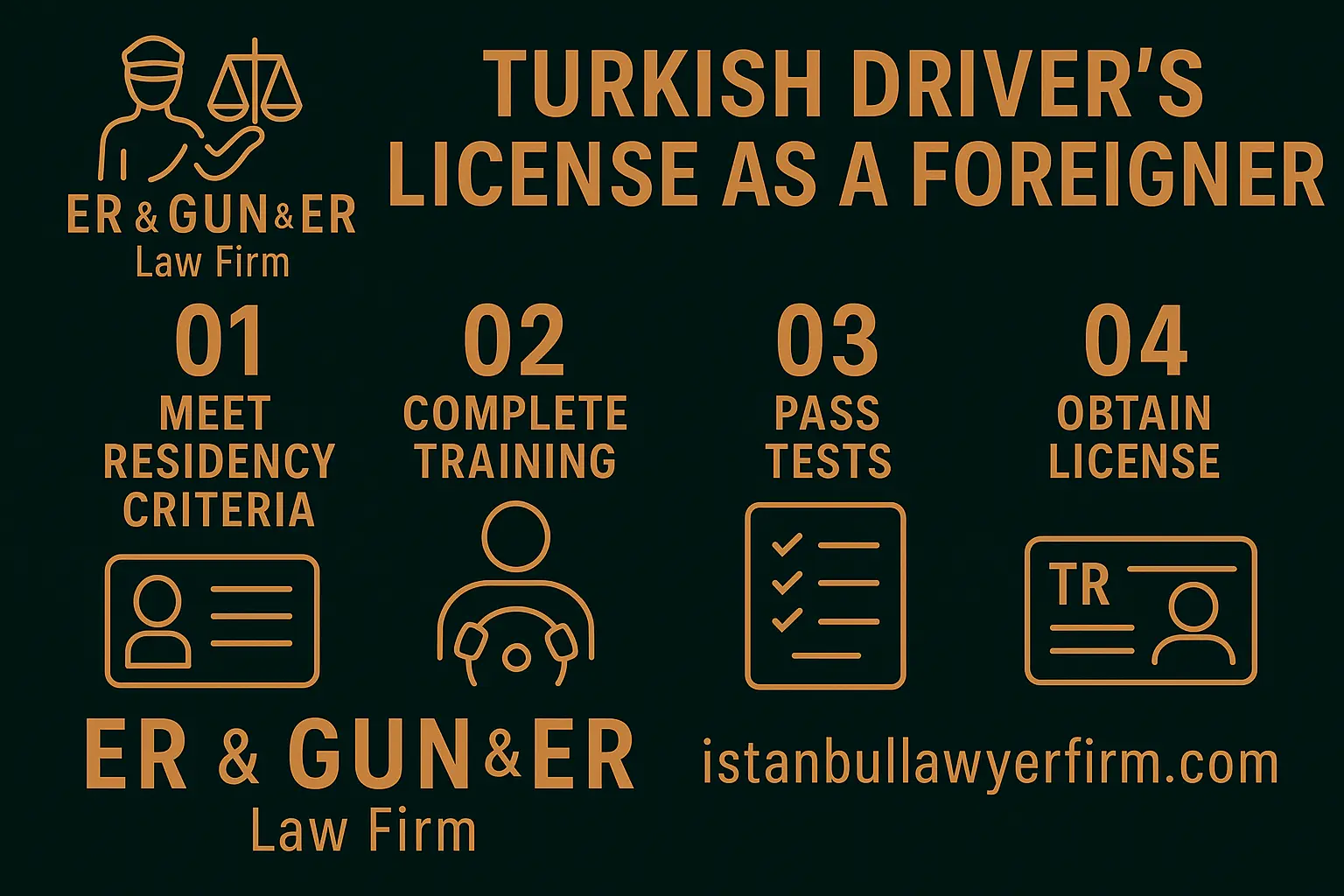
Getting a Turkish driver's license as a foreigner is a process that operates on two entirely different legal tracks depending on your situation—and identifying which track applies to you is the first and most consequential step, because the requirements, costs, timelines, and documentation differ substantially between them. The first track is direct exchange: if you hold a valid driver's license issued by a country that has a bilateral recognition agreement with Turkey, you can convert that license to a Turkish one without sitting a written or practical exam, subject to administrative conditions including valid residence permit, medical fitness certificate, and verified document authentication. The second track is the full Turkish licensing process: if your license was issued by a country with no bilateral agreement with Turkey, or if you do not meet the exchange eligibility conditions, you must register with a Turkish driving school (sürücü kursu), complete the required theory and practical training hours, pass the Turkish written traffic knowledge exam, and pass the practical driving test—the same process a Turkish citizen goes through when obtaining a license for the first time. Beyond these two tracks, foreign nationals who are short-stay visitors can drive legally in Turkey on a valid foreign license or an International Driving Permit (IDP) for a defined period without obtaining a Turkish license at all—but this visitor driving right ends once the foreigner establishes residence in Turkey, at which point the licensing obligation is triggered. The official legislative framework is governed by the Highway Traffic Law (Karayolları Trafik Kanunu, Law No. 2918) and its implementing regulation, accessible at Mevzuat. This guide covers every dimension of the Turkish driver's license process for foreigners: visitor driving rights, IDP validity, the direct exchange process, the full exam route, medical requirements, document obligations, residence permit interactions, license categories, and the practical steps at each stage.
Visitor driving rights in Turkey
A lawyer in Turkey advising on visitor driving rights must explain that a foreign national entering Turkey as a tourist or short-stay visitor can drive legally on Turkish roads using their valid foreign driver's license for a period tied to their permitted stay—without needing to obtain a Turkish license or register with any authority. This visitor driving right is not unlimited in duration. Once the foreign national transitions from visitor status to resident status by obtaining a Turkish residence permit, an obligation to obtain a Turkish license is triggered, and continuing to drive on a foreign license beyond the applicable grace period after obtaining residency creates a traffic law violation rather than a convenience. Practice may vary by authority and year — check current guidance on the current Turkish traffic law provisions governing visitor driving rights and on the specific deadline that follows the grant of a Turkish residence permit.
An Istanbul Law Firm advising on the International Driving Permit (IDP) must explain that an IDP is a standardized multilingual document issued by the motorist's home country automobile association that accompanies and translates the original national license for recognition purposes in countries party to the 1949 Geneva and 1968 Vienna road traffic conventions, both of which Turkey has ratified. The IDP does not independently authorize driving; it facilitates recognition of the original license at traffic stops. A foreign visitor who carries both their valid national license and a current IDP is in the strongest documentation position in Turkey. An IDP without the original national license is not sufficient. Practice may vary by authority and year — check current guidance on the current Turkish traffic authority's position on digital or electronic IDP formats and on documentary requirements at traffic stops for foreign-licensed drivers.
A Turkish Law Firm advising on the transition from visitor to resident must explain that Turkish law ties the licensing obligation to the formal establishment of residence marked by the grant of a Turkish residence permit. A foreign national who holds a short-term or long-term residence permit and who drives in Turkey beyond the applicable grace period on a foreign license is operating outside the permitted framework, and Turkish traffic police are authorized to penalize this violation. The residence permit in Turkey framework—covering the categories and application process—is analyzed in the resource on residence permit in Turkey. Practice may vary by authority and year — check current guidance on the current grace period and enforcement approach applicable to foreign-licensed residents who have exceeded it.
Bilateral exchange agreements explained
A law firm in Istanbul advising on the driver's license exchange Turkey bilateral agreement framework must explain that Turkey has concluded bilateral agreements with a number of countries that permit direct license exchange without examination. The holder of a valid license from one of these countries can convert it to a Turkish license by submitting the required documents and meeting the administrative conditions—no written test, no practical driving examination. The list of countries covered by exchange agreements is not static: it changes as Turkey concludes new agreements or amends existing ones, and a foreigner who last verified eligibility years ago may be working from outdated information. Practice may vary by authority and year — check the current list of exchange-eligible countries directly from the Turkish Directorate General of Security (Emniyet Genel Müdürlüğü) before making any licensing plans based on assumed exchange eligibility.
Countries historically covered by Turkish bilateral exchange agreements include most EU member states and a number of other European and regional countries—but the specific terms of each agreement, including which license categories are exchangeable, vary between them. A German B-class license holder, a UK license holder, and a US license holder face different eligibility positions, and the applicable rules must be checked specifically for each issuing country rather than assumed from general regional groupings. An English speaking lawyer in Turkey routinely advises clients on this point because the bilateral agreement status is the single most important variable in determining the time, cost, and effort the Turkish licensing process will require for a specific individual. Practice may vary by authority and year — check current guidance from the Turkish driving license authority on whether your specific license-issuing country is currently covered and on the terms applicable to your license category.
A Turkish Law Firm advising on partial exchange coverage must explain that even where an agreement exists between Turkey and the license-issuing country, it may cover only the B-class standard passenger vehicle category while leaving other classes—motorcycle (A), truck (C), bus (D)—subject to the full examination requirement. A foreign national who holds a motorcycle endorsement or commercial vehicle license from an agreement country must specifically verify whether the exchange covers their additional categories, and must plan for examination if those categories fall outside the agreement's scope. This is a common source of planning errors that leads to unexpected examination obligations mid-process. Practice may vary by authority and year — check current guidance on the specific categories covered by the agreement applicable to your license-issuing country.
Direct exchange: step-by-step process
An English speaking lawyer in Turkey advising on the convert foreign license Turkey process must explain that the direct exchange application is submitted to the Provincial Directorate of Security (İl Emniyet Müdürlüğü) traffic registration office in the applicant's province of residence—not to the driving school, not to the municipality, and not through a general online portal. Applications submitted to the wrong office are returned without processing. The process spans several weeks from initiation to license issuance because it involves a medical appointment, document authentication steps, and administrative review—none of which can be collapsed into a single day. Practice may vary by authority and year — check current guidance on the current submission office in your province and on any appointment booking requirements recently introduced for exchange applications.
The documents required for a direct exchange application are: a valid Turkish residence permit; the original foreign driver's license (not a photocopy); a certified Turkish translation prepared by a sworn translator (yeminli tercüman) notarized at a Turkish notary public; an apostille or diplomatic authentication on the original foreign license; a medical fitness report (sürücü sağlık raporu) from an authorized Turkish health facility; biometric photographs in the current specification; passport copies showing identity and most recent entry pages; and the administrative fee payment receipt. Every document must meet current format requirements—a translation by a non-sworn translator, an apostille on a photocopy rather than the original, or an expired medical report causes rejection. A law firm in Istanbul advising exchange applicants typically reviews the complete document package before submission precisely because document format errors are the most common cause of delays and rejection. Practice may vary by authority and year — check current guidance on the complete document checklist and format requirements from the Turkish licensing authority before assembling your application.
The apostille requirement deserves specific attention. Turkey is a party to the Hague Apostille Convention, which means driver's licenses issued by other Hague Convention member countries require an apostille stamp from the issuing country's competent authority—not a consular certification, not a notarized copy. The authority competent to issue apostilles on driver's licenses varies by country: in some jurisdictions it is the Ministry of Justice, in others it is the national or regional traffic authority. This apostille process typically requires sending the original license to the competent authority by post and waiting for its return, which takes several weeks in most jurisdictions. Because this step typically has the longest lead time among all required documents, it should be initiated first—before booking a medical appointment or engaging a translator. Practice may vary by authority and year — check current guidance on the apostille-issuing authority for driver's licenses in your specific country and on any expedited apostille service available.
Medical fitness requirements
A Turkish Law Firm advising on the Turkish driving license medical requirements must explain that every applicant—whether applying through direct exchange or through the full examination route—must obtain a medical fitness report from a Turkish health facility authorized by the Ministry of Health to conduct driver's license fitness examinations (sürücü adayı muayenesi). The examination assesses visual acuity with and without correction, color vision, hearing capacity, and general physical and mental fitness to drive. A foreign medical certificate, disability assessment, or doctor's letter does not substitute for the Turkish report regardless of its credentials or the reputation of the issuing institution. Practice may vary by authority and year — check current guidance on the current authorized health facilities for driver's license medical examinations in your province, as the authorized list changes periodically.
Visual acuity is the most frequently encountered issue at the medical examination. Turkish standards are assessed first without corrective lenses and then with glasses or contact lenses where applicable, and the thresholds differ between license categories—commercial vehicle classes carry stricter standards than the standard B class. A foreigner who wears glasses or contact lenses should not assume their vision meets Turkish standards based on their home country's driving fitness clearance, because the specific numerical thresholds differ between jurisdictions. An applicant who meets the corrected but not the uncorrected threshold receives a conditional medical clearance requiring corrective lenses while driving, which is noted on the Turkish license. Practice may vary by authority and year — check current guidance on the current Turkish visual acuity thresholds for the specific license category you are applying for.
A law firm in Istanbul advising on the medical report validity period must explain that the report has a defined validity window—if the complete application is not submitted within that period after the examination, the report expires and must be renewed. In a process where multiple documents are being assembled from different sources in different countries, this is a real coordination risk. The medical examination should be scheduled toward the end of the document assembly process—after the apostille and translation are already in hand—because those steps have the longest and most unpredictable lead times, while the medical appointment can typically be arranged quickly once needed. Practice may vary by authority and year — check current guidance on the current validity period of the driver's license medical fitness report in Turkey.
Full Turkish licensing process
An English speaking lawyer in Turkey advising on the full examination route must explain that a foreigner ineligible for direct exchange must complete the same process as a first-time Turkish citizen applicant: enrollment in a licensed Turkish driving school (sürücü kursu), completion of mandatory theory and practical training hours, passing the written traffic knowledge and first aid examination, and passing the practical driving test. The theory examination covers Turkish traffic rules, road signs, traffic law provisions, and basic vehicle mechanics—it is conducted in Turkish. While some driving schools in Istanbul, Ankara, and İzmir offer preparatory instruction in English or other languages, the official government examination is administered in Turkish only. A foreigner who does not read Turkish well enough to sit the examination needs both language support and driving content preparation. Practice may vary by authority and year — check current guidance on any official foreign-language examination accommodations that may have been introduced and on the current examination format and passing score.
The mandatory training hours are set by regulation and cannot be waived based on foreign driving experience. An applicant who has held a foreign license for decades and who drives daily still must complete the prescribed theory instruction hours and practical driving hours at a licensed Turkish driving school before the school can register them in the government examination system. A driving school that offers to skip mandatory hours or to certify completion without actual attendance is operating illegally—and an applicant who relies on such a shortcut risks having their license voided when the fraud is discovered. The driving school manages the government registration; a candidate cannot independently book the official examinations without this school registration. Practice may vary by authority and year — check current guidance on the current mandatory hour requirements for the license category you are pursuing.
A Turkish Law Firm advising on the practical driving test must explain that it is conducted in two stages: a closed-course maneuver test on a dedicated driving course assessing specific maneuvers including parking, emergency stopping, and slope departure; and an on-road test conducted on public roads under examiner supervision assessing general driving behavior and traffic compliance. The maneuver test is where most candidates fail on their first attempt—the precision required for the closed-course maneuvers is more demanding than what most experienced foreign drivers have practiced recently, even if they have been driving safely for years. Turkish driving schools provide maneuver-specific practical sessions calibrated to the current test format, and candidates who invest in these sessions rather than relying solely on general driving experience significantly improve their pass rate. Practice may vary by authority and year — check current guidance on the current practical test format, assessed maneuvers, and failure consequences in your province.
License categories in Turkey
A law firm in Istanbul advising on the Turkish license category system must explain that Turkey uses a European-aligned category framework. The categories most relevant to foreign nationals are: B for standard passenger vehicles and light goods vehicles up to 3,500 kg gross weight; A1, A2, and A for motorcycles by engine capacity and power output; C1 and C for goods vehicles above 3,500 kg gross weight; D1 and D for minibuses and buses by passenger capacity; and BE, CE, DE for the corresponding vehicle and trailer combinations. A foreigner intending to drive only a standard car needs B-class and nothing else. A foreigner intending to ride a motorcycle needs the appropriate A-class regardless of what other licenses they hold. Driving a vehicle outside your licensed category is a separate traffic violation even for holders of a valid Turkish license for a different category. Practice may vary by authority and year — check current guidance on the current Turkish license category definitions and vehicle weight thresholds, which have been periodically updated to align with EU directives.
The category equivalence question—how a foreign license category maps to the Turkish system for exchange purposes—is handled differently for different countries. A US license does not use European category designations, and the Turkish licensing authority must assess the equivalent Turkish category based on the vehicle type the US license authorizes. This assessment may require a letter from the original issuing authority describing the vehicle classes covered. An English speaking lawyer in Turkey advising clients from non-European jurisdictions regularly encounters this issue and recommends obtaining a formal vehicle class description letter from the original licensing authority before initiating the Turkish exchange application—avoiding the common situation where the Turkish authority requests this document during processing and the applicant must restart document collection from abroad. Practice may vary by authority and year — check current guidance from the Turkish licensing authority on the category mapping applicable to your country's license system.
A Turkish Law Firm advising on the age requirements per category must explain that Turkish law sets minimum age requirements for each license category that apply equally to Turkish citizens and foreigners applying through any route. The standard B-class minimum age is 18 years; C-class and D-class categories carry higher age requirements; and certain subcategories have additional professional experience conditions. A foreigner who holds a foreign license for a vehicle class for which the Turkish minimum age has not yet been reached cannot receive that Turkish category through exchange regardless of what the foreign license shows. This situation is uncommon but arises for young expatriates who acquired foreign licenses in jurisdictions with lower age requirements for certain vehicle classes. Practice may vary by authority and year — check current guidance on the current Turkish minimum age requirements for each license category before planning an exchange or examination application for categories other than the standard B class.
Required documents checklist
An English speaking lawyer in Turkey setting out the driving license documents Turkey foreigner requirements must present the complete document checklist clearly for both routes. For the direct exchange route, the complete package is: the original foreign driver's license; a certified sworn Turkish translation of the foreign license notarized at a Turkish notary; an apostille on the original foreign license (or consular legalization for non-Hague countries); the Turkish medical fitness report from an authorized facility; a valid Turkish residence permit; passport copies of the identity and most recent entry pages; biometric photographs in the current official specification; and the administrative fee payment receipt. For the full examination route, the package is: the Turkish medical fitness report; a valid Turkish residence permit; passport copies; biometric photographs; enrollment confirmation from the licensed driving school; and the administrative fee receipt. In both routes, every document must be current—an expired residence permit, an expired medical report, or a non-compliant photograph will halt the application without exception. A law firm in Istanbul advising clients on this process consistently finds that document preparation—not the test or the medical examination—is where most delays originate. Practice may vary by authority and year — check current guidance on the complete document list and format specifications directly from the traffic registration office in your province before preparing your application.
The sworn translation requirement—specifically the requirement that the foreign license be translated by a yeminli tercüman (sworn translator) whose translation is then notarized at a Turkish notary public—is frequently misunderstood. A certified translation from a professional translation service, a translation by a bilingual attorney, or a translation authenticated by a foreign notary does not meet the Turkish requirement. The translation must be produced by a translator registered on the Turkish sworn translator registry, and the notarization must be performed by a Turkish notary. For applicants who are assembling documents from abroad before relocating to Turkey, the sworn translation and notarization step must either be completed in Turkey (typically by visiting a notary shortly after arrival) or arranged through a Turkish notary office that accepts power of attorney instructions. Practice may vary by authority and year — check current guidance on the current Turkish notary requirements for sworn license translations and on any recently introduced digital notarization options.
A Turkish Law Firm advising on the timing of residence permit validity in relation to the license application must explain that the Turkish residence permit presented with the license application must be valid—not expired, not pending renewal. An applicant whose residence permit is in the renewal process and who holds only an appointment confirmation or a temporary document rather than the actual permit card may face a documentation gap. The license application should be timed to a point when a valid, current residence permit card is in hand. The types of residence permits Turkey framework—covering the different categories and their renewal timelines—is analyzed in the resource on types of residence permits Turkey. Practice may vary by authority and year — check current guidance on the current Turkish licensing authority's acceptance of different residence permit document formats and on whether temporary residence documents pending card delivery are accepted.
Driving in Turkey on a foreign license
A law firm in Istanbul advising on driving in Turkey on a foreign license must explain the legal position clearly: a foreign national who is a visitor in Turkey and who holds a valid foreign license may drive in Turkey without a Turkish license, subject to the time limits of their permitted stay and the continuing validity of the foreign license. An IDP accompanying the foreign license strengthens this position at traffic stops. Once residency is established through a Turkish residence permit, this visitor driving right transitions into a compliance obligation—the foreigner must initiate the Turkish licensing process within the applicable grace period. Driving on a foreign license after the grace period has expired is a violation subject to penalties under the Turkish traffic law. Practice may vary by authority and year — check current guidance on the current penalty applicable to residents driving on foreign licenses beyond the grace period and on how this violation is typically handled by Turkish traffic police in practice.
The traffic stop documentation scenario is worth understanding in practical terms. A Turkish traffic police officer who stops a foreign-plated or Turkish-plated vehicle driven by a foreign national will examine the driving license. If the driver presents a valid foreign license and is within their visitor driving period, the officer should accept this as valid driving authorization. If the driver presents a foreign license but is a Turkish resident beyond the grace period, the violation may be noted. If the officer cannot read the foreign license—because it is in a non-Latin script or an unfamiliar format—having an IDP as a companion document is particularly valuable because the IDP is designed precisely for this cross-jurisdiction readability issue. Practice may vary by authority and year — check current guidance on the current Turkish traffic authority's practical approach to foreign licenses at traffic stops and on whether any specific license formats or countries of issue currently create systematic difficulties.
An English speaking lawyer in Turkey advising on insurance requirements for driving in Turkey on a foreign license must explain that a vehicle driven in Turkey—whether by a Turkish citizen or a foreign visitor—must carry valid Turkish compulsory traffic insurance (zorunlu trafik sigortası). A foreign visitor driving their own foreign-registered vehicle in Turkey may satisfy this requirement through a Green Card (International Motor Insurance Certificate) that covers Turkey, or must purchase Turkish compulsory insurance at the border or from a Turkish insurer. A foreign national driving a Turkish-registered vehicle in Turkey must ensure that the vehicle's Turkish insurance policy is current. The vehicle import framework for foreigners driving foreign-registered cars in Turkey—covering the 185-day rule and the temporary import permit—is analyzed in the resource on bringing a foreign-plated car into Turkey. Practice may vary by authority and year — check current guidance on the current insurance requirements applicable to your specific driving situation in Turkey.
After you get your Turkish license
A Turkish Law Firm advising on what happens to the foreign license after exchange must explain that when a foreign driver's license is exchanged for a Turkish one, the original foreign license is typically retained by the Turkish authority and returned to the issuing country's embassy or consulate—it is not simply handed back to the applicant. This matters because a foreigner who has surrendered their foreign license through the Turkish exchange and who later leaves Turkey permanently needs to understand how to have their driving privileges in their home country restored. The procedure varies by country: some countries re-issue the national license when the Turkish one is surrendered; others require a new application. Before initiating the Turkish exchange, the applicant should specifically verify with their home country's licensing authority what will happen to their driving privileges in that country following the exchange and how to restore them if needed. Practice may vary by authority and year — check current guidance from both the Turkish licensing authority and your home country's licensing authority on the license handling and restoration process before initiating the exchange.
The Turkish driver's license validity period and renewal requirements are relevant from the date of issue. Turkish licenses are not issued with unlimited lifetime validity—they carry defined validity periods depending on the license category and the holder's age, and they must be renewed before expiry. A Turkish license issued to a foreigner is subject to the same renewal requirements as one issued to a Turkish citizen, and a foreign national who has obtained a Turkish license must track its expiry date and initiate renewal before the license lapses. Driving on an expired Turkish license is a violation regardless of the holder's nationality or how recently the license was originally obtained. Practice may vary by authority and year — check current guidance on the current validity periods applicable to Turkish licenses for the specific category and age bracket applicable to you and on the current renewal procedure and documentation requirements.
A law firm in Istanbul advising on the Turkish license and Turkish citizenship interaction must explain that a foreign national who subsequently acquires Turkish citizenship after having obtained a Turkish driving license does not need to obtain a new license on the basis of citizenship—the Turkish driving license issued to a foreign resident continues to be valid and is simply treated as the individual's Turkish license going forward. However, the license may need to be updated to reflect any name change or identity number update that accompanies the citizenship acquisition, and this administrative update should be completed promptly to avoid any discrepancy between the license and the holder's current identity documents. The Turkish citizenship options framework—covering the routes to Turkish citizenship and their administrative implications—is analyzed in the resource on Turkish citizenship options. Practice may vary by authority and year — check current guidance on the current Turkish licensing authority procedures for updating license details following Turkish citizenship acquisition.
Common mistakes and how to avoid them
An English speaking lawyer in Turkey advising on the most common errors in the Turkish driver's license application process for foreigners must explain that the mistakes that cause the most delay and expense are almost always document-related rather than test-related. The most frequently encountered errors are: obtaining the apostille on a notarized copy of the license rather than on the original; submitting a translation by a professional translator who is not registered on the Turkish sworn translator registry; presenting an expired medical report because the apostille process took longer than expected; submitting an application to the wrong authority—often to the local municipality or police station rather than the Provincial Security Directorate's specific traffic registration office; and failing to verify in advance whether the bilateral agreement covers all the license categories the applicant holds. Each of these errors is avoidable with proper preparation. Practice may vary by authority and year — check current guidance on current procedures to avoid each of these failure points before submitting your application.
The bilateral agreement assumption error is particularly costly because it typically manifests late in the process. A foreigner who has assembled a complete exchange application package—apostille, translation, medical report, photographs—and then discovers at submission that their country is not on the current bilateral agreement list has wasted several weeks of preparation and must now pivot to the full examination route. The correct approach is to verify bilateral agreement eligibility before investing any time in document assembly, because this single verification takes minutes and determines everything else about the process. A Turkish Law Firm advising first-time applicants consistently identifies this verification step as the single most important thing to do before starting the process. Practice may vary by authority and year — check the current bilateral agreement list from an official Turkish government source rather than from community forums or secondhand information, which may be out of date.
A lawyer in Turkey completing the practical guidance must address the Turkish driving license lawyer engagement question—when legal counsel adds meaningful value over self-managed licensing. For most straightforward exchange applications where the bilateral agreement is confirmed, the documents are straightforward, and the applicant has time to manage the process themselves, the exchange is an administrative procedure rather than a legal one, and professional legal involvement is not necessary. Legal counsel becomes valuable in specific situations: document rejection and resubmission; appeals against exchange denial; understanding the legal position of a resident who has been driving on a foreign license beyond the grace period and who is now regularizing their status; navigating licensing obligations following Turkish citizenship acquisition; and any situation where the applicant's foreign license has been lost, suspended, or subject to any restriction in the issuing country that might affect its exchangeability. The Istanbul Bar Association at istanbulbarosu.org.tr provides resources for identifying qualified practitioners in administrative law and traffic matters. Practice may vary by authority and year — check current guidance on the current Turkish driver's license requirements applicable to your specific situation before making any decisions based on this guide.
Author: Mirkan Topcu is an attorney registered with the Istanbul Bar Association (Istanbul 1st Bar), Bar Registration No: 67874. His practice focuses on cross-border and high-stakes matters where evidence discipline, procedural accuracy, and risk control are decisive.
He advises individuals and companies across Immigration and Residency, Commercial and Corporate Law, and cross-border documentation matters where procedural accuracy and evidence discipline are decisive.
Education: Istanbul University Faculty of Law (2018); Galatasaray University, LL.M. (2022). LinkedIn: Profile. Istanbul Bar Association: Official website.