

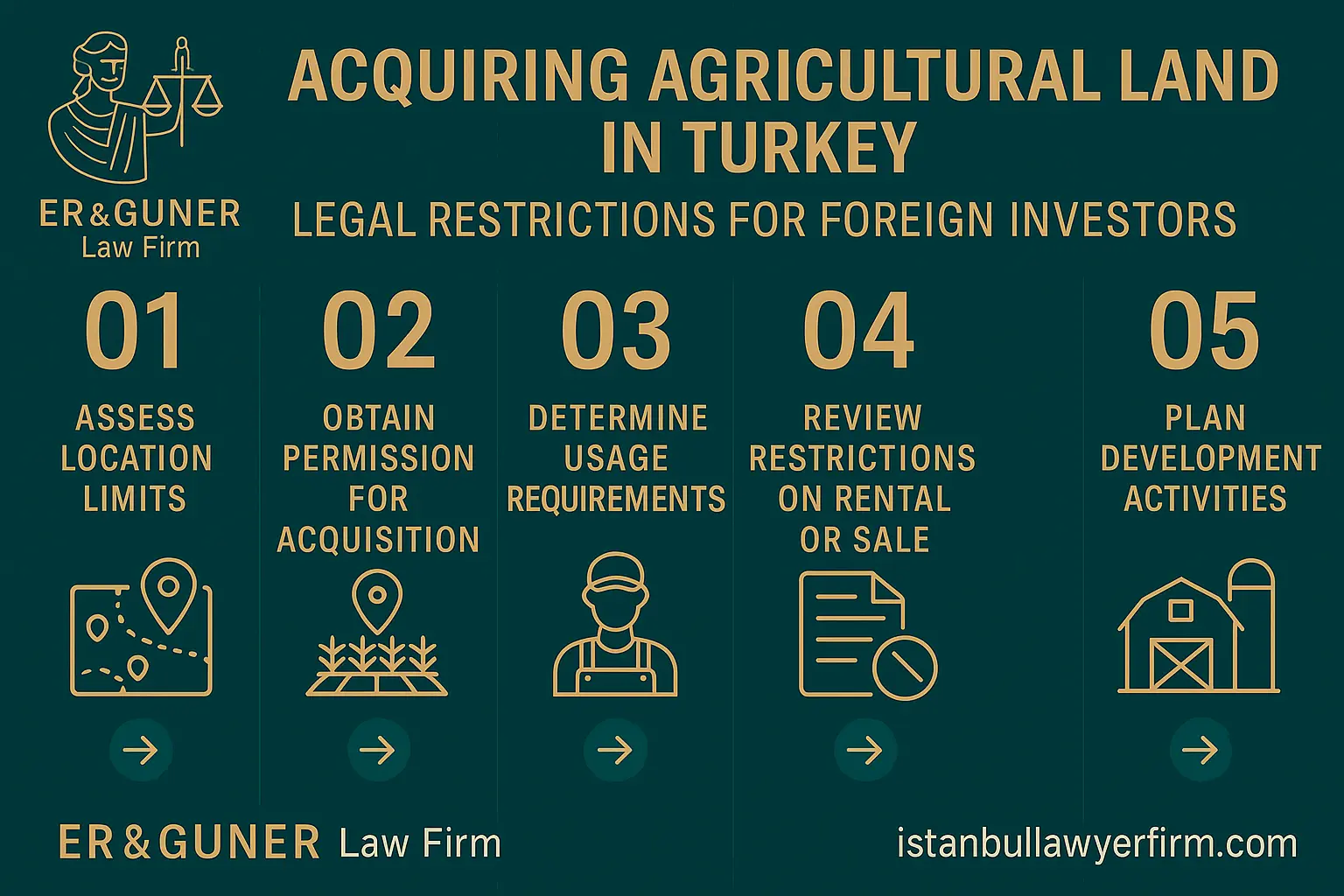
Foreign acquisition of agricultural land in Turkey is governed by a layered legal framework that combines the Land Registry Law (Tapu Kanunu, Law No. 2644), the Soil Conservation and Land Use Law (Toprak Koruma ve Arazi Kullanımı Kanunu, Law No. 5403), the Foreign Direct Investment Law (Law No. 4875), and a set of ministerial regulations that impose nationality-based restrictions, area ceilings, productive use obligations, and Ministry of Agriculture permit requirements that are not visible in any single statutory text. A foreign investor who approaches agricultural land acquisition as a straightforward real estate transaction — applying the same framework used for urban apartment purchases — will encounter obstacles at the Land Registry that a properly structured pre-purchase analysis would have identified and addressed in advance. This guide explains the specific legal conditions that apply, the corporate and regulatory structures most commonly used to navigate them, and the practical compliance obligations that apply after acquisition. For the legal framework governing standard residential and commercial real estate purchases, see the guide on how to buy agricultural land in Turkey. Practice may vary by authority and year — verify current Land Registry requirements and Ministry of Agriculture permit conditions directly before any agricultural land acquisition transaction.
The legal framework — Law No. 2644 and Law No. 5403
A lawyer in Turkey advising on foreign agricultural land acquisition must explain that two statutes create the primary restriction framework, and they operate at different levels of the transaction. Law No. 2644 (the Land Registry Law) governs who can acquire title to Turkish real property — it establishes nationality-based restrictions on foreign individual ownership, the reciprocity condition, and the area ceiling that applies to total foreign land holdings across Turkey. Law No. 5403 (the Soil Conservation and Land Use Law) governs what can be done with agricultural land regardless of who owns it — it classifies land according to agricultural capability, restricts conversion to non-agricultural use, imposes minimum parcel size requirements, and establishes the productive use obligation that applies to all agricultural landowners. These two frameworks interact: a foreign investor who satisfies the Law No. 2644 ownership conditions must also comply with Law No. 5403's use and conversion restrictions throughout the ownership period. Practice may vary — verify current Law No. 2644 nationality eligibility conditions and the specific Law No. 5403 classification applicable to the target parcel before any pre-purchase analysis.
An Istanbul Law Firm advising on the reciprocity condition under Law No. 2644 must explain that Turkish law requires reciprocity as a condition of foreign individual land ownership — meaning that Turkish citizens must be permitted to own real property in the foreign national's home country for that foreign national to be eligible to own property in Turkey. The Turkish Council of Ministers publishes a list of countries whose nationals are eligible to acquire Turkish real property on a reciprocity basis, and the list is periodically updated. A foreign national whose country is not on the eligible list cannot acquire Turkish land individually — but may be able to acquire it through a Turkish company. For countries that are on the eligible list, reciprocity is confirmed by the Land Registry through its internal protocols, and the foreign buyer does not need to separately document the reciprocity condition. Practice may vary by authority and year — verify current reciprocity list status for the specific nationality with the relevant Land Registry directorate before any purchase commitment.
A law firm in Istanbul advising on cadastral classification must explain that Turkish cadastral records classify land into categories — agricultural land (tarım arazisi), forest land (orman arazisi), residential zones (konut alanı), commercial zones (ticaret alanı), and others — and the legal restrictions differ fundamentally between categories. What appears from a satellite view to be open farmland may be classified as forest land in the cadastral records, triggering the Forestry Law (Law No. 6831) with significantly more restrictive acquisition rules for foreign nationals. Conversely, land classified as agricultural in the cadastral records but located within a municipality's development plan boundary may be subject to a pending zoning reclassification that will change its legal character after purchase. We verify cadastral classification, current Land Registry records, and any pending zoning decisions before any agricultural land purchase analysis — because the applicable legal framework is determined by the classification at the time of acquisition, not by the land's physical appearance. Practice may vary — verify current cadastral classification and pending zoning decisions through the relevant municipal and Land Registry authorities before any agricultural land transaction.
Ownership ceilings and the individual area limit
An English speaking lawyer in Turkey advising on the area ceiling for foreign agricultural land ownership must explain that Law No. 2644 Article 35 sets a ceiling on the total agricultural land area that a foreign individual may own in Turkey. The ceiling applies cumulatively across all Turkish agricultural parcels held by the same individual — it is not a per-parcel limit. A foreign investor who already owns agricultural land in Turkey must account for that existing holding when assessing whether a new acquisition stays within the ceiling. Cabinet-level expansion authorization is available in specific investment incentive contexts, but requires a formal application. Practice may vary by authority and year — verify the currently applicable area ceiling under Law No. 2644 Article 35 as amended and the specific calculation methodology for cumulative holdings before any agricultural land acquisition commitment.
A Turkish Law Firm advising on the distinction between individual and corporate acquisition must explain that the area ceiling and certain nationality-based restrictions applicable to individual foreign buyers do not apply in the same way to Turkish companies with foreign shareholders. A Turkish limited company (limited şirketi) or joint stock company (anonim şirket) in which a foreign national holds shares is a Turkish legal entity — and its acquisition of Turkish real property, including agricultural land, is governed by the foreign direct investment framework (Law No. 4875) and Law No. 2644 Article 36 for legal entities. This means that a foreign investor who cannot acquire agricultural land individually due to the area ceiling, nationality restriction, or other Article 35 constraint may be able to acquire it through a Turkish company they establish or in which they hold shares. However, Article 36 imposes its own conditions — the company must be established in Turkey, the acquisition must be within the company's stated business purpose, and specific agricultural activity requirements apply. Practice may vary — verify current Law No. 2644 Article 36 conditions and the specific Ministry of Agriculture requirements applicable to company-held agricultural land before selecting a corporate acquisition structure.
A lawyer in Turkey advising on the military clearance requirement must explain that foreign nationals and companies with foreign shareholders acquiring Turkish real property located in or near designated military or security zones must obtain clearance from the relevant military command (askeri bölge yazısı) before the Land Registry will proceed with title transfer. Agricultural land — which is often located in rural areas that overlap with military proximity zones — is disproportionately affected by this requirement compared to urban real estate. The clearance application is submitted through the Land Registry directorate, which forwards it to the military command for verification. Response times vary between weeks and months. An acquisition timeline that does not account for military clearance processing will overrun. We identify whether a specific parcel requires military clearance as a preliminary step in every agricultural land due diligence — before any purchase price is committed or preliminary agreement is signed. Practice may vary — verify current military zone clearance requirements and the specific processing timeline at the relevant Land Registry directorate before planning any agricultural land acquisition timeline.
Ministry of Agriculture permit requirements and productive use
An Istanbul Law Firm advising on Ministry of Agriculture permit requirements must explain that Law No. 5403 requires a permit from the Provincial Directorate of Agriculture (İl Tarım ve Orman Müdürlüğü) for certain categories of agricultural land transaction — including acquisitions that affect fragmentation of agricultural parcels below the minimum viable farm size, acquisitions in first and second class agricultural land quality zones (birinci ve ikinci sınıf tarım arazisi), and acquisitions that involve any proposed change of use from agricultural to non-agricultural purpose. The permit review assesses whether the proposed acquisition is consistent with the land's agricultural capability classification and whether the planned use will maintain productive agricultural activity. A transaction that proceeds to Land Registry title transfer without the required Ministry permit is legally incomplete and may be administratively challenged. Practice may vary by authority and year — verify current Law No. 5403 permit trigger conditions and the specific application requirements at the relevant Provincial Directorate before any agricultural land acquisition.
A law firm in Istanbul advising on the productive use obligation must explain that Law No. 5403 imposes an ongoing productive use obligation on all agricultural landowners — the land must be actively used in alignment with its agricultural capability classification. For foreign investors who acquire agricultural land for investment or development purposes without an immediate agricultural operation plan, this obligation creates both a regulatory compliance risk (the Provincial Directorate can investigate and sanction passive landholding that does not meet the productive use standard) and a permit risk (future conversion or development applications may be denied on grounds that the landowner has not demonstrated agricultural use). The productive use obligation is not satisfied by mere ownership — it requires active agricultural activity: crop production, livestock operations, greenhouse farming, or agro-tourism, depending on the land's classification and the applicable regional agricultural development plan. Practice may vary — verify current productive use standards applicable to the specific agricultural capability classification and the provincial enforcement approach before planning any acquisition where immediate active agricultural operations are not planned.
An English speaking lawyer in Turkey advising on the minimum parcel size requirements must explain that Law No. 5403 establishes minimum viable farm sizes (asgari tarımsal arazi büyüklükleri) below which agricultural land parcels may not be subdivided or transferred as separate parcels — the specific minimum varies by land quality classification and by region. A foreign investor who wants to acquire a portion of a larger agricultural parcel — rather than the entire parcel — may find that the proposed acquisition creates a sub-minimum size remainder that cannot legally be separated. The minimum size restriction also affects inheritance planning, because an agricultural parcel cannot be divided among multiple heirs if the resulting shares would fall below the minimum viable size. Understanding the minimum parcel size applicable to the specific land before structuring any partial acquisition or succession plan is essential. Practice may vary — verify current Law No. 5403 minimum parcel size requirements for the relevant agricultural zone and land classification before any partial acquisition or inheritance structure is planned. The agricultural land purchase process is analyzed in detail in the resource on how to buy agricultural land in Turkey.
Zoning, classification, and conversion restrictions
A Turkish Law Firm advising on agricultural zoning classification must explain that Law No. 5403 classifies agricultural land according to soil quality and agricultural capability — from Class I (highest quality, most productive) through Class VIII (lowest quality, minimal agricultural potential) — and restrictions on use and conversion become progressively less stringent as the class decreases. Class I and II land is subject to the strictest protection: conversion to non-agricultural use requires both a Provincial Directorate of Agriculture permit and a Council of Ministers decision, and is typically restricted to cases of overriding public necessity. Class III and IV land faces more flexible conversion standards, but still requires formal Ministry approval. Understanding the classification before any purchase is not optional — it determines what can be done with the land throughout the ownership period. Practice may vary — verify current Law No. 5403 classification of the specific parcel and the applicable conversion restrictions before any agricultural land acquisition that involves a non-agricultural development objective.
An Istanbul Law Firm advising on land use conversion (arazi kullanım dönüşümü) must explain that obtaining conversion authorization for agricultural land to non-agricultural use is a multi-stage administrative process that involves the Provincial Directorate of Agriculture, the relevant municipality for parcels within or adjacent to municipal boundaries, and in some cases the Council of Ministers. The process requires demonstrating that the proposed conversion serves a purpose that cannot be satisfied on non-agricultural land, that the agricultural impact has been assessed and mitigated, and that the conditions of the applicable Agricultural Special Environmental Plan have been satisfied. Conversion applications for Class I and II land face a very high administrative barrier and are rarely approved outside of public infrastructure projects. The conversion authorization must be assessed as part of the pre-purchase due diligence — not as a post-purchase administrative step — because an unconvertible parcel purchased with a development intention is a stranded investment. Practice may vary by authority and year — verify current agricultural land conversion authorization procedures and the applicable conversion barrier for the specific land classification before any acquisition with a development objective.
A lawyer in Turkey advising on protected zone restrictions must explain that agricultural land located within or adjacent to specific protected zones faces additional restrictions beyond those imposed by Law No. 5403's agricultural classification framework. These zones include: forest adjacency buffer zones under the Forestry Law (Law No. 6831); wetland and nature protection areas under the Environmental Law (Law No. 2872); archaeological site protection zones under Law No. 2863; and coastal protection zones under the Coastal Law (Law No. 3621). Land that appears in cadastral records as agricultural land may simultaneously fall within one or more of these protection zones, and the most restrictive applicable framework governs. A forest adjacency buffer zone restriction, for example, can prohibit construction, fencing, irrigation installations, and certain farming activities on land that the cadastral records describe as farmland. We identify and map all applicable protection zone overlays as part of every agricultural land due diligence — before any acquisition commitment. Practice may vary — verify current protection zone boundaries applicable to the specific parcel through the relevant environmental and forestry authorities before any agricultural land transaction.
Due diligence — title, encumbrances, and water rights
An English speaking lawyer in Turkey advising on agricultural land due diligence must explain that the due diligence process for agricultural land requires analysis at four parallel tracks: the Land Registry (Tapu ve Kadastro Genel Müdürlüğü) for title and encumbrance records; the Ministry of Agriculture for classification, productive use history, and subsidy obligations; the municipality for zoning status and pending development plan changes; and environmental and forestry authorities for protection zone overlays. A due diligence process that analyzes only the Land Registry records will miss Ministry of Agriculture encumbrances such as prior subsidy-linked use obligations that run with the land, municipal zoning constraints such as a pending reclassification, and protection zone restrictions such as a forest adjacency buffer zone that limits farming activities. We conduct all four tracks simultaneously for every agricultural land due diligence mandate. Practice may vary — verify current information access procedures at each relevant authority before planning any agricultural land due diligence timeline.
A Turkish Law Firm advising on encumbrances specific to agricultural land must explain that Turkish agricultural land carries specific categories of encumbrance that do not appear in standard urban real estate due diligence checklists. These include: irrigation cooperative membership obligations (sulama birliği aidatları) tied to the parcel and transferred to new owners; agricultural subsidy clawback obligations (tarımsal destekleme geri ödemeleri) where prior owners received subsidies subject to ongoing use conditions that bind successors; pre-emption rights (önalım hakları) of co-owners or neighboring agricultural landowners under Law No. 5403 that can be exercised to void a sale to a third party; and agricultural mortgage registrations from cooperative lending arrangements not always visible in the standard Tapu encumbrance search. We conduct an expanded encumbrance search across Land Registry records, Ministry of Agriculture databases, and municipal records for every agricultural land mandate. Practice may vary — verify current Ministry of Agriculture subsidy clawback records access procedures and the specific pre-emption right conditions applicable to the land's classification before any agricultural land purchase commitment.
An Istanbul Law Firm advising on water rights in agricultural land due diligence must explain that access to irrigation water is frequently the most commercially significant attribute of Turkish agricultural land — and it is not automatically transferred with title. Water rights (su hakları) are administered separately from land ownership: the right to draw from a specific water source, to access an irrigation canal, or to participate in a regional irrigation scheme is granted by permit (DSİ — Devlet Su İşleri Genel Müdürlüğü permits), and existing permits may or may not transfer to a new owner depending on the permit terms. Agricultural land whose commercial value depends on a specific water source may lose much of its value if the water access permit does not transfer or is not renewable. We investigate water rights as a distinct track in every agricultural land due diligence, confirming the existence, status, and transferability of all relevant DSİ permits. Practice may vary — verify current DSİ water permit transfer conditions before any agricultural land acquisition where water access is a material commercial assumption. The comprehensive property due diligence framework is analyzed in the resource on real estate due diligence for foreigners in Turkey.
Taxation of agricultural land acquisition and operations
A law firm in Istanbul advising on the tax position of agricultural land acquisition must explain that the tax consequences of acquiring and operating agricultural land in Turkey differ meaningfully from urban real estate and must be assessed against the agricultural context specifically. The title transfer tax (tapu harcı) is calculated on the declared or assessed transfer value at 4% (split equally between buyer and seller, each paying 2%), subject to a minimum declared value floor. Value Added Tax (KDV) is generally not applicable to agricultural land transactions between individuals, though company-to-company transfers may trigger KDV depending on the seller's status. Stamp duty (damga vergisi) applies to the sale agreement at a rate of 0.948% of the contract value. Corporate income tax implications for company-held land depend on the company's accounting treatment of the land as a capital versus operational asset. Practice may vary by authority and year — verify current tapu harcı rates, KDV treatment for the specific transaction structure, and stamp duty calculation methodology before any agricultural land acquisition tax planning.
An English speaking lawyer in Turkey advising on ongoing agricultural land taxation must explain that agricultural land ownership generates ongoing tax obligations independent of whether the land is actively operated. The annual property tax (emlak vergisi) on agricultural land is calculated on the property's assessed value (vergi değeri) at 0.2% per year for land within municipality boundaries and a reduced rate for land outside municipality boundaries — but the assessed value is updated periodically and may not reflect market value. Agricultural income tax applies to income generated from agricultural operations, but Turkey's framework provides significant exemptions for small and medium agricultural operations whose specific threshold and applicable rate must be verified against current legislation. For foreign-owned company structures, corporate income tax applies to profits from agricultural operations at the current rate, with allowable deductions for operational expenses. Practice may vary — verify current agricultural property tax assessment methodology and the specific agricultural income tax exemption thresholds applicable to the operational scale before any tax structuring for agricultural land operations.
A Turkish Law Firm advising on capital gains tax on agricultural land disposal must explain that the gain on sale of agricultural land by an individual is subject to income tax under the Turkish Income Tax Law (Gelir Vergisi Kanunu, GVK) if the land is sold within five years of acquisition — after five years, the gain is exempt from income tax for individual sellers. For company-held agricultural land, the gain on disposal is subject to corporate income tax regardless of the holding period, with specific participation exemption provisions that may reduce the applicable rate on qualifying gains. Foreign investors must also consider whether their home country has a double taxation treaty with Turkey that modifies the Turkish withholding position on the gain, and whether the gain is also taxable in the home country with or without a treaty credit. We advise on the full bilateral tax position — Turkish and home country — before any agricultural land disposal is planned. Practice may vary — verify current GVK five-year capital gains exemption conditions and the applicable treaty provisions for the investor's nationality before any agricultural land disposal transaction. The Turkish tax framework for foreign investors is analyzed in the resource on tax residency for foreigners in Turkey.
Agricultural subsidies and government incentive programs
A lawyer in Turkey advising on Turkish agricultural support programs must explain that the Ministry of Agriculture and Forestry administers a range of agricultural subsidy programs (tarımsal destekler) — including area-based direct income support (doğrudan gelir desteği, DGD), product-specific production subsidies, agricultural mechanization grants, greenhouse support programs, and rural development fund disbursements. Eligibility is generally conditioned on: registration in the Farmer Registration System (Çiftçi Kayıt Sistemi, ÇKS); the land being registered in the agricultural parcel cadastre; and demonstrating active agricultural production on the registered parcels during the relevant season. Foreign nationals who hold Turkish agricultural land individually or through a Turkish company can generally access these programs if the eligibility conditions are met — but the ÇKS registration process requires coordination between the Land Registry, the Ministry of Agriculture, and the applicant's Turkish tax records. Practice may vary by authority and year — verify current ÇKS registration eligibility conditions for foreign individuals and foreign-owned Turkish companies before planning any subsidy application.
An Istanbul Law Firm advising on investment incentive programs for agricultural operations must explain that Turkey's investment incentive framework (yatırım teşvik sistemi), administered by the Ministry of Industry and Technology, includes specific incentive packages for qualifying agricultural investments — including VAT exemptions on machinery and equipment, customs duty exemptions, corporate income tax reductions, interest support for bank financing, and social security premium support for new employment. The applicable incentive tier is determined by geographic location and classified across six regional tiers. Agricultural processing investments (food processing, agro-industrial facilities) typically qualify for higher incentive tiers than pure farming operations. Obtaining an Investment Incentive Certificate (Yatırım Teşvik Belgesi) requires a formal application with a detailed investment project, financial plan, and employment commitments — and the certificate must be obtained before investment expenditure is incurred. Practice may vary — verify current agricultural investment incentive program conditions and the applicable regional tier for the planned investment location before any incentive application is prepared.
A law firm in Istanbul advising on EU-funded rural development programs must explain that Turkey participates in certain EU pre-accession funding mechanisms including rural development components — administered through the IPARD (Instrument for Pre-Accession Assistance for Rural Development) program managed by the Agriculture and Rural Development Support Institution (TKDK). IPARD grants provide co-financing for qualifying agricultural investment projects — farm modernization, food processing facility establishment, agro-tourism development, and agricultural infrastructure — at support rates of 50% to 65% of eligible project costs. Foreign-owned Turkish companies can apply for IPARD grants if they meet the eligibility conditions for the specific measure. Applications are project-based, with calls for applications issued periodically, and require a detailed technical and financial project file. Grant payments are made on a reimbursement basis after investment expenditure is verified. Practice may vary — verify current TKDK IPARD program conditions, open measures, and application call status before planning any investment that anticipates IPARD co-financing. The foreign investment framework is analyzed in the resource on foreign investor company law in Turkey.
Exit strategies, transfer, and inheritance
An English speaking lawyer in Turkey advising on exit planning for agricultural land investments must explain that exit planning must begin at the acquisition stage — not at the point when an exit is desired — because the transfer restrictions applicable to Turkish agricultural land must be reflected in the investment structure from the outset. A foreign investor holding agricultural land individually who wants to sell to another foreign national must confirm that the buyer meets all Law No. 2644 eligibility conditions and that the sale does not trigger a pre-emption right exercisable by neighboring agricultural landowners or co-owners. A foreign investor holding agricultural land through a Turkish company can exit via a share sale rather than a land sale — which avoids the land transfer's tapu harcı, the pre-emption right trigger, and the Ministry of Agriculture notification requirements — while still transferring effective control of the land. We assess exit structure options at the due diligence stage of every agricultural land acquisition mandate. Practice may vary — verify current Law No. 5403 pre-emption right conditions and Law No. 2644 buyer eligibility requirements applicable to the specific exit structure before any disposal planning.
A Turkish Law Firm advising on succession planning for Turkish agricultural land must explain that Turkish inheritance law (TMK, Türk Medeni Kanunu) applies to agricultural land held by foreign nationals in Turkey — the land is distributed according to Turkish succession law, not the deceased's home country law, regardless of any foreign will or estate plan. Turkish succession law establishes mandatory reserved shares (saklı pay) for children and spouses that cannot be disinherited, and agricultural land passing through a Turkish estate is subject to the Probate Court (Sulh Hukuk Mahkemesi) process for heir identification, estate inventory, and title transfer. For agricultural parcels subject to Law No. 5403's minimum viable farm size restriction, inheritance may not be able to divide the land among multiple heirs — the legal remedy is typically the designation of a single agricultural successor heir or a buyout of other heirs' shares at assessed value. International family situations with heirs in multiple countries require coordination between Turkish Probate Court proceedings and any foreign estate administration. Practice may vary — verify current Turkish succession law provisions applicable to agricultural land before any succession planning for Turkish agricultural landholdings.
A lawyer in Turkey advising on long-term lease as an exit mechanism must explain that an investor who wishes to exit ownership while preserving an operational relationship with the land — or who faces a period when title transfer is commercially or administratively impractical — can structure a long-term agricultural lease of the land to an operational tenant, with the leasehold interest registered at the Land Registry. The registered lease provides the tenant with enforceable operational rights and provides the investor with a contractual rental stream and a preserved option to resume full operational control upon lease expiry. A long-term lease that is properly structured — with clear productive use obligations for the tenant to satisfy Law No. 5403 compliance, defined rental adjustment mechanisms, and a Land Registry registration providing third-party enforceability — can serve as both a commercial exit from active management and a legally compliant interim holding structure during a period of ownership transition. Practice may vary — verify current Land Registry lease registration requirements and the specific Law No. 5403 productive use compliance obligations for leased agricultural parcels before structuring any long-term agricultural lease as part of an exit plan. Practice may vary — check current guidance before acting on any information on this page.
How we work in agricultural land mandates
A best lawyer in Turkey managing a foreign agricultural land acquisition begins with a parallel four-track due diligence: Land Registry records for title and encumbrances; Ministry of Agriculture records for classification, productive use history, and subsidy obligations; municipal records for zoning status and pending development plan changes; and environmental and forestry authority records for protection zone overlays. These four tracks run simultaneously — because a sequential investigation that completes one track before starting another will not identify cross-track conflicts until too late in the process. The agricultural land acquisition timeline is typically compressed by commercial pressures, which makes front-loaded parallel analysis the appropriate approach rather than a staged sequential investigation.
ER&GUN&ER advises foreign investors and Turkish companies with foreign shareholders on the full lifecycle of Turkish agricultural land transactions — pre-purchase eligibility analysis, Law No. 2644 compliance structuring, Law No. 5403 due diligence, Ministry of Agriculture permit applications, military clearance coordination, Land Registry title transfer, productive use plan preparation, agricultural subsidy registration, investment incentive certificate applications, IPARD grant applications, corporate structure establishment, long-term lease drafting and registration, tax position analysis, exit structure planning, and Turkish inheritance proceedings for foreign heirs. We work in English throughout all international mandates. For the complete property purchase framework — covering all Turkish real estate acquisition steps from due diligence through Tapu registration — see the resource on buying property in Turkey. Practice may vary — check current guidance before acting on any information on this page.
Frequently Asked Questions
- Can a foreign individual purchase agricultural land in Turkey? Foreign individuals can purchase Turkish agricultural land if their nationality satisfies the reciprocity condition under Law No. 2644 and their total Turkish agricultural landholding stays within the applicable area ceiling. Nationals of countries not on Turkey's reciprocity list cannot acquire individually but may be able to acquire through a Turkish company. Practice may vary — verify current reciprocity list status for your nationality before any acquisition commitment.
- What is the area ceiling for foreign agricultural land ownership? Law No. 2644 Article 35 sets a cumulative ceiling on the total agricultural land area a foreign individual may hold across all of Turkey. The ceiling applies cumulatively — it is not a per-parcel limit. Cabinet-level expansion authorization is available in specific investment incentive contexts. Practice may vary by authority and year — verify the currently applicable ceiling before any acquisition.
- Can I acquire agricultural land through a Turkish company? Yes — a Turkish limited company or joint stock company in which foreign nationals hold shares is a Turkish legal entity that can acquire agricultural land under Law No. 2644 Article 36 conditions, rather than the more restrictive individual foreign ownership provisions of Article 35. The company must have genuine agricultural activity — not merely nominal registration. Practice may vary — verify current Article 36 conditions before forming any corporate vehicle for agricultural land acquisition.
- What is Law No. 5403 and how does it affect my acquisition? Law No. 5403 (the Soil Conservation and Land Use Law) classifies Turkish agricultural land by quality (Class I through VIII), imposes minimum viable parcel size requirements, restricts conversion to non-agricultural use — most restrictively for Class I and II land — and imposes a productive use obligation on all agricultural landowners. These restrictions apply regardless of whether the owner is Turkish or foreign. Practice may vary — verify the Law No. 5403 classification of your target parcel before any acquisition.
- What is the productive use obligation? Law No. 5403 requires agricultural land to be actively used in accordance with its capability classification — crop production, livestock, greenhouse farming, or agro-tourism. Passive ownership without agricultural activity can result in Ministry of Agriculture sanctions and complicate future permit applications. The obligation applies to both individual and company-held agricultural land.
- Do I need Ministry of Agriculture permission before purchasing agricultural land? Certain transactions involving Class I and II agricultural land, fragmentation below minimum parcel size, or proposed change of use require a Ministry of Agriculture permit before Land Registry title transfer. The specific trigger conditions depend on the classification and the transaction structure. Practice may vary — verify current permit trigger conditions with the Provincial Directorate of Agriculture before any acquisition commitment.
- What is military clearance and does my purchase require it? Agricultural land in or near military and security zones requires clearance from the relevant military command before the Land Registry will proceed with title transfer. Rural agricultural land is disproportionately subject to this requirement compared to urban property. Response times vary between weeks and months. We identify clearance requirements at the start of every agricultural land due diligence. Practice may vary — verify current military zone boundaries applicable to the specific parcel before any acquisition timeline is planned.
- Are pre-emption rights a risk in agricultural land transactions? Yes — Law No. 5403 grants pre-emption rights to co-owners and neighboring agricultural landowners in certain circumstances, allowing them to purchase the land at the same price as the third-party buyer. A transfer completed without proper pre-emption notification can be voided within the statutory period. We verify pre-emption right exposure as part of every agricultural land due diligence.
- Can I convert Turkish agricultural land to non-agricultural use? Conversion of agricultural land to non-agricultural use requires Ministry of Agriculture authorization and in some cases a Council of Ministers decision. Conversion of Class I and II land faces a very high administrative barrier. The conversion authorization must be assessed as part of pre-purchase due diligence — not as a post-purchase step — if the development objective requires conversion. Practice may vary — verify current conversion authorization procedures before any acquisition with a development objective.
- What taxes apply to agricultural land acquisition? Title transfer tax (tapu harcı) is calculated at 4% of the declared or assessed value (split equally between buyer and seller). Stamp duty applies to the sale agreement at 0.948% of the contract value. VAT is generally not applicable to individual-to-individual agricultural land transfers. Annual property tax (emlak vergisi) applies at 0.2% of assessed value within municipality boundaries. Capital gains on sale within five years of individual acquisition are subject to income tax; after five years, the gain is exempt. Practice may vary — verify current rates before any tax planning.
- Are there subsidies available for foreign-owned agricultural operations? Foreign nationals and foreign-owned Turkish companies that register in the Farmer Registration System (ÇKS) and demonstrate active agricultural production on registered parcels can generally access Turkish agricultural support programs including DGD area payments, product subsidies, and mechanization grants. IPARD EU pre-accession grants are also accessible to qualifying Turkish companies. Practice may vary — verify current ÇKS registration eligibility for foreign investors before any subsidy application.
- What exit options are available when I want to sell? For individually held land: sale to an eligible buyer meeting Law No. 2644 conditions, subject to pre-emption rights. For company-held land: share sale avoids the land transfer's tapu harcı and pre-emption triggers. Long-term lease registration provides an interim holding structure during exit transitions. Inheritance requires Turkish Probate Court proceedings regardless of any foreign estate plan. Practice may vary — verify the applicable restrictions for your specific exit structure.
- How does Turkish inheritance law apply to agricultural land? Turkish succession law (TMK) applies to Turkish agricultural land regardless of the owner's nationality and any foreign will. Mandatory reserved shares protect children and spouses. Agricultural land cannot be subdivided among heirs below the Law No. 5403 minimum parcel size — a single agricultural successor heir may need to be designated with buyout obligations to other heirs. International succession situations require coordination between Turkish Probate Court and foreign estate proceedings.
- What water rights issues arise in agricultural land due diligence? Water access rights — DSİ irrigation permits, well permits, canal access — are not automatically transferred with title and must be independently verified. Land whose commercial value depends on a specific water source may lose that value if the water permit does not transfer or is not renewable. We investigate water rights as a distinct track in every agricultural land due diligence mandate. Practice may vary — verify current DSİ permit transfer conditions before any acquisition where water access is a material commercial assumption.
- Do you advise on agricultural investment incentive certificates and IPARD grants? Yes — we prepare Investment Incentive Certificate applications for qualifying agricultural and agro-industrial investment projects, coordinate IPARD EU pre-accession grant applications through TKDK, and advise on the full tax and incentive position of agricultural investment projects in Turkey. Incentive applications must be filed before investment expenditure is incurred to preserve eligibility.
Author: Mirkan Topcu is an attorney registered with the Istanbul Bar Association (Istanbul 1st Bar), Bar Registration No: 67874. His practice focuses on cross-border and high-stakes matters where evidence discipline, procedural accuracy, and risk control are decisive.
He advises foreign investors and Turkish companies with foreign shareholders across Agricultural Land Law (Law No. 5403), Land Registry Law (Law No. 2644), Foreign Direct Investment, Ministry of Agriculture Permit Procedures, Agricultural Due Diligence, Investment Incentive Certificate Applications, IPARD Grant Programs, Agricultural Tax Planning, and Succession Planning for Turkish Landholdings matters where regulatory compliance and procedural accuracy are decisive.
Education: Istanbul University Faculty of Law (2018); Galatasaray University, LL.M. (2022). LinkedIn: Profile. Istanbul Bar Association: Official website.