

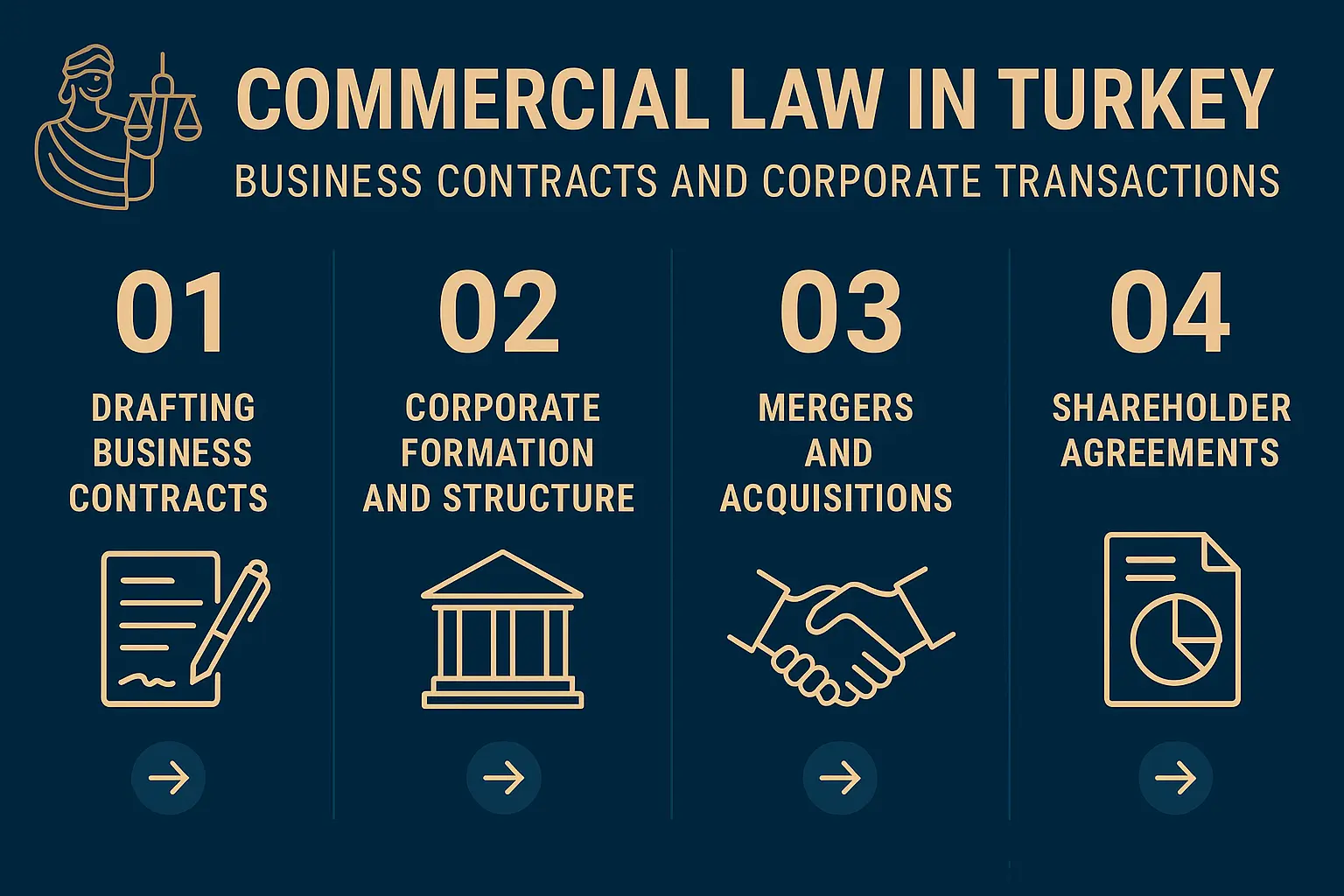
A lawyer in Turkey who advises foreign companies on commercial law understands that Turkey's commercial legal framework—governed primarily by the Turkish Commercial Code, the Turkish Code of Obligations and sector-specific regulatory legislation—creates both significant opportunities and complex compliance requirements for international businesses seeking to establish operations, execute transactions, form partnerships and enforce commercial rights in the Turkish market. An Istanbul Law Firm that serves as commercial law counsel for foreign enterprises provides comprehensive legal support across the entire commercial lifecycle: structuring corporate vehicles and transaction documents, drafting enforceable contracts with appropriate risk allocation and liability protections, conducting due diligence on Turkish counterparties and target companies, managing corporate governance and shareholder relations, ensuring regulatory compliance across tax, licensing, currency and data protection requirements, and representing clients in commercial litigation, arbitration and enforcement proceedings when disputes arise. A Turkish Law Firm with deep experience in cross-border commercial transactions recognizes that foreign companies face unique challenges in Turkey's commercial environment—including bilingual documentation requirements, currency usage restrictions, sector-specific licensing obligations, and enforcement procedures that differ significantly from common law systems—and that addressing these challenges proactively through proper legal structuring prevents the costly disputes and regulatory complications that frequently arise when foreign templates and assumptions are applied without adaptation to Turkish commercial realities. An English speaking lawyer in Turkey who manages commercial law matters for international clients ensures that legal concepts, contractual obligations, regulatory requirements and litigation developments are communicated clearly in English, enabling foreign management teams, boards and in-house counsel to make informed commercial decisions based on accurate understanding of Turkish law rather than imprecise translations or cultural assumptions. Turkish lawyers who practice in this comprehensive commercial law field bring practical familiarity with the Turkish court system's approach to contract interpretation, the enforcement mechanisms available through Turkish execution offices, the regulatory approval processes administered by the Ministry of Trade and sector-specific authorities, and the corporate governance standards that the Turkish Commercial Code imposes on companies operating in Turkey. This guide explains the key principles, transaction structures, governance requirements, contract management strategies, litigation tools and compliance obligations that a methodical lawyer in Turkey addresses when advising foreign companies on commercial law in Turkey.
Key Principles of Turkish Commercial and Contract Law
A lawyer in Turkey who advises foreign companies on the foundational principles of Turkish commercial and contract law explains that Turkey's legal framework for commercial transactions is built on two primary legislative pillars: the Turkish Commercial Code (Law No. 6102), which governs corporate structures, commercial transactions, negotiable instruments, maritime commerce and insurance, and the Turkish Code of Obligations (Law No. 6098), which establishes the general rules for contract formation, performance, breach, liability and remedies that apply to all commercial agreements unless the Commercial Code provides specific rules for the transaction type in question. The principle of freedom of contract prevails under Turkish law—parties are generally free to determine the terms of their agreements, choose their counterparties and structure their commercial relationships as they see fit—but this freedom operates within constraints imposed by public order, mandatory legal provisions and good faith requirements that Turkish courts enforce regardless of the parties' contractual choices. Essential elements for a valid and enforceable contract under Turkish law include mutual consent of the parties expressed through offer and acceptance, a licit subject matter that does not violate mandatory legal provisions or public morality, and sufficient definiteness of the essential terms to enable a court to determine the parties' obligations if a dispute arises. Turkish lawyers who draft commercial agreements for foreign companies ensure that these foundational requirements are satisfied and that the contract's specific provisions—including liability limitations, indemnity obligations, force majeure definitions, termination triggers and dispute resolution mechanisms—comply with the mandatory rules that Turkish courts apply regardless of the parties' choice of governing law. Practice may vary by authority and year — verify current contract formation requirements, enforceability standards and mandatory provision compliance before any commercial agreement execution. For the full procedural framework, see our pillar guide on company formation in Turkey.
An Istanbul Law Firm that structures commercial agreements for international clients explains that several practical requirements of Turkish commercial law frequently surprise foreign companies that are accustomed to common law contracting practices. Turkish courts may require a certified Turkish-language translation of any contract drafted in a foreign language before the contract can be presented as evidence in litigation or enforcement proceedings, which means that bilingual drafting—with both Turkish and English versions prepared simultaneously and with explicit designation of which version governs in case of inconsistency—is essential for contracts that may need to be enforced in Turkish courts. Currency usage restrictions imposed by Presidential Decree and Central Bank regulations prohibit the use of foreign currency denomination in certain categories of contracts between Turkish-resident parties, with exceptions for cross-border transactions and specific contract types, and violation of these restrictions can affect the enforceability of the contract's payment terms. Liability limitation clauses are enforceable under Turkish law but are subject to important restrictions: Turkish law does not permit the exclusion of liability for intentional misconduct or gross negligence through contractual limitation clauses, and any attempt to exclude liability for these categories of fault will be held unenforceable by Turkish courts regardless of the parties' express agreement. Turkish lawyers who advise foreign companies on these requirements ensure that commercial agreements are structured to comply with Turkish mandatory provisions while still achieving the risk allocation and liability protection objectives that the foreign party requires.
A Turkish Law Firm that manages the interplay between Turkish contract law and international commercial practice emphasizes that foreign companies must also understand how Turkish courts interpret commercial agreements, because the interpretive approach differs from common law jurisdictions in ways that affect contract drafting strategy. Turkish courts interpret contracts according to the parties' true and common intention rather than according to the literal meaning of the words used, and they apply principles of good faith and fair dealing as supplementary interpretive tools when the contract language is ambiguous or incomplete. An English speaking lawyer in Turkey who drafts contracts for international clients structures the contract language to minimize interpretive ambiguity, includes detailed definitions of key terms, specifies the consequences of each party's failure to perform specific obligations, and addresses foreseeable contingencies explicitly rather than relying on implied terms or gap-filling principles that may operate differently under Turkish law than the foreign party expects based on their home jurisdiction's legal traditions. The best lawyer in Turkey for commercial contract work combines technical knowledge of Turkish mandatory provisions with practical understanding of how Turkish commercial courts, enforcement offices and arbitral tribunals interpret and apply contractual terms in actual disputes.
Corporate Transaction Structures: Mergers, Acquisitions and Joint Ventures
A lawyer in Turkey who advises foreign investors on corporate transactions explains that Turkey's legal framework offers multiple transaction structures for foreign market entry and investment—including mergers where two or more companies combine into a single surviving entity, share acquisitions where the investor purchases existing shares from current shareholders to acquire control of the target company, asset purchases where specific business assets and liabilities are transferred to the investor without acquiring the target entity itself, joint venture formations where the investor and a local partner establish a new company or contractual arrangement to pursue a shared business objective, and greenfield company establishments where the investor creates a new Turkish entity from scratch—each governed by specific regulatory requirements under the Turkish Commercial Code, the Foreign Direct Investment Law, the Competition Law's merger control provisions and any sector-specific regulations applicable to the target company's industry. The choice of corporate vehicle for the Turkish operation—joint stock company (Anonim Şirket, A.Ş.) which offers the most flexible governance structure and the ability to issue different classes of shares but requires a higher minimum registered capital, limited liability company (Limited Şirket, Ltd. Şti.) which offers simpler governance requirements and a lower capital threshold but with restrictions on share transferability and governance flexibility, branch office of a foreign company which allows direct operations under the foreign parent's legal identity but with full liability exposure for the parent and limitations on certain business activities, or liaison office which permits representational and market research activities but prohibits revenue-generating commercial operations—depends on the investor's liability exposure tolerance, governance flexibility requirements, planned investment scale, anticipated profit repatriation structure, tax planning objectives and the specific regulatory framework applicable to the business sector in which the company will operate. Turkish lawyers who advise on vehicle selection analyze the comparative advantages and disadvantages of each structure against the investor's specific commercial objectives, presenting the analysis in a decision matrix that enables the investor's management and board to make an informed structural choice based on independently verified legal, tax and regulatory considerations rather than assumptions carried over from other jurisdictions where different corporate forms and regulatory frameworks apply. Practice may vary by authority and year — verify current capital requirements, registration procedures, competition notification thresholds and sector-specific authorization requirements before any corporate transaction or company formation.
An Istanbul Law Firm that manages transaction execution for foreign investors coordinates the legal, regulatory and commercial workstreams that must converge for a successful closing: drafting and negotiating the transaction documents including share purchase agreements, asset transfer contracts, joint venture agreements and shareholders' agreements; conducting comprehensive legal due diligence on the target company's corporate records, contractual obligations, litigation exposure, regulatory compliance, employment relationships, intellectual property portfolio, real property holdings and tax position; obtaining any required regulatory approvals from the Competition Board, sector-specific regulators and the Ministry of Trade; coordinating the satisfaction of conditions precedent and the mechanics of closing including payment, share transfer registration, board and officer appointments and registry filings. Turkish lawyers who manage transaction execution ensure that each step complies with Turkish corporate formalities—including notarization requirements for share transfers in joint stock companies, trade registry filing deadlines, and Competition Board notification thresholds—because failure to comply with these formalities can delay closing, create post-closing liability or, in extreme cases, render the transaction voidable.
A Turkish Law Firm that provides post-closing integration support for completed transactions explains that the legal work does not end at closing—post-closing integration requires drafting and registering amendments to the target company's articles of association, establishing the agreed governance structure through board resolutions and internal regulations, transferring intellectual property rights and contract assignments, implementing employment restructuring where applicable, harmonizing accounting and reporting systems with the investor's group requirements, and monitoring compliance with any post-closing covenants, earn-out mechanisms or warranty and indemnity obligations contained in the transaction documents. An English speaking lawyer in Turkey who manages post-closing integration for international investors provides ongoing corporate secretarial services, monitors regulatory filing deadlines, prepares bilingual board and shareholder meeting documentation, and serves as the investor's primary point of contact with Turkish regulatory authorities, ensuring that the newly acquired or established business maintains continuous compliance with its corporate, tax and regulatory obligations from the first day of operation under new ownership.
Board Resolutions, Shareholder Rights and Corporate Governance
A lawyer in Turkey who advises foreign investors on corporate governance explains that effective governance is not merely a compliance exercise but a critical operational requirement for foreign-owned companies in Turkey, because the Turkish Commercial Code imposes strict formality requirements on corporate decision-making—including specific quorum and majority rules for different categories of board and shareholder decisions, mandatory notification and documentation procedures, and personal liability exposure for directors who fail to exercise due care—and non-compliance with these formalities can result in the invalidity of corporate decisions, rejection of trade registry filings, personal liability claims against directors and officers, and shareholder disputes that escalate into commercial litigation. An Istanbul Law Firm that provides governance advisory services for foreign-owned Turkish companies drafts general assembly meeting notices, agenda documents, proxy forms and meeting minutes with strict attention to the formality requirements that the trade registry applies when evaluating whether corporate decisions were validly adopted, and prepares board of directors resolutions in formats that comply with both the Turkish Commercial Code requirements and the governance standards that the foreign parent company applies across its international operations. Turkish lawyers who manage corporate governance for foreign investors advise on quorum requirements for ordinary and extraordinary general assembly meetings, the voting majorities required for different categories of decisions including capital increases, article amendments, merger approvals and director appointments, minority shareholder protection rights including the right to request an independent audit, the right to petition for dissolution on just grounds and the right to challenge unlawful general assembly decisions, and the practical mechanics of conducting corporate governance remotely through electronic meeting systems and electronic signature protocols. Practice may vary by authority and year — verify current corporate governance requirements, trade registry filing standards and electronic meeting procedures before any governance action.
An Istanbul Law Firm that resolves shareholder disputes for foreign investors explains that governance conflicts in Turkish companies frequently arise from disagreements between majority and minority shareholders about dividend distribution, capital increase terms, director appointment and removal, related-party transactions, and strategic direction, and that these conflicts can escalate rapidly from board-level disagreements to commercial court litigation if the governance documents do not provide clear mechanisms for resolving deadlocks and protecting each shareholder's legitimate interests. Turkish lawyers who draft shareholders' agreements for joint ventures and multi-shareholder companies include provisions addressing board composition and nomination rights, reserved matters requiring unanimity or supermajority approval, information rights and access to company records, dividend distribution policies, share transfer restrictions including rights of first refusal, tag-along and drag-along mechanisms, deadlock resolution procedures including escalation, mediation, expert determination and buy-sell mechanisms, and exit rights including put and call options with agreed valuation methodologies. An English speaking lawyer in Turkey who manages governance for international joint ventures prepares bilingual governance documentation, conducts board and shareholder meetings in English with simultaneous Turkish documentation, and serves as the foreign shareholder's governance representative in dealings with Turkish co-shareholders, directors and regulatory authorities.
A Turkish Law Firm that litigates shareholder disputes represents foreign investors in commercial court proceedings involving challenges to unlawful general assembly decisions, derivative actions against directors who breached their duty of care, forced dissolution petitions based on just cause, and share valuation disputes arising from buy-sell mechanisms or squeeze-out proceedings. Turkish lawyers who handle corporate litigation coordinate the litigation strategy with the client's broader commercial objectives—recognizing that shareholder disputes in operating companies must be managed with awareness of the ongoing business relationships, employee stability, customer confidence and regulatory compliance considerations that exist alongside the legal dispute—and that achieving a favorable legal outcome at the cost of destroying the business's commercial value would be a pyrrhic victory that serves neither the client's nor the court's interests. The best lawyer in Turkey for corporate governance combines technical mastery of the Turkish Commercial Code's governance provisions with practical judgment about when to litigate, when to negotiate and when to propose structural solutions that address the underlying commercial interests rather than merely the legal positions of the disputing parties.
Commercial Contract Management and Liability Limitation
A lawyer in Turkey who manages commercial contract portfolios for foreign companies explains that enforceable contracts are the foundation of every successful commercial operation in Turkey, and that contract management—the ongoing process of drafting, negotiating, executing, monitoring, renewing and enforcing commercial agreements across the company's entire counterparty network—requires systematic legal attention to ensure that the company's contractual framework accurately reflects its commercial relationships, adequately allocates risks and liabilities based on each party's control over the relevant risk factors, complies with evolving Turkish regulatory requirements including mandatory provisions, currency restrictions and sector-specific rules, and provides effective enforcement mechanisms that enable the company to recover losses when counterparties fail to perform their contractual obligations. An Istanbul Law Firm that provides contract management services for international clients structures commercial agreements with liability allocation provisions that distribute risk proportionately between the parties based on a detailed assessment of each party's respective control over the risk factors that could cause loss: limitation of liability clauses that cap each party's maximum financial exposure at a level that reflects the contract value, the nature and probability of the risks involved and the availability of insurance coverage, indemnity obligations that require the party best positioned to prevent, detect or mitigate a specific risk category to bear the financial consequences if the risk materializes despite reasonable precautionary measures, liquidated damages provisions that pre-agree the compensation payable for specific categories of breach—particularly delivery delays, quality failures and confidentiality violations—to avoid the cost, uncertainty and delay of litigating damage quantification in Turkish commercial courts, and penalty clauses that create meaningful financial incentives for timely and complete performance of the contract's critical obligations while remaining proportionate enough to survive judicial reduction under the Turkish Code of Obligations' penalty moderation provision. Turkish lawyers who draft these provisions ensure compliance with Turkish mandatory rules—including the absolute prohibition on contractual exclusion of liability for intentional misconduct and gross negligence regardless of the parties' agreement to the contrary, the court's statutory power to reduce penalty clause amounts that it considers disproportionate to the actual harm suffered by the aggrieved party, and the requirement that indemnity obligations be defined with sufficient specificity regarding their scope, trigger conditions, notice requirements and monetary limits to be enforceable in Turkish court proceedings—while still achieving the commercial risk allocation objectives that the foreign company requires to protect its investment and operational interests in Turkey. Practice may vary by authority and year — verify current liability limitation enforceability standards, penalty clause reduction jurisprudence and indemnity clause drafting requirements before any commercial contract execution.
An Istanbul Law Firm that supports contract audit and renewal processes for international clients explains that proactive contract management reduces dispute frequency, prevents unintended liability exposure and builds legal structure into everyday commercial transactions. Turkish lawyers who conduct contract audits review the company's existing contract portfolio to identify provisions that have become unenforceable due to changes in Turkish law, obligations that the company is not currently performing and that create breach exposure, termination and renewal dates that require advance notice to preserve the company's options, insurance and guarantee requirements that the company has not satisfied, and inconsistencies between the company's standard terms and the specific agreements executed with individual counterparties. The audit results are compiled into a risk map that categorizes each identified issue by severity, recommends specific corrective actions, and establishes a monitoring calendar that tracks upcoming deadlines and required actions across the company's entire contract portfolio.
A Turkish Law Firm that enforces commercial contracts in Turkish courts and arbitral tribunals explains that the enforceability of contract provisions depends not only on their legal validity but also on how Turkish courts and enforcement offices interpret and apply them in practice, and that contract drafting must account for the specific enforcement environment in which the contract will operate. An English speaking lawyer in Turkey who drafts contracts for international clients structures dispute resolution clauses with attention to the practical enforcement implications of each option—Turkish commercial court litigation, institutional arbitration under ICC or ISTAC rules, or ad hoc arbitration under UNCITRAL rules—and ensures that the chosen mechanism provides effective, enforceable remedies that the client can actually collect, because obtaining a favorable judgment or award is only the beginning of the enforcement process, and the contract structure must facilitate rather than complicate the conversion of legal rights into actual recovery.
E-Commerce, Digital Platforms and Cross-Border Commercial Law
A lawyer in Turkey who advises on digital commercial law explains that as foreign companies digitize their operations in Turkey—launching e-commerce platforms, offering software-as-a-service products, licensing technology, providing cloud-based services and establishing digital marketplace operations—the commercial law framework extends into specialized regulatory areas including the Turkish Law on the Regulation of Electronic Commerce, the Turkish Consumer Protection Law's distance selling provisions, the Turkish Personal Data Protection Law (KVKK), the Information and Communication Technologies Authority (BTK) registration requirements, and the MASAK anti-money laundering compliance obligations that apply to certain categories of electronic payment processing. An Istanbul Law Firm that structures digital commercial operations for foreign companies drafts platform terms of use, privacy policies, data processing agreements, software license agreements, SaaS subscription terms and click-wrap acceptance mechanisms that comply with Turkish consumer protection requirements, KVKK data processing principles and sector-specific regulations while maintaining compatibility with the foreign company's global terms and the legal requirements of other jurisdictions in which the platform operates. Turkish lawyers who advise on digital commerce ensure that the company's electronic contracting mechanisms satisfy Turkish contract formation requirements—including the provision of pre-contractual information to consumers, the right of withdrawal for distance sales, and the electronic record-keeping obligations imposed by e-commerce legislation—so that contracts formed through digital channels are enforceable in Turkish courts to the same extent as traditional paper-based agreements. Practice may vary by authority and year — verify current e-commerce registration requirements, consumer protection obligations and data protection compliance standards before any digital commerce launch in Turkey.
An Istanbul Law Firm that manages cross-border digital service delivery from Turkey explains that foreign digital service providers face specific compliance obligations regarding VAT collection and remittance for services delivered to Turkish consumers, customs declaration requirements for physical goods imported through e-commerce channels, data localization and cross-border data transfer restrictions under KVKK, electronic payment processing regulation and MASAK reporting obligations, and platform liability for user-generated content, counterfeit goods and intellectual property infringement. Turkish lawyers who structure cross-border digital operations ensure that the service delivery model, the contract terms, the tax compliance framework and the data processing architecture are designed to satisfy Turkish regulatory requirements while maintaining the operational efficiency and scalability that digital business models require. An English speaking lawyer in Turkey who manages digital commerce compliance for international technology companies prepares regulatory compliance roadmaps that identify each applicable obligation, assign responsibility for compliance within the company's organizational structure, establish monitoring procedures for regulatory changes, and create response protocols for enforcement inquiries from Turkish regulatory authorities.
A Turkish Law Firm that enforces digital commercial rights in Turkish courts and regulatory proceedings represents clients in disputes involving platform terms of use violations, software license breaches, data processing agreement violations, intellectual property infringement through digital channels, and unfair commercial practices in electronic commerce. Turkish lawyers who handle digital commerce disputes coordinate the enforcement strategy across the available legal channels—civil litigation for breach of contract and intellectual property infringement, criminal complaints for unauthorized access, data theft and fraud, regulatory complaints to the BTK, KVKK and consumer protection authorities, and domain name dispute resolution proceedings through the Turkish domain name dispute resolution system—to achieve the most effective combination of remedies for the client's specific situation. The best lawyer in Turkey for digital commercial law combines knowledge of Turkey's technology regulation framework with practical understanding of how digital businesses operate, ensuring that legal advice is commercially realistic and that enforcement strategies account for the technical realities of digital evidence, cross-border data flows and platform architecture.
Commercial Litigation, Enforcement and Debt Recovery
A lawyer in Turkey who represents foreign companies in commercial litigation explains that despite preventive efforts through careful contract drafting and counterparty vetting, commercial disputes arise from breach of contract, non-payment of invoices, partnership disagreements, performance failures, product liability claims, unfair competition and tortious interference with commercial relationships, and that effective dispute resolution requires both strong litigation capability and practical enforcement skills that convert court judgments and arbitral awards into actual financial recovery. An Istanbul Law Firm that handles commercial litigation for international clients manages the complete dispute resolution process from pre-litigation assessment and demand letter drafting through court filing, evidence gathering, expert witness coordination, oral hearing advocacy and judgment collection, providing weekly progress reports in English and coordinating with the client's foreign counsel where parallel proceedings or cross-border enforcement issues exist. Turkish lawyers who litigate commercial cases in the specialized commercial courts (ticaret mahkemeleri) understand the procedural requirements, evidence presentation standards and expert witness procedures that these courts apply, and they structure the litigation strategy to present the client's case in the format that Turkish commercial judges expect and find persuasive. Practice may vary by authority and year — verify current commercial court jurisdiction rules, procedural requirements and evidence presentation standards before any litigation filing.
An Istanbul Law Firm that manages post-judgment enforcement and debt recovery for foreign creditors explains that obtaining a favorable court judgment or arbitral award is only the first step in the recovery process—the judgment must then be enforced through Turkey's execution office (icra dairesi) system, which operates under the Turkish Enforcement and Bankruptcy Law and administers a comprehensive range of compulsory execution measures including bank account attachment and freezing orders directed to the debtor's banking relationships, real property lien registration and forced sale through public auction, vehicle and movable asset seizure and auction, salary and receivable garnishment orders directed to the debtor's employer or business debtors, and corporate share attachment and sale proceedings. Turkish lawyers who handle enforcement proceedings coordinate with the competent execution office in the jurisdiction where the debtor's assets are located to identify and attach available assets as quickly as possible, because debtors who anticipate enforcement frequently attempt to transfer, conceal or encumber their assets before the creditor's enforcement measures take effect—making speed of execution a critical factor in the recovery outcome. The enforcement process involves filing the enforcement application with the competent execution office together with the original judgment or a certified copy and the required court fee, serving the enforcement notice on the debtor with the statutory seven-day payment period during which the debtor may pay voluntarily to avoid additional enforcement costs, identifying the debtor's attachable assets through comprehensive banking system inquiries sent to all banks operating in Turkey, land registry searches covering all provinces where the debtor may own real property, vehicle and vessel registry checks, and corporate registry investigations to identify business ownership interests, obtaining attachment orders from the execution office, and monitoring the collection and distribution process through to final payment to the creditor. Where the debtor lacks sufficient attachable assets to satisfy the judgment, Turkish lawyers evaluate whether initiating bankruptcy proceedings is appropriate to pursue the debtor's assets through the broader investigative and recovery powers available to the bankruptcy estate, including the ability to challenge fraudulent transfers, preferential payments and undervalue transactions that reduced the debtor's asset base during the suspect period preceding the bankruptcy filing, and the ability to access business records and accounting documentation that may reveal concealed assets or undisclosed income sources.
A Turkish Law Firm that represents clients in arbitration and mediation proceedings explains that many commercial contracts between foreign and Turkish parties include arbitration clauses designating institutional arbitration under ICC, ISTAC or London Court of International Arbitration rules, and that arbitral awards—whether rendered in Turkey or abroad—can be enforced in Turkey through recognition and enforcement proceedings under the Turkish International Arbitration Law or the New York Convention, subject to limited grounds for refusal. An English speaking lawyer in Turkey who manages arbitration proceedings for international clients coordinates the arbitration from filing through award, prepares statements of claim and defense in the format that the designated arbitral institution requires, presents evidence and witness testimony in compliance with the applicable procedural rules, and manages the post-award enforcement process to convert the arbitral award into actual recovery through Turkey's execution office system. Turkish lawyers who handle commercial mediation—which is now mandatory as a pre-litigation step for commercial disputes in Turkey—prepare the mediation strategy, represent the client in mediation sessions, and ensure that any settlement agreement reached through mediation is drafted in enforceable form and registered with the court to create a directly enforceable title that eliminates the need for separate litigation if the counterparty fails to comply with the settlement terms.
Tax Planning, Trade Regulation and Commercial Licensing
A lawyer in Turkey who advises foreign companies on the tax and regulatory dimensions of commercial law explains that commercial operations in Turkey intersect with multiple tax obligations and trade regulations that must be addressed in the contract structuring, transaction planning and ongoing compliance management phases of every commercial relationship. Turkish tax obligations affecting commercial transactions include corporate income tax levied on business profits generated by companies established or operating in Turkey, value-added tax charged on the domestic supply of goods and services at standard and reduced rates depending on the category of goods or services, withholding tax obligations on cross-border payments of dividends to foreign shareholders, interest to foreign lenders, royalties to foreign licensors and service fees to foreign service providers at rates that vary depending on the nature of the payment and the availability of double tax treaty benefits, stamp tax levied on the execution of certain categories of contracts and official documents at rates calculated as a percentage of the contract value, and customs duties and special consumption taxes on goods imported into Turkey that vary depending on the tariff classification, country of origin and any applicable trade agreement preferences. An Istanbul Law Firm that structures commercial transactions for tax efficiency coordinates with the client's in-house tax department, external tax advisors and certified public accountants to analyze the tax impact of proposed transaction structures before they are implemented, ensure that commercial contracts include appropriate tax allocation provisions that clearly specify which party bears each applicable tax obligation and how gross-up mechanics operate if withholding obligations arise, evaluate the availability and conditions for applying reduced withholding tax rates under Turkey's extensive network of bilateral double tax treaties, and implement the invoicing, documentation, filing and record-keeping procedures that satisfy Turkish tax authority requirements for deduction claims, input VAT credit recovery and treaty benefit applications. Turkish lawyers who advise on currency control requirements ensure that contracts between Turkish-resident parties comply with the Presidential Decree and Central Bank restrictions on foreign currency denomination and indexation, that cross-border payment obligations are structured to satisfy Central Bank reporting requirements and any applicable foreign exchange permission conditions, and that the documentary record of any foreign exchange conversions is maintained in the format that both the tax authorities and the banking regulators require for their respective compliance verification purposes. Practice may vary by authority and year — verify current tax rates, treaty applicability, currency control restrictions, customs duty schedules and regulatory filing requirements before any commercial transaction structuring.
An Istanbul Law Firm that manages regulatory licensing for foreign companies operating in Turkey explains that many business sectors in Turkey require pre-operation permits, Ministry approvals or sector-specific registrations before commercial activities can lawfully commence—including energy generation and distribution, financial services and banking, insurance, telecommunications, education, healthcare, construction and contracting, media and broadcasting, food production and distribution, and various categories of professional services. Turkish lawyers who manage licensing applications coordinate with the Ministry of Trade, the relevant sector-specific regulatory authority, the local Chamber of Commerce, the tax administration and any other governmental bodies whose approval is required, preparing and filing the application documentation in the format and sequence that each authority requires and monitoring the application through the approval process. An English speaking lawyer in Turkey who assists international companies with licensing translates application requirements, prepares bilingual correspondence with regulatory authorities, attends inspection and interview appointments as the company's legal representative, and reports progress to the company's management in English with clear timelines and decision points.
A Turkish Law Firm that supports compliance with anti-money laundering, economic substance and currency control requirements helps commercial clients design transaction monitoring systems, implement MASAK reporting procedures, maintain the documentation and record-keeping that Turkish regulatory authorities require, and respond to regulatory inquiries and inspection findings. Turkish lawyers who manage regulatory compliance integrate the tax, trade, licensing, currency control, anti-money laundering and data protection obligations into a unified compliance framework that the company's management can oversee through regular reporting and that the company's operational teams can implement through clear procedures and documented controls. The best lawyer in Turkey for commercial regulatory compliance recognizes that regulatory planning is not a cost center but a strategic investment that reduces enforcement risk, prevents operational disruptions, maintains the company's reputation with Turkish institutional counterparties and creates the regulatory foundation that enables sustainable commercial growth and long-term operational success in the increasingly competitive Turkish market.
Common Mistakes Foreign Companies Make in Turkish Commercial Transactions
A lawyer in Turkey who corrects commercial agreements for foreign companies explains that the most common and costly mistakes arise from applying foreign legal templates, contractual assumptions and business practices to Turkish commercial transactions without adequate adaptation to Turkish legal requirements, court interpretation standards, enforcement realities and commercial customs that differ significantly from the common law and civil law traditions with which most international companies are familiar. Foreign contract templates frequently contain provisions that are partially or entirely unenforceable under Turkish law—such as unlimited liability exclusion clauses that violate the mandatory prohibition under the Turkish Code of Obligations on excluding liability for intentional misconduct and gross negligence regardless of the parties' contractual agreement, penalty and liquidated damages provisions that Turkish courts will reduce to what they consider a proportionate and reasonable level if the stipulated amount is manifestly excessive relative to the actual harm suffered, governing law clauses that attempt to apply foreign law to contract elements that are governed by mandatory Turkish provisions which cannot be derogated by party choice including consumer protection rules, employment law requirements and real property transaction formalities, dispute resolution clauses that designate forums or procedural mechanisms that are impractical or unenforceable in Turkey due to jurisdictional limitations, recognition barriers or the absence of reciprocity agreements, and standard boilerplate provisions transplanted from common law jurisdictions that have no legal effect under Turkish civil law or that Turkish courts interpret differently than the drafting party intended based on the common law meaning of the provision. An Istanbul Law Firm that adapts foreign templates for Turkish commercial use reviews each provision against Turkish enforceability standards, identifies and replaces unenforceable or ineffective clauses with Turkish-compliant alternatives that achieve the same commercial objective within the constraints of Turkish mandatory law, adds provisions that Turkish law requires but that common law templates typically omit—such as adaptation clauses for changed circumstances under the Turkish Code of Obligations' hardship provisions, specific notification and cure period requirements for contractual termination, and the bilingual documentation and certified translation provisions needed for Turkish court and enforcement proceedings—and ensures that the adapted contract achieves the commercial protection objectives of the original template while being fully enforceable in Turkish courts, Turkish arbitral proceedings and Turkish execution offices. Turkish lawyers who perform this adaptation work present their recommendations in a comprehensive redline comparison format that enables the foreign company's in-house counsel and management to see exactly what was changed, why each change was necessary, and how the adapted provision achieves the same commercial objective through Turkish-compliant means, facilitating the internal approval process and building the institutional knowledge about Turkish legal requirements that improves the company's contracting efficiency and reduces adaptation costs over time. Practice may vary by authority and year — verify current enforceability standards, mandatory provision requirements and contract adaptation best practices before any commercial agreement execution in Turkey.
An Istanbul Law Firm that advises foreign companies on counterparty risk in Turkey explains that another frequent and costly mistake is failing to perform adequate legal due diligence on Turkish business partners before entering commercial relationships, signing contracts or making payments. Turkish lawyers who conduct pre-engagement due diligence verify the counterparty's trade registry status, authorized representatives, financial condition, litigation history, tax compliance record, regulatory standing and beneficial ownership structure through independent sources rather than relying on the counterparty's own representations, because commercial fraud, insolvency concealment and identity misrepresentation are risks that due diligence is specifically designed to detect before they materialize into losses. An English speaking lawyer in Turkey who manages counterparty vetting for international clients presents the due diligence findings in a structured risk report with specific recommendations—proceed, proceed with protective conditions, or decline—that enables the foreign company's management to make informed decisions about the proposed commercial relationship based on independently verified information rather than the counterparty's sales presentation.
A Turkish Law Firm that helps foreign companies avoid governance and compliance mistakes in Turkish commercial operations explains that operational mistakes—such as failing to hold required general assembly meetings, neglecting trade registry filing deadlines, operating without required sectoral licenses, non-compliance with currency control restrictions, or inadequate tax and invoicing documentation—can create regulatory exposure, contractual enforceability problems and personal liability for directors that compound over time if not identified and corrected early. Turkish lawyers who provide ongoing compliance monitoring for foreign-owned Turkish companies establish a regulatory calendar that tracks all recurring filing, reporting and renewal obligations, conduct periodic compliance audits that test the company's adherence to its corporate, tax and regulatory obligations, and provide quarterly compliance reports to the company's management and board that identify any gaps and recommend specific corrective actions with implementation timelines. The best lawyer in Turkey for foreign company commercial operations combines transactional expertise with ongoing compliance support, ensuring that the company's legal framework remains current, enforceable and aligned with its evolving commercial objectives throughout the life of the Turkish operation.
Frequently Asked Questions
- Can foreign companies sign enforceable contracts in Turkey? Yes. Foreign companies can enter enforceable contracts under Turkish law regardless of whether they have a registered legal presence in Turkey. However, the contract must comply with Turkish formation requirements, and a certified Turkish translation may be needed for court or regulatory proceedings. Establishing a registered presence is advisable for ongoing commercial operations to ensure regulatory compliance and enforcement efficiency.
- Is English-language contract text legally valid in Turkey? Yes, contracts in English are valid between the parties. However, Turkish courts and enforcement offices require certified Turkish translations for litigation and enforcement proceedings. Bilingual drafting with both Turkish and English versions prepared simultaneously, with a governing language clause, is the recommended practice for contracts that may need to be enforced in Turkish courts.
- What corporate vehicle options are available for foreign investors? Foreign investors can establish a joint stock company (A.Ş.), limited liability company (Ltd. Şti.), branch office or liaison office in Turkey, each with different capital requirements, governance structures, liability profiles and tax implications. The choice depends on the investor's commercial objectives, liability tolerance, governance preferences and the regulatory requirements of the specific business sector.
- How are commercial disputes resolved in Turkey? Commercial disputes are resolved through litigation in specialized commercial courts, institutional or ad hoc arbitration, or mandatory commercial mediation which must be attempted before filing most commercial lawsuits. The dispute resolution mechanism depends on the contract terms and the nature of the claim.
- Can liability be excluded by contract under Turkish law? Liability limitation clauses are generally enforceable, but Turkish law prohibits the exclusion of liability for intentional misconduct and gross negligence. Courts also have the power to reduce penalty clause amounts they consider excessive. Contract drafting must account for these mandatory restrictions.
- What are the currency restrictions for commercial contracts in Turkey? Presidential Decree and Central Bank regulations restrict foreign currency denomination in certain categories of contracts between Turkish-resident parties, with exceptions for cross-border transactions and specific contract types. Non-compliant currency clauses may be deemed unenforceable.
- What due diligence should be conducted before a Turkish business transaction? Comprehensive due diligence includes corporate registry verification, financial analysis, beneficial ownership investigation, litigation history review, regulatory compliance assessment, employment and labor law review, intellectual property portfolio analysis, real property title verification and tax compliance confirmation.
- What sectors require specific licenses to operate in Turkey? Many sectors require pre-operation permits or Ministry approval, including energy, financial services, insurance, telecommunications, education, healthcare, construction, media, food production and professional services. Operating without required licenses can result in administrative fines, operational suspension and criminal liability.
- How are court judgments enforced in Turkey? Court judgments are enforced through Turkey's execution office (icra dairesi) system, which administers bank account attachment, real property liens, vehicle seizure, salary garnishment and public auction procedures. Foreign court judgments must first be recognized through recognition and enforcement proceedings in Turkish courts.
- Can arbitral awards be enforced in Turkey? Yes. Domestic arbitral awards are enforceable under the Turkish International Arbitration Law, and foreign arbitral awards are enforceable under the New York Convention through recognition and enforcement proceedings in Turkish courts, subject to limited grounds for refusal.
- What are the main tax obligations for commercial operations in Turkey? Primary tax obligations include corporate income tax on business profits, value-added tax on goods and services, withholding tax on cross-border payments, stamp tax on certain contracts and documents, and customs duties on imported goods. Double tax treaties may reduce withholding rates on cross-border payments.
- Is commercial mediation mandatory in Turkey? Yes. Mandatory commercial mediation was introduced as a pre-litigation requirement for most commercial disputes. Parties must attempt mediation before filing a commercial lawsuit, and the mediation process must be completed within the prescribed time period. Settlement agreements reached through mediation can be registered as enforceable court titles.
- What mistakes do foreign companies most commonly make in Turkey? Common mistakes include using unadapted foreign contract templates, failing to perform counterparty due diligence, neglecting Turkish-language documentation requirements, non-compliance with currency control restrictions, operating without required sectoral licenses, and failing to maintain corporate governance formalities.
- How can foreign shareholders protect their rights in Turkish companies? Through properly drafted shareholders' agreements that include board nomination rights, reserved matter approval requirements, information and audit rights, dividend distribution policies, share transfer restrictions, deadlock resolution mechanisms and exit rights with agreed valuation methodologies.
- Does ER&GUN&ER Law Firm handle commercial law matters for foreign companies? Yes. ER&GUN&ER Law Firm provides comprehensive commercial law services for foreign companies including contract drafting and negotiation, corporate transaction structuring, due diligence, corporate governance advisory, regulatory licensing, commercial litigation and arbitration, enforcement and debt recovery, and ongoing compliance monitoring, with bilingual English-Turkish legal support throughout.
Author: Mirkan Topcu is an attorney registered with the Istanbul Bar Association (Istanbul 1st Bar), Bar Registration No: 67874. His practice focuses on cross-border and high-stakes matters where evidence discipline, procedural accuracy, and risk control are decisive.
He advises individuals and companies across Immigration and Residency, Real Estate Law, Tax Law, and cross-border documentation matters where procedural accuracy and evidence discipline are decisive.
Education: Istanbul University Faculty of Law (2018); Galatasaray University, LL.M. (2022). LinkedIn: Profile. Istanbul Bar Association: Official website.