

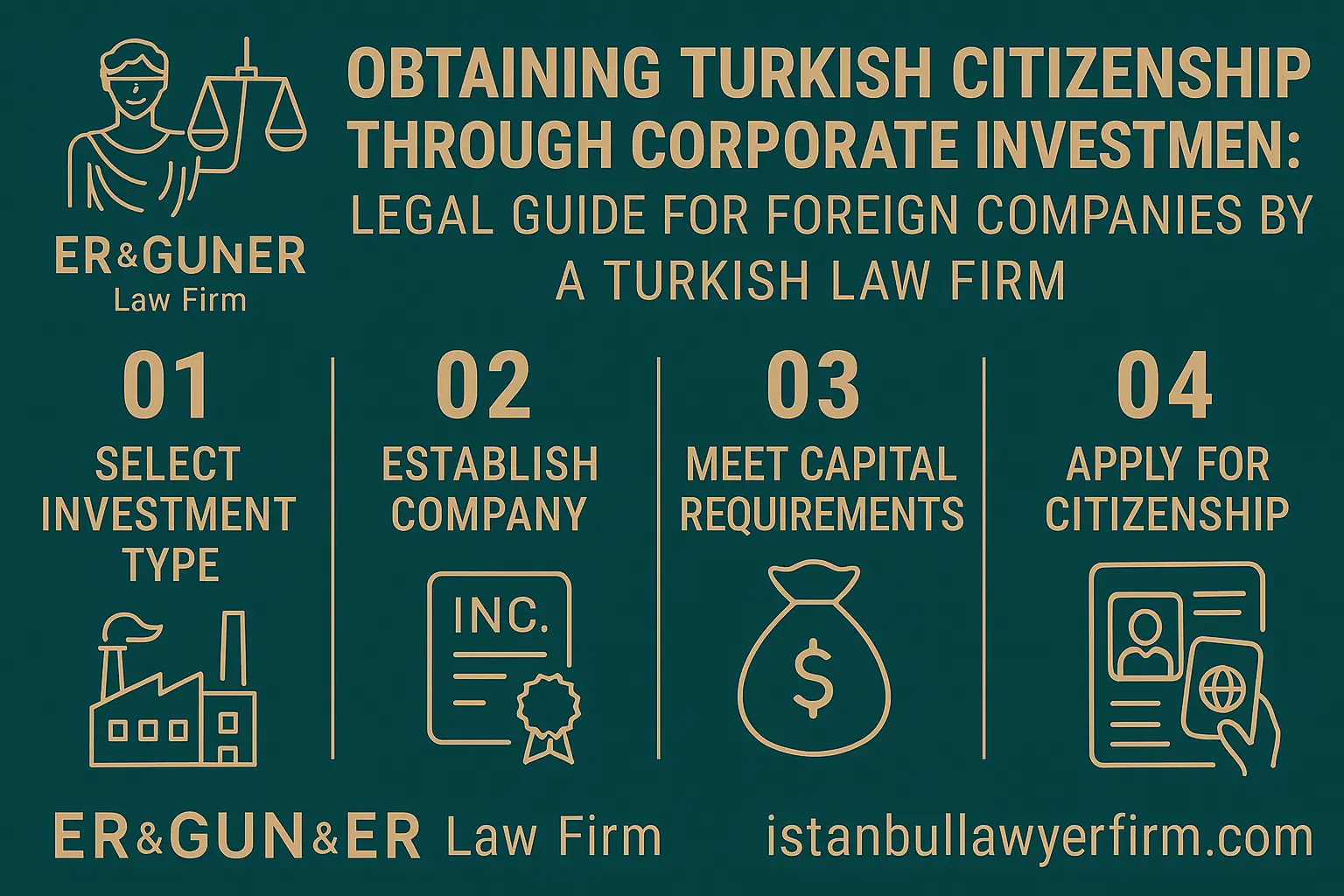
A lawyer in Turkey who advises foreign corporations on citizenship acquisition through corporate investment understands that the Turkish citizenship by investment program—administered under Presidential Decree No. 2018/11849 and subsequent implementing regulations issued by the Ministry of Interior, Directorate General of Migration Management, and the Ministry of Treasury and Finance—offers a legally structured pathway for foreign companies and their beneficial owners to obtain Turkish citizenship by making qualifying corporate investments that satisfy defined capital thresholds, create employment for Turkish nationals, and maintain those investments for the mandatory retention period without liquidation, capital reduction or employment level deterioration that would disqualify the application. An Istanbul Law Firm that guides foreign corporations through the corporate investment citizenship process provides comprehensive legal support across the full application lifecycle: conducting preliminary eligibility assessments evaluating whether the proposed corporate investment structure, capital amounts, employment projections, and source of funds documentation satisfy the current legal requirements; designing investment structures that qualify for the citizenship program while also achieving the foreign company's broader business objectives in Turkey; managing the due diligence process producing source of funds documentation and compliance analysis that satisfies the Directorate General of Migration Management's anti-money laundering screening; coordinating the capital flow documentation demonstrating the qualifying investment amount has been transferred to and maintained in Turkey; managing the parallel residency permit and citizenship application process for qualifying applicants and their family members; and maintaining post-approval compliance through the mandatory monitoring period to protect against citizenship revocation arising from investment maintenance failures. A Turkish Law Firm with deep experience in investment citizenship for corporate applicants recognizes that the corporate route differs materially from the real estate route both in documentation requirements and in the specific compliance obligations that attach during the investment retention period—requiring that the legal strategy address not only the citizenship application itself but the ongoing corporate governance, financial reporting, employment maintenance, and regulatory compliance obligations that condition continued citizenship validity. An English speaking lawyer in Turkey who manages corporate citizenship applications for international companies ensures that foreign executives, boards, and shareholders based outside Turkey understand every requirement at each application stage, can provide responsive documentary support when the Directorate General requests additional information, and can make the governance decisions needed to maintain investment eligibility without interruption throughout the retention period. Turkish lawyers who specialize in investment citizenship bring practical familiarity with the specific documentation formats, certification requirements, translation standards, notarization procedures, and administrative processing timelines that determine application success within Turkey's citizenship by investment administrative framework.
Eligibility Criteria and Qualifying Investment Categories for Corporate Applicants
A lawyer in Turkey who explains the eligibility framework for corporate investment citizenship advises that the Turkish citizenship by investment program currently recognizes multiple qualifying investment categories with different minimum thresholds, compliance requirements and documentation standards, and that selecting the appropriate investment category based on the foreign company's business model, financial capacity, sector expertise and strategic objectives—rather than defaulting to the most publicized category—is among the most consequential decisions in the citizenship application strategy. An Istanbul Law Firm that conducts eligibility assessments for corporate citizenship applicants evaluates each qualifying investment category in detail: fixed capital investment in a Turkish company at a minimum threshold certified by the Ministry of Industry and Technology requires the foreign company to establish or acquire a Turkish operating entity, inject the qualifying capital amount through documented bank transfers, obtain the Ministry of Industry and Technology's conformity certificate confirming the investment amount and qualifying status, and maintain the invested capital without reduction below the threshold amount for the three-year retention period—with fixed capital investment covering machinery, equipment, factory facilities, technology infrastructure and other productive assets qualifying under the Ministry's certification standards; employment creation meeting the minimum Turkish national employment threshold certified by the Ministry of Family and Social Services requires establishing the minimum number of direct employment relationships with Turkish nationals documented by SGK registration, payroll records and employment contracts, maintaining those employment relationships continuously throughout the retention period without falling below the threshold headcount, and obtaining the Ministry's employment conformity certificate confirming the headcount as of the application date; real estate investment combined with corporate ownership at the qualifying property value threshold requires purchase of Turkish real estate through the corporate entity at or above the minimum value confirmed by a licensed real estate appraisal, annotation of the title deed with a three-year transfer prohibition pledge, and maintenance of the property ownership without transfer for the pledge duration; bank deposit maintained in a Turkish bank licensed by the Banking Regulation and Supervision Agency at the qualifying minimum deposit amount for at least three years without reduction below the threshold; and government debt instruments purchased through regulated capital markets intermediaries and held for at least three years. Practice may vary by authority and year — verify current investment thresholds, qualifying asset categories, conformity certificate procedures and retention period requirements for each investment category before any corporate citizenship investment strategy is selected or implemented. For the full procedural framework, see our pillar guide on company formation in Turkey.
An Istanbul Law Firm that assesses corporate governance eligibility for the citizenship program explains that foreign-controlled companies seeking citizenship through corporate investment must satisfy not only the financial thresholds of the chosen investment category but also the corporate governance requirements that Turkish authorities apply when evaluating the company's legal structure, ownership transparency, regulatory compliance status and capacity to maintain the qualifying investment for the full retention period. Turkish lawyers conducting corporate governance eligibility assessments examine the company's Articles of Association for compliance with the Turkish Commercial Code, verify trade registry registration accuracy and currency, confirm that the company's authorized signatories and legal representatives are properly registered and that their authority documentation is current, review the company's tax compliance status including outstanding tax liabilities that could indicate financial distress threatening investment maintenance capacity, examine the company's social security compliance record for any outstanding SGK premium payment obligations, and assess the company's regulatory compliance status in its operating sector for any pending enforcement actions that could result in license revocation or operational restrictions incompatible with investment maintenance. Companies with governance deficiencies discovered during the eligibility assessment must implement corrective measures—trade registry updates, tax compliance remediation, Articles of Association amendments, or regulatory filings—before citizenship application submission, since unresolved governance issues identified during the Directorate General's review generate requests for additional documentation, cause processing delays, and in some cases result in application rejection that requires restarting the process after full remediation.
A Turkish Law Firm that advises on multi-layer corporate structures for investment citizenship explains that foreign companies frequently hold Turkish investments through intermediate holding companies, offshore entities or complex group structures that require careful mapping and disclosure because Turkish citizenship authorities require complete beneficial ownership transparency and will reject applications where the ownership chain between the citizenship applicant and the qualifying Turkish investment cannot be documented clearly and compliantly through authenticated corporate documentation. An English speaking lawyer in Turkey who advises international corporate groups on ownership structure documentation for citizenship applications manages the translation, notarization, apostille and corporate certification requirements for each layer of the ownership chain—ensuring that registered shareholders, ultimate beneficial owners, board composition and authorized representatives are documented through the formats Turkish authorities require, that each foreign corporate document in the ownership chain is properly apostilled or consularly legalized and translated by a certified Turkish sworn translator, and that the ownership documentation presents a clear, complete and verified chain of corporate control from the citizenship applicant through every intermediate entity to the qualifying Turkish investment.
For the full procedural framework on the qualifying investment routes and the institutional review architecture at the Vatandaşlık Daireleri, see our pillar guide on the full investment citizenship procedure.
Due Diligence, Compliance Obligations and Source of Funds Documentation
A lawyer in Turkey who manages the due diligence process for corporate citizenship applications explains that the Directorate General of Migration Management applies anti-money laundering screening to all citizenship by investment applications and that the source of funds documentation demonstrating that the invested capital originates from lawful commercial activity, investment returns, business income, inheritance or other legitimate sources must be sufficiently comprehensive, credible and documented to satisfy the Directorate General's review without triggering requests for additional information that delay processing or rejection determinations that require reapplication. An Istanbul Law Firm that prepares source of funds documentation packages for corporate citizenship applicants builds each package around the specific capital source applicable to the investing company: companies investing funds generated from the foreign parent company's commercial operations document the source through audited financial statements of the parent demonstrating revenue generation, corporate income tax declarations confirming tax compliance, board resolutions authorizing the Turkish investment, bank statements showing the origination of transferred funds in the parent company's accounts, and inter-company transfer documentation showing the movement of funds from the parent to the Turkish entity; companies investing proceeds from asset disposals document the source through asset sale agreements, bank records of disposal proceeds receipt, capital gains tax payment documentation, and valuation reports confirming the commercial value of the disposed assets; companies investing funds from third-party financing document the source through loan agreements, lender due diligence documentation, drawdown confirmations, and banking records showing the flow of borrowed funds into the Turkish investment. Turkish lawyers preparing source of funds packages evaluate each proposed documentation package against the standards applied by Turkish citizenship authorities and by the correspondent banks processing the international transfers—because banking anti-money laundering compliance can create independent delays when large international transfers lack sufficient source documentation, potentially delaying the capital transfer that starts the investment retention period even before the citizenship application is filed. Practice may vary by authority and year — verify current source of funds documentation standards, anti-money laundering compliance requirements for citizenship applications, banking transfer documentation requirements and correspondent bank compliance standards before any capital transfer for citizenship investment is initiated.
An Istanbul Law Firm that manages ongoing compliance obligations during the investment retention period explains that the three-year retention period between qualifying investment completion and citizenship application approval—during which the qualifying capital must remain invested, employment headcount must remain at or above the certified threshold, and all corporate compliance obligations must be satisfied without material disruption—creates a sustained compliance management requirement that cannot be addressed through a single pre-application compliance review but requires continuous monitoring, periodic certification, and proactive remediation of any compliance gaps that arise during the retention period. Turkish lawyers managing retention period compliance implement systematic monitoring programs: tracking fixed capital amounts through quarterly financial statement review to confirm that book value of qualifying assets has not declined below the threshold through depreciation adjustments, asset disposal or capital reduction; monitoring employment headcount through monthly SGK declaration records to confirm that the certified minimum number of Turkish national employees remains continuously employed; tracking bank deposit balances through monthly banking statements to confirm qualifying deposits have not been reduced below the threshold; reviewing regulatory license status to confirm operating licenses required for the company's activities remain valid and current; and maintaining tax compliance through quarterly review of corporate tax, VAT and withholding tax filing and payment records to confirm no material tax compliance failures that could indicate financial distress. Any compliance gap detected during retention period monitoring must be remediated immediately—restoring capital to threshold levels, rehiring to restore employment headcount, or resolving regulatory issues—and the remediation must be documented with the same evidentiary specificity as the original compliance confirmation.
A Turkish Law Firm that advises on sector-specific compliance obligations for corporate citizenship applicants explains that companies in regulated industries face compliance requirements beyond the general corporate law framework that must be satisfied throughout the retention period—because license revocation, significant regulatory sanction or enforcement action affecting the company's ability to operate in its licensed sector during the retention period can constitute a material change in investment status that requires notification to citizenship authorities and may trigger citizenship application suspension or revocation proceedings. An English speaking lawyer in Turkey who manages cross-border compliance for international companies seeking citizenship through corporate investment ensures that the Turkish compliance program is coordinated with the foreign parent company's global compliance framework, that Turkish regulatory developments affecting the qualifying investment are immediately communicated to foreign management, and that the company's responses to Turkish regulatory inquiries are managed with the same attention to legal accuracy and strategic consequence that the importance of protecting citizenship eligibility throughout the retention period demands.
Investment Structuring and Capital Flow Documentation
A lawyer in Turkey who designs investment structures for corporate citizenship applicants explains that the choice of legal entity form, capital injection mechanism, banking arrangements and investment documentation format are not merely technical implementation details but foundational strategic decisions that determine whether the investment qualifies for the citizenship program, whether the capital flow can be documented in the format Turkish authorities require, and whether the investment structure can be maintained through the three-year retention period without triggering regulatory complications that disqualify the application or require costly restructuring. An Istanbul Law Firm that structures corporate investments for citizenship qualification designs each structure around the specific requirements of the chosen investment category and the foreign company's business model: for fixed capital investment qualification, the Turkish entity must be structured to hold the qualifying assets on its balance sheet in categories that the Ministry of Industry and Technology recognizes as qualifying fixed capital—machinery, production equipment, IT infrastructure, licensed technology and similar productive assets—rather than financial assets, inventory or working capital that may not qualify under the Ministry's certification criteria; for employment creation qualification, the Turkish entity must be structured as an operating employer with direct SGK-registered employment relationships with the qualifying Turkish national employees, since employees of contractors, subcontractors or affiliated companies whose social security contributions are not paid under the qualifying entity's tax identification number may not count toward the employment threshold; for bank deposit qualification, the deposit must be held in the qualifying entity's own account at a Turkish bank licensed by the BDDK in the format the citizenship regulation specifies—a standard deposit account documented with a bank letter confirming the deposit amount, currency, account holder identity and minimum three-year retention commitment. Turkish lawyers implementing investment structures document each structural element with board resolutions authorizing the investment, shareholder decisions approving capital injections, articles of association amendments reflecting investment commitments, and banking correspondence confirming the qualifying deposit or investment account arrangements—creating a comprehensive structural documentation package that supports both the Ministry conformity certificate applications and the citizenship application itself. Practice may vary by authority and year — verify current qualifying asset categories for fixed capital certification, employment counting methodologies, bank deposit format requirements and banking arrangement documentation standards before any investment structure is designed or implemented.
An Istanbul Law Firm that manages capital flow documentation for citizenship investments explains that demonstrating the qualifying capital has been lawfully transferred to Turkey, invested in the qualifying asset category, and maintained without reduction requires a documented capital flow trail that begins with the origination of funds in the source accounts, continues through each banking leg of the international transfer, and ends with confirmation of the funds' receipt and investment in the qualifying Turkish asset—with every transfer leg documented by official bank records that Turkish citizenship authorities can verify independently. Turkish lawyers managing capital flow documentation collect the complete set of transfer records: the foreign currency transfer instructions issued by the originating bank; the SWIFT or IBAN transfer confirmation records showing the transfer amount, currency, originating account, receiving account and transfer date; the Turkish bank's incoming transfer confirmation acknowledging receipt; the currency exchange confirmation if the transferred amount required conversion from foreign currency to Turkish lira; the investment application or escrow account opening documentation confirming the funds are held in the qualifying format; and the bank letter confirming investment status in the format prescribed by the applicable Ministry conformity certificate application procedure. For multi-tranche capital injections where the qualifying threshold is reached through multiple transfers over time, documentation must cover every tranche individually and demonstrate the cumulative invested amount reaches and exceeds the qualifying threshold on a specific date—which becomes the investment completion date from which the three-year retention period runs.
A Turkish Law Firm that advises on banking relationship management for corporate citizenship investments explains that maintaining effective banking relationships with the Turkish banks processing and holding the qualifying investment is operationally critical throughout the retention period—because the bank's ongoing documentation of deposit balances, investment account status, and compliance with retention commitments forms the primary evidentiary record demonstrating continuing investment eligibility, and any banking relationship disruption including account closures, balance reductions, transfer restrictions or compliance holds imposed by the bank's own anti-money laundering procedures can create investment eligibility gaps requiring immediate legal intervention. An English speaking lawyer in Turkey who manages banking relationships for corporate citizenship clients maintains regular communication with the qualifying Turkish bank's compliance and customer service departments, monitors account status through the periodic bank statements included in retention period compliance reviews, coordinates immediately with banking counsel if the bank raises compliance questions about the qualifying account, and prepares the necessary account documentation and source of funds supplements needed to resolve banking compliance holds without creating a break in the investment retention period that could affect citizenship eligibility.
Real Estate Investment and Job Creation Requirements
A lawyer in Turkey who advises on real estate-combined corporate citizenship investments explains that acquiring qualifying real estate through a Turkish corporate entity—rather than as an individual purchaser—provides structural advantages including liability limitation, facilitated future transfer through share sale rather than property transfer, and potential tax efficiency benefits, but also imposes additional documentation requirements including demonstration that the corporate purchaser has clear legal title, that the purchase price meets or exceeds the qualifying minimum determined by a licensed real estate appraisal, and that the mandatory three-year transfer prohibition annotation on the title deed is properly registered to satisfy the retention requirement. An Istanbul Law Firm that manages corporate real estate acquisitions for citizenship qualification conducts comprehensive property due diligence before purchase commitment: title deed examination confirming the seller has clear, unencumbered ownership without mortgages, liens, encumbrances, litigation annotations, pre-emption rights or zoning restrictions that could impair the purchase or the title deed annotation required for citizenship qualification; cadastral record review confirming the property's registered boundaries, area and classification match the physical property and the purchase agreement description; municipality records review confirming the property has valid building permits, occupancy certificates and no outstanding urban planning enforcement actions; property appraisal by a licensed real estate appraiser authorized by the Capital Markets Board confirming the property value meets or exceeds the citizenship qualifying threshold; and tax clearance confirmation showing no outstanding property tax liabilities that could create a title encumbrance. Turkish lawyers managing the purchase transaction coordinate the notarized sale agreement, title deed transfer at the land registry office, simultaneous annotation of the transfer prohibition for citizenship qualification, and post-purchase municipal registration—ensuring that the title deed produced for the citizenship application reflects both clear corporate ownership and the three-year transfer prohibition annotation in the format citizenship authorities require. Practice may vary by authority and year — verify current minimum property value thresholds, appraisal authorization requirements, title deed annotation procedures for citizenship qualification, and property due diligence documentation standards before any real estate investment for citizenship qualification is initiated.
An Istanbul Law Firm that structures employment-based citizenship qualification for corporate applicants explains that the employment creation route—requiring a minimum number of direct Turkish national employees documented by SGK registration and Ministry of Family and Social Services certification—demands sustained human resources management throughout the retention period at a level that foreign companies must plan for operationally, not just administratively, because temporary employment arrangements, contractor relationships disguised as employment, or employment headcount fluctuations that fall below the threshold at any point during the retention period create eligibility gaps requiring immediate remediation and notification. Turkish lawyers advising on employment qualification structure the employment relationships to satisfy Ministry certification standards: employment contracts must reflect direct employment relationships with the corporate entity holding the qualifying investment, not with affiliated companies or service providers; contracts must provide for the minimum wage and social security contribution compliance required by Turkish labor law; SGK registration must be completed before the citizenship application date and maintained continuously; and the employment relationships must be documented with contracts, SGK registration confirmation, payroll records and social security contribution payment receipts creating the evidentiary record needed for Ministry certification and for any subsequent compliance verification during the retention period. Companies must implement HR management systems capable of generating the documentation formats that Ministry certification requires, including SGK-registered employee counts on specific certification dates, individual employment contract copies, payroll records showing wage payments, and social security contribution payment confirmation for the certification period.
A Turkish Law Firm that monitors employment compliance during the citizenship retention period explains that maintaining the certified employment headcount requires HR management protocols addressing the full range of employment life-cycle events that could reduce headcount below the threshold—including employee resignations, retirements, dismissals, health leaves and seasonal fluctuations—because the legal obligation is not merely to employ the qualifying number on the certification date but to maintain that headcount continuously without gap throughout the retention period. An English speaking lawyer in Turkey who advises foreign companies on employment retention strategies develops contingency protocols for each potential headcount reduction scenario: rapid recruitment programs triggered when headcount falls below a defined buffer level above the qualifying threshold; documented rehiring procedures enabling rapid replacement of departing employees; employment contract provisions creating notice period and gardening leave arrangements that provide time to recruit replacements before departing employees' last days; and documentation procedures ensuring that any temporary headcount reduction below the threshold and subsequent restoration is immediately recorded with the precise dates, individual employee identification numbers and SGK documentation needed for any Ministry compliance inquiry.
Tax Planning, Financial Reporting and Cross-Border Obligations
A lawyer in Turkey who advises on tax implications of corporate citizenship investments explains that establishing a Turkish operating entity to hold a qualifying citizenship investment creates a comprehensive Turkish tax presence with corporate income tax, VAT, withholding tax, transfer pricing and stamp tax obligations that must be managed throughout the retention period—and that tax planning for the corporate citizenship investment should address not only Turkish tax efficiency but also the cross-border tax implications of the corporate structure including the tax treatment of capital flows between the Turkish entity and the foreign parent, the applicability of double tax treaties to distributions and service payments, and the transfer pricing implications of any commercial transactions between the qualifying Turkish entity and related parties. An Istanbul Law Firm that manages tax planning for corporate citizenship investments develops integrated tax strategies addressing each major tax area: corporate income tax planning for the Turkish entity including evaluation of available investment incentive regimes—particularly the Investment Incentive Certificate program administered by the Ministry of Industry and Technology that provides corporate income tax reductions, customs duty exemptions, social security employer premium support and, for strategic investments, VAT exemption and land allocation—that can reduce the tax cost of maintaining the qualifying corporate investment; VAT planning for the Turkish entity's commercial activities including the VAT treatment of capital equipment purchases, construction services and real estate acquisitions; withholding tax optimization for distributions from the Turkish entity to the foreign parent company through evaluation of applicable double tax treaty rates and procedural requirements for treaty-reduced withholding; and transfer pricing compliance for any management fee arrangements, intellectual property licensing, financial transactions or other controlled transactions between the qualifying Turkish entity and related parties. Practice may vary by authority and year — verify current corporate income tax rates, available investment incentive programs and eligibility criteria, applicable double tax treaty provisions and their procedural requirements, withholding tax rates on different income categories, and transfer pricing documentation obligations before any tax strategy for corporate citizenship investment is designed or implemented.
An Istanbul Law Firm that manages financial reporting for corporate citizenship applicants explains that the Turkish entity holding the qualifying investment must maintain financial statements prepared in accordance with Turkish Financial Reporting Standards or Turkish Accounting Standards equivalent to IFRS for large-scale entities—and that these financial statements serve dual purposes as both the statutory compliance document required by Turkish commercial law and a key evidential document in the citizenship application demonstrating the investment amount, asset categories and maintenance of the qualifying threshold throughout the retention period. Turkish lawyers coordinating financial reporting for citizenship compliance work in conjunction with the company's Turkish certified public accountants to ensure that the financial statement presentation—particularly the balance sheet classification of qualifying fixed capital assets, the disclosure of bank deposits and investment accounts, and the notes describing the investment structure and retention commitments—provides the Ministry conformity certificate reviewers and citizenship application reviewers with the clear, complete and verifiable investment confirmation they require, and that any accounting treatment questions affecting the qualifying asset classification are resolved conservatively to protect citizenship eligibility rather than optimizing for a financial statement presentation that could be questioned during compliance review.
A Turkish Law Firm that advises on international reporting implications of Turkish corporate citizenship explains that Turkish citizenship acquired through corporate investment may trigger reporting obligations in the investor's home jurisdiction under beneficial ownership registries, tax authority disclosure requirements, foreign asset reporting regimes and, for US persons, potentially under FBAR, FATCA and IRS foreign corporation reporting provisions—and that failure to satisfy these foreign reporting obligations can create legal consequences in the investor's home jurisdiction that are independent of and potentially more severe than any compliance issues in Turkey. An English speaking lawyer in Turkey who advises international investors on the cross-border reporting implications of Turkish corporate citizenship ensures that the Turkish citizenship and corporate investment are disclosed accurately in all applicable foreign reporting regimes, that the investor understands the specific reporting obligations in their home jurisdiction before citizenship is acquired, and that the corporate structure holding the Turkish investment is organized in a manner that satisfies both Turkish citizenship requirements and the investor's home jurisdiction reporting and tax compliance obligations without unnecessary exposure in either jurisdiction.
Shareholder Agreements, Corporate Contracts and Governance Documentation
A lawyer in Turkey who drafts governance documentation for corporate citizenship applicants explains that the shareholder agreements, board resolutions, corporate memoranda and governance policies prepared for the Turkish entity holding the qualifying citizenship investment must satisfy not only the general Turkish Commercial Code requirements applicable to all Turkish companies but also the specific documentation standards that citizenship authorities apply when reviewing the investment structure—and that governance documentation deficiencies including unsigned board resolutions, incomplete shareholder meeting minutes, unregistered capital increases and improperly certified corporate documents have caused preventable citizenship application delays and rejections that proper legal drafting would have avoided. An Istanbul Law Firm that prepares comprehensive governance documentation packages for corporate citizenship applicants addresses every documentation element required for both Turkish commercial law compliance and citizenship application submission: shareholder agreements governing the Turkish entity must include provisions confirming the capital retention commitment for the citizenship qualification period, restricting share transfers that would disrupt the qualifying ownership structure without replacement qualifying investment, defining decision-making procedures for major corporate actions that require Ministry notification, and establishing dispute resolution procedures that protect the investment structure from governance deadlock that could threaten investment maintenance; board resolutions authorizing the citizenship investment, the capital injection, the property acquisition, the employment creation and the citizenship application itself must be prepared in the format the Turkish Commercial Code requires—recording the specific decision text, vote count, meeting date and signatory identities—and notarized where required for trade registry filing or Ministry submission; corporate memoranda documenting the company's investment commitment, governance structure and compliance procedures provide citizenship reviewers with the organizational context needed to evaluate the investment's sustainability and the company's capacity to maintain eligibility throughout the retention period. Practice may vary by authority and year — verify current board resolution format requirements, shareholder agreement content standards for citizenship qualification, notarization requirements for specific document categories, and trade registry filing procedures for corporate governance changes before any governance documentation for citizenship application is prepared.
An Istanbul Law Firm that manages shareholder agreement drafting for joint venture corporate citizenship investments explains that where the Turkish entity holding the qualifying investment has multiple shareholders—for example where the foreign company establishing the citizenship-qualifying investment has Turkish joint venture partners or minority co-investors—the shareholder agreement must carefully address the interaction between joint venture governance rights and the citizenship qualification requirements, ensuring that joint venture partners cannot exercise governance rights in ways that threaten investment eligibility, reduce qualifying capital below threshold, eliminate qualifying employment, or transfer qualifying assets without the consent procedures needed to protect the citizenship applicant's eligibility position throughout the retention period. Turkish lawyers drafting joint venture shareholder agreements for citizenship-qualifying investments incorporate specific citizenship protection provisions: defined consent requirements for any capital reduction, asset disposal or employment level decision that could affect citizenship eligibility; notification obligations requiring prompt disclosure to the citizenship applicant shareholder of any regulatory, legal or financial development affecting the qualifying investment; deadlock resolution mechanisms that prevent governance paralysis from creating investment maintenance failures that could disqualify the citizenship application; and exit protection provisions ensuring that if a co-shareholder seeks to exit the joint venture, the exit mechanism cannot be structured in a way that disrupts the qualifying investment before the retention period is completed.
A Turkish Law Firm that manages corporate document authentication for international citizenship applications explains that every corporate document originating outside Turkey that is submitted to Turkish citizenship authorities—including foreign parent company board resolutions, corporate certificates of good standing, articles of incorporation, shareholder registers, director lists, audited financial statements and powers of attorney—must satisfy the authentication requirements applicable to foreign documents in Turkey: documents from Hague Convention apostille countries must be apostilled by the competent authority in the issuing country; documents from countries that are not Hague Convention members must be consularly legalized through the Turkish consulate in the issuing country or the relevant foreign country's consulate in Turkey; and all authenticated foreign documents must be translated into Turkish by a sworn translator (yeminli tercüman) whose translation is certified by a Turkish notary before submission to Turkish authorities. An English speaking lawyer in Turkey who manages document authentication for international corporate citizenship applications coordinates the apostille or legalization process for each required foreign document, identifies the specific Turkish-language certification format required for each document category, arranges certified Turkish translation through qualified sworn translators, and verifies that each authenticated document reaches the citizenship application package in the legally compliant format and within the processing timeline the application requires.
Residency Permits, Work Authorization and Migration Management
A lawyer in Turkey who manages migration documentation for corporate citizenship applicants explains that foreign nationals participating in corporate investment citizenship applications—whether as company shareholders, directors, executives managing the Turkish operation or family members seeking family reunification citizenship—must maintain valid Turkish legal status throughout the investment and application process, and that managing the interaction between temporary residency permits, investment-based residency documentation, citizenship application processing and travel requirements during the lengthy investment retention and application period requires systematic migration management to prevent gaps in legal status that could disqualify applicants or restrict their ability to be present in Turkey for application procedures, document signings and administrative proceedings. An Istanbul Law Firm that manages migration documentation for corporate citizenship clients maintains comprehensive residency status tracking for each applicant and family member: monitoring permit expiry dates and initiating renewal applications within sufficient lead time to ensure continuous valid status without gaps; preparing renewal application documentation reflecting the current investment documentation and application progress; managing the transition from temporary residence permits to the long-term residence permit that may become available as Turkish residence duration increases; and coordinating the appointment scheduling, biometric data submission and permit card collection procedures at the Provincial Directorate of Migration Management that each permit application and renewal requires. Turkish lawyers managing residency permit renewals for corporate citizenship applicants prepare each renewal application package tailored to the specific permit type and the applicant's current status: short-term residence permits justified by investment documentation require current investment certification, property ownership documentation or bank deposit confirmation; family member permits require relationship documentation certified and authenticated to Turkish standards; and executive and management personnel permits require employment documentation confirming the applicant's role in the qualifying Turkish entity. Practice may vary by authority and year — verify current residence permit types available to corporate investment applicants, renewal documentation requirements, appointment procedures at Provincial Migration Management Directorates, and transition procedures between permit types before any residency management strategy is implemented.
An Istanbul Law Firm that manages work permit applications for foreign executives managing Turkish corporate citizenship investments explains that foreign nationals working in Turkey in their capacity as company directors, general managers, department heads or operational personnel require work permits issued by the Ministry of Family and Social Services—separate from and in addition to residence permits—and that work permit applications for foreign personnel in corporate citizenship-qualifying companies require specific documentation confirming both the applicant's employment qualifications and the employing company's legal and financial capacity, including trade registry records, tax registration, SGK compliance confirmation and financial statements demonstrating the company's ability to sustain the employment relationship. Turkish lawyers managing work permit applications for corporate citizenship clients coordinate the employer submission through the Ministry's online work permit application system, prepare the required documentation package including employment contract, educational qualification certificates, professional reference letters and company financial statements in the prescribed formats, and manage the interaction between work permit approval timelines and the employment commencement dates that affect SGK registration obligations and employment threshold certification for citizenship qualification purposes. Foreign executives who are simultaneously company directors and shareholders of the Turkish qualifying entity face specific work permit classification questions—because the Turkish work permit framework treats director-shareholders differently from employee-only positions—that require careful legal analysis to ensure the chosen classification satisfies both work permit requirements and citizenship qualification employment counting standards.
A Turkish Law Firm that manages family member citizenship and residency for corporate investors explains that the Turkish citizenship by investment program extends citizenship eligibility to the investor's spouse and minor children through derivative citizenship applications filed simultaneously with or after the principal investor's application—and that preparing complete, certified and authenticated family member documentation covering marriage certificates, birth certificates and family registry extracts in the format Turkish citizenship authorities require is among the most administratively intensive aspects of the corporate citizenship application. An English speaking lawyer in Turkey who manages family member documentation for international corporate citizenship clients coordinates the apostille certification and sworn Turkish translation of foreign personal status documents—marriage certificates, birth certificates, divorce decrees where applicable, name change documentation and adoption records—ensuring each document satisfies the authentication standards of both the issuing country's competent authority and the Turkish citizenship authorities reviewing the derivative applications, and prepares family member residence permit applications ensuring each family member maintains valid Turkish legal status continuously from permit application through citizenship grant.
Post-Approval Monitoring, Compliance Maintenance and Strategic Corporate Development
A lawyer in Turkey who advises on post-citizenship grant obligations explains that Turkish citizenship acquired through corporate investment does not terminate the investor's obligations with the grant of citizenship—because the citizenship regulations impose ongoing compliance requirements for a defined post-grant period during which the qualifying investment must be maintained and documented, investment-related corporate governance obligations continue, and regulatory changes could affect the ongoing validity of the citizenship if the investor fails to maintain the investment conditions that justified the original grant. An Istanbul Law Firm that manages post-citizenship compliance for corporate investment clients implements structured monitoring programs covering every dimension of ongoing compliance: investment maintenance confirmation through quarterly financial statement review, banking statement analysis and property registry verification demonstrating that qualifying assets remain in the categories and at the values required; employment maintenance confirmation through monthly SGK declaration records showing continuous employment of the qualifying headcount; corporate governance compliance confirmation through trade registry currency verification, annual general assembly compliance, board meeting documentation and tax filing currency; and regulatory compliance monitoring across all sector-specific regulatory domains applicable to the Turkish operating entity, ensuring that license renewals, regulatory reports and compliance certifications are filed within their prescribed deadlines without creating gaps in regulatory standing that could affect citizenship validity. Turkish lawyers conducting post-citizenship compliance reviews generate structured compliance status reports documenting the current status of each monitored compliance dimension, identifying any deficiency requiring immediate remediation, and providing remediation recommendations with specific actions, responsible parties and documentation standards for each identified gap. Practice may vary by authority and year — verify current post-citizenship grant monitoring period duration, mandatory reporting obligations to citizenship authorities, compliance verification documentation requirements and remediation procedures for investment maintenance gaps before any post-citizenship compliance program is designed.
An Istanbul Law Firm that advises corporate citizenship holders on strategic business development explains that Turkish citizenship creates significant commercial advantages for foreign companies that extend beyond the citizenship itself—including access to Turkey's extensive network of bilateral investment protection treaties protecting the Turkish investment from adverse government action, eligibility for Turkish state investment incentives available to Turkish companies that may not be accessible to foreign-headquartered entities, simplified access to Turkish government procurement, preferential treatment in specific regulated sectors requiring Turkish ownership or management, and enhanced credibility with Turkish commercial counterparties who perceive Turkish-citizen ownership as a commitment to long-term market presence. Turkish lawyers advising on citizenship-driven commercial strategy identify which specific incentive programs, procurement opportunities and commercial advantages are most relevant to the client's specific industry and business model, evaluate the eligibility criteria and application requirements for each identified opportunity, and develop implementation roadmaps enabling the client to realize the citizenship program's commercial value systematically rather than discovering and pursuing individual opportunities reactively as they arise. Companies should also evaluate how Turkish citizenship interacts with their global corporate structure—particularly whether citizenship-holding entities in the Turkish structure provide advantages in other markets where Turkey has preferential trade relationships, bilateral investment treaties or facilitated visa access that benefit the company's regional business development strategy.
A Turkish Law Firm that manages corporate restructuring for citizenship holders explains that business growth, ownership changes, strategic partnerships and market evolution frequently require the qualifying Turkish entity to undergo structural changes—capital increases, ownership transfers, merger or acquisition transactions, business line additions or operational restructuring—that must be managed carefully to maintain citizenship qualification throughout the change process and to satisfy the notification and approval obligations that the citizenship regulations impose when qualifying investment structures change materially. An English speaking lawyer in Turkey who advises international companies on corporate restructuring within the citizenship qualification framework ensures that proposed structural changes are evaluated for citizenship eligibility impact before implementation, that required Ministry notifications are filed within applicable deadlines, that replacement qualifying investment documentation is prepared when structural changes require substituting new qualifying assets for previously qualifying assets, and that the post-restructuring corporate documentation is updated to reflect the new structure accurately in all trade registry filings, citizenship authority records and Ministry certification databases. The best lawyer in Turkey for corporate investment citizenship combines deep knowledge of the citizenship regulations with practical corporate governance expertise and cross-border legal coordination capability, ensuring that the citizenship investment continues to deliver its intended strategic value throughout the full life of the corporate investment program.
Frequently Asked Questions
- Can a foreign company obtain Turkish citizenship through corporate investment? The citizenship by investment program grants citizenship to natural persons—the beneficial owners, directors or shareholders of investing companies—rather than to legal entities. The corporate investment structure qualifies the natural person applicants whose ownership of the qualifying Turkish entity meets the program's investment thresholds and employment requirements.
- What is the minimum investment amount for corporate citizenship qualification? Minimum thresholds vary by investment category and are subject to regulatory revision. Fixed capital investment, employment creation, bank deposit, real estate and government debt instrument routes each carry different current thresholds certified by different Ministries. Current thresholds must be verified with qualified legal counsel at the time of investment planning since they have increased periodically since the program's introduction.
- How long must the qualifying investment be maintained? The general retention period is three years from investment completion, during which the qualifying capital must remain invested, qualifying employment headcount must be maintained, and qualifying real estate must remain in the corporate entity's ownership with the title deed transfer prohibition annotation in place without transfer or encumbrance that violates retention conditions.
- What source of funds documentation is required? Turkish citizenship authorities require documentation establishing that invested capital originates from lawful sources—commercial revenue, investment returns, asset disposals or inheritance—demonstrated through audited financial statements, bank records of fund origination, tax compliance documentation, asset sale records and inter-company transfer documentation covering every leg of the capital flow from source to Turkish investment.
- Can family members obtain citizenship alongside the corporate investor? Yes. The citizenship by investment program extends derivative citizenship eligibility to the investor's spouse and minor children through simultaneous or subsequent derivative applications supported by authenticated marriage certificates, birth certificates and family status documentation meeting Turkish certification standards.
- Does Turkey recognize dual citizenship for investment citizenship holders? Turkish law generally permits retention of prior citizenship upon acquisition of Turkish citizenship, though investors must verify whether their home country recognizes dual nationality and what obligations Turkish citizenship acquisition triggers in their home jurisdiction.
- What residency obligations apply during the investment period? The citizenship by investment program does not impose minimum physical presence requirements in Turkey during the investment retention period, though applicants must be present in Turkey for specific procedural steps including biometric enrollment, permit applications and certain document signings that cannot be completed by proxy.
- Can the qualifying corporate investment be sold after citizenship is granted? After the mandatory retention period expires without triggering disqualifying conditions, the restrictions on transfer or liquidation of the qualifying investment are generally released—though investors should confirm current post-retention period obligations with qualified legal counsel before any disposal, as regulatory frameworks have evolved and continue to evolve.
- What happens if employment headcount falls below the qualifying threshold during the retention period? A temporary reduction below the qualifying employment threshold during the retention period creates a compliance gap that should be immediately remediated through recruitment and reported to citizenship authorities as required by the applicable regulatory notification obligations—with the gap's duration, remediation timing and documentation determining whether it affects citizenship eligibility or results in application suspension.
- Are there tax benefits associated with Turkish corporate citizenship? Corporate citizenship may provide access to Turkish investment incentive programs offering corporate income tax reductions, customs duty exemptions and social security employer premium support. The specific incentives available depend on the investment sector, regional location, investment amount and employment creation level under the Ministry of Industry and Technology's Investment Incentive Certificate program criteria.
- Can corporate structure changes be made after citizenship qualification investment is completed? Structural changes including capital increases, ownership transfers, merger transactions and business restructuring are possible but must be managed carefully to maintain investment qualification throughout the change process, satisfy notification obligations to citizenship authorities, and ensure replacement qualifying documentation is prepared where the structural change affects the qualifying asset or employment classification.
- What post-citizenship grant obligations continue after citizenship is approved? Post-grant obligations include maintaining the qualifying investment for the full retention period if not yet elapsed, satisfying any Ministry-required post-grant compliance reporting, maintaining corporate governance compliance for the qualifying Turkish entity, and updating citizenship authority records if material changes in investment structure or beneficial ownership occur.
- Can corporate citizenship be revoked after it is granted? Turkish citizenship law provides for revocation of citizenship obtained through fraud, material misrepresentation or systematic failure to satisfy the qualifying conditions on which citizenship was granted. Citizenship obtained through genuine qualifying investment maintained in compliance with retention requirements and supported by accurate documentation is not subject to revocation on grounds of investment performance after the retention period is completed.
- How long does the corporate citizenship application process take? Processing timelines vary based on application completeness, documentation authentication requirements, Ministry conformity certificate processing, and Directorate General review workload. Applications with complete, properly authenticated documentation packages and clear source of funds documentation generally process more quickly than applications requiring additional documentation requests. Current processing timelines should be verified with qualified legal counsel at the time of application planning.
- Does ER&GUN&ER Law Firm handle corporate investment citizenship applications? Yes. ER&GUN&ER Law Firm provides comprehensive corporate investment citizenship services including eligibility assessment, investment structure design, source of funds documentation, Ministry conformity certificate applications, capital flow documentation, employment qualification management, shareholder and governance documentation, family member derivative applications, residency permit management, post-approval compliance monitoring and strategic corporate development advisory, with bilingual English-Turkish legal support throughout each engagement.
Author: Mirkan Topcu is an attorney registered with the Istanbul Bar Association (Istanbul 1st Bar), Bar Registration No: 67874. His practice focuses on cross-border and high-stakes matters where evidence discipline, procedural accuracy, and risk control are decisive.
He advises individuals and companies across Immigration and Residency, Real Estate Law, Tax Law, and cross-border documentation matters where procedural accuracy and evidence discipline are decisive.
Education: Istanbul University Faculty of Law (2018); Galatasaray University, LL.M. (2022). LinkedIn: Profile. Istanbul Bar Association: Official website.