

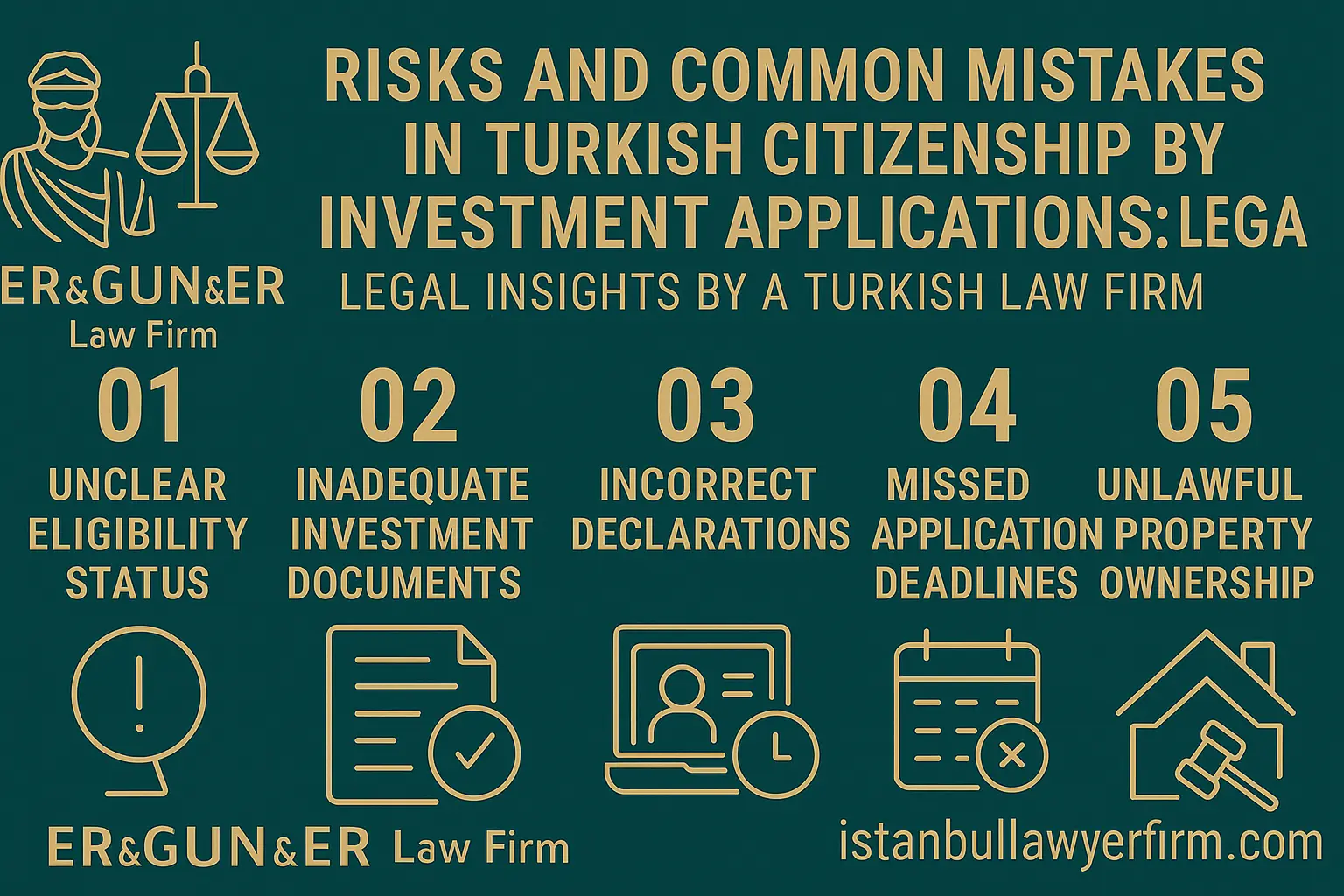
A lawyer in Turkey who advises foreign nationals on citizenship by investment applications understands that the Turkish investment citizenship program—while offering a legitimate and efficient pathway to Turkish nationality for qualifying investors—is governed by strict regulatory requirements, evolving administrative standards and compliance obligations that create multiple points of failure for applicants who approach the process without comprehensive legal guidance. An Istanbul Law Firm that represents investment citizenship applicants helps clients avoid the documentation errors, investment compliance failures, timing miscalculations and procedural misalignments that account for the majority of application rejections, delays and post-grant revocation risks in the Turkish citizenship by investment program. A Turkish Law Firm with experience in investment immigration coordinates every element of the application process—from initial investment structuring and property acquisition through document preparation, ministerial submission, security screening and post-grant compliance monitoring—to ensure that each step satisfies the current regulatory requirements and that the application file tells a consistent, verifiable story from the investment transaction through the citizenship grant. An English speaking lawyer in Turkey who manages citizenship applications for international investors ensures that the regulatory requirements, documentary standards and compliance obligations are communicated clearly to clients who may be coordinating their application from abroad and who depend on their Turkish legal counsel to navigate a process conducted entirely in Turkish through administrative channels that do not accommodate foreign-language submissions. Turkish lawyers who specialize in investment citizenship bring practical familiarity with the General Directorate of Population and Citizenship Affairs, the General Directorate of Land Registry and Cadastre, the Banking Regulation and Supervision Agency, the Ministry of Interior and the security screening procedures that each application must pass before citizenship can be granted. This guide maps the most common risks and mistakes that a methodical lawyer in Turkey identifies and prevents in Turkish citizenship by investment applications.
Documentation Errors and Civil Registry Mismatches in Citizenship Applications
A lawyer in Turkey who reviews citizenship application files before submission explains that incomplete, inconsistent or improperly authenticated documentation is the single most common cause of application delays and rejections in the Turkish investment citizenship program. The application file must include a comprehensive set of documents that establish the applicant's identity, civil status, criminal background, investment transaction, financial capacity and compliance with all program requirements—and each document must be properly authenticated through the applicable chain of apostille or consular legalization, translated into Turkish by a sworn translator, and formatted in accordance with the administrative standards applied by the General Directorate of Population and Citizenship Affairs. Missing documents, expired documents, documents that have not been properly apostilled or legalized, translations that contain errors or omissions, and documents that are formatted in ways that do not conform to the administrative template expected by the receiving authority all create grounds for the application to be returned for correction or rejected outright, adding weeks or months to the processing timeline and, in some cases, creating a window during which regulatory changes may alter the applicable requirements or thresholds. Turkish lawyers who prepare citizenship application files maintain detailed checklists that track the status, authentication chain, translation quality and expiry date of every document in the file, ensuring that the submitted application is complete, current and compliant at the moment of submission. Practice may vary by authority and year — verify current documentation requirements, authentication standards and document validity periods before any citizenship application submission.
An Istanbul Law Firm that identifies and corrects civil registry mismatches in citizenship application files explains that one of the most frequently encountered documentation problems involves inconsistencies between the applicant's identity information as it appears across different documents in the file. The applicant's name as spelled in the passport may differ from the name as transliterated in the property title deed, which may differ from the name as recorded in the bank deposit certificate, which may differ from the name as translated in the sworn Turkish translation of the birth certificate—and any of these inconsistencies can trigger a query from the reviewing authority that delays the application or, in the worst case, raises identity verification concerns that escalate to the security screening stage. These inconsistencies typically arise from differences in transliteration conventions between languages, from data entry errors by banks, notaries or land registry clerks, or from the applicant's use of different name formats in different countries. Turkish lawyers who prepare citizenship applications conduct a comprehensive name consistency audit across all documents in the file before submission, identifying and resolving any discrepancies through corrective applications to the relevant issuing authority, supplementary identity declarations, or explanatory cover letters that document the equivalence of different name spellings with reference to the applicant's passport as the primary identity document.
A Turkish Law Firm that manages document authentication for international citizenship applicants notes that the apostille and consular legalization requirements for citizenship application documents vary depending on the issuing country, the document type and the applicable bilateral agreements between Turkey and the applicant's country of origin. Documents issued by countries that are parties to the Hague Apostille Convention must bear an apostille from the competent authority in the issuing country, while documents from non-Hague countries must be legalized through the consular chain—typically involving authentication by the Ministry of Foreign Affairs in the issuing country followed by legalization by the Turkish Embassy or Consulate in that country. An English speaking lawyer in Turkey who coordinates the authentication process for clients assembling documents from multiple countries manages the logistics of obtaining apostilles and consular legalizations across different jurisdictions, tracking processing times and ensuring that all documents are authenticated before their validity periods expire. The authentication process is time-sensitive because many documents—particularly criminal record certificates and bank statements—have limited validity periods, and a document that was valid when authenticated may expire before the application file is complete if other documents in the file require longer processing times. Coordinating the authentication timeline so that all documents are valid simultaneously at the moment of submission is one of the most operationally challenging aspects of citizenship application preparation.
For the full procedural framework on the qualifying investment routes and the institutional review architecture at the Vatandaşlık Daireleri, see our pillar guide on the citizenship by investment legal framework.
Non-Compliance with Investment Conditions and Holding Period Requirements
A lawyer in Turkey who advises on investment compliance in citizenship applications explains that the Turkish citizenship by investment program imposes specific conditions on the qualifying investment—including minimum value thresholds, holding period requirements, transaction documentation standards, banking channel requirements and retention obligations—that must be satisfied both at the time of application and for a specified period after the citizenship grant, and that failure to comply with any of these conditions can result in application rejection or, more seriously, post-grant revocation of citizenship that affects the principal applicant and all derivative family members. The investment conditions vary depending on the investment category, and each category has its own documentation requirements, institutional verification procedures and compliance standards that the applicant must satisfy. Real estate purchases must meet the minimum property value threshold established by regulation as assessed by the General Directorate of Land Registry and Cadastre rather than by the contractual purchase price alone, the property must be purchased from a Turkish citizen or a Turkish legal entity rather than from another foreign national, the title deed must be annotated with a non-sale restriction (satış yasağı şerhi) for the required holding period that evidences the buyer's commitment not to sell or transfer the property during the retention period, and the purchase price must be paid through the Turkish banking system with complete documentary proof of the funds transfer from the buyer's Turkish bank account to the seller's account including SWIFT messages, bank receipts and confirmation letters that create an unbroken chain of evidence from the buyer's source of funds to the seller's receiving account. Bank deposit investments must meet the minimum deposit threshold established by regulation, the funds must be deposited in a Turkish bank that is authorized to accept deposits under the program, and the deposit must be locked for the required retention period with a formal bank letter confirming the lock amount, the lock period, the depositor's identity, the commitment not to withdraw during the retention period and the purpose of the deposit in terms that correspond to the citizenship program requirements. Capital contributions to Turkish companies, government bond purchases and job creation investments each have their own specific conditions, verification procedures and documentation requirements that must be satisfied with the same level of precision and documentary rigor. Turkish lawyers who structure qualifying investments ensure that every condition is satisfied from the outset and that every transaction step is documented contemporaneously, because retroactive correction of investment compliance failures is often impossible or impractical once the transaction has been completed and because the documentation assembled at the time of the transaction is the primary evidence that the authorities will review when evaluating the application. Practice may vary by authority and year — verify current investment thresholds, holding period requirements and documentation standards before any qualifying investment transaction.
An Istanbul Law Firm that monitors investment compliance throughout the application process and the post-grant holding period explains that one of the most common and most serious compliance mistakes involves the premature disposition of the qualifying investment before the holding period has expired. For real estate investments, the property must remain in the applicant's name and the non-sale annotation on the title deed must remain in place for the full duration of the required holding period—typically three years from the date of the title deed annotation—and any sale, transfer, encumbrance or other disposition of the property during this period constitutes a breach of the investment condition that can trigger revocation proceedings. Turkish lawyers who advise investment citizenship clients on post-grant obligations provide clear written guidance on the retention requirements, establish calendar reminders for the holding period expiry date, and monitor the title deed status through periodic land registry checks to ensure that no unauthorized changes have been recorded. For bank deposit investments, the retention obligation requires the funds to remain locked in the Turkish bank for the specified period, and any withdrawal, transfer or encumbrance of the deposit before the retention period expires creates the same revocation risk. The consequences of premature disposition are severe—citizenship may be revoked not only for the principal applicant but also for family members who obtained derivative citizenship through the same application—making compliance monitoring one of the most critical post-grant services that an experienced law firm provides.
A Turkish Law Firm that advises on fund sourcing and anti-money laundering compliance in citizenship applications emphasizes that the source of the investment funds must be documented transparently and that the documentation must be consistent with the applicant's declared income, business activities and financial profile. Turkish authorities conduct due diligence on the source of funds as part of the citizenship application review, and the National Intelligence Organization (MİT) conducts security background checks that may include financial intelligence screening. Applicants who cannot demonstrate the legitimate origin of their investment funds—through business ownership records, employment income documentation, inheritance certificates, property sale proceeds, investment portfolio liquidation records or other verifiable sources—face enhanced scrutiny that can delay or derail the application. An English speaking lawyer in Turkey who prepares fund sourcing documentation for international investors helps clients assemble a comprehensive financial narrative that traces the investment funds from their origin through any intermediate transactions to the qualifying investment in Turkey, with supporting documentation at each step that an examiner can verify independently. The fund sourcing documentation should be prepared with the same rigor as a tax audit defense file, because the standard of review applied by Turkish authorities has become increasingly thorough in recent years as the investment citizenship program has matured and as international anti-money laundering standards have tightened.
Timing Risks, Submission Windows and Document Expiry
A lawyer in Turkey who manages citizenship application timelines explains that the coordination of document collection, authentication, translation, investment completion and application submission within the applicable time windows is one of the most operationally complex aspects of the citizenship process, and that miscalculating any element of the timeline can result in document expiry, missed submission deadlines or investment compliance gaps that require individual documents to be re-obtained, re-authenticated and re-translated at significant additional cost and delay. The timeline complexity arises from the fact that different documents have different validity periods, different authentication processing times and different institutional dependencies that the applicant cannot fully control. Criminal record certificates typically have a validity period of six months from the date of issuance by the foreign authority, and the clock starts running from the issuance date rather than the authentication or submission date—meaning that an applicant who obtains a criminal record certificate early in the document collection process may find it expired by the time the remaining documents are ready for submission. Bank statements, financial certificates and fund sourcing documentation may have shorter validity periods or may need to be current as of a date close to the submission date to reflect the applicant's financial situation accurately. Passport copies must reflect the applicant's current passport with adequate remaining validity, and a passport that is renewed during the application preparation period requires all passport-dependent documents to be updated with the new passport number. The investment transaction documents—including the property deed, the conformity certificate, the bank lock letter and the payment confirmation—must be current, accurately reflect the investment status and be consistent with the applicant's financial declarations and identity documents at the time of submission. If the document collection process takes longer than anticipated—because of delays in obtaining apostilles from foreign authorities with heavy processing backlogs, extended processing times at sworn translation offices during peak periods, or administrative bottlenecks at banks or land registry offices that delay the issuance of conformity certificates or lock letters—early-collected documents may expire before the file is complete, requiring the applicant to obtain, authenticate and translate replacement documents that restart the validity clock and may themselves expire if the remaining documents continue to be delayed. Turkish lawyers who manage citizenship application timelines create detailed project plans with milestone dates and buffer periods that sequence the document collection, authentication and translation activities in an order that minimizes the risk of expiry, prioritizing documents with the shortest validity periods for collection closest to the anticipated submission date and scheduling documents with longer validity periods for earlier collection. Practice may vary by authority and year — verify current document validity periods and submission timing requirements before any application preparation.
An Istanbul Law Firm that coordinates with banks and land registry offices on behalf of citizenship applicants explains that delays in obtaining essential transaction documents—particularly the conformity certificate (uygunluk belgesi) from the General Directorate of Land Registry and Cadastre that confirms the property meets the minimum value threshold, and the bank lock letter that confirms the deposit commitment for bank deposit investments—are among the most common causes of timeline disruption in citizenship applications. These documents depend on institutional processing that is outside the applicant's direct control, and processing times can vary significantly depending on the workload of the relevant office, the complexity of the transaction and any verification steps that the institution requires before issuing the document. Turkish lawyers who manage these institutional interactions maintain relationships with the relevant offices, submit applications with complete and accurate supporting documentation to minimize processing queries, and follow up systematically to track progress and identify potential delays before they become critical. For real estate investments, the conformity certificate process requires the General Directorate to verify the property's assessed value against the minimum threshold and to confirm that the transaction meets all regulatory requirements, a process that can take several weeks depending on the volume of applications being processed simultaneously.
A Turkish Law Firm that advises on timing strategy for citizenship applications notes that regulatory changes—including increases in minimum investment thresholds, modifications to holding period requirements, or changes in the documentation standards—can occur with limited advance notice and may apply to applications submitted after the effective date of the change regardless of when the qualifying investment was made. This regulatory timing risk creates an incentive to complete and submit the application as quickly as possible after the qualifying investment is finalized, and to maintain the application file in a state of submission readiness so that it can be filed promptly if regulatory changes are anticipated. An English speaking lawyer in Turkey who monitors regulatory developments on behalf of citizenship applicants provides advance notice of anticipated changes, advises on the optimal submission timing based on the current regulatory environment, and coordinates accelerated document preparation when timely submission is critical to securing the application under existing rules before new requirements take effect.
Regulatory Changes, Legislative Updates and Evolving Application Standards
A lawyer in Turkey who tracks regulatory developments affecting the citizenship by investment program explains that the program's eligibility criteria, investment thresholds, documentation requirements and procedural standards have been amended multiple times since the program's inception, and that each amendment creates compliance challenges for applicants who began their investment planning or document preparation under the previous rules. The minimum property value threshold for real estate investments has been increased on several occasions—most notably from USD 250,000 to USD 400,000 in June 2022—reflecting the government's periodic reassessment of the program's economic and policy objectives. The categories of qualifying investments have been modified over time, with new investment routes added and existing routes refined to reflect evolving policy priorities. The documentation requirements have been enhanced to include additional verification steps such as the conformity certificate process that requires the General Directorate of Land Registry and Cadastre to independently verify the property's assessed value. The security screening procedures conducted by the National Intelligence Organization have been expanded and professionalized to reflect both domestic security priorities and Turkey's commitments under international anti-money laundering and counter-terrorism financing frameworks. Applicants who relied on information obtained weeks or months earlier from informal sources, real estate agents, online forums, social media discussions or outdated legal guides published before the most recent regulatory amendment may discover at the point of submission that their investment no longer meets the current threshold, that their documentation package is missing newly required elements such as the conformity certificate, that the procedural steps they followed no longer conform to the current administrative practice, or that the security screening requirements have been enhanced in ways that require additional documentation or longer processing times than originally anticipated. Turkish lawyers who specialize in investment citizenship maintain current awareness of all regulatory amendments, administrative circulars, ministerial directives and procedural changes through systematic monitoring of the Official Gazette, Ministry of Interior announcements, General Directorate of Population and Citizenship Affairs directives and the practical experience gained from ongoing case management that reveals how regulatory changes are being interpreted and applied in practice by the reviewing authorities. Practice may vary by authority and year — verify current eligibility criteria, investment thresholds and procedural requirements before any investment decision or application preparation.
An Istanbul Law Firm that advises clients on adapting to regulatory changes during the application process explains that mid-process regulatory changes create particularly difficult situations for applicants who have already made their qualifying investment but have not yet submitted the application or who have submitted the application but have not yet received a decision. The applicability of new rules to pending applications depends on the specific terms of the regulatory change and the transitional provisions, if any, that the authorities adopt—and in some cases, the transitional rules are unclear or leave discretion to the reviewing authority, creating uncertainty about whether the application will be evaluated under the old or the new standards. Turkish lawyers who manage pending applications during regulatory transitions communicate promptly with the relevant authorities to clarify the applicable standards, prepare supplementary documentation or amended applications as needed, and advise clients on whether to accelerate the submission, supplement the existing application with additional documentation, or restructure the investment to comply with the new requirements.
A Turkish Law Firm that helps clients navigate evolving security screening standards notes that the background investigation conducted by the National Intelligence Organization has become more thorough and more time-consuming as the citizenship by investment program has matured and as Turkey has faced increasing international pressure to ensure the integrity of its investment immigration programs. An English speaking lawyer in Turkey who prepares clients for the security screening process advises on the types of information that may be reviewed, the documentation that may be requested and the timeline that applicants should expect for the screening process. The security screening evaluates the applicant's criminal history, financial background, political affiliations, travel patterns and any factors that may raise national security or public order concerns, and applicants who have complex international backgrounds, extensive multi-country travel histories, business interests in politically sensitive or high-risk regions, or financial profiles involving multiple jurisdictions and currencies should be prepared for enhanced scrutiny, additional documentation requests and longer processing times that extend the overall application timeline beyond the standard period. Transparency, consistency, completeness and proactive disclosure in the application documentation are the most effective strategies for navigating the security screening process smoothly and minimizing the risk of adverse findings or prolonged investigation.
Misalignment with Immigration Processes and Permit Coordination
A lawyer in Turkey who manages citizenship applications alongside ongoing immigration processes explains that citizenship by investment applications frequently overlap with residence permit renewals, work permit applications, property registration proceedings and tax filing obligations, and that the failure to coordinate these parallel processes creates procedural conflicts, permit gaps and compliance risks that can jeopardize both the immigration status and the citizenship application. An applicant who holds a residence permit that expires during the citizenship application processing period must ensure that the permit is renewed before expiry, because a lapsed residence permit may be interpreted as a break in continuous residence that could affect the application evaluation. Similarly, an applicant who changes their address, employment status or family composition during the application processing period must ensure that these changes are reflected in both the immigration records and the citizenship application file, because inconsistencies between the two sets of records create queries that delay processing. Turkish lawyers who coordinate citizenship and immigration processes maintain a unified compliance timeline that tracks all residence permit expiry dates, renewal filing deadlines, address registration obligations, employment status changes and family composition updates across both the immigration and citizenship administrative systems, ensuring that all official records maintained by the Provincial Directorate of Migration Management, the General Directorate of Population and Citizenship Affairs and any other relevant administrative bodies are consistent, current and mutually reinforcing throughout the entire application period from initial investment through final citizenship grant. Practice may vary by authority and year — verify current coordination requirements between immigration and citizenship processes before any filing.
An Istanbul Law Firm that advises on permit transition planning for citizenship applicants explains that the relationship between the residence permit category and the citizenship application route must be managed carefully. Applicants who hold short-term residence permits based on property ownership, tourism or family reunification may need to ensure that their permit status is compatible with the investment citizenship application route they are pursuing, and that any change in permit category is processed through the Provincial Directorate of Migration Management before it creates an inconsistency in the application file. Turkish lawyers who manage these transitions coordinate with the migration directorate, the population directorate and the land registry to ensure that all administrative records reflect the same current information and that the citizenship application file is supported by consistent immigration documentation.
A Turkish Law Firm that advises citizenship applicants on travel management during the application processing period notes that international travel during the pending application does not necessarily create problems, but that applicants should carry current copies of their residence permit, their application receipt and a letter from their attorney confirming the pending application when crossing Turkish borders. An English speaking lawyer in Turkey who advises mobile international clients on travel during the application period provides clear guidance on re-entry requirements, the documentation that should be carried during travel, and the situations in which travel should be avoided—such as during scheduled biometric appointments, security screening interviews or document verification stages that require the applicant's physical presence in Turkey. Maintaining uninterrupted legal status in Turkey throughout the application period is essential to avoiding complications that could delay or jeopardize the citizenship grant.
Coordination with Real Estate, Banking and Escrow Partners
A lawyer in Turkey who structures qualifying real estate investments for citizenship applicants explains that the property acquisition process must be managed with citizenship compliance as the primary objective, meaning that every aspect of the transaction—from property selection and due diligence through price negotiation, contract execution, payment processing and title deed registration—must be structured to satisfy the program's regulatory requirements rather than optimized solely for investment return or personal preference. The property must meet the minimum value threshold as assessed by the General Directorate of Land Registry and Cadastre, the seller must be a Turkish citizen or a Turkish legal entity, the purchase price must be paid through the Turkish banking system with a complete documentary trail from the buyer's account to the seller's account, and the title deed must be annotated with the non-sale restriction that evidences the buyer's commitment to retain the property for the required holding period. Turkish lawyers who structure citizenship investments coordinate with real estate agents, property developers, banks and the land registry to ensure that every element of the transaction satisfies both the commercial objectives and the regulatory requirements, preventing the costly situation in which an investor completes a property purchase that does not qualify for the citizenship program because of a technical non-compliance that could have been identified and corrected before closing. Practice may vary by authority and year — verify current property qualification criteria and transaction documentation standards before any investment property acquisition.
An Istanbul Law Firm that coordinates banking documentation for citizenship applications explains that the payment processing and fund documentation requirements for qualifying investments have become increasingly detailed as the authorities have enhanced their due diligence standards. The bank transfer from the buyer to the seller must be traceable from the buyer's source account through any intermediate accounts to the seller's receiving account, and the bank must issue documentation confirming the transfer amount, the parties, the dates and the stated purpose. For bank deposit investments, the depositing bank must issue a formal lock letter confirming the deposit amount, the lock period, the applicant's identity and the purpose of the deposit in terms that correspond to the citizenship program requirements. Turkish lawyers who prepare banking documentation for citizenship applications maintain templates and checklists that reflect the current administrative expectations, coordinate directly with the bank's compliance and documentation departments to ensure that the issued documents meet the required format and content standards, and review all banking documentation before submission to identify and correct any discrepancies or omissions.
A Turkish Law Firm that assists with escrow arrangements in citizenship investment transactions advises that using an escrow mechanism to hold the purchase funds until all citizenship-related conditions are verified provides an additional layer of protection for the investor that can prevent significant financial loss in cases where the transaction does not qualify for the program. An English speaking lawyer in Turkey who drafts escrow agreements for international investors ensures that the escrow terms include release conditions tied to specific, verifiable milestones in the citizenship qualification process: title deed registration in the applicant's name confirming ownership transfer, non-sale annotation confirmation on the title deed confirming the holding period restriction, conformity certificate issuance by the General Directorate of Land Registry and Cadastre confirming that the property meets the minimum value threshold, and verification that the seller meets the eligibility criteria required by the program for qualifying transactions. This structural protection prevents the situation—which occurs more frequently than most investors realize—in which an investor pays the full purchase price for a property that subsequently turns out not to qualify for the citizenship program because the assessed value falls below the minimum threshold as determined by the General Directorate's independent valuation, because the seller's eligibility is disputed due to corporate structure or nationality issues, because the title deed contains undisclosed encumbrances, liens or legal disputes that prevent the required non-sale annotation from being recorded, or because administrative or regulatory changes between the date of payment and the date of application submission alter the qualifying criteria in ways that exclude the purchased property. Without escrow protection, the investor in any of these scenarios faces the difficult and potentially costly task of unwinding the transaction, negotiating with the seller for a return of funds, and restructuring the investment to acquire a different qualifying property—all while the application timeline continues to run and document validity periods continue to expire. With escrow protection, the investor's funds are not released until the qualification conditions are confirmed, providing both financial security and negotiating leverage that protects the investor's interests throughout the transaction.
Post-Grant Compliance, Monitoring and Revocation Prevention
A lawyer in Turkey who advises citizenship recipients on post-grant obligations explains that the grant of Turkish citizenship through the investment program does not terminate the applicant's compliance obligations—the qualifying investment must be maintained for the full duration of the required holding period after the citizenship grant, and any breach of the retention requirement during this period can trigger administrative proceedings for the revocation of citizenship that, if successful, strips the individual of Turkish nationality retroactively. The revocation risk applies not only to the principal applicant but also to the spouse and dependent children who obtained derivative citizenship through the same application, meaning that a compliance failure by the principal applicant—whether intentional, negligent or inadvertent—can have cascading consequences for the entire family's legal status, residence rights, travel document validity and access to Turkish public services. Turkish lawyers who provide post-grant compliance monitoring services track the status of the qualifying investment through periodic verification checks conducted at defined intervals—verifying that the property remains registered in the applicant's name at the land registry with the non-sale annotation intact and without any unauthorized encumbrances, liens or transfer annotations, or verifying that the bank deposit remains locked in the designated account at the specified amount without any partial withdrawals, set-offs or encumbrances that would reduce the qualifying balance. These monitoring services provide the applicant with documented evidence of ongoing compliance that can be produced immediately if the authorities conduct a follow-up review, and they create an early warning system that detects any unauthorized changes to the title deed or bank account, administrative errors by institutional staff, or third-party actions such as fraudulent transfer attempts or creditor attachments that could affect the investment status before they escalate into formal compliance proceedings. Practice may vary by authority and year — verify current post-grant compliance requirements and retention period obligations before any disposition of the qualifying investment.
An Istanbul Law Firm that handles post-grant administrative inquiries explains that Turkish authorities may conduct follow-up reviews of citizenship recipients' compliance status, particularly when regulatory changes create new reporting requirements or when information comes to the attention of the authorities that raises questions about the original application's compliance. These inquiries may request updated documentation confirming the continued retention of the qualifying investment, financial declarations showing the source and status of the investment funds, or residency information demonstrating the recipient's connection to Turkey. Turkish lawyers who manage these inquiries respond promptly with organized, complete documentation packages that demonstrate ongoing compliance, minimizing the duration and intensity of the review and preventing the inquiry from escalating into formal revocation proceedings.
A Turkish Law Firm that advises on citizenship revocation defense represents clients who face administrative proceedings challenging the validity of their citizenship grant based on alleged non-compliance with investment conditions, alleged fraud or misrepresentation in the original application, or alleged criminal conduct that provides grounds for denaturalization under Turkish law. An English speaking lawyer in Turkey who defends against revocation proceedings assembles the evidence of compliance, prepares legal submissions challenging the factual or legal basis of the revocation claim, and represents the client in administrative hearings and, if necessary, judicial proceedings challenging the revocation decision. The defense strategy in revocation cases depends on the specific grounds alleged and the evidence available, but in all cases, the quality of the documentation maintained during the investment period and the post-grant compliance monitoring records are the most important defensive assets. The best lawyer in Turkey for citizenship revocation defense combines investment immigration expertise with administrative litigation experience and a thorough understanding of the procedural rights available to citizenship recipients under Turkish constitutional and administrative law.
Dual Tax Obligations, Financial Reporting and Cross-Border Considerations
A lawyer in Turkey who advises investment citizenship recipients on tax implications explains that acquiring Turkish citizenship may create dual tax residency obligations that affect the recipient's worldwide tax position and financial reporting requirements. Turkey taxes residents on their worldwide income, and the acquisition of Turkish citizenship—combined with the presence of Turkish assets, the maintenance of a Turkish address and the holding of a Turkish residence permit—may establish or strengthen the factors that Turkish tax authorities consider when evaluating tax residency status. An English speaking lawyer in Turkey who coordinates tax planning for citizenship recipients helps clients assess whether their Turkish citizenship and associated ties create Turkish tax residency, whether a double tax treaty between Turkey and the client's country of residence provides relief from dual taxation, and what financial reporting obligations arise from the combination of Turkish citizenship, Turkish assets and foreign income. The tax analysis should be conducted before the citizenship application is submitted rather than after the grant, because the tax implications may influence the investment structure, the residency planning and the overall financial strategy associated with the citizenship acquisition. Practice may vary by authority and year — verify current tax residency rules, financial reporting obligations and applicable double tax treaty provisions before any citizenship-related financial planning.
An Istanbul Law Firm that advises on international financial reporting obligations for dual nationals explains that citizenship recipients who maintain financial accounts, investments or business interests in multiple countries may be subject to automatic information exchange requirements under the Common Reporting Standard (CRS) and, for US-connected persons, the Foreign Account Tax Compliance Act (FATCA). Turkish banks and financial institutions report account information for non-resident account holders to the Turkish tax authorities, which exchange the information with the account holder's country of tax residence under CRS agreements. Citizenship recipients who become Turkish tax residents must ensure that their worldwide financial accounts and investments are declared in their Turkish tax returns, and that their Turkish accounts are properly reported in their foreign tax returns if they remain tax resident in their country of origin. Turkish lawyers who advise dual nationals on financial reporting coordinate with international tax advisors to ensure that reporting obligations are met in all relevant jurisdictions and that the reporting positions are consistent across jurisdictions to avoid discrepancies that could trigger cross-border tax investigations.
A Turkish Law Firm that provides comprehensive post-citizenship advisory services helps clients integrate their Turkish citizenship into their overall financial, estate and succession planning. An English speaking lawyer in Turkey who advises on estate planning for dual nationals explains how Turkish inheritance law—including forced heirship provisions, the taxation of inherited assets and the procedural requirements for cross-border estate administration—affects citizenship recipients who hold assets in Turkey and who have heirs residing in different jurisdictions. The interaction between Turkish inheritance law and the inheritance laws of the recipient's other country of nationality or residence creates planning opportunities and risks that should be addressed through coordinated wills, trust structures where applicable, and beneficiary designations that reflect the legal requirements of both jurisdictions. Proactive planning prevents the costly and time-consuming disputes that arise when a dual national dies without having coordinated their estate plan across the jurisdictions in which they held assets and in which their heirs reside.
Frequently Asked Questions
- What are the most common reasons for citizenship by investment application rejection? The most common reasons include incomplete or expired documentation, inconsistencies between identity information across different documents in the file, non-compliance with investment value thresholds, failure to provide adequate fund sourcing documentation, missing apostilles or consular legalizations, and failure to meet submission timing requirements. Comprehensive document preparation and pre-submission review by experienced counsel significantly reduce rejection risk.
- Can my citizenship be revoked after it is granted? Yes, under specific circumstances including fraud or misrepresentation in the original application, failure to maintain the qualifying investment for the required holding period, disposition of the property or withdrawal of the bank deposit before the retention obligation expires, or criminal conduct that provides grounds for denaturalization under Turkish law. Post-grant compliance monitoring helps prevent inadvertent breaches.
- How long must I keep the qualifying property before I can sell it? The property must remain registered in your name with the non-sale annotation on the title deed for the duration of the holding period specified by regulation—typically three years from the date of the title deed annotation. Selling or transferring the property before this period expires constitutes a breach that can trigger citizenship revocation proceedings for the applicant and derivative family members.
- What happens if the investment threshold increases after I buy the property? If the property was purchased and the application was submitted before the threshold increase took effect, the application is generally evaluated under the rules applicable at the time of submission. However, transitional provisions vary with each regulatory change, and applicants who have purchased property but not yet submitted the application face uncertainty. Timely submission after investment completion reduces this regulatory timing risk.
- Do I need to live in Turkey after receiving citizenship? Turkish citizenship by investment does not impose a mandatory residence requirement after the grant. However, maintaining some connection to Turkey—through property ownership, periodic visits, tax compliance and updated address registration—supports the ongoing validity of the citizenship and helps prevent complications with future administrative reviews.
- Will acquiring Turkish citizenship affect my tax obligations in my home country? Acquiring Turkish citizenship may create dual tax residency implications depending on your home country's tax rules and the applicable double tax treaty. Some countries tax their citizens on worldwide income regardless of residence, while others apply residency-based taxation. Tax planning should be conducted before the citizenship application to understand and manage the implications.
- Can my spouse and children also receive citizenship through my investment? Yes, the spouse and dependent children under eighteen of the principal applicant are eligible for derivative citizenship through the same application, subject to their own identity documentation, criminal record clearance and security screening requirements. Each family member's documents must be prepared and authenticated individually.
- What fund sourcing documentation is required? The authorities expect documentation that traces the investment funds from their legitimate origin to the qualifying investment in Turkey, including business ownership records, employment income documentation, inheritance certificates, property sale proceeds, investment portfolio liquidation records, bank statements showing the accumulation and transfer of funds, and any other documents that establish the lawful origin of the investment capital.
- How long does the citizenship application process typically take? Processing times vary depending on the completeness of the documentation, the efficiency of institutional processing for conformity certificates and bank letters, the duration of the security screening and the volume of applications being processed. Applicants should plan for a processing period of several months from submission to grant, though expedited processing may be available in straightforward cases with complete documentation.
- What should I do if my documents contain name inconsistencies? Name inconsistencies across documents must be resolved before submission through corrective applications to the relevant issuing authorities, supplementary identity declarations, or explanatory cover letters with supporting documentation establishing the equivalence of different name spellings. Your attorney should conduct a comprehensive name consistency audit across all documents in the file.
- Can I travel internationally while my citizenship application is being processed? International travel during the application processing period is generally permitted, but applicants should carry current copies of their residence permit, application receipt and a letter from their attorney confirming the pending application. Travel should be avoided during scheduled biometric appointments, security screening interviews or document verification stages.
- What is a conformity certificate and why is it important? The conformity certificate is issued by the General Directorate of Land Registry and Cadastre and confirms that the property meets the minimum value threshold and that the transaction satisfies the regulatory requirements for the citizenship program. This certificate is a required element of the application file and must be obtained before submission.
- Do I need to open a Turkish bank account for the application? Yes. The investment funds must flow through the Turkish banking system, and the applicant must have a Turkish bank account for the payment of the property purchase price or for the deposit of qualifying funds. The bank documentation confirming the transaction is a required element of the application file.
- What happens if my application is rejected? A rejected application may be corrected and resubmitted if the rejection was based on curable deficiencies such as missing documents, expired certificates or technical errors. If the rejection was based on substantive grounds such as security screening concerns or investment non-compliance, the corrective options are more limited and should be assessed by experienced counsel on a case-by-case basis.
- Does ER&GUN&ER Law Firm handle citizenship by investment applications? Yes. ER&GUN&ER Law Firm provides comprehensive legal services for Turkish citizenship by investment applications, including investment structuring, document preparation, authentication coordination, ministerial submission, security screening support, post-grant compliance monitoring and revocation defense, with bilingual English-Turkish legal support throughout the process.
Author: Mirkan Topcu is an attorney registered with the Istanbul Bar Association (Istanbul 1st Bar), Bar Registration No: 67874. His practice focuses on cross-border and high-stakes matters where evidence discipline, procedural accuracy, and risk control are decisive.
He advises individuals and companies across Immigration and Residency, Real Estate Law, Tax Law, and cross-border documentation matters where procedural accuracy and evidence discipline are decisive.
Education: Istanbul University Faculty of Law (2018); Galatasaray University, LL.M. (2022). LinkedIn: Profile. Istanbul Bar Association: Official website.