

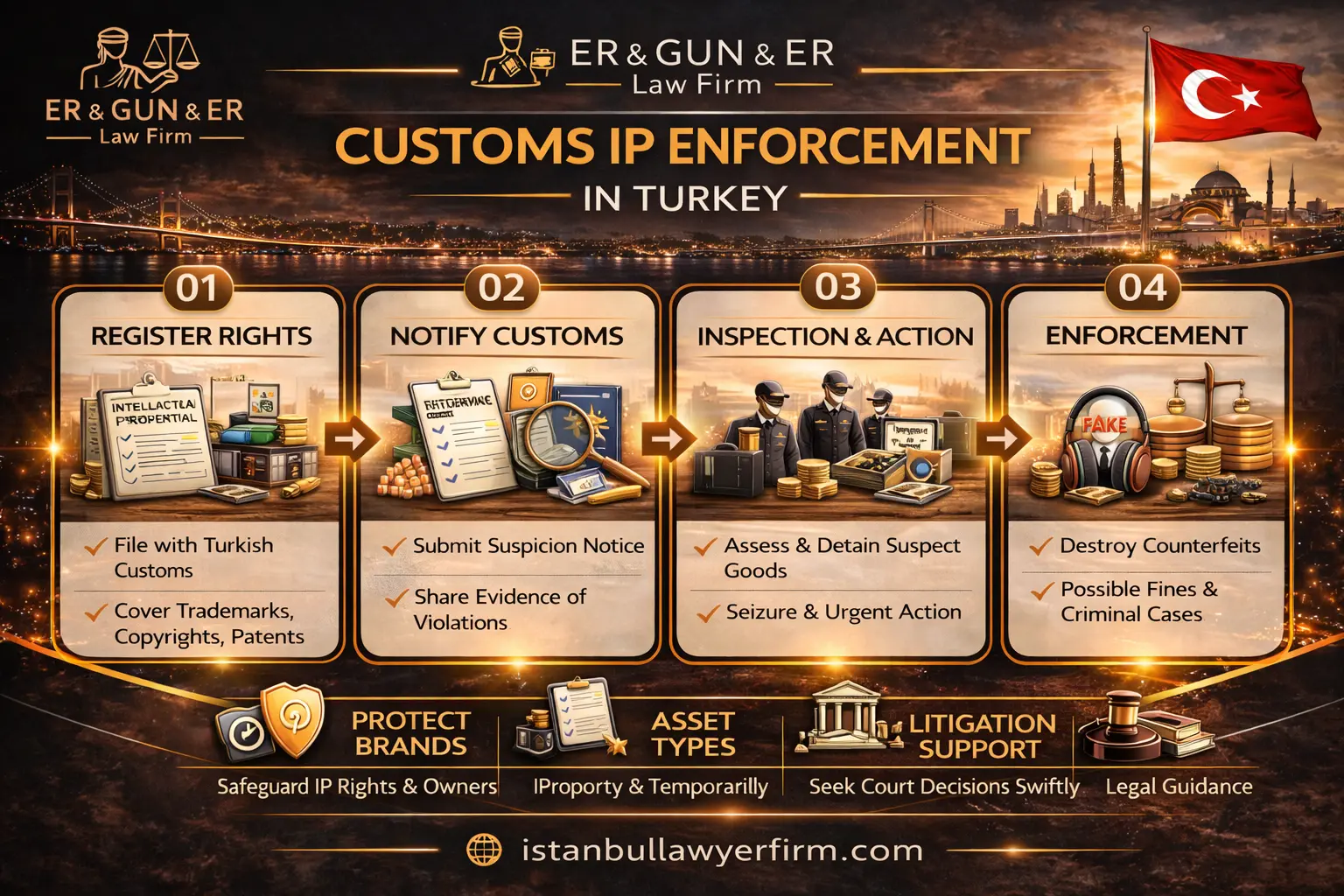
A lawyer in Turkey who advises rights holders and importers on Turkish customs IP enforcement understands that border measures are the administrative tools that allow customs authorities to pause suspected counterfeit or infringing goods at the point of import, export or transit before those goods enter commercial circulation—and that the effectiveness of customs IP enforcement in Turkey depends far more on the quality of advance preparation than on the strength of the underlying IP rights themselves, because customs officers acting under administrative time pressure need clear, practical identification materials to recognize infringement indicators without conducting a full legal merits analysis. An Istanbul Law Firm that designs and manages customs IP enforcement programs for rights holders operating in Turkish markets provides comprehensive advisory and operational support spanning every stage of the enforcement lifecycle: building customs recordation packages for trademarks, designs and patents that satisfy Turkish customs authority requirements and provide actionable identification guidance; designing product identification evidence packs that give customs officers the practical tools to recognize infringing goods using visible, objective indicators; establishing alert and incident response protocols that ensure detention notifications reach the right personnel and trigger immediate, organized responses; managing detention and notification workflows including inspection attendance, sampling coordination and authenticity conclusion documentation; preparing enforcement suspension applications and court injunctions where administrative measures must be reinforced through judicial relief; advising on structured settlement, consent destruction and release procedures that resolve detentions efficiently without unnecessary litigation; coordinating parallel civil and criminal enforcement steps where the evidence supports escalation beyond administrative customs measures; and managing the compliance program governance that keeps recordation current, authorized channel data accurate and enforcement decisions documented and consistent. A Turkish Law Firm with experience in both Turkish customs administrative practice and IP enforcement litigation brings practical knowledge of how Turkish customs authorities implement the detention and release workflow, what documentation formats customs officers find most useful during time-pressured inspections, and how the administrative customs record needs to be structured to support later civil and criminal proceedings where the same evidence will be evaluated by courts under different standards. An English speaking lawyer in Turkey who coordinates customs IP enforcement for multinational rights holders ensures that the enforcement program's documentation, response protocols and escalation decisions are managed in a format that enables global brand protection teams to maintain effective oversight of Turkish customs proceedings without requiring Turkish language proficiency. Practice may vary by authority and year — check current guidance before locking enforcement roadmaps or publishing commitments to specific customs procedures or outcomes.
Border Enforcement Framework and IP Rights Covered at Turkish Customs
A lawyer in Turkey who explains Turkish customs border enforcement for IP rights advises that the customs suspension of release process—in which customs authorities hold suspected infringing goods pending verification and resolution rather than allowing them to pass through clearance—is fundamentally an administrative system designed to move quickly with limited time for full merits litigation, making advance preparation by both rights holders and importers the decisive factor that determines whether a customs hold produces effective enforcement or creates operational disruption without achieving the underlying protection objective. An Istanbul Law Firm that advises rights holders on the Turkish customs IP enforcement framework explains the critical operational distinction between customs border measures and court-based enforcement: customs action is administrative, time-sensitive and triggered by a suspicion standard that requires identifiable indicators rather than proven infringement, meaning that customs officers do not perform the legal merits analysis that courts conduct—they match visible goods characteristics against the rights holder's identification materials and make a practical determination about whether to maintain a hold and notify relevant parties. Turkish lawyers advising on which IP rights are most effectively enforced through Turkish customs identify the practical considerations that determine each right's customs suitability: trademarks are typically the most operationally effective right for border enforcement because registered marks are visible on goods, packaging and labels in a form that customs officers can compare against the rights holder's specimens without technical expertise; design rights can be recorded and enforced at customs, but their identification requires clearer visual feature guidance and comparison materials because the protected elements may be less immediately obvious than word marks or logos; patent rights create more challenging customs identification questions because assessing patent infringement often requires technical analysis that is not feasible in the customs timeframe, making patents more suitable as supplementary enforcement tools combined with trademark or design recordation that can trigger initial detention; and copyright can arise in customs contexts for specific goods categories, but enforcement must be built around recognition procedures and identifiable indicators that customs can apply without specialized rights analysis. Practice may vary by authority and year — verify current Turkish customs authority recognition procedures for each IP right category, current recordation requirements for each right type, and current customs identification standards before designing any border enforcement strategy.
An Istanbul Law Firm that advises on the Turkish customs IP enforcement ecosystem explains that border measures must be understood as one component of a coordinated enforcement strategy rather than as a standalone solution—because customs detention creates a time window during which the rights holder must decide whether to pursue administrative destruction, seek a court order maintaining the hold, or accept release if the goods appear legitimate, and those decisions must be made quickly based on evidence that may be incomplete at the time the hold occurs. Turkish lawyers designing customs IP enforcement frameworks help rights holders understand the relationship between customs administrative measures and downstream civil and criminal enforcement: the customs record—including the detention notice, inspection photographs, authenticity conclusion memo and resolution documentation—becomes the factual foundation for any subsequent court proceedings, meaning that evidence quality at the customs stage directly affects the rights holder's position in later litigation; the customs hold provides a unique opportunity to examine potentially infringing goods before they enter distribution, because once goods clear customs and enter the market they become substantially harder to identify, seize and verify; and the importer's response to a customs hold—including any authenticity claims, authorization evidence and provenance documentation provided during the administrative process—becomes part of the evidentiary record that courts and prosecutors will evaluate if the matter escalates beyond administrative resolution. An English speaking lawyer in Turkey who coordinates customs IP enforcement for international brands ensures that the enforcement program's structure accounts for all downstream uses of customs records—building administrative documentation with the quality and chain-of-custody discipline that civil litigation and criminal complaints require, rather than treating the customs process as an administrative formality separate from the broader enforcement strategy.
A Turkish Law Firm that advises importers facing Turkish customs IP holds explains that the importer's operational response to a customs detention begins with a documentation problem rather than a legal argument: the importer must quickly produce the commercial invoice, packing list, transport documents and authorization evidence—such as license letters, distribution agreements or manufacturer certificates—that demonstrate the goods' legitimate origin and authorized status in a form that customs officers can evaluate without extended analysis. An English speaking lawyer in Turkey who represents importers in Turkish customs IP disputes helps importers understand that the importer objection customs IP Turkey process requires a structured, organized documentary response that addresses the specific infringement indicators the rights holder has identified rather than a general denial of wrongdoing—because customs officers evaluating importer objections need to see objective evidence that directly responds to the identification indicators in the rights holder's materials, not marketing statements or generalized authenticity claims. The best lawyer in Turkey for customs IP enforcement matters combines practical knowledge of Turkish customs administrative practice with IP litigation experience that enables effective management of enforcement situations where administrative and judicial measures must be coordinated simultaneously.
Customs Recordation, Application Dossier and Product Identification
A lawyer in Turkey who advises on customs recordation for trademark rights explains that recording a trademark right with Turkish customs authorities—the act that turns a registry right into an operational border enforcement tool—requires substantially more than submitting a certificate of registration, because the recordation file must also provide customs officers with the practical identification materials they need to recognize protected goods, identify potential infringement indicators and make informed detention decisions without expert assistance or extended analysis time. An Istanbul Law Firm that prepares customs recordation packages for rights holders builds each recordation dossier around the needs of the customs officer who will use it during a port inspection: a one-page right summary identifying the specific registrations, covered goods classes and product families that matter for border enforcement, enabling officers to quickly confirm scope without reviewing lengthy registry extracts; proof of ownership documentation including the registration certificate with current ownership details that match the entity making the recordation application, with any assignment or licensing documentation needed where the applicant and registry owner differ; a contact matrix identifying primary and backup responders with time zones, response commitments and escalation paths that ensure notifications reach a person who can act immediately rather than sitting in an inbox until business hours; authorized importer and distributor information that allows legitimate shipments to be cleared quickly rather than detained unnecessarily; and a product identification kit containing authentic product photographs showing marks, labels, packaging, batch coding and other visible features alongside a structured indicator list distinguishing hard indicators—features that definitively separate authentic from counterfeit goods—from soft indicators that trigger closer inspection without being conclusive alone. Practice may vary by authority and year — verify current Turkish customs authority recordation format requirements, current documentation standards for trademark, design and patent recordation applications, and current refresh and update procedures for maintaining active recordation files before preparing any recordation package.
An Istanbul Law Firm that designs customs application dossiers for complex brand portfolios explains that the rights holder application customs Turkey dossier must be built as a border-ready evidence pack organized for officer use under time pressure rather than as a compliance submission designed for administrative review at leisure. Turkish lawyers preparing rights holder application dossiers implement a structured dossier architecture: the product identification kit includes high-resolution photographs of authentic products from multiple angles with annotations identifying the specific marks, holograms, serial number positions and packaging security features that officers should verify; a known counterfeit indicators section documents specific defects, misspellings, color inconsistencies and packaging errors observed in previously identified counterfeit goods, organized as a comparison guide with authentic and counterfeit photographs side by side; an authorized channel reference explains what authorized supply chains for the brand's Turkish market typically look like, providing context that helps officers distinguish legitimate imports from unauthorized goods; and a decision guidance section explains how to handle ambiguous cases—suspected parallel imports, goods from authorized sources with documentation gaps, goods requiring technical assessment—with clear escalation paths rather than leaving officers to improvise. An English speaking lawyer in Turkey who manages multi-brand dossier programs for international rights holders implements version control, refresh calendars and access control systems that keep dossiers current across packaging changes, authorized channel updates and portfolio additions—because a dossier containing outdated packaging photographs, stale contact details or missing authorized distributor information systematically creates false positives that detain legitimate goods and erode the customs authority relationship that effective enforcement depends on.
A Turkish Law Firm that advises on evidence integrity for customs IP enforcement explains that the evidence pack's value as a foundation for later civil and criminal proceedings depends entirely on maintaining the chain-of-custody discipline and documentation consistency that courts require to evaluate customs records as reliable evidence. An English speaking lawyer in Turkey who manages evidence architecture for customs IP programs designs evidence systems with downstream legal use in mind: authentic product photographs are stored with metadata, effective dates and version numbers that confirm they represent the product as it appeared when the detained goods were inspected; counterfeit indicator documentation is tied to specific prior incidents with dates and locations that provide concrete foundation for the infringement analysis; and every update to identification materials is recorded with a change log that prevents confusion about which version of identification materials was in use at the time of a specific detention. The program should also establish a secure evidence sharing method for transmitting identification materials to customs authorities and for receiving detention photographs and reports without uncontrolled distribution that could expose sensitive brand intelligence to counterfeiters who monitor enforcement patterns to refine their operations.
Risk Profiling, Detention Workflow and Notification Management
A lawyer in Turkey who advises on customs monitoring program design for IP enforcement explains that the customs monitoring program Turkey framework enables rights holders to work with customs authorities to build risk profiles that improve detection rates by directing inspection resources toward shipments that exhibit objective risk indicators—and that the effectiveness of risk profiling depends on providing current, evidence-based indicator data rather than speculative assessments that create detection noise without improving true-positive rates. An Istanbul Law Firm that develops customs monitoring risk profiles for brand protection programs implements risk indicator frameworks that balance enforcement effectiveness with proportionality: primary risk indicators based on objective shipment characteristics such as declared value inconsistency relative to typical market pricing, shipper identity mismatch against authorized supplier lists, routing through known high-counterfeit-volume origination points and packaging description inconsistency with the rights holder's labeled product formats; secondary indicators that trigger closer inspection rather than automatic detention, such as unusual quantities for the declared end use, documentation formatting inconsistencies and transshipment patterns inconsistent with authorized distribution routes; and authorized channel pre-clearance information that reduces false-positive detection by identifying shipments from confirmed authorized importers that should be processed without heightened scrutiny. Turkish lawyers designing risk profiles help rights holders understand that profile data must be maintained as a current, dated document with source citations for each indicator—because customs authorities and courts may evaluate whether profiling was evidence-based or speculative, and profiling that appears to be based on nationality, commercial rivalry or unverifiable intelligence creates both enforcement legitimacy concerns and potential liability exposure if legitimate importers can show their goods were targeted without objective justification. Practice may vary by authority and year — verify current Turkish customs authority risk profiling procedures, current data sharing protocols between rights holders and customs, and current privacy and data protection requirements applicable to shipment intelligence data before implementing any risk profiling program.
An Istanbul Law Firm that manages detention and notification workflow for rights holders explains that the sequence from initial customs suspension through authenticity conclusion, importer notification, response evaluation and resolution decision must be managed as a disciplined incident management process rather than as an ad hoc commercial response—because each stage of the detention flow creates evidence that becomes part of the permanent record, and decisions made under time pressure without documentation discipline regularly create problems in later proceedings where accuracy and consistency are tested. Turkish lawyers managing detention incidents implement structured incident protocols: the incident opens when the detention notice is received, and the notice is immediately preserved as the first exhibit with the shipment identifiers and contact details; the incident owner is assigned and the internal escalation clock starts, with tasks assigned at each stage that account for realistic response times without creating unrealistic commitments to customs authorities; the authenticity verification step produces a structured conclusion memo tied to the product identification indicators rather than to general impressions, with the specific photographs and visible features that support the conclusion identified by exhibit reference; and the incident closes with a resolution record that documents the outcome—release, destruction, court escalation or settlement—and the basis for the resolution decision, stored as a permanent exhibit in the incident archive. An English speaking lawyer in Turkey who manages notification flow for international brands ensures that customs authority notifications in Turkish are accurately understood and translated for global brand protection teams, and that response communications to customs follow established templates that are factual, non-accusatory and consistent with the incident record rather than reflecting the commercial pressure that storage costs, demurrage and delivery deadline disruptions create during the hold period.
A Turkish Law Firm that advises on alert handling governance for customs IP programs explains that the speed and quality of the rights holder's response to a detention notification is often the most consequential operational factor because customs administrative windows can be short in practice and delays in responding can result in release of detained goods before the rights holder has produced the authenticity conclusion and escalation decision that the situation requires. An English speaking lawyer in Turkey who designs alert response governance for IP enforcement programs implements pre-positioned resources that prevent response delays: pre-drafted verification letter templates that confirm whether specific goods appear infringing based on visible indicators, with appropriate hedging that avoids claiming a final legal determination before complete verification; backup contact structures that ensure notification reaches a qualified responder even when primary contacts are unavailable due to time zones, travel or leave; and a decision authority matrix that identifies who can authorize each escalation step—authenticity confirmation, inspection request, court escalation, settlement negotiation—at the required speed without requiring senior executive involvement for every routine detention. The program should also maintain a communications discipline rule that designates a single spokesperson for external communications during each incident, prevents individual staff from making inconsistent statements about detained shipments across email and messaging channels, and requires that all external communications be reviewed against the incident record before transmission.
Inspection, Sampling and Evidence Standards
A lawyer in Turkey who advises on inspection participation for customs IP enforcement explains that when customs authorities provide rights holders with the opportunity to attend inspection of detained goods, the inspection must be managed as a structured evidence-gathering exercise rather than as an informal authenticity check—because inspection observations, photographs and conclusions become core exhibits in the customs record and in any subsequent civil or criminal proceedings, making their quality, consistency and chain-of-custody integrity as important as the substantive infringement analysis they document. An Istanbul Law Firm that manages inspection participation for rights holders in Turkish customs detentions prepares rights holder representatives for each inspection with a structured inspection protocol: an inspection checklist based on the product identification kit that identifies the specific features to examine and photograph at each inspection, ensuring consistency across different ports, different officers and different product variants within the same brand; a photography protocol specifying required angles, lighting conditions and reference items to photograph alongside the detained goods, producing consistent visual documentation that supports reliable comparison with the authentic specimens in the identification kit; a chain-of-custody protocol for any samples taken at inspection, specifying how samples are labeled, sealed and stored to maintain the integrity that laboratory analysis or court evidence requirements demand; and a conclusion vocabulary that standardizes the language used to describe inspection findings—using terms like "likely counterfeit based on indicators X, Y, Z," "inconclusive pending further analysis" or "appears authorized based on documentation presented"—rather than improvised characterizations that can create credibility problems when compared against later filings. Practice may vary by authority and year — verify current Turkish customs authority procedures for rights holder inspection attendance, current sampling procedures and chain-of-custody requirements, and current evidentiary standards for inspection documentation in Turkish administrative and civil proceedings before preparing any inspection participation protocol.
An Istanbul Law Firm that advises on evidence quality for customs IP enforcement explains that the most common evidence quality failure in Turkish customs IP detentions is the gap between the identification materials in the rights holder's recordation dossier and the evidence actually produced during inspection—where inspection photographs do not capture the specific features identified in the indicator list, where authenticity conclusions are not tied to specific observable indicators, and where sampling does not follow chain-of-custody documentation that would make samples usable as evidence in later proceedings. Turkish lawyers improving evidence quality in customs programs help rights holders implement quality assurance steps that prevent these gaps: a pre-inspection brief that reviews the product ID kit with the inspection attendee and confirms which specific indicators will be examined during the inspection; a post-inspection review that compares the inspection photographs against the indicators documented in the kit and identifies any gaps before the conclusion memo is finalized; and a conclusion sign-off rule that requires the conclusion memo to be reviewed by a second qualified person before it is transmitted to customs or used as the basis for escalation decisions. An English speaking lawyer in Turkey who manages evidence quality for multinational brands coordinates the Turkish inspection record with the global brand protection team's standards for authenticity documentation—ensuring that Turkish customs inspection evidence meets both Turkish administrative evidentiary standards and the multinational company's internal evidence quality requirements that govern consistent decision-making across jurisdictions.
A Turkish Law Firm that advises on importer submission evaluation during customs IP detentions explains that when importers present provenance documentation, authorization evidence or alternative explanation during the detention process, the rights holder must evaluate that evidence systematically and document its evaluation rather than ignoring it or dismissing it without analysis—because courts and customs authorities reviewing the rights holder's enforcement conduct will assess whether the rights holder gave reasonable consideration to importer submissions before proceeding to destruction or court escalation. An English speaking lawyer in Turkey who manages importer submission evaluation for rights holders implements a structured evaluation protocol: the importer's submissions are catalogued as numbered exhibits with receipt dates; the evaluation memo addresses each specific document and explains why it does or does not resolve the specific indicators of concern; and the evaluation conclusion is tied to the specific evidence reviewed rather than to a general characterization of the importer as implausible or uncooperative. This disciplined evaluation protects the rights holder against claims that it proceeded unreasonably and also provides accurate guidance about whether the detained goods are actually infringing or represent a false positive that should be released without further action.
Destruction, Court Orders and Enforcement Remedies
A lawyer in Turkey who advises on resolution options for Turkish customs IP detentions explains that the rights holder's decision between pursuing administrative destruction through the customs procedure, seeking a court injunction to maintain the hold and extend enforcement options, and negotiating structured settlement or release must be made quickly based on the inspection evidence available at the time—and that each option has different evidence requirements, timing constraints and downstream implications that must be understood before the resolution decision is made rather than after it is implemented. An Istanbul Law Firm that advises rights holders on customs detention resolution manages the resolution decision through a structured options analysis: administrative destruction procedures available through Turkish customs practice require the rights holder to have documented an infringement conclusion tied to specific indicators, to have provided the importer with opportunity to present objections, and to have maintained a destruction confirmation record that proves the resolution was implemented; court injunction for customs seizure Turkey is appropriate when the administrative timeframe is insufficient for complete verification, when the scale of infringement justifies judicial supervision, or when the rights holder needs court-level evidence preservation for subsequent damages or criminal proceedings; and consensual settlement arrangements—including consent to destruction, re-export, relabeling or return to sender depending on what the specific situation and applicable practice permit—can resolve detentions efficiently where both parties recognize the outcome and the rights holder's commercial priorities favor speed over establishing a deterrent precedent through formal proceedings. Practice may vary by authority and year — verify current Turkish customs authority destruction procedures and requirements, current administrative court jurisdiction and procedures for customs IP injunction applications, current evidence requirements for each resolution option, and current practice on consensual settlement documentation before advising on any specific detention resolution strategy.
An Istanbul Law Firm that manages court injunction applications arising from customs IP detentions explains that the transition from administrative customs detention to judicial enforcement requires a court-ready evidence pack built from the customs record—including the detention notice, inspection photographs, authenticity conclusion memo, rights holder's registration proofs and, where available, expert analysis or sampling results—organized in the format that Turkish administrative or civil courts expect for IP enforcement applications. Turkish lawyers preparing court applications in customs IP cases ensure that the customs evidence is presented in a form that courts can evaluate without requiring customs-specific expertise: the detention notice establishes the administrative basis for the hold; the inspection record and photographs provide the factual foundation for the infringement allegation; the registration proofs confirm the rights holder's standing; and the authenticity conclusion memo explains—in plain, objective terms tied to specific visual indicators—why the detained goods appear to infringe the recorded rights. An English speaking lawyer in Turkey who manages court escalation for multinational rights holders coordinates the Turkish court filing with the company's global legal team—ensuring that court submissions accurately reflect the customs record, that the relief requested is defined in operational terms the court can implement, and that the court proceeding timeline is communicated accurately to the global team without creating false expectations about hearing dates or decision timelines that Turkish court scheduling cannot guarantee.
A Turkish Law Firm that manages bonds and liability risk in Turkish customs IP enforcement explains that the customs bond for IP detention Turkey framework and related security arrangements—which may be part of the process when rights holders request customs to maintain detention or when courts grant interim relief—create financial governance questions that must be managed through internal approval processes rather than improvised under operational pressure. An English speaking lawyer in Turkey who advises on bond and security management in customs IP cases helps rights holders implement governance protocols for security arrangements: preserving official requests for security with clear identification of what is being requested and on what legal basis; obtaining internal approval for security provision through the appropriate financial authority rather than allowing operational staff to make binding commitments; and maintaining records of what security was provided, how it was structured and what conditions attach to its release—because these records become relevant if the rights holder later seeks recovery of security costs as part of damages or if the importer seeks security forfeiture arguing wrongful detention. The rights holder's liability exposure for wrongful detention—situations where the detention turns out to have been based on incorrect identification, overstated indicator significance or failure to consider the importer's authorization evidence—makes the evidence-led, conservative approach to infringement conclusions not just an evidentiary best practice but a genuine risk management requirement that the enforcement program's governance must enforce consistently.
Parallel Criminal Measures and Online Enforcement
A lawyer in Turkey who advises on parallel criminal complaint counterfeit Turkey proceedings in connection with customs IP enforcement explains that criminal measures are appropriate when the evidence from the customs detention demonstrates deliberate counterfeiting rather than documentation deficiency or authorization dispute—and that the decision to file a criminal complaint must be based on a systematic evidence review rather than on the commercial frustration of encountering another counterfeit shipment, because criminal allegations that are not supported by adequate evidence create professional responsibility issues for counsel and reputational risk for the rights holder when criminal investigators or prosecutors conclude that the evidence does not support the allegations made. An Istanbul Law Firm that coordinates civil and criminal enforcement arising from customs IP detentions builds a separate criminal evidence pack that is consistent with but distinct from the customs recordation dossier: the criminal evidence pack includes the specific exhibits that demonstrate deliberate counterfeiting rather than innocent error—including examination of the goods' manufacturing characteristics that could only result from intentional copying, evidence of misleading origin claims in the importer's commercial documentation, or patterns of repeat behavior that demonstrate awareness of infringement continuing despite prior enforcement—while preserving the objective, non-accusatory tone that makes criminal submissions credible to investigative authorities who evaluate whether to open proceedings. Turkish lawyers managing parallel civil and criminal enforcement from customs records ensure that the vocabulary used in customs submissions, civil court filings and criminal complaints is consistent—because inconsistencies between how the infringement is described across different proceedings are routinely identified by defense counsel and can undermine the rights holder's credibility across all enforcement channels simultaneously. Practice may vary by authority and year — verify current Turkish criminal procedure requirements for IP-related criminal complaints, current evidentiary standards for demonstrating criminal intent in counterfeiting cases, and current coordination protocols between customs administrative proceedings and criminal investigations before initiating any parallel criminal complaint arising from a customs detention.
An Istanbul Law Firm that manages online and small parcels IP enforcement in coordination with customs border measures explains that the shift of counterfeit goods flows toward e-commerce channels and postal shipments—reflected in the growing importance of small parcels IP enforcement Turkey—requires adapting the customs enforcement program to the different operational realities of postal and courier channels where individual packages are small, documentation is minimal and processing volumes make the comprehensive inspection procedures applicable to container shipments impractical. Turkish lawyers designing cross-channel enforcement programs help rights holders adapt their identification materials for small-parcel contexts: simplified indicator lists that focus on the most reliable quick-check features visible on exterior packaging without requiring the package to be opened; simplified authenticity conclusion procedures that enable rapid determination decisions appropriate to the shorter administrative windows typical of postal and express courier channels; and coordination protocols with the rights holder's e-commerce enforcement team so that online platform takedowns and border detention actions reinforce each other rather than operating in isolation. An English speaking lawyer in Turkey who manages integrated online and border enforcement for international brands coordinates the evidence architecture across channels—ensuring that online listing screenshots, platform takedown records and border detention notices are stored in a unified incident management system that enables pattern analysis, repeat-offender identification and coordinated enforcement pressure that counterfeit operations find substantially harder to circumvent than single-channel enforcement that can be avoided by shifting between container imports, postal shipments and online marketplace listings depending on which channel is currently under active enforcement pressure.
A Turkish Law Firm that advises on anti-counterfeiting strategy Turkey customs program design explains that the most effective customs IP enforcement programs treat each detention incident as a learning opportunity that improves future detection quality rather than as a one-time event that is resolved and forgotten—because counterfeit operations are adaptive organizations that modify their tactics, packaging, shipping routes and documentation in response to enforcement pressure, making a static enforcement program progressively less effective over time. An English speaking lawyer in Turkey who manages continuous improvement for customs IP programs implements incident close-out protocols that extract enforcement intelligence from each detention: which identification indicators proved reliable and should be retained in the product ID kit; which indicators produced false positives and should be revised or removed; which shipping routes, shipper identities or documentation patterns correlate with infringing goods and should be incorporated into risk profiling; and which elements of the importer's defense—authorization claims, provenance documentation, alternative explanation—were encountered for the first time and require policy response to prevent similar situations from creating inconsistent outcomes in future detentions. This continuous improvement posture keeps the enforcement program current with counterfeiting tactics while reducing the false-positive rate that creates legal risk and erodes the customs authority relationship that sustained enforcement depends on.
Data Governance and Confidentiality in Customs IP Enforcement
A lawyer in Turkey who advises on data governance for customs IP enforcement programs explains that the incident data generated by border enforcement activities—including shipment identifiers, importer details, supply chain intelligence, risk profiling data and authenticity analysis outputs—contains sensitive commercial information that requires careful governance both to protect the rights holder's own strategic intelligence and to comply with data protection obligations applicable to the collection and processing of information about identified or identifiable persons and commercial entities. An Istanbul Law Firm that designs data governance frameworks for customs IP programs implements access control and retention policies that enable effective enforcement while maintaining data discipline: a least-privilege access architecture that limits sensitive incident data—particularly importer identities, supply chain routing intelligence and authentication analysis conclusions—to personnel with a legitimate enforcement need to review it, rather than making enforcement data broadly available within the organization; a retention schedule that maintains incident records for the periods needed to support downstream civil or criminal proceedings while implementing deletion protocols for data that no longer serves an active enforcement purpose; and a secure transmission protocol that prevents sensitive identification materials from being distributed through uncontrolled channels that could expose brand protection intelligence to counterfeiters who monitor enforcement patterns to optimize their avoidance tactics. Practice may vary by authority and year — verify current Turkish data protection law requirements applicable to customs enforcement data, current requirements for cross-border transfer of enforcement-related personal data, and current data retention obligations arising from parallel civil or criminal proceedings before implementing any data governance framework for a customs IP program.
An Istanbul Law Firm that manages communications discipline in customs IP enforcement explains that the confidentiality governance dimension of border enforcement extends to how rights holders and importers communicate during and after detentions—because statements made in emails, messaging applications and informal communications during enforcement incidents regularly become exhibits in later proceedings where their accuracy and tone are evaluated by courts and prosecutors assessing each party's conduct. Turkish lawyers implementing communications discipline for customs IP programs establish approved communication templates for external contacts that are factual, non-accusatory and consistent with the incident record; designate single spokespersons for external communications during active incidents; require that all external statements be reviewed against the current incident record before transmission; and define clear rules about what information can be shared with customs, with importers and with external investigators without creating either evidentiary problems or data protection violations. An English speaking lawyer in Turkey who manages communications discipline for multinational brands coordinates the Turkish enforcement communications with the global communications team—ensuring that public statements about enforcement actions, press releases about seizure outcomes and social media content about brand protection activities are factually accurate, legally compliant and consistent with the evidentiary record in Turkish proceedings where any public overclaiming will be tested by opposing counsel.
A Turkish Law Firm that advises on program-level data analysis explains that the incident data archive accumulated through sustained customs IP enforcement contains valuable intelligence about counterfeiting patterns, enforcement effectiveness and risk indicator accuracy that can improve future detection rates if analyzed systematically and responsibly. An English speaking lawyer in Turkey who manages data analysis for IP enforcement programs implements privacy-conscious analytics that focus on shipment-level patterns and counterfeit tactic indicators rather than individual-level data retention that would exceed the enforcement purpose justifying collection: analyzing which indicator combinations correlate with confirmed infringement to refine the product ID kit; identifying port-specific or routing-specific patterns that should update the risk profiling memo; tracking false-positive rates by indicator type to remove or reduce weight for indicators that systematically misflag legitimate goods; and measuring response time and documentation quality trends that identify where the program's governance needs strengthening. These analytics are stored as summary intelligence memos rather than as raw personal data archives, and each analytics output is tied to the enforcement purpose it serves so the program can demonstrate proportionate data use if the governance is ever evaluated by a data protection authority or a court examining the rights holder's enforcement conduct.
Compliance Program Design and Continuous Improvement
An Istanbul Law Firm that designs customs IP compliance programs as enterprise governance systems explains that the anti-counterfeiting strategy Turkey customs program must be built as a workflow that produces evidence automatically and reduces improvisation—establishing clear roles, pre-positioned resources and standardized procedures that maintain quality under the operational pressure that real enforcement incidents create. Turkish lawyers implementing enterprise customs IP compliance programs design each element to reinforce the others: the rights recordation system maintains current, officer-usable identification materials for each protected right and refreshes automatically when packaging or authorized channels change; the alert management system assigns incident owners, opens incident logs and starts response clocks immediately when detention notifications arrive without requiring manual coordination decisions that create delay; the evidence management system stores all incident materials in version-controlled, access-controlled repositories with clear exhibit references that support downstream legal use; and the decision governance system applies standardized conclusion vocabulary and requires sign-off review for infringement conclusions and escalation decisions, preventing inconsistent individual calls that create program-level credibility problems across different ports and different personnel. Practice may vary by authority and year — verify current Turkish customs authority procedures and documentation expectations, current Turkish administrative court standards for customs IP evidence, and current enforcement program governance requirements before implementing any enterprise customs IP compliance program.
An English speaking lawyer in Turkey who implements customs IP compliance programs for multinational brands provides the bilingual program documentation and ongoing advisory support that enables global brand protection teams to maintain effective oversight of Turkish enforcement activities without requiring Turkish-language expertise in the program's operational staff. Turkish lawyers managing program implementation coordinate each element's design with the global brand protection team's standards—ensuring that Turkish customs enforcement procedures, evidence formats and escalation governance are consistent with the multinational company's enterprise compliance framework rather than operating as an isolated local program without connection to the global enforcement strategy. The training dimension of program implementation covers not only Turkish customs authority procedures but the program's own indicator lists, communications discipline rules and escalation decision frameworks—because consistent staff behavior under time pressure is the governance output that most directly determines whether individual enforcement incidents are managed with the evidence quality and decision discipline that the program requires.
A Turkish Law Firm that advises on compliance program testing and continuous improvement explains that program effectiveness must be periodically verified through structured testing that simulates actual enforcement scenarios rather than relying on the assumption that documented procedures will be followed accurately under real incident pressure. An English speaking lawyer in Turkey who manages compliance program testing conducts mock-incident drills simulating the complete detention response sequence—measuring response speed, documentation quality, evidence pack completeness, internal approval timing and external communication consistency against the program's designed standards. Drill outcomes are documented in improvement memos that update procedures, contact lists and identification materials where gaps are identified. Real incident outcomes are analyzed through systematic post-incident review that extracts program-wide lessons rather than treating each detention as isolated. The result of sustained program governance is a customs IP enforcement program whose quality improves over time as it accumulates institutional knowledge about Turkish customs authority practice, counterfeit tactic adaptation and the evidence standards that Turkish courts and prosecutors apply to customs-sourced IP enforcement matters—creating sustainable enforcement effectiveness that single-incident responses without program infrastructure cannot achieve. The best lawyer in Turkey for customs IP enforcement matters combines Turkish customs administrative expertise with IP litigation experience and enterprise compliance program design capability—providing the integrated advisory that transforms individual enforcement incidents into a systematic program that protects IP rights effectively while managing the liability, reputation and operational risks that poorly governed enforcement creates.
Frequently Asked Questions
- What is customs IP enforcement and how does it work in Turkey? Customs IP enforcement is the administrative system that allows Turkish customs authorities to suspend release of suspected counterfeit or infringing goods at the border, pending verification and resolution. It differs from court enforcement because the initial decision-maker is a customs officer acting under administrative procedure with limited time for full legal analysis. Effectiveness depends on advance preparation including rights recordation, product identification materials and pre-positioned response protocols. Practice may vary by authority and year.
- Which IP rights can be recorded with Turkish customs for border enforcement? Trademarks, designs and patents can be recorded with Turkish customs to support border enforcement. Trademarks are typically the most operationally effective because marks are visible on goods without technical analysis. Designs require clearer visual feature guides. Patents create more challenging identification questions because technical assessment may be needed. Each right type has its own recordation and identification requirements. Verify current requirements before preparing recordation packages.
- What does a customs recordation dossier need to contain? An effective recordation dossier includes a one-page right summary with registration details and covered goods; proof of current ownership matching the registry; primary and backup contact details for immediate response; authorized importer and distributor information to prevent false positives; a product identification kit with authentic product photographs, hard and soft indicator lists, and authorized channel data; known counterfeit indicator documentation; and a refresh calendar with an internal update owner. Practice may vary by authority and year.
- What happens when customs detains a shipment for suspected IP infringement? When customs suspends release, it typically issues a detention notice with shipment identifiers and begins the notification process. The rights holder should immediately preserve the notice, open an incident log, assign an incident owner and initiate the authenticity verification process using the product identification kit. The importer should respond with provenance documentation, authorization evidence and any relevant authenticity proofs. Both parties' communications become part of the evidence record. Practice may vary by authority and year.
- How should an importer respond to a customs IP detention notice? The importer should immediately collect the commercial invoice, packing list, transport documents and any authorization evidence—license letters, distribution agreements, manufacturer certificates—and organize them as an indexed response pack that addresses the specific infringement indicators the rights holder has identified. Responses should be factual, consistent and submitted promptly because delay can be interpreted adversely. Importers should avoid informal settlements that bypass the customs record and should preserve all communications as exhibits.
- When should a rights holder seek a court injunction in connection with a customs detention? A court injunction for customs seizure may be appropriate when the administrative timeframe is insufficient for complete verification, when the infringement scale justifies judicial supervision, or when court-level evidence preservation is needed for subsequent proceedings. The court application should be built from the customs record with clear exhibit references and should request specific operational relief rather than abstract legal declarations. Practice varies by court and case type—verify current procedure before preparing any court application.
- What is the destruction procedure for counterfeit goods in Turkish customs? The destruction procedure requires the rights holder to have documented an infringement conclusion tied to specific indicators, to have provided the importer opportunity to present objections, and to maintain a destruction confirmation record. The rights holder should not assume that destruction is available in every case or that it proceeds automatically following a confirmed infringement conclusion. Rights holders should also avoid promising destruction timelines to internal stakeholders because customs practice differs by port and case type. Practice may vary by authority and year.
- What bond or security arrangements may apply in Turkish customs IP enforcement? Financial security or undertakings may be part of the process in certain customs holds or court-ordered detention situations, but amounts and requirements depend on specific case circumstances and applicable authority practice rather than standard published rules. Rights holders should maintain internal approval processes for security decisions and preserve all official security requests and provision documentation. Security amounts should not be assumed from summaries. Practice may vary by authority and year.
- When is a parallel criminal complaint appropriate in a customs IP case? Criminal complaints should be considered when evidence demonstrates deliberate counterfeiting rather than documentation error—such as evidence of intentional copying in manufacturing characteristics or patterns of repeat infringement despite prior enforcement. The decision should be documented in a dated internal memo citing specific evidence. Criminal complaints should not be used as default escalation in every detention. The criminal evidence pack must be consistent with but separate from the customs recordation dossier. Practice may vary by authority and year.
- How does small parcel and online enforcement interact with customs border measures in Turkey? As counterfeit flows shift toward postal and express courier channels, customs enforcement must adapt to the shorter processing windows and minimal documentation typical of small-parcel shipments. Rights holders should maintain simplified indicator lists designed for small-parcel inspection and coordinate border detention actions with e-commerce platform takedowns. Online listing records—screenshots with timestamps and URLs—should be stored in the same incident management system as customs records to support pattern analysis and coordinated enforcement.
- What data governance requirements apply to customs IP enforcement programs in Turkey? Enforcement programs generate sensitive commercial data about shipment routes, importer identities and supply chain intelligence that requires access control, retention scheduling and secure transmission governance. Turkish data protection law applies to collection and processing of personal and commercial data in enforcement contexts. Cross-border data transfers require appropriate mechanisms. Incident data should be retained for periods sufficient to support potential downstream proceedings but deleted when no longer serving an active enforcement purpose. Verify current requirements before implementing data governance procedures.
- How should rights holders manage evidence integrity throughout the customs enforcement process? Evidence integrity requires treating each detention as a separate case, maintaining chain-of-custody documentation for photographs and samples, using standardized conclusion vocabulary tied to specific indicator evidence, version-controlling product identification materials with effective dates, and preserving all incident records in an access-controlled archive with a change log. Inspection photographs should capture the specific features identified in the indicator list. Conclusions should be signed and dated and should not be modified without documentation of the change and its basis.
- What constitutes an effective customs IP compliance program? An effective program includes current rights recordation with officer-usable identification materials; an alert management system that assigns incident owners and starts response clocks immediately; standardized evidence documentation with sign-off requirements; a decision governance system that applies consistent conclusion vocabulary; training that keeps staff current with Turkish customs authority procedures and the program's indicator lists; periodic mock-incident drills that test response speed and documentation quality; and continuous improvement protocols that update identification materials and risk profiling based on real incident outcomes.
- What liability risks do rights holders face in Turkish customs IP enforcement? Rights holders who detain legitimate goods through inaccurate identification, overstated indicator significance or failure to consider importer authorization evidence face potential liability for wrongful detention losses. This risk is managed through evidence-led, conservative infringement conclusions supported by objective indicator documentation; systematic evaluation of importer submissions before proceeding to destruction or court escalation; and authorized channel data that prevents false positives for legitimate imports. Criminal complaints without adequate evidential foundation create additional professional and reputational risk.
- Does ER&GUN&ER Law Firm provide legal support for customs IP enforcement in Turkey? Yes. ER&GUN&ER Law Firm provides comprehensive legal support for customs IP enforcement including rights recordation and dossier preparation, product identification kit design, detention incident management, inspection attendance, authenticity conclusion review, court injunction applications, destruction and settlement coordination, importer defense representation, parallel criminal measure coordination, online and small-parcel enforcement program design, data governance implementation and compliance program development—with bilingual English-Turkish legal services throughout each engagement.
Author: Mirkan Topcu is an attorney registered with the Istanbul Bar Association (Istanbul 1st Bar), Bar Registration No: 67874. His practice focuses on cross-border and high-stakes matters where evidence discipline, procedural accuracy, and risk control are decisive.
He advises individuals and companies across Immigration and Residency, Real Estate Law, Tax Law, and cross-border documentation matters where procedural accuracy and evidence discipline are decisive.
Education: Istanbul University Faculty of Law (2018); Galatasaray University, LL.M. (2022). LinkedIn: Profile. Istanbul Bar Association: Official website.