

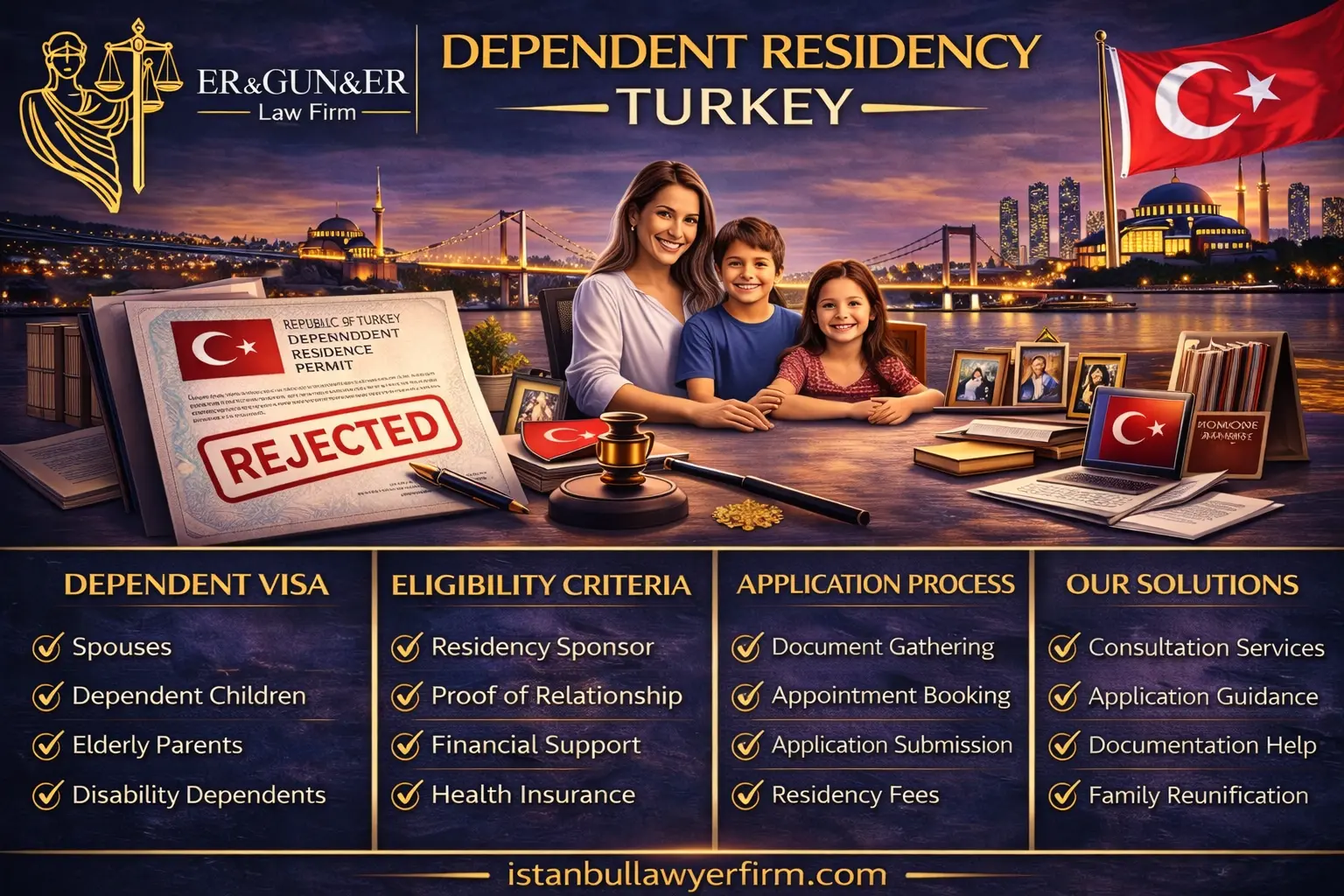
The dependent residency process Turkey is built on a relationship-and-document foundation: the dependent's right to reside in Turkey does not exist independently but derives entirely from the qualifying relationship with the sponsor, and every element of the permit application—the relationship evidence, the sponsor's status documentation, the shared address proof, and the health insurance—must be current, consistent, and authenticated to the specific standards that DGMM applies when it assesses whether the family unit qualifies for the dependent permit. A sponsor who has an eligible qualifying status—Turkish citizenship or a valid Turkish residence or work permit—and who has a properly documented qualifying family relationship with the dependent can anchor a legally sound application; but a sponsor whose own permit is in an uncertain status, whose financial sufficiency documentation is inadequate, or whose address registration does not match the declared family address creates a destabilized application that reflects adversely on all the dependent permits it is intended to support. The address registration and insurance consistency requirement is not satisfied by a one-time compliance at the application stage—it is a continuing obligation that persists throughout the permit period, and a change of address that is not reported, a health insurance policy that is allowed to lapse, or a sponsor's permit that expires without renewal each create ongoing grounds for dependent permit cancellation that must be actively managed. Timing errors are among the most preventable but most frequently encountered failures in the dependent residency process: a renewal application filed after the current permit expires, a health insurance policy that lapses before the renewal permit is issued, and an e-Ikamet appointment scheduled without accounting for waiting times at the relevant DGMM provincial directorate all create unauthorized status that accumulates daily and that has practical enforcement consequences. Dependent family members who are children present specific additional compliance challenges—age thresholds, custody documentation requirements, and the transition to independent permit status when the child reaches the applicable age—that must be planned for in advance rather than addressed reactively when the threshold is crossed. This article provides a comprehensive, practice-oriented guide to the dependent residency process Turkey as it operates in 2026, addressed to sponsors managing the immigration status of their family members, dependent family members seeking to understand their own rights and obligations, and the legal and administrative advisors who support them.
Dependent residency overview
A lawyer in Turkey advising on the dependent residency process Turkey must explain that Turkey's immigration system does not use the term "dependent visa" or "dependent permit" as a formal legal category—the relevant legal framework is the family residence permit established under the Law on Foreigners and International Protection (LFIP, Law No. 6458), accessible at Mevzuat. The family residence permit is the mechanism through which a foreign national who has a qualifying relationship with a Turkish citizen or with a foreign national holding a valid Turkish residence or work permit can obtain lawful residence status in Turkey, and it is this permit category that serves the function of dependent residence in the Turkish immigration system. The DGMM dependent residence permit Turkey administration is conducted by the Directorate General of Migration Management, accessible at goc.gov.tr, through its provincial directorates, and the specific documentary standards, processing practices, and assessment approaches vary by province. The family dependent ikamet Turkey framework covers the foreign national spouse of a Turkish citizen or qualifying resident, the dependent foreign national children of the Turkish citizen or qualifying resident, and in specific circumstances dependent foreign national parents of a Turkish citizen—each with its own documentary requirements and eligibility conditions. Practice may vary by authority and year — check current guidance on the current LFIP family permit provisions and on any recent regulatory changes that may have affected the qualifying relationship categories or the documentation requirements for dependent residence applications.
An Istanbul Law Firm advising on the dependent residency overview must help families understand the derivative character of the dependent's status: the dependent permit is not self-sustaining—it depends at every point on the continuation of the qualifying relationship and the continuation of the sponsor's qualifying status. A dependent whose sponsor's permit expires, whose sponsor dies, or whose qualifying relationship ends (divorce, child aging out) has a permit whose qualifying basis has been extinguished, and must either transition to an independent permit basis or exit Turkey—because the dependent permit cannot continue independently after its qualifying foundation is removed. This derivative character is the most important structural feature of the dependent residency process Turkey that families must understand before relying on the dependent permit as a stable residence strategy, because it means that the family's immigration stability depends on the stability of the sponsor's status and the integrity of the qualifying relationship—and any disruption to either dimension has cascading effects on all the dependent permits that depended on them. The comprehensive family residence permit Turkey framework—which is the legal basis for all dependent residence in Turkey—is analyzed in detail in the resource on family residence permit Turkey. Practice may vary by authority and year — check current guidance on the current LFIP provisions governing the continuity conditions for family and dependent permits and on the specific circumstances that require notification to DGMM about changes in the qualifying relationship or the sponsor's status.
A Turkish Law Firm advising on the dependent residency overview for a large family unit—with a sponsor, a dependent spouse, and multiple dependent children—must explain the specific coordination challenges that arise when multiple family members' permits are all filed and managed simultaneously, potentially with different expiry dates and different age-based circumstances. A family where the sponsor is a Turkish citizen and where there are a foreign national spouse and two foreign national children may have three separate pending permit applications at different stages of the e-Ikamet process simultaneously, each requiring its own documentation package, its own appointment, and its own permit card issuance. The coordination of these parallel applications—ensuring that all three are filed on time, that the documentation for each is consistent with the others, and that the appointment scheduling allows for the sponsor's participation where required—is a family immigration management challenge that benefits significantly from professional support. The immigration lawyer dependent residence Turkey practice that most effectively manages large family units approaches the compliance program as an integrated project rather than as multiple independent individual applications, because decisions made for one family member's application often affect the optimal strategy for the others. Practice may vary by authority and year — check current guidance on the current DGMM appointment and application procedures for simultaneous family member permit applications and on whether DGMM offers any family coordination mechanisms for families with multiple concurrent applications.
Who counts as dependent
A law firm in Istanbul advising on who counts as a dependent for Turkish family ikamet purposes must explain the specific categories recognized under the LFIP framework as qualifying family members for the family residence permit, because Turkish immigration law does not adopt a broad cultural or personal definition of "family" but adheres to specific legally defined relationship categories. The LFIP recognizes the foreign national spouse of a Turkish citizen or of a qualifying foreign national permit holder as a primary qualifying dependent—this is the most straightforward and most commonly pursued dependent residence category. The LFIP also recognizes dependent foreign national children of the Turkish citizen or qualifying resident—this category includes both biological and legally adopted children who satisfy the applicable age conditions established by the LFIP. The dependent adults beyond the immediate spousal and child categories—such as parents of a Turkish citizen who are foreign nationals—may be eligible for family permits in specific circumstances under the LFIP's provisions, but the specific eligibility conditions for these extended family categories require case-specific analysis. The spouse dependent residence Turkey application is the most commonly filed dependent permit type and has the most developed administrative practice; the child dependent residence permit Turkey application is the second most common and involves specific age-related complications discussed later. Practice may vary by authority and year — check current guidance on the current LFIP family member eligibility categories and on any recently recognized or excluded categories through DGMM administrative practice or legislative amendment.
The eligibility of a foreign national child as a qualifying dependent family member depends on the LFIP's specific age threshold, which defines the upper limit of "child" for family permit eligibility purposes. A child who is below the applicable age threshold at the time of application qualifies for the dependent permit; a child who reaches the age threshold during a permit period must transition to an independent permit category before the age-based family permit eligibility terminates. The LFIP establishes this threshold as a specific age defined by the law, and practice may vary by authority and year — check current guidance on the current LFIP age threshold for child family permit eligibility and on any changes to this threshold that may have been made through legislative amendment. The dependency element of child eligibility—the requirement that the child be genuinely dependent on the sponsoring parent for their care and support—is assessed alongside the age requirement, and a child who is legally a minor but who is otherwise established independently (enrolled in a foreign university, employed abroad) may face questions about their continued dependency. Practice may vary by authority and year — check current guidance on the current DGMM assessment standards for child dependency in family permit applications and on whether DGMM applies additional scrutiny to dependency claims for older children who are approaching the age threshold.
A Turkish Law Firm advising on the parent-of-Turkish-citizen dependent category must address the specific additional requirements and limitations applicable to this less common but practically important family permit scenario. A foreign national parent of a Turkish citizen—such as a foreign national mother or father whose adult child has Turkish citizenship and who wishes to reside in Turkey with their Turkish child—may be eligible for a family permit as a dependent of the Turkish citizen child, subject to the specific conditions that the LFIP and DGMM's administrative practice apply to this category. The dependency in this scenario flows in the reverse direction from the standard parent-child dependent permit: the foreign national parent is the dependent and the Turkish citizen adult child is the sponsor, which creates a specific documentation challenge because the parent must demonstrate their genuine dependency on the Turkish citizen child rather than the child's dependency on the parent. Financial dependency—the parent's reliance on the Turkish citizen child for financial support—and care dependency—the parent's need for personal care that the Turkish citizen child provides—are the most commonly documented bases for the parent's dependency claim. Practice may vary by authority and year — check current guidance on the current LFIP and DGMM standards for the foreign national parent-of-Turkish-citizen family permit category and on the specific dependency evidence currently required and accepted by DGMM for this category.
Sponsor eligibility basics
An English speaking lawyer in Turkey advising on sponsor requirements dependent residence Turkey must explain that the sponsor's qualifying status—Turkish citizenship or a valid Turkish residence or work permit—is the foundational condition for the dependent permit application, and that any uncertainty about the sponsor's qualifying status must be resolved before the dependent permit application is filed. A Turkish citizen sponsor's eligibility is established through their Turkish National Identity Card (T.C. Kimlik Kartı), and the citizenship itself provides the qualifying basis without requiring any additional immigration status proof. A foreign national sponsor—one who is themselves in Turkey on a valid residence or work permit—must demonstrate not only their identity but the current validity, type, and sufficient remaining duration of their own Turkish permit, because the dependent permit's maximum duration is capped by the sponsor's permit duration and a sponsor whose permit has only weeks of remaining validity creates a problematic dependent application timeline. The financial sufficiency obligation—the sponsor's duty to demonstrate adequate income or resources to support the dependent family member without requiring Turkish public assistance—is assessed at the application stage and must be documented through evidence meeting DGMM's current standards for the specific permit category and the number of dependents being sponsored. Practice may vary by authority and year — check current guidance on the current financial sufficiency documentation standards and minimum thresholds applicable to dependent residence sponsors at the specific DGMM provincial directorate where the application will be filed.
The sponsor's ongoing obligations after the dependent permit is issued extend beyond the application stage—the sponsor bears a continuing responsibility for the accuracy of the information provided in the application, for maintaining the shared address registration, for ensuring the dependent's health insurance continuity, and for notifying DGMM of significant changes in the qualifying relationship (divorce, child aging out, sponsor's departure from Turkey). A Turkish citizen sponsor who is not actively managing these ongoing obligations—who has forgotten that the dependent's permit renewal is approaching, who has allowed the health insurance to lapse, or who has changed address without updating the dependent's permit records—is creating grounds for the dependent's permit cancellation that were entirely preventable through basic administrative management. The Turkish citizen sponsor who is also managing their own immigration needs—such as a naturalized Turkish citizen who may have some historical immigration complexity—must coordinate their own administrative situation with the dependent permit management to ensure that no conflicts between their own status and the dependent permit's conditions arise. The sponsor requirements dependent residence Turkey framework, including the specific financial and administrative obligations that persist throughout the permit period, are a topic that should be addressed explicitly in the pre-application legal consultation so that the sponsor understands what they are committing to. Practice may vary by authority and year — check current guidance on the current ongoing sponsor obligations for dependent family permit holders and on the specific notification requirements applicable when the qualifying relationship or the sponsor's own status changes.
A law firm in Istanbul advising on the specific complications that arise when the sponsor is a foreign national with a work permit—rather than a Turkish citizen—must address the additional documentation layer required for this sponsor category. A work permit holder sponsoring a dependent family member must demonstrate: their own work permit's validity and current status; the employer's current active status (a work permit holder whose employer is no longer operating creates questions about the permit's continuation); financial sufficiency at a level sufficient to support both themselves and the dependent through the requested permit period; and the family relationship documentation between themselves and the dependent. The work permit holder's own permit duration caps the dependent's permit duration, which means that if the work permit is being renewed and there is uncertainty about the renewal's success, the dependent permit application should be coordinated with the work permit renewal timeline rather than filed independently. A dependent whose sponsor's work permit is refused at renewal faces an immediate loss of the qualifying basis for their own family permit—a compound immigration problem that must be managed simultaneously on both the work permit and the dependent permit tracks. Practice may vary by authority and year — check current guidance on the current DGMM practices for work permit holder sponsors and on the specific additional documentation required for work permit holder sponsors relative to Turkish citizen sponsors.
Relationship evidence standards
A Turkish Law Firm advising on relationship evidence standards for dependent residence applications must explain that the specific documentary proof required differs by the type of qualifying relationship—marriage, birth parent-child, adoption, legal dependency—and that each category has both the underlying relationship document requirements and the specific authentication requirements that must be satisfied before DGMM will accept the document as evidence. For the spouse dependent residence Turkey application, the primary relationship document is the marriage certificate—an official civil marriage document issued by the competent authority in the country where the marriage was registered. A marriage certificate issued in a foreign country must be apostilled under the Hague Apostille Convention (for marriages from countries that are Convention parties) or consularly legalized (for marriages from non-Convention countries), and then certified-translated into Turkish by a sworn translator recognized under Turkish notarial standards. The authentication chain must be complete—the apostille must be on the underlying certificate or on a certified copy issued by the official civil registry of the marriage country, and the certified Turkish translation must cover both the underlying certificate text and the apostille text. Practice may vary by authority and year — check current guidance on the current DGMM authentication chain requirements for marriage certificates from specific countries and on whether any simplified authentication procedures are currently available for marriages from specific countries with which Turkey has bilateral agreements.
The DGMM assessment of the spousal relationship does not end with the formal authentication of the marriage certificate—it also includes a credibility assessment of whether the marriage is genuine rather than a sham marriage entered into for immigration purposes. The LFIP and DGMM's administrative practice provide for refusal of family permits where the marriage appears to be a marriage of convenience rather than a genuine family relationship, and the evidence that most effectively supports the genuineness of the marriage includes: the duration of the relationship before the marriage (documented through photographs, correspondence, or travel records); evidence of shared life and cohabitation at a shared address; joint financial activity; children of the marriage; and any other evidence that demonstrates the marital relationship's substantive character. A recently contracted marriage between parties who have little documented history of prior relationship and who cannot produce evidence of a shared life beyond the marriage certificate itself presents a higher credibility challenge than a marriage between parties with a documented prior relationship and an established pattern of shared life. Practice may vary by authority and year — check current guidance on the current DGMM credibility assessment standards for spousal relationship evidence in dependent permit applications and on any specific additional evidence that DGMM currently requests where the marriage's genuineness is in question.
An English speaking lawyer in Turkey advising on the relationship evidence for a civil partnership or registered partnership—where the dependent's relationship with the sponsor is a legally recognized non-marital partnership under the law of a foreign country—must address the specific challenge that arises because Turkish law does not recognize civil partnerships or non-marital registered partnerships as a qualifying basis for the family residence permit. The family permit framework under the LFIP is predicated on a legally recognized marriage under Turkish private international law—a non-marital partnership, even one that is legally equivalent to marriage under the law of the foreign country where it was registered, does not satisfy the marital relationship requirement. A foreign national whose relationship with their Turkish citizen partner is characterized as a civil partnership or cohabiting relationship in the legal terms of their home country, rather than as a marriage, does not qualify for the dependent family permit on the basis of that relationship status and must pursue a different permit category—typically the short-term permit based on an independent qualifying purpose. Practice may vary by authority and year — check current guidance on the current Turkish private international law standards for recognizing foreign marriage equivalents and on any recent developments affecting the eligibility of non-marital relationship statuses for family permit purposes under Turkish immigration law.
Children documentation rules
A best lawyer in Turkey advising on children documentation rules for the child dependent residence permit Turkey application must explain the specific documents required to establish both the parent-child relationship and the child's eligibility for the dependent permit, because the documentation chain for a child applicant differs from the spousal documentation chain in both the underlying document type and the specific authentication requirements. The primary document for establishing the parent-child relationship is the child's birth certificate—the official civil birth registration document issued by the competent authority in the child's birth country—and this document must be apostilled and certified-translated into Turkish using the same authentication chain applicable to the marriage certificate. The birth certificate must specifically identify the sponsoring parent as the child's parent in the civil record—a birth certificate that does not show the sponsoring parent's name (for example, one that shows only the name of the non-sponsoring parent) does not establish the required relationship between the child and the sponsor and must be supplemented by additional documentation establishing the full parentage. Practice may vary by authority and year — check current guidance on the current DGMM standards for birth certificate content and authentication requirements for child dependent permit applications from specific countries.
The child dependent residence permit Turkey application for an adopted child requires documentation of the legal adoption in addition to the birth certificate—specifically, the adoption decree or equivalent legal document establishing the adoptive parent-child relationship under the applicable law, also apostilled and certified-translated. Turkish private international law generally recognizes foreign adoptions that are valid under the law of the country where the adoption was granted, subject to the condition that the adoption does not conflict with Turkish public policy, and DGMM assesses adopted children's permit applications within this recognition framework. An adoption that was granted through a legal process in a recognized foreign jurisdiction—with a formal court or administrative order—is treated differently from an informal family arrangement that is described as an adoption but that does not have formal legal recognition in any jurisdiction. The documentation of a formal foreign adoption for DGMM purposes requires the adoption decree to be presented in the same apostilled and translated form as other official documents, and the adoption decree should specifically show the adoptive relationship between the child and the sponsoring parent. Practice may vary by authority and year — check current guidance on the current Turkish private international law standards for recognizing specific types of foreign adoptions and on the DGMM documentation requirements for adopted child dependent permit applications.
A Turkish Law Firm advising on the custody documentation requirements for a child dependent whose parents are separated or divorced must address the specific complications that arise when the child's family situation is not the standard intact-family model. A child whose parents are divorced and who seeks a dependent permit based on the Turkish citizen parent's sponsorship must provide documentation establishing not only the parent-child relationship but also that the Turkish citizen parent has legal authority to act as the sponsoring parent for the child's permit application—which in a custody dispute context may require the custody order or parenting agreement that allocates custody and parental decision-making authority to the sponsoring parent. A child who lives with both parents across different countries—spending part of the year in Turkey with the Turkish citizen parent and part of the year in another country with the other parent—has a permit situation that requires specific management to ensure that the child's Turkish permit covers the periods of Turkish residence. The child custody and divorce documentation intersections with dependent permit applications are further addressed in the resource on child custody in Turkish divorce. Practice may vary by authority and year — check current guidance on the current DGMM requirements for custody documentation in child dependent permit applications where the child's parents are separated or in contested custody proceedings.
Dependent adults and care
A law firm in Istanbul advising on the dependent adult category—foreign national adults other than spouses who seek resident status in Turkey based on their dependency on a Turkish citizen or qualifying resident—must explain that this is the most legally nuanced and least administratively developed category in the Turkish dependent residence framework. The LFIP's family permit provisions primarily address spouses and children, and the extension of family permit eligibility to adult dependents such as parents, adult siblings, or other family members who are genuinely dependent on the sponsor requires a case-by-case assessment under the LFIP's general provisions rather than the application of a clearly defined standard for each relationship type. A foreign national parent who is elderly or disabled and who is genuinely dependent on their Turkish citizen adult child for financial support and personal care presents the most commonly encountered dependent adult case, and the documentation of both the parental relationship and the genuine dependency is the central challenge in these applications. Practice may vary by authority and year — check current guidance on the current DGMM assessment standards for dependent adult family member applications and on the specific relationship categories and dependency types that DGMM currently treats as qualifying for the family permit framework.
The documentation of genuine dependency for an adult dependent requires evidence that goes beyond the formal relationship document—it requires evidence that the adult dependent's financial or care needs are genuinely being met by the Turkish citizen or resident sponsor, and that the dependency is real rather than nominal. For a financially dependent adult parent, the documentation typically includes evidence of the parent's own limited financial resources (pension income statements, bank account records showing limited independent means) alongside evidence of the Turkish citizen child's financial support transfers (bank transfer records, regular remittances, shared household evidence). For a care-dependent adult—one who needs personal care due to disability, illness, or advanced age—the documentation typically includes medical or professional care assessments that describe the care needs and evidence that the Turkish citizen child provides or organizes the required care in Turkey. The genuineness of the dependency claim is assessed by DGMM in the same credibility framework as the genuineness of spousal relationships—a nominal dependency claim that is not supported by specific, contemporaneous evidence of actual financial or care need and actual provision by the sponsor will be assessed critically. Practice may vary by authority and year — check current guidance on the current DGMM documentation requirements for financial and care dependency claims in adult dependent family permit applications and on the specific evidence types that DGMM currently considers most persuasive for each dependency basis.
An English speaking lawyer in Turkey advising on the adult dependent's rights during the permit period must explain that the dependent adult permit holder, like the dependent child and spouse, holds a derivative status that depends on the continuation of the qualifying dependency relationship and the sponsor's qualifying status. An adult dependent whose care needs change—for example, a parent who partially recovers from an illness and becomes less dependent on the sponsoring child—may face questions at renewal about whether the dependency that justified the original permit still exists at the renewal stage. An adult dependent whose sponsor's status changes—for example, if the Turkish citizen child emigrates from Turkey or if the sponsor loses their own qualifying status—faces the same derivative status vulnerability as any other family permit holder. The adult dependent who has been residing in Turkey on a family permit for an extended period and who wishes to transition to an independent residence basis—when they have accumulated qualifying residence time toward the long-term permit threshold—must ensure that their accumulated family permit time counts toward the eight-year threshold. Practice may vary by authority and year — check current guidance on the current LFIP provisions governing the continuation conditions for adult dependent family permits and on the specific changes in circumstances that require notification to DGMM or that trigger permit cancellation.
Address and cohabitation proof
A best lawyer in Turkey advising on address registration dependent residence Turkey requirements must explain that the address documentation obligation for dependent permits is one of the most frequently mismanaged compliance areas in the family immigration space—both because applicants underestimate the specific standards required and because the practical management of the address documentation across multiple family members creates coordination challenges. The Turkish law requires that the dependent family member be registered at the same address as the sponsor, and the address documentation for the dependent permit application must be a notarized lease agreement or property title deed in either the sponsor's name or the dependent's name that covers the shared residential address. A household where the sponsor is a Turkish citizen with a property title at one address and the dependent is residing at a rental property at a different address presents an address documentation challenge that requires specific management—either the dependent must be registered at the Turkish citizen's property address, or the Turkish citizen must be documented as residing at the rental property address, or there must be a clear and documented explanation for why the family members are at different addresses. Practice may vary by authority and year — check current guidance on the current DGMM address documentation requirements for dependent permit applications and on whether DGMM currently accepts any specific explanations for temporary address separations within a family unit.
The cohabitation expectation embedded in the dependent permit framework—the implicit requirement that the sponsor and the dependent reside together at the shared address—is assessed by DGMM both at the application stage and at renewal, and evidence that the sponsor and dependent are not genuinely living together at the declared address creates a ground for permit refusal or cancellation. A dependent child who attends a boarding school during the academic year while maintaining the family address as their primary registered residence is in a different situation from a dependent spouse who is living at a completely different address from the sponsor. A dependent spouse who declares the family's Istanbul apartment as the permit address but who is spending extended periods at a different location outside Turkey faces questions about whether the permit address is genuinely the primary residence. The address registration dependent residence Turkey obligation includes both the DGMM permit records and the civil registry address registration system (AKS), and both must reflect the same current address for all family members simultaneously. Practice may vary by authority and year — check current guidance on the current DGMM and civil registry standards for address cohabitation assessment in family permit applications and on the specific circumstances in which DGMM requires additional documentation to verify shared family residence.
A Turkish Law Firm advising on the specific document preparation for address proof must explain that the notarized lease requirement—the requirement that the rental agreement be authenticated by a Turkish notary public rather than being an informal landlord-tenant agreement—is consistently the most commonly misunderstood address documentation requirement among first-time applicants. An informal lease agreement that accurately describes the rental arrangement and that has been in effect for years is not accepted as address documentation unless it has been notarially authenticated, and a landlord who is reluctant to submit the lease to notarial authentication creates a specific practical obstacle for the tenant-applicant that must be addressed before the permit application can be prepared. Where the property is owned by the sponsor or the dependent, the title deed serves as address documentation and does not require notarial authentication because it is itself an official governmental document. The coordination of the address documentation across multiple family members' applications must ensure that all applications declare the same address and that the same notarized lease or title deed covers all family members. Practice may vary by authority and year — check current guidance on the current DGMM notarized lease documentation standards and on whether any alternative address documentation formats are currently accepted for dependent permit applications in specific provincial directorates.
Insurance and coverage basics
A Turkish Law Firm advising on health insurance dependent residence Turkey requirements must explain that health insurance coverage is a mandatory condition for every dependent family permit applicant—the permit will be refused without adequate health insurance documentation—and that the insurance must cover each dependent individually rather than being a blanket family policy that DGMM accepts as covering all family members without individual identification. The health insurance for a dependent permit applicant can be satisfied through a private Turkish health insurance policy in the dependent's own name, through registration as a dependent on the Turkish citizen sponsor's social security (SGK) coverage where the sponsor is an SGK-enrolled employee or citizen, or through other coverage mechanisms currently accepted by DGMM for the specific permit category. The SGK dependent registration route—where a foreign national spouse or child is formally enrolled as a dependent of an SGK-active Turkish citizen—is often the most cost-effective and most comprehensive coverage mechanism, because Turkish social security provides access to the full public health system rather than only the private insurer network, and because the SGK enrollment is administratively stable rather than requiring annual insurance policy renewals. Practice may vary by authority and year — check current guidance on the current SGK dependent enrollment procedures for foreign national family members of Turkish citizens and on the specific documentation required to register a foreign national dependent for SGK coverage.
The private health insurance route for dependent permit applicants requires careful selection of an insurance product that meets DGMM's current acceptance standards—the specific coverage minimums, the specific insurer licensing requirements, and the specific policy format requirements that DGMM applies when assessing whether a submitted insurance certificate satisfies the permit condition. A family with multiple dependent applicants needs to purchase individual policies for each dependent (or ensure that each dependent is individually listed and covered in a family policy) because DGMM assesses the insurance for each applicant individually. The policy duration must cover the full duration of the requested permit period—a policy that expires before the permit would expire creates a coverage gap that is a refusal ground or a partial-permit ground depending on the provincial directorate's current practice. The most reliable approach for a family managing multiple dependent permits is to align all insurance policy renewal dates and all permit renewal dates in the same calendar cycle, so that the insurance renewals and permit renewals are managed as a single coordinated administrative event rather than as multiple independent deadlines at different points in the year. Practice may vary by authority and year — check current guidance on the current DGMM insurance acceptance standards for dependent permit applications and on the specific insurer products currently accepted for family permit purposes in the relevant DGMM provincial directorate.
An English speaking lawyer in Turkey advising on the specific insurance challenge for a dependent child must address the requirement that the child's insurance be in the child's own name or that the child be specifically identified as a covered dependent in the family policy—a requirement that some international insurance products do not readily accommodate because they are structured around a policyholder and general household coverage rather than individually identified dependents. A child under a certain age may be covered automatically under a parent's policy in their home country's insurance framework, but this automatic coverage structure may not produce the individually named insurance certificate that DGMM requires for the child's permit application. A family using a Turkish-issued health insurance product should verify with the insurer before purchase that the policy will produce individual insurance certificates for each covered family member in the format required for DGMM permit purposes. The health insurance family residence permit Turkey dimension and the specific coverage requirements for family permit applications are further addressed in the resource on family residence permit Turkey. Practice may vary by authority and year — check current guidance on the current DGMM requirements for child insurance evidence in dependent permit applications and on the specific certificate formats currently accepted for documenting child insurance coverage.
e-Ikamet workflow control
A law firm in Istanbul advising on the e-ikamet dependent residence application Turkey workflow must explain that each dependent family member's permit application must be submitted as a separate e-Ikamet application through the DGMM's official online portal at e-ikamet.goc.gov.tr—there is no family unit application mechanism that allows a single submission for multiple family members. The e-Ikamet application for a dependent begins with the applicant (or the person managing the application on their behalf, under an appropriate authorization) creating an account, selecting the family residence permit as the permit type, entering the sponsor's identification information for the system to verify the sponsor's qualifying status, completing the personal information for the dependent, uploading the required supporting documents, and scheduling an appointment at the DGMM provincial directorate responsible for the declared Turkish address. The sponsor identification input step—where the sponsor's Turkish identity number (for a Turkish citizen) or foreign identity number (for a foreign national permit holder) is entered—is a critical data entry that must be accurate because the system uses this to verify the sponsor's status and to link the dependent's application to the sponsor's record. An error in the sponsor's identity number input—a transposition of digits, a use of an older identity number rather than the current one—can prevent the application from progressing and must be corrected before the appointment can be scheduled. Practice may vary by authority and year — check current guidance on the current e-Ikamet portal procedures for family permit applications and on any recent changes to the application form fields or the sponsor verification process that may affect dependent permit submissions.
The document upload step of the e-Ikamet application for a dependent permit requires specific attention to ensuring that each required document for the specific permit sub-type is uploaded—the document checklist for a spouse dependent permit differs from the checklist for a child dependent permit, and selecting the correct permit type and declaring the correct qualifying relationship triggers the appropriate checklist. The marriage certificate (apostilled and translated) is required for a spouse application; the birth certificate (apostilled and translated) is required for a child application; and the dependency documentation (financial records, medical documentation) is required for an adult dependent application. Each uploaded document must be in the accepted file format and within the file size limit specified by the portal, and poor-quality scan images that are difficult to read create appointment-stage problems even if the underlying documents are properly authenticated. The insurance certificate must show clearly that coverage begins no later than the permit start date and extends through the full requested permit period; a certificate that shows coverage beginning after the application date or expiring before the permit would expire will create a coverage gap issue at the appointment. Practice may vary by authority and year — check current guidance on the current e-Ikamet portal document upload technical specifications and on the specific documentation checklist for each category of dependent permit application.
A best lawyer in Turkey advising on the appointment scheduling coordination for a family with multiple dependent applications must explain the specific timing considerations that apply when multiple family members' appointments must be arranged in a sequence or simultaneously. Where the sponsor's in-person attendance is required at the dependent's appointment—or where the sponsor's participation would significantly strengthen the application's credibility assessment—the appointment scheduling must account for the sponsor's availability as well as the DGMM directorate's appointment availability. In the Istanbul DGMM directorate, where appointment waiting periods can be significant due to the volume of applications, the family must plan the appointment scheduling sufficiently in advance of any permit expiry dates to ensure that all appointments can be obtained within the available window. A family where the dependent's current permit expires before an appointment can be obtained faces unauthorized status accumulation that begins from the permit's expiry date—making early appointment scheduling as urgent as the document preparation phase of the application. Practice may vary by authority and year — check current guidance on the current appointment waiting times at the specific DGMM provincial directorate where the applications will be filed and on any priority appointment mechanisms that may be available for specific family circumstances such as children's school enrollment or medical necessity.
Appointment and biometrics
An English speaking lawyer in Turkey advising on the appointment and biometrics process for dependent permit applicants must help families understand what to expect at the DGMM provincial directorate appointment and how to prepare for the most productive possible appointment outcome. The appointment involves the DGMM officer reviewing the original documents submitted by the dependent (verifying that they match the digital uploads in the e-Ikamet system), collecting the dependent's biometric data (fingerprints and photograph for the permit card database), and making a preliminary assessment of the application's completeness and compliance. For minor children—those below a specific age—the biometric collection procedure may differ from the adult procedure; practice may vary by authority and year — check current guidance on the current DGMM biometric collection requirements for minor children and on whether parental presence and consent documentation is required for a minor child's biometric collection. The dependent's original documents must be presented at the appointment in the order of the e-Ikamet portal's document checklist, with the apostilled and translated relationship documentation (marriage certificate or birth certificate) clearly identified and prominently presented as the foundational evidence for the application. Practice may vary by authority and year — check current guidance on the current DGMM appointment procedures for dependent permit applicants and on whether specific additional documentation categories are currently requested at the appointment level for dependent permit applications from specific nationality groups.
A Turkish Law Firm advising on the sponsor's role at the dependent's DGMM appointment must address the question of whether the sponsor must be present in person at the dependent's appointment—a question that is answered differently by different DGMM provincial directorates and at different periods. Some provincial directorates currently require the Turkish citizen sponsor to attend the dependent's appointment to verify the sponsorship, present their own identity documents, and answer questions about the family's circumstances; others accept the sponsor's documents as part of the dependent's file without requiring physical presence. The appointment preparation must account for whichever requirement currently applies at the specific directorate, and the immigration lawyer managing the application will confirm the current requirement before scheduling the appointment. Where the sponsor's presence is required, the appointment scheduling must accommodate the sponsor's availability, which creates additional coordination complexity in families where the sponsor has work obligations or travel schedules that conflict with available appointment times. Practice may vary by authority and year — check current guidance on the current sponsor presence requirement at dependent permit appointments at the specific DGMM provincial directorate where the application is being filed and on any alternative procedures for satisfying the sponsor verification requirement where the sponsor cannot attend in person.
The permit card issuance after the appointment—the physical plastic ikamet card issued to each dependent family member—typically occurs through postal delivery to the registered Turkish address rather than through in-person collection at the directorate. Each family member receives a separate permit card, and each card is delivered separately to the registered address. A household with multiple dependent family members whose permit cards are being issued at the same time must ensure that the registered address is reliably monitored for mail delivery during the card issuance period—a missed delivery that results in a card being returned to DGMM requires a specific administrative procedure to arrange redelivery. The permit card is the document that the dependent must carry as evidence of their lawful status in Turkey, and the absence of the physical card—even where the permit has been granted—creates practical complications in banking, school enrollment, and other administrative processes that require presentation of the permit card. Practice may vary by authority and year — check current guidance on the current DGMM permit card delivery procedures and on the specific administrative steps required to recover a card that was not successfully delivered to the registered address.
Renewal and timing strategy
A law firm in Istanbul advising on dependent residence renewal Turkey strategy must explain that the renewal of dependent permits is a multi-dimensional compliance exercise that requires simultaneous management of the permit renewal, the insurance renewal, the address documentation currency, and the sponsor's status confirmation—all within the renewal window that must be satisfied before the current permits expire. The renewal application must be filed within the applicable window before the current permit's expiry date, and practice may vary by authority and year — check current guidance on the current DGMM renewal window requirements for family permits in the specific province where the application will be filed. A renewal application for multiple family members—where the sponsor has a dependent spouse and two children, for example—must coordinate three separate e-Ikamet submissions, three separate appointment slots, and three separate document packages, all of which must be submitted within the relevant window before the applicable expiry dates. The coordination challenge of managing multiple simultaneous renewal submissions is a practical argument for engaging the immigration lawyer dependent residence Turkey practice well in advance of the renewal window, because the preparation time for a complete and coordinated family renewal is significantly longer than for a single individual renewal. Practice may vary by authority and year — check current guidance on the current DGMM appointment availability and processing timelines for family renewal applications and on whether family units can request coordinated appointment times for multiple simultaneous renewal submissions.
The specific timing risk for dependent permit renewals arises from the permit-insurance alignment requirement: the health insurance coverage must be continuous from the expiry of the current permit through the issuance of the new permit, and a gap in insurance coverage during the processing period creates both an insurance compliance issue and a period of uninsured health risk. A family that allows its health insurance policies to expire in anticipation of the renewal permit being issued promptly—without accounting for the processing time between the renewal appointment and the card issuance—creates an uninsured gap that may also affect the renewal permit's insurance compliance assessment if the gap is detected at the renewal review. The most reliable approach is to renew the insurance policies to cover the full next permit period requested, starting from the current permit's expiry date, before the renewal application is filed—so that the renewal application's insurance documentation already shows continuous coverage rather than creating a gap during processing. The renewal timing strategy for dependent permits must also account for the child-aging-out risk: a child who will reach the applicable age threshold during the next permit period must have a transition plan—to a student permit, a short-term permit, or another independent category—that is implemented before the age threshold is crossed and before the family permit eligibility terminates. Practice may vary by authority and year — check current guidance on the current LFIP age threshold for child family permit eligibility and on the specific transition procedures available for children approaching the age threshold.
An English speaking lawyer in Turkey advising on the long-term renewal strategy for a dependent family unit must help the sponsor and the dependents understand the relationship between the current permit management and the longer-term immigration objectives—particularly the accumulation of qualifying residence toward the eight-year long-term permit threshold that would eventually provide independent and more stable residence status for each family member. A foreign national spouse who has held family permits continuously for a qualifying period may become eligible for a short-term permit in their own right, creating an independent residence basis that is not contingent on the continuation of the marriage—a transition right that is particularly important for spouses in difficult family situations. A foreign national who has been in Turkey on family permits across multiple years and who approaches the eight-year threshold for long-term permit eligibility should plan the transition to the long-term permit application with appropriate preparation time, because the long-term permit documentation—establishing the complete history of eight years of lawful uninterrupted residence—requires comprehensive record assembly that must begin before the application deadline. Practice may vary by authority and year — check current guidance on the current DGMM calculation methodology for the eight-year long-term permit qualifying period and on whether family permit years are counted in the same way as other permit categories toward the long-term permit threshold.
Transition to other permits
A Turkish Law Firm advising on the transition from dependent permit to work permit Turkey must explain that a dependent family permit holder who wishes to work in Turkey requires a separate work permit—the family permit does not itself authorize employment—and that the work permit application process is separate from and independent of the family permit system. The work permit is issued by the Ministry of Labor and Social Security through an employer-sponsored application process, and the employer must apply on behalf of the foreign employee through the Ministry's electronic system, meeting the specific conditions applicable to foreign worker employment in Turkey. A dependent spouse who finds a Turkish employer willing to sponsor their work permit can apply for the work permit while maintaining the family permit status—the family permit continues to provide residence authorization during the work permit application period, and upon grant of the work permit the foreign employee's residence is typically addressed through the work permit holder status rather than the separate family permit. The transition from family dependent permit to independent work permit represents an important step toward legal and practical independence from the sponsoring family member's status. Practice may vary by authority and year — check current guidance on the current Ministry of Labor work permit application procedures and on the specific eligibility conditions applicable to foreign national family permit holders who wish to obtain a Turkish work permit.
The transition from the dependent family permit to an independent short-term permit is an important option for foreign national spouses who have held a family permit for the qualifying period established by the LFIP—creating an independent residence basis that is not contingent on the continuation of the marriage. The specific qualifying period required for this transition right and the specific documentation required to exercise it must be verified from current LFIP and DGMM guidance; practice may vary by authority and year — check current guidance on the current LFIP provisions governing the transition from family permit to independent short-term permit for foreign national spouses of Turkish citizens and on the specific qualifying period and documentary requirements currently applicable. An Istanbul Law Firm advising on the transition strategy will typically recommend that the foreign national spouse begin planning the transition well before the qualifying period is reached—ensuring that the required period of continuous family permit holding has been maintained without gaps, that the relevant documentation is assembled, and that the transition application is prepared in advance so it can be filed promptly when the qualifying condition is satisfied. Practice may vary by authority and year — check current guidance on the current transition application procedures and on whether the transition to an independent short-term permit requires the filing of a new e-Ikamet application or can be processed through an administrative notification to DGMM.
A law firm in Istanbul advising on the transition for a child dependent who is approaching the age threshold must explain the specific permit transition options available for a young adult who is aging out of the child family permit category. The most common transition for a child who reaches the family permit age threshold and who is enrolled in a Turkish educational institution is to the student permit category—the enrollment in a Turkish university, language school, or other qualifying program provides the basis for a student permit that continues the child's lawful Turkish residence independently of the family permit. A young adult who is not enrolled in a Turkish educational institution and who does not have another qualifying purpose for an independent permit faces a more challenging transition—they must either identify a qualifying purpose for a short-term permit (property ownership, business connections, or another LFIP-recognized purpose) or exit Turkey. The transition planning must begin before the age threshold is reached, because the transition application must be filed and an appointment scheduled before the family permit's age-based eligibility terminates, and waiting until after the age threshold is crossed creates a gap in lawful status. Practice may vary by authority and year — check current guidance on the current permit transition options for children aging out of the family permit category and on the specific documentation required for each available transition type.
Refusal and cancellation risks
An English speaking lawyer in Turkey advising on dependent residence refusal Turkey risks must explain the specific refusal grounds that most commonly affect dependent permit applications and how each can be identified and addressed before the application is filed. The most common refusal grounds for dependent permit applications include: document authentication failures (apostille missing, translation not certified by sworn translator, marriage certificate not from the official civil registry); address documentation deficiency (no notarized lease, expired lease, address inconsistency between application and documentation); insurance non-compliance (policy not covering the full requested period, insurer not accepted by DGMM, child not specifically covered); sponsor status issues (sponsor's own permit expired or in an uncertain status, financial sufficiency not demonstrated); and relationship genuineness concerns (marriage of convenience finding, insufficient evidence of shared family life). Each refusal ground requires a specific corrective action rather than a general improvement of the application, and the refusal notification document must be carefully analyzed to identify which specific ground applies before any response strategy is developed. Practice may vary by authority and year — check current guidance on the current DGMM refusal ground standards for dependent permit applications and on the specific evidence most effective for preemptively addressing each potential refusal ground before submission.
The dependent residence cancellation Turkey risk—where a valid permit is cancelled before its stated expiry—arises primarily from changes in the qualifying circumstances that undermine the permit's continuing validity. The most common dependent permit cancellation grounds include: termination of the underlying family relationship (divorce terminating the spousal dependent basis, child reaching the age threshold, death of the sponsor); the sponsor's loss of qualifying status (sponsor's own permit cancelled or expired without renewal); DGMM's determination that the family relationship was a sham (a post-issuance finding that the marriage was a marriage of convenience); the dependent's extended absence from Turkey beyond the applicable limits; and the dependent's or sponsor's adverse security record. A cancellation that is based on divorce—the most commonly encountered family relationship termination—does not operate automatically but requires DGMM to issue a formal cancellation decision after being notified of the divorce, and a foreign national spouse who has been divorced but who has not yet received a formal permit cancellation decision is in an ambiguous status that should be resolved through proactive DGMM engagement rather than passive waiting. The residence permit rejection Turkey broader framework—including the specific procedures for challenging cancellation decisions—is analyzed in the resource on residence permit rejection Turkey. Practice may vary by authority and year — check current guidance on the current DGMM cancellation procedures and notification requirements for different categories of dependent permit cancellation grounds.
A Turkish Law Firm advising on the protective provisions for dependent permit holders facing domestic violence or difficult family situations must explain that the LFIP includes specific protections for family permit holders who would otherwise lose their permit basis through divorce resulting from domestic violence. These protective provisions—which are designed to prevent the immigration status leverage that an abusive spouse might otherwise have over a foreign national partner—allow a foreign national family permit holder who is a victim of domestic violence to seek alternative permit status or to maintain some form of lawful status protection while the domestic situation is being addressed through legal proceedings. The specific conditions for invoking these protections and the specific status options available require legal advice from a practitioner with experience in both immigration law and the domestic violence response framework, because the intersection of immigration enforcement and family protection creates a complex environment that requires coordinated legal support. Practice may vary by authority and year — check current guidance on the current LFIP provisions applicable to family permit holders in domestic violence situations and on the specific DGMM and family court procedures available for protecting dependent permit holders who cannot maintain the qualifying family relationship due to domestic violence.
Overstay and entry bans
A best lawyer in Turkey advising on overstay risk dependent residence Turkey must explain that the overstay risk for dependent permit holders arises most commonly from three sources: the failure to file the renewal application before the current permit expires; the cancellation of the permit during its validity period; and the failure to transition to a new permit category before a qualifying condition terminates (such as a child reaching the age threshold). In each case, the unauthorized status begins on a specific date—the day after the permit's expiry, the date of the cancellation decision, or the date the age threshold is crossed—and the unauthorized status accumulates daily from that date, generating fines at the eventual departure and potentially generating entry bans that affect the person's ability to return to Turkey. A dependent family member who has been living in Turkey for years, who has established their life there, and who accumulates unauthorized status through a renewal failure is in a worse practical position than one who has recently arrived—because the established life creates stronger ties that make the departure more disruptive and the potential entry ban more damaging. The comprehensive overstay law Turkey analysis and the specific consequences of each unauthorized status duration are provided in the resource on overstay law Turkey. Practice may vary by authority and year — check current guidance on the current DGMM and border control enforcement policies for overstay situations involving dependent family permit holders.
The entry ban dimension of dependent permit overstay is particularly significant for foreign national spouses and parents of Turkish citizens—because an entry ban that prevents them from entering Turkey creates a family separation that affects not only the banned individual but the Turkish citizen family members who remain in Turkey. A foreign national spouse who exits Turkey with accumulated overstay and who receives an entry ban upon departure is separated from their Turkish citizen spouse and any Turkish citizen children for the duration of the ban, creating a family life disruption that the European Convention on Human Rights Article 8 (right to family life) may be relevant to challenging alongside the Turkish administrative law challenge. The border entry problems Turkey framework—including the specific consequences of departing with unauthorized status and the implications for future re-entry—is analyzed in the resource on border entry problems Turkey. A dependent family permit holder who is facing an overstay situation and who is aware of it before departing Turkey should seek legal advice before any departure, because the management of the departure—including the payment of applicable fines and the engagement with any entry ban proceedings—can significantly affect the long-term outcome of the immigration situation. Practice may vary by authority and year — check current guidance on the current Turkish border control policies for processing overstay situations involving dependent family permit holders and on any specific mitigation options available for persons with close Turkish citizen family ties.
An English speaking lawyer in Turkey advising on proactive overstay prevention for a large family unit must emphasize that the calendar management approach—tracking all permit expiry dates, insurance renewal dates, and applicable compliance deadlines for all family members simultaneously—is the most reliable overstay prevention tool available. A family where the sponsor tracks only their own permit renewal but not the dependent family members' permits creates a specific risk that one or more dependent permits will expire without timely renewal while the sponsor's permit is current. The practical management of multiple family members' permit deadlines benefits from a unified family immigration calendar that shows every permit's expiry date, every insurance policy's expiry date, and every filing deadline for the upcoming renewal period, maintained and reviewed regularly by the person responsible for the family's immigration compliance. An Istanbul Law Firm providing ongoing immigration compliance management for a family client will maintain this calendar and provide advance alerts for each approaching deadline as a standard service, ensuring that no compliance obligation is missed through simple administrative oversight. Practice may vary by authority and year — check current guidance on the current applicable renewal filing windows for dependent permits and on any changes to the advance filing requirements that might affect the compliance calendar timeline.
Appeals and litigation options
A Turkish Law Firm advising on appeals and litigation options for a dependent permit refusal or cancellation must explain the two-track challenge framework available under Turkish administrative law: the administrative objection route within DGMM, and the judicial review route through the administrative courts under the Code of Administrative Procedure. The administrative objection (itiraz) to a DGMM dependent permit refusal or cancellation is the first-line challenge mechanism—it is filed with the DGMM authority that issued the decision, presents specific legal and factual arguments for why the decision was incorrect, and asks DGMM to reconsider and reverse the decision. An administrative objection is most effective where the refusal or cancellation was based on a legal error (DGMM applied the wrong standard), a factual error (DGMM incorrectly assessed an available document), or a procedural defect (DGMM failed to provide adequate notice or opportunity to respond). An administrative objection is less effective where the refusal was correctly based on a genuine document deficiency or a genuine qualification failure—in those cases, the more appropriate response is a corrected reapplication. Practice may vary by authority and year — check current guidance on the current DGMM administrative objection procedures and deadlines for dependent permit refusals and on the specific evidence required to support each category of administrative objection.
The administrative court judicial review option—available through the Turkish administrative courts under the Code of Administrative Procedure (İYUK, Law No. 2577)—provides the secondary challenge mechanism after an unsuccessful administrative objection or where the IYUK filing deadline is more immediately constraining than the administrative objection channel. The administrative court assesses whether DGMM's decision was legally correct under the LFIP—whether the correct legal standard was applied, whether the factual assessment was supported by adequate evidence, and whether the required procedural steps were followed—and can annul a legally incorrect decision. The stay of execution application (yürütmeyi durdurma) filed simultaneously with the administrative court petition is particularly important for a dependent permit cancellation where the permit holder faces immediate unauthorized status, because the stay—if granted—suspends the cancellation's enforcement and provides a period of protected status during the court's merits review. The deportation defense Turkey context—where a dependent permit cancellation is accompanied by a removal order—requires immediate coordinated emergency legal action to challenge both the cancellation and the removal order simultaneously. The deportation defense framework is analyzed in the resource on deportation defense law Turkey. Practice may vary by authority and year — check current guidance on the current administrative court procedures for dependent permit cancellation and removal order challenges and on the specific suspension order standards applicable in the relevant administrative court jurisdiction.
A law firm in Istanbul advising on the practical choice between an administrative objection and a corrected reapplication after a dependent permit refusal must help the family make a realistic assessment of which approach is most likely to produce the permit in the shortest time given the specific refusal grounds. An administrative objection arguing that a correctly identified document deficiency should have been overlooked is not meritorious and will not succeed; a corrected reapplication addressing the deficiency is the appropriate and more efficient response in that scenario. An administrative objection challenging a legally incorrect refusal—where DGMM applied the wrong standard or misread a document—is a meritorious challenge that can reverse the refusal without requiring a new application process. The visa rejection law Turkey context—which covers the administrative and judicial challenge procedures for immigration refusals across the range of permit and visa categories—provides the overarching challenge framework that applies to dependent permit refusals as well. The resource on visa rejection law Turkey provides additional context on the available challenge mechanisms. Practice may vary by authority and year — check current guidance on the current DGMM processing timelines for administrative objections to dependent permit refusals and on the realistic prospect of receiving an administrative objection decision before any unauthorized status becomes an enforcement issue.
Practical filing roadmap
A Turkish Law Firm developing a practical filing roadmap for a family's dependent permit application must address the full preparation sequence—from the pre-filing eligibility assessment through the post-appointment permit card receipt—because each phase of the process depends on the prior phase being completed correctly and because errors in any phase cascade into delays or refusals in the phases that follow. The pre-filing assessment begins with confirming the sponsor's current qualifying status and identifying any issues in the sponsor's own immigration record that must be resolved before a dependent application is filed; it then proceeds to identifying the qualifying relationship category for each dependent, determining what relationship documents are required and what authentication is needed, assessing the current state of each required document, and identifying the gaps that must be filled before the application can be submitted. This assessment should be completed with sufficient time before the permit renewal window opens (or before the current tourist entry expires, if the dependent has not yet been in Turkey on a prior permit) to allow for the document preparation phase without creating time pressure that leads to errors. The immigration lawyer dependent residence Turkey engagement at this pre-filing stage—before any documents are ordered or any applications are drafted—is the most valuable investment in the process because it prevents the downstream problems that arise from filing incomplete or misdirected applications. Practice may vary by authority and year — check current guidance on the current DGMM eligibility assessment standards and on any recently changed documentation requirements for dependent permit applications.
The document preparation phase of the roadmap requires systematic assembly of every required document for every family member's application—in the correct format, with the correct authentication, at the correct currency (date of issue)—before the e-Ikamet applications are submitted. The marriage certificate and/or birth certificates must be ordered from the relevant foreign civil registry, processed through the apostille procedure (or consular legalization for non-Convention countries), and sent to a certified sworn translator for Turkish translation—a process that typically takes weeks for international mail and authentication and that must be initiated long before the filing deadline. The notarized Turkish lease (or title deed documentation) must be current and cover the family's declared address for the full requested permit period. The health insurance policies must be purchased and the certificates obtained. The sponsor's financial sufficiency documentation must be current. Only after all of these documents are assembled, verified against the specific DGMM checklist for each family member's permit type, and confirmed to be consistent with each other—same declared address on all documents, same family relationship reflected in all documents, same sponsor information used in all applications—should the e-Ikamet applications be submitted. A best lawyer in Turkey managing the document preparation phase for a complex family application will work through a systematic checklist for each family member's application and will conduct a final consistency audit across all applications before any is submitted. Practice may vary by authority and year — check current guidance on the current DGMM document standards and on any format, translation, or authentication requirements that have changed since the family's prior permit applications.
An English speaking lawyer in Turkey completing the practical filing roadmap must address the post-appointment monitoring and compliance obligations that turn a successful permit application into a sustainable long-term family immigration arrangement. After each family member's permit card is received, the ongoing compliance obligations must be actively managed: the health insurance must be maintained continuously without gaps; the address registrations in both the DGMM permit system and the civil registry must be kept current; the sponsor must notify DGMM of any significant changes in the qualifying relationship or their own immigration status; and each family member's permit expiry date must be tracked against the applicable renewal window to ensure that renewal applications are filed in time. The Istanbul Bar Association at istanbulbarosu.org.tr provides resources for identifying qualified immigration law practitioners in Istanbul who can support dependent residency applications from the initial eligibility assessment through the long-term compliance management. The full-service immigration support available for families managing dependent residence in Turkey—including ongoing compliance monitoring and renewal management—is described in the resource on full-service immigration law firm Turkey. Practice may vary by authority and year — check current guidance on any recent LFIP legislative changes, new DGMM dependent permit procedures, or revised documentation standards that may affect any aspect of the family's dependent residency compliance program before implementing this article's general analysis in a specific current situation.
Author: Mirkan Topcu is an attorney registered with the Istanbul Bar Association (Istanbul 1st Bar), Bar Registration No: 67874. His practice focuses on cross-border and high-stakes matters where evidence discipline, procedural accuracy, and risk control are decisive.
He advises individuals and companies across Sports Law, Criminal Law, Arbitration and Dispute Resolution, Health Law, Enforcement and Insolvency, Citizenship and Immigration (including Turkish Citizenship by Investment), Commercial and Corporate Law, Commercial Contracts, Real Estate (including acquisitions and rental disputes), and Foreigners Law. He regularly supports corporate clients on governance and contracting, shareholder and management disputes, receivables and enforcement strategy, and risk management in Turkey-facing transactions—often in matters involving foreign shareholders, investors, or cross-border documentation.
Education: Istanbul University Faculty of Law (2018); Galatasaray University, LL.M. (2022). LinkedIn: Profile. Istanbul Bar Association: Official website.