

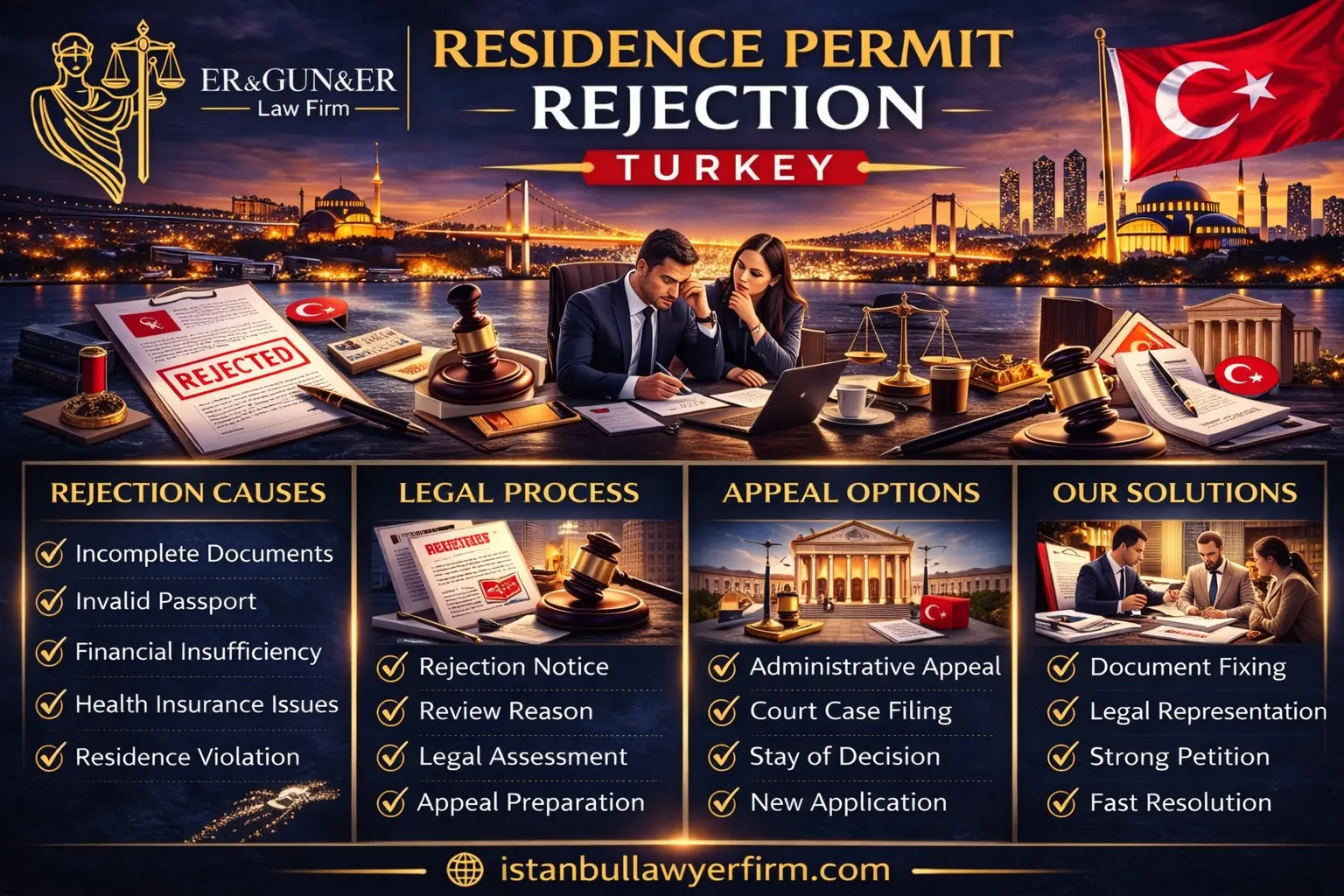
Residence permit rejection Turkey is a documentation-and-chronology problem at its core: the DGMM residence permit refusal is almost always traceable to a specific deficiency in the application file—a missing document, an authentication failure, an address inconsistency, an expired insurance policy, a financial sufficiency gap, or an adverse immigration history code that the applicant did not address before filing—and understanding precisely which deficiency caused the refusal is the first and most important analytical step after a rejection is received. The ikamet rejection Turkey decision is an administrative act issued by the Directorate General of Migration Management under the authority of the Law on Foreigners and International Protection, and like all administrative acts in Turkey it is subject to both administrative objection and judicial review through the administrative courts—but the choice between these channels, and the decision about whether to pursue them or to reapply instead, depends entirely on the specific refusal ground and the specific facts of the case. The document consistency principle that governs Turkish residence permit assessments means that the refusal is often not about a single missing document but about a pattern of inconsistency across multiple documents—a declared address that does not match the address on the lease, an insurance policy that covers a shorter period than the permit requested, a financial statement in a currency that was not converted, or a marriage certificate that is authentic but not apostilled—and the remedy must address the entire consistency picture, not just the one deficiency mentioned in the refusal notification. Prior overstay history and administrative codes in the DGMM system are the hardest refusal grounds to address through reapplication, because they represent systemic immigration compliance failures that cannot be corrected simply by submitting better documents—they require specific administrative engagement with the underlying code or history before a new application is likely to succeed. The timing of the response to a refusal is as important as the substance: a permit applicant whose prior permit has expired and whose new application was refused is in unauthorized status from the day after the prior permit expired, and the unauthorized status accumulates daily from that point—making the choice of response strategy and its implementation a matter of immediate urgency rather than a considered deliberation over weeks. This article provides a comprehensive, practice-oriented guide to residence permit rejection Turkey—covering every dimension from the immediate response to the long-term recovery—addressed to foreign nationals who have received or anticipate a DGMM refusal and who need to understand their options, their obligations, and the strategies that best protect their position.
Rejection decision overview
A lawyer in Turkey advising on a residence permit rejection Turkey situation must begin by helping the applicant understand the precise legal character of the decision they have received. A DGMM residence permit refusal is an administrative decision (idari karar) issued under the Law on Foreigners and International Protection (LFIP, Law No. 6458), whose full text is accessible at Mevzuat, and it carries the full legal weight of a formal administrative act—it is not an informal assessment or a preliminary opinion. The DGMM residence permit refusal typically specifies the grounds for the refusal in the notification document, and those stated grounds are the legal basis against which both administrative objections and judicial review petitions must be directed. The refusal notification also typically specifies the time period within which the applicant must leave Turkey if no other lawful status authorizes their continued presence—this departure period is separate from and distinct from the administrative challenge periods, and the applicant must manage both timelines simultaneously. The DGMM official site at goc.gov.tr provides general procedural information about the permit application and review processes. Practice may vary by authority and year — check current guidance on the current DGMM refusal notification format and on the specific information that must be included in a lawful refusal decision under the LFIP's administrative procedure requirements.
An Istanbul Law Firm advising on the rejection decision overview must help applicants understand the distinction between three different scenarios that are often conflated: an application refusal (where a new permit application was denied before a permit was issued); a permit cancellation (where a previously issued valid permit was cancelled before its stated expiry date); and a permit non-renewal (where a renewal application was denied after the previous permit had expired). The residence permit cancellation Turkey scenario creates the most urgent practical situation, because the person was in valid status and the status has been administratively removed—creating immediate unauthorized status from the date of the cancellation decision. The application refusal creates unauthorized status from the date the prior permit expired (if the refusal is of a renewal application and the prior permit had already expired) or leaves the applicant in the status they held when the application was filed (if the prior permit was still valid when the application was made and the application was refused after the prior permit expired). The permit non-renewal scenario—where the renewal application was denied—is procedurally identical to a new application refusal from the DGMM's perspective but has different practical consequences depending on whether the prior permit expired before or after the refusal was issued. Practice may vary by authority and year — check current guidance on the current LFIP provisions governing the legal consequences of each category of DGMM permit refusal decision and on the specific grace periods that may apply in each scenario.
A Turkish Law Firm advising on the immediate response to a DGMM residence permit refusal must address the time-critical nature of the decision to be made within hours and days of receiving the refusal notification. The three primary response options—immediate reapplication with corrected documents, administrative objection challenging the refusal decision, and judicial review through the administrative courts—each have different timeframes, different procedural requirements, and different strategic implications, and the choice among them cannot be deferred while the applicant considers which option feels most comfortable. A refusal that is based on a correctable document deficiency—a missing apostille, an expired insurance policy, an address documentation gap—is typically most efficiently addressed through a well-prepared corrected reapplication rather than through an appeal that challenges the refusal as legally incorrect, because by the time an appeal is resolved, the corrected documents could have been submitted through a new application. A refusal that is based on a substantive ineligibility finding—an adverse security code, a prior deportation record, an adverse determination about the genuineness of the qualifying relationship—requires the administrative challenge or judicial review route rather than a reapplication, because the document deficiency cannot be corrected and the underlying finding must be challenged through a legal proceeding. Practice may vary by authority and year — check current guidance on the current DGMM refusal decision notification format and on the specific response options available within the notification's stated timeframe.
Common refusal ground patterns
A law firm in Istanbul advising on common DGMM residence permit refusal ground patterns must help applicants recognize the categories of refusal that arise most frequently in Turkish permit practice and assess which category their specific refusal falls into. The most commonly encountered refusal ground categories in DGMM permit decisions include: document deficiency grounds (missing documents, improperly authenticated documents, expired documents, translations that are not certified by a sworn translator); address grounds (no notarized lease, expired lease, address inconsistency between the declared address and the submitted documentation, or a declared address that is not a genuine residential address); insurance grounds (policy that does not meet DGMM's current coverage standards, policy that does not cover the full requested permit period, or a policy issued by an insurer not currently accepted by DGMM for permit purposes); financial sufficiency grounds (income or asset evidence that does not meet the minimum standard for the declared permit duration and category); qualifying purpose grounds (the declared purpose for the permit does not have adequate documentary support); and systemic grounds (prior overstay, entry ban, security code, or other adverse administrative history that creates a substantive eligibility problem independent of the document file). Each category requires a different response, and an applicant who addresses only the document deficiency category while leaving an unresolved systemic ground will receive another refusal on the systemic grounds even if all the document issues are corrected. Practice may vary by authority and year — check current guidance on the current DGMM refusal ground taxonomy and on the specific documentation standards applicable to each ground category.
The residence permit refused Turkey scenario arising from the qualifying purpose grounds category deserves specific attention because it represents the most substantive category of refusal—one that cannot be addressed simply by improving the document file. A qualifying purpose refusal means that DGMM has found that the declared basis for the permit—property ownership, business connections, family relationship, enrollment—is either not genuine or not adequately supported by the available documentation. A property-owner short-term permit refusal based on a qualifying purpose finding may mean that the property is commercial rather than residential, that the title deed is not in the applicant's own name, or that the property transfer was not completed through the land registry at the time of the application. A family permit refusal based on a qualifying purpose finding may mean that DGMM found the declared marriage to be a sham or that the family relationship documentation was insufficient to establish the claimed relationship. The qualifying purpose refusal requires an analysis of both the legal requirements for the claimed basis and the specific evidence that DGMM's refusal identified as inadequate—and the response must directly and specifically address the adequacy finding. Practice may vary by authority and year — check current guidance on the current DGMM assessment standards for each permit category's qualifying purpose documentation and on the specific evidence that DGMM currently considers most persuasive for each purpose sub-category.
The e-ikamet application rejected Turkey scenario—where the rejection occurs at the online application portal stage rather than after the in-person appointment—requires specific attention because the technical and procedural reasons for portal-stage rejections are different from the substantive reasons for appointment-stage refusals. A portal-stage rejection may occur because the applicant selected the wrong permit type, because the uploaded documents did not meet the portal's technical format requirements (file size, file type, image quality), because a required field was left blank or filled incorrectly, or because the system identified a conflict between the declared information and data already in the DGMM database. A portal-stage rejection is typically easier to address than an appointment-stage refusal because it often does not reflect a substantive eligibility determination—it reflects a technical or procedural issue in the online submission that can be corrected through a properly prepared new application. However, the portal-stage rejection also does not stop the unauthorized status clock if the applicant's prior permit has already expired, which means that a portal-stage rejection resolved through reapplication must still be accompanied by management of the unauthorized status that accumulated between the prior permit's expiry and the new application's acceptance. Practice may vary by authority and year — check current guidance on the current e-Ikamet portal at e-ikamet.goc.gov.tr for the specific error notification format and on the specific correction steps available for different categories of portal-stage rejection.
Document completeness failures
A best lawyer in Turkey advising on document deficiency residence permit Turkey failures must explain that document completeness is the most frequently cited refusal ground in Turkish permit practice and the one that is most preventable through systematic pre-application document preparation. The document deficiency residence permit Turkey category encompasses two distinct sub-types: absolute deficiency (where a required document is entirely absent from the file) and quality deficiency (where a document is present but does not meet the authentication, translation, or currency standards required). An absolutely missing document—no health insurance certificate, no notarized lease, no birth certificate for a child permit—is a straightforward deficiency that the applicant can typically identify and correct before filing, and a refusal on this ground in a well-prepared application is almost always preventable. The quality deficiency—a marriage certificate that is authentic but lacks the required apostille; a health insurance certificate that covers the applicant but not for the full requested permit duration; a bank statement that shows adequate funds but is more than the accepted number of months old—is often harder for applicants to identify without expert review, because the document is present in the file and appears to be the right type of document even though it does not meet the specific technical standard required. Practice may vary by authority and year — check current guidance on the current DGMM document quality standards for each required document category and on the specific authentication, translation, and currency requirements currently applied by the specific provincial directorate where the application is filed.
The translation quality dimension of document completeness failures deserves specific emphasis because it is a category where applicants frequently underestimate the required standard. DGMM requires that foreign-language documents be accompanied by certified Turkish translations prepared by a sworn translator (yeminli tercüman) recognized under Turkish notarial standards—an informal translation, a translation prepared by a bilingual family member, or a translation that is accurate but not formally certified is not accepted as adequate. A common document completeness failure arises where an apostilled foreign marriage certificate or birth certificate is submitted with a translation that is correct in its content but was prepared by a person without sworn translator certification—creating a quality deficiency in an otherwise authentic document. Another common translation quality failure involves translations that cover the underlying document but do not include the text of the apostille itself—a DGMM standard that requires the apostille to be translated along with the underlying document. The document deficiency residence permit Turkey checklist that a competent immigration lawyer prepares for a client covers not only the presence of each required document but the specific authentication chain, the specific translation certification, and the specific currency (date of issue) of each document in the file. Practice may vary by authority and year — check current guidance on the current DGMM translation certification requirements and on the specific sworn translator qualification standards currently accepted by DGMM provincial directorates.
An English speaking lawyer in Turkey advising on the document currency requirement—the requirement that documents be currently valid and recently issued rather than outdated—must explain how this standard is applied to different document categories. A bank statement showing financial sufficiency must typically be recent—older statements may be rejected as not reflecting the applicant's current financial position—but the specific acceptable age of a bank statement varies by DGMM provincial practice. A health insurance certificate must cover the full duration of the requested permit, and an insurance certificate that was issued at the beginning of the requested period but that expires before the permit would expire does not satisfy the currency requirement for the full period. A passport must have validity sufficient for the requested permit plus the additional validity margin required by Turkish entry standards—a passport that expires during the requested permit period does not satisfy the document currency requirement even if it was valid at the time of application. The Mevzuat official portal at mevzuat.gov.tr provides access to the legislative framework governing document requirements, and the LFIP's implementing regulations specify many of the currency requirements. Practice may vary by authority and year — check current guidance on the current DGMM document currency standards for each required document category and on the specific age limitations currently applied for financial documents in permit applications.
Address and housing issues
A Turkish Law Firm advising on address registration problem ikamet Turkey must explain that address-related refusals are among the most consistently encountered and most systematically preventable refusal grounds in Turkish permit practice, yet they continue to account for a significant proportion of DGMM rejections because applicants routinely underestimate the specific standards required for address documentation. The fundamental address documentation requirement for a Turkish residence permit application is a notarized lease agreement (noterde tasdikli kira kontratı) or a property title deed establishing the applicant's residential address in Turkey—and the word "notarized" is the critical qualifier that applicants most frequently miss. An informal lease agreement between the landlord and tenant that has not been authenticated by a Turkish notary public is not accepted as adequate address documentation regardless of how clearly it describes the rental arrangement or how much rent is documented as having been paid. A lease that was notarized at the time of a prior permit application but that has since expired—because the lease term concluded before the renewal application was filed—is also not adequate, even if the applicant continues to live at the same address under an informal renewal of the same terms. Practice may vary by authority and year — check current guidance on the current DGMM notarized lease documentation standards and on the specific requirements for lease renewal documentation where the original notarized lease has expired.
The address consistency requirement—the requirement that the address declared in the e-Ikamet application matches the address on the notarized lease, matches the address registered in the civil registry (AKS) address system, and matches the address shown on any other address-linked documents in the file—is a source of refusals that are often entirely preventable but that arise when applicants move between the time the lease is notarized and the time the application is submitted, or when different documents in the file were prepared at different times and reflect different addresses. A notarized lease at one address, a civil registry registration at a different address, and a declared e-Ikamet address that is yet another location creates a three-way inconsistency that is a straightforward refusal ground regardless of the merit of the underlying application. The address registration problem ikamet Turkey scenario is particularly common for applicants who have recently moved, who manage multiple Turkish properties, or who are staying at a temporary address while their permanent residence is being established. A pre-application address consistency audit—comparing all address-linked documents against each other and against the address that will be declared in the e-Ikamet form—is the most reliable way to prevent address-based refusals. Practice may vary by authority and year — check current guidance on the current DGMM address consistency standards and on whether any flexibility is currently applied where minor inconsistencies in address records are accompanied by a clear explanation.
The residential character requirement—the requirement that the declared address be a genuine residential premises rather than a commercial address, a co-working space, or a shared address used by many unrelated people—is an address quality issue that DGMM officers apply with varying degrees of rigor. A declared address that is the registered address of a commercial business, a hotel, or a co-working space provider does not satisfy the residential address requirement, even if the applicant does in fact sleep there. An address that appears to be used by an unusually large number of unrelated foreign nationals—as occurs when permit facilitation services offer "registered address" services at a single premises—may be queried by DGMM as not being a genuine personal residential address. A genuine residential address—an apartment or house where the applicant genuinely lives, under a notarized lease or a title deed in their name—is the only reliable basis for the address documentation requirement. The comprehensive family residence permit Turkey documentation standards for address proof are analyzed in the resource on family residence permit Turkey. Practice may vary by authority and year — check current guidance on the current DGMM assessment standards for residential address credibility and on whether any specific address types are currently being treated as presumptively insufficient for permit purposes.
Insurance and coverage gaps
A law firm in Istanbul advising on health insurance issue residence permit Turkey refusals must explain that the health insurance component of a Turkish permit application is a mandatory requirement that must be satisfied in a specific form—not merely the existence of some form of health coverage, but health insurance meeting DGMM's specific current standards for the permit type and permit duration requested. The health insurance issue residence permit Turkey refusal arises in three primary scenarios: the absence of any health insurance documentation in the application file; the presence of a health insurance policy that does not meet DGMM's current acceptance standards (because of the insurer's licensing status, the policy's coverage limits, the presence of excluded conditions, or the policy's inapplicability to the permit type); and the presence of an insurance policy that covers the applicant but for a shorter period than the permit requested. Each scenario requires a different response: an absent insurance must be obtained before reapplication; a non-compliant policy must be replaced with a compliant one; and a short-duration policy must be replaced with or supplemented by a policy that covers the full requested permit period. Practice may vary by authority and year — check current guidance on the current DGMM health insurance acceptance standards and on the specific coverage minimum requirements currently applied for different permit categories.
The coverage period mismatch is one of the most common insurance-related refusal grounds and is almost entirely preventable through careful pre-application planning. A permit application that requests a permit for a twelve-month period but submits a health insurance policy with a six-month validity creates a coverage gap in the second half of the requested period—and DGMM will typically refuse the application or issue only a permit for the period covered by the insurance, depending on the provincial directorate's current practice. A permit applicant who notices this issue before submission has a straightforward remedy: purchase a policy that covers the full requested period. A permit applicant who discovers this issue through a refusal notification must obtain a compliant policy as part of the reapplication preparation, because the reapplication with the same coverage-period mismatch will receive the same refusal. The insurance policy's explicit coverage dates—the start date and the end date—must both be verified against the requested permit period before the application is submitted, and a policy that begins coverage after the application date or that expires before the permit would expire does not satisfy the requirement. Practice may vary by authority and year — check current guidance on the current DGMM practice for handling insurance coverage period mismatches in permit applications and on whether DGMM currently issues partial permits or complete refusals where the insurance period is shorter than the requested permit period.
The insurer acceptance issue—where the health insurance policy is from an insurer that DGMM currently treats as not qualifying for permit purposes—is a less common but equally complete refusal ground. DGMM applies acceptance standards to insurers as well as to policies, and a policy from an unlicensed insurer, a foreign insurer without a Turkish market presence, or an insurer whose policies DGMM has determined do not meet the required standards is not acceptable even if the coverage terms appear comprehensive. The acceptance status of specific insurers can change over time as DGMM updates its guidance, and a policy from an insurer that was accepted at the time of a prior permit application may not be accepted for a subsequent renewal if DGMM's standards have changed. The most reliable approach is to purchase a policy from a Turkish-licensed insurer with an established track record of DGMM acceptance, confirmed at the time of purchase rather than assumed from past experience. The comprehensive health insurance and coverage considerations for permit applications are further analyzed in the resource on remote worker residency Turkey. Practice may vary by authority and year — check current guidance on the current list of insurers and policy types accepted by DGMM for permit purposes and on any recent changes to the insurer acceptance standards.
Sponsor and income concerns
A best lawyer in Turkey advising on sponsor and income concerns in permit refusals must explain that financial sufficiency is a mandatory eligibility condition for most Turkish residence permit categories—the LFIP requires that permit applicants demonstrate adequate means of financial support without requiring Turkish public assistance—and that the specific evidence required, the minimum threshold applied, and the acceptable documentation formats vary by permit category, permit duration, and DGMM provincial practice. A short-term permit applicant must demonstrate personal financial sufficiency—adequate income or savings to support themselves without Turkish public assistance during the permit period—while a family permit applicant must demonstrate the sponsor's financial sufficiency to support both themselves and the sponsored family member. The financial sufficiency evidence submitted for a Turkish permit application typically includes bank statements showing the account balance over a recent period, income documentation (payroll slips, tax returns, investment income statements, pension statements), or a combination of both, and each type of evidence is assessed differently by DGMM officers. Practice may vary by authority and year — check current guidance on the current DGMM financial sufficiency thresholds and documentation standards applicable to each permit category and on the specific age limitations currently applied to financial documentation submitted with permit applications.
The sponsor income concern in family permit refusals—where the Turkish citizen or resident sponsor's financial documentation is found inadequate—arises in several distinct scenarios: the sponsor's income is real but documented in a format DGMM does not readily assess (irregular freelance income, income in foreign currency without currency conversion evidence, income from a business without payroll documentation); the sponsor's income is below the threshold that DGMM currently applies for the number of family members being sponsored; or the sponsor's income documentation is outdated. A Turkish citizen sponsor who is retired and whose income is primarily pension-based must document the pension income through current pension receipts or bank statements showing regular pension deposits, rather than through employment-based documentation that does not exist for a retiree. A Turkish citizen sponsor who has income from multiple sources—rental income, part-time employment, investment returns—must document all sources comprehensively rather than presenting only one source that alone falls short of the threshold. The family residence permit Turkey financial sufficiency dimension and the specific documentation formats most effective for different income types are analyzed in the resource on family residence permit Turkey. Practice may vary by authority and year — check current guidance on the current DGMM financial sufficiency thresholds for family permit sponsors and on the acceptable documentation formats for non-standard income types.
A Turkish Law Firm advising on the income evidence presentation must help applicants understand that the financial evidence package is not simply about the total amount shown but about the credibility and sustainability of the income picture presented. Bank account statements that show a high balance at the application date but that show no regular income deposits—suggesting that funds were transferred specifically to create the appearance of financial adequacy before the application—may be assessed as not genuinely reflecting the applicant's ongoing financial position. A more persuasive financial evidence package shows a consistent history of regular income deposits at a level that demonstrates ongoing financial sufficiency rather than a temporary injection of funds for application purposes. The consistency between the income sources declared in the application and the sources evidenced in the bank statements is another credibility factor that DGMM officers assess—a declared income source that does not appear in the bank deposit records raises questions about whether that income source is genuine. Practice may vary by authority and year — check current guidance on the current DGMM approach to financial sufficiency credibility assessments in permit applications and on any specific financial evidence patterns that are currently treated as indicating inadequate genuine financial sufficiency.
Prior overstays and codes
A law firm in Istanbul advising on prior overstays and codes as refusal grounds must explain that adverse immigration history recorded in the DGMM system is one of the most difficult categories of refusal ground to address through reapplication alone, because the underlying history cannot be corrected by submitting better documents—it requires specific administrative action to address the code or history before a new application can succeed. The overstay risk after rejection Turkey scenario arises when a prior overstay is recorded in the DGMM database and the current permit application triggers the system to flag the overstay record, resulting in a refusal based on the adverse history rather than on the current application's document quality. A short overstay that ended with a voluntary departure and the payment of applicable fines at the border exit may be recorded in the DGMM system as a history entry rather than as an active ban or code, and this history entry may affect future permit applications at DGMM's discretion without creating an absolute bar. A longer overstay that was processed through a formal administrative procedure—resulting in a formal voluntary departure obligation or a deportation order—may have generated an entry ban or adverse code that creates an absolute bar to permit issuance until the code is removed. Practice may vary by authority and year — check current guidance on the current DGMM database practices for recording and applying prior overstay history in permit application assessments and on whether specific overstay durations trigger different levels of adverse coding in the DGMM system.
The entry ban after residence permit rejection Turkey scenario—where the permit refusal itself triggers or is accompanied by an entry ban or removal requirement—creates the most urgent and most legally complex post-refusal situation. A permit refusal that is accompanied by a departure requirement and an entry ban means that the applicant must leave Turkey within the stated period and may not re-enter until the ban is removed through the specific administrative proceedings described in later sections. The applicant who receives a combined refusal and ban notification must simultaneously pursue the administrative challenge to the refusal (if warranted), initiate the entry ban removal proceedings, and manage the departure requirement timeline—three parallel tracks that must all be activated promptly. The legal analysis of the ban's basis—whether it arose from the permit refusal itself, from a prior deportation order, from a security finding, or from some other administrative ground—is the first step in developing the ban removal strategy, because each basis requires a different challenge approach. The overstay law Turkey consequences and the entry ban implications of accumulated unauthorized status are analyzed comprehensively in the resource on overstay law Turkey. Practice may vary by authority and year — check current guidance on the current DGMM policies for issuing entry bans in connection with permit refusal decisions and on the specific circumstances under which a permit refusal does and does not generate an automatic ban.
An English speaking lawyer in Turkey advising on security-related codes in the DGMM system must explain that these codes—which may originate from different administrative sources including DGMM itself, law enforcement agencies, and judicial authorities—are the hardest category of adverse record to address. A security code placed by law enforcement in connection with an ongoing criminal investigation may not be removable until the criminal matter is resolved; a code placed by a court as part of a judicial travel restriction may require a specific court application to modify; and a code placed by DGMM based on a prior administrative determination may require administrative proceedings specifically designed for that type of code removal. The applicant who receives a permit refusal based on a security-related ground and who does not have information about the specific basis and origin of the code is in a particularly difficult position—they cannot effectively challenge what they cannot specifically identify. The first legal step in these cases is the formal information access request to DGMM under Turkey's right-of-information framework, to identify the specific code, its legal basis, and the authority that placed it, before any challenge strategy can be developed. Practice may vary by authority and year — check current guidance on the current Turkish information access procedures applicable to DGMM database records and on the specific challenge procedures available for different categories of adverse code in the immigration system.
Interview and appointment risks
A Turkish Law Firm advising on interview and appointment risks in the permit application process must explain that the DGMM in-person appointment—where the applicant presents their original documents to a DGMM officer, provides biometric data, and the officer makes a preliminary assessment of the application's completeness and compliance—is the critical point in the permit process where preparation quality most directly determines the outcome. An appointment where the applicant arrives without all required original documents, where the original documents do not match the digital copies uploaded in the e-Ikamet system, or where the applicant cannot answer basic questions about the declared permit purpose and the supporting documentation coherently is an appointment that creates a refusal risk that did not need to exist. The interview dimension of the appointment—where the DGMM officer may ask questions about the applicant's Turkish address, their travel plans, their income situation, or the nature of their qualifying purpose—requires preparation that goes beyond document assembly to include a clear understanding of the facts declared in the application and a consistent, credible narrative about the visit's purpose and circumstances. Practice may vary by authority and year — check current guidance on the current DGMM appointment procedures and on the specific question categories that officers currently focus on for different permit types and applicant nationality categories.
The document mismatch risk at the appointment—where the original documents presented do not match the digital copies uploaded in the e-Ikamet system—is a common appointment-stage problem that arises when applicants make corrections to their documents between the online submission and the appointment date without updating the e-Ikamet upload. An insurance policy that was replaced after the online application was submitted, a lease that was renewed after the online submission, or a bank statement that was updated for the appointment date without changing the online submission creates a mismatch that the DGMM officer will identify during the document verification process. The most reliable approach to preventing document mismatch at the appointment is to complete all document preparation before the e-Ikamet online application is submitted—rather than submitting early and updating documents before the appointment—so that the original documents presented at the appointment match exactly what was uploaded in the online system. A pre-appointment document completeness audit that compares the uploaded digital versions against the original documents to be presented at the appointment can identify mismatches before they become appointment-stage problems. Practice may vary by authority and year — check current guidance on the current DGMM procedures for handling document updates between the e-Ikamet submission and the appointment date and on whether updated documents can be substituted at the appointment for documents that were uploaded during the online application.
The address consistency check at the appointment—where the DGMM officer may query the database for the applicant's civil registry address registration to compare with the address declared in the application—is another appointment-stage risk that arises when the civil registry registration was not updated to reflect the current address before the appointment. An applicant who registered their Turkish address in the civil registry at a prior address, who has since moved to the address on the current lease, but who has not updated the civil registry registration has created an address inconsistency that the appointment officer will identify. This inconsistency is entirely preventable by completing the civil registry address registration update—at the nüfus müdürlüğü—before the e-Ikamet application is submitted, but it is frequently encountered in practice because applicants manage the civil registry and DGMM address systems as separate administrative tasks rather than as a coordinated compliance obligation. Practice may vary by authority and year — check current guidance on the current DGMM appointment procedures for address consistency verification and on whether DGMM officers routinely query the civil registry database during the appointment-stage document review.
e-Ikamet technical problems
A best lawyer in Turkey advising on e-Ikamet technical problems that generate rejection outcomes must explain that the e-Ikamet portal—accessible at e-ikamet.goc.gov.tr—is the exclusive channel through which residence permit applications must be submitted, and that technical and procedural errors in the portal submission can generate rejection outcomes that are entirely unrelated to the substantive merits of the underlying application. The most common e-Ikamet technical rejection scenarios include: selecting the wrong permit type or sub-category, which generates an incorrect document checklist and an application that is assessed against the wrong eligibility criteria; uploading documents in formats that the portal does not accept (incorrect file type, excessive file size, insufficient image quality), which results in the portal either rejecting the upload or the DGMM officer being unable to review the uploaded document; and failing to complete all mandatory fields in the application form, which prevents the application from progressing to the appointment scheduling stage. Each of these scenarios requires a specific technical correction rather than a substantive legal analysis, and the correction must be made before a new application is submitted rather than during the appointment. Practice may vary by authority and year — check current guidance on the current e-Ikamet portal technical specifications and on the specific error notification format used by the portal to communicate technical rejection reasons to applicants.
The permit type selection error in the e-Ikamet application is a particularly consequential technical error because it affects not just the document checklist but the entire legal framework against which the application is assessed—an applicant who selects the short-term property-owner sub-category but who is actually applying on the basis of business connections will receive an assessment based on the property-owner standard, which will either result in a refusal for failure to submit property documentation or an inadvertent misrepresentation if they submit property documentation they do not actually hold. The correct permit type selection requires understanding both the available permit categories under the LFIP and the specific facts of the applicant's qualifying circumstances—a task that is straightforward for a standard application but requires specific analysis for applicants with complex or unusual qualifying situations. A remote worker who is uncertain whether their circumstances qualify for the business connections sub-category of the short-term permit or require a different approach needs legal advice before submitting the e-Ikamet application, not after receiving a technical rejection. The permit type options and their qualifying criteria are analyzed comprehensively in the resource on types of residence permits Turkey. Practice may vary by authority and year — check current guidance on the current e-Ikamet portal permit type options and on any recently added or modified sub-categories that may affect permit type selection decisions.
A Turkish Law Firm advising on e-Ikamet technical problems that arise from the portal's interaction with the DGMM database must address situations where the portal rejects an application because the database shows a conflict with the applicant's immigration history—an existing application in process, an expired permit in a cancellation status, or an adverse code—that the applicant may not know about but that the portal identifies through its real-time database query. An applicant who has a prior permit application in an unresolved status in the DGMM database—for example, a prior application that was filed but never followed up with an appointment—may find that the current application cannot be processed until the prior application's status is resolved. An applicant who has an adverse code that creates a database flag may find that the portal does not complete the application submission process, generating an error message that does not clearly identify the code as the cause. These database conflict scenarios require specific engagement with DGMM to identify and resolve the database status issue before the new application can be successfully submitted. Practice may vary by authority and year — check current guidance on the current DGMM procedures for resolving database status conflicts that prevent e-Ikamet application submissions and on the specific contact channels through which applicants can inquire about and resolve database conflicts.
Reapplication strategy design
A law firm in Istanbul advising on reapplication strategy design after a residence permit refusal must explain that the reapplication decision—whether to reapply and on what basis—requires a systematic analysis of the refusal grounds, the current qualifying circumstances, and the practical timeline constraints before any reapplication is submitted. A reapplication that is submitted without first addressing all of the refusal's stated grounds will receive another refusal on the same grounds—or potentially additional grounds identified in the course of reviewing the reapplication. The reapplication strategy design begins with a root cause analysis of the refusal: identifying every stated ground in the refusal notification, assessing whether each ground reflects a correctable deficiency or a substantive ineligibility finding, and determining whether all stated grounds can be addressed through the reapplication or whether some grounds require administrative or judicial challenge as a prerequisite to a successful reapplication. A refusal with multiple stated grounds requires a response that addresses all of them—not merely the most prominent one. Practice may vary by authority and year — check current guidance on the current DGMM reapplication processing standards and on whether a prior refusal creates any additional scrutiny requirements for a subsequent application in the same or a different permit category.
The timing dimension of the reapplication strategy requires specific attention in cases where the applicant's prior permit has expired and unauthorized status is accumulating. An applicant who spends several weeks preparing a reapplication while unauthorized status accumulates is managing their immigration situation less effectively than one who takes emergency protective steps—such as a voluntary departure that stops the unauthorized status clock and allows reapplication from a position of clean status—while simultaneously preparing the corrected documents. The unauthorized status accumulation issue is analyzed in detail in the overstay law Turkey resource on overstay law Turkey. The specific consequences of unauthorized status—administrative fines, entry ban risk, adverse record in the DGMM system—must be weighed against the costs and disruptions of a voluntary departure, and this weighing exercise requires specific legal advice that accounts for the applicant's specific circumstances, the specific unauthorized status duration, and the specific future immigration plans. Practice may vary by authority and year — check current guidance on the current DGMM and border control enforcement policies for unauthorized status situations and on any specific voluntary departure protocols that mitigate the consequences of overstay.
The permit category switch option—where the reapplication is submitted under a different permit category from the one that was refused—requires specific analysis of whether the switch is legally justified by the applicant's actual qualifying circumstances or whether it represents an attempt to circumvent the refusal by using a different category. A legitimate permit category switch arises where, for example, an applicant whose property-owner short-term permit was refused because the property purchase was not yet finalized applies for a business connections short-term permit based on genuine Turkish business relationships that existed independently of the property transaction. An illegitimate category switch—where the applicant applies under a different category specifically to avoid the refusal ground from the prior category, without having a genuine qualifying basis in the new category—creates a misrepresentation risk that can result in a more serious adverse finding than the original refusal. The reapplication permit category assessment requires legal advice from a practitioner who understands both the qualifying criteria for each available category and the applicant's specific factual circumstances. The full range of permit categories and their qualifying criteria are analyzed in the resource on types of residence permits Turkey. Practice may vary by authority and year — check current guidance on the current DGMM policies for permit category switches following a prior refusal and on whether DGMM treats a category switch application with additional scrutiny.
Administrative objection routes
An English speaking lawyer in Turkey advising on the residence permit appeal Turkey administrative objection route must explain that the LFIP and Turkey's general administrative procedure framework provide for the filing of an administrative objection (itiraz) with DGMM against a permit refusal decision—a mechanism that allows the applicant to present specific legal and factual arguments to DGMM itself for why the refusal should be reversed. The administrative objection is filed with the DGMM authority that issued the refusal—either the provincial directorate that processed the application or the central DGMM, depending on the specific administrative hierarchy applicable to the permit type—within the period established by the applicable administrative procedure rules. The objection must present specific arguments rather than general disagreement: it must identify a specific legal error in DGMM's application of the LFIP standards, a specific factual error in the assessment of the submitted documentation, or a specific procedural defect in how the decision was made. A well-constructed administrative objection that presents these specific arguments with supporting evidence—corrected documents, legal analysis, expert opinion—has a genuine prospect of reversing a refusal decision that was based on a legal or factual error. Practice may vary by authority and year — check current guidance on the current LFIP and administrative procedure framework objection periods applicable to different categories of DGMM permit refusal decisions and on the specific documentation and format requirements for administrative objection submissions.
The strategic decision between pursuing an administrative objection and submitting a corrected reapplication requires assessment of the specific refusal grounds and the practical timeline constraints. An administrative objection argues that the original refusal was wrong based on the evidence that was submitted—it is not an opportunity to submit new evidence that was not in the original file. If the refusal was correct given the evidence submitted—because a required document was genuinely missing, because the insurance policy genuinely did not cover the full period, or because the financial evidence genuinely was insufficient—then an administrative objection arguing that the refusal was wrong has no merit, and a corrected reapplication is the appropriate response. Conversely, if the refusal appears to be based on a legal or factual error—DGMM applied the wrong standard, misread a document, failed to consider a submitted document, or violated a procedural requirement—then an administrative objection challenging the specific error is the appropriate first response before or alongside a corrected reapplication. The DGMM residence permit refusal document must be carefully analyzed to identify the specific grounds stated, and the legal analysis of whether those grounds correctly apply the LFIP's requirements to the submitted evidence is the foundation of the objection strategy. Practice may vary by authority and year — check current guidance on the current DGMM's processing practices for administrative objections to permit refusal decisions and on the typical timeframe within which DGMM resolves objections in different provincial offices.
A Turkish Law Firm advising on the administrative objection process for a permit cancellation—as opposed to a permit refusal—must address the specific urgency that a mid-permit cancellation creates. A permit cancellation converts the holder from a valid permit holder to an unauthorized person from the date of the cancellation decision—a dramatically more urgent situation than a renewal refusal, where the applicant had already been in unauthorized status from the prior permit's expiry. The administrative objection to a permit cancellation must be filed immediately, because each day of delay in filing is a day of unauthorized status accumulation that cannot be recovered. The objection must specifically identify the grounds for challenging the cancellation—the incorrectness of the finding that triggered the cancellation, the absence of adequate notice or opportunity to respond before the cancellation was issued, or the disproportionality of cancellation relative to the specific circumstances—and must be accompanied by any available evidence that directly contradicts the grounds for cancellation. The immigration lawyer residence permit rejection Turkey practice for cancellation situations requires immediate file assembly and objection preparation, with the priority being the filing of the objection to create a formal administrative record rather than waiting for perfect documentation before filing. Practice may vary by authority and year — check current guidance on the current DGMM procedures for permit cancellation decisions and on the specific administrative objection format and timeline requirements applicable to cancellation challenges.
Court review under IYUK
A best lawyer in Turkey advising on administrative court residence permit Turkey review under the Administrative Procedure Law must explain that the administrative courts—governed by the Code of Administrative Procedure (İYUK, Law No. 2577), accessible at Mevzuat—provide the primary judicial remedy for challenging DGMM permit refusal and cancellation decisions, and that the IYUK lawsuit residence permit Turkey is the formal legal proceeding through which the court is asked to review the legality of the administrative decision. The administrative court reviews DGMM permit decisions on grounds of legality: whether DGMM applied the correct legal standard, whether the decision was based on adequate evidence, whether DGMM followed the required procedural steps, and whether the decision was proportionate to the circumstances. The administrative court does not make a fresh assessment of whether the permit should be granted—it reviews whether DGMM's decision to refuse or cancel was legally correct under the LFIP and the applicable administrative procedure rules. If the court finds the decision legally incorrect, it annuls the decision and typically orders DGMM to reassess the application in compliance with the court's finding—it does not typically order DGMM to grant a specific permit. Practice may vary by authority and year — check current guidance on the current administrative court jurisdiction over DGMM permit decisions and on the specific grounds of review that administrative courts currently apply in permit refusal and cancellation cases.
The IYUK filing deadline for an administrative court petition challenging a DGMM permit decision is a strict procedural constraint that must be respected, because a petition filed after the applicable deadline will be dismissed as time-barred regardless of the substantive merits of the challenge. The specific deadline applicable to a DGMM permit refusal challenge depends on the classification of the challenged decision under İYUK—different deadlines apply to different categories of administrative act, and the calculation of the deadline must account for the date on which the applicant was formally notified of the decision. Practice may vary by authority and year — check current guidance on the current İYUK filing deadlines applicable to DGMM permit refusal and cancellation decisions and on the specific notification date rules used for calculating the deadline. An applicant who misses the İYUK filing deadline has typically forfeited the judicial review option for that specific decision—though a subsequent new refusal decision on a reapplication would create a fresh deadline. The court is located in the jurisdiction of the DGMM authority that issued the decision, and the petition must comply with İYUK's procedural requirements for content, format, and service. Practice may vary by authority and year — check current guidance on the current administrative court jurisdiction rules for DGMM permit decisions issued by provincial directorates versus central DGMM.
An English speaking lawyer in Turkey advising on the practical value of the administrative court challenge for a permit refusal must address the realistic range of outcomes and the relationship between the court timeline and the applicant's practical immigration situation. An administrative court proceeding takes time—the court must receive the petition, notify DGMM, receive DGMM's response, potentially conduct an oral hearing, and issue a judgment—and this timeline means that the applicant may be in unauthorized status throughout the proceedings unless a stay of execution is obtained. A court judgment that annuls the DGMM refusal decision—if obtained—is a legally significant outcome that requires DGMM to re-examine the application, but it does not guarantee that the permit will ultimately be granted; DGMM may re-examine and reach the same conclusion using a corrected legal analysis. For a permit applicant whose refusal was based on a legal error, a court-obtained annulment produces a reassessment that corrects the error and typically results in the permit being granted. For an applicant whose refusal was based on a factual determination (DGMM found the qualifying purpose not genuine), the court's standard of review is deferential on factual matters, and a court challenge may be less likely to succeed than a well-documented reapplication. Practice may vary by authority and year — check current guidance on the current Turkish administrative court standard of review for factual determinations in DGMM permit cases and on the practical outcomes of recent administrative court decisions on permit refusal challenges.
Stay of execution themes
A Turkish Law Firm advising on stay of execution immigration Turkey must explain that the administrative court petition to annul a DGMM permit refusal or cancellation decision does not automatically suspend the enforcement of the challenged decision—the applicant remains in unauthorized status and the departure requirement remains in force while the court review is pending, unless the court specifically issues a suspension order (yürütmeyi durdurma kararı) that suspends the enforcement of the challenged decision pending the merits review. The stay of execution application is filed simultaneously with or immediately after the administrative court petition, and the court assesses it against a standard that requires the applicant to demonstrate both that the challenged decision is likely to be found unlawful on the merits (fumus boni juris) and that the harm from the continued enforcement of the decision—the ongoing unauthorized status and the potential departure requirement—is irreversible in a way that cannot be remedied by a subsequent favorable judgment (periculum in mora). A successfully obtained stay order suspends the enforcement of the refusal or cancellation decision—meaning that the applicant's unauthorized status is suspended and they are protected from enforcement action while the court reviews the merits—and this protection is the most immediately valuable outcome of the administrative court proceeding for most permit applicants. Practice may vary by authority and year — check current guidance on the current administrative court standards for stay of execution applications in DGMM permit refusal and cancellation cases and on the typical processing time for stay applications in the relevant administrative court jurisdiction.
The stay of execution application in a permit cancellation case is more urgent than in a refusal case because the cancellation has created an immediate unauthorized status that the stay must address from the moment it is issued. An applicant whose permit has been cancelled and who files an administrative court petition with a simultaneous stay application is seeking protection from the moment of the cancellation decision's enforcement—the stay, if granted, suspends the cancellation and restores the appearance of valid status during the court review. The evidence required for the stay application in a cancellation case must specifically demonstrate why the cancellation is likely to be found unlawful—the incorrectness of the factual finding that triggered the cancellation, the procedural defect in how the cancellation was issued, or the disproportionality of cancellation relative to the specific circumstances—in a manner compelling enough for the court to act on an emergency basis. The deportation defense Turkey context—where a permit cancellation is followed by a removal order—creates a situation where the stay of execution must address both the permit cancellation and the removal order simultaneously, requiring coordinated emergency court applications against both decisions. The deportation defense framework is analyzed in the resource on deportation defense law Turkey. Practice may vary by authority and year — check current guidance on the current Turkish administrative court procedures for stay of execution applications in combined permit cancellation and removal order scenarios.
A law firm in Istanbul advising on the practical management of the stay of execution application must explain that the quality of the legal argument presented in the stay application directly affects the court's decision—a generic application asserting that the challenged decision is wrong without specific legal and factual arguments for why it is likely to be found unlawful is unlikely to produce a stay order. The stay application must present the specific legal errors or factual findings in DGMM's decision that make it likely to be annulled on the merits, the specific harm that will result if enforcement continues during the review period (ongoing unauthorized status, forced departure, family separation), and the specific way in which the harm is irreversible (the unauthorized status days that accumulate cannot be undone, the potential entry ban that may result cannot be prevented retroactively). The preparation of a well-structured stay application—with specific legal analysis, specific evidence of harm, and specific arguments connecting the legal errors to the likelihood of annulment—requires the same quality of legal work as the underlying administrative court petition and must be completed rapidly given the urgency of the situation. Practice may vary by authority and year — check current guidance on the current Turkish administrative court processing of emergency stay applications in immigration permit cases and on any specific court practices or timelines that affect the stay application strategy.
Departure and exit exposure
An English speaking lawyer in Turkey advising on departure and exit exposure after a residence permit refusal or cancellation must explain that the unauthorized status created by the refusal or cancellation—and its management through either a voluntary departure or a continuing stay pending challenge—creates specific risks at the Turkish exit border that must be assessed and planned for before any departure is made. A foreign national who departs Turkey while in unauthorized status—whether resulting from a permit refusal, a permit cancellation, or a permit expiry without timely renewal—is subject to administrative fine processing at the border exit point, and potentially to the issuance of an entry ban that will prevent re-entry for a specified period. The exit processing for an unauthorized-status departure is conducted by the border control officers in coordination with the DGMM database, and the specific administrative consequences—fine amount, entry ban duration—depend on the duration of the unauthorized status at the time of departure, the specific circumstances of the unauthorized status (refusal, cancellation, simple overstay), and the border control officer's assessment of the case. The border entry problems Turkey context—including the specific consequences of departing with unauthorized status and the re-entry implications—is analyzed in the resource on border entry problems Turkey. Practice may vary by authority and year — check current guidance on the current border control processing procedures for unauthorized-status departures and on the specific fine and ban policies currently in effect.
The voluntary departure as a proactive risk management strategy—where the applicant departs Turkey before the unauthorized status accumulates further, pays the applicable fine at the exit, and then reapplies from outside Turkey with corrected documents—is in many cases the most effective overall strategy after a permit refusal, particularly where the refusal was based on correctable document deficiencies rather than substantive ineligibility findings. A voluntary departure that is organized and documented—where the applicant has legal advice about what to expect at the border, what fines will be assessed, and what the re-entry timeline looks like—is far less disruptive than an unplanned exit triggered by enforcement action. The fines applicable at the exit border for unauthorized status vary by duration and are established by Turkish administrative regulations; practice may vary by authority and year — check current guidance on the current fine schedule applicable to unauthorized status exits at Turkish borders. A voluntary departure that results in the issuance of an entry ban—which may occur where the unauthorized status duration is sufficient to trigger the applicable ban policy—must be managed through the entry ban removal proceedings described in the next section before re-entry can be planned. Practice may vary by authority and year — check current guidance on the current Turkish border policy for issuing entry bans upon departure in unauthorized status and on the specific unauthorized status duration thresholds that currently trigger ban issuance.
A Turkish Law Firm advising on the stay-and-challenge option—where the applicant remains in Turkey while pursuing the administrative or judicial challenge to the refusal decision—must help them understand the specific risks of this approach relative to the voluntary departure and reapplication approach. Remaining in Turkey while in unauthorized status pending an administrative challenge means that the unauthorized status continues to accumulate during the challenge period, and a challenge that takes weeks or months to resolve is a challenge during which the unauthorized status record is growing. If the challenge ultimately fails, the applicant must then depart Turkey with a longer unauthorized status record than they would have had if they had departed immediately after the refusal. The stay-and-challenge approach is most justified where the administrative or judicial challenge has a genuine prospect of rapid success—for example, where a stay of execution can be obtained quickly or where an administrative objection produces a fast reversal—and where the unauthorized status accumulation during the challenge period is likely to be modest. The risk-benefit analysis of stay-and-challenge versus voluntary departure is case-specific and requires legal advice that accounts for the specific challenge's prospects, the specific unauthorized status duration risk, and the specific applicant's re-entry plans and timeline. Practice may vary by authority and year — check current guidance on the current DGMM and enforcement authority policies for pursuing permit applicants who remain in Turkey while administrative challenges are pending.
Entry bans and future visas
A best lawyer in Turkey advising on entry ban after residence permit rejection Turkey must explain that an entry ban—a specific administrative restriction recorded in the DGMM database that prevents the entry of a foreign national into Turkey for a specified period—may be issued in connection with a permit refusal or cancellation either directly (as an ancillary consequence of the refusal decision itself) or indirectly (through the unauthorized status that accumulates after the refusal and that triggers ban processing at the departure border). A direct ban issued as part of the permit refusal decision requires specific administrative proceedings to challenge and remove, and these proceedings must typically be conducted from outside Turkey after the applicant has departed. An indirect ban issued at the border during departure requires the same removal proceedings but may have a different legal basis and a different administrative authority responsible for the ban. The entry ban removal Turkey process begins with identifying the specific ban—its duration, its legal basis, and the authority that imposed it—and then filing the appropriate administrative objection or petition with the responsible authority for removal. Practice may vary by authority and year — check current guidance on the current Turkish administrative procedures for entry ban issuance in connection with permit refusal decisions and on the specific removal procedures applicable to each type of ban.
The future visa implications of a permit refusal and entry ban for a foreign national who plans to return to Turkey after the ban period are significant, because the adverse immigration record created by the refusal, the unauthorized status, and the ban will affect the assessment of any future Turkish visa or permit application. A foreign national who applies for a Turkish visa at a Turkish embassy or consulate after having been refused a Turkish residence permit and having departed with unauthorized status will have a visa application that is assessed against a background of adverse Turkish immigration history—the consular officer assessing the visa application will have access to (or can query) the DGMM database showing the prior permit history. The specific impact of this adverse history on future visa and permit applications depends on the nature of the prior adverse record—a short unauthorized status period with a paid fine may have less impact than a long unauthorized status period with a formal ban—and on the specific visa category and purpose being applied for. The visa rejection law Turkey context and the remedies available for challenging adverse visa and permit decisions based on prior history are analyzed in the resource on visa rejection law Turkey. Practice may vary by authority and year — check current guidance on the current Turkish consular and DGMM policies for assessing future visa and permit applications from applicants with prior refusal and unauthorized status history.
An English speaking lawyer in Turkey advising on the entry ban removal proceedings for a foreign national who is outside Turkey and who seeks to return must explain the specific administrative and legal options available for pursuing ban removal from abroad. The formal administrative petition for ban removal (giriş yasağının kaldırılması başvurusu) must be filed through a Turkish lawyer with the DGMM provincial directorate or central authority that issued or maintains the ban, and must present specific legal and factual arguments for why the ban should be removed—the expiry of the ban period, changed circumstances, disproportionality, or legal invalidity of the original basis for the ban. An administrative petition that is filed promptly, that presents specific and well-documented arguments, and that is supported by evidence of the changed circumstances or legal error has a genuine prospect of producing a favorable administrative decision without requiring judicial review. If the administrative petition is denied, the administrative court judicial review route under İYUK is available from abroad through Turkish legal representation. The full-service immigration support framework available for managing permit refusal and entry ban situations is described in the resource on full-service immigration law firm Turkey. Practice may vary by authority and year — check current guidance on the current DGMM administrative petition procedures for ban removal and on the specific evidence that DGMM currently considers most persuasive in assessing ban removal applications from different nationality categories.
Practical recovery roadmap
A Turkish Law Firm developing a practical recovery roadmap after a residence permit rejection Turkey must address the sequence of decisions and actions that most effectively restore the applicant's lawful status—or positions them for a successful future application—while minimizing the unauthorized status accumulation, the adverse immigration record consequences, and the long-term impact on their Turkish immigration prospects. The first action after receiving a permit refusal notification is to identify the specific refusal grounds from the notification document and to obtain qualified legal analysis of each ground—within hours or days, not weeks. The second action is to make the fundamental strategy decision: pursue administrative challenge, reapply with corrected documents, or depart and reapply from abroad—a decision that must be made with specific legal advice rather than intuition or community forum opinion. The third action is to implement whatever protective steps the strategy requires—filing an administrative objection if that is the chosen route, preparing corrected documents if reapplication is chosen, or planning a voluntary departure if that is the most defensible approach—within the timeline that the specific circumstances require. Practice may vary by authority and year — check current guidance on the current DGMM refusal response timelines and on any specific grace periods currently applicable after a permit refusal decision that may affect the timeline for each response action.
The medium-term recovery roadmap for an applicant who has departed Turkey following a refusal and who plans to return must address both the entry ban status (confirming whether an entry ban exists and if so initiating removal proceedings) and the preparation of a corrected permit application that addresses all the grounds for the prior refusal. The corrected application preparation—assembling all required documents in their correct authenticated, translated, and current form, selecting the appropriate permit category, ensuring that the qualifying purpose basis is genuine and documentable, and resolving any adverse history codes that contributed to the prior refusal—is the substantive preparation work that determines whether the future application will succeed. An applicant who departs Turkey, waits for any applicable ban period to expire without pursuing ban removal, and then returns to Turkey to file a new application without addressing the underlying refusal grounds will likely receive another refusal on the same or similar grounds. The systematic document preparation and legal analysis that should precede any reapplication is best conducted with the assistance of an immigration lawyer who has specific experience with the permit category, the specific refusal ground, and the DGMM provincial directorate that will assess the new application. Practice may vary by authority and year — check current guidance on the current DGMM assessment standards for reapplications following a prior refusal in the same permit category and on whether any special scrutiny is applied to reapplications from applicants with prior adverse records.
A best lawyer in Turkey completing the practical recovery roadmap must address the long-term immigration strategy dimension—the assessment of whether the applicant's long-term Turkish immigration plans are achievable through the permit system and what the optimal path to those plans looks like after the disruption of the refusal. A foreign national whose long-term plan was to accumulate eight years of lawful residence toward the long-term permit has had that timeline disrupted by the refusal and the resulting unauthorized status period, and must reassess the timeline to long-term permit eligibility with an accurate accounting of what periods count and what periods do not. A foreign national who is married to a Turkish citizen and whose family permit was refused due to a document deficiency has a straightforward path back to valid status once the deficiency is corrected—but must manage the unauthorized status period between the refusal and the new permit's issuance carefully. The Istanbul Bar Association at istanbulbarosu.org.tr provides resources for identifying qualified immigration law practitioners in Istanbul for foreigners managing permit rejections and recovery proceedings. Practice may vary by authority and year — check current guidance on any recent LFIP legislative changes, new DGMM administrative guidelines on permit refusals, or recent administrative court decisions affecting the legal standards for permit refusal challenges before implementing any aspect of this article's general analysis in a specific current permit rejection situation.
Author: Mirkan Topcu is an attorney registered with the Istanbul Bar Association (Istanbul 1st Bar), Bar Registration No: 67874. His practice focuses on cross-border and high-stakes matters where evidence discipline, procedural accuracy, and risk control are decisive.
He advises individuals and companies across Sports Law, Criminal Law, Arbitration and Dispute Resolution, Health Law, Enforcement and Insolvency, Citizenship and Immigration (including Turkish Citizenship by Investment), Commercial and Corporate Law, Commercial Contracts, Real Estate (including acquisitions and rental disputes), and Foreigners Law. He regularly supports corporate clients on governance and contracting, shareholder and management disputes, receivables and enforcement strategy, and risk management in Turkey-facing transactions—often in matters involving foreign shareholders, investors, or cross-border documentation.
Education: Istanbul University Faculty of Law (2018); Galatasaray University, LL.M. (2022). LinkedIn: Profile. Istanbul Bar Association: Official website.