

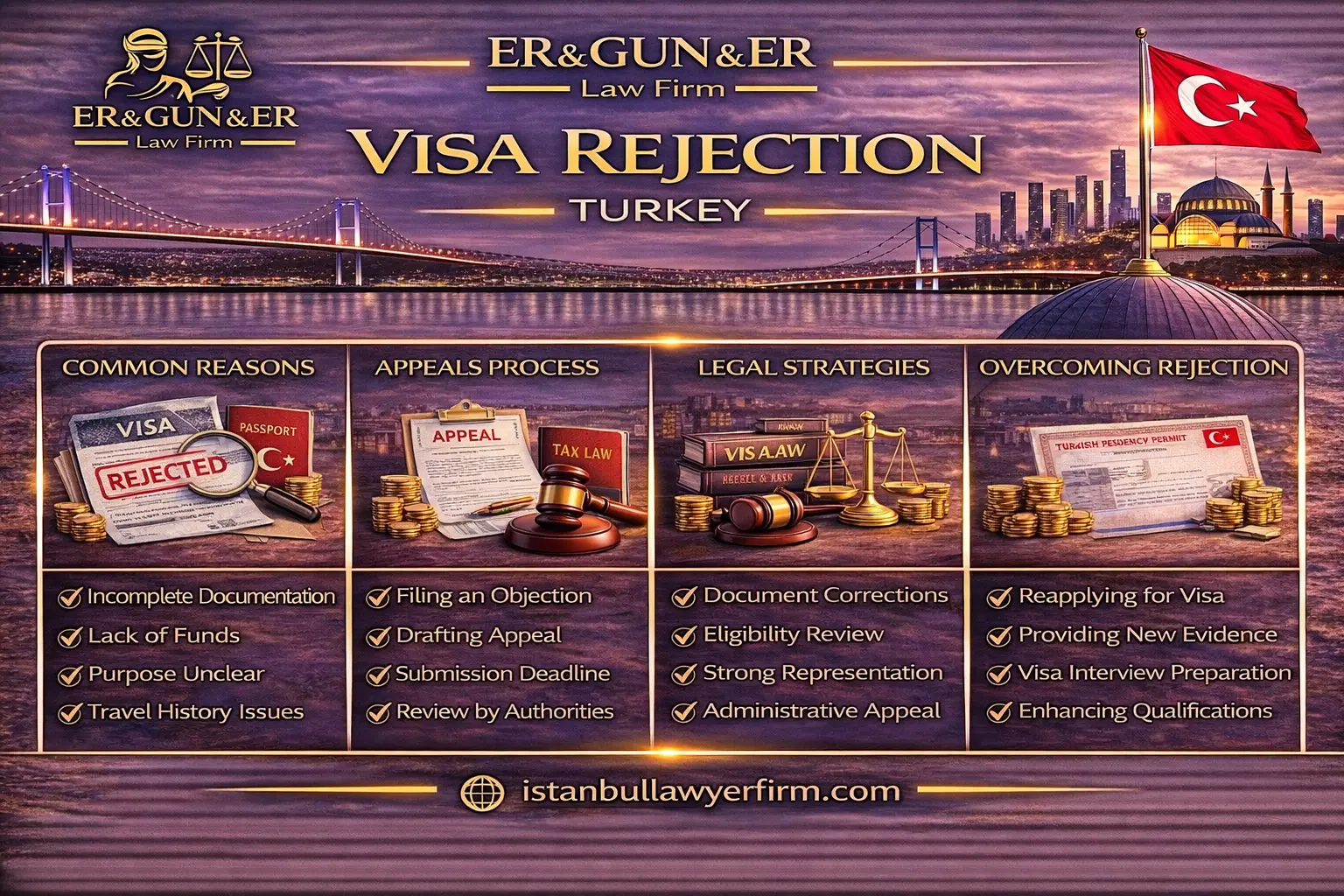
A Turkey visa application rejected outcome is never an isolated administrative act; it is the product of a specific file, a specific documentary record, and a specific assessment against the legal framework governing entry authorization under Turkish law. The outcome of any visa application is shaped by the totality of what the applicant has put before the reviewing authority—the application form, the supporting documents, the invitation or sponsor materials, the financial evidence, the travel history, and the entry and exit record that pre-dates the current application—and the refusal decision reflects the authority's assessment of that totality rather than any single element in isolation. Visa rejection law Turkey operates within the framework established by Law No. 6458 on Foreigners and International Protection and by the detailed visa regulations applied through the Ministry of Foreign Affairs and Turkish diplomatic missions abroad, and understanding this framework is the starting point for any effective response to a refusal. Evidence discipline—the practice of assembling, verifying, and presenting a complete and internally consistent documentary record at the application stage—is the most reliable mechanism for preventing refusals and the most important foundation for any re-application or review strategy after a refusal has occurred. Choosing the correct next step after receiving a Turkey visa refusal letter requires early diagnosis of the refusal ground: a refusal based on inadequate financial documentation requires a fundamentally different response than one based on travel history concerns or an active entry ban, and conflating these grounds produces responses that fail to address the actual basis of the decision. This article provides a practice-oriented analysis of visa rejection law Turkey as it operates in 2026, addressed to individual applicants, families, business travelers, and companies who need to understand what happened, why it happened, and how to respond effectively.
Visa refusal decision framework
The legal framework governing Turkey visa application decisions is established primarily by Law No. 6458 on Foreigners and International Protection, whose full text is accessible at Mevzuat, and by the detailed visa regulations implemented through the Ministry of Foreign Affairs. The visa decision—whether to grant, refuse, or grant with limited validity—is an administrative act of the Turkish state exercised through its diplomatic and consular missions abroad or, for sticker visas and airport visas, through border gate officials. The decision is not a judicial act and does not follow judicial evidentiary standards; the reviewing officer applies an administrative standard of assessment that allows significant discretion in weighing the evidence presented and in determining whether the applicant meets the conditions for a visa grant. The Ministry of Foreign Affairs Turkey visa rules are the operative standards for consular visa processing, and the official visa information published on the Ministry's website at mfa.gov.tr provides the public-facing expression of those rules. The visa decision framework distinguishes between several categories of refusal ground: grounds related to the applicant's personal eligibility, grounds related to the documentary record, grounds related to public order or security assessments, and grounds related to entry bans or flagged administrative records in the DGMM database. Each category of ground has a different evidentiary basis and a different remedial pathway, and the effective response to a refusal depends on correctly identifying which category applies in the specific case. A lawyer in Turkey advising on visa refusal matters begins the analysis with a precise identification of the stated refusal ground—if one has been communicated—and then assesses whether that ground accurately reflects the actual basis for the decision or whether additional unstated grounds may also be present. Turkish consulates are not uniformly required to provide detailed reasons for visa refusals; the obligation to state reasons varies by visa category and consular practice, and applicants who receive only a generic refusal notification may need legal assistance to diagnose the actual basis. The Turkey visa refusal letter, when issued, typically identifies the general category of the refusal ground without providing a detailed factual explanation, and this opacity makes the diagnostic process more complex for applicants without legal guidance. The visa decision, as an administrative act, is in principle subject to administrative review and to judicial challenge, though the practical availability and effectiveness of these options is significantly constrained in the visa context relative to other immigration decisions, as discussed in detail in later sections of this article. The applicant's legal position after a refusal depends substantially on whether the refusal was issued by a Turkish consulate abroad—where the remedial options are most constrained—or by border gate officials upon arrival—where the procedural context is different. Understanding which decision-making authority issued the refusal and under which procedural framework it operated is therefore a foundational step in any post-refusal assessment. Practice may vary by authority and year — check current guidance on the specific procedural framework applicable to the particular visa category and issuing authority involved in a specific refusal.
The visa rejection law Turkey framework operates in a context of significant administrative discretion—a characteristic of visa decision-making systems globally that reflects the sovereign state's broad authority to control the admission of non-nationals. Turkish law grants Turkish diplomatic missions and border authorities substantial latitude in assessing visa applications, and this latitude means that two substantially similar applications submitted by applicants with similar profiles may receive different outcomes at different consulates or in different time periods. The exercise of this discretion is not unconstrained; it must comply with the standards established by LFIP and the implementing regulations, must not be arbitrary in the legal sense, and must be exercised in a manner that is consistent with Turkey's international obligations. However, within those constraints, the reviewing authority's assessment of an applicant's credibility, the authenticity of submitted documents, the plausibility of the stated travel purpose, and the risk that the applicant will not depart Turkey before their authorized period expires is broadly discretionary and not readily subject to second-guessing by a reviewing body. The appeal Turkey visa rejection process is therefore structurally weaker than the appeal mechanisms available for other administrative immigration decisions—such as removal orders or permit refusals—because the initial decision rests on a broader and less rigorously defined legal standard. Administrative review of a visa refusal is in most cases limited to an objection to the issuing authority or its hierarchical superior, and judicial review is constrained both by standing requirements and by the deference that administrative courts typically extend to discretionary administrative decisions. The practical implication of this structural weakness in the review mechanism is that the most effective investment in any visa refusal situation is typically in rebuilding and strengthening the application rather than in pursuing formal review channels that are unlikely to produce a different outcome on the same facts. Turkish lawyers who regularly advise on visa refusal matters consistently find that re-application with a comprehensively strengthened documentary record is more productive than formal review in most standard refusal cases, and that formal review is typically reserved for cases where the refusal appears to be based on a legal error, a factual error in a verifiable record, or a procedural defect in the decision-making process. Practice may vary by authority and year — check current guidance on the specific review options available for the visa category and consular authority involved in the refusal before deciding on the response strategy.
The Ministry of Foreign Affairs Turkey visa rules establish the visa categories available to different nationalities, the conditions for eligibility within each category, and the documentary requirements that applicants must satisfy. The primary visa categories for individual travelers include tourist visas, business visas, student visas, and transit visas, each with its own eligibility criteria and documentary requirements. Work visas—issued to facilitate entry for the purpose of taking up authorized employment in Turkey—operate under a distinct framework that interacts with the work permit system administered by the Ministry of Labor and Social Security. The e-visa system, available through the official Turkey e-visa portal at evisa.gov.tr, provides an online application route for eligible nationalities seeking short-stay tourist and business visas, and a Turkey e-Visa rejection through this system requires a specific response strategy that differs from the approach to a consular visa refusal. The e-visa system applies automatic eligibility checks based on the applicant's nationality and passport data, and a rejection may reflect a database flag rather than a substantive assessment of the applicant's specific travel purpose, making the diagnosis of e-visa rejections particularly important before any reapplication is attempted. The DGMM maintains immigration records that are accessible to consular officials and border gate officers and that can influence visa decisions based on the applicant's prior immigration history in Turkey, including any recorded entry bans, removal proceedings, or permit compliance issues. The interaction between the applicant's DGMM record and the visa decision-making process is a dimension that applicants frequently overlook, particularly those who have had prior immigration difficulties in Turkey but who did not appreciate the extent to which those difficulties would be recorded and would affect future visa applications. The comprehensive immigration and visa law resource on Turkish immigration law provides foundational context for understanding how the visa framework fits within the broader immigration legal landscape. Practice may vary by authority and year — check current guidance on the current e-visa eligibility criteria, the DGMM database access procedures available to consular officials, and the specific documentary requirements for each visa category before filing any visa application.
Where refusals usually arise
A law firm in Istanbul advising applicants on the geography and institutional context of Turkey visa refusals identifies several distinct points in the visa process where refusals most commonly arise, each with its own procedural characteristics. The primary refusal point for applicants from countries that require a consular visa is the Turkish diplomatic mission—embassy or consulate—in the applicant's home country or country of habitual residence. Consular visa refusals represent the largest category of Turkey visa refusal situations, and they occur at the end of a document review process that typically involves the consulate examining the application form, the supporting documents, and the database checks against DGMM and other relevant records. The consular officer's assessment is the determinative step, and the officer's discretion in that assessment is broad, as described in the preceding section. A secondary refusal point arises at the border gate upon the applicant's arrival in Turkey, where border officials assess the traveler's entry eligibility and may refuse admission even where the traveler holds a valid visa, typically because of concerns about travel intent, inadequate supporting documentation, or a flagged record in the DGMM database that was not resolved before travel. Airport-level refusals are particularly disruptive because the applicant has already traveled to Turkey and incurred significant cost before the refusal occurs, and the immediate practical consequences—return to the point of departure, cost of return travel, disruption to travel plans—are severe. The e-visa system generates a third category of refusal, occurring at the online application stage before the applicant has physically traveled, and typically communicated through an automated rejection message without a detailed explanation. The Turkish consulate visa refusal at a diplomatic mission is the most amenable to a structured re-application strategy because the applicant has time to gather additional documentation and rebuild the application before filing again. The border gate refusal is the most urgent and the most distressing, because the applicant must resolve the situation immediately or depart, and the practical options available at the gate are limited to presenting whatever evidence is immediately available. Practice may vary by authority and year — check current guidance on the specific entry assessment procedures and the documentation that border gate officers are authorized to request in specific entry scenarios.
The institutional structure of Turkish consular operations means that practices vary significantly between different diplomatic missions in different countries and even between different consular officers within the same mission. A Turkish consulate that processes very high application volumes—as is typically the case in major origin cities for Turkish visa applications—may apply faster and more standardized assessments than a lower-volume consulate where officers have more time for individualized review. The specific country of application also matters because different nationalities have different bilateral arrangements with Turkey affecting visa requirements, processing timelines, and the documentary standards applied to their applications. An English speaking lawyer in Turkey advising on a consular refusal will identify the specific consulate that issued the refusal, assess the known practice characteristics of that consulate, and factor those characteristics into the re-application strategy. Some consulates are known within the immigration legal community to apply particularly rigorous financial documentation standards, while others are known for heightened scrutiny of travel purpose claims for specific nationality groups, and these known practice patterns inform how a re-application should be structured. The country from which the applicant is applying also affects the authenticity verification procedures that the consulate applies to supporting documents, because some countries' official documents are subject to heightened verification requirements due to known documentation fraud issues in those jurisdictions. An applicant whose documents are subject to these heightened verification procedures must understand that the standard documentary package expected from applicants in other jurisdictions may be insufficient and that additional authentication or verification may be required. The interactions between the local consulate's informal practices and the formal LFIP-based legal framework create a practical landscape that is opaque to applicants without experience of the specific consulate, and this opacity is one of the most significant practical reasons why legal guidance is valuable in the visa refusal context. Practice may vary by authority and year — check current guidance on the specific informal practice characteristics of the relevant Turkish consulate, including any known heightened scrutiny requirements for specific nationality groups or document types, before structuring any re-application.
The administrative review visa refusal Turkey options available at each refusal point differ depending on where in the process the refusal occurred and which authority issued it. A consular refusal is reviewable through an objection to the same consulate or to the Ministry of Foreign Affairs headquarters, with the availability of this option and the practical likelihood of a favorable outcome varying significantly by consular practice. A border gate refusal may be reviewable through an objection to the relevant DGMM provincial directorate or border administration authority, though the compressed timeline of a border situation makes formal review impractical in most cases. An e-visa refusal may be subject to a re-application through the same online system or to a consular application as an alternative pathway, depending on the nature of the refusal. The judicial review visa refusal Turkey pathway—seeking cancellation of a visa refusal through the administrative courts—is theoretically available for all categories of refusal but is practically effective primarily in cases where the refusal appears to be based on a legal error or a verifiable factual error, not in cases where the refusal rests on the reviewing officer's discretionary assessment of the applicant's credibility or intent. The distinction between discretionary refusals and legally-constrained refusals is therefore a critical analytical step in assessing the available remedial options. The comprehensive immigration appeal guidance on immigration appeals in Turkey provides additional context on how Turkish administrative courts approach the review of discretionary immigration decisions. The practical reality is that in most standard visa refusal cases, the most effective remedy is a strengthened re-application rather than a formal review challenge, and the diagnostic analysis of the refusal ground is the starting point for structuring that re-application effectively. Practice may vary by authority and year — check current guidance on the available review options for the specific refusal category and consular authority involved before committing to any particular response strategy.
Common refusal ground patterns
A best lawyer in Turkey analyzing Turkey visa refusal reasons across a broad case population identifies several recurring patterns that account for the majority of refusals. The most common pattern involves inadequate or unconvincing documentation of the applicant's ties to their home country and the corresponding risk of overstay: the consular officer has concluded, based on the documents submitted, that the applicant presents an unacceptably high risk of remaining in Turkey beyond the authorized period and not departing voluntarily. This overstay-risk conclusion is typically drawn from the combined picture of weak financial documentation, weak employment or business ties, weak family ties, and a planned Turkey visit of significant duration, rather than from any single element alone. The second most common pattern involves direct inadequacy in the financial documentation: the consular officer has concluded that the applicant cannot demonstrate sufficient funds to cover their stay in Turkey without engaging in unauthorized economic activity. The third pattern involves travel history concerns, including prior unauthorized stays in Turkey or other countries, prior visa refusals in multiple jurisdictions, or an absence of established international travel history that would provide evidence of the applicant's ability to comply with entry and exit requirements. The fourth pattern involves invitation or sponsor issues, where the inviting party's documentation is inadequate, where the stated relationship between the applicant and the inviting party is implausible, or where the inviting party's own immigration status in Turkey is uncertain. A Turkey visa refusal letter that identifies one of these general categories as the basis of the refusal without specifying the particular documentary gap that drove the decision requires further diagnostic analysis to identify the specific remedial action required. The diagnosis is most straightforward when the refusal letter is specific—naming a particular document that was missing or insufficient—and most challenging when the refusal letter is generic, using formulaic language that could apply to many different underlying factual situations. Practice may vary by authority and year — check current guidance on the standard refusal letter formats used by the relevant Turkish consulate and on the factual circumstances most commonly associated with each type of refusal formulation.
The visa rejection legal advice Turkey process for specific refusal ground patterns requires a tailored analytical approach that addresses the particular evidentiary gap the pattern reflects. For overstay-risk refusals, the diagnostic analysis asks: what evidence of home-country ties was missing from the original application, and what evidence is now available that would change the officer's assessment of the overstay risk? For financial documentation refusals, the analysis asks: what was the specific financial documentation deficiency—insufficient balance, inappropriate type of account, insufficient duration of account history, or inability to explain the source of funds—and what corrected or supplementary documentation addresses that deficiency? For travel history refusals, the analysis asks: has any time passed that allows the applicant to build a stronger travel record, and has any prior overstay or refusal history been addressed through appropriate administrative channels? The Turkey visa rejection legal advice provided by experienced immigration counsel in each of these pattern categories is therefore specific and evidence-focused, not generic, because the remedial action required differs fundamentally depending on which pattern applies. The visa rejection lawyer Turkey who conflates different refusal patterns and prescribes the same generic response to all of them is not providing value; the practitioner who correctly identifies the specific pattern and designs a tailored evidentiary response to that specific pattern is the one whose clients achieve better outcomes on re-application. The interaction between the refusal ground pattern and the applicant's specific personal circumstances also matters: an overstay-risk refusal for an applicant who has recently changed employment requires a different documentary solution than the same pattern for an applicant whose employment situation is stable but whose financial documentation was prepared incorrectly. Practice may vary by authority and year — check current guidance on how the specific Turkish consulate handling the re-application currently assesses the specific evidentiary categories most relevant to the identified refusal ground pattern.
A less common but particularly serious category of refusal involves security and admissibility flags: the applicant is refused not because of documentary inadequacy but because of a record in the DGMM database or another security-related system that indicates a concern about the applicant's admissibility under the public order, public security, or public health grounds established by LFIP. These flags may arise from prior removal proceedings, from intelligence records, from criminal conviction records, or from prior administrative interactions that generated an adverse notation in the relevant database. A Turkey visa application rejected on security grounds presents a fundamentally different remedial challenge from a documentation-based refusal, because the remedial action required is not simply the assembly of better documents but the identification and resolution of the underlying database entry that is driving the adverse assessment. An applicant who has a prior entry ban recorded in the DGMM database cannot resolve a visa refusal that is driven by that ban through document improvement alone; the ban must be addressed through the appropriate administrative or judicial channels before a new visa application is filed, regardless of how strong the supporting documentation for that application may be. The detailed analysis of entry ban impact on Turkey visa applications, and the available channels for addressing active bans before re-application, is covered comprehensively in the resource on entry ban removal in Turkey. The interaction between a prior deportation proceeding and a subsequent visa application is particularly complex, because the deportation record creates an adverse notation that may be visible to the consulate and that requires legal analysis to determine whether it is challengeable and, if so, through which channel. Practice may vary by authority and year — check current guidance on how the DGMM database entries generated by specific prior administrative events are visible to consular officials and what procedural steps are required to address each type of entry before re-application.
Document and evidence discipline
A lawyer in Turkey advising on visa application preparation treats the documentary record as the most important determinant of outcome, because the consular officer assessing the application has access only to what the applicant submits and cannot independently verify claims that are not corroborated by documentation. The principle of evidence discipline in visa applications means that every claim made in the application form must be corroborated by at least one piece of independent documentary evidence, that every document submitted must be current, authentic, and internally consistent with all other documents in the package, and that the package as a whole must tell a coherent story about the applicant's identity, situation, purpose, and intention to depart Turkey within the authorized period. A documentary package that is internally inconsistent—where the stated purpose of travel is business but the financial documentation reflects a personal account with no business-related transactions, or where the stated employer is different from the employer reflected in the social security records—will generate suspicion that undermines the credibility of the entire application regardless of whether any individual document is technically in order. The supporting documents Turkey visa application standard requires applicants to submit documents from multiple independent sources that collectively confirm the same factual picture: the employment letter from the employer, the payslip from the payroll department, the bank statement reflecting salary deposits, and the social security record reflecting the employment relationship should all point to the same employer, the same position, and the same income level. Discrepancies between these documents—different employer names, different income figures, different employment start dates—are red flags that consular officers are trained to identify and that frequently drive adverse credibility assessments even where the applicant can explain the discrepancy. The quality of each individual document also matters: documents that are poorly formatted, that contain unusual typefaces or layouts, that bear signatures that appear inconsistent with authentic specimens, or that are presented in formats unusual for the issuing institution will attract heightened scrutiny. The practical discipline of document quality control—reviewing every document in the package before submission for completeness, accuracy, consistency, and presentation quality—is one of the most concrete contributions that experienced immigration counsel makes in the visa application process. Practice may vary by authority and year — check current guidance on the specific documentary requirements and presentation standards expected by the specific Turkish consulate handling the application.
The Turkish consulate visa refusal that results from a documentary deficiency typically reflects one of three categories of problem: a missing document that the consulate considered essential, a document that was present but insufficient (inadequate financial balance, too-short bank statement history, out-of-date employment letter), or a document that raised a question that the rest of the package failed to answer (unexplained financial transactions, inconsistent employment history, implausible stated purpose). Each category requires a different remedial approach. A missing document situation is the simplest: identify the missing item, obtain it, and include it in the re-application. An insufficient document situation requires understanding what standard of sufficiency the consulate applies—how much financial balance is required, how many months of bank history are expected, how recently the employment letter must be dated—and obtaining documents that meet that standard. A question-raising document situation is the most complex, because it requires understanding not only what question the document raised but also what type of evidence would answer that question to the consulate's satisfaction. An applicant whose bank statement shows large cash deposits of uncertain origin must not only explain the source of those deposits but must do so with corroborating documentation that an administrative officer with limited investigation resources can realistically verify. A law firm in Istanbul preparing a re-application in this category invests in the explanatory narrative—a concise, factually specific cover letter that proactively addresses the question that the original document raised and directs the officer to the specific corroborating documents that answer it—as a core component of the application package. The cover letter is not a standard component of most visa application submissions, but in re-application cases where a specific question has been raised, a targeted explanatory submission is often the most effective single addition to the package. Practice may vary by authority and year — check current guidance on whether the specific Turkish consulate accepts and considers explanatory cover letters and how such submissions are processed in the application review workflow.
The authentication and certification requirements for supporting documents submitted to Turkish consulates vary by document type, issuing country, and consular practice. Documents issued by public authorities in countries that are parties to the Hague Apostille Convention must be apostilled before submission if the consulate requires official authentication; documents from non-convention countries require authentication through the consular chain. Employment letters and bank statements issued by private entities do not require apostille but may require notarization or other certification if the consulate has specific requirements for private documents. The translation requirements for non-Turkish, non-English documents vary by consulate: some consulates accept translations into English without further certification, while others require translations into Turkish by a sworn translator, and still others accept only certified translations in specified formats. An applicant who submits documents that are not authenticated or translated in accordance with the specific consulate's requirements may have a technically complete application rejected on the basis of the authentication or translation deficiency alone, even where the underlying documents are substantively adequate. The resource on immigration firm services in Turkey describes how documentation preparation and authentication are managed as a systematic workflow in full-service immigration practice, providing context for understanding the operational discipline required for consistent documentary compliance. The practical implication is that the document preparation process for a Turkey visa application must begin well in advance of the intended filing date—not the day before the appointment—to allow sufficient time for authentication, translation, and quality review at each stage. Practice may vary by authority and year — check current guidance on the authentication and translation requirements currently applied by the specific Turkish consulate before finalizing any document preparation process.
Invitation and sponsor issues
An Istanbul Law Firm advising on Turkey visa applications that involve a Turkish host or sponsor identifies invitation and sponsor documentation as one of the most frequently mismanaged components of the application package. The invitation letter for a business visa, or the hosting declaration for a family visit visa, serves a specific evidentiary function: it corroborates the stated purpose of the visit, establishes the relationship between the applicant and the Turkish host, and—in some categories—creates a formal legal commitment by the sponsor regarding the applicant's stay in Turkey. A visa rejection lawyer Turkey who encounters an application where the invitation letter was the weak link will analyze the specific deficiency: was the letter vague about the nature of the business meeting, was it signed by a person without evident authority to issue such letters for the inviting company, was it dated too far in advance to be credible as a genuine invitation for the stated dates, or was the stated relationship between the applicant and the host implausible given the other information in the file? Each of these deficiencies requires a different corrective approach. A vague business invitation must be replaced with a specific one that identifies the meetings, parties, and business purpose in concrete terms. A letter signed by an unauthorized person must be replaced with one from an identifiable authority within the inviting organization, accompanied by evidence of that person's position and authority. A pre-dated letter must be replaced with a current, event-specific invitation that corresponds to the specific trip being applied for. An implausible relationship must be addressed through corroborating evidence of the relationship's history and nature. Practice may vary by authority and year — check current guidance on the specific content and format requirements for invitation letters currently applied by the relevant Turkish consulate for the specific visa category being applied for.
The supporting documentation that accompanies an invitation letter must corroborate the letter's claims from multiple independent sources. A business invitation from a Turkish company should be corroborated by documentary evidence of the company's existence and legitimacy: the company's trade registry record (ticaret sicil gazetesi), the company's official website or business cards of the issuing employee, and where available, prior correspondence between the applicant's organization and the inviting company that establishes a documented business relationship. The absence of this corroborating documentation leaves the consular officer with only the invitation letter itself as evidence of the stated purpose, and an officer who is skeptical of the stated purpose will require more than the letter alone to be persuaded. For family visit visas, the corroborating documentation of the family relationship between the applicant and the Turkish host is the central evidentiary question: marriage certificates, birth certificates, and family registry records are the primary document categories, and these must be properly authenticated and translated. Where the family relationship is more distant or informal—a close friend who is hosted in Turkey without a formal family connection—the corroborating evidence of the relationship's genuineness and duration must be particularly strong, because the officer will assess the plausibility of a non-family hosting relationship against the applicant's overall profile. The Turkish host's own immigration status and documentation capacity matters too: a Turkish citizen host presents a simpler sponsorship situation than a foreign national residing in Turkey on a permit, because the latter's permit status may itself be uncertain or under review. Practice may vary by authority and year — check current guidance on the specific corroborating documentation that the Turkish consulate currently expects for different categories of invitation and sponsor arrangements.
Turkish lawyers who advise Turkish companies on the management of business invitation letters for their international business partners and visitors have developed standardized practices for producing invitations that consistently meet consular evidentiary standards. These practices include: using a standard template that covers all required elements (specific dates, specific meeting purposes, identification of the business parties, identification of the issuing authority within the company); ensuring the letter is signed by a senior officer whose position is clearly identified and verifiable; accompanying the letter with the company's official trade registry document; and confirming that the letter is issued on official company letterhead with verifiable contact information. A Turkish company that regularly invites international business visitors and that has developed a consistent, high-quality invitation practice builds a track record that itself contributes to the credibility of its invitations in consular review. An invitation from a company that has a known track record of business relationships with the applicant's organization carries more weight than an invitation from a company that has no prior documented relationship with the applicant or their employer. The reapply after visa rejection Turkey strategy for cases involving invitation deficiencies must therefore address not only the format and content of the new invitation letter but also the broader evidentiary context of the business relationship—presenting documented evidence of prior interactions, communications, and commercial dealings that establishes the invitation as a genuine business need rather than a pretext for entry. Practice may vary by authority and year — check current guidance on the specific evidentiary standards applied to business invitation letters for the relevant visa category and nationality before preparing any invitation documentation for a re-application.
Financial capacity assessment
Turkish lawyers advising visa applicants on the financial documentation dimension of their applications must help clients understand that the financial assessment is not simply a check of whether a sufficient balance exists in the account, but a multi-factor evaluation of the account's plausibility, the stability and source of the funds, and the sufficiency of those funds relative to the planned trip. A bank account that shows an adequate balance as of the statement date but that also shows large, unexplained cash deposits in the months immediately preceding the application—what the immigration legal community calls "padding" or "balance inflation"—is one of the most commonly identified financial documentation problems and generates significant consular skepticism. The consular officer's concern is that the balance reflects funds placed temporarily in the account to satisfy the visa requirement rather than genuinely available financial resources, and this concern is not resolved by the balance figure alone but only by a documented history of consistent income and saving that makes the current balance plausible in context. A bank statement that shows a six-month history of regular salary deposits, stable account operation, and a growing balance that has naturally reached the current level is substantively more persuasive than one that shows a flat or declining balance followed by a sudden large deposit shortly before the application. The financial capacity assessment also considers the source of income: employed applicants with documented employment relationships, retired applicants with documented pension income, and business owners with documented business income each present a different financial profile, and the documentation required to establish each profile convincingly differs accordingly. Practice may vary by authority and year — check current guidance on the specific financial documentation standards and balance thresholds currently applied by the relevant Turkish consulate for the specific visa category and nationality group before preparing any financial documentation package.
A best lawyer in Turkey advising on financial documentation will recommend that applicants submit documentation from multiple sources that collectively establish a coherent financial picture rather than relying on a single bank statement. For employed applicants, the combination of an employment letter stating the salary, recent payslips matching the stated salary, a bank statement showing salary deposits at the stated amount and frequency, and a social security registration record confirming the employment relationship creates a multi-source corroboration of the financial situation that is substantially more persuasive than any single document. For self-employed applicants and business owners, the documentary package is more complex and may include business registration documents, recent tax returns, business bank statements, accountant certifications of income, and professional association registrations, all of which together establish the legitimacy and financial sustainability of the business. For applicants who are funded by a family member or sponsor, the documentation must establish both the sponsor's financial capacity and the genuineness of the sponsorship arrangement: the sponsor's own bank statements and income evidence, a formal sponsorship declaration, and documentary evidence of the family or personal relationship between the applicant and the sponsor. The travel intent visa refusal Turkey pattern that arises from financial documentation concerns typically reflects a consular conclusion that the applicant lacks the financial independence to finance their stay without engaging in unauthorized economic activity in Turkey—a concern that is addressed not only by the financial documentation itself but also by evidence of the applicant's commitment to departing Turkey before the authorized period expires. The interaction between the financial capacity assessment and the overstay-risk assessment means that a strong financial documentation package is part of the broader picture of an applicant who has the means and the motivation to comply with Turkish entry conditions. Practice may vary by authority and year — check current guidance on how the specific consulate currently weights different types of financial evidence and what minimum documentation it currently expects for the specific visa category and nationality.
The financial capacity assessment for business travelers involves a slightly different framework from the tourist visitor assessment, because the basis of the business traveler's financial support is typically the employing or sponsoring company rather than personal savings. A business visa applicant who is traveling at the employer's expense should document the company's financial responsibility clearly: a business travel authorization letter from the employer, a company credit card or travel advance authorization, or a letter of financial guarantee from the company confirming it will cover the travel costs. Where the employer is a recognized international company with a strong public profile, this documentation is typically sufficient to satisfy the financial assessment; where the employer is a smaller or less well-known organization, additional company financial documentation—annual reports, financial statements, or bank guarantees—may be required. The supporting documents Turkey visa application standard for business travelers must reflect the specific travel arrangement accurately and completely, because an inconsistency between the stated financial arrangement and the documentary evidence of that arrangement generates exactly the type of credibility concern that leads to refusals. A business traveler whose application states that the company is covering all costs but whose personal bank statement shows a large recent withdrawal that appears designed to demonstrate personal funds is presenting an internally inconsistent financial narrative that will raise questions. The financial documentation package for any visa application should be organized so that the officer can quickly trace the complete financial narrative from first principles—who is paying, from what funds, how is the financial capacity demonstrated—without needing to make inferences or assumptions. Practice may vary by authority and year — check current guidance on the specific financial documentation requirements for business visa applicants at the relevant Turkish consulate, including any requirements for company-level financial documentation in addition to individual applicant financial evidence.
Travel intent and ties
A Turkish Law Firm advising visa applicants on the travel intent dimension of their application must help clients understand that demonstrating genuine tourism or business intent and an equally genuine intention to depart Turkey within the authorized period requires the same documentary evidence discipline as every other component of the application. The consular officer assessing the travel intent visa refusal Turkey pattern is asking a forward-looking question: does this applicant, based on everything in this file, appear to be a genuine visitor who will leave Turkey when required, or does this profile suggest a risk of overstay? The evidence relevant to this question includes home-country ties—the factors that give the applicant a compelling reason to return home—and the absence of apparent incentives to remain in Turkey beyond the authorized period. Home-country ties include employment or business operations that require the applicant's presence, family members who remain in the home country, property ownership, ongoing professional obligations, and any other responsibility or interest that creates a concrete reason to return. These ties must be documented rather than merely asserted: an applicant who states that they have a demanding job to return to but who has not submitted any employment documentation is asking the consular officer to take their word for a claim that cannot be verified. The documentation of home-country ties for self-employed applicants and business owners is particularly important because these applicants lack the employer-imposed return obligation that employees can document through their employment letter. An English speaking lawyer in Turkey advising self-employed applicants will identify the most credible available evidence of the business ties that create a return obligation—ongoing client contracts, scheduled professional appointments, lease agreements for business premises, tax filing obligations—and ensure that this evidence is comprehensively documented in the application. Practice may vary by authority and year — check current guidance on how the specific Turkish consulate currently weighs different categories of home-country tie evidence for the specific visa category and nationality involved.
The absence of strong home-country ties does not automatically result in a refusal—the consular assessment is holistic—but it significantly increases the evidentiary burden on the applicant to demonstrate intent to depart through other means. An applicant with weak employment ties but with owned property in the home country, dependent family members, ongoing professional certifications, and a documented history of departing other countries within their authorized periods presents a substantially different risk profile from an applicant with no demonstrable ties of any type. The diversity of the tie evidence is important: multiple independent sources of tie evidence are more persuasive than a single category of evidence, however strong that single category may be. A return flight booking is sometimes cited as evidence of intent to depart, but consular officers are generally aware that return flight bookings can be changed or cancelled and therefore treat a return booking as a minor corroborating factor rather than compelling evidence of departure intent. The applicant's prior Turkey travel history—if they have visited Turkey before and departed within the authorized period on each occasion—is one of the strongest single pieces of evidence of departure intent, because it is a documented behavioral record rather than a prospective claim. The relationship between the Ministry of Foreign Affairs Turkey visa rules and the travel intent assessment is reflected in the formal visa conditions: a visa granted for tourism authorizes only tourism activities, not employment, business activities, or extended residence, and the evidence of travel intent must match the authorized purpose of the visa being sought. An applicant who presents a tourism visa application but whose financial situation, accommodation arrangements, and stated activities are more consistent with extended residence or employment will have their stated tourism purpose questioned. Practice may vary by authority and year — check current guidance on the specific travel intent evidence standards applied by the relevant Turkish consulate for the specific nationality and visa category.
The reapply after visa rejection Turkey strategy for cases involving travel intent concerns requires a rebuilding of the applicant's tie documentation rather than simply an improvement of individual documents. Where the original refusal reflected a judgment that the applicant lacked compelling home-country ties, the re-application must present substantively stronger tie evidence—either because the applicant's circumstances have changed (new employment, new family obligations, new property ownership) or because the original documentation was inadequate to represent existing ties that were always present. If the applicant's circumstances genuinely have not changed significantly since the refusal, and the original refusal was based on an accurate assessment of weak ties rather than a documentary gap, a simple re-application without changed circumstances is unlikely to produce a different outcome. In such cases, the legal advice may focus on whether the applicant can strengthen their tie profile before reapplying—accepting a longer-term employment position, completing a formal property transaction, or establishing other documented ties—or whether an alternative visa category or a different entry pathway might be more appropriate for their actual situation. The relationship between the applicant's profile and the visa category being sought is a fundamental strategic question: an applicant who genuinely intends to remain in Turkey for an extended period should be seeking a residence permit through appropriate channels, not a tourist visa, and an applicant who is applying for the wrong visa category will consistently encounter travel intent refusals regardless of how strong their documentation is for that mismatched category. The detailed guidance on residence permit procedures in Turkey provides context for understanding when a residence-based approach is more appropriate than a repeat visa application strategy. Practice may vary by authority and year — check current guidance on the available alternative visa and permit categories that might be more appropriate for the applicant's actual situation and intended period of stay.
Travel history and overstays
A lawyer in Turkey assessing the impact of travel history on a visa application must evaluate both the applicant's Turkey-specific travel history and their broader international travel record, because each dimension provides relevant evidence that consular officers use in their assessment. The Turkey-specific travel history—accessible through DGMM records that link to the applicant's passport number—is the most directly relevant, because it shows whether the applicant has previously visited Turkey, whether they departed within their authorized period on each visit, and whether any adverse administrative events occurred during prior visits. An applicant with a clean Turkey travel history who has made multiple prior visits and departed on time each time has a substantially stronger foundation for a new visa application than a first-time applicant with no demonstrable track record. An applicant who has a recorded overstay in Turkey—even a brief one that was resolved through payment of the applicable fine—will find that the overstay record remains visible in the DGMM database and is accessible to consular officers assessing subsequent applications, and this record will influence the travel intent assessment for the new application. The detailed analysis of how overstay records are generated and how they interact with subsequent immigration proceedings is covered in the resource on Turkey's overstay law framework. The international travel record—as reflected in the applicant's passport stamps and visa history—also provides relevant context: an applicant who has a well-documented history of international travel to multiple countries, with consistent compliance with entry conditions in each jurisdiction, presents a lower overstay risk profile than one who has no international travel history. Conversely, an applicant whose passport shows prior visa refusals from multiple countries, or who has had immigration difficulties in other jurisdictions, presents a higher risk profile that will attract greater scrutiny. Practice may vary by authority and year — check current guidance on how DGMM travel history records are currently accessed by consular officials and what specific prior travel events generate the most significant risk flags in the consular assessment.
The entry ban impact on Turkey visa assessments is one of the most serious dimensions of the travel history analysis, because an active entry ban recorded in the DGMM database effectively prevents visa approval regardless of the quality of the application's documentation on other dimensions. The entry ban may have arisen from a prior overstay, a prior removal proceeding, or a prior adverse administrative finding, and the ban remains in the DGMM database until it expires by its own terms or is administratively lifted through a successful challenge. An applicant who applies for a Turkey visa without first confirming whether an active entry ban is recorded in their name will typically receive a refusal without a detailed explanation of the ban's existence, because the consulate is not always required to disclose the specific database flag driving the refusal. The practical consequence is that an applicant who has had any prior adverse immigration experience in Turkey should, before filing any new visa application, seek legal advice to confirm their DGMM status and to determine whether any active bans or adverse notations need to be addressed before the application is filed. The entry ban removal strategy for applicants with active bans is the starting point for any viable visa re-application strategy in this category, and filing a new visa application before the ban has been addressed is an exercise that is almost certain to result in another refusal without resolving the underlying problem. The detailed analysis of how entry ban challenges are structured and what procedural channels are available is covered in the comprehensive guide on entry ban legal remedies in Turkey. The management of an applicant's broader travel history—including prior visa refusals in other jurisdictions—requires a similarly analytical approach, because different patterns of prior refusal carry different implications for the Turkish consular assessment. A single prior refusal for a readily identifiable documentary deficiency that has since been corrected is very different from multiple refusals across multiple jurisdictions for unspecified reasons. Practice may vary by authority and year — check current guidance on how the specific Turkish consulate currently treats different categories of prior travel history when assessing new visa applications from applicants with complex travel records.
The interaction between a prior Turkey deportation proceeding and a subsequent visa application presents the most legally complex travel history situation, because the deportation creates a record in the DGMM database that is qualitatively more adverse than a simple overstay record. A deportation record may generate an entry ban of significant duration, may trigger ongoing database flags that affect all subsequent Turkish immigration interactions, and may be visible to consular officers in a manner that makes any new visa application extremely difficult to process favorably until the deportation record has been addressed through the appropriate legal channels. The resource on deportation defense law in Turkey provides the foundational legal framework for understanding how deportation proceedings are initiated and how their consequences can be challenged. For applicants whose visa refusal appears to be linked to a prior deportation or removal proceeding, the legal strategy must begin with a comprehensive assessment of the deportation record—its legal basis, its accuracy, its current status in the DGMM database, and the available channels for challenging or mitigating its adverse impact on future entry—before any new visa application is filed. The legal complexity of this analysis, combined with the significant personal and economic consequences of repeatedly unsuccessful visa applications that consume time, fees, and credibility, makes early engagement with experienced immigration counsel the most cost-effective approach for any applicant dealing with a travel history issue of this severity. The relationship between travel history management and the broader immigration strategy requires a coordinated approach that addresses all dimensions of the administrative record simultaneously rather than treating each visa application as a standalone event without reference to the underlying record. Practice may vary by authority and year — check current guidance on how deportation records are currently reflected in the DGMM database and how they interact with consular visa assessment processes before initiating any visa application strategy that involves a prior deportation history.
Security and admissibility flags
A Istanbul Law Firm advising an applicant whose visa refusal appears to be based on a security or admissibility flag—rather than on a documentary deficiency—faces a fundamentally different diagnostic and remedial challenge from the documentation-based refusals discussed earlier. Security and admissibility-based refusals are generally issued under the public order, public security, or public health grounds established in LFIP and in the implementing regulations governing visa issuance, and these grounds are applied through a combination of the applicant's personal history and information from relevant security and intelligence databases. The DGMM maintains database records accessible to consular officials, and these records may include flags arising from prior removal proceedings, from adverse encounters with Turkish law enforcement or intelligence, or from information shared with Turkey through bilateral or multilateral information exchange arrangements. An applicant whose name, passport data, or other identifying information matches a flag in the DGMM database will typically have their application refused without the consulate providing a detailed explanation of the flag's content, because the specific content of security database entries is considered confidential and is not disclosed to applicants. This opacity creates a diagnostic challenge: the applicant receives a refusal notification that may be generic in its stated grounds, and they must determine—without direct access to the database—whether the refusal is driven by a security flag, by a standard administrative record such as a prior entry ban, or by a documentary deficiency that has been framed in generic terms. The distinction matters because each possibility calls for a different response: a security flag may require legal inquiry through formal administrative channels; a prior entry ban requires an entry ban challenge; and a documentary deficiency requires a documentation rebuild. Practice may vary by authority and year — check current guidance on the available formal mechanisms for applicants to inquire about the existence of DGMM database flags that may be affecting their visa applications.
The public health grounds for visa refusal under LFIP have historically been applied in specific circumstances—pandemic-related entry restrictions, cases involving communicable diseases that pose a documented risk to public health—and are not a routine ground for individual visa refusal in standard circumstances. The public order and public security grounds are broader and more commonly invoked in cases where the applicant has a criminal conviction record, has been linked to activities considered threatening to Turkish security interests, or has a pattern of prior conduct that generates an adverse assessment under these grounds. A criminal conviction in the applicant's home country or in any third country may affect the Turkish visa assessment, and the severity of the impact depends on the nature of the conviction, the sentence imposed, and the time elapsed since the conviction. Turkish law does not specify universal criminal record standards for visa eligibility, and practice may vary by authority and year — check current guidance on how specific categories of criminal conviction are currently treated in the consular visa assessment process. An applicant who has a criminal record and who is applying for a Turkey visa should disclose the conviction in the application if required to do so and should seek legal advice before filing to understand how the conviction is likely to affect the assessment. Attempting to conceal a criminal conviction that is discoverable through database checks creates a more serious admissibility problem than the conviction itself, because the concealment suggests dishonesty that compounds the substantive concern raised by the conviction. The legal analysis of whether and how a specific criminal record affects visa eligibility requires familiarity with both Turkish immigration law and the international information-sharing arrangements relevant to the specific nationality and conviction jurisdiction. Practice may vary by authority and year — check current guidance on the criminal record disclosure requirements for the specific Turkish visa category being applied for and on how disclosed criminal history is assessed in the current consular review framework.
An English speaking lawyer in Turkey handling a visa refusal that appears to involve a security or admissibility flag must navigate a legal landscape where the available information is more limited, the available remedies are more constrained, and the strategic options are more complex than in a standard documentary refusal case. The formal mechanism for challenging a security-based refusal—the administrative objection to the issuing consulate or to the Ministry of Foreign Affairs—is available in principle but is practically effective primarily in cases where the refusal is based on a factual error in the database record: a case of mistaken identity, an erroneously recorded event that the applicant can affirmatively document did not occur, or an entry that has been superseded by a subsequent legal resolution. Where the refusal is based on accurate information that the applicant cannot dispute, the remedial options are more limited and may require a longer-term approach: demonstrating rehabilitation over time, obtaining formal clearances in the relevant jurisdiction, or establishing a documented record of compliant behavior that creates a basis for future discretionary favorable consideration. The judicial review visa refusal Turkey pathway is theoretically available but practically very constrained in security-based cases, because courts generally defer substantially to executive branch determinations on security-related admissibility assessments and are unlikely to substitute their own judgment for that of the security-assessing authority on the merits of the security finding. The most realistic pathway in many security-adjacent refusal situations is a combination of legal inquiry to identify the specific basis of the flag, targeted legal action to challenge any demonstrably incorrect database entry, and a managed re-application strategy that is timed and structured to account for the security assessment dimension. Practice may vary by authority and year — check current guidance on the available formal inquiry mechanisms for identifying specific database flags affecting visa applications and on the procedural channels available for challenging incorrect database entries before filing any new visa application.
Reapplication strategy design
A best lawyer in Turkey designing a reapplication strategy after a Turkey visa application rejected outcome must begin with the diagnostic phase—precisely identifying the refusal ground—before any decision is made about what to change in the new application. The most common error in self-managed reapplication is submitting the same application with minimal changes based on a generic assessment of what "might have been wrong," rather than addressing the specific identified deficiency with targeted evidentiary improvement. An applicant who received a refusal based on financial documentation inadequacy and who reapplies with the same financial documents plus a slightly higher balance is addressing the symptom rather than the cause; the consular officer reviewing the second application will see that the same substantive concern—the plausibility of the financial picture, the stability of the income, the source of the funds—remains unaddressed. The diagnostic phase requires reading the refusal letter carefully (if one was provided), assessing the application package against all applicable evidentiary standards, consulting with experienced immigration counsel about the likely actual basis of the refusal given the totality of the file, and reaching a specific diagnosis before any remedial action is planned. Once the diagnosis is established, the reapplication strategy must address the identified deficiency specifically and comprehensively—not partially or generically—while also maintaining the quality of all other elements of the application that were not problematic. Practice may vary by authority and year — check current guidance on the specific interpretation the relevant Turkish consulate places on the specific refusal ground formula used in the refusal notification, as the same formula may be used for different underlying reasons at different consulates.
The timing of the reapplication after a Turkey visa refusal requires strategic consideration. Many consulates track the timing interval between a refusal and a subsequent application, and a reapplication filed very quickly after a refusal—without sufficient time for the applicant's circumstances to have changed materially—may be assessed with heightened skepticism because it suggests that the applicant is attempting to overcome the refusal through persistence rather than through genuine remediation of the underlying concern. A reapplication interval that allows time for the documented change in circumstances that addresses the refusal ground—a new employment contract, a completed property transaction, a corrected bank statement history—is more credible than an immediately filed repeat application with only minor documentary additions. The administrative review visa refusal Turkey pathway, where available, can sometimes be pursued while the reapplication strategy is being developed, because the two tracks are not mutually exclusive: an administrative objection that is unlikely to succeed on its own merits can serve the secondary purpose of obtaining additional information about the basis of the refusal that can then inform the reapplication strategy. However, the practical benefit of this secondary purpose must be weighed against the cost and time of pursuing the objection and against the risk that an unsuccessful objection creates a more complete adverse record. A Turkish Law Firm advising a client on the choice between immediate reapplication and administrative objection will weigh these considerations in light of the specific facts of the case, the urgency of the client's travel need, and the available information about the likely basis of the refusal. The detailed guidance on immigration compliance in Turkey provides context for understanding how the visa application fits within the broader immigration compliance framework that affects both the refusal and the reapplication assessment. Practice may vary by authority and year — check current guidance on the consulate's current practice regarding the minimum interval between a refusal and a subsequent application for the relevant visa category and nationality.
The reapplication strategy for the Turkey e-Visa rejection scenario is distinct from the consular reapplication strategy because the e-visa system applies automated eligibility checks that may be driven by factors—nationality, passport type, database flags—that are not amenable to improvement through documentary strengthening. If the e-visa rejection is driven by a database flag such as an active entry ban, the resolution must occur through the entry ban challenge process before any new e-visa application is filed. If the rejection is driven by nationality-based restrictions—the applicant's nationality is not eligible for the e-visa and requires a consular visa—the appropriate response is a consular application rather than another e-visa attempt. If the rejection is unclear in its basis, an inquiry to the e-visa system's support channel may provide clarification, and a subsequent consular visa application as an alternative to the e-visa route is often the most reliable pathway for applicants who have encountered unexplained e-visa difficulties. The e-visa rejection does not create the same type of adverse administrative record as a consular refusal; it is primarily a technical eligibility determination rather than a substantive assessment of the applicant's credentials, and it therefore carries less weight in subsequent consular assessments than a formal consular refusal would. The strategic decision to pursue a consular visa application rather than a second e-visa attempt—where both options are available to the applicant's nationality—is often the right choice for an applicant who needs certainty of outcome and who can invest in the more comprehensive documentary preparation that a consular application requires. Practice may vary by authority and year — check current guidance on the e-visa eligibility criteria for the relevant nationality and on the alternative consular application options available where e-visa eligibility is uncertain or where a prior e-visa rejection has occurred.
Administrative review options
A law firm in Istanbul advising on the administrative review options available after a Turkey visa refusal must be honest with clients about the structural limitations of these options, because the visa decision-making framework grants consular authorities substantial discretion that administrative review mechanisms are poorly designed to override in most standard cases. The primary administrative review option is the objection filed with the issuing consulate or, in some cases, with the Ministry of Foreign Affairs headquarters through a central review mechanism. The Ministry of Foreign Affairs Turkey visa rules provide the basis for this review pathway, and the applicant's access to and effectiveness of this pathway depends on the specific consulate, the specific visa category, and the specific grounds of the refusal. An objection to the issuing consulate is essentially a request for the same authority to reconsider its own decision, and reconsideration is most likely to be favorable when the objection identifies a clear legal error or factual error that the authority can readily correct. An objection that simply argues that the refusal was wrong—without identifying a specific correctible error and providing the evidence to correct it—is unlikely to produce a favorable outcome, because the reviewing officer will apply the same substantive standards as the original officer and will reach the same conclusion on the same facts. The appeal Turkey visa rejection through the Ministry of Foreign Affairs central review channel—where available—provides a second level of administrative review that is more distant from the original decision and may therefore apply a fresh perspective, but it is subject to the same structural limitation: the reviewing authority will apply the same substantive standards, and a marginal case that was correctly refused by those standards will be correctly refused again on review without new evidence or new legal arguments. Practice may vary by authority and year — check current guidance on the specific administrative review procedures available for the particular visa category and consulate involved, including the procedural format of the objection, the required content, and the response timelines.
The administrative objection, while limited in its direct remedial effectiveness in most standard visa refusal cases, serves several secondary functions that make it worth considering as part of a comprehensive response strategy in appropriate cases. First, filing an objection formally preserves the applicant's position and creates an administrative record of the challenge, which may be relevant if the matter later proceeds to judicial review. Second, the objection process sometimes—though not reliably—produces a written response from the reviewing authority that provides more detail about the basis of the refusal than the original decision letter, and this additional information can inform the reapplication strategy even if the objection itself is unsuccessful. Third, in cases where the refusal was based on a clear factual error—a name misread in the database, an incorrectly dated document, a data entry error in the DGMM system—the objection provides a formal channel for presenting the corrective information and requesting correction of the record, and this factual correction function is where administrative objections are most likely to succeed. An Istanbul Law Firm advising on whether to file an objection will assess whether any of these secondary benefits justify the time and cost of the objection in the specific case, and will advise the client honestly about the probability of a favorable outcome on the direct merits. The Turkey visa rejection legal advice provided in this context should be realistic rather than optimistic: an objection that has very low probability of reversing a correctly decided refusal is not in the client's interest if the time spent on the objection delays the reapplication by a significant period. The more productive investment is typically in the reapplication preparation, with the objection filed only where it serves a specific secondary purpose or where a genuine legal or factual error has been identified. Practice may vary by authority and year — check current guidance on the response timelines and practical processing of administrative objections at the specific Turkish consulate or Ministry of Foreign Affairs channel involved in the specific case.
Turkish lawyers who regularly advise on visa refusal matters have observed that the administrative review process for visa refusals in Turkey is more constrained and less effective than the equivalent processes in some other jurisdictions—particularly those with formal visa appeal tribunals or mandatory reasons requirements. This comparative limitation reflects the broad discretion that Turkey's legal framework grants to its consular authorities and the relatively limited formal requirements for the administrative review process. The practical implication is that the time and resources invested in building a strong re-application are generally better spent than equivalent resources invested in an administrative objection that is unlikely to produce a favorable outcome on marginal grounds. The judicial review pathway—discussed in the next section—provides a more structurally robust challenge mechanism but is subject to its own significant constraints in the visa context. The realistic range of outcomes from administrative review, in most standard visa refusal cases, spans from a relatively quick additional refusal to an occasional favorable reconsideration in cases where a clear error has been identified and corrected. Building the response strategy around this realistic range of outcomes—rather than around an optimistic assumption that an objection will succeed based on the applicant's sense of injustice—produces better overall outcomes for the client. The visa rejection lawyer Turkey who provides this realistic assessment is serving the client's interests better than one who encourages the pursuit of unlikely remedies without disclosing the low probability of success. Practice may vary by authority and year — check current guidance on the current rate and circumstances of favorable administrative review outcomes for visa refusals at the specific Turkish consular authority involved before advising a client on the expected probability of success from an administrative objection.
Court review constraints
An English speaking lawyer in Turkey advising an applicant who seeks judicial review of a Turkey visa refusal must explain the significant structural constraints on this pathway before the client commits resources to it. The judicial review visa refusal Turkey mechanism—the cancellation action (iptal davası) available before Turkish administrative courts under the Code of Administrative Procedure, accessible on Mevzuat—is theoretically available to challenge a visa refusal as an administrative act, but its practical effectiveness in the visa context is substantially more constrained than in other immigration decision contexts such as permit refusals or removal orders. The primary structural constraint is standing: the applicant for a Turkey visa who has been refused is typically located outside Turkey, and the Turkish administrative courts' jurisdiction is premised on the challenged act being a Turkish administrative act to which the petitioner has a legally cognizable interest. The precise standing analysis in visa refusal cases is complex and not uniformly settled across Turkish administrative court jurisprudence, and the practical availability of standing for a foreign national applicant who has received a consular refusal abroad is uncertain. Practice may vary by authority and year — check current guidance on the current standing doctrine applied by Turkish administrative courts to petitions challenging consular visa refusals filed by applicants located outside Turkey. The broader contextual analysis of how administrative court review interacts with immigration decisions is covered in the resource on immigration court appeals in Turkey.
The second major constraint on judicial review of visa refusals is the deference that Turkish administrative courts extend to discretionary administrative decisions, particularly in the security and immigration policy domain. Turkish administrative courts review challenged administrative decisions for procedural regularity and legal compliance, but they do not generally substitute their own judgment for the judgment of the administrative authority on questions that fall within the authority's discretion. A visa refusal that is based on the consular officer's assessment of the applicant's travel intent—a factual judgment made on the basis of the documentary record—will typically survive judicial review if the court finds that the procedure was regular, the legal basis was correctly applied, and the assessment was not arbitrary in the formal legal sense. Only where the court finds that the authority exceeded its legal authority, applied the wrong legal standard, failed to consider legally relevant information, or acted arbitrarily in the technical legal sense—assessed against an improperly low evidential record or in a manner clearly inconsistent with the applicable legal framework—is the court likely to annul the refusal decision. The practical consequence is that judicial review is most realistically available and effective for visa refusals that are based on legal errors, procedural defects, or verifiable factual errors—for example, a refusal based on an entry ban that should not have been imposed, or a refusal that failed to apply the correct legal standard—rather than for refusals based on discretionary assessments that are facially within the authority's legal competence. A best lawyer in Turkey advising on whether to pursue judicial review will make this assessment case-specifically and will advise against pursuing judicial review in cases where the refusal appears to be a correctly decided discretionary determination that does not present a viable legal challenge ground. Practice may vary by authority and year — check current guidance on the current administrative court practice regarding the review standard applied to consular visa refusals before advising a client on the prospects of a judicial challenge.
The practical logistics of pursuing judicial review of a visa refusal from outside Turkey create additional constraints that must be factored into the strategic assessment. A foreign national applicant who is located outside Turkey and who is challenging a Turkish consular refusal must retain Turkish legal representation, coordinate across time zones, arrange for the Turkish-language petition and evidence to be prepared by counsel in Turkey, and participate in a judicial process from which they are physically absent. The cost and logistical complexity of this process must be weighed against the realistic probability of a favorable outcome—which, as described above, is low in most standard discretionary refusal cases—and against the alternative of investing the same resources in building a stronger re-application. The timeline of judicial proceedings in Turkish administrative courts adds a further practical constraint: a decision on the merits may take many months or years, during which the applicant remains unable to enter Turkey unless the court grants an interim stay of the refusal decision—which, for a visa refusal, would be an unusual interim measure—and during which the underlying circumstances affecting the application may change significantly. The appeal Turkey visa rejection through the judicial route should therefore be reserved for cases where there is a genuine and specific legal ground for challenge, where the applicant has a significant stake in obtaining judicial resolution rather than simply re-applying, and where the realistic probability of a favorable outcome justifies the investment of time and resources that judicial proceedings require. A Turkish Law Firm that accurately represents these constraints to clients—rather than encouraging litigation that is unlikely to succeed—is providing the quality of honest, evidence-based advice that effective legal representation requires. Practice may vary by authority and year — check current guidance on the current processing timelines for immigration-related administrative court petitions and on the available interim measures that courts may order in exceptional visa refusal cases.
Timing and risk management
A law firm in Istanbul advising on timing and risk management in visa refusal situations must help clients understand that the timing dimension of the response strategy has direct consequences for the outcomes achievable. The most time-sensitive situation is the airport-level refusal, where the applicant has arrived in Turkey and is being denied entry at the border gate: the options available in this situation are severely compressed by the immediate physical circumstances, and the ability to present additional documentation, reach legal counsel, or contact relevant authorities is constrained by both the physical setting and the compressed timeframe. An applicant who has anticipated a potential border-level issue—based on prior adverse immigration history, a complex travel purpose, or known concerns about their documentation—and who has prepared a comprehensive supporting documentation package before traveling is in a substantially better position than one who arrives without preparation. The proactive preparation of a border-level documentation package for high-risk travelers—organizing all relevant supporting documents in a format that can be quickly reviewed by border officials—is a concrete pre-travel risk management measure that the firm advises for clients with any reason to anticipate a border-level question. For consular refusal situations, the timing pressure is less acute but still real: the interval between a refusal and the client's intended travel date may be short, and a reapplication that cannot be completed in time for the planned travel is commercially useless even if it would succeed on the merits. Risk management in the timing dimension therefore requires early legal engagement—before the visa application is filed, not after the refusal is received—so that the application can be prepared with the quality and completeness needed to minimize the risk of refusal and so that any refusal-and-reapplication cycle can be managed within the client's travel timeline constraints. Practice may vary by authority and year — check current guidance on the typical consular processing timelines for the specific visa category and consulate before setting any travel deadline that depends on a visa being granted.
The risk management dimension of the visa strategy extends to identifying and mitigating risks in the application before it is filed, not just after a refusal has occurred. A proactive risk assessment of a draft visa application—reviewing it for documentary gaps, internal inconsistencies, financial documentation weaknesses, and travel history concerns—can identify refusal risks that can be addressed before the application is submitted, avoiding the cost, delay, and adverse record impact of a refusal followed by a reapplication. This pre-submission risk assessment is most valuable for applicants with complex profiles—those with prior Turkey travel complications, those with multiple-jurisdiction visa histories, those whose financial situations are complex or whose employment relationships are unconventional—because standard applicants with clean profiles and straightforward documentation rarely encounter refusal. The investment in a pre-submission review is proportionate to the risk profile of the application: a high-risk application that involves travel on a critical business deadline or that builds on a prior refusal history justifies more intensive pre-submission review than a first-time application with a straightforward profile. An Istanbul Law Firm providing pre-submission review services for visa applications operates as an early-warning system that identifies and eliminates refusal risks before they manifest as actual refusals—a function that is significantly more cost-effective than managing the remediation of a refusal after the fact. The risk management approach to visa applications also encompasses the management of supporting document quality over time: an applicant who maintains well-organized, current, and authentic documentation of their employment, financial situation, and family ties as an ongoing practice will always have a stronger foundation for a visa application than one who assembles documentation from scratch each time a visa is needed. Practice may vary by authority and year — check current guidance on whether the specific Turkish consulate accepts pre-submission inquiries or pre-application reviews as part of its standard service to applicants before committing to this approach as a risk management strategy.
The entry ban impact on Turkey visa assessments creates a specific timing risk that must be managed proactively by any applicant with prior Turkish immigration difficulties. An entry ban that is in the DGMM database will affect visa assessments for the duration of the ban, and an applicant who applies for a visa without first confirming the ban's status and duration wastes the application fee, creates an additional refusal record, and compounds the adverse impact of the ban on their overall Turkey immigration profile. The timing of any visa application strategy that involves prior Turkish immigration difficulties must therefore begin with a DGMM status inquiry—through appropriate legal channels—to establish the current state of the applicant's record before any application decisions are made. This status inquiry may require a period of legal engagement before the first reapplication can be filed, but this preparation period is far more productive than the cycle of uninformed applications that result in repeated refusals for the same unaddressed underlying cause. The temporal relationship between the resolution of any underlying DGMM record issue and the filing of a new visa application must be managed carefully: a visa application filed immediately after an administrative ban lifting decision may be filed before the lifting has been reflected in the operational DGMM database, with the result that the consulate's database check at the time of the application still shows the ban as active. Confirming that the database has been updated before filing any new application is a timing risk management step that prevents the avoidable recurrence of a refusal despite a successful administrative resolution. The permit management context provided in the resource on permit renewal procedures in Turkey illustrates how the management of administrative timing across interconnected permit and authorization decisions requires the same disciplined calendar management that applies to visa application timing. Practice may vary by authority and year — check current guidance on how quickly DGMM database updates following administrative decisions are reflected in the systems accessible to consular officials before planning the timing of any new visa application that follows an administrative resolution of a prior immigration matter.
Consular communication rules
A Turkish Law Firm advising applicants on the rules governing communication with Turkish consulates in the visa refusal context must help clients understand the significant differences between consular communication norms and the more familiar communication norms of administrative proceedings in other contexts. Turkish consulates, like diplomatic missions generally, are not bound to the same transparency and responsiveness obligations that apply to domestic administrative authorities; they are not required to provide detailed reasons for all refusal decisions, are not required to respond to all applicant inquiries, and are not required to conduct informal pre-application consultations in the way that some other administrative bodies might. The consulate's primary communication obligation is to notify the applicant of the refusal decision and—where the visa category and applicable rules require it—to provide a general statement of the refusal ground. Beyond this minimum, the consulate has discretion about what additional information it provides, how it communicates, and whether it responds to follow-up inquiries. An applicant who sends repeated, unstructured, or demanding communications to a Turkish consulate after receiving a refusal is unlikely to receive a substantive response and may create an adverse impression that affects future applications. The appropriate communication posture after a refusal is measured, formal, and structured: if an administrative objection is to be filed, it should be filed through the correct formal channel in a professionally drafted document; if an inquiry about the refusal grounds is to be made, it should be a concise, specific, formally structured inquiry rather than a general complaint or expression of displeasure. Practice may vary by authority and year — check current guidance on the specific communication channels and formal procedures applicable to post-refusal administrative objections and inquiries at the relevant Turkish consulate before initiating any communication.
An English speaking lawyer in Turkey communicating with a Turkish consulate on behalf of a visa-refused client operates within the general framework of professional legal representation in administrative matters, but must be aware that consulates are not obligated to engage with legal counsel in the same way that domestic administrative authorities are. Some Turkish consulates will receive and consider communications from legal counsel on behalf of applicants; others prefer to communicate directly with applicants and do not engage substantively with third-party communications. The practical approach is to structure the communication—whether from counsel or from the applicant directly—to be maximally useful to the consular officer who receives it: concise, specific, factually accurate, professionally formatted, and accompanied by any documentary evidence that supports the communication's purpose. A professional, formal communication from legal counsel that identifies a specific legal or factual error in the refusal, provides the evidentiary basis for the identification, and requests a specific corrective action is more likely to receive a substantive response than a general complaint or a lengthy argument about the applicant's worthiness. The use of legal counsel for post-refusal communications should be disclosed to the consulate explicitly, with clear identification of the counsel's professional credentials and the authorization from the applicant to communicate on their behalf. The Ministry of Foreign Affairs Turkey visa rules do not specify a uniform policy on legal representation in visa matters, and the practice of individual consulates varies. Practice may vary by authority and year — check current guidance on the relevant Turkish consulate's current policy on communications from legal representatives acting on behalf of refused visa applicants before initiating any communication through legal counsel.
Turkish lawyers advising on the preparation of an administrative objection to a visa refusal must produce a document that satisfies the formal requirements of an administrative objection in Turkey while also being comprehensible and persuasive to the consular officer who will review it. The document must clearly identify the applicant, the specific refusal decision being challenged (including the date of the refusal and the visa category), the specific grounds on which the objection is based, the legal and factual basis for each ground, and the specific relief requested. Supporting documentary evidence must accompany the objection, organized clearly by reference to each ground. The objection should be submitted in Turkish if possible—because Turkish is the operational language of the relevant authority—or in the language designated by the specific consulate for formal administrative communications, which may include English. A Turkish-language objection to a foreign affairs authority is typically the most formally appropriate submission, and applicants without Turkish language capacity should have the objection professionally translated before submission. The formal submission of the objection must be documented: the applicant should retain evidence of submission—a delivery receipt, a formal acknowledgment from the consulate, or a registered mail tracking record—that establishes the date and manner of submission in case the timing later becomes relevant. The interaction between the administrative objection timeline and the reapplication strategy timeline requires coordination: if both tracks are being pursued in parallel, they must be managed so that the positions taken in the objection are consistent with the approach being taken in the reapplication preparation. Practice may vary by authority and year — check current guidance on the formal language and format requirements for administrative objections to the relevant Turkish consulate or Ministry of Foreign Affairs authority before preparing any formal challenge document.
Business travel and companies
A best lawyer in Turkey advising corporate clients on their foreign employees' and business partners' Turkey visa requirements must help those companies understand that the visa refusal risk for business travelers is shaped significantly by company-level factors that the individual applicant's documentation alone cannot address. A business traveler who is invited by a well-established Turkish company, whose visit is supported by a comprehensive company-issued invitation package, whose travel purpose is clearly commercial in nature, and whose home company has a documented prior business relationship with the Turkish inviting party presents a lower refusal risk than an individual applicant with an identical personal profile but no company-level support infrastructure. The company's role in supporting its employees' or business partners' visa applications is therefore a concrete risk management responsibility that extends beyond simply issuing an invitation letter. Companies that regularly send employees or business partners to Turkey—or that regularly host foreign business visitors in Turkey—benefit from developing a standardized visa support package for their travelers: a comprehensive invitation process, standard financial support documentation, standard company background documentation, and a communication protocol for addressing consular inquiries related to their invitations. This institutionalized approach to visa support not only reduces the refusal risk for individual travelers but also builds a track record with the relevant Turkish consulates that can itself contribute to more favorable assessments of the company's invitations over time. The immigration compliance for companies Turkey dimension of this work is discussed more comprehensively in the resource on full-service immigration legal services in Turkey. Practice may vary by authority and year — check current guidance on the specific company-level documentation currently expected by the relevant Turkish consulate for business visa invitations from the type of company involved in the specific application.
The Turkey visa refusal reasons that are most common for business travelers include: an insufficiently specific or credible invitation letter that does not convincingly establish the business purpose of the visit; inadequate documentation of the business relationship between the applicant's employer and the Turkish host company; financial documentation that does not clearly establish the company's responsibility for travel costs; a disconnect between the stated seniority of the business traveler and the level of the business meeting described; and travel history concerns that suggest a pattern of business travel to Turkey for purposes that may not be strictly within the authorized scope of a business visa. An applicant described as a senior executive attending a high-level strategic meeting but who presents a profile suggesting junior employee status will have their stated business purpose questioned; an applicant invited for a project that has been described in similarly inconsistent terms across different documents will face credibility concerns regardless of the quality of the individual documents. The supporting documents Turkey visa application package for business travelers must be internally consistent across all its components, and the company's invitation letter must accurately and specifically describe the business purpose in terms that are plausible given the applicant's role and the nature of the business relationship. A Turkish Law Firm reviewing a corporate client's standard business invitation package for Turkey visa support purposes will assess this internal consistency, identify any plausibility gaps, and recommend adjustments that address those gaps before any specific invitation is issued. The work permit compliance resource on work permits for foreigners in Turkey provides relevant context on the distinction between business visitor status and employment-based authorization, which has direct implications for the appropriate visa category and the scope of permissible activities during the visit. Practice may vary by authority and year — check current guidance on the specific activities that fall within the scope of a Turkish business visa and those that require a work-authorized entry before structuring any business traveler's visa application.
Companies whose foreign national employees need to work in Turkey—not merely visit for meetings—face a fundamentally different legal requirement that cannot be met through a business visa application: the employees need work permits and work visas, not business visitor authorization. The distinction between a business visit (attending meetings, conferences, inspections) and employment (performing work under a Turkish employment or service contract) is legally significant in Turkey, and the misclassification of employment-purpose entry as business-visit entry creates both a work authorization compliance risk and a visa misrepresentation risk. Companies that routinely send employees to Turkey for extended periods under business visas when those employees are actually performing work within the meaning of Turkish employment law should obtain qualified immigration compliance advice on how to structure those assignments correctly. The citizenship-related immigration strategy resource on Turkish citizenship by investment guidance illustrates how the immigration framework intersects with long-term business and investment strategies in Turkey, providing context for understanding how corporate immigration compliance fits within a broader strategic picture. The overall risk management framework for corporate business travel to Turkey combines proactive visa support infrastructure, clear distinction between business visit and employment activities, disciplined invitation documentation practices, and ongoing compliance monitoring to ensure that the company's Turkey-facing business activities are properly authorized at every level. The most effective approach for companies with significant Turkey business activity is to engage specialized immigration legal counsel to develop a systematic compliance framework rather than to manage individual visa applications on an ad hoc basis. Practice may vary by authority and year — check current guidance on the current enforcement approach to business visa misuse in Turkey and on the specific compliance requirements applicable to the company's category of Turkey business activity before designing any corporate visa compliance framework.
Practical roadmap for applicants
An Istanbul Law Firm providing a practical roadmap for applicants who have received a Turkey visa refusal begins with the diagnostic phase and proceeds through a structured sequence of analysis and action that is calibrated to the specific refusal situation. The first step is the careful review of any refusal notification received, extracting whatever information about the refusal ground is communicated and preserving this documentation for the legal analysis. The second step is the reconstruction of the original application—understanding exactly what was submitted, in what format, and with what supporting documentation—to identify any gaps or weaknesses that the refusal notification may be reflecting. The third step is the legal analysis of the probable refusal ground based on the notification and the application file, leading to a specific diagnosis rather than a generic assessment. The fourth step is the assessment of the available response options—reapplication, administrative objection, judicial review, or some combination—based on the nature of the diagnosed ground and the realistic prospects of each option. The fifth step is the development of a specific action plan for the chosen response, including the timeline for each action, the evidence gathering required, the documentation preparation needed, and the filing logistics. This structured five-step approach produces a more effective response than the common alternative of immediately filing another application with the same documents plus minor additions, because it ensures that the response is actually calibrated to the specific problem rather than a generic attempt to demonstrate additional effort. The practical detail required at each step depends on the complexity of the specific case, and the legal guidance needed ranges from advice on document improvement for straightforward documentary deficiency cases to comprehensive legal strategy development for cases involving security flags, entry bans, or prior removal records. Practice may vary by authority and year — check current guidance on the specific procedural requirements and timelines applicable to the chosen response route before committing to any specific action plan.
A Turkish Law Firm managing a client's reapplication after a Turkey visa refusal develops a comprehensive re-application package that addresses the diagnosed refusal ground specifically and completely while also maintaining the quality of all other documentation elements. The package development process includes: collecting all required documents from all required sources; verifying that each document meets the current formal requirements for the specific Turkish consulate; organizing the documents in a logical sequence that makes the application's narrative clear and accessible; preparing any explanatory cover letter or supporting statement that proactively addresses the previously identified concern; reviewing the complete package for internal consistency before submission; and confirming the submission logistics—appointment booking, fee payment, and biometric attendance requirements—are organized in advance. The quality control review before submission is the most important single step in preventing a recurrence of the refusal on a different documentary ground; an application that is rebuilt to address one weakness but that introduces a new inconsistency in the process of doing so may simply generate a different refusal basis. The practical coordination of a re-application for a business traveler who is geographically distant from the relevant Turkish consulate—and who may need to submit their application at a Turkish consulate in a third country if their home country consulate has a very long processing queue—adds logistical complexity that must be managed as part of the overall service. The full range of visa rejection lawyer Turkey services required for a comprehensive re-application strategy encompasses diagnostic analysis, evidentiary counseling, document preparation oversight, consular communication management, and timeline coordination—a scope that reflects the integrated, evidence-driven approach that this type of work requires. Practice may vary by authority and year — check current guidance on the specific submission logistics—including appointment availability and processing timelines—at the relevant Turkish consulate before committing to any specific re-application timeline.
The long-term risk management strategy for frequent Turkey business travelers and for applicants with complex profiles is to invest in the quality and currency of their supporting documentation as an ongoing practice, not only when a visa application is imminent. An applicant who maintains current employment letters, recent bank statements, up-to-date tax records, and regularly renewed professional documentation is always in a state of visa-application readiness that avoids the last-minute scramble to assemble documentation that frequently produces deficient application packages. Companies that invest in systematic visa support infrastructure—standardized invitation practices, maintained company documentation packages, and established consular relationships through regular business volume—reduce the per-application refusal risk for their travelers over time. The relationship between Turkey visa application quality and the applicant's broader Turkey immigration record is also important for applicants who visit Turkey regularly: maintaining a clean exit record, avoiding any overstay or border-gate difficulties, and ensuring that each visit is conducted strictly within the authorized scope of the visa contribute to a positive Turkey travel history that strengthens all future visa applications. The comprehensive full-service immigration support described in the resource on full-service immigration services in Turkey encompasses all dimensions of this ongoing risk management approach, from individual visa applications through corporate compliance management to enforcement defense. The Turkey visa rejection legal advice that produces the best long-term outcomes combines immediate remediation of specific refusal situations with the systematic development of a stronger underlying applicant profile that reduces the risk of future refusals—an integrated approach that treats each visa application as part of a continuous relationship with Turkey's immigration system rather than as an isolated administrative event. Practice may vary by authority and year — check current guidance on any changes to Turkey's visa policy framework, documentary requirements, or consular processing procedures before applying any aspect of this article's analysis to a specific current visa application situation.
Author: Mirkan Topcu is an attorney registered with the Istanbul Bar Association (Istanbul 1st Bar), Bar Registration No: 67874. His practice focuses on cross-border and high-stakes matters where evidence discipline, procedural accuracy, and risk control are decisive.
He advises individuals and companies across Sports Law, Criminal Law, Arbitration and Dispute Resolution, Health Law, Enforcement and Insolvency, Citizenship and Immigration (including Turkish Citizenship by Investment), Commercial and Corporate Law, Commercial Contracts, Real Estate (including acquisitions and rental disputes), and Foreigners Law. He regularly supports corporate clients on governance and contracting, shareholder and management disputes, receivables and enforcement strategy, and risk management in Turkey-facing transactions—often in matters involving foreign shareholders, investors, or cross-border documentation.
Education: Istanbul University Faculty of Law (2018); Galatasaray University, LL.M. (2022). LinkedIn: Profile. Istanbul Bar Association: Official website.