

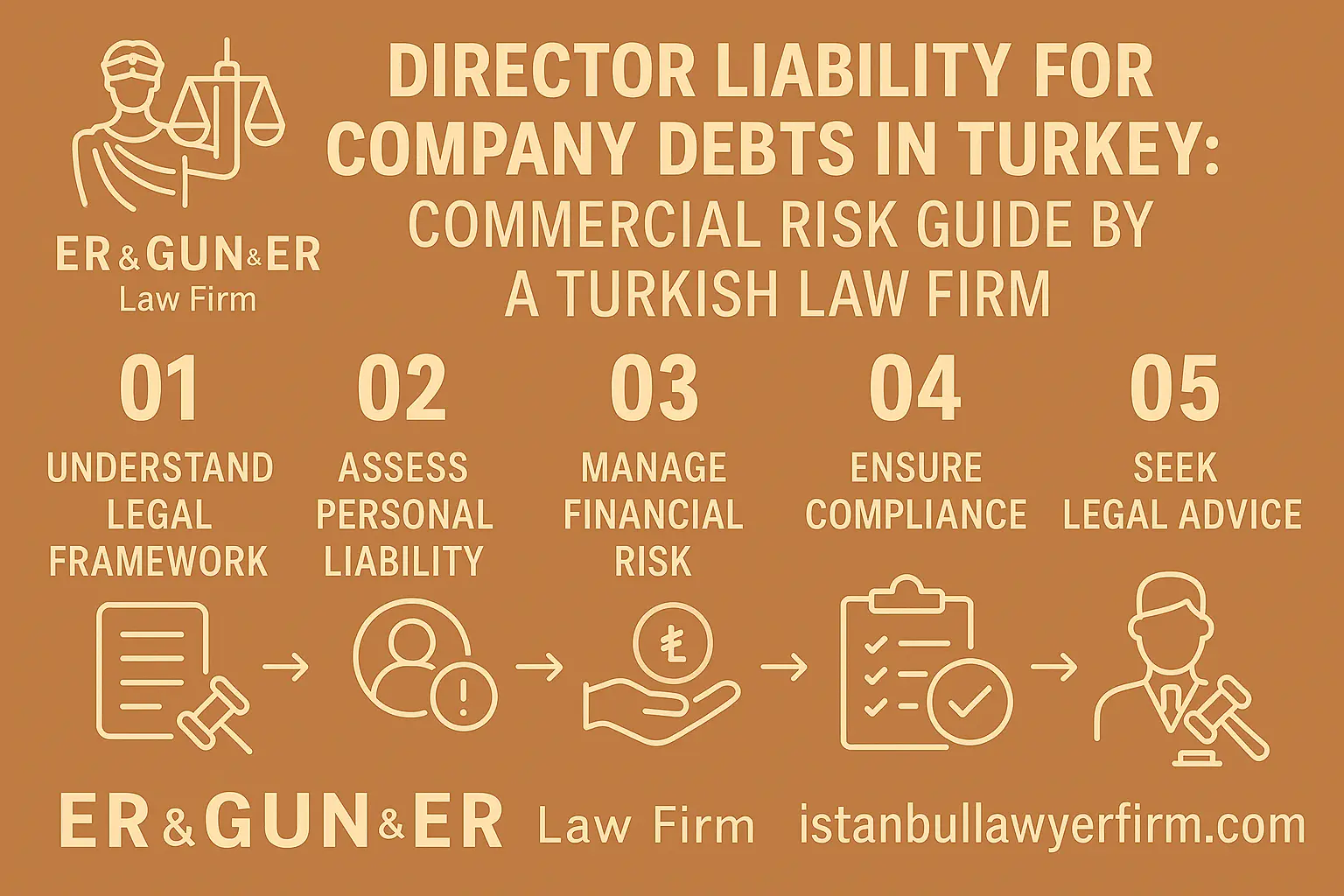
A lawyer in Turkey who advises company directors on personal liability for corporate debts understands that the Turkish Commercial Code's director duty framework, tax law's provisions for director personal liability, the insolvency regime's obligations on directors during financial distress and the civil litigation mechanisms that creditors use to reach director assets create a multi-dimensional personal exposure for company directors that is significantly more extensive than the formal corporate veil that limited liability company structure provides in theory. An Istanbul Law Firm that advises company directors on liability risk management provides comprehensive legal support across the complete liability management spectrum: assessing each director's specific personal liability exposure based on their role, decision authority, information access and the company's current financial and compliance position; designing the internal governance frameworks that demonstrate director duty compliance and reduce the probability that creditors, tax authorities or shareholders can successfully assert personal liability claims; managing tax authority enforcement proceedings where tax debt personal liability is asserted against individual directors; advising on personal guarantee review, limitation and termination strategies for directors who have provided or are being asked to provide personal security for company obligations; representing directors in commercial court litigation where creditor claims target both the company and individual directors; advising on director obligations during insolvency and restructuring proceedings and the personal liability that arises from insolvency rule violations; and designing D&O insurance coverage, contractual indemnification and asset protection strategies that provide financial protection when director liability claims cannot be avoided through preventive governance measures. A Turkish Law Firm with experience advising directors in commercial liability situations brings practical knowledge of how Turkish commercial courts evaluate director duty breach claims, what governance documentation most effectively demonstrates director diligence in liability proceedings, and how tax authorities approach personal director liability assertions for corporate tax debts—enabling defense strategies calibrated to how Turkish enforcement actually operates rather than theoretical liability principles. An English speaking lawyer in Turkey who advises foreign directors on Turkish director liability provides the bilingual legal guidance that enables international board members to understand the specific Turkish legal obligations that apply to them as directors of Turkish companies, which may differ significantly from director duties under their home jurisdiction's company law, and to implement the governance practices that satisfy Turkish standards rather than relying on home-country practices that may not meet Turkish requirements.
Statutory Duties, Duty of Care and Personal Liability Triggers
A lawyer in Turkey who advises on director duties under Turkish commercial law explains that the Turkish Commercial Code imposes a comprehensive duty framework on company directors—including the duty to exercise the diligence of a prudent businessperson in company management under Article 369, the duty of loyalty requiring directors to act in the company's interest rather than their own, specific fiduciary duties regulating conflict of interest management, and a range of non-delegable duties under Article 375 that directors cannot discharge by delegating to management—and that breach of any of these duties creates personal liability exposure for directors who have not exercised the care required by the applicable standard. An Istanbul Law Firm that assesses director duty compliance for company boards identifies the most common personal liability trigger patterns that Turkish commercial courts evaluate in director liability claims: directors who approved transactions in which they had undisclosed conflicts of interest that prevented independent decision-making; directors who approved related-party transactions at terms unfavorable to the company without the independent oversight that fairness protection requires; directors who failed to address identified compliance deficiencies that subsequently caused significant company loss or creditor harm; directors who continued trading when they knew or should have known that the company was insolvent, accumulating debts that could not be repaid to creditors who relied on the company's continued commercial activity; and directors who approved dividend distributions or capital reductions that left the company unable to satisfy its creditor obligations. Turkish lawyers advising on liability trigger assessment help directors understand the specific factual patterns that create the most significant personal liability risk in their specific company context—enabling governance improvements targeted at the highest-risk liability scenarios rather than generic board practice improvements without prioritization. Practice may vary by authority and year — verify current Turkish Commercial Code director duty provisions and their current judicial interpretation, current Turkish court standards for assessing director diligence in commercial litigation, and current liability trigger assessment standards applicable to your specific company type and sector before assessing any director's personal liability exposure.
An Istanbul Law Firm that advises on the duty of care standard applicable to Turkish company directors explains that the prudent businessperson standard of Article 369 requires directors to exercise not merely subjective good faith but an objective level of care benchmarked against what a knowledgeable, diligent director in comparable circumstances would have done—meaning that directors who make business decisions without adequate information, without adequate analysis of available information, without proper board process or with excessive speed that prevents genuine deliberation may fail to satisfy the applicable standard even if their subjective intentions were entirely legitimate. Turkish lawyers advising on duty of care compliance help directors implement the specific governance practices that most effectively demonstrate objective duty of care satisfaction: maintaining documented records of the information available to the board at the time of each significant decision; documenting the analysis and deliberation that supported each significant decision rather than recording only the decision outcome; implementing structured decision-making processes that require consideration of specified risk factors for decisions above identified materiality thresholds; and establishing independent review mechanisms for transactions involving related parties or significant value that provide the independent assessment that arm's-length standard compliance requires. An English speaking lawyer in Turkey who advises foreign directors on Turkish duty of care requirements helps international board members understand how Turkish commercial courts evaluate director decision-making quality—focusing on whether the decision-making process was adequate rather than whether the business decision proved commercially correct—enabling foreign directors to implement the governance documentation practices that satisfy Turkish standards rather than relying on home-country governance practices that may not produce the same documentation results.
A Turkish Law Firm that advises on the non-delegable duties of Turkish company directors under Article 375 explains that certain fundamental director responsibilities cannot be effectively delegated to management or third parties—including the duties to establish and maintain the organizational infrastructure of the company, to monitor management performance through adequate oversight mechanisms, to review and approve the company's annual accounts and reports, and to take the necessary steps to protect the company's solvency and creditor interests when financial distress is identified. An English speaking lawyer in Turkey who advises on non-delegable duty compliance for directors of Turkish companies helps directors understand the specific practical implications of these non-delegable obligations: directors cannot fully discharge their duty to monitor management performance by appointing competent management and then taking no further interest in whether that management is performing adequately; directors cannot discharge their duty to respond to financial distress by delegating crisis management to the CFO without board-level monitoring of the crisis response and board-level decision-making on strategic options; and directors cannot avoid personal liability for failure to address identified governance problems by demonstrating that they delegated responsibility for addressing those problems without follow-up to confirm that the delegated actions were actually completed.
Creditor Rights, Debt Liability and Veil-Piercing
A lawyer in Turkey who advises on creditor rights against company directors explains that while the limited liability principle under Turkish company law generally protects shareholders and directors from personal liability for company debts, Turkish commercial law and judicial practice recognize circumstances in which the corporate veil separating the company from its directors and shareholders can be pierced—enabling creditors to reach director and shareholder personal assets when specific conditions demonstrating abuse of corporate form are satisfied. An Istanbul Law Firm that advises on corporate veil piercing risk for company directors identifies the specific factual patterns that Turkish courts have recognized as supporting veil-piercing claims: commingling of company and personal assets by directors who treat company funds as personally available rather than maintaining clear financial separation; undercapitalization of the company from its establishment combined with director knowledge that the company could not satisfy its contemplated obligations without additional funding; systematic disregard of corporate formalities including failure to maintain separate accounts, failure to hold required board meetings, failure to document significant corporate decisions; and asset diversion where company assets are transferred to directors or related parties at undervalue in circumstances suggesting the transfers were designed to defeat creditor claims. Turkish lawyers advising on corporate veil piercing defense help directors understand what governance practices most effectively demonstrate respect for corporate form: maintaining fully separate company and personal financial accounts with no intermingling; documenting all transactions between the director and the company as arm's-length commercial transactions with appropriate board approval; maintaining complete corporate records including board minutes, shareholder resolutions and financial accounts; and ensuring that capital contributions to the company are genuine equity investments rather than loan arrangements that lack the substance of genuine equity. Practice may vary by authority and year — verify current Turkish commercial court standards for veil-piercing claims, current judicial interpretation of the conditions that support corporate veil disregard, and current evidentiary standards for demonstrating respect for corporate form before assessing any director's veil-piercing exposure.
An Istanbul Law Firm that advises on preferential transaction liability for directors explains that Turkish law provides creditors in insolvency proceedings with the ability to set aside certain transactions completed by the company before insolvency was declared—including payments to connected parties, asset transfers at undervalue, and grants of security for pre-existing debts made within specified periods before the insolvency petition—and that directors who authorized these transactions may face personal liability claims where the transactions are found to have been intended to prefer specific creditors or to remove assets from the reach of general creditors. Turkish lawyers advising on preferential transaction risk management help directors identify and avoid the transaction patterns most likely to be challenged in subsequent insolvency proceedings: pre-insolvency payments to related parties that exceed arm's-length market terms; security grants to existing unsecured creditors in the period before insolvency petition that convert those creditors' position relative to other unsecured creditors; and asset transfers to directors or connected parties in the period before insolvency at prices below independent market valuation. An English speaking lawyer in Turkey who advises international directors on Turkish insolvency-related transaction risk provides practical guidance on the specific transactions that create the highest personal liability risk in the Turkish insolvency context and the documentation practices that most effectively demonstrate that challenged transactions satisfied the arm's-length and good-faith standards that provide the strongest available defenses to preferential transaction claims.
A Turkish Law Firm that advises on commercial court litigation defense for directors facing creditor claims explains that when creditors initiate personal liability claims against directors—whether through direct creditor claims, derivative claims brought on behalf of the company, or claims consolidated with company debt recovery actions—the litigation response must be both legally precise and strategically coordinated with the company's own defense to prevent the inconsistencies between company and director positions that creditors frequently exploit in consolidated proceedings. An English speaking lawyer in Turkey who manages commercial litigation defense for directors facing personal liability claims coordinates each element of the director's individual defense: analyzing the specific legal basis for the creditor's personal liability claim and identifying the strongest available defenses to each element; preparing director witness testimony and evidence documentation that supports the personal liability defense without creating inconsistencies with the company's defense position in parallel proceedings; and coordinating settlement strategy in cases where commercial resolution of the personal liability claim would serve the director's interests more effectively than continued litigation of the underlying claim through the full trial process.
Tax Liability of Directors and Board Responsibility
A lawyer in Turkey who advises on director personal liability for corporate tax debts explains that Turkey's tax legislation—specifically the Tax Procedure Law's provisions on secondary liability (müşterek ve müteselsil sorumluluk) for company officers—creates personal tax liability for company directors and representatives when the company fails to pay specified categories of tax obligations including corporate income tax, withholding taxes, VAT and social security contributions, and the tax authority is unable to collect the outstanding amounts from the company itself. An Istanbul Law Firm that advises on tax liability risk for company directors helps directors understand the specific conditions that activate personal tax liability: personal liability applies primarily where the director had authority over the tax-relevant functions that were not performed correctly—typically the signatory authority and financial oversight responsibility that most directors in active management roles possess; personal liability is activated by demonstration that the company's tax debts cannot be satisfied from company assets rather than requiring evidence of director personal fault for the tax failure in every case; and the order of collection procedure requires that the tax authority first pursue the company before pursuing directors personally, but this protection is lost when the company demonstrably lacks assets sufficient to satisfy the outstanding tax obligation. Turkish lawyers advising on director tax liability management help directors implement the specific measures that most effectively limit personal tax liability exposure: maintaining adequate segregation between strategic director responsibilities and operational management including tax compliance management to reduce the scope of director functions that create tax liability triggers; ensuring that boards receive regular financial reporting that includes specific information about tax payment compliance and any tax compliance deficiencies that have been identified; and ensuring that identified tax compliance deficiencies are addressed promptly rather than allowed to accumulate into material tax debt obligations. Practice may vary by authority and year — verify current Turkish Tax Procedure Law provisions on secondary liability for company directors, current Tax Authority enforcement practice for director personal liability assertions, and current limitation periods for director tax liability claims before assessing any director's personal tax liability exposure.
An Istanbul Law Firm that manages tax authority enforcement defense for directors facing personal liability assertions explains that when the Turkish Revenue Administration initiates personal liability collection action against a director for company tax debts, the director has access to specific administrative and judicial defense mechanisms that must be activated promptly to be effective—and that directors who do not respond to tax authority collection notices within applicable deadlines lose their right to contest the personal liability assessment through the administrative challenge procedures that provide the most efficient defense pathway. Turkish lawyers managing tax enforcement defense for directors implement the specific procedural steps that protect directors' rights most effectively: filing timely administrative objections to personal liability assessments within the 30-day statutory period from notification; preparing documentation demonstrating that the director lacked the specific decision authority over tax compliance functions that activation of personal liability requires; and where administrative challenge is unsuccessful, initiating judicial review before the competent tax court within applicable appeal deadlines. An English speaking lawyer in Turkey who manages tax enforcement defense for international directors in Turkish companies coordinates the Turkish tax defense with the director's overall financial position and any parallel tax compliance obligations in other jurisdictions—ensuring that responses to Turkish tax authority collection actions are consistent with positions taken in other relevant proceedings and that the director's overall tax compliance posture is managed coherently across all relevant jurisdictions.
A Turkish Law Firm that advises on cross-border tax planning for directors with international income explains that directors of Turkish companies who have international compensation arrangements—including compensation from foreign parent companies, international management fees, dividend income from Turkish company shares and salary income from employment arrangements spanning multiple jurisdictions—face complex tax compliance obligations that require coordinated planning to satisfy both Turkish and foreign tax authority requirements without creating inadvertent double taxation or compliance gaps. An English speaking lawyer in Turkey who advises on cross-border tax planning for international directors coordinates with the director's foreign tax advisors to ensure that international compensation arrangements are structured and reported consistently in each relevant jurisdiction, that applicable bilateral tax treaty benefits are claimed correctly, and that the director's overall international tax position is defensible to tax authorities in each jurisdiction where tax compliance obligations arise from the director's Turkish and international activities.
Personal Guarantees, Insolvency and Insurance Strategies
A lawyer in Turkey who advises on personal guarantee risk for company directors explains that directors of Turkish companies—particularly directors of small and medium-sized companies and directors of subsidiaries seeking credit from Turkish banks—are frequently asked to provide personal guarantees securing corporate loan obligations, and that these guarantee arrangements fundamentally alter the director's relationship to company debt by converting the director from a corporate fiduciary protected by limited liability into a direct personal debtor whose personal assets are at risk if the company defaults on the guaranteed obligations. An Istanbul Law Firm that advises on personal guarantee strategy for company directors helps directors evaluate each guarantee request with the specific legal and commercial analysis that protects their interests: reviewing the specific guarantee terms including the amount guaranteed, whether the guarantee covers only principal or also interest and enforcement costs, whether the guarantee has any limitation on duration or circumstances that trigger recall, and whether the guarantee creates unlimited or capped personal exposure; assessing whether the guarantee terms proposed by the lender are commercially standard or contain unusual provisions that create disproportionate personal exposure relative to the credit facility's commercial terms; and identifying the specific negotiating points where guarantee scope, amount or conditions can be modified to reduce director personal exposure while maintaining the security that the lender's credit assessment requires. Turkish lawyers advising on guarantee negotiation help directors understand the common guarantee modifications that lenders will consider: temporal limitations that restrict the guarantee's coverage to specified initial periods after which the guarantee can be reviewed or released; proportionality caps that limit personal guarantee exposure to a defined percentage of the outstanding facility balance rather than full unlimited exposure; co-guarantee arrangements that distribute personal exposure across multiple directors rather than concentrating full exposure on a single guarantor; and carve-outs from guarantee scope for specific categories of company obligation that represent higher-risk exposures the director is unwilling to personally guarantee. Practice may vary by authority and year — verify current Turkish commercial court standards for guarantee enforceability, current Turkish Civil Code provisions on guarantee scope and limitation, and current banking sector practice for guarantee requirements applicable to your specific credit facility type before assessing or negotiating any personal guarantee arrangement.
An Istanbul Law Firm that advises on director obligations during company insolvency explains that when a Turkish company enters formal insolvency proceedings—whether through bankruptcy petition (iflas), concordat restructuring proceeding or voluntary liquidation—the directors face specific legal obligations that differ from their normal course-of-business governance duties and whose violation creates additional personal liability beyond the governance liability arising from the events that caused the insolvency. Turkish lawyers advising on director insolvency obligations help directors understand each obligation and its compliance requirements: the duty to provide the insolvency trustee with complete and accurate information about the company's assets, liabilities, creditors and business operations, with personal liability for material omissions or inaccuracies; the duty to avoid taking actions during the insolvency proceeding that benefit specific creditors or counterparties at the expense of the general creditor pool, with preferential transaction liability for unauthorized payments or asset transfers after the insolvency petition; the duty to cooperate with court-appointed trustees, insolvency administrators and creditor committees, with personal accountability for obstructing or delaying insolvency administration; and the duty to refrain from continuing trading activities that incur new debts that the insolvency estate cannot satisfy, with personal liability for new debts incurred after the director knew or should have known that the company was insolvent. An English speaking lawyer in Turkey who advises foreign directors on Turkish insolvency obligations provides the Turkish law-specific guidance that enables directors unfamiliar with Turkish insolvency procedure to understand and fulfill their specific obligations under Turkish law—preventing the inadvertent violation of insolvency rules through failure to understand the specific Turkish requirements rather than through deliberate non-compliance.
A Turkish Law Firm that advises on D&O insurance and director indemnification for Turkish companies explains that Directors and Officers liability insurance is an important but frequently inadequately understood element of the director liability protection toolkit—because policy terms, coverage limits, exclusions and notification requirements vary significantly across products, and directors who assume their D&O coverage provides comprehensive protection may find that specific exclusions or coverage gaps leave them personally exposed precisely when the insurance protection is most needed. An English speaking lawyer in Turkey who advises on D&O insurance adequacy for director liability risk in Turkey reviews each policy's specific terms for the coverage dimensions most relevant to Turkish director liability scenarios: whether the policy covers Turkish court proceedings and Turkish regulatory investigation defense costs as they are incurred; whether the policy's exclusions for deliberate misconduct, known circumstances and regulatory sanctions will apply to the director liability scenarios most likely to arise in the specific company's context; whether the policy's territorial scope specifically covers Turkish proceedings rather than being primarily designed for home-country director liability scenarios; and whether the coverage limits are adequate for the quantum of director liability claims that the specific company's creditor profile and business scale could generate. The best lawyer in Turkey for director liability matters combines deep knowledge of Turkish Commercial Code director duties, Turkish tax law's director liability provisions, Turkish insolvency law's director obligations and Turkish commercial court litigation practice—providing comprehensive personal liability risk management advice that addresses every relevant legal dimension rather than providing narrowly focused advice that may miss important liability exposures outside the primary advisory focus.
Corporate Governance Best Practices and Liability Prevention
A lawyer in Turkey who advises on corporate governance best practices for director liability prevention explains that the most effective approach to managing personal director liability in Turkey is implementing genuine governance structures that actually produce the company management quality and compliance they are designed to ensure—rather than formal compliance documentation that exists on paper without substantially influencing how the company is actually managed—because Turkish commercial courts evaluating director liability claims assess whether governance was substantive and effective rather than whether governance documents exist. An Istanbul Law Firm that designs corporate governance frameworks for director liability prevention implements governance structures calibrated to each company's specific risk profile: board composition and committee structures that provide the independent oversight mechanisms most relevant to the company's specific risk categories; decision-making authority frameworks that clearly delineate which decisions require board approval versus management authority, preventing both excessive delegation that creates governance gaps and excessive board involvement that prevents efficient management; information and reporting systems that provide directors with accurate, timely and relevant information about company performance and risk in formats that enable effective governance oversight without overwhelming directors with information that cannot be meaningfully used; and accountability mechanisms including internal audit, external audit coordination and management performance evaluation that enable boards to verify that management's governance representations are accurate. Turkish lawyers designing governance frameworks help directors understand that governance documentation serves two simultaneous purposes—genuine management effectiveness and liability defense evidence—and that governance frameworks must satisfy both purposes rather than being optimized for one at the expense of the other. Practice may vary by authority and year — verify current Turkish Commercial Code corporate governance requirements, current sector-specific governance requirements applicable to your company's industry, and current Turkish court standards for evaluating governance adequacy in director liability proceedings before designing any corporate governance framework.
An Istanbul Law Firm that advises on board meeting and documentation practices for director liability reduction explains that the specific practices through which board meetings are conducted and documented create the evidentiary record that director liability proceedings will examine—and that the difference between contemporaneous board minutes that accurately reflect substantive governance deliberation and formulaic minutes that record only formal actions without documenting the deliberative process is frequently the difference between a successful governance defense and a successful creditor claim that directors failed to exercise adequate oversight. Turkish lawyers advising on board documentation practices help directors implement specific documentation approaches that create the strongest available governance defense: recording in minutes not only the decisions reached but the information available to the board, the specific risks considered, the analysis applied to available information and the reasoning supporting each significant decision; documenting dissenting views and minority positions within the board that demonstrate genuine deliberation rather than unanimous rubber-stamping of management proposals; creating contemporaneous records of material information provided to the board through written reports, expert presentations and management briefings rather than relying on later reconstructed accounts of what information was available when decisions were made; and maintaining complete and accurate attendance records that demonstrate which directors were present for each decision and participated in each vote. An English speaking lawyer in Turkey who advises on board documentation practices for international directors in Turkish companies ensures that documentation practices satisfy Turkish legal requirements for corporate governance records—which may specify particular formalities for minutes, resolution formats and record retention—rather than relying on home-country documentation practices that may not produce the same legal protection in the Turkish context.
A Turkish Law Firm that advises on continuous compliance monitoring for director liability prevention explains that director liability risk is not a static condition that can be assessed once and then managed without further attention—because changes in company financial condition, changes in regulatory requirements, changes in the commercial relationships that create director duty obligations and changes in the company's governance personnel all create new liability exposures that require ongoing assessment and responsive governance adjustment rather than single-point compliance verification. An English speaking lawyer in Turkey who provides ongoing compliance monitoring for company directors implements a structured monitoring program that identifies and responds to director liability risk changes as they arise: regular review of company financial indicators for signs of financial distress that trigger enhanced director oversight obligations and potential insolvency-related duty changes; monitoring of regulatory requirement changes that affect director compliance obligations in the company's specific sector; periodic review of related-party transactions and key contracts for compliance with director duty standards; and annual comprehensive director liability risk assessment that evaluates each director's current exposure based on the company's current situation rather than last year's assessment that may not reflect current circumstances. Directors who invest in continuous compliance monitoring consistently maintain better governance quality, identify problems earlier when they are more easily addressed, and accumulate the contemporaneous compliance documentation that creates the strongest available liability defense when director conduct is later scrutinized in commercial litigation or regulatory proceedings.
Litigation Risks and Commercial Dispute Defense Strategies
A lawyer in Turkey who advises on commercial litigation defense for directors explains that when company directors face personal liability claims in Turkish commercial courts—whether brought by creditors as direct defendants, by shareholders in derivative claims on behalf of the company, or by tax authorities asserting personal tax debt liability—the litigation preparation and defense strategy must address both the substantive legal elements of the specific claim type and the procedural demands of Turkish commercial court proceedings, which operate under specific evidentiary and pleading standards that differ from proceedings in many foreign jurisdictions where international directors may have prior litigation experience. An Istanbul Law Firm that manages commercial court litigation defense for directors builds each director's defense around the specific legal basis of the claim being advanced: statutory duty breach claims require demonstrating that the director's governance conduct satisfied the applicable duty of care standard through documented deliberation, information adequacy and process compliance; creditor claims for fraudulent or preferential transactions require demonstrating that the challenged transactions were conducted at arm's-length, on commercially reasonable terms, and without intent to defeat creditor interests; and tax authority personal liability claims require demonstrating either that the director lacked the specific decision authority that activates personal tax liability or that the company's assets at the time of the tax assessment were sufficient to satisfy the obligation without resort to personal collection. Turkish lawyers managing director litigation defense coordinate the director's individual defense with the company's parallel defense where both are defendants in the same proceedings—because the inconsistencies between company and director positions that arise when each is defended without coordination can be exploited by plaintiffs to undermine both defenses simultaneously. Practice may vary by authority and year — verify current Turkish commercial court procedural requirements for director liability claims, current evidentiary standards and expert witness procedures in commercial litigation, and current limitation periods applicable to each director liability claim category before preparing any litigation defense strategy.
An Istanbul Law Firm that advises on interim measures and asset protection for directors facing commercial liability claims explains that creditors who initiate director personal liability claims frequently also apply for interim protective measures—including precautionary seizure (ihtiyati haciz) of director assets before final judgment—and that responding effectively to these interim measure applications requires both understanding the legal standards applicable to precautionary seizure and maintaining adequate documentation of the director's asset and financial position that enables appropriate challenge to the scope of any approved interim measures. Turkish lawyers managing asset protection for directors facing potential seizure applications help directors understand the legal standards for precautionary seizure—which requires the applicant to demonstrate a credible underlying claim and circumstances justifying emergency preservation before a final judgment is available—and identify the specific procedural mechanisms available to challenge interim measures that are disproportionate to the underlying claim's realistic maximum value. An English speaking lawyer in Turkey who advises foreign directors on Turkish commercial litigation interim measures provides the urgent bilingual legal response capacity that enables directors who do not speak Turkish to receive immediate advice and representation when unexpected litigation developments—including interim measure notifications received through Turkish court processes—require prompt action to protect the director's interests.
A Turkish Law Firm that advises on settlement strategy in director liability commercial litigation explains that commercial resolution of director liability claims—through negotiated settlement with creditors, restructured payment arrangements with tax authorities or mediated resolution of shareholder disputes—can in many cases produce significantly more favorable outcomes for directors than continued litigation of claims whose underlying factual basis creates genuine personal liability risk. Turkish lawyers advising on settlement strategy help directors evaluate the specific factors that affect each claim's settlement value and the director's optimal settlement position: the realistic probability of the plaintiff succeeding on each element of the claim at trial based on the available evidence; the realistic quantum of damages or liability that a court would impose if the plaintiff succeeds; the direct and indirect cost of continued litigation including management time, legal expense, reputational impact and distraction from productive activity; and the specific settlement terms—including payment amount, payment timeline, confidentiality conditions and any non-admission language—that would achieve adequate resolution of the plaintiff's claim without creating precedent or admissions that affect the director's position in other pending or potential claims. An English speaking lawyer in Turkey who advises on settlement negotiations for international directors in Turkish commercial litigation provides the bilingual negotiation and documentation service that enables settlement discussions to proceed efficiently between Turkish-speaking plaintiffs and foreign directors whose participation in settlement discussions requires accurate translation and cross-cultural communication management.
D&O Insurance, Indemnification and Asset Protection Planning
A lawyer in Turkey who advises on comprehensive director asset protection planning explains that effective personal liability risk management for Turkish company directors requires a layered approach that combines preventive governance measures reducing liability probability, insurance coverage providing financial protection when liability nevertheless arises, contractual indemnification providing company-funded backup when insurance coverage has gaps, and where appropriate, legal asset structuring that places assets in legally protected positions without constituting the fraudulent asset dissipation that would itself create director liability. An Istanbul Law Firm that designs comprehensive director protection programs helps directors implement each layer of this protection framework in a manner that is legally sound and practically effective: evaluating whether current D&O insurance provides adequate coverage for the specific director liability scenarios most likely in the company's particular commercial context; reviewing contractual indemnification provisions in director service agreements and company articles to confirm their scope, any applicable limitations and the conditions under which they can actually be invoked; and advising on legal asset organization that provides the director with appropriate financial resilience without constituting the kind of pre-emptive asset removal that courts treat as evidence of consciousness of wrongdoing. Turkish lawyers advising on director protection planning help directors understand that there is no single adequate protection mechanism—each mechanism has gaps that the others fill, and effective protection requires all three layers operating together rather than relying exclusively on any one mechanism. Practice may vary by authority and year — verify current Turkish commercial law standards for director indemnification scope and limitation, current D&O insurance market standards and policy terms for Turkish director liability coverage, and current Turkish law standards for distinguishing legitimate asset organization from fraudulent dissipation before designing any director asset protection strategy.
An Istanbul Law Firm that advises on D&O insurance claim management for directors explains that when a director liability claim arises that potentially falls within D&O insurance coverage, the specific steps taken in the first days and weeks after the claim arises—including timely notification to the insurer, cooperation with insurer investigation, and management of conflicts between company and director insurance interests—determine whether coverage is preserved or lost through procedural breach of policy conditions. Turkish lawyers managing D&O insurance claims for director clients provide immediate guidance on policy notification requirements and insurer cooperation obligations from the moment a claim is identified as potentially covered—preventing the inadvertent breach of notification deadlines or cooperation conditions that insurers frequently cite as grounds for coverage denial on procedural grounds independent of the underlying claim's merits. An English speaking lawyer in Turkey who advises foreign directors on D&O insurance claims in Turkey coordinates with the director's global D&O program where the Turkish policy is part of an international coverage structure—ensuring that notifications under the Turkish policy are consistent with notifications under related policies in other jurisdictions and that the overall insurance claim strategy maximizes available coverage across the complete relevant insurance program.
A Turkish Law Firm that advises on the interaction between director contractual indemnification and D&O insurance explains that the practical availability of contractual indemnification—where the company agrees to reimburse the director for personal liability arising from company governance—depends on both the legal enforceability of the indemnification provision and the company's financial capacity to fund the indemnification when the director liability claim arises. An English speaking lawyer in Turkey who advises on director indemnification availability assessment helps directors understand the specific conditions under which their contractual indemnification is enforceable under Turkish law—particularly the categories of liability for which Turkish law permits company indemnification and the categories for which indemnification would be void as contrary to public policy—and provides realistic assessment of the company's financial capacity to fund any indemnification obligation given the circumstances that typically accompany director liability claims, which frequently arise in connection with company financial distress situations where the company's own financial resources may be severely constrained precisely when indemnification obligations would need to be funded. Directors who understand both the legal and practical limitations of their contractual indemnification are better positioned to make realistic assessments of their personal financial exposure and to design supplementary protection through D&O insurance and other mechanisms that address the gaps that contractual indemnification cannot reliably fill.
International Directors and Cross-Border Liability Considerations
A lawyer in Turkey who advises on director liability for international directors serving on Turkish company boards explains that foreign nationals who serve as directors of Turkish companies are subject to the complete Turkish director duty framework—including all Turkish Commercial Code obligations, Turkish tax law personal liability provisions and Turkish insolvency rules—regardless of their nationality, home country residence or the fact that their Turkish director role may be one of multiple board memberships they hold in companies in different countries. An Istanbul Law Firm that advises foreign directors on their Turkish obligations helps international board members understand the specific ways in which Turkish director duties may differ from their home-jurisdiction director duties: the scope of Turkish non-delegable duties under Article 375 which cannot be discharged through delegation even where the director's practical involvement in day-to-day company management is minimal; the Turkish tax law's director personal liability framework which activates on the basis of signatory authority rather than requiring proof of specific fault for each tax compliance failure; and the Turkish commercial court's assessment of director diligence which applies an objective prudent businessperson standard that requires active engagement rather than passive attendance at board meetings. Turkish lawyers advising on foreign director governance compliance help international board members implement the specific governance practices that satisfy Turkish standards—providing Turkish-law-specific board training that supplements rather than replaces the home-country governance knowledge these directors bring from their other board roles. Practice may vary by authority and year — verify current Turkish Commercial Code application to foreign national directors, current Turkish corporate governance requirements applicable to each company type, and current Turkish commercial court practice in director liability cases involving foreign national directors before advising on any foreign director's specific obligations.
An Istanbul Law Firm that advises on multi-jurisdictional director liability coordination for directors who serve on boards in multiple countries explains that a director who serves on boards of companies in multiple jurisdictions may face simultaneous or sequential director liability proceedings in multiple countries arising from the same underlying commercial event—and that managing multi-jurisdictional director liability effectively requires coordination of legal strategy across all relevant jurisdictions rather than treating each country's proceedings as independent matters without strategic connection. Turkish lawyers advising on multi-jurisdictional coordination help directors and their advisors in other countries understand the specific Turkish law dimensions of cross-border liability situations: how Turkish law characterizes specific transactions or governance failures that may be characterized differently under another jurisdiction's law; how Turkish evidentiary standards apply to documents and evidence generated in foreign jurisdictions; and how Turkish limitation periods and procedural deadlines interact with the timelines applicable in parallel foreign proceedings. An English speaking lawyer in Turkey who coordinates Turkish proceedings with parallel foreign matters provides the cross-border legal intelligence that enables the overall multi-jurisdictional defense strategy to be coordinated rather than having each country's proceedings managed without reference to the others in a manner that may create strategic inconsistencies that undermine the director's position across all relevant proceedings.
A Turkish Law Firm that advises on exit planning and succession for directors seeking to reduce Turkish director liability exposure explains that directors who wish to reduce or eliminate their Turkish director liability exposure through resignation or board composition change must carefully manage the exit process to ensure that the resignation eliminates future liability obligations without inadvertently waving rights in existing liability claims or creating the appearance of guilt-motivated resignation that can itself be used adversely in any pending proceedings. An English speaking lawyer in Turkey who advises international directors on managed exit from Turkish board positions helps directors implement exits that satisfy the specific Turkish corporate formalities required for effective board resignation—including proper written resignation notice, board acknowledgment and where required regulatory registration of the change in board composition—while protecting the director's ongoing rights in any pending claims related to their tenure and ensuring that exit communications are managed in a manner consistent with the director's litigation position in any proceeding where the resignation might otherwise be cited adversely. The best lawyer in Turkey for director liability matters provides the integrated commercial, tax and litigation expertise that enables directors facing personal liability exposure to manage their risk across all relevant dimensions simultaneously—combining preventive governance advice, enforcement defense, litigation strategy and asset protection planning in a coordinated approach that addresses the full spectrum of director liability risk rather than providing narrowly focused advice that misses important elements of the director's overall exposure.
Frequently Asked Questions
- Can Turkish company directors be personally sued for company debts? Yes, in specific circumstances. Directors who have provided personal guarantees for company debt are directly liable as debtors if the company defaults. Directors can face personal liability under Turkish commercial law for breach of director duties that causes company or creditor loss. Turkish tax law creates personal liability for directors when the company fails to pay specified tax obligations and company assets are insufficient for collection. Veil-piercing in cases of abuse of corporate form may also enable creditors to reach director assets. The specific circumstances and applicable legal basis vary by situation. Practice may vary by authority and year.
- What is the duty of care standard for Turkish company directors? Turkish Commercial Code Article 369 requires directors to exercise the diligence of a prudent businessperson in managing company affairs. This is an objective standard benchmarked against what a knowledgeable, diligent director would do in comparable circumstances—not merely a subjective good-faith standard. Directors who make decisions without adequate information, without appropriate analysis or without proper board process may fail to satisfy the standard even with good intentions. Demonstrating duty of care compliance requires contemporaneous documentation of the information available and the deliberation applied. Practice may vary by authority and year.
- When can creditors pierce the corporate veil and reach director assets? Turkish commercial courts may disregard the corporate veil separating directors from company liability when specific conditions of corporate form abuse are demonstrated: commingling of personal and company assets, systematic disregard of corporate formalities, undercapitalization combined with director knowledge that the company could not satisfy its obligations, and asset diversion to directors or related parties designed to defeat creditor claims. Each case requires specific factual demonstration of the applicable abuse. Strong corporate governance and financial separation documentation provides the strongest defense against veil-piercing claims. Practice may vary by authority and year.
- Are Turkish directors personally liable for unpaid company taxes? Yes. Turkish Tax Procedure Law creates secondary liability for company directors when the company fails to pay tax obligations including corporate income tax, withholding taxes, VAT and social security contributions, and company assets are insufficient for collection. The liability applies to directors with authority over the relevant tax compliance functions. Directors can contest personal tax liability assertions through administrative objection within 30 days of notification and through subsequent judicial review. Timely response is essential as missed deadlines eliminate administrative challenge rights. Practice may vary by authority and year.
- What should directors consider before signing a personal guarantee? Directors should assess the specific guarantee terms including amount guaranteed, whether coverage is limited or unlimited, duration, recall conditions and whether the guarantee creates joint and several or proportionate liability. They should evaluate whether guarantee scope can be negotiated to reduce personal exposure—including temporal limitations, proportionality caps, co-guarantee arrangements and carve-outs for high-risk obligations. They should understand that personal guarantees convert limited liability protection into direct personal debt obligation if the company defaults. Legal review of guarantee documentation before signing is strongly recommended. Practice may vary by authority and year.
- What are director obligations when a Turkish company becomes insolvent? Directors of insolvent Turkish companies must cooperate fully with appointed trustees and administrators by providing complete and accurate information about company assets and liabilities; avoid preferential payments or asset transfers that benefit specific creditors at the expense of general creditors; refrain from incurring new company debts that the insolvent estate cannot satisfy; cooperate with creditor committees; and comply with court orders and insolvency procedure requirements. Violation of these obligations creates personal liability for resulting creditor losses. Legal advice specific to the insolvency situation should be obtained immediately when financial distress indicators appear. Practice may vary by authority and year.
- Does D&O insurance adequately cover Turkish director liability? D&O insurance may cover certain categories of Turkish director liability depending on the specific policy's terms, coverage limits, exclusions and territorial scope. Common coverage gaps for Turkish scenarios include exclusions for regulatory fines, narrow territorial scope not specifically covering Turkish proceedings, exclusions for deliberate misconduct and coverage limits that may be inadequate for the quantum of claims that can arise from Turkish corporate disputes. Policy review by qualified legal counsel familiar with Turkish director liability scenarios is essential before assuming coverage adequacy. Annual policy review and update is recommended as company exposure changes. Practice may vary by authority and year.
- How does the Turkish Commercial Code regulate related-party transactions? Turkish Commercial Code imposes specific requirements for related-party transactions—transactions between the company and its directors, shareholders or their affiliates. Related-party transactions must generally be approved by the board with interested directors excluded from the approval decision, must be conducted on arm's-length terms that are no less favorable to the company than the terms available in an equivalent transaction with an unrelated party, and must be disclosed in the company's annual report. Directors who approve related-party transactions without satisfying these requirements face personal liability for resulting company loss. Practice may vary by authority and year.
- What is the role of corporate indemnification in Turkish director liability protection? Turkish companies can provide contractual indemnification for directors covering certain categories of director liability arising from their performance of director functions—protecting directors from personal financial loss through company funding of defense costs and adverse judgments. However, Turkish law limits permissible indemnification scope—indemnification for a director's own deliberate misconduct or gross negligence may exceed what Turkish law permits. Directors should obtain legal review of indemnification provisions in their service agreements and company bylaws to confirm their specific scope and any applicable limitations before relying on them as liability protection. Practice may vary by authority and year.
- What documentation most effectively demonstrates director diligence in litigation? The most effective governance defense documentation includes board minutes recording the specific information available, risks considered and reasoning applied to significant decisions; contemporaneous financial reporting received by the board demonstrating director awareness of the company's actual financial position; written records of compliance issues identified and director-directed responses confirming follow-up; related-party transaction approval records confirming compliance with arm's-length and board approval requirements; and any independent expert opinions or external advisors' reports informing significant board decisions. Contemporaneous records created before any dispute arises carry substantially more evidentiary weight than reconstructed accounts created after problems have emerged.
- Can directors resign to avoid liability for ongoing company problems? Resignation eliminates future governance obligations but does not retroactively eliminate liability for conduct that occurred during the director's tenure. Directors considering resignation should obtain legal advice before resigning because resignation timing can affect both the scope of continuing liability and the availability of certain defenses. Resignation timed to coincide with known problems may be interpreted adversely by courts and creditors as evasion rather than legitimate governance decision. Formal resignation procedures including proper notice, board record and regulatory registration where required should be followed regardless of circumstances. Practice may vary by authority and year.
- How does financial distress change director obligations? As a company's financial position deteriorates toward insolvency, director obligations shift—additional duties to protect creditor interests emerge alongside the normal duty to act in shareholders' interests, the range of permissible director actions narrows as protecting against further creditor loss becomes paramount, and specific duties including solvency monitoring, timely insolvency petition where applicable and avoidance of preferential transactions become operative. Directors who fail to recognize and respond appropriately to financial distress signals may face personal liability for losses occurring after they should have taken protective action. Early legal advice when financial distress indicators appear is strongly recommended. Practice may vary by authority and year.
- What are the most common director liability mistakes Turkish courts have addressed? Common patterns in Turkish director liability cases include: approving related-party transactions without independent board assessment and without documentation of arm's-length justification; continuing to incur company debts after becoming aware of insolvency without taking required protective steps; signing personal guarantees without adequate understanding of their full scope and personal financial impact; failing to maintain adequate records of board deliberation on significant decisions; neglecting to address identified compliance deficiencies within reasonable timeframes; and transferring company assets to related parties at undervalue during periods of financial distress. Each situation requires specific factual assessment but understanding these patterns enables proactive governance improvements that reduce the most common liability risks.
- How should foreign directors approach Turkish director duty compliance? Foreign directors of Turkish companies should obtain Turkish law-specific advice on their director obligations rather than relying on home-jurisdiction director duty frameworks, which may differ significantly from Turkish requirements. Specific attention is needed for Turkish Commercial Code's non-delegable duty provisions, Turkish tax law's director personal liability framework, Turkish corporate veil-piercing standards and Turkish insolvency procedure obligations—all of which may operate differently from comparable provisions in the director's home jurisdiction. Regular consultation with Turkish legal counsel throughout the director's tenure, not only when problems arise, is the most effective approach for foreign directors seeking to fulfill Turkish obligations accurately. Practice may vary by authority and year.
- Does ER&GUN&ER Law Firm advise company directors on personal liability risk in Turkey? Yes. ER&GUN&ER Law Firm provides comprehensive director liability advisory including statutory duty compliance assessment, corporate governance framework design, creditor rights and veil-piercing defense, tax authority enforcement defense, personal guarantee review and negotiation, commercial court litigation defense, insolvency obligation compliance, D&O insurance adequacy review, director indemnification structuring and ongoing compliance monitoring—with bilingual English-Turkish legal services throughout each engagement.
Author: Mirkan Topcu is an attorney registered with the Istanbul Bar Association (Istanbul 1st Bar), Bar Registration No: 67874. His practice focuses on cross-border and high-stakes matters where evidence discipline, procedural accuracy, and risk control are decisive.
He advises individuals and companies across Immigration and Residency, Real Estate Law, Tax Law, and cross-border documentation matters where procedural accuracy and evidence discipline are decisive.
Education: Istanbul University Faculty of Law (2018); Galatasaray University, LL.M. (2022). LinkedIn: Profile. Istanbul Bar Association: Official website.