

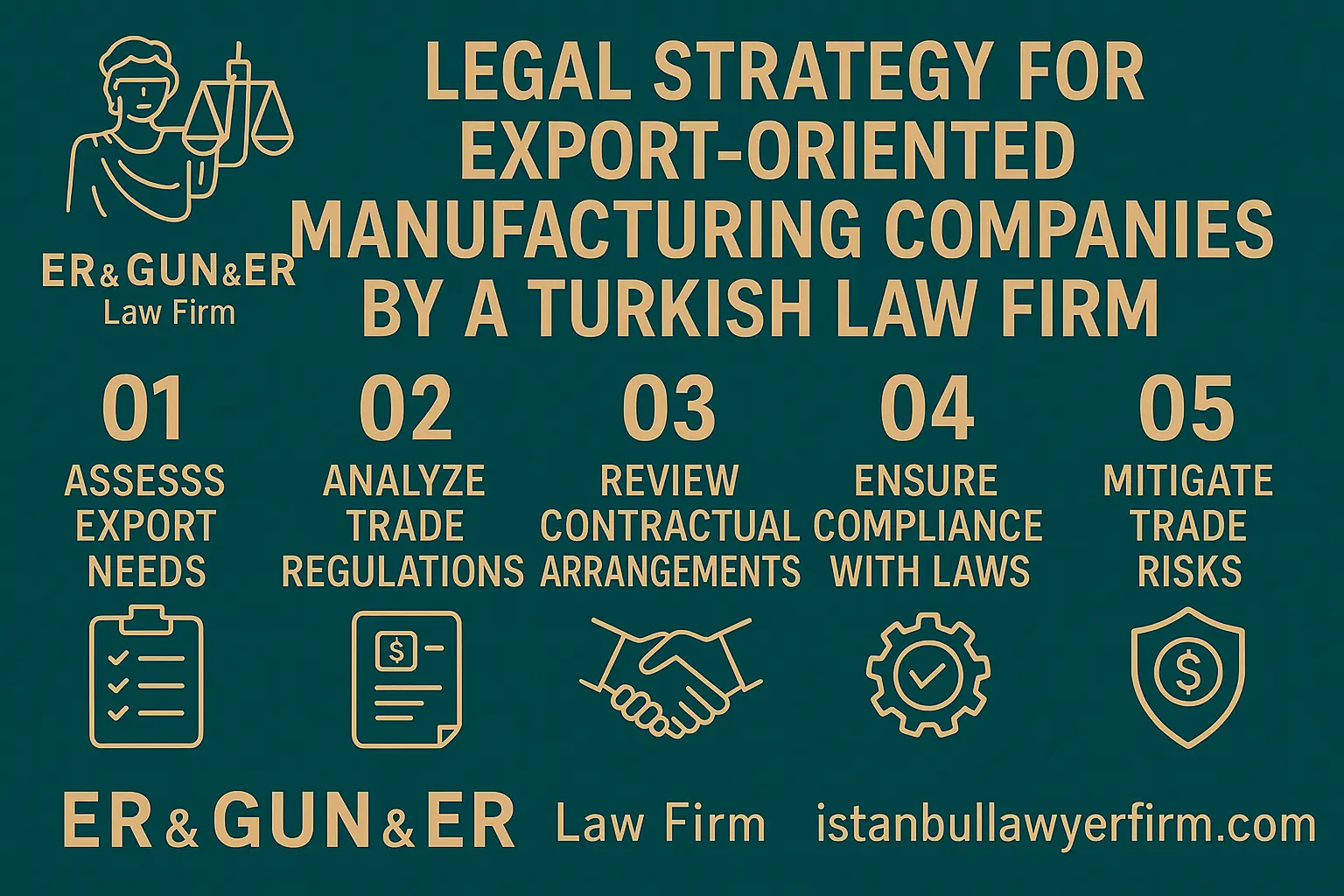
A lawyer in Turkey who advises export-oriented manufacturing companies understands that Turkish export manufacturers operate within a multifaceted legal ecosystem—spanning export licensing and customs compliance, commercial contracting across international supply chains, trade finance and payment security structures, investment incentive programs and free zone regulations, industrial zoning and environmental compliance, and ongoing post-shipment regulatory monitoring—whose components interact in ways that require integrated legal strategy rather than siloed compliance management. An Istanbul Law Firm that advises export manufacturing businesses provides comprehensive legal support across each dimension of the export manufacturing legal framework: securing export licenses, customs registrations, and free zone operating permits; drafting manufacturing contracts, supply chain agreements, and international sales contracts with the provisions that protect manufacturers' interests across jurisdictions; structuring trade finance instruments—letters of credit, bank guarantees, and escrow arrangements—that align with Turkish banking law and export regulatory requirements; identifying and securing investment incentives including VAT refunds, customs duty deferrals, and free zone benefits; advising on industrial zoning compliance and environmental regulatory requirements applicable to manufacturing facilities; and providing the ongoing regulatory monitoring and contract review that keeps export operations compliant as Turkish and international trade regulations evolve. A Turkish Law Firm that serves export manufacturers understands that the commercial pressures of international trade—tight delivery schedules, competitive pricing, and demanding quality standards—make legal certainty not a luxury but a prerequisite for sustainable export manufacturing operations. An English speaking lawyer in Turkey who advises foreign investors and international companies operating Turkish manufacturing facilities provides the bilingual communication that enables international stakeholders to understand Turkey's specific regulatory requirements and their interaction with the applicable international trade standards. Practice may vary by authority and year — verify current Turkish export regulatory requirements, current investment incentive program conditions, and current customs compliance standards with qualified counsel before implementing any export manufacturing legal strategy.
Export Licensing, Customs Compliance and Free Zone Authorizations
A lawyer in Turkey who advises on export regulatory compliance explains that Turkish export-oriented manufacturers must navigate a regulatory framework administered by multiple authorities—including the Ministry of Trade, customs administration, and sector-specific regulatory bodies—whose requirements must be satisfied simultaneously and whose compliance obligations interact in ways that make piecemeal regulatory management substantially less effective than integrated compliance planning. An Istanbul Law Firm that manages export regulatory compliance for manufacturing clients helps businesses understand the specific requirements applicable to their product categories: export license requirements under Turkish export regulations and the Export Control List, which applies to specific product categories including defense-related items, dual-use goods, and products subject to international trade restrictions—with the Harmonized System classification of each exported product determining which export control regime applies and what documentation must accompany each shipment; customs documentation requirements including the customs declaration, the invoice, the packing list, the certificate of origin, and any product-specific certificates—such as phytosanitary certificates for agricultural products, CE marking documentation for products sold to European markets, and conformity certificates for specific regulated product categories—whose absence or incorrectness causes customs clearance delays; and free zone operating requirements for manufacturers established in Turkish free zones, including zone operating licenses, annual investment and production reporting, employment rules, and the specific conditions governing raw material importation and finished goods exportation. Turkish lawyers advising on export regulatory compliance help manufacturers build systematic compliance management processes that identify required documentation for each product category and each destination market before shipments are scheduled rather than discovering documentation gaps when cargo is already at customs. Practice may vary by authority and year — verify current export control classifications, current customs documentation requirements, and current free zone operating conditions with qualified counsel before planning any export shipment or free zone establishment.
An Istanbul Law Firm that advises on customs compliance for export manufacturers explains that correct customs classification and valuation—the two elements most frequently contested in customs disputes—require both technical knowledge of the Harmonized System and Turkish customs law and the documentary discipline that produces auditable records supporting each classification and valuation decision. Turkish lawyers advising on customs compliance help manufacturers implement the specific practices most effective for managing classification and valuation risk: establishing and documenting the correct Harmonized System classification for each exported product at the beginning of the export program rather than applying informal classifications without formal verification—because incorrect classification affects duty rates, export license requirements, statistics reporting, and preferential tariff eligibility simultaneously; maintaining the commercial documentation that supports customs valuation under the transaction value method—the primary valuation method under Turkish customs law—including invoices, contracts, and related party pricing analyses where the buyer and seller have a special relationship; and implementing procedures for identifying and resolving customs classification disputes with customs authorities before they escalate to formal enforcement action, including the advance ruling mechanism that allows manufacturers to obtain binding administrative guidance on classification questions before shipments occur. An English speaking lawyer in Turkey who manages customs compliance for international manufacturing operations ensures that foreign parent companies understand Turkey's specific customs law provisions and how they interact with the customs regimes in the export markets their Turkish facilities supply. Practice may vary by authority and year.
A Turkish Law Firm that advises on Turkish free zone legal strategy explains that Turkey's organized free zones provide export-oriented manufacturers with significant regulatory and tax advantages—including customs duty exemption for goods stored and processed in the zone, income tax exemptions for qualifying operations, and exemption from VAT on goods sold to foreign markets—whose availability depends on compliance with the specific operating conditions that each zone's license imposes. An English speaking lawyer in Turkey who advises manufacturers on Turkish free zone establishment and operation helps clients implement the specific compliance practices most effective for maintaining zone benefits: establishing the zone operating license with the correct production and export commitment parameters that match the business's actual operational plan rather than committing to parameters that cannot be met and that consequently threaten incentive eligibility; implementing the annual reporting procedures—including production volume reports, employment reports, and export value reports—that free zone authorities require for license renewal; and managing the specific restrictions applicable to domestic market sales from free zone operations, where Turkish regulations limit the proportion of production that can be sold domestically without losing the zone's customs exemption benefits. Free zone legal strategy that is integrated with the overall investment incentive program—rather than managed as a standalone regulatory compliance matter—produces more favorable overall economics by ensuring that zone benefits are captured to the maximum extent the applicable regulations permit. Practice may vary by authority and year.
Manufacturing Contracts, Supply Chain Agreements and Quality Frameworks
A lawyer in Turkey who advises on commercial contracting for export manufacturers explains that manufacturing contracts and supply chain agreements for export-oriented operations require specific provisions that reflect the international character of the supply chain—including Incoterms selections that allocate risk and responsibility at the appropriate point in the logistics chain, export compliance representations that allocate responsibility for export regulatory compliance between the manufacturer and the customer, and dispute resolution provisions that function effectively across the jurisdictions involved in the export supply chain. An Istanbul Law Firm that drafts and reviews manufacturing and supply chain contracts for export manufacturers implements the specific contract provisions most effective for each supply chain relationship: upstream supplier contracts that establish quality specifications enforceable through inspection rights and rejection procedures, delivery schedules that impose meaningful consequences for delays affecting export commitments, and component liability provisions that allocate responsibility for component defects that affect exported finished products; downstream distribution and agency contracts for international markets that establish clear territory rights, pricing controls that comply with applicable competition law requirements in each destination market, performance obligations that give the manufacturer leverage to terminate underperforming distributor relationships, and audit rights that enable the manufacturer to verify the distributor's compliance with brand standards; and contract manufacturing agreements for operations where the manufacturer produces to a customer's specifications, which require careful allocation of intellectual property rights, tooling ownership, minimum volume commitments, and termination rights that protect the manufacturer's investment in dedicated production capacity. Turkish lawyers advising on supply chain contracts help export manufacturers understand that contract provisions designed for domestic commercial relationships often require significant adaptation for international export supply chains where different legal systems, enforcement environments, and business cultures all affect how contracts operate in practice. Practice may vary by authority and year — verify current Turkish commercial law requirements applicable to each contract type and current competition law requirements applicable to distribution arrangements with qualified counsel before finalizing any supply chain agreement.
An Istanbul Law Firm that advises on quality and product liability frameworks for export manufacturers explains that exported products expose Turkish manufacturers to product liability claims under both Turkish law and the law of the destination market—making quality management provisions in supply chain contracts a legal risk management tool as well as a commercial quality control mechanism. Turkish lawyers advising on product liability risk management help export manufacturers implement the specific contractual and operational practices most effective for each risk dimension: downstream contract quality warranties that clearly specify the standards the exported product meets, the testing and certification evidence supporting those standards, and the specific scope of the manufacturer's warranty obligation—limiting warranty to replacement or repair rather than accepting consequential damage liability whose scope is difficult to predict; upstream supplier quality warranties that impose on component suppliers the obligation to maintain the quality standards necessary for the finished product to meet its downstream warranty commitments, creating a warranty chain that supports the manufacturer's ability to pass liability upstream when defects originate with supplied components; and product recall and withdrawal provisions that establish the specific procedures for managing a product recall event—including notification obligations, recall cost allocation between manufacturer and distributor, and the evidentiary documentation that supports effective recall management under the product safety regulations of each destination market. An English speaking lawyer in Turkey who advises on product liability risk management for international export manufacturers ensures that warranty and recall provisions are drafted to be enforceable in the destination markets where claims are most likely to be brought rather than only in Turkish courts whose jurisdiction over foreign product liability claims may be limited. Practice may vary by authority and year.
A Turkish Law Firm that advises on contract management for export manufacturing operations explains that the volume and complexity of commercial contracts involved in export manufacturing—ranging from raw material supply contracts through production service agreements to international sales contracts—requires systematic contract lifecycle management rather than individual contract administration to prevent the contract gaps and inconsistencies that create legal exposure in export operations. An English speaking lawyer in Turkey who provides contract management advisory for export manufacturers helps clients implement the specific management practices most effective for each contract portfolio dimension: contract standardization using templates whose core provisions reflect Turkish law requirements and international trade standards, with the specific deviations from the standard template documented and justified for each contract that requires customized terms; contract review scheduling that ensures all contracts with material commercial impact are reviewed for continued legal adequacy at regular intervals and that expiring contracts are identified and renewed or renegotiated before expiry creates legal uncertainty about the continuing commercial relationship; and contract repository management that organizes all active contracts in an accessible format that enables compliance monitoring, dispute evidence preparation, and renewal planning without requiring reconstruction of contract terms from informal records. Systematic contract management for export manufacturing operations is more than an administrative convenience—it is a legal risk management discipline that prevents the contract gaps and conflicts that generate costly disputes in high-volume international commercial relationships. Practice may vary by authority and year.
Trade Finance Structures and Payment Security for Export Transactions
A lawyer in Turkey who advises on trade finance for export manufacturers explains that export transactions—particularly to markets where the manufacturer has limited credit information about the buyer, where currency convertibility presents risk, or where political or regulatory developments could affect payment—require payment security structures whose legal design is as important as their commercial terms in determining whether they provide the protection they appear to offer. An Istanbul Law Firm that advises on trade finance legal structures for export manufacturers helps clients implement the specific instruments most effective for each payment security requirement: letters of credit that comply with UCP 600 and that are structured with documentary requirements the exporting manufacturer can satisfy based on its actual export documentation—because a letter of credit whose documentary requirements cannot be precisely satisfied provides false security rather than real payment protection; bank guarantees and standby letters of credit that are structured as independent payment obligations rather than as secondary obligations dependent on proof of the underlying commercial obligation—providing payment certainty rather than conditional contingent obligations whose enforcement requires litigation; and advance payment guarantees that protect buyers' advance payments against the risk of the manufacturer's failure to deliver, which are required by buyers in transactions where advance payment is the agreed commercial term and where the buyer requires protection against performance risk. Turkish lawyers advising on trade finance structures help export manufacturers understand that the legal enforceability of trade finance instruments depends on the precision with which their documentary requirements are drafted—because banks that issue letters of credit and guarantees honor instruments based on strict documentary compliance rather than on the merits of the underlying commercial transaction. Practice may vary by authority and year — verify current Turkish banking law requirements applicable to trade finance instruments and current UCP 600 requirements with qualified counsel before structuring any trade finance arrangement.
An Istanbul Law Firm that advises on integrating trade finance with export incentive programs explains that Turkish export manufacturers who combine trade finance instruments with Turkey's export incentive framework—including Eximbank credit lines, export credit insurance, and incentive-linked financing arrangements—can access capital on more favorable terms while simultaneously satisfying the export regulatory requirements that maintain their incentive eligibility. Turkish lawyers advising on integrated trade finance and incentive strategies help manufacturers implement the specific arrangements most effective for each business model: Eximbank financing programs that provide export credit to manufacturers at preferential interest rates contingent on meeting export volume and destination market requirements, which must be monitored to ensure continued program eligibility; export credit insurance through Türk Eximbank that protects against buyer default and country risk in export markets, which is integrated with the commercial contract terms to ensure that the insurance coverage aligns with the contractual obligations being insured; and incentive-linked supplier financing arrangements where the manufacturer's preferential financing terms are conditioned on maintaining their investment incentive compliance, requiring coordination between the trade finance documentation and the investment incentive compliance program. An English speaking lawyer in Turkey who advises on integrated trade finance and incentive strategies for international manufacturing investors provides the bilingual documentation and coordination that enables foreign parent companies to understand and participate in Turkey-specific financing programs whose terms are typically documented in Turkish. Practice may vary by authority and year.
A Turkish Law Firm that advises on currency risk management in export contracts explains that Turkish export manufacturers whose production costs are primarily in Turkish lira and whose export revenue is received in foreign currencies face exchange rate exposure whose management requires coordinated legal and financial planning. An English speaking lawyer in Turkey who advises on currency risk management for export manufacturers helps clients implement the specific contractual and financial approaches most effective for each risk profile: contract currency provisions that determine which currency the export price is stated in, how exchange rate movements affect the contract price, and how contractual currency provisions interact with Turkish foreign exchange regulations that affect the manufacturer's ability to retain and use foreign currency revenue; price adjustment mechanisms in longer-term supply contracts that allow the parties to adjust contract prices in response to significant exchange rate movements, protecting the manufacturer's margin against severe lira depreciation while providing the buyer with predictability over the contract's commercial parameters; and cross-border payment timing provisions that align the expected timing of foreign currency receipt with the manufacturer's Turkish lira payment obligations, reducing the period of exchange rate exposure between export revenue receipt and production cost payment. Practice may vary by authority and year.
Investment Incentives, Free Zone Optimization and Industrial Zoning
A lawyer in Turkey who advises on Turkey's investment incentive framework explains that Turkish export-oriented manufacturers can access multiple overlapping incentive programs—administered by the Ministry of Industry and Technology, the Ministry of Trade, and sector-specific regulatory authorities—whose combined benefits can substantially reduce effective tax rates, capital equipment costs, and financing costs for qualifying manufacturers. An Istanbul Law Firm that manages investment incentive applications for manufacturing clients helps businesses identify and secure the incentive programs most relevant to their specific investment and operational profile: the General Investment Incentive Program providing customs duty exemption on machinery and equipment imports and VAT exemption on domestic machinery purchases for qualifying investments; the Regional Investment Incentive Program providing additional benefits including income tax deductions, social security premium support, and land allocation for investments in development priority regions whose additional incentive rates vary by the region's development priority classification; the Priority Investment Incentive Program for specific sectors identified as national development priorities, providing enhanced incentive rates regardless of investment location; and the Technology Intensive Investment Support Program for investments meeting qualifying R&D and technology intensity criteria. Turkish lawyers advising on incentive program selection help manufacturers understand that optimizing incentive benefits requires coordinating the investment's geographic location, sector classification, scale, and technology intensity to qualify for the combination of programs providing the most favorable overall incentive package. Practice may vary by authority and year — verify current investment incentive program eligibility criteria, current benefit rates, and current application procedures with qualified counsel before making investment decisions based on specific incentive program availability.
An Istanbul Law Firm that advises on maintaining investment incentive compliance explains that Turkish investment incentive programs typically impose ongoing compliance obligations—including minimum employment maintenance, investment commitment completion timelines, and export performance requirements—whose satisfaction must be monitored throughout the incentive period to prevent benefit clawback and penalty exposure. Turkish lawyers advising on incentive compliance help manufacturers implement the specific monitoring practices most effective for each incentive program's requirements: systematic tracking of the investment commitment parameters specified in the incentive certificate—total investment amount, qualifying machinery and equipment purchases, employment level, and export value—to identify potential compliance gaps before they become violations that trigger clawback proceedings; annual reporting procedures that satisfy each incentive authority's specific reporting format and timeline requirements, maintaining the administrative compliance that sustains incentive certificate validity; and documentation retention practices that preserve the records needed to demonstrate compliance if the incentive authority conducts an audit—including customs import records for duty-exempt machinery, employment records supporting headcount compliance, and export documentation supporting export volume requirements. An English speaking lawyer in Turkey who manages incentive compliance for foreign-invested manufacturing operations provides regular compliance monitoring reports in English that enable foreign parent companies to track incentive compliance status without requiring Turkish language proficiency. Practice may vary by authority and year.
A Turkish Law Firm that advises on industrial zoning compliance for manufacturing facility selection and development explains that Turkish industrial zone regulations—administered by organized industrial zone authorities, municipal authorities, and sector-specific regulatory bodies—impose specific requirements on manufacturing facility location, construction, operations, and environmental management whose compliance is a precondition for obtaining and maintaining the operating permits that enable legal manufacturing operations. An English speaking lawyer in Turkey who advises on industrial zoning compliance for manufacturing facilities helps investors implement the specific compliance practices most relevant to each facility development stage: zoning suitability assessment before land acquisition that verifies the proposed facility's compliance with the applicable industrial zone's sector restrictions, facility size limitations, environmental protection zones, and construction standards—preventing investment in locations that cannot ultimately receive the required operating permits; environmental impact assessment compliance for facilities whose environmental impact triggers the Turkish Environmental Impact Assessment Regulation's requirements, which must be completed and approved before construction begins; and ongoing environmental operating compliance including waste management permit compliance, emissions monitoring and reporting, and effluent treatment compliance whose continuous maintenance is required to prevent production interruptions caused by environmental enforcement action. Practice may vary by authority and year — verify current industrial zone regulations, current environmental impact assessment requirements, and current environmental operating permit requirements applicable to each specific facility type with qualified counsel before committing to any manufacturing facility location or development plan.
International Sales Contracts, Dispute Resolution and Export Monitoring
A lawyer in Turkey who advises on international sales contracts for export manufacturers explains that agreements covering the sale of Turkish manufactured goods to international buyers must address the specific legal considerations that arise when Turkish law, the buyer's home country law, and the law of the delivery destination all potentially apply to different dimensions of the same transaction—and that contract provisions that work effectively in purely domestic transactions may produce unexpected results when applied to international export sales. An Istanbul Law Firm that drafts international sales contracts for export manufacturers implements the specific provisions most effective for each international commercial relationship: governing law and jurisdiction provisions that clearly designate which country's law governs the contract and which dispute resolution mechanism—commercial arbitration, the buyer's home country courts, or Turkish courts—applies to disputes, with both designations crafted to be enforceable in both Turkey and the buyer's jurisdiction rather than designed around the preferences of only one party; Incoterms provisions that precisely identify the risk transfer point, the responsibility for export and import customs clearance, and the responsibility for insurance and freight costs—preventing the disputes about risk allocation that arise when parties operate under inconsistent understandings of which Incoterms apply; payment terms that align the manufacturer's working capital needs with payment certainty mechanisms appropriate for each buyer relationship—with letter of credit requirements for new relationships or high-risk markets, and open account terms with appropriate credit limits and monitoring for established relationships with documented payment performance. Turkish lawyers advising on international sales contract design help export manufacturers understand that the contract provisions most important for protecting Turkish exporters' interests are often the provisions buyers most strongly seek to modify—making legal advice on which provisions are non-negotiable essential to commercial negotiation strategy. Practice may vary by authority and year.
An Istanbul Law Firm that advises on dispute resolution strategy for export manufacturing operations explains that international commercial disputes in export manufacturing—whether contract performance disputes with customers, quality disputes with component suppliers, or regulatory disputes with Turkish customs or incentive authorities—require dispute resolution mechanisms tailored to each relationship's specific characteristics rather than a uniform approach applied regardless of the counterparty and the dispute's nature. Turkish lawyers advising on dispute resolution strategy help export manufacturers implement the specific mechanisms most effective for each relationship category: international commercial arbitration clauses for contracts with major international buyers and suppliers, specifying institutional arbitration under ICC, ISTAC, or other recognized institutional rules with appropriate seat, language, and arbitrator number provisions that reflect the transaction's value and the parties' specific enforcement needs; mediation provision for commercial relationships where business continuity is more important than winning a particular dispute, establishing a mandatory mediation step before arbitration or litigation that gives the parties a cost-effective opportunity to resolve disputes without damaging the commercial relationship; and direct negotiation escalation provisions for relationships where the parties have sufficient trust and communication to resolve most disputes through structured senior management negotiation, reserving formal dispute resolution for the subset of disputes that negotiation cannot resolve. An English speaking lawyer in Turkey who advises on international dispute resolution for export manufacturers ensures that dispute resolution provisions are enforceable not only under Turkish law but under the law of each jurisdiction where enforcement might ultimately be required. Practice may vary by authority and year.
A Turkish Law Firm that advises on post-shipment compliance monitoring for export manufacturers explains that the regulatory obligations of Turkish export manufacturers do not conclude when goods clear Turkish customs—because ongoing obligations including origin documentation maintenance, incentive compliance reporting, regulatory change monitoring, and sanctions compliance screening require systematic management throughout the export program's duration. An English speaking lawyer in Turkey who provides ongoing compliance monitoring services for export manufacturers implements the specific monitoring practices most effective for each compliance dimension: trade sanction screening monitoring that tracks changes in Turkish export control regulations, EU sanctions programs, US sanctions programs, and the destination-country-specific restrictions applicable to the manufacturer's export markets—with particular attention to the dual-use goods restrictions and sector-specific sanctions that affect manufacturing supply chains; incentive compliance monitoring that tracks the manufacturer's performance against each investment incentive certificate's compliance parameters and flags approaching compliance deadlines before they create violation risk; and customs preference eligibility monitoring that tracks changes in the rules of origin requirements applicable to preferential tariff programs—including the EU-Turkey Customs Union, Turkey's FTA network, and the GSP programs of destination markets—whose rule of origin requirements determine whether the manufacturer's products qualify for preferential duty rates that affect the products' competitiveness in each export market. A lawyer in Turkey for export manufacturing legal strategy combines specific knowledge of Turkish export regulatory law, investment incentive programs, customs compliance requirements, and international trade contract standards with the integrated advisory approach that prevents the compliance gaps that generate enforcement risk and economic loss in export manufacturing operations. Practice may vary by authority and year.
Exit Strategy, Market Expansion and Cross-Border Legal Planning
A lawyer in Turkey who advises on exit strategies for export manufacturing operations explains that planning for a well-structured exit from Turkish manufacturing—whether through business sale, joint venture restructuring, or facility closure—requires the same systematic approach applied to entry, because the legal, tax, regulatory, and operational dimensions of exit must be addressed in advance rather than managed reactively when the exit event arrives. An Istanbul Law Firm that provides exit planning services helps manufacturers implement the specific advance measures most effective for each likely exit scenario: business sale structuring that identifies and addresses the legal, regulatory, and tax issues potential buyers will identify in due diligence—including investment incentive compliance status, environmental regulatory compliance, employment obligation quantification, and intellectual property ownership documentation—before approaching potential buyers; joint venture dissolution planning that addresses Turkish commercial law provisions applicable to unwinding joint venture structures, the valuation and allocation of jointly developed intellectual property, and the regulatory notifications required when manufacturing operations change ownership or control; and facility closure compliance planning that identifies regulatory obligations triggered by closure—including employee termination under Turkish Labor Law, environmental site remediation requirements for industrial facility decommissioning, and incentive clawback exposure resulting from closure before compliance periods have run. Practice may vary by authority and year — verify current exit regulatory requirements and current incentive clawback provisions with qualified counsel before planning any exit transaction.
An Istanbul Law Firm that advises on geographic market expansion for Turkish export manufacturers explains that manufacturers whose export operations are successfully established in initial markets can expand to additional international markets using the legal infrastructure and operational experience built during the initial phase, but that each new market requires specific legal analysis of applicable trade regulations, product compliance requirements, and commercial contract standards. Turkish lawyers advising on market expansion help manufacturers implement the specific planning practices most effective for each new market: pre-entry regulatory assessment that identifies import regulations, product compliance standards, and commercial law requirements applicable in each target market before commercial commitments are made; distribution and agency structure selection that identifies whether the manufacturer's interests are best served by direct importation, exclusive distributor appointment, or local subsidiary establishment—with the legal implications of each structure for enforceability, competition law compliance, and eventual exit assessed before selection; and contract adaptation that modifies the manufacturer's standard commercial contracts for each new market's specific legal requirements including consumer protection, competition law, and product liability standards. An English speaking lawyer in Turkey who advises on international market expansion coordinates the Turkish legal dimensions of expansion with the local legal requirements of each new market through coordination with qualified local counsel. Practice may vary by authority and year.
A Turkish Law Firm that advises on cross-border legal planning for export manufacturing groups explains that manufacturers with operations across multiple jurisdictions face cross-border planning requirements whose management requires coordination across legal systems rather than independent management in each jurisdiction. An English speaking lawyer in Turkey who coordinates cross-border legal planning helps manufacturers implement the specific practices most effective for each group structure dimension: transfer pricing documentation establishing defensible arm's length pricing for transactions between Turkish manufacturing operations and affiliated entities—satisfying Turkish tax authority requirements and those of other jurisdictions where affiliated entities are located; intellectual property ownership and licensing structuring allocating ownership of manufacturing know-how, product designs, and brand rights among group entities in a legally defensible and tax-efficient manner; and group governance frameworks ensuring Turkish manufacturing operations comply with both Turkish commercial law and the group's overall governance standards. A lawyer in Turkey for export manufacturing legal strategy combines specific knowledge of Turkish export regulatory law, investment incentive programs, customs compliance requirements, and international trade contract standards with the integrated advisory approach that prevents the compliance gaps generating enforcement risk and economic loss in export manufacturing operations. Practice may vary by authority and year.
Environmental Compliance, Industrial Zoning and Facility Operations
A lawyer in Turkey who advises on industrial zoning compliance for manufacturing facility development explains that the selection of a compliant facility location—whether in an organized industrial zone, a free zone, or a municipality-administered industrial area—determines which environmental requirements, construction standards, and operational permits apply to the facility throughout its operating life, making legal assessment of potential locations an essential input to site selection decisions rather than a post-acquisition compliance exercise. An Istanbul Law Firm that advises on industrial zone selection and facility development compliance helps manufacturers implement the specific assessment practices most effective for each development scenario: pre-acquisition zoning suitability verification that confirms the proposed location's compatibility with the manufacturer's specific production activities, facility size, waste stream characteristics, and future expansion plans—identifying any zoning restrictions that would limit the facility's operational scope before acquisition commitments are made; environmental impact assessment compliance planning for facilities whose size or environmental footprint triggers the Turkish Environmental Impact Assessment Regulation's pre-construction approval requirements, which can involve multi-month review processes whose timeline must be incorporated into the facility development schedule; and organized industrial zone participation compliance, where manufacturers establishing in organized industrial zones must satisfy zone-specific requirements including minimum facility size standards, infrastructure contribution obligations, and zone authority reporting requirements alongside the general regulatory requirements applicable to all manufacturing facilities. Turkish lawyers advising on industrial zone compliance help manufacturers understand that the organized industrial zone framework provides significant practical advantages—including shared environmental infrastructure, established permit processing relationships, and simplified regulatory coordination—that make organized zone participation worthwhile despite the zone-specific compliance obligations it imposes. Practice may vary by authority and year — verify current industrial zone requirements, current environmental impact assessment thresholds, and current environmental operating permit requirements applicable to each specific production activity with qualified counsel before committing to any facility location or development plan.
An Istanbul Law Firm that advises on environmental compliance for export manufacturing facilities explains that Turkish environmental regulations—including air quality standards, water discharge requirements, waste management licensing, and soil contamination prevention obligations—impose ongoing compliance requirements whose satisfaction must be managed systematically rather than reactively to prevent the enforcement actions that interrupt production and damage relationships with regulatory authorities and neighboring communities. Turkish lawyers advising on environmental compliance management help manufacturers implement the specific practices most effective for each compliance dimension: permit portfolio management that maintains current status for all required environmental operating permits—including air emission permits, water discharge permits, and waste management licenses—tracking renewal deadlines and submitting renewal applications well in advance of expiry to prevent operational interruptions caused by permit lapses; environmental monitoring program management that satisfies the monitoring and reporting obligations imposed by each permit, creating the compliance records that demonstrate regulatory good faith if enforcement issues arise; and environmental incident response planning that establishes clear internal protocols for managing environmental incidents—including spills, emission exceedances, and waste management failures—in ways that satisfy regulatory notification requirements and limit liability exposure. An English speaking lawyer in Turkey who advises on environmental compliance for international manufacturing investors ensures that foreign parent companies understand the specific Turkish environmental requirements applicable to their Turkish facilities and how these requirements interact with the parent company's global environmental compliance programs and sustainability commitments. Practice may vary by authority and year.
A Turkish Law Firm that advises on sustainable manufacturing compliance for Turkish export manufacturers explains that international market access for Turkish manufactured goods increasingly depends on demonstrating compliance with the environmental and sustainability standards applied by major destination markets—including the EU's Carbon Border Adjustment Mechanism applicable to certain product categories, the sustainability reporting requirements applied to suppliers of major international brands, and the supply chain due diligence requirements being implemented in European and other developed markets. An English speaking lawyer in Turkey who advises on sustainability compliance for export manufacturers helps clients implement the specific practices most effective for each market's requirements: EU CBAM compliance planning for manufacturers of covered product categories—including steel, aluminum, cement, fertilizers, and electricity—whose exports to the EU will be subject to carbon pricing requirements whose implementation is being phased in over the coming years; supply chain sustainability documentation for manufacturers supplying international brands that impose supplier environmental and labor standards through their supply chain codes of conduct, which require manufacturers to document environmental management systems, waste reduction programs, and worker welfare standards; and sustainability disclosure preparation for manufacturers whose customers or investors require annual sustainability reporting in recognized frameworks—including GRI, CDP, and the TCFD framework—whose requirements are becoming standard expectations for internationally engaged Turkish manufacturers. Sustainability compliance management that is implemented proactively as part of the export manufacturing strategy positions Turkish manufacturers favorably in international markets where sustainability credentials are increasingly determinative of buyer and investor preference. Practice may vary by authority and year.
Post-Shipment Compliance Monitoring and Regulatory Updates
A lawyer in Turkey who advises on post-shipment compliance for export manufacturers explains that Turkish export regulatory obligations do not conclude when goods clear customs—because ongoing compliance requirements including origin documentation maintenance, incentive compliance reporting, trade sanction screening, and regulatory change monitoring require systematic management throughout the export program's duration to prevent the compliance gaps that become enforcement issues. An Istanbul Law Firm that provides ongoing compliance monitoring services for export manufacturers implements the specific monitoring practices most effective for each compliance dimension: trade sanction screening that tracks changes in Turkish export control regulations, EU sanctions programs, US sanctions programs, and destination-country-specific restrictions affecting the manufacturer's export markets; incentive compliance monitoring that tracks performance against each investment incentive certificate's parameters and flags approaching compliance deadlines before they create violation risk; and customs preference eligibility monitoring that tracks changes in the rules of origin requirements applicable to preferential tariff programs—including the EU-Turkey Customs Union, Turkey's FTA network, and the GSP programs of destination markets—whose requirements determine whether the manufacturer's products qualify for preferential duty rates. Turkish lawyers advising on post-shipment compliance help manufacturers build the systematic monitoring capability that converts reactive compliance management into proactive risk prevention. Practice may vary by authority and year — verify current compliance monitoring requirements with qualified counsel before implementing any ongoing compliance program.
An Istanbul Law Firm that advises on regulatory change management for export manufacturers explains that Turkish trade regulations, investment incentive programs, customs tariff schedules, and free zone operating rules all evolve through ministerial circulars, legislative amendments, and administrative guidance whose cumulative effect on export operations must be assessed continuously rather than periodically. Turkish lawyers advising on regulatory change management help manufacturers implement the specific change tracking practices most effective for each regulatory area: Ministry of Trade circular monitoring for changes to export documentation requirements, customs classification rulings, and free zone operating conditions; Investment incentive program updates tracking changes to eligible sectors, minimum investment thresholds, incentive rate structures, and compliance requirement modifications; and international trade agreement monitoring for changes to preferential tariff rates, rules of origin requirements, and product-specific provisions under Turkey's bilateral and multilateral trade agreements. An English speaking lawyer in Turkey who provides regulatory monitoring services for international manufacturers ensures that regulatory changes affecting Turkish export operations are communicated to foreign parent companies in English with practical assessments of the business impact before the change's effective date rather than after compliance failures have already occurred. Practice may vary by authority and year.
A Turkish Law Firm that advises on annual contract review programs for export manufacturers explains that the standard commercial and regulatory conditions applicable to export manufacturing operations change sufficiently over time that contracts whose terms were legally appropriate when executed may no longer reflect applicable legal requirements or market conditions after several years—making periodic legal review of the complete contract portfolio a risk management practice rather than merely a commercial updating exercise. An English speaking lawyer in Turkey who manages annual contract review programs for export manufacturing clients identifies the specific contracts and provisions most likely to require updating: export sales contracts whose export regulatory compliance representations reference specific regulatory provisions that have since been amended; supply agreements whose force majeure and price escalation provisions do not adequately address the specific risks that have materialized in the manufacturer's supply chain during the contract's term; and trade finance arrangements whose documentary requirements and payment security mechanisms can be improved based on the practical experience accumulated in the commercial relationship. Annual contract review programs that are implemented proactively prevent the accumulation of legal risk in contract portfolios whose terms quietly become inadequate as applicable law and market conditions evolve around them. Practice may vary by authority and year.
Frequently Asked Questions
- What export licenses are required for manufacturing companies in Turkey? Export license requirements depend on the product category, the destination market, and applicable Turkish export control regulations. Products on the Turkish Export Control List—including dual-use goods, defense-related items, and specific regulated technology categories—require export licenses from the relevant authority. Standard commercial goods typically require only customs export declarations. Harmonized System classification determines which export control regime applies to each product. Practice may vary by authority and year.
- How does customs compliance affect export manufacturing operations in Turkey? Turkish customs compliance for export manufacturers covers correct HS classification affecting duty rates and export control requirements, proper customs valuation documentation, certificate of origin documentation for preferential tariff claims, and product-specific export certificates. Classification and valuation disputes are the most common customs enforcement issues and can result in duty assessments, fines, and shipment holds. Systematic compliance management prevents the operational disruptions that customs enforcement creates. Practice may vary by authority and year.
- What are the main benefits of establishing in a Turkish free zone? Turkish free zone benefits for export manufacturers include customs duty exemption on goods imported for processing and re-export, income tax exemption for qualifying operations and employees, VAT exemption on goods sold abroad, and exemption from certain production-related taxes. Benefits are conditioned on maintaining the operating license requirements including production reporting, employment requirements, and export commitments. Domestic market sales are restricted and may reduce incentive eligibility if they exceed applicable thresholds. Practice may vary by authority and year.
- What investment incentive programs are available for export manufacturers in Turkey? Turkish investment incentive programs for export manufacturers include customs duty and VAT exemptions on qualifying capital equipment, income tax deductions and social security premium support under regional incentive programs, land allocation in organized industrial zones, and enhanced benefits under the Priority Investment and Technology Intensive Investment support programs. Eligibility conditions including minimum investment amounts, sector classification, employment requirements, and export commitments vary by program. Practice may vary by authority and year.
- Which Incoterms are most appropriate for Turkish export manufacturing contracts? Incoterms selection for Turkish export contracts depends on the manufacturer's operational capabilities and risk preference. EXW allocates maximum responsibility to the buyer but requires the buyer to manage export customs clearance. FOB and CFR provide commonly used intermediate allocations. DDP provides maximum protection for the buyer but requires the manufacturer to manage import clearance in the destination country. Each selection should be reviewed against the manufacturer's specific logistics capabilities and insurance arrangements. Practice may vary by authority and year.
- How should export manufacturers structure payment terms with international buyers? Payment security structure selection should match the buyer relationship's risk profile: confirmed letters of credit for new relationships or markets with payment risk; unconfirmed letters of credit or documentary collections for established relationships with acceptable track records; open account terms with credit limits for buyers with documented payment performance; and advance payment requirements for made-to-order production where the manufacturer bears specific production cost risk before delivery. Legal review of letter of credit terms before issuance prevents documentary compliance issues. Practice may vary by authority and year.
- What industrial zoning requirements affect Turkish manufacturing facility location? Turkish industrial zone regulations impose requirements on sector eligibility for specific zones, minimum facility size, environmental protection zone setbacks, construction standards, waste management systems, effluent treatment requirements, and environmental impact assessment compliance for facilities above specified size or impact thresholds. These requirements vary between organized industrial zones, free zones, and municipality-administered industrial areas. Zoning suitability should be verified before land acquisition to prevent investment in locations that cannot receive required operating permits. Practice may vary by authority and year.
- What dispute resolution provisions are most effective in international manufacturing contracts? Effective dispute resolution for international manufacturing contracts typically includes mandatory senior management negotiation as a first step, followed by institutional arbitration under recognized rules—ICC, ISTAC, or other appropriate institutions—for disputes that negotiation cannot resolve. The arbitration seat, governing law, language, and number of arbitrators should be selected with the practical enforcement needs of the specific relationship in mind. For ongoing supply relationships, mediation provisions can preserve commercial relationships that litigation would destroy. Practice may vary by authority and year.
- Can Turkish export manufacturers combine investment incentives with trade finance? Yes. Turkish investment incentive programs and trade finance instruments can be combined in integrated structures that maximize the financial benefits available to export manufacturers. Eximbank credit programs, export credit insurance, and incentive-linked financing arrangements can complement each other when properly structured. The interaction between incentive compliance conditions and trade finance documentation should be reviewed to ensure that trade finance arrangements do not inadvertently compromise incentive eligibility. Practice may vary by authority and year.
- What environmental compliance requirements apply to Turkish manufacturing facilities? Turkish manufacturing facilities are subject to environmental impact assessment requirements for facilities above specified thresholds, air emission permit and monitoring requirements, water discharge permit and treatment requirements, hazardous waste management licensing, and industrial facility closure remediation requirements. Requirements vary by facility type, size, and location relative to environmentally sensitive areas. Organized industrial zone authorities typically coordinate collective environmental compliance infrastructure but individual facility compliance obligations remain with the manufacturer. Practice may vary by authority and year.
- What ongoing compliance monitoring is required after export shipment? Post-shipment compliance monitoring for Turkish export manufacturers includes trade sanction screening for changes in destination market restrictions, origin documentation maintenance for preferential tariff claims, incentive compliance reporting to maintain investment certificate validity, and tracking changes in HS classifications affecting duty rates and export control requirements. Destination market product compliance requirements may also require post-market surveillance and incident reporting. Systematic monitoring prevents compliance gaps that become enforcement issues. Practice may vary by authority and year.
- How should Turkish export manufacturers plan for facility exit or business sale? Exit planning for Turkish export manufacturing operations should address investment incentive clawback exposure triggered by exit before incentive compliance periods complete, employment termination obligation quantification under Turkish Labor Law, environmental site compliance documentation needed for facility closure, and corporate governance requirements for legal entity dissolution or transfer. Pre-transaction due diligence preparation that identifies and addresses potential buyer concerns before active marketing begins maximizes transaction value and reduces execution risk. Practice may vary by authority and year.
- What transfer pricing documentation is required for Turkish manufacturing subsidiaries? Turkish tax law requires related party transactions to be priced at arm's length and documented through contemporaneous transfer pricing documentation. Turkish subsidiaries of multinational manufacturing groups must prepare annual transfer pricing documentation covering all related party transactions above specified thresholds, including intercompany manufacturing agreements, intellectual property licensing arrangements, and management service agreements. Documentation requirements align substantially with OECD transfer pricing guidelines. Practice may vary by authority and year.
- How are rules of origin managed for Turkish manufacturers selling to preferential tariff markets? Turkish manufacturers selling to markets where preferential tariff rates are available under the EU-Turkey Customs Union, Turkey's FTA network, or GSP programs must satisfy the specific rules of origin applicable to each preferential arrangement. Rules of origin requirements typically specify minimum Turkish content or processing standards whose satisfaction must be documented through supplier declarations and origin calculations. Changes in product design, supply chain, or manufacturing process can affect origin qualification and should be reviewed for preferential tariff eligibility implications. Practice may vary by authority and year.
- Does ER&GUN&ER Law Firm provide legal services for export-oriented manufacturing companies in Turkey? Yes. ER&GUN&ER Law Firm provides comprehensive legal advisory services for export-oriented manufacturing companies including export license and regulatory compliance, customs compliance management, Turkish free zone establishment and operation, investment incentive application and compliance, industrial zoning and environmental regulatory compliance, manufacturing and supply chain contract drafting and review, international sales contract design, trade finance legal structuring, dispute resolution strategy and representation, post-shipment compliance monitoring, exit planning and restructuring, and cross-border legal coordination for international manufacturing groups—with English-language client communication and bilingual documentation throughout each engagement.
Author: Mirkan Topcu is an attorney registered with the Istanbul Bar Association (Istanbul 1st Bar), Bar Registration No: 67874. His practice focuses on cross-border and high-stakes matters where evidence discipline, procedural accuracy, and risk control are decisive.
He advises individuals and companies across Immigration and Residency, Real Estate Law, Tax Law, and cross-border documentation matters where procedural accuracy and evidence discipline are decisive.
Education: Istanbul University Faculty of Law (2018); Galatasaray University, LL.M. (2022). LinkedIn: Profile. Istanbul Bar Association: Official website.