

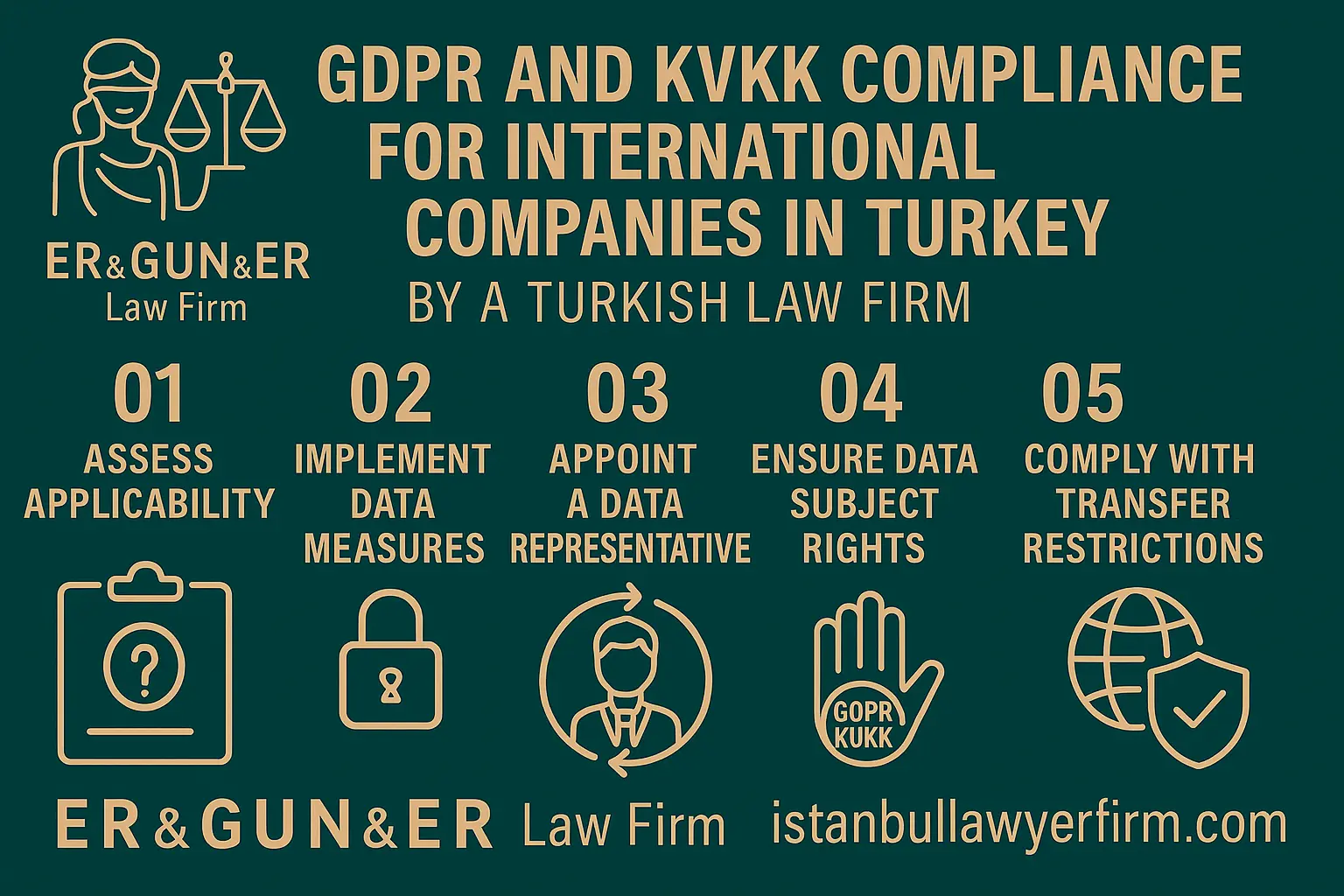
A lawyer in Turkey who advises multinational companies on data privacy compliance understands that international businesses operating in Turkey face the specific challenge of simultaneously satisfying two distinct legal frameworks—the EU General Data Protection Regulation and Turkey's Personal Data Protection Law, KVKK—whose substantial areas of overlap are accompanied by specific divergences in consent standards, lawful processing bases, cross-border transfer mechanisms, enforcement structures, and data subject rights procedures that create compliance gaps when companies apply only one framework's standards to their Turkish operations. An Istanbul Law Firm that advises international companies on GDPR and KVKK compliance provides the integrated legal service that enables businesses to build privacy programs that satisfy both frameworks through a harmonized approach: conducting comparative legal analysis to identify the specific compliance requirements where GDPR and KVKK diverge; assessing the company's specific data processing activities against both frameworks to identify the gaps whose remediation is required for compliant operations; developing unified documentation—including privacy notices, consent mechanisms, data processing agreements, and internal policies—that satisfies both frameworks' requirements; managing the Turkish-specific compliance steps that GDPR-compliant multinationals frequently overlook—including VERBIS registration, KVKK Article 9 cross-border transfer procedures, and Turkish Data Protection Board interaction; and providing ongoing compliance support including audit defense, Board inspection response, and data subject request management. A Turkish Law Firm that handles GDPR and KVKK compliance matters for multinational clients understands that the practical compliance challenge is not identifying where the two frameworks overlap—which is extensive—but identifying the specific compliance gaps where KVKK imposes obligations that GDPR-compliant programs do not fully address. An English speaking lawyer in Turkey who advises on GDPR and KVKK compliance provides the bilingual legal guidance that enables international legal teams, DPOs, and compliance officers to understand Turkey's specific data protection requirements and integrate them into global privacy programs. Practice may vary by authority and year — verify current KVKK provisions, current Turkish Data Protection Board decisions, current VERBIS registration requirements, and current cross-border transfer requirements with qualified counsel before finalizing any multinational GDPR-KVKK compliance program, as Turkey's data protection regulatory environment continues to evolve through Board decisions, legislative amendments, and sector-specific guidance whose implications for multinational compliance programs require ongoing assessment by qualified Turkish legal counsel to ensure that compliance programs remain current with applicable requirements rather than reflecting outdated regulatory standards whose application the Board no longer enforces or new requirements whose implementation the Board has begun to prioritize in its enforcement activities.
GDPR and KVKK: Structural Comparison and Key Divergences
A lawyer in Turkey who advises on GDPR and KVKK structural comparison explains that both frameworks share foundational data protection principles—including purpose limitation, data minimization, accuracy, storage limitation, integrity and confidentiality—but that their specific implementation of those principles and the specific compliance obligations they create differ in ways that materially affect how international companies must structure their Turkish operations' privacy programs. An Istanbul Law Firm that conducts GDPR-KVKK comparative analysis for international clients helps compliance teams understand the specific divergences most practically significant for multinational operations: the lawful processing basis framework—where GDPR provides six alternative bases for lawful processing including legitimate interest, contract performance, and legal obligation, while KVKK's framework is more restrictive in specific ways that require Turkish-specific legal basis analysis for each processing activity; the consent standard—where KVKK requires explicit, informed consent as the legal basis for processing in many circumstances where GDPR would permit processing based on legitimate interest or other bases without consent, creating a more consent-dependent processing model for Turkey; the cross-border transfer mechanism—where GDPR permits international data transfers based on adequacy decisions, standard contractual clauses, and binding corporate rules, while KVKK requires prior Turkish Data Protection Board approval for international transfers unless consent is obtained or a Board-designated adequacy assessment applies; and enforcement—where GDPR creates tiered fines referenced to global annual turnover creating potentially enormous financial exposure, while KVKK creates administrative fines within fixed range caps whose specific current amounts should be verified with current legal guidance. Turkish lawyers advising on GDPR-KVKK structural comparison help international companies understand that the divergences create specific compliance gaps in programs designed for GDPR compliance whose application to Turkey requires specific additional steps. Practice may vary by authority and year.
An Istanbul Law Firm that advises on unified privacy documentation for companies subject to both GDPR and KVKK explains that developing documentation—including privacy notices, consent forms, data processing agreements, and internal privacy policies—that satisfies both frameworks' requirements is more efficient than maintaining separate documentation sets for GDPR and KVKK purposes, but that unified documentation requires careful drafting that satisfies each framework's specific content requirements without creating provisions that comply with one framework while violating the other. Turkish lawyers advising on unified GDPR-KVKK privacy documentation help companies implement the specific drafting approach most effective for each document type: privacy notices—whose KVKK-required content includes specific items that GDPR notices may not typically address, and whose Turkish-language version must be prepared in a format accessible to Turkish data subjects; consent forms—whose KVKK explicit consent requirement must be satisfied in the specific circumstances KVKK identifies, using consent language whose specificity satisfies KVKK's requirements without creating GDPR compliance issues through overly broad withdrawal mechanisms; and data processing agreements—whose KVKK-required provisions must be included in agreements with Turkish data processors alongside GDPR Article 28-required provisions. An English speaking lawyer in Turkey who drafts unified GDPR-KVKK documentation for multinational companies provides the bilingual legal review that ensures each document satisfies both frameworks' requirements in the specific language that the relevant regulatory authority expects. Practice may vary by authority and year.
A Turkish Law Firm that advises on VERBIS registration for companies subject to KVKK explains that the Turkish Data Protection Board's VERBIS registry—the Data Controllers Registry—requires Turkish data controllers and foreign data controllers processing Turkish personal data to register their data processing activities with the Board in a specific format that documents the categories of data processed, the purposes of processing, the data retention periods, and the recipients of data transfers. An English speaking lawyer in Turkey who manages VERBIS registration for multinational companies provides the registration implementation service that enables international companies to satisfy KVKK's registration obligation—completing the registration in the specific format the Board requires, maintaining the registration's currency as data processing activities change, coordinating the registration with the company's global privacy record keeping maintained under GDPR's processing record requirements, and updating the registration when new processing activities commence, when existing processing activities change in scope, or when the company's organizational structure changes in ways that affect the data controller registration. Timely VERBIS registration maintenance is particularly important because the Board has included VERBIS compliance as a component of its routine inspection activities, and registration gaps identified during inspections create specific regulatory exposure that registered companies whose registrations accurately reflect their processing activities do not face. Practice may vary by authority and year.
Lawful Processing Bases, Consent Requirements and Special Category Data
A lawyer in Turkey who advises on KVKK lawful processing basis analysis explains that KVKK's framework for lawful processing of personal data differs from GDPR's in ways that require specific legal basis analysis for each category of data processing activity—because processing that GDPR permits under legitimate interest or other bases without consent may require explicit consent under KVKK, creating a need for consent-based processing in Turkey for activities that global GDPR-compliant programs handle without obtaining consent. An Istanbul Law Firm that conducts KVKK lawful processing basis analysis for international companies helps compliance teams implement the specific assessment approach most effective for each processing category: marketing and analytics processing—where GDPR programs frequently rely on legitimate interest as the lawful basis, but whose KVKK compliance may require explicit consent whose collection must be specifically designed for Turkish data subjects; employment-related data processing—where KVKK's approach to employee data processing has specific characteristics that differ from GDPR's treatment of employment data, requiring specific legal basis analysis for each employment processing activity; and customer data processing—where the interaction between KVKK's consent requirements and Turkey's specific sectoral regulations in banking, telecommunications, and health creates processing basis requirements that must be assessed against each sector's applicable regulatory framework. Turkish lawyers advising on KVKK lawful processing basis analysis help international companies understand that KVKK's more consent-dependent approach requires specific consent infrastructure for Turkish operations—including purpose-specific consent forms, consent withdrawal mechanisms, and consent records—that GDPR-compliant programs may not have fully implemented for the Turkish context, meaning that the consent gap is frequently the most operationally significant difference that companies discover when they assess their GDPR-compliant program against KVKK's requirements for their specific Turkish processing activities. Practice may vary by authority and year.
An Istanbul Law Firm that advises on KVKK special category data compliance explains that KVKK identifies specific categories of personal data as requiring heightened protection—including health data, biometric data, genetic data, criminal record data, and political, religious, philosophical, and union-related data—and that processing these special categories requires either explicit consent or satisfaction of a limited number of specific legal bases whose availability must be specifically assessed for each processing activity. Turkish lawyers advising on special category data compliance help international companies implement the specific approach most effective for each sensitive data category: healthcare and biometric data—where KVKK's processing conditions for health and biometric data in employment, healthcare service, and research contexts must be specifically assessed against each company's use case; background check and criminal record data—where KVKK's specific provisions on criminal conviction and security data create processing conditions that must be satisfied for background verification programs; and union membership and political affiliation data—whose processing requires specific legal basis satisfaction whose implementation must account for Turkish employment law's specific context for union-related data. An English speaking lawyer in Turkey who advises on special category data compliance for multinational companies provides the Turkish-specific legal basis analysis that enables international companies to implement their human resources, health management, and security programs in compliance with KVKK's heightened requirements for sensitive data categories. Practice may vary by authority and year.
A Turkish Law Firm that advises on consent collection and management infrastructure for KVKK-compliant operations explains that implementing effective consent management for Turkish data subjects requires both the technical infrastructure for consent collection, recording, and withdrawal—and the legal governance structure for managing the consent lifecycle in compliance with KVKK's requirements. An English speaking lawyer in Turkey who advises on consent infrastructure implementation provides the legal requirements specification that enables companies to design consent collection processes—including website consent banners, mobile application consent flows, paper consent forms, and verbal consent documentation protocols—that satisfy KVKK's explicit consent requirements for specific processing activities. Practice may vary by authority and year.
Cross-Border Data Transfers: KVKK Article 9 and International Transfer Mechanisms
A lawyer in Turkey who advises on KVKK's cross-border transfer requirements explains that KVKK Article 9's provisions on international personal data transfers create specific compliance obligations for companies that transfer Turkish personal data to servers, processing systems, or data recipients located outside Turkey—and that these obligations differ substantially from GDPR's international transfer framework in ways that require specific Turkish-law compliance steps in addition to any GDPR-required transfer mechanisms. An Istanbul Law Firm that advises on KVKK Article 9 transfer compliance helps international companies implement the specific approach most effective for each transfer situation: assessing whether the transfer destination country satisfies the Turkish Data Protection Board's adequacy determination—which requires specific verification since the Board's adequacy country list is determined through the Board's own assessment process rather than by adopting the EU's adequacy decisions; obtaining explicit consent from data subjects for international transfers when adequacy cannot be established—as one of KVKK's available transfer mechanisms—with the specific consent language and collection process that satisfies KVKK's requirements for transfer consent; and pursuing Board approval for transfers based on Turkish standard contractual clauses or binding corporate rules—as the alternative transfer mechanisms for situations where adequacy and consent are not available—which involves preparing and submitting applications to the Turkish Data Protection Board. Turkish lawyers advising on KVKK international transfer compliance help companies understand that the international transfer compliance gap is one of the most commonly identified deficiencies in GDPR-compliant programs adapted for Turkey—because GDPR standard contractual clauses do not directly substitute for KVKK's Board-approval process, creating a specific additional step whose completion is required for compliant cross-border transfers from Turkey. Practice may vary by authority and year — verify current Turkish Data Protection Board adequacy country list, current Board-approved standard contractual clauses, current Board approval application requirements and processing timelines, and current enforcement practice regarding cross-border transfers without adequate legal basis with qualified counsel before implementing any international personal data transfer from Turkey, as KVKK's cross-border transfer compliance requirements are an area of active regulatory development and Board enforcement whose current status requires specific legal assessment rather than reliance on guidance that may not reflect the Board's most recent decisions and enforcement posture on international transfer compliance.
An Istanbul Law Firm that advises on data transfer mapping for multinational companies explains that effective cross-border transfer compliance requires a comprehensive inventory of data flows from Turkey to other jurisdictions—including transfers to group company systems outside Turkey, transfers to cloud service providers whose data centers are outside Turkey, and transfers to customers, partners, and service providers in other countries—whose legal basis assessment and documentation enable the company to demonstrate compliant transfer practices in Board inspections. Turkish lawyers advising on data transfer mapping help international companies implement the specific approach most effective for each company's data architecture: mapping the complete landscape of personal data flows from Turkey to other jurisdictions—including system-level transfers that business teams may not recognize as personal data transfers and API-based transfers to third-party services that involve Turkish personal data; assessing each identified transfer against KVKK's available legal bases—adequacy, consent, or Board approval—to identify transfers that currently lack compliant legal basis; and prioritizing remediation actions—including obtaining missing transfer consents, reconfiguring data flows to consolidate transfers for which Board approval will be sought, and updating data processing agreements with international service providers to reflect KVKK transfer requirements—organized by the risk severity of each non-compliant transfer based on the data sensitivity, volume, and the Board's enforcement priority signals in recent decisions. An English speaking lawyer in Turkey who manages data transfer mapping for multinational companies provides the structured assessment that enables international compliance teams to understand the Turkish transfer compliance gap and prioritize remediation effectively without the time-consuming process of translating Turkish regulatory guidance independently. Practice may vary by authority and year.
A Turkish Law Firm that advises on data breach response and cross-border incident management explains that personal data breaches affecting Turkish data subjects create specific notification obligations under KVKK—including notification to the Turkish Data Protection Board within a specified period of discovering the breach—and that breach incidents affecting both Turkish and EU data subjects create parallel notification obligations under KVKK and GDPR whose coordination requires synchronized response management. An English speaking lawyer in Turkey who advises on multinational data breach response coordinates the Turkish-law breach assessment—including the materiality threshold assessment for Board notification, the Board notification content requirements, and the data subject notification obligations—with the company's global breach response team to ensure that the Turkish response is timely and accurate while remaining consistent with the company's global breach response messaging. Practice may vary by authority and year.
Data Subject Rights, Request Management and Regulatory Interaction
A lawyer in Turkey who advises on data subject rights implementation explains that KVKK grants Turkish data subjects specific rights—including the right to learn whether their personal data is being processed, to access personal data and information about processing, to know if personal data has been transferred to third parties, to request correction of inaccurate data, to request deletion or destruction of data, and to object to automated processing—and that managing these rights requires both the technical capability to locate and act on requested data and the procedural compliance structure for responding within the required timeframes. An Istanbul Law Firm that advises on data subject rights implementation for Turkish operations helps companies implement the specific approach most effective for each rights management situation: establishing the intake mechanism for rights requests—including the contact channel, identification verification process, and intake documentation—whose design enables efficient routing to the appropriate processing teams; developing the processing workflow that enables rights requests to be assessed, located, and actioned within KVKK's 30-day response deadline while maintaining documentation of each step; and preparing the response communication format that satisfies KVKK's requirements for rights request responses—including the required content, language accessibility, and follow-up mechanisms for complex requests. Turkish lawyers advising on data subject rights implementation help companies understand that the 30-day response deadline creates operational urgency that requires established workflow rather than ad hoc response—and that failure to respond within the deadline creates specific regulatory exposure. Practice may vary by authority and year.
An Istanbul Law Firm that advises on Turkish Data Protection Board interaction and enforcement response explains that the Board's enforcement activities—including self-initiated investigations, third-party complaint investigations, and sector-specific inspections—create specific regulatory engagement situations that require both prepared documentation and skilled regulatory representation. Turkish lawyers advising on Board interaction management help companies implement the specific approach most effective for each regulatory engagement situation: maintaining organized compliance documentation—including VERBIS registration records, processing activity records, consent records, data processing agreements, and transfer documentation—whose availability enables efficient response to Board information requests; preparing for Board inspections—whose preparation includes reviewing the company's Turkish processing activities against current Board enforcement priorities and identifying any compliance gaps whose remediation before inspection reduces enforcement risk; and managing Board proceedings where enforcement action is initiated—whose defense requires both legal representation and organized presentation of the company's compliance evidence. An English speaking lawyer in Turkey who represents multinational companies in Turkish Data Protection Board proceedings provides the bilingual regulatory representation that enables international companies to participate effectively in Board proceedings whose conduct is in Turkish. Practice may vary by authority and year.
A Turkish Law Firm that advises on KVKK audit readiness and gap remediation explains that companies that proactively assess their Turkish data processing activities against current KVKK requirements—rather than discovering gaps through Board inspection—consistently achieve better compliance outcomes and lower enforcement exposure than companies whose compliance status is reactive. An English speaking lawyer in Turkey who conducts KVKK gap assessments for multinational companies provides the structured review—covering VERBIS registration status and accuracy, consent collection mechanisms and their adequacy for each processing activity, data processing agreement compliance with KVKK's specific requirements, cross-border transfer legal basis adequacy under KVKK Article 9, data subject rights procedures and timeline compliance, and data breach response plan adequacy and testing—that enables international companies to understand their Turkish compliance status comprehensively and to prioritize remediation actions by risk severity before regulatory exposure materializes through Board investigation. The best lawyer in Turkey for GDPR and KVKK compliance matters combines specific knowledge of KVKK's provisions, Turkish Data Protection Board decisions and enforcement patterns, GDPR's requirements for international operations, cross-border transfer compliance mechanisms under both frameworks, VERBIS registration requirements, consent architecture for Turkish processing, and Board inspection and enforcement response with the English-language communication that enables international DPOs, compliance officers, and legal teams to manage their Turkish data protection compliance program effectively. Practice may vary by authority and year.
DPO Governance, Vendor Management and Privacy by Design
A lawyer in Turkey who advises on data protection governance for multinational companies explains that while KVKK does not mandate a Data Protection Officer for all companies as GDPR does for specific entity types, effective privacy governance for Turkish operations requires both a clear internal accountability structure and—for companies subject to GDPR's DPO requirement—a governance model that satisfies both frameworks' accountability expectations for Turkish processing. An Istanbul Law Firm that advises on privacy governance structure for multinational companies helps compliance teams implement the specific approach most effective for each company's organizational structure: defining the internal accountability structure for Turkish data processing—including the roles responsible for KVKK compliance, Board interaction, data subject request management, and breach response; integrating the Turkish-specific compliance responsibilities into the global privacy governance model—ensuring that the DPO or equivalent role has appropriate oversight of Turkish operations and awareness of KVKK-specific requirements; and establishing the Board interaction function—including who is authorized to respond to Board inquiries, interact with Board inspectors, and submit applications and notifications. Turkish lawyers advising on privacy governance structure help multinational companies understand that Turkey's regulatory environment creates specific governance requirements—including the need for Turkish-speaking compliance resources who can manage Board interaction and local regulatory relationships—that purely global governance structures may not fully address. Practice may vary by authority and year.
An Istanbul Law Firm that advises on vendor management and data processing agreement compliance for Turkish operations explains that KVKK creates specific requirements for agreements between Turkish data controllers and the data processors they engage—including requirements whose specific content differs from GDPR Article 28's DPA requirements—and that companies with GDPR-compliant vendor agreements must specifically assess whether those agreements satisfy KVKK's additional or different requirements for Turkish processing activities. Turkish lawyers advising on Turkish vendor agreement compliance help companies implement the specific approach most effective for each vendor relationship: assessing the data processing agreement against KVKK's specific requirements—identifying any provisions that satisfy GDPR but not KVKK and any KVKK requirements not addressed by the standard GDPR DPA template; updating agreements with vendors who process Turkish personal data to include KVKK-required provisions—ensuring that the updated agreements continue to satisfy GDPR requirements as well; and managing the international transfer implications of vendor engagements—because using an international vendor to process Turkish personal data creates a cross-border transfer whose KVKK Article 9 compliance requires specific legal basis assessment. An English speaking lawyer in Turkey who reviews vendor agreements for GDPR-KVKK compliance provides the legal assessment that identifies the specific gaps in existing vendor documentation and the specific additions required for Turkish compliance. Practice may vary by authority and year.
A Turkish Law Firm that advises on privacy by design and training for Turkish operations explains that embedding privacy compliance into system development, product design, and operational processes—rather than addressing it as a separate legal overlay—consistently produces more effective and sustainable compliance than documentation-only compliance programs. An English speaking lawyer in Turkey who advises on privacy by design implementation and compliance training for multinational companies provides the practical compliance guidance that enables technical and business teams to understand and implement KVKK requirements within their specific operational contexts—including the specific data minimization, purpose limitation, and security measures that Turkish regulatory expectations require for different processing contexts. Practice may vary by authority and year.
Sector-Specific KVKK Compliance: Banking, Telecommunications, Healthcare and E-Commerce
A lawyer in Turkey who advises on sector-specific KVKK compliance explains that while KVKK applies broadly to all data controllers operating in Turkey, specific regulated sectors—including banking, telecommunications, healthcare, and e-commerce—are subject to additional data protection obligations arising from sector-specific legislation whose compliance requirements interact with and in some cases supplement KVKK's general provisions. An Istanbul Law Firm that advises on sector-specific KVKK compliance helps companies in regulated industries implement the specific compliance approach most effective for each sector: banking and financial services—where the Banking Regulation and Supervision Agency's data governance requirements, customer information confidentiality obligations under the Banking Law, and credit bureau data exchange regulations create specific data processing compliance requirements that must be satisfied alongside KVKK's general provisions; telecommunications—where the Information Technologies and Communication Authority's data retention, lawful interception facilitation, and customer data processing requirements create sector-specific obligations whose compliance requires coordination between KVKK and sectoral regulatory requirements; and healthcare—where Ministry of Health regulations on patient data, hospital information system requirements, and electronic health record frameworks create specific consent, retention, and transfer requirements for health data processing that supplement KVKK's special category data provisions. Turkish lawyers advising on sector-specific KVKK compliance help companies understand that sector regulatory compliance does not substitute for KVKK compliance—and that meeting sector-specific requirements while failing to satisfy KVKK's general provisions creates regulatory exposure under both legal frameworks simultaneously. Practice may vary by authority and year.
An Istanbul Law Firm that advises on e-commerce and digital marketplace KVKK compliance explains that Turkish e-commerce companies—and international e-commerce businesses serving Turkish customers—face specific KVKK compliance obligations whose practical implementation requires both data processing governance and consumer-facing compliance infrastructure. Turkish lawyers advising on e-commerce KVKK compliance help companies implement the specific approach most effective for each digital business model: customer account data management—whose KVKK compliance requires purpose-limited data collection, appropriate retention periods, and accessible deletion mechanisms for Turkish customers; behavioral tracking and targeted advertising—where KVKK's consent requirements for cookie-based tracking create specific technical implementation requirements for Turkish website visitors whose consent must be collected before non-essential cookies are set; and third-party data sharing for marketing, analytics, and personalization—whose KVKK compliance requires specific legal basis assessment for each data sharing activity and specific disclosure to Turkish data subjects about third-party data recipients. An English speaking lawyer in Turkey who advises international e-commerce businesses on Turkish KVKK compliance provides the practical implementation guidance that enables foreign digital businesses serving Turkish customers to manage their Turkish data protection compliance without requiring extensive Turkish regulatory expertise in-house—including guidance on the specific consent mechanism design, cookie management infrastructure, and data subject rights procedures that satisfy KVKK's requirements for Turkish-language digital services whose implementation differs in specific ways from the GDPR-focused implementations that these companies have developed for their EU operations. Practice may vary by authority and year.
A Turkish Law Firm that advises on HR and employment data KVKK compliance explains that Turkish employers—and international companies employing Turkish workers—must manage their employee personal data in compliance with KVKK's requirements, whose application to employment data processing creates specific obligations for HR information systems, recruitment processes, performance management, and employment monitoring. An English speaking lawyer in Turkey who advises on employment data KVKK compliance helps companies implement the specific approach most effective for each HR processing situation: recruitment data—whose processing requires specific purpose limitation and retention period compliance from the initial application stage, and whose management after unsuccessful recruitment requires specific deletion or anonymization to avoid retaining personal data beyond the lawful purpose period; employee monitoring—whose implementation through workplace surveillance, computer monitoring, and GPS tracking requires specific legal basis assessment, employee notification in employment contracts or workplace policies, and security measure implementation; and employee data sharing with group companies and service providers—whose cross-border transfer implications create specific KVKK Article 9 compliance requirements for multinational employers managing Turkish employee data through global HR systems. Practice may vary by authority and year.
Privacy Impact Assessments, Security Requirements and Breach Prevention
A lawyer in Turkey who advises on privacy impact assessments and data security requirements explains that while KVKK does not include an explicit Data Protection Impact Assessment mechanism equivalent to GDPR's Article 35 DPIA requirement, the Board's guidance and enforcement practice create implicit expectations for risk assessment for high-risk processing activities—and that multinational companies subject to GDPR's DPIA requirement should integrate KVKK-specific considerations into their DPIA process for processing activities that involve Turkish personal data. An Istanbul Law Firm that advises on privacy risk assessment for Turkish processing helps companies implement the specific approach most effective for each high-risk processing situation: assessing whether planned processing activities create specific risks for Turkish data subjects that require pre-implementation risk analysis—including large-scale systematic processing, profiling that creates significant effects for data subjects, and processing of special category data; conducting KVKK-informed risk assessment that identifies Turkish-specific risks—including cross-border transfer risks under Article 9, consent adequacy risks, and sector-specific regulatory risks—alongside the GDPR-required risk assessment elements; and documenting risk assessment outcomes and mitigation measures in a format that demonstrates compliance due diligence to the Turkish Data Protection Board in the event of an investigation or enforcement proceeding. Turkish lawyers advising on privacy risk assessment help companies understand that proactive risk assessment whose documentation demonstrates pre-implementation compliance consideration consistently reduces enforcement exposure compared to retrospective compliance justification after a Board investigation has begun. Practice may vary by authority and year.
An Istanbul Law Firm that advises on technical and organizational security measures for KVKK compliance explains that KVKK Article 12 requires data controllers to implement appropriate technical and organizational measures to ensure the security of personal data—and that the Board's enforcement activities have specifically examined security measure adequacy in data breach investigations and enforcement proceedings where inadequate security contributed to personal data incidents. Turkish lawyers advising on KVKK security requirement implementation help companies implement the specific measures most effective for their processing risk profile: technical security measures—including access controls, encryption for data in transit and at rest, penetration testing, and vulnerability management—whose specific implementation standard should reflect the sensitivity of the personal data categories processed and the volume of affected data subjects; organizational security measures—including data protection training, security policy implementation, and incident response procedures—whose documentation enables the company to demonstrate security governance to the Board in enforcement proceedings; and supplier security management—ensuring that data processors engaged by Turkish data controllers implement security measures consistent with KVKK's requirements and that processor security standards are contractually defined and periodically assessed. An English speaking lawyer in Turkey who advises on KVKK security compliance for multinational companies provides the legal requirements specification that enables IT and security teams to understand the specific security standards that KVKK compliance requires for their Turkish processing activities. Practice may vary by authority and year.
A Turkish Law Firm that advises on cookie compliance and online tracking under KVKK explains that Turkish websites and mobile applications that use cookies, web beacons, pixels, or other tracking technologies to collect personal data from Turkish users must comply with KVKK's consent requirements for the personal data collected through those technologies—and that the implementation of cookie consent for Turkish users requires specific technical and legal elements whose absence creates regulatory exposure both from Board enforcement and from Turkish consumer protection regulation. An English speaking lawyer in Turkey who advises on cookie compliance for Turkish digital properties helps companies implement the specific approach most effective for each website and application situation in the Turkish digital environment: designing cookie consent banners and consent management platforms that satisfy KVKK's explicit consent requirements for non-essential cookie deployment—including pre-consent blocking of tracking technologies, granular consent options for different cookie categories, and easy withdrawal mechanisms; maintaining consent records that document Turkish user consent decisions and enable the company to demonstrate consent adequacy to the Board; and managing the interaction between KVKK cookie consent requirements and the company's global consent management platform—ensuring that Turkish users receive the KVKK-compliant consent experience rather than a consent mechanism designed only for GDPR compliance. The best lawyer in Turkey for GDPR and KVKK compliance matters combines specific knowledge of KVKK's provisions, Turkish Data Protection Board enforcement priorities, VERBIS registration requirements, cross-border transfer mechanisms, sector-specific compliance obligations, privacy risk assessment requirements, security measure standards, and cookie compliance frameworks with the English-language communication that enables international compliance teams to build and maintain effective GDPR-KVKK harmonized privacy programs for their Turkish operations. Practice may vary by authority and year.
Building Long-Term GDPR-KVKK Compliance Programs: Sustainability and Evolution
A lawyer in Turkey who advises on building sustainable GDPR-KVKK compliance programs explains that the most significant challenge for multinational companies is not achieving initial compliance but maintaining compliance as data processing activities evolve, as KVKK regulatory requirements are supplemented by Board decisions and sector-specific guidance, and as the company's business model, technology stack, and vendor relationships change in ways that affect the personal data processing activities requiring compliance management. An Istanbul Law Firm that advises on sustainable compliance program design helps international companies implement the specific organizational approach most effective for their scale and operating context: establishing a compliance governance structure that creates clear ownership for KVKK compliance activities—including VERBIS registration maintenance, data subject request management, cross-border transfer monitoring, and Board interaction—at the operational level rather than treating compliance as exclusively a legal department responsibility; implementing change management procedures that identify and assess the KVKK compliance implications of new products, services, and processing activities before they launch—embedding compliance review into the product development and business initiative approval processes rather than addressing compliance after launch; and building the internal expertise that enables the company's compliance team to manage routine KVKK compliance tasks independently while engaging external Turkish legal counsel for complex legal analysis, Board interaction, and enforcement response. Turkish lawyers advising on compliance program sustainability help international companies understand that the cost of maintaining compliance consistently over time is significantly lower than the cost of periodically restoring compliance after it has deteriorated—and that systematic maintenance investment produces consistently better outcomes than episodic compliance effort, particularly in Turkey's data protection environment where Board enforcement activity has increased in frequency and the consequences of compliance gaps identified through investigation rather than self-remediation include both financial penalties and reputational implications that affect the company's relationships with Turkish customers and regulatory authorities. Practice may vary by authority and year.
An Istanbul Law Firm that advises on KVKK regulatory development monitoring explains that the Turkish data protection regulatory environment continues to evolve through Turkish Data Protection Board decisions, legislative amendments to KVKK, and sector-specific guidance whose specific implications for company compliance programs must be assessed as they develop. Turkish lawyers advising on regulatory development monitoring help multinational companies implement the specific approach most effective for staying current with Turkish data protection requirements: monitoring Turkish Data Protection Board decisions—whose analysis reveals enforcement priorities, interpretation of specific KVKK provisions, and compliance standards that the Board applies in investigations and enforcement proceedings; tracking legislative developments affecting KVKK—including amendments whose implementation timeline may require specific compliance program updates; and assessing the implications of regulatory developments for the company's specific processing activities—enabling prompt compliance program adjustment when regulatory changes affect the legal basis, transfer mechanism, or other compliance elements applicable to the company's Turkish processing. An English speaking lawyer in Turkey who provides ongoing regulatory monitoring for multinational companies delivers the regular English-language compliance updates that enable international compliance teams and DPOs to stay current with Turkish data protection requirements without requiring Turkish-language regulatory monitoring capabilities—enabling the company's global privacy governance structure to maintain informed oversight of Turkish operations with the same quality of regulatory intelligence that they maintain for other jurisdictions whose data protection environments they monitor in their primary language. Practice may vary by authority and year.
A Turkish Law Firm that advises on integrating GDPR-KVKK compliance into corporate M&A and due diligence processes explains that companies acquiring Turkish businesses or Turkish assets must assess the target's KVKK compliance status as a component of transaction due diligence—and that KVKK compliance gaps identified through due diligence create both pre-closing remediation requirements and post-closing integration obligations whose management affects the transaction's timeline and post-closing risk profile. An English speaking lawyer in Turkey who conducts KVKK compliance due diligence for M&A transactions provides the structured assessment of the target's VERBIS registration, consent infrastructure, data processing agreements, cross-border transfer compliance, and data breach history that enables acquirers to assess KVKK-related transaction risk and plan post-closing integration. The best lawyer in Turkey for GDPR and KVKK compliance matters for international companies combines specific knowledge of KVKK's provisions and Turkish Data Protection Board enforcement priorities, VERBIS registration requirements, cross-border transfer mechanisms, sector-specific compliance obligations, privacy risk assessment and security requirements, cookie compliance, sustainable program design, regulatory monitoring, and M&A due diligence with the English-language communication that enables multinational companies to build and maintain effective, sustainable GDPR-KVKK harmonized privacy programs for their Turkish operations. Practice may vary by authority and year.
Frequently Asked Questions
- Do both GDPR and KVKK apply to international companies with Turkish operations? Yes. GDPR applies to international companies processing EU personal data, and KVKK applies to data controllers and processors operating in Turkey or processing Turkish personal data. Companies with Turkish operations typically face obligations under both frameworks simultaneously, requiring harmonized compliance programs. Practice may vary by authority and year.
- What are the main differences between GDPR and KVKK for international companies? Key differences include KVKK's more consent-dependent processing basis framework versus GDPR's broader legitimate interest basis; KVKK's cross-border transfer restriction requiring Board approval versus GDPR's standard contractual clauses mechanism; KVKK's VERBIS registration requirement without direct GDPR equivalent; and KVKK's fixed-range administrative fine caps versus GDPR's turnover-based fine tiers. Practice may vary by authority and year.
- What is VERBIS and is registration mandatory? VERBIS is the Turkish Data Controllers Registry administered by the Turkish Data Protection Board. Registration is mandatory for data controllers meeting specific thresholds and is required for foreign data controllers processing Turkish personal data above applicable thresholds. The registration must document processing activities, data categories, retention periods, and transfer recipients. Practice may vary by authority and year.
- Can GDPR standard contractual clauses be used for international transfers from Turkey? No. KVKK's international transfer mechanism under Article 9 differs from GDPR's and requires either Board-designated adequacy, explicit data subject consent, or Board approval of Turkish standard contractual clauses or binding corporate rules. GDPR SCCs do not substitute for KVKK's transfer requirements without specific Board approval. Practice may vary by authority and year.
- What is the KVKK consent standard? KVKK requires explicit, specific consent that is freely given, informed, and based on a positive act. Bundled or implicit consent does not satisfy KVKK's requirements. Consent must be purpose-specific, and each processing purpose may require separate consent. Consent withdrawal mechanisms must be as easy as consent provision. Practice may vary by authority and year.
- Is a Data Protection Officer mandatory under KVKK? KVKK does not mandate a Data Protection Officer for specific entity types as GDPR does. However, effective Turkish data protection governance requires designated internal accountability for KVKK compliance, Board interaction, and breach response. Companies subject to GDPR's DPO requirement must ensure their DPO governance structure appropriately covers Turkish operations. Practice may vary by authority and year.
- What are the KVKK timelines for responding to data subject rights requests? KVKK requires data controllers to respond to data subject rights requests within 30 days. This differs from GDPR's one-month response deadline which can be extended by two additional months for complex cases. The 30-day KVKK deadline generally does not accommodate the same extension flexibility. Practice may vary by authority and year.
- What data breach notification obligations apply under KVKK? KVKK requires data controllers to notify the Turkish Data Protection Board within a specified period of discovering a personal data breach. Board notification must include specific information about the breach's nature, affected data categories, and remediation measures. Data subject notification may also be required depending on the breach's likely impact. Practice may vary by authority and year.
- Can one unified privacy policy cover both GDPR and KVKK requirements? Unified privacy documentation can cover both frameworks with careful drafting that addresses each framework's specific content requirements. A KVKK-compliant privacy notice must include specific items that GDPR notices may not typically address, and the Turkish-language version must be accessible to Turkish data subjects. Legal review specific to both frameworks is required. Practice may vary by authority and year.
- What special categories of data receive heightened protection under KVKK? KVKK identifies specific sensitive data categories including health and biometric data, genetic data, criminal record data, and political, religious, philosophical, and union-related data. Processing these categories requires explicit consent or satisfaction of specific legal bases. The applicable conditions differ from GDPR's special category framework in ways requiring specific Turkish legal basis analysis. Practice may vary by authority and year.
- How does Turkish Data Protection Board enforcement differ from EU GDPR enforcement? The Turkish Data Protection Board imposes administrative fines within fixed monetary range caps rather than the GDPR's turnover-referenced tiered fine structure. The Board also conducts sector-specific investigations and responds to individual complaints. Board proceedings are conducted in Turkish, requiring Turkish-language regulatory representation for multinational companies. Practice may vary by authority and year.
- What vendor agreement provisions are required under KVKK? KVKK creates specific requirements for data processing agreements between Turkish data controllers and processors. These requirements may differ from GDPR Article 28 DPA requirements. International vendor agreements that satisfy GDPR may require specific additions to address KVKK's requirements for Turkish processing activities. The specific provisions required should be assessed against current KVKK guidance. Practice may vary by authority and year.
- Can Turkish personal data be transferred to EU-based servers? International transfers of Turkish personal data to EU-based servers require KVKK Article 9 compliance through adequacy, explicit consent, or Board approval—not automatically permissible despite the EU's GDPR adequacy framework. Companies must specifically assess whether their server infrastructure creates cross-border transfers requiring Turkish transfer mechanism compliance. Practice may vary by authority and year.
- What are the audit priorities for the Turkish Data Protection Board? The Turkish Data Protection Board's enforcement has focused on consent adequacy, cross-border transfer compliance, VERBIS registration, data breach notification timeliness, and response to data subject rights requests. Sector-specific investigations have addressed banking, telecommunications, healthcare, and e-commerce data processing. Current Board enforcement priorities should be confirmed with current legal guidance. Practice may vary by authority and year.
- Does ER&GUN&ER Law Firm provide GDPR and KVKK compliance services for international companies in Turkey? Yes. ER&GUN&ER Law Firm provides comprehensive GDPR and KVKK compliance services for international companies including comparative legal analysis, VERBIS registration management, KVKK lawful processing basis analysis, consent architecture design, unified privacy documentation drafting, cross-border transfer compliance assessment and Board approval applications, data subject rights procedure implementation, Board interaction and audit defense, data breach response coordination, vendor agreement KVKK compliance review, privacy governance structure advisory, and ongoing compliance monitoring—with English-language client communication and bilingual documentation throughout each engagement.
Author: Mirkan Topcu is an attorney registered with the Istanbul Bar Association (Istanbul 1st Bar), Bar Registration No: 67874. His practice focuses on cross-border and high-stakes matters where evidence discipline, procedural accuracy, and risk control are decisive.
He advises individuals and companies across Immigration and Residency, Real Estate Law, Tax Law, and cross-border documentation matters where procedural accuracy and evidence discipline are decisive.
Education: Istanbul University Faculty of Law (2018); Galatasaray University, LL.M. (2022). LinkedIn: Profile. Istanbul Bar Association: Official website.