

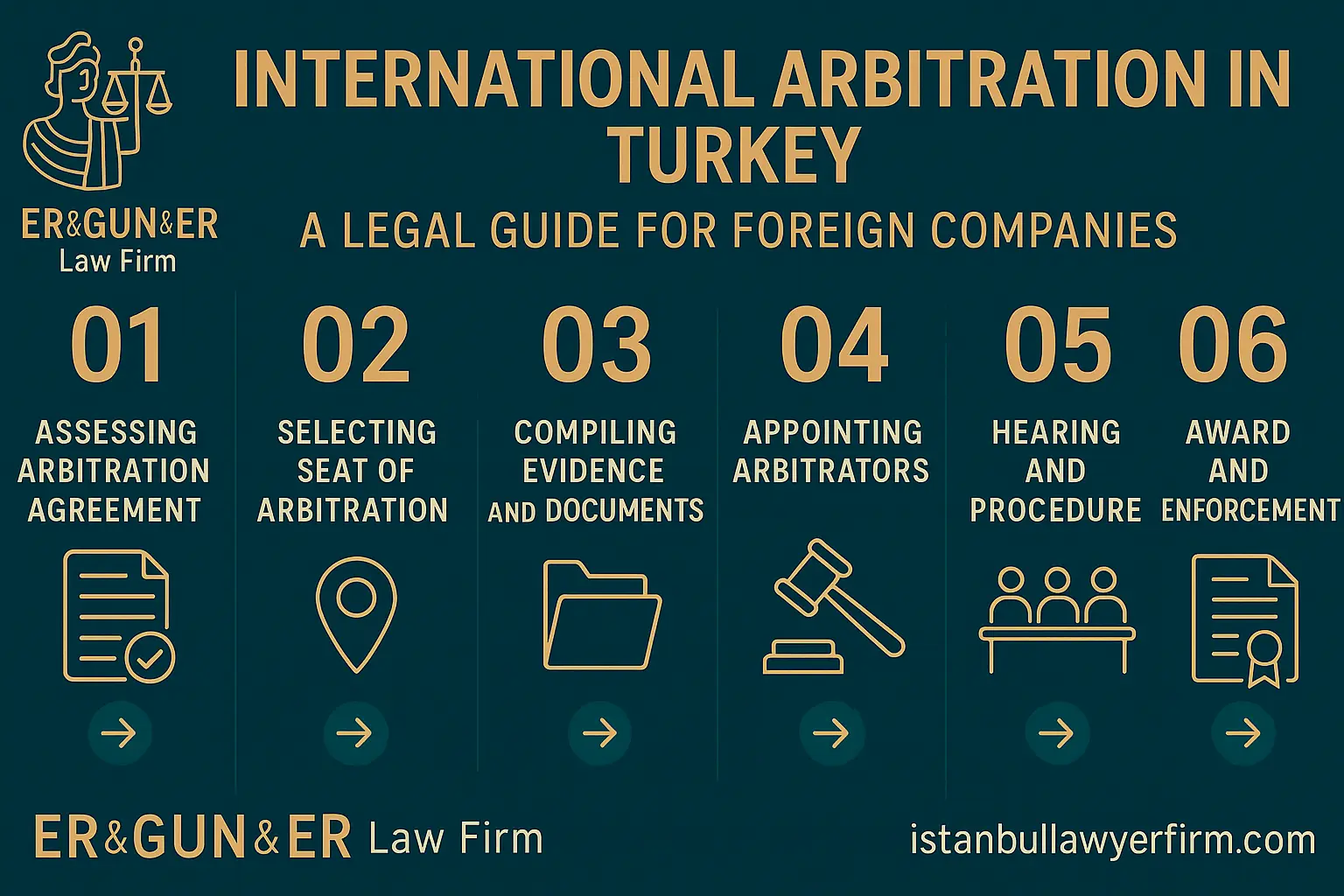
A lawyer in Turkey who advises on international arbitration understands that international arbitration is the dispute resolution mechanism that foreign companies with commercial or investment relationships in Turkey most frequently rely upon—because arbitration provides enforceable resolution through specialized tribunals, avoids the language and procedural barriers of Turkish court litigation, and produces awards enforceable in over 160 countries under the New York Convention. An Istanbul Law Firm that advises on international arbitration in Turkey provides the integrated guidance covering every stage of the arbitration process: drafting arbitration clauses that are valid under Turkish International Arbitration Law No. 4686 and chosen institutional rules; selecting the arbitral seat and institutional framework that best serves the client's enforcement and procedural objectives; managing the tribunal constitution, preliminary conference, document production, witness preparation, hearing logistics, and post-hearing briefing stages of the arbitration procedure; applying for emergency arbitrator relief and interim measures in Turkish courts and arbitral tribunals when the urgency of a dispute requires action before the main tribunal is constituted; enforcing arbitral awards in Turkey through exequatur applications and resisting annulment challenges; pursuing investment arbitration under bilateral investment treaties and multilateral conventions when state conduct has harmed a foreign investment; and managing cross-border execution of awards against assets in Turkey and abroad. A Turkish Law Firm that advises on international arbitration for foreign companies understands that the most important arbitration investment is made before any dispute arises—through correctly drafted arbitration clauses and properly structured contracts—because deficiencies in arbitration clauses are the most common source of jurisdictional objections that delay proceedings and increase costs before the merits are reached. An English speaking lawyer in Turkey who advises on international arbitration for foreign clients provides the bilingual representation that enables foreign companies to participate effectively in Turkish arbitration proceedings whose communications, court filings, and tribunal correspondence are primarily in Turkish. Practice may vary by authority and year — verify current Turkish arbitration law requirements, current institutional rules versions, current enforcement court procedures, and current investment treaty positions with qualified counsel before taking any action in a Turkish arbitration matter, since arbitration law and practice develops through institutional rule revisions, court decisions, and treaty developments.
Arbitration Agreement Drafting, Seat Selection and Jurisdictional Foundations
A lawyer in Turkey who advises on arbitration clause drafting explains that an effective arbitration clause must specify the arbitral rules, the seat of arbitration, the language of the proceedings, the number of arbitrators, and any special procedural elections—and that ambiguities in any of these elements consistently produce jurisdictional challenges that delay proceedings and consume budget that could otherwise be applied to the merits. An Istanbul Law Firm that advises on arbitration clause drafting for international contracts helps clients implement the specific clause approach most effective for each commercial relationship: selecting institutional rules—ICC, LCIA, ICSID, SCC, or ISTAC—that align with the commercial nature of the dispute, the parties' locations, and the enforcement objectives; specifying the seat in terms that clearly define the lex arbitri rather than only the hearing location; confirming that the clause is valid under Turkish International Arbitration Law No. 4686 when Turkey is the seat or when Turkish law governs; and including appropriate provisions for emergency arbitrator relief, expedited procedure eligibility, and consolidation where multiple contracts are involved. Turkish lawyers advising on arbitration clause drafting help foreign companies understand that clauses developed for use in one commercial sector may be inappropriate for another—because construction, energy, investment, and technology disputes have specific features whose procedure and evidence requirements differ in ways that affect which institutional rules, seat, and arbitrator selection mechanisms produce the best outcomes—and that an arbitration clause reviewed by experienced Turkish arbitration counsel before contract execution is the most reliable protection against the jurisdictional objections that delay proceedings and consume resources that would be better applied to the merits. Practice may vary by authority and year.
An Istanbul Law Firm that advises on arbitral seat selection explains that the seat of arbitration determines the national law that governs the arbitration's procedural aspects—including court support for the constitution of the tribunal, court enforcement of interim measures, the grounds available for challenging arbitrators, the form and communication requirements for the award, and the annulment regime—making seat selection a substantive legal decision rather than a logistical choice. Turkish lawyers advising on seat selection help parties understand the specific tradeoffs most important for each dispute profile: Istanbul as seat provides proximity to Turkish courts for interim measure support in disputes involving Turkish assets, while established international seats—Paris, London, Geneva, Singapore—provide courts with extensive experience in arbitration-supportive judicial interventions and predictable annulment standards. An English speaking lawyer in Turkey who advises on seat selection and clause structure for international contracts provides the comparative analysis that enables foreign companies to make informed seat decisions based on enforcement objectives, court intervention track record, and the specific asset and party profiles of their Turkish commercial relationships—confirming that the chosen seat's courts provide the type of arbitration support that the specific dispute profile is most likely to require. Practice may vary by authority and year.
A Turkish Law Firm that advises on the jurisdictional foundations of international arbitration in Turkey explains that Turkish International Arbitration Law No. 4686 applies when the seat is in Turkey and the dispute has an international element—and that the foreign element and arbitrability requirements must be confirmed for the specific dispute before relying on the arbitration clause in place of Turkish court jurisdiction. An English speaking lawyer in Turkey who advises on jurisdictional analysis for international arbitration in Turkey implements the specific approach most effective for each dispute situation: confirming whether the dispute involves an international element under Turkish law; assessing whether the subject matter is arbitrable under Turkish law including any sector-specific restrictions; evaluating the arbitration clause's enforceability in the specific context including any changes in parties, contracts, or commercial relationships since the clause was drafted; and advising on whether a party whose counterparty is resisting arbitration should apply to Turkish courts for assistance in constituting the tribunal. Practice may vary by authority and year.
Institutional versus Ad Hoc Arbitration and Procedural Management
A lawyer in Turkey who advises on the choice between institutional and ad hoc arbitration explains that institutional arbitration—through ICC, ICSID, LCIA, SCC, or ISTAC—provides administrative infrastructure including secretariat support, standard fee schedules, arbitrator appointment mechanisms, and established procedural rules, while ad hoc arbitration—typically under UNCITRAL rules—provides greater procedural flexibility but requires the parties to manage appointments, procedures, and logistics without institutional support. An Istanbul Law Firm that advises on arbitration framework selection helps clients implement the specific framework most appropriate for each dispute: assessing whether the commercial and legal complexity of the dispute warrants institutional administration; evaluating whether ISTAC—the Istanbul Arbitration Centre—offers efficiency advantages for Turkey-seated disputes through its local institutional knowledge; and confirming that the chosen institutional rules' current version addresses the specific procedural features the parties want to include. Turkish lawyers advising on framework selection help foreign companies understand that institutional arbitration is typically preferable when the parties lack a pre-established relationship of trust, because the institution's appointment authority prevents the dispute over tribunal constitution that is the most common source of delay in ad hoc arbitration—and that the additional institutional administration cost is typically justified by the reduction in procedural disputes and the credibility that established institutional rules provide when the award is later presented for enforcement. Practice may vary by authority and year.
An Istanbul Law Firm that advises on procedural management throughout international arbitration explains that effective arbitration case management—from the request for arbitration through the final award—requires systematic attention to procedural deadlines, document production obligations, witness preparation, expert coordination, hearing logistics, and post-hearing briefing, because procedural mistakes in international arbitration typically cannot be corrected after the fact and directly affect the persuasiveness of the case. Turkish lawyers advising on arbitration case management help clients implement the specific management approach most effective for each case profile: preparing the request for arbitration and accompanying exhibits in a format whose completeness prevents a summary dismissal; managing the preliminary conference to secure procedural orders that are favorable on document production scope, briefing schedule, and witness and expert numbers; organizing the evidence bundle in a format that allows the tribunal to navigate efficiently; and preparing witnesses to give clear, consistent, and credible testimony under cross-examination. An English speaking lawyer in Turkey who advises on arbitration case management for foreign companies provides the bilingual coordination that enables foreign-domiciled management and witnesses to participate effectively in proceedings conducted primarily in Turkish. Practice may vary by authority and year.
A Turkish Law Firm that advises on evidence and witness management in international arbitration explains that arbitral tribunals in commercial disputes rely primarily on documentary evidence—contracts, correspondence, financial records, technical reports—rather than on oral testimony, making the organization and presentation of the document bundle one of the most important determinants of the case's persuasive impact. An English speaking lawyer in Turkey who advises on evidence strategy for international arbitration implements the specific approach most effective for each case: identifying the decisive documents at the outset and structuring the case narrative around those documents rather than presenting every available document; managing document production requests to obtain favorable production from the other side while limiting the scope of production obligations; preparing expert witnesses whose technical reports are clearly linked to the legal questions the tribunal must answer; and building a bilingual hearing bundle that is consistently organized and cross-referenced. Practice may vary by authority and year.
Emergency Relief, Interim Measures and Urgent Arbitration Applications
A lawyer in Turkey who advises on emergency relief in international arbitration explains that when a dispute requires immediate protective action before the main tribunal is constituted—including asset preservation to prevent dissipation, evidence preservation to prevent destruction, and injunctive relief to prevent ongoing harm—international arbitration rules including ICC and LCIA provide emergency arbitrator procedures that can be constituted within days, while Turkish courts can also be approached for interim measures in support of arbitration proceedings. An Istanbul Law Firm that advises on emergency relief strategy helps clients implement the specific approach most effective for each urgency situation: assessing whether the facts support the showing of irreparable harm and likely success on the merits required for emergency relief; preparing the emergency application with the specific evidence of harm and urgency that emergency arbitrators require; coordinating Turkish court applications for interim measures that supplement or implement emergency arbitrator orders; and managing enforcement of emergency orders against assets in Turkey. Turkish lawyers advising on emergency relief strategy help foreign companies understand that the speed and completeness of the emergency application is the primary determinant of its success—because emergency arbitrators must act quickly and therefore give particular weight to applications whose evidentiary record is organized and whose legal theory is clearly stated. Practice may vary by authority and year.
An Istanbul Law Firm that advises on Turkish court support for international arbitration explains that Turkish courts can assist international arbitration proceedings by granting interim measures, appointing arbitrators when the agreed appointment mechanism has failed, taking evidence from reluctant witnesses, and recognizing and enforcing interim awards—and that accessing this court support requires understanding the procedural requirements applicable to arbitration-related court applications under Turkish International Arbitration Law No. 4686 and Turkish Code of Civil Procedure. Turkish lawyers advising on court support for international arbitration help parties access the specific court mechanisms most useful for each situation: confirming which Turkish court has jurisdiction over arbitration-related applications; preparing the application documentation in a form that satisfies Turkish procedural requirements; managing the hearing before the relevant court; and coordinating implementation of any court order with the arbitral tribunal. An English speaking lawyer in Turkey who advises on court support applications for foreign parties in international arbitration provides the bilingual court filing management that enables foreign parties to access Turkish courts efficiently without requiring the foreign party's counsel to navigate Turkish procedural rules directly. Practice may vary by authority and year.
A Turkish Law Firm that advises on asset preservation in connection with international arbitration explains that freezing orders—obtained either through emergency arbitration proceedings or Turkish court applications—are most effective when the applicant can demonstrate the specific assets to be frozen, the risk of dissipation, and the legal basis for the claim with concrete evidence rather than general allegations. An English speaking lawyer in Turkey who advises on asset preservation strategy for international arbitration implements the specific approach most effective for each preservation situation: identifying target assets through Turkish corporate registry, land registry, and banking sector searches; preparing preservation applications that target identified assets with specific legal descriptions; managing the post-order enforcement at the relevant Turkish institutions; and monitoring compliance while the main arbitration proceeds. Practice may vary by authority and year. The best lawyer in Turkey for international arbitration matters for foreign companies combines knowledge of Turkish International Arbitration Law No. 4686, institutional arbitration rules, Turkish court procedure for arbitration support, investment treaty frameworks, award enforcement, and annulment defense with the English-language representation that enables foreign companies to participate effectively in Turkish arbitration proceedings.
Award Enforcement, Annulment Defense and Cross-Border Execution
A lawyer in Turkey who advises on arbitral award enforcement in Turkey explains that enforcing a foreign arbitral award in Turkey requires an exequatur application before the competent Turkish court—which examines whether the award satisfies the conditions for recognition under the New York Convention, including whether the arbitration agreement was valid, whether the party against whom enforcement is sought received proper notice, whether the award is final and binding, and whether recognition would be contrary to Turkish public policy. An Istanbul Law Firm that advises on award enforcement in Turkey helps claimants implement the specific enforcement approach most effective for each award profile: identifying the correct competent court; preparing the exequatur application with the certified award, certified translation, and procedural history that the court requires; anticipating the most likely objections based on the specific award's procedural history; and coordinating the hearing before the Turkish court. Turkish lawyers advising on award enforcement help foreign companies understand that the public policy ground is the ground most frequently raised by Turkish respondents—and that awards whose terms comply with fundamental Turkish legal principles and whose enforcement would not produce a result clearly incompatible with Turkish public order are consistently enforced by Turkish courts—making early identification of any public policy risk in the award's terms a key component of pre-award legal strategy. Practice may vary by authority and year.
An Istanbul Law Firm that advises on annulment defense for arbitral awards explains that when a Turkish party applies to annul an award issued in Turkey-seated arbitration, the defending party must respond within strict procedural deadlines and must frame the defense in terms of the specific grounds for annulment available under Turkish International Arbitration Law No. 4686—which are substantially aligned with the Model Law grounds and do not include a general merits review. Turkish lawyers advising on annulment defense help winning parties implement the specific defense approach most effective for each annulment challenge: analyzing the procedural record to confirm that the alleged annulment ground is not substantiated by the arbitration history; preparing the defense submission that addresses each alleged ground with references to the specific procedural records that contradict the allegation; and managing the court hearing while coordinating enforcement of the award in other jurisdictions during the pendency of the annulment challenge. An English speaking lawyer in Turkey who advises on annulment defense for foreign award holders provides the coordinated management that ensures the Turkish annulment proceeding and any parallel enforcement proceedings in other jurisdictions are defended with consistent factual and legal positions. Practice may vary by authority and year.
A Turkish Law Firm that advises on cross-border execution of arbitral awards explains that when the respondent has assets in Turkey and in other jurisdictions, a coordinated multi-jurisdictional enforcement strategy—simultaneously pursuing recognition in Turkey and other asset-holding jurisdictions—consistently produces better recovery than sequential enforcement that allows asset dissipation while proceedings in the first jurisdiction are completed. An English speaking lawyer in Turkey who advises on cross-border enforcement strategy implements the specific approach most effective for each enforcement profile: coordinating with counsel in other jurisdictions to identify the enforcement regime and timeline; preparing Turkish-language enforcement documentation for Turkish proceedings and foreign-language documentation for other proceedings simultaneously; and managing communication between enforcement proceedings to prevent inconsistencies that the respondent exploits to challenge enforcement. Practice may vary by authority and year.
Investment Arbitration, Treaty Claims and Sector-Specific Disputes
A lawyer in Turkey who advises on investment arbitration explains that foreign investors whose investments in Turkey have been harmed by Turkish state conduct—including through regulatory changes, expropriation, discriminatory treatment, or failure of fair and equitable treatment—may have recourse to international investment arbitration under bilateral investment treaties between Turkey and the investor's home country, or under multilateral investment frameworks. An Istanbul Law Firm that advises on investment arbitration for foreign companies helps investors implement the specific approach most effective for each treaty claim: confirming the applicable treaty and its substantive protections including national treatment, most-favored-nation treatment, fair and equitable treatment, full protection and security, and expropriation protection; assessing whether the investor and investment qualify for treaty protection under the definition provisions; managing the cooling-off period and other procedural prerequisites required by the treaty before filing; and preparing the statement of claim with the detailed factual and legal analysis required to establish jurisdiction and substantive treaty violations. Turkish lawyers advising on investment arbitration help foreign investors understand that investment arbitration under ICSID—the International Centre for Settlement of Investment Disputes—removes the dispute entirely from Turkish court jurisdiction and produces awards that are directly enforceable against Turkey as a contracting state to the ICSID Convention—making ICSID arbitration the most powerful dispute resolution mechanism available to a foreign investor whose treaty claim against Turkey can satisfy the investment and investor definition requirements. Practice may vary by authority and year.
An Istanbul Law Firm that advises on sector-specific international arbitration explains that construction, energy, technology, and infrastructure disputes in Turkey frequently involve complex technical issues—including contractor performance, delay and disruption analysis, energy pricing and offtake obligations, force majeure, and regulatory compliance—that require expert evidence whose preparation must be closely coordinated with the legal strategy. Turkish lawyers advising on sector-specific arbitration help clients implement the specific approach most effective for each sector: identifying the technical expert disciplines required; drafting expert mandates that focus the expert analysis on the specific legal questions the tribunal must decide rather than requesting general technical opinions; coordinating the exchange between legal and technical teams so the expert report's factual premises are consistent with the witness evidence and the legal submissions; and preparing the hearing examination and cross-examination strategy for technical witnesses. An English speaking lawyer in Turkey who advises on sector-specific arbitration for foreign companies provides the technical-legal interface management that ensures complex engineering, scientific, or financial expert analysis is presented in a format accessible to arbitral tribunals. Practice may vary by authority and year.
A Turkish Law Firm that advises on dispute prevention and arbitration clause optimization for Turkey-related commercial relationships explains that a comprehensive dispute prevention strategy goes beyond the arbitration clause itself—including contract terms that define performance obligations clearly enough to avoid the specification disputes that generate most commercial arbitrations, notice and cure mechanisms that provide an opportunity for contractual resolution before formal proceedings, escalation clauses that require negotiation and mediation before arbitration, and carefully designed governing law clauses that minimize the conflict-of-laws issues that extend proceedings. An English speaking lawyer in Turkey who advises on dispute prevention for foreign companies with Turkish commercial relationships provides the contract review and clause optimization services that identify arbitration-related drafting deficiencies before they produce procedural complications in a dispute. Practice may vary by authority and year — verify current Turkish investment treaty network, current institutional arbitration rules, current Turkish court practice on award enforcement, and current Turkish International Arbitration Law provisions with qualified counsel before structuring any arbitration-related contractual arrangement or initiating any arbitration proceeding.
Post-Award Process, Mediation Integration and Compliance Management
A lawyer in Turkey who advises on post-award dispute management explains that an arbitral award is not always the end of the commercial dispute—because implementation of the award may require further proceedings to enforce payment, because the respondent may challenge the award through annulment or resist enforcement, and because the parties' ongoing commercial relationship may make negotiated compliance a more practical outcome than compelled enforcement. An Istanbul Law Firm that advises on post-award process management helps winning parties implement the specific approach most effective for each post-award situation: assessing whether the respondent is likely to comply voluntarily or whether enforcement proceedings must be initiated immediately to prevent asset dissipation; coordinating annulment monitoring so that any annulment application is identified promptly and defended within procedural deadlines; evaluating whether a negotiated settlement based on the award provides a commercially more practical outcome than full enforcement; and managing the compliance record so that the winning party's conduct in the post-award period does not inadvertently complicate enforcement. Turkish lawyers advising on post-award management help winning parties understand that the period immediately following an award is the most critical window for enforcement action—because respondents who are disposed to resist enforcement act quickly to move assets or initiate annulment proceedings, and the winning party's immediate response with preservation measures and enforcement filings determines whether the award's value is recovered efficiently. Practice may vary by authority and year.
An Istanbul Law Firm that advises on mediation and settlement integration with international arbitration explains that mediation—whether before, during, or after arbitration—can achieve commercially practical outcomes that enforcement proceedings cannot, including staggered payment arrangements, operational accommodations, and relationship preservation that enforcement typically forecloses. Turkish lawyers advising on mediation integration help parties implement the specific mediation approach most effective for each post-award or mid-arbitration situation: evaluating the settlement value of the case against the time and cost of enforcement; preparing settlement proposals that reflect the award's terms while offering the respondent a commercially feasible implementation path; structuring mediated settlement agreements in a form that is enforceable in Turkish courts if compliance is not achieved; and coordinating the settlement with any pending annulment or enforcement proceedings so that settlement does not inadvertently prejudice the winning party's legal position. An English speaking lawyer in Turkey who advises on mediation integration for international arbitration provides the bilingual mediation management that ensures foreign parties and their counsel fully understand the terms and implications of any settlement. Practice may vary by authority and year.
A Turkish Law Firm that advises on ongoing compliance management for arbitration-related commercial relationships explains that foreign companies with continuing commercial relationships in Turkey benefit from establishing systematic monitoring of compliance with arbitration awards, settlement agreements, and contractual performance obligations—because early identification of compliance failures enables informal resolution before the failure escalates to a new dispute. An English speaking lawyer in Turkey who advises on compliance monitoring for Turkey-based commercial relationships implements the specific monitoring approach most effective for each relationship profile: establishing reporting and audit mechanisms in settlement agreements that provide early visibility into payment compliance; confirming that asset preservation orders remain in place until final payment is received; and preparing the enforcement filing that can be submitted immediately if a compliance failure is confirmed. Practice may vary by authority and year.
Arbitrator Selection, Tribunal Constitution and Procedural Orders
A lawyer in Turkey who advises on arbitrator selection explains that the choice of arbitrators is among the most consequential decisions in international arbitration—because arbitrators' expertise, procedural philosophy, availability, and disclosure obligations affect every subsequent decision in the proceeding—and that poorly conducted arbitrator selection frequently produces conflicts of interest challenges that delay proceedings or procedural approaches inconsistent with the parties' expectations. An Istanbul Law Firm that advises on arbitrator selection for Turkey-related international arbitration helps clients implement the specific selection approach most effective for each dispute: identifying arbitrators with substantive expertise in the relevant commercial sector—construction, energy, technology, or finance—combined with knowledge of Turkish law and practice; assessing potential conflicts of interest through the IBA Guidelines on Conflicts of Interest to anticipate challenges before they are made; evaluating procedural philosophy through publication and award history to confirm alignment with the evidentiary and procedural approach the case requires; and managing the appointment process through the chosen institutional rules or agreed appointment mechanism. Turkish lawyers advising on arbitrator selection help foreign companies understand that for Turkey-seated arbitration, a presiding arbitrator with knowledge of Turkish law is particularly valuable in managing court support applications, supervising the award's compliance with Turkish formal requirements, and navigating any procedural interactions with Turkish courts that arise during the proceedings. Practice may vary by authority and year.
An Istanbul Law Firm that advises on tribunal constitution and challenges explains that if the agreed arbitrator appointment mechanism fails—because a party refuses to nominate its arbitrator or the two party-appointed arbitrators cannot agree on the presiding arbitrator—Turkish courts can intervene to complete the constitution under Turkish International Arbitration Law No. 4686, and that anticipating this possibility by drafting the arbitration clause to include a default appointment mechanism reduces the risk of appointment delay in adversarial proceedings. Turkish lawyers advising on tribunal constitution management help parties implement the specific constitution approach most effective for each situation: confirming that the institutional appointment mechanism is clearly specified in the clause; managing the communication with the institution through the appointment process; preparing an application to the competent Turkish court when the appointment mechanism has failed and court intervention is required; and responding to arbitrator challenges under institutional rules when the other party alleges a conflict of interest. An English speaking lawyer in Turkey who advises on tribunal constitution for foreign companies provides the bilingual communication management between the parties and the institution or court during the appointment process. Practice may vary by authority and year.
A Turkish Law Firm that advises on procedural orders and case management conferences explains that the preliminary conference and initial procedural order establish the framework for the entire arbitration—determining the document production methodology, the briefing schedule, the hearing format, the evidentiary rules, the expert procedures, and the confidentiality regime—and that securing favorable procedural orders at this stage consistently produces a more efficient proceeding than addressing procedural disputes after the framework is established. An English speaking lawyer in Turkey who advises on procedural strategy for international arbitration implements the specific approach most effective for each case: preparing detailed procedural submissions for the preliminary conference that address each contested procedural issue; advancing document production positions that limit the scope of production while obtaining the specific categories of documents most valuable to the case; and securing a hearing schedule that allows adequate preparation time. Practice may vary by authority and year.
Multi-Party Disputes, Consolidation and Parallel Proceedings Management
A lawyer in Turkey who advises on multi-party arbitration explains that many Turkey-related commercial disputes involve three or more parties—including contractors and subcontractors in construction disputes, affiliated companies in corporate disputes, and multiple claimants or respondents in financial disputes—and that managing multi-party arbitration requires careful attention to whether all parties are bound by the arbitration agreement, how the tribunal constitution accommodates multiple party nominations, and whether consolidation with related proceedings is procedurally available and commercially desirable. An Istanbul Law Firm that advises on multi-party arbitration for Turkey-related disputes helps clients implement the specific approach most effective for each multi-party situation: confirming which parties are bound by the arbitration agreement and whether non-signatory joinder is available under the applicable institutional rules; managing the tribunal constitution in a way that satisfies the arbitration clause's appointment mechanism while accommodating multiple nominating parties; evaluating whether consolidation with related proceedings provides procedural efficiency or creates complications through inconsistent positions; and coordinating the joint defense or joint prosecution of claims across multiple related parties. Turkish lawyers advising on multi-party arbitration help foreign companies understand that consolidation provisions in institutional rules differ significantly in their conditions and effects—making the drafting of consolidation provisions in multi-party contracts a strategically important task whose value is often only appreciated retrospectively after a dispute requires consolidation that the clause does not enable. Practice may vary by authority and year.
An Istanbul Law Firm that advises on parallel proceedings management explains that Turkey-related disputes frequently involve parallel proceedings in multiple forums—including Turkish court litigation, arbitration under different contractual arrangements, regulatory proceedings before Turkish administrative authorities, and foreign court proceedings—whose coordination is essential to avoid inconsistent factual findings, issue preclusion, and award enforcement complications. Turkish lawyers advising on parallel proceedings management help parties implement the specific coordination approach most effective for each parallel proceedings situation: analyzing which proceedings must be stayed pending arbitration under Turkish law; identifying the risk that positions taken in Turkish court or regulatory proceedings may be used against the party in arbitration; and managing the sequence and scope of parallel proceedings to preserve the arbitration's advantages while complying with mandatory court or regulatory requirements. An English speaking lawyer in Turkey who advises on parallel proceedings coordination for foreign companies provides the cross-forum case management that ensures positions in Turkish courts, arbitration tribunals, and regulatory proceedings are consistently presented. Practice may vary by authority and year.
A Turkish Law Firm that advises on preclusion and parallel claims management explains that a foreign company whose dispute with a Turkish counterparty involves both contractual claims amenable to arbitration and non-contractual claims that may need to be brought before Turkish courts must carefully analyze the coordination between the two tracks—because Turkish courts may have exclusive jurisdiction over certain non-contractual claims, and because the risk that findings in one proceeding will bind the other must be evaluated before either proceeding is initiated. An English speaking lawyer in Turkey who advises on claim allocation between arbitration and Turkish court proceedings implements the specific approach most effective for each mixed-claim situation: identifying which claims are arbitrable and which must be brought before Turkish courts; confirming whether the arbitral tribunal can address non-contractual claims as ancillary matters; and managing the sequence of proceedings so that the most important issues are decided in the forum that provides the most favorable procedural environment. Practice may vary by authority and year — verify current Turkish court jurisdiction over arbitration-related proceedings, current Turkish law on stay of court proceedings pending arbitration, and current Turkish investment treaty network with qualified counsel before initiating any multi-forum dispute management strategy.
A Turkish Law Firm that advises on costs management in international arbitration explains that arbitration costs—including institutional fees, arbitrator fees, party legal costs, and expert costs—can be substantial in complex commercial disputes, and that managing these costs through proportionate procedural design, targeted discovery, streamlined hearing format, and early evaluation of settlement opportunities is as important as the substantive legal strategy. An English speaking lawyer in Turkey who advises on arbitration cost management for foreign companies implements the specific approach most effective for each case budget: designing the procedural framework to focus discovery and expert work on the decisive issues; evaluating at each procedural stage whether the costs of continuing to arbitration are proportionate to the realistic range of outcomes; and advising on whether costs awards by the tribunal—available in most institutional arbitrations—are a realistic prospect that should be factored into the settlement calculus. Practice may vary by authority and year.
A Turkish Law Firm that advises on confidentiality in international arbitration explains that arbitration's confidentiality advantage over court litigation is not automatic under all institutional rules—and that foreign companies whose disputes involve commercially sensitive information should confirm whether the chosen institutional rules protect proceeding confidentiality, whether additional confidentiality orders from the tribunal are necessary, and whether any parallel court proceedings in Turkey will expose arbitration documents to public disclosure. An English speaking lawyer in Turkey who advises on confidentiality management for Turkey-related arbitration provides the procedural design that protects commercially sensitive information while satisfying the procedural transparency requirements that arbitral tribunals apply to their own proceedings. Practice may vary by authority and year.
A Turkish Law Firm that advises on technology-assisted arbitration management explains that international arbitration increasingly uses digital platforms for document management, virtual hearings, and tribunal communication—and that effective use of these tools requires technical preparation, reliable connectivity, and careful management of the digital evidence chain to ensure that electronically presented evidence maintains its integrity and admissibility under the tribunal's procedural framework. An English speaking lawyer in Turkey who advises on technology integration for international arbitration proceedings implements the specific approach most effective for each hybrid or virtual proceeding: confirming with the tribunal that virtual hearing protocols satisfy due process requirements; preparing witnesses for effective testimony in a virtual format; and managing the technical logistics of digital document sharing so that the hearing proceeds without technical interruption. Practice may vary by authority and year.
A Turkish Law Firm that advises on the interaction between arbitration and Turkish insolvency proceedings explains that when a party to a Turkish arbitration becomes insolvent, the insolvency affects the arbitration in ways that must be analyzed carefully—including whether the automatic stay in Turkish insolvency proceedings extends to arbitration, whether arbitration claims must be converted into insolvency claims, and whether an award obtained after insolvency is enforceable against the insolvency estate. An English speaking lawyer in Turkey who advises on arbitration-insolvency intersections for foreign creditors provides the coordinated analysis that determines the most effective strategy for pursuing an arbitration claim when the counterparty is in or approaching insolvency proceedings in Turkey. Practice may vary by authority and year.
A Turkish Law Firm that advises on witness credibility management in international arbitration explains that cross-examination of key witnesses is frequently the most decisive element of the hearing stage—because tribunals form their views of factual disputes based heavily on witness credibility, and because witnesses whose direct testimony is well-prepared but whose cross-examination is unprepared can destroy the case. An English speaking lawyer in Turkey who advises on witness preparation for international arbitration manages the preparation process in a format accessible to foreign witnesses—including preparing witnesses to understand the format of cross-examination under the applicable institutional rules, practicing specific anticipated cross-examination lines, and confirming that the witness's testimony is consistent with the documentary record on each contested factual point. Practice may vary by authority and year.
A Turkish Law Firm that advises on the strategic use of preliminary objections in international arbitration explains that preliminary objections to jurisdiction and admissibility—challenging the tribunal's authority to hear the dispute before the merits are addressed—can be used both offensively by respondents seeking to terminate proceedings early and defensively by claimants whose jurisdictional position is strong. An English speaking lawyer in Turkey who advises on preliminary objection strategy for Turkey-related arbitration provides the procedural analysis that determines whether a preliminary phase addresses the most important jurisdictional questions early or whether bifurcation creates a tactical opportunity for the other side. Practice may vary by authority and year.
A Turkish Law Firm that advises on Turkish state immunity considerations in international arbitration explains that when a foreign company has a claim against a Turkish state entity—including a state-owned enterprise, a municipality, or a governmental authority—the specific entity's immunity status and the applicable statutory and treaty framework must be confirmed before structuring the arbitration strategy, because state immunity from suit and immunity from execution may affect both the arbitration process and the enforcement of any award obtained. An English speaking lawyer in Turkey who advises on state entity arbitration for foreign companies provides the state immunity analysis that confirms whether the specific Turkish state entity can be a respondent in international arbitration, what waivers of immunity apply, and what enforcement mechanisms are available against state entity assets. Practice may vary by authority and year.
Frequently Asked Questions
- What law governs international arbitration in Turkey? International arbitration in Turkey is governed primarily by Turkish International Arbitration Law No. 4686, which applies when the seat is in Turkey and the dispute has an international element. Ad hoc arbitration may also be governed by UNCITRAL rules by party agreement. The Code of Civil Procedure applies supplementarily for court support measures. Practice may vary by authority and year.
- What should an international arbitration clause for Turkey-related contracts include? An effective clause should specify the arbitral institution and rules, the seat of arbitration, the language of proceedings, the number of arbitrators, and any special elections including emergency arbitrator access and expedited procedure eligibility. The clause must be valid under Turkish law when Turkey is the seat. Practice may vary by authority and year.
- What arbitration institutions are commonly used for Turkey-related disputes? ICC, ICSID, LCIA, SCC, UNCITRAL, and ISTAC are the most frequently used frameworks for international disputes involving Turkey. ICSID is specifically applicable to investment treaty claims against the Turkish state. The appropriate institution depends on the commercial nature of the dispute, the parties' locations, and enforcement objectives. Practice may vary by authority and year.
- How is an arbitral award enforced in Turkey? A foreign arbitral award is enforced in Turkey through an exequatur application to the competent Turkish court, which examines whether New York Convention recognition conditions are satisfied. The court does not re-examine the merits. Awards contrary to Turkish public policy may be refused enforcement. Practice may vary by authority and year.
- On what grounds can an arbitral award be annulled in Turkey? Awards seated in Turkey can be annulled under the grounds in Turkish International Arbitration Law No. 4686, which are substantially aligned with the UNCITRAL Model Law grounds including invalidity of the arbitration agreement, improper notice, award beyond the scope of the submission, improper tribunal constitution, and public policy. The court does not review the merits. Practice may vary by authority and year.
- Can emergency arbitrator relief be obtained for Turkish disputes? Yes. Institutional rules including ICC and LCIA provide emergency arbitrator procedures for urgent relief before the main tribunal is constituted. Turkish courts can also grant interim measures in support of arbitration proceedings under Turkish International Arbitration Law No. 4686. Practice may vary by authority and year.
- What is investment treaty arbitration and is it available for Turkey-related disputes? Investment treaty arbitration allows foreign investors to bring claims directly against Turkey for treaty violations including expropriation, fair and equitable treatment failures, and discriminatory measures. Claims are available under applicable bilateral investment treaties between Turkey and the investor's home country. ICSID arbitration is available for claims under treaties providing ICSID jurisdiction. Practice may vary by authority and year.
- How long does international arbitration typically take in Turkey-related disputes? Timelines vary significantly depending on case complexity, institutional rules, the number of arbitrators, the volume of evidence, and the parties' procedural cooperation. Simple expedited procedures may conclude in months; complex multi-party disputes may take several years. Procedural management decisions at the outset affect the overall timeline. Practice may vary by authority and year.
- Can Turkish courts provide assistance during pending arbitration proceedings? Yes. Turkish courts can assist international arbitration by granting interim measures, appointing arbitrators when the agreed mechanism has failed, taking evidence from reluctant witnesses, and enforcing interim awards. Applications for court assistance are governed by Turkish International Arbitration Law No. 4686 and Turkish Code of Civil Procedure. Practice may vary by authority and year.
- What are the main grounds for resisting award enforcement in Turkey? A party resisting enforcement may argue that the arbitration agreement was invalid, that it did not receive proper notice, that the award exceeds the submission scope, that the tribunal was improperly constituted, or that enforcement is contrary to Turkish public policy. These are narrow grounds that do not permit re-examination of the merits. Practice may vary by authority and year.
- Can post-award mediated settlements be enforced in Turkey? Yes. Mediated settlement agreements can be submitted to Turkish courts for registration, and registered settlement agreements are directly enforceable. Mediated settlements that address award implementation should be structured to ensure enforceability and should address their relationship to any pending annulment or enforcement proceedings. Practice may vary by authority and year.
- Is local Turkish legal representation required for international arbitration proceedings? While parties may choose their arbitration counsel freely for the tribunal proceedings, Turkish legal representation is necessary for court applications related to arbitration—including interim measure applications, arbitrator appointment applications, exequatur filings, and annulment defense before Turkish courts. Practice may vary by authority and year.
- How are cross-border enforcement strategies managed when assets are in multiple jurisdictions? Coordinated multi-jurisdictional enforcement—simultaneously pursuing recognition in Turkey and other asset-holding jurisdictions—requires coordination of procedural timelines, consistent factual positions across jurisdictions, and translation management. Turkish counsel coordinates the Turkish proceedings while liaising with counsel in other jurisdictions. Practice may vary by authority and year.
- What is ISTAC and when is it appropriate for Turkey-related disputes? ISTAC—the Istanbul Arbitration Centre—is Turkey's dedicated international arbitration institution whose rules provide a modern institutional framework for Turkey-seated arbitration. ISTAC may offer efficiency advantages for disputes where Turkish-based institution administration and bilingual Turkish-English secretariat support are beneficial. Practice may vary by authority and year.
- Does ER&GUN&ER Law Firm provide legal services for international arbitration in Turkey? Yes. ER&GUN&ER Law Firm provides legal services for international arbitration in Turkey including arbitration clause drafting and review, seat selection advisory, institutional framework selection, request for arbitration preparation, procedural management, evidence and witness strategy, emergency relief applications, Turkish court support applications, award enforcement exequatur proceedings, annulment defense, investment treaty arbitration, cross-border execution strategy, post-award compliance management, and mediation integration—with English-language client communication and bilingual court and tribunal documentation throughout each engagement.
Author: Mirkan Topcu is an attorney registered with the Istanbul Bar Association (Istanbul 1st Bar), Bar Registration No: 67874. His practice focuses on cross-border and high-stakes matters where evidence discipline, procedural accuracy, and risk control are decisive.
He advises individuals and companies across Immigration and Residency, Real Estate Law, Tax Law, and cross-border documentation matters where procedural accuracy and evidence discipline are decisive.
Education: Istanbul University Faculty of Law (2018); Galatasaray University, LL.M. (2022). LinkedIn: Profile. Istanbul Bar Association: Official website.