

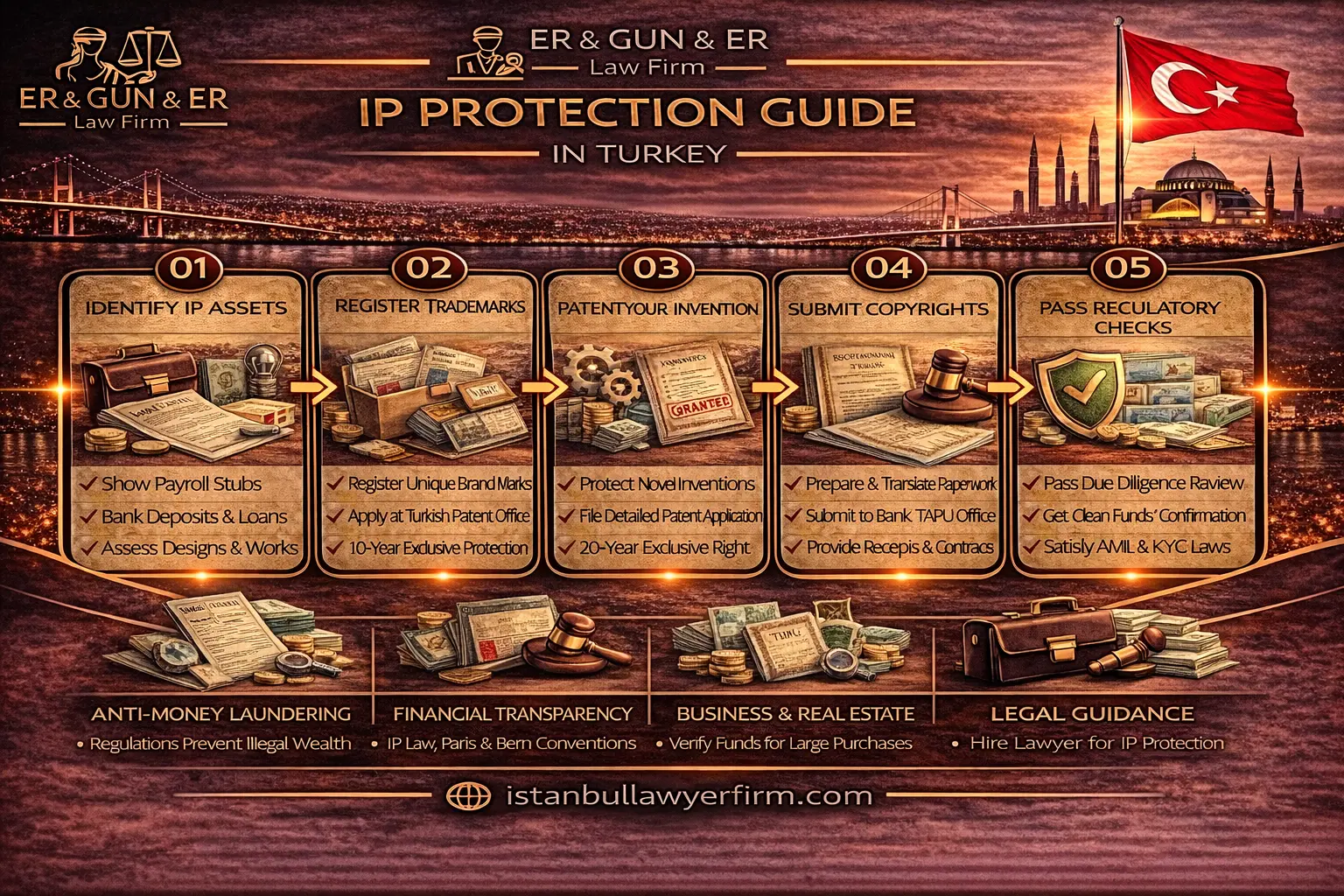
A coherent IP protection strategy in Turkey begins with a written map of what your business creates, uses, markets, and keeps confidential. This map should distinguish registrable rights such as trademarks, patents, and industrial designs from rights that arise without registration such as copyright and protected know how. In this IP protection guide Turkey perspective, the goal is not paperwork but enforceable exclusivity that supports sales channels, licensing, investment, and clean exits. A practical approach applies intellectual property law Turkey principles to the commercial reality of launch schedules, distributors, and cross border manufacturing. For brands, that means a clearance review, filing strategy with TÜRKPATENT, and consistent use and policing to avoid dilution. For inventions, it means confidentiality before filing, inventor documentation, and an early assessment of what should be patented, kept as a trade secret, or managed through controlled disclosure. For creative works, it means tracking authorship, commissioning terms, and distribution contracts so that ownership and licenses are never assumed. For confidential information, it means defining secrecy, restricting access, and aligning employment and commercial agreements with trade secret practice under the Turkish Commercial Code and Competition Law. Enforcement options include civil actions under the Industrial Property Code, criminal routes where applicable, border measures under the Customs Law, and online platform notices coordinated with evidential records. When international stakeholders are involved, working with a lawyer in Turkey who coordinates local counsel and an English speaking lawyer in Turkey who can align documents with global standards reduces avoidable friction.
IP strategy overview
An IP strategy overview should begin with governance, because rights are created by people and managed by processes. In Turkey, the first governance question is who owns the asset at creation and whether that ownership is documented. For a startup, that means founder assignments, contractor agreements, and contributor policies that are signed before any external disclosure. For an established company, it means confirming that legacy registrations, renewals, and recorded changes are aligned across subsidiaries. The second question is scope, because rights must match the goods, services, and markets that generate revenue. Trademarks should reflect current and planned classes, while patents and designs should reflect the product roadmap rather than only the current version. The third question is timing, because premature disclosure can destroy patentability and late filing can allow competitors to occupy the register. A disciplined approach uses internal intake forms, technical review, and a decision committee that can approve budgets and priorities. The fourth question is enforcement readiness, because a right that cannot be proven or acted upon quickly loses deterrence value. That readiness depends on evidence logs, market monitoring, and clear escalation paths for sales teams and distributors. The fifth question is cross border alignment, because Turkey is often a manufacturing, logistics, or sales hub for regional operations. International groups should align Turkish filings with home jurisdiction portfolios and ensure that naming, ownership, and priority claims are consistent. Where the business operates from Istanbul, engaging a law firm in Istanbul that can coordinate filings and disputes in one workflow is operationally efficient. Strategy is also about risk appetite, because not every infringement merits immediate litigation and not every right merits registration. A written policy that sets decision criteria helps maintain consistency and supports budgeting and reporting to management.
A mature strategy distinguishes between preventive measures and reactive measures, and it assigns responsibility for each. Preventive measures include clear brand guidelines, controlled templates for packaging, and review of supplier documentation. They also include registration sequencing so that key marks, core inventions, and distinctive designs are protected before scale manufacturing. Reactive measures include a standard playbook for cease and desist communications, platform notifications, and evidence collection. In sectors with high imitation risk, an anti-counterfeiting strategy Turkey should be built into procurement and distribution from the beginning. That strategy relies on product authentication features, batch tracking, and contracts that require cooperation during investigations. It also relies on training, because staff must recognize suspicious inbound shipments, abnormal reseller pricing, and parallel import patterns. When distributors are used, agreements should set out reporting duties and allocate who leads complaints and who pays investigation costs. The strategy should also address customs recordation and the interface with logistics providers, because border intervention depends on fast communication. The same framework should cover online marketplaces, because counterfeit sales often move between platforms and accounts. A consistent approach uses a centralized evidence vault with screenshots, product samples, invoices, and authenticated web captures. It should include a plan for expert analysis, because technical comparisons can be decisive in court and in administrative processes. It should also include reputational management, because public allegations must be accurate and coordinated with legal steps. practice may vary by authority and year — check current guidance. Finally, the strategy should be reviewed periodically to reflect new products, new channels, and updated enforcement practice.
Strategic planning must also address the difference between registration and commercial reality, especially for brands that evolve rapidly. A trademark portfolio should be reviewed against actual use, because unused or inconsistent use can weaken enforcement positions. For trademark enforcement Turkey, the strongest cases are usually those where the mark is used consistently, supported by invoices, packaging, and advertising archives. The same evidence supports damages arguments and helps counter defences based on descriptive use or lack of confusion. Patents and designs likewise benefit from documentation, including dated engineering files, version histories, and decisions to file or not file. Where a right is not registered, the strategy should specify which alternative claim will be used, such as unfair competition, copyright, or breach of confidence. That choice affects which court has jurisdiction, which evidence is most persuasive, and which interim measures are realistic. It also affects how fast relief can be sought, because some routes are inherently more document driven than others. Contractual strategy is part of the overview, because licenses, assignments, and coexistence arrangements can resolve conflicts without prolonged litigation. However, contracts must be drafted with enforceability in mind, including governing law, dispute resolution, and proof of authority to sign. A common mistake is treating IP as a single box, while in Turkey different rights are administered by different institutions and enforced through different channels. Coordination is therefore critical, particularly when a company operates through multiple entities, brands, and product lines. Search queries often look for a best lawyer in Turkey, but the right selection criterion is sector experience, litigation discipline, and the ability to document facts rigorously. Management should require periodic reporting on filings, risks, and enforcement actions so that IP is tracked like any other core asset. When that reporting exists, decisions become faster and inconsistent enforcement becomes easier to avoid.
Mapping protectable assets
Mapping protectable assets is a practical exercise that converts business activities into a rights matrix. It starts with interviews across product, engineering, marketing, sales, and procurement, because each function generates different IP. Engineering contributes inventions, prototypes, technical drawings, and manufacturing processes. Marketing contributes brand names, logos, slogans, packaging concepts, and campaign content. Sales and procurement contribute customer lists, pricing structures, tender materials, and supplier specifications that may constitute know how. The mapping should record the creator, creation date evidence, where the asset is stored, and who has access. It should also record whether any third party contributed, because joint development and commissioned work can complicate ownership. For groups with investors or acquisition plans, this mapping becomes the backbone of IP due diligence Turkey readiness. A clean file should show which registrations exist, which applications are pending, and which rights rely on unregistered protection. It should also show which rights are core to revenue and which are defensive, because not all assets justify the same spend. The mapping must cover company names and trade names, because commercial sign protection can overlap with trademark protection. It must also cover domain names and social media handles, because inconsistent ownership can undermine brand control. For software and content, the map should track repositories, authorship records, and the chain of title from employees and contractors. For manufacturing, the map should track tooling, molds, and supplier specific configurations that are hard to replicate. Once the matrix is prepared, it should be maintained as a living document rather than a one time audit.
Asset mapping should not stop at what is easy to name, because the most valuable elements are often embedded in processes. In Turkey, confidential information can be protected through contractual duties, workplace policies, and claims based on unfair competition and breach of confidence. For trade secrets protection Turkey, the key question is whether the information is actually treated as secret and whether access is restricted on a need to know basis. That assessment requires reviewing access logs, permission structures, and whether sensitive data is shared through uncontrolled channels. It also requires reviewing how suppliers and distributors are onboarded, because uncontrolled sharing during negotiations can destroy secrecy. A practical mapping will classify know how into tiers, such as strategic, operational, and incidental, and it will match controls to each tier. Controls include confidentiality agreements, clean room procedures for joint projects, and export controls where relevant. Documentation is essential, because courts typically expect the claimant to explain what the secret is and why it matters commercially. This is also the stage to align data protection and cybersecurity controls, because a breach may trigger parallel regulatory exposure. practice may vary by authority and year — check current guidance. Where internal teams are not aligned, a workshop led by Turkish lawyers can help translate business practice into legally defensible controls. The mapping should also check whether any information was imported from a prior employer or competitor, because that can create immediate risk. A neutral review of onboarding files and employee declarations reduces the likelihood of later allegations. The asset map should further record where evidence is generated, such as lab notebooks, purchase orders, and internal approvals. When evidence sources are known, later enforcement actions can be prepared faster and with less disruption.
A map is only as good as the ownership chain behind it, and ownership must be documented rather than assumed. For trademarks and designs, the applicant name should match the operating entity that uses the right or the holding entity that licenses it. For patents, inventorship and entitlement must be reviewed carefully, because incorrect inventorship can create vulnerability. For copyright and software, the default rules on authorship and employer ownership should be checked against contracts and actual working relationships. Where contractors are used, the company should not rely on invoices alone, because payment does not necessarily transfer IP. Instead, a written assignment should describe the work, the rights transferred, and the scope of use in a way that can be proven later. This is where an IP assignment agreement Turkey framework becomes operational, especially for code contributions, designs, and marketing materials. Assignments should also address moral rights considerations where relevant, because some author rights cannot be waived in the same way as economic rights. Where assets were developed with partners, the map should record joint ownership terms and decision making rules for enforcement and licensing. Joint ownership without clear governance can block deals, because one party may refuse consent or demand leverage value. The mapping exercise should therefore include a review of shareholder agreements and joint venture contracts where IP is core. It should also include a review of finance documents, because banks and investors may take security over IP or require covenants. For consumer products, the map should link IP to regulatory documentation, because product compliance claims can influence branding choices. Where a business rebrands or changes packaging, the map should record transition plans so that old marks are not abandoned prematurely. When mapping is done with this level of discipline, registration decisions and enforcement actions become far more predictable.
Trademark protection basics
Trademark protection in Turkey is primarily built on registration, supported by consistent use and clear brand governance. Before filing, a clearance search should cover identical and confusingly similar marks, relevant classes, and potential conflicts with trade names. The objective is to reduce refusal and opposition risk and to avoid building marketing investment on a sign that cannot be secured. A filing strategy should align with the goods and services actually offered and with the near term expansion plan. Overly narrow filings can leave gaps, while overly broad filings can create vulnerability if parts of the specification are never used. The application should be prepared with attention to how examiners and third parties read the specification, especially in crowded sectors. Where the mark includes stylization or figurative elements, the choice between word, device, and combined filings should be intentional. For many clients, the core step is trademark registration Turkey through TÜRKPATENT with clean ownership and correct applicant details. If you need a deeper walk through, the trademark registration overview provides process context that can be aligned with your portfolio. After filing, portfolio administration matters, including docketing, address updates, and recording changes of name or ownership. Where a holding company structure is used, licenses should be documented so that use can be attributed correctly. Brand use guidelines should control how marks appear on packaging and digital interfaces, because inconsistent use can weaken distinctiveness. In practice, coordination between marketing and legal avoids last minute changes that create clearance risk. When clients want a single point of accountability, a Istanbul Law Firm can coordinate searches, filings, renewals, and dispute response in one file. A disciplined trademark file should always include evidence of first use, market presence, and the rationale for class coverage.
Registration is not the end of trademark work, because the register is dynamic and conflicts often arise after filing. Third parties may challenge applications or registrations, and a business should prepare evidence and arguments in advance. The quality of the file, including how the mark is used and how consumers perceive it, often shapes the strength of later submissions. Where a conflict is commercial rather than abusive, negotiated coexistence or consent can sometimes be more efficient than full litigation. Any coexistence arrangement should be drafted with precision, because vague territory or channel boundaries can fail in practice. A watch service helps identify risky filings early, but it should be tuned to avoid noise that creates decision fatigue. In regulated sectors, brand clearance should include product labelling and advertising constraints so that the mark can be used compliantly. That is one reason portfolio counsel often coordinates with regulatory counsel when health, cosmetics, or food claims are involved. practice may vary by authority and year — check current guidance. Changes in ownership or corporate structure should be recorded promptly, because recordal gaps can complicate enforcement standing. Where a mark is licensed, the license terms should control quality and define how infringement is reported and handled. Uncontrolled licensing can dilute the mark and create disputes between licensors and licensees. For companies operating through distributors, contracts should define who can use the mark in domain names and social media pages. Internal training matters as well, because sales teams often generate unofficial slogans or variants that are hard to protect later. A well maintained portfolio therefore combines register management with disciplined use and clear contractual controls.
Trademark conflicts increasingly start online, so brand owners should treat digital monitoring as part of basic protection. The first response is often an evidence capture, because listings, usernames, and product photos can change quickly. Screenshots alone are sometimes challenged, so authenticated web captures and platform records should be considered. A measured first letter can resolve many disputes, but it should be grounded in clear rights and accurate facts. Online trademark infringement Turkey matters most where confusion affects consumer choice, where counterfeit goods are offered, or where the infringer targets the brand reputation. Platform takedown tools can be effective, but the documentation and wording should be consistent with the registered scope and with local unfair competition standards. Where a seller persists, escalation can include interim injunction requests and applications for evidence preservation. Parallel import scenarios should be analysed carefully, because the legal position can depend on exhaustion and the condition of the goods. Businesses should also monitor paid advertising and keyword bidding, because misuse can divert traffic without obvious product copies. For social media, impersonation and misleading pages can often be addressed through combined trademark and consumer deception arguments. If a domain is used to mislead consumers, the factual record should include DNS history, registrant data, and content archives. A rapid response team should coordinate legal, brand, and customer support messaging to avoid inconsistent statements. Cease and desist letters should avoid overreach, because inaccurate claims can trigger counter allegations. Where multiple countries are involved, harmonizing notice templates reduces the risk of contradictory positions. Over time, consistent action builds deterrence and makes later court applications more credible.
Patent protection basics
Patent protection in Turkey is governed by the Industrial Property Code and implemented through filings with TÜRKPATENT. The first practical step is to control disclosure, because public presentations, sales offers, and uncontrolled discussions can destroy novelty. Businesses should use confidentiality agreements and limit access to inventions until a filing decision is made. Inventor declarations and internal invention disclosure forms help ensure that the technical contribution is recorded accurately. A prior art review is recommended to understand what is already known and to frame claims that are defensible. The drafting phase should be managed carefully, because the specification must support the claims and must disclose the invention sufficiently. Overly narrow claims can be easy to design around, while overly broad claims may be rejected or invalidated later. For many companies, the key milestone is patent registration Turkey readiness with a clear ownership chain and a file that matches the product roadmap. For procedural context and common pitfalls, the patent registration guide can be used as a checklist alongside counsel. International applicants should also consider how Turkish filings align with priority claims, translations, and naming conventions. If an invention was developed with external partners, entitlement and licensing rights should be documented before filing. R and D incentives and grants may impose disclosure or reporting obligations that should be coordinated with patent timing. A patent strategy should distinguish between core inventions that merit broad protection and peripheral improvements that may be kept as know how. Maintenance and annuity administration must be planned, because patent portfolios can become expensive if not rationalized. A disciplined file management approach ensures that later enforcement and licensing work is supported by clear technical records.
From an enforcement perspective, patents are only as strong as their claim scope and the evidence supporting infringement. A company should therefore maintain technical documentation showing how the protected product is made, sold, and used in Turkey. When competitors launch similar products, early technical comparison helps decide whether the issue is infringement or lawful competition. For patent infringement Turkey analyses, the focus is usually on claim construction, product tear down evidence, and expert evaluation. Pre litigation steps should be handled cautiously, because premature accusations can trigger declaratory actions or business disruption. Where products are complex, sampling and lab testing protocols should be designed to withstand scrutiny. If the alleged infringement occurs in manufacturing, supply chain documents and witness evidence may be as important as the physical product. In many disputes, the commercial objective is to stop the infringing supply quickly rather than to debate theory in abstract. Interim measures may be available, but they typically require a coherent narrative of validity, infringement, and urgency. practice may vary by authority and year — check current guidance. Settlement is often realistic where parties have complementary technologies, but settlement should not compromise future portfolio value. Any settlement should address stock clearance, future design arounds, and confidentiality of technical disclosures exchanged during negotiation. Where foreign parties are involved, translation and technical accuracy in correspondence becomes critical to avoid later misinterpretation. When clients need coordinated drafting and dispute handling, a Turkish Law Firm can align claim strategy, expert briefing, and procedural steps under one file. A patent program therefore requires ongoing management that connects R and D decisions to enforcement and licensing outcomes.
Patent strategy should be integrated with product development and manufacturing decisions, not treated as an isolated legal exercise. Where the market moves fast, a staged filing approach may be considered so that early concepts are protected while refinement continues. Businesses should document version history and testing data, because these records support both patent drafting and later expert work. When inventors move between employers, onboarding and exit controls reduce the risk of disputes over entitlement and confidential know how. The portfolio should also be reviewed for freedom to operate concerns, because owning patents does not automatically grant the right to practice an invention. In Turkey, freedom to operate is often managed through targeted searches, design around decisions, and licensing discussions. If a third party patent blocks a launch, the options may include negotiating a license, challenging validity, or adjusting the product. Those decisions should be taken with commercial teams, because time to market and supply contracts may be impacted. Where patents are licensed out, the agreement should address field of use, quality control, reporting, and audit rights. Royalty structures should be aligned with verifiable sales metrics to reduce later disputes. Where patents are assigned, the transaction should include warranties on title, encumbrances, and pending disputes. A global patent family should also be managed with export and customs considerations, because technical products move through Turkey as a regional hub. Patent filings can also support valuation exercises, but valuation assumptions must be grounded in market data rather than wishful projections. An internal decision record explaining why each filing was made helps demonstrate good faith portfolio management in later disputes. When these operational links are built, patents become a tool for planning and negotiation rather than only a litigation asset.
Industrial design protection
Industrial design protection in Turkey is designed to secure the visual features of a product, including lines, contours, colours, shape, texture, and ornamentation, when those features create a distinctive overall impression. The commercial advantage is straightforward, because a registered design can support quick action against look alike products that trade on your market recognition. In practice, the design file should be built around how the product is actually sold, because the relevant comparison is often made through the perspective of an informed user rather than an engineer. That is why photographs or drawings must show the aspects you want protected and must avoid unnecessary ambiguity that later allows arguments about what is and is not claimed. A well planned filing typically includes multiple views and, where appropriate, close ups that make the protected features unmissable. Before any filing, you should control disclosure to the market and to suppliers, because premature publication can complicate novelty analysis and weaken confidence in enforcement. The filing is made through TÜRKPATENT, and the applicant details should match your ownership model and any licensing structure you use across group companies. If you are preparing industrial design registration Turkey as part of a product launch, align the filing scope with packaging, user interface elements, and product variants that consumers actually perceive. If a product has functional constraints, the strategy should separate functional features from visual features, because design rights are not intended to monopolize technical solutions. For portfolios, it is often efficient to define a core design and then build a family of related applications that cover the main commercial variants. Your counsel should also evaluate whether design protection overlaps with trademark or copyright protection, because coordinated filings can increase deterrence without duplicating effort. The most frequent procedural mistakes come from inconsistent visuals, unclear disclaimers, and ownership details that do not align with the entity shown on invoices and packaging. A short internal review meeting with product and marketing teams usually prevents those mistakes, because it forces the business to articulate what makes the design distinctive. Where the design is central to brand identity, a lawyer in Turkey should coordinate timing and evidence collection so that you can prove first market presence without risking early disclosure. For a step by step overview that can be aligned with your products, the design registration process can be used as a practical reference during preparation. Once the filing plan is set, the business should assign clear responsibility for renewals, portfolio changes, and recordal of corporate restructures so that rights remain enforceable.
Design protection is strongest when it is integrated into product documentation and compliance review, because product visuals rarely exist in isolation from marketing claims and regulatory labelling. Packaging, icons, and layout elements often carry both design value and consumer information, and inconsistencies between versions can create evidential noise in a dispute. If the product is sold in multiple formats, you should keep an archive of each commercial presentation, including dated catalogues and screenshots of product pages. This archive supports both infringement comparison and the defence against allegations that the design was already publicly known. Where a design is tied to product claims, counsel should coordinate with regulatory teams to ensure that the visual presentation does not invite avoidable compliance challenges. A useful cross check is the product claims compliance discussion, because IP disputes often trigger collateral scrutiny of marketing statements. When suppliers contribute to a design, contracts should clarify whether the supplier is merely implementing your concept or whether it contributes original elements that require assignment. If the supplier contributes, the agreement should define the permitted use and should require cooperation if you later need evidence or testimony. Design protection can also interact with tooling and molds, because physical control over molds can become a practical barrier against unauthorized production. Accordingly, procurement contracts should address ownership and return of molds, confidentiality of technical drawings, and restrictions on producing for third parties. If you rely on unregistered design arguments or unfair competition concepts, the evidential threshold and the legal framing may shift depending on the sector and the forum. practice may vary by authority and year — check current guidance. Even when a design is registered, you should anticipate defences based on functional constraints, prior disclosure, and independent creation, and you should prepare rebuttal material early. That rebuttal can include internal concept drafts, design iteration files, and early prototypes that show the evolution of distinctive features. When these materials are organized in advance, interim measures become more realistic because the court can understand the protected look quickly. The commercial objective is to secure leverage in negotiations and to prevent market confusion, not to litigate every minor similarity that has no material impact.
From an enforcement perspective, design rights are effective when the protected features are visually clear and easy for a judge to compare. For consumer products, obtaining representative samples of the suspect goods is often as important as obtaining screenshots, because physical inspection exposes subtle differences and confirms source. A disciplined sampling protocol should record where and when the item was purchased, preserve invoices, and keep packaging intact. Where online listings are used as evidence, capture the full page context, seller identity, and the route a consumer takes from advertisement to checkout. If the infringement is tied to imports, consider coordinating design enforcement with customs monitoring so that suspect shipments can be identified early. Design disputes can also overlap with trademark and unfair competition claims, particularly where copying targets the overall get up of a product. Counsel should choose claims that fit the evidence, because a design registration may cover the core look while additional arguments address confusing packaging and misleading advertising. When the suspected products move through multiple intermediaries, tracing the supply chain requires careful handling of invoices, shipment records, and distributor communications. In many matters, the fastest commercial result comes from coordinated actions against sellers, importers, and key online accounts rather than a single isolated target. Any pre action communication should remain factual and should avoid overstating technical conclusions before expert review. If a dispute is likely, arrange internal product side by side comparisons and prepare clear visual exhibits that the court can understand without industry knowledge. Those exhibits should highlight the protected elements and explain why the alleged copy produces the same overall impression in the market. Where foreign management must approve steps quickly, an English speaking lawyer in Turkey can align Turkish procedure with the evidence packages used in other jurisdictions so that decision making is consistent. Confidentiality should be maintained during enforcement to prevent the opposing party from adjusting products before inspections occur. If you plan a settlement, ensure that the terms cover remaining stock, future variants, and the handling of molds and design files. Design enforcement works best when it is treated as an operational discipline supported by documentation, not as an ad hoc reaction after copies are already widespread.
Copyright scope Turkey
Copyright in Turkey generally arises automatically when an original work is created and fixed in a form that can be perceived, without the need for prior registration. This makes copyright an essential layer for businesses that produce software, marketing content, photographs, audiovisual materials, architectural designs, and manuals. The core compliance task is not filing but proving authorship, ownership, and the scope of licensed use across channels. For commissioned works, ownership should be clarified in writing, because payment for a deliverable does not always resolve who controls reproduction, adaptation, and distribution. For employer created works, companies should keep onboarding and employment records that show the working relationship and the assignment of economic rights where needed. In transactions, buyers often ask for clear chain of title evidence, because a missing assignment in a content project can be as damaging as a missing trademark filing. Where multiple contributors exist, a documentation protocol should attribute contributions and define how modifications and derivative works are managed. This is particularly important in brand campaigns that reuse stock elements, external fonts, and third party music, because licensing scope can be narrower than expected. When a business operates across borders, contract templates should define governing law and dispute resolution in a way that is enforceable in Turkey. A compliance oriented approach to copyright protection Turkey also includes keeping records of permissions, invoice trails, and license texts in a searchable archive. Businesses should coordinate copyright management with brand management, because content misuse can distort brand identity and mislead consumers even when trademarks are intact. For social media and influencer content, agreements should define who can repost, edit, and use content in paid advertising. Where content is created by agencies, the contract should address sub contractors so that hidden contributors do not later assert ownership. When disputes arise, the first practical objective is to secure evidence of the original files, timestamps, and publication history. Working with a law firm in Istanbul that understands both commercial contracting and dispute procedure helps businesses connect ownership documentation to enforceable remedies. The earlier those records are organized, the less disruptive enforcement becomes during a launch or a public campaign.
In practice, copyright questions often turn on whether the work meets the originality threshold and whether the claimant can show the creative contribution. For software, the focus is typically on source code and the structure and organization expressed through code, rather than on general ideas or functionality. Businesses should therefore keep repository histories, contributor logs, and access records that show who wrote what and under which contractual terms. For databases and data driven products, protection may be limited to the selection and arrangement that reflects creative choices, rather than to raw facts. Marketing materials require similar discipline, because templates are often reused and modified across campaigns, creating confusion about versions and authorship. A version control practice for creative files, including layered design files and final exports, strengthens the ability to prove copying. Moral rights concepts, including attribution and integrity, should be considered when editing third party works, even where economic rights are licensed. For audiovisual productions, agreements should specify rights in scripts, performances, and recordings so that distribution on multiple platforms is covered. Where employee created materials are used after termination, maintaining evidence of the employment relationship and the job scope helps avoid later claims. When third party assets are incorporated, keep the license terms linked to the specific file and campaign in which the asset is used. If your teams rely on open source or creative commons materials, the compliance file should document the applicable license conditions and attribution requirements. practice may vary by authority and year — check current guidance. For photography, it is often useful to preserve raw files and metadata, because these details support authorship and can rebut fabrication allegations. For architectural and industrial documentation, preserve project approvals and draft iterations that show the creative process over time. For content that is rapidly published and edited online, set up an internal capture routine so that you can prove what was published at a given time. These operational steps do not replace legal analysis, but they create the factual base that makes legal analysis actionable.
Copyright enforcement in Turkey typically starts with identifying the infringing act and preserving proof before the material is removed or modified. For online uses, this may involve capturing the webpage, the account details, and the hosting context, because the same content can appear under multiple accounts. If the infringing party is a commercial competitor, contractual and unfair competition arguments may sit alongside copyright arguments, depending on the facts. Where the infringement involves product manuals, software, or technical drawings, confidentiality considerations should be assessed to avoid disclosing sensitive information while asserting rights. Many disputes are resolved through targeted notices and negotiated undertakings, but notices should be consistent with ownership records to avoid challenges. Where a platform offers a rights holder complaint process, submissions should be supported by clear proof of authorship and the first publication timeline. For repeated infringement, escalation options may include interim measures and requests for removal, but the decision depends on urgency and the economic impact. If you suspect a wider distribution network, investigate the source files and distribution channels rather than focusing only on public posts. Where content is used in printed materials, collecting physical samples and distribution invoices can be as important as capturing online evidence. When foreign language translations are involved, consider whether the translation is itself protected and whether the translator has transferred rights. Evidence should also address the scale of use, because a single isolated copy may justify a different response than a coordinated commercial campaign. In some matters, the key objective is to stop the misuse quickly to protect brand reputation rather than to pursue extended monetary claims. An Istanbul Law Firm can coordinate evidence preservation, contractual review, and court filings so that the legal theory matches the available proof. Confidential settlement terms should include deletion obligations, audit rights for digital repositories, and commitments regarding future content creation. Where enforcement is pursued, internal stakeholders should be briefed to avoid inconsistent public statements that complicate negotiations. A disciplined copyright program therefore combines rights documentation, controlled publishing processes, and a clear response plan for infringement incidents.
Trade secrets protection
Trade secrets are often the most valuable IP in Turkey because they cover manufacturing methods, formulations, customer intelligence, and pricing models that are never visible in registrations. The legal protection typically relies on contractual duties, unfair competition principles under the Turkish Commercial Code, and case based confidentiality practice rather than a single registry. The first practical requirement is definitional, because the business must be able to describe what the secret is with reasonable specificity. The second requirement is control, because information that is shared freely across departments, personal emails, or messaging groups will be difficult to present as secret later. Access should be limited to those who need the information for their role, and the company should be able to show that limitation through permissions and logs. Documents should be labeled in a consistent way and stored in systems where downloads and sharing can be audited. A written policy that defines confidential tiers helps employees understand their obligations and helps management enforce them consistently. For trade secrets protection Turkey, the strongest files show that the secret provides commercial advantage and that the business invested in keeping it confidential. When suppliers are involved, confidentiality clauses should be paired with practical controls such as segregated production lines or restricted tooling access. If a project is co developed, clean room protocols can reduce contamination risk between teams and help isolate what is shared under what conditions. Exit procedures are critical, because many trade secret disputes arise when employees leave and take files or client contacts with them. A proper exit process includes return of devices, revocation of credentials, and a written reminder of ongoing confidentiality obligations. Where new hires come from competitors, onboarding should include a written instruction not to bring third party confidential information into your systems. The objective is to build a defensible compliance posture before any conflict, not after a leak has already occurred. A best lawyer in Turkey will usually start by testing the secrecy controls and the evidential trail, because courts look for concrete measures rather than broad assertions. When these controls are in place, the business can move faster and with greater credibility if misappropriation is suspected.
The contractual layer for trade secrets should cover employees, contractors, suppliers, distributors, and potential investors, because leaks often occur at interfaces. Confidentiality agreements should define the confidential information broadly enough to capture evolving know how, but they should also include examples that make the obligations tangible. Agreements should restrict reverse engineering where appropriate, and they should prohibit using confidential information to compete or to solicit customers. However, restrictions must be drafted with a realistic understanding of enforceability and competition constraints, because overbroad terms invite disputes. A parallel internal policy should explain how information is shared, how documents are labeled, and which channels are prohibited for sensitive materials. Training should be repeated, because staff turnover can quickly undermine a policy that is never revisited. When misappropriation is suspected, the legal theory often combines breach of contract with unfair competition analysis, particularly where the conduct distorts market fairness. For a broader conceptual discussion that can inform pleadings and correspondence, the unfair competition framework provides useful context. In investigations, companies should take care to avoid unlawful monitoring, because evidence gathered through improper access can create separate liability and evidential challenges. Internal IT teams should preserve logs and access records in a forensically sound way that can be explained later. Where devices are involved, imaging and chain of custody documentation should be planned before any confrontation with the suspected individual. practice may vary by authority and year — check current guidance. In commercial negotiations, it is common to exchange confidential information under mutual confidentiality terms, and the process should include controls on copying and downstream sharing. A data room structure with watermarking, access restrictions, and audit trails reduces risk and supports later proof if a leak occurs. Where a dispute escalates, counsel may need to seek rapid preservation measures to prevent deletion and to secure evidence of transfers. A disciplined trade secret program therefore treats confidentiality as an operational system rather than as a single clause in a contract.
When trade secret disputes reach litigation, the claimant must balance the need to explain the secret with the need to keep it confidential. This usually requires careful structuring of pleadings, attachments, and expert materials so that sensitive details are limited to what is necessary. Businesses should prepare a redaction protocol and define who inside the organization can access the litigation file. If technical experts are used, engagement letters should include confidentiality and data handling terms, because experts will often receive the most sensitive materials. Remedies can include orders to stop use and disclosure, delivery up or deletion obligations, and compensation claims, but the realistic outcome depends on facts and proof. The strongest early steps are often injunctive, because once a secret is widely disseminated the commercial value may be impossible to restore fully. To support urgency, the company should show why the information is valuable, how it was protected, and what specific conduct indicates misuse. Where the misuse appears connected to a competitor launch, market evidence and timing analysis help demonstrate the causal link between access and product decisions. If the dispute involves cross border transfers, coordinate with foreign counsel to secure parallel evidence, because data can move quickly between jurisdictions. Communications with counterparties should be managed carefully, because uncontrolled accusations can trigger defamation claims or retaliatory filings. In settlement, focus on practical controls such as device returns, deletion certifications, and non solicitation commitments, rather than relying on broad promises. Where business continuity is required, consider whether limited licensing or transition arrangements can resolve immediate harm while preserving long term competitiveness. A Turkish Law Firm with litigation discipline can structure confidentiality measures and evidential submissions so that the court can act without forcing unnecessary disclosure. practice may vary by authority and year — check current guidance. Even after a dispute is resolved, update policies and access controls, because repeated incidents often reveal the same underlying governance gaps. Trade secret protection therefore succeeds when it is treated as a continuous compliance program backed by enforceable contracts and credible evidence.
Licensing and assignments
Licensing is the mechanism that turns IP into controlled commercial use, whether the licensee is a subsidiary, a distributor, or a strategic partner. A license should define the licensed right precisely, because a trademark, a design, and a software copyright each require different usage controls. Territory, field of use, sales channels, and sublicensing rights should be drafted so that the agreement matches the business model and avoids silent expansion. Quality control is particularly important for trademarks, because uncontrolled use can weaken distinctiveness and complicate enforcement against third parties. For technology, the agreement should clarify whether the license covers improvements, updates, and technical support, because those points often drive value. Royalty structures should be tied to measurable events such as net sales, units, or service subscriptions, and reporting should be auditable. Audit rights should be practical, including access to records and a dispute mechanism for calculation disagreements. If confidentiality is central, the license should include detailed data handling and reverse engineering restrictions appropriate to the product. An IP licensing agreement Turkey should also address how infringement is handled, including who sends notices, who files actions, and how recoveries are allocated. Dispute resolution clauses should be drafted with enforcement in mind, because an award or judgment must be executable against the relevant assets. Termination provisions should anticipate what happens to stock, marketing materials, and customer data after the relationship ends. Where licenses are granted to distributors, ensure that online sales policies and marketplace rules are aligned with the brand strategy. If the license involves multiple rights, draft the agreement so that termination of one right does not unintentionally terminate unrelated rights. Cross border groups should harmonize Turkish license templates with global templates, while still adapting to local practice and procedural requirements. Experienced Turkish lawyers will usually insist on evidential clarity, because enforcement disputes often hinge on whether a use was authorized under the contract. When licenses are drafted with operational discipline, they reduce conflict and strengthen the portfolio rather than creating unmanaged risk.
Assignments transfer ownership and therefore require stronger formality and diligence than routine licensing. In a transaction, the buyer should confirm that the seller has clear title, that no security interests or pledges exist, and that there are no hidden co owners. The assignment document should identify the right with enough detail that it can be recorded and that it will cover future enforcement. For registered rights, it is usually prudent to complete recordal steps with the relevant registry, because recordal supports standing and public notice. Where trademarks, patents, or designs are involved, confirm that the registration details match the corporate name and that any name changes were recorded properly. For unregistered rights such as software and content, confirm that creator assignments exist and that subcontractor contributions were captured. A well drafted IP assignment agreement Turkey will include representations on title, non infringement knowledge, and the absence of undisclosed disputes. It will also include transitional support obligations, because in practice the buyer may need access to files, passwords, and technical documentation to exploit the right. If the assignment is part of a share deal, confirm whether the IP sits in the target company or in a separate holding entity, because closing documents must reflect the structure. Tax treatment, stamp duty exposure, and accounting recognition should be reviewed with finance advisors, because IP transfers can have reporting consequences. practice may vary by authority and year — check current guidance. If the asset is core to a product line, consider a transitional license back to the seller if the seller must continue supplying the product post closing. For ongoing research and development, define how improvements are handled, because disputes frequently arise when a transferred technology is improved after closing. If multiple jurisdictions are involved, coordinate the Turkish assignment with foreign filings and corporate approvals so that the chain of title remains consistent. Closing deliverables should include a complete schedule of rights and the evidence folder that supports use and creation, not only registration numbers. When assignments are prepared with this level of detail, they support financing, licensing, and enforcement without reopening ownership questions later.
Cross border licensing and technology transfer often raise competition and compliance questions that must be addressed alongside IP formalities. Where a license grants exclusivity or restricts parallel imports, the commercial justification should be documented and the restrictions should be calibrated to the legitimate purpose. Confidential know how transfer should be described with enough precision that the recipient understands what is delivered, while still preserving secrecy against third parties. Technical assistance services, training, and updates should be defined, because disputes often arise when the licensor believes it transferred more support than it intended. If a license includes access to source code or manufacturing recipes, consider staged disclosure tied to payment and performance milestones. Operationally, it is important to separate background IP, foreground improvements, and customer specific adaptations so that ownership remains clear. Where joint development is anticipated, establish governance for invention disclosures, filing decisions, and cost sharing before work begins. Dispute resolution provisions should also consider interim measures, because urgent relief may be needed even when the main dispute is arbitrated. For long term relationships, include mechanisms for periodic review and amendment, because products evolve and initial specifications become outdated. Audit and reporting clauses should be realistic and should define acceptable record formats, because disputes often arise from inconsistent accounting approaches. Termination for breach should be tied to objective triggers and a clear cure process so that the parties can manage risk without constant threats. Post termination obligations should address use of marks, return of confidential materials, and the handling of customer communications. If the relationship involves sublicensing, define approval rights and monitoring duties, because uncontrolled sublicensing can create infringement risk and brand dilution. Where the agreement is used to resolve a dispute, settlement language should be aligned with public facing conduct to avoid consumer deception allegations. In group structures, intra group licenses should be documented with the same care as external licenses, because third parties and courts often require proof of authorization. Well structured licensing and assignment documentation therefore acts as a compliance tool, a dispute prevention tool, and a value creation tool at the same time.
IP in employment context
IP ownership in an employment setting should be documented before a project starts, not after a dispute arises. In Turkey, the default allocation of rights can differ depending on whether the output is a patentable invention, a design, software, or marketing content. A practical approach is to align employment contracts, internal policies, and project documentation so that the company can demonstrate entitlement under the Industrial Property Code and the Copyright Law. For inventions, the key is to keep a clear record of the inventor, the scope of the contribution, and the moment the invention was disclosed internally. For software and creative materials, the key is to confirm that economic rights needed for commercialization are granted to the employer or are assigned on creation. Businesses should avoid relying on implied transfers, because implied terms are difficult to prove and are often contested when value becomes visible. In cross functional teams, it is common for marketing, product, and engineering to contribute to the same output, so the documentation must capture who contributed what. The same discipline applies to translations, photographs, and user manuals, because these materials are frequently outsourced or co-created. A written policy that requires employees to use company systems for work product reduces later disputes about access, timestamps, and version history. Confidentiality obligations should be stated clearly and reinforced through training, because trade secret controls often fail at the human interface. Where employees attend fairs, conferences, or sales meetings, they should be instructed not to disclose unfiled inventions or prototype visuals. If disclosure is necessary for commercial reasons, it should be controlled through non-disclosure agreements and limited access channels. Management should also define who is authorized to approve public announcements, product demos, and external collaboration on R and D. These steps support a defensible position under intellectual property law Turkey and reduce the risk that a competitor will claim earlier disclosure. When the organization is international, aligning Turkish employment documentation with global templates prevents gaps between jurisdictions. A lawyer in Turkey should review the employment and contractor stack to ensure that ownership, confidentiality, and dispute escalation are consistent.
Employment documentation should be paired with a working invention disclosure process, because contracts alone do not generate evidence. An internal disclosure form should capture the problem solved, the technical solution, contributors, and any prior art references the team is aware of. The form should also ask whether any external party contributed, because joint development can affect entitlement and later licensing flexibility. Where employees work remotely, the company should document the tools and systems used to create work product, because private devices can complicate evidence collection. If a company permits bring your own device practices, it should still implement access logging and deletion policies for confidential files. Employee handbooks should cover the use of open source code and third party materials, because misuse can contaminate ownership and create compliance exposure. In regulated industries, marketing approvals should include an IP check so that campaign slogans and packaging elements are cleared before publication. Exit procedures should be treated as an IP control point, because departures are a common moment for customer lists and templates to leave the organization. A structured exit process includes disabling access promptly, collecting devices, and obtaining a written acknowledgment of ongoing confidentiality obligations. If the departing employee moves to a competitor, the company should act quickly but proportionately, focusing on factual preservation rather than speculation. Internal investigations should be coordinated with HR and IT to avoid unlawful access to personal accounts and to preserve admissible records. Where wrongdoing is suspected, counsel may consider civil measures for evidence preservation while also preparing a commercial communication plan. In some sectors, non-solicitation and limited post-employment restrictions are used to protect client relationships, but enforceability depends on drafting and proportionality. practice may vary by authority and year — check current guidance. The most reliable protection remains strong confidentiality governance supported by selective access, audit trails, and consistent discipline. Experienced Turkish lawyers can help ensure that employment templates, internal policies, and investigation steps align with procedural standards.
Many IP problems in Turkey arise from the use of contractors, consultants, and agencies who are treated like employees but are not covered by employment rules. For those relationships, the company should use written work orders and agreements that transfer the necessary economic rights and define permitted portfolio references. If the contractor is an individual, confirm the identity, signature authority, and the link between invoices and deliverables, because enforcement later depends on provable chain of title. If the contractor is a company, ensure that it warrants it has obtained assignments from its staff and subcontractors, because the buyer cannot practically chase every contributor. Where a project involves both creative content and technical development, separate clauses should address each category so that the scope of transfer is not ambiguous. For software, define whether the transfer includes source code, build scripts, documentation, and the right to modify and create derivative works. For design deliverables, require delivery of the original editable files, because PDFs and images may not support future variants and can weaken proof of authorship. For inventions created under service agreements, require timely internal invention disclosures so that patent filings are not missed due to late communication. Secondments and shared personnel between group companies should be documented carefully, because entitlement can be unclear when a person is paid by one entity but reports to another. If the business uses interns and students, use clear onboarding terms that define ownership and confidentiality, because informal arrangements often produce disputes when a project succeeds. Training should also cover social media behavior, because employee posts can inadvertently disclose prototypes, packaging, or internal presentations. If a dispute arises, the company should preserve emails, repository logs, and design files, and it should document how the work was created and approved. When sensitive information is involved, internal legal should coordinate communications to avoid sharing confidential data in dispute correspondence. Where an employee claims authorship or entitlement, early negotiation can be effective if the company can show clear documentation and consistent policies. The commercial goal is to maintain continuity of product development while removing uncertainty over ownership and permitted use. A well structured employment and contractor framework therefore reduces litigation risk and increases the confidence of investors and commercial partners.
IP due diligence steps
IP due diligence begins with defining the transaction objective, because the scope of review should match what the buyer will actually rely on after closing. A share acquisition typically requires a full portfolio review, while an asset deal requires deeper chain of title analysis for the specific rights being transferred. In Turkey, the starting point is a schedule of registered trademarks, patents, and designs filed with TÜRKPATENT, including pending applications and any recorded changes. The reviewer should verify that the applicant and owner names match the corporate registry records and that signatures and authorizations are properly documented. The file should also include licenses, coexistence agreements, settlement undertakings, distribution agreements, and any security interests that touch IP. Evidence of use is relevant, because enforcement strength and portfolio rationalization decisions depend on how marks and designs are used in commerce. For technology, the reviewer should request invention disclosure records, R and D logs, and documentation of external collaborations that may affect entitlement. For software, due diligence should cover repository access, contributor agreements, and third party dependencies so that ownership and licensing risk is visible. For content, confirm commissioning terms, agency contracts, and the scope of rights granted for images, videos, and text used in campaigns. Domain names and social media accounts should be checked for ownership and control, because a mismatch between brand ownership and account ownership creates operational vulnerability. Confidential information should be reviewed through policies, NDAs, and access controls rather than through a request for the secrets themselves. The reviewer should also check for ongoing disputes, threatened claims, and regulatory investigations that could impact the ability to use a sign or product concept. This work is often presented as IP due diligence Turkey in transaction checklists, but its real value is identifying which issues can be cured pre-closing and which must be priced. A disciplined seller will maintain a data room that links each right to its evidence folder, including invoices, screenshots, and product samples. Because many issues involve both corporate and procedural nuances, a law firm in Istanbul can coordinate registry checks, contract review, and litigation risk assessment in one workflow. The output should be a risk graded report that identifies title gaps, enforcement exposure, and post-closing actions required to stabilize the portfolio.
A key due diligence question is whether the target has enforced its rights consistently, because inconsistent enforcement can weaken deterrence and create estoppel style arguments. The reviewer should examine past cease and desist letters, settlement terms, and court outcomes to understand how the target positions its rights. If the target tolerated confusingly similar uses, the buyer should assess whether future enforcement will be challenged on fairness grounds. Portfolio strength also depends on maintenance discipline, including docketing and timely handling of official communications and third party attacks. Where the target relies on unregistered rights, the reviewer should identify the alternative legal bases and the evidence available for each. Trade secret posture should be assessed through access controls and employee practices, because weak controls create both leakage risk and weak litigation prospects. Supply chain diligence matters, because counterfeit issues often arise from uncontrolled manufacturing relationships or from leakage of tooling and packaging files. If goods are imported, check whether the target has used customs measures, whether it has product identification guides, and whether logistics teams understand escalation. For consumer facing products, ensure that packaging and marketing approvals are documented, because IP disputes can trigger collateral scrutiny of product representations. In licensing heavy businesses, confirm that royalties are audited and that sublicensing is controlled, because uncontrolled sublicensing can create unauthorized uses. Where patents and designs are core, the reviewer should consider commissioning an independent technical assessment of claim coverage and design distinctiveness. If the target operates through distributors, confirm that distribution contracts include clear brand use rules, online sales policies, and cooperation obligations for enforcement actions. Some issues will be curable through recordal, confirmatory assignments, and updated licenses, while others require negotiation of warranties and indemnities. practice may vary by authority and year — check current guidance. Due diligence should be led by counsel who can convert findings into closing actions and enforceable contractual protections, not merely into a list of observations. A Turkish Law Firm with transaction and dispute experience can structure the review so that legal theory, evidence, and practical remedies are aligned.
The diligence report should separate red flag issues from routine clean up items, because management attention is limited during a transaction. Red flags include missing assignments for core brands, unresolved co-ownership disputes, and reliance on third party licenses that can be terminated easily. Another red flag is a mismatch between the entity that owns the rights and the entity that sells the goods, because it can complicate standing and create tax and transfer pricing questions. Where an acquisition is financed, lenders may require security over IP, so existing pledges and negative covenants must be identified early. Closing documents should include confirmatory assignments for any gaps discovered, and they should require cooperation for recordal after completion. If the deal includes a transition services period, allocate responsibility for renewals, dispute handling, and platform takedowns during the transition. Representations and warranties should address title, non-infringement knowledge, validity challenges, and the absence of undisclosed licenses and encumbrances. Indemnity mechanisms should be drafted so that they match the likely harm scenario, such as loss of a key mark or interruption of a product launch. Post-closing integration is often where IP value is lost, because teams forget to update ownership records, domain accounts, and signature authorities. A structured post-closing checklist should cover registry recordals, domain transfers, contract novations, and internal policy updates for employees and contractors. If the target has multiple brands, consider whether some rights should be consolidated into a holding structure and licensed back to operating companies. If the business will expand into new product lines, align new filings with the integration plan so that the buyer does not inherit gaps and then repeat them. Where disputes are ongoing, ensure that the buyer receives the full evidence folder, counsel correspondence, and a clear decision history on settlement positions. The diligence report should also identify monitoring tools and vendors used, because continuity of monitoring affects enforcement success. When the buyer understands the IP story and the documentation is complete, integration becomes a business task rather than a legal emergency. Well executed diligence therefore protects purchase value and reduces the chance that the first post-closing months are consumed by avoidable disputes.
Online brand protection
Online brand protection in Turkey requires a workflow that connects monitoring, evidence capture, and escalation decisions across multiple platforms. Brands should monitor marketplaces, social media, search advertising, and app stores, because infringement patterns often move from one channel to another. The first step in most matters is to confirm the right relied on, including the exact registered sign and the goods and services coverage. The second step is to capture evidence in a way that preserves the seller identity, the product presentation, and the consumer journey to purchase. Because listings change quickly, time stamping and authenticated captures should be considered when the issue is commercially significant. Where counterfeit risk exists, order and retain samples so that packaging, labels, and product quality can be tested and documented. A response may start with platform notice tools, but those notices should be consistent with the legal theory you would use in court. The same notice template should not be used blindly, because different platforms request different data points and different proof formats. Where impersonation is involved, combine trademark arguments with consumer deception framing to increase responsiveness. One common risk pattern is described as online trademark infringement Turkey when the activity targets Turkish consumers, uses Turkish language content, or ships into Turkey. Parallel import situations require careful assessment, because genuine goods can still create consumer harm if warranties, safety, or aftersales service are misrepresented. Brands should also monitor reseller pricing manipulation and misleading sponsored content that uses brand terms to divert traffic. Internal coordination with customer support is important, because complaints and refund requests can become evidence of confusion. When multiple jurisdictions are affected, align takedown steps so that statements about ownership and authorization remain consistent. A Istanbul Law Firm can coordinate platform submissions, evidence preservation, and follow on court measures so that online steps support enforceable outcomes. This discipline turns digital enforcement from a reactive task into a predictable operational function.
Domain names often become the focal point of brand abuse because a domain can impersonate the official website and capture customer data. A domain conflict should be analysed as both an IP issue and a fraud risk, because the harm may include phishing, payment diversion, and reputational damage. The legal options can include contact with the registrar, platform level procedures, and court based measures depending on facts and the registry involved. The first operational step is to preserve the domain content, the DNS records, and any payment or contact details shown on the site. Where possible, obtain historic screenshots and hosting information to show how the domain was used over time. If the registrant data is masked, counsel may need to pursue disclosure routes through registrars or hosting providers. When the domain is used for counterfeit sales, evidence of transactions and shipping into Turkey strengthens the nexus for local action. For domain name dispute Turkey situations, businesses should avoid informal bargaining that funds bad actors, and instead focus on securing control through structured steps. Any communication with the registrant should be carefully drafted to avoid revealing investigation methods or internal security information. If the domain is linked to social media pages, capture the cross links because coordinated accounts often fall together when one element is removed. Technical evidence should be explained in plain language, because decision makers may not be familiar with DNS mechanics or hosting layers. practice may vary by authority and year — check current guidance. Where management is outside Turkey, instructions and approvals must be handled quickly because domains can be transferred within hours. An English speaking lawyer in Turkey can translate technical facts into procedural steps and coordinate parallel actions with foreign counsel. A resolution plan should include post transfer security steps, such as locking the domain, updating DNS, and aligning email authentication settings. After resolution, review internal brand guidelines so that customers can distinguish official channels from fraudulent ones.
Online measures should be planned as part of an overall enforcement ladder that includes negotiation, civil litigation, and where appropriate criminal complaints. When platform tools fail or when the infringer is coordinated, the brand owner often needs a court order to compel removal, seizure of stock, or disclosure of identities. Before escalation, confirm that the trademark file and use evidence are organized, because weak documentation can undermine urgency arguments. If the activity involves repeated confusing use, a focused factual record supports both interim measures and final relief. A good starting point is to prepare a short brief based on the trademark infringement analysis approach, tailored to the specific online channels involved. That brief should identify the exact signs used, the product categories offered, and the evidence of consumer confusion or diversion. Where the target is an importer or major seller, consider engaging investigators to trace supply chain links and identify warehouses. Correspondence should offer a clear path to compliance, but it should also preserve the option to escalate without prejudicing the file. If an injunction is sought, the application should explain why delay increases harm, particularly where counterfeit goods affect safety or warranties. For trademark enforcement Turkey planning, counsel should coordinate online evidence with physical sampling, distributor records, and customs intelligence. The litigation team should also consider whether unfair competition arguments add value, especially where the conduct includes misleading advertising or passing off. When multiple marks are involved, prioritise the strongest registrations rather than asserting every variant, because focus improves credibility. Settlement terms should address future online conduct, including keyword advertising restrictions and the handling of remaining inventory. If the parties need a structured roadmap, the enforcement options overview can inform the choice between warnings, interim measures, and full proceedings. After each incident, update monitoring filters, because the infringer may reappear under new seller names or slightly modified product photos. Consistent online enforcement reduces consumer harm and signals to the market that misuse will be addressed systematically.
Customs enforcement options
Customs enforcement is a practical tool in Turkey because many counterfeit and grey market goods move through ports, airports, and free zones. To use it effectively, a brand owner should prepare a clear rights package and a product identification guide that customs officers can apply quickly. The package should include proof of registration, images of genuine goods, known counterfeit indicators, and contact details for rapid confirmation. Where multiple marks and designs exist, prioritize the rights that are easiest to verify visually, because speed matters at the border. The business should also map typical shipment routes, importers of record, and logistics partners so that alerts are meaningful rather than generic. When the risk profile is high, train internal staff to respond to customs queries on short notice and to coordinate product inspection and sampling. This approach is often described as customs IP enforcement Turkey in corporate playbooks, but operationally it is a coordination exercise between legal, logistics, and investigators. Border measures become far more effective when they sit within an anti-counterfeiting strategy Turkey that also addresses online sales and local distribution. Brands should consider cooperation letters with key distributors so that information from the field can be cross referenced with customs alerts. Where products have serial numbers or security labels, provide examples and explain how to check authenticity without specialist equipment. If the product is technical, prepare simplified comparison sheets that show the critical differences between genuine and suspected goods. Communication protocols should define who can confirm authenticity and who can authorize escalation to litigation. Because customs actions can impact legitimate trade, ensure that internal assessments are cautious and based on verifiable indicators. A best lawyer in Turkey will typically align customs steps with civil options so that any detention is supported by a court strategy if escalation is required. Records of past detentions should be maintained, because repeat patterns help identify sources and predict future shipments. When planned properly, border measures reduce market entry of suspect goods and create leverage against organized supply chains.
In practice, customs work requires preparation before any incident, because detentions are time sensitive and officers need quick feedback. Authorization letters and representative contact details should be ready, and they should reflect the entity that owns the relevant registrations. If the right is held by a foreign parent, ensure that local representatives have documented authority to act, because ambiguity can delay decisions. Brands should coordinate with logistics teams so that notifications reach the right people even outside business hours. Where samples are provided for comparison, document chain of custody and ensure that the sample is a current production item, not an obsolete version. If the suspected goods are detained, the business should evaluate whether the indicators are strong enough to justify escalation, because wrongful action can create commercial exposure. The evaluation should consider product photographs, labels, importer identity, and whether the shipment documentation suggests legitimate sourcing. If escalation is chosen, counsel may need to prepare court filings and coordinate with investigators to trace the wider distribution network. The operational steps and common documentation can be reviewed through the customs IP enforcement guide so that internal teams understand what to prepare. Evidence handling matters, because seized goods may be stored under conditions that affect packaging and product integrity. Where testing is needed, agree protocols with experts so that results can be explained clearly and linked to the protected signs. practice may vary by authority and year — check current guidance. Customs officers may require clarifications that are commercial in nature, such as which distributor is authorized, so keep authorization records current. If the matter involves parallel imports, coordinate with brand and aftersales teams to document consumer harm caused by non-authorized channels. After each case, debrief the teams and update the identification guide, because counterfeiters change packaging and documentation patterns. This cycle converts isolated detentions into a learning system that strengthens future border interventions.
Customs measures are not a substitute for a coherent litigation plan, because border intervention usually addresses a shipment rather than the underlying business model. To achieve lasting impact, identify the entities behind repeated shipments and consider actions against importers, warehouses, and key resellers. Where the goods are clearly counterfeit, coordination with prosecutors may be considered, but the decision should be based on evidence and proportionality. Where the goods may be genuine, analyse exhaustion and contractual authorization carefully, because aggressive measures can backfire in commercial disputes. Brand owners should also consider consumer safety and regulatory aspects, because counterfeit goods may pose health and compliance risks beyond IP. If the product category is regulated, coordinate with compliance advisors so that any public statements are accurate and do not trigger unnecessary regulatory disputes. In multi right portfolios, use the right that is easiest to explain at the border, and reserve complex technical patent arguments for court proceedings. Maintain a record of authorized importers and licensees, because customs teams need a simple reference to distinguish legitimate shipments. If a supplier relationship is involved, review contractual terms on tooling, overproduction, and disposal of defective stock, because these issues often feed grey market flows. When disputes involve distributors, consider negotiated solutions that tighten channel control while preserving business continuity. Where enforcement proceeds to court, align customs evidence with civil claims so that the narrative remains consistent across forums. Photographs, samples, and shipment documents should be organised so that an expert can evaluate them without reconstruction of the chain of events. Because border measures can disrupt trade, internal approvals should require a documented risk assessment and a clear decision rationale. After a successful intervention, consider follow up monitoring of the same routes and intermediaries to prevent immediate re-entry. Where repeated interventions occur, the accumulated evidence may support stronger remedies and commercial pressure. A mature customs program therefore combines preparation, cautious decision making, and coordination with broader enforcement and compliance controls.
Civil enforcement toolkit
Civil enforcement in Turkey is the main channel for stopping infringing conduct and restoring commercial control over IP assets. The Industrial Property Code provides a structured basis for claims involving registered trademarks, patents, and designs. Copyright and confidentiality disputes may instead be pursued under the Copyright Law and unfair competition principles, depending on the facts. The first step is to confirm standing, because the claimant must show ownership or an authorized license position that permits enforcement. Ownership should be supported by registry extracts, assignment documents, and a clear corporate name history. The claim should identify the infringing acts precisely, including the sign used, the product scope, and the commercial channels involved. Courts generally expect a coherent comparison that explains why the conduct creates confusion, copies protected features, or exploits protected expression. Before filing, counsel should evaluate whether a warning letter is commercially useful or whether it risks evidence destruction. Interim relief can be critical where the harm is ongoing, so the file should be prepared as if urgency must be demonstrated from day one. A strong interim request usually relies on clear registrations, consistent market use, and a disciplined evidence package. The Code of Civil Procedure shapes how evidence is presented and how experts may be appointed, so procedural planning matters. A claimant should also decide early whether the objective is only cessation or also financial recovery, because this affects evidence strategy. When multiple defendants exist, such as an importer, wholesaler, and online seller, the case theory should connect each role to the infringement. Settlement should remain an option, but it should be approached with a clear minimum outcome and a plan for compliance monitoring. practice may vary by authority and year — check current guidance. Engaging a lawyer in Turkey early helps align the civil claim, the evidence plan, and the commercial messaging so that each step supports the next.
Forum selection is a practical decision, because IP disputes may be heard by specialized IP courts in certain locations and by general commercial courts elsewhere. The claimant should consider where the defendant is located, where the infringing acts occur, and where evidence and witnesses can be produced efficiently. Interim injunction practice often turns on how clearly the right is proven and how concretely the harm is described in business terms. Courts may require the claimant to provide a form of security for interim measures, so management should be prepared for that discussion. The application should present the factual narrative in a way that can be understood without industry background and without heavy technical jargon. Where the dispute involves technical products, early expert involvement can clarify what needs to be proven and what is merely argumentative. A claimant should also anticipate counterclaims, including invalidity challenges for registered rights, and should prepare a response strategy. If invalidity is a realistic threat, parallel defensive preparation can be as important as the infringement pleadings. Evidence should be organized so that each exhibit has a clear purpose, because excessive irrelevant exhibits can reduce credibility. If the infringement is online, the pleadings should connect the digital listing to a responsible legal entity and not only to a username. If the infringement is in manufacturing, the pleadings should anticipate how production evidence will be obtained without trespass or unlawful access. Where ongoing commercial relations exist, such as supplier dependencies, counsel should map operational risks before choosing aggressive steps. Negotiated undertakings can be a practical tool when a full trial is disproportionate, but undertakings must be drafted so that breach is provable. practice may vary by authority and year — check current guidance. A law firm in Istanbul can coordinate court work with investigators, notary steps, and internal compliance teams so that evidence and instructions flow without delay. The objective is to build a process that management can run repeatedly, because enforcement is rarely a single event.
Civil remedies can be tailored to the commercial problem, and tailoring should be done before filing rather than after the case is underway. If the key harm is consumer confusion, the claim should prioritize cessation of use and removal of infringing signs from products and advertising. If the key harm is diverted sales, the claim may also seek an accounting style review of commercial activity to support compensation arguments. Where counterfeit stock is involved, orders for seizure, storage, and destruction may be requested, but operational planning is needed to manage logistics. Courts may require clear identification of locations and responsible parties, so preliminary investigation often determines whether relief is realistic. For online sellers, relief may focus on blocking specific listings and preventing re-uploads through a defined notice and monitoring mechanism. If the infringer uses multiple corporate vehicles, the claimant should document control links carefully to avoid procedural objections. A clear distinction should be made between evidence of infringement and evidence of damages, because each serves a different legal purpose. When a settlement is reached, the agreement should define a verification process, such as periodic checks and document delivery, to confirm that infringement has stopped. It should also address remaining stock, returns, and the handling of packaging and marketing materials that still carry infringing signs. Confidentiality of settlement terms should be assessed carefully, because secrecy can sometimes reduce deterrence, while publicity can sometimes create reputational risk. Enforcement after judgment can require coordination with enforcement offices and practical steps to identify assets and inventory. A disciplined file should therefore track the defendant’s commercial footprint, including warehouses, import patterns, and key sales accounts. practice may vary by authority and year — check current guidance. Working with an Istanbul Law Firm that handles both filings and post-order execution reduces fragmentation and prevents evidence gaps. The strongest outcome is achieved when legal steps are sequenced with business steps, so that the market impact is immediate and measurable.
Criminal enforcement basics
Criminal enforcement is typically considered where conduct is deliberate, organized, and connected to counterfeit production or distribution. The right holder’s first task is to confirm that the underlying right is enforceable in the form required for criminal action, because not every dispute fits the criminal track. In practice, registered trademarks are often the clearest basis for criminal complaints when counterfeit goods are placed on the market. The complaint should be supported by a concise evidence package that shows the registration, the genuine product presentation, and the suspect activity. A product identification guide can help investigators distinguish genuine and suspect goods during searches and seizures. Coordination with law enforcement requires clear and factual communication, because investigators and prosecutors will not adopt speculative allegations. If purchases are made to obtain samples, the chain of custody and the purchase context should be documented carefully. Where warehouses or workshops are involved, location intelligence and proof of commercial activity can materially affect the scope of action. The right holder should also plan how seized goods will be stored and evaluated, because poor storage can damage evidence and create disputes. Criminal files often move alongside civil options, and the decision should be strategic rather than emotional. A criminal complaint may create leverage, but it can also trigger defensive litigation or reputational countermeasures. For that reason, the company should set internal approval thresholds and require a written risk assessment before filing. practice may vary by authority and year — check current guidance. The best results usually come from disciplined case preparation rather than aggressive language. Working with a best lawyer in Turkey who can manage coordination with investigators, prosecutors, and parallel civil counsel reduces the risk of procedural missteps. The aim is to stop the criminal supply chain while preserving admissible proof for any follow-on civil relief.
Criminal routes should not be used as a substitute for resolving a genuine commercial dispute where parties have arguable rights and the facts are ambiguous. If the dispute turns on contract interpretation, coexistence arrangements, or technical validity assessments, prosecutors may treat it as a civil matter. A careful pre-filing assessment should therefore test whether the allegation is essentially counterfeiting or whether it is a brand conflict between businesses. The right holder should also consider proportionality, because overly broad requests can be rejected and can undermine credibility. Cooperation with law enforcement often requires rapid responses to questions about authenticity, licensing, and authorized channels. If the right holder cannot respond quickly, investigators may lose momentum and the opportunity for effective action may pass. Internal teams should be trained to provide factual confirmations without revealing unnecessary confidential information. Where foreign parent companies own the registrations, authorizations should be prepared so that the local representative can act without delay. Cross-border coordination is important because counterfeit operations can involve production in one country, transit through another, and sales in Turkey. In such cases, consistent statements across jurisdictions reduce the risk that defendants exploit contradictions. A criminal file may also raise data protection and privacy issues when digital records, customer data, or payment information are involved. The right holder should avoid unlawful access to third-party accounts and should rely on lawful preservation channels. practice may vary by authority and year — check current guidance. If foreign management needs quick legal explanations and decision options, an English speaking lawyer in Turkey can translate procedural steps and evidential requirements without diluting accuracy. The criminal track should be treated as one tool among several, selected only when it matches the facts and the business objective. When used correctly, it can disrupt distribution networks and complement civil measures without replacing them.
In a typical criminal matter, the right holder plays an active supporting role, because investigators need technical and commercial context. That role includes providing reference samples, packaging comparisons, and explanations of authentication features. It also includes identifying authorized importers and distributors, because legitimate channels can be confused with suspect channels if records are not current. Where searches and seizures occur, counsel may attend to observe, to clarify authenticity points, and to ensure that the record reflects key facts. The company should prepare a protocol for who can attend and how communications will be handled on site, because uncontrolled statements can later be quoted out of context. If forensic examination is needed, define the scope early and ensure that testing does not destroy samples unnecessarily. A written expert brief should translate product characteristics into objective indicators that can be photographed and described. When the matter involves multiple suspects, the right holder should avoid focusing only on visible sellers and should assist in tracing upstream supply. Payment records, shipping labels, and marketplace transaction data can be valuable, but they must be gathered and presented through lawful channels. Coordination between criminal and civil counsel is important so that evidence gathered in one track is usable and consistent in the other. If the suspects propose settlement, assess whether undertakings can realistically be verified and whether stock clearance provisions are enforceable. The right holder should also consider reputational risk and customer communication, especially if counterfeit goods may raise safety concerns. practice may vary by authority and year — check current guidance. A coordinated team of Turkish lawyers can manage the interface between prosecutors, experts, and civil courts so that actions do not undermine each other. The long-term objective is not only a single seizure but also sustained disruption of the network that funds repeat infringements. After each action, debrief and update product identification materials so that the next intervention is faster and more precise.
Evidence preservation methods
Evidence preservation is the difference between a strong enforcement file and a complaint that collapses under procedural objections. Turkish procedure offers tools for securing evidence before or during litigation when there is a risk of loss, alteration, or destruction. The Code of Civil Procedure provides mechanisms to request court-assisted evidence determination, including on-site examinations and expert involvement. The strategic choice is whether to preserve evidence quietly first or to send a warning that may trigger rapid deletion. For physical goods, the simplest method is often a controlled purchase with complete documentation of the seller identity and transaction context. Product samples should be stored with packaging intact and labeled with dates, invoices, and chain of custody notes. For manufacturing evidence, court-supported inspections can be considered, but only after counsel assesses access, proportionality, and confidentiality concerns. Notary determinations can be useful for capturing visible facts, such as website content, marketplace listings, and public advertisements. Digital captures should include full page context, URLs, timestamps, and account identifiers, and they should be stored in a tamper-resistant archive. Where technical comparisons are needed, prepare a clear expert brief that defines what must be compared and why it matters legally. The evidence plan should also anticipate possible defences, such as claims of independent creation or authorization by an affiliate. If the case involves confidential information, limit disclosure to what is necessary and build protective steps into the evidence request. practice may vary by authority and year — check current guidance. Working with a Turkish Law Firm that coordinates notary work, court applications, and forensic support helps maintain a consistent chain of custody. A consistent chain is critical because evidence that cannot be authenticated may be ignored even if the underlying infringement is obvious. Evidence preservation should therefore be treated as a first response discipline, not as a clean-up task after litigation starts.
For online infringements, speed is essential because sellers can edit listings, delete accounts, or migrate to new platforms in minutes. A capture should show not only the infringing image or text but also the seller name, product title, price display, and shipping options. The capture should also document how a consumer would reach the listing, including search results pages when those pages show the infringing sign. If possible, preserve the page source and the full URL path, because small changes can later be used to deny continuity. Where a transaction is completed, retain order confirmations, shipment tracking records, and communications with the seller. Payment records can support identification and may later assist in tracing related accounts. Hosting and domain data can also be relevant, particularly when a fraudulent website is used to impersonate the brand. A secure internal evidence folder should store these items with restricted access, because leakage can alert the infringer to your methods. If platform procedures allow, request preservation of account data and transaction history through formal channels. When the infringement involves repeated uploads, document the pattern to support arguments about deliberate conduct. For social media, capture profile pages, follower counts, linked websites, and the history of username changes where available. For mobile apps, preserve store listings, developer account details, and version history information before the listing changes. practice may vary by authority and year — check current guidance. Translating digital evidence into court-ready exhibits requires discipline, because judges expect a clear narrative rather than a dump of screenshots. The objective is to show a coherent timeline of conduct and to connect that conduct to a responsible party. When that link is established, legal remedies become practical rather than theoretical.
Evidence preservation is also relevant inside the company, particularly when the suspected misconduct involves employees, contractors, or business partners. Internal investigations should start with a preservation hold that prevents deletion of relevant emails, chats, and repository data. The hold should be issued through internal channels and documented so that the company can later prove it acted promptly and responsibly. IT teams should avoid accessing personal accounts without legal basis, because unlawful access can create liability and can taint the evidence. Where company devices are involved, forensic imaging can preserve data in a defensible way while minimizing disruption to business operations. Chain of custody must be documented from the moment a device is collected, including who handled it and where it was stored. If confidential files were transferred, logs showing downloads, USB use, or cloud sharing events can be critical. Interviews should be planned carefully, with clear objectives and accurate notes, because inconsistent accounts can undermine the investigation. If external investigators are engaged, contracts should include confidentiality, data handling, and reporting standards. The company should also consider employment law aspects, because disciplinary steps must be aligned with HR procedure and evidence. In some cases, early negotiation can secure return and deletion of materials without escalation, but negotiation should not compromise evidence integrity. If litigation is anticipated, preserve relevant contracts, onboarding documents, and access policies to show the confidentiality framework. practice may vary by authority and year — check current guidance. After the incident, review why the access was possible and adjust permissions, because recurrence is common when root causes are ignored. Evidence preservation should therefore feed into compliance improvements and not remain an isolated crisis response. A well-run internal process reduces both legal risk and operational disruption.
Compliance and monitoring
Compliance and monitoring should be treated as a governance function, because IP value depends on disciplined administration over time. Portfolio administration starts with accurate owner details, docketing, and a renewal calendar that is maintained by responsible personnel. Changes in corporate name, address, or group structure should be reflected in registry records and internal templates to avoid standing disputes later. Contract templates should be standardized so that confidentiality, ownership, and license language is consistent across departments. Marketing review should include an IP clearance step so that new signs and packaging elements are screened before public launch. Engineering review should include a disclosure control step so that inventions are not publicly disclosed before a filing decision is made. Procurement should include supplier terms that restrict overproduction, control tooling, and require cooperation in enforcement investigations. Sales teams should be trained on brand use rules so that distributors and resellers do not create unauthorized variants or misleading claims. Where multiple brands exist, assign clear internal brand owners who can approve use and who can authorize enforcement action. Monitoring should be risk-based, focusing on high margin products, high imitation categories, and markets where parallel imports are common. Internal reporting should record incidents, actions taken, and outcomes so that management can see trends rather than isolated events. Evidence folders should be maintained continuously, including product photos, packaging archives, invoices, and advertising records. Compliance should also include review of third-party content and software dependencies to prevent licensing breaches that weaken ownership positions. practice may vary by authority and year — check current guidance. A periodic internal audit helps identify gaps in assignments, contractor agreements, and access controls before they become transaction blockers. When monitoring is embedded into routine operations, enforcement decisions become faster and less disruptive.
Supply chain monitoring is central to preventing counterfeits, because leakage often originates in manufacturing relationships and packaging vendors. Vendor onboarding should include due diligence on subcontracting practices and a clear prohibition on producing for third parties using your tooling or files. Contracts should require secure handling of artwork, molds, and technical drawings, and they should define return and destruction obligations at the end of the relationship. Quality control audits can also function as IP controls, because unauthorized runs often reveal themselves through batch anomalies and mismatched components. Distribution agreements should define authorized channels and should restrict marketplace sales when they undermine brand strategy. If the business relies on authorized resellers, require them to report suspicious offers and to cooperate with sample purchases and investigations. Online monitoring should capture not only the brand name but also product imagery, packaging shapes, and recurring seller patterns. Where authentication features exist, train customer support staff to recognize reports that indicate counterfeit activity. A single incident log should track customs alerts, marketplace notices, and field reports so that the company can connect related signals. If regulatory compliance is relevant, coordinate claim reviews so that enforcement communications do not inadvertently admit non-compliance. When disputes involve parallel imports, document consumer impact through warranty claims, safety complaints, and aftersales service records. Data retention policies should preserve key commercial records long enough to support enforcement, while respecting privacy and data protection duties. practice may vary by authority and year — check current guidance. A monitoring program should also include periodic review of domain registrations and social media handles to detect early-stage impersonation. The aim is to detect problems when they are small and inexpensive to resolve, rather than when they have already scaled. Continuous monitoring therefore reduces both legal risk and commercial disruption.
A compliance program must include a response protocol, because monitoring without escalation rules leads to inconsistent action and wasted effort. The protocol should define severity categories, decision owners, and the minimum evidence required before contacting an alleged infringer. It should also define when to prioritize quiet evidence preservation and when to prioritize immediate takedown or court intervention. Budgeting should be realistic, because enforcement often requires sampling, expert support, translations, and court costs that must be approved quickly. Management should require post-incident reviews so that each matter generates improvements in templates, access controls, and monitoring filters. If the company plans to raise capital or sell assets, keep a transaction-ready folder that contains assignments, licenses, and registry extracts in a consistent format. This folder should also include a summary of past disputes and settlements, because counterparties will ask how the portfolio has been defended. Employee training should be refreshed periodically and should be tailored to roles, because engineers, marketers, and procurement teams face different risks. Reporting lines should allow staff to raise concerns without delay, because early internal warnings often prevent external harm. External advisors should be integrated into the protocol so that instructions, evidence, and approvals can be exchanged without confusion. Compliance should also address branding consistency, because uncontrolled variations can create gaps between the sign you register and the sign you actually use. Documentation discipline should be rewarded internally, because it directly affects litigation readiness and negotiation leverage. practice may vary by authority and year — check current guidance. A well-run program does not guarantee absence of infringement, but it reduces the time between detection and effective action. Over time, consistent monitoring and proportionate enforcement create deterrence and protect customer trust. The result is an IP portfolio that supports growth, licensing, and investment with fewer preventable disputes.
FAQ
Q1: Begin by mapping what you create, what you sell, and what you keep confidential, and then decide which assets should be registered and which should be protected through contracts and policies. Control disclosure during this mapping so that inventions and distinctive designs are not publicly revealed before a filing decision. A written plan that assigns responsibilities for filings, monitoring, and enforcement usually prevents the most common operational failures.
Q2: Copyright generally arises automatically when an original work is created and fixed in a perceivable form, so registration is not the primary compliance step. The practical priority is proving authorship and ownership through contracts, version histories, and secure archiving of original files. Keep a clear chain of title for agency work and contractor deliverables to avoid disputes when the work becomes commercially valuable.
Q3: Use written agreements that clearly transfer the economic rights needed for your intended commercial use, and ensure the agreement covers subcontractors and future modifications. Do not rely on invoices or informal emails as proof of ownership. Store signed contracts and deliverables together so that the chain of title is easy to demonstrate in a dispute or transaction.
Q4: Preserve evidence before sending notices, because online listings and accounts can change quickly after a warning. Use platform complaint tools where appropriate, but align the complaint language with the right you can prove and the evidence you can authenticate. If the conduct is repeated or coordinated, prepare for escalation using court-supported preservation tools and targeted claims.
Q5: Prepare a rights package and a product identification guide that customs officers can apply quickly and consistently. Assign internal contacts who can confirm authenticity promptly and who can coordinate sampling and further action if goods are detained. Build the process into logistics workflows so that notifications are not lost between departments.
Q6: Define what information is confidential, restrict access on a need-to-know basis, and maintain audit trails that show control in practice. Pair contractual confidentiality obligations with operational measures such as secure repositories, labeling, and disciplined sharing procedures. Exit and onboarding processes should reinforce confidentiality and prevent uncontrolled transfer of files and customer data.
Q7: A license should define territory, scope, channels, quality control, reporting, and audit rights so that authorized use is clear and enforceable. If the license includes know how, define confidentiality handling and restrictions on reverse engineering. Draft termination and post-termination obligations carefully so that stock clearance and ongoing marketing use are controlled.
Q8: The timing and cost of enforcement depend on the forum, the evidence quality, and whether interim measures are realistic for the facts. practice may vary by authority and year — check current guidance. A realistic plan focuses on evidence readiness, proportionality, and a clear commercial objective rather than broad demands.
Q9: Civil and criminal routes can sometimes run in parallel, but they should be coordinated so that evidence and factual statements remain consistent. Criminal steps are typically considered where conduct is deliberate and connected to counterfeit supply chains, while civil steps provide structured remedies for cessation and compensation. The correct choice depends on facts, evidence, and the business objective.
Q10: Preserve proof through controlled purchases, authenticated online captures, and documented chain of custody for samples and records. Organize exhibits so that each document supports a specific allegation and a specific remedy request. Avoid relying on informal screenshots alone when the matter is commercially significant.
Q11: Conduct periodic portfolio and contract audits to identify missing assignments, outdated owner details, and gaps in license documentation. Align brand use guidelines with how the business actually markets and sells products, because inconsistent use weakens enforcement positions. Keep a transaction-ready folder so that future investment or sale processes are not delayed by avoidable documentation gaps.
Q12: Foreign companies should align Turkish filings and ownership records with the global portfolio and ensure local authority documents are ready for enforcement steps. Translation quality and consistent corporate naming conventions are practical issues that can determine whether filings and court submissions are accepted without delay. A coordinated approach across legal, brand, and logistics teams usually delivers the most predictable outcomes.

