

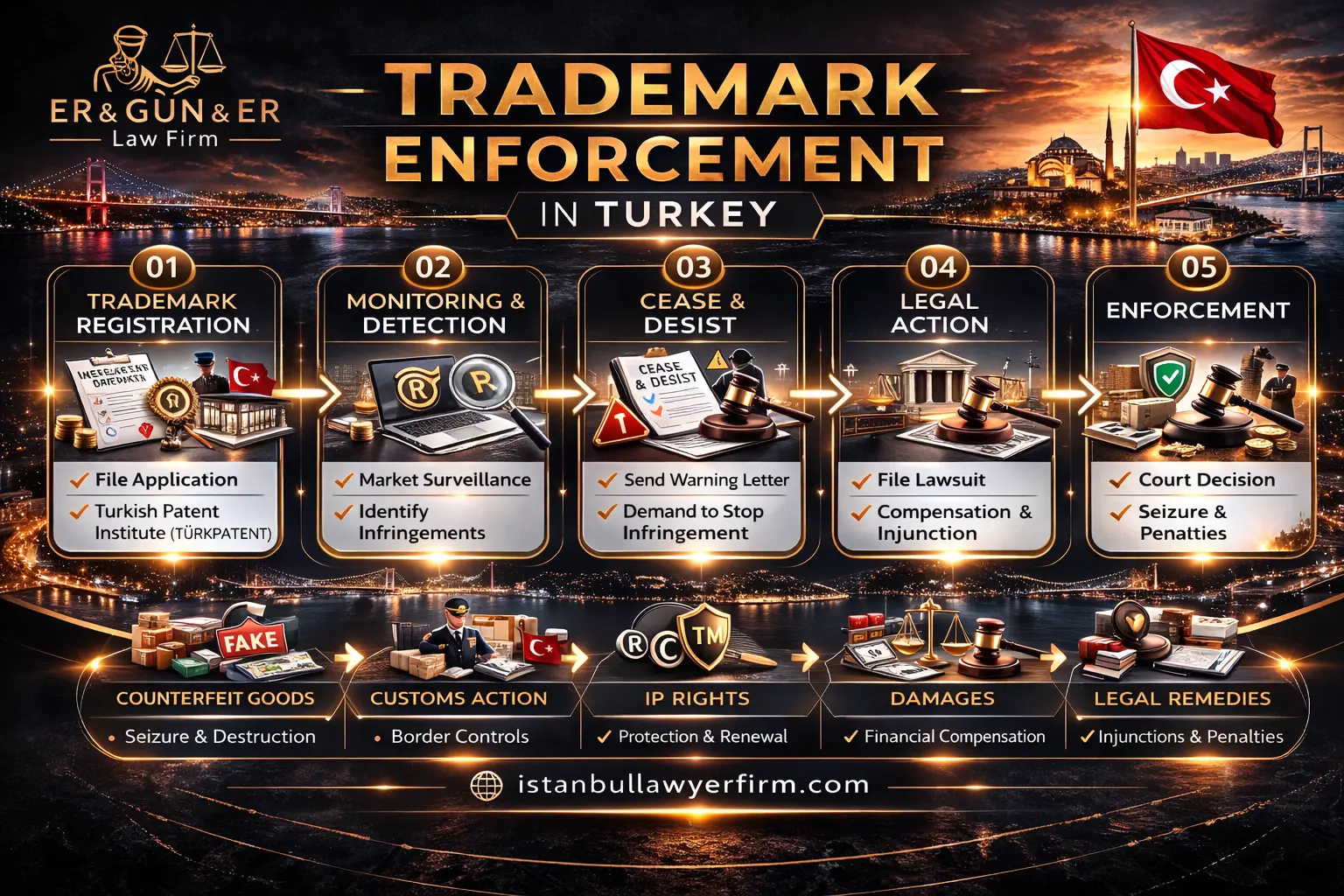
Trademark enforcement in Turkey is not one procedure but a set of coordinated routes that include civil litigation, criminal complaints, customs border measures, and platform-driven online takedowns. A brand owner must choose the right route based on the evidence available, the harm profile, and the operational need to stop sales quickly without compromising later claims. Most disputes are won or lost on evidence quality, because courts and authorities test who can prove use, confusion risk, and the chain of infringement. Timing expectations must remain realistic because schedules depend on court workload, port practice, and platform response behavior, and “practice may vary by authority and year — check current guidance.” The best enforcement file is built as an evidence pack with an index, chronology, and custody notes rather than as a narrative complaint. For cross-language coordination and consistent communications, many rightsholders rely on English speaking lawyer in Turkey to keep Turkish filings and English business records aligned.
Enforcement options overview
Trademark enforcement Turkey should be approached as a route selection problem that begins with a clear harm statement and a proof map. The first route is often a civil action where the claimant asks the court to stop use and preserve evidence. The second route is criminal when the facts indicate deliberate counterfeiting rather than a borderline trade dispute. The third route is customs detention for shipments, which can stop goods before they enter the market through customs IP enforcement Turkey. The fourth route is online action through marketplace and platform tools where listings can be removed quickly if the proof is clean. Each route has different evidence expectations and different risk of collateral damage. A civil route can be slow without interim measures, but it can produce structured remedies and court-readable reasoning. A criminal route can create pressure and preserve evidence, but it requires careful factual grounding and cannot be treated as a leverage tool. A customs route can be fast, but it depends on recordation and officer-ready identification materials. An online route can be fast, but it depends on platform rules and requires disciplined screenshot capture and preservation. The file should therefore begin by listing what you need now and what you can prove now. The file should also list what you may need later for damages and accounting. If multiple routes are used, the narrative must be consistent across them. A strong starting control is to appoint one incident owner and one counsel owner. “practice may vary by authority and year — check current guidance.” For strategy that remains consistent across lanes, many brands coordinate with Turkish lawyers rather than letting sales teams negotiate ad hoc.
Route selection also depends on whether the issue is classic counterfeiting, confusing similarity, or unfair market behavior that uses the mark as a hook. Where the problem is systematic copying, an early package of evidence preservation trademark disputes Turkey is often more valuable than a long argument about intent. Where the problem is a confusingly similar sign, a trademark infringement lawsuit Turkey file usually needs proof of use, proof of similarity, and proof of confusion likelihood in context. Where the problem is misleading marketing behavior, unfair competition trademark Turkey can run in parallel and often changes the remedy framing. Where the problem is an advertising comparison that references a mark, online and advertising compliance can intersect, and the enforcement team should keep messaging disciplined. The overview at trademark infringement overview can help align internal understanding of infringement patterns without relying on article citations. If the problem includes goods at the border, a recordation plan is needed before the next shipment arrives. If the problem is mainly online, a monitoring plan and takedown pack is needed before the next listing wave appears. The file should be built in a way that a new reviewer can understand without reading internal emails. That means a chronology, an index, and a short “consumer takeaway” or “marketplace takeaway” memo. The memo should explain what the public sees and why it is harmful, using exhibits rather than adjectives. The file should avoid promising a specific timeline to executives because litigation calendars vary. “practice may vary by authority and year — check current guidance.” For consistent, calm planning, many companies involve law firm in Istanbul early to prevent contradictions across channels.
Enforcement options must also consider proportionality and business continuity because overreach can create liability and reputational harm. If you pursue criminal escalation for a grey market dispute, you may trigger scrutiny that you did not intend. If you send broad threats without evidence, you may provoke counterclaims and forum shopping. If you request aggressive interim relief without clean exhibits, you risk losing credibility for the later merits stage. If you pursue repeated takedowns without preserving proof of listings, you may lose your own evidence trail when the platform removes the content. The file should therefore record what was seen, when it was seen, and how it was captured, with custody notes. The file should record the decision reasons for selecting a route, because later internal audits may ask why a path was chosen. The file should also include a “stop rule” that pauses escalation until authenticity is verified in ambiguous cases. The enforcement team should also maintain a rule that public statements are controlled and factual. This is especially important where your enforcement touches advertising, because careless statements can create new risk. The reference at comparative advertising compliance can help remind teams that public comparative messaging requires substantiation discipline even during disputes. The file should also keep settlement options open and document them without appearing to trade legal rights for silence without counsel review. “practice may vary by authority and year — check current guidance.” For measured control under pressure, many brands keep a standing relationship with Istanbul Law Firm so incident response follows a repeatable playbook.
Evidence and preservation
Evidence is the foundation of every route, and evidence preservation trademark disputes Turkey should be treated as a first-hour task, not a later clean-up task. Start by capturing the infringing use in context with time-stamped screenshots and full-page views. Capture the seller identity, listing URL, and product identifiers where available. Capture the price, shipping terms, and any “official” claims that increase confusion. Capture the mark as used, including placement, typography, and accompanying visuals. Preserve purchase records if test purchases are made, including invoices, shipment labels, and packaging photos. Preserve communications that show consumer confusion, but keep personal data minimized and relevant. Preserve your own trademark registration certificates and renewal status pages as clean exhibits. Preserve proof of your own use, such as invoices, packaging, and marketing materials, because use can be contested. Preserve a chronology that ties every capture to a date and a person. Preserve the chain of custody for physical samples so later authenticity disputes do not become procedural fights. Preserve the identity of the capturing person and device where it matters, especially for ephemeral content. Preserve platform notices and confirmation emails because they show what was removed and when. If you plan to seek interim relief, preserve the urgency facts and the harm narrative with exhibits. “practice may vary by authority and year — check current guidance.” For a disciplined evidence architecture, many rights holders work with lawyer in Turkey to structure the pack so it is court-ready.
Preservation also means avoiding self-inflicted contradictions across your own records, because opposing parties will search for inconsistencies. Keep one master “facts memo” that describes what happened and cites exhibits, and update it only with version control. Keep one “mark specimen memo” that shows your genuine mark use and registration scope, and keep it consistent across all filings. Keep one “confusion memo” that explains why consumers would be misled, and tie it to marketplace context rather than to abstract similarity statements. If a matter may become criminal complaint trademark infringement Turkey, preserve the evidence that indicates deliberate counterfeiting, such as bulk quantities, repeated listings, or obvious packaging errors. If a matter may involve search and seizure counterfeit Turkey, preserve location and storage indicators lawfully available, such as warehouse addresses shown on invoices or shipping labels. If a matter may involve customs border actions, preserve HS descriptors, shipment routing, and product identifiers that customs can use without legal interpretation. The reference at trademark registration guide can help ensure your right proofs are complete and current in the file. Evidence should be collected lawfully and proportionately, because improper evidence can create separate problems. Evidence should also be stored securely, because leaks can compromise strategy and confidentiality. “practice may vary by authority and year — check current guidance.” For bilingual chain-of-custody notes and consistent exhibit labeling, many global brands rely on English speaking lawyer in Turkey.
Evidence preservation is also a business process that benefits from a standard template, because repeat incidents are common in counterfeiting and impersonation. Create an evidence checklist that is route-neutral, so it works for civil, criminal, customs, and online actions. Maintain a screenshot capture protocol that includes full URL, date, and seller identity. Maintain a test purchase protocol that includes packaging photo angles and receipt archiving. Maintain a physical storage protocol for samples with access logs. Maintain a metadata protocol for videos and stories, because those disappear quickly. Maintain an internal escalation rule that triggers legal hold when a serious incident occurs. Maintain a “no improvisation” rule for communications to infringers, because informal messages can become exhibits. Maintain a “privacy minimization” rule so personal data is not collected without reason. Maintain a “clean room” rule so only approved exhibits are used in court filings and platform complaints. Maintain an incident log that records every step and outcome in a linear sequence. This is how trademark monitoring services Turkey becomes operational, because monitoring without preservation produces no enforceable record. “practice may vary by authority and year — check current guidance.” For program-level templates and audits, the reference at corporate compliance programs can help align IP enforcement with enterprise governance.
Cease and desist letters
A cease and desist letter Turkey trademark is a tool for controlled escalation, not a substitute for evidence. The letter should be drafted after the evidence pack is stabilized so the claims match what can be proven. The letter should identify the right, the mark, and the problematic use in a precise and factual way. The letter should attach a limited set of exhibits or offer to provide them, depending on strategy. The letter should specify what conduct must stop, such as use on listings, packaging, or signage. The letter should also specify what remedial steps are requested, such as removal of listings or confirmation of stock disposal, without promising outcomes. The letter should avoid threats about penalties, fines, or timelines because those details can change and can undermine credibility if misstated. The letter should avoid defamatory language and should avoid calling the recipient a “criminal” without a court finding. The letter should also avoid admitting any uncertainty about the right unless strategically necessary. The letter should be consistent with the intended litigation narrative if escalation occurs. The letter should be delivered through a method that produces proof of delivery and recipient identity. The file should store the sent letter, delivery proof, and any response as exhibits. The letter should be approved by one owner to avoid conflicting versions. “practice may vary by authority and year — check current guidance.” For controlled drafting and delivery strategy, many rights holders use Turkish Law Firm so the letter is firm, factual, and litigation-ready.
Cease and desist letters also serve as a settlement gateway, so the file should prepare a settlement framework before sending. If the recipient is a distributor or reseller, the letter should ask for provenance and authorization proof rather than assuming bad faith. If the recipient is a clear counterfeiter, the letter may be used to preserve admissions and to set the stage for stronger measures. If the recipient is a marketplace seller, the letter should be consistent with platform complaint packages to avoid contradictions. The letter should also consider whether the conduct implicates unfair competition trademark Turkey alongside trademark infringement, because the framing can affect negotiation posture. The letter should include a request for written undertakings where appropriate, but undertakings should be drafted carefully and proportionately. The letter should also include a document request list that is realistic, such as invoices, supplier identity, and stock quantities, but not speculative or irrelevant categories. The letter should avoid creating an impression that the sender is uncertain about facts, and should instead ask for documents as part of verification. The letter should also consider whether immediate takedown is needed through platform channels rather than waiting for a response. If urgency exists, a preliminary injunction trademark Turkey path may be considered in parallel, but letter content must not undermine that. “practice may vary by authority and year — check current guidance.” For bilingual negotiations and consistent record creation, law firm in Istanbul can keep settlement communications aligned with evidence.
Responses to cease and desist letters must be handled with the same discipline as the initial letter, because responses often include admissions or contradictions. If the recipient claims authorization, request the document chain and verify it against the licensor and scope. If the recipient claims the mark is generic or invalid, note the claim but keep the file focused on infringement evidence and registration scope. If the recipient offers to settle, require that the settlement be in writing and that the scope is clear, because vague “we will stop” messages are not enforceable. If the recipient removes listings, capture proof of removal and store it with timestamps, because later relisting is common. If the recipient threatens counterclaims, keep communications factual and avoid escalation language. If the recipient is abroad, coordinate cross-border service methods and store delivery proofs carefully. If the recipient ignores the letter, the file should record the non-response and proceed with the route selection memo based on urgency and harm. The key is to avoid drifting into informal negotiation that creates inconsistent statements across channels. “practice may vary by authority and year — check current guidance.” For a controlled negotiation and escalation posture, many brands ask best lawyer in Turkey to manage response review and next-step decisions.
Civil court actions
Civil actions are the structured route for stopping infringement and obtaining court-recognized remedies, and they are typically the backbone of a trademark infringement lawsuit Turkey file. A civil case starts with defining the claims, the defendant identity, and the infringing acts with precision. The petition should be written as a fact-and-exhibit document, not as a rhetorical narrative. The petition should identify the trademark right and attach the registration proof as an exhibit. The petition should identify the infringing use in context and attach time-stamped captures and purchase records. The petition should explain why the use creates confusion risk or unfair association, using objective indicators. The petition should also address jurisdiction and proper venue, especially where defendants operate online. The petition should avoid claiming guaranteed timelines, hearing dates, or damages amounts because those depend on court practice and evidence. The petition should prepare for defenses such as authorization, parallel import, or non-use allegations, and it should preserve proof to answer them. The petition should include a remedy map, separating injunctive relief from damages and accounting requests. The petition should be consistent with any prior cease and desist letter and with any platform complaints filed. “practice may vary by authority and year — check current guidance.” For coherent pleadings and exhibit indexing, many rights holders coordinate with Istanbul Law Firm.
Civil litigation also interacts with interim measures, because rights holders often need immediate relief before a full merits decision. The file should therefore be built with a parallel track for preliminary injunction trademark Turkey, but the motion should be evidence-led and proportional. Civil actions may also be coordinated with customs and criminal routes, but every route must use the same factual vocabulary to avoid contradictions. If customs detention exists, the customs record is a strong exhibit bundle for civil court because it shows physical goods and chain-of-custody. If criminal complaint steps are taken, the civil file should avoid statements that presume criminal guilt; it should focus on infringement indicators and harm. If online takedowns are pursued, preserve the platform notices and removals as exhibits, because they show market behavior. The civil file should also anticipate expert review for damages calculation trademark Turkey, so keep sales estimates conservative and supported by evidence. If accounting is requested, the civil petition should state why accounting is needed and what records are requested, without being overbroad. The civil file should also include a settlement lane, because many disputes settle after initial motions, but settlement must be documented to prevent repeat infringement. “practice may vary by authority and year — check current guidance.” For coordinated civil strategy and consistent communications across lanes, Turkish lawyers can keep the file disciplined and court-ready.
Civil court actions require long-term file hygiene because cases can last and evidence must remain retrievable. Maintain a master exhibit list with stable numbering so later supplements do not break references. Maintain a chronology that includes every filing, every notice, and every procedural order. Maintain a custody log for physical samples, because authenticity disputes often arise later. Maintain a “positions memo” that lists what the claimant asserts and what the claimant can prove, and update it only through controlled versions. Maintain a “defense tracking memo” that logs each defense raised and the exhibit that answers it. Maintain a “communications discipline memo” so internal teams do not make public statements that contradict court positions. Maintain a “parallel lane memo” that records customs and online actions and their outcomes. This coherence is critical in multi-route enforcement, because the other side will try to show inconsistency. “practice may vary by authority and year — check current guidance.” For clients needing a structured, ongoing case management approach, many work with law firm in Istanbul to keep the evidence pack navigable and the pleadings consistent across the life of the dispute.
Preliminary injunctions
A preliminary injunction trademark Turkey request is the route used when stopping harm cannot wait for a full merits judgment. The court evaluates urgency, plausibility, and proportionality based on the evidence presented at the time of filing. The motion should therefore be drafted after the evidence pack is stabilized and indexed, not while the team is still collecting screenshots. The motion should define the exact conduct to be restrained, such as use on listings, packaging, signage, or advertisements. The motion should explain why the conduct creates confusion risk or brand harm in the current market context. The motion should attach time-stamped captures and purchase records that show ongoing use, not only historical incidents. The motion should explain why damages later would not fully cure the harm, without exaggerating consequences. The motion should avoid asserting statutory timelines, because scheduling depends on the court and the case posture. The motion should avoid claiming specific security amounts, because security and undertakings can differ by court and facts. The motion should define the scope of requested relief narrowly enough to be enforceable and not overbroad. The motion should anticipate defenses such as authorization, parallel trade, or nominative use and address them with documents. The motion should include a service plan so the order can be implemented quickly if granted, without making promises. The motion should include a compliance plan for platforms and intermediaries if the conduct is online. “practice may vary by authority and year — check current guidance.” For disciplined motion strategy and clean exhibit mapping, many claimants work with lawyer in Turkey.
An injunction pack is stronger when it separates what the public sees from what the right holder knows internally. The court typically focuses on external manifestations such as storefronts, listings, labels, and packaging. The pack should therefore include full-context screenshots, not cropped fragments that omit seller identity and date context. The pack should include a short “market harm memo” that explains distribution channels and why confusion is likely in that channel. The pack should include proof of the claimant’s mark use and registration scope in a format that is easy to read. The pack should include evidence that the infringement is ongoing, because urgency is difficult to show for stale incidents. The pack should include proof that the defendant controls the use, because injunctions must be directed to controllable actors. The pack should also include proof of attempts to resolve the matter, such as the cease and desist correspondence, but only where it supports urgency and good faith. The pack should avoid speculative claims about defendant intent, because intent is rarely the urgent factor in an interim decision. The pack should also avoid mixing unrelated disputes into the motion, because that dilutes urgency. If the infringement involves shipments, the customs record can be powerful evidence, and the operational overview at customs border measures guide can help align the detention record with court exhibit formatting. The pack should identify what can be verified immediately and what requires later accounting, to keep the interim request proportional. The pack should be written as short, numbered paragraphs that cite exhibit numbers, because judges read quickly. The pack should also include a proposed order wording that is specific and implementable. “practice may vary by authority and year — check current guidance.” For cross-language brands and multi-channel harm, the interim pack often benefits from English speaking lawyer in Turkey to keep the same facts consistent across Turkish filings and internal English reports.
Injunction decisions also require disciplined follow-up because interim relief can create new disputes if implemented inconsistently. If an order is granted, the team should preserve the granted order, service proof, and implementation proof as a single bundle. Implementation proof should include platform confirmations, seller communications, and before-and-after captures where relevant. If an order is denied, the team should preserve the denial reasoning and update the risk plan without assuming the merits are lost. If the court asks for additional evidence, the response should be narrow and exhibit-led rather than a rewritten story. If security is required, the file should preserve the request and what was provided using official documents, without stating amounts as general rules. The enforcement team should also avoid public statements that suggest a final liability finding, because interim measures are not final judgments. The team should update the internal incident log to reflect what changed, such as listings removed or shipments held. The team should also coordinate with the monitoring team so reappearance is detected quickly. The team should ensure that settlement discussions do not contradict the court record, because contradictions damage credibility. The team should maintain a “single narrative memo” for all internal stakeholders so customer support and sales teams do not improvise explanations. The team should also maintain a proportionality review so legitimate third-party sellers are not swept into the enforcement net without evidence. “practice may vary by authority and year — check current guidance.” For controlled post-order governance and consistent communications, many clients coordinate with Istanbul Law Firm to keep the injunction record aligned with later merits pleadings.
Unfair competition claims
Unfair competition claims can supplement trademark claims when the conduct harms market fairness beyond strict trademark scope. The topic label unfair competition trademark Turkey reflects that many infringement patterns also involve deception, passing off, and unfair exploitation of reputation. The legal framing usually relies on the Turkish Commercial Code principles of honest commercial practice, without needing to cite article numbers in a strategy memo. The key is to define the competitive context and show how the conduct distorts consumer choice or competitor relations. Unfair competition claims can be useful when the sign is similar but not identical, or when the conduct includes misleading commercial communications. Unfair competition claims can also be useful when the infringement is part of a broader scheme, such as fake distributor networks or deceptive reseller pages. The evidence pack should therefore include consumer-facing context, such as website layout, store signage, and marketing messages. The pack should also include internal business context, such as distribution models and authorized channels, but only as needed for fairness analysis. The claim should avoid moral judgments and should instead explain measurable market effects, such as confusion, diversion, and dilution of distinctiveness. The claim should be aligned with the trademark theory so the two do not contradict each other. The claim should also consider the requested remedies, such as cessation, corrective statements, and prevention of repeat conduct, without promising outcomes. The claim should avoid asserting damages numbers at the liability stage, because damages require later accounting and proof. “practice may vary by authority and year — check current guidance.” For coherent dual-track pleadings, many rights holders consult Turkish lawyers who can keep unfair competition arguments tied to exhibits.
Unfair competition also interacts with advertising and platform conduct, especially where the infringer uses comparative messaging or misleading endorsements. If the infringing listing claims “official” status or uses fake awards, the unfair competition lane can address those misrepresentations directly. If the conduct includes deceptive comparative statements, the compliance lens in unfair competition law overview can help structure what must be proved without turning the claim into a policy debate. The claim should document the specific statements that mislead, with screenshots and timestamps. The claim should document the placement of disclaimers if any, and whether they are readable in the channel used. The claim should document how consumers would interpret the net impression, using context rather than speculation. The claim should document how the defendant benefits commercially, such as by capturing traffic or sales, but it should do so with objective indicators. The claim should also document any pattern of repeat conduct, because repeat conduct supports stronger remedy framing. The file should avoid attributing intent without evidence, because unfair competition can be established through effects and practice standards. The claim should also avoid overbreadth, because courts prefer targeted orders that are enforceable. The claim should be coordinated with cease and desist correspondence so the defendant cannot point to inconsistent accusations. The claim should also be coordinated with platform takedown submissions so the same statements are described consistently. The claim should be coordinated with any customs incident records so the same factual vocabulary is used. “practice may vary by authority and year — check current guidance.” For a unified narrative across IP and unfair competition lanes, many claimants use best lawyer in Turkey to keep wording consistent and defensible.
Unfair competition claims can also protect against conduct that sits outside classic goods confusion, such as misleading domain redirects or deceptive reseller pages. If the defendant uses the mark as a keyword or hidden metadata, the claim should capture how consumers are diverted, with evidence. If the defendant uses lookalike packaging that does not perfectly match the registered mark, the claim can still address passing off through overall presentation. If the defendant uses false contact information or false corporate identifiers, the claim can incorporate those deceptive practices as part of the market distortion narrative. The file should preserve WHOIS data, platform seller data, and business registry data where relevant, but should keep personal data minimized and lawful. The file should also preserve any customer complaints that show confusion, but should redact unnecessary personal identifiers. The claim should remain anchored to the request for cessation and prevention, and should avoid turning into a general morality argument. If a corrective statement is sought, the claim should propose a proportionate correction concept rather than a punitive announcement. The claim should also be careful not to create defamation risk by asserting criminality without a finding. The claim should coordinate with licensing and coexistence discussions, because unfair competition framing can affect negotiation tone. The claim should also coordinate with damages planning, because unfair competition can broaden the accounting narrative, but it still requires proof. “practice may vary by authority and year — check current guidance.” For controlled pleadings and safe public communications, many organizations keep a central incident owner supported by Turkish Law Firm so unfair competition and trademark theories stay aligned.
Damages and accounting
Damages and accounting are the stage where enforcement moves from stopping conduct to quantifying harm and unjust benefit, and they must be handled with conservative, evidence-led methods. The topic label damages calculation trademark Turkey should be treated as a methodology question, not a number promise. The claimant must first establish liability and scope of infringement before accounting requests are meaningful. The accounting request should identify what records are needed and why those records are uniquely in the defendant’s control. The request should be tailored to the infringing products, channels, and time period, and should avoid overbroad fishing. The claimant should preserve market evidence such as pricing, listing history, and shipment quantities to support plausibility. The claimant should preserve its own sales and marketing evidence to support causation arguments, but should not assume causation is automatic. The claimant should preserve brand investment evidence only where it is relevant and provable, and should keep it separate from consumer-facing evidence. The claimant should avoid asserting statutory timelines for disclosure or court schedules because these vary by court. The claimant should avoid asserting fixed damages figures early because figures depend on records, expert work, and contested facts. The claimant should build a damages memo that lists categories of harm, proof types, and data sources, not final numbers. The memo should state assumptions as assumptions and should be dated and version-controlled. “practice may vary by authority and year — check current guidance.” For conservative damages planning and accounting requests, many rights holders coordinate with Istanbul Law Firm to keep claims tied to evidence rather than to speculation.
Accounting also depends on data integrity, because defendants will challenge calculations by attacking inputs and methods. This is why the file should preserve screenshots with timestamps and full context rather than cropped images. This is why test purchase records should include receipts, shipping labels, and packaging photos. This is why customs incident files should preserve shipment identifiers and inspection notes, because they anchor quantity and product identity. This is why platform notices should be archived, because takedown history can support repetition and scale. The claimant should be careful about using third-party analytics as if they were exact sales data, and should label them as indicators when they are only indicators. The claimant should propose a structured approach to how records will be reviewed, including what the court should order and how confidentiality will be protected. The claimant should anticipate that a defendant may claim lawful parallel trade, and should plan how to separate legitimate channels from infringing channels in the accounting narrative. The claimant should also plan how to handle mixed listings where some items are legitimate and some are infringing, because mixed cases create calculation complexity. The claimant should avoid relying on a single spreadsheet without linking each row to an exhibit or record source. The claimant should use a reconciliation memo that explains how each data source relates to the claimed harm category. The claimant should also preserve versions of working papers, because changes without explanation undermine credibility. “practice may vary by authority and year — check current guidance.” For structured accounting frameworks and confidentiality-safe disclosure requests, many rights holders work with Turkish lawyers to draft exhibit-linked requests rather than narrative demands.
Damages planning should also be coordinated with settlement strategy, because many cases settle once parties understand the evidence strength and the likely accounting scope. The file should therefore maintain a “settlement model memo” that lists what the claimant needs to feel protected, such as cessation, undertakings, and verified stock disposal. The memo should separate “must have” terms from “negotiable” terms, but it should be grounded in evidence and risk, not in anger. The memo should include a plan for verifying compliance, such as periodic monitoring and platform checks, because settlement without monitoring often fails. The memo should also consider how to handle existing inventory, because inventory decisions affect both harm and future infringement risk. The memo should also consider reputational and business continuity factors, especially where the defendant is a distributor rather than a counterfeiter. The file should avoid using settlement numbers as if they were damages findings, because settlements are compromises and not admissions. The file should record settlement communications carefully and keep them separate from the merits evidence archive. The file should ensure that any settlement draft does not contradict court pleadings, because contradictions can be exploited. The file should also avoid promising that a settlement will “end all risk,” because risk depends on compliance and monitoring. “practice may vary by authority and year — check current guidance.” For disciplined settlement modeling and verification planning, many brands rely on English speaking lawyer in Turkey to keep cross-border expectations aligned with Turkish enforcement realities.
Criminal complaints basics
A criminal complaint trademark infringement Turkey is typically considered when the facts indicate deliberate counterfeiting or organized infringement rather than a civil-style sign dispute. The criminal lane is evidence-sensitive and should be approached as a separate project with its own exhibit pack. The first step is to stabilize the evidence and preserve chain-of-custody for samples, because authenticity disputes are common. The second step is to preserve purchase records, invoices, and packaging photos, because these show what was sold and how it was represented. The third step is to preserve seller identity evidence, such as store address, company name, and platform seller ID, because criminal steps require actor identification. The fourth step is to avoid public accusations, because criminal claims must be grounded and statements can backfire. The fifth step is to define the operational goal, such as seizure of counterfeit stock, evidence preservation, or disruption of a supply chain. The sixth step is to coordinate criminal steps with civil steps so pleadings do not contradict each other. The seventh step is to coordinate criminal steps with customs incidents if shipments are involved, because customs records can be strong exhibits. The eighth step is to avoid guessing penalties, fines, or timelines, because criminal procedures vary by prosecutor practice and workload. The ninth step is to preserve internal decision memos explaining why criminal escalation was chosen, because later proportionality questions can arise. The tenth step is to ensure that the claim focuses on counterfeit indicators and objective facts, not on assumed intent. The eleventh step is to maintain confidentiality and access control for the criminal evidence pack. The twelfth step is to keep communications factual with authorities and avoid inconsistent narrative shifts. “practice may vary by authority and year — check current guidance.” For careful criminal-lane coordination, many rights holders work with Turkish Law Firm to keep the record disciplined and consistent.
Criminal complaints also require an evidence threshold discipline so the brand does not overuse criminal tools for borderline disputes. The file should classify cases into categories such as clear counterfeit, ambiguous origin, grey market, and confusing similarity without product falsification. Only some categories are suitable for criminal escalation, and the classification should be documented with reasons. The file should include a “counterfeit indicators memo” that lists the objective signs observed and ties each sign to photo evidence. The memo should avoid generalized claims like “looks fake” and should instead list specific discrepancies. The file should include a “scale memo” that describes quantities and distribution scope as evidenced, because scale matters for operational decisions. The file should include a “location memo” that describes where goods were stored or sold as evidenced, because location affects enforcement steps. The file should preserve any third-party investigator outputs as exhibits, but should ensure they were obtained lawfully and with custody notes. The file should preserve correspondence with platforms or marketplaces showing repeated listings, because repetition supports inference of deliberate conduct. The file should be careful about personal data, collecting only what is necessary for enforcement. The file should avoid relying on anonymous tips without corroboration, because corroboration is needed for credibility. The file should coordinate with corporate compliance teams so criminal escalation decisions follow a documented sign-off process. “practice may vary by authority and year — check current guidance.” For balanced, defensible escalation decisions, many brands consult best lawyer in Turkey to stress-test the evidence threshold before filing.
Criminal proceedings can also run in parallel with civil actions, but parallelism increases the need for consistency and careful sequencing. The file should maintain one master chronology that logs customs notices, platform removals, civil filings, and criminal steps as separate lanes. The file should ensure that the factual vocabulary is consistent across lanes, such as product identifiers, dates, and actor names. The file should avoid making civil-only arguments in criminal submissions, and should avoid making criminal-intent claims in civil pleadings unless evidence supports them. The file should preserve authority communications and any seizure minutes as exhibits, because those become core records later. The file should also preserve any decisions not to proceed, because they inform later strategy and demonstrate proportionality. The brand should plan how to communicate internally about criminal steps so business teams do not overstate them to partners. The brand should also plan how to handle media inquiries, typically by limiting comments to confirmed procedural facts. The file should keep a compliance instruction for employees to avoid social media commentary about suspects and raids. The file should also coordinate with online enforcement teams to prevent suspect sellers from simply migrating to new accounts during proceedings. “practice may vary by authority and year — check current guidance.” For disciplined parallel-lane management and controlled communications, many organizations keep a central incident owner supported by Istanbul Law Firm so the criminal lane strengthens, rather than undermines, the overall enforcement posture.
Search and seizure measures
Search and seizure measures are the procedural tools used to preserve evidence and secure suspected counterfeit stock before it disappears. The topic label search and seizure counterfeit Turkey should be treated as an evidence-preservation project, not a spectacle. The first practical step is to confirm that the suspected location, actor identity, and product scope are evidenced, because vague targets create weak requests. The second step is to assemble a clean exhibit pack with time-stamped captures, test purchase records, and packaging photos that support suspicion. The third step is to map chain of custody, because seized items become exhibits and must be traceable. The fourth step is to prepare a neutral “what to seize” list that focuses on marks, packaging, labels, and inventory rather than unrelated items. The fifth step is to plan how seized digital evidence will be handled, because devices and listings can contain critical proof. The sixth step is to plan how business interruption will be minimized, because proportionality matters and overreach can backfire. The seventh step is to plan for on-site documentation such as photographs and minutes, because later disputes often focus on what was actually found. The eighth step is to plan who will attend and how observations will be recorded, because staff notes become part of the record. The ninth step is to avoid public communications before a verified outcome, because premature accusations create reputational and legal exposure. The tenth step is to coordinate with any parallel civil action so the seizure request is consistent with the pleadings and the evidence map. The eleventh step is to coordinate with any criminal complaint steps if the facts indicate organized counterfeiting, while keeping vocabulary consistent across files. The twelfth step is to preserve a written decision memo showing why the measure was necessary, because later challenges often ask whether less intrusive options existed. The thirteenth step is to protect confidential commercial data discovered during the measure through access controls and a confidentiality protocol. The fourteenth step is to record every step in a chronology so later “who did what when” questions can be answered without reconstruction. “practice may vary by authority and year — check current guidance.” For planning and courtroom-ready evidence architecture, many rightsholders involve lawyer in Turkey early to keep requests proportional and exhibit-led.
Operationally, search and seizure succeeds when it is framed as “preserve proof” rather than “punish,” because courts and authorities expect disciplined necessity. The file should show that counterfeit goods or confusingly similar goods are currently in circulation or imminently being circulated. The file should show that ordinary requests for documents would not work because the evidence could be destroyed or moved. The file should show the link between the location and the infringing goods using objective indicators, such as shipping labels, marketplace seller addresses, or invoices. The file should show why the mark and packaging indicators support suspicion, using side-by-side comparisons that are dated and readable. The file should show a plan for how goods will be stored, labeled, and photographed so the chain of custody is not later challenged. The file should show a plan for how the right holder will participate, such as providing an authenticity expert, while ensuring the process remains neutral and recorded. The file should show a plan for how innocent third-party items will be avoided, because proportionality affects credibility. The file should show a plan for how seized documents will be reviewed without disclosing irrelevant personal data. The file should anticipate that the other side will claim legitimacy or parallel trade and should therefore preserve provenance documents where found. The file should also anticipate that the other side will claim abuse and should therefore keep all communications factual and limited. If the suspected goods involve licensed products, the enforcement team should be prepared to show how licensing boundaries work and why the goods fall outside them. The reference at licensing agreement basics can help align the authorization narrative with the enforcement narrative without citing articles. The file should also keep a “post-measure” plan for how evidence will be integrated into civil pleadings and any platform takedown packs. “practice may vary by authority and year — check current guidance.” For coordinated fieldwork planning and record integrity, many rightsholders rely on Turkish lawyers to keep notes and exhibits consistent with later litigation.
After a measure, the most common failure is losing the evidential value through poor documentation, not losing it through adverse legal theory. The team should immediately create a seizure bundle that contains the official minutes, photographs, sample lists, and any digital captures made on site. The bundle should be indexed and cross-referenced to the original request so it is clear what was authorized and what was found. The team should store the bundle with access control and an audit log because it often contains sensitive supplier and customer data. The team should then update the master chronology and the master exhibit list so later pleadings can cite stable exhibit numbers. The team should then evaluate whether the evidence supports a narrower claim or a broader claim, and record that evaluation in a dated memo. The team should avoid changing the narrative between “before” and “after” without explaining why, because contradictions harm credibility. If the evidence suggests legitimate origin, the team should document that finding and adjust course rather than doubling down. If the evidence suggests deliberate counterfeiting, the team should coordinate with the criminal lane without inflating claims beyond what the minutes show. The team should also coordinate with the civil lane for preliminary injunction and damages planning, because seized records can change the accounting scope. The team should coordinate with online enforcement because seized seller account data can support marketplace takedowns and pattern detection. The team should also coordinate with customs recordation if the incident reveals new routing patterns, because future border holds may be improved. The team should avoid public announcements that imply guilt, because legal outcomes are still pending and overstatement creates risk. “practice may vary by authority and year — check current guidance.” For disciplined post-measure file integration and controlled communications, many clients rely on best lawyer in Turkey to keep the record coherent across civil, criminal, and platform lanes.
Customs border actions
Customs border actions are the route used to stop suspect shipments before they enter the domestic market, and they require a proactive recordation and identification posture. The topic label customs IP enforcement Turkey should be treated as an operational program that starts before detention, not as a reaction after goods are already distributed. The first step is to ensure the trademark right is registered and that the ownership record matches the entity acting at customs. The second step is to record the right with customs where applicable and to provide an officer-friendly product identification kit. The third step is to provide authorized importer and licensee information so legitimate shipments are not wrongly detained. The fourth step is to maintain a responsive contact point who can answer customs notifications quickly. The fifth step is to prepare a detention response protocol that produces a written authenticity position based on objective indicators, not on instinct. The sixth step is to preserve the detention notice, shipment identifiers, and photos as the core incident bundle. The seventh step is to request inspection and sampling where practice allows, and to document chain of custody. The eighth step is to decide whether to pursue administrative destruction routes or court escalation routes based on evidence strength and business goals. The ninth step is to coordinate messaging so statements to customs and statements to courts use the same factual vocabulary. The tenth step is to avoid guessing detention periods or destruction timelines because these vary by port and workflow. “practice may vary by authority and year — check current guidance.” The eleventh step is to record outcomes and feed them back into risk profiling so future detection improves. The twelfth step is to keep a central incident log that can be used for repeat offender mapping without over-disclosing. The thirteenth step is to coordinate border actions with online takedowns because counterfeiters often operate across channels. The fourteenth step is to keep customs actions proportional and evidence-led to reduce liability risk for false positives. For coordinated border strategy and incident governance, many rightsholders consult law firm in Istanbul to keep the recordation file and response file consistent.
A customs file is only as effective as its product identification kit, because customs officers need observable indicators, not legal arguments. The kit should include authentic packaging images, label templates, and typical serial formats in a dated, versioned format. The kit should include “hard indicators” such as misspellings or incorrect hologram placement, because these are usable at inspection. The kit should include “soft indicators” such as unusual routing, but soft indicators should be treated as triggers for inspection rather than proof. The kit should include a list of authorized importers and a method for verifying new importers quickly, because many disputes are about authorization rather than counterfeiting. The kit should include a short explanation of how parallel trade differs from counterfeit, because this affects how the right holder responds to ambiguous shipments. The kit should include a response template that confirms whether goods are likely infringing based on visible indicators, without claiming a final determination. The kit should include a confidentiality rule because it contains supply chain intelligence. The kit should be updated when packaging changes, because stale kits cause missed detentions and false detentions. The customs incident file should store the notice, photos, inspection memo, and the final resolution record as one indexed bundle. The bundle should also store any court filings if court measures were used to maintain detention. The bundle should store communications with brokers and carriers because chain-of-custody disputes can arise later. The operational guide at customs border enforcement guide can be used to align internal playbooks with the typical customs workflow without citing statute articles. “practice may vary by authority and year — check current guidance.” For cross-port consistency and bilingual correspondence discipline, many brands use Turkish Law Firm to implement one standard incident protocol.
Border actions must be integrated into the overall enforcement strategy so the company does not treat customs incidents as isolated events. Each customs incident should be logged with product line, route, shipper identifiers, and outcome, using a structured incident taxonomy. The taxonomy should distinguish clear counterfeit from ambiguous authorization disputes so response posture remains consistent and defensible. The company should run periodic reviews to update risk profiling indicators based on evidence, not anecdotes. The company should align border learnings with civil and criminal strategy, because repeat patterns may justify stronger measures later. The company should align border learnings with licensing governance, because authorization lists are a major driver of false positives. The company should align border learnings with online enforcement because the same sellers often operate online and ship by parcels. The company should also coordinate with internal compliance so incident data is stored securely and used only for enforcement purposes. The company should avoid public claims about seizure success, because those claims can create unfair competition and defamation exposure if not carefully worded. If a case is resolved through destruction or settlement, store proof of resolution and store any agreed undertakings. If a case is resolved by release, document why and update the kit so the same false positive does not repeat. “practice may vary by authority and year — check current guidance.” For continuous improvement and risk governance, many rightsholders retain lawyer in Turkey to keep the border program aligned with legal standards and operational reality.
Online marketplace takedowns
Online marketplace takedowns are often the fastest route to reduce consumer harm, but they only work when the proof pack is disciplined and repeatable. The topic label online marketplace trademark takedown Turkey should be treated as a platform-evidence workflow, not as a complaint email. The first step is to capture the listing in full context with URL, seller identity, date, and platform view. The second step is to capture product photos, mark placement, and any “official” or “authorized” statements that increase confusion. The third step is to preserve your own trademark certificate and proof of use in a compact exhibit bundle. The fourth step is to draft a concise takedown notice that points to the specific listing and the specific right, using platform categories. The fifth step is to avoid over-claiming, such as accusing fraud, unless evidence supports it, because platforms often require precise legal grounds. The sixth step is to preserve platform submission confirmations and correspondence as exhibits, because they show what was removed and when. The seventh step is to monitor for relisting under new seller accounts and preserve new captures, because relisting is common. The eighth step is to keep a “seller cluster memo” that groups related listings by objective identifiers, such as identical photos or identical descriptions, to show pattern. The ninth step is to coordinate takedowns with civil strategy, because platform removals can support urgency arguments for injunctions. The tenth step is to coordinate takedowns with customs strategy, because online listings often precede shipments. The eleventh step is to avoid claiming fixed platform response times, because platform practice changes. “practice may vary by authority and year — check current guidance.” The twelfth step is to use one controlled narrative memo across all platform submissions to avoid contradictory descriptions of the same infringement. For scalable takedown programs, many brands rely on Turkish lawyers to keep notices consistent and evidence-led.
Marketplace enforcement also depends on understanding platform roles and the evidence they actually accept, which is a practical compliance question. A platform may ask for registration numbers, screenshots, and proof of ownership, but it may not evaluate nuanced arguments about confusion. A platform may also treat seller identity as confidential, so your evidence must focus on content and the right rather than identity speculation. This is why the proof pack should be designed to be platform-ready and court-ready at the same time, with an index and a chronology. The pack should include a “brand authenticity memo” that explains how genuine goods are sold and how consumers can be misled by unauthorized listings, using objective indicators. The pack should include a “photo similarity memo” where counterfeiters reuse your official images, because image reuse is a strong indicator of deceptive conduct. The pack should include a “pricing anomaly memo” only as context, because pricing alone is not proof. The pack should avoid collecting unnecessary personal data from buyers or sellers, because privacy and proportionality matter. The platform workflow should be coordinated with broader e-commerce compliance understanding, and the reference at e-commerce compliance overview can help align platform takedowns with regulatory expectations without adding legal noise to the takedown notice. The pack should also be coordinated with advertising issues when the infringer uses comparative or deceptive claims, and the reference at comparative advertising law guide can support internal message discipline. “practice may vary by authority and year — check current guidance.” For coordinated takedown governance and evidence integrity, many rightsholders involve best lawyer in Turkey to standardize templates and prevent accidental overreach.
Takedown programs should also include escalation thresholds, because platforms can be slow or inconsistent and some cases require court action. Define a threshold for when repeated relisting triggers an injunction request. Define a threshold for when volume and harm justify a damages and accounting track. Define a threshold for when counterfeit scale suggests criminal escalation is appropriate, without assuming outcomes. Record these thresholds in an internal playbook and update them based on what works. Maintain an archive of takedown submissions and outcomes so you can show a pattern of enforcement and persistence. Maintain a monitoring routine that captures relisted content quickly, because stale captures are weak. Maintain a “platform change log” because platforms change reporting forms and evidence fields, and stale templates create delays. Maintain a “counter-notice protocol” because sellers may challenge removals and you need a consistent response. Maintain a “seller education script” for authorized sellers so legitimate listings are not caught in broad sweeps. Maintain a “brand communications rule” so customer-facing teams do not make inconsistent statements about counterfeit status. Maintain a “link to civil file” method so platform evidence is mirrored in litigation exhibits with stable numbering. “practice may vary by authority and year — check current guidance.” For program discipline and cross-lane consistency, many brands coordinate with law firm in Istanbul to keep platform evidence, customs evidence, and court evidence under one master chronology.
Domain and social handles
Domains and social handles are enforcement targets because they enable impersonation, diversion, and long-term consumer confusion without physical goods. The topic label domain name dispute Turkey trademark reflects that domain disputes can be handled through structured dispute mechanisms or through court claims, depending on the facts. The first step is to capture the domain or handle use with time-stamped screenshots and page source context where appropriate. The second step is to capture WHOIS and registration data where available, and store it as an exhibit with date. The third step is to capture how the domain redirects, including intermediate redirects, because redirection patterns can be evidence of intent to mislead. The fourth step is to capture any use of the mark in email addresses, contact forms, or payment pages, because these features increase consumer harm risk. The fifth step is to capture social media profile details, follower counts, and posts that show impersonation patterns. The sixth step is to preserve reports filed with the platform and any platform responses as exhibits. The seventh step is to create a “confusion and harm memo” that explains how consumers are diverted, using objective indicators such as fake support lines or counterfeit payment links. The eighth step is to coordinate with civil strategy because domain and handle evidence can support urgency arguments. The ninth step is to coordinate with criminal steps when fraud indicators exist, but only based on evidence. The tenth step is to avoid guessing dispute timelines, because registry and platform practice changes. “practice may vary by authority and year — check current guidance.” The eleventh step is to maintain a “future prevention memo” with recommended security controls such as domain monitoring and social handle reservations. For disciplined strategy and evidence control, many brands work with Turkish lawyers.
Social media impersonation trademark Turkey issues are often resolved through platform reporting, but platform reporting succeeds only when the proof pack is structured and consistent. The proof pack should show the registered mark, genuine brand accounts, and the impersonating account side by side. The proof pack should show the confusing elements, such as copied logos, copied product images, and copied descriptions. The proof pack should show consumer harm indicators, such as fake support links or fake order forms, while keeping personal data minimized. The proof pack should preserve timestamps because accounts can delete posts after being reported. The proof pack should preserve any customer complaints, but those should be redacted and used only as contextual evidence. The proof pack should preserve the account ID and the URL because usernames can change. The enforcement team should also keep a “reporting log” that records when reports were filed and what responses were received. If a platform does not act, the file should document non-response and consider civil routes. The file should also consider whether the impersonation is linked to counterfeit listings on marketplaces, and coordinate evidence across incidents. The file should avoid calling the impersonator a “fraudster” publicly unless evidence and legal posture support that, because overstatement creates risk. “practice may vary by authority and year — check current guidance.” For bilingual coordination and consistent platform communications, many brands involve lawyer in Turkey so reporting narratives and court narratives match.
Domain and handle enforcement should be integrated into monitoring because impersonation often reappears under new domains and new handles. Maintain a domain watch list that includes obvious typos and common variants, and record when new registrations appear. Maintain a social handle watch list that includes lookalike names and common brand misspellings, and record when new accounts appear. Maintain a capture protocol so every new incident is documented in a consistent format with an index and a chronology. Maintain a takedown escalation protocol so repeated incidents trigger stronger steps, but keep steps proportional and evidence-led. Maintain a “brand security memo” that explains internal measures such as DMARC, brand verification programs, and customer education, because prevention reduces enforcement load. Maintain a “cross-channel linkage memo” that links impersonation domains to marketplace seller accounts where evidence supports linkage, because linkage supports pattern arguments. Maintain a “settlement and undertakings” template for cases where an operator is identifiable and willing to cease, but keep undertakings enforceable and specific. Maintain an archive of resolved cases because old cases provide evidence patterns and improve response speed. Maintain a confidentiality rule because investigations can reveal supplier data and customer data. “practice may vary by authority and year — check current guidance.” For program design that connects domain, social, marketplace, and customs lanes into one coherent monitoring system, many rightsholders coordinate with Turkish Law Firm so the evidence pack format remains consistent across all enforcement channels.
Parallel settlement strategy
Settlement should be treated as a parallel workstream that runs alongside enforcement, not as an afterthought when litigation becomes tiring. The topic label trademark settlement agreement Turkey signals that the agreement must be enforceable and evidence-based, not only a handshake. The first step is to define what the brand needs operationally, such as cessation, delisting, stock disposal, and non-repetition undertakings. The second step is to define what the brand can prove, because settlement leverage depends on evidence strength and credibility. The third step is to define what the other side claims, such as authorization or parallel trade, and to request proof early. The fourth step is to keep settlement communications controlled and consistent with court and platform narratives, because contradictions reduce leverage. The fifth step is to avoid promising immunity from future actions unless terms are clearly defined and lawful. The sixth step is to include a verification mechanism, such as allowing monitoring and requiring documentary proof of stock disposal. The seventh step is to include a non-admission clause where appropriate, while still ensuring practical cessation is clear. The eighth step is to include a confidentiality clause that does not prevent lawful enforcement or legal reporting obligations. The ninth step is to define breach consequences in operational terms, such as immediate escalation back to court, without quoting tariffs or penalty ranges. The tenth step is to keep the agreement narrow enough to be enforceable and not a general peace treaty for unrelated matters. The eleventh step is to ensure signatory authority is proved and attached to the agreement file. The twelfth step is to preserve settlement drafts and final versions with version control, because later disputes often turn on which version was signed. The thirteenth step is to keep the settlement file separate from the merits evidence file, but cross-referenced through a master chronology. The fourteenth step is to avoid public statements about settlement that imply guilt or victory, because those can create collateral risk. “practice may vary by authority and year — check current guidance.” For disciplined settlement drafting and verification clauses, many brands rely on best lawyer in Turkey to keep terms enforceable and consistent with ongoing enforcement.
A settlement strategy should also address the specific channel where infringement occurred, because obligations differ for physical trade and for online listings. If the infringement is on marketplaces, the agreement should require removal of specific seller accounts, listing URLs, and image sets, with proof of removal. If the infringement is through websites and domains, the agreement should require transfer or deactivation of specific domains and redirection rules, with proof. If the infringement is through physical stock, the agreement should require inventory disclosure and a documented disposal process, while respecting lawful constraints and confidentiality. If the infringement includes customs incidents, the agreement should address how future shipments will be handled and what authorization proofs will be used to avoid false detentions. If the infringement includes mixed goods, the agreement should distinguish what may be sold legitimately and what must stop, because ambiguity causes repeat disputes. The agreement should include a definition section that uses objective identifiers such as registration numbers, mark specimens, and product line names. The agreement should include a monitoring clause that allows the right holder to check compliance without harassment and without collecting unnecessary personal data. The agreement should include an escalation clause that allows quick court action if a breach is detected, because delays reduce deterrence. The agreement should also include a communication clause that prevents parties from making misleading public statements, because public statements can create unfair competition risk. The agreement should be consistent with any existing license relationship, because settlement cannot rewrite license rights without proper amendments. The agreement should also include a governing law and forum clause appropriate for Turkish enforcement, but it should not promise outcomes. “practice may vary by authority and year — check current guidance.” For bilingual brands and cross-border counterparties, English speaking lawyer in Turkey can keep settlement language consistent with Turkish enforceability expectations while making it readable to non-Turkish stakeholders.
Settlement success depends on follow-up governance, because many infringers stop temporarily and then reappear under new names. The file should therefore include a settlement monitoring plan with periodic checks and a documented protocol for handling breaches. The monitoring plan should use the same evidence capture protocol as litigation evidence, with timestamps and full context. The monitoring plan should also include an internal decision threshold for what counts as a breach and what steps are taken first. The breach protocol should start with evidence capture, then a written notice, then escalation options, rather than emotional reactions. The settlement archive should include the signed agreement, signatory proof, and the compliance proofs received. The archive should also include a change log if the agreement is amended later. If the settlement involves third parties such as platforms, the file should store platform confirmations of account removals as exhibits. If the settlement involves customs and logistics actors, the file should store authorization letters and distributor confirmations used to clear legitimate shipments. The file should avoid treating settlement as a complete end to monitoring, because monitoring is part of trademark enforcement Turkey in practice. The file should also avoid placing settlement pressure on customer support teams, because they can create inconsistent messages. The enforcement team should maintain a single narrative memo about the settlement status for internal use only. “practice may vary by authority and year — check current guidance.” For ongoing compliance and breach response management, many brands coordinate with Istanbul Law Firm to keep enforcement actions proportionate and evidence-led after settlement.
Licensing and coexistence
Licensing and coexistence are preventive and corrective tools that can reduce enforcement load when legitimate business relationships exist or can be structured. The topic label trademark licensing enforcement Turkey reflects that enforcement often turns on whether a party is authorized, what the scope is, and whether quality control obligations were met. The first step is to define the authorized uses clearly, including territory, channels, goods, and presentation standards. The second step is to define quality control and audit rights, because lack of control can undermine the brand and complicate enforcement. The third step is to define reporting obligations so the licensor can detect drift early. The fourth step is to define sub-licensing rules and reseller rules, because unauthorized downstream sales are a frequent dispute source. The fifth step is to define termination triggers and post-termination obligations, such as stock run-off and delisting, with proof requirements. The sixth step is to ensure that license documentation matches customs recordation and authorized importer lists, because border enforcement relies on those lists to avoid false positives. The seventh step is to ensure that the licensing file is consistent with platform enforcement, because platforms may ask for authorization proof. The eighth step is to avoid using informal permission emails as “licenses,” because informal permissions are hard to enforce and easy to dispute. The ninth step is to maintain a license register with version control and contact details for each licensee. The tenth step is to maintain a “coexistence memo” where similar marks coexist, because coexistence boundaries must be documented to prevent future confusion. The eleventh step is to coordinate licensing and coexistence terms with civil litigation positions so the brand does not contradict its own scope definitions. The twelfth step is to use neutral language and clear definitions, because vague coexistence clauses generate disputes. The thirteenth step is to store signatory authority proofs and corporate documents as exhibits to reduce challenges. The fourteenth step is to keep licensing governance aligned with corporate compliance. “practice may vary by authority and year — check current guidance.” For structured drafting and enforceability, the reference at licensing agreements guide can support internal alignment without relying on statutory article numbers.
Licensing enforcement also requires monitoring, because most disputes arise when the licensee drifts from the agreed scope rather than when it intentionally infringes. The brand should maintain a periodic audit routine that checks packaging, advertising, and online listings for compliance with license standards. The audit routine should preserve evidence with timestamps and keep a clean archive, because enforcement later depends on proof of deviation and notice. The brand should maintain a notice-and-cure protocol that is written and versioned so licensees receive consistent messages. The brand should avoid tolerating repeated deviations without documenting them, because tolerance can be argued as implied consent. The brand should also avoid sudden termination without the documentation trail required by the agreement and by good governance, because abrupt action can trigger counterclaims. The brand should maintain a channel map that shows where each licensee is permitted to sell and where it is not, because online channels easily create scope drift. The brand should coordinate with marketplaces by providing authorized seller lists where platforms allow, because that reduces false takedowns and reduces disputes. The brand should coordinate with customs by keeping authorized importer lists current, because customs detentions of licensee shipments create unnecessary cost. The brand should coordinate with internal sales teams so they do not give informal permissions that conflict with licenses. The brand should also coordinate with marketing teams because marketing often collaborates with licensees and can create inconsistent public messaging. “practice may vary by authority and year — check current guidance.” For governance templates and audit-ready documentation, many brands use Turkish Law Firm to integrate licensing controls into the enforcement program without turning business relationships into permanent conflicts.
Coexistence arrangements are sometimes necessary in crowded markets, but they must be documented carefully to avoid losing distinctiveness and enforcement strength. A coexistence agreement should define how marks will be presented, what goods are covered, and what channels are restricted. The agreement should define what happens when one party expands into the other’s territory or product category. The agreement should include monitoring and notice provisions so disputes are managed early. The agreement should also include a mechanism for handling digital expansion, such as new domains and new social accounts, because digital channels often create new confusion. The agreement should avoid vague “we will not oppose” language without boundaries, because that creates unpredictable exposure. The agreement should also avoid clauses that could be read as abandoning rights, because enforcement later may rely on showing continuous protection. The brand should maintain a coexistence register and cross-reference it in enforcement decision memos so letters and takedowns do not contradict agreed boundaries. The brand should also train internal teams to check the register before sending cease and desist letters, because an inconsistent letter can create liability. The brand should preserve coexistence agreements in a secure repository with access logs, because they are sensitive business documents. “practice may vary by authority and year — check current guidance.” For careful coexistence drafting and future-proof boundary design, many companies involve best lawyer in Turkey to ensure the agreement is enforceable and does not unintentionally weaken the core trademark enforcement Turkey posture.
Cross-border coordination
Cross-border coordination is necessary because infringements rarely respect borders and evidence often sits in multiple jurisdictions. The enforcement team should start by mapping where the infringing activity occurs, where goods are shipped, and where the main decision-makers sit. The team should then map which legal routes are available in each relevant country and how those routes interact. In Turkey, civil, criminal, customs, and platform actions can be coordinated, but parallel foreign actions must not contradict Turkish filings. This is why maintaining one master chronology and one master evidence index is critical. The master chronology should record captures, test purchases, platform notices, customs detentions, and court filings in date order. The master index should assign stable exhibit numbers that can be reused across jurisdictions while adding local sub-indexes for local procedural requirements. The team should also maintain a token sheet for names, addresses, and corporate identifiers so translations and filings remain consistent. The team should avoid using different product names in different jurisdictions unless the difference is documented and explained, because inconsistent product identifiers undermine credibility. The team should coordinate counsel communications through one approved narrative memo to prevent drift. The team should also coordinate public communications, because statements made abroad can be read in Turkey and vice versa. If customs incidents occur in multiple countries, the team should align product ID kits and authorized channel lists across those countries to reduce false positives. The team should also coordinate online takedown notices so platform statements remain consistent and do not create new admissions. “practice may vary by authority and year — check current guidance.” For cross-border brands, English speaking lawyer in Turkey can act as the Turkey-side coordinator to keep evidence and messaging consistent.
Cross-border coordination also requires planning for data privacy and confidentiality, because evidence sharing can involve personal data and commercial secrets. The team should define what evidence can be shared broadly and what evidence must be shared only under counsel control. The team should store sensitive evidence in a restricted repository with access logs. The team should use secure transfer methods and avoid uncontrolled messaging platforms for sensitive exhibits. The team should document who received what and when, because chain-of-custody is part of credibility. The team should also account for language: Turkish courts require Turkish submissions, so translations must be planned early and must be consistent with the token sheet. The team should avoid rushed translations that change meaning, because translation drift creates contradictions across jurisdictions. The team should coordinate with investigators, but should ensure investigators follow lawful collection methods and provide custody notes. The team should coordinate with customs agents and freight forwarders, but should control what is disclosed and keep a record of disclosures. The team should also coordinate with internal compliance teams so enforcement work does not violate company policies on data handling. The reference at corporate compliance programs can help align evidence governance with enterprise controls without changing the litigation narrative. “practice may vary by authority and year — check current guidance.” For document governance and cross-border evidence packaging, many brands rely on Istanbul Law Firm to keep Turkey-side submissions consistent and defensible.
Cross-border coordination is also about sequencing, because actions in one jurisdiction can affect leverage and evidence in another. The team should decide whether to start with platform takedowns to reduce immediate harm, or with civil filings to preserve evidence through court measures. The team should decide whether to use customs detention to stop shipments, or whether the issue is mostly domestic distribution. The team should decide whether to pursue criminal steps, and if so, ensure that civil filings do not prejudge criminal outcomes. The team should decide whether to send cease and desist letters, and if so, ensure that letters do not conflict with ongoing investigations. The team should maintain a “route selection memo” that is updated when new evidence arrives, because new evidence can change optimal sequencing. The memo should be factual, dated, and exhibit-led, and should avoid promising outcomes. The team should also evaluate settlement timing, because settlement can be effective after a clear injunction or after a strong customs incident, but settlement can be weak when evidence is still unclear. The team should ensure that settlements do not block necessary future enforcement actions and that settlements include verifiable undertakings. The team should monitor for repeat offenders and store pattern evidence to support stronger measures later. “practice may vary by authority and year — check current guidance.” For strategic sequencing and consistency across multi-jurisdiction matters, many companies use Turkish Law Firm to coordinate the Turkey lane as part of a global enforcement program.
Compliance and monitoring
Compliance and monitoring is the program layer that turns one enforcement case into a repeatable system, and it is the practical meaning of trademark monitoring services Turkey. The program should start with a portfolio map that lists registered marks, goods and services scope, and renewal status. The program should include a monitoring plan across marketplaces, social media, domains, and customs routes. The program should include a capture protocol that produces time-stamped, full-context evidence that is court-usable. The program should include an escalation matrix that defines when to use letters, when to use platform takedowns, when to use civil filings, and when to use criminal or customs routes. The program should include a training module for internal teams so sales and marketing do not make informal permissions that weaken enforcement. The program should include an authorized channel register so legitimate sellers can be distinguished from infringers quickly. The program should include a product ID kit for customs and for internal authenticity checks, updated by version control. The program should include a central incident log with ticket numbers, outcomes, and lessons learned. The program should include a confidentiality policy for incident data and a retention policy for archives. The program should avoid promising outcomes and should focus on process quality and evidence integrity. “practice may vary by authority and year — check current guidance.” For program design and audits, Istanbul Law Firm can implement templates that keep monitoring and enforcement aligned across teams.
Monitoring effectiveness also depends on integrating data from multiple sources without creating a privacy or overreach problem. The program should collect only what is necessary to identify infringement and prove it, and should avoid personal data collection that is not relevant. The program should store evidence in a structured repository with an index and a chronology for each incident. The program should use stable naming and exhibit numbering so evidence can be reused in court filings and platform complaints without confusion. The program should maintain a “repeat offender memo” that groups incidents by objective identifiers such as identical photos, identical contact numbers, or identical shipping labels, but should avoid speculative identity claims. The program should coordinate customs and online monitoring because counterfeiters often shift routes when one channel is pressured. The program should coordinate with licensing governance because false positives often occur when licensee lists are stale. The program should coordinate with business teams so legitimate promotions and advertising do not accidentally trigger platform flags or confuse consumers. The program should coordinate with corporate compliance because enforcement communications and data handling must follow internal policy. The program should run periodic drills where a simulated infringement is captured and escalated, to test response speed and template usability. The program should record drill outcomes and update templates accordingly. “practice may vary by authority and year — check current guidance.” For companies that want monitoring to feed directly into enforceable actions, English speaking lawyer in Turkey can help keep evidence packs and notices consistent and legally usable.
Compliance and monitoring also requires close-out discipline so each case improves the program rather than being forgotten. After each case, write a close-out memo that records what worked, what failed, and what should be updated in templates. Update the product ID kit if counterfeit indicators changed or if packaging changed. Update the authorized channel list if a legitimate seller was mistakenly targeted. Update the cease and desist template if recipients used a recurring defense that needs a standard answer. Update the injunction pack checklist if courts requested additional exhibits. Update the customs recordation file if port practice revealed new needed details. Update the platform takedown pack if platform forms changed or required different proof types. Store the close-out memo with the incident archive so future teams can learn without repeating errors. Maintain access controls and an audit log for sensitive archives because they can contain supply chain intelligence. Keep a “single narrative memo” rule so internal communications remain consistent during incidents. Avoid public marketing about enforcement “wins” because overstatement creates new risk and can undermine legal positions. “practice may vary by authority and year — check current guidance.” For ongoing governance, audits, and program updates, many organizations align their enforcement playbook with corporate compliance program guidance so trademark enforcement becomes a controlled compliance function rather than a reactive firefighting exercise.
FAQ
Q1: trademark enforcement Turkey usually combines civil, criminal, customs, and online actions depending on the evidence and urgency. Start by stabilizing an indexed evidence pack and a chronology. “practice may vary by authority and year — check current guidance.”
Q2: trademark infringement lawsuit Turkey filings are stronger when each factual sentence points to an exhibit. Avoid guessing timelines, damages, or court schedules. Preserve proof of use and proof of infringing use in full context.
Q3: cease and desist letter Turkey trademark should be factual, litigation-ready, and delivered with proof. Avoid defamatory language and avoid promising penalties or outcomes. Keep the letter consistent with platform submissions and court positions.
Q4: preliminary injunction trademark Turkey motions focus on urgency, plausibility, and proportionality. Prepare a clean injunction pack with time-stamped captures and an implementable proposed order. “practice may vary by authority and year — check current guidance.”
Q5: evidence preservation trademark disputes Turkey should start immediately with screenshots, URLs, seller IDs, and purchase records where feasible. Maintain chain-of-custody notes for physical samples. Use version control for all memos and exhibits.
Q6: unfair competition trademark Turkey claims can supplement trademark theories where deception and passing off are central. Preserve misleading statements and net-impression context. Keep public communications disciplined to avoid collateral risk.
Q7: damages calculation trademark Turkey depends on records, accounting, and contested facts, so do not fix numbers early. Build a methodology memo and request proportionate accounting. “practice may vary by authority and year — check current guidance.”
Q8: criminal complaint trademark infringement Turkey should be reserved for clear counterfeit indicators and organized conduct. Keep a separate criminal evidence pack with custody notes. Avoid public accusations without a verified record.
Q9: search and seizure counterfeit Turkey measures require proportionality and strong evidence packs. Preserve official minutes, photos, and chain-of-custody notes. Coordinate the post-measure bundle with civil and platform lanes.
Q10: customs IP enforcement Turkey is most effective when rights are recorded and product ID kits are current. Preserve detention notices and inspection records as core exhibits. “practice may vary by authority and year — check current guidance.”
Q11: online marketplace trademark takedown Turkey workflows succeed when notices are precise and evidence is time-stamped and complete. Preserve platform confirmations and monitor for relisting. Coordinate takedowns with injunction strategy.
Q12: domain name dispute Turkey trademark and social media impersonation trademark Turkey require fast capture and consistent reporting logs. Maintain a monitoring program and standardized evidence templates. For trademark settlement agreement Turkey, ensure undertakings are verifiable and breach-ready.

