

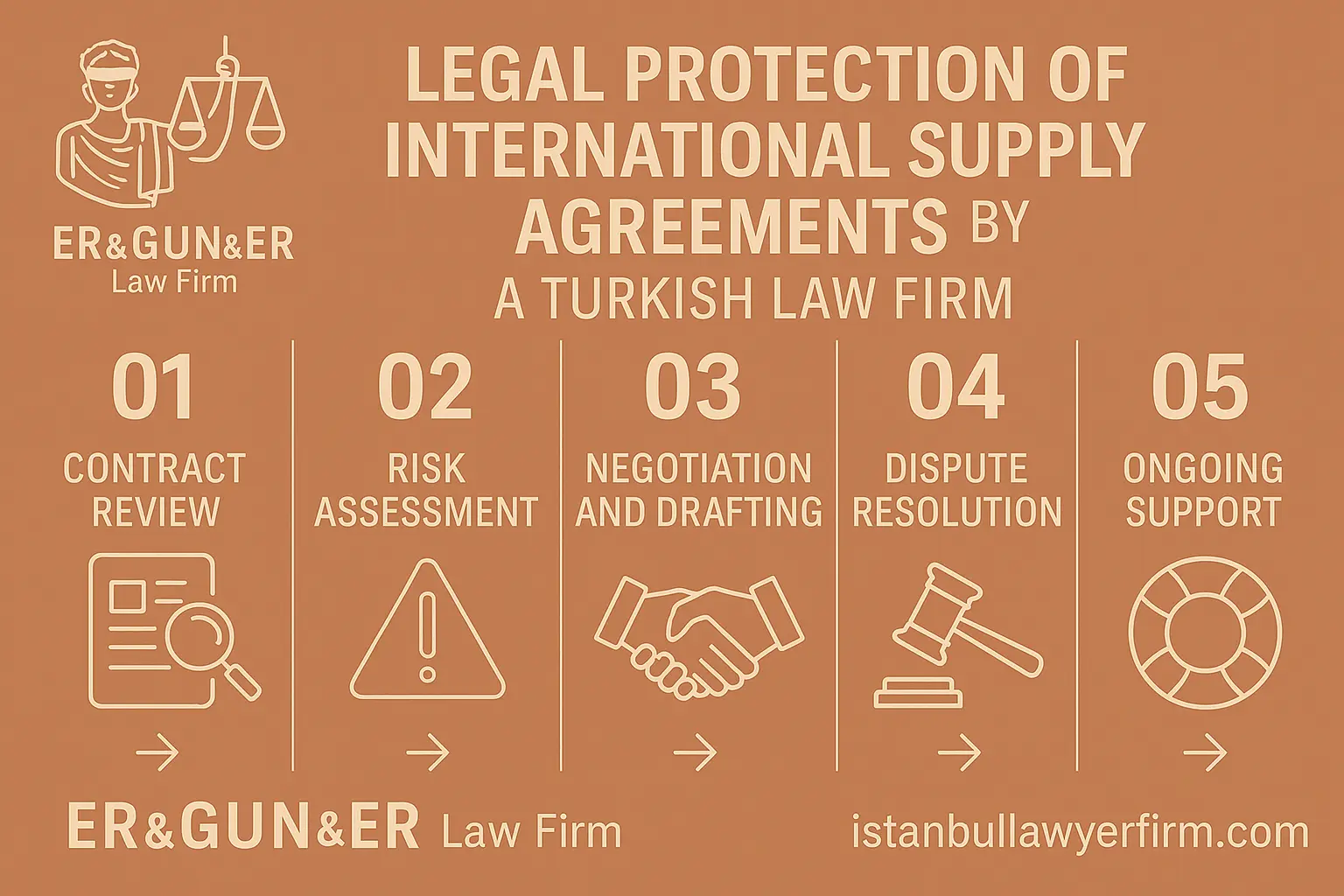
International supply agreements involving Turkish parties operate at the intersection of domestic Turkish contract law, Turkish commercial law provisions specific to merchants, international conventions that may apply automatically or by party choice, private international law governing choice of law and enforcement, arbitration and litigation frameworks, and sector-specific regulatory considerations. The foundational framework derives from the Turkish Code of Obligations No. 6098 (TBK) including the sales contract provisions in Articles 207 through 281, seller's liability for defects in Articles 219 through 231, buyer's obligations in Articles 232 through 239, debtor's default provisions in Articles 112 through 126, and impossibility and force majeure framework in Articles 136 through 138. The Turkish Commercial Code No. 6102 (TTK) supplements the general framework for merchant-to-merchant transactions with Article 23 on inspection and notification of defects (muayene ve ihbar külfeti) imposing strict timeframes — eight days from receipt for apparent defects and prompt notification upon discovery for hidden defects, subject to the general limitation period. The United Nations Convention on Contracts for the International Sale of Goods (CISG — Vienna Convention 1980) has been in force in Turkey since 1 August 2011 and applies automatically to contracts for international sale of goods between parties whose places of business are in different Contracting States under CISG Article 1(1)(a) unless parties explicitly opt out under Article 6. Private International Law No. 5718 (MÖHUK) governs choice of law analysis (Article 24 on contractual obligations) and foreign judgment and arbitral award recognition (Articles 50-58). International arbitration under the International Arbitration Law No. 4686 (MTK) and foreign arbitral award enforcement under the New York Convention 1958 (to which Turkey acceded through Law No. 3731 effective 25 September 1991) provide the international dispute resolution framework. Incoterms 2020 published by the International Chamber of Commerce (effective 1 January 2020, replacing Incoterms 2010), UCP 600 governing documentary credits (effective 1 July 2007), and URDG 758 governing demand guarantees (effective 1 July 2010) provide additional international frameworks applicable where parties incorporate them. Competition Law No. 4054 and the Block Exemption Communiqué on Vertical Agreements (Communiqué No. 2002/2) affect specific supply agreement provisions. Mandatory mediation for commercial receivable disputes under Law No. 7155 of 6 December 2018 (effective 1 January 2019, implemented through TTK Article 5/A) governs specific disputes as a prerequisite to litigation. Foreign exchange considerations under Decision No. 32 (as amended effective 13 September 2018) affect currency denomination for contracts between Turkish residents. Practice may vary by authority and year, and effective supply agreement protection benefits from integrated analysis across these frameworks rather than isolated attention to single frameworks. A lawyer in Turkey coordinates the framework selection and integration for each supply relationship.
Structuring international supply contracts under TBK, TTK, and CISG framework
A Turkish Law Firm structuring international supply contracts works through the framework selection that determines which substantive law applies. CISG application analysis addresses whether the Vienna Convention applies automatically under Article 1(1)(a) because both parties have places of business in different Contracting States, under Article 1(1)(b) through private international law rules leading to application of a Contracting State's law, or not at all where the subject matter or party type falls outside CISG scope (Article 2 excludes consumer sales, auction sales, sales of securities, ships, vessels, aircraft, and electricity; Article 3 addresses contracts with substantial service components). Opt-out considerations under Article 6 permit parties to exclude CISG application by express agreement — the clause must be explicit and unambiguous, and simply choosing "Turkish law" or "law of Turkey" without more typically does not exclude CISG because CISG is part of Turkish law for qualifying international contracts. Opt-in considerations where parties wish to apply CISG despite its non-automatic application are possible, though the parties' ability to apply CISG where its conditions are not met is bounded by the chosen law's acceptance of that choice. Choice of Turkish domestic law (TBK supplemented by TTK for merchant transactions) with express CISG exclusion provides a predictable domestic framework for parties preferring that approach. Choice of foreign domestic law under MÖHUK Article 24 is generally permitted, subject to Turkish mandatory provisions (emredici hükümler) and Turkish public order (kamu düzeni) limitations — Turkish consumer protection, Turkish competition law, Turkish employment law, Decision No. 32 foreign exchange rules for Turkey-resident contracts, and other mandatory provisions apply regardless of party choice where the contract's Turkish nexus brings them into scope. Hybrid framework approaches combining choice of law for main contract with different frameworks for specific issues (for example, main law chosen but arbitration governed separately) are possible but require careful drafting to avoid interpretive gaps. For framework on contract drafting methodology and risk management, readers can consult our contract drafting and risk management guide. Practice may vary by authority and year, and framework selection benefits from analysis of each party's position because CISG, TBK, TTK, and foreign law produce materially different outcomes on core issues including conformity, passage of risk, avoidance, and damages.
Turkish lawyers who address the commercial elements of international supply contracts work through the provisions that require careful attention in cross-border context. Product specifications defining the goods — quality standards referenced to recognized industry or international standards (ISO, ASTM, DIN, sector-specific technical specifications), certification requirements (CE marking for EU-destined goods, TSE for Turkey-market goods, halal or kosher certifications where applicable), sampling and testing protocols, and documentation requirements — anchor the substantive commercial relationship and define what conformity means for purposes of defect analysis. Delivery terms address timing, location, transportation, and risk transfer through incorporation of Incoterms 2020: EXW (Ex Works), FCA (Free Carrier), CPT (Carriage Paid To), CIP (Carriage and Insurance Paid To), DAP (Delivered at Place), DPU (Delivered at Place Unloaded — replacing the former DAT term), and DDP (Delivered Duty Paid) apply to all transport modes; FAS (Free Alongside Ship), FOB (Free on Board), CFR (Cost and Freight), and CIF (Cost, Insurance and Freight) apply specifically to sea and inland waterway transport. The Incoterm selected materially affects the risk transfer point, transportation and insurance cost allocation, customs clearance responsibility, and documentary flow — selecting an inappropriate Incoterm for the transport mode or commercial reality is a routine source of cross-border supply disputes. Quantity provisions including minimum order quantities, tolerances (plus-or-minus percentages), order flexibility mechanisms, and take-or-pay commitments structure volume expectations. Price provisions including pricing methodology (fixed, indexed, cost-plus), currency denomination (USD, EUR, TRY, with Decision No. 32 restrictions on TRY requirement for certain contracts between Turkish residents effective 13 September 2018), price adjustment mechanisms for raw material cost changes or inflation, and rounding and conversion rules define the economic relationship. Payment terms including wire transfer, letters of credit under UCP 600, documentary collections, open account with credit insurance, and other methods, with payment timing (advance, against shipping documents, net days after invoice), align cash flow and security. Practice may vary by authority and year, and supply contract drafting benefits from industry-specific attention because generic provisions miss the operational patterns typical in specific sectors.
An English speaking lawyer in Turkey coordinating bilingual contract drafting for cross-border supply relationships addresses the language and interpretation elements that support effective cross-border contracts. Dual-language execution with Turkish and English versions is common for Turkey-nexus international contracts, and the controlling language clause matters: parties commonly designate one version as controlling with the other as reference, though some sophisticated contracts specify controlling language by subject matter area. Translation quality is the substantive issue behind the clause: technical terminology must align across languages, and industry terms without direct equivalents require explicit definition. Legal terminology translation where Turkish and English legal concepts diverge requires careful drafting — concepts like "consequential damages," "reasonable efforts," "material breach," and "fundamental breach" carry meanings shaped by their home legal system and need explicit contractual definition when deployed across systems. Communication protocols during performance should specify language for formal notices (typically the controlling language or both languages), channels for routine operational communications (email with specified addresses, typically with KEP or verified email for formal matters), and escalation pathways for disputes. Documentation standards for shipping documents (bills of lading, CMR waybills, air waybills), invoices (with Turkish VAT information where applicable), certificates of origin, quality certificates, and inspection certificates need explicit specification to avoid operational friction. Incorporation of international commercial terms — Incoterms 2020 (not earlier versions unless deliberately chosen), UCP 600, URDG 758 — should reference the specific publication and version. The Turkey-resident contracts requirement under Decision No. 32 applies regardless of contract language. Practice may vary by authority and year, and cross-border supply agreements benefit from integrated Turkey-and-home-jurisdiction drafting coordination because substantive provisions may operate differently under different legal frameworks.
Dispute prevention and arbitration clause design
A lawyer in Turkey designing dispute prevention architecture for international supply contracts works through the framework that reduces dispute probability while supporting effective resolution when disputes emerge. Pre-dispute procedures — escalation ladders requiring executive-level engagement before formal proceedings, cooling-off periods allowing time for informed response, good-faith negotiation obligations with documentation requirements — establish structured pre-dispute engagement. Mandatory mediation requirements under Law No. 6325 and the commercial mediation expansion through Law No. 7155 (effective 1 January 2019 for commercial receivable disputes under TTK Article 5/A) apply as a procedural prerequisite to litigation for qualifying disputes — failure to complete mandatory mediation before filing suit produces procedural rejection (dava şartı eksikliği). Contractual mediation clauses beyond mandatory requirements, where parties agree mediation as precondition to arbitration or litigation, require drafting attention to mediator selection (named mediator, institutional mediation through Turkey Mediation Authority, or party-appointed mediator mechanisms), timing (a specified period after the dispute arises, with termination provisions if mediation fails), and procedural elements (confidentiality, cost allocation, mediator powers). Contractual rights exercise procedures — proper notice requirements, cure periods, documentation of performance issues — support relationship preservation by creating formal opportunity for resolution before escalation. Amicable resolution procedures including joint technical committees for technical disputes, periodic relationship reviews at specified intervals, and escalation paths to senior commercial leadership reduce the probability that recoverable disputes reach formal proceedings. Practice may vary by authority and year, and dispute prevention benefits from investment in relationship-preservation mechanisms because the cost of formal dispute resolution typically far exceeds the cost of prevention architecture.
Turkish lawyers who address arbitration clause design for international supply contracts work through the drafting elements that determine arbitration effectiveness. Scope definition — covering "all disputes arising out of or in connection with" the contract versus narrower categorical coverage — shapes the arbitration framework. Institutional selection includes ISTAC (Istanbul Arbitration Centre, established by Law No. 6570 of 29 November 2014 and operational from 26 October 2015, with its 2015 Arbitration and Mediation Rules), ICC (International Chamber of Commerce, headquartered in Paris, with the 2021 ICC Rules in current use), LCIA (London Court of International Arbitration), SIAC (Singapore International Arbitration Centre), HKIAC (Hong Kong International Arbitration Centre), and UNCITRAL Rules (for ad hoc arbitration without institutional involvement). ISTAC offers advantages for Turkey-nexus disputes including familiarity with Turkish commercial patterns, cost efficiency, and proximity; ICC provides globally-recognized institutional support with broad arbitrator rosters; other institutions offer specialized strengths by region or sector. Seat of arbitration (yargı yeri) is a legal concept determining the procedural law governing the arbitration and is distinct from hearing location — a Turkey-seated arbitration is governed by MTK No. 4686 and Turkish courts have supervisory jurisdiction, while a foreign-seated arbitration is governed by the seat's arbitration law. Language of arbitration typically follows the contract's controlling language or the parties' common working language, with cost implications — non-Turkish proceedings require translation of Turkish-language documents and witness testimony. Number of arbitrators is typically one for smaller or simpler disputes and three for substantial or complex disputes, with appointment mechanisms (party appointment with chair selection, institutional appointment, list procedure) defining the selection process. Interim measures authority covers both tribunal-ordered measures under MTK Article 6 and the institutional rules, and court-ordered measures under HMK Articles 389-399 for Turkey-connected urgent matters. Costs allocation provisions (each party bears own costs; costs follow the event; tribunal discretion) affect post-award economic outcomes. For detailed framework on arbitration clause drafting, readers can consult our arbitration clause drafting guide. Practice may vary by authority and year, and arbitration clause drafting benefits from specialist experience because drafting choices produce materially different outcomes in dispute scenarios.
An Istanbul Law Firm coordinating choice of forum and choice of law analysis for cross-border supply contracts addresses the framework that determines dispute resolution jurisdiction and substantive law. Turkish court selection for contracts with substantial Turkish nexus provides advantages including familiarity with Turkish commercial practice, efficient access to Turkish asset enforcement, and predictable procedural framework; the Istanbul Anadolu or Istanbul Commercial Courts of First Instance (Asliye Ticaret Mahkemeleri) are common selections for Istanbul-seated parties. Foreign court selection engages the foreign judgment enforcement framework in Turkey under MÖHUK Articles 50-58: recognition and enforcement of foreign judgments requires competent jurisdiction of the rendering court under rules acceptable to Turkish law, reciprocity with Turkey (satisfied either through bilateral treaty or through practical reciprocity demonstrated in the rendering country's practice toward Turkish judgments), proper service and opportunity to be heard, no conflict with Turkish public order, and certain other requirements — reciprocity is often the practical hurdle for judgments from countries without bilateral treaty. Choice of law under MÖHUK Article 24 generally permits party choice subject to mandatory provisions and public order limitations — Turkish consumer protection, Turkish competition law, Decision No. 32 foreign exchange rules, and other mandatory provisions apply regardless of contractual choice where Turkish nexus engages them. Conflict of laws considerations where different issues may fall under different law systems (for example, contract validity under the chosen law, but capacity under the party's personal law) require careful analytical structure. Exclusive versus non-exclusive jurisdiction clauses produce materially different outcomes — exclusive clauses generally close off other forums while non-exclusive clauses permit parallel options. Asymmetric jurisdiction clauses where one party has broader forum options than the other (common in financing arrangements) face enforceability questions varying across jurisdictions. Practice may vary by authority and year, and forum and law selection benefits from analysis of commercial relationship characteristics and anticipated dispute patterns because the selection materially affects practical outcomes.
Performance monitoring and quality compliance
A Turkish Law Firm coordinating performance monitoring architecture for international supply agreements works through the framework that detects and addresses performance issues before they become material breaches. Key performance indicator architecture with measurable standards — delivery timeliness metrics (on-time delivery rates, lead time compliance, stockout frequency), quality compliance metrics (defect rates, rework rates, return rates), documentation compliance metrics (on-time documentation, accuracy rates), and commercial metrics (invoicing accuracy, payment compliance) — produces objective performance framework. Reporting requirements including monthly operational reports, quarterly commercial reports, annual comprehensive reviews, and event-triggered reports for specific incidents support systematic monitoring. Audit rights covering financial records, production records, quality records, and compliance records with defined audit frequency (typically annual for routine audits with for-cause audits available), audit scope (specific records and operations), audit procedures (notice periods, confidentiality, cost allocation), and audit outcome protocols support verification capability. Inspection rights at defined checkpoints — pre-production samples, in-production quality, pre-shipment inspection (PSI) at the supplier's facility, loading supervision at the port, and receiving inspection at the buyer's facility — provide graduated quality verification. Inspection standards should reference applicable industry standards, ISO frameworks (ISO 9001 quality management, ISO 14001 environmental management, ISO 45001 occupational health and safety, and product-specific ISO standards), and contractually-defined acceptance criteria. Third-party inspection through SGS, Bureau Veritas, Intertek, or other internationally-recognized inspection agencies provides independent verification. For framework on commercial litigation and contract enforcement applicable when monitoring reveals enforcement-worthy issues, readers can consult our commercial litigation and contract enforcement guide. Practice may vary by authority and year, and performance monitoring architecture benefits from industry-specific customization because metrics and mechanisms that work for one relationship may not fit another.
Turkish lawyers who address the TBK and TTK framework for defective performance and buyer remedies work through the provisions that determine buyer options when goods do not meet contract requirements. TBK Article 219 establishes the seller's warranty for defects (ayıba karşı tekeffül) distinguishing visible defects (açık ayıp), hidden defects (gizli ayıp), and fraudulently concealed defects (hile ile gizlenmiş ayıp) with different treatment. TTK Article 23 applicable to merchant-to-merchant sales imposes strict inspection and notification obligations: the buyer must examine received goods within eight days of receipt for apparent defects and notify the seller of any defects immediately upon discovery; hidden defects must be notified immediately upon discovery within the general two-year limitation under TBK Article 231 (with extended limitations for fraudulently concealed defects). The eight-day apparent defect timeframe is strict — failure to notify within this period typically results in loss of defect-based remedies for apparent defects, even where the defects are genuine and substantial. CISG provides alternative framework where CISG applies: Article 35 defines conformity, Article 38 requires examination within as short a period as is practicable in the circumstances, Article 39 requires notice specifying the nature of the lack of conformity within a reasonable time (with a two-year outer limit from actual handing over of the goods under Article 39(2)), and Article 40 removes the notice requirement where the seller knew or could not have been unaware of the non-conformity. The CISG reasonable-time standard is softer than the TTK eight-day rule but is fact-specific and not unlimited. Buyer remedies under TBK Article 227 include rescission of the contract (dönme) with mutual restitution, price reduction (bedel indirimi) reflecting the defect-diminished value, replacement where the goods are generic and replacement is available, or damages (tazminat) — typically the buyer elects among available remedies rather than cumulating them. CISG buyer remedies under Articles 46-52 include specific performance (delivery of substitute goods for fundamental breach, repair for non-fundamental breach), price reduction under Article 50, avoidance under Article 49 for fundamental breach or seller's failure to deliver within additional period fixed by buyer, and damages under Article 74. Practice may vary by authority and year, and defective performance analysis benefits from early legal advice because the statutory notification periods cannot be extended retroactively.
An English speaking lawyer in Turkey coordinating quality compliance documentation for international supply relationships addresses the practical framework that supports both operational quality and legal defensibility. Documentation discipline during normal operations — systematic quality records (inspection reports, testing data, non-conformance reports), incoming goods inspection records, in-process quality records, outgoing inspection records, and shipping documentation — supports later establishment of quality baselines and deviation patterns. Communication documentation during quality issues — formal notices of non-conformity with specific identification of defects, responses from the seller with commitments and timelines, remediation efforts and their outcomes, and follow-up communications — supports subsequent dispute resolution and satisfies the notification requirements under TTK Article 23 and CISG Article 39. Photographic and sample retention with metadata documentation (date, location, batch reference, chain of custody) supports objective evaluation. Third-party certification retention (quality certificates, compliance certificates, calibration records for testing equipment, third-party inspection reports) supports independent verification. Cross-border quality issue communication faces language and technical-terminology considerations that require careful drafting to avoid misunderstandings that can themselves become disputes. Evidence preservation during ongoing quality disputes includes sample preservation under controlled conditions, documentation preservation under litigation hold principles, and witness statement collection while memories are fresh. Practice may vary by authority and year, and quality compliance documentation benefits from systematic discipline because the cumulative record across the contract lifecycle determines the evidentiary strength available if formal proceedings become necessary.
Remedies, liquidated damages, and performance security
A lawyer in Turkey coordinating remedy architecture for international supply agreements works through the framework that balances commercial practicality with legal enforceability. Damages under Turkish law include direct damages (the loss directly caused by the breach), consequential damages (indirect losses resulting from the breach), and in specific circumstances moral damages, each operating under proof and causation requirements. Direct damages are generally recoverable subject to standard causation and proof requirements. Consequential damages including lost profits (yoksun kalınan kar) are recoverable under TBK general principles subject to foreseeability at contract formation — damages not foreseeable at contract formation are typically not recoverable regardless of actual causation. Lost profits require specific proof of the profits that would have been realized absent the breach, with evidentiary standards that courts apply rigorously. Mitigation obligations (zarar görenin zararı azaltma yükümlülüğü) require the non-breaching party to take reasonable steps to mitigate losses, and unmitigated losses that reasonable mitigation would have avoided are not recoverable. CISG Article 77 imposes parallel mitigation obligations where CISG applies. Damage caps through contractual limitation of liability are generally enforceable subject to mandatory provisions, with TBK Article 115 invalidating liability exclusions for gross negligence or intentional misconduct. Liquidated damages provisions (cezai şart) under TBK Articles 179-182 provide pre-agreed damage amounts for breach categories, offering certainty of recovery without proof-of-actual-damage burden. TBK Article 179 defines the penalty clause, Article 180 addresses the relationship between penalty and principal performance, Article 181 addresses reduction where partial performance occurs, and Article 182 permits judicial reduction of excessive penalty clauses where the penalty is disproportionate to the breach severity and the contracting parties' commercial position. Article 182 reduction is less readily available in merchant-to-merchant contracts than in non-merchant contracts because commercial sophistication reduces the court's paternalistic concern, but reduction remains available in appropriate cases. For framework on debt collection applicable to recovery of unpaid amounts, readers can consult our debt collection guide. Practice may vary by authority and year, and remedy architecture benefits from careful drafting because the provisions drive practical enforcement outcomes.
Turkish lawyers who address performance security mechanisms for international supply contracts work through the frameworks that provide commercial protection for contract performance. Performance bonds under URDG 758 (ICC Uniform Rules for Demand Guarantees, effective 1 July 2010) are abstract and independent guarantees paying upon compliant demand without requiring proof of underlying breach — the "independence principle" separates the guarantee obligation from the underlying contract, making the guarantee a pure-payment instrument triggered by documentary compliance. URDG 758 incorporation provides standardized terminology, clear demand requirements, and established dispute resolution provisions. Letters of credit under UCP 600 (ICC Uniform Customs and Practice for Documentary Credits, effective 1 July 2007) provide payment security for the seller upon presentation of compliant documents, with banks examining documents for facial compliance rather than underlying performance. Standby letters of credit function as performance bonds but operate under letter of credit framework (UCP 600 or ISP98), providing an alternative performance guarantee structure. Escrow arrangements where an independent third party (bank, law firm, or specialized escrow agent) holds funds or documents pending specified conditions provide bilateral security — common in purchase-price releases tied to quality verification or milestone completion. Advance payment guarantees protect the buyer's advance payments against seller non-performance; retention arrangements withhold a portion of purchase price (typically 5-10%) pending warranty period completion; parent company guarantees provide enhancement where subsidiary creditworthiness is uncertain. Insurance arrangements including trade credit insurance (protecting against buyer payment default), political risk insurance (protecting against cross-border political risks), and cargo insurance (protecting against transit losses) provide additional risk transfer. Practice may vary by authority and year, and performance security selection benefits from matching to the commercial risks of the specific transaction because each mechanism has strengths and limitations that make it suited to different risk profiles.
An Istanbul Law Firm coordinating the interaction between commercial remedies and competition law considerations addresses the framework where supply agreement provisions may raise competition concerns. Competition Law No. 4054 Article 4 prohibits agreements that prevent, distort, or restrict competition; specific supply agreement provisions face competition scrutiny. The Block Exemption Communiqué on Vertical Agreements (Communiqué No. 2002/2) provides safe harbor for qualifying vertical agreements where the supplier's market share does not exceed 40% and no hardcore restrictions are present. Vertical restraints including exclusive distribution (the buyer is the only distributor in a defined territory), exclusive supply (the seller supplies only this buyer), selective distribution (the seller supplies only qualified resellers), non-compete obligations (the buyer does not handle competing products), and category management arrangements each face specific analysis under the block exemption and its hardcore restriction list. Market share thresholds under the block exemption define the boundary of safe-harbor protection — agreements exceeding thresholds receive substantive competition analysis under Article 4 and the individual exemption framework under Article 5. Hardcore restrictions that void block exemption coverage include resale price maintenance (setting or constraining the reseller's resale price), market partitioning (restricting the territory or customer group into which the reseller can sell, with limited exceptions for exclusive distribution structures), restrictions on cross-supplies within a selective distribution network, and other restrictions listed in the Communiqué. Minimum advertised price policies, minimum resale price policies, and recommended resale prices with practical enforcement characteristics face hardcore restriction analysis. Competition clearance analysis before implementation supports risk management — notification to the Competition Authority under the Turkish merger control framework for qualifying joint ventures, and ex-ante competition analysis for significant distribution arrangements, avoid post-hoc investigation exposure. Dawn raid preparedness where the Competition Authority may conduct unannounced inspections requires prepared document management, personnel training on legal counsel contact and interview protocols, and attorney retention for representation. Practice may vary by authority and year, and competition law interaction with supply agreement provisions benefits from specialist competition counsel because the technical framework requires dedicated expertise.
Termination rights and exit mechanisms
A Turkish Law Firm coordinating termination architecture for international supply agreements works through the framework under TBK and TTK supplemented by contract provisions. Termination for material breach (esaslı ihlal nedeniyle fesih) provides remedy where the breaching party's conduct rises above the material breach threshold — the threshold analysis considers breach characteristics, the contract importance of the breached provision, whether performance has become impossible or substantially diminished, and the commercial impact on the non-breaching party. Cure period frameworks, where the breaching party receives notice and an opportunity to remedy before termination is effective, balance relationship preservation against rigid enforcement; typical drafting provides a defined cure period (14, 30, or 60 days depending on the breach category) with termination permitted only if the breach is not cured within the period. Notice requirements for termination — written form, specified delivery methods (registered mail, KEP, or specified courier with tracking), content requirements (specific identification of breach, cure opportunity, termination effective date), and other procedural elements — affect effectiveness and the availability of damages claims. Termination for specified events including insolvency of the counterparty (bankruptcy filing, appointment of receiver, general assignment for benefit of creditors), change of control (acquisition by competitor or entity otherwise commercially incompatible), regulatory events (loss of required licenses, sanctions designations), and prolonged force majeure (continuation beyond a specified period) provide exit pathways for defined circumstances. Force majeure under TBK Articles 136-138 addresses scenarios where performance becomes impossible due to events beyond party control — temporary impossibility suspends performance while the impossibility continues; permanent impossibility dissolves the contract with mutual restitution of performed portions. Hardship doctrine (aşırı ifa güçlüğü) under TBK Article 138, introduced in the 2012 TBK revision, applies in extreme circumstances where performance, while possible, has become extraordinarily burdensome due to unforeseeable subsequent events; the remedy is contract adaptation to restore the commercial balance or, if adaptation is not feasible, contract termination. Termination for convenience, where parties include provisions permitting termination without cause typically with notice period and possible exit payment, provides commercial flexibility. CISG Articles 49 (buyer's right to avoid) and 64 (seller's right to avoid) provide distinct termination framework for CISG-governed contracts, centered on the "fundamental breach" concept under Article 25. For framework on commercial law applicable to business contracts, readers can consult our commercial law overview. Practice may vary by authority and year, and termination architecture benefits from careful drafting because subtle differences produce materially different outcomes across scenarios.
Turkish lawyers who address post-termination obligations work through the framework where specific obligations survive termination to govern the wind-down. Return of goods, materials, and documents — physical property, intellectual property materials in the counterparty's possession, confidential materials, and other physical or tangible items — produces practical execution questions that benefit from anticipatory drafting (specifying return timelines, condition requirements, shipping cost allocation, and destruction alternatives for items impractical to return). Confidentiality obligations surviving termination address continued protection of information exchanged during the relationship; duration should be specified (common durations range from three to ten years post-termination with perpetual obligations for certain categories of highly-sensitive information), and scope should cover the categories of information and the permissible uses. Non-compete and non-solicitation obligations surviving termination, where enforceable, protect competitive positions during a post-termination period; Turkish law enforces post-termination non-competes with scope, duration, and geographic reasonableness limits, and overly broad restrictions are subject to judicial modification or non-enforcement. Outstanding payment obligations including accrued but unpaid amounts, post-termination expense reimbursements, and adjustment payments require specific resolution with a reconciliation process and payment timeline. Warranty obligations surviving termination for goods delivered before termination continue under the warranty terms as if the contract had not ended — the warranty obligation attaches to the delivered goods, not to the ongoing supply relationship. Intellectual property arrangements at termination — license termination mechanics, material return or destruction, residual rights treatment — require explicit handling because default rules produce outcomes that may not match either party's expectations. Indemnification obligations surviving termination for pre-termination events preserve risk allocation. Tax clearance including final VAT filings, withholding tax reconciliations, and other tax matters requires coordinated execution. Reputational and commercial management during termination — communications with shared customers, suppliers, and other stakeholders — supports business continuity for both parties. Practice may vary by authority and year, and post-termination architecture benefits from drafting discipline because generic provisions produce gaps that create disputes during termination execution.
An English speaking lawyer in Turkey coordinating cross-border termination considerations works through the elements that arise when supply relationships span jurisdictions. Multi-jurisdictional termination coordination addresses how termination affects operations, obligations, or parties in multiple jurisdictions — a termination effective in one jurisdiction may have different timing or consequences elsewhere, and sequencing matters. Choice of law application to termination provisions where different aspects of termination may fall under different law systems requires careful analysis. Foreign enforcement of termination-related remedies where the breaching party's assets are abroad requires planning that begins with contract drafting (not with enforcement attempts) — forum and law selection, arbitration seat choice, and asset visibility documentation all affect ultimate recovery. Regulatory notifications where termination triggers reporting to regulators in multiple jurisdictions (securities regulators for public companies, competition authorities for significant relationships, sector regulators for regulated industries) require coordinated timing. Industry-specific termination requirements — automotive dealership termination protections, franchise termination rules, distributor termination rights under certain national laws that override contractual termination provisions — can produce unexpected exposure. Communication strategy for cross-border termination addresses stakeholders, languages, and cultural expectations; a termination executed with technical correctness can still fail commercially if communication generates avoidable backlash. Wind-down operations coordination addresses personnel matters, customer transitions, supplier transitions, and other operational elements. Practice may vary by authority and year, and cross-border termination benefits from integrated Turkey-and-home-jurisdiction planning because the issues span both legal systems.
Post-termination enforcement and claims recovery
A lawyer in Turkey coordinating post-termination claim enforcement works through the framework under the Execution and Bankruptcy Law No. 2004 (İcra ve İflas Kanunu — İİK) that governs enforcement against the breaching party's assets. Enforcement proceedings (icra takibi) are initiated at the competent enforcement office (icra müdürlüğü) with a payment order (ödeme emri) served on the debtor; the debtor can pay, object (itiraz), or take no action within the statutory response period (typically seven days for most enforcement categories), with enforcement proceeding to asset attachment if no action is taken. Enforcement with judgment (ilamlı takip) applies where a court judgment or arbitral award exists — the claim's existence and amount are established by the judgment or award, and the enforcement focuses on execution mechanics rather than merits. Enforcement without judgment (ilamsız takip) applies for undisputed claims with acceptable documentary proof (bills of exchange, checks, promissory notes, certain invoice categories with delivery confirmation), with a simpler procedure but exposure to debtor objection that converts the proceeding into a merits determination. Provisional attachment (ihtiyati haciz) under İİK Articles 257 et seq. provides interim protection before final judgment where the creditor demonstrates that the claim is based on documentary evidence or that there is reasonable concern about debtor asset dissipation; the application requires judicial authorization, typically with security posting proportionate to potential wrongful-attachment damages. Provisional injunction (ihtiyati tedbir) under HMK Articles 389-399 provides interim protection for non-monetary claims, with similar security posting requirements. Asset investigation through the MASAK financial intelligence coordination where available, land registry searches for real property, corporate registry searches for shareholdings, and bank inquiries supports enforcement planning. Bankruptcy proceedings (iflas) under İİK where the debtor becomes insolvent introduce claim priority rules that can materially affect recovery. For detailed framework on enforcement proceedings, readers can consult our enforcement proceedings guide. Practice may vary by authority and year, and enforcement benefits from early asset investigation because enforcement success correlates strongly with available attachable assets.
Turkish lawyers who address claim documentation and procedural preparation for enforcement work through the framework that translates substantive claims into enforceable positions. Claim quantification with documentation supporting the amounts — contract documentation establishing the obligation, performance documentation showing completed or rejected work, invoice records with delivery confirmations, payment records and reconciliations, and damage calculations with supporting methodology — establishes the foundation. Contract documentation assembly includes the original executed contract, amendments and addenda, ancillary agreements (nondisclosure, quality, escrow, guarantees), and course-of-performance documents that support interpretation. Performance documentation including delivery records, inspection records, acceptance records (or records of rejection), communications documenting performance acknowledgment, and operational records demonstrating the performance pattern supports factual claim basis. Damages documentation including financial records supporting damage calculations, expert analyses for technical damages (engineering damages, lost-profits modeling, diminished-value assessments), mitigation records showing the non-breaching party's mitigation efforts, and other damage evidence supports damage claims. Notice documentation showing the sequence of notices given, responses received or absence of response, and other notice elements supports procedural compliance. Interest calculation under TTK Article 1530 commercial default interest (higher than civil default interest), specified contractual interest provisions, and applicable interest calculation methodology affects claim amounts. Attorney fee recovery where applicable rules permit recovery under the Turkish attorney fee tariff or contractual attorney fee provisions affects claim economics. Practice may vary by authority and year, and claim preparation benefits from systematic documentation because enforcement success depends substantially on evidentiary foundation.
An Istanbul Law Firm coordinating practical elements of post-termination enforcement addresses the framework that transforms legal entitlement into actual recovery. Strategic timing of enforcement actions considers asset availability (pre-bankruptcy enforcement often recovers more than post-bankruptcy claim submission), debtor commercial position (debtors facing liquidity stress may negotiate settlements that post-stress debtors cannot), market conditions affecting attachable asset values, and other factors that affect practical outcomes. Pre-enforcement settlement exploration where negotiated resolution can achieve faster or better outcomes than adversarial enforcement supports practical efficiency — settlement is often available at enforcement initiation stages that becomes unavailable once the debtor has adjusted to enforcement pressure. Enforcement coordination across asset categories including bank accounts (through banking searches and attachment orders), real estate (through land registry attachment), movable property (through physical attachment), receivables (through third-party attachment / garnishment), shares (through corporate registry attachment), and vehicles (through TNVTS vehicle registry attachment) requires procedural approach tailored to each category. Third-party involvement through garnishment of receivables owed to the debtor, joinder of co-defendants where applicable, and coordination with other creditors in multi-creditor contexts expands enforcement scope. Enforcement fee management covers proceeding fees, attorney fees, court fees, translation and expert fees, and other costs — these are generally recoverable from the debtor in successful enforcement but must be financed upfront. Bankruptcy filing consideration where the debtor's continuing non-payment suggests systemic insolvency can produce better coordinated outcomes than continued individual enforcement, particularly when multiple creditors are pursuing the same debtor. Regulatory coordination where financial regulators, banking regulators, or sector regulators hold relevant information or authority can support broader enforcement capability. Practice may vary by authority and year, and post-termination enforcement benefits from specialized experience because procedural and strategic elements require dedicated expertise beyond generic legal representation.
Cross-border enforcement and foreign award recognition
A Turkish Law Firm coordinating cross-border enforcement in international supply disputes works through the framework that applies when enforcement crosses national boundaries. Foreign arbitral award enforcement in Turkey under the New York Convention 1958 — to which Turkey acceded through Law No. 3731 and which entered into force for Turkey on 25 September 1991 — as implemented through MTK No. 4686 provides the primary framework for enforcing foreign awards from Convention signatory countries. The New York Convention framework provides narrow refusal grounds under Article V limited to specific categories: invalidity of arbitration agreement under the governing law; inadequate notice or opportunity to present case; award exceeding the scope of submission to arbitration; irregularity in tribunal composition or procedure contrary to parties' agreement or the seat's law; award not yet binding or set aside or suspended in the country where or under the law of which it was made; subject matter not capable of settlement by arbitration under Turkish law; and award contrary to Turkish public order (kamu düzeni). Turkish court proceedings to enforce foreign awards require specific documentation including the award in original or certified copy, the arbitration agreement, Turkish translation where the originals are not in Turkish, and apostille certification (for documents from Hague Apostille Convention party countries) or consular legalization for other countries. Foreign judgment enforcement in Turkey under MÖHUK Articles 50-58 operates under more restrictive framework than arbitral award enforcement. Recognition requirements include competent jurisdiction of the rendering court under rules that Turkish law accepts, reciprocity with the rendering country (mütekabiliyet) satisfied either through bilateral treaty or through practical reciprocity demonstrated in the foreign country's treatment of Turkish judgments, proper service and opportunity to be heard in the foreign proceedings, compatibility with Turkish public order, and absence of a Turkish judgment on the same matter between the same parties. Reciprocity is often the practical obstacle for judgments from countries without bilateral treaty; some major trading partners have treaty arrangements with Turkey while others require demonstration of practical reciprocity. For framework on international trade law, readers can consult our international trade law guide. Practice may vary by authority and year, and cross-border enforcement benefits from specialist experience because procedural requirements differ materially from standard domestic enforcement.
Turkish lawyers who address Turkish judgment and award enforcement in foreign jurisdictions work through the framework applying where Turkish-originated decisions require foreign enforcement. Turkish arbitral award enforcement abroad under the New York Convention provides framework for enforcement in Convention signatory countries (more than 170 jurisdictions), with the specific procedure in each foreign jurisdiction determined by local implementation; documentation standards, translation requirements, and procedural mechanics vary across jurisdictions but the substantive Article V framework is largely consistent. Turkish court judgment enforcement abroad depends on the specific foreign country's framework for recognition of foreign judgments — major common law jurisdictions generally apply common law principles of comity with variations, EU member states apply the Brussels Ibis Regulation (to which Turkey is not party, producing the general MÖHUK-equivalent analysis for enforcement in EU states), and other jurisdictions have national recognition frameworks. Bilateral treaty analysis where Turkey has recognition and enforcement treaties with specific countries (bilateral judicial assistance treaties with various countries addressing recognition and enforcement) provides specific framework for enforcement under the treaty provisions. Asset tracing across jurisdictions through international information-exchange frameworks, investigative services, and formal cross-border assistance procedures supports identification of enforceable assets. Parallel enforcement strategies pursuing enforcement simultaneously in multiple jurisdictions where assets are distributed require careful coordination — inconsistent proceedings can produce conflict and sometimes undermine recognition in later jurisdictions. Hague Service Convention procedures for service abroad and Hague Evidence Convention procedures for evidence gathering abroad support cross-border procedural integration. Practice may vary by authority and year, and international enforcement benefits from coordinated multi-jurisdictional approach because strategic decisions in one jurisdiction affect outcomes in others.
An English speaking lawyer in Turkey coordinating practical integration between Turkish and foreign legal proceedings addresses the operational elements that support effective cross-border supply dispute resolution. Document authentication for cross-border use includes apostille certification under the Hague Apostille Convention (for Convention member states — Turkey has been a party since 29 September 1985) and consular legalization for non-Convention countries. Sworn translation requirements where Turkish documents require certified translation for foreign use and foreign documents require certified translation for Turkish use affect documentation preparation cost and timeline. Evidence preservation across jurisdictions addresses local preservation obligations, privilege protection under the specific jurisdiction's rules, and specific other evidence elements. Witness and expert testimony coordination addresses witness location, language of testimony, video testimony arrangements where permitted, and procedural requirements for cross-border testimony. Privilege considerations across jurisdictions face the complication that privilege rules differ materially between Turkey (where attorney-client privilege is recognized under the Attorney Law No. 1136 and specific procedural law provisions but does not follow the precise contours of common law privilege) and common law jurisdictions, and civil law jurisdictions have their own variations; protecting privileged communications requires understanding both regimes. Time zone and language coordination for multi-jurisdictional proceedings addresses practical logistics. Cost management across jurisdictions including court fees, attorney fees at the standards applicable in each jurisdiction, expert fees, and other costs requires consolidated budgetary planning. Practice may vary by authority and year, and cross-border coordination benefits from dedicated coordination infrastructure because practical elements require systematic attention beyond substantive legal work.
Continuous contract review and legal updates
A lawyer in Turkey coordinating continuous contract review architecture for international supply relationships works through the framework that keeps contracts aligned with evolving legal, commercial, and operational realities. Periodic contract review schedules address review frequency (typically annually for significant agreements; more frequent for high-change environments such as technology supply or regulated products), scope (full review of commercial and legal terms, versus targeted review of specific risk areas), participants (legal counsel, commercial team, operations, finance), and outputs (recommended amendments, process adjustments, or status quo confirmation). Legal update monitoring covers Turkish legislative developments (new laws, amendments to TBK, TTK, or regulations), Court of Cassation jurisprudence affecting contract interpretation, Competition Authority decisions affecting specific contractual provisions, tax framework changes, and other legal evolution. International framework monitoring covers CISG developments (no major amendments but evolving interpretive jurisprudence), Incoterms updates (the 2020 version replaced 2010 with specific changes including DPU replacing DAT and clarifications on FCA, DAP, DPU, DDP), UCP revisions, URDG updates, and other international framework evolution. Commercial environment monitoring covers industry developments, counterparty developments (financial condition, ownership changes, strategic shifts), market developments (supply-demand shifts, commodity price patterns), and regulatory developments affecting the specific sector. Contract amendment procedures address amendment authority (which party personnel can execute amendments), amendment process (formal documentation, signature requirements, implementation), documentation (amendment agreements, consolidated versions), and related elements. Amendment versus new contract analysis determines whether change fits within the existing contract structure or warrants a replacement agreement — substantial scope expansions, fundamental commercial term changes, or accumulation of multiple amendments often warrant replacement. For framework on contract law for foreign companies, readers can consult our contract law guide for foreign companies. Practice may vary by authority and year, and continuous review benefits from systematic scheduling because ad hoc review typically misses issues that systematic coverage would identify.
Turkish lawyers who address trigger events requiring contract review work through the framework where specific events warrant attention beyond regular review cycles. Legislative changes including new laws affecting contract framework (amendments to TBK and TTK do occur, and secondary regulation changes regularly), changes to MÖHUK provisions, and other legislative developments may require contract attention. Regulatory framework changes including new regulations from the Competition Authority, Banking Regulation and Supervision Agency (BDDK) for banking-related arrangements, Capital Markets Board (SPK) for capital-markets-related arrangements, and sector regulators affect specific contractual compliance. Court of Cassation precedent where decisions of the Supreme Court of Appeals affect the interpretation of specific contractual issues produce review needs. Tax framework changes affecting contractual payments — VAT changes (the general rate is 20% effective 10 July 2023, with 10% and 1% reduced rates for specific categories), withholding tax adjustments, transfer pricing rule updates, and other tax developments — require attention. Foreign exchange framework changes under Decision No. 32 — the 13 September 2018 amendments introduced significant restrictions on foreign-currency-denominated contracts between Turkey-resident parties, and subsequent amendments have adjusted the scope — affect contractual currency choices. Customs and trade framework changes affecting goods classification, duty rates, trade facilitation frameworks, and related elements affect contract operations. Competition law developments affecting vertical restraint analysis, market share considerations, and other competition elements affect contractual provisions. Consumer protection developments affect consumer-facing supply elements where applicable. KVKK data protection developments including the Law No. 7499 (March 2024) amendments on cross-border data transfers affect contractual data-handling provisions. Industry-specific developments in regulated sectors produce sector-specific review triggers. Practice may vary by authority and year, and trigger event response benefits from systematic legal monitoring because developments affect contracts in ways that only legal analysis reveals.
An Istanbul Law Firm coordinating contract amendment execution for international supply agreements addresses the framework that translates review findings into effective updates. Amendment drafting addresses specific modifications with attention to interaction with existing provisions (avoiding amendments that contradict unchanged provisions), cross-references (updating downstream references to amended sections), definition consistency (updating defined terms where the amendment changes their scope), and other coherence elements. Multi-party coordination where contracts involve multiple parties requires amendment consent coordination and execution procedures that account for party availability and signatory authority. Bilingual amendment execution where original contracts were bilingual requires translation coordination and version management to maintain the correspondence between Turkish and foreign-language versions. Amendment documentation including recitals explaining the amendment purpose (helpful for future interpretation by courts or arbitrators), effective dates (distinguishing signing date from effective date where they differ), and other documentation elements supports future interpretation. Implementation coordination where amendments affect operational practices requires internal training, process updates, and communication with operational personnel who will execute the amended arrangements. Regulatory notification where amendments trigger regulatory obligations (for example, material amendments to merger-notified arrangements, or amendments to regulated-sector contracts that require regulatory approval) requires timing coordination. Third-party notification where amendments affect third-party relationships (guarantors, insurers, sublicensees) requires appropriate communication. Archive management maintaining version history with amendment records, consolidated versions, and related materials supports future reference and dispute resolution. Practice may vary by authority and year, and amendment execution benefits from systematic coordination because practical implementation of contract amendments often requires more than the legal documentation itself suggests.
Author: Mirkan Topcu is an attorney registered with the Istanbul Bar Association (Istanbul 1st Bar), Bar Registration No: 67874. His practice focuses on cross-border and high-stakes matters where evidence discipline, procedural accuracy, and risk control are decisive, with particular concentration on international supply agreement legal protection including structuring under TBK No. 6098 (Articles 207-281 sales, 219-231 defects, 232-239 buyer obligations, 112-126 default, 136-138 impossibility and hardship, 179-182 penalty clauses) and TTK No. 6102 (Article 23 eight-day apparent defect inspection framework, Article 5/A mandatory commercial mediation, Article 1530 commercial default interest), CISG Vienna Convention 1980 application analysis (in force for Turkey since 1 August 2011) for international sale of goods contracts with Turkish parties, Incoterms 2020 incorporation (effective 1 January 2020 with the eleven-term framework), UCP 600 documentary credit structuring (effective 1 July 2007), URDG 758 demand guarantee frameworks (effective 1 July 2010), MÖHUK No. 5718 Article 24 choice of law and Articles 50-58 foreign judgment recognition analysis, dispute resolution architecture through Turkish courts under HMK No. 6100, international arbitration under MTK No. 4686 with ISTAC (established by Law No. 6570 of 29 November 2014 and operational from 26 October 2015) and ICC, LCIA, SIAC, HKIAC, UNCITRAL institutional rule selection, mandatory mediation under Law No. 6325 and Law No. 7155 of 6 December 2018 (effective 1 January 2019), Competition Law No. 4054 vertical restraint analysis under Block Exemption Communiqué No. 2002/2, performance monitoring and quality compliance architecture, remedies including penalty clauses under TBK Articles 179-182 with Article 182 judicial reduction, termination and force majeure framework under TBK Articles 136-138 including hardship doctrine, performance security through UCP 600 letters of credit and URDG 758 demand guarantees, enforcement under the Execution and Bankruptcy Law No. 2004 (İİK) including İİK Articles 257 et seq. provisional attachment and HMK Articles 389-399 provisional injunction, and cross-border enforcement under the New York Convention 1958 (effective for Turkey 25 September 1991 through Law No. 3731) and MÖHUK Articles 50-58.
He advises individuals and companies across Commercial and Corporate Law, Commercial Contracts, Foreign Investment, Data Protection and Privacy, Intellectual Property, Arbitration and Dispute Resolution, Enforcement and Insolvency, Citizenship and Immigration (including Turkish Citizenship by Investment), Real Estate (including acquisitions and rental disputes), International Tax, International Trade, Foreigners Law, Sports Law, Health Law, and Criminal Law. He regularly supports Turkish and international clients on international supply agreement structuring from framework selection through drafting, dispute prevention architecture with arbitration clause design, performance monitoring and quality compliance framework, remedy architecture with performance security design, termination planning and execution, post-termination enforcement coordination, cross-border recognition and enforcement of Turkish and foreign judgments and arbitral awards, and continuous contract review supporting ongoing commercial relationships.
Education: Istanbul University Faculty of Law (2018); Galatasaray University, LL.M. (2022). LinkedIn: Profile. Istanbul Bar Association: Official website.
Frequently asked questions
- Does CISG apply to international supply contracts with Turkish parties? Yes, in many cases. The United Nations Convention on Contracts for the International Sale of Goods (Vienna Convention 1980) has been in force in Turkey since 1 August 2011. CISG applies automatically under Article 1(1)(a) when parties have places of business in different Contracting States, unless parties explicitly opt out under Article 6. Choosing "Turkish law" without more typically does not exclude CISG because CISG is part of Turkish law for qualifying contracts.
- What statute governs general contract law in Turkey? The Turkish Code of Obligations No. 6098 (TBK) provides the general contract framework including sales provisions in Articles 207-281, defect liability in Articles 219-231, default in Articles 112-126, force majeure in Articles 136-138, and penalty clauses in Articles 179-182.
- What special provisions apply to merchant-to-merchant sales? The Turkish Commercial Code No. 6102 supplements TBK for merchant sales. TTK Article 23 requires buyer examination and notification within eight days for apparent defects and notification of hidden defects immediately upon discovery within the general limitation. Missing the eight-day apparent defect notification typically forecloses defect-based remedies for those defects.
- What are Incoterms 2020 and how do they apply? Incoterms 2020 are International Chamber of Commerce rules effective 1 January 2020 (replacing Incoterms 2010). The eleven terms are EXW, FCA, CPT, CIP, DAP, DPU (replacing the former DAT), and DDP for all transport modes, and FAS, FOB, CFR, CIF specifically for sea and inland waterway transport. The Incoterm chosen determines risk transfer, transportation and insurance allocation, and customs responsibility.
- How do party choice of law provisions operate? MÖHUK No. 5718 Article 24 generally permits parties to choose applicable law for their contract. Mandatory Turkish law provisions (consumer protection, competition law, Decision No. 32 foreign exchange rules for Turkey-resident contracts) and Turkish public order apply regardless of party choice where Turkish nexus engages them.
- What arbitration framework applies in Turkey? The International Arbitration Law No. 4686 (MTK) governs international arbitration. ISTAC (established by Law No. 6570 of 29 November 2014, operational from 26 October 2015) provides institutional Turkish arbitration. ICC, LCIA, SIAC, HKIAC, and UNCITRAL Rules are alternatives. Seat selection determines procedural law and supervisory jurisdiction.
- How are foreign arbitral awards enforced in Turkey? The New York Convention 1958 (effective for Turkey 25 September 1991 through Law No. 3731) as implemented through MTK No. 4686 provides the enforcement framework with narrow Article V refusal grounds. Enforcement requires the award, arbitration agreement, Turkish translation, and apostille or consular legalization, and proceeds through specialized procedures substantially simpler than foreign judgment enforcement.
- How are foreign judgments recognized in Turkey? MÖHUK Articles 50-58 govern recognition with requirements including competent jurisdiction, reciprocity (through bilateral treaty or practical reciprocity), proper service, compatibility with Turkish public order, and absence of conflicting Turkish judgment. The reciprocity requirement is the practical obstacle for judgments from countries without bilateral treaty with Turkey.
- Is mediation mandatory for commercial disputes? Yes, for specific categories. Law No. 7155 of 6 December 2018 (effective 1 January 2019) implemented mandatory mediation for commercial receivable disputes between merchants through TTK Article 5/A. Failure to complete mandatory mediation before filing suit produces procedural rejection.
- What liquidated damages framework applies? TBK Articles 179-182 govern penalty clauses (cezai şart). Article 182 permits judicial reduction of excessive penalty clauses where the penalty is disproportionate, though reduction is less readily available in merchant-to-merchant contracts than in non-merchant contracts. Careful drafting distinguishing penalty clauses from fixed damages affects reduction possibilities.
- What competition law considerations affect supply agreements? Competition Law No. 4054 Article 4 prohibits competition-restrictive agreements. The Block Exemption Communiqué No. 2002/2 on Vertical Agreements provides safe harbor where supplier market share does not exceed 40% and no hardcore restrictions are present. Hardcore restrictions including resale price maintenance and market partitioning void exemption coverage.
- What force majeure framework applies? TBK Articles 136-138 address impossibility; Article 138 hardship (aşırı ifa güçlüğü) applies in extreme circumstances with contract adaptation or termination as remedy. CISG Article 79 provides exemption from liability for impediment beyond control where CISG applies. Contractual force majeure provisions typically supplement statutory framework.
- How are supply contract enforcement proceedings conducted? Execution and Bankruptcy Law No. 2004 governs enforcement. Enforcement with judgment (ilamlı takip) after court or arbitral award, enforcement without judgment (ilamsız takip) for documentary claims, and provisional attachment under Articles 257 et seq. provide the framework. Bankruptcy proceedings apply in insolvency scenarios.
- What cross-border considerations apply to supply contracts? Integrated analysis across choice of law under MÖHUK Article 24, dispute resolution framework (arbitration versus litigation, forum selection), enforcement considerations (foreign arbitral award enforcement under New York Convention, foreign judgment enforcement under MÖHUK Articles 50-58), document authentication including apostille under the Hague Convention (Turkey party since 29 September 1985), and practical Turkey-foreign coordination supports effective cross-border contracts.
- How does ER&GUN&ER Law Firm structure supply agreement engagements? Engagements begin with integrated framework analysis addressing CISG application, governing law selection, and dispute resolution architecture, translated into comprehensive contract drafting, performance monitoring framework, remedy architecture, termination mechanisms, enforcement preparation, cross-border coordination, and continuous review supporting the full contract lifecycle.