

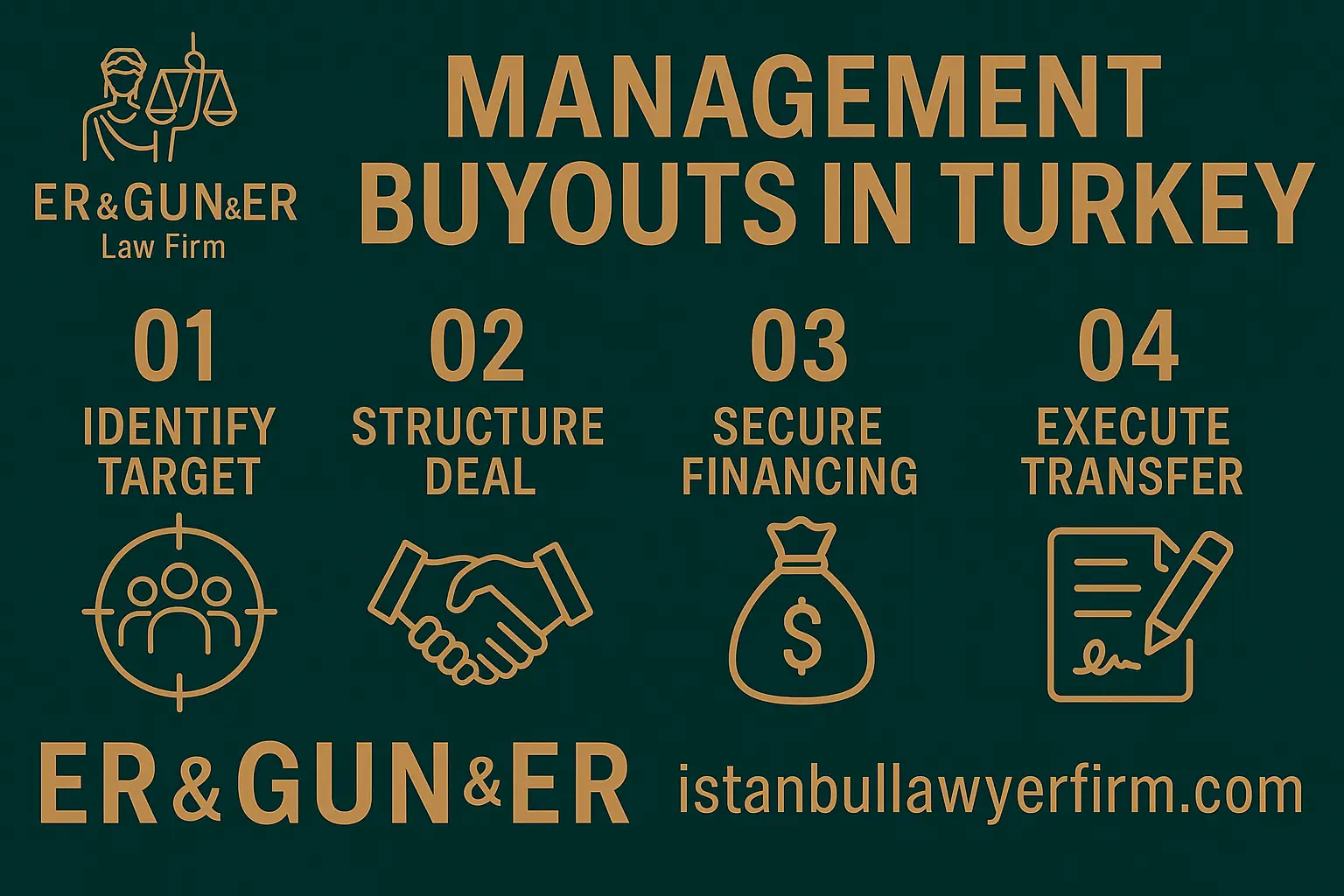
Management buyouts (MBOs) in Turkey operate within a statutory framework combining the Turkish Commercial Code No. 6102 foundational provisions, Competition Law No. 4054 merger control, Corporate Tax Law No. 5520 transaction tax treatment, Capital Markets Law No. 6362 (SPK) for publicly-traded targets, Banking Law No. 5411 for financing structure, Turkish Code of Obligations No. 6098 for contractual framework, Labor Law No. 4857 for employment continuity, and Tax Procedure Law No. 213 for tax reporting. The foundational MBO-specific legal constraint under Turkish corporate law is the financial assistance prohibition (mali yardım yasağı) under TTK Article 380 which restricts a joint stock company (A.Ş.) from providing financial assistance — loans, guarantees, security, or other financial support — to third parties for the acquisition of its own shares, with narrow exceptions for employee participation schemes under defined conditions. This prohibition shapes MBO structural architecture because the target company generally cannot directly finance management's acquisition of target shares, driving structures through NewCo acquisition vehicles with post-closing merger or debt push-down planning. Related treasury share framework under TTK Article 379 limits a company's direct acquisition of its own shares to 10% of capital with conditions, further constraining structural options. Share transfer mechanics vary by company form — joint stock company (A.Ş.) nominal shares under TTK Articles 489-496 (with potential share ledger endorsement requirements for nama shares) versus limited liability company (Ltd. Şti.) quota transfer under TTK Article 595 requiring notarial deed, general assembly approval, and Trade Registry registration. Rekabet Kurumu (Turkish Competition Authority) merger control under Competition Law No. 4054 Articles 7 and 10 applies when jurisdictional thresholds are met under Communiqué 2010/4 as amended by 2022/2 and 2026/2 — currently TRY 750 million combined Turkey turnover with at least TRY 250 million from one party (Article 7(1)(a)), or TRY 250 million Turkey turnover acquired with TRY 3 billion global acquirer turnover (Article 7(1)(b)), with further thresholds for technology undertakings. Tax-neutral structuring through Corporate Tax Law No. 5520 Article 19 merger provisions or Article 20 demerger provisions supports efficient post-closing restructuring where requirements are met, with VAT exemption under Law No. 3065 Article 17/4(c) covering share transfers and qualifying participation disposals. Practice may vary by authority and year, and MBO architecture requires integrated legal, tax, financing, and regulatory analysis rather than isolated handling. A lawyer in Turkey coordinates the structural analysis, documentation, regulatory approvals, and post-closing integration that determine MBO success. For framework on M&A generally which provides the transactional foundation for MBOs, readers can consult our M&A legal process guide.
Statutory framework and the financial assistance constraint
A Turkish Law Firm advising on MBO structuring works from the Turkish Commercial Code No. 6102 framework with particular attention to the financial assistance prohibition (mali yardım yasağı) that is the critical MBO-specific constraint. TTK Article 380 establishes that a joint stock company cannot provide advances, loans, guarantees, or security for the purpose of acquisition of its own shares by third parties — intended to prevent target companies from funding their own acquisition in ways that harm creditors and minority shareholders. The prohibition operates as strict rule without proportionality test — transactions violating Article 380 are void (batıl) with consequent unwinding obligations. Narrow exceptions permit specific employee share participation schemes under defined conditions, but management acquisition of substantial stake for MBO purposes generally does not qualify for exception. Related TTK Article 379 treasury share framework limits company direct acquisition of own shares to 10% of capital with conditions including general assembly authorization, specific purposes, and funding from distributable reserves — providing limited alternative pathway for specific transaction elements rather than core MBO financing. The financial assistance prohibition parallels EU Second Company Law Directive framework, reflecting continental European corporate capital maintenance doctrine. Practice may vary by authority and year, and Article 380 analysis is the foundational structural analysis for any Turkish MBO.
Turkish lawyers who address MBO structural responses to the financial assistance constraint work through the architectural alternatives that Turkish practice has developed. NewCo acquisition structure establishes a newly-formed company (typically Turkish A.Ş. or Ltd. Şti., depending on tax and operational considerations) that raises acquisition financing externally (bank debt, vendor financing, private equity debt) and uses those funds to acquire target shares from existing shareholders — NewCo is the direct contractual acquirer with external financing sources. Post-closing merger between NewCo and target (downstream merger) under TTK Articles 136-158 merger framework consolidates debt into the operating entity — post-merger debt push-down is mechanically possible but requires careful analysis of creditor protections, tax neutrality under KV Article 19, and other merger requirements. Vendor financing structure where sellers accept deferred consideration (seller notes, earn-out arrangements, other deferred structures) reduces the third-party financing requirement and corresponding Article 380 exposure. Sponsor-led structures through private equity funds or strategic investors who provide equity capital combined with third-party bank financing support acquisition without target financial assistance. Subordinated vendor loan arrangements may be structured to survive post-acquisition alongside senior debt. Structural analysis must verify that financing mechanism does not trigger Article 380 directly or through indirect arrangement that would be recharacterized by court. Practice may vary by authority and year, and structural design requires Article 380 compliance verification rather than assumed applicability of common international MBO structures.
An Istanbul Law Firm addressing share transfer mechanics works through the company-form-specific framework governing the share acquisition itself. Joint stock company (A.Ş.) nominal share transfer under TTK Articles 489-496 — nama shares (nominative shares) transfer through endorsement (ciro) and delivery, with share ledger (pay defteri) entry completing transfer as against the company; registered shares include both bearer (hamiline) and nominative (nama) subtypes with different transfer mechanics. Bearer shares after Law No. 7262 of 27 December 2020 require Trade Registry notification through Central Securities Depository system for transfers, introducing transparency requirements for bearer shares. Pre-emption rights under TTK Article 461 for new share issuances and Article 591 for limited liability quotas affect secondary market share transfers where agreements or articles establish such rights. Limited liability company (Ltd. Şti.) quota transfer under TTK Article 595 requires notarial deed (noter sözleşmesi), general assembly approval unless articles permit transfer without approval, and Trade Registry registration — procedural formality substantially exceeds A.Ş. nama share transfer. Share ledger update for A.Ş. and partner registry (ortaklar pay defteri) update for Ltd. Şti. complete the intra-company registration. Practice may vary by authority and year, and share transfer procedure selection substantially affects MBO transaction complexity and timeline.
Financing architecture for management buyouts
A lawyer in Turkey coordinating MBO financing works through the integrated architecture spanning equity, debt, and hybrid structures tailored to Article 380 constraints. Management equity investment typically represents baseline contribution — management team invests personal funds, financing sources include personal savings, home equity lines, family investment, and other personal capital sources. Vendor financing through seller notes reduces cash requirement at closing and provides seller-side alignment through deferred consideration — notes may carry interest at negotiated rate, with security arrangements varying by transaction — typical features include subordination to senior debt, other covenant structures, and earn-out mechanics tied to post-closing performance. Senior bank debt under Banking Law No. 5411 framework provides primary third-party financing — Turkish bank syndicated loans, foreign bank facilities, and other institutional debt — with security typically through share pledge of acquired shares, parent guarantees, and other collateral not triggering Article 380. Private equity debt or mezzanine financing through specialized funds provides intermediate layer with higher return profile and subordinated position to senior debt. Practice may vary by authority and year, and financing mix design balances cost, flexibility, and structural feasibility within Turkish legal constraints.
Turkish lawyers who address security architecture for MBO financing work through the framework that supports lender protection without triggering financial assistance prohibition. Share pledge (hisse senedi rehni) over acquired target shares provides direct security — share pledge under TMK Articles 954-972 general pledge framework or TTK specific share pledge provisions with registration through share ledger endorsement for nama shares and notarial deed for Ltd. Şti. quota pledge. Account pledge (hesap rehni) over transaction bank accounts and specific operational accounts provides cash flow security. Receivable assignment (alacak temliki) supports lender recovery against target receivables. Real estate mortgage (ipotek) over target-owned property provides traditional collateral where target assets are not subject to other liens. Intellectual property pledge for IP-rich targets supports specialized collateral where valuable patents, trademarks, or other IP exists. Personal guarantees from management team members provide additional credit support though raising other considerations for management financial exposure. Corporate guarantees from target subsidiaries require careful analysis against Article 380 prohibition — guarantees supporting acquisition of target's parent shares typically would be problematic under Article 380 interpretation. Intercreditor agreement among multiple lenders establishes priority, enforcement coordination, and other multi-lender mechanics. For framework on share purchase agreements covering transaction documentation, readers can consult our share purchase agreements guide. Practice may vary by authority and year, and security architecture requires integrated legal, credit, and operational analysis.
An English speaking lawyer in Turkey addressing tax-efficient financing structure works through the Corporate Tax Law No. 5520 framework combined with international tax considerations. Thin capitalization rules under KV Article 12 limit interest deductibility for related-party debt exceeding 3:1 debt-to-equity ratio — calculation at shareholder equity level with adjustments for specific items, with excess interest recharacterized as non-deductible dividend distribution. Transfer pricing rules under KV Article 13 require arm's length pricing for all related-party transactions including intragroup loans — specific documentation including master file (for taxpayers exceeding TRY 500 million turnover threshold) and country-by-country reporting (for multinational enterprise groups exceeding EUR 750 million consolidated revenue). Withholding tax on interest payments to non-resident lenders under GVK Article 94 framework applies at specific rates — 0% for foreign bank loans under conditions, 10% for foreign non-bank lenders in specific circumstances, reduced rates under applicable DTTs. Dividend withholding tax under CBK 7887 of 22 December 2023 applies at 15% on dividends distributed to non-resident shareholders, with DTT reductions where applicable. Tax-neutral merger under KV Article 19 requires conditions including business continuation, specific form requirements, and other elements — when available, permits merger without immediate tax realization. For framework on corporate tax for foreign companies covering cross-border dimensions, readers can consult our corporate tax for foreign companies guide. Practice may vary by authority and year, and tax-efficient financing design substantially affects MBO economics.
Due diligence architecture and risk allocation
A Turkish Law Firm coordinating MBO due diligence works through the integrated verification framework covering corporate, contractual, tax, employment, regulatory, and operational dimensions. Corporate due diligence covers organizational documents (articles of association, shareholders agreement, internal regulations), corporate history (founding documents, capital changes, board/shareholder resolutions), shareholder structure (current ownership, share ledger accuracy, pledges or encumbrances), management structure (director appointments, authorized signatories, other governance elements), and Trade Registry Gazette (Ticaret Sicil Gazetesi) publications covering material corporate actions. Contractual due diligence reviews material customer and supplier contracts, financing agreements and security documents, lease agreements for real property and equipment, licensing and IP agreements, distribution and agency arrangements, and other material commercial relationships. Change-of-control analysis identifies contracts with change-of-control triggers that may permit counterparty termination, require consent, or trigger other consequences — significant for MBOs because management acquisition typically triggers change of control provisions even with management continuity. Practice may vary by authority and year, and due diligence discipline determines whether post-closing surprises materialize that damage transaction value.
Turkish lawyers who address tax and employment due diligence work through the framework covering these substantial liability and transition areas. Tax due diligence covers Corporate Tax filings and payments, VAT compliance and categories of VAT transactions, payroll taxes and social security contributions, withholding taxes on various payments, stamp tax on qualifying documents, local taxes, transfer pricing compliance and documentation, and tax audit history and outstanding matters. Outstanding tax assessments, tax litigation, and other tax exposures require quantification and indemnification planning. Employment due diligence covers collective employment relationships including collective labor agreements (toplu iş sözleşmesi), employment contracts and specific terms, severance and notice liability accruals, social security compliance and SGK obligations, occupational health and safety compliance under Law No. 6331, employment litigation and disputes, and other employment-related matters. Under Labor Law No. 4857 Article 6, workplace transfer (işyeri devri) transfers employees automatically to acquiring party with employment continuity — relevant for asset deals, share acquisitions do not trigger Article 6 application since employer entity continues. Management compensation structure for incoming management team requires specific planning including employment contracts, equity incentives, other compensation elements. For framework on corporate governance architecture which connects to post-MBO governance, readers can consult our corporate governance and legal compliance guide. Practice may vary by authority and year, and specialized diligence for tax and employment typically reveals quantifiable liabilities affecting valuation.
An Istanbul Law Firm addressing regulatory and sector-specific due diligence works through the framework covering the specialized regulatory dimensions affecting specific target businesses. Regulatory licensing review identifies required licenses, permits, and authorizations for target business operations, status of each authorization (validity, renewal requirements, transfer or reissuance requirements upon change of control), and other regulatory matters. Sector-specific regulatory frameworks apply for banking (BDDK authorization and ongoing regulatory oversight), insurance (SEDDK framework and approvals), energy (EPDK for electricity, gas, petroleum), telecommunications (BTK framework), food and pharmaceuticals (Ministry of Health and Ministry of Agriculture and Forestry), financial services beyond banking (SPK for capital markets intermediaries), and other regulated sectors. Competition Authority notification analysis under Competition Law No. 4054 and Communiqué 2010/4 framework determines whether merger control notification is required based on transaction structure and parties' turnover — failure to notify when required creates substantial penalty exposure and transaction unwinding risk. Environmental compliance review addresses permit status, remediation obligations, and other environmental matters. Data protection compliance review under KVKK Law No. 6698 addresses data processing, transfer, and other elements. Practice may vary by authority and year, and regulatory due diligence complexity varies substantially by target sector.
Competition Authority merger control framework
A lawyer in Turkey coordinating Rekabet Kurumu (Turkish Competition Authority) merger control analysis works through the Competition Law No. 4054 Articles 7 and 10 framework combined with Communiqué 2010/4 as amended by Communiqué 2022/2 (Official Gazette 31768 of 4 March 2022, effective 4 May 2022) and Communiqué 2026/2 (Official Gazette 33165 of 11 February 2026). Article 7 establishes merger control jurisdiction for concentrations meeting turnover thresholds — Communiqué 2010/4 Article 7(1)(a) applies when the combined Turkey turnover of transaction parties exceeds TRY 750 million with at least one party having Turkey turnover exceeding TRY 250 million, Article 7(1)(b) applies when the acquired party's Turkey turnover exceeds TRY 250 million with the acquirer's global turnover exceeding TRY 3 billion. Technology undertakings (teknoloji teşebbüsü) — defined by Communiqué 2024/2 to include undertakings active in digital platforms, software, financial technology, biotechnology, pharmaceutical, agrochemical, and health technology sectors — face lower thresholds with specific framework as refined by Communiqué 2026/2. Concentration definition includes share or asset acquisitions resulting in change of control, qualifying mergers, and specific joint venture arrangements. Practice may vary by authority and year, and merger control analysis requires specific turnover calculation and threshold verification before transaction execution.
Turkish lawyers who address merger control procedure work through the notification and review framework governing Authority review. Notification filing requires completed Form CO (or Form Kısa for qualifying simplified transactions) with supporting documentation including transaction agreements, turnover evidence, market analysis, shareholding structure, and other prescribed elements. Preliminary review period runs up to 15 business days during which the Authority determines whether to clear, open full review, or request additional information — transactions may be implemented after 15-day period with no Authority action under deemed approval mechanism though parties typically await formal decision. Full review proceeds for transactions raising competitive concerns with 6-month statutory review period (extendable in specific circumstances) for detailed market analysis, potential commitment negotiation, and final decision. Pre-notification consultation through informal Authority engagement supports complex transaction planning. Clearance, conditional clearance (with structural or behavioral remedies), and prohibition are the three outcome categories. Transaction implementation before clearance (gun jumping) under Article 11 creates penalty exposure up to 10% of annual Turkey turnover and potential transaction unwinding. Post-notification obligations include pre-closing conditions monitoring, implementation timeline, and other compliance elements. Practice may vary by authority and year, and merger control timeline planning is integral to MBO closing architecture.
An English speaking lawyer in Turkey addressing MBO-specific competition analysis works through the framework applicable to management-led acquisitions. Pure management buyout where acquiring vehicle is owned by management without external investor involvement — competition analysis addresses whether management acquisition changes effective control from existing ownership, whether joint control scenarios emerge if multiple managers co-invest, and other control analysis elements. Sponsor-backed MBO (also termed MBO/MBI depending on mix of incumbent and new management) involving private equity or strategic investor participation — control analysis considers sponsor's governance rights, management's residual rights, and other factors determining whether concentration meets Article 7 definition. Secondary buyout scenarios where existing management acquires from private equity or strategic investor may involve control change from institutional to management ownership. Geographic market definition and relevant product market analysis for target business determine market share assessment where Authority examines competitive effects. Vertical and conglomerate concentration concerns may apply where management has existing business interests creating potential vertical or horizontal overlaps with target operations. Practice may vary by authority and year, and MBO competition analysis benefits from early Authority consultation in complex scenarios.
Tax architecture and structuring optimization
A Turkish Law Firm coordinating tax architecture for MBO transactions works through the integrated framework covering acquisition taxation, holding-period tax treatment, and eventual exit tax optimization. Share transfer taxation for individual sellers (capital gains under Income Tax Law No. 193 Article 80) applies graduated rates up to 40% for shares held less than two years, with exemption after two years for non-business individual holdings — this creates significant tax-driven structuring consideration for individual selling shareholders. Corporate shareholder disposition of shareholdings held for at least two years benefits from 75% corporate tax exemption under Corporate Tax Law No. 5520 Article 5(1)(e) with satisfaction of conditions including holding period, distributable source, and other requirements. Share transfer VAT exemption under Law No. 3065 Article 17/4(c) covers individual share sales and qualifying corporate participations held for at least two years — removing VAT from qualifying transactions. Stamp tax on share purchase agreements applies at rates set by Stamp Tax Law No. 488 with specific exemptions — careful document architecture can minimize stamp tax burden. Notarial fees for Ltd. Şti. quota transfers apply based on transfer value at rates set by Notary Law No. 1512 framework. Trade Registry fees for change of ownership registration apply at modest rates. Practice may vary by authority and year, and tax architecture selection substantially affects overall transaction economics.
Turkish lawyers who address merger and demerger tax neutrality work through the framework supporting post-closing restructuring without immediate tax realization. Corporate Tax Law No. 5520 Article 19 tax-neutral merger framework requires that the acquired company transfers assets and liabilities to acquiring company, the merger is effected under TTK framework, the acquired company's shareholders receive acquiring company shares, and other requirements are met — when satisfied, the merger does not create tax realization at the company or shareholder level, carryover of tax basis applies, and tax attributes including loss carryforwards may transfer subject to conditions. Article 20 demerger (bölünme) framework similarly provides tax neutrality for qualifying demergers. MBO post-closing merger between NewCo and target enables debt push-down while preserving tax neutrality where Article 19 conditions are satisfied. Tax losses carryforward from target company pre-acquisition generally require specific analysis — loss carryforward is subject to restrictions under Article 9 of Corporate Tax Law particularly where substantial change of activity occurs. Spin-off structures for specific business units or subsidiaries may support pre-MBO preparation or post-closing reorganization. Practice may vary by authority and year, and tax-neutral structuring requires specific compliance with regulatory framework rather than assumed availability.
An Istanbul Law Firm addressing ongoing tax obligations for MBO structures works through the framework covering the multi-year tax implications of management ownership. Management tax treatment on acquired shares addresses treatment of any below-market acquisition (potential imputed income), vesting schedules (earn-out or future consideration), capital gains timing for future dispositions, dividend tax treatment on future distributions, and other personal tax considerations. Target company Corporate Tax at 25% effective 1 January 2024 (increased from 23% under Law No. 7456) applies to taxable income with standard deductions and exemptions. Dividend distribution to management shareholders faces withholding tax at 15% under CBK 7887 of 22 December 2023 for individual shareholders, with corporate shareholders benefiting from participation exemption under Article 5(1)(a) for Turkish corporate dividends. Intercompany dividend within consolidated structures faces specific treatment. Withholding on NewCo interest payments to bank lenders and other debt providers affects ongoing tax compliance. Transfer pricing ongoing compliance for related-party transactions between management-owned entities requires documentation and arm's length analysis. For framework on LLC versus joint stock company structural comparison relevant to NewCo and target entity selection, readers can consult our LLC vs joint stock company guide. Practice may vary by authority and year, and ongoing tax coordination is integral to successful MBO long-term outcomes.
Transaction documentation and closing architecture
A lawyer in Turkey coordinating transaction documentation works through the integrated framework covering share purchase agreement, financing documentation, corporate resolutions, and ancillary agreements. Share Purchase Agreement (SPA) or Share Sale and Purchase Agreement (SSPA) is the foundational document — the typical architecture addresses purchase price (fixed, adjusted, earn-out structures), purchase price adjustment mechanics (working capital adjustment, debt and cash adjustment, other balance sheet adjustments), representations and warranties by sellers (corporate, operational, financial, tax, employment, intellectual property, litigation, compliance, other representations), indemnification framework (scope, procedure, limitations including caps and deductibles, survival periods, other indemnification elements), covenants between signing and closing (conduct of business, consents, other pre-closing covenants), closing conditions (regulatory approvals, consents, absence of material adverse change, other conditions), and post-closing provisions (transition services, non-competition and non-solicitation, other continuing obligations). Transaction insurance including warranty and indemnity (W&I) insurance may be procured to allocate representation risk. Escrow arrangements hold portions of purchase consideration to secure indemnification claims during survival period. Practice may vary by authority and year, and SPA documentation discipline substantially affects both transaction execution and post-closing outcomes.
Turkish lawyers who address financing and governance documentation work through the integrated framework supporting deal execution. Financing documentation includes loan agreements with senior lenders (often in multi-tranche structure with other lenders), security documents (share pledge agreement, account pledge, real estate mortgage, receivable assignment, other security), intercreditor agreement coordinating multiple lender rights, guarantee agreements from management or sponsors where applicable, and other financing-related documentation. Corporate resolutions include target company board resolutions approving transaction where relevant, general assembly resolutions approving specific matters, NewCo formation documents and initial corporate actions, and other corporate documentation. Shareholders agreement for post-closing governance addresses management equity allocation, vesting provisions, tag-along and drag-along rights, pre-emption rights under TTK Article 461, information rights, reserved matters requiring shareholder consent, board composition and nomination rights, exit mechanisms (IPO, trade sale, secondary buyout, other exits), valuation mechanisms for forced sale scenarios, and other governance elements. Employment agreements for management team address compensation structure, equity incentive mechanics, vesting provisions, termination provisions, non-competition and non-solicitation covenants, and other employment terms. Practice may vary by authority and year, and documentation architecture must support both transaction execution and long-term governance.
An English speaking lawyer in Turkey addressing closing mechanics and post-closing integration works through the coordinated procedural framework. Closing preparation includes condition precedent verification, closing deliverables coordination (original documents, executed agreements, board resolutions, Trade Registry filings, and other items), escrow account funding, payment instruction confirmation, and other preparation elements. Closing day mechanics involve coordinated execution of all transaction documents, payment flows, share transfer registration, Trade Registry filing, and other closing steps — often conducted through simultaneous closing at legal counsel offices or notary with all parties present. Post-closing immediate steps include Trade Registry Gazette publication, tax office notifications, bank signatory updates, regulatory notifications for licensed businesses, and other immediate administrative tasks. Post-closing integration over weeks to months covers accounting and reporting system integration, employment arrangement completion, customer and supplier notification, operational integration, and other longer-term integration tasks. Working capital adjustment finalization typically within 60-90 days post-closing involves accounting review, adjustment calculation, dispute resolution if contested, and final payment settlement. For framework on escrow accounts supporting transaction architecture, readers can consult our escrow accounts guide. Practice may vary by authority and year, and closing discipline prevents problems that can surface months after transaction completion.
Post-closing governance and management alignment
A Turkish Law Firm coordinating post-closing governance architecture works through the framework establishing management team operation of the acquired business. Board composition for Turkish A.Ş. companies under TTK Articles 359-371 addresses board size (minimum one director permitted under current framework, though multiple directors common for substantial businesses), director election mechanics, term limits and reappointment mechanisms, board committees where applicable, and other governance elements. Under Law No. 7511 amendment of 29 May 2024, board chairman may be elected for multiple years without annual reelection requirement — providing stability for MBO governance. Reserved matters requiring shareholder approval typically include amendments to articles of association, capital changes, mergers or demergers, dissolution, other fundamental matters. Contractual reserved matters requiring investor consent in sponsor-backed MBOs typically include business plan approval, annual budget approval, categories of transactions above threshold, management changes, and other matters creating investor oversight. Information rights address financial reporting frequency and content, operational reporting, board materials access, other information delivery. Management alignment through equity incentive structures (shares, options, phantom equity, or other equity-linked instruments) creates financial alignment with sponsor and long-term value creation. Practice may vary by authority and year, and governance architecture determines the operational reality of post-MBO business management.
Turkish lawyers who address shareholders agreement enforcement and dispute prevention work through the framework that supports harmonious operation. Tag-along rights (beraber satış hakkı) protect minority shareholders (often management) by allowing them to participate in majority sale transactions — typical triggers address sales above specific ownership threshold, other triggering events. Drag-along rights (birlikte satış zorlama hakkı) allow majority shareholders to compel minority to participate in sale under conditions — typical thresholds require majority percentage, specific valuation, other conditions. Right of first refusal (öncelikli alım hakkı) and right of first offer (öncelikli teklif hakkı) provide existing shareholders opportunity to match or preempt transfers to third parties. Buy-sell mechanisms address valuation disputes through mechanisms like shotgun clauses, Texas shoot-out, or other mechanical valuation procedures. Vesting and reverse vesting for management shares addresses departure scenarios — good leaver/bad leaver distinctions with other consequences. Dispute resolution clauses typically provide for arbitration under institutional rules (ISTAC, ICC, LCIA commonly used) with specific governance around expedited procedures for categories. For framework on shareholder deadlock scenarios and resolution, readers can consult our shareholder deadlock guide. Practice may vary by authority and year, and shareholders agreement drafting discipline prevents disputes that would otherwise emerge under unclear provisions.
An Istanbul Law Firm addressing ongoing compliance and performance monitoring works through the framework spanning the years following MBO closing. Covenant compliance monitoring under financing documentation requires ongoing attention — financial covenants (leverage ratios, coverage ratios, minimum EBITDA, other financial tests), affirmative covenants (reporting, compliance, other ongoing obligations), negative covenants (restrictions on additional debt, dispositions, dividends, acquisitions, other matters). Covenant breach notification, cure rights, and waiver procedures affect financing relationship stability. Regulatory compliance ongoing obligations particularly for licensed businesses require continued attention. Tax compliance covers ongoing Corporate Tax, VAT, payroll, withholding, and other filing and payment obligations. Corporate governance compliance includes board meeting frequency, general assembly requirements, Trade Registry updates for corporate actions, and other governance obligations. Earn-out measurement and payment where transaction includes earn-out requires post-closing accounting, performance measurement, and payment calculation. Performance monitoring against original investment thesis supports ongoing strategic decision-making. For framework on director liability which affects post-MBO management responsibilities, readers can consult our director liability guide. Practice may vary by authority and year, and post-closing compliance discipline protects the MBO investment from avoidable problems.
Exit planning and secondary transactions
A lawyer in Turkey coordinating exit planning for MBO investments works through the framework supporting management team realization on their investment. Trade sale (strategic sale) to industry buyer typically offers highest valuation where strategic synergies exist — preparation includes financial cleanup, operational documentation, management team continuity planning, identification of qualified buyers, and other preparation. Secondary buyout to private equity buyer provides alternative pathway — second-generation private equity acquisition offers valuation based on financial performance with potentially different strategic direction. Initial Public Offering (IPO) through Istanbul Stock Exchange (Borsa İstanbul) listing under SPK Capital Markets Law No. 6362 framework provides public market exit — prerequisite includes specific financial track record, governance upgrades, prospectus preparation, underwriter engagement, and other IPO-specific steps. Management recapitalization through refinancing and partial exit allows management to realize partial value while continuing ownership — debt refinancing provides cash for shareholder distribution. Practice may vary by authority and year, and exit pathway selection depends on market conditions, strategic alternatives, and specific management objectives.
Turkish lawyers who address SPK regulatory framework for IPO or mandatory tender offer scenarios work through the Capital Markets Law No. 6362 framework. Public offering registration requires SPK prospectus review, Borsa İstanbul listing committee approval, other regulatory steps. Corporate governance upgrades for public company status address independent director requirements, committee structures (Audit, Corporate Governance, Nomination, and other committees for specific listing segments), related-party transaction rules, disclosure framework, and other governance elements. Mandatory tender offer under SPK Communiqué II-26.1 applies when an acquirer obtains management control of a publicly-traded company (typically through 50%+ acquisition), requiring offer to minority shareholders at prescribed price (typically higher of weighted average 6-month price and acquisition price). Tender offer framework affects MBO transactions involving public target companies — structural planning may include pre-listing private acquisition followed by public listing, or alternative structures avoiding mandatory tender obligations. Public market reporting obligations continue post-IPO including periodic financial reporting, material event disclosure, insider trading compliance, and other public company obligations. Practice may vary by authority and year, and SPK framework compliance requires specific expertise beyond general MBO counsel.
An English speaking lawyer in Turkey addressing international buyer transactions works through the cross-border framework applying to foreign acquirer interest. Foreign strategic buyers may pursue target acquisition subject to foreign investment framework — generally liberal Turkish foreign investment regime under FDI Law No. 4875 provides national treatment for most industries with specific exceptions in regulated sectors. Foreign private equity acquirer involvement subjects transaction to international fund considerations alongside Turkish transaction framework. Cross-border due diligence extends Turkish due diligence to buyer's home jurisdiction and specific operational markets where target does business. International tax coordination addresses buyer's home country tax implications, Turkish withholding on acquisition payments and post-closing flows, DTT benefits coordination, and other cross-border tax matters. Currency considerations for USD or EUR-denominated transactions involve Turkish lira conversion mechanics, FX hedging considerations, and other currency elements. Post-closing integration coordination between Turkish target operations and foreign acquirer operational systems supports transition. For framework on legal consultancy for foreign investors covering cross-border transaction support, readers can consult our legal consultancy for foreign investors guide. Practice may vary by authority and year, and international exit transactions benefit from integrated Turkish and international counsel.
Author: Mirkan Topcu is an attorney registered with the Istanbul Bar Association (Istanbul 1st Bar), Bar Registration No: 67874. His practice focuses on cross-border and high-stakes matters where evidence discipline, procedural accuracy, and risk control are decisive, with particular concentration on management buyouts (MBOs) and leveraged buyout (LBO) structuring in Turkey across the integrated statutory framework combining Turkish Commercial Code No. 6102 foundational provisions including the critical Article 380 financial assistance prohibition (mali yardım yasağı) that constrains MBO/LBO structuring by restricting target company advances, loans, guarantees, or security for acquisition of own shares, Article 379 treasury share framework with 10% of capital limit, share transfer mechanics under Articles 489-496 for joint stock company (A.Ş.) nama shares and Article 595 for limited liability (Ltd. Şti.) quota transfers requiring notarial deed and general assembly approval, Law No. 7262 of 27 December 2020 bearer share Trade Registry notification framework, pre-emption rights under Articles 461 and 591, board structure under Articles 359-371 as amended by Law No. 7511 of 29 May 2024, merger framework under Articles 136-158 for post-closing debt push-down through NewCo-target downstream merger, demerger framework under Articles 159-179, Capital Markets Law No. 6362 (SPK) framework for publicly-traded targets including mandatory tender offer under Communiqué II-26.1 for 50%+ acquisitions requiring offer to minorities at prescribed price, Corporate Tax Law No. 5520 Article 19 tax-neutral merger provisions supporting post-closing restructuring, Article 20 demerger provisions, Article 5(1)(e) 75% participation exemption for 2-year+ held shares, Article 12 thin capitalization rules with 3:1 debt-to-equity limit, Article 13 transfer pricing framework, CBK 7887 dividend withholding tax at 15% effective 1 January 2024, Value Added Tax Law No. 3065 Article 17/4(c) share transfer VAT exemption, Competition Law No. 4054 Articles 7 and 10 merger control with Communiqué 2010/4 as amended by 2022/2 (Official Gazette 31768 of 4 March 2022) setting thresholds at TRY 750M combined Turkey turnover with TRY 250M individual or TRY 250M acquired with TRY 3 billion global acquirer, and 2026/2 (Official Gazette 33165 of 11 February 2026) with technology undertaking lower thresholds for digital platforms, software, fintech, biotech, pharma, agrochemical, and health tech sectors, 15-day preliminary review and 6-month full review procedure with gun-jumping penalties up to 10% annual Turkey turnover, Banking Law No. 5411 for loan financing framework, Labor Law No. 4857 Article 6 workplace transfer for asset deals, Occupational Health and Safety Law No. 6331, Tax Procedure Law No. 213, Turkish Code of Obligations No. 6098 contractual framework including Articles 502-514 mandate and Articles 285-298 gift provisions relevant to below-market transfer analysis, Notary Law No. 1512 for quota transfer formalities, Stamp Tax Law No. 488, and integrated regulatory frameworks across BDDK (banking), SEDDK (insurance), EPDK (energy), BTK (telecommunications), KVKK (data protection) depending on target sector.
He advises on MBO transaction structuring from initial feasibility analysis through post-closing integration and eventual exit, with attention to Article 380 financial assistance compliance through NewCo architecture design, financing coordination spanning senior bank debt with share pledge security, vendor financing with seller notes, private equity debt and mezzanine tiers, and management equity contribution, due diligence architecture across corporate, contractual, tax, employment, regulatory, and operational dimensions with tailored workstreams per target sector, Competition Authority notification strategy and filing preparation with pre-notification consultation where appropriate, tax-efficient transaction structuring through Article 19 tax-neutral merger framework, participation exemption planning, and thin capitalization optimization, SPA and financing documentation negotiation with representations, warranties, indemnification, and escrow architecture, shareholders agreement design for post-closing governance including management equity vesting, tag-along and drag-along rights, reserved matters architecture, and dispute resolution mechanisms, post-closing integration supporting financial reporting, regulatory compliance, and operational integration, ongoing covenant compliance and governance support during holding period, and exit transaction support through trade sale, secondary buyout, IPO, or recapitalization pathway. His practice spans Commercial and Corporate Law, Commercial Contracts, Foreign Investment, Data Protection and Privacy, Intellectual Property, Arbitration and Dispute Resolution, Enforcement and Insolvency, Citizenship and Immigration, Real Estate, International Tax including MBO tax architecture, International Trade, Foreigners Law, Sports Law, Health Law, and Criminal Law.
Education: Istanbul University Faculty of Law (2018); Galatasaray University, LL.M. (2022). LinkedIn: Profile. Istanbul Bar Association: Official website.
Frequently asked questions
- What is the financial assistance prohibition and how does it affect MBOs? Under TTK Article 380, a joint stock company cannot provide advances, loans, guarantees, or security for the acquisition of its own shares by third parties — transactions violating Article 380 are void. MBOs must be structured through NewCo acquisition vehicles with external financing that does not involve target company financial assistance, with potential post-closing merger to consolidate debt into operating entity subject to merger framework compliance.
- What share transfer mechanics apply to MBO acquisitions? Joint stock (A.Ş.) nama shares transfer through endorsement and delivery under TTK Articles 489-496 with share ledger registration. Limited liability (Ltd. Şti.) quota transfers under TTK Article 595 require notarial deed, general assembly approval, and Trade Registry registration — substantially more formal than A.Ş. nama share transfer. Bearer shares require Trade Registry notification under Law No. 7262 since 2020.
- When is Rekabet Kurumu merger notification required? Under Communiqué 2010/4 as amended by 2022/2 and 2026/2, notification is required when combined Turkey turnover exceeds TRY 750 million with at least one party having TRY 250 million Turkey turnover (Article 7(1)(a)), or when acquired party's Turkey turnover exceeds TRY 250 million with acquirer's global turnover exceeding TRY 3 billion (Article 7(1)(b)). Technology undertakings face lower thresholds under special rules.
- How is tax-neutral merger achieved for post-closing restructuring? Corporate Tax Law No. 5520 Article 19 permits tax-neutral merger where the acquired company transfers all assets and liabilities to acquiring company, the merger follows TTK framework, and conditions are met. Tax basis carries over, no immediate tax realization at company or shareholder level, and tax attributes including loss carryforwards may transfer subject to restrictions.
- What financing structures are used for Turkish MBOs? Typical architecture combines management equity contribution, vendor financing through seller notes, senior bank debt under Banking Law No. 5411 with share pledge security, and potentially private equity debt or mezzanine tiers. Security structures must not trigger Article 380 financial assistance prohibition — target company cannot typically guarantee or secure third-party debt financing acquisition of its own shares.
- What capital gains tax applies on share sales to management? For individual sellers, GVK Article 80 applies graduated rates up to 40% for shares held less than two years, with exemption after two years for non-business holdings. Corporate sellers holding shares for at least two years benefit from 75% participation exemption under KV Article 5(1)(e). VAT exemption under KDV Article 17/4(c) covers individual share sales and qualifying corporate participations.
- How does SPK mandatory tender offer affect MBO of public companies? Under SPK Communiqué II-26.1, acquisition of management control in publicly-traded companies (typically 50%+) triggers mandatory tender offer to minority shareholders at prescribed price (generally higher of weighted average 6-month price and acquisition price). This significantly affects structural planning for MBOs of public company targets with potential delisting or structural alternatives.
- How do thin capitalization rules affect MBO debt financing? KV Article 12 thin capitalization rules limit interest deductibility for related-party debt exceeding 3:1 debt-to-equity ratio calculated at shareholder equity level. Excess interest is recharacterized as non-deductible dividend distribution. External bank financing is generally not subject to thin capitalization limits, but related-party structures (sponsor debt, management loans) must be planned within the 3:1 threshold.
- What happens to employees in an MBO? Share acquisitions preserve employer entity continuity — employment contracts continue without interruption. Asset deals trigger Labor Law Article 6 workplace transfer framework with automatic employee transfer, joint liability of transferor and transferee for pre-transfer obligations for 2 years, and prohibition on dismissal due to transfer. Management team employment requires new or amended contracts with incentive structures.
- How long does a Turkish MBO typically take? Transaction timeline varies by complexity — straightforward MBO without merger control may close in 3-5 months from initial negotiation through closing, while complex MBO with Rekabet Kurumu notification and multi-stage financing may take 6-12 months. Due diligence takes 4-8 weeks typically, documentation negotiation 4-8 weeks, regulatory clearance timeline determines critical path.
- What shareholders agreement provisions are essential for MBOs? Core provisions include management equity vesting with good leaver/bad leaver framework, tag-along and drag-along rights, pre-emption rights on future transfers, information rights with financial reporting frequency, reserved matters requiring investor consent, board composition mechanisms, exit procedures (IPO, trade sale, secondary, recapitalization), valuation mechanisms for forced sale scenarios, and dispute resolution clauses typically through institutional arbitration.
- Can foreign managers participate in Turkish MBOs? Yes, with no specific restriction on foreign manager participation in Turkish MBOs. Foreign managers can hold positions in Turkish companies, acquire shares, and participate in management structures. Work permit requirements under Law No. 6735 apply for foreign manager employment with quota and compensation thresholds. Tax implications for foreign management shareholders require specific planning including potential treaty considerations.
- What exit options are available post-MBO? Primary exit pathways include trade sale to strategic acquirer (typically highest valuation where strategic synergies exist), secondary buyout to private equity buyer (alternative institutional exit), IPO through Borsa İstanbul listing under SPK framework (public market exit with ongoing public company obligations), and management recapitalization through refinancing with partial shareholder distribution. Selection depends on market conditions, strategic alternatives, and management objectives.
- What are the main due diligence focus areas for MBOs? Corporate structure and governance documentation, material contracts with change-of-control analysis, tax compliance and outstanding exposures, employment obligations and pending disputes, intellectual property, real estate, regulatory licensing and compliance for sector-specific requirements, environmental compliance, data protection under KVKK, litigation and other claims, and financial statement verification through financial due diligence coordinated with legal due diligence.
- How does ER&GUN&ER Law Firm structure MBO engagements? Engagements begin with structural feasibility analysis including Article 380 compliance, proceed through due diligence coordination across legal, financial, and operational workstreams, financing architecture coordination with lenders and sponsor where applicable, Competition Authority notification where required, transaction documentation negotiation, closing execution, post-closing integration support, and ongoing governance and compliance support through holding period and exit planning.