

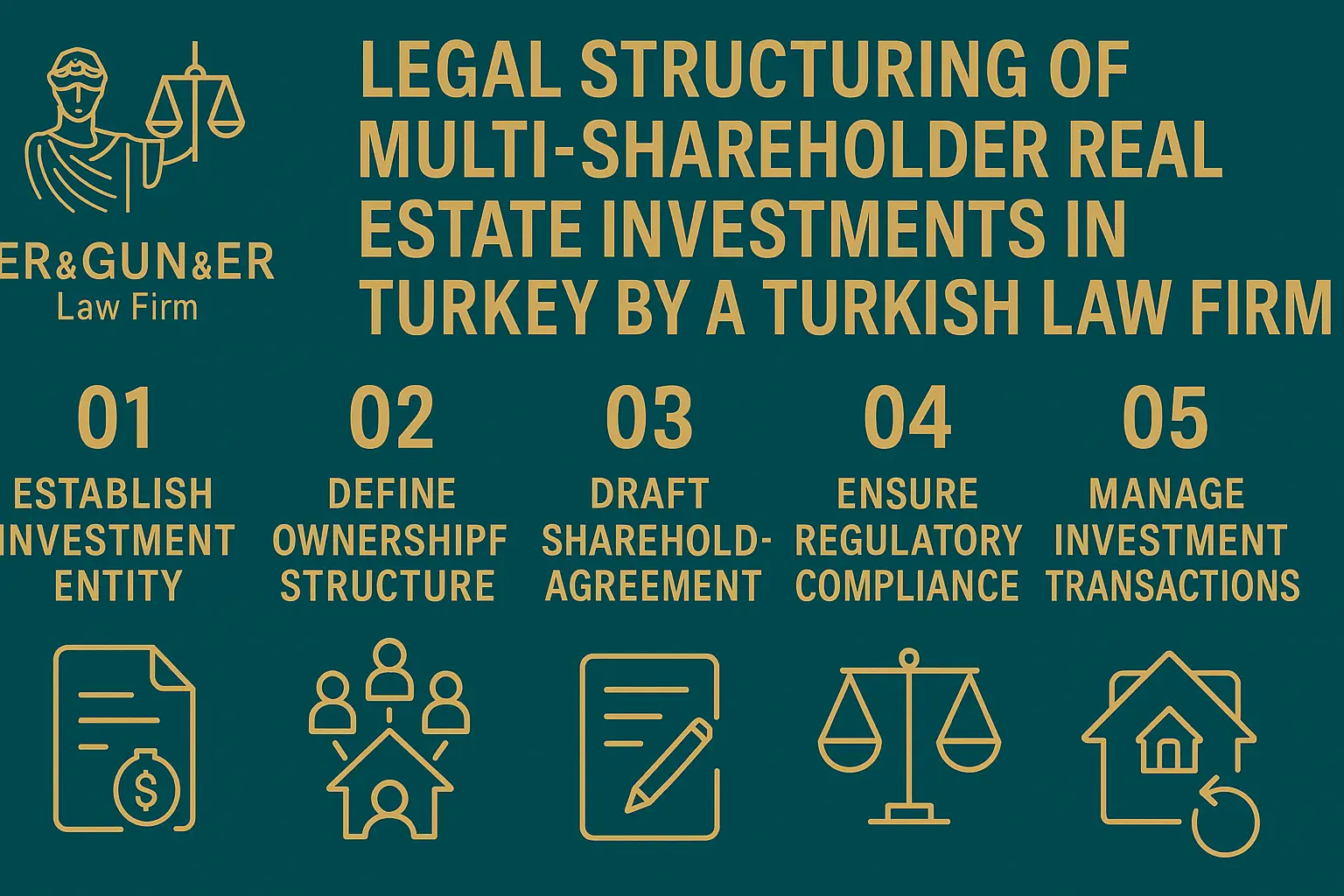
Multi-shareholder real estate investments in Turkey operate within an integrated legal framework combining the Turkish Civil Code No. 4721 Articles 683-703 co-ownership (paylı mülkiyet) and joint ownership (iştirak halinde mülkiyet) frameworks, Articles 732-735 statutory preemption right (yasal önalım), Condominium Law No. 634 (Kat Mülkiyeti Kanunu) governing multi-unit building ownership with management plan (yönetim planı) under Article 28 and unit owners assembly (kat malikleri kurulu) under Article 29, Land Registry Law No. 2644 Article 35 foreign natural person acquisition framework (reciprocity abolished by Law No. 6302 in 2012) and Article 36 foreign legal entity acquisition through Foreign Direct Investment Law No. 4875 coordination, Turkish Commercial Code No. 6102 investment vehicle framework including joint stock company (A.Ş.) under Articles 329-330 with share transfer under Articles 489-496, limited liability company (Ltd) under Articles 573-644 with quota transfer under Article 595, Turkish Obligations Code No. 6098 Articles 620-645 ordinary partnership (adi ortaklık) framework, Capital Markets Law No. 6362 Communiqué III-48.1 Real Estate Investment Trust (GYO) framework with Corporate Income Tax exemption for qualifying entities, Turkish Obligations Code Articles 299-378 lease framework with Article 344 rent increase cap based on 12-month TÜFE average and Articles 347-350 eviction grounds, Civil Code Articles 495-682 inheritance framework, MÖHUK Article 20 lex rei sitae principle for Turkish real estate inheritance regardless of nationality, Inheritance and Transfer Tax Law No. 7338, Income Tax Law No. 193 Article 80 and Supplementary Article 80 capital gains framework with 5-year holding period exemption, and other regulatory elements. A lawyer in Turkey coordinates the vehicle selection, documentation, governance, tax, and substantive legal elements determining multi-shareholder real estate investment outcomes. For framework on joint venture legal risk analysis, readers can consult our joint venture legal risk guide.
Statutory framework for multi-party real estate ownership
A Turkish Law Firm advising multi-shareholder real estate investors works from Civil Code Articles 683-703 framework governing multiple-party real estate ownership. Co-ownership (paylı mülkiyet) under Articles 688-700 permits multiple owners to hold fractional interests (pay) in undivided property — each co-owner has distinct fractional share (1/2, 1/3, other fractions) with rights including use, own-share disposition, and other rights subject to co-ownership management framework. Articles 689-690 co-ownership management permits administrative decisions by simple majority with specific decisions requiring unanimous consent — use allocation, improvements, other management elements. Article 691 extraordinary management covers major decisions requiring enhanced consent including alterations, asset dispositions. Article 698 sale of co-owned property requires unanimous consent absent specific exception — any single co-owner may effectively block sale. Joint ownership (iştirak halinde mülkiyet) under Articles 701-703 creates undivided ownership without fractional shares — typical examples include inheritance joint ownership pending partition, other statutory joint ownership situations. Joint ownership requires unanimous consent for major actions. Practice may vary by authority and year, and ownership form selection substantially affects ongoing management flexibility. Historical application of co-ownership in Turkish practice commonly appears in family inheritance situations where multiple heirs retain interest, investment partnerships where parties prefer simpler structure avoiding corporate vehicle overhead, and small-scale joint investment between specific investor groups. Documentation discipline for co-ownership includes specific apportionment of fractional interests recorded at Land Registry, written co-ownership agreement addressing management issues, periodic accounting for shared expenses and income, and other administrative elements. Judicial partition (taksim) remedy under Civil Code Articles 698-699 provides ultimate dispute resolution mechanism where co-owners cannot agree on continued joint ownership — court may order physical division where practicable, forced sale with proceeds distribution where physical division impractical.
Turkish lawyers who address statutory preemption rights work through Civil Code Articles 732-735 framework protecting co-owners against unwanted third-party ownership changes. Article 732 statutory preemption right (yasal önalım hakkı) provides existing co-owners with right to match third-party offer when another co-owner sells fractional share — preserves co-ownership composition. Preemption exercise period under Article 733 — 3 months from actual sale notification to co-owners, strict deadline with procedural requirements. Pricing under statutory preemption — existing co-owner must match actual sale price and material terms. Preemption exercise procedure — formal notification, deposit of purchase price, lawsuit filing within time limitation. Consequences of successful preemption — original third-party sale unwound, preemption-exercising co-owner substitutes into buyer position. Article 734 preemption waiver through express written agreement permits avoidance — common in commercial co-ownership arrangements with advance contractual planning. Practice may vary by authority and year, and preemption substantially affects co-ownership liquidity and disposition planning.
An Istanbul Law Firm addressing Condominium Law framework works through Law No. 634 (Kat Mülkiyeti Kanunu, 1965) governing multi-unit building ownership. Condominium ownership (kat mülkiyeti) creates combined unit-level individual ownership with proportionate shared ownership of common areas — each unit owner holds unit title plus fraction of common elements. Building-level management through management plan (yönetim planı) under Article 28 — comprehensive document specifying unit owner rights, common area use rules, maintenance responsibilities, registered with Land Registry and binding all unit owners. Unit owners assembly (kat malikleri kurulu) under Article 29 — periodic meetings making building-level decisions including management appointment, budget approval, significant repairs. Unit owner fees (aidat) allocation typically based on floor area share (arsa payı) with other allocation frameworks. Manager appointment through unit owners assembly with specific authority, dismissable through assembly decision. Multi-shareholder real estate investments frequently use condominium units — shares in SPVs holding individual units or direct co-ownership of individual units provide alternative structural approaches. For framework on condominium law for foreign landlords, readers can consult our condominium law framework. Practice may vary by authority and year, and condominium framework provides essential multi-unit building governance structure.
Investment vehicle selection framework
A lawyer in Turkey coordinating vehicle selection works through framework evaluating alternative structures for multi-shareholder real estate investment. Direct co-ownership under Civil Code Articles 683-703 — simplest structure with parties on title, no intermediate legal entity, no corporate tax layer, preemption rights automatic, limited governance flexibility, major decision unanimity requirements may create deadlocks. Ordinary partnership (adi ortaklık) under Obligations Code Articles 620-645 — non-corporate contractual arrangement, partners jointly liable, flexibility in management, no corporate income tax (pass-through), limited formation procedure. Joint stock company (A.Ş.) under TTK Articles 329-330 — robust corporate vehicle with limited liability, transferable shares facilitating ownership changes, sophisticated governance with board of directors and general assembly, share transfer through endorsement and share book under Articles 489-496, minimum capital TRY 250,000 under Presidential Decree No. 7887 (effective 1 January 2024) with Law No. 7511 transition through 31 December 2026. Limited liability company (Ltd) under TTK Articles 573-644 — more flexible than A.Ş. with smaller capital (TRY 50,000), quota transfer more complex under Article 595 (notarization, general assembly approval, Trade Registry registration), simpler governance with managers. Practice may vary by authority and year, and vehicle selection depends on investor number, investment size, governance complexity, tax optimization, and other factors.
Turkish lawyers who address GYO framework work through Capital Markets Law No. 6362 and Communiqué III-48.1 specialized framework for publicly-listed real estate investment vehicles. Gayrimenkul Yatırım Ortaklığı (GYO) establishes special-purpose joint stock company focused on real estate investment with specific regulatory framework. GYO advantages include: (a) Corporate Income Tax exemption under KVK Article 5(1)(d) for qualifying entities with at least 25% public float, (b) tax-efficient access to Turkish real estate market through publicly-listed shares, (c) professional management with regulatory oversight, (d) liquidity through stock exchange listing, (e) other regulatory benefits. GYO requirements include: (a) minimum paid-in capital TRY 100 million (current threshold), (b) at least 25% public float within specific period after establishment, (c) restricted investment scope (primarily Turkish real estate), (d) operational restrictions limiting activities outside core real estate, (e) other regulatory requirements. GYO suitability — appropriate for large-scale institutional investment with long-term horizon, not suitable for small private investment groups, extensive regulatory compliance requires specialized operational support. Alternative to GYO for qualifying investment vehicles includes Real Estate Investment Fund (GYF, gayrimenkul yatırım fonu) under specific framework — more flexible than GYO with different tax treatment and regulatory requirements. Practice may vary by authority and year, and GYO framework provides specialized vehicle for specific institutional investment profiles.
An English speaking lawyer in Turkey addressing vehicle selection decision criteria works through framework comparing alternatives for investor situations. Investor number analysis — 2-5 investors often suitable for direct co-ownership or ordinary partnership, 5-15 investors typically benefit from Ltd, 15+ investors or institutional participation supports A.Ş., public-market orientation suggests GYO consideration. Investment size affects vehicle economics — corporate vehicle formation and compliance costs proportionate at higher investment levels, smaller investments may bear disproportionate corporate overhead. Governance complexity — simple pass-through structure with unanimous decisions suits direct co-ownership, complex decision frameworks with supermajority voting and committee structures suit corporate vehicles. Liability protection need — direct co-ownership and ordinary partnership expose personal assets, corporate vehicles provide liability shield. Tax optimization — direct ownership permits direct personal tax treatment, corporate structures introduce corporate tax layer but may offer deductions, GYO provides exemption at qualifying conditions. Exit flexibility — corporate vehicles provide share transferability versus co-ownership requiring preemption navigation, public vehicles (GYO) provide maximum liquidity. For framework on company formation for real estate investment, readers can consult our company formation guide. Practice may vary by authority and year, and vehicle selection benefits from integrated analysis of investor needs and operational requirements.
Foreign investor participation framework
A Turkish Law Firm coordinating foreign investor participation works through framework addressing foreign buyer considerations in multi-shareholder structures. Land Registry Law No. 2644 Article 35 governs foreign natural person real property acquisition — foreigners may acquire Turkish property subject to sector restrictions (military zones, strategic areas) and area ceiling (30 hectares per individual foreigner with potential doubling through Council of Ministers permission). Law No. 6302 (18 May 2012) abolished reciprocity requirement under Article 35 — foreign nationals may acquire Turkish property regardless of home country reciprocity, subject to Council of Ministers country determinations. Foreign legal entity acquisition under Article 36 coordinates with Foreign Direct Investment Law No. 4875 framework — foreign companies establishing Turkish subsidiaries may acquire property through Turkish subsidiary subject to standard company framework. Direct foreign entity acquisition through Turkish branch or representative office may be available in circumstances with other requirements. Security zones and strategic areas require specific clearances for foreign acquisition — military zone designation restricts foreign ownership, other designations may require governmental approval. Practice may vary by authority and year, and foreign investor participation framework establishes baseline eligibility with restrictions in particular contexts.
Turkish lawyers who address Turkish acquisition vehicle structuring work through framework supporting foreign investor participation through Turkish intermediary entities. Turkish SPV approach — foreign investor establishes Turkish Ltd or A.Ş. specifically for real estate investment, Turkish SPV acquires property, foreign investor holds shares in Turkish SPV rather than direct property ownership. SPV advantages include: (a) simplifies multi-property portfolio with shared vehicle, (b) easier transfer through share transfer versus property transfer, (c) liability insulation of foreign investor from Turkish property-related liabilities, (d) tax efficiency through Turkish corporate structure, (e) other operational benefits. SPV considerations include: (a) corporate formation and maintenance costs, (b) Turkish corporate tax layer (23% current rate) absent exemption, (c) minimum capital requirements, (d) ongoing compliance and reporting obligations, (e) other operational burdens. Joint Turkish SPV for multiple foreign investors — multi-shareholder foreign investor group may share single Turkish SPV for economies of scale in formation, maintenance, and property management. Practice may vary by authority and year, and SPV structure selection benefits from integrated tax, legal, and operational analysis.
An Istanbul Law Firm addressing cross-border documentation works through framework supporting foreign investor onboarding. Turkish tax identification number (vergi kimlik numarası) requirement for all foreign investors — obtained through local tax office with passport documentation. Power of attorney (vekaletname) for Turkish representation when foreign investors cannot attend in person — scope definition critical, notarization and apostille authentication through Hague Convention 1961 framework (Turkey acceded 29 September 1985, Law No. 3028), consular legalization for non-Hague countries. Document authentication chain for foreign corporate documents — apostille or consular legalization, sworn Turkish translation by registered Turkish sworn translator, other authentication elements. AML compliance under MASAK Law No. 5549 — source-of-funds verification, UBO identification, other compliance elements. Residence and visa considerations for active investor participation — other considerations depending on planned Turkish presence. Real estate due diligence discipline prerequisite to foreign investor commitment — title verification, encumbrance analysis, zoning compliance, building permit review, tax clearance, and other pre-acquisition verification significantly reduces transaction risk and protects foreign investor interests. Due diligence typically requires 2-4 weeks for standard transactions, longer for complex properties with multiple units, commercial uses, or specific other complications. For framework on real estate due diligence for foreigners, readers can consult our real estate due diligence guide. For framework on legal residence through real estate purchase, readers can consult our residence through real estate purchase guide. Practice may vary by authority and year, and foreign investor onboarding typically adds 4-8 weeks to transaction timeline.
Shareholder agreement architecture for real estate investments
A lawyer in Turkey coordinating shareholder agreement drafting works through framework addressing real estate-specific multi-shareholder governance requirements. Reserved matters (saklı tutulan konular) framework specifies major decisions requiring qualified shareholder approval — real estate-reserved matters typically include property acquisition above specific threshold, property disposition, major capital expenditure or renovation, refinancing or mortgage decisions, rental strategy decisions (significant tenant matters, long-term lease execution), manager appointment and compensation, business plan modifications, and other major decisions. Supermajority voting requirements (75%, 80%, or 90%) for reserved matters provide effective minority protection while preserving majority flexibility on operational decisions. Board representation provisions specify minority board or committee representation — real estate investment vehicles often use compact board structures with shareholder-appointed members, observer rights, other representation mechanisms. Information rights enhance statutory Article 437 rights with real estate-elements — regular financial reporting, property performance metrics, tenant-related updates, capital expenditure reporting, other information provisions. Practice may vary by authority and year, and shareholder agreement architecture enhances baseline corporate framework with real estate-provisions.
Turkish lawyers who address transfer restrictions work through framework governing share ownership changes in real estate investment vehicles. Right of first refusal (ROFR) permits existing shareholders to match third-party offers — preserves investor composition. Tag-along rights (birlikte satış hakkı) protect minority by requiring purchaser acquiring majority position to offer same terms to minority — prevents majority control premium extraction. Drag-along rights (birlikte satış zorunluluğu) permit majority to compel minority participation in bulk sale at same pricing — supports majority exit while providing minority price parity. Put options at triggers (shareholder death, disability, default scenarios, strategic deadlock) provide exit certainty. Call options permit exit by remaining shareholders in circumstances. Real estate-exit triggers include property performance below thresholds, property disposition decisions, refinancing events triggering valuation, other events. Valuation methodology specification critical — typically market appraisal by independent valuer, possibly multiple valuer average, other methodologies. For framework on shareholder agreements generally, readers can consult our shareholder agreement guide. Practice may vary by authority and year, and transfer restriction architecture balances existing composition preservation with legitimate transition flexibility.
An English speaking lawyer in Turkey addressing capital contribution framework works through framework managing investment fund flows and ongoing capital needs. Initial capital contribution structure — contribution proportional to equity interests with other frameworks, payment timing coordination with property acquisition, escrow arrangements where appropriate. Additional capital calls (pay çağrısı) for ongoing operational or development needs — triggers, notice procedures, penalty provisions for non-contributing shareholders including dilution or interest charges. Shareholder loan framework providing flexibility without equity dilution — documentation, interest rates and terms, subordination arrangements where senior debt exists, repayment priority framework. External financing coordination — mortgage structuring with consent requirements for significant debt, guarantor arrangements with allocation, refinancing authority within shareholder agreement. Default framework for non-contributing shareholders — forced dilution, mandatory sale, forfeiture, other remedies. Capital structure protection through anti-dilution provisions — preemption rights for additional share issuance, other anti-dilution mechanisms. Practice may vary by authority and year, and capital contribution architecture balances operational flexibility with investor protection.
Capital contribution and financing framework
A Turkish Law Firm coordinating capital contribution architecture works through the framework managing investment fund flows across transaction and operational phases. Initial capital contribution structure typically proportional to equity interests — contribution amount reflects equity percentage, payment timing coordinated with property acquisition milestones, escrow arrangements where appropriate for staged contributions. Contribution methods vary across cash contribution (most common), in-kind contribution through specific asset transfer to vehicle, mixed contribution combining cash and in-kind elements. In-kind contribution valuation under TTK Article 343 and Article 579 requires independent expert valuation (bağımsız değerleme) for joint stock companies and limited liability companies with procedural requirements — over-valuation or under-valuation creates specific risks including shareholder liability. Capital call (pay çağrısı) framework for additional contributions — other triggers including operational needs, development costs, unexpected expenses, opportunity capital, and other scenarios, notice procedures with other formal requirements, penalty provisions for non-contributing shareholders. Shareholder loan (ortak kredisi) framework providing flexibility without equity dilution — other documentation, arm's-length interest rates typically required for tax purposes, subordination to senior debt arrangements, repayment priority framework among shareholders. Practice may vary by authority and year, and capital contribution architecture requires attention to balance operational flexibility with investor protection. Tax implications of capital contribution structure require integrated analysis — cash contributions create predictable basis for shareholders, in-kind contributions may trigger deemed dispositions with associated tax consequences for contributing shareholder, mixed contributions require apportionment for basis tracking. Foreign currency capital contributions for foreign investors typically converted to Turkish Lira at official exchange rate at contribution date — exchange rate documentation important for future basis tracking and capital structure verification. Bank account requirements for capital contributions — Turkish corporate vehicles require Turkish bank account for contribution receipt with anti-money laundering documentation, contribution from foreign investor accounts requires SWIFT documentation and source-of-funds verification.
Turkish lawyers who address external financing coordination work through the framework managing bank debt and other external capital sources. Mortgage financing structure — typical security package includes property mortgage (ipotek) under Civil Code Article 881, potential share pledge (hisse rehni) under Commercial Code framework, guarantor arrangements where required, other security elements. Multi-shareholder mortgage coordination — shareholder consent requirements for significant debt under reserved matters framework, guarantor allocation among shareholders (typically proportionate to equity), other coordination elements. Financing terms negotiation includes interest structure (fixed, variable, hybrid), maturity typically 10-20 years for residential investment property, loan-to-value (LTV) typically up to 60-70% for investment property with specific variations by property type, covenants restricting property use and operational decisions, default framework and foreclosure procedures. Refinancing authority within shareholder agreement — other consent requirements, refinancing triggers, execution authority allocation. Alternative financing sources include mezzanine debt, private equity co-investment, seller financing in circumstances, other financing alternatives. Capital structure protection through anti-dilution provisions — preemption rights for additional share issuance, valuation protections, other anti-dilution mechanisms. Practice may vary by authority and year, and financing coordination requires integrated attention across legal, commercial, and tax dimensions.
An English speaking lawyer in Turkey addressing default and recovery framework works through the framework managing financial difficulties and non-contributing shareholder scenarios. Non-contributing shareholder consequences under shareholder agreement — forced dilution through issue of additional shares to contributing shareholders, mandatory sale of non-contributing shareholder's interest at discount, forfeiture of specific rights, charging interest on overdue contributions, other remedies. Dilution calculation methodology for penalty dilution — predetermined formulas typically applying significant discount to non-contributing shareholder valuation, procedural protections ensuring fair process. Loan default scenarios for property-mortgaged investments — coordinated shareholder response to preserve collective interest, potential shareholder funding to cure default, restructuring negotiations with lender, sale strategy where cure unavailable, bankruptcy considerations in extreme scenarios. Guarantor liability allocation where shareholders have guaranteed loan — typically proportional to equity interest though other arrangements possible, contribution right among guarantors where one guarantor pays more than proportionate share. Cross-default considerations for multi-property portfolio — default on one property may trigger cross-default provisions affecting other properties, other coordination requirements. Emergency funding mechanisms for urgent capital needs — super-priority shareholder loans, other emergency funding structures, specific consent requirements for emergency actions. Practice may vary by authority and year, and default framework planning protects collective investment during financial stress.
Rental operations and property management governance
A Turkish Law Firm coordinating rental operations framework works through Turkish Obligations Code No. 6098 Articles 299-378 lease (kira sözleşmesi) framework governing multi-shareholder property leasing. Lease agreement form framework under Article 301 — written form preferred, content recommendations including rent amount, term, security deposit, specific operational elements. Article 344 rent increase cap for residential and workplace leases — annual rent increase limited to 12-month TÜFE (Consumer Price Index) average, specific formulas for specific lease categories. Articles 347-350 eviction grounds — tenant rental default, improper use, owner personal use requirement (with restrictions for residential), substantial refurbishment needs, other grounds with procedural requirements. Security deposit framework under Article 342 — maximum 3 months rent, restrictions on handling and return. Sublease (alt kira) provisions under Article 322 — tenant permitted to sublease with landlord consent in circumstances, specific subletting framework. Practice may vary by authority and year, and lease framework provides detailed statutory framework with substantial tenant protections requiring landlord discipline. Lease registration at Tapu Müdürlüğü under Article 312 — annotation of lease in Land Registry provides specific protections for tenant against subsequent purchasers, particularly relevant for long-term commercial leases. Lease term considerations — definite-term leases (belirli süreli) versus indefinite-term leases (belirsiz süreli) differ substantially in termination framework, eviction procedure, and tenant security. Workplace lease (işyeri kirası) under Articles 339-346 has distinct framework from residential lease with longer minimum terms, more restrictive termination rights for landlord, and other commercial tenant protections. Foreign tenant situations require additional attention — currency clauses, dispute resolution preferences, and other foreign-specific elements requiring tailored lease documentation.
Turkish lawyers who address property management structure work through framework allocating operational responsibility in multi-shareholder contexts. Professional property manager engagement — third-party management firm handling tenant relations, rent collection, maintenance typically more efficient than shareholder-managed operations. Management agreement (yönetim sözleşmesi) specifies manager responsibilities, compensation (typically percentage of gross rental income), performance standards, reporting obligations, termination rights, other framework. Shareholder oversight balances manager autonomy with investor control — reserved matters requiring shareholder consent include significant tenant matters, capital expenditure above threshold, property disposition, other major decisions. Manager reporting obligations include monthly financial reporting, quarterly performance reviews, annual comprehensive analysis. Fee structures vary — fixed fee, percentage of gross rental income (typically 5-10%), or hybrid structures. For framework on property management law specifically, readers can consult our property management law guide. Practice may vary by authority and year, and management structure selection affects operational efficiency throughout investment period.
An Istanbul Law Firm addressing condominium governance interaction works through framework managing multi-shareholder investment property within condominium building context. Condominium Law No. 634 unit owners assembly participation — shareholders in multi-shareholder investment vehicle must coordinate assembly participation, voting alignment, other building-level governance. Designation of assembly representative — single representative authorized to vote for investment vehicle's unit(s), clear internal authorization framework, other representation arrangements. Condominium fee (aidat) payment coordination — investment vehicle pays condominium fees as unit owner. Building-level decisions affecting investment property — repairs, renovations, service provider changes, management company selection, building financial decisions require shareholder coordination on assembly position. Conflicts between investment vehicle and other unit owners — coordinated legal approach where investment vehicle interests conflict with other unit owners or building management. Short-term rental restrictions in condominium context — restrictions under Condominium Law amendments and building-specific management plans affecting rental strategy. Insurance coordination — condominium insurance for shared elements complemented by investment-specific property insurance for investor-held unit. Practice may vary by authority and year, and condominium governance interaction requires attention given legal and practical complexity.
Taxation framework for multi-shareholder real estate
A lawyer in Turkey coordinating tax analysis works through framework addressing multi-shareholder real estate taxation across transaction, ongoing, and exit dimensions including federal-municipal coordination across multiple authorities with different deadlines and procedural requirements. Transaction taxation includes title transfer tax (tapu harcı) at 4% of declared value under Fees Law No. 492 typically split 2% buyer/2% seller, VAT under VAT Law No. 3065 depending on property type and transaction structure, stamp duty on transaction documents under Stamp Duty Law No. 488. VAT Law No. 3065 Article 17/4(r) exemption for qualifying property transactions including transfers of business as going concern, specific new-construction residential properties, and other exemption categories. Ongoing taxation includes rental income under Income Tax Law No. 193 — individual owners taxed at progressive rates with deductions, corporate owners taxed at 23% corporate income tax (current rate). Rental income deductions include expenses, depreciation, maintenance costs, other deductible expenses with documentation requirements. Property tax (emlak vergisi) under Real Estate Tax Law No. 1319 — annual tax based on property type and location with other allocation among shareholders. Environmental cleaning tax (çevre temizlik vergisi) and other municipal fees. Value Added Tax on rental operations where applicable — commercial rentals typically subject to VAT under other conditions, residential rentals typically exempt under Article 17/4(d). Social security (SGK) obligations where property employs personnel — relevant for larger investment properties with dedicated employees. Double taxation treaty analysis for foreign shareholders receiving distributions or capital gains through Turkish investment vehicle — treaty-reduced withholding rates supported by Turkish Residence Certificate (Mukim Belgesi) obtained from Turkish Revenue Administration. Estate tax planning coordination with home country estate tax rules — specific jurisdictions impose estate tax on worldwide assets of citizens or domiciliaries affecting Turkish investment treatment. For framework on real estate investment funds specifically as alternative investment structure, readers can consult our real estate investment funds guide. Practice may vary by authority and year, and tax planning benefits from integrated analysis across transaction, ongoing, and exit phases.
Turkish lawyers who address capital gains and exit taxation work through framework managing investment realization tax consequences. Individual owner capital gains under Income Tax Law No. 193 Article 80 and Supplementary Article 80 — 5-year holding period exemption provides significant tax benefit, properties held less than 5 years subject to capital gains taxation at progressive rates. Corporate owner capital gains — fully taxable at corporate rate absent exemption, 75% participation exemption under KVK Article 5(1)(e) may apply to gains from qualifying participation dispositions. GYO exemption regime — qualifying GYO entities receive corporate tax exemption providing structural advantage for qualifying vehicles. Deemed capital gains through share transfer — transfer of shares in real estate holding company may trigger deemed property transfer tax consequences in circumstances, requiring careful structuring. Inheritance taxation under Inheritance and Transfer Tax Law No. 7338 graduated rates 1-10% applying to inherited property interests including shares in real estate holding entities. Gift taxation at higher rates (10-30%) discourages lifetime gift strategies without tax planning. Double taxation treaty analysis for foreign shareholders — specific treaties may reduce withholding tax on dividend distributions, other elements depending on treaty terms. Practice may vary by authority and year, and exit tax planning requires attention to structure to minimize tax friction on investment realization.
An English speaking lawyer in Turkey addressing tax structuring strategies works through framework optimizing tax outcomes across investment life cycle. Holding period planning to leverage 5-year individual exemption — timing exit to achieve exemption where feasible, structuring interim transactions to preserve exemption eligibility. Corporate structure selection for tax efficiency — direct ownership versus corporate holding considerations, Turkish corporate structure versus foreign holding entity analysis, GYO qualification analysis for larger investments. Dividend versus capital gain characterization — distributions versus exit structuring affects tax treatment with specific implications depending on investor tax profile. Loss utilization planning — operational losses carried forward under Corporate Income Tax framework, utilization against future gains, other loss utilization elements. Tax residence planning for foreign shareholders — Turkish tax residence triggers with specific global tax implications, non-resident taxation framework limitations. Transfer pricing compliance for intra-group transactions where multi-shareholder structure involves affiliated parties — documentation requirements under KVK Article 13. Inheritance tax planning through timing, structure, and elements reducing inheritance tax exposure. Practice may vary by authority and year, and tax strategy benefits from coordinated Turkish and home-country advisor engagement.
Inheritance coordination and succession planning
A Turkish Law Firm coordinating inheritance planning works through integrated framework addressing succession of real estate investment interests. Turkish Civil Code Articles 495-682 inheritance framework governs Turkish-situated real estate regardless of shareholder nationality under MÖHUK Article 20 lex rei sitae principle. Articles 495-501 statutory succession framework identifies legal heirs with specific hierarchy — descendants, spouse, parents, grandparents, other relatives depending on family situation. Forced heirship (saklı pay) under Articles 506-508 protects heir categories — descendants (1/2 of legal share), spouse (1/4 with descendants, 1/2 without), parents (1/4 where applicable) — applies to Turkish real estate regardless of foreign will contents under lex rei sitae framework. Articles 605-610 disclaimer of inheritance (reddi miras) within strict 3-month period permits heir to reject inheritance. Inheritance certificate (mirasçılık belgesi) under Article 598 through Peace Civil Court (Sulh Hukuk Mahkemesi) or notary provides foundational heir identification. Inheritance Tax under Law No. 7338 graduated rates 1-10% with declaration deadlines (4 months for deaths in Turkey, 6 months for deaths abroad) and installment payment over 3 years in 6 semi-annual installments due in May and November each year. Practice may vary by authority and year, and inheritance coordination addresses fundamental succession considerations for multi-generational real estate investment. Cross-border inheritance complications for foreign shareholders — multiple jurisdictions may claim taxation rights over deceased shareholder estate, requiring treaty analysis and integrated estate planning. Inheritance certificate (mirasçılık belgesi) procurement for foreign heirs — typically obtained through Sulh Hukuk Mahkemesi (Peace Civil Court) for foreign-related estates, notary procedure available for purely Turkish citizen estates. Documentation requirements include death certificate (with apostille for foreign deaths), heir identification documentation, family relationship evidence, and other supporting documents. Translation requirements for foreign-language documents through sworn Turkish translator. Practical timeline for foreign-related inheritance certificate obtainment typically 4-12 weeks depending on documentation completeness and court workload.
Turkish lawyers who address shareholder agreement succession planning work through framework coordinating corporate succession with inheritance framework. Shareholder agreement succession provisions address share disposition upon shareholder death — typical provisions include: (a) mandatory purchase by surviving shareholders at valuation, (b) mandatory offer to surviving shareholders with right of refusal, (c) permitted transfer to heir categories with restrictions, (d) combination of alternatives depending on circumstances. Valuation methodology for death-triggered transactions — predetermined formula, independent appraisal, other framework — requires advance planning given urgent execution context. Life insurance funding for buyout obligations — insurance proceeds fund surviving shareholder purchase of deceased shareholder's interest, requires policy coordination and premium allocation framework. Succession through specific family structures — family trusts (limited application in Turkish law context), family limited partnerships, other structures with specific legal and tax implications. Cross-border inheritance coordination for foreign shareholders — home country estate planning coordination with Turkish legal framework, potential MÖHUK Article 50 tenfiz procedures for foreign inheritance decisions affecting Turkish assets. For framework on property inheritance laws specifically, readers can consult our property inheritance laws guide. Practice may vary by authority and year, and succession planning integration with shareholder framework is foundational for multi-generational real estate investment.
An Istanbul Law Firm addressing exit and dispute resolution framework works through integrated framework managing investment wind-down scenarios. Voluntary exit through ROFR, tag-along, drag-along, and put/call mechanisms under shareholder agreement. Deadlock resolution mechanisms for shareholder disagreement unable to resolve — buy-sell provisions (Texas shootout or similar), forced sale of entire property with proceeds distribution, mandatory mediation, other resolution frameworks. Just cause dissolution action under TTK Article 531 available for qualified minority (10% closed company, 5% listed) — court may order alternative remedies including minority buyout at fair value as alternative to company dissolution. Dispute resolution typically arbitration through ISTAC, ICC, or other institution under International Arbitration Law No. 4686 (MTK) with Turkish court residual jurisdiction for specific matters including urgent injunctions. Property disposition through sale — coordinated marketing, acceptance of buyer offers requiring shareholder approval under reserved matters framework, closing execution and proceeds distribution. Liquidation through corporate vehicle dissolution — satisfaction of corporate obligations, asset distribution to shareholders, other wind-down elements. Practice may vary by authority and year, and exit framework requires attention to preserve investment value and minimize dispute during realization. Tax-efficient exit structuring requires advance planning — share transfer versus asset transfer treatment differs substantially with different tax consequences for selling and remaining shareholders. Distribution-versus-sale characterization affects shareholder treatment with different tax outcomes depending on shareholder profile and applicable tax framework. Liquidity timing coordination across multiple shareholders with different exit timing preferences — staggered exit mechanisms, partial liquidity events, and other coordination structures provide flexibility. Post-exit dispute resolution mechanisms — final accounting procedures, escrow arrangements for contingent liabilities, indemnification frameworks for representations and warranties, and other post-closing protections preserve investor relationships and protect collective value through transition.
Author: Mirkan Topcu is an attorney registered with the Istanbul Bar Association (Istanbul 1st Bar), Bar Registration No: 67874. His practice focuses on cross-border and high-stakes matters where evidence discipline, procedural accuracy, and risk control are decisive, with particular concentration on multi-shareholder real estate investments in Turkey across the integrated legal framework combining Turkish Civil Code No. 4721 Articles 683-703 co-ownership (paylı mülkiyet) and joint ownership (iştirak halinde mülkiyet) frameworks with Articles 688-700 co-ownership management including simple majority and unanimous consent requirements, Article 698 unanimous consent for sale, Articles 701-703 joint ownership framework, Articles 732-735 statutory preemption right (yasal önalım) with 3-month exercise period under Article 733 and Article 734 waiver capability, Civil Code Articles 495-682 inheritance framework with Articles 506-508 forced heirship (saklı pay) applying to Turkish real estate under lex rei sitae, Articles 605-610 disclaimer of inheritance, Article 598 inheritance certificate (mirasçılık belgesi), Article 531 just cause dissolution action for qualified minority, Condominium Law No. 634 (Kat Mülkiyeti Kanunu) with Article 28 management plan and Article 29 unit owners assembly, Land Registry Law No. 2644 Article 35 foreign natural person acquisition framework with Law No. 6302 (18 May 2012) reciprocity abolition and 30-hectare ceiling, Article 36 foreign legal entity acquisition through Foreign Direct Investment Law No. 4875 framework, Turkish Commercial Code No. 6102 investment vehicle framework including Articles 329-330 joint stock company with Articles 489-496 share transfer, Articles 573-644 limited liability company with Article 595 quota transfer, Turkish Obligations Code No. 6098 Articles 620-645 ordinary partnership framework, Presidential Decree No. 7887 minimum capital (A.Ş. TRY 250,000, Ltd. TRY 50,000 effective 1 January 2024) with Law No. 7511 transition through 31 December 2026, Capital Markets Law No. 6362 Communiqué III-48.1 Real Estate Investment Trust (GYO) framework with Corporate Income Tax Article 5(1)(d) exemption for qualifying entities, Turkish Obligations Code Articles 299-378 lease framework with Article 344 rent increase cap based on 12-month TÜFE average and Articles 347-350 eviction grounds, Article 342 security deposit 3-month maximum, MÖHUK Private International Law No. 5718 Article 20 lex rei sitae principle, Article 50 tenfiz framework for foreign inheritance judgment recognition, Inheritance and Transfer Tax Law No. 7338 graduated rates 1-10%, Income Tax Law No. 193 Article 80 and Supplementary Article 80 capital gains framework with 5-year holding period exemption for individual owners, Corporate Income Tax Law No. 5520 Article 5(1)(e) 75% participation exemption, Fees Law No. 492 title transfer tax 4% framework, VAT Law No. 3065 Article 17/4(r) exemption framework, MASAK Law No. 5549 anti-money laundering framework, KVKK No. 6698 data protection, Hague Apostille Convention 1961 (Turkey acceded 29 September 1985, Law No. 3028), International Arbitration Law No. 4686 (MTK) for dispute resolution through ISTAC, ICC, LCIA, or SIAC.
He advises multi-shareholder real estate investors on integrated strategy from initial vehicle selection through exit, investment vehicle analysis across direct co-ownership, ordinary partnership, Ltd company, A.Ş. company, and GYO alternatives based on investor number, investment size, governance complexity, liability protection, tax optimization, and exit flexibility criteria, foreign investor participation structuring including Turkish SPV approach versus direct participation, Land Registry Article 35 compliance analysis for foreign natural person acquisition and Article 36 framework for foreign legal entity acquisition, shareholder agreement architecture with real estate-reserved matters, board composition, information rights, transfer restrictions including ROFR, tag-along, drag-along, put/call options with real estate-triggers, capital contribution and financing framework including initial contributions, additional capital calls, shareholder loan arrangements, external financing coordination, default frameworks for non-contributing shareholders, rental operations framework under Turkish Obligations Code including lease structuring with Article 344 TÜFE-based rent increase compliance, property management arrangements with professional managers, Condominium Law governance coordination, taxation framework across transaction, ongoing, and exit phases with strategic optimization, inheritance coordination including forced heirship analysis for Turkish real estate, shareholder agreement succession provisions, cross-border inheritance coordination for foreign shareholders, and dispute resolution through arbitration and court frameworks. His practice spans Commercial and Corporate Law, Commercial Contracts, Foreign Investment, Data Protection and Privacy, Intellectual Property, Arbitration and Dispute Resolution, Enforcement and Insolvency, Citizenship and Immigration, Real Estate including multi-shareholder and joint venture structures, International Tax, International Trade, Foreigners Law, Sports Law, Health Law, and Criminal Law.
Education: Istanbul University Faculty of Law (2018); Galatasaray University, LL.M. (2022). LinkedIn: Profile. Istanbul Bar Association: Official website.
Frequently asked questions
- What are the main investment vehicles for multi-shareholder real estate in Turkey? Primary alternatives include direct co-ownership (paylı mülkiyet) under Civil Code Articles 683-703, ordinary partnership (adi ortaklık) under Obligations Code Articles 620-645, limited liability company (Ltd) under TTK Articles 573-644, joint stock company (A.Ş.) under TTK Articles 329-330, and Real Estate Investment Trust (GYO) under Capital Markets Communiqué III-48.1.
- What is statutory preemption in co-ownership? Under Civil Code Article 732, existing co-owners have statutory preemption right (yasal önalım hakkı) to match third-party offers when another co-owner sells fractional share. Article 733 establishes 3-month exercise period from sale notification. Article 734 permits waiver through express written agreement.
- Can foreigners participate as multi-shareholders in Turkish real estate? Yes. Land Registry Law Article 35 permits foreign natural person acquisition with reciprocity abolished by Law No. 6302 in 2012 and 30-hectare individual ceiling. Article 36 governs foreign legal entity acquisition through Foreign Direct Investment Law No. 4875 framework.
- What is GYO and when is it suitable? GYO (Gayrimenkul Yatırım Ortaklığı / Real Estate Investment Trust) under Capital Markets Communiqué III-48.1 is publicly-listed real estate investment vehicle with Corporate Income Tax exemption under Article 5(1)(d) for qualifying entities. Suitable for large-scale institutional investment with minimum capital (currently TRY 100M+) and 25% public float requirement.
- How does condominium governance interact with multi-shareholder investment? Condominium Law No. 634 creates building-level governance through management plan (yönetim planı) under Article 28 and unit owners assembly (kat malikleri kurulu) under Article 29. Multi-shareholder investment vehicle must coordinate assembly participation and voting through designated representative with clear internal authorization.
- What rental law framework applies to investment properties? Turkish Obligations Code Articles 299-378 govern lease. Article 344 caps annual rent increase at 12-month TÜFE (Consumer Price Index) average for residential and workplace leases. Articles 347-350 specify eviction grounds. Article 342 limits security deposit to 3 months rent.
- What capital gains tax applies to individual owner property sale? Under Income Tax Law No. 193 Article 80 and Supplementary Article 80, individual owner property sale after 5-year holding period is exempt from capital gains taxation. Sales within 5-year period subject to capital gains at progressive rates with specific framework.
- How does forced heirship apply to multi-shareholder real estate? Turkish Civil Code Articles 506-508 forced heirship (saklı pay) protects descendants (1/2 of legal share), spouse (1/4 with descendants, 1/2 without), and parents (1/4 where applicable). Applies to Turkish real estate regardless of foreign shareholder nationality or foreign will contents under MÖHUK Article 20 lex rei sitae principle.
- What minimum capital applies for Turkish real estate company vehicles? Under Presidential Decree No. 7887 (effective 1 January 2024), joint stock company (A.Ş.) minimum capital is TRY 250,000, limited liability company (Ltd) minimum capital is TRY 50,000. Law No. 7511 (29 May 2024) provides transition through 31 December 2026 for existing companies.
- What closing costs apply to multi-shareholder real estate acquisition? Title transfer tax (tapu harcı) at 4% of declared value under Fees Law No. 492, typically split 2% buyer/2% seller. VAT under circumstances depending on property and transaction type with Article 17/4(r) exemptions available for qualifying transactions. Stamp duty on transaction documents under Stamp Duty Law No. 488.
- How are shareholder agreements enforced for real estate investments? Turkish Obligations Code framework governs enforcement. Specific performance available where damages inadequate. Liquidated damages (cezai şart) enforceable subject to restrictions on excessive amounts. Arbitration through ISTAC, ICC, or other institutions common for dispute resolution. Provisional injunctions under HMK Articles 389-399 available for urgent enforcement.
- Can disclaimer of inheritance affect multi-shareholder succession? Yes. Civil Code Articles 605-610 permit heir to disclaim inheritance within 3-month period of knowledge — affects succession to deceased shareholder interests in multi-shareholder real estate. Shareholder agreements should anticipate potential disclaimer scenarios with alternative succession mechanisms.
- What role does shareholder agreement play in exit coordination? Shareholder agreements typically specify exit mechanisms including ROFR (right of first refusal), tag-along rights, drag-along rights, put/call options, and deadlock resolution procedures. Real estate-triggers often include property performance thresholds, major refinancing events, and specific strategic decisions.
- How do investment vehicles affect inheritance tax? Direct co-ownership inheritance subjects heir to property value-based inheritance tax under Law No. 7338 (1-10% graduated rate). Corporate vehicle shares subject to same inheritance tax on share value. GYO public shares may have different market-based valuation. Planning across vehicle types affects inheritance tax exposure.
- How does ER&GUN&ER Law Firm structure multi-shareholder real estate engagements? Engagements begin with investor assessment covering number, investment size, governance preferences, and exit expectations, proceed through vehicle selection analysis across alternatives, property acquisition coordination with due diligence and closing, shareholder agreement drafting with real estate-provisions, operational support including rental management and condominium governance coordination, tax structuring for transaction, ongoing, and exit phases, inheritance and succession planning, and exit coordination with dispute resolution support where needed.