

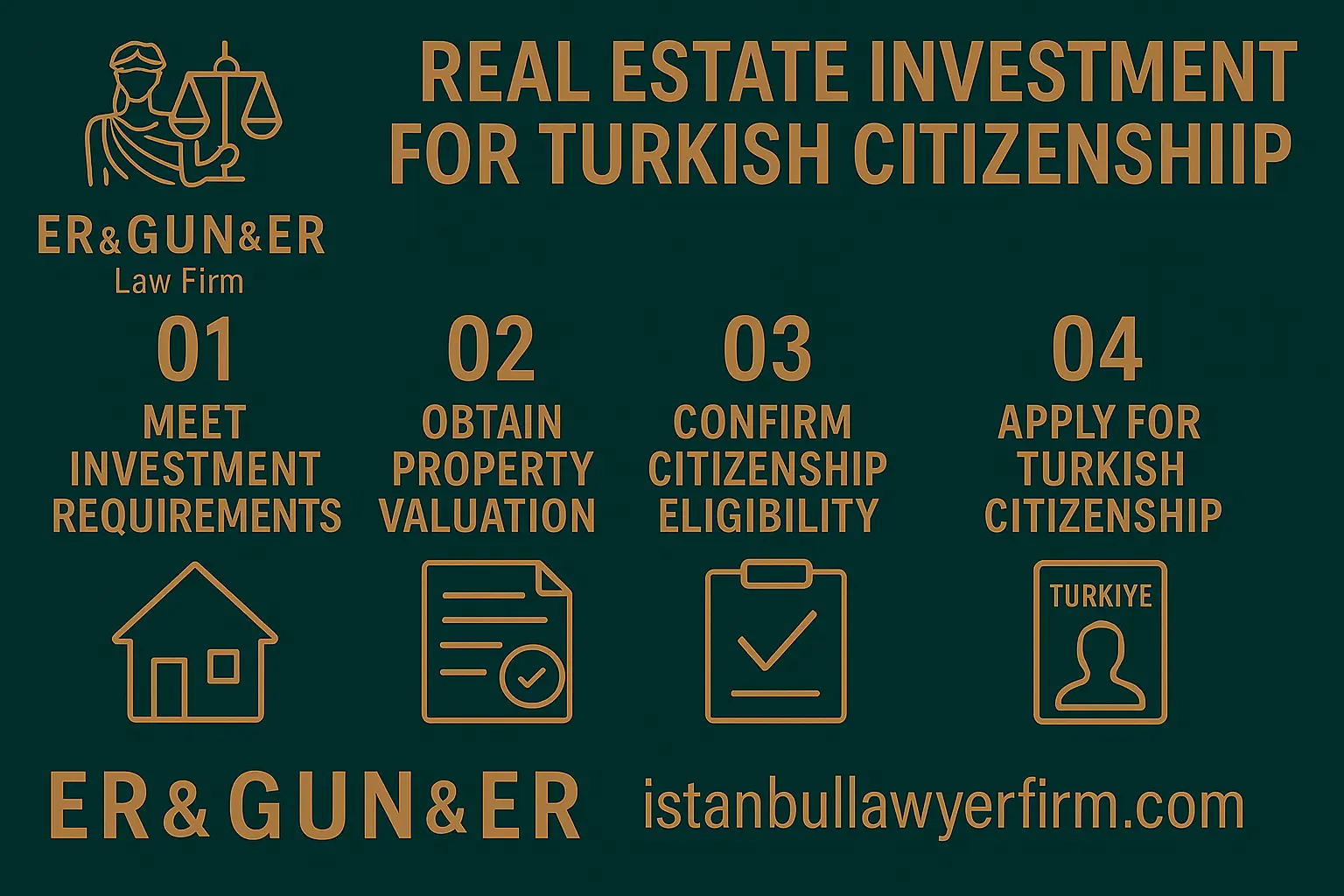
Turkish citizenship by real estate investment operates as one of several investment-based naturalization pathways under Turkish law, with specific procedural requirements distinguishing it from both the broader naturalization framework and the alternative investment categories (capital deposit, government bonds, fund participation, and others). The framework that governs the relevant legal questions is set primarily by the Türk Vatandaşlığı Kanunu (Law No. 5901, the Turkish Citizenship Law) governing the substantive citizenship rules; the Türk Vatandaşlığı Kanunu Uygulama Yönetmeliği (Implementing Regulation) m.20 governing the investment-based citizenship pathway including the real estate investment subcategory; the Tapu Kanunu (Law No. 2644) and its Law No. 6302 amendments governing the underlying real estate acquisition; the Türk Medeni Kanunu (Law No. 4721) governing property rights; the Bakanlar Kurulu Kararı dated 13 June 2022 increasing the qualifying real estate investment threshold from $250,000 to $400,000; Decree No. 32 (Türk Parasının Kıymetini Koruma Hakkında Karar) governing currency-related transaction requirements; SPK Communiqué III-62.1 governing the SPK-licensed gayrimenkul değerleme şirketi (real estate appraisal company) framework; and the Yabancılar ve Uluslararası Koruma Kanunu (Law No. 6458) governing residence permits coordinating with the citizenship pathway. Practice may vary by authority and year.
An English speaking lawyer in Turkey advising international applicants on the Turkish citizenship-by-investment pathway through real estate will explain that the procedural architecture has stabilized substantially since the 2017-2018 launch period, with current practice operating through structured procedural workflows that experienced advisors can navigate predictably. The body of this guide walks through the legal framework architecture covering the $400,000 threshold and qualification requirements, the application procedure through the conformity certificate (uygunluk belgesi) process at the Çevre Şehircilik ve İklim Değişikliği Bakanlığı and the citizenship workflow through the Nüfus ve Vatandaşlık İşleri Genel Müdürlüğü (NVİGM) with final Cumhurbaşkanlığı Kararı, the investment structuring with the three-year non-resale annotation discipline at the Tapu Müdürlüğü, the tax architecture covering Tapu Harcı and capital gains coordination, the risk management discipline covering pre-acquisition diligence and post-acquisition compliance, the multi-asset portfolio strategy supporting threshold aggregation, the family member inclusion architecture under TVK m.12, and the constitutional (AYM) and international (AİHM) rights safeguards available where application denials warrant subsequent review. For procedural orientation on adjacent topics, our notes on Turkish citizenship by investment, real estate due diligence for foreigners and inheritance disputes for foreign heirs can be read alongside this material.
1) Legal Framework: $400,000 Threshold under Türk Vatandaşlığı Kanunu Uygulama Yönetmeliği
A lawyer in Turkey advising on the legal framework will explain that the citizenship-by-real-estate-investment pathway operates under the Türk Vatandaşlığı Kanunu Uygulama Yönetmeliği m.20 framework, which establishes the qualifying conditions, documentary requirements and procedural workflow. The procedure ordinarily requires the qualifying investment to be a real estate acquisition meeting the $400,000 (USD) minimum value as established by the Bakanlar Kurulu Kararı dated 13 June 2022 (the threshold was previously $250,000 from the framework's launch through 12 June 2022); the value to be confirmed by an SPK-licensed gayrimenkul değerleme şirketi through the regulated appraisal framework supporting both the citizenship qualification and the broader regulatory compliance; the foreign-currency conversion to be executed through a Turkish bank generating the Döviz Alım Belgesi (DAB) documenting the foreign-currency-to-Turkish-lira conversion at the prevailing exchange rate; the Turkish-lira purchase consideration to be paid to the seller through traceable banking channels; and the property to be acquired in the qualifying applicant's individual name with full title transfer.
An Istanbul Law Firm advising on the threshold-and-aggregation framework will note that the $400,000 minimum can be satisfied through either single-property acquisitions or multi-property portfolios where the aggregate value meets the threshold, with specific procedural requirements applying to each approach. The procedure ordinarily considers single-property acquisitions as the operationally simpler route requiring only one property's diligence, appraisal and registration; multi-property aggregation as the more flexible route allowing distribution across multiple geographies, property categories and price points but requiring coordinated procedural handling of multiple properties under unified citizenship documentation. The standard approach treats the threshold as a minimum rather than a target, with experienced applicants typically pursuing acquisitions at meaningful margin above the threshold to provide protection against any subsequent valuation adjustment that could otherwise create qualification risk if the appraised value falls below the strict threshold. The valuation-margin discipline reflects the practical reality that real estate appraisals operate within reasonable ranges rather than at precise points, with the resulting potential for the SPK-licensed appraiser to issue a value either above or below the precise threshold depending on the methodology, comparable transactions and market conditions at the appraisal date. Conservative threshold planning targeting acquisitions at fifteen to twenty percent margin above the strict $400,000 threshold substantially reduces the qualification risk from valuation variability while operating within the broader investment strategy parameters. The standard approach also coordinates the appraisal timing with the broader transaction sequence to ensure the appraisal date and the title transfer date align with the regulatory framework's documentary requirements rather than producing temporal disconnects that complicate subsequent procedural steps.
A Turkish Law Firm advising on the qualifying property characteristics will note that not every real estate acquisition qualifies for the citizenship pathway, with specific characteristics affecting eligibility. The procedure ordinarily requires the property to be free of disqualifying encumbrances at the time of acquisition; the property's title to be transferred properly with the qualifying applicant as the registered owner; the property's value to be supported by the SPK-licensed appraisal at or above the $400,000 threshold (using prevailing exchange rates for the USD-to-Turkish-lira conversion calculation); the property's location and category to satisfy the qualifying-property requirements; the foreign-currency-to-Turkish-lira conversion to be properly documented through the Döviz Alım Belgesi chain; and the broader transaction documentation to support the conformity certificate application that the Çevre Şehircilik ve İklim Değişikliği Bakanlığı will subsequently issue. The discipline outlined in our note on Turkish citizenship by investment covers the broader citizenship architecture. Practice may vary by authority and year. The qualifying-property characteristic detail deserves separate operational attention because not every Turkish real estate acquisition automatically qualifies for the citizenship pathway, with specific structural and procedural attributes affecting eligibility. The procedure ordinarily requires the property to be sold by a Turkish citizen seller (or by a Turkish company under specific circumstances) rather than by another foreign national, because the framework's underlying policy intent is to channel foreign currency into the Turkish economy through transactions with Turkish-side counterparties; the property's title to be free of disqualifying encumbrances at acquisition with any pre-acquisition encumbrances cleared as part of the transaction; the property to have valid construction permits and occupancy certifications where applicable; the property's transfer to be supported by the appropriate documentary chain including the satış vaadi sözleşmesi (where applicable for off-plan acquisitions), the principal Tapu transfer documentation, and the supporting transactional documentation that the conformity certificate application will subsequently rely on.
For the full procedural framework on the qualifying investment routes and the institutional review architecture at the Vatandaşlık Daireleri, see our pillar guide on turkish citizenship by investment.
2) Application Procedure: Conformity Certificate, Çevre Şehircilik Bakanlığı and NVİGM Workflow
An English speaking lawyer in Turkey advising on the application procedure will explain that the Turkish citizenship-by-real-estate-investment workflow operates through several coordinated steps involving multiple Turkish authorities, with the procedural sequence and timing affecting both the application's success probability and the overall timeline. The procedure ordinarily begins with the property acquisition completion at the Tapu Müdürlüğü with the title transfer, the three-year non-resale annotation registration (üç yıl satılmayacaktır şerhi), and the documentary chain assembly supporting subsequent application steps; continues with the conformity certificate (uygunluk belgesi) application through the Çevre Şehircilik ve İklim Değişikliği Bakanlığı confirming the property meets the qualifying investment requirements; proceeds to the citizenship application submission to the Nüfus ve Vatandaşlık İşleri Genel Müdürlüğü (NVİGM) with the conformity certificate and supporting documentation; and culminates in the final Cumhurbaşkanlığı Kararı (Presidential Decree) granting Turkish citizenship to the qualifying applicant. The procedural sequence operates as a structured pipeline rather than as parallel tracks, with each step's completion supporting the next step's initiation, and with disciplined documentary preparation at each stage materially affecting the overall application's processing efficiency. Procedural shortcuts or attempts to bypass sequential steps typically produce processing delays rather than acceleration.
A lawyer in Turkey advising on the documentary chain assembly will note that the application package requires structured documentation covering each procedural element, with the documentary discipline directly affecting the application's processing efficiency. The procedure ordinarily requires the property documentation including the new Tapu (title deed) issued in the applicant's name, the SPK-licensed appraisal report supporting the qualifying value, the Döviz Alım Belgesi documenting the foreign-currency conversion, and the underlying purchase contracts and payment documentation; the applicant identification documentation including passport copies, biometric photographs, and birth certificates with apostille legalization where required; the family member documentation where family inclusion is sought (spouse marriage certificate, children's birth certificates, dependency proofs where applicable); the criminal background documentation including police certificates from the applicant's country of nationality and any country of long-term residence; and the broader supporting documentation covering address registration, tax identification, and any other category-specific requirements.
A Turkish Law Firm advising on the inter-authority coordination will note that the citizenship application requires structured coordination across multiple authorities with specific functional responsibilities. The procedure ordinarily involves the Tapu Müdürlüğü for property registration and the three-year annotation; the SPK-licensed gayrimenkul değerleme şirketi for the qualifying appraisal under SPK Communiqué III-62.1; the relevant Turkish bank for foreign-currency conversion and the Döviz Alım Belgesi issuance; the Çevre Şehircilik ve İklim Değişikliği Bakanlığı for the conformity certificate (uygunluk belgesi) confirming property qualification; the NVİGM for the citizenship application processing including documentary review, security checks coordinated with relevant authorities, and the substantive evaluation of the application; and the Cumhurbaşkanlığı for the final granting decision through Cumhurbaşkanlığı Kararı. The standard approach is to coordinate the procedural workflow through experienced counsel who can manage the inter-authority handoffs rather than attempting independent navigation that frequently produces avoidable procedural delays. Practice may vary by authority and year. The NVİGM processing dimension deserves separate operational attention because the citizenship application's substantive review combines documentary verification, security clearance coordination and broader application evaluation through structured review processes. The procedure ordinarily involves NVİGM's documentary verification confirming completeness and authenticity of the application package; security clearance coordination through relevant Turkish authorities including the Emniyet Genel Müdürlüğü (General Directorate of Security) and other security-related bodies as appropriate; verification of the applicant's broader background including any prior Turkish residence history, any prior Turkish-related applications or proceedings, and any other relevant personal history; substantive evaluation of the application's compliance with the Türk Vatandaşlığı Kanunu Uygulama Yönetmeliği framework; and preparation of the file for the Cumhurbaşkanlığı Kararı stage where the final granting decision occurs. The structured review process supports both individual application processing efficiency and the broader integrity of the citizenship pathway.
3) Investment Structuring, Three-Year Annotation and Holding Period Discipline
An Istanbul Law Firm advising on investment structuring for the citizenship pathway will note that the structural choice substantially affects both the application's qualification analysis and the post-citizenship asset management framework. The procedure ordinarily requires the qualifying investment to be held in the applicant's individual name for the citizenship qualification, with corporate ownership structures generally not supporting the direct citizenship pathway (alternative investment categories may have different structural treatments, but the real estate route specifically operates through individual ownership). The standard approach considers the qualifying property as the citizenship-qualifying asset held in the applicant's individual name during the three-year holding period, with broader portfolio assets held through whatever ownership structures the applicant's investment strategy supports separately from the citizenship-qualifying property. The structural separation between the citizenship-qualifying property (individual ownership) and broader portfolio assets (potentially corporate ownership) reflects the citizenship framework's underlying policy intent of channeling foreign-currency investment through identifiable individual investors rather than through corporate intermediaries that could obscure the underlying beneficial-ownership chain. Applicants whose broader investment strategy involves substantial Turkish corporate-owned real estate can pursue both the citizenship-qualifying individually-owned property and the broader portfolio in parallel rather than viewing them as alternatives.
A lawyer in Turkey advising on the three-year annotation discipline will explain that the three-year non-resale commitment operates through a specific Tapu annotation registered at the time of the property's transfer, with the annotation creating both procedural and substantive constraints during the holding period. The procedure ordinarily registers the annotation as üç yıl satılmayacaktır şerhi (three-year non-resale annotation) at the Tapu Müdürlüğü as part of the title transfer process; the annotation appears on the property's registry record providing constructive notice to any third party that the applicant cannot transfer the property within the three-year period; the annotation's removal at the end of the three-year period requires specific procedural steps confirming the citizenship qualification has been achieved and the holding period has been completed; and the annotation interacts with any broader transaction activity affecting the property during the holding period including potential transfers, encumbrances, and other registry-affecting events.
A Turkish Law Firm advising on the holding period operational discipline will note that the holding period itself produces ongoing operational considerations even though the property continues under the applicant's normal ownership and use. The procedure ordinarily allows the applicant to use the property freely for personal use including residential or vacation use; lease the property to tenants generating rental income subject to ordinary rental income taxation under GVK m.70 (the citizenship pathway does not impose specific rental restrictions beyond the general ownership rules); maintain and improve the property through ordinary owner activities; and address ordinary property management matters including tax compliance, utility management and any tenant relationships. The principal restriction during the holding period is the non-resale commitment registered as the Tapu annotation; rental activity is unrestricted, ordinary use is unrestricted, and broader portfolio activity outside the citizenship-qualifying property is unaffected. Practice may vary by authority and year. The rental income operational architecture deserves separate attention because rental activity during the holding period produces both ongoing income and ongoing tax obligations that the post-acquisition compliance framework should address. The procedure ordinarily allows rental contracts under the Türk Borçlar Kanunu's konut kira sözleşmesi (residential lease) or işyeri kira sözleşmesi (commercial lease) frameworks depending on the property category; rental income reporting through the Gelir Vergisi Kanunu m.70 and related provisions establishing the gayrimenkul sermaye iradı (real estate capital income) tax framework; the foreign-investor specific tax treatment where rental income may be subject to specific reporting and withholding considerations depending on the investor's tax-residency status; and the practical operational considerations including tenant relationship management, utility coordination, property maintenance, and any tenant-related dispute resolution that the property owner must address through the broader property management framework.
4) Tax Architecture: Tapu Harcı, KDV, Capital Gains and Cross-Border Coordination
An English speaking lawyer in Turkey advising on the tax architecture will explain that the citizenship-pathway property acquisition triggers the same tax obligations applicable to any Turkish real estate transaction, with the citizenship-specific overlay introducing additional considerations around the long-term tax position. The procedure ordinarily involves the Tapu Harcı (title deed fee) under the Harçlar Kanunu (Law No. 492) at four percent of the declared transfer value typically split equally between buyer and seller; the KDV (Katma Değer Vergisi / VAT) under the Katma Değer Vergisi Kanunu (Law No. 3065) where applicable to the specific transaction structure with potential exemption provisions under m.17/4 affecting certain transactions including the foreign-buyer-specific exemption framework that can apply to qualifying first-acquisition transactions where specific conditions are met; the Emlak Vergisi (annual property tax) under the Emlak Vergisi Kanunu (Law No. 1319) applying to ongoing ownership with rate categories depending on the property type (konut, işyeri, arazi, arsa) and location classification; and the various supplementary tax obligations covering the broader transaction documentation chain including notary fees, translation fees and any stamp tax obligations on specific contractual documents executed in connection with the broader transaction.
A Turkish Law Firm advising on the post-three-year disposition tax framework will note that the three-year holding period's expiration triggers specific tax considerations affecting the post-period disposition strategy. The procedure ordinarily considers individual seller capital gains under the Gelir Vergisi Kanunu (Law No. 193) m.80 framework where dispositions within five years of acquisition typically produce taxable capital gains under the değer artış kazancı (value-increase gains) framework; the practical implication that the citizenship-qualifying property's three-year holding period falls within the five-year capital-gains-applicable window, with dispositions immediately after the three-year period ending still subject to capital gains tax for two additional years before reaching the five-year exemption threshold; the tax-planning implication that holding the property through the full five-year period (rather than disposing immediately at the three-year mark) substantially reduces the tax exposure on disposition; and the broader tax-planning architecture coordinating the citizenship-qualifying property's tax treatment with the applicant's broader portfolio and international tax position.
A lawyer in Turkey advising on the cross-border tax coordination will note that Turkish citizenship acquisition itself can affect the applicant's broader international tax position, with implications extending beyond the immediate property-acquisition transaction. The procedure ordinarily considers the Turkish tax-residency framework where physical residence in Turkey for more than six months produces Turkish tax-residency status with worldwide income reporting obligations; the home-country tax-residency framework where the applicant's home jurisdiction may continue to assert tax residency despite Turkish citizenship acquisition; the applicable double taxation treaty framework where Turkey has treaties with most major investor countries providing coordination mechanisms preventing double taxation; the rental income reporting where rental from the citizenship-qualifying property triggers Turkish tax obligations potentially also reportable in the home jurisdiction; and the disposition reporting where future disposition triggers Turkish capital gains tax potentially also reportable in the home jurisdiction. Practice may vary by authority and year. The double taxation treaty coordination deserves separate operational attention because the specific treaty between Turkey and the applicant's home jurisdiction substantially affects the practical tax exposure on rental income, capital gains and broader income categories. The procedure ordinarily considers the residency-tiebreaker rules determining which jurisdiction's tax residency applies for treaty purposes where both jurisdictions assert residency; the source-of-income rules determining which jurisdiction has primary taxing rights for various income categories; the credit-or-exemption methods for relieving double taxation where both jurisdictions have valid taxing rights; and the certificate-of-residency documentation supporting treaty-benefit claims through the relevant procedural mechanisms. The treaty analysis should be conducted in coordination with home-country tax counsel rather than in isolation through Turkish counsel only.
5) Risk Management: Pre-Acquisition Diligence and Post-Acquisition Compliance
Turkish lawyers who advise on citizenship-pathway risk management will note that the pathway's success depends substantially on disciplined diligence at the acquisition stage and consistent compliance during the holding and application phases, with structural protections built into the transaction architecture rather than relied upon as post-event remediation. The procedure ordinarily requires pre-acquisition diligence covering the property's title status through Tapu Müdürlüğü registry verification, the encumbrance position confirming no disqualifying restrictions, the seller's authority to transact, the property's qualification under the citizenship-pathway requirements (location, category, valuation support), the SPK-licensed appraisal supporting the qualifying value with realistic margin against the threshold, and the broader documentary verification supporting both the immediate transaction and the subsequent citizenship application. The pre-acquisition diligence operates as the principal protection against post-acquisition complications because remediating issues discovered after acquisition is materially more difficult, more expensive and more time-consuming than identifying and addressing them before financial commitment. Professional diligence intensity should be calibrated to the transaction's significance with citizenship-pathway transactions warranting investment-grade rather than retail-consumer level analysis. The investment-grade discipline includes structured documentation of every diligence step rather than relying on informal verification; independent verification through multiple sources rather than reliance on seller-provided documentation alone; physical site inspection where appropriate to verify the property's actual condition matches the documentary representation; and reasoned written conclusions supporting the diligence decision rather than oral or implicit conclusions. The structured discipline supports both the immediate transaction's success and the broader documentary chain that the subsequent citizenship application will rely on across multiple authorities and review stages. Disciplined preparation reduces both procedural friction and substantive risk exposure across the citizenship-pathway lifecycle from acquisition through citizenship grant.
A lawyer in Turkey advising on the developer-and-project risk dimension will note that off-plan and developer-financed acquisitions involve specific risk categories that the diligence framework should address. The procedure ordinarily considers developer creditworthiness analysis evaluating the developer's track record, financial position and project completion history; project-specific diligence covering the underlying land title, construction permits, regulatory approvals and project economic viability; staged-payment architecture tying capital deployment to verified construction milestones rather than to calendar dates; performance bond or escrow protection supporting buyer recovery if the developer fails to deliver; and contractual risk allocation through representations, warranties, indemnification and termination provisions appropriate to the specific transaction profile. The standard approach treats developer and project risks as substantive transaction-evaluation factors rather than as residual considerations because developer failure during the citizenship-pathway timeline can fundamentally affect both the property investment and the citizenship qualification.
An Istanbul Law Firm advising on the post-acquisition compliance discipline will note that the holding period requires ongoing compliance attention even though no specific application activity occurs during the bulk of the period. The procedure ordinarily requires maintaining the property's three-year annotation status without inadvertent removal or compromise; addressing any property-related disputes, encumbrances or registration issues that surface during the holding period before they affect the citizenship qualification; managing ordinary tax compliance including emlak vergisi (property tax) declarations and rental income reporting where applicable; coordinating any property modifications, leasing arrangements or operational changes within the framework that the citizenship pathway permits; and preparing the post-three-year procedural workflow including the annotation removal coordination, the broader citizenship application documentary chain assembly, and the inter-authority coordination supporting application processing. The discipline outlined in our note on real estate due diligence for foreigners covers the broader diligence framework. Practice may vary by authority and year. The annotation status maintenance dimension deserves separate operational attention because the three-year non-resale annotation creates specific procedural sensitivity that requires deliberate handling rather than passive expectation. The procedure ordinarily considers the routine maintenance of the annotation through the holding period without inadvertent alteration through unrelated registry activity; the response framework for any third-party challenge to the property's title status that could affect the annotation's continuity; the procedural handling of any necessary corrections or updates to the property's registry record that must be coordinated to preserve rather than disrupt the annotation; the documentary chain assembly supporting the eventual annotation removal at the end of the three-year period; and the broader transactional discipline ensuring that any property-related activity during the holding period is evaluated against its potential effect on the citizenship qualification rather than treated as unrelated to the citizenship pathway. Even routine activities can have unanticipated effects on the annotation status if not handled with awareness of the citizenship-qualification implications.
6) Multi-Asset Portfolio Strategy and Threshold Aggregation
An English speaking lawyer in Turkey advising on the multi-asset portfolio strategy will explain that the $400,000 threshold can be satisfied through portfolio aggregation rather than single-property acquisition where the applicant's investment strategy supports such an approach. The procedure ordinarily allows the qualifying investment to be distributed across multiple properties with the aggregate value satisfying the threshold, with each property meeting the procedural requirements for citizenship-qualifying acquisitions including the three-year non-resale annotation, the SPK-licensed appraisal supporting the property's contributing value, and the broader documentary chain. The portfolio approach provides specific advantages for applicants whose investment strategy supports geographic diversification across multiple Turkish markets, asset-category diversification across residential and commercial properties, or risk diversification through smaller individual exposures rather than concentrated single-property risk.
A Turkish Law Firm advising on the portfolio operational complexity will note that multi-property qualification produces specific procedural complexity requiring structured handling. The procedure ordinarily requires coordinated diligence across all the properties contributing to the qualifying threshold, with the diligence intensity scaled to each property's individual significance; coordinated SPK-licensed appraisal across all properties with the aggregated valuation supporting the threshold; coordinated foreign-currency conversion and Döviz Alım Belgesi documentation across the various property acquisitions; coordinated three-year annotation registration at multiple Tapu Müdürlükleri (potentially across multiple geographies); coordinated conformity certificate application at the Çevre Şehircilik ve İklim Değişikliği Bakanlığı reflecting the multi-property qualification; and unified citizenship application submission to NVİGM with the aggregated documentary package supporting the qualification.
A lawyer in Turkey advising on the strategic considerations affecting the portfolio choice will note that the single-property versus portfolio choice involves trade-offs that the application strategy should evaluate against the applicant's broader investment objectives. The procedure ordinarily considers single-property acquisition as the operationally simpler approach producing fewer procedural steps, less coordination overhead, and reduced risk of any single-element procedural failure compromising the qualification; portfolio acquisition as the strategically more flexible approach supporting investment diversification but introducing operational complexity that requires structured coordination. The standard approach for applicants whose primary objective is citizenship qualification (rather than broader investment activity) is to pursue single-property qualification with sufficient margin above the threshold; the portfolio approach is more appropriate for applicants whose broader investment strategy involves multiple Turkish properties and where the citizenship qualification operates as one of several investment objectives. Practice may vary by authority and year. The geographic-distribution dimension deserves separate operational attention because portfolio acquisition across multiple Turkish geographies introduces specific coordination requirements that single-property acquisition does not. The procedure ordinarily considers the multiple Tapu Müdürlükleri coordination where each property's transfer requires separate registry-office handling potentially across different cities or regions; the SPK-licensed appraisal coordination where different appraisal companies may handle different properties in different geographies; the multiple bank relationships supporting Döviz Alım Belgesi documentation where the foreign-currency conversions span multiple transactions; the multiple municipality interactions for any property-specific zoning, permitting or compliance verification; and the unified documentary assembly bringing together the geographically-distributed property documentation into a coherent application package. The geographic-distribution complexity reinforces the standard approach for citizenship-primary applicants of pursuing single-property qualification rather than portfolio aggregation, while supporting the portfolio approach for applicants whose broader investment strategy independently warrants the geographic distribution.
7) Family Member Inclusion, Post-Citizenship Residency and Travel Coordination
An Istanbul Law Firm advising on family inclusion under the citizenship-by-investment pathway will explain that the framework permits inclusion of specified family members in the qualifying applicant's citizenship application under the Türk Vatandaşlığı Kanunu m.12 framework, with specific eligibility criteria and procedural requirements applying to the family-inclusion architecture. The procedure ordinarily permits the inclusion of the applicant's spouse (subject to marriage verification through the appropriate apostilled and translated documentation); the applicant's minor children under 18 years of age; and disabled adult children regardless of age (subject to disability documentation); with each included family member receiving Turkish citizenship through the same Cumhurbaşkanlığı Kararı that grants the principal applicant's citizenship. The family inclusion produces no additional investment requirement beyond the principal applicant's qualifying investment, making it an efficient mechanism for family-wide citizenship acquisition through a single qualifying transaction. The framework's family-inclusion provisions reflect the broader policy intent of facilitating cohesive family-unit citizenship acquisition rather than fragmenting families across different nationality statuses, with the resulting practical efficiency for applicants whose family structure aligns with the framework's eligibility categories.
A lawyer in Turkey advising on the family member documentation architecture will note that the inclusion process requires structured documentary support for each family member, with the documentation discipline directly affecting the application's processing efficiency. The procedure ordinarily requires the spouse's marriage certificate with apostille legalization and sworn Turkish translation; the children's birth certificates with apostille legalization and sworn Turkish translation; passport copies and biometric photographs for each included family member; criminal background documentation for adult family members from each country of nationality and significant residence; address registration and other category-specific documentation supporting the family relationship and inclusion eligibility; and any disability documentation where adult children are included on disability grounds. The standard approach is to assemble the family documentation in parallel with the principal applicant's documentation rather than as a sequential add-on, because procedural delays in any family member's documentation can affect the broader application timeline.
A Turkish Law Firm advising on the post-citizenship residency and travel coordination will note that Turkish citizenship acquisition produces specific operational implications affecting the new citizens' ongoing residency and international mobility position. The procedure ordinarily produces Turkish passport eligibility for each new citizen with the resulting visa-free or visa-on-arrival access across various jurisdictions depending on the specific destination's treatment of Turkish passport holders; nüfus cüzdanı (Turkish national identity card) issuance supporting domestic Turkish identification needs; address registration in Turkey through the address registration system supporting administrative interactions; tax-residency analysis depending on actual residence patterns and the applicable double taxation treaty considerations; and any military service implications for male new citizens depending on age and other circumstances under the broader military service framework. Practice may vary by authority and year. The military service framework deserves separate operational attention because Turkish citizenship produces specific obligations under the Askerlik Kanunu (Military Service Law, Law No. 1111) framework that male citizens of certain age categories may face, with specific exemption pathways and bedelli askerlik (paid military service) options available depending on the new citizen's age, prior military service in the home country, and other circumstances. The procedure ordinarily considers the obligation framework for Turkish male citizens generally; the specific provisions applicable to citizens acquiring Turkish citizenship through naturalization including the citizenship-by-investment pathway; the bedelli askerlik option where the applicable framework permits payment-based satisfaction of the military service obligation; the muafiyet (exemption) framework for various qualifying circumstances; and the practical handling considerations for new citizens whose home-country military service has previously been completed.
8) Constitutional and International Rights Safeguards: AYM and AİHM Pathways
Turkish lawyers who advise on application denial review will explain that citizenship application denials can be challenged through structured legal pathways escalating from administrative review through judicial review and ultimately to constitutional and international rights forums where domestic remedies have been exhausted. The procedure ordinarily begins with administrative review through the NVİGM where the denial decision can be reconsidered through internal procedures or through a fresh application addressing the basis for the prior denial; continues through judicial review through Turkish administrative courts under the İdari Yargılama Usulü Kanunu (Law No. 2577) where the denial decision can be challenged as unlawful or as exceeding administrative discretion; proceeds through Danıştay (Council of State) appellate review where lower-court decisions can be appealed; and ultimately reaches the Anayasa Mahkemesi (Constitutional Court) for constitutional review and the European Court of Human Rights (Avrupa İnsan Hakları Mahkemesi, AİHM) for international rights review where domestic remedies have been exhausted.
An English speaking lawyer in Turkey advising on the Anayasa Mahkemesi (AYM) pathway will note that the AYM bireysel başvuru (individual application) under the 6216 sayılı Anayasa Mahkemesi Kanunu m.45-51 framework provides a constitutional review pathway for fundamental rights violations including potentially relevant rights such as private and family life under Türkiye Cumhuriyeti Anayasası m.20 and the European Convention on Human Rights' Article 8, and equal treatment under the Anayasa's m.10 and the Convention's Article 14. The procedure ordinarily requires the AYM application to be filed within 30 days of the final domestic court decision becoming definitive (under m.47/5 of the 6216 sayılı Kanun); the application to identify the specific constitutional rights claimed to be violated and the documentary basis supporting the violation claim; the application to demonstrate that domestic remedies have been exhausted before the AYM application is appropriate; and the application to be supported by the documentary chain establishing both the procedural history and the substantive merits.
An Istanbul Law Firm advising on the AİHM (European Court of Human Rights) international pathway will note that international rights review represents the final layer of substantive review where Turkish domestic remedies have been exhausted including AYM constitutional review. The procedure ordinarily requires the AİHM application to be filed within four months of the final domestic decision (the application deadline reduced from six months following the entry into force of Protocol 15 to the European Convention on Human Rights); the application to identify the Convention rights claimed to be violated with specific reference to the Convention's substantive provisions; the application to demonstrate that domestic remedies have been exhausted; the application to satisfy the AİHM's admissibility framework including the absence of significant disadvantage, prior consideration by another international body, and other procedural requirements; and the substantive merits to be supported through the documentary chain and analysis. The discipline outlined in our note on inheritance disputes for foreign heirs covers procedurally adjacent litigation frameworks. Practice may vary by authority and year. The AİHM admissibility analysis deserves separate operational attention because the Court's screening framework filters substantial portions of incoming applications before substantive consideration, with disciplined admissibility analysis substantially affecting the realistic prospect of merits review. The procedure ordinarily considers the Convention-rights-grounded requirement establishing that the alleged violation falls within the Convention's substantive provisions rather than involving rights protected only by domestic law; the ratione personae requirement establishing the applicant's standing as a victim of the alleged violation; the ratione loci requirement establishing the violation's nexus to a Convention contracting state's jurisdiction; the ratione temporis requirement establishing the violation occurred after the contracting state's Convention ratification; the manifestly ill-founded screening filtering applications without realistic merits prospects; the abuse-of-the-right-of-application screening filtering applications brought for improper purposes; and the no-significant-disadvantage screening filtering applications where the applicant has not suffered a significant disadvantage unless the case raises substantive issues warranting consideration. Each admissibility dimension warrants disciplined analysis before resource commitment to the AİHM pathway, particularly where the citizenship-application denial context produces specific factual patterns that the Court's prior jurisprudence may treat in particular ways.
9) Frequently Asked Questions for Citizenship-Track Investors and Applicants
- What is the minimum investment amount for Turkish citizenship through real estate? The minimum is currently $400,000 (USD) under the Bakanlar Kurulu Kararı dated 13 June 2022, increased from the previous $250,000 threshold. The qualifying value is established through SPK-licensed appraisal under SPK Communiqué III-62.1.
- What legal framework governs the citizenship-by-real-estate-investment pathway? The Türk Vatandaşlığı Kanunu (Law No. 5901) and its Uygulama Yönetmeliği m.20 governing the investment-based citizenship pathway; the Tapu Kanunu (Law No. 2644) and Law No. 6302 amendments governing the underlying real estate acquisition; the BKK dated 13 June 2022 establishing the $400,000 threshold; Decree No. 32 governing currency-related transaction requirements; SPK Communiqué III-62.1 for the SPK-licensed appraisal framework; and the Yabancılar ve Uluslararası Koruma Kanunu (Law No. 6458) for related residency considerations.
- Can I buy multiple properties to meet the threshold? Yes. The $400,000 minimum can be satisfied through portfolio aggregation where multiple properties' aggregate value meets the threshold, with each property meeting the procedural requirements including the three-year non-resale annotation, SPK-licensed appraisal supporting the contributing value, and broader documentary chain.
- Can I rent out the qualifying property during the holding period? Yes. The three-year non-resale commitment restricts disposition (sale or transfer) but does not restrict leasing. Rental income is subject to ordinary rental income taxation under GVK m.70 but does not affect the citizenship qualification.
- How long does the citizenship process take? The processing timeline depends on the application's documentary completeness, the security clearance processing through the relevant authorities, and the broader processing capacity at the NVİGM and the Cumhurbaşkanlığı. Process timelines vary based on multiple factors that the diligent application preparation can influence but cannot fully control. Practice may vary by authority and year.
- Can family members be included in the application? Yes, under the Türk Vatandaşlığı Kanunu m.12 framework. The applicant's spouse and minor children under 18 years of age can be included; disabled adult children can be included regardless of age subject to disability documentation. Family inclusion produces no additional investment requirement beyond the principal applicant's qualifying investment.
- Do I need to physically reside in Turkey? No. The citizenship-by-investment pathway does not require physical residency in Turkey. However, broader residence registration and tax-residency considerations may apply depending on the applicant's actual residence patterns post-citizenship.
- What if the developer fails to deliver the property? Pre-acquisition diligence including developer creditworthiness analysis, project-specific diligence, staged-payment architecture, performance bond or escrow protection, and contractual risk allocation through representations and warranties supports buyer recovery in developer-failure scenarios. Off-plan acquisitions warrant particular attention to these protections.
- Can I apply from abroad? Yes. The application can be processed through notarized vekaletname (power of attorney) executed before a Turkish noter or before a Turkish consulate abroad with appropriate legalization, supporting remote handling of the procedural workflow including property acquisition, document submission and inter-authority coordination.
- What taxes apply to the qualifying property? The Tapu Harcı (title deed fee) under the Harçlar Kanunu (Law No. 492) at four percent of declared value typically split between buyer and seller; potential KDV (VAT) under the KDV Kanunu (Law No. 3065) with specific exemption provisions under m.17/4; the Emlak Vergisi (annual property tax) under the Emlak Vergisi Kanunu (Law No. 1319); and capital gains tax under GVK m.80 if the property is disposed within five years of acquisition.
- Can I sell the property after the three-year period? Yes. The three-year non-resale annotation can be removed at the end of the holding period through Tapu Müdürlüğü procedures. However, the GVK m.80 capital gains tax framework applies to dispositions within five years of acquisition, so dispositions immediately after the three-year period still face two additional years of capital-gains-tax exposure before reaching the five-year exemption threshold.
- What is the conformity certificate (uygunluk belgesi)? The official certificate issued by the Çevre Şehircilik ve İklim Değişikliği Bakanlığı confirming that the property meets the qualifying investment requirements for the citizenship pathway. The conformity certificate forms part of the documentary chain submitted with the citizenship application to NVİGM.
- What is the role of the Döviz Alım Belgesi (DAB)? The Foreign Currency Purchase Document issued by the Turkish bank executing the foreign-currency-to-Turkish-lira conversion. The DAB documents the conversion at a Turkish-lira value referenced to a specific date, establishing that the qualifying foreign-currency investment was properly converted through banking channels supporting both regulatory currency-control compliance and citizenship-application documentary requirements.
- What pathways exist if the application is denied? Administrative review through NVİGM; judicial review through Turkish administrative courts under İYUK (Law No. 2577); appellate review through Danıştay; constitutional review through the Anayasa Mahkemesi (AYM) bireysel başvuru under the 6216 sayılı Kanun within 30 days of the final domestic decision; and international rights review through the AİHM within four months of the final domestic decision (under Protocol 15 to the European Convention on Human Rights).
- Does ER&GUN&ER Law Firm advise on Turkish citizenship by real estate investment? Yes. ER&GUN&ER Law Firm is an Istanbul-based law firm advising international applicants, family offices, investment migration consultants and individual high-net-worth clients on Turkish citizenship by real estate investment, including legal framework analysis under the Türk Vatandaşlığı Kanunu Uygulama Yönetmeliği m.20 with the $400,000 threshold framework; pre-acquisition due diligence covering Tapu verification through TAKBİS, qualifying property selection, and SPK-licensed appraisal coordination; transaction execution including Döviz Alım Belgesi compliance, three-year non-resale annotation registration, and Tapu transfer coordination; conformity certificate (uygunluk belgesi) application through the Çevre Şehircilik ve İklim Değişikliği Bakanlığı; citizenship application submission and processing coordination through the Nüfus ve Vatandaşlık İşleri Genel Müdürlüğü with final Cumhurbaşkanlığı Kararı; family member inclusion architecture under TVK m.12; multi-property portfolio aggregation strategy where applicable; tax architecture coordination covering Tapu Harcı, KDV, Emlak Vergisi and post-three-year capital gains under GVK m.80; risk management discipline covering off-plan and developer-financed acquisition protection; and constitutional (AYM) and international (AİHM) pathways for application denial review — with English-language client communication and bilingual documentation throughout each engagement. Files in this area are typically led personally by the managing partner rather than delegated.
Author: Mirkan Topcu is an attorney registered with the Istanbul Bar Association (Istanbul 1st Bar), Bar Registration No: 67874. His practice focuses on cross-border and high-stakes matters where evidence discipline, procedural accuracy, and risk control are decisive.
He advises international applicants, family offices, investment migration consultants, individual high-net-worth clients and corporate participants on Turkish citizenship by real estate investment under the Türk Vatandaşlığı Kanunu (Law No. 5901) and its Uygulama Yönetmeliği m.20, the Tapu Kanunu (Law No. 2644) as amended by Law No. 6302 of 2012, the Türk Medeni Kanunu (Law No. 4721), the Bakanlar Kurulu Kararı dated 13 June 2022 establishing the $400,000 minimum threshold, Decree No. 32 (Türk Parasının Kıymetini Koruma Hakkında Karar) governing currency-related transaction requirements, SPK Communiqué III-62.1 governing the SPK-licensed gayrimenkul değerleme şirketi framework, the Yabancılar ve Uluslararası Koruma Kanunu (Law No. 6458) for residency coordination, the Harçlar Kanunu (Law No. 492) governing Tapu Harcı, the Katma Değer Vergisi Kanunu (Law No. 3065), the Emlak Vergisi Kanunu (Law No. 1319), the Gelir Vergisi Kanunu (Law No. 193) governing rental income (m.70) and capital gains (m.80), the İdari Yargılama Usulü Kanunu (Law No. 2577) governing administrative court challenges to denial decisions, the 6216 sayılı Anayasa Mahkemesi Kanunu governing constitutional review through bireysel başvuru, and the European Convention on Human Rights framework supporting AİHM international rights review where domestic remedies have been exhausted. His advisory work covers pre-acquisition due diligence with TAKBİS verification, qualifying property selection and SPK-licensed appraisal coordination through SPK Communiqué III-62.1; transaction execution including Döviz Alım Belgesi (DAB) compliance through Turkish banks, three-year non-resale annotation (üç yıl satılmayacaktır şerhi) registration at the Tapu Müdürlüğü, and Tapu transfer coordination; conformity certificate (uygunluk belgesi) application through the Çevre Şehircilik ve İklim Değişikliği Bakanlığı; citizenship application processing through the Nüfus ve Vatandaşlık İşleri Genel Müdürlüğü with final Cumhurbaşkanlığı Kararı; family member inclusion under TVK m.12 covering spouse and minor children with disability-based adult children inclusion where applicable; multi-property portfolio aggregation strategy; tax architecture coordination across Tapu Harcı, KDV, Emlak Vergisi and post-three-year GVK m.80 capital gains analysis; off-plan and developer-financed acquisition risk management; and the escalation pathway from NVİGM administrative review through Turkish administrative courts, Danıştay, the Anayasa Mahkemesi (AYM) bireysel başvuru, and ultimately the AİHM where the application denial review framework warrants international rights review.
Education: Istanbul University Faculty of Law (2018); Galatasaray University, LL.M. (2022). LinkedIn: Profile. Istanbul Bar Association: Official website.