

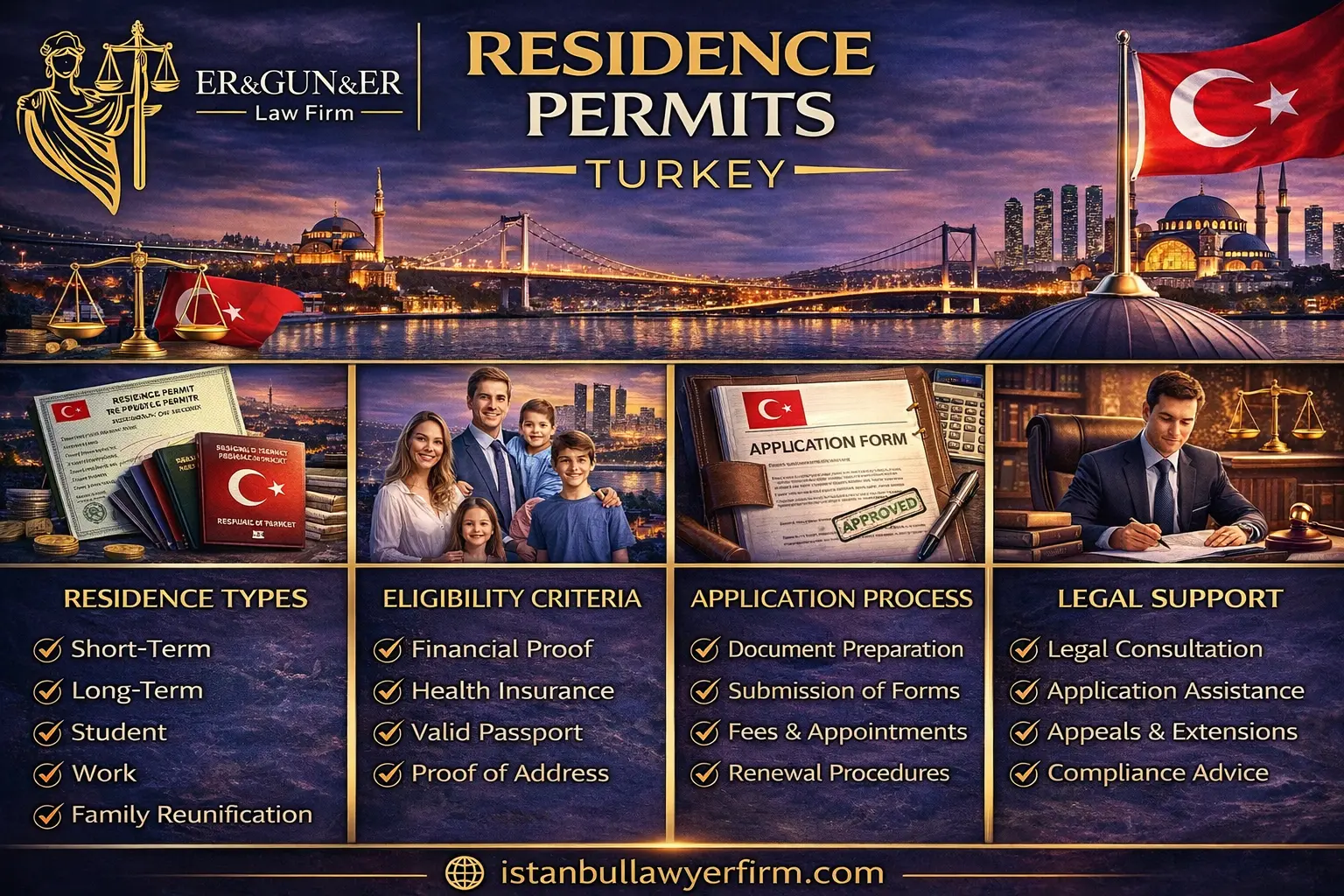
Residence permit outcomes in Turkey are determined by file quality and chronological compliance—the DGMM residence permit Turkey decision reflects not only whether the applicant meets the eligibility criteria on paper but whether every required document is complete, current, and consistent, whether the application was filed within the applicable window, and whether the applicant's Turkish address registration and health insurance are in order at the moment the file is assessed. The types of residence permits Turkey offers are defined by the Law on Foreigners and International Protection, and each type was designed to accommodate a specific factual profile: the short-term permit for investment, property ownership, and other defined purposes; the family permit for foreign spouses and children of Turkish citizens and permit holders; the student permit for enrolled degree and language students; the long-term permit for those who have completed eight continuous years of lawful residence; the humanitarian permit for irregular situations that the other categories do not cover; and the victim protection permit for trafficked persons who cooperate with authorities. Selecting the correct permit type is not merely a procedural choice—it is a substantive one, because the conditions attached to each permit, the documents required to prove eligibility, and the grounds on which the permit may be refused or cancelled all differ by category, and a permit application filed under the wrong category wastes time and creates a gap in lawful status. Address registration is a recurring compliance obligation rather than a one-time task: a change of address that is not reported to the relevant civil registry and DGMM can create grounds for refusal of a pending renewal, denial of a transition to a higher-status permit, and in some cases administrative action. The renewal window—the period within which a renewal application must be filed before the current permit expires—is tightly defined, and an application submitted after the expiry of the current permit is an overstay with legal consequences that begin on the day after the permit expired, not the day after the application is assessed. This article provides a comprehensive, practice-oriented guide to the full range of Turkish residence permits as they operate in 2026, addressed to foreign nationals managing their immigration status in Turkey, corporate sponsors supporting foreign employees, and families navigating the family permit system.
Residence permit system overview
A lawyer in Turkey advising on the residence permit system must begin with the statutory framework: all residence permits for foreign nationals in Turkey are governed by the Law on Foreigners and International Protection (LFIP, Law No. 6458), whose full text is accessible at Mevzuat. The LFIP, which entered into force in 2014, replaced the former Foreigners Law and established both the substantive permit categories and the institutional framework through which those permits are administered. The primary administrative authority is the Directorate General of Migration Management (DGMM), accessible at goc.gov.tr, which processes applications, issues permit cards, and enforces immigration compliance through its provincial directorates in each province of Turkey. The LFIP's permit framework distinguishes between residence permits—which authorize a foreign national to reside in Turkey for a defined purpose and period—and visas, which authorize entry and short-term presence but do not constitute a residence authorization for extended lawful stay beyond the visa validity. A foreign national who has entered Turkey on a tourist visa and who wishes to remain beyond the visa's validity period must apply for a residence permit through the official e-Ikamet system before the visa expires, or they will be in overstay from the day after the visa expires. Practice may vary by authority and year — check current guidance on the current DGMM procedural requirements applicable to the transition from visa status to residence permit status in the specific province where the application is filed.
An Istanbul Law Firm advising on the residence permit system architecture must help foreign nationals understand that each permit type creates a distinct legal status with its own conditions, its own renewal logic, and its own pathway to longer-term or permanent status. The LFIP creates a structured immigration hierarchy: most foreigners begin with one of the short-term or special-purpose permits; those who maintain lawful continuous residence for eight years become eligible for the long-term residence permit, which is the closest status available to permanent residency in the Turkish immigration system; and those who pursue Turkish citizenship through naturalization—including through the Citizenship by Investment program—ultimately exit the residence permit system entirely. A foreign national who understands this hierarchy can make strategic permit choices that are consistent with their longer-term immigration objectives—for example, choosing a short-term property-owner permit rather than a tourist extension, where both might technically be available, because the property-owner permit counts toward the eight-year long-term permit accumulation while a tourist extension typically does not in the same way. The permit card itself—the plastic ikamet card issued by DGMM—must be carried and produced upon request by law enforcement, and the absence of a valid card in the cardholder's possession (as opposed to the card being merely expired) can create immediate enforcement issues during routine identity checks. Practice may vary by authority and year — check current guidance on the current DGMM ikamet card carrying and production obligations applicable to residence permit holders in Turkey.
A Turkish Law Firm advising on the administrative organization of the residence permit system must explain that the provincial directorates of migration management (İl Göç İdaresi Müdürlükleri) are the operationally critical offices for most permit matters—processing applications, conducting interviews, issuing refusal decisions, and managing the biometrics collection process. The Istanbul directorate processes the largest volume of applications in Turkey given Istanbul's significance as an economic hub and the concentration of foreign nationals there, and the processing timelines, administrative practices, and document acceptance standards at the Istanbul directorate may differ from those in other provinces—practice may vary by authority and year — check current guidance on the current Istanbul DGMM provincial directorate's processing timelines and specific document requirements for the permit type being pursued. The national DGMM website and the e-Ikamet portal together provide the primary official information source for application procedures, required documents, and policy updates, but the specific interpretation and administrative practice at the provincial level can differ from what the national guidance suggests, and applicants should be prepared for province-level variations. The immigration lawyer residence permit Turkey practice that is most effective combines awareness of the national statutory framework with specific knowledge of the provincial directorate's current administrative practice. Practice may vary by authority and year — check current guidance on the current DGMM administrative practices at the specific provincial directorate responsible for the applicant's place of residence in Turkey.
Short-term permit categories
A law firm in Istanbul advising on the short term residence permit Turkey category must explain that the LFIP establishes the short-term residence permit as a broadly inclusive category that covers a wide range of purposes for foreign nationals who do not qualify for the more specific family, student, or long-term categories. The short-term permit's defined purposes include: scientific research to be conducted in Turkey; property ownership—where a foreign national owns real estate in Turkey and wishes to reside there in connection with that ownership; commercial connections—where a foreign national maintains business relationships with Turkey without being employed in Turkey; attendance at a language or short courses that do not qualify for the student permit; medical treatment—where the treatment itself is an approved medical procedure in Turkey; tourism purposes—for those who cannot or prefer not to obtain a tourist visa extension and who wish to establish documented lawful residence; and purposes defined by the Council of Ministers. Each of these sub-categories has specific eligibility requirements and specific documents that establish the qualifying purpose, and an application filed under the wrong sub-category—for example, applying as a property owner when the property ownership documentation is incomplete—will be assessed as incomplete rather than simply redirected to the correct sub-category. Practice may vary by authority and year — check current guidance on the current DGMM documentation requirements for each sub-category of the short-term residence permit and on any recently added or modified purposes under the Council of Ministers' authority.
The types of residence permits Turkey framework for the short-term permit includes specific limitations that differentiate it from the other categories and that applicants must understand before choosing this permit type. The short-term permit does not authorize employment in Turkey—a foreign national who wishes to work must obtain a separate work permit issued by the Ministry of Labor—and a short-term permit holder who works without an authorized work permit is in violation of both the employment law and potentially the conditions of their residence permit, creating dual enforcement exposure. The short-term permit's maximum duration per grant is capped at a specified period established by the LFIP and implementing regulations, and the permit cannot be renewed indefinitely without assessment of whether the qualifying purpose continues to exist—a property-owner permit requires that the property ownership be maintained throughout the permit period, and a permit holder who sells their Turkish property before the permit expires may lose the qualifying basis for the current permit before its natural expiry. The short-term permit does accumulate toward the eight-year lawful residence period required for long-term permit eligibility, unlike some visa-based statuses, making it a useful bridge for foreign nationals who are not yet eligible for a more specific permit category but who wish to establish their residence period toward the long-term permit threshold. Practice may vary by authority and year — check current guidance on the current maximum grant duration for short-term permits by sub-category and on the specific conditions that must be maintained throughout the short-term permit period.
An English speaking lawyer in Turkey advising on the property-owner short-term permit—one of the most commonly pursued sub-categories by foreign nationals who have purchased Turkish real estate—must explain the specific documentation required to establish property ownership as the qualifying purpose and the specific conditions under which this permit is vulnerable to challenge or refusal. The property ownership must be established through an authentic title deed (tapu senedi) issued by the Turkish Land Registry, and the property must be in the applicant's own name—a property owned by a company of which the applicant is a shareholder does not establish personal property ownership for permit purposes. The property must be residential property rather than commercial property for this specific sub-category, and the location of the property determines the provincial directorate with jurisdiction over the application—the application is filed at the directorate in the province where the property is located, not at the directorate nearest to the applicant's actual place of residence if different. The real estate due diligence steps that foreign buyers should take before acquiring Turkish property—both to verify their ownership rights and to ensure the property is suitable as a permit basis—are analyzed in the resource on real estate due diligence in Turkey. Practice may vary by authority and year — check current guidance on the current DGMM documentation requirements for the property-owner sub-category of the short-term permit and on any minimum property value thresholds or other conditions currently applied by DGMM for this sub-category.
Family residence permits
A best lawyer in Turkey advising on the family residence permit Turkey category must explain that this permit is available to foreign national family members of Turkish citizens or of foreign nationals who hold valid Turkish residence or work permits, and that the specific family relationships recognized for this purpose and the conditions applicable to each family member category are defined by the LFIP. The family permit is available to: the foreign spouse of a Turkish citizen or of a foreign resident permit holder; the dependent foreign child of a Turkish citizen or of a foreign resident permit holder; and the dependent foreign parent of a Turkish citizen—subject to the specific conditions applicable to each relationship. The family residence permit Turkey application must be filed on behalf of the qualifying family member by the Turkish citizen sponsor or the resident foreign national sponsor, and the sponsor's obligations—including the financial sufficiency requirement demonstrating the ability to support the family member—are assessed as part of the eligibility determination. The financial sufficiency threshold requires the sponsor to demonstrate income or assets sufficient to support the family member at a level that does not require public assistance, and the specific amount or evidence type accepted by DGMM for this demonstration may vary by province and by current guidance. Practice may vary by authority and year — check current guidance on the current financial sufficiency documentation acceptable for family residence permit applications and on any minimum income thresholds currently applied by DGMM for the sponsoring Turkish citizen or resident.
An Istanbul Law Firm advising on the family permit for the foreign spouse of a Turkish citizen must address the specific documentation required to establish the marital relationship and the specific conditions that must be maintained throughout the permit period. The marriage must be officially registered and documented through a Turkish or foreign marriage certificate—where the certificate is foreign, it must be apostilled and certified-translated into Turkish before it will be accepted as evidence of the marital relationship. The foreign spouse's family permit is typically granted for a duration shorter than the maximum allowed and must be renewed; and the permit is subject to the condition that the marriage remains intact—a divorce or annulment during the permit period may create grounds for cancellation of the family permit and require the foreign national to transition to a different permit category or to exit Turkey. A foreign spouse who has held a family permit for three years may apply for a short-term permit in their own right, creating an independent immigration status that is not dependent on the marriage—and this transition is strategically important for spouses in difficult marriages who would otherwise face a choice between maintaining the marriage and maintaining their immigration status. The LFIP's family protection provisions—which provide some protection for family permit holders experiencing domestic violence—are an important dimension of the family permit framework that is discussed in more detail in the victim protection section. Practice may vary by authority and year — check current guidance on the current documentation requirements for the foreign spouse family permit and on the specific conditions under which DGMM cancels a family permit following divorce or annulment.
A Turkish Law Firm advising on the family permit for the dependent child of a Turkish citizen or foreign permit holder must address the specific age limitations and conditions applicable to child family permits. The family permit is available for dependent children who meet the age requirements specified in the LFIP, and a child who ages out of the family permit eligibility during the permit period must transition to a different permit category—typically the short-term permit or the student permit if they are enrolled in a Turkish educational institution—before the family permit expires. The documentation of the parent-child relationship—through birth certificates that must be apostilled and certified-translated—and the documentation of the child's dependency status are the primary evidentiary requirements for child family permits. A child who is both a foreign national and a Turkish citizen (holding dual nationality through the Turkish citizen parent) does not require a Turkish residence permit, because Turkish nationality confers the right of residence in Turkey regardless of any other nationality held. The family permit for a foreign national child attending a Turkish school requires coordination between the family permit and the school enrollment documentation, and the permit's renewable duration should be managed to align with the child's school year to avoid administrative gaps. Practice may vary by authority and year — check current guidance on the current age thresholds and dependency conditions applicable to child family permits and on the specific documentation required to establish the parent-child relationship for permit purposes.
Student residence permits
A law firm in Istanbul advising on the student residence permit Turkey category must explain that this permit is specifically designed for foreign nationals who are enrolled in a Turkish educational institution at the secondary level or above—including universities, higher education institutions, and language schools meeting the required enrollment criteria. The student permit requires an enrollment letter or acceptance document from a Turkish institution that is recognized by the relevant Turkish education authority (the Council of Higher Education, YÖK, for higher education institutions), confirming the student's enrollment in a program with a duration consistent with the permit duration requested. The student permit is typically granted for the duration of the enrolled program—or the academic year, depending on the specific institution and program—and is renewable annually for students who continue their enrollment. A student who completes their degree during a permit period and wishes to remain in Turkey while seeking employment or transitioning to another status must apply for the appropriate new permit before the student permit expires, and the timing of this transition is critical because the student permit does not authorize employment and does not automatically convert to a work or short-term permit upon completion of the degree. Practice may vary by authority and year — check current guidance on the current DGMM and YÖK requirements applicable to student permits and on the specific institutional recognition conditions that must be met before an enrollment letter from a Turkish institution can serve as the basis for a student permit.
The residence permit documents Turkey requirements for student permit applicants include: the completed e-Ikamet application form; a valid passport with sufficient remaining validity; the institutional enrollment letter; proof of financial sufficiency to support the student during the enrollment period (the specific evidence type accepted varies by DGMM province); proof of health insurance coverage for the duration of the permit period; the address registration document (notarial lease agreement or property title); and passport-format photographs. The financial sufficiency documentation for student permits—which must demonstrate that the student will not require public support during their studies—can be satisfied through bank statements, scholarship documentation, a parental support letter with supporting financial evidence, or other documentation accepted by DGMM at its discretion. The health insurance requirement for the student permit—a critical component that is discussed in more detail in the insurance section—must be met with a policy that covers the full duration of the permit period, not merely the application date, and a policy that lapses during the permit period can create grounds for permit cancellation. Practice may vary by authority and year — check current guidance on the current financial sufficiency and health insurance documentation standards applicable to student permit applications at the specific DGMM provincial directorate where the application is filed.
An English speaking lawyer in Turkey advising on the language school student permit—a category within the student permit framework that applies to foreign nationals enrolled in Turkish language courses rather than degree programs—must address the specific eligibility conditions and limitations applicable to this sub-category. The language school permit requires enrollment in a Turkish language institution that meets the specific recognition criteria established by DGMM, and not all language schools in Turkey qualify as suitable institutions for permit purposes—enrollment in an unrecognized school will result in refusal of the student permit even if the enrollment letter is formally similar to one from a recognized institution. The duration of the language school student permit is typically shorter than the duration available for degree program students, and the student permit for language school enrollment may not be renewable indefinitely—DGMM may limit the total duration for which a foreign national can rely on language school enrollment as the basis for a student permit, requiring transition to a different permit type after a specified accumulation of language school permits. The immigration lawyer residence permit Turkey practice specifically for student situations requires monitoring both the institution's recognition status and the specific DGMM limitations on language school permit accumulation. Practice may vary by authority and year — check current guidance on the current DGMM recognition criteria for Turkish language schools as suitable institutions for student permits and on any current limitations on language school permit duration or renewal.
Long-term residence permits
A best lawyer in Turkey advising on the long term residence permit Turkey must explain that this permit—sometimes referred to as the ikamet tezkeresi süresiz (indefinite residence permit)—is the highest-status residence permit available under the LFIP and is designed to provide a near-permanent immigration status to foreign nationals who have demonstrated sustained lawful residence and integration in Turkey. The eligibility for the long-term permit requires the applicant to have resided in Turkey lawfully and continuously for at least eight years under valid residence permits, without interruption of the required duration and without periods of disqualifying absence from Turkey. The eight-year calculation is not simply the total calendar time that has passed since the applicant first received a residence permit—it specifically counts the periods of lawful residence under valid permits, and periods of overstay, periods outside Turkey exceeding the allowable limits, and periods on status types that do not qualify toward the accumulation may be excluded from the calculation. The applicant must not have been a public burden—having received social assistance from Turkish public sources—during the residence period, and must demonstrate ongoing financial sufficiency to meet their needs without public support at the time of application. Practice may vary by authority and year — check current guidance on the current DGMM calculation methodology for the eight-year lawful residence requirement and on the specific types of status and absence periods that count toward or interrupt the required accumulation.
An Istanbul Law Firm advising on the long-term permit documentation and eligibility conditions must address the specific affirmative evidence requirements that the applicant must demonstrate at the time of application. The long-term permit application requires, beyond the standard identification and photograph requirements: comprehensive evidence of the eight-year lawful residence period through certified copies of all prior valid residence permits; financial sufficiency documentation demonstrating adequate income or assets to self-support; proof of health insurance or enrolled Turkish social security (SGK) membership; a clean security record confirmed through the standard security check conducted as part of the application process; and evidence of no prior public assistance receipt. The clean security record requirement means that a foreign national who has been subject to deportation proceedings, who has been issued a temporary removal measure, or who has a criminal conviction of a disqualifying nature during the eight-year residence period may be ineligible for the long-term permit even if they have technically maintained eight years of lawful status. The long-term permit itself—once granted—is not subject to periodic renewal in the same way as the time-limited permits, but it can be cancelled if the holder no longer meets the conditions for its maintenance, including through extended absence from Turkey exceeding the permitted absence period. Practice may vary by authority and year — check current guidance on the current DGMM conditions for long-term permit maintenance and on the specific absence periods that risk triggering cancellation of an existing long-term permit.
A Turkish Law Firm advising on the strategic importance of the long-term permit in the context of long-term Turkey-based life and business planning must explain how the rights associated with this permit differ from those of time-limited permits—making the long-term permit a qualitatively different and more valuable status for those who qualify. The long-term permit holder is entitled to most of the same rights as Turkish citizens in areas of civil law, commerce, education, and social security, with specific exceptions defined by the LFIP—including restrictions on political rights, the right to vote, certain public employment positions, and military service obligations. The long-term permit's near-permanent character—the absence of a fixed expiry date and the automatic accumulation of presence rather than requiring periodic renewal applications—provides a stability that time-limited permit holders do not have, particularly in business contexts where long-term investment and employment decisions require a predictable immigration foundation. Foreign nationals who have achieved long-term permit status may find that it simplifies both their personal and business arrangements in Turkey—bank account management, property transactions, and commercial registrations are all more straightforward with a long-term permit than with a short-term or annually renewed permit. Practice may vary by authority and year — check current guidance on the current specific rights and limitations applicable to long-term residence permit holders in Turkey and on any recent legislative changes affecting the long-term permit holder's civil and commercial status.
Humanitarian residence permits
A law firm in Istanbul advising on the humanitarian residence permit Turkey category must explain that this permit exists to address situations that fall outside the standard permit categories but where the LFIP's drafters recognized a legitimate need for lawful status that cannot be addressed through the other available permit types. The humanitarian permit is a discretionary category that DGMM may grant in circumstances that are defined by the LFIP as including: situations where immediate departure from Turkey would be contrary to humanitarian principles; situations involving persons who are stateless or whose nationality cannot be established; situations involving persons who, for reasons beyond their control, cannot use a travel document; situations involving unaccompanied minors; and similar circumstances that the DGMM determines warrant humanitarian status on a case-by-case basis. The humanitarian permit is not an alternative to the refugee or subsidiary protection status provided by the international protection framework—those statuses are governed by a separate part of the LFIP—but it operates alongside the protection framework to address the grey area cases where formal protection is not being sought or granted but where deportation or forced departure would create disproportionate harm. The discretionary character of the humanitarian permit means that its availability cannot be guaranteed, and the applicant must present the DGMM with specific, documented evidence of the humanitarian circumstances that make the other permit categories unavailable or inappropriate. Practice may vary by authority and year — check current guidance on the current DGMM approach to humanitarian permit applications and on the specific circumstances that DGMM currently accepts as qualifying for humanitarian status.
An English speaking lawyer in Turkey advising on the humanitarian permit in the context of a foreign national who cannot exit Turkey due to documented circumstances—a serious medical condition requiring treatment in Turkey, a civil conflict in the country of nationality that makes return dangerous, or a loss of travel documents that cannot be resolved through consular channels in Turkey—must address the specific documentation required to support each type of humanitarian claim. A medical humanitarian claim requires current medical documentation from a licensed Turkish medical institution establishing the nature of the condition, the necessity of treatment in Turkey, and the risk that travel would pose to the patient's health or life. A country-conditions humanitarian claim requires objective documentation of the conditions in the country of nationality—from recognized human rights organizations, official country reports, or similar authoritative sources—that establishes the genuine risk associated with return. A documentation failure claim—where the foreign national cannot obtain a travel document from their country of nationality's embassy or consulate—requires evidence of attempts to obtain the document and the embassy or consulate's refusal or inability to issue it. The humanitarian permit application must be filed with DGMM before any overstay occurs if possible, because a foreign national who has already accumulated overstay days faces the additional obstacle of the overstay violation in addition to the substantive humanitarian claim, and DGMM may treat the overstay as undermining the good faith of the humanitarian application. Practice may vary by authority and year — check current guidance on the current DGMM procedural requirements for humanitarian permit applications and on the specific documentation standards for each category of humanitarian claim.
A Turkish Law Firm advising on the humanitarian permit for stateless persons or persons with uncertain nationality must address the specific additional complexity that arises when the applicant cannot demonstrate their nationality through any recognized travel document. A stateless person—one who is not considered a national by any state—has specific rights under international law and under the LFIP's provisions, and the humanitarian permit is one of the mechanisms through which DGMM can provide lawful status to a stateless person who does not qualify for or has not applied for international protection status. The documentation of statelessness typically requires evidence of the circumstances that created the stateless condition—the dissolution of the country of birth, the acquisition of another nationality that was subsequently revoked, or the legal conditions of birth in a state that does not confer nationality by birth—and this documentation may itself be difficult to obtain given the nature of statelessness. The DGMM's assessment of a humanitarian permit for a stateless person involves both the factual determination of the applicant's nationality status and the policy judgment about whether the humanitarian permit is the appropriate status for the specific circumstances, and legal representation is particularly valuable in navigating this assessment. Practice may vary by authority and year — check current guidance on the current DGMM approach to humanitarian permits for stateless persons and on the interaction between the humanitarian permit framework and Turkey's international protection system for stateless persons who also face persecution risks.
Victim protection permits
A best lawyer in Turkey advising on the victim of human trafficking residence permit Turkey category must explain that this permit is a specialized protection status established by the LFIP for foreign nationals who have been identified as victims of human trafficking in Turkey and who are cooperating with Turkish law enforcement and judicial authorities in the investigation or prosecution of the traffickers. The victim protection permit recognizes that victims of human trafficking frequently face specific vulnerabilities that make it dangerous or impossible to exit Turkey or to maintain regular immigration status through the standard permit system—they may not have valid travel documents (which may have been confiscated by traffickers), they may fear retaliation if they exit Turkey, or they may need to remain in Turkey to testify in criminal proceedings against the traffickers. The permit provides a formal legal status that allows the victim to remain in Turkey lawfully while the investigation and prosecution proceed, and it provides access to support services, legal assistance, and in some cases shelter that are organized through the Ministry of Family and Social Services and law enforcement. The legal basis for identifying a trafficking victim and issuing the victim protection permit involves specific coordination between the DGMM, law enforcement (police and gendarmerie), and prosecutor offices, and the process is initiated when law enforcement identifies or receives a report about a potential trafficking victim. Practice may vary by authority and year — check current guidance on the current DGMM procedures for issuing victim of trafficking residence permits and on the specific coordination mechanisms between law enforcement and DGMM in trafficking victim identification and permit issuance.
An Istanbul Law Firm advising on the victim protection permit from a practical and legal support perspective must address both the immediate protection function of the permit and the longer-term legal strategy for the victim who has received this status. The immediate protection function includes lawful status in Turkey, protection from deportation while the status is in force, and access to support services; the longer-term strategy must address what the victim's immigration options are after the trafficking investigation and prosecution conclude. A trafficking victim who has fully cooperated with Turkish authorities during the investigation and prosecution of their traffickers may, depending on the circumstances, be eligible for continued residence on humanitarian grounds, transition to a standard short-term or family permit if they have an independent qualifying basis, or return to their home country if conditions there are safe. The legal representation of a trafficking victim in the permit process—ensuring that the victim's rights under the LFIP are fully exercised, that they receive the support services they are entitled to, and that their immigration status is maintained throughout the protection period—requires both immigration law expertise and awareness of the criminal law proceedings in which the victim is participating. The broader immigration enforcement context—including deportation defense for foreign nationals who are at risk of removal—is analyzed in the resource on deportation defense in Turkey. Practice may vary by authority and year — check current guidance on the current victim protection permit duration, the conditions for renewal, and the support services available to victim protection permit holders in Turkey.
A Turkish Law Firm advising on the interaction between the victim protection permit and the family permit framework must address specific situations where a trafficking victim has family members—children, a spouse—who are also present in Turkey and who need their own immigration status managed during the protection period. A child of a trafficking victim who is in Turkey with the victim may need a family permit if the child is not themselves a trafficking victim, and the management of the child's permit status—particularly where the child is a minor with no independent immigration basis—requires coordination between the victim's protection status and the child's family permit application. The victim's own compliance with the conditions of the victim protection permit—including cooperation with law enforcement, residence at the specified address, and compliance with any restrictions on movement or communication imposed as part of the protection arrangement—is a condition of maintaining the permit, and any failure of compliance can result in permit cancellation. The legal representation of the victim must therefore address both the immigration status management and the legal compliance with the specific conditions of the protection arrangement, which requires an attorney who is familiar with both the immigration law framework and the specific law enforcement context of the trafficking investigation. Practice may vary by authority and year — check current guidance on the current conditions applicable to victim protection permits and on the specific compliance obligations that victims must meet to maintain this status throughout the protection period.
Choosing the right permit
A law firm in Istanbul advising a foreign national on choosing the right permit type must conduct the selection analysis against the applicant's specific factual situation—their purpose for being in Turkey, their family connections to Turkey, their educational enrollment status, their immigration history, their future plans, and their practical compliance capacity—rather than against an abstract preference for one permit type over another. The most common error in permit type selection occurs when a foreign national chooses the most easily available permit—typically the short-term property-owner or tourist-purpose permit—without assessing whether they could qualify for a more appropriate permit that better matches their actual circumstances and provides a stronger legal foundation for their Turkish residence. A foreign national who is married to a Turkish citizen should be applying for the family permit rather than the short-term permit, even if both might be technically available, because the family permit is specifically designed for their situation and provides the specific protections—including the three-year transition right—that the short-term permit does not. An applicant who is enrolled in a Turkish university degree program should use the student permit rather than a short-term permit based on another qualifying factor, because the student permit specifically accommodates the academic year pattern of presence and absence that degree programs require. Practice may vary by authority and year — check current guidance on the current DGMM approach to permit type selection and on whether DGMM allows an applicant to choose between two available permit types or whether the agency directs applicants to the most specific applicable category.
The residence permit documents Turkey selection that accompanies the permit type choice must accurately reflect the chosen permit's specific eligibility basis—and the documents must be authentic, complete, and current as of the application date. A mismatch between the declared permit purpose and the documents provided—for example, declaring a property-owner purpose but presenting a rental agreement rather than a title deed—is a common basis for application rejection that results from inadequate pre-application document preparation. The document preparation phase is where the permit selection decision is operationalized: once the appropriate permit type has been identified, the specific documents required for that type must be assembled in their correct form, apostilled and translated where they originate from foreign sources, and organized in the order specified by the DGMM application procedure before the e-Ikamet online application is completed. An applicant who completes the e-Ikamet application and schedules an appointment before their documents are fully assembled and verified creates the risk of attending the appointment with an incomplete file, which typically results in a request for supplementary documents that delays the process and may create a gap if the current permit is close to expiry. The full-service immigration support framework available from qualified Turkish immigration lawyers is described in the resource on full-service immigration law firm Turkey. Practice may vary by authority and year — check current guidance on the current DGMM document standards and organization requirements for each permit type before beginning the document preparation phase.
An English speaking lawyer in Turkey advising on the strategic permit selection for a foreign national with long-term plans to remain in Turkey must assess the permit type choice against the applicant's longer-term immigration objectives, including whether the applicant is ultimately pursuing Turkish citizenship through naturalization, maintaining ongoing business or investment activity in Turkey, or planning to establish a permanent family base in Turkey. A foreign national who is investing in Turkey and who qualifies for the Citizenship by Investment program may find that the residence permit phase is a transition stage toward citizenship rather than a permanent status, and the most appropriate permit type during this transition may be different from the permit that would be most appropriate for a foreign national who intends to remain in Turkey on an indefinite residence permit without pursuing citizenship. The accumulation of lawful residence time toward the eight-year long-term permit threshold is a relevant consideration in permit type selection even for applicants who are not yet focused on the long-term permit, because the choice of permit types that count toward versus do not count toward this threshold affects the timeline for eventual long-term status eligibility. Practice may vary by authority and year — check current guidance on which specific permit types currently count toward the eight-year long-term permit accumulation and on any recent changes to the calculation methodology that might affect the strategic permit type selection.
e-Ikamet application workflow
A best lawyer in Turkey advising on the e-ikamet residence permit application Turkey workflow must explain that the DGMM's e-Ikamet portal—accessible at e-ikamet.goc.gov.tr—is the mandatory online platform through which all residence permit applications (other than those processed through the DGMM's institutional partnerships) must be initiated, and that the application is not submitted by attending a DGMM office directly without prior online application and appointment scheduling. The e-Ikamet application process begins with the applicant creating an account on the portal, completing the online application form for the specific permit type they are seeking, uploading the required supporting documents in the specified digital format, and scheduling an appointment at the DGMM provincial directorate responsible for their registered address in Turkey. The online application form captures the applicant's personal information, passport details, Turkish address, permit type selection, declared purpose, and the specific supporting information relevant to the declared purpose—each section of the form must be completed accurately and consistently with the documents being uploaded, because any discrepancy between the form data and the uploaded documents is a basis for rejection at the appointment. The DGMM has established specific formatting requirements for uploaded documents—file size limits, acceptable file formats, and quality standards—that must be met for the document upload to be successfully processed, and an applicant who uploads documents that do not meet these technical requirements will receive an error notification and must resubmit before scheduling the appointment. Practice may vary by authority and year — check current guidance on the current e-Ikamet portal document upload requirements and on any recent changes to the application form or the required document categories for the specific permit type being sought.
An Istanbul Law Firm managing an e-Ikamet application for a foreign national client must address the specific data entry discipline required to ensure that the online application accurately reflects the permit type's requirements and the applicant's specific qualifying facts. The permit type selection in the e-Ikamet form triggers a specific set of mandatory document upload requirements, and selecting the wrong permit type—or selecting the correct type but the wrong sub-category within that type—produces a document checklist that may not match the applicant's actual situation, leading to either an incomplete file or an unnecessary document submission that creates confusion at the appointment. The Turkish address field in the e-Ikamet application must exactly match the address registered on the notarial lease agreement or title deed being submitted as address proof, because a discrepancy between the declared address and the address documentation is a common and easily avoidable error that creates processing complications. The e-Ikamet system's appointment scheduling function is the final step of the online application, and the applicant should schedule the appointment for a date that provides sufficient time to gather any remaining documents, verify all uploaded materials, and if necessary make corrections to the online form before attending in person. Practice may vary by authority and year — check current guidance on the current e-Ikamet appointment availability in the relevant province and on any temporary appointment restrictions or alternative appointment procedures currently in effect at the specific DGMM provincial directorate.
A Turkish Law Firm advising on e-Ikamet application management for multiple family members who are all applying for residence permits at the same time must address the specific coordination requirements that arise when family members' applications are linked—particularly where one family member's permit (the sponsor's) is a condition for another family member's permit (the dependent's). A family permit application that depends on the sponsor's active residence or work permit must be submitted with evidence that the sponsor's permit is valid and has adequate remaining duration to support the family member's application, and a sponsor whose permit is itself in the renewal process at the time of the family member's application creates a specific documentation challenge that must be addressed proactively. The e-Ikamet system treats each family member's application as a separate submission with its own reference number and appointment, but the interdependencies among the applications must be managed to ensure that the appointment dates and document packages are coordinated. The DGMM residence permit Turkey process for family applications typically requires the sponsor to attend the appointment with the family member in at least some situations, and the attendance requirements at the provincial directorate should be confirmed before the appointment is scheduled. Practice may vary by authority and year — check current guidance on the current e-Ikamet coordination requirements for linked family permit applications and on whether the sponsor's in-person attendance is currently required at the dependent family member's appointment.
Appointment and biometrics
A law firm in Istanbul advising on the DGMM appointment and biometrics process must explain that the in-person appointment at the DGMM provincial directorate is the critical operational step in the residence permit process where the applicant presents their original documents for verification, provides their biometric data (fingerprints and photograph), and where the DGMM officer reviews the application file and makes a preliminary assessment of completeness. The appointment is scheduled through the e-Ikamet portal, and the appointment date and time establish the applicant's official compliance with the application deadline—an applicant who has scheduled an appointment before the expiry of their current permit is generally considered to have filed in time even if the appointment itself falls after the permit expiry, but this protection depends on the appointment having been scheduled and the application having been submitted through the portal before expiry. Arriving at the DGMM directorate for the appointment with the complete original document file—all documents that were uploaded in the e-Ikamet system, in their original or certified copy form, plus any additional documents that the specific provincial directorate requires beyond the standard checklist—is essential for avoiding a request for supplementary documents that extends the processing timeline. The biometric data collection at the appointment creates the physical database record that will be linked to the applicant's permit card when it is issued, and any discrepancy between the biometric data on the applicant's existing permit card (if they are renewing) and the new biometric data captured at the appointment may require additional verification. Practice may vary by authority and year — check current guidance on the current DGMM appointment procedures and biometrics requirements at the specific provincial directorate and on any appointment scheduling restrictions currently in effect.
An English speaking lawyer in Turkey advising on what to bring to the DGMM appointment must help the applicant prepare a structured document file that mirrors the checklist generated by the e-Ikamet system but is organized for efficient review by the DGMM officer. The standard required documents for most permit types include: a valid passport with sufficient remaining validity; the application receipt generated by the e-Ikamet system; a notarized lease agreement or title deed as address proof; health insurance documentation; biometric photographs meeting DGMM specifications; and the specific documents required for the permit's qualifying purpose (title deed for property-owner short-term, marriage certificate for family permit, enrollment letter for student permit, and so on). Foreign-language documents must be accompanied by certified Turkish translations—translations prepared by a sworn translator (yeminli tercüman) recognized by Turkish notarial standards—and the translation must be complete and accurate rather than a summary. A document file that is organized in the order of the DGMM checklist, with each document clearly labeled and with copies provided alongside the originals, facilitates faster review and reduces the risk of a document being overlooked during the appointment. Practice may vary by authority and year — check current guidance on the current photograph specifications required by DGMM for biometric photographs submitted at residence permit appointments and on any recent changes to the document organization requirements at the specific provincial directorate.
The residence permit card itself—issued by DGMM after the appointment and document verification are successfully completed—is typically mailed to the applicant's registered Turkish address rather than collected in person at the directorate. The wait period between the appointment date and the arrival of the permit card at the registered address varies by province and by processing workload, and the applicant must remain at the registered address or arrange for receipt of the card at that address, because a card that cannot be delivered and is returned to DGMM creates both an administrative complication and a documentation gap. During the period between the appointment and the receipt of the new permit card, the applicant typically receives a document from DGMM confirming that the application is under processing, and this processing document serves as temporary evidence of the pending lawful status for interactions with authorities, banks, or other institutions that require evidence of residence permit status. A best lawyer in Turkey advising on post-appointment permit management will specifically recommend that the applicant confirm their registered address delivery situation before the appointment and arrange for reliable receipt of the mailed card. Practice may vary by authority and year — check current guidance on the current DGMM permit card issuance process, the expected processing timeline after the appointment, and the procedures for requesting redelivery of a card that was not successfully delivered.
Insurance and address records
A Turkish Law Firm advising on health insurance residence permit Turkey requirements must explain that health insurance coverage is a mandatory requirement for most residence permit types—the exception being the long-term permit holder who may be covered through Turkish social security enrollment rather than private health insurance—and that the insurance document presented at the DGMM appointment must meet specific coverage standards that differ from what many foreign nationals expect based on their home-country insurance experience. The health insurance required for a Turkish residence permit must cover the full duration of the permit period—not merely the application date—and must be issued by a licensed insurer that is accepted by DGMM for this purpose. A standard international travel insurance policy with short coverage periods, high deductibles, or limited benefits for chronic conditions may not qualify as adequate for permit purposes even if it is described as "comprehensive" by the insurer. The specific coverage criteria that DGMM applies to health insurance documents—minimum benefit levels, exclusion restrictions, insurer licensing requirements—must be confirmed with current DGMM guidance before selecting an insurance product for permit purposes, because the acceptance standards can change and an insurance product that was accepted in a prior year may not meet the current standard. Practice may vary by authority and year — check current guidance on the current DGMM health insurance standards for residence permit applications and on the specific insurance products that DGMM currently accepts for each permit type and applicant nationality.
The address registration residence permit Turkey requirement operates through two parallel channels: the registration of the applicant's Turkish address in the civil registry (nüfus müdürlüğü) through the address registration system (adres kayıt sistemi, AKS), and the registration of the same address with DGMM as the applicant's residence permit address. Both registrations are required, and a mismatch between the two—an address registered with the civil registry that differs from the address declared in the e-Ikamet application—is a source of administrative complications that can affect permit processing and delivery. The address documentation required for the residence permit application is typically a notarized lease agreement (noterde tasdikli kira kontratı)—a lease agreement that has been witnessed and authenticated by a Turkish notary public—or a property title deed if the applicant owns the property at which they reside. An unnotarized lease agreement—one that is a direct agreement between the landlord and tenant without notarial authentication—is generally not accepted as adequate address documentation for DGMM purposes, and a common error among first-time applicants is presenting an unnotarized lease agreement at the appointment. The address registered for permit purposes must be a genuine residential address in Turkey at which the applicant actually resides, not an address of convenience provided by a third party, because DGMM may verify the declared address through field checks or mail delivery, and an address that proves to be uninhabited or unavailable to the applicant creates grounds for permit cancellation. Practice may vary by authority and year — check current guidance on the current DGMM and civil registry address documentation requirements and on whether any alternative forms of address proof are currently accepted in specific circumstances.
An Istanbul Law Firm advising on address change management during an active residence permit must explain that a change of address within Turkey—including a move between neighborhoods in the same city or a move to a different province—requires prompt notification to both the civil registry and DGMM to keep the permit records current. The notification of an address change to DGMM should be made within the period specified by the LFIP and its implementing regulations, and an applicant who changes address without notifying DGMM risks both the non-delivery of permit-related correspondence (including the permit card) and a finding at their next renewal appointment that their recorded address does not match their current residence documentation. A move to a different province also has implications for permit administration: the DGMM provincial directorate responsible for the permit changes when the applicant moves to a different province, and the renewal application at the next renewal will be processed by the new provincial directorate, which may have different administrative practices from the previous one. The address change notification process itself—which can typically be initiated through the e-Ikamet portal for DGMM notification and through the e-Government portal (e-Devlet) for civil registry notification—should be completed before the permit is issued to the new address to ensure continuous, verified address records. Practice may vary by authority and year — check current guidance on the current DGMM address change notification procedures and timelines and on the specific consequences of failing to notify DGMM of an address change within the required period.
Renewal and transition planning
A best lawyer in Turkey advising on residence permit renewal Turkey strategy must explain that the renewal process is not simply a repetition of the initial application—it is an opportunity to verify that the qualifying basis for the permit continues to exist, to assess whether transition to a different permit type would be more appropriate, and to address any compliance issues that have arisen during the current permit period before they become grounds for refusal at renewal. The renewal application must be filed within a specific window before the current permit expires—the specific window is established by the LFIP and implementing regulations and practice may vary by authority and year — check current guidance on the current renewal application window applicable to the specific permit type being renewed. An application filed after the permit has expired is not a renewal but a new application subject to the consequences of the overstay that occurred between the permit's expiry and the new application's filing, and these consequences—administrative fines, potential entry ban, and a permanent record of the overstay violation—make late filing an outcome to be avoided at virtually all costs. The renewal application must be filed through the e-Ikamet portal with the same procedural discipline as the initial application, and the document package must reflect the current status of all qualifying conditions—current health insurance, current address documentation, current financial evidence, and current evidence of the qualifying purpose. Practice may vary by authority and year — check current guidance on the current DGMM renewal procedures and document requirements for each permit type and on any changes to the renewal window or the document standards since the last renewal was filed.
An Istanbul Law Firm advising on permit type transition planning must address the strategic moments at which a foreign national might productively transition from one permit type to another—moving from a short-term permit to a family permit upon marriage to a Turkish citizen, moving from a student permit to a short-term permit upon graduation, or moving from any permit type to the long-term permit upon accumulating eight years of qualifying residence. Each transition requires assessing whether the new permit type's eligibility conditions are met, what documents are required to establish eligibility for the new type, and how the transition affects any ongoing accumulation of qualifying residence toward the long-term permit. The timing of a permit type transition should be planned to avoid gaps in lawful status: the transition application should be filed before the current permit expires, and the new permit type's application process should be initiated with sufficient lead time to allow for the appointment and processing without creating a status gap. A particularly important transition scenario is the move from a short-term property-owner permit to a longer-term family permit following marriage to a Turkish citizen—this transition is important because the family permit provides stronger legal protection, additional rights, and a clearer pathway to eventual citizenship or long-term residence than the property-owner short-term permit. Practice may vary by authority and year — check current guidance on the current DGMM procedures for mid-period permit type transitions and on whether a transition application can be filed before the current permit expires or only at renewal time.
A Turkish Law Firm advising on the long-term planning dimension of permit renewal must help foreign nationals think through their permit strategy as a multi-year sequence rather than as individual annual administrative tasks. A foreign national who plans to remain in Turkey indefinitely should track their accumulation of qualifying residence toward the eight-year long-term permit threshold from the beginning of their Turkish residence, ensuring that each renewal is filed within the required window and that no status gaps or disqualifying absences interrupt the accumulation. The documentation of the residence accumulation—certified copies of all prior valid permits, evidence of continuous residence through address records and tax filings, and documentation of any absences from Turkey during the accumulation period—should be maintained in a personal immigration file that is updated with each permit renewal and that is readily available when the long-term permit application is eventually filed. The visa rejection law Turkey context—including the reasons that prior permit applications were refused and how those refusals affect subsequent applications—is an important dimension of the multi-year strategy that is analyzed in the resource on visa rejection law Turkey. Practice may vary by authority and year — check current guidance on the current DGMM documentation requirements for the long-term permit application and on any recent changes to the qualifying residence accumulation rules that might affect the timeline for long-term permit eligibility.
Refusals and risk factors
A law firm in Istanbul advising on residence permit refusal Turkey risk factors must help applicants understand the most common grounds on which DGMM refuses residence permit applications and how these grounds can be avoided through disciplined application preparation. The most frequently encountered refusal grounds include: insufficient documentation of the qualifying purpose—where the applicant has declared a permit purpose but has not provided the specific documents required to establish that purpose; failure to meet the health insurance requirement—where the insurance policy presented does not meet DGMM's current standards or does not cover the full permit period; address documentation deficiency—where the notarial lease agreement is not properly notarized, is expired, or does not match the declared address; financial insufficiency—where the evidence of financial resources does not meet the minimum standard for the permit type; and security-related grounds—where DGMM's background check identifies issues including prior deportation orders, prior permit violations, or criminal history. A refusal for insufficient documentation is the most technically avoidable of these grounds, because it results from a failure to submit the correct documents rather than from a substantive eligibility problem, and a pre-application document review by a qualified immigration lawyer can typically identify and correct document deficiencies before the application is submitted. Practice may vary by authority and year — check current guidance on the current DGMM refusal grounds and documentation standards applicable to the specific permit type and on any recent changes to the acceptance criteria for key document categories.
The residence permit documents Turkey checklist that DGMM applies at the appointment is the primary control point for identifying application deficiencies, and the DGMM officer may either request supplementary documents on the spot (if the deficiency is minor and correctable) or issue a formal request for supplementary documentation with a deadline for response (if the deficiency is more significant). An applicant who receives a supplementary document request must respond within the specified deadline with the complete required documentation, and a failure to respond or a response with still-incomplete documentation results in the formal refusal of the application. The formal refusal decision—which identifies the specific grounds for refusal—is the document that the applicant must rely upon to understand the basis for the refusal and to assess whether an administrative objection or appeal is appropriate. A refusal that is based on a correctable document deficiency may be most efficiently addressed through a new application rather than through an appeal, because the appeal process may be slower than a new application with corrected documentation—but a refusal that is based on a substantive eligibility assessment (such as a security finding or a financial insufficiency determination) requires the appeal mechanism if the applicant believes the assessment is incorrect. Practice may vary by authority and year — check current guidance on the current DGMM supplementary document request procedures and deadlines and on the formal refusal notification process applicable to each permit type.
An English speaking lawyer in Turkey advising on nationality-specific risk factors must address the reality that DGMM's assessment of residence permit applications is affected by the applicant's nationality—certain nationalities face heightened scrutiny, additional documentation requirements, or specific restrictions that do not apply to nationals of other countries. The LFIP grants the Council of Ministers authority to impose specific restrictions or conditions on the residence of nationals of specific countries, and these country-specific measures—which may include additional documentation requirements, additional interview steps, or outright restrictions on certain permit types—must be identified and addressed in the application strategy for affected nationalities. A foreign national whose nationality subjects them to heightened scrutiny or specific restrictions should seek legal advice from an immigration specialist with specific experience in managing applications for their nationality, because the standard application guidance may not account for the additional requirements that apply to their specific situation. The overstay law Turkey context—including the consequences that an existing overstay creates for a pending permit application—is analyzed in the resource on overstay law Turkey. Practice may vary by authority and year — check current guidance on the current country-specific restrictions or requirements applicable to the applicant's nationality in the Turkish residence permit system and on any recent changes to nationality-based application requirements.
Overstay and exit exposure
A Turkish Law Firm advising on overstay risk residence permit Turkey must explain that an overstay—the presence in Turkey without a valid residence permit or visa after the permitted stay has expired—creates immediate legal consequences that begin on the first day after the permit or visa expires and accumulate with each additional day of unlawful presence. The overstay risk is particularly acute for residence permit applicants who delay filing their renewal application until the current permit is close to expiry, because any administrative delay in obtaining an appointment—which may be subject to waiting periods depending on DGMM appointment availability—can result in the permit expiring before the appointment is scheduled. The LFIP establishes specific administrative responses to overstay, including the imposition of administrative fines calculated based on the duration of the overstay, the potential issuance of a voluntary departure notice, and in cases of significant or repeated overstay, the issuance of a deportation order and an entry ban that may prevent the foreign national from re-entering Turkey for a specified period. A foreign national who has accumulated overstay days must address this status proactively—either by leaving Turkey voluntarily and paying the applicable fine at the border, or by filing a new permit application while attempting to address the overstay through DGMM's administrative processes—rather than waiting for enforcement authorities to act, because the voluntary departure approach typically results in less severe consequences than a forced deportation. Practice may vary by authority and year — check current guidance on the current DGMM and border control enforcement policies for overstay in Turkey and on the specific fines and other consequences currently applicable to each duration category of overstay.
The overstay risk residence permit Turkey dimension creates specific complications for foreign nationals who are simultaneously managing a pending permit application and an existing overstay—a situation that arises when the renewal application was filed but the appointment was not secured before the permit expired. In this situation, the applicant is technically in overstay from the day after the permit expired, even though a renewal application is pending, and the pending application's existence does not automatically halt the accumulation of overstay days or the potential enforcement consequences. The strength of the overstay management argument depends on whether the applicant has documentary evidence that the renewal application was submitted through the e-Ikamet system before the permit expired—the e-Ikamet submission timestamp creates a record of the application date—and whether the delay in obtaining an appointment was due to factors beyond the applicant's control (DGMM appointment unavailability) rather than the applicant's own procrastination. A foreign national who finds themselves in an overstay situation with a pending renewal should seek legal advice immediately rather than waiting to see how the situation develops, because early legal intervention can sometimes prevent the overstay from escalating to a formal enforcement action. Practice may vary by authority and year — check current guidance on the current DGMM approach to pending renewal applications where the current permit has expired and on the extent to which the pending application's existence protects the applicant from overstay enforcement during the appointment wait period.
An English speaking lawyer in Turkey advising on the exit exposure dimension of overstay must explain that a foreign national who has accumulated overstay days will typically face questioning, administrative proceedings, and potentially an entry ban when they attempt to exit Turkey at an international border crossing or airport. The duration of the overstay and the foreign national's compliance history—whether they have had prior overstays or enforcement actions in Turkey—are relevant to the severity of the exit-processing outcome, and a short overstay by a first-time violator will typically be handled differently from a long overstay by a person with a pattern of immigration violations. A foreign national who plans to exit Turkey with an unresolved overstay situation should seek legal advice before attempting to exit, because the exit itself may trigger consequences—administrative fines, entry ban, passport stamp—that affect the person's ability to re-enter Turkey or apply for future Turkish immigration status. The full overstay legal analysis, including the specific consequences and the available legal remedies, is provided in the resource on overstay law Turkey. Practice may vary by authority and year — check current guidance on the current Turkish border control procedures for processing departing foreign nationals with overstay records and on the specific administrative fine payment procedures available at Turkish border crossings.
Appeals and litigation options
A best lawyer in Turkey advising on residence permit appeals must explain that DGMM's refusal of a residence permit application—like most administrative decisions in Turkey—is subject to administrative and judicial review mechanisms that allow the applicant to challenge the refusal and seek reversal. The first recourse after a permit refusal is typically an administrative objection (itiraz) filed with DGMM itself or with the relevant administrative authority, presenting specific legal and factual arguments for why the refusal decision was incorrect. The administrative objection must be filed within the applicable deadline—established by the administrative procedure rules—and must specifically identify the grounds on which the refusal is challenged: whether DGMM applied the wrong legal standard, whether the decision was based on factual errors, whether a required procedural step was omitted, or whether the decision was disproportionate to the applicant's circumstances. The administrative objection is reviewed by DGMM or the relevant authority and may result in the reversal of the refusal decision—permitting the issuance of the residence permit—or in a formal confirmation of the refusal that opens the pathway to judicial review. Practice may vary by authority and year — check current guidance on the current administrative objection timelines and procedures applicable to DGMM residence permit refusal decisions and on the specific grounds that administrative objections must address to be effective.
An Istanbul Law Firm advising on the judicial review pathway for a refused residence permit application must explain that administrative court proceedings in Turkey—governed by the Administrative Procedure Law—provide the avenue for challenging a DGMM refusal decision that was upheld on administrative objection or where the administrative objection period has elapsed. The administrative court proceeding involves filing a petition with the competent administrative court within the applicable filing deadline from the date of the confirmed refusal decision, presenting the factual and legal basis for challenging the refusal, and pursuing the case through the administrative court's review process, which typically involves the court examining the administrative file, requesting DGMM's response, and issuing a judgment on whether the refusal was lawful. An administrative court judgment that finds the refusal unlawful typically results in a court order requiring DGMM to issue the permit, and this order creates a legal obligation on DGMM that must be complied with regardless of DGMM's own assessment of the merits. The effectiveness of the judicial review pathway depends heavily on the quality of the administrative court petition—which must identify specific legal errors in DGMM's refusal decision with reference to the applicable statutory provisions and administrative standards—and on the timely filing of the petition before the judicial review deadline. Practice may vary by authority and year — check current guidance on the current administrative court jurisdiction over DGMM residence permit refusal decisions and on the specific filing deadlines and procedural requirements for administrative court petitions challenging refusal decisions.
A Turkish Law Firm advising on the practical value of the appeal and litigation pathways must help applicants understand that the legal challenge to a refusal decision does not automatically grant the applicant the right to remain in Turkey while the challenge is pending—the refusal of the permit application leaves the applicant in an unauthorized status, and the pursuit of a legal challenge does not stay the enforcement consequences of the unauthorized status unless the court specifically issues a suspension order (yürütmeyi durdurma kararı) pending the merits review. The application for a suspension order—which must be made simultaneously with or promptly after the administrative court petition is filed—requires the applicant to demonstrate both that the underlying challenge has merit and that the harm from the continued enforcement of the refusal decision (the applicant's inability to lawfully remain in Turkey) outweighs the harm from suspending the refusal pending the merits review. A successful suspension application allows the applicant to remain in Turkey in a legally suspended-enforcement status while the administrative court reviews the merits of the refusal challenge, and this status protection is often the most critical near-term outcome of the litigation strategy. The comprehensive deportation defense framework—which overlaps significantly with the residence permit appeals framework in cases where a refusal triggers removal proceedings—is analyzed in the resource on deportation defense in Turkey. Practice may vary by authority and year — check current guidance on the current administrative court procedures for suspension order applications in residence permit refusal cases and on the typical timeline for administrative court review in the relevant jurisdiction.
Practical compliance roadmap
A Turkish Law Firm developing a practical compliance roadmap for a foreign national's Turkish residence permit management must address the full sequence of compliance obligations from the moment of arrival in Turkey through the entire period of lawful residence, because compliance is a continuous obligation rather than a periodic task triggered only by renewal deadlines. The arrival-phase compliance obligations include: registering with the Turkish civil registry address system (AKS) within the required period of arrival; obtaining appropriate health insurance coverage; completing the initial residence permit application through e-Ikamet before the existing visa or permitted stay period expires; and attending the DGMM appointment with a complete and organized document file. The ongoing compliance obligations during an active permit period include: maintaining the qualifying basis for the permit—property ownership, enrollment, family relationship—throughout the permit period; maintaining continuous health insurance coverage; notifying DGMM and the civil registry of any address changes promptly; managing departures from Turkey to ensure that any absence periods do not exceed the limits applicable to the specific permit type; and tracking the renewal deadline to ensure the next application is filed within the required window. A law firm in Istanbul that provides ongoing immigration compliance management for a foreign national client—tracking deadlines, monitoring qualifying conditions, and proactively advising on upcoming compliance requirements—provides substantially more protection against enforcement risk than one that is engaged only reactively when a problem arises. Practice may vary by authority and year — check current guidance on the current DGMM and civil registry compliance obligations applicable to residence permit holders and on any recent changes to the required reporting or notification procedures.
An English speaking lawyer in Turkey advising on the documentation management dimension of the compliance roadmap must help the foreign national establish a personal immigration file—a complete and organized record of their Turkish immigration history—that serves both as a compliance tracking tool and as the evidentiary foundation for any future permit applications or challenges. The personal immigration file should contain: certified copies of all prior valid residence permits; the e-Ikamet application reference numbers and submissions for each application; the DGMM appointment confirmations and processing receipts for each application; all address registration documents (notarial lease agreements, title deeds) for each address at which the applicant has registered during their Turkish residence; all health insurance policies covering each period of residence; passport copies showing all entry and exit stamps during the Turkish residence period; and any DGMM correspondence, including refusal decisions, supplementary document requests, and renewal confirmations. This documentation, maintained from the earliest stages of Turkish residence and updated with each permit period, makes the eventual long-term permit application straightforward because the qualifying eight-year accumulation can be demonstrated from a complete documentary record rather than having to be reconstructed from scattered sources. Practice may vary by authority and year — check current guidance on the current DGMM documentation requirements for the long-term permit application and on any minimum documentation standards that DGMM currently requires for demonstrating continuous lawful residence.
A best lawyer in Turkey completing the practical compliance roadmap must address the specific risk-control measures that are most effective in preventing the three most common compliance failures—late renewal application, inadequate health insurance, and address mismatch. The late renewal failure is prevented by a calendar alert system that tracks the permit expiry date and triggers the renewal preparation process—document assembly, insurance renewal verification, and e-Ikamet application submission—with sufficient lead time to account for appointment waiting periods. The inadequate health insurance failure is prevented by verifying the insurance product's compliance with current DGMM standards at the time of purchase (not merely at the time of prior application) and by confirming that the renewal policy is in force and provides coverage from the first day of the new permit period—not from the policy purchase date. The address mismatch failure is prevented by updating both the civil registry AKS registration and the DGMM permit records simultaneously whenever an address changes, and by confirming that the notarial lease agreement to be submitted at the next renewal is current and matches the address in both official systems. The Istanbul Bar Association at istanbulbarosu.org.tr provides resources for identifying qualified immigration law practitioners in Istanbul for foreign nationals who need ongoing compliance management support. Practice may vary by authority and year — check current guidance on any recent DGMM policy changes, new permit requirements, or revised processing procedures that may affect the compliance roadmap before implementing any aspect of this article's general analysis in a specific current immigration situation.
Author: Mirkan Topcu is an attorney registered with the Istanbul Bar Association (Istanbul 1st Bar), Bar Registration No: 67874. His practice focuses on cross-border and high-stakes matters where evidence discipline, procedural accuracy, and risk control are decisive.
He advises individuals and companies across Sports Law, Criminal Law, Arbitration and Dispute Resolution, Health Law, Enforcement and Insolvency, Citizenship and Immigration (including Turkish Citizenship by Investment), Commercial and Corporate Law, Commercial Contracts, Real Estate (including acquisitions and rental disputes), and Foreigners Law. He regularly supports corporate clients on governance and contracting, shareholder and management disputes, receivables and enforcement strategy, and risk management in Turkey-facing transactions—often in matters involving foreign shareholders, investors, or cross-border documentation.
Education: Istanbul University Faculty of Law (2018); Galatasaray University, LL.M. (2022). LinkedIn: Profile. Istanbul Bar Association: Official website.