

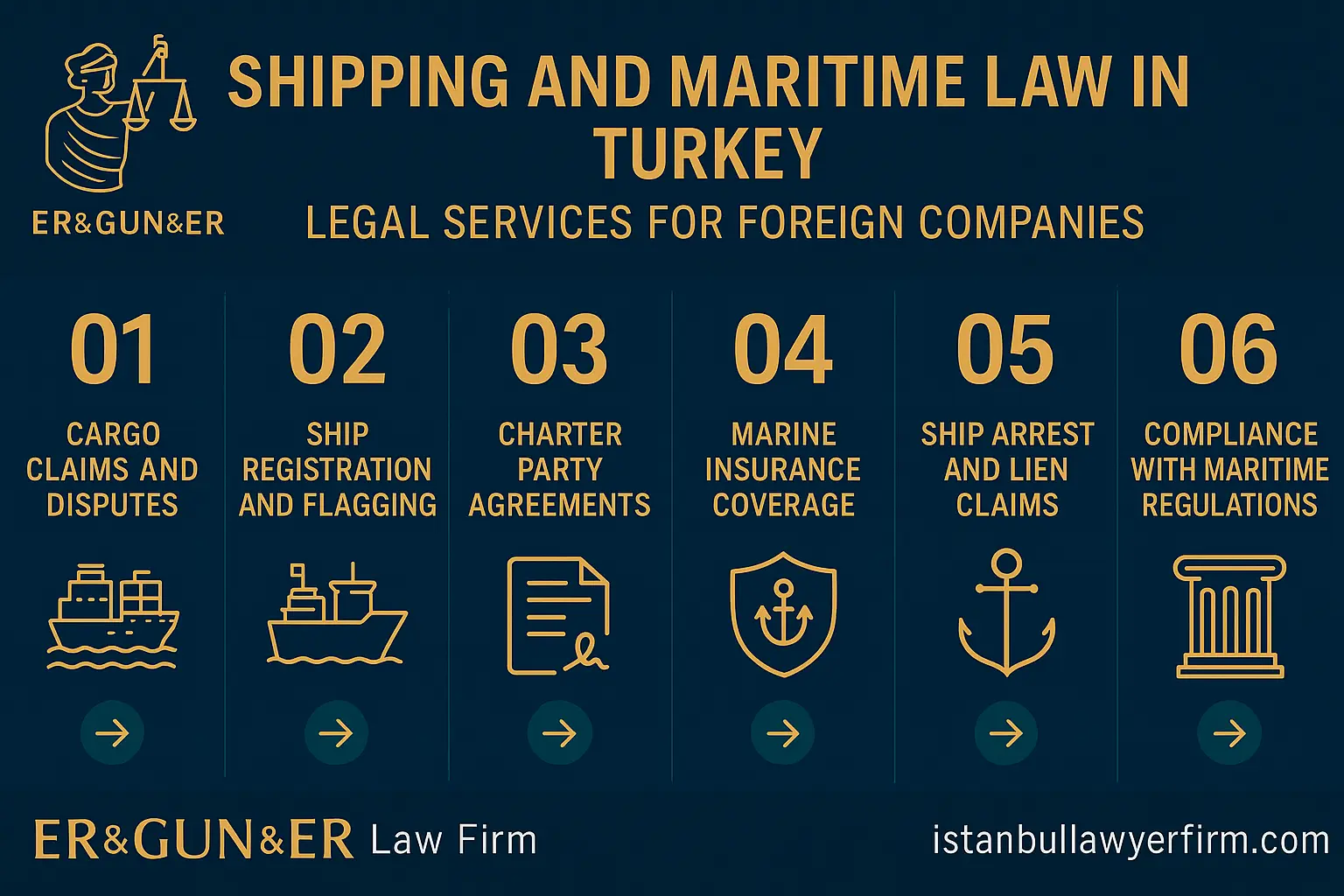
Foreign shipping companies engage with Turkish maritime law through one of two doors: by entering Turkish-flagged ownership through the Turkish International Ship Registry (TUGS) or other registry mechanisms, or by operating foreign-flagged vessels that call at Turkish ports, transit Turkish waters, or carry cargo to or from Turkey. The legal regime is materially different on each side of that distinction. Turkish-flagged operations bring the operator inside the Turkish maritime legal system as a registered Turkish-flag participant, with all the corporate, tax, labour, and regulatory consequences that follow. Foreign-flagged operations bring the operator into Turkish jurisdiction only at the points of contact — port entry, cabotage exclusion, port state control inspection, customs interaction, environmental compliance, ship arrest exposure, and dispute resolution before Turkish courts where the substantive case so requires.
This guide addresses the foreign-operator perspective on Turkish maritime law: the eligibility rules for foreign participation in Turkish-flagged shipping; the cabotage restriction that reserves coastal trading to Turkish-flag operators; the Paris Memorandum of Understanding on Port State Control regime that governs vessel inspections in Turkish ports; the work permit and Maritime Labour Convention requirements for foreign crew working on or through Turkey; the customs and transit log procedures for foreign cargo movements; the exposure to ship arrest in Turkish ports for unpaid maritime claims; the recognition and enforcement of foreign maritime judgments and arbitral awards under the Turkish International Private Law Code (Law No. 5718) and the New York Convention 1958; and the tax considerations that affect foreign shipping operations touching Turkish waters or ports. ER&GUN&ER Law Firm advises foreign shipowners, charterers, freight forwarders, P&I clubs, and lenders on Turkish-side compliance, transactional structuring, and dispute resolution across these dimensions.
The Two Doors: Turkish-Flag Ownership vs Foreign-Flag Operations
The first strategic decision for any foreign shipping company looking at Turkey is whether to operate under the Turkish flag or to bring foreign-flagged tonnage into Turkish trades. The Turkish-flag option opens the cabotage market (domestic Turkish trades), provides access to TUGS tax advantages on international trades, and brings the operator inside the Turkish regulatory perimeter. The foreign-flag option preserves the operator's existing flag-state regime, manning structure, and tax position, but locks the operator out of cabotage and exposes the operator to port state control on every Turkish port call.
The economic case for Turkish-flag operations is strongest where the operator is targeting Turkish coastal trades (where cabotage makes Turkish flag a hard requirement), where the operator is running a fleet that primarily serves Turkish ports and cargoes (where TUGS tax advantages on international trades produce material savings), or where the operator wants to use Turkish-incorporated structures to access Turkish capital markets and bilateral investment treaty protections. The case for foreign-flag operations is strongest where the operator is occasionally calling at Turkish ports as part of broader international trades, where the operator's home-jurisdiction flag is preferred for commercial or financial reasons, or where the operator's existing crewing structure is incompatible with Turkish manning rules.
The decision is not all-or-nothing. Many foreign shipping groups operate hybrid structures with a Turkish-flag arm (typically a Turkish-incorporated operating subsidiary running TUGS-registered vessels in international trades) alongside their foreign-flag operations. The hybrid structure captures the TUGS advantages for the Turkish-touching tonnage while preserving the operator's existing foreign-flag operations elsewhere. We model the decision for every client with material Turkish exposure, because the specific commercial profile of each operator typically determines a different optimal structure than the generic "Turkish flag for Turkish trades" assumption suggests.
Foreign Investment in Turkish-Flagged Shipping: TUGS Eligibility and Structure
The Turkish International Ship Registry under Law No. 4490 of 1999 ("TUGS Law") is the legal instrument that opens Turkish-flag operations to foreign capital. Article 3 of the TUGS Law sets out the eligibility criteria for TUGS registration, which are materially broader than the standard National Ship Registry (MGS) criteria. Vessels owned by Turkish citizens, by Turkish-incorporated companies meeting defined ownership thresholds, by foreign-incorporated companies operating through Turkish branches subject to specific conditions, and by certain other qualifying owners can register under TUGS.
The standard structure for foreign investors entering TUGS-registered shipping is a Turkish-incorporated operating company (typically a joint stock company under TTK Book IV) that owns the vessels and registers them under TUGS. Foreign capital flows into the Turkish operating company as equity or shareholder loan, with the operating company's tax position governed by Turkish corporate income tax law as modified by the TUGS Article 12 exemption on operating income. The foreign investor's return takes the form of dividends from the Turkish operating company (subject to Turkish dividend withholding tax under the corporate tax treaty network) or capital gain on exit (subject to Turkish capital gains rules and the applicable bilateral tax treaty).
The substantive TUGS advantages — corporate income tax exemption on operating income from TUGS-registered vessels, income tax exemption on crew wages, capital gains tax exemption on vessel sales — are conditional and require ongoing compliance with the TUGS Law's operational requirements. The Revenue Administration audits TUGS-claiming operators periodically, and exemptions can be denied retroactively if the conditions are found not to have been met during the audit period. We structure TUGS operations with audit defensibility as a core design parameter, including the documentary trail demonstrating eligibility, the operational separation from non-eligible activities, and the contemporaneous evidence of voyage compliance with the TUGS scope. Practice may vary by authority and year on the specific audit emphasis; the trend has been toward more documentary scrutiny of TUGS claims since 2020.
The Cabotage Restriction on Foreign-Flagged Vessels in Turkish Waters
The Cabotage Law (Law No. 815 of 19 April 1926) reserves Turkish coastal trading to vessels flying the Turkish flag and owned by Turkish nationals or qualifying Turkish-incorporated entities. For foreign shipping operators, the cabotage restriction is the single most consequential gating rule of Turkish maritime law. Article 1 of the Cabotage Law defines reserved coastal trading broadly to include the carriage of passengers or cargo between Turkish ports, fishing in Turkish territorial waters, towage and salvage operations within Turkish waters, and certain port and harbour services.
The practical consequence for foreign operators is that a foreign-flagged vessel cannot load cargo at a Turkish port and discharge it at another Turkish port; cannot carry passengers between Turkish ports; cannot perform towage or salvage operations within Turkish waters as its principal commercial activity; and cannot conduct fishing in Turkish territorial waters. International trades — loading or discharging at a Turkish port with the other end of the voyage outside Turkey — are not affected by the cabotage rule, which is why foreign-flagged tonnage routinely calls at Turkish ports for international cargo movements without any cabotage issue.
Specific exemptions from the cabotage rule are administered under the supervision of the Ministry of Transport and Infrastructure and the Coast Guard. Exemptions exist for certain pleasure craft and yacht operations, scientific research vessels, vessels operating under bilateral or multilateral international agreements that override the cabotage rule, and certain operations connected to offshore energy activities. Each exemption category has specific qualifying conditions and documentary requirements, with case-by-case clearance required for non-standard operations. Practice may vary by authority and year on the granular interpretation of the cabotage scope; the Court of Cassation and the Council of State (Danıştay) have refined the analysis multiple times since the law's enactment, with the trend toward strict interpretation of exemptions.
Port State Control: Turkey's Paris MoU Inspection Regime
Turkey is a member of the Paris Memorandum of Understanding on Port State Control (Paris MoU) and conducts port state control inspections on foreign-flagged vessels calling at Turkish ports under the Paris MoU framework. The inspection regime applies the standardised Paris MoU procedures, with vessel selection based on the New Inspection Regime (NIR) risk profile, the Ship Risk Profile (SRP) calculation, the inspection priority based on time since last inspection and recent deficiency record, and the geographic distribution of the inspection across Paris MoU ports.
Inspection scope follows the Paris MoU procedures: documentary inspection of the certificates required by SOLAS, MARPOL, STCW, ILO, and other applicable conventions; physical inspection of the vessel's structural condition, safety equipment, and operational practices; and detailed inspection of specific systems where the documentary review or initial physical inspection identifies concerns. Deficiencies are recorded in the Paris MoU database (THETIS) and follow the standard Paris MoU classification: deficiency only (rectified before departure), deficiency requiring rectification before next port, or detention (vessel cannot depart until specific deficiencies are corrected).
For foreign operators, the practical consequences of Turkish port state control are: routine inspections add 4-8 hours to the standard port turnaround time; deficiency findings carry forward into the vessel's Paris MoU record and affect inspection frequency at all Paris MoU ports; detention is a serious operational and reputational event with cascading consequences for charter performance, insurance, and future port calls. The legal response framework includes the right to appeal a detention decision through the Turkish administrative procedure, with our practice handling appeals where the detention is procedurally or substantively contestable. Practice may vary by authority and year on the specific deficiencies prioritised in Turkish port state control; the Coast Guard publishes annual inspection statistics that show consistent emphasis on MARPOL Annex I (oil prevention) and SOLAS structural requirements.
Foreign Crew Working in Turkey: Work Permits, MLC, and Social Insurance
Foreign crew working on Turkish-flagged vessels or working ashore in Turkey in connection with shipping operations are subject to the International Labour Force Law (Law No. 6735 of 28 July 2016) and the implementing regulations on foreign work permits. The general rule is that foreign nationals require a work permit to perform any paid employment in Turkey or for a Turkish employer, with the permit obtained from the Ministry of Labour and Social Security through the standard application procedure. Specific exemptions and simplified procedures apply to seafarers under defined circumstances.
For foreign crew on TUGS-registered vessels, the TUGS Law and its implementing regulations relax certain manning rules, allowing non-Turkish crew to a greater extent than the National Ship Registry permits. The work permit framework for these crew members operates through a streamlined process administered jointly by the Ministry of Transport and Infrastructure (for the maritime credentials) and the Ministry of Labour and Social Security (for the work permit). Standard documentation includes the seafarer's identification documents, certificate of competency under STCW, medical fitness certificate, employment contract conforming to MLC standards, and the shipowner's compliance documentation under the TUGS regime.
Social insurance for foreign crew is governed by the Social Insurance Law (Law No. 5510) and the bilateral social security agreements Turkey has concluded with the crew member's home country (where applicable). The general rule is that foreign crew working on Turkish-flagged vessels are subject to Turkish social insurance contributions through the standard SGK (Social Security Institution) framework, with bilateral treaties potentially exempting the crew from Turkish contributions where they remain covered under the home country regime. The MLC 2006 ratified through Law No. 6447 effective 23 August 2017 provides the international framework for seafarer protection that overlays both the Turkish-flag and the foreign-flag analysis. Practice may vary by authority and year on the specific bilateral agreement coverage; the SGK publishes the current bilateral agreement list and the procedural conditions for treaty-based exemption claims.
Customs Interaction for Foreign Cargo Operations
Foreign cargo movements through Turkish ports interact with the Customs Law (Law No. 4458) and the implementing regulations on import, export, transit, and bonded warehousing. The standard interactions for foreign shipping operators include: import customs clearance for cargo discharged at Turkish ports for Turkish destinations; export customs clearance for cargo loaded at Turkish ports for foreign destinations; transit declarations for cargo passing through Turkish ports without entering Turkish customs territory; and bonded warehouse arrangements for cargo held at Turkish ports pending onward shipment.
The transit regime is particularly relevant for foreign-flagged vessels that load and discharge cargo on through-routes that touch Turkish ports. The TIR Carnet system (under the TIR Convention to which Turkey is party) facilitates road and intermodal transit through Turkey, with the maritime leg interfacing with the TIR procedure at the discharge or loading port. The Common Transit Convention to which Turkey acceded provides additional transit facilitation for movements involving Turkey and other Common Transit countries. Both regimes operate through standardised documentary procedures with electronic submission to the Turkish customs authorities.
Customs detention of cargo at Turkish ports is a recurring operational risk for foreign shipping operators. The detention can be triggered by documentary deficiencies (manifest discrepancies, missing certificates of origin, customs valuation disputes), regulatory holds (sanitary and phytosanitary inspection, sanctions screening, dual-use export verification), or enforcement actions (criminal investigation, IP infringement seizure). Resolution of customs detention requires interaction with the customs administration through the standard administrative procedure, with court appeal available where the detention is contested on substantive grounds. Practice may vary by authority and year on specific enforcement priorities; sanctions-related detentions have increased materially since the geopolitical changes of 2022 and require careful documentary preparation in advance of the port call.
Ship Arrest of Foreign-Flagged Vessels in Turkish Ports
Foreign-flagged vessels calling at Turkish ports are subject to the Turkish ship arrest regime under TTK Articles 1352-1376 implementing the 1952 Brussels Arrest Convention to which Turkey acceded through Law No. 6469. The arrest jurisdiction follows the convention principles: arrest is available for the maritime claims listed in Article 1 of the 1952 Convention, the arrest is effected by court order issued by the competent commercial court of the port where the vessel is located, and the vessel can be detained pending the provision of security calibrated to the claim amount.
The practical exposure for foreign operators is that any port call at a Turkish port creates the opportunity for arrest action by any creditor with a maritime claim against the vessel or its owner. Common triggering claims include unpaid bunker invoices from Turkish or foreign suppliers, unpaid port and pilotage dues, salvage and towage fees from prior incidents, crew wage claims, charter party damages, cargo damage claims, and collision damage claims. The arrest can be obtained on an ex parte basis with documentary support, and the vessel detention can begin within hours of the petition being filed.
The standard response framework for the foreign owner facing arrest is to provide a P&I Club Letter of Undertaking (LOU) as substitute security, obtaining vessel release while the substantive dispute proceeds in the appropriate forum (Turkish court, foreign court, or arbitration). The LOU mechanic is operationally efficient and well-established in Turkish maritime practice, with International Group P&I Club LOUs accepted by the Turkish maritime courts in the vast majority of cases. Where the LOU is not available or not accepted, a bank guarantee or cash deposit serves the same function. Wrongful arrest claims are available where the petitioner's claim was unfounded or the arrest was obtained on materially false documentary submissions, with damages calculated on the operational losses caused by the wrongful detention. Practice may vary by authority and year on the security level demanded; the trend has been toward standardisation around the underlying claim amount with reasonable margins for interest and procedural costs.
Pollution Liability for Foreign Vessels Under Turkish Waters
Foreign vessels in Turkish waters are subject to the same pollution liability regime that applies to Turkish-flagged vessels: the Civil Liability Convention 1992 (CLC, ratified by Law No. 4658) for tankers carrying persistent oil; the Bunker Convention 2001 (ratified by Law No. 5934) for bunker oil from any vessel; MARPOL 73/78 with all six Annexes for operational discharges; and Law No. 5312 on Response to Pollution of the Marine Environment by Petroleum and Other Harmful Substances for the domestic response and compensation framework.
The CLC and Bunker Convention impose strict liability on the registered shipowner for pollution damage from oil escape or discharge, with compulsory insurance requirements for vessels above defined size thresholds. The vessel's insurance certificate (the "Blue Card") evidencing CLC or Bunker Convention coverage must be available for inspection and is verified during port state control inspections. Vessels lacking the required insurance certificate face port denial, detention, and administrative fines.
The domestic response regime under Law No. 5312 imposes obligations on the polluter to fund response operations, with the calculation of compensable damage covering both clean-up costs and broader environmental restoration. The Coast Guard directs response operations and has authority to order vessel detention, vessel arrest under maritime claim procedures, and emergency action at the polluter's expense where the polluter does not respond promptly. Foreign operators facing pollution incident exposure in Turkish waters need integrated legal and operational response capability, with the P&I club, the local correspondents, and the Turkish maritime counsel working in coordination from the first hours of the incident. Practice may vary by authority and year on the calculation of administrative fines; the maximum fine levels under the Environmental Law (Law No. 2872) have been increased multiple times since 2018.
Cross-Border Charter Party Disputes: Forum, Law, and Enforcement
Charter party disputes involving foreign operators typically arise under English law (the dominant choice for international charter parties) with London Maritime Arbitrators Association (LMAA) arbitration as the dispute resolution mechanism. The Turkish-side analysis focuses on the points where the Turkish jurisdiction interacts with the foreign-law-governed dispute: ship arrest in Turkish ports as security for the foreign-seated arbitration; recognition and enforcement of the resulting arbitral award in Turkey under the New York Convention 1958; and the Turkish-law analysis of any subsidiary contracts (sub-charters, port operations agreements, bunker supply contracts) that may be governed by Turkish law even where the head charter is governed by English law.
Ship arrest in support of foreign arbitration is procedurally available in Turkey, with the Turkish maritime courts willing to grant arrest on the basis of the arbitral claim where the underlying maritime claim is well-documented. The arrest can be obtained and maintained alongside the substantive arbitration, with the security demanded by the Turkish court typically released to the prevailing party once the foreign arbitral award is recognised in Turkey. Practice may vary by authority and year on the specific procedural requirements; the Turkish courts have generally been cooperative in supporting foreign-seated arbitration through the arrest mechanism.
Recognition and enforcement of foreign arbitral awards proceeds under the New York Convention 1958 acceded to by Turkey through Law No. 3731 effective 25 September 1991. The standard Convention defences are available to the resisting party, with the Turkish commercial courts handling recognition and enforcement on a procedural framework that has matured significantly since the 1990s. The enforcement timeline is typically 6-18 months at first instance, with appeal rights extending the overall process to 2-4 years in fully-contested cases. We coordinate the Turkish-side recognition and enforcement strategy with the foreign-side arbitration team for every cross-border maritime dispute, because the Turkish enforcement step often determines the practical recovery on a foreign arbitral win.
Recognition and Enforcement of Foreign Maritime Judgments and Awards
Foreign maritime judgments — court judgments from foreign courts in maritime disputes — are enforceable in Turkey under the Turkish International Private Law Code (Law No. 5718 of 2007, "MÖHUK") Articles 50-59. The standard recognition test under Article 54 requires: a final and binding foreign judgment from a court with jurisdiction under MÖHUK rules; reciprocity with the issuing jurisdiction (either by treaty or by establishing actual reciprocity in practice); compatibility with Turkish public order; and proper service on the defendant in the foreign proceedings.
The reciprocity requirement is the most operationally significant filter. Bilateral judicial cooperation treaties simplify enforcement against jurisdictions that have such treaties with Turkey. For other jurisdictions, the petitioner must demonstrate that the foreign court would in practice enforce a Turkish judgment in similar circumstances — a documentary exercise that requires legal opinions and case examples from the foreign jurisdiction. The reciprocity test has been a meaningful obstacle to enforcement of judgments from jurisdictions without strong cooperation history with Turkey.
Foreign arbitral awards face a materially easier enforcement path under the New York Convention 1958. The Convention's standard defences (lack of arbitration agreement, defective composition of tribunal, scope excess, due process violation, public policy, non-arbitrability) are exhaustive, with no separate reciprocity requirement beyond the Convention's reciprocity reservation. This is the dominant reason why arbitration is the preferred dispute resolution mechanism in cross-border maritime contracts: the enforcement path in Turkey is materially more predictable than the path for foreign court judgments. We design the dispute resolution architecture for cross-border shipping contracts with the Turkish enforcement step explicitly in view, because the contract that produces a Turkish-enforceable award is structurally more valuable than the contract that produces an unenforceable foreign judgment. Practice may vary by authority and year on the specific application of New York Convention defences; the Court of Cassation has issued multiple decisions refining the public policy analysis in particular.
Tax Considerations for Foreign Shipping Operations in Turkey
Foreign shipping operators with Turkish exposure encounter several specific Turkish tax interactions. The first is the corporate income tax position of any Turkish branch or subsidiary the foreign operator establishes for Turkish operations: Turkish-incorporated subsidiaries are subject to corporate income tax under Law No. 5520 at the standard rate (currently 25% under the post-2024 framework) on their worldwide income, with the TUGS exemption available for TUGS-registered vessel operations as discussed above. Turkish branches of foreign companies are subject to corporate income tax on their Turkey-source income, with the branch profits also subject to a branch profits tax on remittance to head office.
The second interaction is the source-country withholding regime on payments from Turkish payors to foreign shipping operators. Charter hire payments by Turkish charterers to foreign shipowners are subject to withholding tax under the standard Turkish source rules, with relief typically available under the bilateral tax treaty network. The standard treaty position on shipping income (typically following OECD Model Convention Article 8) gives the home country of the operator exclusive taxing rights over international shipping profits, which removes the Turkish withholding obligation for treaty-protected operators. The procedural requirement is the foreign operator's certificate of tax residence in their home jurisdiction, presented to the Turkish payor before payment.
The third interaction is the value-added tax (KDV) position of shipping services. International transportation services are generally KDV-exempt under VAT Law (Law No. 3065) Article 14. Domestic Turkish transportation is KDV-taxable at the standard rate. The domestic-vs-international distinction tracks the geographic scope of the service rather than the contracting parties' nationality, which means a foreign operator providing international transportation that touches Turkey can structure to maintain the KDV exemption with proper documentation. Practice may vary by authority and year on the specific documentary requirements for KDV exemption claims; the Revenue Administration has refined the requirements multiple times since the original implementation.
Practical Operational Compliance for Port Calls
Beyond the substantive legal framework discussed above, every Turkish port call by a foreign-flagged vessel requires specific procedural compliance with port operational rules. The standard pre-arrival requirements include the Notice of Arrival to the port authority and the Coast Guard at the prescribed lead time (typically 24-72 hours depending on vessel category and cargo), the submission of the standard FAL documents (crew list, passenger list, cargo manifest, dangerous cargo declaration, ship's stores declaration, crew effects declaration, maritime declaration of health), and the vessel security pre-arrival information under the ISPS Code.
On arrival, the vessel must present for inspection by the port authority, customs, immigration, sanitary inspection, and (for vessels in scope) port state control. Each agency has its own documentary and physical inspection requirements, with the port agent typically coordinating the agency interactions on behalf of the vessel. Standard documentation includes the vessel's certificates (registry, classification, safety, security, environmental), the crew documentation (CDC, identity documents, work permits where applicable), and the cargo documentation (bills of lading, manifests, certificates of origin, sanitary certificates).
Departure clearance requires the vessel to be in good standing with all the agencies that inspected on arrival, with port dues and pilotage and other operational charges paid (or guaranteed under standing arrangements with the port agent). Clearance delays at the departure stage typically result from outstanding administrative findings (port state control deficiencies requiring rectification, customs questions on cargo, immigration issues with crew changes), unpaid charges (port dues, pilotage, agency fees), or interim legal action (ship arrest, customs detention, court orders). We support foreign operators with both the routine port-call compliance and the response to non-routine events that can extend port stays beyond schedule. Practice may vary by authority and year on the specific port procedures; each major Turkish port (Istanbul, Ambarlı, Tekirdağ, İzmit, İzmir, Mersin, Iskenderun) operates under its own port-specific rules within the national regulatory framework.
Frequently Asked Questions
- Can a foreign company own a Turkish-flagged vessel? Yes, through Turkish-incorporated structures meeting the eligibility conditions of the National Ship Registry (Law No. 6102) or the Turkish International Ship Registry (Law No. 4490). TUGS in particular accommodates broader foreign ownership than the standard MGS.
- What is the cabotage restriction? Under Law No. 815 of 1926, coastal trading between Turkish ports is reserved to Turkish-flagged vessels owned by Turkish nationals or qualifying Turkish entities. Foreign-flagged vessels cannot perform domestic coastal trading except under specific exemptions.
- Can foreign-flagged vessels call at Turkish ports? Yes, for international trades (loading or discharging at a Turkish port with the other end of the voyage outside Turkey). Cabotage limits only domestic Turkey-to-Turkey trades.
- Is Turkey a Paris MoU member? Yes. Turkey is a full member of the Paris Memorandum of Understanding on Port State Control and conducts inspections under Paris MoU procedures with results recorded in THETIS.
- Do foreign crew need work permits to work in Turkey? Yes, under the International Labour Force Law (No. 6735 of 2016). Streamlined procedures apply to seafarers under defined conditions, particularly for crew on TUGS-registered vessels.
- Are Turkish social security contributions required for foreign crew? Generally yes, under Law No. 5510, for foreign crew working on Turkish-flagged vessels. Bilateral social security treaties can exempt the crew from Turkish contributions where they remain covered under the home country regime.
- Can a foreign-flagged vessel be arrested in a Turkish port? Yes. Turkey is party to the 1952 Brussels Arrest Convention (ratified by Law No. 6469), and foreign-flagged vessels in Turkish ports are subject to arrest for the maritime claims listed in the Convention.
- What security can be provided to release an arrested vessel? A P&I Club Letter of Undertaking (LOU) is the standard form, accepted by Turkish maritime courts in the vast majority of cases. Bank guarantees and cash deposits also work.
- What pollution liability applies to foreign vessels in Turkish waters? The same regime that applies to Turkish-flagged vessels: CLC 1992 (Law No. 4658) for persistent oil tankers; Bunker Convention 2001 (Law No. 5934) for bunker oil; MARPOL 73/78 with all six Annexes; and Law No. 5312 on domestic pollution response.
- Can foreign court judgments be enforced in Turkey? Yes, under the Turkish International Private Law Code (Law No. 5718) Articles 50-59, subject to the standard enforcement test including reciprocity. Bilateral judicial cooperation treaties simplify enforcement against treaty-jurisdiction judgments.
- Are foreign arbitral awards easier to enforce than foreign court judgments? Yes. The New York Convention 1958 (acceded by Turkey through Law No. 3731 effective 25 September 1991) provides a more predictable enforcement path with exhaustive defences, which is why arbitration is the standard dispute resolution choice in cross-border maritime contracts.
- Are international shipping services subject to Turkish VAT? International transportation services are generally KDV-exempt under VAT Law (Law No. 3065) Article 14. Domestic Turkish transportation is KDV-taxable at the standard rate. Documentary compliance is required to maintain the international exemption.
- Are charter hire payments to foreign shipowners subject to Turkish withholding tax? Subject to withholding under standard Turkish source rules, with relief typically available under bilateral tax treaty Article 8 (international shipping profits). Treaty residence certificate is required to claim treaty relief.
- Is the Bosphorus governed differently from other Turkish waters? Yes. The Montreux Convention of 1936 governs the international regime of the Turkish Straits, with Turkey's domestic authority exercised through the Turkish Straits Maritime Traffic Regulation of 1998. Specific transit rules and pilotage requirements apply.
- Where does ER&GUN&ER Law Firm support foreign shipping operations in Turkey? TUGS structuring and registration; cabotage analysis and exemption applications; port state control defence and detention appeals; foreign crew work permits and MLC compliance; customs interaction; ship arrest representation (both petitioning and defending); pollution incident response; cross-border dispute resolution; and recognition/enforcement of foreign judgments and arbitral awards under MÖHUK and the New York Convention.
Author: Mirkan Topcu is an attorney registered with the Istanbul Bar Association (Istanbul 1st Bar), Bar Registration No: 67874. His practice focuses on cross-border and high-stakes matters where evidence discipline, procedural accuracy, and risk control are decisive.
He advises foreign shipowners, charterers, freight forwarders, P&I clubs, marine insurers, and lenders financing foreign-flagged tonnage trading to Turkey across Maritime and Shipping Law, TUGS Structuring, Port State Control Defence, Ship Arrest, Pollution Liability, Foreign Crew Compliance, Cross-Border Dispute Resolution, and Foreign Judgment/Award Recognition under MÖHUK and the New York Convention.
Education: Istanbul University Faculty of Law (2018); Galatasaray University, LL.M. (2022). LinkedIn: Profile. Istanbul Bar Association: Official website.