

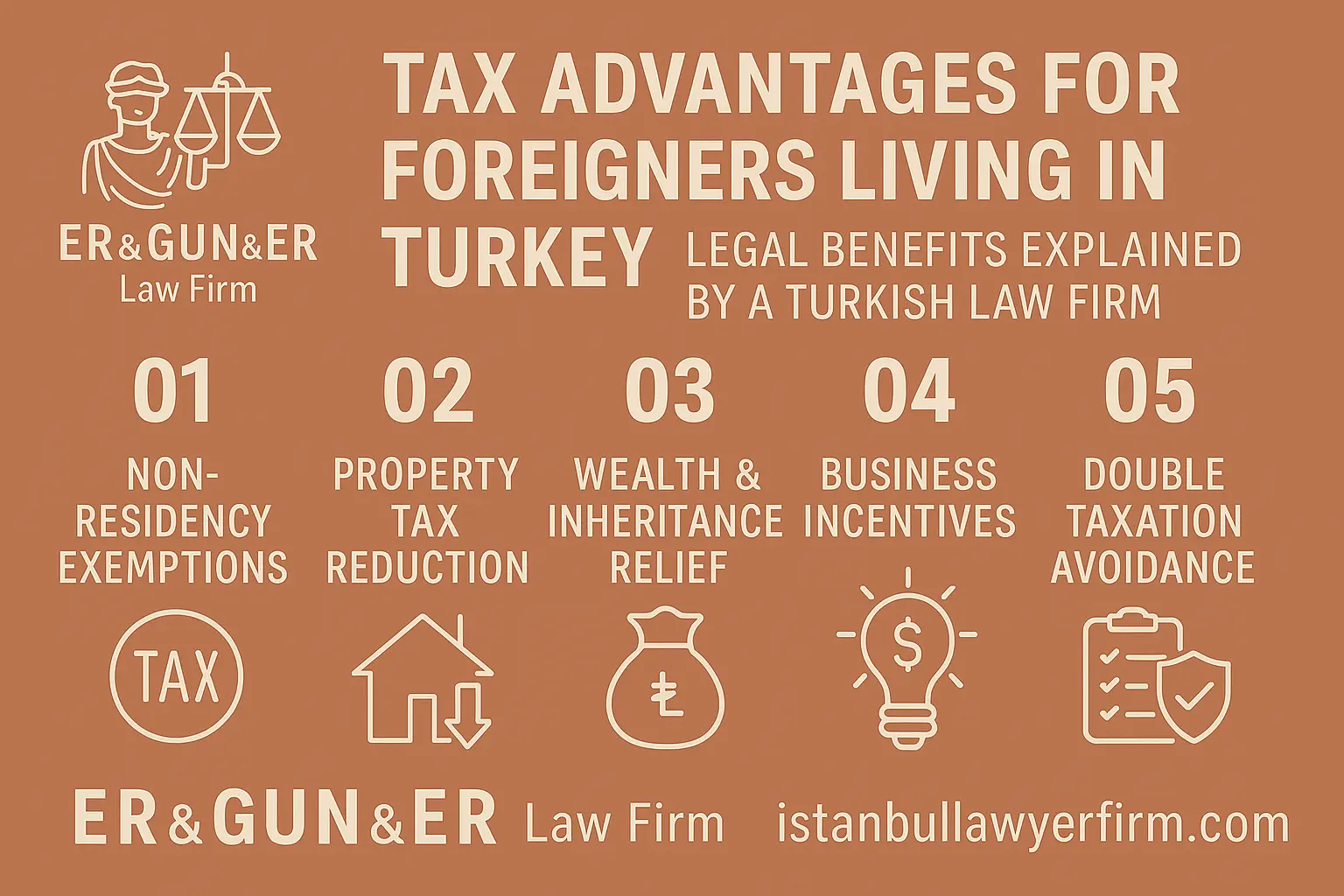
Foreigners residing or investing in Türkiye operate under a tax framework defined principally by the Income Tax Law (Law No. 193, the "GVK"), the Corporate Tax Law (Law No. 5520, the "KVK"), the Value Added Tax Law (Law No. 3065, the "KDVK"), the Tax Procedure Law (Law No. 213, the "VUK"), and the network of bilateral double taxation treaties (DTTs) Türkiye has signed with over 85 countries based on the OECD Model Tax Convention. Specific incentive regimes operate under the R&D Activities Support Law (Law No. 5746), the Technology Development Zones Law (Law No. 4691), the Free Zones Law (Law No. 3218), and the Investment Incentives Decree (Council of Ministers Decision No. 2012/3305). Cross-border reporting obligations operate under the FATCA Intergovernmental Agreement (signed 29 July 2015, ratified by Law No. 7018) and the OECD Common Reporting Standard (CRS) implemented through the Multilateral Competent Authority Agreement.
The framework distinguishes between full tax liability (tam mükellefiyet) under GVK Article 3 — applying to residents who are taxed on worldwide income — and limited tax liability (dar mükellefiyet) under GVK Article 6 — applying to non-residents who are taxed only on Turkish-source income under GVK Article 7. Resident status is determined under GVK Article 4 by either Turkish domicile or continuous residence in Türkiye for more than six months in a calendar year. The framework offers genuine tax planning opportunities — VAT exemption on foreigners' first real estate purchase under KDVK Article 13(i), capital gains exemptions for individuals under GVK Articles 80-82, R&D and software income exemptions under Laws 5746 and 4691, Free Zone exemptions under Law 3218, reduced corporate tax rates under KVK Article 32/A for incentivized investments, and treaty-based withholding rate reductions — but these benefits require proper structuring, documentation, and ongoing compliance. ER&GUN&ER Law Firm advises foreign individuals, expatriate professionals, foreign-owned companies, and high-net-worth investors on residency determination, tax-optimal investment structuring, DTT application and Tax Residency Certificate (Mali İkamet Belgesi) procurement, R&D and TDZ incentive applications, withholding tax reduction, FATCA/CRS compliance, and tax audit defence before the Revenue Administration (Gelir İdaresi Başkanlığı) and Tax Courts. Practice may vary by authority and year — check current guidance.
Tax Residency Framework Under GVK Articles 3-7
Tax residency in Türkiye is determined under GVK Article 4 (Income Tax Law, Law No. 193 of 31 December 1960). A person is a Turkish tax resident — and therefore subject to full tax liability under GVK Article 3 on worldwide income — if either of two alternative tests is met: domicile in Türkiye (ikametgâhı Türkiye'de bulunanlar) under Civil Code (Law No. 4721) framework, or continuous residence in Türkiye for more than six months (bir takvim yılı içinde Türkiye'de devamlı olarak altı aydan fazla oturanlar) within a calendar year. Temporary departures do not interrupt the six-month count. The "more than six months" Turkish domestic threshold is conceptually similar to but distinct from the 183-day threshold commonly used in DTT residency tie-breaker rules under OECD Model Article 4.
GVK Article 5 provides important exceptions: foreign government officials and consular staff, scientists and specialists, business representatives, journalists, students, healthcare seekers, and persons in custody whose stay in Türkiye exceeds six months are nonetheless not deemed Turkish tax residents. These statutory exceptions can preserve non-resident status for legitimate cross-border professionals despite extended Turkish presence. GVK Article 6 establishes limited tax liability (dar mükellefiyet) for non-residents, who are taxed only on Turkish-source income as defined in GVK Article 7 — which lists specific categories including income from immovable property in Türkiye, business income earned through a permanent establishment in Türkiye, employment income from work performed in Türkiye, dividend income from Turkish entities, interest from Turkish sources, royalties from Turkish licensees, and capital gains on Turkish assets. Non-residents not earning these specified Turkish-source incomes have no Turkish income tax filing obligation. Practice may vary by authority and year — check current guidance.
Residency determination under GVK Article 4 has practical consequences across multiple tax categories. A Turkish tax resident must declare worldwide income on the annual income tax return under GVK Articles 85-92, with foreign tax credit available under GVK Article 123 for foreign taxes paid on the same income (subject to limits). A non-resident has no declaration obligation for foreign-source income but faces Turkish withholding taxes under GVK Article 94 on Turkish-source dividends, interest, and royalties — typically 10% on dividends from joint stock companies, 15% on dividends from limited liability companies, and 20% on royalties under domestic rates, often reduced under applicable DTTs. The residency analysis also affects social security obligations under SGK Law (Law No. 5510), inheritance tax exposure under Law 7338, and reporting obligations under FATCA and CRS regimes. Documentation of presence (entry-exit records, lease agreements, utility bills) becomes critical evidence under VUK if residency is later contested by the Revenue Administration.
Full vs Limited Liability: Which Regime Applies
The choice between full and limited liability is not elective — it is determined by GVK Article 4 facts. However, the practical effect depends heavily on the source of the foreigner's income. For a foreign retiree receiving foreign pensions and holding minimal Turkish assets, full liability under GVK Article 3 brings the foreign pension into the Turkish tax base — although DTT relief may eliminate or reduce Turkish tax under typical pension articles (most Turkish DTTs assign primary or exclusive taxing rights on pensions to the residence state, so a Turkish-resident retiree may pay only Turkish tax on a foreign pension; a non-resident retiree pays only the source state's tax). For an expatriate executive working in Türkiye on assignment, full liability brings worldwide compensation into the Turkish base, but DTT employment articles (Article 15 of typical Turkish DTTs) and the foreign tax credit under GVK Article 123 mitigate double taxation.
For foreign investors holding only Turkish-source investment assets, limited liability under GVK Article 6 confines Turkish tax to the Turkish-source items under GVK Article 7. Withholding taxes under GVK Article 94 typically discharge the non-resident's Turkish tax obligation on dividends, interest, and royalties — meaning the non-resident pays the withholding rate (or treaty-reduced rate) at source and need not file a Turkish income tax return for those items. Where the non-resident must declare (for example, for capital gains exceeding statutory thresholds), the limited liability return covers only the Turkish-source items. The structural attractiveness of limited liability for foreign passive investors is significant — but it depends on actually maintaining non-resident status under GVK Article 4 by managing Turkish presence carefully. Practice may vary by authority and year — check current guidance.
The transition between regimes mid-year creates compliance complexity that VUK procedural framework addresses through partial-year filings. A foreigner moving to Türkiye and triggering full liability mid-year files a Turkish return covering worldwide income from the residency commencement date, with documentation establishing the precise commencement date. A Turkish resident leaving Türkiye and ending residency mid-year files a return covering worldwide income up to departure and may face an exit-related declaration depending on income types and timing. Careful documentation through entry-exit records issued by the Migration Management Presidency (Göç İdaresi Başkanlığı) and address registration changes with the Civil Registry (Nüfus Müdürlüğü) under Law 5490 supports the residency commencement and termination determinations.
Foreign-Source Income and the Foreign Tax Credit
Turkish tax residents under GVK Article 3 must declare worldwide income, but GVK Article 123 provides a foreign tax credit (yabancı ülkelerde ödenen vergilerin mahsubu) to prevent juridical double taxation. The credit is limited to the Turkish tax that would have been imposed on the same foreign-source income — meaning if the foreign tax exceeds the Turkish tax on the same income, the excess is not refunded but cannot reduce Turkish tax on other income. The credit requires documentary proof of foreign tax payment, typically through foreign tax authority certificates apostilled under the Hague Apostille Convention 1961 (Türkiye party since 1985 through Law No. 6303) and translated into Turkish under HMK Article 223 by sworn translators registered with Turkish notaries.
Where a DTT applies, treaty relief mechanisms operate in parallel with the unilateral GVK Article 123 credit. Most Turkish DTTs (which follow the OECD Model Tax Convention with adaptations) assign primary or exclusive taxing rights to one of the contracting states for specific income categories: real estate income to the source state under Article 6, business profits to the residence state unless attributable to a permanent establishment under Article 7, dividends with a reduced source-state withholding cap under Article 10 (typically 5-15% depending on the holding percentage), interest with a reduced source-state cap under Article 11 (typically 10-15%), royalties with a reduced source-state cap under Article 12 (typically 10%), capital gains with rules varying by asset type under Article 13, employment income to the work-performance state under Article 15, and pensions typically to the residence state under Article 18. Practice may vary by authority and year — check current guidance.
Turkish DTT application requires a Tax Residency Certificate (Mali İkamet Belgesi) issued by the Revenue Administration (Gelir İdaresi Başkanlığı) under VUK framework, attested by foreign tax authorities for treaty residency claims abroad, and corresponding foreign tax residency certificates for treaty residency claims in Türkiye. The certificate procurement process involves filing the standard application with the relevant Tax Office (Vergi Dairesi) along with proof of Turkish tax registration and residence. For non-residents seeking to apply Turkish DTT benefits to reduce Turkish withholding under GVK Article 94, the foreign tax authority's residency certificate must be filed with the Turkish withholding agent (typically a Turkish bank or company making the payment) before the payment, accompanied by sworn Turkish translation. Failure to provide timely certification means full domestic withholding applies, with the non-resident bearing the burden of seeking treaty refund retrospectively through the Turkish Revenue Administration.
The Turkish DTT Network and OECD Model
Türkiye maintains a comprehensive DTT network with over 85 countries, generally based on the OECD Model Tax Convention with country-specific variations reflecting bilateral negotiations. Major DTTs include those with Germany (1985, revised 2011), the United Kingdom (1986, with protocol amendments), the United States (1996), the Netherlands (1986, revised 2009), France (1987), Italy (1990), Russia (1997, revised 2017), the United Arab Emirates (1993), Switzerland (2010), Saudi Arabia (2007), Kazakhstan (1995), Azerbaijan (1994), and the Gulf Cooperation Council states. Each DTT contains specific articles addressing income categories with country-specific withholding caps, tie-breaker rules for dual residents under Article 4, permanent establishment definitions under Article 5, and methods of relief from double taxation under Article 23 (typically credit method, occasionally exemption method).
The Mutual Agreement Procedure (MAP) under typical Article 25 of Turkish DTTs allows competent authority resolution of treaty disputes — including transfer pricing adjustments, dual residency conflicts, and treaty interpretation disagreements. The Turkish competent authority is the Revenue Administration's International Tax Department, and MAP requests must generally be filed within three years of the first notification of the action giving rise to taxation contrary to the treaty, although DTT-specific time limits apply. Türkiye is signatory to the Multilateral Convention to Implement Tax Treaty Related Measures to Prevent Base Erosion and Profit Shifting (the BEPS Multilateral Instrument or "MLI") signed on 7 June 2017, which modifies multiple Turkish DTTs simultaneously to incorporate BEPS minimum standards including the Principal Purpose Test (PPT) anti-abuse rule under MLI Article 7. Practice may vary by authority and year — check current guidance.
DTT residence tie-breaker rules under OECD Model Article 4 paragraph 2 apply where an individual qualifies as resident in both contracting states under their respective domestic laws — for example, a person domiciled in the United Kingdom but spending more than six months in Türkiye in a calendar year. The tie-breaker tests apply sequentially: permanent home availability, then centre of vital interests (personal and economic ties), then habitual abode, then nationality, then mutual agreement between competent authorities. Resolving dual residency conclusively under treaty tie-breaker rules requires factual documentation including property ownership records, family residence patterns, business activities, banking relationships, and social ties. Where the tie-breaker resolves residency to the foreign state, the individual is treated as a non-resident for treaty purposes while remaining a Turkish domestic resident under GVK Article 4 — meaning treaty-protected items are not taxed in Türkiye but Turkish-source items remain subject to Turkish tax under treaty source-state rules.
Real Estate Investment: KDVK 13(i) VAT Exemption and Capital Gains
Real estate investment by foreigners in Türkiye benefits from a significant VAT exemption under VAT Law (Law No. 3065) Article 13(i), which exempts the first acquisition of residential or commercial real estate by foreign individuals not residing in Türkiye, foreign legal entities not having a permanent establishment in Türkiye, and Turkish citizens residing abroad continuously for more than six months. The exemption applies to the first delivery (ilk teslim) by the property developer or seller of newly built property — meaning resale transactions between owners are not eligible. Eligibility conditions include: payment in foreign currency transferred from abroad through a Turkish bank with corresponding foreign-exchange purchase certificate (döviz alım belgesi), holding the property for at least one year before resale (sale within one year triggers retroactive VAT liability with penalty interest under VUK), and proper declaration of the exemption claim at the time of acquisition.
Turkish VAT rates on real estate acquisitions vary by property type and area: residential property up to 150 square metres net area in non-luxury developments may benefit from reduced 1% VAT under Council of Ministers Decision No. 2007/13033 (with adjustments in subsequent decisions); larger or luxury residential and commercial property is subject to 20% standard VAT. The KDVK Article 13(i) exemption — when applicable — eliminates this VAT cost entirely for qualifying foreign buyers, representing significant savings on high-value purchases. Title deed transfer fees (tapu harcı) under the Fees Law (Law No. 492) apply separately at 4% of the declared property value (split 2% buyer / 2% seller as legal default, often shifted by contract to one party) and are not exempted under KDVK 13(i). Practice may vary by authority and year — check current guidance.
Capital gains on real estate sales are governed by GVK Article 80 (incidental income, arızi kazanç) for non-business sellers and GVK Article 82 (commercial income) for business sellers. Under GVK Article 80, gains from sale of real estate held for more than five years by an individual non-business taxpayer are exempt from income tax — the holding period exemption applying regardless of nationality. Gains realised within five years are taxable as incidental income, with the gain calculated as sale price minus indexed acquisition cost (using TÜFE inflation index under VUK) minus deductible transaction costs. For non-resident sellers, the same calculation applies under GVK Article 7 and Article 80; the buyer or notary acting as paying party may be required to withhold under GVK Article 94 on gains attributable to foreign sellers, with the seller filing a Turkish return for final assessment. The five-year exemption represents a significant planning tool for long-term foreign property holders.
Investment Incentives Under Decision 2012/3305 and KVK Article 32/A
Türkiye's primary investment incentive regime operates under the Investment Incentives Decree (Council of Ministers Decision No. 2012/3305), which classifies investments into four schemes: General Investment Incentive Scheme, Regional Investment Incentive Scheme, Priority Investment Incentive Scheme, and Strategic Investment Incentive Scheme. Each scheme provides a different combination of incentives drawn from the menu including: VAT exemption on machinery and equipment imports and domestic acquisitions; customs duty exemption on imported machinery and equipment; reduced corporate tax rates under KVK Article 32/A (with reductions ranging from 30% to 90% of the standard 25% rate, applied until the cumulative tax saving reaches a specified contribution-to-investment ratio); social security premium employer support under SGK framework; income tax withholding support; interest support on investment loans; land allocation in industrial zones; and VAT refund for buildings under construction.
Scheme eligibility depends on investment amount thresholds, sectoral classification under the Decision's annexes, geographic location (Türkiye is divided into six investment zones with Zone 6 receiving the highest support, intended to drive development in less industrialised regions including parts of Eastern and Southeastern Anatolia), and strategic priority criteria. The application is filed with the Ministry of Industry and Technology (Sanayi ve Teknoloji Bakanlığı) for the Investment Incentive Certificate (Yatırım Teşvik Belgesi) before commencement of the investment. Foreign-invested companies established under Turkish Commercial Code (Law No. 6102) have equal access to the incentive regime as Turkish-owned companies under the principle of national treatment confirmed by the Foreign Direct Investment Law (Law No. 4875) Article 3. Practice may vary by authority and year — check current guidance.
The reduced corporate tax rate under KVK Article 32/A is among the most valuable incentive elements for capital-intensive investments. The standard corporate tax rate increased to 25% from 1 January 2024 under amendments by Law No. 7456. Under KVK 32/A, qualifying investments receive a reduced rate that may go as low as 2.5% (90% reduction) for the highest-priority investments in Zone 6, applied to all corporate income (not just income from the incentivized investment) until the cumulative tax saving equals a specified percentage of the investment amount (the contribution-to-investment ratio, ranging from 15% to 50%). Strategic investments — meeting criteria including high technology content, import substitution, and minimum investment thresholds — receive enhanced parameters. Tax planning around KVK 32/A requires careful coordination of investment timing, certificate scope, and income recognition under VUK accounting principles.
R&D Incentives Under Law 5746 and TDZ Under Law 4691
The R&D Activities Support Law (Law No. 5746 of 28 February 2008) provides comprehensive incentives for qualifying R&D, design, and innovation activities. Under Law 5746 Article 3, eligible R&D expenditures benefit from: 100% deduction from corporate or income tax base under VUK (representing immediate expense recognition rather than capitalisation); income tax withholding exemption on salaries paid to R&D personnel (effectively a salary subsidy ranging from 80% for personnel with PhD or master's degrees to 95% for support personnel meeting specified criteria); social security premium employer support of 50% under SGK framework; stamp duty exemption under Stamp Duty Law (Law No. 488) on R&D-related documents; and customs duty exemption on imported R&D equipment. Eligibility requires either operation of an R&D Centre certified by the Ministry of Industry and Technology with at least 15 full-time R&D personnel (reduced to 10 for certain sectors), or participation in an R&D project supported by TÜBİTAK or another qualifying funding source.
The Technology Development Zones Law (Law No. 4691 of 26 June 2001) provides distinct and significant incentives for software and technology companies operating within designated TDZs (commonly known as Teknoparks): exemption from income and corporate tax on income derived from software development and R&D activities until 31 December 2028 under the current sunset (extended by successive amendments); income tax withholding exemption on salaries of R&D, software, and design personnel; VAT exemption under KDVK on sales of qualifying software products to domestic and foreign customers; social security premium employer support under SGK; and stamp duty exemption. Major TDZs include İTÜ ARI Teknokent, Bilkent Cyberpark, ODTÜ Teknokent, Yıldız Teknopark, and dozens of other zones across Türkiye. Foreign-owned technology companies establishing Turkish subsidiaries operating from a TDZ can benefit from these incentives equally with Turkish-owned companies. Practice may vary by authority and year — check current guidance.
The Law 5746 R&D incentive and the Law 4691 TDZ incentive can be complementary in some structures but cannot generally be combined for the same activity under anti-double-dipping rules in implementing regulations. Choice between regimes depends on: the nature of activity (Law 4691 requires actual presence in a designated TDZ with rented or owned office space; Law 5746 R&D Centre regime can operate in any location subject to certification); the personnel scale (Law 5746 R&D Centre requires 15 R&D personnel; Law 4691 TDZ has lower headcount thresholds for some activities); the income type (Law 4691 specifically targets software and technology product income; Law 5746 covers broader R&D activity expenditure); and the long-term strategy. Both regimes require ongoing reporting to the Ministry and submission to periodic audit, with disqualification consequences for non-compliance under VUK principles.
Free Zones Under Law 3218
The Free Zones Law (Law No. 3218 of 6 June 1985) establishes designated free zones (serbest bölgeler) where companies operating under a Free Zone Operating Licence (Serbest Bölge Faaliyet Ruhsatı) issued by the Ministry of Trade benefit from comprehensive tax and customs advantages. Under Law 3218 Article 6, qualifying free zone activities benefit from: corporate and income tax exemption on manufacturing income for Free Zone Operating Licence holders engaged in production activities (the production exemption); income tax withholding exemption on wages paid to employees of qualifying manufacturers exporting at least 85% of their FOB production value; VAT exemption on transactions within the free zone and on sales from the free zone abroad; customs duty exemption on goods entering the free zone from abroad; and stamp duty and certain fees exemptions on free zone-related transactions.
Major Turkish free zones include İstanbul Atatürk Airport Free Zone, İstanbul Industrial and Trade Free Zone, İzmir Aegean Free Zone, Mersin Free Zone, Bursa Free Zone, and Antalya Free Zone, each with sectoral specialisations. Foreign-invested companies establish Turkish entities (typically Anonim Şirket or Limited Şirket under TTK) and apply for the Free Zone Operating Licence specifying the activity scope. The activity scope determines the applicable exemptions: production-focused licences benefit from the strongest exemptions; trading and service licences benefit from more limited exemptions. The free zone regime is particularly attractive for export-oriented manufacturing, logistics and warehousing, and certain financial and insurance services subject to Ministry approval. Practice may vary by authority and year — check current guidance.
The Free Zone tax exemption framework interacts with the broader Turkish corporate tax system in specific ways. Income earned in the free zone and qualifying for exemption is excluded from the Turkish corporate tax base under KVK Article 5 (corporate tax exemptions). Distributions from the Turkish company to its parent (foreign or domestic) remain subject to dividend withholding under GVK Article 94 (typically 10% on dividends from joint stock companies, often reduced under DTTs). Transfer pricing under KVK Article 13 (disguised profit distribution through transfer pricing) applies fully — meaning related-party transactions with the free zone company must be at arm's length under OECD Transfer Pricing Guidelines, with documentation requirements under Communiqué No. 1 on Disguised Profit Distribution Through Transfer Pricing. Free zone exit transactions (winding up, licence termination) trigger specific tax consequences that require advance planning under VUK procedural framework.
Withholding Taxes on Cross-Border Income
Cross-border payments from Turkish sources to non-residents are generally subject to withholding under GVK Article 94 (for individuals) and KVK Article 30 (for corporations). Domestic statutory rates include: dividends from joint stock companies (Anonim Şirket) at 10%, dividends from limited liability companies (Limited Şirket) at 10% under recent amendments, interest on bank deposits at varying rates depending on currency and term (typically 0-15%), royalties and licence fees at 20%, professional services and consultancy fees at 20%, rental payments to non-residents at 20%, and capital gains on certain Turkish assets at 15%. The withholding agent (Turkish payor) is responsible for calculation, withholding, and remittance to the Tax Office under VUK procedural framework, with strict liability for amounts not properly withheld even if the substantive tax liability lies with the non-resident recipient.
DTT-based withholding rate reduction is the principal cross-border tax planning mechanism. Most Turkish DTTs reduce dividend withholding to 5-15% (typically 5% for parent-subsidiary holdings of 10-25% or more, 15% otherwise), interest withholding to 10-15%, and royalty withholding to 10%. Application of treaty rates requires advance documentation: the foreign recipient must provide a Tax Residency Certificate from the foreign tax authority, attested as required, before the payment is made. The Turkish withholding agent applies the treaty rate when the documentation is in order; otherwise, the full domestic rate applies and the foreign recipient must seek refund through the Turkish Revenue Administration retrospectively under VUK refund procedure. Refund applications require the same Tax Residency Certificate plus proof of domestic withholding paid, and the Revenue Administration's processing time can be substantial. Practice may vary by authority and year — check current guidance.
Transfer pricing exposure under KVK Article 13 (disguised profit distribution through transfer pricing, örtülü kazanç dağıtımı) and the Turkish equivalent of OECD Transfer Pricing Guidelines requires that all related-party cross-border transactions — including management fees, interest on intercompany loans, royalties on technology and brand licensing, and centralised service charges — be priced at arm's length supported by Transfer Pricing Documentation (Local File and Master File for groups exceeding revenue thresholds). Country-by-Country Reporting (CbCR) under KVK Article 13/A applies to ultimate parent entities of multinational enterprise groups with consolidated revenue exceeding TRY 750 million (approximately EUR 18 million at recent FX rates), implemented through Turkey's participation in the BEPS Action 13 framework. Failure of transfer pricing compliance can lead to disguised distribution recharacterization with corporate tax liability, deductibility denial, and dividend withholding tax exposure on the recharacterized amounts.
Social Security Totalization Agreements
Türkiye's social security framework under Social Security and General Health Insurance Law (Law No. 5510 of 31 May 2006) imposes employer and employee contribution obligations for individuals working in Türkiye. Under SGK Law 5510 Article 4, employees are categorised as 4/a (private sector employees), 4/b (self-employed and certain corporate officers), and 4/c (public sector employees), with different premium rates and benefit structures. Combined employer-employee social security premiums total approximately 34.5-37.5% of gross salary subject to a monthly ceiling indexed to minimum wage, plus separate unemployment insurance contributions of 3% (employer 2%, employee 1%) under Unemployment Insurance Law (Law No. 4447). For foreign employees, this contribution burden can be substantial — and double contribution exposure arises if the home country also requires contributions on the same income.
Türkiye has signed bilateral social security totalization agreements (Sosyal Güvenlik Sözleşmeleri) with over 30 countries to prevent double contributions and protect cross-border accumulation of benefit entitlements. Major agreements include those with Germany, the United Kingdom, the Netherlands, France, Belgium, Switzerland, Austria, Sweden, Norway, Denmark, Czech Republic, Bulgaria, Romania, Bosnia and Herzegovina, Albania, and several other European and former Soviet states; bilateral agreements also exist with Canada, Quebec separately, Libya, and several others. Each agreement typically provides: detached worker exemption (foreign employees temporarily assigned to Türkiye remain on home-country social security for a defined period, commonly 24-60 months, under a Certificate of Coverage issued by the home authority); applicable legislation rules avoiding dual application; and totalization of contribution periods for benefit eligibility purposes (combining Turkish and foreign contribution periods to qualify for pensions in either or both states). Practice may vary by authority and year — check current guidance.
The Certificate of Coverage (in Türkiye, the corresponding document is issued by SGK; in EU countries, typically Form A1 under Regulation 883/2004 framework where the EU-Turkey Association Agreement social security provisions apply) is the practical mechanism for claiming detached worker exemption. The certificate must be obtained from the home country authority before or shortly after the assignment commencement and presented to the Turkish employer and SGK to support exemption from Turkish premiums. Failure to obtain the certificate timely can result in dual contribution exposure with retrospective reclaim from the home authority — a process that can be complex and slow. For self-employed foreigners (4/b), the totalization framework operates similarly through bilateral agreement provisions on self-employed persons, with documentation demonstrating continued home-country self-employment coverage.
FATCA, CRS, and Cross-Border Information Reporting
Türkiye is party to the United States Foreign Account Tax Compliance Act (FATCA) regime through an Intergovernmental Agreement (IGA) signed on 29 July 2015 and ratified in Turkish domestic law by Law No. 7018 published in 2017. The FATCA IGA is a Model 1 reciprocal agreement requiring Turkish financial institutions to identify US accountholders (US citizens, US tax residents, and US-controlled entities) and report account information annually to the Turkish Revenue Administration, which transmits the information to the United States Internal Revenue Service. US persons holding accounts in Türkiye must complete IRS Form W-9 with Turkish banks; non-US persons complete IRS Form W-8BEN or W-8BEN-E (for entities) declaring non-US status. Failure to complete forms or providing false information can lead to recalcitrant account treatment with 30% withholding on US-source payments under FATCA framework.
The OECD Common Reporting Standard (CRS) framework operates separately from FATCA and is implemented in Türkiye through the Multilateral Competent Authority Agreement on Automatic Exchange of Financial Account Information (MCAA) signed 21 April 2017. Türkiye commenced CRS reporting in 2019 covering 2018 financial year data, with subsequent annual exchanges. Under CRS, Turkish financial institutions identify accountholders who are tax residents of CRS partner jurisdictions (over 100 countries participating including all EU member states, the United Kingdom, Switzerland, the United Arab Emirates, Singapore, and others) and report account balances, interest, dividends, sale proceeds of financial assets, and other relevant information to the Turkish Revenue Administration, which exchanges with partner authorities annually. Practice may vary by authority and year — check current guidance.
For foreign individuals with Turkish accounts, FATCA and CRS mean that non-disclosure of Turkish financial holdings to the home country's tax authority is not a sustainable strategy — the home authority will receive the information through automatic exchange. Compliance planning should therefore start from the assumption of full transparency: declare Turkish income and assets to the home country's tax authority as required by home country rules, claim foreign tax credits or treaty relief for taxes paid in Türkiye, and maintain documentation supporting both Turkish and home-country positions. For foreign individuals becoming Turkish residents, the converse applies — Turkish residency triggers worldwide income reporting under GVK Article 3, and CRS data flowing into Türkiye from foreign banks will inform Turkish Revenue Administration of foreign assets and income. The Turkish General Communiqué on CRS and FATCA implementation (issued by Revenue Administration) provides operational guidance for financial institutions and accountholders.
Inheritance Tax Under Law 7338
Inheritance and gift transfers involving Turkish property or Turkish-resident parties are subject to tax under the Inheritance and Gift Tax Law (Law No. 7338 of 8 June 1959, as amended). Tax liability arises for: inheritance and gift transfers from Turkish citizens regardless of property location (with worldwide tax base); transfers from foreigners covering only Turkish-situated property (limited tax base); and transfers to Turkish residents from any source. The applicable rates are progressive, ranging from 1% to 30% for inheritance transfers and 10% to 30% for gift transfers, with brackets indexed annually under VUK general tariff provisions. Specific exemptions include direct inheritance among close family members (subject to threshold amounts adjusted annually), qualifying charitable transfers, and certain compensatory transfers under TBK contract framework.
For foreign individuals owning Turkish real estate, Turkish bank accounts, or Turkish company shares, Law 7338 inheritance tax exposure arises on transfer of these Turkish assets to heirs upon death, regardless of the deceased's nationality or residence. Heirs must file the inheritance and gift tax declaration (veraset ve intikal vergisi beyannamesi) within four months of death (six months for heirs abroad under Law 7338 Article 9), at the tax office of the deceased's last residence (or for foreigners with no Turkish residence, at the tax office where the property is located). The Land Registry under Law 2644 typically requires evidence of inheritance tax declaration filing or tax clearance certificate (vergi ilişiksizlik belgesi) before completing title transfer to heirs under TMK Article 599 framework.
Cross-border inheritance planning for Turkish assets involves coordination between Turkish Law 7338 and the home country's inheritance, estate, or transfer tax regime. Türkiye is not party to many bilateral inheritance tax treaties — unlike its extensive income tax DTT network, the inheritance tax treaty network is more limited. Where no specific treaty exists, double inheritance taxation can arise on the same assets, mitigated only by potential foreign tax credit mechanisms under domestic law of the home country (varying by jurisdiction). Pre-death structuring options include lifetime gifts using available exemptions under Law 7338 (subject to gift tax rates), Turkish company structures with proper succession planning under TTK Articles 489-501 and 595-598, lifetime transfers to controlled entities, and coordinated wills under TMK Articles 502-544 (Turkish testamentary succession framework) and applicable foreign succession law under MÖHUK Article 20 (lex rei sitae for immovables means Turkish law governs Turkish real estate inheritance regardless of deceased's nationality). Practice may vary by authority and year — check current guidance.
Annual Compliance and Audit Defence
Turkish tax compliance for foreign-resident individuals operates on a calendar-year basis with annual income tax returns due in March of the following year for income earned in the prior calendar year, under VUK procedural framework and GVK Articles 92-93 specifically. Foreign individuals with limited tax liability (non-residents) may have no filing obligation if all Turkish-source income is fully discharged through final withholding under GVK Article 94. Foreign-resident individuals (full liability under GVK Article 3) must declare worldwide income with applicable foreign tax credits under GVK Article 123. Real estate income, capital gains, and business income may require declaration regardless of residency status depending on amount thresholds. For Turkish company shareholders, the company files corporate tax returns under KVK Articles 14-22 by the end of April for the prior calendar year (or different fiscal year if applied for).
The Turkish Revenue Administration (Gelir İdaresi Başkanlığı) operates under VUK with broad audit and assessment powers. Tax audits (vergi incelemesi) under VUK Articles 134-141 can be initiated based on risk-scoring algorithms, third-party data (including FATCA/CRS information), industry-specific reviews, or specific complaints. Foreign individuals and foreign-controlled companies often face heightened scrutiny on residency determination, transfer pricing under KVK Article 13, treaty residency claims, R&D incentive eligibility under Law 5746, and Free Zone exemption qualifications under Law 3218. The audit process includes data requests under VUK with strict response deadlines (typically 15 days, extensible upon proper request), site visits, and ultimately a Tax Audit Report (Vergi İnceleme Raporu) presenting the auditor's findings and proposed assessments.
Tax dispute resolution operates through multiple channels under VUK and Administrative Procedure Code (Law No. 2577, the "İYUK"). Pre-assessment, taxpayers can settle through reconciliation (uzlaşma) under VUK Articles 24-25 (provincial reconciliation commissions) or central reconciliation (merkezi uzlaşma) for larger amounts, typically achieving settlements at 10-50% of proposed assessments depending on the disputed issues. Post-assessment, taxpayers can challenge through the Tax Court (Vergi Mahkemesi) within 30 days of the assessment notice under İYUK procedural framework, with appeals to the Regional Administrative Court (Bölge İdare Mahkemesi) and ultimately to the Council of State (Danıştay). The Tax Court process typically takes one to three years through the appellate stages. Strategic decisions between reconciliation and litigation depend on the legal merits, the cost-benefit of penalty exposure, and the availability of evidence, with ER&GUN&ER Law Firm advising on the optimal path based on the specific facts of each engagement.
Frequently Asked Questions
- What law governs income tax for foreigners in Türkiye? The Income Tax Law (Law No. 193, the "GVK") of 31 December 1960. Articles 3-7 govern the residency framework, Article 4 defines residency tests, Article 6 establishes limited liability for non-residents, and Article 7 lists Turkish-source income categories.
- What are the tax residency tests in Türkiye? Under GVK Article 4, residency is established by either Turkish domicile (under the Civil Code Law 4721 framework) or continuous residence in Türkiye for more than six months in a calendar year. Both tests apply alternatively. Statutory exceptions under GVK Article 5 cover certain categories (foreign government officials, scientists, journalists, students, healthcare seekers).
- What is the difference between full and limited tax liability? Full liability (tam mükellefiyet) under GVK Article 3 applies to residents and covers worldwide income. Limited liability (dar mükellefiyet) under GVK Article 6 applies to non-residents and covers only Turkish-source income as defined in GVK Article 7.
- What is the standard corporate tax rate? Under KVK Article 32, the standard corporate tax rate is 25% effective from 1 January 2024 (increased from 20%) under amendments by Law No. 7456. Under KVK Article 32/A, qualifying incentivised investments under Decision 2012/3305 receive reduced rates that may go as low as 2.5% (90% reduction).
- What VAT exemption applies to foreign property buyers? KDVK (Law No. 3065) Article 13(i) exempts the first acquisition of newly built residential or commercial property by qualifying foreigners (non-resident foreigners, foreign legal entities without Turkish PE, Turkish citizens residing abroad more than 6 months). Conditions include foreign currency payment from abroad and 1-year holding period before resale.
- What capital gains exemption applies to real estate? Under GVK Article 80, gains from real estate held more than 5 years by individual non-business sellers are exempt from income tax. Gains within 5 years are taxable as incidental income with indexed acquisition cost calculation under VUK.
- What R&D incentives are available? The R&D Activities Support Law (Law No. 5746) of 28 February 2008 provides 100% R&D expenditure deduction, salary withholding exemption (80-95%), 50% SGK premium employer support, and stamp duty exemption. The Technology Development Zones Law (Law No. 4691) provides corporate/income tax exemption on software income until 31 December 2028 (current sunset).
- What Free Zone benefits exist? Free Zones Law (Law No. 3218) of 6 June 1985 provides corporate/income tax exemption on manufacturing income, salary withholding exemption for exporters meeting 85% export threshold, VAT exemption, and customs duty exemption for licenced free zone activities.
- How extensive is Türkiye's DTT network? Türkiye maintains over 85 bilateral DTTs based on the OECD Model Tax Convention. Major partners include Germany, UK, US, Netherlands, France, Italy, Russia, UAE, Switzerland. Türkiye is signatory to the BEPS Multilateral Instrument (MLI) signed 7 June 2017.
- How is treaty relief claimed? Through a Tax Residency Certificate (Mali İkamet Belgesi) from the foreign tax authority, attested as required, presented to the Turkish withholding agent before payment. Failure to provide timely certification means full domestic withholding applies; refunds can be sought retrospectively from the Revenue Administration.
- What are typical Turkish withholding tax rates? Under GVK Article 94 and KVK Article 30: dividends 10%, interest varies (often 10-15%), royalties 20%, professional services 20%, rental payments 20%. DTTs typically reduce dividend withholding to 5-15%, interest to 10-15%, and royalties to 10%.
- How does FATCA apply to Türkiye? Türkiye signed the FATCA Intergovernmental Agreement (Model 1 reciprocal) on 29 July 2015, ratified by Law No. 7018 in 2017. Turkish financial institutions identify US accountholders and report annually to the Turkish Revenue Administration, which transmits to the IRS.
- How does CRS apply to Türkiye? Türkiye signed the OECD Multilateral Competent Authority Agreement on 21 April 2017 and commenced CRS reporting in 2019 (for 2018 data). Annual automatic exchange occurs with over 100 partner jurisdictions including all EU member states, UK, Switzerland, UAE, Singapore.
- Are there social security totalization agreements? Yes — Türkiye has bilateral social security agreements with over 30 countries including Germany, UK, Netherlands, France, Belgium, Switzerland, Austria, Canada. Detached worker exemption operates through Certificate of Coverage from the home authority. Operating under SGK Law (Law No. 5510) framework.
- Where does ER&GUN&ER Law Firm support foreigner tax matters? Residency determination under GVK Articles 3-7; full vs limited liability planning; DTT application and Tax Residency Certificate procurement; KDVK 13(i) VAT exemption claims for property purchases; investment incentive certificates under Decision 2012/3305 and KVK 32/A; R&D incentives under Law 5746 and TDZ under Law 4691; Free Zone licensing under Law 3218; FATCA/CRS compliance and remediation; transfer pricing documentation under KVK Article 13; tax audit defence and reconciliation under VUK Articles 24-25; and Tax Court litigation under İYUK Law 2577 framework.
Author: Mirkan Topcu is an attorney registered with the Istanbul Bar Association (Istanbul 1st Bar), Bar Registration No: 67874. His practice focuses on cross-border and high-stakes matters where evidence discipline, procedural accuracy, and risk control are decisive.
He advises foreign individuals, expatriate professionals, foreign-owned companies, high-net-worth investors, and private wealth families across Turkish Tax Residency Determination under GVK Articles 3-7, DTT Application and Mali İkamet Belgesi Procurement, KDVK Article 13(i) VAT Exemption Claims, Investment Incentive Certificate applications under Decision 2012/3305 and KVK Article 32/A, R&D Incentives under Law 5746 and Technology Development Zone benefits under Law 4691, Free Zone Licensing under Law 3218, FATCA and CRS Compliance, Transfer Pricing Documentation under KVK Article 13, Inheritance and Gift Tax under Law 7338, and Tax Audit Defence and Tax Court Litigation under VUK and İYUK Law 2577.
Education: Istanbul University Faculty of Law (2018); Galatasaray University, LL.M. (2022). LinkedIn: Profile. Istanbul Bar Association: Official website.