

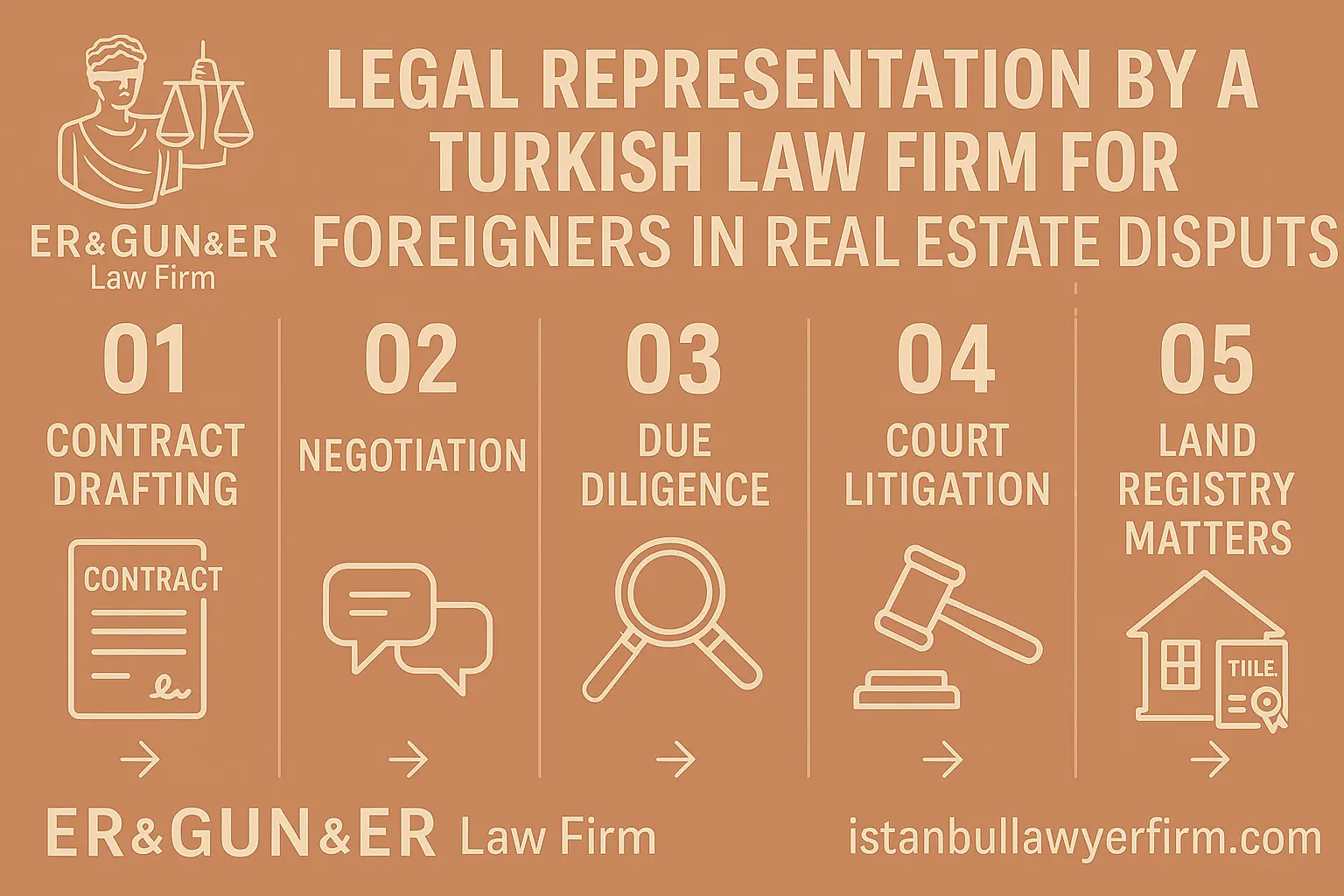
Turkish real estate disputes operate through a layered statutory framework with distinct procedural pathways depending on the dispute category. Foreign property owners, investors, and tenants encounter Turkish real estate procedure most commonly when title disputes arise (claims that registration is incorrect or based on flawed transactions), sale-purchase contract disputes (defective property, delayed delivery, non-conforming goods), tenant-landlord disputes (eviction, rent determination, contract violations), co-ownership and partition disputes (heirs or co-owners cannot agree on use or sale), condominium disputes (apartment buildings under Kat Mülkiyeti framework), and developer liability disputes (construction defects, contract non-performance against builder).
The substantive law operates through Türk Medeni Kanunu (Turkish Civil Code, Law No. 4721) of 22 November 2001 effective 1 January 2002 — Articles 683-1027 covering property law (eşya hukuku) including ownership, possession, title registration, and limitation of property rights; Türk Borçlar Kanunu (Turkish Code of Obligations, Law No. 6098) of 11 January 2011 effective 1 July 2012 — Articles 207-281 covering sale of goods and Articles 299-378 covering lease contracts including residential and commercial tenancy; Tapu Kanunu (Land Registry Code, Law No. 2644) of 22 December 1934 covering land registry framework and foreign acquisition under Article 35; Kat Mülkiyeti Kanunu (Condominium Code, Law No. 634) of 23 June 1965 covering apartment building ownership; Tüketicinin Korunması Hakkında Kanun (Consumer Protection Code, Law No. 6502) of 7 November 2013 covering consumer-developer disputes; İmar Kanunu (Zoning Code, Law No. 3194) of 3 May 1985 covering building permits and zoning; and Hukuk Muhakemeleri Kanunu (Civil Procedure Code, Law No. 6100) of 12 January 2011 covering procedural framework.
The dispute resolution architecture operates through specialised courts, mandatory mediation under Hukuk Uyuşmazlıklarında Arabuluculuk Kanunu (Mediation Code, Law No. 6325) as expanded by Law No. 7445 of 1 September 2023 (the major 2023 mandatory mediation reform that extended mandatory mediation to tenant-landlord disputes, co-ownership partition matters, and consumer disputes), enforcement framework under İcra ve İflas Kanunu (Enforcement and Bankruptcy Code, Law No. 2004), and arbitration framework under Milletlerarası Tahkim Kanunu (International Arbitration Code, Law No. 4686) for international cases — though arbitrability of property-related disputes is limited. Foreign clients should expect to navigate this multi-track architecture rather than treating real estate dispute resolution as a single procedural pathway.
The Statutory Framework: Property Law Across Turkish Codes
Real estate disputes draw on multiple statutes operating concurrently. Understanding which statute governs which aspect of the dispute is the foundational analysis that determines procedural pathway, applicable substantive rules, and available remedies.
Türk Medeni Kanunu Articles 683-1027 govern property law (eşya hukuku) substantively. Article 683 establishes ownership (mülkiyet) as the broadest property right covering use, enjoyment, and disposition. Articles 696-700 establish co-ownership in two forms: paylı mülkiyet (shared co-ownership where each owner has identifiable percentage share) and elbirliği mülkiyeti (collective co-ownership where owners hold rights collectively without identifiable shares, typical for inheritance until partition). Articles 698-699 establish partition (paylaşma) framework including in-kind division and sale-with-proceeds-distribution. Article 716 establishes acquisition of immovable property through land registry registration. Articles 718-728 establish the scope of immovable property ownership including buildings, planted vegetation, water sources, and similar attached elements.
Articles 1006-1027 establish the land registry (tapu sicili) framework. Article 1006 establishes the registry's protective effect for good-faith third parties relying on registry content. Article 1010 establishes the registry's evidentiary weight in property disputes. Articles 1023-1027 establish title cancellation and registration framework — the procedural pathway for challenging incorrect registry entries. Article 1024 specifically addresses cases where registration was based on legally flawed transactions; Article 1025 addresses good-faith protection for third parties acquiring from the apparent registered owner.
Türk Borçlar Kanunu Articles 207-281 govern sale contracts (satım sözleşmesi). Articles 219-231 specifically address defective goods (ayıba karşı tekeffül) framework — the seller's liability for goods not conforming to contract terms or having hidden defects. The framework distinguishes between hukukî ayıp (legal defects, such as third-party rights affecting the property), maddî ayıp (material defects, such as physical condition issues), and ekonomik ayıp (economic defects, such as misrepresented yields or returns). Buyer remedies include rescission (sözleşmeden dönme), price reduction (semen tenzili), repair (onarım), and damages (tazminat).
Articles 299-378 govern lease contracts (kira sözleşmeleri). Articles 339-356 specifically address residential and roofed workplace leases (konut ve çatılı işyeri kiraları) with the protective framework that limits landlord termination grounds, restricts rent increases, and protects tenant occupancy. The framework's structure substantially favours tenants in residential leases — eviction grounds are limited under Articles 350-356 to specific categories, rent increases above the periodic legal indexation require specific procedural framework, and lease renewals operate by extension rather than by termination-and-renewal logic. Commercial leases for non-residential, non-workplace properties operate under more flexible framework with greater contractual freedom.
Tapu Kanunu addresses the land registry framework with specific attention to foreign acquisition. Article 35 as amended by Law No. 6302 of 18 May 2012 permits foreign nationals to acquire Turkish real estate subject to country-eligibility (under Cabinet decree), 30-hectare total nationally and 10%-of-district quantitative limits, and restricted-zone constraints. The pre-2012 reciprocity (mütekabiliyet) requirement was eliminated by the 2012 amendment.
Kat Mülkiyeti Kanunu (Law No. 634) addresses apartment building ownership through the kat mülkiyeti (condominium ownership) framework that distinguishes between bağımsız bölüm (individual units owned by individual unit owners) and ortak yerler (common areas owned collectively). The framework establishes apartment building governance through kat malikleri kurulu (assembly of unit owners), yönetici (building manager), and yönetim planı (building management plan). Disputes among unit owners or between unit owners and management run through specific procedural pathways under the Code.
Tüketicinin Korunması Hakkında Kanun (Law No. 6502) addresses consumer protection in transactions where the seller is a commercial party (developer, real estate company) and the buyer is consuming the property for personal use rather than commercial activity. Consumer-developer disputes route through Tüketici Mahkemesi (Consumer Court) with specific procedural advantages for consumers including reduced filing fees, expedited timelines, and protective substantive rules. The framework's coverage of pre-construction sales (ön ödemeli konut satışı) under Articles 40-46 establishes specific protections for buyers paying for properties before completion.
İmar Kanunu (Law No. 3194) addresses zoning and building permits. Disputes involving building permit (yapı ruhsatı) issues, occupancy permit (yapı kullanma izin belgesi) issues, illegal construction (kaçak yapı), zoning plan changes (imar plan değişikliği), and similar regulatory matters route through administrative pathways including idare mahkemesi (administrative court). The framework's intersection with private real estate disputes is significant because regulatory issues often produce direct impact on property value, usability, and transferability.
Common Real Estate Dispute Categories
Real estate disputes encountered by foreign clients in Türkiye fall into recurring categories with distinct procedural and substantive frameworks. Recognising the dispute category is the foundational analysis that determines pathway selection.
Title disputes (tapu uyuşmazlıkları) are among the most fundamental categories. Common scenarios include: registration based on forged signatures or fraudulent power of attorney; registration based on legally invalid transactions (incompetent seller, lack of necessary consents); double-sale scenarios where the same property was sold to multiple buyers; inheritance-linked title disputes where the registered owner's title is challenged on inheritance grounds; muris muvazaası (testator's collusion) disputes where the deceased made apparent inter vivos transfers but actually intended testamentary distribution that bypassed reserved portion or other heirs' rights; and adverse possession (kazandırıcı zamanaşımı) disputes where occupants claim title through long possession.
Sale and purchase contract disputes (satım sözleşmesi uyuşmazlıkları) cover the broad range of issues arising from property transactions. Common scenarios include: seller's failure to deliver clear title (encumbrances, third-party claims, registration issues); buyer's failure to pay purchase price; defects in the property that breach the seller's quality obligations under TBK Articles 219-231; misrepresentation by seller about property characteristics, zoning status, or related matters; pre-construction sale disputes where the developer fails to deliver the property as specified or on time; and disputes over earnest money (kapora) and similar pre-contractual deposits.
Tenant-landlord disputes (kira uyuşmazlıkları) are particularly common for foreign tenants and foreign landlords. Common scenarios include: eviction (tahliye) disputes where landlord seeks tenant's removal; rent determination (kira tespiti) disputes where the parties disagree on appropriate rent level (especially relevant given inflation-driven rent disputes in recent periods); rent increase (kira artışı) disputes where the landlord's proposed increase exceeds legal limits; deposit (depozito) disputes at lease termination; lease renewal disputes; and habitability disputes where the tenant claims the property is unfit for the leased purpose.
Co-ownership and partition disputes (paydaşlık uyuşmazlıkları) arise when multiple parties own a property and cannot agree on use or disposition. Common scenarios include: inherited property where heirs cannot agree on retention versus sale; jointly purchased property where co-owners' relationships have changed; partnership-purchased property where the underlying partnership has dissolved; and family property where generational changes produce co-owner conflicts. Resolution typically requires partition (taksim) or co-ownership dissolution (izale-i şuyu / paydaşlığın giderilmesi) proceedings.
Condominium disputes (kat mülkiyeti uyuşmazlıkları) arise within apartment buildings governed by Kat Mülkiyeti Kanunu. Common scenarios include: disputes over common area maintenance and costs; disputes over building management decisions; disputes over assessments and reserve fund contributions; disputes over individual unit modifications affecting common areas; disputes over usage restrictions; and disputes over building insurance and major repairs.
Developer liability disputes are a specific subcategory affecting buyers from professional developers. Common scenarios include: construction quality defects discovered after delivery; delayed delivery beyond contract deadlines; substituted materials or specifications inferior to contract terms; failure to obtain occupancy permits or other regulatory approvals; project abandonment or developer insolvency; common area defects affecting multiple buyers; and warranty claims under the developer's quality guarantees.
Easement and similar limited property right disputes affect properties subject to easements (irtifak hakları), usufruct rights (intifa hakkı), residence rights (oturma hakkı), or similar limited rights. Disputes can involve scope of the right, exercise of the right, or termination of the right.
Mortgage and lien disputes affect properties subject to mortgage (ipotek) or other registered liens. Disputes can involve enforceability of the mortgage, priority among multiple liens, foreclosure procedures, or release of the mortgage upon debt satisfaction.
Title Disputes: Tapu İptal ve Tescil Davası
The tapu iptal ve tescil davası (title cancellation and registration action) is the foundational procedural mechanism for challenging Turkish land registry entries. The action runs under TMK Articles 1024-1027 framework and addresses scenarios where the existing registry entry does not correctly reflect the substantive ownership position.
Substantive grounds for title cancellation include: the underlying transaction supporting the registration was legally invalid (lack of capacity, lack of valid consent, formal defects, fraud, undue influence); the registration was based on forged documents or unauthorised power of attorney; the registration occurred without the substantive owner's knowledge or consent; the registration violates legal restrictions on property transfer (Article 35 foreign-acquisition limits, restricted zones, family protection rules); the registration represents inheritance-linked transfer that should be unwound (muris muvazaası, reserved portion impairment); and the registration represents acquisition by adverse possession that should not have been recognised. Each substantive ground requires specific evidence and produces specific remedy outcomes.
Muris muvazaası (testator's collusion) is a recurring substantive ground in Turkish real estate disputes. The scenario involves deceased persons who, during lifetime, made apparent transfers (typically sales) of real estate to specific persons (often selected heirs, family members, or third parties) but where the apparent transfer actually intended testamentary distribution that would otherwise have produced reserved portion claims or different heir distribution. Yargıtay (Court of Cassation) jurisprudence has developed substantial framework around muris muvazaası analysis including factual indicators (lack of actual purchase price payment, family-only transactions, transfers shortly before death, transfers favouring specific heirs while excluding others). Successful muris muvazaası claims produce title cancellation with property returning to the deceased's estate for proper inheritance distribution.
Procedural framework for tapu iptal davası operates through Asliye Hukuk Mahkemesi (Civil Court of First Instance) under HMK Article 2 general jurisdiction. The court of jurisdiction is typically the location of the disputed property. The action is filed by the substantive owner or claimed substantive owner (the person whose ownership the registry should reflect) against the registered owner. Where third-party rights are at stake, those parties join as defendants or interested parties.
Standing (sıfat) analysis determines who can bring the action. The substantive owner has direct standing. Heirs of the substantive owner have derivative standing. Persons with registrable rights (mortgagees, tenants with registered leases) may have standing depending on their specific interest. Persons with mere contractual claims without registered rights typically lack standing for title cancellation, though they may have separate contractual claims.
Evidentiary framework is heavy. The plaintiff must establish both the substantive defect in the registration and their own substantive ownership claim. Documentary evidence (contracts, payment records, civil status documents, prior registry entries) is typically essential. Witness testimony may support specific factual elements. Expert opinions may address valuation, signature authenticity, document authenticity, and similar technical questions. Cases with substantial evidence on both sides require careful procedural management.
Good-faith third-party protection under TMK Article 1023 limits title cancellation in specific circumstances. Where a third party acquired in good-faith reliance on the registry's content for value, that third party's title may be protected even if the original registration was defective. The framework's protective effect produces an operational reality that recovery from chain-of-transfer registrations becomes more difficult as transfers proceed; prompt action when title disputes arise is operationally important.
Statute of limitations under various provisions affects title actions. Some title actions face general 10-year limitation under Türk Borçlar Kanunu Article 146; others operate without limitation as substantive ownership claims. The specific limitation analysis depends on the substantive ground for the title action and the parties involved.
Interim relief through tedbir (precautionary measures) under HMK Article 389-399 is operationally important. Pending title action can be lengthy; interim relief preventing further transfer of the disputed property protects the plaintiff's eventual remedy. Tapu Müdürlüğü's tedbir registration (tedbir şerhi) prevents further transfer or encumbrance during the litigation.
Sale and Purchase Contract Disputes
Sale-purchase disputes operate under TBK Articles 207-281 framework with specific subcategories addressing different defect and breach scenarios. The framework's structure provides multiple buyer remedies that operate alongside or in alternative to one another depending on the breach character.
Defective goods framework under Articles 219-231 covers cases where the property does not match the contractual description or has material defects affecting its value or usability. The framework distinguishes between defects that the buyer knew about at purchase (no remedy) and hidden defects (remedy available) — but the framework's "knew" standard is interpreted strictly, meaning that defects buyer could have discovered through reasonable inspection but did not actually discover often remain compensable.
Buyer remedies under Article 227 include four alternatives: rescission of the sale (sözleşmeden dönme) with return of property and refund of purchase price; price reduction (semen tenzili) with proportional refund based on the defect's effect on value; demand for repair (ayıbın giderilmesi) at seller's cost; or demand for replacement (ayıpsız mislin teslimi) where the goods are fungible. For real estate, replacement is typically not available given each property's unique character; rescission, price reduction, and repair are the practical options.
Notification timing under Article 223 is operationally critical. The buyer must notify the seller of the defect promptly upon discovery; failure to provide timely notice can produce loss of remedy rights. The notification standard for hidden defects allows reasonable time for the buyer to discover the defect through normal use, but the seller can argue that the buyer's notification was untimely if discovery should reasonably have occurred earlier.
Limitation periods under Article 231 establish that defective-goods claims for real estate face a five-year limitation period from delivery, which is extended where the seller has acted with intent or gross negligence in concealing the defect (in which case general 10-year limitation under Article 146 applies). The five-year limitation applies regardless of when the defect is discovered, creating a hard cutoff that affects long-term defect claims.
Pre-construction sales (ön ödemeli konut satışı) under TKHK (Law No. 6502) Articles 40-46 operate as a specific subcategory with consumer-protective framework. The buyer of a property purchased before construction completion has specific rights including: protection of paid amounts through bank guarantee or building completion insurance; right to withdraw from the contract within 14 days of contract execution without justification; right to expect delivery within the specified timeframe; right to property meeting the contracted specifications; and substantive remedies for delayed delivery and defective construction.
Pre-construction sale disputes route through Tüketici Mahkemesi (Consumer Court) where the buyer is a consumer and the seller is a commercial party. The court's procedural framework includes reduced filing fees for consumers, expedited handling, and substantive interpretation favourable to consumers in ambiguous contract terms. Foreign buyers acquiring residential properties from professional developers typically qualify for consumer status and benefit from this protective framework.
Specific performance (aynen ifa) claims under TBK Article 112 framework allow buyers who have paid the purchase price to demand actual title transfer where the seller refuses to complete the transaction. The remedy converts the contractual right to a property right through court-ordered registration. The framework addresses scenarios where the seller has received payment but withholds title transfer based on subsequent regret, alternative offers, or other reasons.
Earnest money (kapora) and pre-contractual deposit disputes operate under TBK Articles 35-39 framework on negotiation liability and Article 156-160 framework on penalty clauses. Where parties exchange deposits before formal sale contract, the deposit's substantive treatment depends on whether it is structured as earnest money (forfeitable on buyer's withdrawal, double-refundable on seller's withdrawal under Article 177), penalty clause securing performance, or simple advance payment.
Defective Construction and Developer Liability
Construction defect disputes form a substantial subcategory of real estate disputes affecting buyers from professional developers. The framework operates through TBK general framework, TKHK consumer framework where applicable, and specific construction-related provisions.
Substantive defect categories include: structural defects affecting the building's integrity (foundation issues, load-bearing problems, water infiltration, settlement issues); finish defects affecting non-structural elements (flooring, wall finishes, fixtures, appliances); systems defects affecting installed systems (plumbing, electrical, HVAC, security); common area defects in multi-unit buildings; non-conforming substitutions where the developer used materials or specifications inferior to contract terms; and regulatory non-compliance affecting occupancy permits, zoning compliance, or similar regulatory status.
Warranty framework under TBK Article 478 (specifically addressing eser sözleşmesi / construction contracts) establishes 5-year liability for construction defects from delivery, extended to 20 years for hidden defects intentionally concealed by the contractor. The framework's structure provides longer protection than the general goods-sale framework, recognising the higher complexity and longer functional life of construction work.
Notification and remedy framework requires the buyer to identify defects and notify the developer within reasonable time of discovery. The buyer's remedy options include demand for repair (ayıbın giderilmesi), demand for cost-of-repair compensation where the buyer arranges repair, demand for damages (tazminat) for losses caused by the defect, demand for price reduction (bedel indirimi), and in serious cases demand for rescission with property return and price refund. Each remedy has specific evidentiary requirements; effective claim presentation typically combines multiple supporting elements.
Expert assessment (bilirkişi incelemesi) is procedurally central in construction defect cases. Court-appointed experts with relevant technical credentials examine the property, identify defects, evaluate causation, and estimate repair costs. Court reliance on expert reports is significant; the report often determines case outcome subject to procedural challenges. Pre-litigation expert assessments commissioned by the parties can support but do not replace the court-appointed expert framework.
Project abandonment scenarios where developers cease construction or become insolvent produce specific complications. Buyers may have priority in incomplete construction projects through specific protective frameworks; bank guarantees or building completion insurance under TKHK pre-construction sale framework can provide recovery sources. Where the developer's insolvency affects multiple buyers, coordinated action across affected buyers can produce better outcomes than individual fragmented action.
Common area developer defects in multi-unit buildings face specific procedural complexity. Common areas are owned collectively by unit owners under Kat Mülkiyeti framework; developer liability for common area defects can be enforced by the building management on behalf of all unit owners or by individual unit owners with specific procedural framework. Coordinating action for common area defects typically produces better outcomes than fragmented individual action.
Statute of limitations for construction defect claims operates through the TBK Article 478 framework — 5 years for ordinary defects, 20 years for hidden defects with intentional concealment. The framework's structure produces specific operational implications for buyers discovering defects late in the warranty period; prompt action upon discovery is essential to preserve remedies before limitation expiry.
Tenant-Landlord Disputes Under TBK
Tenant-landlord disputes operate primarily under TBK Articles 299-378 lease framework with specific protective provisions for residential and roofed-workplace leases under Articles 339-356. The framework substantially favours tenants in protected lease categories, limiting landlord's grounds for eviction and rent increase capability.
Eviction (tahliye) framework under Articles 350-356 establishes the limited grounds on which landlord can evict tenant from residential or roofed-workplace property. Substantive grounds include: tenant's non-payment of rent (with specific procedural framework requiring two unpaid-rent notifications during lease year), tenant's substantial breach of lease terms, landlord's own occupation requirement (kendisi veya yakınları için ihtiyaç), property's reconstruction or comprehensive renovation requirement, tenant's substantial damage to property, tenant's substantial nuisance affecting neighbours, and similar specific grounds. Eviction outside these grounds generally cannot succeed regardless of other landlord interests.
Rent determination (kira tespiti) framework under Article 344 governs disputes over appropriate rent levels. The framework distinguishes between rent for new lease periods (where market rent applies) and rent renewal during ongoing lease (where indexation framework applies). Rent renewal is limited to the prior 12 months' Consumer Price Index increase, with specific exceptions for cases involving substantial change in property value or use.
The 25% rent cap (kira artış sınırı) introduced in 2022 under temporary legislation limited residential rent increases to 25% during the temporary period regardless of CPI levels; this temporary framework expired in stages during 2023-2024 with return to standard CPI-based framework. The temporary cap produced substantial litigation during its application period and continues to produce residual disputes regarding rent levels established during the cap period.
Lease renewal framework under Articles 347-348 establishes that lease contracts automatically renew unless terminated by tenant. Landlord cannot terminate at end of contract period absent specific grounds; the framework effectively converts fixed-term leases into perpetual leases subject to tenant's termination right. The framework's protective effect for tenants is substantial — tenants who pay rent and observe lease obligations have effective tenure security regardless of contractual term.
Landlord's own occupation requirement (ihtiyaç sebebiyle tahliye) is the most common eviction ground for residential leases. The landlord must demonstrate genuine need for personal use or use by close family. The court reviews the asserted need substantively — pretextual claims to circumvent tenant protections face substantive review and typically fail. Successful own-occupation eviction requires the landlord to actually use the property for the asserted purpose for at least three years; failure produces tenant's right to compensation under Article 355.
Reconstruction or renovation eviction (yeniden inşa veya esaslı tamir) requires substantial actual reconstruction work that prevents tenant use during the work period. The framework requires actual permits and substantive work plan rather than mere cosmetic improvements. Failed renovation evictions produce tenant compensation under Article 355.
Mandatory mediation under HUAK Article 18-A as added by Law No. 7445 of 1 September 2023 made mediation compulsory for tenant-landlord disputes including eviction, rent determination, and similar lease disputes. The framework requires mediation attempt before court action; cases filed without prior mediation face dismissal as procedurally defective. The 2023 reform represented a substantial procedural change requiring foreign clients and counsel to incorporate mandatory mediation into dispute strategy.
Eviction enforcement framework operates through İcra ve İflas Kanunu (Law No. 2004) execution procedures. Eviction judgments are enforced through icra müdürlüğü (enforcement office) with specific procedural framework for tenant removal. The framework includes notice periods, removal scheduling, and specific protections for tenant's belongings. Enforcement procedures typically take several weeks from judgment to actual eviction.
Co-Ownership and Partition Procedures
Co-ownership disputes arise when multiple parties own a property and cannot agree on use, management, or disposition. The framework operates under TMK Articles 688-703 (paylı mülkiyet — shared co-ownership) and Articles 701-703 (elbirliği mülkiyeti — collective co-ownership) with partition framework under TMK Articles 698-700 and izale-i şuyu / paydaşlığın giderilmesi framework.
Paylı mülkiyet (shared co-ownership) operates with each owner having identifiable percentage share. Each owner can dispose of their share independently subject to other owners' pre-emption rights (önalım hakkı / şufa hakkı) under Article 732-735. Decisions on common matters require majority or unanimous agreement depending on the matter's significance. Where co-owners cannot agree, partition proceedings provide exit mechanism.
Elbirliği mülkiyeti (collective co-ownership) operates with owners holding rights collectively without identifiable individual shares. Inheritance creates elbirliği mülkiyeti among heirs until partition. Partnership or joint venture relationships can create elbirliği mülkiyeti depending on structure. Decisions require unanimity; individual owners cannot dispose of "their share" because shares are not individually identifiable until partition.
Partition (taksim) under Articles 698-699 framework converts co-ownership into individual ownership. Partition can occur through agreement among co-owners (rızai taksim) where consensus is achievable, or through court-supervised partition (kazai taksim) where consensus is unavailable. Court-supervised partition operates in two forms: in-kind division (aynen taksim) where the property can practically be divided into separately ownable units, or sale-with-proceeds-distribution (satış suretiyle taksim) where in-kind division is impractical.
İzale-i şuyu / paydaşlığın giderilmesi (co-ownership dissolution) is the procedural mechanism for sale-with-proceeds-distribution. The action runs through Sulh Hukuk Mahkemesi under HMK Article 4/c jurisdiction. The court determines the appropriate dissolution method, supervises the procedure, and oversees proceeds distribution. For real estate where in-kind division is impractical (single building, indivisible parcel), the court typically orders public auction (açık artırma) with proceeds distributed among co-owners according to their shares.
Mandatory mediation under HUAK Article 18-A as expanded by Law No. 7445 of 1 September 2023 made mediation compulsory for co-ownership and partition disputes. The framework requires mediation attempt before court action; co-owners must demonstrate mediation participation before bringing partition proceedings. The mandatory mediation framework has produced substantial increase in negotiated co-ownership resolutions, reducing court partition volume.
Auction procedures for property under partition operate through specific framework. The court appoints expert appraisers to establish minimum auction price. Public notice is given through prescribed channels. Co-owners typically have right to participate in the auction and acquire the entire property by outbidding other bidders. Where no co-owner acquires, the highest external bidder receives the property with proceeds distributed among former co-owners according to ownership shares.
Tax implications of partition affect the financial outcome. Partition through court order generally does not produce capital gains tax exposure because it is considered a substitution of asset form rather than a sale. However, sale auction in partition can produce tax exposure for participating co-owners depending on holding periods and other circumstances. Tax planning around partition produces meaningful financial outcomes.
Pre-emption rights (önalım hakkı / şufa hakkı) under Articles 732-735 affect dispositions of individual shares in paylı mülkiyet. Where a co-owner sells their share to a third party, other co-owners have right to acquire the share at the same price within prescribed period (typically three months from notification of the sale). The framework allows co-owners to prevent unwanted third parties from joining the co-ownership.
Condominium Disputes Under Kat Mülkiyeti Kanunu
Condominium disputes arise within apartment buildings governed by Kat Mülkiyeti Kanunu (Law No. 634). The framework's structure addresses the specific challenges of multi-unit buildings where individual unit owners share ownership of common areas and depend on collective decision-making for building management.
Bağımsız bölüm (individual unit) and ortak yer (common area) distinction is foundational. Individual units are owned by individual unit owners with separate title deeds (kat mülkiyeti tapusu) and can be sold, mortgaged, leased, and otherwise disposed of independently. Common areas (lobby, elevators, building exterior, foundations, roofs, common service areas) are owned collectively by all unit owners in proportion to their unit shares. Unit modifications affecting common areas, structural elements, or building exterior require specific procedural framework.
Kat malikleri kurulu (assembly of unit owners) is the building's primary governance body. The kurul makes decisions on building management, common area maintenance, building budget, and major decisions affecting the building. Decision-making operates through majority voting on most matters with unanimous voting required for specific decisions affecting fundamental property rights. The yönetim planı (building management plan) establishes the building-specific governance framework.
Yönetici (building manager) handles day-to-day building administration. The yönetici can be a unit owner, a hired professional, or a management company. Yönetici responsibilities include collecting assessments, paying common expenses, supervising maintenance, enforcing building rules, and coordinating major repairs. Unit owners' disputes with the yönetici regarding management decisions, expense allocation, or rule enforcement run through specific procedural pathway.
Common expenses (ortak giderler) are allocated among unit owners according to the share allocation in the management plan, typically proportional to unit areas or as otherwise specified. Disputes over expense allocation, expense calculation, or expense reasonableness operate through specific framework allowing unit owners to challenge unreasonable expenses. Article 18-19 framework establishes the unit owners' obligation to pay assessments and the consequences of non-payment.
Non-payment of assessments produces specific enforcement framework. Article 20 establishes that unit's owner faces personal liability for unpaid assessments. Article 23 establishes that unpaid assessments create lien on the unit that can be enforced through specific procedure. The framework allows efficient enforcement against non-paying unit owners without requiring substantial litigation.
Modification disputes affect unit owners proposing changes to their units that affect common areas or other units. Common modification scenarios include: structural modifications affecting load-bearing elements; facade modifications affecting building exterior; window changes affecting building uniformity; HVAC additions affecting common service systems; and use changes affecting building character. The framework requires specific approval procedures for various modification categories.
Mandatory mediation framework under HUAK Article 18-A applies to most condominium disputes through the 2023 expansion. Disputes between unit owners, between unit owners and management, and similar internal building disputes typically require mediation attempt before court action.
Yönetim planı disputes affect the building-specific governance framework. Where unit owners disagree about management plan provisions or seek to amend the plan, the framework requires specific majority for amendments. Disputes over plan interpretation or amendment validity route through specific procedural framework.
Mandatory Mediation Framework Under HUAK
Hukuk Uyuşmazlıklarında Arabuluculuk Kanunu (Mediation Code, Law No. 6325) of 7 June 2012 established the mediation framework in Turkish civil disputes. The framework's scope expanded substantially through Law No. 7445 of 1 September 2023 (the 2023 mandatory mediation reform) extending mandatory mediation to multiple new categories including most real estate dispute categories.
Pre-2023 mandatory mediation scope under HUAK Article 18-A covered: commercial disputes (since 1 January 2019), labour disputes (since 1 January 2018), and consumer disputes for amounts above prescribed thresholds. Real estate disputes generally faced voluntary mediation framework where mediation was available but not compulsory.
Post-2023 mandatory mediation scope expanded to include: tenant-landlord disputes (eviction, rent determination, deposit disputes, lease violations); co-ownership and partition disputes (izale-i şuyu, paydaşlığın giderilmesi); condominium disputes between unit owners and between unit owners and management; commercial real estate disputes (already covered); consumer-developer disputes (already covered for amounts above threshold). The expanded scope effectively brings most real estate dispute categories within mandatory mediation framework.
Mediation procedure operates through accredited mediator (arabulucu) with specific qualifications under HUAK framework. The parties either select a mediator by agreement or have one assigned through Adalet Bakanlığı's mediator pool (arabulucu siciliünden atama). Mediation runs through structured sessions where the mediator facilitates negotiation but does not decide substantive matters. Outcomes are: anlaşma (agreement) ending the dispute through mediated settlement, anlaşmama (non-agreement) allowing the dispute to proceed to court, or partial agreement covering some but not all dispute elements.
Procedural consequences of mediation requirement include the Article 18-A framework requirement that mediation must be attempted before court action in covered dispute categories. Court actions filed without prior mediation attempt face dismissal as procedurally defective; the framework includes specific certification (arabuluculuk son tutanağı) confirming mediation completion that must accompany court filings.
Settlement enforcement framework provides immediate enforceability for mediated agreements. Settlements documented in standard mediation agreement format under HUAK Article 18 framework have direct enforceability through icra (enforcement) procedures without requiring separate court ratification. The framework's structure produces operational efficiency comparable to court judgments without the litigation timeline.
Mediation timeline requirements under HUAK framework establish deadlines including the typical 3-week mediation period from mediator appointment with extension possibilities. The compressed timeline produces operational efficiency relative to court proceedings but requires preparation discipline by parties — substantive negotiation positions, documentary support, and authority for settlement should be ready before mediation rather than developed during the process.
Confidentiality framework under HUAK Article 4 protects mediation discussions from subsequent use as evidence in court proceedings. Parties can negotiate openly during mediation without concern that statements made will become evidence against them in subsequent litigation. The framework supports candid negotiation that drives settlement.
Mediation strategy considerations for real estate disputes include: preparing realistic settlement positions before mediation rather than starting with maximalist claims; understanding the procedural advantages of court action versus mediation given the specific dispute; coordinating with foreign clients on settlement authority given communication constraints; and managing the mandatory mediation as opportunity for genuine settlement rather than mere procedural step before court action.
Court Jurisdiction Across Real Estate Disputes
Turkish court jurisdiction over real estate disputes varies by dispute category. Understanding which court has jurisdiction is operationally essential because filing in the wrong court produces dismissal and procedural delay.
Sulh Hukuk Mahkemesi (Civil Court of Peace) under HMK Article 4 has jurisdiction over specific dispute categories regardless of monetary value. Article 4/c specifically covers certain real estate matters including rental disputes (eviction, rent determination), co-ownership and partition disputes (izale-i şuyu, paydaşlığın giderilmesi), and certain inheritance-related succession matters. The framework distinguishes from value-based jurisdictional thresholds — Sulh Hukuk's jurisdiction is determined by case category, not monetary amount.
Asliye Hukuk Mahkemesi (Civil Court of First Instance) under HMK Article 2 has residual jurisdiction over civil disputes not specifically assigned to another court. Most title disputes (tapu iptal ve tescil davası), most sale-purchase disputes outside consumer scope, easement and similar limited property right disputes, and general property disputes route through Asliye Hukuk Mahkemesi. The framework's structure produces Asliye Hukuk as the default court for substantive real estate matters not specifically assigned elsewhere.
Tüketici Mahkemesi (Consumer Court) has jurisdiction over consumer disputes under TKHK Article 73 framework. Disputes between professional sellers/developers and consumer buyers route through Tüketici Mahkemesi where the buyer's profile meets consumer status. The court's procedural framework includes reduced filing fees, expedited handling, and substantive interpretation favouring consumers in ambiguous contracts. Foreign buyers acquiring residential properties from professional developers typically qualify as consumers and benefit from this protective framework. Pre-construction sale disputes under TKHK Articles 40-46 route through Tüketici Mahkemesi.
İcra Mahkemesi (Enforcement Court) handles disputes arising during enforcement procedures under İcra ve İflas Kanunu (Law No. 2004) framework. Issues including enforcement procedure validity, third-party claims (istihkak), debt amount disputes during enforcement, and similar procedural matters route through İcra Mahkemesi. The court does not handle substantive real estate disputes; it handles procedural matters arising in enforcement of judgments or other enforceable documents.
İdare Mahkemesi (Administrative Court) handles disputes against administrative authorities. Real estate matters reaching İdare Mahkemesi typically involve: building permit disputes (yapı ruhsatı iptali), zoning plan disputes (imar plan değişikliği iptali), expropriation disputes (kamulaştırma), tax assessment disputes affecting real estate, and similar disputes against administrative authorities. The administrative pathway operates under İdari Yargılama Usulü Kanunu (Law No. 2577) with specific procedural framework distinct from civil courts.
Bölge İdare Mahkemesi (Regional Administrative Court) and Danıştay (Council of State) provide appellate review for administrative real estate disputes. Bölge Adliye Mahkemesi (Regional Court of Justice) and Yargıtay (Court of Cassation) provide appellate review for civil real estate disputes including title disputes, sale disputes, and tenant-landlord disputes.
Yer yetkisi (territorial jurisdiction) typically follows the location of the disputed property. HMK Article 12 establishes that disputes concerning real rights over immovable property must be filed where the property is located. The framework's structure produces concentrated litigation in courts having jurisdiction over specific property locations regardless of where parties are domiciled.
Specialised courts within the general court system handle specific dispute categories in larger jurisdictions. Istanbul, Ankara, and Izmir have specialised consumer courts, specialised commercial courts, and similar specialised divisions handling specific subject matters. Filing in the appropriate specialised court within the broader court system can affect handling speed and substantive expertise.
Enforcement and Title Recovery
Court judgments and other enforceable documents in real estate disputes operate through İcra ve İflas Kanunu (Law No. 2004) enforcement framework. The framework's structure determines how favourable judgments translate into actual property transfers, evictions, payments, and similar real-world outcomes.
Title transfer enforcement implements judgments ordering registration changes. Where the court orders title registration in favour of the plaintiff, the judgment is presented to Tapu Müdürlüğü for direct registration without requiring separate enforcement procedure. The framework's structure produces operational efficiency for title-related judgments — registration directly implements the substantive outcome.
Eviction enforcement (tahliye icrası) under İİK Article 269 framework implements eviction judgments. The procedure runs through icra müdürlüğü (enforcement office) with specific timeline including notice to tenant, opportunity for voluntary departure within prescribed period, and physical eviction with assistance from law enforcement where necessary. Tenant belongings face specific procedural framework — items not removed by tenant during eviction become subject to storage and ultimate disposition under prescribed procedure.
Money judgment enforcement implements judgments ordering payment of money. The enforcement procedure includes asset identification, attachment (haciz), and conversion to cash through court-supervised sale or auction. Real estate assets face specific procedural framework given their distinctive characteristics; attached real estate typically proceeds to public auction with proceeds applied to the judgment debt.
Public auction (açık artırma) procedures apply to court-ordered sales including partition sales and enforcement sales of attached real estate. The procedure includes appraisal by court-appointed expert, public notice through prescribed channels, auction procedure with minimum price typically set at percentage of appraised value, and proceeds distribution among creditors or co-owners according to applicable framework. The procedure has been refined over recent years to address transparency concerns and improve auction outcomes.
Mortgage foreclosure (ipotek tahsisi) operates through specific framework under İİK and substantive mortgage rules. Mortgaged property can be foreclosed by the mortgage holder through enforcement procedure following debtor default. The procedure runs through icra müdürlüğü with specific timeline and notice framework. Mortgage priority among multiple liens follows specific rules based on registration timing and other factors.
Recognition and enforcement of foreign judgments in Turkish real estate matters operates through MÖHUK (Law No. 5718) Articles 50-59 framework. Foreign judgments affecting Turkish real estate face specific recognition framework with substantive review including jurisdiction, reciprocity, procedural fairness, no contradiction with Turkish decisions, and public policy compliance. Where the foreign judgment affects Turkish immovable property, additional scrutiny applies given Turkey's substantive jurisdiction over its immovable property under MÖHUK Article 20/2.
International arbitration awards face specific framework under MTK (Law No. 4686) and the New York Convention to which Türkiye has been party since 1992 (Law No. 3737). Recognition and enforcement of foreign arbitration awards generally operates more flexibly than foreign judgment enforcement, but specific limitations apply for awards affecting Turkish public order or arbitrability requirements.
Arbitrability of real estate disputes in Türkiye is limited. Disputes involving Turkish real estate ownership (substantive title) generally are not arbitrable because they involve real rights and public registry framework. Contractual disputes related to real estate (sale contract performance, lease contract performance, developer contract performance) can be arbitrable subject to the specific dispute character. The arbitrability analysis is operationally important when arbitration clauses are considered for real estate transactions.
Counsel Engagement Across Real Estate Disputes
Real estate dispute resolution benefits substantially from counsel engagement across the dispute lifecycle. The substantive complexity of Turkish real estate framework, the multiple procedural pathways depending on dispute category, the mandatory mediation framework's operational requirements, and the interaction with regulatory and tax dimensions all produce value for professional counsel involvement.
Pre-dispute analysis at issue identification establishes the substantive and procedural framework for the case. Key analysis elements include: substantive ground for the dispute under applicable Turkish law; appropriate procedural pathway including court of jurisdiction and mediation requirements; available remedies and their relative effectiveness; statute of limitations status; evidence requirements and current evidence position; and parties' negotiation positions and likely litigation outcomes. The analysis produces the case-specific roadmap for dispute handling.
Pre-litigation strategy considerations include whether to pursue negotiated settlement, mediation (mandatory or voluntary depending on category), or direct litigation. The strategy depends on the specific dispute, the parties' positions, and the likely outcome of each pathway. Generic preference for litigation over negotiation often produces worse outcomes than thoughtful pathway selection.
Mediation preparation for mandatory mediation cases is operationally important. The mandatory framework's structure produces mediation as opportunity rather than mere procedural step. Effective mediation preparation includes substantive case analysis, realistic settlement parameters, documentary support for negotiation positions, and authority to settle within those parameters. Foreign clients face specific challenges given communication constraints; advance coordination on authority and parameters before mediation produces better outcomes.
Litigation strategy across the dispute categories addresses court-of-jurisdiction selection, claim formulation, evidence preparation, expert witness coordination, and procedural management. The Turkish litigation framework's structure differs substantially from common-law systems in evidence procedure, expert witness role, and judicial fact-finding; foreign clients benefit from counsel orientation on these procedural differences before litigation rather than during it.
Interim relief through tedbir (precautionary measures) under HMK Articles 389-399 framework is often operationally critical. Title disputes benefit from tedbir şerhi (precautionary annotation) preventing further property transfer during litigation. Eviction disputes benefit from tedbir preserving status quo or specific protective measures. The interim relief framework's operational value depends on prompt action when disputes arise.
Foreign client coordination throughout the procedure addresses communication, document handling, authority for procedural decisions, and travel coordination where appearances are required. Power of attorney arrangements allow foreign clients to participate in Turkish procedures without travelling to Türkiye for every step. Document coordination including apostille and translation requirements should be addressed early to avoid timeline complications during procedural milestones.
Tax coordination for real estate disputes addresses the tax implications of dispute outcomes. Settlements, judgments, and partition outcomes can produce capital gains tax exposure, transfer tax exposure, or other tax implications depending on the specific outcome and parties' positions. Coordination with tax counsel during dispute resolution produces outcomes that consider both legal and tax dimensions rather than producing legal victory with unexpected tax cost. A Turkish Law Firm coordinating dispute strategy with tax planning produces integrated outcomes more frequently than fragmented engagement across separate specialty providers.
Cross-border coordination matters for foreign clients with home-jurisdiction implications from Turkish real estate disputes. Foreign tax obligations, foreign legal proceedings (such as inheritance disputes producing parallel proceedings in multiple jurisdictions), and foreign reporting requirements all interact with Turkish dispute outcomes. Coordinated handling across jurisdictions produces better integrated outcomes than fragmented handling.
The Turkish Law Firm value-add concentrates in substantive engagement with the technical content of Turkish real estate framework alongside operational coordination with the foreign client and any foreign counsel. An Istanbul Law Firm experienced in cross-border real estate disputes approaches the engagement at the intersection of substantive law, procedural framework, and operational coordination across the dispute lifecycle.
Frequently Asked Questions
- What is the substantive law governing Turkish real estate disputes? Türk Medeni Kanunu (Turkish Civil Code, Law No. 4721) Articles 683-1027 govern property law including ownership, possession, title registration, and limitation of property rights. Türk Borçlar Kanunu (Turkish Code of Obligations, Law No. 6098) Articles 207-281 govern sale contracts and Articles 299-378 govern lease contracts. Tapu Kanunu (Law No. 2644) governs land registry framework. Kat Mülkiyeti Kanunu (Law No. 634) governs apartment building ownership. Tüketicinin Korunması Hakkında Kanun (Law No. 6502) governs consumer-developer disputes. İmar Kanunu (Law No. 3194) governs zoning and building permits.
- What is tapu iptal ve tescil davası? Title cancellation and registration action under TMK Articles 1024-1027 framework — the procedural mechanism for challenging Turkish land registry entries that do not correctly reflect substantive ownership. Substantive grounds include underlying transaction invalidity, forged documents, registration without consent, violation of Article 35 foreign-acquisition limits, muris muvazaası (testator's collusion in inheritance-linked transfers), and similar grounds. The action runs through Asliye Hukuk Mahkemesi under HMK Article 2 jurisdiction at the property's location.
- What is muris muvazaası? Testator's collusion — a Turkish jurisprudential framework addressing scenarios where deceased persons made apparent inter vivos transfers (typically sales) of real estate but actually intended testamentary distribution that bypassed reserved portion or other heirs' rights. Yargıtay has developed substantial framework around factual indicators including lack of actual purchase price payment, family-only transactions, transfers shortly before death, and transfers favouring specific heirs. Successful claims produce title cancellation with property returning to deceased's estate.
- How are construction defects handled? TBK Article 478 establishes 5-year liability for construction defects from delivery, extended to 20 years for hidden defects intentionally concealed by contractor. Buyer remedies include repair (ayıbın giderilmesi), repair-cost compensation, damages (tazminat), price reduction (bedel indirimi), and rescission with property return. Court-appointed expert (bilirkişi) examines property and identifies defects. Pre-construction sales under TKHK (Law No. 6502) Articles 40-46 receive enhanced consumer protection through Tüketici Mahkemesi jurisdiction.
- What courts handle real estate disputes? Sulh Hukuk Mahkemesi under HMK Article 4/c handles tenant-landlord disputes, co-ownership and partition disputes, and certain inheritance-related matters. Asliye Hukuk Mahkemesi under HMK Article 2 has residual jurisdiction over title disputes and general real estate matters. Tüketici Mahkemesi under TKHK Article 73 handles consumer-developer disputes. İcra Mahkemesi handles enforcement procedure issues. İdare Mahkemesi handles administrative disputes including building permit and zoning challenges. Territorial jurisdiction follows property location under HMK Article 12.
- What is mandatory mediation under HUAK Article 18-A? Hukuk Uyuşmazlıklarında Arabuluculuk Kanunu (Law No. 6325) Article 18-A as expanded by Law No. 7445 of 1 September 2023 made mediation compulsory for tenant-landlord disputes (eviction, rent determination, lease violations), co-ownership and partition disputes (izale-i şuyu, paydaşlığın giderilmesi), condominium disputes, commercial real estate disputes, and consumer-developer disputes. Cases filed without prior mediation attempt face dismissal as procedurally defective. Mediated agreements have direct enforceability without separate court ratification.
- How do tenant evictions work? TBK Articles 350-356 limit landlord's eviction grounds to specific categories including non-payment of rent (with two-notification framework during lease year), substantial breach of lease terms, landlord's own occupation requirement (kendisi veya yakınları için ihtiyaç), property's reconstruction or comprehensive renovation requirement, tenant's substantial damage, tenant's substantial nuisance, and similar specific grounds. Mandatory mediation under HUAK Article 18-A applies. Eviction enforcement runs through icra müdürlüğü with specific notice and removal procedures.
- How is rent determined and increased? TBK Article 344 governs rent determination disputes. Rent renewal during ongoing lease is limited to prior 12 months' Consumer Price Index increase, with specific exceptions for substantial change in property value or use. The 2022-2024 temporary 25% rent cap (kira artış sınırı) applied during specified periods and produced substantial litigation. Standard CPI-based framework applies post-cap-period. Rent for new lease periods follows market rates.
- What is izale-i şuyu? Co-ownership dissolution (paydaşlığın giderilmesi) under TMK Articles 698-700 framework — the procedural mechanism for converting co-ownership into individual ownership when co-owners cannot agree. The action runs through Sulh Hukuk Mahkemesi under HMK Article 4/c jurisdiction. Court determines appropriate dissolution method: in-kind division (aynen taksim) where practical, or sale-with-proceeds-distribution (satış suretiyle taksim) typically through public auction (açık artırma). Mandatory mediation applies under HUAK Article 18-A.
- How are condominium disputes resolved? Kat Mülkiyeti Kanunu (Law No. 634) governs apartment buildings with kat malikleri kurulu (assembly of unit owners) as primary governance, yönetici (building manager) for day-to-day administration, and yönetim planı (management plan) establishing building-specific framework. Disputes operate through specific procedural pathways with mandatory mediation under HUAK Article 18-A applying to most disputes. Article 18-23 framework addresses common expenses, assessment enforcement, and lien rights for unpaid assessments.
- Can foreign judgments on Turkish real estate be enforced? MÖHUK (Law No. 5718) Articles 50-59 framework governs recognition and enforcement of foreign judgments. Article 54 substantive requirements include foreign court jurisdiction, reciprocity (treaty or de facto), procedural fairness, no contradiction with Turkish decisions, and public policy compliance. Foreign judgments affecting Turkish immovable property face additional scrutiny given Turkey's substantive jurisdiction over its immovable property under MÖHUK Article 20/2. Foreign arbitration awards operate under MTK (Law No. 4686) and New York Convention 1958 (Türkiye party since 1992 through Law No. 3737).
- Are real estate disputes arbitrable? Limited. Disputes involving Turkish real estate substantive title (real rights) are generally not arbitrable because they involve public registry framework. Contractual disputes related to real estate (sale contract performance, lease contract performance, developer contract performance) can be arbitrable subject to specific dispute character. The arbitrability analysis matters when arbitration clauses are considered for real estate transactions; generic arbitration clauses may not produce enforceable arbitration in real estate disputes despite parties' apparent intent.
- What about pre-emption rights? Önalım hakkı / şufa hakkı under TMK Articles 732-735 affects dispositions of individual shares in paylı mülkiyet (shared co-ownership). Where a co-owner sells their share to a third party, other co-owners have right to acquire the share at the same price within prescribed period (typically three months from sale notification). The framework allows co-owners to prevent unwanted third parties from joining the co-ownership.
- How is enforcement timeline? Title transfer enforcement typically operates immediately through Tapu Müdürlüğü registration. Eviction enforcement under İİK Article 269 typically runs several weeks from icra application to physical eviction including notice periods. Money judgment enforcement varies based on debtor cooperation and asset availability. Public auction enforcement for attached real estate typically runs several months including appraisal, notice, and auction. Mortgage foreclosure timeline depends on debtor response and court schedule.
- Where does ER&GUN&ER Law Firm support real estate dispute engagements? As a Turkish Law Firm experienced in real estate litigation and cross-border property disputes, support across the dispute lifecycle: pre-dispute analysis under Türk Medeni Kanunu (Law No. 4721) Articles 683-1027 property law framework, Türk Borçlar Kanunu (Law No. 6098) Articles 207-281 sale framework and Articles 299-378 lease framework, Tapu Kanunu (Law No. 2644) land registry framework with Article 35 foreign-acquisition framework as amended by Law No. 6302 of 18 May 2012 (country-eligibility under Bakanlar Kurulu decree, 30-hectare and 10%-of-district limitations, restricted zones), Kat Mülkiyeti Kanunu (Law No. 634) condominium framework, Tüketicinin Korunması Hakkında Kanun (Law No. 6502) consumer-developer framework with Articles 40-46 pre-construction sale protections, İmar Kanunu (Law No. 3194) zoning and building permit framework, Hukuk Muhakemeleri Kanunu (Law No. 6100) civil procedure framework, and Hukuk Uyuşmazlıklarında Arabuluculuk Kanunu (Law No. 6325) Article 18-A mandatory mediation framework as expanded by Law No. 7445 of 1 September 2023; Title Disputes through tapu iptal ve tescil davası under TMK Articles 1024-1027 framework before Asliye Hukuk Mahkemesi under HMK Article 2 jurisdiction with substantive ground analysis covering underlying transaction invalidity, forged documents, registration without consent, Article 35 violations, muris muvazaası (testator's collusion) framework with Yargıtay jurisprudence on factual indicators, adverse possession (kazandırıcı zamanaşımı) under TMK Article 712-713 framework, good-faith third-party protection under TMK Article 1023 framework, evidence preparation including documentary, witness, and expert evidence, statute of limitations analysis under various provisions, and tedbir (precautionary measure) coordination including tedbir şerhi (precautionary annotation) under HMK Articles 389-399 framework; Sale and Purchase Disputes under TBK Articles 207-281 framework with Articles 219-231 defective goods (ayıba karşı tekeffül) framework distinguishing hukukî, maddî, and ekonomik defects, Article 227 buyer remedies (rescission, price reduction, repair, replacement), Article 223 notification timing requirements, Article 231 limitation periods (5 years standard, 10 years with concealment), Article 478 construction contract framework (5-year warranty, 20-year hidden defect with concealment), specific performance (aynen ifa) under Article 112 framework, earnest money (kapora) framework under Articles 35-39 and Article 156-160 penalty clause framework, and pre-construction sale framework under TKHK Articles 40-46; Tenant-Landlord Disputes under TBK Articles 299-378 framework with Articles 339-356 residential and roofed-workplace lease protective framework, Articles 350-356 limited eviction grounds (non-payment with two-notification framework, substantial breach, ihtiyaç sebebiyle tahliye, reconstruction or renovation requirement, substantial damage, substantial nuisance), Article 344 rent determination framework, Article 347-348 lease renewal automatic-extension framework, 2022-2024 temporary 25% rent cap (kira artış sınırı) residual disputes, Article 355 compensation for failed own-occupation evictions, mandatory mediation under HUAK Article 18-A as expanded 1 September 2023, eviction enforcement under İİK Article 269 framework; Co-Ownership and Partition Disputes under TMK Articles 688-703 paylı mülkiyet and elbirliği mülkiyeti framework with Articles 698-700 partition framework, izale-i şuyu / paydaşlığın giderilmesi through Sulh Hukuk Mahkemesi under HMK Article 4/c jurisdiction with mandatory mediation under HUAK Article 18-A, public auction (açık artırma) procedures, pre-emption rights (önalım hakkı / şufa hakkı) under Articles 732-735, and tax planning around partition outcomes; Condominium Disputes under Kat Mülkiyeti Kanunu (Law No. 634) framework with bağımsız bölüm and ortak yer distinction, kat malikleri kurulu governance, yönetici management framework, yönetim planı building-specific framework, common expenses (ortak giderler) allocation, Article 18-23 framework on assessment enforcement and unit liens, modification approval procedures, mandatory mediation under HUAK Article 18-A; Developer Liability and Construction Defect Disputes through Tüketici Mahkemesi for consumer cases or Asliye Hukuk Mahkemesi for non-consumer cases, court-appointed expert (bilirkişi) coordination, project abandonment scenarios with bank guarantee or building completion insurance recovery, common area defect coordination across multiple buyers, and warranty enforcement under TBK Article 478 framework; Mediation Strategy under HUAK framework including pre-2023 voluntary framework and post-2023 mandatory framework under Law No. 7445, mediator selection and Adalet Bakanlığı assignment, settlement enforcement under HUAK Article 18, confidentiality framework under Article 4; Court-of-Jurisdiction Selection across Sulh Hukuk Mahkemesi under HMK Article 4/c (rental, partition, certain inheritance), Asliye Hukuk Mahkemesi under HMK Article 2 (residual including title disputes), Tüketici Mahkemesi under TKHK Article 73, İcra Mahkemesi for enforcement issues, İdare Mahkemesi for administrative matters, with appellate review through Bölge Adliye Mahkemesi or Bölge İdare Mahkemesi and high court review through Yargıtay or Danıştay; Enforcement under İcra ve İflas Kanunu (Law No. 2004) framework including title transfer enforcement, eviction enforcement under İİK Article 269, money judgment enforcement, public auction (açık artırma) procedures with court-appointed appraisal, mortgage foreclosure (ipotek tahsisi); Recognition and Enforcement of Foreign Judgments and Arbitration Awards under MÖHUK (Law No. 5718) Articles 50-59 framework with Article 54 substantive requirements, Article 20/2 immovable property considerations, MTK (Law No. 4686) framework, New York Convention 1958 (Türkiye party since 1992 through Law No. 3737); Arbitrability Analysis distinguishing real-rights disputes (generally not arbitrable) from contractual disputes (potentially arbitrable); Cross-Border Coordination including foreign tax implications, foreign legal proceedings, foreign reporting requirements, parallel proceedings management; Tedbir (Precautionary Measures) under HMK Articles 389-399 framework including tedbir şerhi for title disputes; and Power of Attorney (vekaletname) coordination through Turkish notary, Turkish consulate abroad, or foreign notary with apostille framework under 1961 Hague Convention (Türkiye party since 1985), enabling foreign clients to participate in Turkish real estate dispute procedures without physical presence in Türkiye.
Author: Mirkan Topcu is an attorney registered with the Istanbul Bar Association (Istanbul 1st Bar), Bar Registration No: 67874. His practice at this Turkish Law Firm focuses on cross-border and high-stakes matters where evidence discipline, procedural accuracy, and risk control are decisive.
He advises foreign property owners, foreign investors, foreign tenants and landlords, foreign developers, and multinational corporates across Turkish real estate dispute engagements under Türk Medeni Kanunu (Turkish Civil Code, Law No. 4721) Articles 683-1027 property law framework with Article 683 ownership scope, Articles 696-700 co-ownership (paylı mülkiyet shared and elbirliği mülkiyeti collective), Articles 698-699 partition framework, Articles 712-713 adverse possession (kazandırıcı zamanaşımı), Article 716 acquisition through registry, Articles 718-728 immovable property scope, Article 1006 registry protective effect, Article 1010 evidentiary weight, Articles 1023-1027 title cancellation framework with Article 1024 invalid-transaction-based registration and Article 1025 good-faith protection, Articles 732-735 pre-emption rights (önalım hakkı / şufa hakkı), and Articles 688-703 co-ownership detailed framework; Türk Borçlar Kanunu (Turkish Code of Obligations, Law No. 6098) Articles 207-281 sale framework with Articles 219-231 defective goods (ayıba karşı tekeffül), Article 227 buyer remedies, Article 223 notification timing, Article 231 limitation periods, Article 112 specific performance, Articles 35-39 negotiation liability, Articles 156-160 penalty clauses, Articles 299-378 lease framework with Articles 339-356 protective residential and roofed-workplace lease provisions, Articles 350-356 eviction grounds, Article 344 rent determination, Articles 347-348 automatic renewal, Article 478 construction contract warranty (5-year standard, 20-year hidden defect with concealment); Tapu Kanunu (Law No. 2644) framework with Article 35 foreign acquisition as amended by Law No. 6302 of 18 May 2012; Kat Mülkiyeti Kanunu (Condominium Code, Law No. 634) of 23 June 1965 with bağımsız bölüm and ortak yer framework, kat malikleri kurulu governance, yönetici management, yönetim planı building plan, Article 18-23 common expense and lien framework; Tüketicinin Korunması Hakkında Kanun (Consumer Protection Code, Law No. 6502) of 7 November 2013 with Article 73 Tüketici Mahkemesi jurisdiction, Articles 40-46 pre-construction sale protections; İmar Kanunu (Law No. 3194) for zoning and building permit dimensions; Hukuk Muhakemeleri Kanunu (Law No. 6100) procedural framework including Article 2 Asliye Hukuk Mahkemesi residual jurisdiction, Article 4 Sulh Hukuk Mahkemesi specific jurisdiction (Article 4/c rental, partition, inheritance), Article 12 territorial jurisdiction at property location, Articles 389-399 tedbir (precautionary measures) framework; Hukuk Uyuşmazlıklarında Arabuluculuk Kanunu (Mediation Code, Law No. 6325) of 7 June 2012 with Article 18-A mandatory mediation framework as expanded by Law No. 7445 of 1 September 2023 covering tenant-landlord disputes, co-ownership and partition disputes, condominium disputes, and consumer-developer disputes; İcra ve İflas Kanunu (Enforcement and Bankruptcy Code, Law No. 2004) enforcement framework including Article 269 eviction enforcement, money judgment enforcement, public auction procedures, mortgage foreclosure; Milletlerarası Tahkim Kanunu (International Arbitration Code, Law No. 4686) for international arbitration cases; Milletlerarası Özel Hukuk ve Usul Hukuku Hakkında Kanun (MÖHUK, Law No. 5718) Articles 50-59 recognition and enforcement of foreign judgments framework with Article 54 substantive requirements, Article 20/2 immovable property substantive jurisdiction; New York Convention 1958 (Türkiye party since 1992 through Law No. 3737) for foreign arbitration award recognition; İdari Yargılama Usulü Kanunu (Law No. 2577) for administrative dispute pathways including building permit and zoning challenges; Tüketici Mahkemesi jurisdiction for consumer-developer disputes; pre-emption rights (önalım hakkı / şufa hakkı) coordination; tax dimension coordination including capital gains, transfer tax, and VAT implications of dispute outcomes; Power of Attorney (vekaletname) coordination through Turkish consulate or foreign notary with apostille framework under 1961 Hague Apostille Convention (Türkiye party since 1985); cross-border coordination with foreign counsel for multi-jurisdictional matters; muris muvazaası (testator's collusion) framework analysis with Yargıtay jurisprudence; expert witness (bilirkişi) coordination including structural, valuation, and other technical expertise; arbitrability analysis distinguishing real-rights from contractual disputes; settlement and enforcement coordination across the dispute lifecycle from initial issue identification through final resolution and post-resolution monitoring.
Education: Istanbul University Faculty of Law (2018); Galatasaray University, LL.M. (2022). LinkedIn: Profile. Istanbul Bar Association: Official website.