

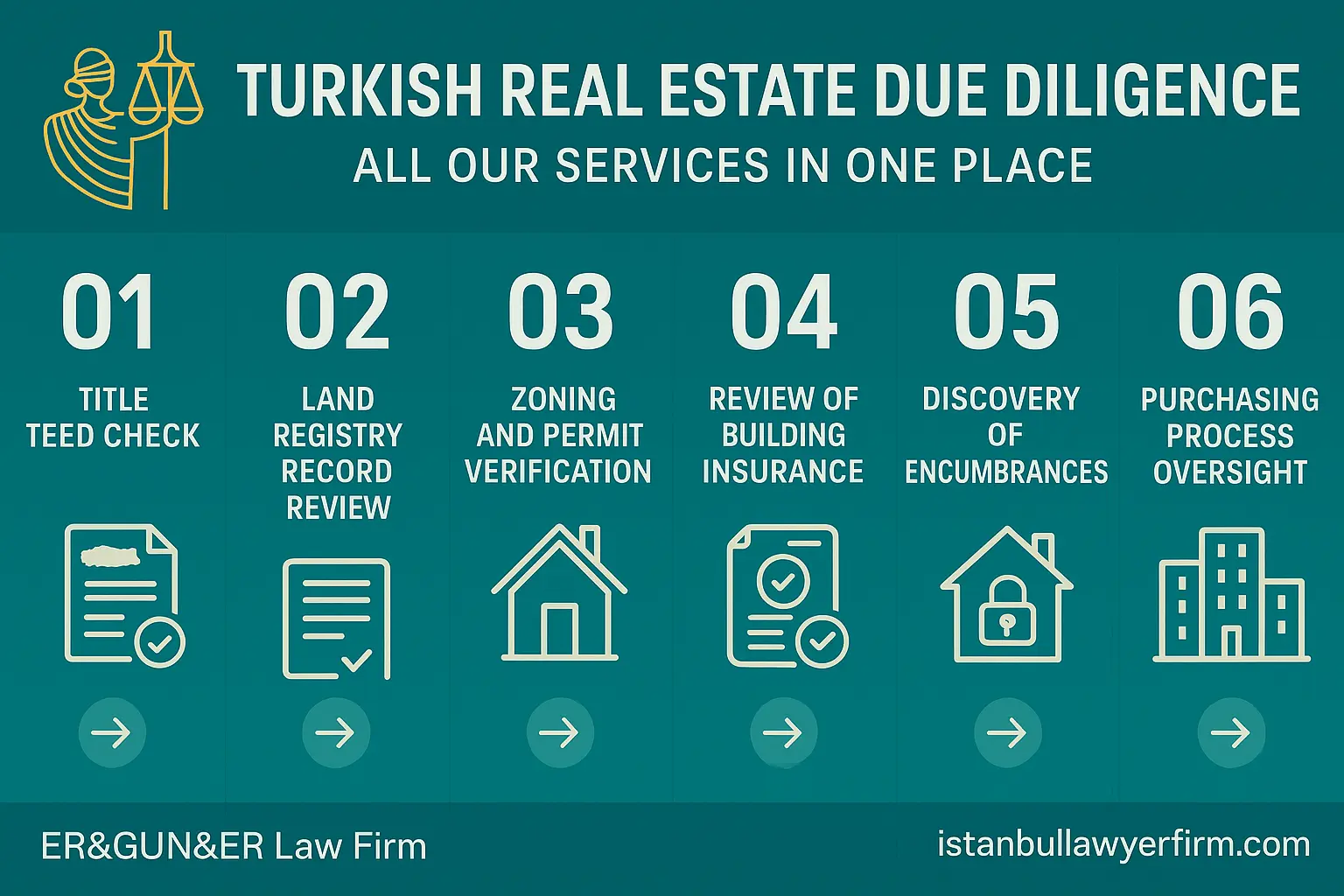
Real estate due diligence for foreign buyers in Turkey is the structured legal and technical review of a target property before purchase that confirms title authenticity, ownership rights, encumbrance status, zoning and construction compliance, tax position, developer reliability, structural and seismic safety, and the property's eligibility for the buyer's intended purpose (residential use, commercial operation, citizenship-by-investment qualification). The framework that governs the relevant legal questions is set primarily by the Tapu Kanunu (Law No. 2644, the Land Registry Law) governing real estate registration including foreign acquisition; the Türk Medeni Kanunu (Law No. 4721, the Turkish Civil Code) governing property rights, ownership categories and encumbrance frameworks; the Kat Mülkiyeti Kanunu (Law No. 634) governing condominium and floor ownership (kat irtifakı and kat mülkiyeti); the İmar Kanunu (Law No. 3194, the Zoning Law) governing zoning, construction permits and occupancy certificates; the Türk Borçlar Kanunu (Law No. 6098, the Turkish Code of Obligations) governing the underlying purchase contract; and the Türk Vatandaşlığı Kanunu (Law No. 5901) together with its implementing regulation governing citizenship-by-investment qualification. Practice may vary by authority and year.
An English speaking lawyer in Turkey advising foreign buyers on Turkish-property due diligence will explain that the diligence process operates as a structured sequence of confirmations rather than a single document review, with each layer addressing specific risk categories that surface in different phases of the transaction. The body of this guide walks through the underlying necessity and risk profile of due diligence, the Tapu Müdürlüğü registry review and floor ownership analysis, the zoning and construction permit verification, the tax and developer reliability assessment, the earthquake and technical-environmental due diligence, the foreign ownership restrictions and contract-escrow architecture, the citizenship-by-investment compliance overlay, and the vekaletname-based remote purchase coordination layer. For procedural orientation on adjacent topics, our notes on title deed verification in Turkey, buying property in Istanbul, Turkish citizenship by investment, real estate taxes in Turkey and power of attorney for foreigners can be read alongside this material.
1) Why Real Estate Due Diligence Is Essential for Foreign Buyers
A lawyer in Turkey who explains the due diligence imperative will start with the structural information asymmetry that foreign buyers face in the Turkish property market. The procedure ordinarily exposes foreign buyers to risks that local market participants typically navigate through accumulated familiarity: title authenticity questions where the seller's claimed ownership does not match the Tapu registry entry; encumbrance complications where the property carries mortgages, court-ordered seizure annotations (haciz şerhi), tax liens or other registered restrictions that the foreign buyer is not initially aware of; joint ownership configurations where the seller is one of multiple co-owners and cannot transfer full title without coordination; inheritance complications where the property is part of an unsettled estate with multiple heirs; usufruct or other dismembered property rights (intifa hakkı) granting third parties use rights that survive the title transfer; and zoning or construction-permit defects that subject the property to demolition risk, transfer restrictions or operational limitations.
An Istanbul Law Firm advising on the diligence-versus-no-diligence consequence framework will identify the typical loss categories that the absence of diligence produces. Where buyers proceed without title verification, common outcomes include payment of deposit or full purchase price to a seller who cannot ultimately deliver clean title; discovery at the Tapu transfer appointment that registered encumbrances block the transfer; subsequent post-transfer litigation by undisclosed heirs or co-owners challenging the transfer's validity; demolition orders for properties built without permits or in violation of zoning rules; tax debts attached to the property that the buyer inherits with the title; and operational restrictions (commercial use prohibitions, rental restrictions, foreign ownership limitations) that prevent the buyer's intended use. The standard approach is to treat each transaction as documentary verification before financial commitment rather than as financial commitment followed by documentary review. The loss-recovery framework where diligence has been skipped deserves operational attention because recovery options after the fact are typically more limited and more procedurally costly than prevention through pre-transaction diligence. Where the buyer has paid funds to a seller who cannot deliver clean title, recovery options include civil litigation against the seller for return of funds and damages (with collection difficulty depending on the seller's actual asset base and any concealment); criminal complaint where the seller's conduct rises to the level of fraud (dolandırıcılık) under the Türk Ceza Kanunu's framework; and recovery against any intermediaries or agents who facilitated the transaction with culpable knowledge or negligence. Each recovery pathway carries its own procedural friction and timeline, with realistic recovery often producing partial outcomes rather than full restoration of the buyer's position. The pre-transaction diligence cost is invariably lower than the post-transaction recovery cost.
A Turkish Law Firm coordinating the diligence framework for the foreign-buyer profile specifically will note the additional layers that apply where the buyer is not a Turkish national. Foreign acquisition operates within the Tapu Kanunu's reciprocity framework that limits foreign nationals' ability to acquire property based on the bilateral relationship between Turkey and the buyer's country of nationality; geographic restrictions limit foreign ownership in defined zones (military zones, security zones, certain provincial caps); aggregate ownership limitations cap the total area a foreign individual can hold across Turkey; and citizenship-by-investment buyers face additional compliance overlays including valuation report standards, three-year non-resale commitments, and registration requirements that ordinary buyers do not encounter. The discipline outlined in our note on title deed verification in Turkey covers the underlying registry-review framework in greater depth. Practice may vary by authority and year. The reciprocity framework's operational dimension deserves separate attention because the framework's application has evolved over time and currently treats most foreign nationalities favorably while maintaining specific restrictions that the diligence file should verify rather than assume. The Tapu Kanunu's reciprocity provisions, as amended through legislative changes in 2012, replaced the traditional country-by-country reciprocity inquiry with a list-based system administered by the Council of Ministers that designates the eligible nationalities; the current list is broad and covers nationals from a substantial majority of countries, but specific national exclusions exist and the diligence file should verify the buyer's nationality against the current list rather than assuming general eligibility. Where the buyer holds dual nationality, the file's analysis covers both nationalities to ensure that the more advantageous status applies to the acquisition rather than allowing the less favorable nationality to control where dual citizenship creates planning flexibility.
2) Tapu Müdürlüğü Registry Review and Floor Ownership Analysis
An English speaking lawyer in Turkey conducting the Tapu Müdürlüğü registry review will explain that the Tapu (title deed) and the supporting registry records are the foundational documentary basis for Turkish property ownership. The procedure ordinarily requires obtaining the current Tapu registry extract (Tapu kaydı) showing the property's registration number, parcel and independent unit identifiers, current owner identity and shareholding percentage, encumbrance section listing mortgages, liens, court annotations and other registered restrictions, the property's dimensional data (square meterage, floor and block details), and the property's land registry classification. The standard approach is to obtain the extract dated within days of the transaction rather than relying on a recent-but-not-current extract because new encumbrances can be registered between the extract date and the transfer date. The Tapu Müdürlüğü's underlying registry system operates through TAKBİS (Tapu ve Kadastro Bilgi Sistemi, the Land Registry and Cadastre Information System), the centralized digital platform that records all property registration data nationwide and feeds the documentary outputs that the diligence process relies on. The procedure ordinarily allows authorized parties to obtain Tapu extracts directly from the local Tapu Müdürlüğü office serving the property's location, with extract issuance ordinarily completed within the same day for routine requests; specialized historical extracts showing the property's full registration history (including past owners, past encumbrances and past annotations) require separate request procedures and may take longer to produce. Where the property has had multiple owners over time or has been subject to past encumbrances that have since been released, the historical extract can identify dormant issues that the current-snapshot extract does not show but that may resurface in subsequent disputes or claims.
An Istanbul Law Firm advising on floor ownership analysis will explain that apartments and units in multi-unit buildings require additional verification beyond the basic Tapu review because floor ownership operates through a specific framework under the Kat Mülkiyeti Kanunu (Law No. 634). The procedure ordinarily requires distinguishing between two floor ownership statuses: kat irtifakı (construction servitude), which applies to units in buildings under construction or buildings whose iskan (occupancy permit) has not yet been issued, and kat mülkiyeti (full condominium ownership), which applies to units in completed buildings with full occupancy permits and full title individualization. The standard approach is to verify which status applies, confirm that the unit's specific designation matches the actual physical unit being purchased (block letter, floor number, unit number), and confirm that the unit's square meter declaration matches the physical reality. Where the property is in kat irtifakı status, the buyer should anticipate the eventual conversion to kat mülkiyeti and confirm that conversion is procedurally feasible without complications.
Turkish lawyers who handle the encumbrance-and-annotation review (şerh analizi) will note that the Tapu's encumbrance section can contain multiple categories of registered restrictions that affect the property's transferability and value. The procedure ordinarily requires identifying mortgages (ipotek) registered to secure debts; haciz şerhi (court-ordered seizure annotations) registered through enforcement proceedings against the seller; tax liens registered by tax authorities for unpaid property tax; expropriation annotations (kamulaştırma şerhi) registered where the property is subject to public-use acquisition; intifa hakkı (usufruct rights) granting third parties use rights that survive title transfer; geçit hakkı (right-of-way easements) granting access through the property; and other rights-of-way or registered restrictions specific to the property. Each category produces different transfer implications and different remediation options. Practice may vary by authority and year. The annotation-removal mechanics deserve separate operational attention because not all encumbrances must necessarily defeat the transaction — some can be cleared at closing through coordinated payment arrangements, while others require pre-closing remediation that the seller must complete before the transaction proceeds. The standard approach is to categorize each registered annotation by remediation pathway: mortgage releases (ipotek terkin) typically clear at closing through payment of the secured debt to the mortgagee with simultaneous registration of release; tax liens clear through payment of the underlying tax debt with registration of release through the relevant tax office; haciz şerhi annotations clear through resolution of the underlying enforcement proceeding with the relevant icra dairesi (enforcement office); intifa hakkı and similar dismembered rights typically require negotiated termination by the rights-holder which may require commercial consideration; and expropriation annotations indicate fundamental transfer-restriction problems that ordinarily preclude rather than complicate the transaction. The categorization at the diligence stage allows the buyer to make informed decisions about which encumbrances are workable and which are dispositive of the transaction.
3) Zoning, Construction Permits and Municipal Document Checks
A Turkish Law Firm advising on zoning and construction permit verification will explain that the legal-physical alignment of the property is one of the most consequential diligence layers because zoning and permit defects can produce demolition orders, fine exposure and operational restrictions that survive ordinary title transfer. The procedure ordinarily requires obtaining the property's zoning status from the local belediye (municipality) confirming the parcel's zoning designation (residential, commercial, agricultural, mixed-use, industrial, protected); the building's yapı ruhsatı (construction permit) showing that the building was authorized at construction; the iskan (occupancy permit, also called yapı kullanma izin belgesi) showing that the completed building was certified for occupation; and the conformity of the as-built structure to the permitted construction (including footprint, floor count, total construction area, and use category).
A lawyer in Turkey coordinating the zoning analysis will note that zoning compliance extends beyond the binary permit/no-permit question into substantive use questions that the foreign buyer's intended purpose may trigger. The procedure ordinarily requires verifying that the parcel's zoning designation supports the intended use (residential property cannot be used for commercial business under the same zoning designation); that the building's permitted use category matches the intended use; that any planned modifications (renovations, conversions, additions) would be permissible under the current zoning; and that the property is not located in a protected zone (cultural heritage area, ecological protection area, agricultural reserve, urban renewal designation) where additional restrictions apply. The discipline outlined in our note on adjacent buying property in Istanbul covers the broader Istanbul-specific market context within which the zoning analysis operates. The zoning-conversion analysis adds another dimension where the buyer's intended use diverges from the property's current zoning designation, because conversion is sometimes feasible through municipal application processes and sometimes structurally precluded by the broader zoning plan. The procedure ordinarily requires identifying the desired use; checking the current zoning plan to determine whether the desired use is permissible under the existing designation; checking the broader regional plan (1/100,000 ve 1/25,000 ölçekli planlar at the regional level, 1/5,000 nazım imar planı at the framework level, and 1/1,000 uygulama imar planı at the implementation level) to determine whether the broader planning framework supports the intended use; and identifying any pending plan revisions that may affect the property's status. Where conversion is feasible through application, the file should anticipate the realistic timeline and procedural cost rather than treating conversion as a free post-purchase option.
An Istanbul Law Firm advising on municipal compliance documentation will explain that beyond the core zoning and permit framework, several additional municipal records affect the property's status. The procedure ordinarily requires checking the building's structural risk reports (yapı risk raporu) where applicable; the urban transformation (kentsel dönüşüm) status of the building and its surrounding parcel under Law No. 6306 governing transformation of areas at risk of natural disaster; the deprem performans raporu (earthquake performance assessment) where the building has been evaluated; the property's tax assessment value (rayiç bedel) for property tax and inheritance tax calculation purposes; and any expropriation projects (kamulaştırma) affecting the property or its access infrastructure. The combination of all municipal layers produces the complete compliance picture that the diligence file documents for the buyer's pre-purchase decision. Practice may vary by authority and year. The municipal-records gap analysis deserves operational attention because municipal record systems vary in completeness across different belediye offices and across different time periods, with older properties or properties in smaller municipalities sometimes producing incomplete documentary chains that the diligence file must address rather than ignore. The standard approach is to identify gaps proactively (missing yapı ruhsatı, missing iskan, missing zoning confirmation, building footprint inconsistencies between municipal records and current physical reality), document the gap pattern, and make explicit decisions about how each gap affects the transaction's risk profile rather than treating gaps as procedural inconveniences to be worked around. Where gaps are concentrated and material, the standard approach typically counsels against the transaction or counsels significantly reduced purchase price reflecting the regulatory risk that the gaps produce; where gaps are isolated and substantively explainable, the transaction can proceed with the gap analysis preserved in the documentary file for future reference.
4) Tax Status, Developer Reliability and Off-Plan Risk
An English speaking lawyer in Turkey advising on tax-status verification will explain that the property's tax position affects both the immediate transaction (whether tax debts block the title transfer) and the post-transfer ongoing position (the buyer's ongoing tax obligations). The procedure ordinarily requires verifying that the seller has paid all accrued property tax (emlak vergisi) up to the transfer date through municipal tax records; that no fiscal liens have been registered against the property for unpaid tax debts; that the seller's title transfer tax (tapu harcı) obligation has been or will be met at transfer; that the property's tax classification (residential vs commercial vs agricultural) aligns with its zoning and intended use; and that the rayiç bedel used for tax purposes is consistent with the transaction's commercial reality. The discipline outlined in our note on real estate taxes in Turkey covers the broader tax framework within which transaction-specific verification operates.
A Turkish Law Firm advising on developer reliability assessment will note that off-plan and new-construction purchases require diligence layers that resale transactions do not, because the buyer is committing capital to a developer's future delivery rather than acquiring an existing completed asset. The procedure ordinarily requires obtaining the developer's Ticaret Sicil Müdürlüğü extract showing legal status, registered representatives, capital and corporate history; reviewing the developer's track record on completed projects through court records (litigation history), bank records (financial reliability indicators where accessible), and market reputation indicators; verifying the developer's authorization to construct and sell on the specific parcel through the construction permit chain; and reviewing the contractual structure (off-plan contract / satış vaadi sözleşmesi) for the buyer's protection mechanisms including delivery date guarantees, penalty clauses for delays, refund mechanisms for project failure, and bank guarantees or other security where applicable. The off-plan contract's notarization requirement under the Türk Borçlar Kanunu's framework deserves separate attention because satış vaadi sözleşmesi must be executed in resmi şekil (notarized form) to produce binding effect on the parties; private writings purporting to operate as off-plan sales contracts are typically unenforceable as title-transfer commitments and provide only limited remedies if the developer defaults on delivery.
Turkish lawyers who handle off-plan transaction diligence will note that escrow or trust account structures for the deposit and progress payments are central to risk management in this transaction category. The procedure ordinarily requires structuring payment release in stages tied to verified construction milestones (foundation completion, structural completion, exterior shell completion, interior finishing, occupancy permit issuance) rather than time-based release that does not correlate with actual progress; documenting payment release conditions in writing with the developer and the escrow agent; maintaining inspection rights during construction so the buyer can independently verify progress; and preserving cancellation rights where construction defaults beyond defined tolerances. Practice may vary by authority and year, and off-plan diligence is one of the most consequential differentiators between transaction success and transaction loss in the foreign-buyer market. The construction milestone framework deserves separate attention because the milestone definitions and verification mechanisms determine whether progress payments correlate with actual construction progress or simply with calendar dates. The standard approach is to define milestones through specific physical-construction events that an independent inspector can verify: foundation pour completion (temel atma) verified through site inspection or through municipal certification where available; structural framing completion (kaba inşaat tamamlanması) verified through site inspection of completed columns, beams and floor slabs; weather-protected shell completion (mantolama tamamlanması) verified through inspection of windows, exterior walls and roofing; mechanical, electrical and plumbing completion (mekanik, elektrik ve sıhhi tesisat tamamlanması) verified through inspection of installed systems; interior finishing completion (iç doğrama tamamlanması) verified through inspection of completed surfaces, fixtures and finishings; and occupancy permit issuance (iskan alınması) verified through the actual permit document. Each milestone-payment release should require both a documentary trigger (inspection report, permit document) and a registered confirmation that the underlying construction has been independently verified.
5) Earthquake Risk, DASK and Technical-Environmental Due Diligence
A lawyer in Turkey advising on earthquake risk diligence will explain that Turkey's location in a seismically active region makes earthquake-specific due diligence a substantive component of any property transaction rather than an optional add-on. The procedure ordinarily requires verifying the building's compliance with the post-1999 seismic regulations introduced after the Marmara earthquake and substantially updated through subsequent revisions to the Türkiye Bina Deprem Yönetmeliği (Turkish Earthquake Building Code); confirming the building's date of construction relative to the applicable code generation; obtaining the building's structural assessment report where one has been performed; checking the parcel's location against the seismic hazard map (deprem tehlike haritası) maintained by AFAD (Afet ve Acil Durum Yönetimi Başkanlığı, the Disaster and Emergency Management Authority); and verifying the property's DASK (Doğal Afet Sigortaları Kurumu, the Natural Disaster Insurance Pool) earthquake insurance coverage status, which is mandatory for residential properties under the Zorunlu Deprem Sigortası framework.
An Istanbul Law Firm advising on the kentsel dönüşüm (urban transformation) framework will explain that urban transformation under Law No. 6306 (Afet Riski Altındaki Alanların Dönüştürülmesi Hakkında Kanun) provides both a risk indicator and a potential value impact for properties in designated transformation zones. The procedure ordinarily requires checking whether the property or its surrounding parcel is registered as a riskli yapı (risky building) or located within a riskli alan (risky area) under the Çevre, Şehircilik ve İklim Değişikliği Bakanlığı's framework; reviewing any pending or proposed transformation projects that affect the property; assessing the financial implications of transformation (demolition with reconstruction, financial compensation, replacement unit allocation); and evaluating the timeline implications. The standard approach for foreign buyers is to view kentsel dönüşüm status as a material disclosure rather than as a binary buy/no-buy criterion, with the buyer's response depending on the specific transformation project's economics and timeline.
Turkish lawyers who handle environmental and technical diligence will note that beyond seismic risk, environmental factors can affect property usability and value. The procedure ordinarily requires checking the parcel's location against environmental protection designations (sit alanı for archaeological/cultural protection, milli park for national parks, ekolojik koruma alanı for ecological protection areas); verifying soil contamination history particularly for industrial-area properties; reviewing flood risk through topographical analysis and historical flood records; assessing slope stability for hillside properties; and confirming that infrastructure access (roads, utilities, water, sewerage) is properly registered and operational. The standard approach combines documentary review with site inspection where possible, with the inspection cross-referencing the documentary picture against the physical reality. Practice may vary by authority and year. The environmental-layer framework involves multiple distinct regulatory regimes that the diligence file should distinguish rather than collapse into general "environmental risk" analysis. Sit alanı (site protection) status under the Kültür ve Tabiat Varlıklarını Koruma Kanunu (Law No. 2863) restricts modification and development of properties within designated archaeological, historical or natural heritage sites, with substantive impact on usage rights. Milli park (national park) status under the Milli Parklar Kanunu (Law No. 2873) prohibits most development within designated national park boundaries. Ekolojik koruma alanı designations under various environmental regulations restrict development based on biodiversity, water resource or special habitat protections. Tarım arazisi (agricultural land) classifications under the Toprak Koruma ve Arazi Kullanımı Kanunu (Law No. 5403) restrict conversion of agricultural parcels to other uses. Each layer produces specific restrictions that may or may not affect the buyer's intended use; the diligence file's responsibility is to identify which layers apply and what restrictions follow rather than to make subjective risk judgments without the regulatory basis.
6) Foreign Ownership Restrictions, Contracts and Escrow Architecture
A Turkish Law Firm advising on foreign ownership restrictions will explain that the Tapu Kanunu's framework imposes specific restrictions on foreign acquisition that the diligence file must verify before transaction structuring. The procedure ordinarily requires confirming that the buyer's nationality is not on a restricted-nationality list under the reciprocity framework; checking that the property is not located in a military zone (askeri yasak bölge) where foreign acquisition is generally prohibited; verifying that the property is not in a security zone (özel güvenlik bölgesi) where foreign acquisition requires specific clearance; checking the property's location against the district-level foreign ownership cap (foreign nationals collectively cannot hold more than ten percent of a district's land area); and verifying the buyer's individual aggregate ownership against the country-wide limit on individual foreign ownership. Since 2019, the military zone clearance procedure operates through the Tapu Müdürlüğü's central system that consults the relevant military authority during the registration process rather than requiring direct buyer applications.
An English speaking lawyer in Turkey advising on contract architecture will explain that the underlying purchase contract operates within the Türk Borçlar Kanunu (Law No. 6098) framework, with specific formal requirements for property transactions. The procedure ordinarily requires the principal title transfer to occur before the Tapu Müdürlüğü as a public act (resmi şekil) rather than through a privately executed contract; pre-contract arrangements (satış vaadi sözleşmesi for off-plan and earnest money for resale) typically take notarized form to be enforceable; the bilingual contract structure for foreign buyers should align Turkish-language and English-language versions through a controlling-version clause where translation differences arise; and contract terms should address the standard transaction issues (purchase price, payment schedule, possession transfer, delivery condition, default remedies, dispute resolution) with explicit Turkish-law applicability and Turkish-court jurisdiction. The bilingual contract structure deserves separate attention because translation discrepancies between versions can produce material disputes that the controlling-version clause should pre-resolve; the standard approach is to designate the Turkish-language version as the controlling version (because Turkish courts apply Turkish-language texts) while providing a parallel English-language version that the foreign buyer can reference for substantive understanding. Where translation discrepancies are discovered after execution, the controlling-version clause directs the dispute resolution to the Turkish text rather than allowing the foreign buyer to argue that the English understanding controls.
Turkish lawyers who handle escrow architecture will note that escrow mechanisms for foreign buyers serve to align payment timing with documentary verification, reducing the risk that funds transfer before the title can be cleanly delivered. The procedure ordinarily requires escrow account structuring through a Turkish bank or through a notary-supervised trust arrangement; release-condition documentation specifying the events that trigger fund release (typically Tapu Müdürlüğü registration completion with the buyer as registered owner); payment-currency arrangements (the Foreign Currency Purchase Document or "Döviz Alım Belgesi" requirement for foreign-currency transactions); and clear default-and-refund mechanics where the title cannot be delivered as represented. The discipline outlined in our note on buying property in Istanbul covers the broader transaction-execution framework within which the escrow architecture operates. Practice may vary by authority and year. The Foreign Currency Purchase Document framework deserves separate operational attention because it operates as a substantive compliance requirement rather than an administrative formality, particularly for citizenship-track acquisitions. The procedure ordinarily requires the foreign-currency funds to be transferred from abroad to a Turkish bank or authorized institution; the foreign-currency-to-Turkish-lira conversion to be executed through the bank or authorized institution generating the Döviz Alım Belgesi (Foreign Currency Purchase Document); the converted Turkish lira to be paid to the seller through traceable banking channels; and the Foreign Currency Purchase Document to be presented at the Tapu Müdürlüğü as part of the transfer documentary chain. Citizenship-track buyers face additional documentary discipline because the citizenship application uses the Foreign Currency Purchase Document as evidence of the qualifying foreign-currency investment; gaps or inconsistencies in the documentary chain produce both transactional friction and citizenship application complications that can defeat the citizenship qualification despite the underlying property purchase being valid in itself.
7) Real Estate Due Diligence for Citizenship by Investment
An Istanbul Law Firm advising foreign buyers on citizenship-by-investment property diligence will explain that the citizenship-track adds substantive compliance overlays to the standard real estate diligence. The procedure ordinarily requires verifying that the property's purchase price meets the citizenship-qualifying investment threshold (currently four hundred thousand US Dollars or its equivalent in Turkish lira at the date of the official valuation, applicable to acquisitions on or after 13 June 2022); obtaining a valuation report (taşınmaz değerleme raporu) from a Sermaye Piyasası Kurulu (SPK)-licensed appraiser confirming the property's value at or above the threshold; verifying that the property has not been previously used for a citizenship qualification by another applicant within the relevant restriction period; confirming that the seller is not a Turkish resident foreign national whose sale to another foreigner triggers specific restrictions; and structuring the purchase price documentation through Turkish banking channels with the appropriate Foreign Currency Purchase Document. The valuation report's technical requirements are substantive rather than formal because the SPK-licensed appraiser must apply specific valuation methodology consistent with the SPK's framework and must support the conclusion through documented comparables, physical inspection findings, and the appraiser's professional judgment; over-valuations designed to inflate the property's apparent value to meet the threshold produce both regulatory sanctions for the appraiser and citizenship-application complications for the buyer including potential rejection of the application or subsequent revocation of citizenship granted on a misrepresented basis.
A lawyer in Turkey advising on the citizenship-track procedural sequence will note that the diligence chain extends beyond the property itself into the buyer's documentary qualification. The procedure ordinarily requires the buyer to register the three-year non-resale commitment (üç yıl satılmama taahhüdü) with the Tapu Müdürlüğü as an annotation against the property's registration; the commitment legally restricts the buyer from disposing of the property within three years from the acquisition date, with violations producing both forfeiture of the citizenship qualification and potential revocation of citizenship already granted; the buyer's broader application package proceeds through the Nüfus ve Vatandaşlık İşleri Genel Müdürlüğü (Directorate General of Civil Registration and Citizenship) under the İçişleri Bakanlığı (Ministry of Interior) with the property documentation as one component of the broader application; and the application timeline depends on the broader package's documentary completeness and administrative processing rather than only on the property-specific elements.
Turkish lawyers who handle the property-side procedural mechanics will identify the documentary chain that the citizenship-track Tapu transfer requires. The procedure ordinarily requires the SPK-licensed appraiser's valuation report meeting the threshold; the Foreign Currency Purchase Document evidencing the foreign-currency-to-Turkish-lira conversion at a Turkish bank or authorized institution; the title transfer at the Tapu Müdürlüğü with the citizenship-track three-year non-resale annotation registered simultaneously; the property's eligibility confirmation through the Tapu Kanunu m.40 framework and the implementing regulations issued by the Çevre, Şehircilik ve İklim Değişikliği Bakanlığı together with the Tapu ve Kadastro Genel Müdürlüğü; and the documentary record assembled in form ready for inclusion in the broader citizenship application. The discipline outlined in our note on Turkish citizenship by investment covers the broader citizenship application framework. Practice may vary by authority and year. The citizenship-track procedural sequence deserves separate attention because the property acquisition is one component of a broader procedural chain that produces the citizenship outcome only when all components are completed properly. The procedure ordinarily requires the property acquisition with three-year non-resale annotation registered at the Tapu Müdürlüğü; the property's certificate of conformity (uygunluk belgesi) issued by the Çevre, Şehircilik ve İklim Değişikliği Bakanlığı confirming that the property meets the citizenship-track investment criteria; the broader application to the İçişleri Bakanlığı's Nüfus ve Vatandaşlık İşleri Genel Müdürlüğü with the property documentation, the buyer's identity documentation, the buyer's family member documentation where the application includes spouse and minor children, the buyer's clean criminal record certification from the country of origin (apostilled or consular-legalized and translated), and the broader supporting package; the application's processing through the relevant procedural stages including security review and Cabinet decision; and the resulting citizenship grant that follows the formal Cabinet decision (Bakanlar Kurulu kararı). The end-to-end timeline reflects all procedural stages combined rather than only the property-specific elements.
8) Vekaletname for Remote Purchase and Closing Coordination
A Turkish Law Firm advising foreign buyers on remote purchase architecture will explain that vekaletname (power of attorney) arrangements allow the entire transaction lifecycle to proceed without the buyer's physical presence in Turkey, from initial diligence through final Tapu registration. The procedure ordinarily requires the vekaletname to be executed before a Turkish consulate in the buyer's country of residence (which operates as the equivalent of a Turkish notary under the Noterlik Kanunu's consular extension provisions) or before a foreign notary with subsequent apostille or consular legalization and sworn Turkish translation. The vekaletname's scope must explicitly authorize the property-specific acts: title research and Tapu registry analysis, contract negotiation and signing, escrow account opening and management, valuation report procurement, Tapu Müdürlüğü registration appointment attendance, payment instruction execution, and post-registration administrative acts including utility account transfers and municipal tax registration. The vekaletname's revocation framework deserves separate attention because vekaletnames are revocable at the principal's discretion under the Türk Borçlar Kanunu's vekalet sözleşmesi (mandate contract) framework, with revocation taking effect upon proper notification to the vekaletname-holder and to relevant third parties (banks, registries, notaries) where the revocation should restrict their further reliance on the instrument. The standard approach is to issue scope-limited vekaletnames matched to specific transaction phases rather than open-ended vekaletnames covering all conceivable future acts, because narrower scope reduces both the principal's exposure if the vekaletname-holder acts beyond the principal's intent and the procedural friction associated with subsequent revocation. Where the transaction proceeds through multiple discrete phases (initial diligence, contract execution, registration), separate vekaletnames for each phase provide additional principal-side control and accommodate scope adjustments as the transaction develops without requiring revocation of an over-broad initial instrument. The phase-based approach is therefore both legally protective and operationally efficient.
An English speaking lawyer in Turkey coordinating the remote-purchase documentary chain will note that the vekaletname's documentary chain itself requires authentication architecture that aligns with the buyer's home country and with Turkish documentary expectations. The procedure ordinarily requires apostille for vekaletnames executed in countries that are members of the Hague Apostille Convention, or consular legalization through Turkish consulates for non-member countries; sworn Turkish translation of foreign-executed vekaletnames performed by an officially recognized translator with notarial certification of the translation; and timing coordination between vekaletname execution and the transaction's procedural milestones because vekaletnames do not retroactively authorize acts taken before their execution. The discipline outlined in our note on power of attorney for foreigners covers the broader vekaletname architecture in greater depth.
Turkish lawyers who handle the closing coordination layer will note that the closing-day mechanics require pre-coordination across multiple institutions to avoid the operational friction that distance-based execution can otherwise produce. The procedure ordinarily requires Tapu Müdürlüğü appointment scheduling with the appropriate office for the property's location; identity documentation preparation including the buyer's passport (presented through the vekaletname-holder rather than physically by the buyer where the buyer is not present), the buyer's Turkish tax number (vergi numarası), and the seller-side identification; the valuation report and Foreign Currency Purchase Document where applicable; the payment-execution coordination so that the funds transfer aligns with the registration completion; and the post-registration documentation delivery (new Tapu, registration confirmation, copy of all transaction documents) to the buyer's preferred address through couriered hard copies and digital delivery. Practice may vary by authority and year, and the closing coordination quality determines whether the transaction concludes cleanly in a single appointment or requires multiple appointments to address procedural gaps. The closing-day operational sequence deserves separate attention because the actual Tapu Müdürlüğü appointment proceeds through a defined procedural chain that small documentary gaps can disrupt at the counter. The procedure ordinarily requires arrival at the Tapu Müdürlüğü appointment with the complete documentary package (vekaletname original with apostille and sworn translation; buyer's passport and any required identity documentation; seller's identity documentation; current Tapu showing seller as registered owner; valuation report where citizenship-track applies; Foreign Currency Purchase Document where foreign-currency funding applies; SPK-licensed appraiser report where the property type triggers mandatory valuation; tax clearance from the relevant municipality; and any required corporate documentation where seller or buyer is a legal entity); review of the documentary package by the Tapu Müdürlüğü officer; payment of the title transfer tax and other transaction fees; signature of the registration record; issuance of the new Tapu showing the buyer as registered owner; and confirmation of the registration's completion in the central system. Each procedural step produces a documentary record that the post-closing folder maintains for future reference and for any subsequent regulatory or commercial verification.
9) Frequently Asked Questions for Foreign Buyers and International Investors
- What is real estate due diligence in Turkey? The structured legal and technical review of a target property before purchase covering title authenticity, ownership rights, encumbrances, zoning and construction compliance, tax position, developer reliability, structural and seismic safety, foreign ownership restrictions, and the property's eligibility for the buyer's intended purpose including citizenship-by-investment qualification where applicable.
- Why is due diligence essential for foreign buyers specifically? Foreign buyers face structural information asymmetry in the Turkish property market, additional layers of foreign ownership restrictions under the Tapu Kanunu, geographic restrictions in military and security zones, and citizenship-by-investment compliance overlays that ordinary Turkish buyers do not encounter.
- What is the Tapu and how is it reviewed? The Tapu (title deed) is the official record of property ownership. Review covers the current Tapu registry extract showing registration number, parcel and unit identifiers, current owner identity and shareholding percentage, encumbrance section listing mortgages, liens and court annotations, dimensional data, and land registry classification.
- What are kat irtifakı and kat mülkiyeti? Two floor ownership statuses under the Kat Mülkiyeti Kanunu (Law No. 634): kat irtifakı applies to units in buildings under construction or without an iskan (occupancy permit), while kat mülkiyeti applies to units in completed buildings with full occupancy permits and full title individualization.
- What zoning and construction permit checks are required? Verification of the parcel's zoning designation; the building's yapı ruhsatı (construction permit); the iskan (occupancy permit / yapı kullanma izin belgesi); the conformity of the as-built structure to the permitted construction; and the property's status under any urban renewal or protection designations.
- What tax checks does due diligence include? Verification that the seller has paid all accrued property tax (emlak vergisi); that no fiscal liens are registered for unpaid tax debts; that the title transfer tax (tapu harcı) obligation will be met at transfer; that the property's tax classification aligns with its zoning and intended use; and that the rayiç bedel is consistent with the transaction's commercial reality.
- How is developer reliability assessed for off-plan purchases? Through Ticaret Sicil Müdürlüğü extract review, track record analysis on completed projects, court records review for litigation history, financial reliability indicators where accessible, construction-permit authorization verification, and contractual structure review for buyer protection mechanisms including delivery guarantees, penalty clauses, refund mechanisms and bank guarantees.
- What is DASK and is it mandatory? DASK (Doğal Afet Sigortaları Kurumu, the Natural Disaster Insurance Pool) is the mandatory earthquake insurance under the Zorunlu Deprem Sigortası framework applicable to residential properties. The insurance covers earthquake-related structural damage up to defined coverage limits.
- What is kentsel dönüşüm? Urban transformation under Law No. 6306 (Afet Riski Altındaki Alanların Dönüştürülmesi Hakkında Kanun) covering buildings registered as riskli yapı (risky building) or located in riskli alan (risky area) under the Çevre, Şehircilik ve İklim Değişikliği Bakanlığı's framework. Status produces both risk indicators and potential value impacts requiring case-specific analysis.
- What foreign ownership restrictions apply? Reciprocity-based restrictions on certain nationalities; geographic restrictions in military zones (askeri yasak bölge) where foreign acquisition is generally prohibited and security zones (özel güvenlik bölgesi) where foreign acquisition requires clearance; the district-level cap (foreign nationals collectively cannot hold more than ten percent of a district's land); and the country-wide individual ownership limit.
- Does the buyer need to apply to the Ministry of Defense? No — since 2019, the military zone clearance procedure operates through the Tapu Müdürlüğü's central system that consults the relevant military authority during the registration process rather than requiring direct buyer applications.
- What is the citizenship-by-investment property threshold? Currently four hundred thousand US Dollars or its equivalent in Turkish lira at the date of the official valuation, applicable to acquisitions on or after 13 June 2022. The threshold applies to qualifying real estate investments under the Türk Vatandaşlığı Kanunu Uygulama Yönetmeliği's investment criteria.
- What is the three-year non-resale commitment? A registered Tapu annotation (şerh) under which the citizenship-track buyer commits not to dispose of the property within three years from the acquisition date. Violation produces both forfeiture of the citizenship qualification and potential revocation of citizenship already granted on that basis.
- Can the entire purchase be completed without traveling to Turkey? Yes, through a properly drafted and authenticated vekaletname (power of attorney) executed at a Turkish consulate abroad or before a foreign notary with apostille or consular legalization and sworn Turkish translation. The vekaletname's scope must explicitly authorize the property-specific acts including diligence, contract execution, escrow management, Tapu registration and post-registration administrative steps.
- Does ER&GUN&ER Law Firm advise foreign buyers on Turkish real estate due diligence? Yes. ER&GUN&ER Law Firm is an Istanbul-based law firm advising foreign buyers, expatriates and international investors on Turkish real estate due diligence across the complete transaction lifecycle, including Tapu Müdürlüğü registry analysis, kat irtifakı and kat mülkiyeti floor ownership verification, zoning and construction permit review, municipal compliance checks, tax status and developer reliability assessment, earthquake risk and DASK insurance verification, kentsel dönüşüm status analysis, foreign ownership restrictions and military zone clearance coordination, contract and escrow architecture, citizenship-by-investment compliance under the Tapu Kanunu m.40 framework and the Türk Vatandaşlığı Kanunu Uygulama Yönetmeliği, and vekaletname-based remote purchase coordination — with English-language client communication and bilingual documentation throughout each engagement. Files in this area are typically led personally by the managing partner rather than delegated.
Author: Mirkan Topcu is an attorney registered with the Istanbul Bar Association (Istanbul 1st Bar), Bar Registration No: 67874. His practice focuses on cross-border and high-stakes matters where evidence discipline, procedural accuracy, and risk control are decisive.
He advises foreign buyers, expatriates, international investors and multinational families on Turkish real estate due diligence under the Tapu Kanunu (Law No. 2644), the Türk Medeni Kanunu, the Kat Mülkiyeti Kanunu (Law No. 634), the İmar Kanunu (Law No. 3194), the Türk Borçlar Kanunu (Law No. 6098), and the Türk Vatandaşlığı Kanunu (Law No. 5901) together with its implementing regulation, including Tapu Müdürlüğü registry analysis and encumbrance review, kat irtifakı and kat mülkiyeti floor ownership verification, zoning and construction permit examination, municipal compliance checks including iskan and yapı ruhsatı verification, tax status and developer reliability assessment for off-plan purchases, earthquake risk and DASK insurance verification, kentsel dönüşüm status analysis under Law No. 6306, foreign ownership restrictions including military zone (askeri yasak bölge) and security zone (özel güvenlik bölgesi) clearance coordination through the Tapu Müdürlüğü's central consultation system, contract and escrow architecture under the Türk Borçlar Kanunu's transaction framework, citizenship-by-investment compliance with valuation report procurement and three-year non-resale commitment registration, and vekaletname-based remote purchase coordination for buyers unable to travel to Turkey.
Education: Istanbul University Faculty of Law (2018); Galatasaray University, LL.M. (2022). LinkedIn: Profile. Istanbul Bar Association: Official website.