

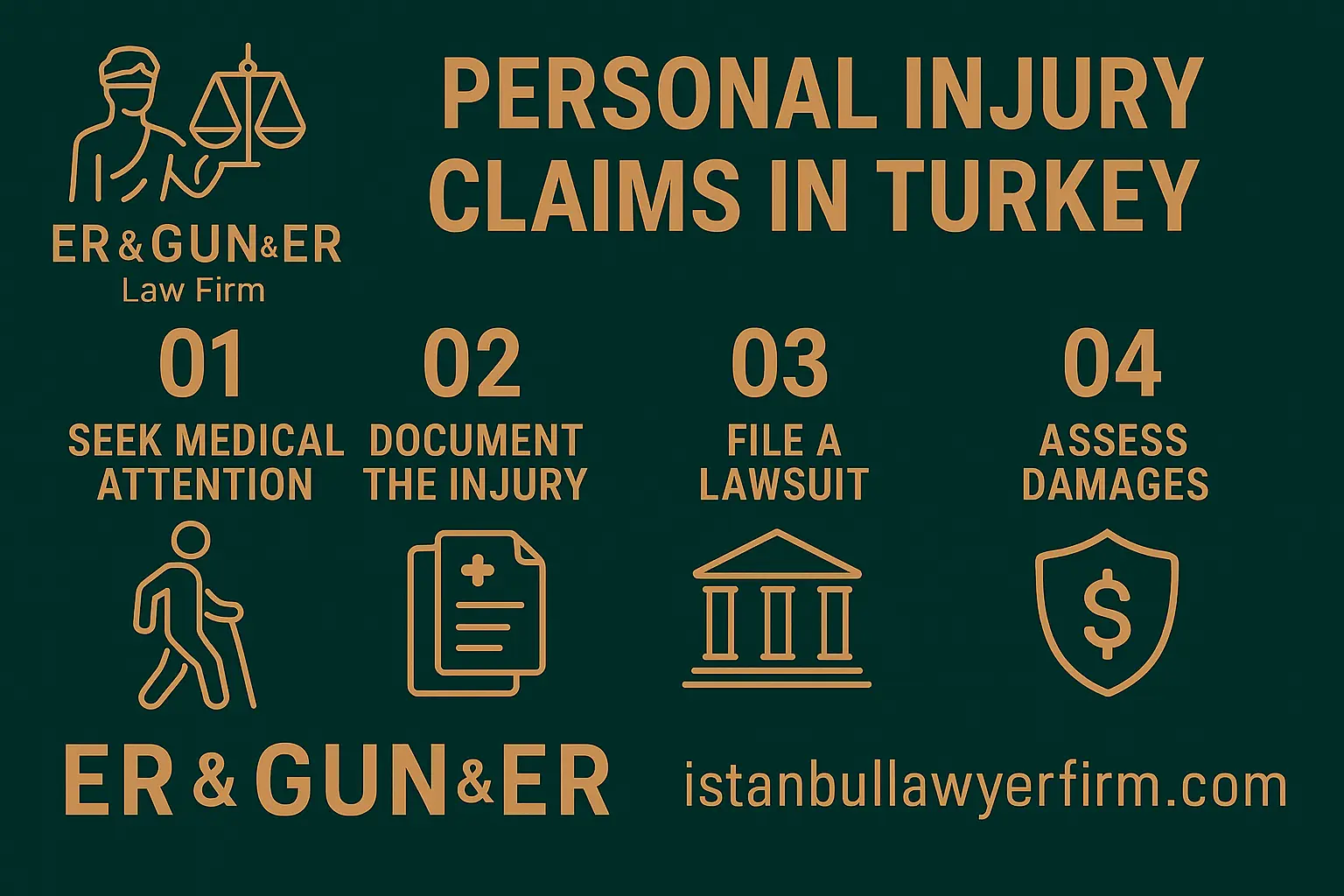
Personal injury claims in Turkey involving foreign victims sit at the intersection of the civil liability framework set out in the Türk Borçlar Kanunu (Turkish Code of Obligations), the criminal liability framework under the Türk Ceza Kanunu, the compulsory motor insurance regime under the Karayolları Trafik Kanunu, the procedural framework under the Hukuk Muhakemeleri Kanunu, and — where the foreign victim has returned home before litigation begins — the cross-border recognition and enforcement framework. Foreign nationals injured in traffic collisions, workplace incidents, medical procedures, premises-liability events or assaults face the same substantive entitlements as Turkish citizens, but encounter procedural friction that turns on language, evidence collection from abroad, vekaletname (power of attorney) execution under apostille or consular legalization, and coordination between Turkish counsel and home-country advisors. Practice may vary by authority and year, and the discussion below describes how a claim is built and defended in practice rather than promising particular monetary outcomes.
An English speaking lawyer in Turkey who handles personal injury files for foreign victims will tell you that the file is judged on its evidentiary architecture rather than on the gravity of the injury alone: the chain that links a documented mechanism of injury, a quantified set of pecuniary losses, a credible non-pecuniary harm narrative, and a defendant against whom the liability rule of the Türk Borçlar Kanunu can be applied. The body of this guide walks through the substantive liability framework, the principal categories of injury, the evidence architecture that converts a story into a justiciable claim, the compensation typology, the pre-litigation workflow, the civil court process before the Asliye Hukuk Mahkemesi, the insurance dispute path through the Sigorta Tahkim Komisyonu where applicable, and the appeal and enforcement routes through the Bölge Adliye Mahkemesi (Regional Court of Appeal) and the Yargıtay (Court of Cassation). For procedural orientation on coordinating with bilingual representation, our note on English-speaking legal representation in Turkey can be read alongside this material.
1) Legal Framework: Türk Borçlar Kanunu and Liability Standards for Personal Injury
A lawyer in Turkey who maps the civil liability landscape for personal injury will start with the Türk Borçlar Kanunu, which establishes the principal liability rules — fault-based liability (kusur sorumluluğu), strict liability (kusursuz sorumluluk) and the special liability regimes that attach to motor vehicles, employers, animal keepers, building owners, organizers of dangerous activities and producers of defective products. Fault-based liability requires the claimant to establish four elements: an unlawful act or omission, fault on the defendant's part (intention or negligence), damage suffered by the claimant, and a causal link (illiyet bağı) between the act and the damage. Strict liability releases the claimant from the duty to prove fault but still requires proof of the act, the damage and the causal link, with the defendant's defense limited to specified statutory exceptions such as force majeure, the victim's own gross fault or the act of a third party that broke the causal chain. Practice may vary by authority and year, and Turkish courts have continued to refine the boundary between fault-based and strict liability through accumulated decisions of the Yargıtay. Within the fault-based framework, the standard of care expected of the defendant is calibrated to the defendant's role and the foreseeability of the harm: a professional engaged in a regulated activity is expected to meet the standard of competent practice in the relevant field, a commercial operator is expected to anticipate the foreseeable risks associated with the operation, and a private individual is expected to act with the ordinary prudence of a reasonable person in similar circumstances. Where the defendant's conduct fell short of the applicable standard and the failure caused the injury, fault is established. Where the defendant raises contributory fault on the victim's part — for example, where a pedestrian crossed against a signal or a worker failed to use issued protective equipment — the court evaluates the contribution and apportions damages accordingly under the Türk Borçlar Kanunu's contributory fault provisions, with the victim's recovery reduced rather than extinguished unless the contribution rises to the level of gross fault that severs the causal link.
An Istanbul Law Firm preparing a personal injury claim will treat the choice of liability rule as the foundational analytical step, because the rule selected determines the burden of proof, the available defenses and the documentary architecture the file will need. Where the injury arose from a motor vehicle accident, the strict liability of the operator (işleten) under the special motor vehicle regime applies and the compulsory motor third-party liability insurance (Zorunlu Mali Sorumluluk Sigortası, ZMSS) of the operator's vehicle is engaged as an additional defendant. Where the injury arose from a workplace incident, the employer's heightened duty of care under the İş Sağlığı ve Güvenliği Kanunu and the Türk Borçlar Kanunu's special employer-liability provisions applies, and the Sosyal Güvenlik Kurumu (SGK) workplace accident regime overlays a separate statutory benefit pathway. Where the injury arose on commercial or residential premises, the building owner's strict liability under the Türk Borçlar Kanunu's premises-liability rule applies, with the operator's general duty of care providing an additional fault-based avenue. Where the injury arose from a medical procedure, the contractual relationship between the patient and the healthcare provider, together with the professional standard of care for medical practice, defines the analytical frame.
A Turkish Law Firm advising on the liability frame will also identify whether parallel criminal proceedings are likely, because a criminal complaint under the Türk Ceza Kanunu's intentional injury (kasten yaralama) or negligent injury (taksirle yaralama) provisions can affect the civil case in several ways. A criminal investigation produces an evidentiary record — police reports, witness statements, expert opinions, sometimes Adli Tıp Kurumu (Forensic Medicine Institute) reports — that the civil court may consider; a criminal conviction may shift the burden of disproof in the civil case under accepted principles; and the longer criminal prescription period may extend the effective civil prescription window where the act constituting the injury also constitutes a crime. We assess this overlay early in our engagement, because the decision whether to file a criminal complaint, whether to participate as a complainant (katılan) in criminal proceedings, and how to coordinate the timing of the civil filing with the criminal track are choices that materially affect the file's trajectory. The standard approach is to file the criminal complaint (suç duyurusu) with the competent Cumhuriyet Başsavcılığı (Public Prosecutor's Office) where the act constituting the injury appears to satisfy the elements of an offense under the Türk Ceza Kanunu, to support the complaint with the contemporaneous police record and the medical examination report, and to request the prosecutor's investigation of the incident scene, the witness statements and the available digital evidence. Where the prosecutor opens a public prosecution (kamu davası), the victim may register as a complainant and obtain access to the investigation file, attend hearings before the competent criminal court and submit motions on evidence and procedure. Practice may vary by authority and year, and the strategic value of the parallel criminal track depends on the specific evidentiary contribution it makes to the civil file rather than on the criminal sanction outcome itself.
2) Categories of Personal Injury: Traffic, Workplace, Medical, Premises and Assault
An English speaking lawyer in Turkey advising foreign victims will describe the principal categories of personal injury matters with their distinctive evidentiary and procedural features, because the recovery posture is shaped by the category as much as by the gravity of the injury. Traffic accident claims are the most frequent category, governed by the Karayolları Trafik Kanunu and the Türk Borçlar Kanunu's strict-liability rule for motor vehicle operators, and engage the ZMSS insurer of the operator's vehicle as a co-defendant or as the primary respondent in insurance arbitration before the Sigorta Tahkim Komisyonu. The procedure ordinarily requires the victim to obtain the trafik kazası tespit tutanağı (traffic accident report) from the responding police unit, the medical examination report from the receiving emergency department, and — for foreign victims who later return home — copies of these records and any subsequent treatment documentation translated and authenticated for use in Turkish proceedings. Practice may vary by authority and year.
Turkish lawyers handling workplace injury claims for foreign workers will explain that the İş Sağlığı ve Güvenliği Kanunu imposes an enhanced employer duty of care, with the employer required to identify, evaluate and mitigate workplace hazards, train workers, provide protective equipment and document compliance. Where the employer's failure to discharge this duty contributes to an injury, the worker may pursue civil compensation under the Türk Borçlar Kanunu's special employer-liability provisions while simultaneously claiming SGK statutory benefits — temporary disability income, permanent disability pension, medical treatment coverage — through the social security pathway. The civil claim and the SGK benefit are not mutually exclusive, but the civil compensation calculation typically nets out the SGK benefits already paid for the same loss components. For foreign workers, the file should establish that the employer's compliance documentation either fell short of statutory expectations or that the documented compliance was not implemented in operational practice, with the gap demonstrated through expert engineering reports and witness evidence.
Turkish lawyers who handle premises-liability and medical-malpractice claims for foreign victims will distinguish the two analytical frames: premises liability proceeds under the Türk Borçlar Kanunu's special rule for building owners, which holds the owner strictly liable for defects in the construction or maintenance of the building that cause damage, with the operator's general duty of care offering an additional fault-based avenue; medical malpractice proceeds under the contractual relationship between patient and provider — typically a hospital or a private practitioner — with the professional standard of care evaluated by independent medical experts. In our practice, premises liability claims for foreign tourists most commonly arise from hotel or restaurant incidents — slips, falls, burns, poolside or beachfront accidents — while medical malpractice claims arise from elective procedures such as cosmetic surgery, dental treatment and hair transplantation, where foreign patients return home and discover complications post-operatively. The cross-border evidence collection in these cases requires careful coordination with home-country medical providers, sworn translation of overseas records and apostille authentication where applicable. Where the claim involves serious injury or death, the file may also engage the Adli Tıp Kurumu (Forensic Medicine Institute) for an institutional medical-legal opinion that the civil court frequently treats as authoritative on causation and disability assessment. Adli Tıp Kurumu reports are typically obtained either through the criminal investigation file or by direct civil-court appointment, and the questions submitted to the institution should be drafted with the file's evidentiary needs in mind rather than left as generic medical inquiries.
3) Establishing Fault, Causation and Damage: Evidence Architecture
A lawyer in Turkey running the evidence architecture for a personal injury file will treat the case as three independent evidentiary tracks that must each meet the civil court's threshold: fault (or, under strict liability, the act and the absence of statutory defenses), causation linking the act to the injury, and quantified damage that can be reduced to a compensable amount. Each track relies on different sources, and weakness in any one track materially undermines the file even where the other two are strong. The procedure ordinarily requires the file to assemble the police report (where applicable), the contemporaneous medical examination record, the subsequent treatment records covering surgery, hospitalization and rehabilitation, the discharge summary identifying functional outcomes, the imaging studies (X-ray, MRI, CT) supporting clinical findings, witness statements taken contemporaneously where possible, surveillance or dashcam footage where available, and expert reports prepared by qualified Turkish experts in the relevant clinical, engineering or accident-reconstruction discipline.
Turkish lawyers preparing the medical evidence layer will coordinate with the treating institutions in Turkey to obtain the complete medical file rather than only the discharge summary, because the discharge summary alone routinely understates the injury narrative the civil court needs. The standard document set includes the emergency department record, the hospitalization charts, the operative reports for any surgical interventions, the rehabilitation and physiotherapy records, the imaging studies, the prescription records, the laboratory results, the medical certificates issued for work absence (rapor), and the disability assessment report (özürlü sağlık kurulu raporu) where applicable. Where the treatment continued in the foreign victim's home country after return, the home-country medical records must be sworn-translated and authenticated through apostille (for Hague Apostille Convention member states) or consular legalization (for non-member states), with the chain of authentication preserved as a separate evidentiary annex so that the Turkish court can verify the documentary genealogy without independent reconstruction. Where the Turkish treating institution declines to release the complete medical file directly to the patient — typically citing internal policy on archived records — the patient or counsel can request the file through the institution's hasta hakları birimi (patient rights unit) or, where the institution is a public hospital, through the Sağlık Bakanlığı (Ministry of Health) administrative channels under the Hasta Hakları Yönetmeliği. Where the records have been archived to off-site storage and the institution requires lead time to retrieve them, the request should be issued in writing with a clear deadline and preserved as a dated exhibit, because subsequent friction over file completeness is more easily managed when the institution's response timeline is documented from the outset. Where billing records are needed to substantiate the pecuniary damages claim, the institution's financial archive is a separate request track from the clinical archive and the two requests should be issued in parallel.
An Istanbul Law Firm coordinating expert evidence will organize the file so that the court's appointment of independent experts (bilirkişi) operates on a foundation that the file already supports. Civil courts in personal injury cases typically appoint a panel of medical experts to opine on the causal link between the act and the injury, the permanence of any disability, the impact on earning capacity, and the degree to which the injury reduces the victim's general ability to lead a normal life. For traffic accidents, the court additionally appoints accident-reconstruction experts to evaluate fault distribution among the parties; for workplace injuries, occupational safety experts to evaluate the employer's compliance with statutory duties; for medical malpractice, specialist medical experts to evaluate the standard of care. The standard approach is to anticipate the expert appointment, prepare the file with the questions the experts will be asked clearly answerable from the documents, and reserve focused legal argument for the moments when expert findings are translated into legal conclusions. The discipline outlined in our adjacent note on cross-border evidentiary structuring through bilingual legal representation can support this coordination.
4) Compensation: Pecuniary, Non-Pecuniary and Fatal Injury Claims
A Turkish Law Firm preparing the compensation typology will explain that Turkish civil law distinguishes pecuniary damages (maddi tazminat) from non-pecuniary damages (manevi tazminat), with each measured under separate principles and supported by separate evidence. Pecuniary damages cover quantifiable losses including past and future medical expenses, rehabilitation and physiotherapy costs, prosthetics and assistive devices, in-home care expenses, lost earnings during recovery, loss of earning capacity where the injury produces lasting disability, and incidental costs including travel for treatment, accommodation for accompanying family members, and damage to personal property at the time of the incident. Each category is supported by documentary evidence — invoices, receipts, payroll records, employment contracts, tax declarations, expert valuations of earning capacity — and the calculation typically deploys actuarial methodology that the court-appointed expert applies to project lifetime earning loss in present-value terms. Practice may vary by authority and year, and the actuarial methodology has continued to evolve through Yargıtay decisions on discount rates and life expectancy assumptions. The actuarial methodology distinguishes between the active working period — during which the victim's projected earnings are aggregated and discounted to present value — and the post-retirement period during which residual support obligations and pension flows are evaluated separately. The discount rate applied to future losses, the life expectancy table referenced for projection horizon and the wage growth assumption applied to project nominal earnings are each subject to review based on accumulated case law, and a competent file anticipates expert questions on each of these inputs by attaching the supporting documentation rather than leaving the methodology to be reconstructed during trial. Where the victim was a self-employed professional or a business owner, the earnings projection draws on tax declarations, accounting records and industry benchmarks rather than on payroll alone, with the methodology adjusted to reflect the variable income structure typical of self-employment.
An English speaking lawyer in Turkey preparing the non-pecuniary damages narrative will treat the manevi tazminat claim as a structured presentation of the injury's impact on the victim's life rather than as an emotional appeal, because Turkish courts evaluate non-pecuniary damages through a multi-factor analysis that includes the gravity of the physical injury, the duration and intensity of the suffering, the permanence of the consequences, the impact on the victim's professional and social life, the victim's age and life circumstances, the degree of fault on the defendant's part, the financial circumstances of the parties, and the comparable awards in similar cases. The standard approach is to support the narrative with psychological evaluation reports where post-traumatic stress, depression or anxiety has resulted, with photographs documenting visible injuries before and after recovery, with statements from family members and colleagues describing the victim's pre-injury and post-injury functional capacity, and with documentation of activities the victim can no longer undertake. Awards in non-pecuniary damages are not formulaic and the file must build the case for the specific amount sought.
A lawyer in Turkey advising on fatal injury cases will explain that the framework supports separate claims by the deceased's surviving relatives for funeral expenses, support loss (destekten yoksun kalma tazminatı) where the deceased contributed to the support of the claimant, and non-pecuniary damages for the close relatives' grief and emotional loss. The support-loss claim is calculated actuarially on the same projected-earnings basis as a living-victim earning capacity claim, with the projection reduced to reflect the proportion of the deceased's earnings that supported the claimant rather than the deceased's own consumption. For foreign families of deceased victims, the file must establish the family relationship through certified family records — vital records authenticated through apostille or consular legalization — and, where the deceased was the family's primary earner, financial dependency through documentary evidence of support flows. The discipline outlined in our note on foreign nationals' inheritance rights in Turkey can be read alongside this material because the inheritance and the injury claim sometimes proceed in parallel. The destekten yoksun kalma tazminatı calculation methodology applied by the Yargıtay deploys actuarial principles that distinguish between the deceased's earnings, the proportion the deceased consumed personally, the proportion that supported each surviving family member, and the projected duration of that support based on standard life expectancy tables. The widow or widower's support fraction is typically calculated on the assumption that the deceased's earnings supported the household at a defined proportion until the surviving spouse's own retirement age or a second marriage event; each child's support fraction is calculated until the child reaches the age of legal majority or completes higher education within defined assumptions. Foreign families should anticipate that the Turkish court will apply these methodologies even where the family resides abroad, with the calculations expressed in Turkish lira and the final award subject to currency translation at the date of payment.
5) Pre-Litigation Workflow: Records, Insurance and Vekaletname
Turkish lawyers running the pre-litigation phase for foreign victims will treat the period between the incident and the filing of the claim as evidence-gathering rather than as waiting time, because the contemporaneous records collected at this stage form the foundation that the file will rely on at trial. The standard approach is to instruct the victim — or, where the victim is incapacitated, the victim's family — to obtain and preserve the police report, the emergency department record, all subsequent medical documentation, photographic evidence of visible injuries and of the incident location, contact details of any witnesses, and any official correspondence from insurers, employers or third parties. Where the victim has returned home, instructions for ongoing record collection are issued in writing so that the home-country records can be assembled in a form usable in Turkish proceedings. The procedure ordinarily requires identity documents, incident records and authority certificates to be authenticated through apostille (for Hague Apostille Convention member states) or consular legalization (for non-member states), with sworn translation through Turkish notary-registered translators (yeminli tercüman).
An Istanbul Law Firm coordinating with insurers during the pre-litigation phase will identify all policies engaged by the incident and the limits and exclusions applicable to each. For traffic accidents, the operator's ZMSS policy is engaged for bodily injury claims up to the prescribed coverage limits, and the operator's voluntary motor own-damage insurance and the victim's own travel insurance may also be engaged depending on policy terms. For workplace injuries, the SGK statutory benefits apply alongside any employer's voluntary accident insurance. For premises liability, the building owner's and operator's general liability policies may be engaged. The pre-litigation engagement with insurers ordinarily proceeds through written correspondence rather than informal calls, with each communication preserved as a dated exhibit, and any settlement offers evaluated against the documented loss assessment rather than accepted under time pressure. Where the insurer's response is inadequate, the matter may proceed to the Sigorta Tahkim Komisyonu (Insurance Arbitration Commission) as a faster alternative to civil court for insurance-coverage disputes. Beyond the principal ZMSS coverage, several adjacent insurance products may be engaged depending on the incident profile: the operator's voluntary motor own-damage and supplementary liability insurance (kasko and ihtiyari mali sorumluluk) typically covers losses beyond the ZMSS limits; the commercial premises owner's general liability insurance covers premises-liability claims; the employer's voluntary accident insurance (ferdi kaza sigortası) supplements SGK statutory benefits for workplace incidents; the foreign victim's home-country travel insurance may cover repatriation, medical evacuation and supplementary medical expenses; and the credit card or tour operator's bundled travel coverage may engage on a primary or secondary basis. The standard approach is to map all engaged policies in a coverage register, identify the order of coverage (primary, excess, supplementary), and pursue claims against each policy on its own merits without allowing one insurer's denial to prejudice the file before the other insurers. Where the foreign victim's home-country travel insurer pays in the first instance, the insurer typically takes a subrogation interest in the Turkish recovery, and the coordination between the Turkish file and the home-country subrogation rights should be documented in writing.
A Turkish Law Firm preparing the foreign victim for representation through vekaletname will draft the power of attorney with the scope necessary for the full litigation lifecycle: filing the civil claim, representing the client at all hearings, receiving service of process and judgments on the client's behalf, filing appeals where appropriate, executing and enforcing the judgment, receiving funds from the defendant or insurer, and handling related criminal-track participation as a complainant where the criminal track has been initiated. The vekaletname is executed before a Turkish notary by a client physically present in Turkey, or before a foreign notary with apostille (for Hague Apostille Convention member states) or consular legalization at a Turkish consulate (for non-member states), with sworn Turkish translation. The procedure ordinarily requires the vekaletname to be executed on a recent date and to expressly authorize representation in personal injury proceedings, because generic powers of attorney without specific subject-matter authorization are routinely insufficient for the procedural acts the file will require. Practice may vary by authority and year.
6) Court Process: Asliye Hukuk Mahkemesi, Expert Reports and Hearings
An English speaking lawyer in Turkey filing the civil claim will identify the competent court — typically the Asliye Hukuk Mahkemesi (Civil Court of First Instance) of the place where the incident occurred or where the defendant resides, with the Tüketici Mahkemesi (Consumer Court) competent where the relationship between the parties is a consumer relationship and the İş Mahkemesi (Labor Court) competent for workplace injury claims against employers. The procedure ordinarily requires the claim petition (dava dilekçesi) to identify the parties, the factual narrative, the legal grounds under the Türk Borçlar Kanunu and any related statutes, the principal compensation amounts claimed for each loss category, the request for non-pecuniary damages, the documentary evidence list, the witness list, and the request for expert appointments. The claim petition is filed electronically through the UYAP (Ulusal Yargı Ağı Bilişim Sistemi) e-filing system together with the official fee payment, and the court issues a docket number and schedules the preliminary stages.
Turkish lawyers who manage the procedural calendar through trial will treat the early case management hearing (ön inceleme) as a critical procedural milestone, because it crystallizes the factual disputes, identifies the documents in dispute, fixes the witness list and frames the questions the experts will be asked. The standard approach is to file all documentary evidence in the original claim petition or in the early supplemental submission rather than holding it back, because procedural rules under the Hukuk Muhakemeleri Kanunu generally close the evidentiary record after the early case management stage. Where additional evidence emerges later — for example, ongoing medical treatment records or supplementary expert opinions — the procedure for late submission is more limited and the court may decline to consider material that should reasonably have been available earlier. The expert appointment that follows ordinarily produces a written report on which the parties may submit objections and obtain a supplementary opinion if the original report is incomplete or methodologically defective. Where the claimant initially understated the compensation amount because the full extent of the injury or its financial consequences became clear only during the proceedings, the procedural mechanism of ıslah under the Hukuk Muhakemeleri Kanunu can be used to amend the claimed amount upward within statutory parameters; the standard approach is to anticipate the need for ıslah at the outset by reserving the right in the original petition rather than treating the increase as a surprise. Where the defendant raises a counterclaim or where the file involves multiple defendants whose liability inter se needs adjudication, the procedural calendar may extend beyond the timeline a single-defendant file would require.
A lawyer in Turkey participating in the trial hearings will represent the client through the vekaletname for clients who are not physically present in Turkey, with the court generally accepting representation on documentary issues and routine procedural matters without requiring the client's appearance. Where the client's testimony is required — for example, on the personal impact of the injury on daily life — the court can accept testimony through audiovisual means in appropriate cases or through written testimony with sworn translation. The trial typically concludes with the court's judgment (karar), which sets out the factual findings, the legal analysis, the disposition on each compensation category and the awarded amounts. The judgment timeline depends on case complexity, the number of defendants, the expert workload and the parties' procedural conduct, with multi-defendant traffic-accident claims involving an insurer typically progressing on a different cadence from medical malpractice claims that turn on contested standard-of-care analysis. Practice may vary by authority and year.
7) Insurance Disputes, Sigorta Tahkim Komisyonu and Strict-Liability Mechanisms
An Istanbul Law Firm coordinating insurance disputes will explain that the Sigorta Tahkim Komisyonu (Insurance Arbitration Commission) provides a specialized alternative dispute resolution forum for disputes between insureds (or third-party claimants) and insurance companies, with timelines materially shorter than ordinary civil court proceedings and decisions enforceable through the standard execution mechanism. The procedure ordinarily requires the claimant to first submit a written claim to the insurer, allow the statutory response window, and then — where the insurer's response is inadequate or absent — file the arbitration application with the Commission. The application identifies the parties, the policy engaged, the factual background, the documentary evidence, and the compensation amount sought. The Commission appoints one or more arbitrators depending on the claim value, and the proceedings ordinarily conclude with a written decision within a defined statutory window from the application date. Practice may vary by authority and year.
A Turkish Law Firm advising on the choice between Sigorta Tahkim Komisyonu arbitration and ordinary civil court litigation will weigh several factors: the speed advantage of the Commission, the limitation of the Commission's jurisdiction to disputes within insurance policy coverage rather than the broader liability claim against the tortfeasor, the available appeal pathways from each forum, and the strategic value of consolidating the claim against the tortfeasor and the insurer in a single civil proceeding. Where the claim is purely an insurance-coverage dispute against the insurer — for example, a ZMSS claim where fault has been established and the only dispute is the amount of compensation owed under the policy — the Commission is typically the more efficient forum. Where the claim engages multiple defendants with overlapping but distinct liability bases and the insurer's exposure depends on the upstream liability finding, ordinary civil court litigation in a single consolidated proceeding may be more efficient despite its longer timeline. The Sigorta Tahkim Komisyonu's procedural framework distinguishes between single-arbitrator and multi-arbitrator proceedings based on the claim value: claims at or below a defined threshold proceed before a single arbitrator while claims above the threshold proceed before a panel, with the threshold reviewed periodically. Arbitrator selection draws from the Commission's roster of qualified arbitrators, with the parties able to challenge appointments on conflict-of-interest grounds. Decisions of the Commission below a defined value threshold are final, while decisions above the threshold can be challenged before the competent civil court within the statutory window from notification. The choice between Commission arbitration and ordinary civil court litigation should account for the value threshold above which appellate review is available, because finality at the Commission level is an efficiency advantage in routine cases but a strategic risk where complex causation or quantum questions warrant appellate review.
Turkish lawyers handling strict-liability mechanisms beyond the motor vehicle context will identify the specific statutory rules that displace the ordinary fault-based framework. The Türk Borçlar Kanunu's special rules on the liability of building owners for defects in construction or maintenance, on the liability of animal keepers for damage caused by animals in their custody, and on the producer's liability for damage caused by defective products under the Tüketicinin Korunması Hakkında Kanun (Consumer Protection Code) each set out independent strict-liability regimes with their own statutory defenses. Where the foreign victim's injury falls within one of these regimes, the analytical posture shifts: the file does not need to establish fault in the ordinary sense, only the act, the damage and the causal link, with the defendant's defense limited to the statutory exceptions. The discipline outlined in our note on title and property issues is helpful where premises-liability claims overlap with property-ownership questions about the responsible defendant. The identification of the correct defendant under the building owner's strict-liability rule deserves particular care, because the statutory liability attaches to the owner as recorded in the Tapu (Land Registry) rather than to the operational tenant or business that occupies the premises, while the operator's general fault-based liability runs in parallel and frequently provides the practical defendant with the deeper resources to satisfy the judgment. Where the building is held through a holding company structure or where the property is in the process of transfer between owners, the file must reconcile the Tapu record with the ownership chain to ensure that the named defendant matches the legally responsible party at the time of the incident. Where the operator is a commercial enterprise — a hotel, a restaurant, a shopping center, a fitness facility — the operator's general liability insurance is typically engaged as an additional coverage layer that the file should identify and include in the claim architecture from the outset.
8) Appeal, Enforcement and Cross-Border Recovery
A lawyer in Turkey advising on the appeal architecture will explain that civil judgments are subject to a two-tier appellate review under the current procedural framework: first to the Bölge Adliye Mahkemesi (Regional Court of Appeal, also referred to as İstinaf), which reviews both factual findings and legal conclusions and can issue a substituted judgment; and second to the Yargıtay (Court of Cassation), which reviews legal questions and procedural compliance, with the power to confirm, reverse and remand or to issue a partial reversal. The procedure ordinarily requires the notice of appeal to be filed within the statutory period from the notification of the trial judgment, with the appellate brief setting out the procedural and substantive grounds for review and the documentary evidence supporting each ground. The standard approach is to reuse the indexed exhibit set from the trial file rather than to introduce inconsistent new narratives, because the appellate court reads any divergence between the trial record and the appellate brief as a credibility signal.
An Istanbul Law Firm coordinating enforcement will explain that a final judgment that the losing party fails to satisfy voluntarily proceeds to compulsory execution through the icra dairesi (enforcement office) competent for the debtor's place of residence or business. The procedure ordinarily requires the judgment creditor to apply for execution proceedings, identify the debtor's assets — bank accounts, vehicles, real property, accounts receivable from third parties — and direct the enforcement office to issue the relevant attachment and seizure orders. Where the judgment debtor is the operator's ZMSS insurer rather than the operator personally, the insurer ordinarily satisfies the judgment voluntarily within the policy limits, with enforcement proceedings becoming necessary only for amounts exceeding the policy limits or where coverage disputes persist. Where the judgment debtor's assets are located abroad, the cross-border enforcement of the Turkish judgment proceeds through the recognition and enforcement framework of the foreign jurisdiction, and the foreign victim's home-country counsel takes the lead on the recognition application supported by certified copies of the Turkish judgment and apostille authentication. The icra dairesi enforcement workflow ordinarily begins with the issuance of a payment order (icra emri or ödeme emri depending on the underlying instrument) served on the debtor, followed by the debtor's window to satisfy the judgment voluntarily or to raise procedural objections; absent voluntary satisfaction, the enforcement office proceeds to identify and attach the debtor's assets through the e-haciz (electronic attachment) system that links to bank account databases, vehicle registrations and Tapu records. Where the debtor's bank accounts are identified, attachment notices are transmitted electronically and the funds are transferred to the enforcement file's escrow account; where vehicles are identified, the enforcement office issues immobilization notices that prevent transfer and schedule public auction; where real property is identified, the kadastro records are annotated and the property proceeds to public auction subject to mortgage priorities and statutory protections for primary residence. Third-party debt collection — for example, attachment of the debtor's accounts receivable from clients — is available where the third party is identified, and the receiving party must redirect payments to the enforcement file rather than to the original creditor.
A Turkish Law Firm advising foreign victims on cross-border recovery will reconcile the Turkish judgment with the home-country recognition and enforcement framework before assuming that recovery against assets abroad is straightforward. The procedure ordinarily requires the Turkish judgment to be final and not subject to further appeal in Turkey, the foreign court to confirm reciprocity (or to apply a treaty-based recognition framework where one exists), and the foreign court to satisfy itself that the Turkish proceedings respected fundamental procedural rights including notice and the opportunity to be heard. Where the home-country framework imposes additional substantive requirements — for example, public-policy review or limitations on punitive damages — the Turkish judgment may need to be presented with care to avoid recognition refusal on grounds that could have been managed through earlier coordination. The discipline outlined in our adjacent note on immigration and status considerations can be read alongside this material where the foreign victim's status in Turkey continues to interact with the litigation timeline.
9) Frequently Asked Questions for Foreign Victims and International Families
- Can foreign nationals file personal injury claims in Turkish courts? Yes. Foreign nationals have full standing to file civil claims in Turkish courts on the same substantive basis as Turkish citizens, subject to procedural rules including representation through a Turkish-licensed attorney for filings and hearings, with sworn translation and apostille or consular legalization for foreign-issued documents.
- What is the prescription period for personal injury claims under Turkish law? The Türk Borçlar Kanunu sets a general prescription period of two years from the date the victim becomes aware of the damage and the responsible party, with an absolute outer limit of ten years from the date of the act. Where the act constitutes a crime, the longer criminal prescription period may apply, extending the effective civil window in those cases.
- Do I need to be physically present in Turkey to pursue a claim? No. Foreign victims can be represented through a vekaletname (power of attorney) executed before a Turkish notary or before a foreign notary with apostille (for Hague Apostille Convention member states) or consular legalization (for non-member states), with sworn Turkish translation. The vekaletname must specifically authorize personal injury representation.
- What documents should I collect immediately after an injury in Turkey? The police report (where applicable), the emergency department record, all subsequent medical documentation, photographic evidence of visible injuries and the incident location, contact details of any witnesses, copies of identity documents, and any official correspondence from insurers, employers or third parties. Each item should be preserved as a dated exhibit.
- What types of compensation are available? Pecuniary damages covering past and future medical expenses, rehabilitation, prosthetics, in-home care, lost earnings, loss of earning capacity, and incidental costs; non-pecuniary damages for pain, suffering and loss of life quality; and, in fatal injury cases, support-loss and grief-related damages for surviving relatives.
- How is non-pecuniary damages calculated? Non-pecuniary damages are not formulaic. Courts apply a multi-factor analysis including the gravity of the injury, the duration and intensity of suffering, the permanence of consequences, the impact on professional and social life, the victim's age, the degree of fault on the defendant's part and comparable awards in similar cases. The amount sought must be supported by structured narrative evidence.
- What is the role of expert reports in personal injury cases? Civil courts typically appoint independent experts (bilirkişi) — medical experts, accident-reconstruction experts, occupational safety experts depending on the case — whose written reports inform the court's findings on causation, fault distribution, disability assessment and earning capacity. The file should be prepared so that the experts can answer the relevant questions from the documents already submitted.
- What is ZMSS and how does it apply to traffic accident claims? Zorunlu Mali Sorumluluk Sigortası (ZMSS) is the compulsory motor third-party liability insurance maintained by every motor vehicle operator. In traffic accident bodily injury claims, the operator's ZMSS insurer is engaged as a co-defendant or as the primary respondent in arbitration, with coverage subject to policy limits set by regulation.
- What is the Sigorta Tahkim Komisyonu and when is it used? The Sigorta Tahkim Komisyonu (Insurance Arbitration Commission) is a specialized arbitration forum for disputes between insureds or third-party claimants and insurance companies, offering shorter timelines than ordinary civil court proceedings. It is most commonly used for ZMSS coverage disputes after fault has been established.
- Which civil court is competent for personal injury claims? Typically the Asliye Hukuk Mahkemesi (Civil Court of First Instance) of the place where the incident occurred or where the defendant resides, with the Tüketici Mahkemesi competent for consumer-relationship disputes and the İş Mahkemesi competent for workplace injury claims against employers.
- How long does a civil personal injury case take? Timelines depend on case complexity, the number of defendants, expert workload and the parties' procedural conduct. Multi-defendant traffic-accident claims involving an insurer typically progress on a different cadence from medical malpractice claims that turn on contested standard-of-care analysis. Practice may vary by authority and year.
- How are appeals handled in personal injury cases? Civil judgments are subject to two-tier appellate review: first to the Bölge Adliye Mahkemesi (Regional Court of Appeal), which reviews both factual and legal findings; and second to the Yargıtay (Court of Cassation), which reviews legal questions and procedural compliance. Appeals must be filed within the statutory period from notification of the judgment.
- How is a Turkish judgment enforced abroad? Cross-border enforcement of a Turkish judgment proceeds through the recognition and enforcement framework of the foreign jurisdiction, requiring the Turkish judgment to be final, satisfaction of reciprocity (or treaty-based recognition where applicable), and confirmation that the Turkish proceedings respected fundamental procedural rights. Home-country counsel typically leads the recognition application.
- Can a parallel criminal complaint be filed alongside the civil claim? Yes, where the act constituting the injury also constitutes a crime under the Türk Ceza Kanunu — for example, intentional injury (kasten yaralama) or negligent injury (taksirle yaralama). The criminal investigation produces an evidentiary record useful in the civil case, and a criminal conviction may shift the burden of disproof in civil proceedings.
- Does ER&GUN&ER Law Firm advise foreign victims on personal injury claims in Turkey? Yes. ER&GUN&ER Law Firm is an Istanbul-based law firm advising foreign nationals, international families and cross-border claimants on the complete personal injury claim lifecycle, including liability analysis under the Türk Borçlar Kanunu, evidence architecture and expert coordination, pecuniary and non-pecuniary compensation strategy, vekaletname execution for remote representation, civil court litigation before the Asliye Hukuk Mahkemesi, insurance disputes through the Sigorta Tahkim Komisyonu, parallel criminal-track participation as complainant where applicable, appellate review through the Bölge Adliye Mahkemesi and the Yargıtay, enforcement through the icra dairesi and cross-border recognition coordination with home-country counsel — with English-language client communication and bilingual documentation throughout each engagement. Files in this area are typically led personally by the managing partner rather than delegated.
Author: Mirkan Topcu is an attorney registered with the Istanbul Bar Association (Istanbul 1st Bar), Bar Registration No: 67874. His practice focuses on cross-border and high-stakes matters where evidence discipline, procedural accuracy, and risk control are decisive.
He advises foreign victims, international families and cross-border claimants on personal injury matters in Turkey including traffic accident, workplace, medical, premises-liability and assault-related claims, with coordinated handling of civil litigation, insurance arbitration, parallel criminal-track participation and appellate review, and on adjacent matters where the personal injury claim intersects with immigration status, inheritance rights and cross-border judgment enforcement.
Education: Istanbul University Faculty of Law (2018); Galatasaray University, LL.M. (2022). LinkedIn: Profile. Istanbul Bar Association: Official website.