

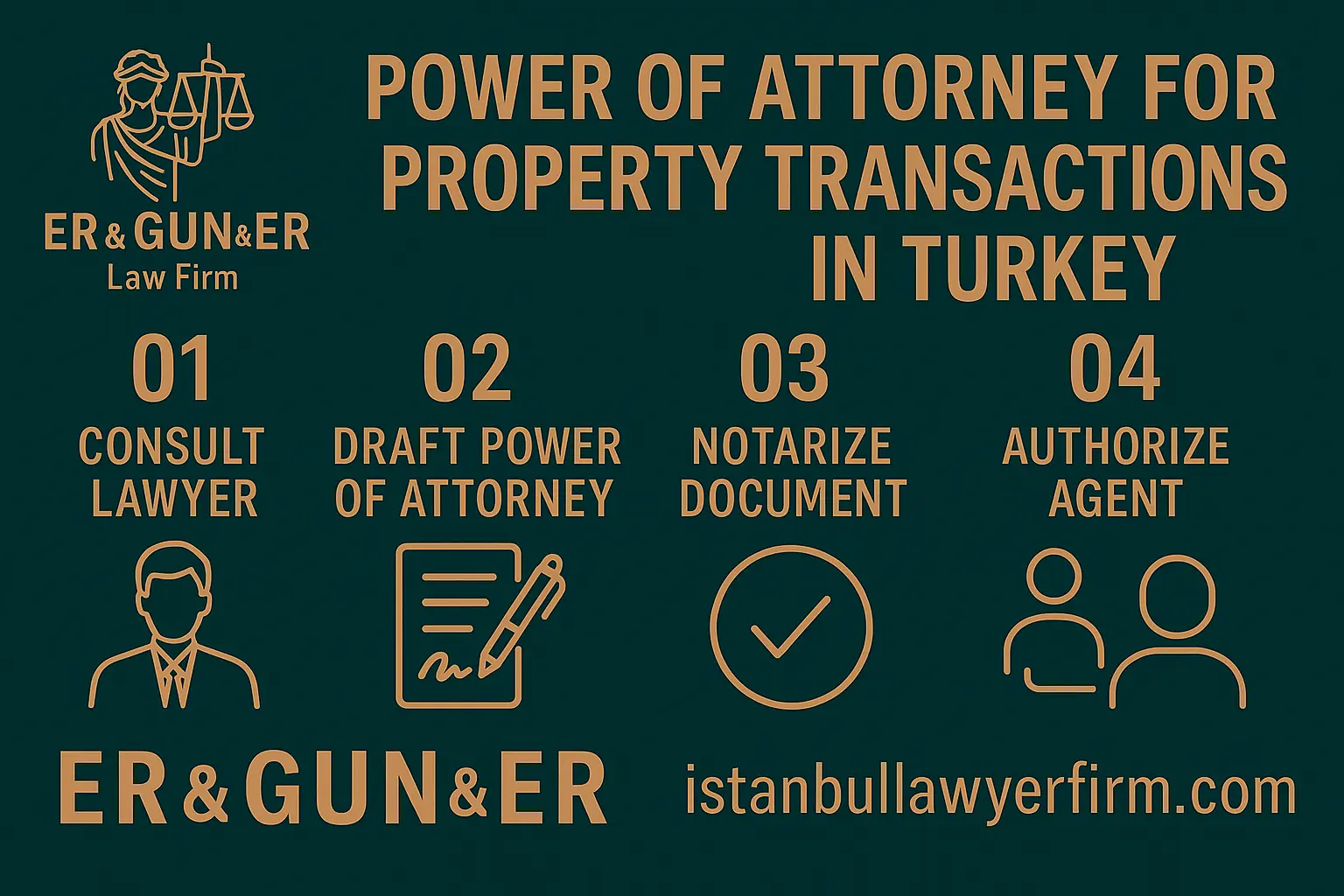
A power of attorney (vekaletname) for property transactions in Turkey is the principal instrument through which a real estate transaction can be executed without the personal presence of the owner or buyer at the Land Registry counter, and it is consequently the most heavily relied-upon document for foreign nationals who instruct Turkish counsel to complete a purchase, a sale, an inheritance transfer or a related real estate matter remotely. The framework that governs the document is set primarily by the Türk Borçlar Kanunu (Law No. 6098), which codifies the substantive agency relationship between the principal (vekalet veren) and the agent (vekil), the Noterlik Kanunu (Law No. 1512), which sets out the formal requirements for notarial execution, the Tapu Kanunu (Law No. 2644) and the implementing Tapu Sicili Tüzüğü, which govern the use of the vekaletname before the Tapu Müdürlüğü (Land Registry Directorate). For foreign-issued documents, the framework is supplemented by the Hague Apostille Convention where the issuing country is a member state, and by consular legalization through Turkish consular missions where the issuing country is not. Practice may vary by authority and year, and the discussion below describes how these layers operate together in practice rather than promising particular timelines or outcomes.
An English speaking lawyer in Turkey who handles vekaletname files for foreign clients will tell foreign buyers and sellers that the document is judged on three independent layers — the substantive scope (whether the powers granted cover the specific transactional steps the agent will perform), the formal authentication (whether the document was executed before a Turkish notary or, for foreign-issued instruments, through apostille or consular legalization with sworn Turkish translation), and the operational acceptance (whether the Tapu Müdürlüğü or other receiving authority accepts the document at the moment of use). A vekaletname that is strong on two layers but weak on the third produces failure at the counter, with cure typically requiring re-execution and additional travel that the cross-border timing of foreign clients is least able to absorb. The body of this guide walks through the legal foundations, the scope and types of vekaletname, the execution formalities, the cross-border authentication chain, the Tapu Müdürlüğü practice, the agent duties and liability framework, the tax and cost layer, and the revocation and dispute routes that foreign principals should anticipate. For procedural orientation on related real estate practice, our notes on buying property in Istanbul and title deed risk management can be read alongside this material.
1) Legal Framework: Vekaletname under the Türk Borçlar Kanunu and the Noterlik Kanunu
A lawyer in Turkey who maps the vekaletname landscape will start with the substantive agency framework of the Türk Borçlar Kanunu, which establishes the agency relationship as a contract between principal and agent under which the agent undertakes to perform defined legal acts on the principal's behalf. The framework covers the agent's duty of care, the agent's duty of loyalty, the agent's duty to follow the principal's instructions and to account for actions taken, the principal's duty to compensate the agent for permitted expenses, and the rules on the agent's liability for damages caused by acts beyond the granted scope or by violation of the duty of care. The procedure ordinarily requires the principal to define the scope of authority precisely, because under the substantive framework the agent's binding authority on third parties extends only as far as the granted scope; acts beyond the scope produce liability of the agent toward the principal and may not bind the principal toward the third party at all. Practice may vary by authority and year.
An Istanbul Law Firm advising on the formal layer will explain that the Noterlik Kanunu superimposes specific execution requirements on agency documents intended for use in real estate transactions. Under current Turkish practice, a vekaletname authorizing real estate acts — purchase, sale, exchange, mortgage, partition, inheritance transfer, the establishment of usufruct or other real rights — must be executed before a Turkish notary in the form prescribed for that subject matter, with the notary verifying the principal's identity through official identity documents, recording the principal's declared authorization in the notary's register, and issuing a notarized vekaletname document to the principal. For real estate vekaletnames in particular, the document must include the principal's photograph affixed by the notary at the time of execution, because the photograph is part of the formal validity of the instrument and Tapu Müdürlüğü officials check its presence and condition before accepting the document. The standard approach is to execute the vekaletname directly at a notary office in Turkey when the principal is physically present in the country, because the resulting document does not require apostille, consular legalization or translation and proceeds directly into use without the additional steps that foreign-executed instruments require.
A Turkish Law Firm coordinating the document's interface with the Tapu Müdürlüğü will explain that the Tapu Kanunu and the Tapu Sicili Tüzüğü do not create a separate registration system for vekaletnames themselves; the document is presented at the moment of the underlying transaction and reviewed by the Tapu officer (tapu memuru) for compliance with formal and substantive requirements at that point. The procedure ordinarily requires the agent to bring to the appointment the original vekaletname (where executed in Turkey) or the apostilled or consularly legalized original together with the sworn Turkish translation (where executed abroad), the agent's identity document, the principal's photograph copy or other identifying material referenced in the vekaletname, and the underlying transaction documents (sale contract, inheritance certificate, mortgage instrument, depending on the act). The Tapu officer evaluates whether the granted scope covers the specific transactional act and whether the document's formal validity is intact; where the officer raises concerns, the cure typically involves a return to a notary or a translator rather than a registry-side amendment. The discipline outlined in our note on title deed risk management is helpful as background reading on Tapu Müdürlüğü interactions. The Tapu officer's review of the vekaletname is structured rather than discretionary: the officer compares the principal's identity in the vekaletname to the principal's identity in the underlying transaction file (matching name spelling, identification number and date of birth), confirms that the listed agent matches the person presenting the document at the counter, examines the scope language for explicit authorization of the specific Tapu act being performed, and verifies the document's formal authentication by reviewing the notary seal (for Turkish-issued documents) or the apostille / consular legalization stamp and sworn translation (for foreign-issued documents). Where the same vekaletname has been used at the same Tapu Müdürlüğü in earlier transactions, the office may have a record of the document, but the officer reviewing the current transaction performs an independent check rather than relying on prior acceptances; the standard approach is to bring the document to each appointment as if it were the first use, with no assumption that prior acceptance carries forward.
2) Types and Scope: General, Special and Subject-Matter Vekaletnames
An English speaking lawyer in Turkey advising on vekaletname types will distinguish three principal forms relevant to real estate practice. A general vekaletname (genel vekaletname) authorizes the agent to perform a broad range of legal acts on the principal's behalf, but for real estate transactions the document must explicitly include the powers required for the specific Tapu Müdürlüğü acts contemplated; a vekaletname described as "general" without explicit real estate authorization is routinely rejected at the counter because the Tapu officer reads the absence of explicit authorization as a scope limitation. A special vekaletname (özel vekaletname) is drafted for a defined set of acts identified by subject matter — for example, the sale of a specifically identified property at a specifically identified price, the purchase of a specifically identified property, or the representation in a specifically identified inheritance transfer. A subject-matter vekaletname tailored to inheritance proceedings (veraset için vekaletname) authorizes the agent to act in the post-death transfer of property registered in the deceased's name to the heirs, including the obtaining of the inheritance certificate (mirasçılık belgesi or veraset ilamı) and the execution of the Tapu transfer.
A lawyer in Turkey drafting the scope clauses will treat the scope as the most operationally consequential element of the vekaletname, because the Tapu officer's acceptance turns on whether the scope language covers the specific act being performed at the counter. The standard approach is to draft scope language that combines the substantive powers (to sell, to buy, to mortgage, to partition, to accept inheritance, to renounce inheritance, to register or to delete real rights, to receive purchase price funds, to pay purchase price funds, to sign the Tapu transfer instrument, to receive Tapu receipts and copies) with the procedural powers required to interface with related authorities (to interact with the Vergi Dairesi for tax registration and tax clearance, to apply for the Foreign Currency Purchase Document at an authorized bank, to obtain the energy performance certificate, to obtain the compulsory earthquake insurance policy, to obtain the property valuation report) and with the practical powers needed to complete the transaction (to receive keys, to register utility accounts, to update the address records, to interact with the housing management). For specific transactional contexts — for example, citizenship by investment acquisitions — the scope must additionally cover the specialized steps unique to that context, including the holding-period annotation on the Tapu and the citizenship application's documentary requirements.
An Istanbul Law Firm advising on the choice between general and special vekaletnames will weigh the principal's risk tolerance against the operational efficiency that broader scope provides. Special vekaletnames produce tighter agent control because the agent's authority is confined to the specifically identified act, but they require re-execution if the underlying transaction parameters change — for example, where the seller renegotiates the price after the vekaletname is executed, the document must be amended or re-issued because the scope is tied to a specific price. General vekaletnames provide operational flexibility because the agent can adjust to negotiation outcomes within the granted scope, but they expand the principal's exposure to agent decisions the principal cannot pre-approve. The standard approach we recommend for foreign buyers in active transactions is a tailored vekaletname that grants the substantive powers needed for the transaction without tying them to specific commercial parameters, with the commercial parameters controlled through the underlying purchase agreement and the agent's instruction memo rather than through the vekaletname's scope language. The vekaletname's duration deserves explicit attention at the drafting stage, because under the Türk Borçlar Kanunu's agency framework a vekaletname remains valid until it is revoked, until the principal or agent dies, until the principal becomes legally incapacitated, or until the underlying purpose is fulfilled, but specific transactional contexts may benefit from an explicit time limit (süre) included in the document itself. Where the underlying transaction has a defined timeline — for example, a property purchase scheduled to complete within a specific window — the vekaletname can be drafted with a sunset date that automatically extinguishes the agent's authority on completion of the transaction or on a defined fallback date. Where the principal anticipates ongoing real estate management rather than a single transaction, the vekaletname can be drafted with an open-ended duration and a structured review cadence (annual review, transaction-specific reauthorization for material acts) that combines operational flexibility with periodic principal oversight.
3) Execution Formalities: Notary, Photograph and Identity Verification
Turkish lawyers handling vekaletname execution at a Turkish notary office will guide the principal through the procedural steps required for a Tapu-acceptable instrument. The procedure ordinarily requires the principal to attend the notary office in person with valid identification — for Turkish citizens, the Türk kimlik kartı; for foreign nationals resident in Turkey, the residence permit (ikamet izni) together with the passport; for foreign visitors not resident in Turkey, the passport — and to identify the agent by full name, parental information, identification number where applicable and, in current practice, the agent's identity document. The notary verifies the principal's identity, records the principal's declared authorization with the scope language drafted for the transaction, affixes the principal's photograph taken at the notary office or supplied by the principal at the moment of execution, and issues the notarized vekaletname with the notary's seal and signature. The standard approach is to draft the scope language in coordination with the lawyer handling the underlying transaction before the notary appointment, because notaries draft from standard templates that may not capture the specific transactional needs of foreign-buyer files.
Turkish lawyers who accompany foreign principals to the notary will prepare bilingual instructions explaining each step before the appointment, because the notary appointment itself is conducted in Turkish and the principal's understanding of the document being executed is part of the validity of the agency relationship under the Türk Borçlar Kanunu. Where the principal does not speak Turkish at a level sufficient to follow the notary's reading of the document, the standard approach is to engage a sworn translator (yeminli tercüman) registered with the same notary office to attend the appointment, translate the document orally for the principal during execution, and sign the notary's register confirming the translation. Some notary offices maintain in-house registered translators for major foreign languages; others require the principal to bring the translator separately. Where a translator attends, both the principal and the translator sign the register, and the resulting vekaletname records the translator's intervention in the notary's record. Languages routinely available through notary-registered translators in Istanbul include English, Russian, Arabic, German, French, Spanish, Italian and Mandarin; less common languages may require advance scheduling and may add to the appointment's lead time. Where the principal communicates entirely in a language for which no notary-registered translator is locally available, the standard approach is to use a chain — the principal's language to a working language (typically English) and then to Turkish through a separate registered translator — with both translators signing the register. Practice may vary by authority and year.
A Turkish Law Firm reviewing the executed vekaletname will check the document at delivery for technical defects that would cause Tapu rejection, because cure after execution is more cumbersome than verification at the notary office. The standard approach is to confirm that the principal's photograph is properly affixed and clearly identifiable, that the principal's identity details match the underlying identity document exactly, that the agent's identification is sufficient to allow the Tapu officer to verify the agent's identity at the counter, that the scope language covers the specific transactional acts contemplated, that the date of execution is current and the validity period (where included) extends through the anticipated transaction date, and that the notary's seal and signature are present and clear. Where any element is defective, the notary will typically reissue the document during the same appointment, and the principal should not leave the notary office before the lawyer has completed this review. Practice may vary by authority and year.
4) Cross-Border Authorization: Foreign-Issued POAs, Apostille and Consular Legalization
A lawyer in Turkey advising foreign principals who cannot travel to Turkey for vekaletname execution will explain that the document can be executed before a foreign notary or other authority empowered to issue notarial acts in the principal's country of residence, with subsequent authentication for use in Turkey through one of two routes. For principals in countries that are members of the Hague Apostille Convention, the foreign-executed document is authenticated by an apostille issued by the competent authority in the country of execution — typically the foreign ministry, the secretary of state's office, or another designated authority depending on the country — and the apostilled document then proceeds to sworn Turkish translation and notarial certification of the translation in Turkey. For principals in countries that are not members of the Apostille Convention, the foreign-executed document is authenticated through consular legalization, with the document first certified by the relevant authority in the country of execution and then legalized by a Turkish consulate or embassy in that country, before proceeding to sworn translation in Turkey.
An Istanbul Law Firm coordinating the cross-border execution will draft the vekaletname text in advance and circulate it to the principal in the format the foreign notary will require, because the substantive scope must be fixed before the foreign execution rather than added afterwards. The standard document set ordinarily includes the vekaletname text in Turkish (which the foreign notary executes regardless of the foreign notary's local language, with the foreign notary's role typically limited to verifying the principal's identity and authenticating the principal's signature on a document drafted in advance), or in a parallel-column bilingual format with Turkish in one column and the local language in the other. Some foreign notaries prefer to execute the document in the local language with a separate Turkish translation prepared in Turkey after authentication; others accept Turkish-only documents and limit their role to identity and signature verification. The standard approach is to confirm the foreign notary's preferred format before the appointment and to provide the principal with the document in the format that will be accepted, because re-execution after a format mismatch is expensive in cross-border timing.
An English speaking lawyer in Turkey running the post-authentication chain will receive the apostilled or consularly legalized vekaletname from the principal, send it to a sworn Turkish translator (yeminli tercüman), and obtain the notary's certification of the translation. The procedure ordinarily requires the translator's translation to be physically bound to a copy of the source vekaletname (with the apostille or consular legalization stamp visible in the bound packet), the translator's notarized declaration to be added to the package, and the resulting bound document to be presented at the Tapu Müdürlüğü together with the original apostilled or legalized source document. Where the translation is performed in Turkey through a notary-registered translator, the binding and certification typically take one to two business days. Foreign principals should anticipate that the cross-border chain — foreign notary execution, apostille or consular legalization, courier to Turkey, sworn translation, notarial certification of translation — typically takes between one and four weeks depending on the country of origin and the speed of consular services where applicable. Practice may vary by authority and year. The translation step itself is a frequent source of friction, because the Turkish notary certifying the translation operates under specific format requirements that may not match the format the foreign notary used for the source document. The standard approach is to engage the sworn translator (yeminli tercüman) directly through the Turkish notary office where the certification will be issued, rather than through an external translation service, because translators registered with the same office are familiar with the office's binding and certification preferences and can produce a translation that the notary accepts without additional iterations. Where the source document includes apostille text in a foreign language, the translation must include the apostille text translated into Turkish, and the notary's certification covers both the body of the document and the apostille. Where the source document was executed in two or more languages on the same instrument (for example, a parallel-column bilingual format), the translation should reflect the document's structure and the notary's certification should identify the source language whose translation is being certified.
5) Tapu Müdürlüğü Procedure: Using the Vekaletname at Title Transfer
A Turkish Law Firm coordinating the Tapu Müdürlüğü appointment will treat the vekaletname review as the first procedural gate that the agent must clear at the counter, because the Tapu officer's evaluation of the document determines whether the underlying transaction proceeds on the scheduled date. The procedure ordinarily requires the agent to bring to the appointment the original vekaletname (the Turkish-issued original or the apostilled/legalized original with sworn translation bundle for foreign-issued documents), the agent's identity document, the underlying transaction documents (sale contract for purchases, inheritance certificate for inheritance transfers, mortgage instrument for mortgage establishments), the property valuation report, the energy performance certificate, the compulsory earthquake insurance (DASK) policy, the Foreign Currency Purchase Document for foreign buyer transactions, the property tax clearance from the relevant municipality, and the Tapu transfer fee receipt. The Tapu officer reviews each document in sequence; the vekaletname is reviewed first because the agent's standing depends on it.
Turkish lawyers who accompany foreign-buyer agents to the Tapu appointment will anticipate the officer's standard checklist on the vekaletname: identity matching between the principal named in the vekaletname and the principal named in the underlying transaction document; scope sufficiency covering the specific transactional act being performed; format integrity including photograph, notary seal, signature and date; for foreign-executed documents, the apostille or consular legalization stamp on the source document and the proper binding of the sworn Turkish translation. Where the officer raises an issue on the vekaletname, the cure depends on the issue: scope insufficiency typically requires re-execution of a new vekaletname covering the missing power; format defects on Turkish-issued documents typically require return to the issuing notary for correction; format defects on foreign-issued documents may require re-execution abroad with associated cross-border timing implications. The standard approach is to anticipate scope-sufficiency issues by drafting comprehensive scope language at the outset rather than relying on minimum-scope drafting that risks counter-side rejection. Where the same vekaletname has been used in earlier transactions and the principal has retained copies for use at successive Tapu appointments, the standard practice is to confirm the document's continuing validity before each use — particularly checking whether the principal has revoked the document, whether the principal's identity details have changed (for example, through passport renewal), and whether the underlying powers remain operationally relevant. Practice may vary by authority and year.
Turkish lawyers handling foreign-buyer transactions will sequence the Tapu appointment within the broader transaction calendar, because the vekaletname must remain valid through the appointment date and the supporting documents must each remain valid through their own expiry windows. The procedure ordinarily requires coordination between the Tapu appointment date (set by the Tapu Müdürlüğü based on the parties' application), the property valuation report's validity (typically valid for a fixed period from issuance under current SPK regulation on real estate valuation), the DASK policy's effective dates, the Foreign Currency Purchase Document's transaction-specific reference to the Tapu transaction, and the property tax clearance's currency. Where any document expires or becomes invalid during the lead-up to the appointment, the file must address the supplement or replacement before the appointment rather than at the counter. The discipline outlined in our note on buying property in Istanbul covers the broader transaction architecture in which the vekaletname operates.
6) Agent Duties, Liability and Risk Management
A lawyer in Turkey advising on the agency relationship will explain that the agent's duties under the Türk Borçlar Kanunu include the duty of care (özen yükümlülüğü) calibrated to the agent's professional standing and the nature of the transaction, the duty of loyalty (sadakat yükümlülüğü) requiring the agent to act in the principal's interest and to avoid conflicts of interest, the duty to follow instructions (talimatlara uyma yükümlülüğü) within the granted scope, and the duty to account (hesap verme yükümlülüğü) requiring the agent to provide the principal with information about the transaction's progress and a final accounting on completion. The procedure ordinarily requires the agent to keep contemporaneous records of actions taken, payments made, documents received and decisions reached, with these records preserved as evidence of the agent's performance and as the basis for the final accounting. Where the agent is a Turkish-licensed attorney, the additional professional duties under the Avukatlık Kanunu (Law No. 1136) and the Türkiye Barolar Birliği Meslek Kuralları layer on top of the substantive agency framework.
An Istanbul Law Firm structuring the principal-agent relationship for foreign buyers will draft an instruction memo (talimat mektubu) separately from the vekaletname, because the vekaletname controls the agent's external authority toward third parties while the instruction memo controls the agent's internal duties toward the principal. The standard approach is to grant the vekaletname with sufficient scope to cover the transactional acts the agent will perform, while constraining the agent's actual exercise of those powers through the instruction memo's specifications — for example, the maximum purchase price the agent may agree, the conditions under which the agent may release escrow funds, the events that require the principal's prior approval before the agent acts. The agent's third-party acts within the vekaletname's scope bind the principal even where they exceed the instruction memo's internal limits, but the agent is liable to the principal for the breach; the standard approach is to combine the external scope discipline with the internal instruction discipline rather than to rely on a narrow vekaletname that fails at the Tapu counter.
A Turkish Law Firm advising foreign principals on agent selection will treat the agent's identity and credentials as a primary risk control. Where the agent is the principal's Turkish counsel, the professional regulation of the Avukatlık Kanunu provides supervisory oversight and the principal's recourse extends to the bar association's disciplinary mechanisms in cases of professional misconduct. Where the agent is a third party — a real estate professional, a relative, or another individual identified by the principal — the principal should anticipate that the regulatory layer is thinner and that the principal's recourse is limited to civil action under the Türk Borçlar Kanunu's agency-liability framework. The standard approach for foreign buyers is to grant the vekaletname to a Turkish-licensed attorney who handles the transaction as part of professional engagement, with any operational tasks (key collection, utility setup, post-closing administration) delegated to other parties through subordinate authorizations issued by the attorney within the vekaletname's chain-of-authority structure rather than through separate vekaletnames issued by the principal abroad. Where the agent is a Turkish-licensed attorney representing the principal in a contemplated or pending dispute alongside the real estate matter, the vekaletname must satisfy the requirements of the Avukatlık Kanunu for litigation representation, which include specific powers required for procedural acts that the general agency framework does not automatically include — for example, the powers to compromise (sulh olma), to acknowledge claims (kabul), to waive claims (feragat), to receive funds, to appoint substitute counsel and to initiate or withdraw proceedings. Where the vekaletname omits these specific powers and they later become relevant to the file, the principal must execute a supplementary vekaletname covering the missing powers, which adds cross-border timing risk if the principal is abroad at the moment the supplementary authorization is needed. The discipline outlined in our note on English-speaking legal representation in Turkey can be read alongside this material because attorney-as-agent vekaletname mechanics interact with the broader bilingual representation framework.
7) Tax, Notary Fees and Cost Planning
An English speaking lawyer in Turkey advising on the cost layer of vekaletname execution will explain that the principal cost categories at execution are the notary fees (noter harcı) for the document's drafting, execution and certified-copy issuance, calculated under the official notary tariff (Noter Harç Tarifesi) updated annually; the sworn translation fees where the document is foreign-issued and requires Turkish translation, calculated by the translator by page or by character; the apostille or consular legalization fees where the document is foreign-issued, calculated under the issuing country's tariff and the Turkish consular fee schedule; and the courier fees for cross-border document delivery where applicable. The standard approach is to circulate a pre-execution cost forecast to foreign principals before the notary appointment, because cost surprises at execution have repeatedly caused friction where the principal assumed a lighter cost profile than the actual mechanics produce.
A Turkish Law Firm advising on the broader tax layer of property transactions executed under vekaletname will distinguish the costs associated with the vekaletname itself from the costs associated with the underlying transaction. The vekaletname execution typically does not trigger stamp tax (Damga Vergisi) under current practice for real estate vekaletnames, with the principal cost being the notary fee; the underlying property transaction triggers separate cost categories including the title transfer tax (tapu harcı) calculated on the declared transaction value or the property's tax-assessed value (whichever is higher), the value-added tax (KDV) where applicable to the specific property type, the real estate agent's commission where engaged, and any income tax consequences for the seller depending on holding period and personal circumstances. The procedure ordinarily requires the cost analysis to map all categories at the term-sheet stage and to identify which costs the vekaletname-holding agent will administer on the principal's behalf, because the agent's vekaletname must explicitly include the powers to make payments to the relevant tax authorities and to receive receipts in the principal's name. A typical cost forecast for a foreign-buyer property acquisition under vekaletname includes the notary fee for the vekaletname execution itself, the sworn translation fees for foreign-issued source documents, the apostille or consular legalization fees in the principal's home country, the title transfer tax (tapu harcı) calculated on the higher of the declared value or the tax-assessed value, the property valuation report fee charged by the SPK-licensed valuer, the DASK earthquake insurance premium, the energy performance certificate fee, the Foreign Currency Purchase Document fee charged by the authorized bank, the property tax clearance fee at the relevant municipality, and the legal fees for counsel handling the file. Where the principal is using the vekaletname for a citizenship-by-investment acquisition, additional costs include the property valuation specifically required for the citizenship file and the citizenship application fees themselves. The standard approach is to express the forecast in Turkish lira while highlighting the foreign-currency equivalent at a defined exchange rate, with the principal's bank confirming the conversion mechanism in advance to avoid surprises at the moment of payment.
Turkish lawyers handling foreign-buyer files will also reconcile the cost layer with the foreign principal's home-country tax position, because the Turkish acquisition may have reporting and deductibility implications under the principal's home-country tax regime. The standard approach is to provide the principal with a written cost summary at completion identifying each payment made on the principal's behalf, the recipient authority, the purpose, the date of payment and the receipt reference, so that the principal's home-country tax adviser can use the summary as the documentary basis for any home-country reporting. Where the principal's country has a double-taxation treaty with Turkey, the treaty's interaction with Turkish withholding obligations (where any apply to the transaction) should be addressed through the principal's home-country adviser rather than assumed by Turkish counsel. The discipline outlined in our note on Turkish tax framework for foreign individuals can be read alongside this material. Practice may vary by authority and year.
8) Revocation, Termination and Disputes Concerning the Vekaletname
A lawyer in Turkey advising on revocation will explain that the principal may revoke a vekaletname at any time under the Türk Borçlar Kanunu's agency framework, with the revocation effective from the moment it is properly executed and notified to the agent and to the relevant third parties. The procedure ordinarily requires the principal to execute the revocation through a Turkish notary in the form prescribed for revocation instruments (azilname), with the notary recording the revocation in the notary's register and issuing a notarized azilname document. Where the original vekaletname was executed at a specific notary office, the standard approach is to execute the azilname through the same office where practicable, because that notary's register provides the most direct chain of revocation evidence. Where the principal is abroad, the azilname can be executed before a foreign notary with apostille or consular legalization and sworn Turkish translation, applying the same authentication chain that applies to the original vekaletname.
An Istanbul Law Firm coordinating the post-revocation notification will explain that the revocation is effective as between principal and agent from the moment of execution, but third parties dealing with the agent in good faith may continue to rely on the apparent authority of the unrevoked vekaletname until they receive notice of the revocation. The procedure ordinarily requires the principal — through counsel — to deliver written notification of the revocation to the institutions where the vekaletname has been or could be presented, including the Tapu Müdürlüğü where the principal owns property, the relevant Vergi Dairesi, the principal's Turkish bank where applicable, and any counter-party identified in pending transactions. The standard approach is to include a copy of the notarized azilname with each notification and to retain the institutional acknowledgment of receipt as evidence of completed notification. For foreign principals concerned about the speed of effective revocation, the priority sequence is the Tapu Müdürlüğü first (because property dispositions create the most consequential third-party exposure), the bank second, and other institutions in descending order of transactional risk. The notification chain itself ordinarily proceeds through written delivery — registered mail with delivery confirmation (iadeli taahhütlü), notarial notification (noter ihtarnamesi), or in-person delivery with stamped acknowledgment from the receiving institution — so that the principal can later evidence that the notification was received and the recipient could no longer rely on the apparent authority of the unrevoked vekaletname. Where the agent is the same person as the principal's Turkish counsel, the notification to counsel proceeds through the bar's professional channels with a written notice copied to the bar association where the relationship raises supervisory concerns. Where the agent is suspected of having acted outside scope before the revocation took effect, the notification to the Tapu Müdürlüğü should be supplemented by a request for the registry to flag any pending applications referencing the vekaletname, so that completed transactions can be identified for review and pending transactions can be paused while the principal evaluates the agent's prior performance. Practice may vary by authority and year, and timely notification has consistently been the determinative factor in protecting principals against post-revocation third-party claims.
A Turkish Law Firm advising on disputes arising from the agency relationship will identify the principal categories: disputes between principal and agent over scope, performance and accounting (resolved through civil court litigation under the Türk Borçlar Kanunu's agency framework, typically before the Asliye Hukuk Mahkemesi competent for the principal's place of residence or the agent's place of residence under the Hukuk Muhakemeleri Kanunu); disputes over the validity of acts performed under the vekaletname (resolved through civil court annulment proceedings where the act was performed beyond scope or after revocation); and disputes with third parties claiming priority or competing rights against acts performed under the vekaletname (resolved through Tapu Müdürlüğü administrative remedies and, where necessary, civil court annulment of registry entries). The procedure ordinarily requires the dispute file to be built on the documentary chain — the vekaletname, the azilname where applicable, the notification records, the underlying transaction documents, the agent's accounting — with the litigation strategy adapted to the specific dispute category and the available remedy. The discipline outlined in our note on title deed dispute resolution covers adjacent areas where vekaletname disputes overlap with property-record disputes. Annulment proceedings against acts performed under a vekaletname proceed differently depending on the ground for annulment. Where the act was performed beyond the scope of the granted authority, the annulment claim ordinarily proceeds before the competent civil court with the principal as plaintiff seeking annulment of the registry entry and, where applicable, restoration of the prior status. Where the act was performed after the vekaletname was revoked but before the third party received notice of the revocation, the third party's good-faith reliance may protect the act; the principal's recourse in that case typically lies against the agent personally for the value of the unauthorized disposition rather than against the third party. Where the principal's signature on the original vekaletname is alleged to be forged or obtained through fraud, criminal complaint to the Cumhuriyet Başsavcılığı under the Türk Ceza Kanunu's relevant offenses runs alongside the civil annulment proceeding, with the criminal investigation typically producing evidence (handwriting analysis, witness statements, notary register review) useful in the civil case. Practice may vary by authority and year, and the documentary discipline in vekaletname disputes — preserving the chain of execution, notification and revocation evidence — typically determines the outcome more than substantive argument on the merits.
9) Frequently Asked Questions for Foreign Principals and International Investors
- What is a vekaletname and when is it required for property transactions in Turkey? A vekaletname is the Turkish power of attorney through which a principal authorizes an agent to perform legal acts on the principal's behalf. It is required for any real estate transaction at the Tapu Müdürlüğü where the principal cannot or chooses not to attend personally — purchases, sales, mortgages, inheritance transfers, partition, and the establishment of usufruct or other real rights.
- Can a vekaletname be issued from abroad? Yes. The document can be executed before a foreign notary or other authority empowered to issue notarial acts, then authenticated for use in Turkey through apostille (for Hague Apostille Convention member states) or consular legalization (for non-member states), with sworn Turkish translation and notarial certification of the translation in Turkey.
- Must a real estate vekaletname be notarized? Yes. Real estate vekaletnames must be executed before a Turkish notary in the form prescribed for that subject matter, including the principal's photograph affixed at the time of execution, the notary's identity verification, and the notary's seal and signature. Foreign-executed instruments must follow the apostille or consular legalization chain to achieve equivalent authentication.
- What is the difference between a general and a special vekaletname? A general vekaletname authorizes a broad range of legal acts but must explicitly include real estate authorization to be accepted by the Tapu Müdürlüğü. A special vekaletname is drafted for a defined set of acts identified by subject matter — for example, the sale of a specifically identified property at a specifically identified price.
- Can the agent sub-delegate the granted powers? Sub-delegation (tevkil) is permitted only where expressly authorized in the vekaletname or implicitly where the nature of the transaction requires it. Where sub-delegation is contemplated, the vekaletname should expressly authorize it and identify any conditions on its exercise.
- Does the vekaletname need to be registered separately at the Tapu Müdürlüğü? No. The vekaletname is not registered as a separate Tapu instrument; it is presented at the moment of the underlying transaction and reviewed by the Tapu officer for compliance with formal and substantive requirements at that point.
- What happens if the agent acts beyond the granted scope? Acts beyond the granted scope produce liability of the agent toward the principal under the Türk Borçlar Kanunu's agency framework and may not bind the principal toward the third party. The principal can pursue civil remedies against the agent and may seek annulment of the third-party act through the competent civil court.
- How does the principal revoke a vekaletname? Through a notarized revocation instrument (azilname) executed before a Turkish notary or, where the principal is abroad, through a foreign-executed azilname authenticated by apostille or consular legalization and sworn Turkish translation. The revocation is then notified to the agent and to relevant third parties including the Tapu Müdürlüğü.
- Does a vekaletname survive the principal's death? No. The vekaletname terminates upon the principal's death by operation of law, and the agent's authority ends at that moment. Continued real estate matters proceed under the inheritance framework with new authorizations issued by the heirs.
- What costs are associated with executing a vekaletname? Notary fees (noter harcı) under the official tariff for the document's drafting and execution, sworn translation fees where the document is foreign-issued, apostille or consular legalization fees for foreign-issued documents, and courier fees for cross-border delivery where applicable. The cost forecast should be provided in advance.
- Is stamp tax payable on a vekaletname for property transactions? Real estate vekaletnames typically do not trigger stamp tax under current practice, with the principal cost being the notary fee. The stamp tax position should be confirmed before execution because applicable rates and exemptions are subject to periodic adjustment.
- How long does the cross-border execution chain take? The chain — foreign notary execution, apostille or consular legalization, courier to Turkey, sworn translation, notarial certification of translation — typically takes between one and four weeks depending on the country of origin and the speed of consular services where applicable. Practice may vary by authority and year.
- What documents accompany the vekaletname at the Tapu appointment? The agent's identity document, the underlying transaction documents (sale contract, inheritance certificate, mortgage instrument), the property valuation report, the energy performance certificate, the DASK policy, the Foreign Currency Purchase Document for foreign-buyer transactions, the property tax clearance, and the Tapu transfer fee receipt.
- Can a foreign-language vekaletname be used directly? No. Vekaletnames executed in foreign languages must be accompanied by sworn Turkish translation with notarial certification of the translation, physically bound to the apostilled or consularly legalized source document.
- Does ER&GUN&ER Law Firm advise on vekaletname structuring and execution for foreign buyers? Yes. ER&GUN&ER Law Firm is an Istanbul-based law firm advising foreign buyers, sellers, inheritance representatives and international investors on the complete vekaletname lifecycle, including substantive scope drafting under the Türk Borçlar Kanunu, formal notarial execution under the Noterlik Kanunu, foreign-issued POA authentication via apostille or consular legalization with sworn Turkish translation, agent duty and liability frameworks, Tapu Müdürlüğü transaction support, tax and notary cost planning, revocation through azilname execution and notification, and dispute resolution before the competent civil courts — with English-language client communication and bilingual documentation throughout each engagement. Files in this area are typically led personally by the managing partner rather than delegated.
Author: Mirkan Topcu is an attorney registered with the Istanbul Bar Association (Istanbul 1st Bar), Bar Registration No: 67874. His practice focuses on cross-border and high-stakes matters where evidence discipline, procedural accuracy, and risk control are decisive.
He advises foreign buyers, sellers, inheritance representatives and international investors on Turkish real estate matters including vekaletname structuring under the Türk Borçlar Kanunu and the Noterlik Kanunu, foreign-issued POA authentication via apostille and consular legalization, Tapu Müdürlüğü transaction support, agent duty and liability frameworks, revocation and azilname execution, and dispute resolution before the competent civil courts; together with adjacent matters where the vekaletname intersects with citizenship-by-investment files, inheritance proceedings, and broader cross-border transactional support.
Education: Istanbul University Faculty of Law (2018); Galatasaray University, LL.M. (2022). LinkedIn: Profile. Istanbul Bar Association: Official website.