

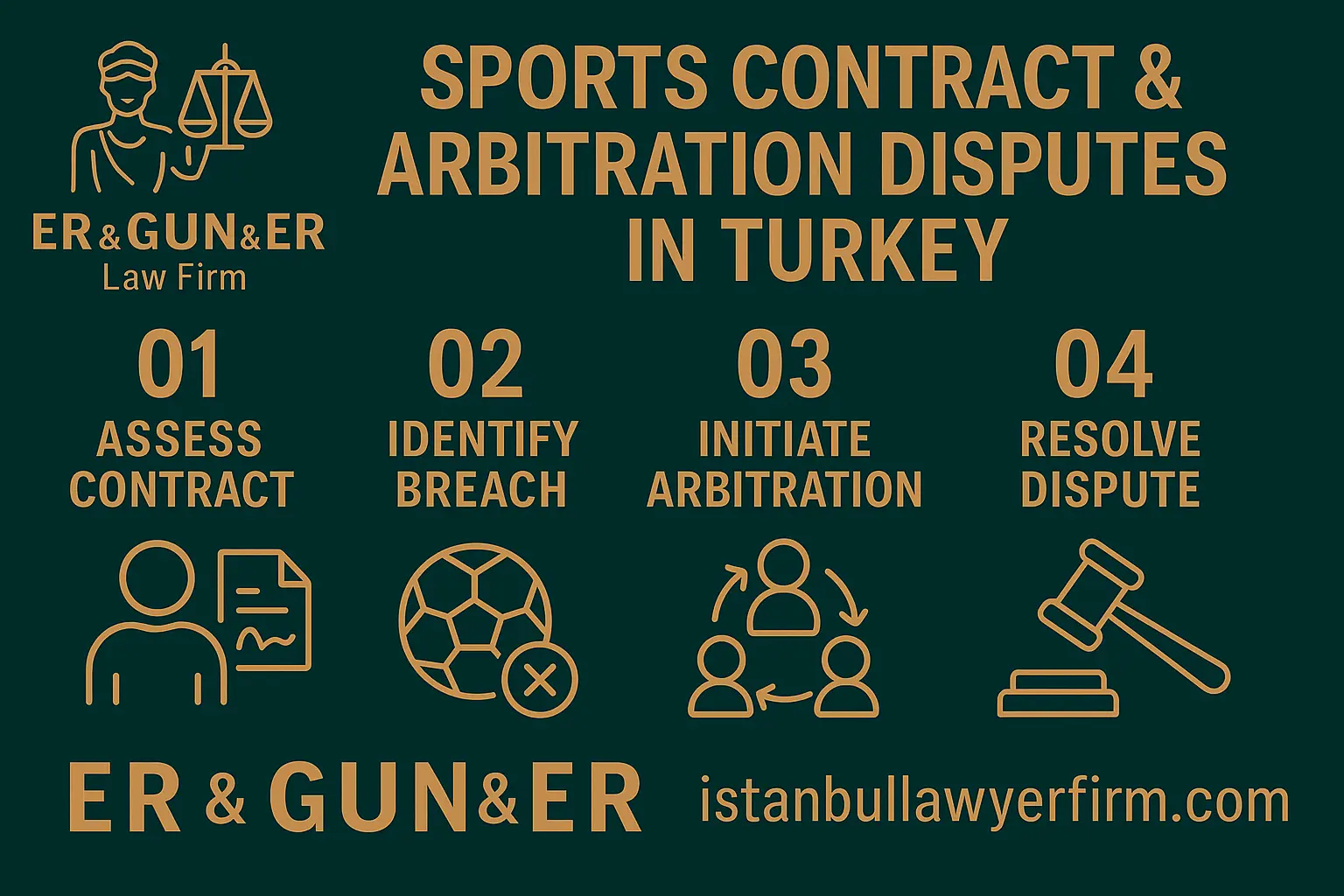
Sports contract arbitration in Türkiye sits at the intersection of three statutory and regulatory layers: a constitutional rule on mandatory sports arbitration (Anayasa, Article 59 as amended by Law No. 6214 on 17 March 2011), a national-level regulatory framework anchored by the Law on the Establishment and Duties of the Turkish Football Federation (Law No. 5894 of 16 May 2009) and the Law on Sports Clubs and Sports Federations (Law No. 7405 effective 26 April 2022), and an international layer comprising FIFA's regulatory framework (the FIFA Statutes and the FIFA Regulations on the Status and Transfer of Players, "RSTP") and the Court of Arbitration for Sport (CAS) Code of Sports-related Arbitration. For non-football sports, federation-specific arbitration boards (Tahkim Kurulları) operate under their respective federation statutes within the same constitutional architecture.
The defining feature of the Turkish framework is the constitutional principle that decisions of federation arbitration boards on sports management and discipline are final and not subject to appeal before any judicial authority (Anayasa, Article 59, paragraph 3). This produces a closed national-level dispute system that is materially different from the standard civil arbitration regime under the Code of Civil Procedure (Law No. 6100, "HMK") Articles 407-444 and the International Arbitration Law (Law No. 4686 of 21 June 2001). For foreign players, coaches, agents, and clubs, the practical question is rarely whether to arbitrate — the answer is almost always yes — but rather where: before the TFF Uyuşmazlık Çözüm Kurulu (UÇK) and Tahkim Kurulu (TFF Arbitration Board), before the FIFA Football Tribunal, before CAS as an appeal forum, or in some constellations before all three sequentially. ER&GUN&ER Law Firm advises foreign players, coaches, agents, clubs, and federations on contract design, dispute strategy, sequencing across forums, evidence preparation, oral advocacy, and post-award enforcement under the New York Convention 1958 (Law No. 3731 of 25 September 1991) and FIFA's disciplinary enforcement framework.
The Constitutional Foundation: Article 59 and Mandatory Sports Arbitration
The constitutional foundation of Turkish sports arbitration is paragraph 3 of Article 59 of the Constitution (Anayasa), as added by the constitutional amendment Law No. 6214 of 17 March 2011 and approved by referendum. The provision states that decisions of sports federations on the management and discipline of sports activities can only be challenged through mandatory arbitration, and that the decisions of arbitration boards established for this purpose are final and cannot be appealed to any judicial authority. The constitutional design responds to the structural reality that sports disputes require expertise, speed, and predictable outcomes that ordinary civil courts cannot reliably provide, and to the international regulatory framework (FIFA Statutes, IOC Charter) that requires member federations to maintain internal dispute resolution mechanisms.
The constitutional rule applies to "sports management and discipline" decisions, which the Constitutional Court has interpreted to cover the standard scope of federation arbitration: contract disputes between players and clubs, transfer disputes, agent disputes, disciplinary sanctions, licensing decisions, and competition-related matters. The exclusion from civil court review is broad but not unlimited; matters falling outside the federation's scope of authority remain subject to ordinary civil and administrative jurisdiction. Practice may vary by authority and year on the specific scope analysis; the Constitutional Court has issued multiple decisions over the years refining the boundary between federation arbitration jurisdiction and ordinary judicial jurisdiction.
The single recognised channel for review of federation arbitration decisions within the Turkish legal system is the constitutional individual application (bireysel başvuru) to the Constitutional Court (Anayasa Mahkemesi, "AYM") under Article 148, paragraph 3 of the Constitution and the Law on Establishment and Procedures of the Constitutional Court (Law No. 6216). The AYM has held — most clearly in decisions developing the case law from 2013 onwards — that federation arbitration board decisions can be reviewed for compliance with constitutional fundamental rights, particularly the right to a fair trial (adil yargılanma hakkı) under Article 36 of the Constitution and Article 6 of the European Convention on Human Rights. This is a narrow remedy focused on procedural fairness rather than merits review, but it is the only domestic legal channel beyond the federation arbitration system itself. Practice may vary by authority and year on the AYM's evolving approach; the case law has continued to refine the standard for procedural fairness in sports arbitration.
The Statutory Framework: Law 5894, Law 7405, and Federation Statutes
Three principal statutes form the backbone of Turkish sports arbitration. The Law on the Establishment and Duties of the Turkish Football Federation (Law No. 5894 of 16 May 2009) constitutes the TFF as an autonomous public legal entity with regulatory authority over football in Türkiye and establishes the TFF's internal organs, including the General Assembly, the Board of Directors, the Dispute Resolution Chamber (Uyuşmazlık Çözüm Kurulu, "UÇK"), and the Arbitration Board (Tahkim Kurulu) under Article 6. The TFF's Statute and Regulations elaborate on the procedural and substantive frameworks for dispute resolution, in alignment with the FIFA Statutes that the TFF is required to respect as a FIFA member association.
The Law on Sports Clubs and Sports Federations (Law No. 7405) effective 26 April 2022 modernised the broader sports regulatory framework, replacing parts of the older Sports Services Law (Law No. 3289) and consolidating rules on the establishment, governance, financial supervision, and federation relations of sports clubs and federations across all sports disciplines except football (which remains under Law 5894 and TFF self-regulation). Law 7405 establishes the framework within which non-football federations design their internal arbitration boards, with the same constitutional rule under Article 59 applying to those boards' decisions on management and discipline matters. The Ministry of Youth and Sports (Gençlik ve Spor Bakanlığı) exercises supervisory authority over federations under Law 7405.
The general civil arbitration framework under HMK Articles 407-444 and the International Arbitration Law (Law No. 4686) applies to commercial disputes that fall outside the federation arbitration scope — for example, sponsorship disputes, broadcasting rights disputes, equipment supply disputes, and other commercial matters not connected to the management or discipline of sports activities. The line between "sports arbitration" (under Article 59 and federation rules) and "commercial arbitration" (under HMK or Law 4686) is sometimes contested, and forum selection in contract drafting accordingly matters. Practice may vary by authority and year on the specific demarcation; the Court of Cassation has issued decisions clarifying the boundary in commercial disputes with sports elements.
The Turkish Football Federation: UÇK and Tahkim Kurulu
Within the TFF, two bodies handle dispute resolution. The Dispute Resolution Chamber (Uyuşmazlık Çözüm Kurulu, UÇK) operates as the first-instance forum for disputes between clubs and players, between clubs and coaches, between clubs and agents, and between players and agents, where the parties have signed a TFF-registered contract or where the dispute falls within the UÇK's defined competence under the TFF Statute and the UÇK Procedural Regulation. The Arbitration Board (Tahkim Kurulu) operates as the appellate forum within the TFF, hearing appeals from UÇK decisions and from other TFF decisions including disciplinary sanctions and licensing decisions.
Members of the UÇK and the Tahkim Kurulu are appointed under the TFF Statute on the basis of legal qualifications and independence requirements designed to ensure adjudicatory neutrality. The chairs are senior legal professionals (typically retired senior judges or experienced legal academics), and the panels include both lawyers and football-specific experts. Hearings are conducted in Turkish; the procedural framework is designed to deliver decisions within compressed timeframes consistent with the football calendar, although actual timing varies with case complexity and party cooperation.
The TFF arbitration system is structurally closed: decisions of the Tahkim Kurulu are final under Anayasa Article 59 and not subject to civil court review, with the constitutional individual application to the AYM as the sole domestic remedy beyond the system. The closure produces speed and finality, which the football industry generally values, but it also concentrates the importance of getting the case right at the UÇK and Tahkim Kurulu stages, because the appellate avenues outside the TFF system (FIFA, CAS) are limited to specific scenarios and are not available as a general second-look mechanism. Practice may vary by authority and year on specific procedural emphases; the Tahkim Kurulu has continued to refine its approach as the case law has developed.
Filing Before the UÇK
A claim before the UÇK is initiated by a written petition (başvuru dilekçesi) submitted in Turkish, accompanied by the contract underlying the claim, evidence of breach (payment records, correspondence, witness statements where relevant), the player or coach licence record, identification documents, and the procedural filing fee under the TFF tariff. The UÇK Procedural Regulation specifies the form of the petition and the supporting evidence required for different categories of claim (salary claims, termination claims, image rights claims, transfer-related claims). Foreign claimants typically rely on Turkish counsel for the petition drafting and procedural management, while reserving substantive coordination with the foreign legal team.
The UÇK procedure follows a written-pleadings emphasis with hearings convened where the panel considers oral examination necessary. The respondent files a response within the period set by the UÇK (typically a short period reflecting the football-calendar urgency), and the parties may exchange replies. Witness evidence, expert reports, and documentary evidence are admitted on the standard procedural rules. The decision is rendered in writing with a reasoned justification; the operative part and the reasoning are notified to the parties through the standard notification channels.
The substantive law applied by the UÇK is a combination of the contract terms, the TFF regulatory framework, the FIFA RSTP (where applicable to international elements), and the general principles of Turkish contract law under the Code of Obligations (Law No. 6098). Where the contract contains a choice-of-law clause selecting Turkish law, that selection governs; where the contract is silent on choice of law, the UÇK applies Turkish law as the law of the seat. Foreign-element disputes (foreign player, foreign agent, foreign club) raise additional questions on the relationship between the UÇK and the FIFA Football Tribunal that we address in the FIFA section below. Practice may vary by authority and year on specific procedural emphases; the UÇK has continued to refine its approach as the case load and the international complexity of disputes have evolved.
Appeal to the TFF Tahkim Kurulu
Decisions of the UÇK can be appealed to the TFF Tahkim Kurulu within the time limit set by the TFF Statute and the procedural regulations (the standard appeal period is short, reflecting the football calendar urgency). The appeal is initiated by a written appeal petition setting out the grounds of appeal, accompanied by the contested decision, the relevant procedural file, and the applicable filing fee. The Tahkim Kurulu reviews the appeal on both factual and legal grounds, with the scope of review defined by the appeal grounds and the panel's assessment of the case.
The Tahkim Kurulu also has original jurisdiction (not appellate) over decisions of TFF organs other than the UÇK, including disciplinary decisions of the Disciplinary Committee (Disiplin Kurulu), licensing decisions, and decisions of the Professional Football Disciplinary Committee (Profesyonel Futbol Disiplin Kurulu, "PFDK"). Appeals from these other TFF organs go directly to the Tahkim Kurulu as the first and final TFF-level review. The Tahkim Kurulu's panel composition is structured to provide both legal expertise and football-specific knowledge.
Tahkim Kurulu decisions are final under Anayasa Article 59 and produce immediate enforceability under TFF rules. Within the Turkish legal system, no further review is available beyond the constitutional individual application to the AYM discussed above. Outside the Turkish legal system, the question of CAS review of TFF Tahkim Kurulu decisions is structurally limited: the FIFA Statutes provide for CAS appeal in defined categories of football disputes, but the Turkish constitutional rule and the TFF regulatory framework constrain the practical availability of CAS review for disputes that the TFF system has classified as falling within its exclusive arbitration jurisdiction. Practice may vary by authority and year on specific scope determinations; the interaction between Turkish constitutional rules and FIFA's appeal architecture remains a developing area.
Constitutional Complaint to the Constitutional Court
The constitutional individual application (bireysel başvuru) to the Constitutional Court under Anayasa Article 148, paragraph 3 and Law No. 6216 is the sole domestic legal remedy available against TFF Tahkim Kurulu decisions. The application must be filed within thirty days of notification of the contested decision under Law No. 6216 Article 47, paragraph 5, on the grounds that the decision violated a fundamental right or freedom guaranteed by the Constitution and the European Convention on Human Rights. The applicant must have exhausted the federation arbitration remedies (UÇK and Tahkim Kurulu) before approaching the AYM, in line with the standard subsidiarity principle.
The grounds typically invoked in sports arbitration AYM applications are the right to a fair trial under Article 36 of the Constitution and Article 6 of the ECHR, focused on procedural fairness elements: equality of arms, opportunity to present the case, reasoned decision, independence and impartiality of the arbitration panel, and access to evidence. Substantive merits review is not available — the AYM does not act as a fourth-instance court reviewing the correctness of the federation arbitration decision; it reviews only whether constitutional procedural rights were respected.
Where the AYM finds a violation, the standard remedy is to declare the violation and order retrial before the federation arbitration body that violated the constitutional right, with the AYM's findings binding on the federation body. The retrial mechanism aims to remedy the procedural violation without disturbing the constitutional architecture that reserves substantive sports decisions to the federation system. The AYM also has the option to award compensation in appropriate cases. Practice may vary by authority and year on specific procedural emphases; the AYM's approach to sports arbitration has continued to refine since the introduction of the individual application mechanism in 2012.
The FIFA Football Tribunal: PSC, DRC, and Agents Chamber
FIFA's dispute resolution architecture for football has been reorganised into the Football Tribunal, which encompasses three chambers: the Players' Status Chamber (PSC) handling disputes between clubs and coaches and certain disputes between clubs (including training compensation and solidarity contribution disputes), the Dispute Resolution Chamber (DRC) handling disputes between clubs and players and certain other player-related disputes, and the Agents Chamber handling disputes involving licensed football agents under the FIFA Football Agent Regulations. The Football Tribunal operates under the FIFA Statutes (current version), the FIFA Regulations on the Status and Transfer of Players (RSTP), the FIFA Procedural Rules Governing the Football Tribunal, and the FIFA Football Agent Regulations.
FIFA jurisdiction over a sports contract dispute requires an international dimension under RSTP Article 22: the dispute must involve parties from different national associations, or it must have a clear cross-border element triggering FIFA jurisdiction. A pure domestic dispute between a Turkish club and a Turkish player without international elements falls outside FIFA jurisdiction and within TFF jurisdiction. A dispute between a Turkish club and a foreign player, or between a Turkish club and a foreign coach, or between a Turkish club and a foreign agent, or involving a Turkish-owned foreign vehicle, can fall within FIFA jurisdiction depending on the specific configuration.
The relationship between FIFA jurisdiction and TFF jurisdiction is governed by the FIFA Statutes and the principles of subsidiarity and party autonomy. The standard rule is that FIFA has jurisdiction over international disputes unless the parties have agreed in writing to submit the dispute to an independent arbitration tribunal at national level that respects the principles of equal representation and procedural fairness set out in FIFA's regulations (the "national dispute resolution chamber" or NDRC standard). The TFF UÇK is recognised as meeting the NDRC standard for football disputes, which means that international disputes involving Turkish parties can validly be heard by UÇK rather than by FIFA where the contract so provides. Practice may vary by authority and year on specific NDRC recognition; the FIFA framework continues to develop alongside the international football industry.
Filing Before FIFA Under the RSTP
A claim before the FIFA Football Tribunal is initiated through the FIFA Legal Portal, with the claim form, the supporting documents (contract, evidence of breach, payment records, communications), and the filing fee submitted electronically. Proceedings are conducted in English (or other FIFA working languages by special arrangement). The respondent files a response within the time limit set by FIFA, the parties may exchange further pleadings as the panel directs, and the decision is rendered after the panel's deliberation, typically within several months of the close of pleadings.
The substantive law applied by the FIFA Football Tribunal is the FIFA RSTP and the FIFA regulatory framework, supplemented by the contract terms and (where the FIFA framework is silent or ambiguous) the choice-of-law clause in the contract or the law of the country of the relevant national association. Key RSTP provisions include Article 13 (contracts must be respected), Article 14 (termination for just cause), Article 15 (termination for sporting just cause), Article 16 (termination during the season), Article 17 (consequences of terminating a contract without just cause, including compensation and sporting sanctions), and Article 25 paragraph 5 (two-year prescription period for filing claims, calculated from the event giving rise to the dispute).
Compensation under RSTP Article 17 in cases of termination without just cause is calculated by reference to defined criteria — the remuneration and other benefits due to the player under the existing contract and any new contract, the time remaining on the existing contract, the fees and expenses paid or incurred by the former club (amortised over the contract term), whether the breach occurred during the protected period — with the panel's assessment incorporating the relevant facts. The architecture of Article 17 has produced extensive case law that the Football Tribunal applies as guiding precedent. Sporting sanctions (transfer restrictions, registration bans) can also follow termination without just cause in the protected period. Practice may vary by authority and year on specific application; the Football Tribunal's approach has continued to develop alongside the RSTP amendments.
The Court of Arbitration for Sport: Jurisdiction and Procedure
The Court of Arbitration for Sport (CAS, French: Tribunal Arbitral du Sport, "TAS") based in Lausanne, Switzerland is the supreme international forum for sports disputes. CAS operates under the Code of Sports-related Arbitration administered by the International Council of Arbitration for Sport (ICAS), with two principal divisions: the Ordinary Arbitration Division (OAD) for first-instance disputes submitted directly to CAS by agreement of the parties, and the Appeals Arbitration Division (AAD) for appeals from decisions of sports federations and other sports bodies that have provided for CAS appeal in their statutes or regulations.
CAS jurisdiction over a Turkish sports dispute can arise in several configurations. First, an appeal from a FIFA Football Tribunal decision lies to CAS within 21 days of notification of the operative part of the decision under the FIFA Statutes Article 57 and the CAS Code Rule 49, with the CAS panel reviewing the FIFA decision de novo on the law and facts as the standard scope of review under CAS Code Rule 57. Second, an appeal from another international sports federation decision (UEFA, IOC, IAAF, etc.) where the federation's statutes provide for CAS appeal. Third, an appeal from certain TFF decisions where the FIFA Statutes provide for CAS jurisdiction notwithstanding the Turkish constitutional rule on finality, in narrow categories defined by FIFA. Fourth, a first-instance dispute submitted to CAS by mutual agreement of the parties under the OAD framework, typically pursuant to a CAS arbitration clause in a sports-related contract.
CAS jurisdiction over TFF Tahkim Kurulu decisions in disputes that the TFF has classified as falling within its exclusive arbitration jurisdiction under Anayasa Article 59 is structurally limited and contested. The constitutional rule on finality and the TFF's own regulatory framework operate to restrict CAS jurisdiction over those disputes; FIFA's framework and the CAS Code provide for appeal in defined categories that may include some football-related matters. The interaction is sensitive and case-specific, and forum selection at the contract drafting stage is the most reliable way to manage the question. Practice may vary by authority and year; the case law continues to develop as the international and Turkish frameworks interact.
CAS Appeal Procedure Under the Code of Sports-related Arbitration
A CAS appeal is initiated by the Statement of Appeal (déclaration d'appel) filed within the time limit set by the relevant federation's statutes (typically 21 days under FIFA Article 57 and other major federation rules), with the operative part of the contested decision attached. The Appeal Brief follows within ten days from the expiry of the appeal time limit (CAS Code Rule 51), setting out the facts, the legal arguments, and the relief sought. The respondent files an Answer within twenty days of receipt of the Appeal Brief (Rule 55). The panel is constituted from the CAS list of arbitrators (Rule 53) — typically three arbitrators for an appeal, with each party appointing one and the chair appointed by the CAS division president unless the parties agree otherwise.
Proceedings before CAS are conducted in English or French (the parties may agree on another language, but the working languages of CAS are English and French). The procedure includes written pleadings, document production, a hearing (where required), examination of witnesses and experts, and post-hearing briefs as appropriate. The CAS panel applies the law chosen by the parties or, in the absence of choice, the law of the country in which the federation issuing the contested decision is domiciled, with subsidiary application of general principles and the federation's own regulations under CAS Code Rule 58.
The CAS award is final and binding upon notification under CAS Code Rule 59. Within the limited framework of Swiss arbitration law, the award can be challenged before the Swiss Federal Tribunal under Articles 190-192 of the Swiss Federal Act on Private International Law (PILA), but only on the narrow grounds specified in Article 190(2) — irregular constitution of the panel, lack of jurisdiction, ruling beyond or short of the claims submitted, violation of equality of parties or right to be heard, and violation of public policy. The grounds are interpreted restrictively by the Swiss Federal Tribunal, and successful challenges are rare. The narrow review confirms the finality of CAS awards in practice. Practice may vary by authority and year on specific Swiss Federal Tribunal jurisprudence; the case law continues to develop alongside international arbitration norms.
Recognition and Enforcement Under the New York Convention
CAS awards and FIFA Football Tribunal decisions, where rendered as arbitral awards, fall within the scope of the New York Convention on the Recognition and Enforcement of Foreign Arbitral Awards 1958, to which Türkiye is party through Law No. 3731 effective 25 September 1991. The recognition and enforcement procedure in Türkiye is governed by the International Private and Procedural Law (Law No. 5718) Articles 60-63, with the Court of First Instance of Civil Affairs at the location of the assets or the debtor as the competent court. The applicant files a recognition petition with the certified copy of the award, the underlying arbitration agreement (where applicable), and the certified Turkish translation, paying the standard court fees.
The grounds for refusing recognition are limited to the New York Convention Article V grounds, which the Turkish court reviews narrowly: incapacity of the parties or invalidity of the arbitration agreement, lack of proper notice or inability to present the case, award beyond the scope of the submission, irregular composition of the tribunal, award not yet binding or set aside in the seat, non-arbitrability of the subject matter under Turkish law, and violation of Turkish public policy (kamu düzeni). The public policy ground is interpreted narrowly by the Court of Cassation; commercial arbitration awards including sports awards are generally enforced.
FIFA's parallel disciplinary enforcement framework provides an alternative path for compliance. Under the FIFA Disciplinary Code, FIFA can impose sporting sanctions on clubs and federations that fail to comply with FIFA Football Tribunal decisions and CAS awards in football-related matters, including transfer bans, points deductions, and ultimately exclusion from FIFA competitions. The sporting sanctions framework often produces compliance more quickly than judicial enforcement, particularly for established clubs that depend on participation in FIFA-organised competitions. Practice may vary by authority and year on specific enforcement strategy; the optimal sequencing of judicial enforcement and FIFA disciplinary enforcement depends on the debtor's profile and the nature of the award.
Forum Selection Strategy: National vs. International Pathways
The forum selection question for a Turkish-element sports dispute begins with the contract. Where the player-club contract or coach-club contract contains an explicit forum clause designating the UÇK as the exclusive first-instance forum, that selection governs and the dispute proceeds through the TFF system (UÇK → Tahkim Kurulu → AYM as the constitutional remedy). Where the contract designates FIFA as the forum (for international contracts with sufficient FIFA jurisdiction), the dispute proceeds through the FIFA Football Tribunal with CAS as the appeal forum. Where the contract designates CAS directly under the OAD framework, the dispute proceeds at CAS as a first-instance arbitration.
Where the contract is silent or ambiguous on forum, the default rules apply. For purely domestic disputes (Turkish club, Turkish player, no foreign element), the TFF system has primary jurisdiction. For international disputes (foreign player or foreign club element), the FIFA Football Tribunal has presumptive jurisdiction unless the parties have agreed to a national-level NDRC that meets FIFA's procedural standards (which the UÇK does for football). The strategic choice between the TFF system and the FIFA system for international disputes turns on factors including speed (TFF typically faster), language (TFF in Turkish, FIFA in English), substantive law (Turkish law plus contract vs RSTP plus contract), enforcement profile (TFF decisions enforceable through TFF disciplinary mechanisms; FIFA decisions enforceable through FIFA disciplinary mechanisms plus CAS appeal route), and tactical considerations specific to the case.
For non-football sports, the configuration is different because non-football federations operate under their own statutes (within the Law 7405 framework) and their arbitration boards' decisions are subject to the same Article 59 finality rule. International appeal possibilities depend on the relevant international federation's statutes (IOC, IAAF, FINA, FEI, etc., each with its own CAS appeal architecture). The CAS Ad Hoc Division operates at major international competitions to provide expedited dispute resolution during the competition period. Practice may vary by authority and year on specific federation rules; the international and national frameworks continue to develop alongside the sports industry.
Strategic Considerations for Foreign Players, Coaches, Agents, and Clubs
For foreign players, coaches, and agents entering into Turkish football contracts, the strategic considerations begin with contract design. The forum clause should be drafted explicitly with awareness of the UÇK/FIFA/CAS framework, with the choice tested against the player's typical risk profile (a player likely to face termination disputes may prefer FIFA jurisdiction with CAS appeal; a player primarily concerned with quick salary recovery may prefer UÇK speed). The choice-of-law clause should specify the applicable substantive law (Turkish law, FIFA RSTP, or both in defined ways). Compensation calculation methodology in case of breach should be addressed where possible to reduce the discretion that the eventual panel will exercise.
During the contractual relationship, evidence preservation discipline is essential. Salary payments should be tracked with bank records; communications between the player/agent and the club should be preserved (including WhatsApp, email, and other digital channels); training participation, match selection, and performance issues should be documented; and any incident triggering termination consideration (medical issues, disciplinary issues, performance issues) should be documented at the time, not reconstructed later. The procedural rules of UÇK, FIFA, and CAS all give significant weight to contemporaneous documentary evidence; reliance on after-the-fact narrative without documentary support is consistently weak across all three forums.
For Turkish clubs facing claims by foreign players, coaches, or agents, the strategic considerations include early case assessment to identify whether the claim has merit and what the realistic settlement range is, engagement of counsel familiar with both the TFF system and the FIFA/CAS framework, evidence assembly and witness preparation, procedural compliance to avoid procedural defaults that can determine cases without merits review, and management of the FIFA disciplinary risk exposure that follows from non-compliance with adverse decisions. Settlement is often the most efficient outcome, particularly where the club's exposure to sporting sanctions (transfer ban, point deduction) under the FIFA Disciplinary Code creates pressure to resolve the matter before sanctions take effect. Practice may vary by authority and year on specific settlement dynamics; the relative bargaining power of clubs and individual claimants has shifted over time as the FIFA enforcement framework has tightened.
Frequently Asked Questions
- What is the constitutional basis for sports arbitration in Türkiye? Anayasa Article 59, paragraph 3, as added by Law No. 6214 of 17 March 2011, providing for mandatory arbitration of federation decisions on sports management and discipline, with arbitration board decisions final and not subject to civil court appeal.
- What is the TFF Tahkim Kurulu? The Arbitration Board of the Turkish Football Federation, established under Law No. 5894 Article 6, serving as the appellate forum within the TFF for football disputes including appeals from the Uyuşmazlık Çözüm Kurulu (UÇK) and original jurisdiction over disciplinary and licensing decisions.
- What is the UÇK? The Dispute Resolution Chamber of the TFF, the first-instance forum for contract disputes between clubs and players, coaches, and agents under TFF-registered contracts.
- Are TFF Tahkim Kurulu decisions appealable to civil courts? No. Under Anayasa Article 59 paragraph 3, federation arbitration decisions are final and not subject to civil court review. The sole domestic remedy is constitutional individual application to the AYM on fundamental rights grounds.
- Can I file a constitutional complaint against a Tahkim Kurulu decision? Yes, by individual application to the Constitutional Court under Anayasa Article 148 paragraph 3 and Law No. 6216, within thirty days of notification, on grounds of violation of fundamental rights including the right to a fair trial.
- What is the FIFA Football Tribunal? The reorganised FIFA dispute resolution body comprising the Players' Status Chamber (PSC), the Dispute Resolution Chamber (DRC), and the Agents Chamber, with jurisdiction over international football disputes under the FIFA RSTP.
- When does FIFA have jurisdiction over a Turkish football dispute? Under RSTP Article 22 where the dispute has international dimensions (parties from different associations or cross-border elements). Pure domestic disputes fall to the TFF system.
- What is the prescription period for FIFA claims? Two years from the event giving rise to the dispute, under RSTP Article 25 paragraph 5.
- What is CAS? The Court of Arbitration for Sport (Tribunal Arbitral du Sport, TAS) in Lausanne, Switzerland, the supreme international sports arbitration forum operating under the Code of Sports-related Arbitration administered by ICAS.
- What is the CAS appeal time limit? Twenty-one days from notification of the operative part of the contested decision, under FIFA Statutes Article 57 and CAS Code Rule 49.
- Can CAS awards be challenged? Only before the Swiss Federal Tribunal on the narrow grounds of Article 190(2) of the Swiss PILA: irregular constitution, lack of jurisdiction, ultra/infra petita, violation of equality or right to be heard, violation of public policy.
- How are CAS awards enforced in Türkiye? Through the recognition and enforcement procedure under MÖHUK (Law No. 5718) Articles 60-63 and the New York Convention 1958 (Türkiye party through Law No. 3731), at the Court of First Instance of Civil Affairs.
- What happens if a Turkish club ignores a FIFA or CAS decision? FIFA can impose sporting sanctions under the FIFA Disciplinary Code, including transfer bans, point deductions, and competition exclusion, in addition to the judicial enforcement route under the New York Convention.
- What law governs sports arbitration outside football? The Law on Sports Clubs and Sports Federations (Law No. 7405 of 26 April 2022) governs the framework for non-football federations, with each federation's statute establishing its arbitration board, all subject to the Anayasa Article 59 finality rule.
- Where does ER&GUN&ER Law Firm support sports arbitration matters? Contract design including forum and choice-of-law clauses; UÇK and Tahkim Kurulu representation under Law 5894; FIFA Football Tribunal proceedings under the RSTP; CAS proceedings under the Code of Sports-related Arbitration; constitutional individual application to the AYM; recognition and enforcement under MÖHUK Articles 60-63 and the New York Convention; and FIFA Disciplinary Code compliance and enforcement matters.
Author: Mirkan Topcu is an attorney registered with the Istanbul Bar Association (Istanbul 1st Bar), Bar Registration No: 67874. His practice focuses on cross-border and high-stakes matters where evidence discipline, procedural accuracy, and risk control are decisive.
He advises foreign players, coaches, agents, clubs, federations, and sports investors across Sports Contract Drafting and Forum Selection, TFF Arbitration before the UÇK and Tahkim Kurulu, FIFA Football Tribunal proceedings (PSC, DRC, Agents Chamber), CAS Appeals, Constitutional Individual Applications to the Anayasa Mahkemesi, Recognition and Enforcement of foreign arbitral awards under MÖHUK and the New York Convention, and FIFA Disciplinary Code compliance.
Education: Istanbul University Faculty of Law (2018); Galatasaray University, LL.M. (2022). LinkedIn: Profile. Istanbul Bar Association: Official website.