

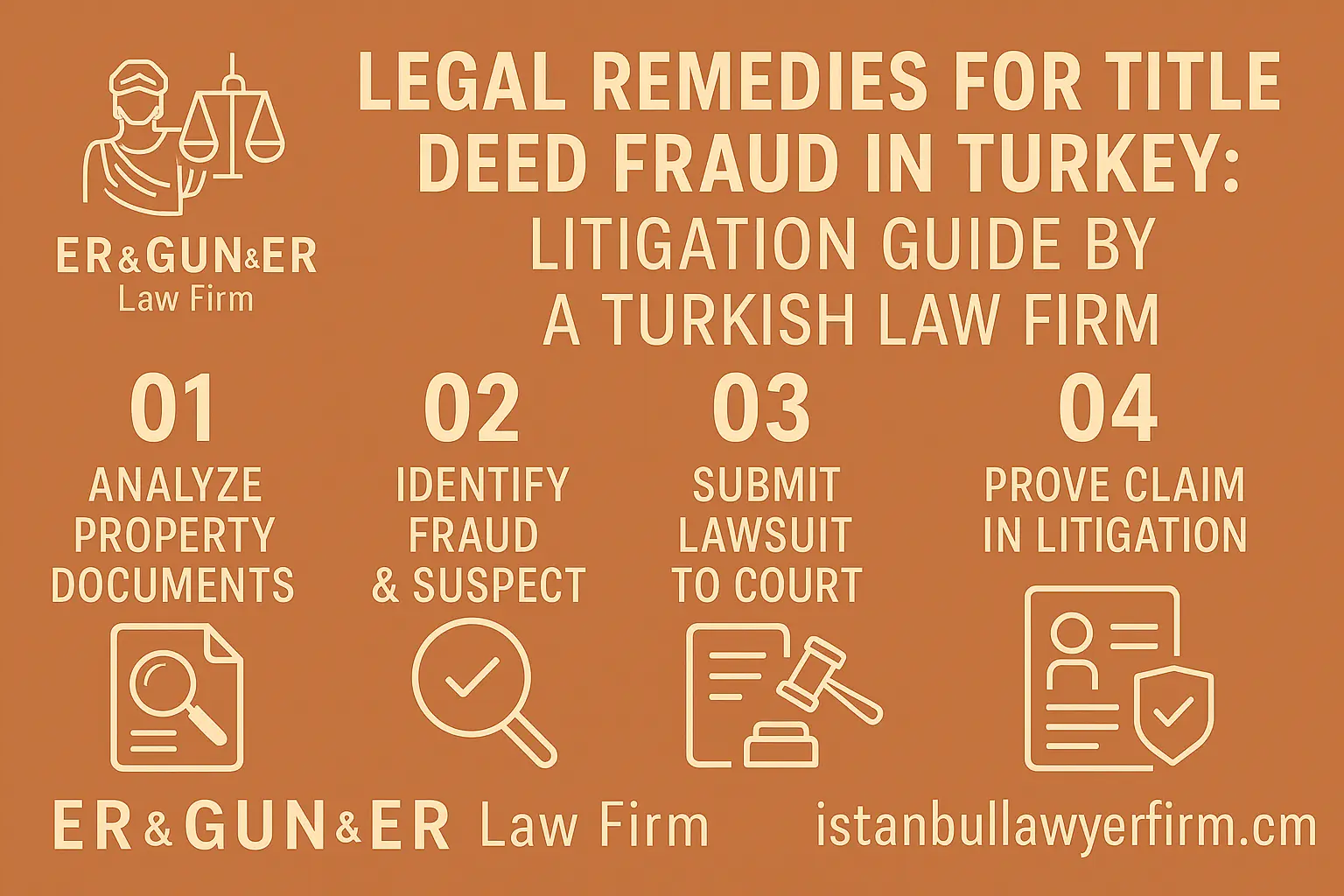
Title deed fraud (tapu sahteciliği) remedies in Türkiye operate through an integrated framework spanning civil restoration, criminal prosecution, state liability, and procedural protection mechanisms. The principal Turkish legal sources are: the Civil Code (Law No. 4721, the "TMK") Article 1024 establishing the title cancellation and registration action (tapu iptali ve tescili davası) as the principal civil remedy, Article 1023 establishing the registry good-faith principle that creates the substantive challenge in fraud cases, and Article 1007 establishing State Treasury (Hazine) liability for losses arising from improper land registry record-keeping; the Land Registry Law (Law No. 2644, "Tapu Kanunu") Article 7 establishing registry reliability and Article 18 governing land registry official liability; the Penal Code (Law No. 5237, "TCK") Articles 204 (official document forgery — 2-5 years imprisonment with aggravated forms reaching 5-10 years), 207 (private document forgery), 155 (breach of trust), 157 (fraud — 1-5 years), 158 (aggravated fraud — 3-10 years, with specific aggravations for banking, public office, and similar circumstances reaching higher penalties), and Articles 142-144 (theft with relevant aggravations); the Civil Procedure Code (Law No. 6100, "HMK") Articles 4 and 18 establishing Asliye Hukuk Mahkemesi jurisdiction for real estate disputes, Articles 389-403 governing preliminary injunction (ihtiyati tedbir), Articles 199 governing electronic evidence, Articles 266-287 governing expert witness procedures critical for handwriting analysis, and Articles 282-291 governing judicial inspection; the Mediation Law (Law No. 6325, "HUAK") Article 18/B (added by Law No. 7445 of 28 March 2023, effective 1 September 2023) establishing mandatory mediation for qualifying immovable property disputes; and the Code of Obligations (Law No. 6098, "TBK") Articles 49-51 governing civil tort liability against fraud perpetrators, and Articles 502-514 governing power of attorney framework critical for POA fraud analysis.
Strategic title fraud defence operates through coordinated multi-track approach combining civil restoration, criminal prosecution, state liability against Treasury, and integrated procedural protection. Each track addresses different aspects of the harm: civil restoration through TMK 1024 directly seeks title return; criminal prosecution under TCK 204/207/157/158 punishes perpetrators and supports civil case evidence; State Treasury liability under TMK 1007 provides compensation alternative where civil restoration fails or is incomplete; and HMK 389 preliminary injunction prevents further harm during proceedings. Foreign property owners face additional considerations including: power of attorney fraud where Turkish proxies misuse delegated authority; document authentication challenges across jurisdictions; communication and language barriers requiring sworn translation under HMK Article 223; and integrated procedural complexity. The Hague Apostille Convention 1961 (Türkiye party through Law No. 6303 of 8 May 1985 since 1985, with recent expansions including UAE effective 7 May 2022, Canada 2024, and Qatar 2024) facilitates cross-border document authentication for foreign-executed evidence. ER&GUN&ER Law Firm advises foreign and Turkish property owners on integrated title fraud defence with civil, criminal, and state liability coordination. Practice may vary by authority and year — check current guidance.
Tapu İptali ve Tescili Davası Under TMK Article 1024
The title cancellation and registration action (tapu iptali ve tescili davası) under TMK Article 1024 is the principal civil remedy for title deed fraud in Türkiye. The action operates as combined declaratory and corrective remedy: declaratory in that it establishes the legal invalidity of the fraudulent transaction; corrective in that it directs registry correction restoring true ownership. Successful TMK 1024 action results in court-ordered registry correction with retroactive effect — the fraudulent registration is treated as never having validly existed, and the original ownership is restored as if the fraudulent transaction never occurred.
Substantive grounds for TMK 1024 action include: forged documents (sahte belge) underlying the registration including forged identity documents, forged signatures, forged power of attorney; lack of capacity of the purported transferor (incompetent person, minor, deceased person fraudulently represented as alive); transfer by non-owner (transfer purportedly executed by person without ownership rights); fundamental procedural defects in the registry execution including improper Tapu Müdürlüğü execution; misrepresentation of fundamental facts including identity confusion, property identification errors, and similar concerns; and integrated grounds reflecting absence of valid legal foundation for the registration. The action does not require proof of bad faith on the part of the current registered owner where the action is based on fundamental invalidity rather than third-party reliance issues. Practice may vary by authority and year — check current guidance.
The substantive challenge in TMK 1024 actions involves the registry good-faith principle under TMK Article 1023 — bona fide purchasers (third parties acquiring without knowledge of the fraud) are protected against registry challenges in defined circumstances. The principle creates substantive analysis: where the fraud involves direct misappropriation by the current registered owner, TMK 1023 protection generally does not apply because the current owner is not bona fide; where the fraud involved earlier transactions and the current owner acquired in good faith without knowledge of the underlying defect, TMK 1023 protection may bar TMK 1024 action against the current owner — but State liability under TMK 1007 typically remains available. Strategic case analysis includes specific evaluation of the title chain, identification of bad faith versus bona fide actors, and integrated coordination with State liability framework where TMK 1023 protection blocks direct restoration. The Asliye Hukuk Mahkemesi (Civil Court of First Instance) holds jurisdiction under HMK Articles 4 and 18 for these actions. Yargıtay 1. Hukuk Dairesi (1st Civil Chamber of Court of Cassation) is the principal appellate chamber for tapu iptali ve tescili appeals. Mandatory mediation under HUAK Article 18/B applies to qualifying immovable property disputes, requiring attempted mediation as procedural prerequisite for court filing. Strategic mediation engagement provides early resolution opportunity but typically does not resolve fundamental title fraud cases requiring formal court adjudication.
State Treasury Liability Under TMK Article 1007
State Treasury (Hazine) liability under TMK Article 1007 represents critical substantive remedy for title deed fraud victims that operates independently of civil restoration against fraud perpetrators. Article 1007 establishes that the State is liable for losses arising from improper land registry record-keeping (tapu sicilinin yanlış tutulması) — meaning victims of registry-based fraud can pursue compensation directly from the State Treasury without dependence on perpetrator solvency or asset recovery.
The TMK 1007 framework provides several substantive advantages over standard civil liability claims. The State Treasury has guaranteed solvency unlike fraud perpetrators who may have dissipated assets, fled jurisdiction, or lack collectable wealth. The liability standard is essentially objective — the State is liable for registry errors regardless of specific Tapu Müdürlüğü official fault, supporting recovery in cases involving subtle procedural failures rather than identifiable individual misconduct. The framework supports compensation for full loss including property value, transaction costs, ongoing damages, and integrated harm — though specific damage components require evidentiary support. The action operates against the Treasury (Hazine) rather than individual officials, simplifying defendant identification and process service. Practice may vary by authority and year — check current guidance.
Procedural framework for TMK 1007 action operates through Asliye Hukuk Mahkemesi jurisdiction with specific procedural considerations. The action is independent of the underlying tapu iptali action — victims can pursue both simultaneously, sequentially based on tapu iptali outcomes, or TMK 1007 alone where civil restoration is impractical due to TMK 1023 protection of subsequent bona fide owners. The State has indemnification rights against actually responsible officials and fraud perpetrators after Treasury payment under integrated rücu (recourse) framework. Limitation period under TBK Articles 146-147 framework applies with specific commencement triggers depending on case circumstances. Evidence framework includes: registry documentation establishing the fraudulent registration; evidence of registry procedural failures supporting Treasury liability; damage documentation including property valuation, transaction documentation, and consequential harm evidence; and integrated supporting evidence. Strategic TMK 1007 framework integration with broader fraud defence typically operates as: primary remedy where TMK 1023 protects subsequent bona fide acquirers blocking direct restoration; alternative remedy supporting compensation if direct restoration fails despite efforts; and integrated parallel remedy where some property loss is recoverable through restoration and other components require monetary compensation. Yargıtay 4. Hukuk Dairesi historically handled administrative tort cases including TMK 1007 actions; current chamber assignments may vary based on court structure modifications. ER&GUN&ER Law Firm coordinates TMK 1007 Treasury actions with broader title fraud defence through integrated representation.
Criminal Framework Under TCK 204, 207, 157, 158
Criminal prosecution for title deed fraud operates through multiple Turkish Penal Code provisions addressing specific aspects of fraudulent conduct. TCK Article 204 (resmi belgede sahtecilik — official document forgery) addresses forgery of official documents including title deeds, court orders, government certifications, and similar official instruments. The base offence carries imprisonment of 2-5 years, with aggravated forms reaching 5-10 years where the forgery involves specific aggravating circumstances including official position misuse or institutional document categories. Title deed forgery typically operates under Article 204 framework with specific case factors determining specific penalty range.
TCK Article 207 (özel belgede sahtecilik — private document forgery) addresses forgery of private documents including private contracts, private agreements, and similar private instruments. Where fraud schemes involve forged private contracts in addition to forged registry documents, both Articles 204 and 207 may apply depending on specific document characteristics. TCK Article 155 (güveni kötüye kullanma — breach of trust) addresses misuse of property entrusted for specific purposes including misappropriation by attorneys-in-fact, trustees, agents, and similar fiduciaries — with specific application to power of attorney fraud where Turkish proxies misuse delegated authority. Practice may vary by authority and year — check current guidance.
TCK Article 157 (dolandırıcılık — fraud) addresses obtaining benefit through fraudulent conduct with imprisonment of 1-5 years and judicial fine. TCK Article 158 (nitelikli dolandırıcılık — aggravated fraud) addresses fraud committed under specific aggravating circumstances with substantially elevated penalties of 3-10 years imprisonment and substantial judicial fine. Aggravating circumstances under Article 158 include: fraud through religious instruments or beliefs; fraud through misuse of public office; fraud through false claims of relationships with public institutions; fraud committed against vulnerable persons; fraud involving banking/credit institutions; fraud involving information systems and electronic transactions; and fraud committed by professional groups including lawyers, public officials, and similar trusted positions. Many title deed fraud cases qualify for Article 158 aggravated fraud framework based on specific circumstances. TCK Articles 142-144 (hırsızlık — theft) may apply in specific aggravated contexts where the fraud framework operates through specific theft elements. Criminal procedure under CMK (Law No. 5271) operates through prosecutor (Cumhuriyet Savcısı) investigation following criminal complaint (şikayet) under Article 158 framework. Statute of limitations under TCK Article 66 framework applies with specific periods varying by offence severity. Strategic criminal prosecution coordination with civil restoration includes: criminal evidence supporting civil case factual determinations; criminal court findings providing res judicata effect for civil proceedings under specific circumstances; integrated victim compensation under criminal proceedings supporting financial recovery; and integrated procedural coordination ensuring optimal sequencing and timing.
Preliminary Injunction Under HMK Articles 389-403
Preliminary injunction (ihtiyati tedbir) under HMK Articles 389-403 represents critical procedural tool in title deed fraud cases preventing further harm during the substantive litigation period. HMK Article 389 establishes the substantive preliminary injunction framework requiring: existence of underlying right requiring protection; threat of harm if protection is not granted; and integrated proportionality analysis. Title fraud cases routinely qualify for preliminary injunction based on threatened further property transfers, alterations, or dissipations during litigation period.
Specific preliminary injunction measures available in title fraud cases include: title transfer restriction (tapu üzerine ihtiyati tedbir) preventing the registered owner from further transferring or encumbering the property during litigation; transaction hold preventing pending transactions from completing during litigation evaluation; physical use restriction preventing material alterations or dispositions affecting property value or condition; and integrated supplementary measures supporting specific case requirements. The title transfer restriction operates through registration in the Tapu Müdürlüğü land registry system creating notice to potential third-party transferees and preventing valid registration of subsequent transactions during the injunction period. Practice may vary by authority and year — check current guidance.
Procedural framework for preliminary injunction operates through HMK Articles 390-403 with specific requirements. HMK Article 390 establishes injunction application before the court with jurisdiction over the substantive case (typically Asliye Hukuk Mahkemesi for tapu iptali matters). Article 391 enables ex parte (without notice to opposing party) applications in cases of imminent harm — supporting urgent fraud cases where notice would enable further dissipation. Article 392 establishes the responsibility framework requiring applicants to compensate injunction-related damages if the substantive case ultimately fails. Article 393 establishes appeal rights for affected parties. Article 397 establishes injunction expiration if substantive case is not filed within specified periods following injunction grant. Strategic preliminary injunction integration with broader title fraud defence typically operates as foundational protective step preserving the property status pending substantive resolution. Foreign property owners benefit substantially from preliminary injunction protection because cross-border procedural complexity typically extends resolution timeframes — without injunction protection, perpetrators often dissipate property value or transfer to bona fide subsequent purchasers triggering TMK 1023 protection that blocks direct restoration. Comprehensive injunction strategy combines title transfer restriction with: bank account freezes against perpetrators; criminal investigation triggers supporting evidence preservation; integrated coordination with cross-border enforcement frameworks for foreign-located perpetrators; and integrated documentation supporting substantive case development.
Power of Attorney Fraud Under TBK 502-514
Power of attorney fraud (sahte vekaletname / vekalet kötüye kullanılması) represents specifically common pattern in foreign property owner cases where Turkish proxies misuse delegated authority. The framework operates under Code of Obligations (Law No. 6098, "TBK") Articles 502-514 governing the agency relationship (vekalet sözleşmesi). TBK Article 504 establishes that the agent's authority is limited to the specific scope granted in the power of attorney — actions exceeding the granted scope (yetki aşımı) bind the principal only with subsequent ratification.
TBK Article 506 establishes that specific high-risk acts require explicit grant of authority including: real estate transactions; gifts; settlement and arbitration agreements; capital contributions; loan agreements; and similar significant acts. General powers of attorney without specific real estate authorisation generally do not authorise property transfers — yet fraudulent agents sometimes execute property transfers under purportedly general authority through Tapu Müdürlüğü procedural failures or document misrepresentation. Where the agent transferred property exceeding authorised scope, the principal can pursue: tapu iptali ve tescili action under TMK 1024 against the registered transferee (subject to TMK 1023 good-faith analysis); civil tort action against the agent under TBK Articles 49-51 and integrated agency liability; and criminal prosecution under TCK Article 155 (breach of trust) and Article 158 (aggravated fraud) framework where applicable. Practice may vary by authority and year — check current guidance.
Fraudulent power of attorney scenarios operate through several distinct patterns. Outright forged powers of attorney involving fabricated signatures and notarial certifications fall under TCK 204 (official document forgery) framework. Authority misuse where genuine but limited powers of attorney are exceeded falls under TBK 504/506 framework with civil and criminal consequences. Identity fraud where someone other than the actual property owner executes apparent powers of attorney impersonating the owner creates complex evidentiary challenges. Notary failures where notarial procedures fail to verify identity adequately create both criminal exposure for involved actors and TMK 1007 State liability where Tapu Müdürlüğü reliance on defective notarial documents creates registry errors. Strategic power of attorney fraud defence includes: power of attorney revocation registration in Tapu Müdürlüğü preventing further authorised abuse; criminal complaint coordination with prosecutor's office; preliminary injunction under HMK 389 preserving status; tapu iptali action against fraudulent registrant; State liability action under TMK 1007 where appropriate; and integrated cross-border coordination for foreign-executed powers of attorney with Hague Apostille 1961 (Türkiye party through Law No. 6303 since 1985, recent expansions UAE 2022, Canada 2024, Qatar 2024) framework. Foreign property owners should specifically consider: limiting power of attorney scope to specific transactions rather than general authority; requiring time limitations on authority; conducting periodic Tapu Müdürlüğü status verification preventing extended undetected abuse; and integrating ER&GUN&ER Law Firm representation as alternative to extensive power of attorney delegation.
Evidence Development and Expert Witnesses
Evidence development in title deed fraud cases requires comprehensive integration of documentary evidence, expert analysis, and procedural evidence preservation. Documentary evidence framework includes: complete title chain from Tapu Müdürlüğü records through TAKBİS system access; questioned documents including allegedly forged signatures, identification documents, and integrated transactional documentation; legitimate comparison documents establishing genuine signatures and identification for forensic comparison; communications evidence including messages, emails, and integrated communications evidence indicating fraud awareness or planning; financial evidence including bank transfer documentation, payment records, and integrated financial flows; and integrated documentary evidence supporting case theory.
Expert witness framework under HMK Articles 266-287 supports substantive technical analysis critical for fraud case development. Forensic handwriting analysis (imza incelemesi) by court-appointed experts represents standard procedure for signature forgery cases — comparing questioned signatures against verified comparison samples through standardised forensic methodology. Document analysis experts evaluate paper, ink, and integrated physical document characteristics for forgery indicators. Forensic technology experts evaluate electronic documents, digital signatures, and integrated electronic evidence under HMK Article 199 framework. Real estate valuation experts establish property values supporting damage calculation. Practice may vary by authority and year — check current guidance.
Judicial inspection (keşif) under HMK Articles 282-291 supports physical examination of property and integrated evidence in court presence. Judicial inspection in title fraud cases typically addresses: property identification confirming actual property matches registry description; physical evidence evaluation for cases involving property condition or use disputes; integrated coordination with expert witness analysis; and integrated procedural evidence preservation. Witness testimony under HMK Articles 240-265 supports integrated case evidence including: property history witnesses including neighbours, prior tenants, and similar persons familiar with property history; transaction witnesses including parties involved in legitimate prior transactions; perpetrator-related witnesses including persons aware of fraud planning or execution; and integrated factual support. Discovery and disclosure framework under HMK supports document production from third parties including banks (transaction records), notaries (notarial documentation), and government authorities (registry and procedural records). Strategic evidence development integration with civil and criminal proceedings supports cross-utilisation of evidence developed in either forum, coordinated witness testimony, and integrated case theory development. Cross-border evidence development for foreign property owner cases involves: Hague Convention Service of Process (Service Convention) for foreign witness service; Hague Convention on Taking of Evidence Abroad (Evidence Convention) for foreign deposition and document production; Mutual Legal Assistance Treaties for criminal investigation cross-border coordination; and integrated foreign counsel coordination supporting evidence development across jurisdictions.
Civil Liability and Compensation Framework
Civil liability framework against fraud perpetrators operates under TBK Articles 49-51 establishing comprehensive tort liability framework. TBK Article 49 establishes general tort principle requiring: unlawful act; fault (intentional or negligent conduct); damage to plaintiff; and causal nexus between unlawful conduct and damage. Title fraud perpetrators face TBK 49 liability based on fraud as paradigmatic unlawful act with intentional misconduct creating substantive damages.
TBK Article 50 establishes that multiple tortfeasors share joint and several liability supporting recovery from any individually solvent perpetrator. Article 51 provides specific compensation framework principles including monetary compensation as principal remedy with restoration in kind where appropriate. Compensation components include: direct property loss measured by property value at relevant valuation date; loss of use including rental income that would have been earned; transaction costs incurred in fraud-related transactions; legal expenses including attorney fees, expert costs, and integrated litigation expenses; emotional distress (manevi tazminat) under TBK Article 56 framework where appropriate; and integrated consequential damages supporting comprehensive recovery. Practice may vary by authority and year — check current guidance.
Limitation period under TBK Articles 72-73 framework applies with: 2-year limitation from awareness of damage and perpetrator; 10-year limitation from underlying tortious act regardless of awareness; with extensions where the underlying conduct constitutes criminal offence with longer criminal limitation periods. The criminal limitation extension represents critical advantage in title fraud cases — TCK Article 66 criminal limitation periods (typically substantially longer than civil 2-year limitation) extend the civil limitation period under TBK 73 framework. Asset preservation through preliminary injunction under HMK 389 supports judgment collection prospects by preventing perpetrator asset dissipation during litigation. Bank account freezes, asset seizures, and integrated enforcement measures supplement preliminary injunction framework. Cross-border asset recovery for international fraud perpetrators operates through: New York Convention 1958 for arbitration award enforcement (Türkiye party since 1992); bilateral judgment enforcement treaties where applicable; international criminal cooperation frameworks for criminal asset recovery; and integrated foreign counsel coordination for foreign-jurisdiction asset enforcement. Strategic civil liability integration with criminal prosecution and TMK 1007 State liability provides comprehensive recovery framework — civil liability against perpetrators where collectable; State liability under TMK 1007 where perpetrator collection fails; and integrated criminal restitution under CMK framework where criminal proceedings produce specific restitution orders. ER&GUN&ER Law Firm coordinates comprehensive title fraud civil liability with integrated criminal and State liability representation.
Cross-Border Coordination and Foreign Owner Considerations
Cross-border coordination represents critical aspect of title deed fraud defence for foreign property owners requiring integrated international procedural framework. The Hague Apostille Convention 1961 (Türkiye party through Law No. 6303 of 8 May 1985 since 1985, with recent expansions including UAE effective 7 May 2022, Canada 2024, and Qatar 2024) facilitates document authentication for foreign-executed evidence including: foreign-executed powers of attorney requiring authentication; foreign identity documents and corporate documentation; foreign court orders and judgments potentially relevant to fraud analysis; and integrated evidentiary documents requiring cross-border use. Documents from countries not party to Hague Apostille framework require consular legalisation through Turkish embassy or consulate in the originating country. HMK Article 223 establishes sworn translation requirements for foreign-language documents through translators registered with Turkish notaries — ensuring linguistic and substantive translation accuracy supporting evidentiary use.
Hague Service Convention (Convention on the Service Abroad of Judicial and Extrajudicial Documents in Civil or Commercial Matters of 1965) governs cross-border service of process for foreign defendants and witnesses. Türkiye is party to the Service Convention with specific implementation procedures through designated central authorities. Strategic service coordination supports both Turkish litigation requiring foreign service and integrated cross-border procedural cooperation. Hague Evidence Convention (Convention on the Taking of Evidence Abroad in Civil or Commercial Matters of 1970) governs cross-border evidence collection including: foreign witness depositions; foreign document production; foreign expert examinations; and integrated evidentiary procedures. Bilateral judicial cooperation treaties supplement multilateral frameworks for specific country relationships providing additional procedural pathways. Practice may vary by authority and year — check current guidance.
Foreign owner specific considerations include several integrated elements. Power of attorney structuring with limited scope, time limits, and integrated controls reduces fraud exposure compared to broad general delegations. Periodic Tapu Müdürlüğü status verification through TAKBİS authorised attorney access enables early detection of unauthorised registrations. Banking transaction monitoring with Turkish and foreign banking systems supports detection of fraudulent payment flows. Communication infrastructure with Turkish counsel including secure communication channels, regular reporting, and integrated coordination supports active oversight of Turkish property interests. Insurance considerations including specialty foreign-owner insurance products where available provide additional protection layer though not substitute for substantive legal protection. Diplomatic and consular support through home country embassies and consulates provides supplemental support in serious cases though primary remedy operates through Turkish legal system. Cross-border asset recovery for international fraud perpetrators operates through New York Convention 1958 (Türkiye party since 1992) for arbitration award enforcement, bilateral judgment enforcement treaties where applicable, international criminal cooperation frameworks for criminal asset recovery, and integrated foreign counsel coordination for foreign-jurisdiction asset enforcement. Anayasa Mahkemesi (Constitutional Court) individual application under Anayasa Article 148/3 provides additional protective avenue where systemic property rights violations meet specific criteria — supporting integrated defence strategy for cases where standard frameworks prove inadequate. ER&GUN&ER Law Firm provides comprehensive cross-border title fraud defence with foreign counsel coordination, multi-jurisdiction enforcement, and integrated strategic representation across procedural frameworks.
Frequently Asked Questions
- What is the principal civil remedy for title deed fraud? Tapu iptali ve tescili davası under TMK Article 1024 — title cancellation and registration action seeking court-ordered registry correction restoring true ownership. Action operates before Asliye Hukuk Mahkemesi with Yargıtay 1. Hukuk Dairesi appellate jurisdiction.
- What about the registry good-faith principle? TMK Article 1023 protects bona fide purchasers acquiring without knowledge of underlying defects. Where current registered owner is bona fide subsequent acquirer, TMK 1023 may bar direct TMK 1024 restoration — but TMK 1007 State liability remains available.
- What is TMK Article 1007 State liability? State Treasury (Hazine) liability for losses from improper land registry record-keeping. Independent of fraud perpetrator collection prospects. Provides compensation alternative where civil restoration is blocked by TMK 1023 or perpetrator insolvency. Action against Hazine in Asliye Hukuk Mahkemesi.
- What criminal offences apply? TCK Article 204 (official document forgery — 2-5 years base, 5-10 years aggravated); Article 207 (private document forgery); Article 155 (breach of trust — POA fraud); Article 157 (fraud — 1-5 years); Article 158 (aggravated fraud — 3-10 years with specific aggravations). TCK Article 66 limitation periods.
- What about preliminary injunction? HMK Articles 389-403 ihtiyati tedbir framework. Title transfer restriction (tapu üzerine ihtiyati tedbir) preventing further transfers during litigation. Article 391 ex parte applications for urgent cases. Critical foundational protection in fraud cases.
- Is mediation required? HUAK Article 18/B (added by Law No. 7445 of 28.3.2023, effective 1.9.2023) mandatory mediation applies to qualifying immovable property disputes including certain tapu iptali cases. Procedural prerequisite for court filing.
- What about power of attorney fraud? TBK Articles 502-514 framework. Article 504 limits authority to granted scope (yetki aşımı). Article 506 requires specific authorisation for real estate transactions. Strategic remedies include POA revocation registration, tapu iptali action, civil tort liability, and TCK 155/158 criminal prosecution.
- What civil liability applies to perpetrators? TBK Articles 49-51 tort framework. Article 49 elements: unlawful act, fault, damage, causal nexus. Article 50 joint and several liability. Article 51 compensation principles. Article 56 emotional distress (manevi tazminat) where appropriate.
- What limitation periods apply? TBK Articles 72-73: 2-year from awareness of damage and perpetrator; 10-year from underlying act. TCK Article 66 criminal limitations extend civil limitation under TBK 73 where conduct constitutes crime.
- What about cross-border evidence? Hague Apostille 1961 (Türkiye party through Law No. 6303 since 1985, recent expansions UAE 2022, Canada 2024, Qatar 2024) for document authentication. HMK Article 223 sworn translation. Hague Service Convention and Hague Evidence Convention for cross-border procedural cooperation.
- What evidence development applies? HMK Articles 266-287 expert witness framework with handwriting analysis (imza incelemesi) standard procedure. HMK Articles 282-291 judicial inspection (keşif). Article 199 electronic evidence. Documentary evidence through TAKBİS access and integrated discovery.
- What about title insurance? Title insurance market in Türkiye remains substantially limited compared to common law jurisdictions. Specific policies and coverage scope vary substantially. Where coverage exists, claims typically operate under Sigortacılık Kanunu (Law No. 5684) framework with arbitration through Sigorta Tahkim Komisyonu where applicable.
- What asset recovery is available? Preliminary injunction under HMK 389 for asset preservation. Civil enforcement under İcra ve İflas Kanunu (Law No. 2004) for judgment enforcement. Cross-border asset recovery through bilateral treaties, New York Convention 1958 (arbitration awards, Türkiye party since 1992), and integrated international cooperation.
- Does CMK criminal restitution apply? Criminal procedure framework under Law No. 5271 includes victim restitution mechanisms within criminal proceedings supplementing separate civil action. Strategic coordination between civil and criminal proceedings supports comprehensive recovery.
- Where does ER&GUN&ER Law Firm support title fraud matters? Comprehensive tapu iptali ve tescili representation under TMK Article 1024 with TMK Article 1023 good-faith analysis; TMK Article 1007 State Treasury (Hazine) liability action for indirect compensation where direct restoration blocked; criminal complaint and prosecution coordination under TCK Articles 204, 207, 155, 157, 158, and 142-144; HMK Articles 389-403 preliminary injunction (ihtiyati tedbir) including ex parte urgent applications under Article 391; HUAK Article 18/B mandatory mediation engagement; power of attorney fraud analysis under TBK Articles 502-514 with revocation registration; civil liability under TBK Articles 49-51 with TBK Articles 72-73 limitation analysis; expert witness coordination under HMK Articles 266-287 with handwriting analysis; judicial inspection under HMK 282-291; cross-border evidence under Hague Apostille (Law 6303), Hague Service Convention, Hague Evidence Convention; HMK Article 223 sworn translation coordination; asset recovery under İİK Law No. 2004; New York Convention 1958 international arbitration award enforcement; CMK Law No. 5271 victim restitution coordination; Asliye Hukuk Mahkemesi litigation; Yargıtay 1. Hukuk Dairesi appellate representation; and Anayasa Mahkemesi individual application where systemic property rights violations support constitutional review.
Author: Mirkan Topcu is an attorney registered with the Istanbul Bar Association (Istanbul 1st Bar), Bar Registration No: 67874. His practice focuses on cross-border and high-stakes matters where evidence discipline, procedural accuracy, and risk control are decisive.
He advises foreign and Turkish property owners, family offices, and institutional investors across Tapu İptali ve Tescili Davası under TMK (Law No. 4721) Article 1024 with TMK Article 1023 Registry Good-Faith Analysis, State Treasury (Hazine) Liability under TMK Article 1007 for Improper Registry Record-Keeping, Criminal Prosecution Coordination under TCK (Law No. 5237) Articles 204 (Resmi Belgede Sahtecilik 2-5 Years Base), 207 (Özel Belgede Sahtecilik), 155 (Güveni Kötüye Kullanma), 157 (Dolandırıcılık 1-5 Years), 158 (Nitelikli Dolandırıcılık 3-10 Years) with TCK Article 66 Limitation Framework, Preliminary Injunction (İhtiyati Tedbir) under HMK (Law No. 6100) Articles 389-403 with Article 391 Ex Parte Applications and Tapu Üzerine İhtiyati Tedbir, HUAK (Law No. 6325) Article 18/B Mandatory Mediation under Law No. 7445 of 28.3.2023, Power of Attorney Fraud under TBK (Law No. 6098) Articles 502-514 with Article 504 Authority Scope and Article 506 Real Estate Specific Authorisation, Civil Liability under TBK Articles 49-51 with TBK Articles 72-73 Limitation Framework and Article 56 Emotional Distress, Expert Witness Coordination under HMK Articles 266-287 with Handwriting Analysis (İmza İncelemesi), Judicial Inspection under HMK Articles 282-291, Electronic Evidence under HMK Article 199, Cross-border Documentation through Hague Apostille Convention 1961 (Türkiye party through Law No. 6303 since 1985 with Recent Expansions UAE 2022, Canada 2024, Qatar 2024) and HMK Article 223 Sworn Translation, Asset Recovery under İcra ve İflas Kanunu (Law No. 2004), New York Convention 1958 International Arbitration Award Enforcement (Türkiye party since 1992), Criminal Procedure Coordination under CMK (Law No. 5271), Asliye Hukuk Mahkemesi Litigation, Yargıtay 1. Hukuk Dairesi Appellate Representation, and Anayasa Mahkemesi Individual Application for Property Rights Violations.
Education: Istanbul University Faculty of Law (2018); Galatasaray University, LL.M. (2022). LinkedIn: Profile. Istanbul Bar Association: Official website.