

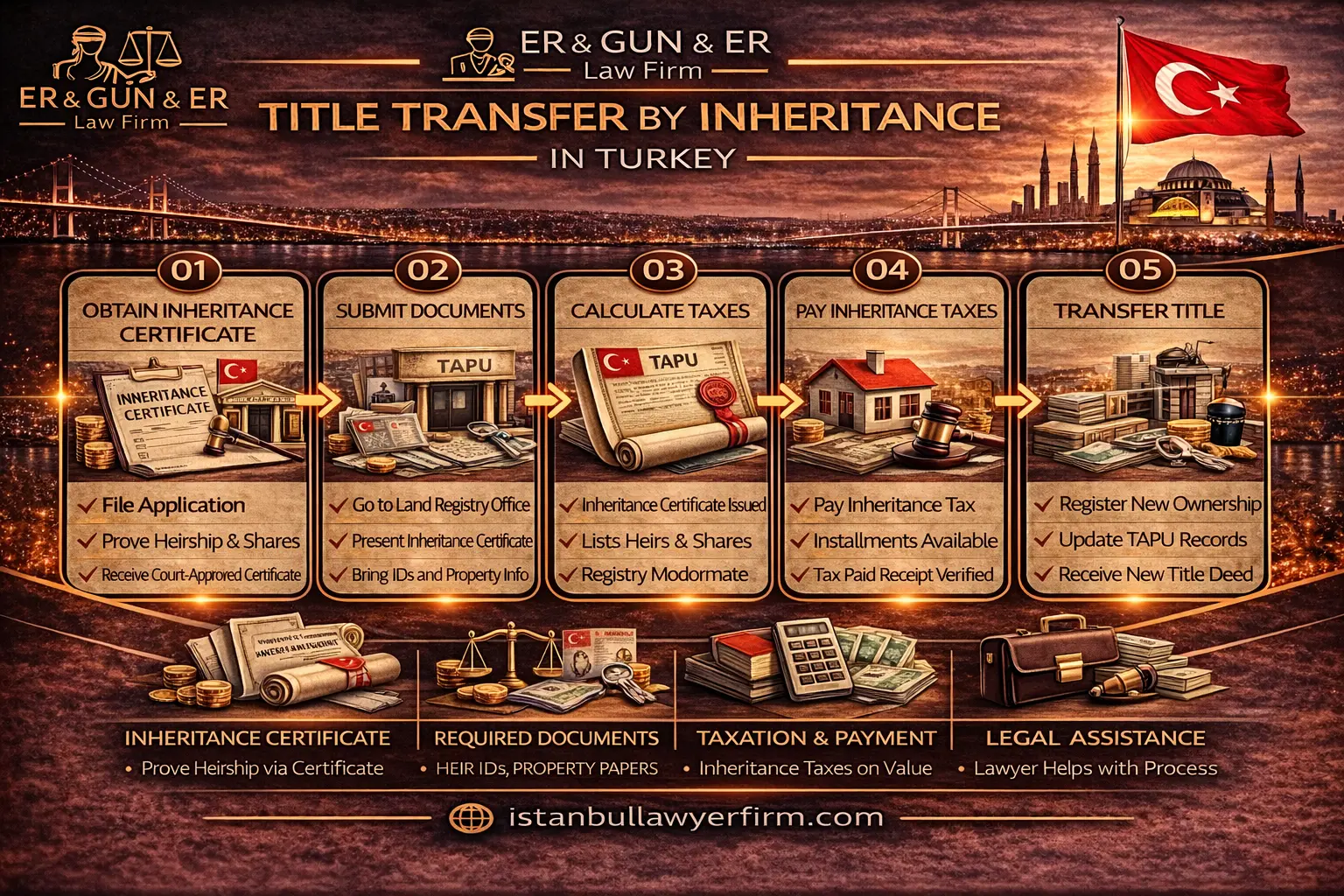
Title transfer by inheritance (intikal yoluyla tapu devri) in Türkiye operates through an integrated multi-track framework spanning standing proof, tax reporting, land registry execution, and integrated co-ownership and dispute management. The principal Turkish legal sources are: the Civil Code (Law No. 4721, the "TMK") Articles 495-682 governing inheritance generally with Article 598 establishing the inheritance certificate (veraset ilamı / mirasçılık belgesi) as the principal standing proof, Articles 705-706 governing immovable property registration, Articles 997-1027 governing the land registry system, Articles 701-703 establishing co-ownership in undivided shares (elbirliği mülkiyeti) as default inheritance outcome, Articles 642-679 governing partition (paylaşma davası), Article 506 establishing forced shares (saklı pay), Article 605 establishing renunciation (reddi miras) within 3 months, and Articles 527-540 governing testamentary forms; the Notary Law amendment by Law No. 6217 of 14 January 2011 enabling notarial issuance of inheritance certificates as alternative to court issuance; the Land Registry Law (Law No. 2644, "Tapu Kanunu") establishing the registration framework; the Inheritance and Transfer Tax Law (Law No. 7338, "VİV") Article 9 establishing declaration deadlines (4 months from death where decedent and heir both in Türkiye, 6 months for cross-border deaths) and Article 17 establishing the tax clearance certificate (vergi ilişiksizlik belgesi) prerequisite for land registry transfer; the International Private Law and Procedure Law (Law No. 5718, "MÖHUK") Article 20 establishing lex rei sitae (Turkish law for Turkish immovables) and Articles 50-59 governing foreign judgment recognition (tenfiz); the Hague Apostille Convention 1961 (Türkiye party through Law No. 6303 of 8 May 1985 since 1985, with recent expansions including UAE effective 7 May 2022, Canada 2024, and Qatar 2024); the Mediation Law (Law No. 6325, "HUAK") Article 18/B added by Law No. 7445 of 28 March 2023 (effective 1 September 2023) establishing mandatory mediation for qualifying immovable property disputes including partition; and the Code of Obligations (Law No. 6098, "TBK") Articles 502-514 governing power of attorney framework critical for foreign heir representation.
The procedural sequence operates through coordinated lanes producing documents that feed downstream stages: standing lane producing the inheritance certificate; tax reporting lane producing VİV declaration evidence and the Article 17 clearance certificate; land registry lane executing TMK 705 registration restoring property to heirs; foreign documentation lane handling Hague Apostille and HMK Article 223 sworn translation for cross-border elements; co-ownership governance lane managing post-registration TMK 701-703 elbirliği mülkiyeti; and dispute management lane handling contested matters separately. Operational details vary by Tapu Müdürlüğü office and Vergi Dairesi practice — practice may vary by authority and year, and any specific operational detail should be confirmed for the relevant office and current period rather than assumed from prior cases. ER&GUN&ER Law Firm advises Turkish and foreign heirs on integrated inheritance title transfer with multi-lane coordination, statutory framework analysis, and dispute prevention.
Veraset İlamı Under TMK 598 and Law 6217
The inheritance certificate (veraset ilamı or mirasçılık belgesi) under TMK Article 598 is the principal standing proof for inheritance title transfer. The certificate establishes: identity of the decedent; identity of legal heirs; share allocation among heirs based on TMK statutory rules (or testamentary modifications where applicable); and integrated standing for downstream procedural use. The certificate represents the master share table that all subsequent lanes (tax reporting, land registry, banking) reference for consistent identification and allocation.
Issuance authority for the inheritance certificate operates through two parallel pathways. Sulh Hukuk Mahkemesi (Civil Court of Peace) issuance under TMK Article 598 represents the traditional pathway with judicial determination of heir identification and share allocation. Notarial issuance under Law No. 6217 of 14 January 2011 (which amended Notary Law No. 1512) provides streamlined alternative for uncomplicated cases — notaries can issue inheritance certificates where heir identification is straightforward and uncontested. Complex cases including disputed heir identification, missing or unknown heirs, foreign heir verification challenges, and similar complications typically require judicial certificate through Sulh Hukuk Mahkemesi. Practice may vary by authority and year — check current guidance.
Strategic certificate management operates through several integrated principles. Single master version control prevents propagation errors across downstream lanes — corrected certificates require systematic update across all dependent files. Token consistency between certificate names and identity documents prevents downstream rejection — name variations, transliteration differences, and similar token drift cause registry refusals despite substantive correctness. Custody discipline with single custodian and certified copy distribution prevents version conflicts and supports privacy protection. Foreign heir integration requires special attention — foreign heirs must be properly reflected on the certificate with consistent identity tokens matching their passport documentation. Translation of foreign-language documents supporting heir status (foreign birth certificates, marriage certificates, identity documents) must be coordinated through HMK Article 223 sworn translation framework with consistent token mapping. The certificate must align with statutory inheritance share rules under TMK framework: Article 499 establishes spouse share allocations varying by parentela (1/4 with descendants, 1/2 with second parentela parents/siblings, 3/4 with third parentela grandparents, all if alone); Article 506 establishes forced shares (saklı pay) protecting descendants (1/2 of legal share), parents (1/4 of legal share), and spouse (varying by co-heir configuration). The certificate must reflect any reduction actions under Articles 560-571 (tenkis davası) where lifetime gifts or testamentary dispositions exceed permissible thresholds infringing forced shares.
VİV Tax Declaration Under Articles 9 and 17
Inheritance tax (veraset ve intikal vergisi) declaration under the Inheritance and Transfer Tax Law (Law No. 7338, "VİV") represents critical lane that must complete before land registry transfer in most cases. VİV Article 9 establishes declaration deadlines: 4 months from death where the decedent died in Türkiye and the heir is in Türkiye; 6 months where the death occurred abroad or the heir is abroad. The declaration is submitted to the Vergi Dairesi (Tax Office) of the decedent's last residence in Türkiye, or alternatively the heir's residence office for specific case configurations.
Declaration content requires comprehensive estate inventory including: real estate assets with parcel identifiers and valuation evidence; bank accounts with balance documentation as of death date; vehicle and other tangible assets; corporate ownership interests; receivables and other intangible rights; and integrated estate composition. Valuation framework operates through specific VİV provisions and implementing regulations, with real estate typically valued through municipal property tax base values or specific market value documentation depending on circumstances. The declaration produces VİV assessment and payment obligations distributed among heirs according to inheritance certificate share allocation. Practice may vary by authority and year — check current guidance.
VİV Article 17 establishes the vergi ilişiksizlik belgesi (tax clearance certificate) as documentary prerequisite for land registry transfer of inherited immovables. The certificate evidences either: complete tax payment supporting unrestricted transfer; or appropriate payment plan and security supporting conditional transfer. The integration between VİV Article 9 declaration and Article 17 clearance creates the procedural pipeline: declaration → assessment → payment or payment plan → clearance certificate → land registry transfer eligibility. Strategic timing coordination supports both VİV deadline compliance and reasonable progression toward land registry transfer. Foreign heir cases create additional complexity — foreign heir documentation, communication challenges, and cross-border financial coordination can extend timelines while VİV deadline compliance must still be managed. Power of attorney representation under TBK Articles 502-514 enables Turkish-resident representatives to handle VİV declaration on behalf of foreign heirs, though comprehensive financial information and decision authority must be properly delegated. The reporting lane should be maintained as separate evidence pack from registry pack, preserving submission proofs, official communications, payment receipts, and clearance certificate as integrated documentation supporting both VİV compliance demonstration and downstream registry use.
Land Registry Registration Under TMK 705 and Tapu Kanunu
Land registry registration under TMK Article 705 establishes the substantive transfer mechanism — title to Turkish immovable property transfers only through formal registration in the land registry, not through inheritance certificate or tax clearance alone. The integrated framework operates through Land Registry Law (Law No. 2644, "Tapu Kanunu") procedural provisions and TMK Article 706 establishing the official deed (resmi senet) as constituent transfer instrument. Inheritance transfer represents specific application of general TMK 705 framework with adapted procedural requirements reflecting inheritance-specific nature.
The land registry appointment (tapu randevusu) is the operational execution event requiring comprehensive documentation pack including: inheritance certificate (TMK 598) establishing standing and shares; VİV Article 17 clearance certificate (or equivalent procedural status documentation); identity proofs for attending heirs or representatives; powers of attorney (TBK 502-514) for non-attending heirs with appropriate scope and form; current title deed extracts confirming property identification; foreign documentation with Hague Apostille and HMK 223 sworn translation where applicable; and integrated supporting documentation. The Tapu Müdürlüğü with jurisdiction over the property (typically based on parcel location) executes the registration. TAKBİS (Tapu ve Kadastro Bilgi Sistemi) electronic system supports the integrated transaction with real-time status updates. Practice may vary by authority and year — check current guidance.
Strategic registration execution operates through several integrated controls. Pre-appointment verification confirms documentation completeness across all categories preventing appointment failures from missing materials. Token consistency across inheritance certificate, identity documents, parcel identifiers, and supporting documentation prevents rejection from clerical inconsistencies. Custody planning for original documents supports presentation requirements while maintaining document security. Representative coordination ensures that powers of attorney specifically authorise inheritance registration steps with appropriate scope under TBK Article 506 (specific authorisation requirement for real estate transactions). Foreign heir coordination involves comprehensive document pipeline including: foreign-issued death certificates, identity documents, and integrated supporting documentation through Hague Apostille framework; sworn translation under HMK 223 with consistent token mapping; integrated logistics supporting timely document availability. Post-registration verification through updated title deed extract storage provides completion evidence and base for subsequent transactions. The registration creates default elbirliği mülkiyeti (joint ownership in undivided shares) under TMK Articles 701-703 unless specific allocation through partition or testamentary direction modifies the outcome.
Elbirliği Mülkiyeti and Co-Ownership Governance
Elbirliği mülkiyeti (joint ownership in undivided shares) under TMK Articles 701-703 represents the default outcome of inheritance registration where multiple heirs receive interests in inherited property. The framework establishes that all heirs hold the property collectively without divided shares — meaning no single heir holds an identifiable separate share that can be independently transferred, encumbered, or used. This contrasts with paylı mülkiyet (ownership in defined shares) where co-owners hold specific fractional interests permitting independent management of those interests.
The substantive consequences of elbirliği mülkiyeti include: unanimous heir consent requirement for property dispositions (sale, mortgage, lease beyond specific limits); shared management with collective decision-making; shared expense and revenue allocation among all heirs; and integrated complications for transactions requiring less than full heir cooperation. The framework reflects the transitional nature of post-inheritance ownership pending either: voluntary partition through heir agreement converting elbirliği mülkiyeti to paylı mülkiyet or individual ownership; or judicial partition through paylaşma davası under TMK Articles 642-679. Practice may vary by authority and year — check current guidance.
Strategic co-ownership governance operates through multiple integrated mechanisms. Co-ownership memorandum documenting heir agreements about property use, expense allocation, revenue sharing, decision-making procedures, and similar operational matters supports orderly management without requiring formal partition. Spokesperson designation for external communications (banks, tenants, municipal offices, building administration) prevents conflicting messages and procedural confusion. Cost ledger and revenue ledger documentation supports later reimbursement claims and dispute resolution through documented financial flows rather than disputed memory. Decision protocols for major decisions (sale, lease, significant repairs, capital improvements) prevent later disputes about authorised conduct. Power of attorney representation for absent heirs through TBK Articles 502-514 with appropriate scope supports continued operation when heirs are dispersed across jurisdictions. Building administration coordination under Kat Mülkiyeti Kanunu (Law No. 634) framework where applicable manages condominium-specific concerns including common expense liability, building rules, general assembly participation. Tax compliance coordination across heirs supports VİV and ongoing property tax obligations with consistent documentation. The strategic objective is preserving inheritance value and family relationships through structured governance during the typically extended period between inheritance and final partition or sale resolution.
Partition Through TMK 642-679 Paylaşma Davası
Partition (paylaşma) under TMK Articles 642-679 represents the substantive remedy for resolving elbirliği mülkiyeti where heirs cannot reach voluntary allocation agreement. TMK Article 642 establishes that any heir can demand partition at any time (with specific exceptions for testamentary partition restrictions or contractual limitations). The framework supports both voluntary partition through heir agreement and judicial partition through paylaşma davası (partition action) before Sulh Hukuk Mahkemesi (Civil Court of Peace) under HMK Article 4 jurisdictional framework.
Partition methodology under TMK Articles 644-660 operates through several integrated approaches. Physical partition (aynen taksim) under Article 650 represents the preferred method where the property can be physically divided among heirs reflecting share allocations. Sale and proceeds distribution (satış suretiyle paylaşma) under Article 651 applies where physical partition is not feasible — the property is sold (typically through judicial auction) and proceeds are distributed according to share allocation. Allocation with compensation (tahsis ve takas) involves allocating specific assets to specific heirs with monetary balancing payments where allocations are unequal. The selection between methods involves court analysis of: physical divisibility considering practical use limitations, value preservation considering whether division reduces total value, heir preferences and cooperation level, and integrated case factors. Practice may vary by authority and year — check current guidance.
HUAK Article 18/B mandatory mediation framework (added by Law No. 7445 of 28 March 2023, effective 1 September 2023) applies to qualifying immovable property disputes including partition cases meeting specific criteria. The framework requires attempted mediation as procedural prerequisite for court filing — meaning paylaşma davası filing requires prior mediation attempt with mediation certification. Strategic mediation engagement provides early resolution opportunity preserving family relationships and avoiding extended litigation costs. However, partition cases involving fundamental disagreement about valuation, allocation method, or heir identification typically require judicial resolution despite mediation attempt. Cross-border partition cases with foreign heirs face additional procedural complexity — Hague Service Convention coordination for foreign heir service, Hague Evidence Convention for cross-border evidence, MÖHUK Article 20 lex rei sitae confirming Turkish law application to Turkish immovable partition regardless of decedent or heir foreign connections. Strategic partition planning includes: pre-action evidence development including current title extracts, valuation analysis, and integrated estate documentation; mediation strategy supporting potential pre-litigation resolution; partition action filing with comprehensive evidence and clear remedy specification; and integrated execution planning ensuring partition outcomes can be effectively implemented through registry and integrated channels. ER&GUN&ER Law Firm advises on integrated partition strategy from voluntary mediation through judicial proceedings.
Foreign Heir Documentation and Cross-Border Framework
Foreign heir cases require coordinated cross-border documentation pipeline ensuring Turkish-usable evidence supporting standing, identity, representation, and integrated procedural requirements. The principal cross-border documentation framework operates through Hague Apostille Convention 1961 (Türkiye party through Law No. 6303 of 8 May 1985 since 1985, with recent expansions including UAE effective 7 May 2022, Canada 2024, and Qatar 2024) for documents from member states, and consular legalisation through Turkish embassy or consulate for non-member state documents.
Documentation typically required for foreign heirs includes: foreign-issued death certificates supporting decedent identification; foreign-issued birth certificates and marriage certificates supporting heir relationship establishment; foreign passport and identity documentation supporting identity tokens; foreign-issued powers of attorney supporting Turkish representative engagement; and integrated supporting documentation depending on case circumstances. HMK Article 223 establishes sworn translation requirements through translators registered with Turkish notaries with specific certification framework. Translation quality and consistency across multiple documents materially affects acceptance — name variations, transliteration differences, and integrated token drift cause downstream rejections despite substantive correctness. Practice may vary by authority and year — check current guidance.
MÖHUK Article 20 establishes lex rei sitae (law of the place where property is situated) for immovable property — Turkish law applies to Turkish-situated immovable property inheritance regardless of decedent's nationality, residence, or domicile. The framework provides clarity that Turkish inheritance procedural requirements (TMK 598 inheritance certificate, VİV declaration, TMK 705 registration) apply to Turkish immovables in foreign decedent estates. MÖHUK Articles 50-59 govern foreign judgment recognition (tenfiz) procedures where foreign court orders or judgments require Turkish enforcement — relevant for foreign probate orders, foreign court-ordered partition decrees, and similar foreign judicial outputs. The integrated cross-border framework operates through coordinated international procedural cooperation including Hague Service Convention for cross-border service of process, Hague Evidence Convention for cross-border evidence collection, and integrated bilateral judicial cooperation. Power of attorney representation through TBK Articles 502-514 typically provides operational mechanism for foreign heir Turkish procedural participation — properly scoped POA executed at Turkish consulate abroad or with Hague Apostille for foreign-executed POAs supports Turkish counsel engagement covering inheritance certificate, VİV declaration, land registry transfer, and integrated procedural steps. ER&GUN&ER Law Firm provides comprehensive foreign heir representation with cross-border documentation coordination, integrated procedural management, and foreign counsel coordination across jurisdictions.
Estate Tax Lane Coordination and Risk Controls
Estate tax lane coordination represents critical procedural infrastructure supporting both VİV compliance and downstream registry transfer. The lane operates through structured evidence development rather than opportunistic document gathering — the strategic objective is creating comprehensive documentation supporting both VİV substantive compliance and procedural verification by tax authorities and downstream registry officials.
Documentation framework typically includes: comprehensive estate inventory with asset categorisation, valuation evidence, and integrated supporting documentation; VİV declaration submission with complete asset coverage and consistent share allocation matching inheritance certificate; assessment correspondence and payment documentation supporting tax compliance demonstration; Article 17 clearance certificate as integrated outcome supporting registry transfer; and integrated bank, valuation, and supporting evidence supporting tax compliance and downstream procedural use. Strategic lane management operates through several integrated controls. Single custodian responsibility prevents version conflicts and supports privacy protection. Chronological documentation with dated submission proofs, official communications, and integrated event records supports both compliance demonstration and procedural verification. Token consistency between tax lane and registry lane prevents downstream registry rejection from inconsistent identification. Practice may vary by authority and year — check current guidance.
Risk control framework addresses common failure points in estate tax compliance. Deadline management for VİV Article 9 declaration deadlines (4 months Türkiye/6 months cross-border) prevents penalty exposure and maintains procedural posture supporting clean Article 17 clearance. Asset discovery management addresses post-declaration discovery of additional estate assets through controlled supplement procedures rather than ad hoc additions creating compliance gaps. Cross-border financial coordination supports foreign heir participation in declaration and payment without creating procedural complications. Heir cooperation coordination supports unified declaration submission across multiple heirs preventing inconsistent or duplicative declarations. Disclosure discipline maintains appropriate confidentiality of sensitive estate information while providing required tax authority transparency. The integrated lane operates through procedural infrastructure supporting both substantive compliance and integrated downstream procedural objectives. Strategic counsel engagement provides specialised expertise in VİV substantive provisions, procedural requirements, and integrated coordination across multiple jurisdictions and authorities. ER&GUN&ER Law Firm coordinates VİV declaration, Article 17 clearance, and integrated tax lane management with downstream registry transfer and broader inheritance administration.
Disputes and Procedural Risk Management
Inheritance disputes represent significant procedural risk requiring structured management preventing administrative paralysis and preserving procedural posture for substantive resolution. The integrated dispute management framework operates through lane separation — administrative inheritance procedures (TMK 598 certificate, VİV declaration, TMK 705 registration) continue for undisputed elements while contested matters operate in separate substantive resolution lanes preventing administrative contamination.
Common dispute categories include: heir identification disputes involving claimed but unrecognised heirs, alleged disinheritance, or integrated standing concerns; share allocation disputes involving forced share infringement claims under TMK Articles 506 and 560-571 (tenkis davası) or testamentary interpretation disputes; will validity disputes involving testamentary capacity, formal compliance with TMK Articles 527-540 will form requirements, undue influence, or integrated will challenge grounds; pre-death transfer disputes involving alleged fraud, simulation, or undue influence affecting estate composition; co-ownership disputes during elbirliği mülkiyeti period including use, expense, and management disagreements; and partition disputes during paylaşma davası proceedings. Each category operates through appropriate substantive procedural framework. Practice may vary by authority and year — check current guidance.
Strategic dispute management operates through integrated procedural and substantive controls. Evidence preservation early in dispute development supports later substantive resolution — official extracts, communications records, financial documentation, and integrated supporting evidence become critical for substantive case development. Procedural lane separation maintains administrative progression for undisputed elements (typical configuration: most heirs uncontested with specific contested aspect) preventing total administrative paralysis. Cross-jurisdiction coordination for foreign heir disputes integrates Turkish procedural framework with foreign procedural elements. Mediation engagement under HUAK 18/B framework where applicable supports potential pre-litigation resolution preserving relationships and resources. Litigation strategy through appropriate Turkish courts (Sulh Hukuk Mahkemesi for partition, Asliye Hukuk Mahkemesi for will validity and integrated substantive matters, specialised Aile Mahkemesi for family relationship aspects) operates through specialised procedural framework supporting substantive resolution. Yargıtay appellate review through specialised civil chambers (typically 2nd, 3rd, 7th, 8th, 14th Civil Chambers depending on specific dispute type) supports procedural correctness and substantive accuracy. Anayasa Mahkemesi individual application under Article 148/3 provides additional protective framework where systemic property rights or fair trial violations meet specific criteria. Strategic counsel engagement provides specialised expertise across substantive Turkish inheritance law, procedural framework, and integrated cross-border coordination supporting comprehensive dispute resolution. ER&GUN&ER Law Firm provides integrated dispute representation across pre-litigation, mediation, judicial proceedings, and appellate review with comprehensive cross-border coordination.
Frequently Asked Questions
- What is the principal standing proof for inheritance title transfer? Veraset ilamı (mirasçılık belgesi) under TMK Article 598. Issuable through Sulh Hukuk Mahkemesi (traditional pathway) or notarially under Law No. 6217 of 14.1.2011 (streamlined alternative for uncomplicated cases). Master share table for all downstream lanes.
- What VİV declaration deadlines apply? VİV Article 9: 4 months from death where decedent and heir both in Türkiye; 6 months for cross-border deaths (decedent died abroad or heir abroad). Submission to Vergi Dairesi of decedent's last residence.
- What is vergi ilişiksizlik belgesi? Tax clearance certificate under VİV Article 17. Documentary prerequisite for land registry transfer of inherited immovables. Evidences either complete tax payment or appropriate payment plan and security supporting transfer.
- How does title transfer to heirs work? TMK Article 705: title transfer requires registration in land registry. Inheritance certificate alone does not transfer title — only Tapu Müdürlüğü registration following inheritance procedure transfers title. TMK Article 706 official deed (resmi senet) constituent transfer instrument.
- What is elbirliği mülkiyeti? Joint ownership in undivided shares under TMK Articles 701-703 — default inheritance registration outcome. All heirs hold property collectively without divided shares. Unanimous consent required for dispositions until partition.
- What about partition? Paylaşma under TMK Articles 642-679 — heirs can demand partition at any time (with limited exceptions). Methods: aynen taksim (physical partition, Article 650), satış suretiyle paylaşma (sale and proceeds distribution, Article 651), tahsis ve takas (allocation with compensation). Sulh Hukuk Mahkemesi jurisdiction.
- Is mediation required for partition? HUAK Article 18/B (added by Law No. 7445 of 28.3.2023, effective 1.9.2023) mandatory mediation applies to qualifying immovable property disputes including partition. Procedural prerequisite for paylaşma davası filing.
- What about forced shares (saklı pay)? TMK Article 506 establishes saklı pay protections: descendants 1/2 of legal share, parents 1/4 of legal share, spouse varying by co-heir configuration. Protected against testamentary disposition and lifetime gifts. TMK Articles 560-571 tenkis davası (reduction action) for infringement.
- What about renunciation (reddi miras)? TMK Article 605 — heirs can renounce inheritance within 3 months of learning of inheritance. Renunciation prevents both inheritance benefit and inheritance debt liability. Strategic option for estates with substantial debts.
- What about cross-border inheritance? MÖHUK Article 20 — Turkish law applies to Turkish immovables (lex rei sitae) regardless of decedent nationality, residence, or domicile. MÖHUK Articles 50-59 govern foreign judgment recognition (tenfiz) for foreign probate orders or court decrees.
- What about foreign documentation? Hague Apostille Convention 1961 (Türkiye party through Law No. 6303 since 1985, recent expansions UAE 2022, Canada 2024, Qatar 2024) for member state documents; consular legalisation for non-member states. HMK Article 223 sworn translation through translators registered with Turkish notaries.
- What about powers of attorney? TBK Articles 502-514 framework. Article 506 requires specific authorisation for real estate transactions. Foreign-issued POAs require Hague Apostille and HMK 223 sworn translation. Scope must specifically authorise inheritance certificate, VİV declaration, and registry transfer steps.
- Which courts have jurisdiction? Sulh Hukuk Mahkemesi (Civil Court of Peace) for inheritance certificate issuance and partition (paylaşma davası). Asliye Hukuk Mahkemesi (Civil Court of First Instance) for will validity and integrated substantive matters. Aile Mahkemesi for family relationship aspects. Yargıtay specialised civil chambers for appellate review.
- What about co-ownership governance? TMK Articles 701-703 elbirliği mülkiyeti framework with unanimous consent requirement. Strategic management through co-ownership memorandum, spokesperson designation, cost/revenue ledgers, decision protocols, and integrated governance preventing later disputes.
- Where does ER&GUN&ER Law Firm support inheritance title transfer? Comprehensive veraset ilamı procurement under TMK Article 598 through Sulh Hukuk Mahkemesi or notarial pathway under Law 6217; VİV (Law 7338) Article 9 declaration with 4/6 month deadline management and Article 17 clearance certificate coordination; TMK Article 705 land registry registration through Tapu Müdürlüğü with TAKBİS integration; elbirliği mülkiyeti governance under TMK Articles 701-703; partition under TMK Articles 642-679 with HUAK Article 18/B mandatory mediation; saklı pay analysis under TMK Article 506 and tenkis davası under TMK Articles 560-571; reddi miras under TMK Article 605; testamentary will analysis under TMK Articles 527-540; MÖHUK Article 20 cross-border inheritance and Articles 50-59 tenfiz; Hague Apostille (Law 6303) and HMK Article 223 sworn translation for cross-border documentation; TBK Articles 502-514 power of attorney with Article 506 specific authorisation; foreign heir representation across Hague Service and Evidence Conventions; Sulh Hukuk Mahkemesi, Asliye Hukuk Mahkemesi, and Aile Mahkemesi litigation; Yargıtay appellate representation; and Anayasa Mahkemesi individual application for property rights protection.
Author: Mirkan Topcu is an attorney registered with the Istanbul Bar Association (Istanbul 1st Bar), Bar Registration No: 67874. His practice focuses on cross-border and high-stakes matters where evidence discipline, procedural accuracy, and risk control are decisive.
He advises Turkish and foreign heirs, family offices, and institutional fiduciaries across Inheritance Title Transfer under TMK (Law No. 4721) Article 598 Veraset İlamı with Sulh Hukuk Mahkemesi Issuance and Notarial Alternative under Law No. 6217 of 14.1.2011, VİV (Law No. 7338) Article 9 Declaration with 4-month Türkiye and 6-month Cross-border Deadlines and Article 17 Vergi İlişiksizlik Belgesi (Tax Clearance Certificate), TMK Article 705 Land Registry Registration through Tapu Müdürlüğü with TAKBİS Integration and TMK Article 706 Resmi Senet (Official Deed), Tapu Kanunu (Law No. 2644) Procedural Framework, Elbirliği Mülkiyeti under TMK Articles 701-703 and Co-ownership Governance, Partition under TMK Articles 642-679 with TMK Article 650 Aynen Taksim and Article 651 Satış Suretiyle Paylaşma through Sulh Hukuk Mahkemesi, HUAK (Law No. 6325) Article 18/B Mandatory Mediation under Law No. 7445 of 28.3.2023, Saklı Pay (Forced Share) Analysis under TMK Article 506 with Descendants 1/2, Parents 1/4, and Spouse Variable Shares, Tenkis Davası (Reduction Action) under TMK Articles 560-571, Reddi Miras (Renunciation) under TMK Article 605 within 3-month Period, Testamentary Forms under TMK Articles 527-540, Cross-border Inheritance under MÖHUK (Law No. 5718) Article 20 Lex Rei Sitae and Articles 50-59 Tenfiz, Hague Apostille Convention 1961 (Türkiye party through Law No. 6303 since 1985 with Recent Expansions UAE 2022, Canada 2024, Qatar 2024), HMK (Law No. 6100) Article 223 Sworn Translation, TBK (Law No. 6098) Articles 502-514 Power of Attorney with Article 506 Specific Authorisation, Hague Service Convention 1965 and Hague Evidence Convention 1970 Cross-border Procedural Cooperation, Sulh Hukuk Mahkemesi and Asliye Hukuk Mahkemesi Litigation, Aile Mahkemesi Family Court Proceedings, Yargıtay Appellate Civil Chambers Representation, and Anayasa Mahkemesi Individual Application for Property Rights and Fair Trial Protection.
Education: Istanbul University Faculty of Law (2018); Galatasaray University, LL.M. (2022). LinkedIn: Profile. Istanbul Bar Association: Official website.