

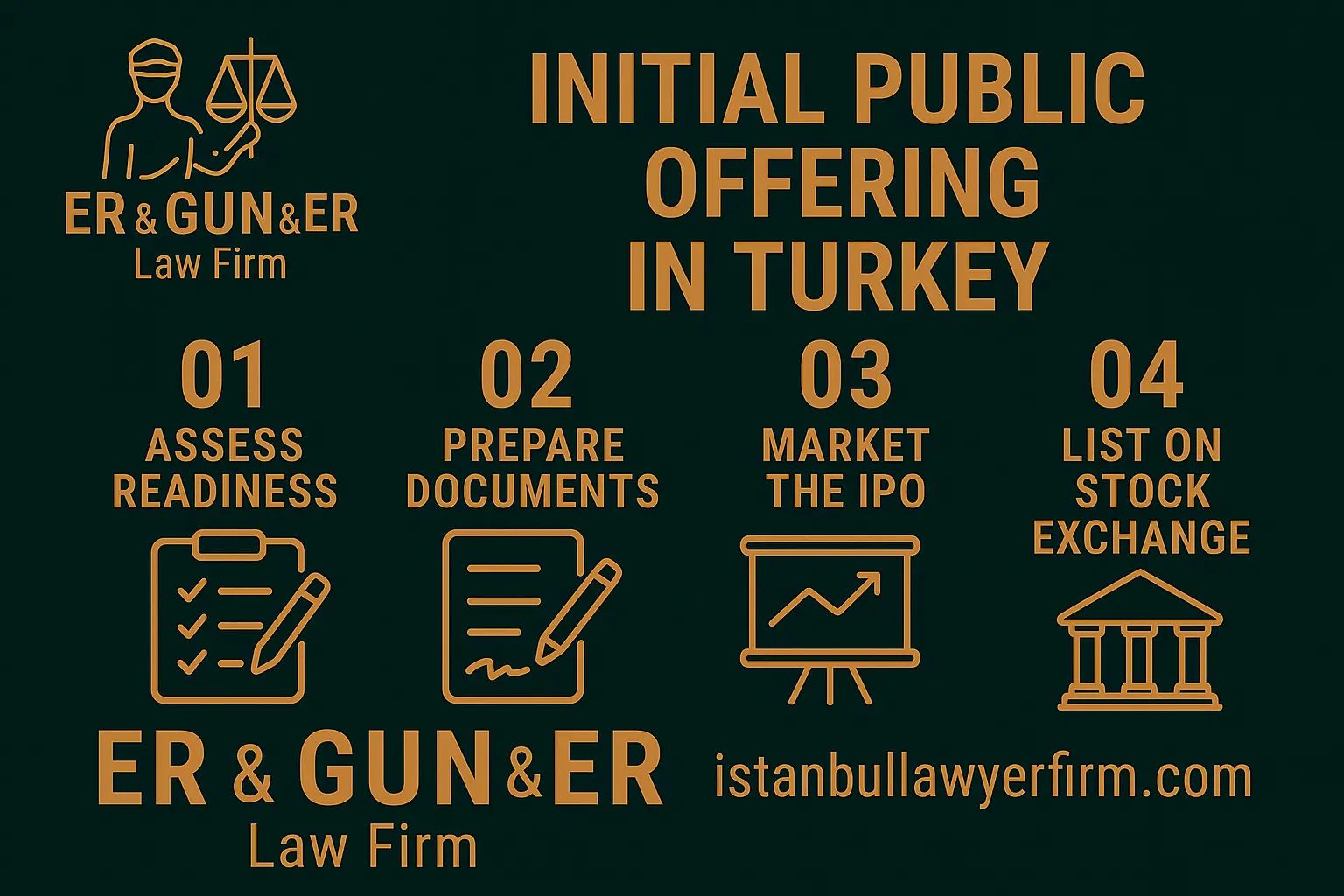
An initial public offering (halka arz) in Türkiye marks the entry of a Turkish joint stock company (anonim şirket) into the public capital markets through admission of its shares to trading on Borsa İstanbul under the supervision of the Sermaye Piyasası Kurulu (SPK). Foreign-affiliated issuers, multinational corporate groups holding Turkish subsidiaries, private equity sponsors planning portfolio company listings, family-owned Turkish enterprises seeking institutional capital, and cross-border investors evaluating Turkish equity opportunities all benefit from substantive understanding of the framework before committing to the listing path. The transaction is simultaneously a corporate, securities, regulatory, tax, governance, and reputational exercise, and the framework's complexity produces meaningful value from coordinated counsel engagement.
An Istanbul Law Firm advising on Turkish IPO engagements works against a substantive statute set: Sermaye Piyasası Kanunu (Capital Markets Law, SPK, Law No. 6362) of 6 December 2012 (Resmi Gazete 30 December 2012 No. 28513) Articles 4-6 governing public offering and admission to trading, Article 8 governing prospectus content, Article 10 governing prospectus liability, Articles 12-13 governing capital markets institutions, Articles 26-29 governing tender offer and squeeze-out, Articles 47-50 governing public companies, Articles 107-115 governing market abuse, and Articles 106-107 establishing criminal sanctions for insider trading (içerden öğrenenlerin ticareti) and market manipulation (piyasa dolandırıcılığı); Türk Ticaret Kanunu (Turkish Commercial Code, TTK, Law No. 6102) of 13 January 2011 (Resmi Gazete 14 February 2011 No. 27846) governing joint stock company corporate framework Articles 329-562 with Articles 397-406 governing independent audit; Vergi Usul Kanunu and 5520 sayılı Kurumlar Vergisi Kanunu governing the tax framework; 6698 sayılı Kişisel Verilerin Korunması Kanunu (KVKK) governing data protection in the disclosure context; 4875 sayılı Doğrudan Yabancı Yatırımlar Kanunu of 5 June 2003 (Resmi Gazete 17 June 2003 No. 25141) governing inbound foreign investment; 5549 sayılı Suç Gelirlerinin Aklanmasının Önlenmesi Hakkında Kanun under MASAK; and sectoral statutes including 5411 sayılı Bankacılık Kanunu under BDDK, 5684 sayılı Sigortacılık Kanunu under SEDDK, 4628 governing energy markets under EPDK, 5809 sayılı Elektronik Haberleşme Kanunu under BTK, and 6112 sayılı Radyo ve Televizyonların Kuruluş ve Yayın Hizmetleri Hakkında Kanun under RTÜK.
The institutional architecture supporting Turkish IPOs includes the Sermaye Piyasası Kurulu (SPK) supervising the offering and approving the prospectus, Borsa İstanbul (BIST) operating the trading venue and admitting securities to listing across its market tiers, Kamuyu Aydınlatma Platformu (KAP) operating the central electronic disclosure system, Merkezi Kayıt Kuruluşu (MKK) maintaining the central securities registry through dematerialised share records, İstanbul Takas ve Saklama Bankası (Takasbank) operating clearing and settlement, Türkiye Sermaye Piyasaları Birliği (TSPB) functioning as the self-regulatory association for capital markets institutions, Türkiye Cumhuriyet Merkez Bankası (TCMB) framing foreign exchange and currency repatriation rules, Mali Suçları Araştırma Kurulu (MASAK) administering anti-money laundering compliance, sectoral regulators (BDDK, SEDDK, EPDK, BTK, RTÜK) issuing change-of-control approvals and continuing supervision where applicable, and the Asliye Ticaret Mahkemesi together with Yargıtay 11. Hukuk Dairesi handling securities disputes and prospectus liability claims.
SPK 6362 Framework: Public Offering Architecture
The Turkish public offering framework sits in 6362 sayılı Sermaye Piyasası Kanunu, supplemented by SPK communiqués (tebliğ) including the Prospectus Communiqué (II-5.1), the Sales Communiqué (II-5.2), the Special Cases Communiqué (II-15.1), and the Disclosure Communiqué (II-15.1 series). Article 4 of SPK 6362 defines public offering (halka arz) as the call to acquire securities directed to an unlimited number of persons through any means, with specific exemptions for private placements falling within prescribed thresholds and qualified investor offerings. Article 5 governs the requirement to publish a prospectus prior to the public offering, and Article 6 establishes the principle that securities offered to the public must be admitted to trading on a stock exchange operating in Türkiye.
An Istanbul Law Firm structuring a Turkish IPO ordinarily begins with eligibility analysis under TTK 6102 corporate framework. The issuer must be organised as a joint stock company (anonim şirket) with paid-in capital meeting the minimum threshold for the targeted Borsa İstanbul market tier, board structure aligned with Sermaye Piyasası Kurulu corporate governance principles, audited financial statements covering the look-back period required by the Prospectus Communiqué, and articles of association compliant with public company requirements. Limited liability companies (limited şirket) cannot conduct public offerings without first converting to anonim şirket form under TTK Articles 180-194 conversion framework.
The offering can be structured as a primary issuance (sermaye artırımı yoluyla halka arz), a secondary sale by existing shareholders (ortak satışı yoluyla halka arz), or a combination of both. Primary issuance increases the issuer's share capital and channels gross proceeds to the company subject to deduction of issuance costs. Secondary sale transfers existing shares from selling shareholders to public investors with proceeds flowing to those shareholders. Combined offerings deliver both fresh capital to the issuer and partial liquidity to selling shareholders, with the relative split disclosed in the prospectus and reflected in the underwriting structure.
A Turkish Law Firm advising on offering size calibration analyses the float (halka açıklık oranı) percentage targeted at admission, the post-offering shareholder structure including any remaining controlling block, and any over-allotment (greenshoe) facility under the Prospectus Communiqué allowing additional share allocation up to a defined percentage of the base offering. The float percentage drives Borsa İstanbul market tier eligibility, with the Yıldız Pazar (Star Market) requiring higher float and free float market capitalisation thresholds than the Ana Pazar (Main Market) or Alt Pazar (Sub-Market). The chosen tier determines admission criteria, continuing obligations, and index inclusion pathways.
Pricing methodology under the Prospectus Communiqué proceeds through one of three principal pathways: fixed price (sabit fiyatla halka arz) where the offering price is set in advance based on independent valuation; book building (talep toplama yoluyla halka arz) where institutional investor demand is collected within a price range and final price determined post-bookbuild; or sale at the stock exchange (borsada satış yoluyla halka arz) for secondary offerings. Each method carries distinct documentation, allocation, and pricing-determination mechanics that the deal team selects against the issuer's profile, market conditions, and underwriter recommendation.
The offering timetable ordinarily spans six to nine months from kick-off to listing for first-time issuers, with shorter timelines achievable for issuers already meeting public company readiness criteria. The principal milestones include diligence kick-off, prospectus drafting, audited financial statement finalisation, SPK pre-filing engagement, formal Sermaye Piyasası Kurulu application under Article 5, prospectus approval, Borsa İstanbul listing application, marketing roadshow, book building or fixed price subscription period, allocation, registration with MKK, and admission to trading. Each phase produces specific legal deliverables coordinated against the master timetable.
An Istanbul Law Firm coordinating an IPO timeline engages with multiple workstreams in parallel: legal due diligence on the issuer's corporate, commercial, employment, real estate, IP, regulatory, litigation, tax, and KVKK matters; financial due diligence and audit completion; valuation analysis supporting the offering range; corporate governance restructuring including independent director recruitment, audit committee formation under TTK 6102 and SPK communiqués, and committee charter drafting; articles of association amendment to reflect public company requirements; and underwriter and intermediary mandate documentation. The deal team's discipline at each phase prevents downstream timeline slippage during the SPK review.
Sermaye Piyasası Kurulu Approval and Prospectus Process
Sermaye Piyasası Kurulu approval represents the principal regulatory gate for a Turkish IPO. Article 8 of SPK 6362 governs prospectus content, requiring that the document contain all material information enabling investors to make informed assessment of the issuer's assets and liabilities, financial position, profits and losses, and prospects, together with the rights attaching to the securities. The Prospectus Communiqué (II-5.1) elaborates the substantive content requirements organised in defined sections including the summary, risk factors, issuer description, business overview, management and corporate governance, financial information, offering terms, and additional information.
An Istanbul Law Firm drafting a Turkish IPO prospectus coordinates with the issuer's finance team, the auditor, the underwriter (intermediary institution), the financial adviser, and any sectoral counsel where regulated business segments are involved. The drafting process proceeds through working drafts circulated among the working group, with iterative refinement of disclosures across multiple drafting sessions. The final prospectus is filed with SPK in Turkish, with English translations prepared in parallel for international marketing where the offering targets foreign institutional investors through international tranches.
Article 10 of SPK 6362 establishes prospectus liability. The issuer, the issuer's directors, the selling shareholders (where applicable), the underwriter, and any other persons whose names appear in the prospectus as taking responsibility for content are jointly and severally liable for damages arising from inaccurate or incomplete prospectus statements. The liability framework supports investor claims through the Asliye Ticaret Mahkemesi where investors demonstrate acquisition of securities in reliance on the prospectus and resulting loss attributable to the prospectus deficiency. Yargıtay 11. Hukuk Dairesi has produced material decisions on prospectus liability shaping current drafting practice.
A Turkish Law Firm managing prospectus risk implements layered defensive practices: comprehensive due diligence with documented findings; verification of substantially all factual statements against source documents; independent expert review of valuation and forward-looking statements where included; balanced and prominent risk factor disclosure addressing identified business, regulatory, and financial risks; clear segregation of forward-looking statements from historical fact with appropriate cautionary language; and signed officer and director certifications confirming review of the prospectus content. The verification record supports defence in any subsequent prospectus liability claim.
The SPK review proceeds in two principal phases: a substantive review of the prospectus draft against the Prospectus Communiqué, including detailed comments and revision rounds; and a final approval phase where the SPK issues the offering circular approval (izahname onayı) and authorises the offering. Pre-filing engagement with SPK staff is standard practice and addresses contested disclosures, novel structures, exemption applications, or sectoral coordination issues before formal filing. The pre-filing dialogue narrows the formal review timeline and reduces the risk of late-stage substantive changes.
Sermaye Piyasası Kurulu may impose conditions on its approval, require additional disclosure, mandate restructuring of certain offering features, or in exceptional cases decline approval. Conditions ordinarily address specific risk disclosures, related-party transaction structures, lock-up arrangements for controlling shareholders, or use-of-proceeds restrictions. Decline decisions are appealable to the İdare Mahkemesi within sixty days under 2577 sayılı İdari Yargılama Usulü Kanunu, with further appeal to the Bölge İdare Mahkemesi and ultimately Danıştay. Anayasa Mahkemesi recourse remains available where fundamental rights issues are engaged.
An Istanbul Law Firm coordinating the offering announcement publishes the approved prospectus on Kamuyu Aydınlatma Platformu (KAP), the issuer's website, and the underwriter's distribution channels in accordance with the Prospectus Communiqué publication requirements. The summary prospectus accompanies the full document and provides condensed disclosure for retail investor reference. Marketing materials, research reports prepared by the underwriter, and roadshow presentations operate under restrictions during the offering period to ensure that all communications remain consistent with the prospectus and within the parameters of permissible publicity under SPK rules.
Borsa İstanbul Listing Tiers and Eligibility Criteria
Borsa İstanbul operates an Equity Market structured into multiple tiers with distinct admission and continuing obligation regimes. The Yıldız Pazar (Star Market) accommodates large issuers meeting elevated free float, market capitalisation, and operational scale thresholds; the Ana Pazar (Main Market) addresses mid-tier issuers; the Alt Pazar (Sub-Market) hosts smaller issuers including emerging companies; and the Yakın İzleme Pazarı (Close Watch Market) is designated for issuers under heightened supervision following compliance concerns. Specialised platforms accommodate venture capital, real estate investment, and structured products with sector-specific eligibility criteria.
An Istanbul Law Firm advising on Borsa İstanbul listing tier selection analyses the issuer's free float percentage at admission, free float market capitalisation, paid-in capital, audited equity, profitability over the look-back period, operational track record, and sectoral profile against the Borsa İstanbul Listing Directive (Kotasyon Yönergesi) thresholds in force at the application date. The thresholds evolve through Borsa İstanbul amendments, and the deal team consults the version current to the application to confirm eligibility. Aspirational tier selection above eligibility produces application rejection or downgrade to the next eligible tier.
The Borsa İstanbul listing application proceeds in parallel with the SPK approval process. Following SPK prospectus approval, the issuer files the listing application with Borsa İstanbul including the approved prospectus, audited financial statements, articles of association, board and general assembly resolutions authorising the offering, certificates from MKK regarding share dematerialisation, certificates from Takasbank regarding clearing arrangements, intermediary institution mandate confirmation, and the listing fee. Borsa İstanbul reviews the application against admission criteria, technical requirements (share dematerialisation, ISIN allocation), and corporate governance representations, ordinarily completing within statutory timelines following complete application submission.
A Turkish Law Firm coordinating dematerialisation under MKK regulations confirms that all shares to be admitted to trading are recorded electronically in the central securities registry. The MKK system replaced physical share certificates following the dematerialisation reform, and admission to trading is conditional on confirmation that the issuer's share register is fully recorded with MKK. The intermediary institution coordinates the technical onboarding alongside Takasbank settlement system integration, ensuring that the secondary market trading infrastructure is operational from the admission date.
Continuing obligations vary by tier but uniformly include periodic financial reporting under Turkish Financial Reporting Standards (TFRS) consistent with International Financial Reporting Standards (IFRS), material event disclosure on KAP, related-party transaction disclosure under SPK communiqués, share trading restriction periods (closed periods) for corporate insiders during specified windows around financial reporting, board and committee composition maintenance, and corporate governance compliance reporting. Higher tiers attract enhanced obligations including detailed sustainability and governance disclosures and proactive investor relations infrastructure.
An Istanbul Law Firm advising on tier transitions (uplifts and downgrades) examines the substantive operational changes triggering reclassification: market capitalisation movement, free float changes through subsequent transactions, financial performance trends affecting profitability criteria, governance compliance issues producing supervisory concerns, and corporate transactions altering the issuer's profile. Tier transitions follow Borsa İstanbul procedures with disclosure obligations, investor communication requirements, and where the transition is downward, accelerated remediation timelines to address the underlying issues.
Specialised market segments accommodate specific issuer profiles. The Real Estate Investment Trust (gayrimenkul yatırım ortaklığı) segment under SPK communiqués hosts REITs subject to portfolio composition, distribution, and operational rules. The Venture Capital Investment Trust (girişim sermayesi yatırım ortaklığı) segment accommodates venture capital investment trusts with private market exposure transmitted to public investors. Investment funds, exchange-traded funds, and structured products operate under separate communiqué frameworks within Borsa İstanbul's market architecture.
Prospectus Liability Under SPK Article 10 and Disclosure Standards
Prospectus liability under Article 10 of SPK 6362 imposes joint and several civil liability on identified persons for damages arising from inaccurate, misleading, or incomplete prospectus content. The liable persons include the issuer, the issuer's directors signing the prospectus, the selling shareholders, the underwriter, and other persons whose names appear in the prospectus as taking responsibility for specific content. Defences include demonstration of reasonable diligence and reasonable belief in the accuracy of the relevant statement, with the burden allocated according to the role and information access of the defendant.
An Istanbul Law Firm advising on prospectus drafting calibrates risk factor disclosure to the issuer's actual risk profile rather than to a templated catalogue. Substantive risk factors cover the issuer's business model risks (customer concentration, supplier dependency, technology risk, key person risk), financial risks (leverage, liquidity, foreign exchange exposure, interest rate exposure, refinancing risk), regulatory risks (sectoral licence dependence, regulatory change exposure, antitrust exposure), legal risks (material litigation, regulatory enforcement, IP exposure), market risks (competition, demand cyclicality, geopolitical exposure), and offering-specific risks (post-offering control structure, lock-up expiry, dilution).
The SPK Prospectus Communiqué requires forward-looking statements (geleceğe yönelik açıklamalar) to be supported by adequate underlying analysis and accompanied by appropriate cautionary language identifying assumptions, risks, and uncertainties. Inclusion of forward-looking content is optional, but where included it must be balanced, supported, and clearly distinguished from historical fact. Earnings forecasts (kâr tahminleri) and synergy projections trigger heightened verification requirements and ordinarily require auditor reports addressing the underlying methodology and assumptions.
A Turkish Law Firm conducting prospectus verification implements a structured backup process. Each material factual statement in the prospectus is traced to a verifiable source: financial information to audited financial statements; market data to published reports from named sources; regulatory information to issued permits, licences, or correspondence with authorities; contractual information to executed agreements; intellectual property information to TÜRKPATENT registry extracts; real estate information to Tapu ve Kadastro Genel Müdürlüğü registry; and litigation information to court records. The verification file documents the source for each statement and forms the defensive record in any subsequent claim.
Director and officer certifications support the verification structure. Each director signs a declaration confirming review of the prospectus, knowledge of its contents, and absence of material omissions or inaccuracies. The selling shareholders sign equivalent declarations addressing matters within their information scope. The underwriter conducts independent verification reflecting its responsibility for content accuracy under Article 10. The certifications and underlying verification record are retained as part of the offering closing record for the duration of the limitation period applicable to prospectus claims.
An Istanbul Law Firm defending prospectus liability claims through the Asliye Ticaret Mahkemesi addresses three principal lines of defence: that the challenged statement was accurate at the time of publication; that the defendant exercised reasonable diligence and held reasonable belief in the statement's accuracy; and that the claimant cannot demonstrate causation between the alleged inaccuracy and the claimed loss. Yargıtay 11. Hukuk Dairesi has developed case law guidance on each line of defence, addressing the standard of care expected of issuers, directors, underwriters, and other liable persons.
Continuing disclosure obligations after admission to trading sit alongside prospectus liability. Material event disclosure under the Special Cases Communiqué (II-15.1) requires issuers to publish information likely to affect the value of securities, including financial results, corporate transactions, material litigation, regulatory actions, and management changes. Failure to disclose timely produces SPK administrative penalties, KAP supervisory reporting, and where serious omissions affect investor decisions, civil liability under general securities law principles supplemented by SPK 6362 framework.
Underwriting and Capital Markets Institution Framework
Capital markets intermediary services in Türkiye are regulated activities reserved for capital markets institutions (sermaye piyasası kurumları) authorised by SPK under Articles 12-13 of SPK 6362. The principal categories include investment firms (yatırım kuruluşları) authorised across various activity scopes including underwriting, dealer-broker (alım satım aracılığı), portfolio management, investment advisory, and custody services. Foreign investment banks ordinarily participate in Turkish IPO underwriting through Turkish-licensed affiliates, joint ventures with Turkish brokerage houses, or syndication arrangements where the lead underwriter holds the necessary local authorisation.
An Istanbul Law Firm advising on the underwriting structure differentiates among firm commitment underwriting (kesin taahhütle aracılık) where the underwriter agrees to purchase any unsold shares; best efforts underwriting (en iyi gayret aracılığı) where the underwriter undertakes marketing without commitment to absorb unsold shares; and combined structures balancing risk allocation. The selected structure influences the underwriting fee, the issuer's pricing flexibility, and the commercial dynamics around the offering. Firm commitment offerings provide the issuer with pricing certainty at the cost of higher fees reflecting the underwriter's risk capital.
The Underwriting Agreement (aracılık sözleşmesi) addresses the offering scope, pricing methodology, allocation principles, fee structure, lock-up undertakings by the issuer and selling shareholders restricting post-offering share sales for a defined period, market stabilisation arrangements (where permitted under SPK communiqués), force majeure and material adverse change termination rights, representations and warranties from the issuer covering corporate, financial, regulatory, and operational matters, indemnification by the issuer for prospectus-related claims, and governing law and dispute resolution clauses ordinarily selecting Turkish law and Asliye Ticaret Mahkemesi or institutional arbitration.
A Turkish Law Firm coordinating syndication structures the relationship between the lead underwriter (lider aracı kurum), co-managers, and any selling group members participating in distribution. The Inter-Syndicate Agreement allocates fees, responsibilities for stabilisation activities, allocation discretion, and contingent obligations. Where international tranches participate, the structure coordinates with international underwriting practice while maintaining compliance with Turkish capital markets institution rules and the specific requirements of SPK communiqués governing intermediary institution conduct.
Allocation principles governing the apportionment of shares among retail investors, qualified investors, and any reserved categories operate under SPK communiqués with disclosure in the prospectus. Discretionary allocation (tahsisat) by the underwriter operates within the disclosed framework with prohibition on practices producing market abuse risk including spinning, laddering, or quid pro quo allocations. The deal team's allocation discipline supports the offering's reputation and reduces post-offering supervisory exposure.
Stabilisation activity (fiyat istikrarı işlemi) following admission to trading is permitted within parameters set by SPK communiqués. The underwriter's stabilisation manager may purchase securities in the secondary market during a defined stabilisation period to support the trading price within the disclosed parameters. The greenshoe over-allotment option (ek satış hakkı) supports stabilisation by allowing the underwriter to short the offering up to the over-allotment amount and cover the short position through purchases or exercise of the option. Stabilisation activity must be disclosed and conducted within the rules to avoid market manipulation exposure under SPK 107-115.
An Istanbul Law Firm advising selling shareholders on lock-up undertakings coordinates the duration, exceptions, and waiver mechanics. Standard lock-up periods range from one hundred eighty to three hundred sixty-five days from listing, with controlling shareholders ordinarily accepting the longer period and management shareholders accepting variable periods aligned with their continuing role. Exceptions accommodate share grants in employee plans, transfers to affiliates within the group structure, and hedging within disclosed parameters. The lock-up disclosure in the prospectus binds the post-offering supply dynamics shaping early trading behaviour.
Public Disclosure Platform (KAP) and Continuing Obligations
Kamuyu Aydınlatma Platformu (KAP) operates as the central electronic disclosure system for Turkish public companies under SPK supervision. Listed issuers publish material information through KAP including periodic financial reports (annual, half-year, and quarterly), material event notifications (özel durum açıklamaları) under the Special Cases Communiqué, general assembly notices and resolutions, board resolutions on prescribed matters, related-party transaction disclosures, share buyback announcements, dividend distributions, capital increase and decrease decisions, corporate governance compliance reports, sustainability disclosures, and ad-hoc announcements addressing specific events.
An Istanbul Law Firm advising on KAP disclosure discipline maps the issuer's continuing obligation calendar against the listing tier requirements. Annual financial reports require independent audit under TFRS consistent with IFRS, with publication on KAP within the timeline specified by SPK communiqués following financial year end. Half-year reports follow a shorter publication timeline with limited review by the auditor. Quarterly reports address specific issuers and operational segments. The deal team supports the issuer's finance and investor relations teams in meeting publication deadlines while maintaining accuracy and completeness.
Material event disclosure under the Special Cases Communiqué requires immediate publication of information likely to affect the price of securities. The framework distinguishes between special cases requiring detailed disclosure formats (corporate transactions, capital changes, board changes, regulatory actions, material litigation outcomes) and other material events requiring narrative disclosure on KAP. The disclosure timing follows the principle of immediate publication upon the information becoming material and verifiable, with delay permitted only in specific circumstances supported by appropriate confidentiality measures.
A Turkish Law Firm advising listed issuers on insider list (içerden öğrenen kişi listesi) maintenance under the Special Cases Communiqué establishes the protocols identifying individuals having access to material non-public information at the issuer, advisers, and counterparties. The insider list framework supports market abuse prevention, evidentiary preservation in any subsequent investigation, and personal accountability for trading restrictions. The list is updated promptly when new individuals gain access and when previously-listed individuals lose access, with retention for the period prescribed by SPK communiqués.
Closed periods (kapalı dönem) restrict trading by corporate insiders during defined windows around periodic financial reporting and other significant disclosure events. The closed period typically extends from a defined date before the disclosure event to the publication date plus a specified buffer. Trading during the closed period is permitted only in specific circumstances such as pre-existing trading plans (with adequate documentation), tax-driven transactions outside the insider's discretionary control, or specific exemptions under SPK communiqués. Violation of closed period rules exposes individuals to administrative penalties and potential criminal liability under SPK 106-107 where insider trading elements are established.
Corporate governance compliance reporting addresses the Sermaye Piyasası Kurulu Corporate Governance Principles applicable to listed companies. The principles cover board composition including independent director ratios, committee structures (audit committee, corporate governance committee, early detection of risk committee), shareholder rights, related-party transactions, and disclosure standards. Issuers prepare annual compliance statements identifying applied principles, departures from principles with explanation, and the substantive governance practices supporting the listing. The compliance reporting forms part of the annual report disclosure framework on KAP.
Sustainability disclosure has expanded under successor SPK communiqués reflecting global investor expectations. Listed issuers in scope prepare sustainability reports addressing environmental, social, and governance matters in alignment with frameworks adopted by SPK including reference to Task Force on Climate-related Financial Disclosures (TCFD) recommendations and Global Reporting Initiative (GRI) standards as applicable. The substantive content addresses climate risk, social impact, governance practices, and disclosure data points relevant to the issuer's sector. The reporting framework continues to evolve and the deal team monitors regulatory updates affecting the issuer's continuing obligations.
Foreign Investor Participation and Currency Repatriation
Türkiye operates a generally liberal regime for foreign investor participation in capital markets under 4875 sayılı Doğrudan Yabancı Yatırımlar Kanunu of 5 June 2003 (Resmi Gazete 17 June 2003 No. 25141) supplemented by Türkiye Cumhuriyet Merkez Bankası (TCMB) foreign exchange rules. Foreign investors may acquire shares in IPOs and trade on Borsa İstanbul through licensed Turkish capital markets institutions providing custody, brokerage, and settlement services. The custody account framework operated by Takasbank and intermediary institutions supports the international investor's portfolio management, settlement, and corporate action processing.
An Istanbul Law Firm advising international institutional investors on Turkish IPO participation coordinates the onboarding workstreams with the chosen custodian and brokerage. The onboarding includes account opening with the intermediary institution under capital markets institution rules, MKK investor account establishment for shareholding records, Takasbank settlement account integration, and KYC documentation under MASAK 5549 anti-money laundering compliance. Tax registration for non-resident investors operates under Vergi Usul Kanunu and Kurumlar Vergisi Kanunu (5520) with reference to applicable double taxation treaties.
Currency framework for foreign investor participation operates through TCMB rules permitting foreign currency inflow for investment purposes and outflow for repatriation of investment proceeds, dividends, and divestment receipts. The framework supports conversion at TCMB exchange rates through authorised banks holding the necessary correspondent relationships. Foreign currency-denominated investment subscription operates within the prescribed framework with conversion to Turkish Lira at the relevant rate; share trading on Borsa İstanbul occurs in Turkish Lira and foreign-currency-denominated equity issuances are not standard practice for Turkish listed companies.
A Turkish Law Firm advising on tax aspects of Turkish IPO participation by non-resident investors examines the dividend withholding regime, capital gains treatment under Turkish tax law, double taxation treaty positions, and substance requirements for treaty benefits. Dividends from Turkish public companies to non-resident shareholders are subject to withholding at the applicable rate under domestic law modified by treaty positions where applicable. Capital gains realised by non-resident investors on Borsa İstanbul-listed shares benefit from specific exemptions under domestic tax law subject to compliance with the prescribed conditions.
Sectoral acquisition restrictions persist for certain segments where the IPO participation crosses thresholds requiring sectoral regulator approval. Banking sector listed companies trigger BDDK approval under 5411 sayılı Bankacılık Kanunu for direct or indirect acquisitions crossing statutory thresholds (ten, twenty, thirty-three, fifty percent and above). Insurance sector listed companies trigger SEDDK approval under 5684 sayılı Sigortacılık Kanunu. Energy, telecom, broadcasting, and aviation sector listed companies engage sector-specific change-of-control rules. The thresholds and procedures are sector-specific, and the deal team identifies applicable rules during the foreign investor's onboarding analysis.
Anti-money laundering compliance under 5549 sayılı Suç Gelirlerinin Aklanmasının Önlenmesi Hakkında Kanun administered by MASAK requires the intermediary institution to perform customer due diligence on the foreign investor including beneficial ownership identification, source of funds verification, and ongoing monitoring of activity against the customer profile. Politically exposed persons (PEPs) attract enhanced due diligence. Suspicious transaction reporting to MASAK operates within the prescribed framework with confidentiality protections preventing tipping-off to the subject of the report.
An Istanbul Law Firm advising on cross-border investor regulatory compliance addresses sanctions screening, beneficial ownership disclosure under TTK 6102 and SPK communiqués (where the investor crosses notification thresholds), and reporting obligations under foreign investor home jurisdiction rules. The reporting framework includes notifications to SPK of significant shareholding changes (ordinarily five, ten, fifteen, twenty, twenty-five percent and above), public disclosure on KAP through the issuer, and continuing reporting obligations as the investor's stake evolves. The deal team coordinates this disclosure with the investor's home jurisdiction filing obligations to maintain consistent reporting positioning.
Insider Trading and Market Abuse Under SPK Articles 106-115
Articles 107-115 of SPK 6362 establish the market abuse framework prohibiting insider trading (içerden öğrenenlerin ticareti) and market manipulation (piyasa dolandırıcılığı). Article 106 establishes criminal sanctions for insider trading including imprisonment and judicial fines calibrated against the financial benefit obtained or the harm avoided. Article 107 establishes parallel sanctions for market manipulation. The framework supplements the administrative penalty regime applied by SPK in non-criminal cases, with criminal proceedings handled by Asliye Ceza Mahkemesi or Ağır Ceza Mahkemesi depending on the financial threshold.
An Istanbul Law Firm advising newly-listed issuers and their personnel on market abuse compliance establishes structural protections: insider list maintenance under the Special Cases Communiqué; closed period trading restrictions for corporate insiders around financial reporting; pre-clearance protocols for senior management trading outside closed periods; information barriers (Çinli duvar, Chinese walls) within the issuer separating market-sensitive functions from broader corporate communication; and personal account dealing rules for capital markets institution employees aligned with their employer's compliance framework.
Insider trading under SPK Article 106 covers transactions in the issuer's securities by persons holding material non-public information about the issuer derived from their position as a director, officer, employee, shareholder, or person with privileged access through professional engagement (auditors, advisers, counterparties, regulators). The element of materiality is assessed by reference to whether a reasonable investor would consider the information important in their investment decision. The element of non-public character requires that the information has not been disclosed to the market through KAP or other public dissemination.
A Turkish Law Firm advising on insider information identification examines the boundary between market-moving information requiring disclosure under the Special Cases Communiqué and routine information falling outside the disclosure requirement. Common categories of material information include earnings results, material corporate transactions (M&A, divestitures, joint ventures), regulatory actions (approvals, denials, sanctions), litigation outcomes affecting the financial position, management changes, capital structure changes, and significant operational developments. The materiality assessment is fact-specific, and SPK precedent guides the analysis.
Market manipulation under SPK Article 107 covers transactions or orders giving false or misleading signals as to the supply, demand, or price of securities; transactions securing the price at an artificial level; and use of fictitious devices or deception. Common manipulative patterns include matched orders, wash trades, spoofing (entering orders without intent to execute), painting the tape (multiple transactions creating artificial trading volume), pump and dump schemes, and dissemination of false information. Sermaye Piyasası Kurulu surveillance and Borsa İstanbul market monitoring identify potentially manipulative patterns for investigation and referral.
SPK administrative penalties under Article 103 supplement the criminal framework with monetary penalties, trading bans, and other measures applicable to violations not rising to criminal threshold or in addition to criminal proceedings. Administrative penalty decisions are appealable to the İdare Mahkemesi under 2577 sayılı İdari Yargılama Usulü Kanunu within sixty days of notification, with subsequent appeal to the Bölge İdare Mahkemesi and Danıştay. The administrative and criminal frameworks operate in parallel, and a single course of conduct may attract both administrative and criminal proceedings.
An Istanbul Law Firm representing individuals or entities under SPK or criminal investigation for market abuse coordinates the defence across administrative and criminal tracks. The defence engages with SPK staff during the investigation phase, prepares written submissions addressing the alleged conduct, presents evidence supporting alternative explanations or absence of mens rea, coordinates with criminal counsel on parallel proceedings, and represents the client before the Asliye Ceza Mahkemesi or Ağır Ceza Mahkemesi where prosecution proceeds. The Yargıtay specialised chambers handle market abuse appeals depending on the prosecution category.
Sectoral Regulator Coordination for Regulated Issuers
IPOs of issuers operating in regulated sectors require coordination with the relevant sectoral regulator alongside the SPK and Borsa İstanbul process. An Istanbul Law Firm structuring the regulatory pathway maps the applicable sectoral framework, the change-of-control approvals triggered by the listing transaction (where the listing produces concentration changes), and the continuing supervisory obligations applicable to the listed regulated entity. The sectoral regulator's substantive review timeline operates independently from the SPK timeline and ordinarily extends the overall offering preparation period.
Banking sector IPOs under 5411 sayılı Bankacılık Kanunu require BDDK coordination on multiple dimensions. The bank's capital structure post-listing must remain consistent with capital adequacy requirements; the new shareholding structure must comply with BDDK fitness and properness standards for shareholders crossing significant ownership thresholds; the prospectus disclosure must reflect the bank's regulatory capital position, asset quality, and risk profile; and the listing communications must align with banking secrecy and customer protection rules. BDDK coordination begins early in the offering preparation and continues through ongoing supervision.
Insurance sector IPOs under 5684 sayılı Sigortacılık Kanunu require SEDDK coordination addressing solvency capital position, governance arrangements, fitness and properness of management, business plan, and policyholder protection. The insurer's post-listing shareholding structure must support the prudential framework applicable to the underwriting business. Reinsurance arrangements, technical reserves adequacy, and investment portfolio composition disclosed in the prospectus require SEDDK alignment. Where the issuer operates a private pension business, additional pension-specific coordination engages the framework administered by SEDDK.
A Turkish Law Firm advising energy sector IPO issuers coordinates with EPDK on the licence framework applicable to the issuer's operations across generation, transmission, distribution, supply, market operations, and natural gas storage segments. The post-listing shareholding structure must comply with EPDK rules; the prospectus must disclose the licence position, regulatory commitments, and tariff exposure; and continuing supervisory obligations apply to the listed energy company including periodic reporting and material event notification to EPDK alongside SPK reporting.
Telecom IPOs under 5809 sayılı Elektronik Haberleşme Kanunu require BTK coordination on the operator's authorisation framework, frequency allocations, infrastructure access arrangements, consumer protection commitments, and ownership transparency. Listed telecom operators face dual disclosure obligations to BTK on regulatory matters and to SPK on capital markets matters. Broadcasting IPOs under 6112 sayılı Radyo ve Televizyonların Kuruluş ve Yayın Hizmetleri Hakkında Kanun engage RTÜK on cross-ownership restrictions, foreign ownership limits applicable to media segments, and content compliance obligations.
Aviation sector IPOs under 2920 sayılı Türk Sivil Havacılık Kanunu encounter foreign ownership caps for Turkish-flag carriers and operational restrictions affecting the post-listing shareholding structure. The framework requires careful structuring to ensure that the offering does not produce non-compliance with the Turkish-flag carrier ownership requirements through foreign investor allocation. The deal team designs allocation parameters reserving sufficient Turkish ownership to maintain certification requirements while accommodating institutional investor demand.
An Istanbul Law Firm coordinating multi-regulator transactions (banking groups holding insurance subsidiaries; energy groups operating across electricity and gas) constructs a master regulatory timeline accommodating SPK, Borsa İstanbul, sectoral regulators, and where applicable Rekabet Kurulu under 4054 sayılı Rekabetin Korunması Hakkında Kanun and Tebliğ No. 2010/4. The timeline sequences notifications, information responses, hearings, and decisions across regulators. Long-stop dates in any related transactional documents are calibrated against the slowest expected approval to prevent automatic termination during pending review.
Tax Framework and Capital Increase Mechanics
The tax framework applicable to Turkish IPOs operates under 5520 sayılı Kurumlar Vergisi Kanunu (corporate income tax), 193 sayılı Gelir Vergisi Kanunu (individual income tax), 3065 sayılı Katma Değer Vergisi Kanunu (VAT), and 488 sayılı Damga Vergisi Kanunu (stamp duty). Public offerings of shares in Turkish joint stock companies benefit from specific exemptions and reductions reflecting the policy goal of supporting capital markets development. The deal team coordinates with the issuer's tax adviser on transaction structuring, documentation, and post-offering compliance.
An Istanbul Law Firm advising on corporate income tax aspects examines the issuer's profile against tax incentive eligibility. Listed companies historically benefit from a reduced corporate income tax rate compared to private companies under specific conditions including admission to a qualifying Borsa İstanbul market tier, free float thresholds, and continuing public company status. The deal team verifies the conditions current to the listing and the issuer's continuing eligibility to apply the reduced rate. Loss carry-forward, transfer pricing, withholding tax, and tax incentive certificate aspects integrate with the listing planning.
Capital increase through public offering operates under TTK 6102 capital increase framework supplemented by SPK communiqués addressing capital increases by listed companies. The general assembly authorises the capital increase, the board determines the offering parameters within the authorised framework, and the new shares are issued upon completion of the subscription. Pre-emptive rights (rüçhan hakkı) under TTK Articles 461-463 may be excluded for public offerings to non-existing shareholders subject to qualified majority approval and SPK communiqué requirements addressing the exclusion procedure.
A Turkish Law Firm advising on the issuance documentation prepares the supporting articles of association amendment, the general assembly resolutions addressing the capital increase and rights exclusion (where applicable), the board resolutions setting offering parameters, and the registration filings with the Ticaret Sicil Müdürlüğü. The new share issuance is registered upon completion of the subscription with proceeds receipt and TTK and SPK procedural compliance. Türkiye Ticaret Sicili Gazetesi publication completes the public registration of the post-offering capital structure.
Stamp duty (damga vergisi) under 488 sayılı Kanun applies to specific documents in the offering with rates and exemptions determined by the schedule appended to the statute. Public offering subscription forms, underwriting agreements, and certain related documents face stamp duty considerations integrated into the cost analysis. VAT under 3065 sayılı Kanun applies to underwriting and intermediary services at the standard rate, with the issuer ordinarily bearing VAT on professional services contracted in connection with the offering.
Investor-level taxation depends on the investor's residence status, holding period, and income classification. Turkish-resident individual investors face capital gains treatment with specific exemptions for shares held for prescribed periods and dividend income subject to withholding at applicable rates. Turkish-resident corporate investors face corporate income tax treatment with specific exemptions for participation income meeting prescribed conditions. Non-resident investors operate under treaty-modified withholding and capital gains regimes with the specific exemptions for Borsa İstanbul-traded shares supporting market liquidity.
An Istanbul Law Firm coordinating post-offering tax compliance addresses the issuer's transition to listed company tax obligations including withholding administration on dividend distributions, transfer pricing documentation supporting related-party transactions under Article 13 of 5520, periodic tax filings, and coordination with the auditor on tax provisioning in financial statements. Vergi İdaresi inspections of newly-listed companies operate within the standard framework, with the listing transaction itself attracting examination of the corporate restructuring, capital changes, and selling shareholder transactions where applicable.
Frequently Asked Questions
- What is the principal statute governing initial public offerings in Türkiye? 6362 sayılı Sermaye Piyasası Kanunu (SPK) of 6 December 2012 (Resmi Gazete 30 December 2012 No. 28513) governs public offerings, prospectus content and liability, capital markets institutions, market abuse, and continuing obligations of public companies. The framework is supplemented by SPK communiqués (II series) including the Prospectus Communiqué (II-5.1), Sales Communiqué (II-5.2), and Special Cases Communiqué (II-15.1). The corporate framework operates under 6102 sayılı Türk Ticaret Kanunu Articles 329-562.
- What corporate form is required for a Turkish IPO? The issuer must be a joint stock company (anonim şirket) under TTK 6102 with paid-in capital meeting the minimum threshold for the targeted Borsa İstanbul tier, audited financial statements covering the look-back period, and articles of association compliant with public company requirements. Limited liability companies (limited şirket) cannot conduct public offerings without first converting to anonim şirket form under TTK Articles 180-194 conversion framework.
- What are the principal Borsa İstanbul market tiers? Borsa İstanbul operates the Yıldız Pazar (Star Market) for large issuers, the Ana Pazar (Main Market) for mid-tier issuers, the Alt Pazar (Sub-Market) for smaller and emerging companies, and the Yakın İzleme Pazarı (Close Watch Market) for issuers under heightened supervision. Eligibility criteria address free float percentage, free float market capitalisation, paid-in capital, audited equity, and operational track record under the Borsa İstanbul Listing Directive in force at the application date.
- How is the IPO prospectus approved in Türkiye? The prospectus is filed with Sermaye Piyasası Kurulu under Article 5 of SPK 6362, reviewed against the Prospectus Communiqué (II-5.1) substantive content requirements through one or more comment rounds, and approved (izahname onayı) prior to the public offering. Pre-filing engagement with SPK staff is standard practice and addresses contested disclosures or novel structures before formal filing. Borsa İstanbul listing application proceeds in parallel and produces admission to trading following SPK approval.
- What is the prospectus liability framework in Türkiye? Article 10 of SPK 6362 imposes joint and several civil liability on the issuer, directors, selling shareholders, underwriter, and other persons identified in the prospectus as taking responsibility for content for damages from inaccurate, misleading, or incomplete prospectus statements. Defences include reasonable diligence and reasonable belief in accuracy, supported by the verification process, director certifications, and underwriter verification records.
- What pricing methods are available for Turkish IPOs? The Prospectus Communiqué provides three principal pricing methods: fixed price (sabit fiyatla halka arz) where the offering price is set in advance based on independent valuation; book building (talep toplama yoluyla halka arz) where institutional investor demand is collected within a price range and final price is determined post-bookbuild; and sale at the stock exchange (borsada satış yoluyla halka arz) for secondary offerings. Method selection reflects issuer profile, market conditions, and underwriter recommendation.
- What is the role of Kamuyu Aydınlatma Platformu (KAP)? KAP operates as the central electronic disclosure system for Turkish public companies under SPK supervision. Listed issuers publish periodic financial reports under Turkish Financial Reporting Standards (TFRS) consistent with IFRS, material event notifications under the Special Cases Communiqué, general assembly notices and resolutions, related-party transaction disclosures, corporate governance compliance reports, and sustainability disclosures through KAP.
- How does Merkezi Kayıt Kuruluşu (MKK) function in the IPO process? MKK maintains the central securities registry through dematerialised share records that replaced physical share certificates following the dematerialisation reform. Admission to Borsa İstanbul trading is conditional on confirmation that the issuer's shares are fully recorded with MKK. The intermediary institution coordinates dematerialisation alongside Takasbank settlement system integration to ensure trading infrastructure operability from admission.
- What is the framework for foreign investor participation in Turkish IPOs? Türkiye operates a generally liberal regime under 4875 sayılı Doğrudan Yabancı Yatırımlar Kanunu of 5 June 2003 (Resmi Gazete 17 June 2003 No. 25141) supplemented by TCMB foreign exchange rules. Foreign investors may participate in IPOs and trade on Borsa İstanbul through licensed Turkish capital markets institutions providing custody, brokerage, and settlement services. Sectoral acquisition restrictions persist for banking, insurance, energy, telecom, broadcasting, and aviation sectors.
- What sectoral regulator approvals affect IPOs of regulated issuers? Banking IPOs require BDDK coordination under 5411 sayılı Bankacılık Kanunu. Insurance IPOs require SEDDK coordination under 5684 sayılı Sigortacılık Kanunu. Energy IPOs engage EPDK on licence frameworks. Telecom IPOs engage BTK under 5809 sayılı Elektronik Haberleşme Kanunu. Broadcasting IPOs engage RTÜK under 6112 sayılı Kanun. Aviation IPOs engage Turkish-flag carrier ownership requirements under 2920 sayılı Türk Sivil Havacılık Kanunu.
- What are the insider trading and market abuse rules under SPK 6362? Articles 107-115 of SPK 6362 prohibit insider trading (içerden öğrenenlerin ticareti) and market manipulation (piyasa dolandırıcılığı). Article 106 establishes criminal sanctions for insider trading and Article 107 establishes parallel sanctions for market manipulation, with administrative penalties under Article 103 supplementing the criminal framework. Insider list maintenance under the Special Cases Communiqué supports compliance and evidentiary preservation.
- What corporate governance principles apply to Turkish listed companies? Sermaye Piyasası Kurulu Corporate Governance Principles address board composition including independent director ratios, committee structures (audit committee, corporate governance committee, early detection of risk committee under TTK 6102 Article 378), shareholder rights, related-party transactions, and disclosure standards. Issuers prepare annual compliance statements identifying applied principles and explained departures, published on KAP within the annual report disclosure framework.
- What are the post-listing continuing obligations? Listed issuers face periodic financial reporting under TFRS consistent with IFRS, material event disclosure under the Special Cases Communiqué, related-party transaction approvals and disclosures, share trading restrictions for corporate insiders during closed periods, board and committee composition maintenance, governance compliance reporting, and sustainability disclosure under successor SPK communiqués reflecting global investor expectations.
- What is the typical timeline for a Turkish IPO? First-time issuers ordinarily allocate six to nine months from kick-off to listing, with shorter timelines achievable for issuers already meeting public company readiness criteria. Principal milestones include diligence kick-off, prospectus drafting, audited financial statement finalisation, SPK pre-filing engagement, formal Article 5 application, prospectus approval, Borsa İstanbul listing application, marketing roadshow, book building or subscription period, allocation, MKK registration, and admission to trading.
- Where does ER&GUN&ER Law Firm support these matters? As a Turkish Law Firm experienced in capital markets engagements, support across the initial public offering lifecycle covers pre-engagement readiness assessment of corporate, financial, regulatory, and governance gaps, kick-off and structuring including primary versus secondary mix and Borsa İstanbul tier selection (Yıldız Pazar, Ana Pazar, Alt Pazar, Yakın İzleme Pazarı), legal due diligence across corporate, commercial, employment, real estate, IP under 6769 sayılı Sınai Mülkiyet Kanunu, regulatory licences, litigation, tax, KVKK 6698 compliance, and MASAK 5549 sanctions and anti-money laundering compliance, prospectus drafting and verification under SPK 6362 Article 8 content requirements with Article 10 liability standards, regulatory engagement with Sermaye Piyasası Kurulu including pre-filing dialogue and formal Article 5 application, parallel Borsa İstanbul listing application coordination, sectoral regulator coordination (BDDK under 5411, SEDDK under 5684, EPDK on energy framework, BTK under 5809, RTÜK under 6112, ÇASGB on aviation under 2920), Rekabet Kurulu coordination under 4054 and Tebliğ 2010/4 where change-of-control thresholds engage, underwriting agreement and intermediary institution mandate documentation including firm commitment versus best efforts structures and lock-up undertakings, marketing and book building period legal support including permissible publicity, market abuse compliance under SPK Articles 106-115 with insider list maintenance and closed period protocols, allocation logistics, MKK dematerialisation and Takasbank settlement integration, KAP disclosure across periodic financial reporting, material events under the Special Cases Communiqué, related-party transactions, corporate governance compliance, and sustainability disclosure, foreign investor onboarding under 4875 sayılı Doğrudan Yabancı Yatırımlar Kanunu and TCMB foreign exchange rules, tax framework engagement under 5520 sayılı Kurumlar Vergisi Kanunu and 488 sayılı Damga Vergisi Kanunu, capital increase mechanics under TTK 6102 Articles 461-463 with rights exclusion procedures, vekaletname coordination through Turkish consulate without apostille requirement or foreign notary with apostille under the 1961 Hague Apostille Convention plus sworn translation by yeminli tercüman, coordination with foreign jurisdiction counsel, sworn translators, Turkish notaries (noter), banking partners, custodians, auditors, financial advisers, and communications advisers as applicable, and ongoing dispute resolution support before the Asliye Ticaret Mahkemesi, Yargıtay 11. Hukuk Dairesi for prospectus liability and securities claims, Asliye Ceza Mahkemesi or Ağır Ceza Mahkemesi for criminal market abuse proceedings, İdare Mahkemesi for SPK administrative penalty appeals under 2577 sayılı İdari Yargılama Usulü Kanunu, with integrated multi-disciplinary engagement across substantive frameworks and lifecycle stages from pre-engagement readiness assessment through to ongoing advisory framework for the listed company.
Author: Mirkan Topcu is an attorney registered with the Istanbul Bar Association (Istanbul 1st Bar), Bar Registration No: 67874. His practice at this Turkish Law Firm focuses on cross-border and high-stakes matters where evidence discipline, procedural accuracy, and risk control are decisive.
He advises Turkish issuers preparing for public offerings, foreign-affiliated holding companies bringing Turkish subsidiaries to market, private equity sponsors planning portfolio company listings, family-owned enterprises seeking institutional capital, international institutional investors evaluating Turkish equity opportunities, and listed companies managing continuing obligations under Turkish capital markets engagements operating against 6362 sayılı Sermaye Piyasası Kanunu of 6 December 2012 (Resmi Gazete 30 December 2012 No. 28513) Articles 4-6 public offering framework, Article 8 prospectus content, Article 10 prospectus liability, Articles 12-13 capital markets institutions, Articles 26-29 tender offer and squeeze-out, Articles 47-50 public companies, and Articles 107-115 market abuse with Articles 106-107 criminal sanctions; SPK communiqués including the Prospectus Communiqué (II-5.1), Sales Communiqué (II-5.2), and Special Cases Communiqué (II-15.1); 6102 sayılı Türk Ticaret Kanunu of 13 January 2011 (Resmi Gazete 14 February 2011 No. 27846) Articles 329-562 joint stock company corporate framework with Articles 397-406 independent audit and Articles 461-463 capital increase with rights exclusion; 5520 sayılı Kurumlar Vergisi Kanunu and 488 sayılı Damga Vergisi Kanunu tax framework; 6698 sayılı Kişisel Verilerin Korunması Kanunu (KVKK); 4875 sayılı Doğrudan Yabancı Yatırımlar Kanunu of 5 June 2003 (Resmi Gazete 17 June 2003 No. 25141); 5549 sayılı Suç Gelirlerinin Aklanmasının Önlenmesi Hakkında Kanun under MASAK; 4054 sayılı Rekabetin Korunması Hakkında Kanun of 7 December 1994 (Resmi Gazete 13 December 1994 No. 22140) and Tebliğ No. 2010/4 where applicable; sectoral statutes 5411 Bankacılık under BDDK, 5684 Sigortacılık under SEDDK, 4628 energy under EPDK, 5809 Elektronik Haberleşme under BTK, 6112 RTÜK, and 2920 Türk Sivil Havacılık Kanunu; international frameworks including the 1961 Hague Apostille Convention; institutional coordination across Sermaye Piyasası Kurulu, Borsa İstanbul, Kamuyu Aydınlatma Platformu, Merkezi Kayıt Kuruluşu, İstanbul Takas ve Saklama Bankası, Türkiye Sermaye Piyasaları Birliği, Türkiye Cumhuriyet Merkez Bankası, Mali Suçları Araştırma Kurulu, Ticaret Sicil Müdürlüğü, Türkiye Ticaret Sicili Gazetesi, Asliye Ticaret Mahkemesi, and Yargıtay 11. Hukuk Dairesi; vekaletname coordination through Turkish consulate without apostille requirement or foreign notary with apostille under the 1961 Hague Apostille Convention plus Turkish sworn translation by yeminli tercüman; coordination with foreign jurisdiction counsel, sworn translators, yeminli tercüman, notaries, banking partners, custodians, auditors, financial advisers, and communications advisers as applicable; and integrated multi-disciplinary engagement across substantive frameworks and lifecycle stages from pre-engagement readiness assessment through to ongoing advisory framework for listed companies.
Education: Istanbul University Faculty of Law (2018); Galatasaray University, LL.M. (2022). LinkedIn: Profile. Istanbul Bar Association: Official website.