

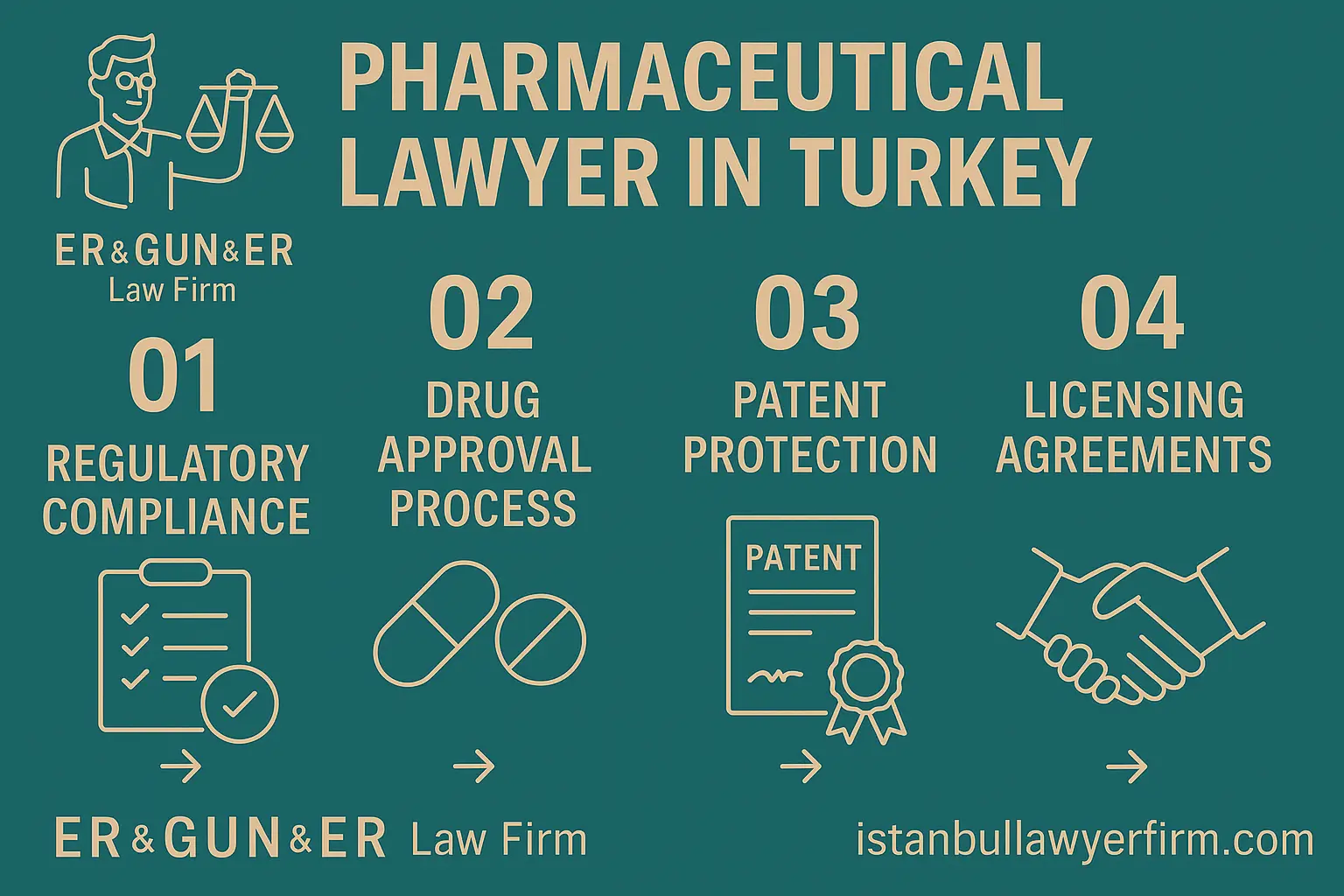
Pharmaceutical legal representation in Turkey is not a single practice area — it is a concurrent management of regulatory proceedings at TİTCK (Turkish Medicines and Medical Devices Agency), compliance monitoring under GMP and pharmacovigilance frameworks, contractual risk allocation across distribution and manufacturing arrangements, IP enforcement in coordination with TÜRKPATENT, and dispute resolution before administrative courts, the Advertising Board, and commercial courts. A decision made at the marketing authorization dossier stage — for example, the labeling claims approved — determines what promotional activity is permitted, which in turn determines the scope of advertising compliance risk, which in turn affects the evidence available in any later unfair competition dispute with a competitor. Companies that manage these layers separately rather than as an integrated legal program create gaps that regulators and adversaries exploit. For a comprehensive explanation of the Turkish pharmaceutical regulatory framework, see our guide on pharmaceutical law Turkey. This page sets out how we work across the main pharmaceutical law representation categories.
Marketing authorization and TİTCK licensing
A lawyer in Turkey advising on marketing authorization must explain that the Turkish dossier submission process requires CTD-format documentation that must satisfy TİTCK's technical assessment requirements and the legal requirements for the completeness of the application — and that procedural deficiencies in the legal or administrative sections of the dossier (incorrect applicant details, missing power of attorney from the foreign manufacturer, incomplete translation of source documents) can cause the application to be suspended for correction while the substantive review clock is paused, adding months to the authorization timeline without any change in the substantive assessment. We review the complete dossier — including all legal and administrative documentation — before submission to identify and correct procedural gaps that would delay the process. For new chemical entities and biosimilars, we coordinate the legal review with the regulatory consultant's scientific review, because the classification of the product (new chemical entity, generic, hybrid, biosimilar) determines the applicable assessment pathway, the data exclusivity protections available to the originator, and the requirements the generic applicant must satisfy. Practice may vary by authority and year — verify current TİTCK dossier requirements, applicable assessment pathway criteria, and data exclusivity periods for the relevant product category before structuring any marketing authorization application strategy.
An Istanbul Law Firm advising on TİTCK refusals and appeals must explain that when TİTCK issues a deficiency letter or a preliminary refusal, the applicant has a defined response window — and the quality of the response, particularly the legal argumentation challenging any disputed assessment conclusions, can be the difference between a favorable reassessment and a formal refusal that requires a full appeal. We prepare refusal responses that specifically address each deficiency point identified by TİTCK, distinguish between substantive and procedural grounds for the refusal, and where the refusal raises regulatory interpretation questions, present the applicable regulatory guidance and precedent supporting the applicant's position. Where a formal refusal is issued, we prepare the administrative court appeal, coordinating expert scientific opinions on the disputed technical questions with the legal challenge to TİTCK's procedural compliance. Practice may vary — verify current TİTCK deficiency response deadlines and the applicable administrative court appeal procedures before planning the response strategy for any specific refusal.
GMP compliance and inspection defense
A law firm in Istanbul advising on GMP inspection defense must explain that a TİTCK GMP inspection that identifies critical or major non-conformities triggers a formal corrective action and preventive action (CAPA) requirement — and the company's response to the inspection findings must be both technically credible and legally structured to avoid the findings being treated as an admission in any subsequent administrative or criminal proceeding. The distinction between a "critical" non-conformity (which can result in immediate license suspension or import ban) and a "major" non-conformity (which triggers a corrective action requirement without immediate suspension) depends on TİTCK's classification of the finding, and that classification can be challenged on legal grounds where the factual basis for the "critical" designation is disputed. We review the inspection report before the company prepares its CAPA response, assess whether any findings are legally challengeable, and structure the response to address the substance of each finding while preserving the company's procedural position. Practice may vary by authority and year — verify current TİTCK GMP inspection classification criteria and the specific CAPA response timelines required for critical versus major non-conformities before finalizing any inspection response.
An English speaking lawyer in Turkey advising on multi-site compliance programs must explain that for international pharmaceutical manufacturers with multiple production sites supplying Turkey, the GMP compliance program must address both TİTCK's inspection requirements for each site and the cross-site documentation consistency requirements — because TİTCK may conduct simultaneous reviews of multiple sites in connection with a single marketing authorization, and inconsistencies in quality documentation between sites can generate findings that affect the authorization across all sites. We advise on the structuring of quality agreements between manufacturing sites, the allocation of GMP responsibility between the marketing authorization holder and contract manufacturers, and the legal liability framework for product defects arising from manufacturing non-conformities at each site. Practice may vary — verify current TİTCK multi-site GMP inspection procedures and the specific quality agreement requirements for contract manufacturing arrangements before finalizing any cross-site quality program.
Clinical trial regulatory compliance
A Turkish Law Firm advising on clinical trial authorization must explain that clinical trials in Turkey require simultaneous approval from both the relevant Ethics Committee and TİTCK — and the two applications, while submitted to different bodies, must be consistent in their content because discrepancies between the ethics committee application and the TİTCK application create regulatory risk during the review process. The legal documentation requirements for Turkish clinical trial applications include: a valid Investigator's Brochure (IB) or equivalent background documentation; a protocol and protocol synopsis compliant with TİTCK's format requirements; informed consent forms and subject information sheets that meet both the legal requirements under the Regulation on Clinical Research and the ethical standards of the reviewing committee; insurance documentation covering trial-related liability for each Turkish investigator site; and — for international sponsors without a Turkish establishment — a local Clinical Trial Sponsor Representative authorization. Practice may vary by authority and year — verify current TİTCK clinical trial application requirements and Ethics Committee submission procedures before beginning any Turkish clinical trial application.
A lawyer in Turkey advising on Clinical Trial Agreements (CTAs) must explain that the CTA between the international sponsor and the Turkish investigator site is a legally complex document that must address: data ownership and publication rights (including the sponsor's right to control publication timing without infringing the investigator's academic freedom rights); IP assignment for any inventions arising from the trial; serious adverse event reporting obligations and the timeline alignment between Turkish regulatory requirements and the sponsor's global SAE reporting system; subject compensation and insurance coverage; and termination rights. Turkish courts have applied the general contract law framework to CTAs in enforcement disputes, but CTAs also intersect with the mandatory regulatory requirements under the Regulation on Clinical Research, which limits the parties' ability to contractually modify certain obligations — particularly those relating to informed consent and subject protection. Practice may vary — verify current Turkish mandatory requirements applicable to CTA content and the specific Turkish regulatory reporting timelines for SAE notifications before finalizing any CTA for a Turkish clinical trial.
Pharmaceutical advertising and promotional compliance
An Istanbul Law Firm advising on pharmaceutical advertising compliance must explain that the Turkish regulatory framework for pharmaceutical promotion is one of the most restrictive in the region — distinguishing sharply between promotion to healthcare professionals (which is permitted subject to content limitations) and promotion to consumers (which is prohibited for prescription medicines and severely restricted for OTC products). The Regulation on Promotional Activities of Medicinal Products for Human Use defines what constitutes "promotional activity," which is broader than most international companies expect: it includes congress sponsorships, speaker fees, company-sponsored symposia, hospitality at medical meetings, and any communication designed to encourage prescription or use of a specific product. A company that believes its healthcare professional engagement activities fall outside the "promotional" category because they are framed as "medical education" should verify that framing with Turkish legal counsel — because TİTCK and the Advertising Board assess the promotional character of an activity based on its overall design and effect, not just its stated purpose. Practice may vary — verify current TİTCK promotional activity definitions and Advertising Board enforcement criteria for the specific activity type before commencing any healthcare professional engagement program in Turkey.
A law firm in Istanbul advising on advertising compliance investigations must explain that when TİTCK or the Advertising Board initiates an investigation into a pharmaceutical company's promotional activities, the company's response must be submitted within the response deadline specified in the investigation notice — typically a short period — and must specifically address each allegation with reference to the applicable regulatory provisions and the factual evidence supporting compliance. A generic response that acknowledges the investigation without engaging specifically with each allegation is unlikely to produce a favorable outcome. We prepare investigation responses that systematically address each allegation, identify the regulatory provisions under which the activity was conducted, and present the documentary evidence of compliance (approval records, training logs, compliance certificates) in an organized form. Where a violation has occurred, we also advise on the settlement mechanisms available to reduce the administrative sanction and on the structural changes required to prevent recurrence. Practice may vary by authority and year — verify current Advertising Board investigation response procedures and sanction settlement options before responding to any pharmaceutical promotional activity investigation.
Patent and market exclusivity enforcement
An English speaking lawyer in Turkey advising on pharmaceutical patent enforcement must explain that originator pharmaceutical companies have two parallel protection mechanisms in Turkey — patent protection under the Industrial Property Code (SMK, Law No. 6769) and data exclusivity protection under the pharmaceutical regulations, which prevents generic applicants from relying on the originator's clinical data for a defined period after the originator's marketing authorization. These mechanisms are complementary but distinct: a patent can be challenged through an invalidity action at TÜRKPATENT or through a court proceeding, while data exclusivity is enforced through TİTCK's assessment process for generic applications. An originator that becomes aware that a generic company has filed a marketing authorization application that may rely on its protected clinical data should assess both the data exclusivity protection available and the patent coverage of the product — because a generic launch strategy that is blocked by data exclusivity can also be challenged on patent grounds, and vice versa. Practice may vary by authority and year — verify current Turkish data exclusivity periods for new chemical entities and the specific patent linkage mechanisms available through TİTCK's generic assessment process before developing any originator defense strategy.
A Turkish Law Firm advising on parallel import enforcement must explain that unauthorized parallel imports of pharmaceutical products — where a product licensed in another country is imported into Turkey outside the official distribution channel — can be challenged through trademark enforcement (if the parallel importer repackages the product in a way that affects the trademark) and through marketing authorization enforcement (since a product imported outside the licensed supply chain may not have been stored in conditions that preserve its quality). We advise originators on establishing the evidentiary basis for both types of challenge and coordinate customs recordal applications at Turkish Customs with the trademark enforcement strategy. The intellectual property law Turkey framework — covering trademark enforcement and parallel import legal mechanisms — is analyzed in the resource on intellectual property law Turkey. Practice may vary — verify current Turkish court approaches to pharmaceutical parallel import enforcement and the specific customs recordal procedures before implementing any parallel import control strategy.
Distribution agreements and supply chain disputes
A lawyer in Turkey advising on pharmaceutical distribution agreements must explain that the legal structure of the distribution arrangement — whether the distributor is an exclusive importer-distributor, a non-exclusive reseller, or a commissioned agent — determines both the regulatory obligations that attach to the distributor (since certain TİTCK filings must be made by the Marketing Authorization Holder or its local representative, not by an independent distributor) and the commercial law protections the distributor can claim if the relationship is terminated. A Turkish exclusive distributor who has invested significantly in regulatory affairs support — obtaining pharmacovigilance certifications, maintaining TİTCK correspondence, and building a local sales force — may be able to assert portfolio compensation claims analogous to those available to commercial agents under TTK Article 122 if the distribution is terminated without just cause, even though the relationship is characterized as distribution rather than agency. We structure distribution agreements with termination provisions, performance benchmarks, and regulatory affairs scope definitions that minimize this exposure while protecting the foreign manufacturer's flexibility to restructure its Turkish distribution strategy. Practice may vary — verify current Turkish court interpretations of portfolio compensation claims in pharmaceutical distribution termination disputes before structuring any Turkish exclusivity arrangement.
A best lawyer in Turkey managing a pharmaceutical supply chain dispute must explain that distribution disputes in the pharmaceutical sector often have regulatory dimensions that general commercial litigation counsel may not anticipate: a distributor's failure to maintain cold chain compliance, or a regulatory authority's withdrawal of TİTCK certification from a distributor, may trigger contractual termination rights that the manufacturer has — but asserting those rights without coordinating with TİTCK on supply continuity creates its own regulatory exposure. We manage pharmaceutical distribution disputes with simultaneous attention to the contractual position and the regulatory continuity requirements. The Istanbul Bar Association at istanbulbarosu.org.tr provides resources for identifying qualified practitioners. Practice may vary — check current guidance before acting on any information on this page.
Frequently Asked Questions
- Does a foreign company need a local representative to obtain marketing authorization in Turkey? Yes — foreign pharmaceutical companies without a Turkish establishment must appoint a local Marketing Authorization Holder representative (MAH temsilcisi) to interact with TİTCK and bear regulatory responsibility for the product in Turkey.
- What is the response deadline after a TİTCK deficiency letter? TİTCK specifies the response deadline in each deficiency communication. Timelines vary by assessment pathway. Practice may vary — verify the specific deadline in the notice and with TİTCK before finalizing any response.
- Can a TİTCK marketing authorization refusal be appealed? Yes — formal refusals can be challenged through administrative court proceedings. The appeal must address both the substantive grounds for the refusal and any procedural compliance issues with TİTCK's assessment process.
- What happens during a TİTCK GMP inspection that identifies critical non-conformities? Critical non-conformities can trigger immediate license suspension or import ban pending corrective action. A CAPA response must be submitted within the period specified by TİTCK. The legal characterization of findings as "critical" versus "major" can be challenged where the factual basis is disputed.
- Are pharmaceutical advertising rules different from general advertising rules in Turkey? Yes — pharmaceutical promotion is governed by the specific Regulation on Promotional Activities, which is significantly more restrictive than general advertising law. Promotion of prescription medicines to consumers is prohibited. Healthcare professional engagement activities (congresses, speaker fees, hospitality) are subject to specific content and value limitations.
- What is data exclusivity and how is it enforced in Turkey? Data exclusivity prevents generic marketing authorization applicants from relying on the originator's clinical trial data for a defined period after the originator's authorization. It is enforced through TİTCK's generic assessment process. The protection period varies by product category. Practice may vary — verify current exclusivity periods applicable to your product.
- Can a clinical trial in Turkey be initiated without TİTCK approval? No — both TİTCK approval and Ethics Committee approval are required before a clinical trial can commence. Initiating a trial without both approvals is a serious regulatory violation.
- What documents are required from an international sponsor for a Turkish clinical trial? The sponsor's regulatory documents, Investigator's Brochure, trial protocol, informed consent forms, insurance documentation covering Turkish sites, and — if the sponsor has no Turkish establishment — a local Clinical Trial Sponsor Representative authorization. Practice may vary — verify current TİTCK format requirements before submission.
- How should pharmaceutical companies respond to Advertising Board investigations? Within the response deadline specified in the investigation notice, with a specific written response addressing each allegation, the applicable regulatory provisions, and the documentary evidence of compliance. Generic responses that do not engage with specific allegations are unlikely to produce favorable outcomes.
- Can you represent both the originator and the generic company in Turkey? We represent each client individually. Each mandate is assessed for conflicts before acceptance — we do not represent adverse parties in the same dispute.
Author: Mirkan Topcu is an attorney registered with the Istanbul Bar Association (Istanbul 1st Bar), Bar Registration No: 67874. His practice focuses on cross-border and high-stakes matters where evidence discipline, procedural accuracy, and risk control are decisive.
He advises pharmaceutical companies, medical device manufacturers, and health investors across Pharmaceutical Regulatory Law, Clinical Trial Compliance, Intellectual Property, and commercial dispute matters where regulatory precision and market access are decisive.
Education: Istanbul University Faculty of Law (2018); Galatasaray University, LL.M. (2022). LinkedIn: Profile. Istanbul Bar Association: Official website.